
Burly.Thurr
Shared posts
14 Jun 20:49
Russia Hits Back at U.S. Over Syria
Burly.ThurrArming the rebels. I'm having a hard time forming a coherent opinion about this.
The Kremlin said evidence of Syrian leader al-Assad's alleged use of chemical weapons was unconvincing, and criticized Washington's decision to arm opposition fighters.
13 Jun 18:15
"Whatever you now find weird, ugly, uncomfortable and nasty about a new medium will surely become its..."
Burly.ThurrI was just rocking out to Strange Overtones so I had to reshare this interesting quote. Brian Eno was a hipster before it was cool.
““Whatever you now find weird, ugly, uncomfortable and nasty about a new medium will surely become its signature. CD distortion, the jitteriness of digital video, the crap sound of 8-bit - all of these will be cherished and emulated as soon as they can be avoided. It’s the sound of failure: so much modern art is the sound of things going out of control, of a medium pushing to its limits and breaking apart. The distorted guitar sound is the sound of something too loud for the medium supposed to carry it. The blues singer with the cracked voice is the sound of an emotional cry too powerful for the throat that releases it. The excitement of grainy film, of bleached-out black and white, is the excitement of witnessing events too momentous for the medium assigned to record them.””
-
-
Brian Eno (1995)
this man is a damn genius and he said this in 1995. he predicted the future accurately.
(via weformlikevoltron)
13 Jun 18:13
nineteeneighties: Depeche Mode - Everything Counts [WWF Club...
Burly.ThurrDepeche Mode is at the MN State Fair this year. Only crappy seats are left (for $60!). I checked.


13 Jun 18:12
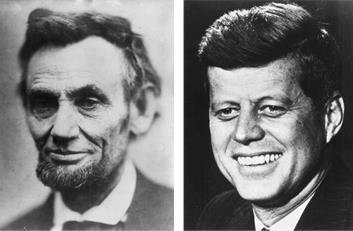
odesea: primarie: Have a history teacher explain this if they...
Burly.ThurrThis is dumb. It should say he was _in_ Marilyn Monroe.
Have a history teacher explain this if they can.
Abraham Lincoln was elected to Congress in 1846.
John F. Kennedy was elected to Congress in 1946.
Abraham Lincoln was elected President in 1860.
John F. Kennedy was elected President in 1960.
Both were particularly concerned with civil rights.
Both wives lost a child while living in the White House.
Both Presidents were shot on a Friday.
Both Presidents were shot in the head.
Now it gets really weird.
Lincoln’s secretary was named Kennedy.
Kennedy’s Secretary was named Lincoln.
Both were assassinated by Southerners.
Both were succeeded by Southerners named Johnson.
Andrew Johnson, who succeeded Lincoln, was born in 1808.
Lyndon Johnson, who succeeded Kennedy, was born in 1908.
John Wilkes Booth, who assassinated Lincoln, was born in 1839.
Lee Harvey Oswald, who assassinated Kennedy, was born in 1939.
Both assassins were known by their three names.
Both names are composed of fifteen letters.
Now hang on to your seat.
Lincoln was shot at the theater named “Ford.”
Kennedy was shot in a car called “Lincoln” made by “Ford.”
Booth and Oswald were assassinated before their trials.
And here’s the “kicker”:
A week before Lincoln was shot, he was in Monroe, Maryland.
A week before Kennedy was shot, he was with Marilyn Monroe.
AND……………….:
Lincoln was shot in a theater and the assassin ran to a warehouse…
Kennedy was shot from a warehouse and the assassin ran to a theater…
I saw this had to share just in case anyone did not know.I WILL NEVER CEASE TO REBLOG THIS
mind fuck
12 Jun 16:15

Get a Free Vehicle History Report Before You Buy a Car
by Melanie Pinola
Burly.ThurrI'm not in the market for a car right now, but I like little backdoor methods like this. Might try searching my own VINs just to see what's out there.
In our ceaseless quest to provide you with the most helpful tips and tricks in the known universe, we frequently refresh old stories with more accurate information. Nothing lasts forever, after all, and life hacks are no exception.
Adam and -1 others like this
11 Jun 14:47

I love the Hillary Clinton Twitter bio but I wish she would have...
Burly.ThurrNo comment needed.
I love the Hillary Clinton Twitter bio but I wish she would have lead off with “pantsuit aficionado.”
10 Jun 20:59

Nothing to hide
by Nathan Yau
Burly.Thurr@Bflindsley. Some fair counterpoints, here.
With all the stuff going on with surveillance and data privacy — especially the past week — it's worthwhile to revisit this essay by Daniel J. Solove, a professor of law at George Washington University, on why privacy matters even if you "have nothing to hide."
"My life's an open book," people might say. "I've got nothing to hide." But now the government has large dossiers of everyone's activities, interests, reading habits, finances, and health. What if the government leaks the information to the public? What if the government mistakenly determines that based on your pattern of activities, you're likely to engage in a criminal act? What if it denies you the right to fly? What if the government thinks your financial transactions look odd—even if you've done nothing wrong—and freezes your accounts? What if the government doesn't protect your information with adequate security, and an identity thief obtains it and uses it to defraud you? Even if you have nothing to hide, the government can cause you a lot of harm.
"But the government doesn't want to hurt me," some might argue. In many cases, that's true, but the government can also harm people inadvertently, due to errors or carelessness.
You might not have anything to hide right now, but maybe a random string of choices that was completely harmless looks a lot like something else a few years from now, to someone sniffing around the archives. The patterns when there are no patterns sort of thing. Personal data without the person. [via @hmason]
10 Jun 17:59

Rise of craft beer
by Nathan Yau
Burly.Thurr@CCK Saw this tweeted this morning but was too lazy to track down on Reader. Thanks for sharing!
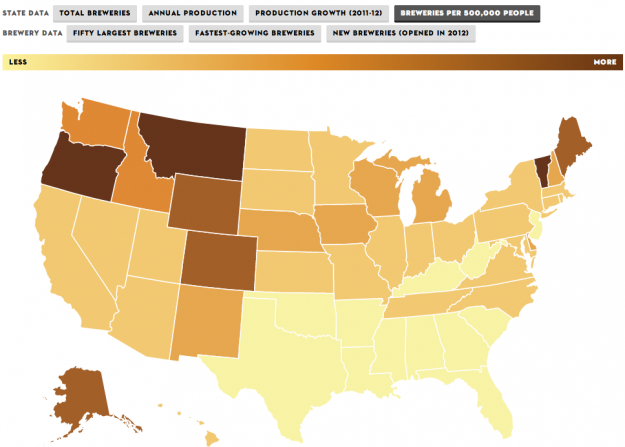
The Brewers Association just released data for 2012 on craft beer production and growth. The New Yorker mapped the data in a straightforward interactive.
As of March, the United States was home to nearly two thousand four hundred craft breweries, the small producers best known for India pale ales and other decidedly non-Budweiser-esque beers. What's more, they are rapidly colonizing what one might call the craft-beer frontier: the South, the Southwest, and, really, almost any part of the country that isn't the West or the Northeast.
Most articles and lists on craft beer tend to focus on total production and breweries, so California, a big state with a lot of people, always ends up on top. And as a Californian, I'm more than happy with my access to all the fine brews around here, but clearly, there are many more states to visit. RV trip anyone? [via @kennethfield]
07 Jun 12:46
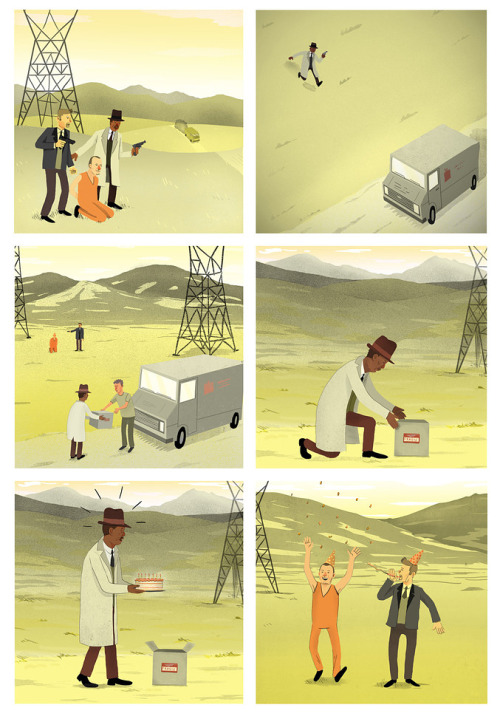
Alternative ending
Burly.ThurrThe heart of humor is the element of surprise.
Yarrgk and -1 others like this
06 Jun 17:36

Mark this news, America. It is yet another wake-up call.


Wake Up, America: You're Letting Your Privacy Slip Away
by Conor Friedersdorf
Robert Scoble / Flickr
Mark this news, America. It is yet another wake-up call.
"The National Security Agency is currently collecting the telephone records of millions of US customers of Verizon, one of America's largest telecoms providers, under a top secret court order issued in April," Glenn Greenwald reports. "The order, a copy of which has been obtained by the Guardian, requires Verizon on an 'ongoing, daily basis' to give the NSA information on all telephone calls in its systems, both within the US and between the US and other countries." Just as disturbing is the fact that we don't even know if AT&T and other major telecommunications companies have received similar secret orders.
Says the Electronic Frontier Foundation:
Says the Electronic Frontier Foundation:
There is no indication that this order to Verizon was unique or novel. It is very likely that business records orders like this exist for every major American telecommunication company, meaning that, if you make calls in the United States, the NSA has those records. And this has been going on for at least 7 years, and probably longer. This type of untargeted, wholly domestic surveillance is exactly what EFF, and others have been suing about for years.How is this legal?
There is, in fact, debate about whether it is legal, but The New York Times explains the government's theory:
That's the most pressing question. The civic negligence required to reach this point is the thing that most disappoints me about my fellow citizens, who ought to throw out every last member of Congress complicit in the metastasizing surveillance state. I am serious. Look up your representative. In a letter or phone call, demand they take a stand against this, on penalty of you voting against them in a primary or general.
That's how change happens when the president who promised it turns out to have lied.
We don't know if the federal government has a similar order for AT&T or any other carrier. Or if they're spying on Americans' emails as well. Why? That isn't the sort of thing President Obama thinks he needs to tell us, and Congress persists in giving him that latitude. Americans, who haven't been objecting to any of this in large numbers, aren't even demanding to know whether or not their government is assembling the most sophisticated surveillance state in human history.
Has fear of terrorism done this to us?
Apathy?
Denial?
Whatever the cause, the current behavior of the American electorate does not befit a free people.
The Supreme Court, the one branch of government not accountable to the people, hasn't been helpful either, though there is a passage from a Sonia Sotomayor concurrence that merits wider attention:
Is he right?
The order was sought by the Federal Bureau of Investigation under a section of the Foreign Intelligence Surveillance Act, the 1978 law that regulates domestic surveillance for national security purposes, including "tangible things" like a business's customer records. The provision was expanded by Section 215 of the Patriot Act, which Congress enacted after the 9/11 terrorist attacks.How is it tolerated by the American people?
That's the most pressing question. The civic negligence required to reach this point is the thing that most disappoints me about my fellow citizens, who ought to throw out every last member of Congress complicit in the metastasizing surveillance state. I am serious. Look up your representative. In a letter or phone call, demand they take a stand against this, on penalty of you voting against them in a primary or general.
That's how change happens when the president who promised it turns out to have lied.
We don't know if the federal government has a similar order for AT&T or any other carrier. Or if they're spying on Americans' emails as well. Why? That isn't the sort of thing President Obama thinks he needs to tell us, and Congress persists in giving him that latitude. Americans, who haven't been objecting to any of this in large numbers, aren't even demanding to know whether or not their government is assembling the most sophisticated surveillance state in human history.
Has fear of terrorism done this to us?
Apathy?
Denial?
Whatever the cause, the current behavior of the American electorate does not befit a free people.
The Supreme Court, the one branch of government not accountable to the people, hasn't been helpful either, though there is a passage from a Sonia Sotomayor concurrence that merits wider attention:
...it may be necessary to reconsider the premise that an individual has no reasonable expectation of privacy in information voluntarily disclosed to third parties. This approach is ill suited to the digital age, in which people reveal a great deal of information about themselves to third parties in the course of carrying out mundane tasks. People disclose the phone numbers that they dial or text to their cellular providers; the URLs that they visit and the e-mail addresses with which they correspond to their Internet service providers; and the books, groceries, and medications they purchase to online retailers. Perhaps, as JUSTICE ALITO notes, some people may find the "tradeoff" of privacy for convenience "worthwhile," or come to accept this "diminution of privacy" as "inevitable," and perhaps not.A change in jurisprudence is years away from happening, if it ever happens. The surveillance state as now constituted could be reined in quickly if only the American people demanded it. Wake up! Senator Mark Udall says that this is the kind of surveillance Americans will find shocking.
I for one doubt that people would accept without complaint the warrantless disclosure to the Government of a list of every Web site they had visited in the last week, or month, or year. But whatever the societal expectations, they can attain constitutionally protected status only if our Fourth Amendment jurisprudence ceases to treat secrecy as a prerequisite for privacy. I would not assume that all information voluntarily disclosed to some member of the public for a limited purpose is, for that reason alone, disentitled to Fourth Amendment protection.
Is he right?
    
|
05 Jun 18:38
youmightfindyourself: Mickey Mouse in Vietnam is a 16mm...
Burly.ThurrA complement to the ongoing subtext of war, killing, and state intervention.
Mickey Mouse in Vietnam is a 16mm underground short movie. The director was Lee Savage, the producer and head designer was Milton Glaser. It features the Disney character Mickey Mouse being shipped to Vietnam during the war. Moments after arriving, he is shot dead. It was produced independently in 1969 and has a total running time of one minute. This film was lost for many years until April 22, 2013 when a YouTube user uploaded the video.
05 Jun 18:36
Word on the Street
Burly.Thurr"Post Joy Thrills"
Why don't we have more post modern public art urban decay in the Twin Cities?


29 May 15:11
Invasion! 10 years later... from Apr 8, 2013
Burly.ThurrFollow-up to the Iraq Anniversary and War Diaries. This podcast is where I learned about the exhibit. It's an interesting episode, but I know how much you all loathe podcasts.
- "Too Much Information" [0:00:00]
- "Lt. Timothy McLaughlin" [0:27:57]
- "Lt. Timothy McLaughlin" [0:30:28]
- "Tim McLaughlin’s American flag used to cover a statue of Saddam Hussein in Baghdad, 2003." [(Photo: Jerome Delay/Associated Press)] [0:36:49]
- "Invasion: Diaries and Memories of War in Iraq by Peter Maass" [0:48:12] https://www.wfmu.org/playlists/shows/50160
- "Lt. Timothy McLaughlin" [0:27:57]
- "Lt. Timothy McLaughlin" [0:30:28]
- "Tim McLaughlin’s American flag used to cover a statue of Saddam Hussein in Baghdad, 2003." [(Photo: Jerome Delay/Associated Press)] [0:36:49]
- "Invasion: Diaries and Memories of War in Iraq by Peter Maass" [0:48:12] https://www.wfmu.org/playlists/shows/50160
29 May 14:32
The Ghost of Iraq - By John Norris
by JOHN NORRIS
Burly.ThurrSharing in order to post this: http://wardiaries.org/diary/
A diary and journal displayed in NYC as part of an exhibit marking a 10th anniversary of the war in Iraq.
How the last war is haunting the Syria debate.
29 May 14:25


Great ad campaign by PBS but I’m pretty sure they just...
Burly.ThurrSolid PBS marketing from NY.
Great ad campaign by PBS but I’m pretty sure they just created all the new fall programming for TLC.
NY PBS Creates Ads With Fake Reality Shows | EW
28 May 03:00
youmightfindyourself: The Act of Killing is a film about...
Burly.ThurrSharing for the link to the review. The trailer doesn't do it justice. My opinion of Werner Herzog is woefully underdeveloped. Perhaps this film would help (though he's not the primary force behind it.)
The Act of Killing is a film about genocide. And it is so surreal, and so disconcerting that one actually searches for reassurance that it’s okay to watch, okay to have watched. Deeply respected documentarians Errol Morris and Werner Herzog are credited as executive producers, one notes. The film has played established festivals. It’s been authorized. And yet its audience was desperate to exit the theater, and with good reason. This is a film about men who did unspeakable things, and who claim to be at peace with what they’ve done, though we aren’t sure we believe them. Perhaps it is fitting, then, that the film itself is so difficult to grapple with. Or maybe even saying that is an oversimplification: an attempt, in retrospect, to tidy things up with words.
23 May 12:58
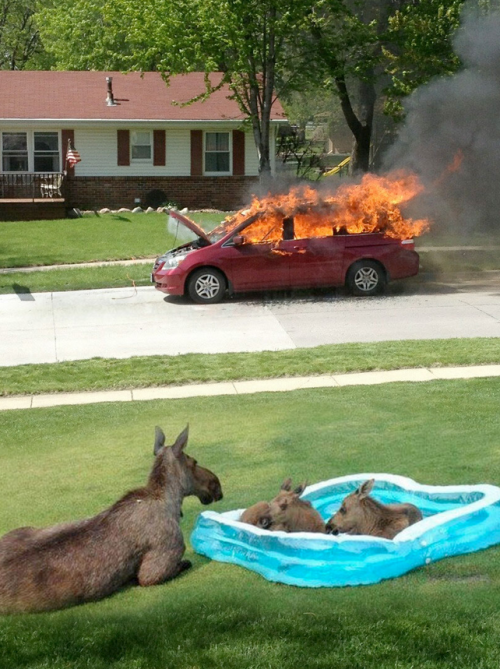
chrismohney: It’s going to be a beautiful day out there folks!
Burly.ThurrMore arousing senselessness from teh interwebz.
23 May 12:53
muffpunch: Someone on reddit made a Hilary pantsuit...
Burly.ThurrI'm sorry guys. I can't help myself from sharing sometimes.

22 May 19:44


neoteotihuacan: A few months back, a small twitter hashtag got...
A few months back, a small twitter hashtag got kind of crazy - #overlyhonestmethods
Its a hashtag full of scientists admitting shortcuts in research, along with the daily face palms and annoyances of a scientific lifestyle. Science is hard, yo.
I decided to steal some of the more popular tweets from the trending hashtag along with some random images of scientists from Google image search and combine them. This is the result. it works, I think.
The full album can be found here: http://imgur.com/a/x77kL
22 May 18:01

larhunter: Salted caramel peanut butter. Vanilla bean espresso...
Burly.ThurrI have to admit these look amazing.
Salted caramel peanut butter. Vanilla bean espresso peanut butter. White chocolate pretzel peanut butter.
29 Apr 00:21
(via Watch: Graphics FX Montage from Kosinski’s...
Burly.ThurrThere are still moments throughout the day that I've thought about this movie from last night. This montage isn't that interesting, but seeing it out of context does look pretty cool.
26 Apr 17:43
The Death That Saved My Life
by zocalo
I was 28, a professional living in Palo Alto, six months into my marriage, when I suffered a stroke in my sleep.
It was a surprise. I’d been a college athlete and marathoner.
The diagnosis was idiopathic dilated cardiomyopathy. To translate to English: heart failure. The doctors didn’t know why, but my heart’s ability to pump blood was so diminished that I needed a new heart. The doctors weren’t sure when I would need the transplant; it could be eight years or eight months.
I was admitted to Stanford University Medical Center, and my condition continued a rapid decline. In a matter of weeks, I lost nearly half my body weight, my lips turned blue, and my skin took on a yellowish hue. I was dying.
The doctors listed me for a transplant, and the wait began. Would I get a heart in time? As I passed in and out of consciousness, I heard stories about people on my floor who were also waiting for hearts. Several died. I prayed for a new heart. I envisioned running another marathon. I pictured camping with my wife, Kendall, in the Sierras. I even prayed for rainy nights, which would increase the possibility of accidents and donors.
Shortly after 1 a.m. on May 2, 2001—eight weeks after my diagnosis—a doctor opened the door of my hospital room. He was short and wore a surgical cap.
“We have a heart for you; do you want it?”
I asked if my friend, Dr. Marc Pelletier, would perform the surgery. The doctor, standing in my doorway, raised his eyebrows, glanced at the many beeping machines keeping me alive, and smiled. He nodded yes.
In the course of our brief exchange, it hit me. I was getting the gift of a lifetime. With tears in my eyes, I said I wanted the heart.
I punched the numbers on the phone next to my bed. My voiced cracked as I told my wife they had found a heart for me. In minutes, she was sitting next to my bed.
I had to wait until morning for the surgery. During those seven hours, I was at once terrified that I might not survive the surgery, hopeful that I might regain my life, and grateful that I was being given this incredible gift.
And sad, deeply so, because I knew my chance at life meant that someone had died.
Across the Bay, two parents were having a very different night. Their eldest son, Tommy, had been killed in a car accident. I later learned that he was a much-loved 19-year-old youth minister. His first priority was helping others, yet God had chosen to cut his life dramatically short.
On the worst night of their lives, Tommy’s parents thought of people in need, people they had never met, people who desperately needed Tommy’s organs. On May 2, Tommy saved six lives, including mine.
I awoke from the transplant with an overwhelming, almost crushing sense of guilt. My prayers for a “rainy night” had gone answered. I spent entire days in tears. I met with psychiatrists and priests, but nothing assuaged my overwhelming survivor’s guilt. At the very least, I wanted desperately to thank the family that had saved my life.
To prevent additional emotional anguish, Stanford closely monitors communication between recipients and donor families. When I wrote a letter of thanks, I gave it to an intermediary, a social worker, who in turn passed it on to the donor family. For the next nine years, I sent them a letter of thanks every May 2. I realized that the family might not want to hear from me, but writing the letters brought me some small solace.
Nearly 10 years after the transplant, I received an unexpected letter from my donor’s father. We corresponded with some regularity over the next few months, and, in mid-May 2011, I met Tommy’s dad in a pizzeria. Tom Sr. was a tall, muscular man. His eyes welled up when I walked in holding my 2-year-old son, Lane. My wife held our 6-year-old daughter, Carlie, by the hand. I put Lane down and gave Tom an awkward hug. It wasn’t long before Lane was sitting on his lap.
That day, I was able to say thank you in person. I told Tom Sr. I’d been practicing for this moment for the past 10 years.
A year later, I met Tommy’s mother. I hugged her for nearly 10 seconds. When she talked about her son, she smiled and wiped her eyes.
You know that feeling you get when you see someone in a military uniform and you have an overwhelming desire to say thank you? But you know that saying those two measly words isn’t nearly enough? That’s what saying thank you to Tommy’s parents was like.
I could never tell them how much their selfless act has meant to me. But it was a start.
23 Apr 18:31
The Human Zoo
by Freakonomics
Burly.ThurrI need to remember to feed this into my playlist.
If you’re a fan of behavioral economics on the radio, check out BBC Radio 4′s new weekly program The Human Zoo. It is hosted by Michael Blastland, a journalist, and Nick Chater, professor of behavioral science at the University of Warwick. Chater is also on the advisory board of the British Government’s Behavioral Insights Team (or “Nudge Unit”), which you heard about in the Freakonomics podcast “The Tax Man Nudgeth.” Human Zoo episodes are accompanied by online experiments.
16 Apr 12:53

Real to Reel: History at the Movies
by Eric@BackStory
Burly.Thurr@Bryan - I just started listening to this podcast this morning. It turns out there's a part about the differences between Django and Lincoln. Haven't gotten there yet, but I thought you'd like to know, RE: our conversation last friday.

A scene from “Titanic,” winner of Best Picture in 1997.
Six of this year’s nine nominees for Best Picture at the Oscars are films based in history. That may seem like a lot, but for the past 40 years, the majority of Best Picture winners have had an historical bent. On this episode we ask what makes history such a popular subject for American filmmakers.
From the early days of film — when people thought movies would replace textbooks in the classroom — to the Cold War — when the government and Hollywood thought they could control behavior through film — the History Guys look at the impact of history on celluloid culture, and at how movies have made and remade history. They also debate the merits of current Oscar nominees (Lincoln, Zero Dark Thirty, and Django Unchained) and consider the ways those movies reflect contemporary thinking about history.
Guests Include:
- Robert Jackson, University of Tulsa
- Todd Bennett, East Carolina University
- Mark Peterson, UC Berkeley
Show Segments:
Listen to individual segments from the show.
Further Exploration:
Resources galore! Peruse a list of outside sources used in the making of this episode, including the video of the Dixon Experimental Sound Film and Mark Peterson’s look at a third ‘terrible’ Revolutionary flick.
Staff Picks:
See some of our staff’s favorite films about history.
Music from the Episode:
A full listing of the tracks, and links to buy them yourselves.
Even Further:
The listener discussion that helped shape the show.
15 Apr 23:36
Surly closes on purchase of Minneapolis site for planned brewery
by John Vomhof Jr.
Burly.ThurrHoly effing yes!
Surly Brewing Co. closed Monday on the purchase of a Minneapolis site where it plans to build a $20 million brewery.
The 8.3-acre site is located at the northeast corner of Malcolm Avenue and Fifth Street, straddling the Minneapolis-St. Paul border near the University of Minnesota's TCF Bank Stadium. Surly first identified that parcel as its "preferred site" last September, following a lengthy real estate search led by Minneapolis-based Tegra Group.
"It took us two years to find the perfect location…


29 Mar 02:57

Thenceforward and Forever Free [Rebroadcast]
by Jamal Millner
Burly.ThurrExcellent reflections on the 150th anniversary of the Emancipation Proclamation. I love this Backstory show.

Abraham Lincoln and His Emancipation Proclamation, The Strobridge Lith. Co, 1888. Source: LOC
On January 1, 1863 – 150 years ago this week – President Lincoln issued the Emancipation Proclamation. It declared that all slaves in the rebellious states “shall be then, thenceforward, and forever free.” Today, Lincoln is remembered as “The Great Emancipator,” but the story of emancipation is complex and contradictory. And the question of how we choose to commemorate this anniversary can be touchy.
On this episode, we set out to understand the way Americans thought about emancipation in 1862, and reflect on its shifting meanings since then. Along the way, we make stops at the Emancipation Memorial in Washington D.C., the Civil War centennial commemorations in the height of the Civil Rights Era, and the former capital of the Confederacy today. And we hear the voices of former slaves themselves, remembering their first experiences of freedom.
Guests Include:
- David Blight, Professor of American History, Yale University
- Ta-Nehisi Coates, senior editor, The Atlantic
- Christy Coleman, President, American Civil War Center at Historic Tredegar
- Kirk Savage, Professor of the History of Art & Architecture, Univ. of Pittsburgh
- Michael Vorenberg, Associate Professor of History, Brown University
Further Exploration
Resources galore! Enjoy some outside links compiled by the BackStory team to create a more complete picture of the narratives surrounding emancipation, and consult a bibliography of sources used in the making of this episode.
Even Further
Read the listener discussion that helped shape this episode.
See a listing of music used in the making of this episode.
Individual segments from this episode.
29 Mar 02:56

Straight Shot: Guns in America [Rebroadcast]
by Jess
Burly.ThurrA great follow-on to the Freakonomics podcast on how to think about guns.

Infantryman training in Ft Knox, Kentucky, 1942. US Office of War Information.
In the aftermath of the shootings in Newtown, Connecticut, Americans of all political stripes are wrestling with one big question: who should, and shouldn’t, have access to guns? So in this hour of BackStory, that’s the question we’ll be pushing back through the centuries.
On this episode, the History Guys look at the changing ways Americans have regulated gun ownership, and at what those weapons have meant to different segments of society. They consider the importance of the militia to the drafting of the Second Amendment, and explore the central role of the state in arming citizens. They also pay a visit to a 21st century version of the armories of the past: a gun show.
Guests Include:
- Kevin Sweeney, Amherst College, on the role of the state in arming early Americans.
- Adam Winkler, University of California, Los Angeles, on gun control in the Wild West and the Black Panthers’ embrace of the Second Amendment.
- Laura Browder, University of Richmond, on why the image of the gun-toting frontier woman continues to resonate.
Show Segments:
Listen to individual segments from the episode.
Further Exploration:
Resources galore! Peruse a list of outside sources compiled by the BackStory team to provide a more complete picture of the history of gun ownership in America, and consult a bibliography of works used in the making of this episode.
Even Further:
Read the listener discussion that helped shape this show.
29 Mar 02:54

On Exoplanets and Love: Natalie Batalha on Science That Connects Us to One Another
Burly.ThurrThis Exoplanet show is good. But so is this one: http://www.podtrac.com/pts/redirect.mp3/download.publicradio.org/podcast/being/programs/2012/10/04/201201004_prolife_prochoice_prodialogue_128.mp3
A mission scientist with NASA's Kepler Space Telescope, Natalie Batalha hunts for exoplanets — Earth-sized planets beyond our solar system that might harbor life. She speaks about unexpected connections between things like love and dark energy, science and gratitude, and how "exploring the heavens" brings the beauty of the cosmos and the exuberance of scientific discovery closer to us all.