
Journal of the American Chemical Society
DOI: 10.1021/jacs.5c01012


Publication date: April 2025
Source: Trends in Chemistry, Volume 7, Issue 4
Author(s): Salma A. Elsherbeni, Tahir Maqbool, Md Abdul Bari, Eman M. AlQahtani, Louis C. Morrill

In February through April 1965, Hoffmann devised several MO tools to explain the regiochemistry of the Diels-Alder and the preference of the Cope reaction to proceed by the chair rather than boat orientations, when both were possible. The secret lay in secondary orbital interactions that were revealed through qualitative perturbation theory. This research led to the fourth and fifth 1965 JACS communications by Hoffmann and Woodward.
In 1965, R. B. Woodward and Roald Hoffmann published five communications in the Journal of the American Chemical Society that formed the basis for what has been known as the Woodward and Hoffmann (W−H) rules. The last two of these communications applied secondary molecular orbital interactions – that is, interactions that involved atomic orbitals removed from the primary reaction centers – to explain the so-called Alder endo-exo rule of maximum overlap of orbitals for regiochemistry in the Diels-Alder reaction and the then recently noted preference of the chair orientation over the boat orientation in the Cope reaction. This publication presents the back stories of these latter two W−H communications, based on a comprehensive examination of Hoffmann's laboratory notebooks, more than 100 hours of interviews with Hoffmann, interviews with other chemists, and documents found in both Hoffmann's and Woodward's archives.

Green chemistry assessment of an environmentally friendly microwave-assisted (MW) esterification of levulinic acid to obtain medium- and long-chain alkyl levulinates. Synthesis of biofuels and fuel additives from renewable sources in high yields (>90 mol %).
Alkyl levulinates (ALs) represent a family of bio-compounds derived from levulinic acid (LA), a platform chemical obtained from lignocellulosic biomass. Medium- and long-chain ALs (pentyl levulinate or longer) have shown potential as biofuel and fuel additives due to their relatively low oxygen content and resemblance to biodiesel. This study reports a fast and environmentally friendly method for synthesizing ALs via microwave (MW)-assisted LA esterification, laying emphasis on medium- and long-chain ALs. By combining p-toluenesulfonic acid (5 wt % loading) as catalyst and MW radiation as heating source for a short time (5 minutes), excellent yields of ALs (≥89 mol %) were achieved for a wide range of primary and secondary alcohols (2–10 carbons), overcoming the expected lower reactivity of long chain alcohols. Additionally, formation of undesired side products, such as dialkyl ethers or LA aldol condensation products, was significantly minimized. The feasibility of recovering the unreacted alcohol was successfully proved by simple distillation (88 wt % recovery). The green chemistry metrics assessment proved that this approach aligns with the green chemistry principles and the United Nations Sustainable Development Goals, offering a more sustainable pathway for biofuel and fuel additive production.

Preparation of renewable terephthalates and aromatic diisocyanates is presented using a transition metal-free route through a mild electrochemical decarboxylative aromatization on gram scale. Terephthalates were readily converted into aromatic diisocyanates in flow and used to synthesize 100 % renewable thermoplastic polyurethanes.
Aromatic diisocyanates, invaluable commodity chemicals for polymer manufacturing, are produced annually on megaton scales from petroleum-derived diamines via phosgenation. Existing routes toward renewable alternatives are sparse and limited by access to functionalized aromatic starting materials, such as terephthalates. Herein, we report the development of a robust route to renewable terephthalates and aromatic diisocyanates from D-galactose via Eastwood olefination and Diels–Alder cycloaddition, followed by a mild electrochemical decarboxylative aromatization. This process was developed and applied on gram-scale to synthesize terephthalates, which were transformed into aromatic diisocyanates via Curtius rearrangement in flow. We demonstrate gram-scale preparation of 1,4-phenylene diisocyanate and 2,5-toluene diisocyanate and formulation of these monomers to prepare fully renewable thermoplastic polyurethanes. Preparation of these renewable aromatic diisocyanates proceeds without the use of high-pressure gases or costly transition-metals and represents a novel route to fully renewable aromatic diisocyanates.


A general strategy to prepare water-stable 2-pyridyl organoboron reagents has been developed. The merger of the reagents with a neutral Suzuki–Miyaura coupling condition enables a robust and efficient 2-pyridylation reaction of aryl halides.
The stability of 2-pyridylation reagents is a long-standing issue in cross-coupling chemistry due to hydrolysis. However, as the use of pyridine-based pharmaceuticals continues to increase, there is a high demand for stable and reactive 2-pyridylation reagents. Herein, a general strategy to prepare water-stable 2-pyridylboron reagents has been developed. The application of the water-stable 2-pyridylboron reagents in a neutral Suzuki–Miyaura coupling with a halide scavenger enables an efficient 2-pyridylation reaction of aryl halides.


Nature, Published online: 13 February 2025; doi:10.1038/d41586-025-00425-4
High living costs paired with stagnant stipends are being blamed for a drop in PhD enrolments in several countries.

![Cover Feature: Sulfonatocalix[4]arene-Based Scavengers for V-Type Nerve Agents with Enhanced Detoxification Activity (Chem. Eur. J. 9/2025)](https://chemistry-europe.onlinelibrary.wiley.com/cms/asset/719d8631-0d7a-4b99-b5ff-d05ce71aae93/chem202580902-toc-0001-m.png)
Molecules that rapidly detoxify nerve agents under physiological conditions might be useful to treat nerve agent poisoning or to support existing treatment strategies. In their Research Article (DOI: 10.1002/chem.202404321), S. Kubik and co-workers show that a sulfonatocalix[4]arene derivative containing two hydroxamic acid residues deactivates highly toxic and persistent V-type nerve agents such as VX with very promising activity. Moreover, the observed increase in activity over the corresponding monosubstituted calixarene appears to be more than just a statistical effect, but also seems to involve additional beneficial effects of the two substituents. This work thus brings supramolecular small-molecule nerve agent scavengers closer to application.
Abstract
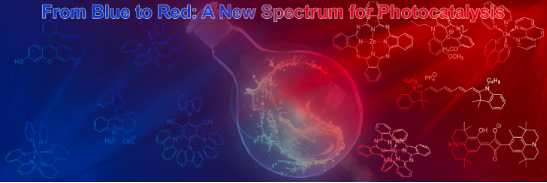
Red-light-activated photocatalysis has become a powerful approach for achieving sustainable chemical transformations, combining high efficiency with energy-saving, mild conditions. By harnessing the deeper penetration and selectivity of red and near-infrared light, this method minimizes the side reactions typical of higher-energy sources, making it particularly suited for large-scale applications. Recent advances highlight the unique advantages of both metal-based and metal-free catalysts under red-light irradiation, broadening the range of possible reactions, from selective oxidations to complex polymerizations. In biological contexts, red-light photocatalysis enables innovative applications in phototherapy and controlled drug release, exploiting its tissue penetration and low cytotoxicity. Together, these developments underscore the versatility and impact of red-light photocatalysis, positioning it as a cornerstone of green organic chemistry with significant potential in synthetic and biomedical fields.
Beilstein J. Org. Chem. 2025, 21, 296–326. doi:10.3762/bjoc.21.22

