12 Oct 14:38
Org. Biomol. Chem., 2021, 19,9476-9482
DOI: 10.1039/D1OB01807H, Paper
Zhengbao Xu, Lizhi Zhang
Methanol as a formylating agent in the C–H functionalization of N-heteroarenes.
The content of this RSS Feed (c) The Royal Society of Chemistry
12 Oct 14:36
Dalton Trans., 2021, 50,16909-16915
DOI: 10.1039/D1DT03134A, Frontier
Jeffery Wee Kiong Seah, Ronald Hong Xiang Teo, Pak-Hing Leung
A number of palladacycles containing chiral chelating auxiliaries have been utilized as efficient catalysts for asymmetric hydrophosphination reactions.
The content of this RSS Feed (c) The Royal Society of Chemistry
12 Oct 06:06
by Amreen K Bains,
Ayanangshu Biswas,
Debashis Adhikari

Abstract
Herein, we describe an isolable, air-stable, homogeneous, nickel catalyst that performs dehydrogenative cross-coupling reaction between secondary and primary alcohols to result α-alkylated ketone products selectively. The sequence of steps involve in this one-pot reaction is dehydrogenation of both alcohols, condensation between the ketone and the aldehyde, and hydrogenation of the in situ-generated α,β-unsaturated ketone. Preliminary mechanistic investigation hints a radical mechanism following borrowing hydrogen reaction.
11 Oct 13:59
by managing.editor@est.acs.org (American Chemical Society)

Environmental Science & Technology
DOI: 10.1021/acs.est.1c04943

11 Oct 13:55
Org. Chem. Front., 2021, 8,7050-7076
DOI: 10.1039/D1QO01139A, Review Article
Jinghua Wu, Zhiqiang Ma
Functionalization of olefins has been an important transformation in synthetic chemistry. This review will focus on the natural product synthesis employing the MHAT reaction as the key strategy.
The content of this RSS Feed (c) The Royal Society of Chemistry
11 Oct 13:50
by managing.editor@est.acs.org (American Chemical Society)

Environmental Science & Technology
DOI: 10.1021/acs.est.1c04094

11 Oct 13:49
by Kitae Kwon, R. Thomas Simons, Meganathan Nandakumar, and Jennifer L. Roizen

Chemical Reviews
DOI: 10.1021/acs.chemrev.1c00444
11 Oct 13:45
Green Chem., 2021, 23,8406-8427
DOI: 10.1039/D1GC03145G, Perspective
Roger Arthur Sheldon
This perspective reviews the current status and prospects of biocatalysis in ionic liquids.
The content of this RSS Feed (c) The Royal Society of Chemistry
08 Oct 05:39
by Zilu Lv, Jikun Xu, Chenyu Li, Lin Dai, Huihu Li, Yongda Zhong, and Chuanling Si

ACS Sustainable Chemistry & Engineering
DOI: 10.1021/acssuschemeng.1c05585
08 Oct 05:38
by Tao Peng, Taotao Zhuang, Yu Yan, Jin Qian, Graham R. Dick, Jean Behaghel de Bueren, Sung-Fu Hung, Yun Zhang, Ziyun Wang, Joshua Wicks, F. Pelayo Garcia de Arquer, Jehad Abed, Ning Wang, Armin Sedighian Rasouli, Geonhui Lee, Miao Wang, Daping He, Zhe Wang, Zhixiu Liang, Liang Song, Xue Wang, Bin Chen, Adnan Ozden&, Yanwei Lum, Wan Ru Leow, Mingchuan Luo, Debora Motta Meira, Alexander H. Ip, Jeremy S. Luterbacher, Wei Zhao, and Edward H. Sargent

Journal of the American Chemical Society
DOI: 10.1021/jacs.1c08348

07 Oct 11:39
by Hengbo Yin, Pengfei Yuan, Bang-An Lu, Huicong Xia, Kai Guo, Gege Yang, Gan Qu, Dongping Xue, Yongfeng Hu, Junqi Cheng, Shichun Mu, and Jia-Nan Zhang

ACS Catalysis
DOI: 10.1021/acscatal.1c02259

07 Oct 11:34
by List, Benjamin
Synlett 2021;
DOI: 10.1055/s-0037-1612268

[...]
© Georg Thieme Verlag Stuttgart · New York
Article in Thieme eJournals:
Table of contents | Abstract
07 Oct 11:29
Chem. Commun., 2021, 57,11591-11603
DOI: 10.1039/D1CC05202K, Feature Article
Xiaowen Chen, Zhimin Jia, Fei Huang, Jiangyong Diao, Hongyang Liu
The recent progress in the synthesis and catalytic application of atomically dispersed metal catalysts on nanodiamond and its derivatives is systematically summarized.
The content of this RSS Feed (c) The Royal Society of Chemistry

06 Oct 11:27
by Jeong, Dong Yeun
Synlett
DOI: 10.1055/a-1608-5633

Organic photoredox catalysts with a long excited-state lifetime have emerged as promising alternatives to transition-metal-complex photocatalysts. This paper explains the effectiveness of using long-lifetime photoredox catalysts for organic transformations, focusing on the structures and photophysics that enable long excited-state lifetimes. The electrochemical potentials of the reported organic, long-lifetime photocatalysts are compiled and compared with those of the representative Ir(III)- and Ru(II)-based catalysts. This paper closes by providing recent demonstrations of the synthetic utility of the organic catalysts.1 Introduction2 Molecular Structure and Photophysics3 Photoredox Catalysis Performance4 Catalysis Mediated by Long-Lifetime Organic Photocatalysts4.1 Photoredox Catalytic Generation of a Radical Species and its Addition to Alkenes4.2 Photoredox Catalytic Generation of a Radical Species and its Addition to Arenes4.3 Photoredox Catalytic Generation of a Radical Species and its Addition to Imines4.4 Photoredox Catalytic Generation of a Radical Species and its Addition to Substrates Having C≡X Bonds (X=C, N)4.5 Photoredox Catalytic Generation of a Radical Species and its Bond Formation with Transition Metals4.6 Miscellaneous Reactions of Radical Species Generated by Photoredox Catalysis5 Conclusions
[...]
Georg Thieme Verlag KG Rüdigerstraße 14, 70469 Stuttgart, Germany
Article in Thieme eJournals:
Table of contents | Abstract | Full text
06 Oct 11:27
by Jing Du,
Huang Ouyang,
Bien Tan

This review summarizes the synthesis of several porous organic polymers (POPs) that can be used for CO2 catalytic conversion, systematically listing the progress of heterogeneous metal-supported POPs catalysts in CO2 catalytic conversion and summarizes the current challenges in this field. Finally, the prospects of catalysts for ideal catalytic conversion of CO2 in the future is mentioned.
Abstract
To overcome the challenges of global warming and environmental pollution, it is necessary to reduce the concentration of carbon dioxide (CO2) in the atmosphere, which is mainly accumulated in the air through the burning of fossil fuels. Therefore, the development of environmentally friendly strategies to capture carbon dioxide and convert it into value-added products offers a promising way forward for reducing carbon dioxide concentration in the atmosphere. In this context, POPs (porous organic polymers) have shown great potential as CO2 selective adsorbents due to their high specific surface area, chemical stability, nanoscale porosity and structural diversity, as well as POPs based heterogeneous catalysts for CO2 conversion. This review provides a concise account of preparation methods of various POPs, challenges and current development trends of POPs in photocatalytic CO2 reduction, electrocatalytic CO2 reduction and chemical CO2 conversion.
05 Oct 09:52
ARKIVOC Volume 2021 - Part (viii): General Papers
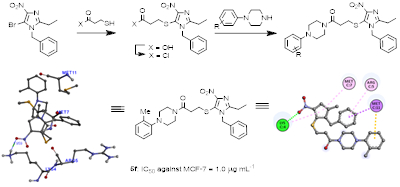
Synthesis, anticancer activity and molecular docking studies of new 4-nitroimidazole derivatives (21-11479OP)
Yaseen A. Al-Soud, Kafa A. S. Alhelal, Bahjat A. Saeed, Luay Abu-Qatouseh, Hossam H. Al-Suod, Alaa H. Al-Ahmad, Najim A. Al-Masoudi and Raed A. Al-Qawasmeh
Full Text: PDF (773K)
Supplementary Material: PDF (1,285K)
pp. 296 - 309
received Jan 24 2021; accepted Jul 8 2021; published Jul 16 2021;
04 Oct 15:08
Org. Biomol. Chem., 2021, 19,9223-9230
DOI: 10.1039/D1OB01729B, Paper
Santa Mondal, Sabina Yashmin, Abu Taleb Khan
A highly regioselective hydrothiolation reaction is developed for the synthesis of vinyl sulfides and thioethers using copper(I) iodide from 4-hydroxydithiocoumarins and arylacetylenes/styrenes.
The content of this RSS Feed (c) The Royal Society of Chemistry
04 Oct 08:41
Nature, Published online: 29 September 2021; doi:10.1038/d41586-021-02585-5
Cleaving bonds can transform the abundant material lignin into renewable feedstocks.

04 Oct 08:40
by Akash Kaithal,
Basujit Chatterjee,
Christophe Werlé,
Walter Leitner

Homogeneous catalysts based on ruthenium and manganese enable the generation of gaseous CO and H2 (syngas) from conveniently storable and easily transportable methanol. Conversion/time profiles and kinetic isotope effects together with spectroscopically detected intermediates indicate rapid dehydrogenation followed by two possible catalytic pathways via formaldehyde or methyl formate for decarbonylation as mechanistic manifold.
Abstract
The acceptorless dehydrogenation of methanol to carbon monoxide and hydrogen was investigated using homogeneous molecular complexes. Complexes of ruthenium and manganese comprising the MACHO ligand framework showed promising activities for this reaction. The molecular ruthenium complex [RuH(CO)(BH4)(HN(C2H4PPh2)2)] (Ru-MACHO-BH) achieved up to 3150 turnovers for carbon monoxide and 9230 turnovers for hydrogen formation at 150 °C reaching pressures up to 12 bar when the decomposition was carried out in a closed vessel. Control experiments affirmed that the metal complex mediates the initial fast dehydrogenation of methanol to formaldehyde and methyl formate followed by subsequent slow decarbonylation. Depending on the catalyst and reaction conditions, the CO/H2 ratio in the gas mixture thus varies over a broad range from almost pure hydrogen to the stoichiometric limit of 1:2.
04 Oct 08:35
by Wanfang Li,
Yan Zheng,
Erdong Qu,
Jin Bai,
Qinyue Deng

β-Keto amides are versatile building-blocks in organic chemistry. This Review summarized the up-to-date advancement in the synthesis and reactivities of β-keto amides and their applications for heterocycle constructions and coordination chemistry. A special focus is given to the enlightening developments under the background of transition-metal- and organocatalysis.
Abstract
β-Keto amides are a versatile class of compounds that find wide applications in organic chemistry owing to the juxtaposition of multiple reaction sites within their molecular structures. Due to the importance of β-keto amides in modern organic chemistry, numerous novel preparation methods, synthetic applications and unprecedented reactivities have been recorded over the past decade. Taking advantage of transition-metal-catalysis and organocatalysis, β-keto amides have emerged into a jack-of-all-trades building block for many stereoselective or tandemized multicomponent reactions. But so far, no reviews have been documented on these recent achievements with β-keto amides. Our Review aims to provide a thorough summary regarding: (a) the synthesis of β-keto amides, (b) the reactivities of β-keto amides, (c) the synthetic applications of β-keto amides in various important heterocyclic compounds, and (d) the coordination of β-keto amides with main group elements and transition metals and the relevant applications.
03 Oct 16:02
by Min-Jie Zhou, Lei Zhang, Guixia Liu, Chen Xu, and Zheng Huang

Journal of the American Chemical Society
DOI: 10.1021/jacs.1c05479

01 Oct 05:47
by Murugaiah A. M. Subbaiah and Nicholas A. Meanwell

Journal of Medicinal Chemistry
DOI: 10.1021/acs.jmedchem.1c01215

01 Oct 05:46
by Yangyang Shen and Tomislav Rovis

Journal of the American Chemical Society
DOI: 10.1021/jacs.1c08157

01 Oct 05:46
by Shuheng Tian, Yuchen Jiao, Zirui Gao, Yao Xu, Linke Fu, Hui Fu, Wu Zhou, Chaoquan Hu, Guosheng Liu, Meng Wang, and Ding Ma

Journal of the American Chemical Society
DOI: 10.1021/jacs.1c08159

30 Sep 12:45
Chem. Sci., 2021, 12,15445-15472
DOI: 10.1039/D1SC03810A, Perspective

Open Access
Luca Banfi, Andrea Basso, Chiara Lambruschini, Lisa Moni, Renata Riva
This perspective aims at celebrating the 100th anniversary of the discovery of the Passerini three component reaction.
The content of this RSS Feed (c) The Royal Society of Chemistry
30 Sep 06:53
Org. Biomol. Chem., 2021, 19,9291-9298
DOI: 10.1039/D1OB01714D, Paper
Yuan-Zhao Ji, Chi Zhang, Jun-Hu Wang, Hui-Jing Li, Yan-Chao Wu
Direct conversion of sulfinamides to thiosulfonates is achieved under metal-free conditions without the use of additional redox agents.
The content of this RSS Feed (c) The Royal Society of Chemistry
30 Sep 06:52
by Natalie Holmberg-Douglas and David A. Nicewicz

Chemical Reviews
DOI: 10.1021/acs.chemrev.1c00311
29 Sep 16:27
by Liam Drew
Nature, Published online: 29 September 2021; doi:10.1038/d41586-021-02624-1
The ability to develop animals that have human organs could save the lives of people waiting for transplants, but ethical issues still need to be faced.

29 Sep 06:44
by Craig S. Day, Alexander Fawcett, Ruchira Chatterjee, and John F. Hartwig

Journal of the American Chemical Society
DOI: 10.1021/jacs.1c07330

29 Sep 06:43
Nature, Published online: 28 September 2021; doi:10.1038/d41586-021-02612-5
Concrete will be crucial for much-needed climate-resilient construction. But the cement industry must set out its plan for decarbonization.


