
Organic Letters
DOI: 10.1021/acs.orglett.3c00876

Selective hydrogenation of phenol to cyclohexanol, an industrially important reaction over Pd-CuO/CeO2 showed very high efficiency under mild conditions. Palladium loading on CuO/CeO2 led to hydrogen spillover on the catalyst surface increasing the oxygen vacancies helping activation of phenol as phenoxide ion with perpendicular orientation of aromatic ring on catalyst surface as evident from FTIR studies.
Hydrogenation of phenol to cyclohexanone/cyclohexanol is an important reaction in production of nylon-6, nylon-66 and in petroleum industry. Liquid phase phenol hydrogenation over Pd-CuO/CeO2 was carried out under mild conditions. Palladium impregnated over CuO/CeO2 synthesized by co-precipitation method showed excellent catalytic activity for phenol hydrogenation (99% conversion with 80% cyclohexanol yield) at 90 °C and 10 bar H2 pressure in water. Commercial 10%Pd/C showed only 8% phenol conversion under identical conditions. The detailed characterization revealed significant improvement in surface area of ceria after addition of CuO and decrease in crystallite size with creation of defects in CeO2 lattice. XPS analysis showed Pd loading on CuO/CeO2 to cause hydrogen spillover on the surface leading to increase in the oxygen vacancies. The interaction of phenol with catalyst surface studied by detailed FTIR analysis, revealed activation of phenol on oxygen vacancy of ceria as phenoxide ion with perpendicular orientation of aromatic ring on catalyst surface.

C−F Insertion reactions represent a powerful approach to prepare complex fluorinated compounds, yet they are extremely scarce. Here we report a hydrogen bonding-mediated system that allows for activation of activated alkyl fluorides without sequestering the released fluoride in an unreactive by-product. This allows for formal insertion of fluorinated styrenes into the C−F bond affording gem-difluorinated products.
C−F Insertion reactions represent an attractive approach to prepare valuable fluorinated compounds. The high strength of C−F bonds and the low reactivity of the fluoride released upon C−F bond cleavage, however, mean that examples of such processes are extremely scarce in the literature. Here we report a reaction system that overcomes these challenges using hydrogen bond donors that both activate C−F bonds and allow for downstream reactions with fluoride. In the presence of hexafluoroisopropanol, benzyl and propargyl fluorides undergo efficient formal C−F bond insertion across α-fluorinated styrenes. This process, which does not require any additional fluorinating reagent, occurs under mild conditions and delivers products featuring the gem-difluoro motif, which is attracting increasing interest in medicinal chemistry. Moreover, readily available organic bromides can be engaged directly in a one-pot process that avoids the isolation of organic fluorides.

Synthesis
DOI: 10.1055/a-2039-7985

Anilines selectively arylated at their ortho, meta or para positions are useful building blocks in synthesis and have found applications in many areas. The most straightforward method for their synthesis relies on the direct arylation of a C(sp2)–H bond of anilines, an attractive strategy avoiding the prefunctionalization of the starting anilines provided that such arylations proceed with high levels of regioselectivity. Such reactions are presented and discussed, in a comprehensive manner, in this review article, with an emphasis on the regioselectivity of the processes and factors governing both the reactivity and selectivity. 1 Introduction2 ortho-Arylation of Anilines2.1 Direct C(sp2)–H ortho-Arylation of Anilines2.2 Directed C(sp2)–H ortho-Arylation of Anilines3 meta-Arylation of Anilines4 para-Arylation of Anilines4.1 Direct C(sp2)–H para-Arylation of Anilines via Oxidative Radical Homodimerization4.2 Direct C(sp2)–H para-Arylation of Anilines via Transition-Metal Catalysis5 Conclusion and Outlook
[...]
Georg Thieme Verlag KG Rüdigerstraße 14, 70469 Stuttgart, Germany
Article in Thieme eJournals:
Table of contents | Abstract | Full text


A manganese-catalyzed cross-coupling of two secondary alcohols in a divergent synthesis of either γ-disubstituted alcohols or β-disubstituted ketones is herein reported. A wide range of different alcohols could undergo the cross-coupling process smoothly and furnish the corresponding products by using the same catalyst, with overall moderate to good yields.
A homogeneous manganese-catalyzed cross-coupling of two secondary alcohols for the divergent synthesis of γ-disubstituted alcohols and β-disubstituted ketones is reported. Employing the well-defined Mn-MACHOPh as the catalyst, this novel protocol has a broad substrate scope with good functional group tolerance and affords a diverse library of valuable disubstituted alcohols and ketones in moderate to good yields. The strong influence of the reaction temperature on the selective formation of alcohol products was theorized in preliminary DFT studies. Studies have shown that the Gibbs free energy of the formation of alcohols is thermodynamically more favourable than corresponding ketones at a lower temperature.
 Open Access
   This article is licensed under a Creative Commons Attribution 3.0 Unported Licence.

An o-benzoquinone complex bearing a P≡N unit displays reversible covalent-bond formation when exposed to green light in cryogenic matrices. This is the first demonstration of the reactivity of phosphorus mononitride towards an organic molecule.
The interstellar candidate phosphorus mononitride PN, a metastable species, was generated through high-vacuum flash pyrolysis of (o-phenyldioxyl)phosphinoazide in cryogenic matrices. Although the PN stretching band was not directly detected because of its low infrared intensity and possible overlaps with other strong bands, o-benzoquinone, carbon monoxide, and cyclopentadienone as additional fragmentation products were clearly identified. Moreover, an elusive o-benzoquinone-PN complex formed when (o-phenyldioxyl)phosphinoazide was exposed to UV irradiation at λ=254 nm. Its recombination to (o-phenyldioxyl)-λ5-phosphinonitrile was observed upon irradiation with the light at λ=523 nm, which demonstrates for the first time the reactivity of PN towards an organic molecule. Energy profile computations at the B3LYP/def2-TZVP density functional theory level reveal a concerted mechanism. To provide further evidence, UV/Vis spectra of the precursor and the irradiation products were recorded and agree well with time-dependent DFT computations.

Deracemization is like magic. Chiral catalysts and visible light act like a magician and his magic props, leading to deracemization as a magical tool that can convert a racemic compound into one of its enantiomers with 100 % atomic efficiency. In their Review (DOI: 10.1002/chem.202204029), Z. Jiang and co-workers provide a comprehensive overview of the advances in this attractive area, with a systematic summary and discussion.

Haloalkanes are first-choice reagents for alkylation reactions. However, synthetic applications of fluoroalkanes are much less explored, mainly because of the sluggishness of the C−F bonds against chemical transformations. However, various useful transformations of the C−F bonds have recently emerged. This review provides an overview of C−C bond formation at the monofluorinated sp3-hybridized carbon via C−F bond cleavage, including cross-coupling and multi-component coupling reactions, and the differences between alkyl fluorides and other halides as coupling counterparts.
Carbon-fluorine bonds are stable and have demonstrated sluggishness against various chemical manipulations. However, selective transformations of C−F bonds can be achieved by developing appropriate conditions as useful synthetic methods in organic chemistry. This review focuses on C−C bond formation at monofluorinated sp3-hybridized carbons via C−F bond cleavage, including cross-coupling and multi-component coupling reactions. The C−F bond cleavage mechanisms on the sp3-hybridized carbon centers can be primarily categorized into three types: Lewis acids promoted F atom elimination to generate carbocation intermediates; nucleophilic substitution with metal or carbon nucleophiles supported by the activation of C−F bonds by coordination of Lewis acids; and the cleavage of C−F bonds via a single electron transfer. The characteristic features of alkyl fluorides, in comparison with other (pseudo)halides as promising electrophilic coupling counterparts, are also discussed.

The development of aryl alkyl sulfides as dichotomous electrophiles for the site-selective silylation via C−S bond cleavage has been achieved. The iron-catalyzed selective cleavage of C(aryl)−S bonds can occur in the presence of β-diketimine ligands, while the cleavage of C(alkyl)−S bonds can be achieved by t-BuONa without the use of any transition metal, resulting in the corresponding silylated products with high efficiency.
The development of aryl alkyl sulfides as dichotomous electrophiles for site-selective silylation via C−S bond cleavage has been achieved. Iron-catalyzed selective cleavage of C(aryl)−S bonds can occur in the presence of β-diketimine ligands, and the cleavage of C(alkyl)−S bonds can be achieved by t-BuONa without the use of transition metals, resulting in the corresponding silylated products in moderate to excellent yields. Mechanistic studies suggest that Fe−Si species may undergo metathesis reactions during the cleavage of C(aryl)−S bonds, while silyl radicals are involved during the cleavage of C(alkyl)−S bonds.

Abstract
The last decade has witnessed the emergence of innovative synthetic tools for the synthesis of fluorinated molecules. Among these approaches, the transition-metal-catalyzed functionalization of various scaffolds with a panel of fluorinated groups (XRF, X = S, Se, O) offered straightforward access to high value-added compounds. This review will highlight the main advances made in the field with the transition-metal-catalyzed functionalization of C(sp2) and C(sp3) centers with SCF3, SeCF3, or OCH2CF3 groups among others, by C–H bond activation. The scope and limitations of these transformations are discussed in this review.
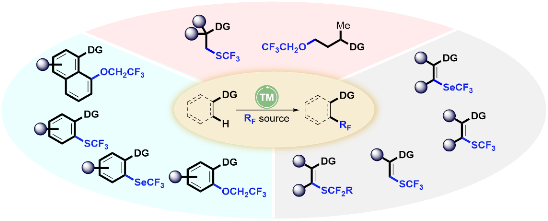
Beilstein J. Org. Chem. 2023, 19, 448–473. doi:10.3762/bjoc.19.35


Nature Reviews Chemistry, Published online: 13 April 2023; doi:10.1038/s41570-023-00482-1
Here, the utility of nitrogen-atom transfer chemistry is highlighted, the aspects that dictate nitride philicity discussed, and the reactivity of metal nitrides towards substrate functionalization examined. Emerging strategies and the remaining obstacles to harnessing nitrogen-atom transfer for nitrogenation of organic small molecules are presented.


Publication date: June 2023
Source: Trends in Chemistry, Volume 5, Issue 6
Author(s): Tingting Meng, Marisa C. Kozlowski, Tiezheng Jia


Synlett
DOI: 10.1055/a-2045-2369

Hydrazine-inserted pyrrole-based diboron fluorophores that display strong fluorescence in either the solution or solid state are widely used in biomedicine and optoelectronic materials science. A growing demand calls for multiple strategies for generating novel fluorophores to solve problems of small Stokes shifts and poor solid-state fluorescence. By changing their frameworks, several series of novel diboron compounds have recently been developed as increasingly valuable classes of fluorophores owing to their tunable structures and outstanding spectroscopic properties, such as high fluorescence quantum yields, large Stokes shifts, high photostability, and low LUMO energy levels due to the presence of electron-deficient BF2 groups. This review mainly highlights key synthetic strategies for the fluorophores BOPHY, BOPPY, and BOAPY developed by our group, together with the superior properties of these compounds. Significant photophysical data for these fluorophores in solution and solid states are included within the scope of this review. The facile functionalization of these fluorophores permits practical structural modifications to generate novel versatile dyes with excellent chemical and photophysical properties. We believe that these fluorophores hold promise to make important contributions in a wide range of applications.1 Introduction2 BOPHY Fluorophore2.1 Discovery of BOPHY and its Fundamental Properties2.2 Synthesis and Properties of Modified BOPHY Derivatives3 BOPPY and BOPYPY Fluorophores3.1 Discovery of BOPPY and BOPYPY, and Their Fundamental Properties3.2 Synthesis and Properties of Benzo-Fused BOPPYs from Isoindoles3.3 Nucleophilic Substitution and Cross-Coupling Reactions of Halogenated BOPPYs3.4 Knoevenagel Reaction4 BOAPY and BOPAHY Fluorophores5 Conclusion
[...]
Georg Thieme Verlag KG Rüdigerstraße 14, 70469 Stuttgart, Germany
Article in Thieme eJournals:
Table of contents | Abstract | Full text

Nature Synthesis, Published online: 30 March 2023; doi:10.1038/s44160-023-00298-3
Suzuki–Miyaura mechanochemistryNature, Published online: 30 March 2023; doi:10.1038/d41586-023-00928-y
Crocodiles and Komodo dragons provide evidence to support the idea of a scaly cover over the teeth of dinosaur Tyrannosaurus rex.

