Shared posts

27 Sep 06:29

CO2 promoted photoredox/Ni-catalyzed semi-reduction of alkynes with H2O

Green Chem., 2023, 25,7978-7982
DOI: 10.1039/D3GC03290F, Communication
Shenhao Chen, Chanjuan Xi
CO2-promoted photoredox/Ni dual catalyzed semi-reduction of alkynes with water has been developed, which provides a method for the synthesis of Z-alkenes in high yields with high stereoselectivity under mild conditions.
The content of this RSS Feed (c) The Royal Society of Chemistry
27 Sep 06:27

Why is phenyl azide so unreactive in [3 + 2] cycloaddition reactions? Demystifying Sustmann's paradigmatic parabola

Org. Chem. Front., 2023, 10,5579-5591
DOI: 10.1039/D3QO00811H, Research Article
Open Access Open Access
Creative Commons Licence&nbsp This article is licensed under a Creative Commons Attribution 3.0 Unported Licence.
Luis R. Domingo, Mar Ríos-Gutiérrez, Patricia Pérez
Phenyl azide only participates in [3 + 2] cycloaddition reactions with strongly nucleophilic enamines. A good correlation between the polar character of the reaction and the relative reaction rate constants kr is found.
The content of this RSS Feed (c) The Royal Society of Chemistry
26 Sep 06:17

How mothers tolerate their children | Science

Robby Vroemans

Not what I expected from the title, but ok...

Shifting pools of antigen can influence pregnancy-induced immune tolerance
26 Sep 06:16

Visible light-induced organophotoredox-catalyzed difunctionalization of alkenes and alkynes

Green Chem., 2023, 25,8459-8493
DOI: 10.1039/D3GC03291D, Critical Review
Subham Gupta, Abhishek Kundu, Sumit Ghosh, Amrita Chakraborty, Alakananda Hajra
This review comprehensively summarizes visible light-induced difunctionalization strategies for alkene and alkyne systems in metal-free conditions with literature coverage up to July 2023.
The content of this RSS Feed (c) The Royal Society of Chemistry
23 Sep 14:13

Ruthenium‐Catalyzed Aminocarbonylation with Isocyanates Through Weak Coordinating Groups

by Elisa Y. Lai, Binbin Yuan, Lutz Ackermann, Magnus J. Johansson
Ruthenium-Catalyzed Aminocarbonylation with Isocyanates Through Weak Coordinating Groups

Under mild conditions: A redox-neutral and base-free protocol for the directed ruthenium-catalyzed C−H aminocarbonylation is developed through high-throughput experimentation. The mild conditions allowed the introduction of privileged amide moieties to a wide range of anilides bearing various substitution patterns and different weakly Lewis basic directing groups.


Abstract

Introducing amide functional groups under mild conditions has growing importance owing to the prevalence of such moiety in biologically active molecules. Herein, we disclose a mild protocol for the directed ruthenium-catalyzed C−H aminocarbonylation with isocyanates as the amidating agents developed through high-throughput experimentation (HTE). The redox-neutral and base-free reaction is guided by weakly Lewis basic functional groups, including anilides, lactams and carbamates to access anthranilamide derivatives. The synthetic utility of this transformation is reflected by large-scale synthesis and late-stage functionalization.

22 Sep 09:15

Multicomponent hydrosulfonylation of alkynes for the synthesis of vinyl sulfones

Green Chem., 2023, 25,8820-8825
DOI: 10.1039/D3GC02284F, Paper
Lan Mei, Xiao-Rong Shu, Fa-Liang Liu, Jiao-Zhe Li, Jian-Feng Zhang, Keqi Tang, Wen-Ting Wei
An efficient and mild multicomponent reaction (MCR) for the preparation of vinyl sulfones achieved by carrying out hydrosulfonylation of alkynes with the corresponding aryl diazonium salts, K2S2O5 and thiophenols at room temperature without any metal catalysts or additives.
The content of this RSS Feed (c) The Royal Society of Chemistry
22 Sep 09:14

Inside Cover: Synthesis of Levulinic Acids From Muconic Acids in Hot Water (Angew. Chem. Int. Ed. 46/2023)

by Céderic Ver Elst, Robby Vroemans, Mathias Bal, Sergey Sergeyev, Carl Mensch, Bert U.W. Maes
Inside Cover: Synthesis of Levulinic Acids From Muconic Acids in Hot Water (Angew. Chem. Int. Ed. 46/2023)

Simple heating of muconic acid in water at high temperature in an autoclave under autogenic pressure provides levulinic acid in high yield, as described by Bert U. W. Maes et al. in their Communication (e202309597). The method can also be applied to make substituted levulinic acids from the corresponding muconic acids. Lignin oil rich in propylguaiacol obtained from pine sawdust has been successfully transformed into 3-propyllevulinic acid.


22 Sep 06:05

Metallaphotoredox-enabled aminocarboxylation of alkenes with CO2

by Jun-Ping Yue

Nature Catalysis, Published online: 21 September 2023; doi:10.1038/s41929-023-01029-9

CO2 conversion to valuable chemicals is of great interest in sustainable chemistry. Now, β-amino acids are synthesized by a dual catalytic strategy that enables the aminocarboxylation of alkenes using CO2, proceeding via alkene radical anion intermediates that are generated using a designed binaphthol-derived photoredox catalyst.
21 Sep 10:42

Ex‐Situ Generation of Bis(trifluoromethyl)disulfide and Applications to Trifluoromethylthiolation Reactions

by Julia Vladimirovna Kolodiazhnaia, Haraldur Gunnar Gudmundsson, Simon Steffen Pedersen, Troels Skrydstrup
Ex-Situ Generation of Bis(trifluoromethyl)disulfide and Applications to Trifluoromethylthiolation Reactions

Herein, an operationally simple protocol for the ex-situ generation of the toxic and volatile disulfide, CF3SSCF3, from the readily available and cost-efficient Langlois reagent is reported. Among the trifluoromethythiolations reaction studied, application of this disulfide in a Cu-catalyzed coupling with aryl boronic acids is disclosed, showing good to excellent yields of trifluoromethylthio-substituted aryl products.


Abstract

Herein, a convenient and operationally simple protocol for the ex-situ generation of bis(trifluoromethyl)disulfide from the readily available and commercial Langlois reagent is reported. The one-step synthesis of the toxic and volatile CF3SSCF3 is performed in a two-chamber reactor with simple PPh3 and N-bromosuccinimide as the activator, allowing for the safe handling and tandem utilization in direct trifluoromethylthiolation reactions. The versatility of the ex-situ generated CF3SSCF3 is demonstrated in known electrophilic, nucleophilic, and a radical trifluoromethylthiolation reactions. Furthermore, the application of the CF3SSCF3 in a copper-catalyzed cross-coupling with boronic acids is disclosed, showing good to excellent yields of trifluoromethyl-substituted aryl products, including pharmaceutically relevant molecules.

21 Sep 10:40

Sulfur‐Centered Radicals in Visible Light Isocyanide Photochemistry

by Camilla Russo, Francesca Brunelli, Gian Cesare Tron, Mariateresa Giustiniano
Sulfur-Centered Radicals in Visible Light Isocyanide Photochemistry

Sulfur-centered radicals have a key role in a plethora of synthetic transformations, whose scope is ever-expanding thanks to visible light photocatalysis. The current review focuses on those transformations involving isocyanides and S-centered radicals and aims to highlight the chemical space accessible and the mechanistic rational underpinning current and future developments.


Abstract

Sulfur-centered radicals have a key role in a plethora of synthetic organic transformations, whose scope has been further expanded thanks to the possibility to generate such species under visible light photocatalytic conditions. This review focuses on those transformations involving isocyanides and sulfur-centered radicals with the aim to highlight the chemical space accessible, both in terms of complexity and diversity, and the mechanistic rational underpinning the current and future development of such chemical methodologies.

21 Sep 07:22

Geminal-atom catalysis for cross-coupling

by Xiao Hai

Nature, Published online: 20 September 2023; doi:10.1038/s41586-023-06529-z

Heterogeneous geminal-atom catalysts, which pair single-atom sites in specific coordination and spatial proximity, offer a new avenue for the sustainable manufacture of fine chemicals.
20 Sep 14:34

Strategic application of C–H oxidation in natural product total synthesis

by Ian Bakanas

Nature Reviews Chemistry, Published online: 20 September 2023; doi:10.1038/s41570-023-00534-6

Strategies that utilize the oxidation of unactivated C–H bonds are becoming increasingly popular in natural product total synthesis. This Review classifies and highlights the different strategic use-cases of oxidation reactions as they were applied in recent total syntheses.
15 Sep 08:32

Psychedelic drug MDMA moves closer to US approval following success in PTSD trial

by Sara Reardon

Nature, Published online: 14 September 2023; doi:10.1038/d41586-023-02886-x

Long-awaited trial data show drug is effective at treating post-traumatic stress disorder in a diversity of people.
13 Sep 06:17

Solvent-free and ball mill-free catalytic C–H methylation

Green Chem., 2023, 25,9138-9145
DOI: 10.1039/D3GC02411C, Paper
Open Access Open Access
Creative Commons Licence&nbsp This article is licensed under a Creative Commons Attribution 3.0 Unported Licence.
Matic Hribersek, Carolina Méndez-Gálvez, Martin Huber, Paul J. Gates, Patrick Shakari, Ayan Samanta, Lukasz T. Pilarski
The selective and efficient catalytic C–H methylation of (hetero)arenes is demonstrated without involving solvents or ball milling.
The content of this RSS Feed (c) The Royal Society of Chemistry
12 Sep 09:40

Green metrics in mechanochemistry

Chem. Soc. Rev., 2023, 52,6680-6714
DOI: 10.1039/D2CS00997H, Review Article
Open Access Open Access
Nicolas Fantozzi, Jean-Noël Volle, Andrea Porcheddu, David Virieux, Felipe García, Evelina Colacino
The quantitative assessment of the greenness of mechanochemical processes for green metrics were calculated is herein reported. A general introduction to the topic, variables influencing the reaction outcome and, an outlook are also provided.
The content of this RSS Feed (c) The Royal Society of Chemistry
12 Sep 09:37

Temperature‐Dependent Structures of Single‐Atom Catalysts

by Yuhui Chen, Rui Zhang, Hsiao‐Tsu Wang, Ying‐Rui Lu, Yu‐Cheng Huang, Yu‐Chun Chuang, Hua Wang, Jun Luo, Lili Han
Temperature-Dependent Structures of Single-Atom Catalysts

The local structures of Ni single-atom catalysts were regulated by adjusting carbonization temperature of their precursors. The oxidation state, total coordination number, and bond length of the metal center decrease with the increase of the carbonization temperature. The relationship between structure and performance was explored. The structure after regulation could promote the adsorption of CO2 and improve electrocatalytic CO2 reduction activity.


Abstract

Single-atom catalysts (SACs) have the unique coordination environment and electronic structure due to the quantum size effect, which plays an essential role in facilitating catalytic reactions. However, due to the limited understanding of the formation mechanism of single atoms, achieving the modulation of the local atomic structure of SACs is still difficult and challenging. Herein, we have prepared a series of Ni SACs loaded on nitrogen-doped carbon substrates with different parameters using a dissolution-and-carbonization method to systematically investigate the effect of temperature on the structure of the SACs. The results of characterization and electrochemical measurements are analyzed to reveal the uniform law between temperature and the metal loading, bond length, coordination number, valence state and CO2 reduction performance, showing the feasibility of controlling the structure of SACs through temperature to regulate the catalytic performance. This is important for the understanding of catalytic reaction mechanisms and the design of efficient catalysts.

12 Sep 09:37

Atomically Dispersed Cobalt/Copper Dual‐Metal Catalysts for Synergistically Boosting Hydrogen Generation from Formic Acid

by Yanzhe Shi, Bingcheng Luo, Runqi Liu, Rui Sang, Dandan Cui, Henrik Junge, Yi Du, Tianle Zhu, Matthias Beller, Xiang Li
Atomically Dispersed Cobalt/Copper Dual-Metal Catalysts for Synergistically Boosting Hydrogen Generation from Formic Acid

Atomically dispersed N-coordinated Co/Cu dual-metal sites were designed and constructed for improved dehydrogenation of formic acid. In situ spectroscopy and theoretical calculations revealed that the Co/Cu dual-metal sites synergistically improve the performance of the optimized catalytic system. The presented work describes catalysts based on low-cost earth abundant dual-metal sites as promising candidates for H2 storage and delivery.


Abstract

The development of practical materials for (de)hydrogenation reactions is a prerequisite for the launch of a sustainable hydrogen economy. Herein, we present the design and construction of an atomically dispersed dual-metal site Co/Cu−N−C catalyst allowing significantly improved dehydrogenation of formic acid, which is available from carbon dioxide and green hydrogen. The active catalyst centers consist of specific CoCuN6 moieties with double-N-bridged adjacent metal-N4 clusters decorated on a nitrogen-doped carbon support. At optimal conditions the dehydrogenation performance of the nanostructured material (mass activity 77.7 L ⋅ gmetal −1 ⋅ h−1) is up to 40 times higher compared to commercial 5 % Pd/C. In situ spectroscopic and kinetic isotope effect experiments indicate that Co/Cu−N−C promoted formic acid dehydrogenation follows the so-called formate pathway with the C−H dissociation of HCOO* as the rate-determining step. Theoretical calculations reveal that Cu in the CoCuN6 moiety synergistically contributes to the adsorption of intermediate HCOO* and raises the d-band center of Co to favor HCOO* activation and thereby lower the reaction energy barrier.

11 Sep 06:42

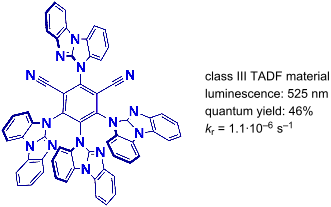
Organic thermally activated delayed fluorescence material with strained benzoguanidine donor

by Alexander C. Brannan, Elvie F. P. Beaumont, Nguyen Le Phuoc, George F. S. Whitehead, Mikko Linnolahti and Alexander S. Romanov

Abstract

Organic thermally activated delayed fluorescence (TADF) materials have been widely investigated due to their impressive electronic properties and applied potential for the third generation of organic light-emitting diodes (OLED). We present organic TADF material (4BGIPN) based on the strained benzoguanidine donor and compare it with the benchmark carbazole-based material (4CzIPN). Extended π-conjugation in 4BGIPN material results in yellow-green luminescence at 512 nm with a fast radiative rate of 5.5 × 10⁻⁵ s−1 and a photoluminescence quantum yield of 46% in methylcyclohexane solution. Such a nitrogen-rich 4BGIPN material has a significantly stabilized highest occupied molecular orbital (HOMO) at −6.4 eV while the lowest unoccupied molecular orbital (LUMO) at −4.0 eV, indicating potential suitability for application as the electron transport layer or TADF class III emitter in OLEDs.

Beilstein J. Org. Chem. 2023, 19, 1289–1298. doi:10.3762/bjoc.19.95

11 Sep 06:19

Cover Feature: Fluoroalkyl Sulfoximines for Versatile Photocatalytic Radical Fluoroalkylations (Chem. Rec. 9/2023)

by Takashi Koike
Cover Feature: Fluoroalkyl Sulfoximines for Versatile Photocatalytic Radical Fluoroalkylations (Chem. Rec. 9/2023)

The cover depicts the generation of fluoroalkyl radical species by photoredox catalysis from chiral and structurally diverse fluoroalkyl sulfoximine compounds. See the Personal Account by T. Koike (DOI: 10.1002/tcr.202300032).


05 Sep 07:34

Recent Developments in Photocatalytic Reduction of Nitro Compounds to Valuable Scaffolds

by Aggarwal, Varun

Synlett
DOI: 10.1055/a-2122-8508


The reduction of nitro compounds is one of the fundamental organic transformations and ascertain wide applicability in industrial chemistry, synthesis of valuable scaffolds, fine chemical synthesis, as well as environmental applicability for decontamination process. The transformation involves the conversion of nitro compounds into valuable scaffolds including amino, nitroso, hydroxyl amines, azo, and hydrazo compounds. Conventional approaches for the reduction of nitro compounds involves the environmentally harmful stoichiometric reagents, high-boiling reaction media, tedious processes, and harsh reaction conditions with high temperature and pressure. Additionally, the selectivity always remains a serious concern associated with the process due to the possibilities of several stable intermediate formation in the reaction pathway of reduction of nitro compounds. Nitro compounds are also of serious environmental concerns being a part of most harmful and high-priority classes of pollutants mainly released from industrial effluents, agricultural waste, and human sewage. A simple degradation of these pollutants bearing nitro group just removes the pollutants, however, the selective reduction of nitro group to valuable functionalities as mentioned above provides the industrially important scaffolds. With the advent of photocatalytic organic transformation, most of the scientific fraternity working in the area of organic synthesis, catalysis, and environmental decontaminations are utilizing the clean, green, low-temperature, energy and cost-effective, sustainable processes for the reduction of nitro compounds to access valuable scaffolds. Nowadays a lot of mechanistic developments in the field ease the processes for the developments of such highly valuable organic transformations. Herein, the present Account is focused on the recent developments in the photocatalytic reduction of nitro compounds to valuable scaffolds.1 Introduction2 Reduction of Nitro Compounds2.1 Conventional Approaches for Reduction of Nitro Compounds2.2 General Photocatalytic Mechanism3 Mechanistic Pathways: Electrochemical, Conventional and Photocatalytic Approaches3.1 Mechanism of Electrochemical Reduction of Nitroarene3.2 Conventional Reduction Mechanism of Nitroarenes3.3 General Photocatalytic Reduction Mechanism of Nitroarenes4 Photocatalytic Reduction of Nitro Compounds to Valuable Scaffolds4.1 Reduction of Nitro Compounds to Corresponding Amines4.2 Reduction of Nitro Compounds to Azo Compounds4.3 Reduction of Nitro Compounds to Azoxy Compounds4.4 Reduction of Nitro Compounds to Nitroso Compounds4.5 Reduction of Nitro Compounds to Hydroxyl Amines5 Future Perspective6 Conclusion
[...]

Georg Thieme Verlag KG Rüdigerstraße 14, 70469 Stuttgart, Germany

Article in Thieme eJournals:
Table of contents  |  Abstract  |  Full text

05 Sep 06:22

Organoborane-catalysed reductive depolymerisation of catechyl lignin under ambient conditions

Green Chem., 2023, 25,8172-8180
DOI: 10.1039/D3GC02025H, Paper
Shihao Su, Fan-shu Cao, Shuizhong Wang, Qingru Shen, Gen Luo, Qiang Lu, Guoyong Song
C-lignin biopolymers can be efficiently depolymerized into catechol derivatives with 85% yield and 91% selectivity at room temperature and ambient pressure in highly concentrated form (300 mg mL−1) over an organoborane catalyst.
The content of this RSS Feed (c) The Royal Society of Chemistry
04 Sep 09:31

Transition‐Metal‐Catalyzed Addition of Organosulfur Compounds to Alkynes and Alkenes: Catalysis and Catalyst Poisons

by Yuki Yamamoto, Akiya Ogawa
Transition-Metal-Catalyzed Addition of Organosulfur Compounds to Alkynes and Alkenes: Catalysis and Catalyst Poisons

Transition-metal-catalyzed addition of organosulfur compounds to carbon-carbon unsaturated bonds has been considered as one of the challenging reactions due to the catalyst poisons. Recently, novel systems have been investigated to suppress the catalyst poisons. This article highlights the pioneering studies on the catalytic addition of organosulfur compounds to alkynes and alkenes and describes their catalysis and catalyst poisons.


Abstract

The addition of heteroatom compounds to alkynes and alkenes is an atom-efficient method of carbon-heteroatom bond formation and is widely used as a fundamental synthetic method for the construction of functional molecules. Nevertheless, examples of transition-metal-catalyzed addition reactions of group 16 heteroatom compounds to carbon-carbon unsaturated bonds have been limited due to the widespread belief that organic sulfur and selenium compounds are representative catalyst poisons. In recent decades, however, several seminal catalytic reactions of sulfur compounds have been developed, providing important insights into catalysis and poisons. Therefore, this paper focuses on the transition-metal-catalyzed addition of organosulfur compounds to alkynes and alkenes, gains comprehensive insights into the catalysis and catalyst poisons, and proposes concepts for the development of transition-metal-catalyzed reactions of group 16 heteroatom compounds.

03 Sep 12:30

Organophotocatalysed synthesis of 2-piperidinones in one step via [1 + 2 + 3] strategy

by Yi-Dan Du

Nature Communications, Published online: 02 September 2023; doi:10.1038/s41467-023-40197-x

The synthesis of 2-piperidinone derivatives remains challenging. Here, the authors develop an organophotocatalysed [1 + 2 + 3] strategy to enable the one-step access to diverse 2-piperidinones from ammonium salts, alkenes, and unsaturated carbonyl compounds.
02 Sep 04:24

Iron-catalyzed oxosulfonylation of alkynes with small-ring compounds and Na2S2O5 for the synthesis of β-keto sulfones

Org. Chem. Front., 2023, 10,5190-5197
DOI: 10.1039/D3QO01218B, Research Article
Liu-Bin Li, Hui Qiu, Mu-Han Li, Nan-Nan Dai, Lan Mei, Yu He, Lei Yu, Ting Li, Wen-Ting Wei
An efficient and rapid iron-catalyzed oxosulfonylation of alkynes with small-ring compounds and Na2S2Ofor the synthesis of β-keto sulfones has been developed.
The content of this RSS Feed (c) The Royal Society of Chemistry
01 Sep 15:38

Visible-light-induced iron-catalyzed S–N cross-coupling of thiols with dioxazolones

Green Chem., 2023, 25,7529-7533
DOI: 10.1039/D3GC02479B, Communication
Jing-Jing Tang, Ning Yan, Yiwei Zhang, Yi Wang, Ming Bao, Xiaoqiang Yu
The visible-light-promoted iron-catalyzed S–N cross coupling of thiols with dioxazolones is described. This reaction occurred via an exogenous-photosensitizer-free process and showed wide substrate scope under mild reaction conditions.
The content of this RSS Feed (c) The Royal Society of Chemistry
01 Sep 15:38

The crucial role of silver(I)-salts as additives in C–H activation reactions: overall analysis of their versatility and applicability

Chem. Soc. Rev., 2023, 52,6359-6378
DOI: 10.1039/D3CS00328K, Review Article
Renato L. de Carvalho, Emilay B. T. Diogo, Simon L. Homölle, Suman Dana, Eufrânio N. da Silva Júnior, Lutz Ackermann
This review discusses the important role of silver(I) salts as additives in transition-metal catalyzed C–H activation, and depicts the discussion about the current shift towards Ag-free procedures, as plausible and sustainable alternatives.
The content of this RSS Feed (c) The Royal Society of Chemistry
01 Sep 05:39

Ortho-C–H methoxylation of aryl halides enabled by a polarity-reversed N–O reagent

by Xin Liu

Nature Chemistry, Published online: 31 August 2023; doi:10.1038/s41557-023-01312-z

Pd/norbornene cooperative catalysis provides a strategy for arene functionalization, but the electrophile scope is typically limited to ‘soft’ elements such as carbon, nitrogen and sulfur. Now the ortho-C–H methoxylation of aryl halides has been realized using a polarity-reversed N−O reagent and facilitated by a C7-bromo-substituted norbornene mediator.
31 Aug 07:40

Nickel-catalyzed cross-electrophile coupling of aryl thiols with aryl bromides via C–S bond activation

Org. Chem. Front., 2023, 10,5171-5179
DOI: 10.1039/D3QO01236K, Research Article
Hao Xu, Cai-Yu He, Bo-Jie Huo, Jia-Wen Jing, Chengping Miao, Weidong Rao, Xue-Qiang Chu, Xiaocong Zhou, Zhi-Liang Shen
We report a cross-electrophile coupling of aryl thiols with aryl bromides via C–S bond activation instead of S–H bond cleavage. The reaction proceeded effectively in the presence of a nickel catalyst, magnesium, and lithium chloride to afford various biaryls in moderate to good yields.
The content of this RSS Feed (c) The Royal Society of Chemistry
29 Aug 15:38

Photocatalytic reduction of mono, di, and tri-nitrophenols over a Bi2MoO6/carbon nitride heterojunction

New J. Chem., 2023, 47,17775-17782
DOI: 10.1039/D3NJ03243D, Paper
Phyu Phyu Cho, Phyu Phyu Mon, Devthade Vidyasagar, Giridhar Madras, Ch. Subrahmanyam
We employed a solvothermal and thermal pyrolysis approach to prepare a heterojunction of oxide perovskite (Bi2MoO6) dispersed on polymeric carbon nitride (PCN) sheets.
The content of this RSS Feed (c) The Royal Society of Chemistry
29 Aug 14:13

Supramolecular axial chirality in [N–I–N]+-type halogen bonded dimers

Chem. Sci., 2023, 14,10194-10202
DOI: 10.1039/D3SC03170E, Edge Article
Open Access Open Access
Creative Commons Licence&nbsp This article is licensed under a Creative Commons Attribution 3.0 Unported Licence.
Shuguo An, Aiyou Hao, Pengyao Xing
The [N–I–N]+-type halogen bond performed as a powerful tool for the construction of functional axial chiral compounds, enriching the toolbox for asymmetric synthesis and optics.
The content of this RSS Feed (c) The Royal Society of Chemistry