
ACS Catalysis
DOI: 10.1021/acscatal.3c05836

Publication date: 10 February 2024
Source: Journal of Cleaner Production, Volume 440
Author(s): Annelies De Meyer, Sanne Verdonck, Ilié Storms, Joachim López, Maxim Tschulkow, Tine Compernolle, Steven Van Passel, Jos Van Orshoven, Bruno Verbist, Ruben Guisson, Wouter Arts, Sander Van den Bosch, Joost Van Aelst, Bert Sels, Bart Muys
 Open Access
   This article is licensed under a Creative Commons Attribution-NonCommercial 3.0 Unported Licence.
Publication date: 15 February 2024
Source: Molecular Catalysis, Volume 555
Author(s): Bingkun Cui, Di Zeng, Wenjing Wang, Ruofan Li, Taikang Jia, Hongxiang Chu, Ling Zhang, Wenzhong Wang

C−F Insertion reactions are powerful methods for preparing fluorinated molecules, however their development has been severely hampered by the challenge of activating strong C−F bonds without sequestering the released fluoride. Recently, several strategies have emerged that allow for C−F insertion of a range of fluorinated substrates. In this article, the recent breakthroughs are discussed focusing on the key underlying concepts.
C−F Insertion reactions, where an organic fragment formally inserts into a carbon–fluorine bond in a substrate, are highly attractive, yet largely unexplored, methods to prepare valuable fluorinated molecules. The inherent strength of C−F bonds and the resulting need for a large thermodynamic driving force to initiate C−F cleavage often leads to sequestering of the released fluoride in an unreactive by-product. Recently, however, several groups have succeeded in overcoming this challenge, opening up the study of C−F insertion as an efficient and highly atom-economical approach to prepare fluorinated compounds. In this article, the recent breakthroughs are discussed focusing on the key conceptual advances that allowed for both C−F bond cleavage and subsequent incorporation of the released fluoride into the product.
Nature, Published online: 22 January 2024; doi:10.1038/d41586-024-00173-x
Advances in artificial intelligence are at the heart of many of this year’s most exciting areas of technological innovationSynthesis
DOI: 10.1055/a-2226-4082

The development of organic dyes with high fluorescence quantum yield (FLQY) and tunable emission has significant application potential in biomedicine and material science. The synthesis of four N-bridged annulated BODIPY dyes with styryl units at the 3- and 3,5-positions of the BODIPY core, introduced by Knoevenagel condensation reaction, is reported. These dyes show high FLQY and tunable fluorescence. The intrinsic relationship between structure and properties is comprehensively analyzed through density functional theory (DFT) calculations, which is crucial for the rational design of new BODIPY dyes with desired properties for specific applications.
[...]
Georg Thieme Verlag KG Rüdigerstraße 14, 70469 Stuttgart, Germany
Article in Thieme eJournals:
Table of contents | Abstract | Full text

N-Carboxyanhydrides are species derived from the addition of a carboxylic acid to an isocyanate, and are well-known to form amides products with release of CO2. Although first reported over 120 years ago, their potential use as reagents for amide bond-forming reactions is currently underexplored. In this article, the properties, synthesis and current applications of NCAs are highlighted.
N-Carboxyanhydrides (NCAs) are compounds derived from the addition of a carboxylic acid to an isocyanate, and are known to form amides readily with the release of CO2 as a by-product. NCAs have been known for over 120 years, but despite their lengthy history, have remained so far overshadowed by more traditional approaches to amide bond formation. In this review, the potential utility of NCAs in the context of amide bond formation is reviewed and their preparation, reactivity and practical application are also discussed.

The visible-light induced cross-dehydrogenative coupling (CDC) reactions have made tremendous developments in the last few years. This review focuses on the recent advances in rose bengal photocatalyzed CDC reactions to create carbon-carbon/carbon-heteroatom bond under visible light to synthesize various important organic molecules.
Over the past few years, organic chemistry has used the organic dye rose bengal‘s ability to absorb visible light. In present-day research, the innovation of environmentally friendly processes for carbon-carbon/carbon-heteroatoms (Nitrogen, Oxygen, Sulphur, and Phosphorus) bond formation has great importance. The photocatalyzed cross-dehydrogenative coupling (CDC) reactions using rose bengal (RB) is a promising technique for creating carbon-carbon/carbon-heteroatom bonds directly from readily available compounds. Our review focuses on the current advancement in rose bengal that uses photocatalyzed carbon-carbon/carbon-heteroatom bond-making reactions to synthesize various important organic molecules via CDC reactions.

A manganese-catalyzed dehydrogenative coupling of glycerol with amines for the synthesis of substituted 2-methylquinoxalines, 2-ethylbenzimidazoles, and α-aminoketones was reported. NHC-based pincer manganese complex featuring a pyridine backbone displayed high catalytic activity and selectivity. No external oxidants were used in these reactions and hydrogen and water were produced as the only by-products.
Glycerol is one of the important biomass-derived feedstocks and the high-value utilizations of glycerol have attracted much attentions in recent years. Herein, we report a manganese catalyzed dehydrogenative coupling of glycerol with amines for the synthesis of substituted 2-methylquinoxalines, 2-ethylbenzimidazoles, and α-aminoketones without any external oxidant. In these reactions, NHC-based pincer manganese complex featuring a pyridine backbone displayed high catalytic activity and selectivity, in which hydrogen and water were produced as the only by-products using glycerol as a C3 synthon.
Nature, Published online: 16 January 2024; doi:10.1038/d41586-024-00116-6
Authors from wealthy countries cannot all pay publishing feesNature Chemistry, Published online: 16 January 2024; doi:10.1038/s41557-023-01404-w
Single-step addition of an aryl ring and a protected amine across an alkene is a succinct route to valuable phenethylamine products, but existing methods suffer from limited scope. Now a family of compounds containing a sulfinamide functional group have been developed to react via electrophilic radicals to yield phenethylamines through an aryl migration with precise stereochemical control.Nature, Published online: 15 January 2024; doi:10.1038/d41586-024-00111-x
Richmond Sarpong wishes more people had access to the nitrogen-regulated device.Nature Synthesis, Published online: 15 January 2024; doi:10.1038/s44160-023-00470-9
In this Issue, we focus on reaction outcomes which are unique to flow setups and their application in synthesis.Robby VroemansGo @Karel! ;)

A Ni(II) embedded N-rich porous organic polymer (Ni@MOP−Am) mediated strategy for the synthesis of N-alkylated scaffolds of amines with readily available alcohols via a borrowing hydrogen mechanism, also known as “hydrogen autotransfer”. The catalyst demonstrated excellent activity up to 97 % yield and serves as an affordable protocol for such reactions.
The first-of-its-kind, one-pot N-alkylation reaction of amines over Ni(II) impregnated porous organic polymer of highly dense N-rich skeleton is reported. The primeval Ni(II) decorated hollow spherical porous polymer is synthesized and employed in a series of catalytic reactions involving C−N bond formation. The catalytic reactions are optimised to yield the desired product highlighting the role of different substituents present on the reactants towards the overall selectivity and efficiency. The detailed reaction mechanism is corroborated with computation validating a three-step arrow formalism viz. dehydrogenation of the alcohol, condensation with amines to generate the imine as intermediate followed by hydrogenation by a borrowing strategy to yield the final product. The role of the bare support material in the first step and that of the Ni(II) centres of the support material in the third step is marked as pivotal for the forward reaction to proceed with enriching sustainability and feasibility.

An effective strategy of C-O bonds cleavage in lignin using metal triflate as the catalyst was developed, and the carboxylic acid or alcohol could be used as the nucleophile to stabilize the reactive intermediates formed during the depolymerization of lignin to prepare corresponding ester/ether compounds.
The effective cleavage of C−O bonds in linkages of lignin was one of the significant strategies promoting lignin valorization. Herein, the strategy of C−O bonds cleavage of lignin using metal triflate as the catalyst was developed. The carboxylic acid or alcohol could be used as the nucleophile to stabilize the reactive intermediates formed during the depolymerization of lignin, and the corresponding ester/ether compounds could be obtained. This catalytic system was suitable for the C−O bond cleavage in α-O-4 and β-O-4 linkages with excellent efficiency. Additionally, reaction conditions were optimized. The reaction mixture was detected by 1H NMR, and no other byproducts were found. As for treated lignin samples, the cleavage of C−O bonds in linkages was determined by 2D HSQC NMR, the increased content of the phenol hydroxyl group was proved by FT-IR, and the reduced molecular weight was investigated by GPC. Furthermore, multiple phenolic compounds were detected by GC-MS in the reaction mixtures.

Herein, we report an efficient N-alkylation of amines with alcohols using N-heterocyclic carbene cobalt-pincer catalyst under mild conditions. Various alcohol and aniline substrates and functional groups including nitrile, ether, thioether and alkene could be well tolerated. Moreover, experimental studies and DFT calculations were also performed to illustrate the reaction mechanism.
Alcohols are widely available and can be derived from renewable resources. Catalytic alcohol amination for N-alky amine synthesis using the borrowing hydrogen strategy is an environmentally benign and prominent sustainable method, which produces water as the sole byproduct. However, expensive noble metals are generally employed for this transformation, while the nonprecious metal-based catalysts were also known for this reaction and have attracted considerable attention recently. Herein, an efficient N-alkylation of amines with alcohols using base-metal cobalt catalysts is reported. This reaction is catalyzed by an N-heterocyclic carbene cobalt-pincer catalyst and the reaction operates simply and under mild conditions. Various alcohol and aniline substrates and functional groups including nitrile, ether, thioether and alkene could be well tolerated. Moreover, experimental studies and DFT calculations were also performed to illustrate the reaction mechanism. Our results suggest that the N-alkylation reaction proceeds via a hydrogen autotransfer mechanism.

Time for a change. The use of N,N-dimethyl formamide (DMF) will be restricted in the European Union from December 2023 because of its reproductive health hazard. Now is the time to replace DMF in fundamental research so that future processes are not reliant on an obsolete, hazardous solvent.
As of December 2023, the use of common solvent N,N-dimethyl formamide (DMF) will be restricted in the European Union because of its reproductive health hazard. Industrial facilities must comply with stricter exposure limits, and researchers are recommended to find alternative solvents. Here we explain the restrictions on DMF, which disciplines are affected, and how to substitute DMF to keep research and development commercially relevant.

Laser-ablated boron atom reaction with hexafluorobenzene (C6F6) has been performed in neon and argon matrices. Besides the single C−F bond activation species fluoropentafluorophenyl boryl radical, a 2-difluoroboryl-tetrafluorophenyl radical is also generated via dual C−F bond activation of hexafluorobenzene on subsequent irradiation.
The reaction of laser-ablated boron atoms with hexafluorobenzene (C6F6) was investigated in neon and argon matrices, and the products are identified by matrix isolation infrared spectroscopy and quantum-chemical calculations. The reaction is triggered by a boron atom insertion into one C−F bond of hexafluorobenzene on annealing, forming a fluoropentafluorophenyl boryl radical (A). UV-Vis light irradiation of fluoropentafluorophenyl boryl radical causes generation of a 2-difluoroboryl-tetrafluorophenyl radical (B) via a second C−F bond activation. A perfluoroborepinyl radical (C) is also observed upon deposition and under UV-Vis light irradiation. This finding reveals the new example of a dual C−F bond activation of hexafluorobenzene mediated by a nonmetal and provides a possible route for synthesis of new perfluorinated organo-boron compounds.

This Review focuses on the recent strategies developed for the thiocyanation of C(sp3)−H bonds via the formation of a C-centered radical intermediate. These approaches have provided easy access to original thiocyanate products of high interest.
Organic thiocyanates are an important class of compounds because they are present in several bioactive molecules and can be used as key synthetic intermediates to access biorelevant sulfur-containing scaffolds. Although the chemistry of organothiocyanates has been studied for decades, a recent resurgence of interest in the field has led to major advances in the synthesis of new molecules bearing a thiocyanate moiety. An emerging and powerful strategy consists in the selective functionalization of C(sp3)-H bonds through the formation of a key C-centered radical intermediate. This review highlights the recent work that has been reported to access novel alkylthiocyanate scaffolds through this promising approach.

A strategy for sulfonylation of boronic acids with sulfonyl chlorides has been established via Suzuki-type radical cross-coupling. This approach allows for the synthesis of more than 50 sulfone examples enabled by photoredox catalysis under visible light radiation. Moreover, the title reaction is applied in late-stage functionalization of bioactive molecules, and further transformation of the resulting sulfones into 2-functionalized sulfones, borates, triphenylphosphine oxide and N-arylcarbazole can be also achieved.

In this Minireview we present and discussed a series of examples from various areas in which reactive intermediates have been detected during mechanochemical reactions. Understanding the factors behind the formation and stabilization of these intermediates could enhance mechanochemical methods and chemical reaction development.
Mechanochemical reactions offer methodological and environmental advantages for chemical synthesis, constantly attracting attention within the scientific community. Besides unmistakable sustainability advantages, the conditions under which mechanochemical reactions occur, namely solventless conditions, sometimes facilitate the isolation of otherwise labile or inaccessible products. Despite these advantages, limited knowledge exists regarding the mechanisms of these reactions and the types of intermediates involved. Nevertheless, in an expanding number of cases, ex situ and in situ monitoring techniques have allowed for the observation, characterization, and isolation of reaction intermediates in mechanochemical transformations. In this Minireview, we present a series of examples in which reactive intermediates have been detected in mechanochemical reactions spanning organic, organometallic, inorganic, and materials chemistry. Many of these intermediates were stabilized by non-covalent interactions, which played a pivotal role in guiding the chemical transformations. We believe that by uncovering and understanding such instances, the growing mechanochemistry community could find novel opportunities in catalysis and discover new mechanochemical reactions while achieving simplification in chemical reaction design.
Abstract
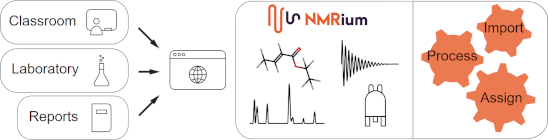
NMRium is the first web-based software that allows displaying, processing, interpretation, and teaching of 1D and 2D NMR data in a user-friendly interface. It can import the most common data formats (e.g., JCAMP-DX, Bruker, Varian, and Jeol). While the scope for the use of NMRium encompasses a variety of applications such as being a component in data repositories or electronic lab notebooks (ELN), performing structure elucidation or preparing raw spectral data for publication, it also excels in enhancing teaching of NMR interpretation. In this paper, we present some current possibilities of this new tool. Several series of exercises are already provided on https://www.nmrium.org/teaching.
Beilstein J. Org. Chem. 2024, 20, 25–31. doi:10.3762/bjoc.20.4

Thoughts of Claudia Ley, Editor-in-Chief of Ullmann's Encyclopedia of Industrial Chemistry, and Henrique Teles, board member of ChemSusChem and Ullmann's Encyclopedia, on the progress that is being made in industrial chemistry, which is as important as progress made in academia.
Robby Vroemans@Karel
Open Access  This article is licensed under a Creative Commons Attribution-NonCommercial 3.0 Unported Licence.


