Down from $2.99. Expires in 7 days. Neat little app for converting sheet music into a digital, scrollable view based on various preferences.
iframe
Statistics: Posted by sixb0nes — Mar 17th, 2019 8:29 am
Statistics: Posted by sixb0nes — Mar 17th, 2019 8:29 am
Sale ends in 20 hoursIncredibox is a musical game that helps you create a mix very easily by managing a band of beatboxers.
Just drag and drop icons on the different characters and start creating music!
Find the right combos during the game and unlock animated bonuses that will help you improve your mix...
Statistics: Posted by IDStorms — Mar 9th, 2019 10:32 pm

All images: Yijie Hu
As a part of a larger project inside of a unique bookstore in Suzhou, China, architectural designers WUtopia Lab framed a reading room with a colorful structure referred to as the “Xanadu of Rainbows.” Made of one-centimenter thick aluminum sheets that have been perforated and cut into swooping shapes, the metal rainbow is created in a gradient that shifts through almost every shade in the ROYGBIV spectrum.
The word Xanadu is used to describe an idyllic space or place, which is what the architects sought to create with the vibrant, flowing design. The curved panels are installed along the ceiling and down the walls of the bookstore’s reading room and sections of the structure drip down like chromatic stalactites. In addition to creating an eye-catching aesthetic, the panels also functionally divide the open space into sections. To see more of WUtopia Lab’s interior and exterior work, check them out on Instagram. (via ArchDaily)


Photographs © Winnie Au
Any person who’s been within shouting distance of a dog owner has probably heard the term “cone of shame,” a euphemism for the medically prescribed devices that dogs must sometimes wear. The cones, traditionally uncomfortable and made of stiff plastic, keeps dogs away from their post-surgery stitches or bothersome skin conditions.
Photographer and dog mom Winnie Au sought to flip the narrative on these puppy-eyes-inducing devices by showcasing dogs in a variety of delightfully frilly and fluffy cones. The photo series, Cone of Shame, complements each canine’s body type, fur, and personality with handcrafted cones by costume designer Marie-Yan Morvan.

Au shares with Colossal that the featured dogs were cast from all over New York, as she and Morvan sought to discover interesting looking dogs, and also match canines to pre-existing cone concepts. The pair worked collaboratively to draw from Au’s loose ideas like “sea urchin” or “cotton candy,” and homed in on feasible designs and materials. Textured cones were formed from feathers, egg shells, and straws, and sleek designs were made with faux flower petals and makeup application wedges.
“When I concepted this series, it was meant to be more abstract and less straightforward portraiture,” the photographer explains. “So when I looked at the dogs, I would look at their fur as one element, the backdrop color as another element, and then the cone style would be the final element. The goal was to put the pieces together like an abstract painting and make sure the colors and tones worked in symmetry with each other.”
Au has just released the “Cone of Shame” images in note card format, as part of a Kickstarter campaign that supports Animal Haven’s Recovery Road fund. You can follow Winnie Au and Marie-Yan Morvan on Instagram.


Statistics: Posted by BlankdeBlack — Feb 14th, 2019 11:45 am

Jim F. Faure, who goes by Jim Skull, introduces his decades-long practice with his pseudonym. The Paris-based sculptor focuses exclusively on human skulls. Using innumerable strands of colorful thread, Murano glass beads, rope, and even porcupine quills, Faure creates an entirely new “skin” for the skeletal forms. Each skull’s covering also trails off into dramatic cascades that shape-shift depending on how the skull is displayed.
Faure transforms the surface of an object that often strikes fear into a visually enticing decorative object, inviting the viewer to study the divots and contours of our shared anatomical structure. In an artist statement, the sculptor cites his upbringing in New Caledonia in the South Pacific, followed by wide-ranging international travels in New Zealand, India, and Hong Kong as informing his fascination with the ritual and cultural aspects of the human experience. You can see more of Faure’s work on his website.


torp3918Noooooooooooooooooooooooooooooooooooooooooooooooooooooooooooooooooooooooo!

Emergency responders are currently battling a "deep seated," four-alarm blaze that started in the basement of a restaurant on Toronto's bustling Danforth Avenue.
Toronto fire officials say they responded to the site of Detroit Eatery at 389 Danforth Ave., between Chester and Arundel Avenues, around 6:45 a.m. on Tuesday morning.
Fire at Detroit Eatery this morning: thoughts go out to Chris and family! pic.twitter.com/kGzuGzDiPX
— Ben Rodgers (@Rodge156068) January 22, 2019
What was initially declared a two-alarm fire escalated after 9 a.m. as difficult weather conditions and historic construction made things tricky for firefighting operations.
The apartments above the restaurant and those in neighbouring buildings have been evacuated. No injuries have been reported.
Please keep Detroit Eatery in mind guys. It’s my second home. Some of people I’m most comfortable around work and hang out there.
— Isaac Stein (@IsaacStein2) January 22, 2019
No one was hurt ❤️ pic.twitter.com/vEgGfvpVJw
The "stubborn" four-alarm fire was finally knocked down at 10:32 a.m., according to the Toronto Fire Service, though firefighters are expected to remain on scene well into Tuesday afternoon "doing overhaul" and investigating. Officials are asking residents to please avoid the area.
If you’ve visited me in Toronto, there’s a 100% chance I took you to @DetroitEatery. It’s impossible to categorize. The people - from all walks of life in parallel universes - are what makes Detroit so special. The Danforth will rally to support Chris in a mind-blowing way. pic.twitter.com/2qvPWHxf5W
— John Sharkman (@JohnSharkman) January 22, 2019
Detroit Eatery, home to one of Toronto's best diner burgers, appears to be in rough shape on account of the fire — so much so that neighbourhood residents have already set up a GoFundMe campaign to help rebuild it.
Help restore Detroit Eatery https://t.co/LrPYRM4jIi
— Ana Di (@dimitriadou_ana) January 22, 2019
"Detroit Eatery is a staple of the neighbourhood that the locals know and love," reads the GoFundMe page, which has raised $125 in just two hours.
"Often having 3 generations of family members sitting down for brunch or getting together with good friends."
"The Detroit Eatery is not only a quality diner but a social hub and community hotspot," it continues. "Please help restore it to its former glory and allow this establishment to serving the public for years to come."

Cutting corners is all well and good when you're cleaning Bart Simpson's bedroom, but when you're getting paid by a federal agency to bring packages to the doorsteps of people who shelled out specifically for home delivery? Not so much.
A GTA resident was compelled to share footage from his home security system this week after catching a Canada Post employee not even trying to deliver a package to his house.
"How Canada Post 'delivers' packages," reads the title of a video uploaded to YouTube on Monday night. The uploader, Yul Brenner, used the same headline when sharing the clip to Reddit's r/toronto subreddit, where it racked up more than 500 comments in just one day.
The two minute, 41-second-long video starts with a Canada Post delivery truck pulling up across the street from where Brenner lives (somewhere in York region, he said by private message.)
After a solid minute of sitting in the truck, a postal worker gets out and walks up to the home carrying only a slip of paper—no package in sight.
The delivery person doesn't even knock on the door when he to the house. Instead, he gingerly hangs a delivery notice on the door handle and backs away immediately.
Seconds later, someone opens the door and calls after him, asking why he didn't knock.
"I didn't know if anybody was home... I'll bring the package," the worker replies, at which point he grabs a box from his truck and scans it while walking back to the house. "Usually there's nobody home, that's why."
This doesn’t surprise me in the least. I work from home and have found numerous slips on my door for a delivery “attempt” that was never attempted. Do better @canadapostcorp
— Kamara Toffolo (@kamaratoffolo) January 15, 2019
How Canada Post "delivers" packages (as in not at all) https://t.co/eTqEKoA5KZ via @YouTube
Hundreds of angry video viewers aren't buying the mail delivery person's excuse.
"Happens all the time to me here in Toronto," wrote one of nearly 400 YouTube commenters. I've watched the mailman run to my door exactly the same way without attempting a delivery just putting the stupid notice up... Useless Canada Post."
"This has happened to me more than a few times when I was home," wrote someone else. "I then have to wait til the next day, get in the car, drive down to the post office, wait in line, and deliver the package home myself. Canada Post parcel delivery workers deserve no support."
This happens all the time. Most of the time though they have the package in their hand, carry it to the door, but don't ring the doorbell. I don't understand why? Keeping the Shoppers post office in business? Such a waste of time. https://t.co/plEt2pn0cl
— Iain Grant (@ijg) January 15, 2019
Brenner himself admitted on Reddit that Canada Post is one of the reasons why he put cameras outside his home in the first place.
"I was hoping they would see them and actually attempt a delivery," he wrote. "Guess I underestimated how lazy these drivers are."
Brenner says that he did file a complaint with Canada Post online to tell them where the incident happened.
Canada Post, for its part, admits that "delivery should have been attempted on the first visit to the door."

The RCMP were alerted to counterfeit Canadian currency in circulation. RCMP are advising the public and businesses to be cautious when accepting any denominations of cash and to familiarize themselves with Canadian currency security features by reading the Bank of Canada website.
The Bank of Canada includes security measures on each new series of banknotes it creates. In general, for most newer-series banknotes, it recommends checking for difficult-to-counterfeit features such as a hologram in the otherwise transparent window of the bill, raised ink in places including the phrase “Bank of Canada,” and a transparent outline around the maple leaf on the face side of the bill. The new vertical $10 bills have raised ink on the portrait, large number 10 and the word “Canada,” as well as a picture of an eagle feather which changes colour from gold to green based on the angle it is being viewed at.

Yellowstone National Park, all images courtesy of Scott Reinhard
Scott Reinhard combines contemporary land elevations with historic maps to create three-dimensional environments of a specific region, city, or state. To produce the digital maps, he pulls elevation data from the United States Geological Survey, which he then embeds with location information and merges with the original design of the old maps.
Producing these hybrids allows the Brooklyn-based graphic designer to gain a better sense of the topography found in large areas without aerial photography, while also developing a story from the cartographic information. He often selects locations he has personally visited or is generally curious about for his digitally produced works. “I am from Indiana, which always felt so flat and boring,” he explains to Colossal. “When I began rendering the elevation data for the state, the story of the land emerged. The glaciers that receded across the northern half of the state after the last ice age scraped and gouged and shaped the land in a way that is spectacularly clear.”
By visualizing the history that shaped a location’s composition at a large scale, Reinhard is able to notice trends in the environment in a more localized way. These forces affect how we traverse our daily environments, but are hard to comprehend without taking the time to zoom out, or look at from above. “As a visual person, I was most intrigued by the ability to visually harness data and create images that helped me gain insight into locations,” he continues. “I felt empowered by the ability to collect and process the vast amounts of information freely available, and create beautiful images.”
Reinhard was introduced to the methods he uses in his digital maps through Daniel Huffman’s website Something About Maps. You can see more of Reinhard’s digital works on Instagram and buy select high-quality prints, on his website. (via This Isn’t Happiness)

Teton Range

Yosemite

State of California

Southern California

Asheville, North Carolina

Glacier

Mount St. Helens

Acadia
torp3918Yes.
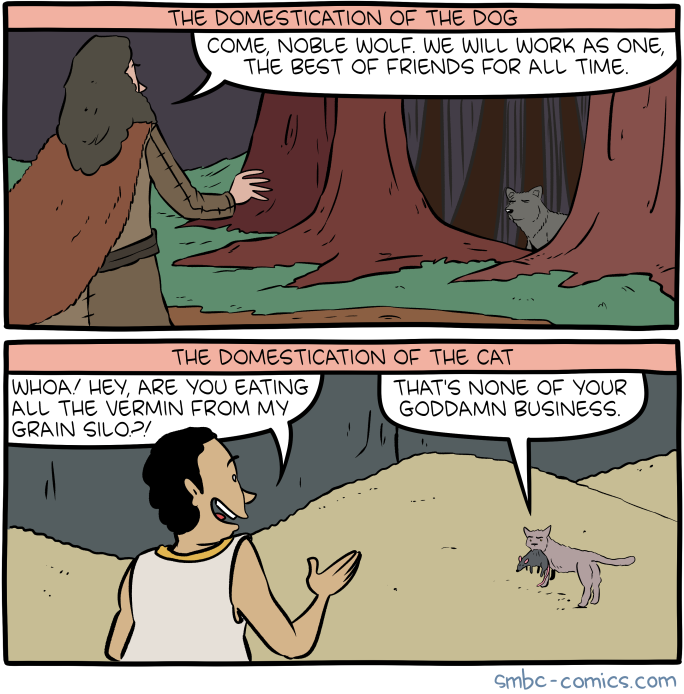
Hovertext:
This is the least cruel cat joke I've ever made. Do the checks start rolling in now?
Philadelphia-based photographer and videographer Bruce W. Berry Jr. brings together images from the International Space Station (ISS) in his new time-lapse video, The World Below. Berry used public content from NASA to form the meditative short film that reads like a supersized version of today’s popular drone landscape videos. The World Below offers a glimpse at the vast scale of our planet, with portions of the ISS in-frame to provide additional perspective. The film compares richly textured, abstracted topography with dense networks of bright lights to showcase the powerful impact of humans on the planet.
All video and time-lapse sequences were taken by astronauts onboard the ISS. Berry then edited, color graded, denoised, and stabilized the footage to create the seamless quality of the final film. If you’re interested to learn the specifics of the clips’ locations, the filmmaker lists them out to the best of his knowledge in the video notes.
Berry created a similar video in 2013, but decided to create the newer version due to the wealth of content that has become available since his original take. The ISS makes 14.54 orbits around the Earth every day, providing ample opportunity for new views. You can see more of Berry’s photography portfolio on his website, and watch more videos on his Vimeo channel. (via Vimeo Staff Picks)


torp3918We need a lathe.
Woodworker Keith Williams of Oddball Gallery in Minier, Illinois creates geodesic spheres that balance math and art. Each sculptural form is created from 170 wood triangles that are then hand-assembled into 12 pentagons and 20 hexagons. Next these shapes are glued together into an angular 180-sided ball that is placed onto a lathe and transformed into a completely smooth sphere.
As Williams removes approximately 1/4″ of wood, natural rings from the plywood are brought to the surface, covering the final piece in a dizzying array of concentric circles. You can watch a behind-the-scenes look at how these objects are made in the video above. FInd more peeks into the Oddball Studio on Williams’ website and Youtube. (via Laughing Squid)


torp3918So dog.
.png)
Hovertext:
Pyrite is actually much more visually interesting than gold, but after the apocalypse comes, you won't be able to trade it for dune buggies, scimitars, and spiked helmets.
Layers is a new 4K digital art film by Russian director Maxim Zhestkov (previously) which follows a mutating black cube as colorful layers are revealed inside, showcasing a stark contrast between its surface and core. Several iterations of the black monolith are bisected by an invisible force, showcasing purples, greens, reds, and a bright blue that fills the largest area at the structures’ center. The objects float through fictional gallery spaces (like we’ve seen in previous films Elements and Volumes) presenting each as impossible sculptures that can only be produced by digital means. Layers is the fourth film Zhestkov has launched since 2017. You can view other art films from his series, and keep up with future projects on Vimeo, Instagram, and Behance.


Statistics: Posted by Dillbreaker — Nov 25th, 2018 8:40 pm


Canada’s digital workforce is growing faster than many other countries combined according to a new tool that attempts to shed light on a part of the world’s online gig economy that largely goes unmeasured.
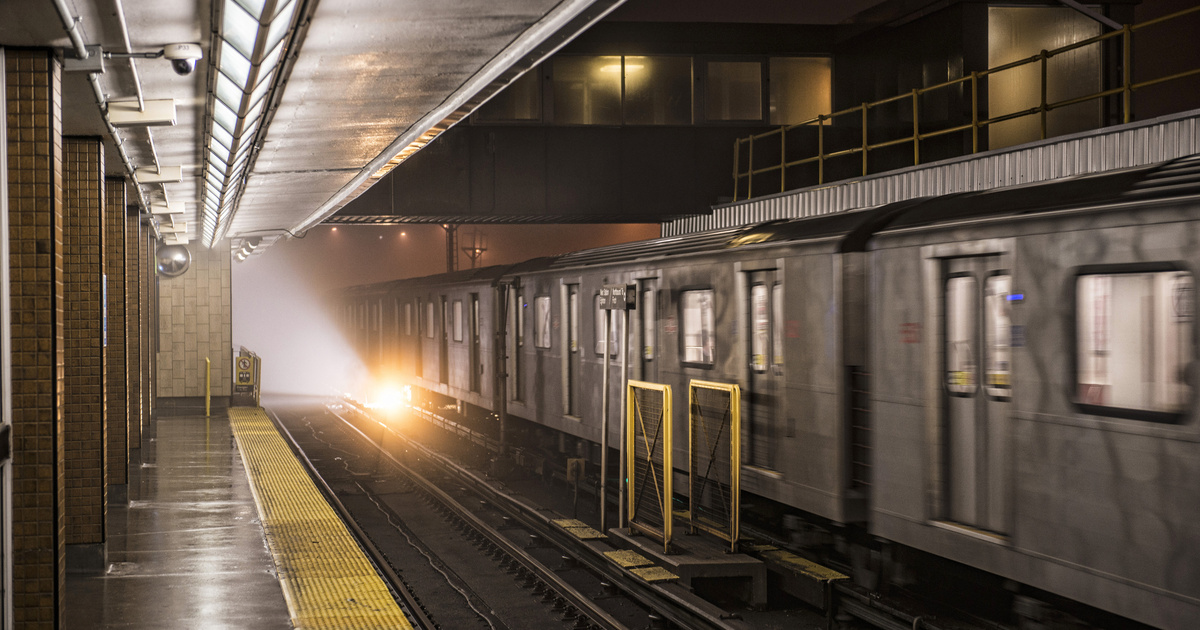
There are a lot of little annoyances when riding the TTC. Crying babies, late trains, smelly food, crowding like a sardine can, and delays can all make commuting a walking nightmare.
But, Toronto's transit agency is looking to make things a little better―by reducing the amount of noise and vibration when riding the subway.
Our neighbours along Line 2 have rightly raised concerns about loud trains passing below their homes, causing significant vibrations. The cause is wheel flats, as seen here. We believe we know why: slippery rail, skidding wheels. We’re fixing. More here: https://t.co/rLxXEXjtUw pic.twitter.com/ZfXzjTS9cU
— Brad Ross (@bradTTC) October 29, 2018
A new investigation has found many of the wheels on the Bloor-Danforth line to have developed "flats," which form when the wheels rub down in certain spots. These flats can cause significant vibration and noise as the train cars roll along.
This rubbing can be caused by several things, and the TTC says it's investigating the main causes to help prevent it in the future.
Some causes include emergency brakes being activated, debris on the tracks causing regular brakes to slide along the rail, or just normal wear after a long service life.
Over the next while, the TTC will be working to re-grind the wheels on certain cars to make them round again, reducing the amount of vibration and noise. Each train consists of a few cars, and the cars will be swapped out individually for repair to prevent service disruption.

As a seasonally appropriate topic for Halloween, the Oregon Zoo is posting a few of their favorite animal X-rays taken during routine health exams. Included in the mix is a branch-dwelling chameleon, open-beaked toucan, and a bat that appears to be caught mid-flight. The scans are a normal part of the check-ups at the zoo, and are used by animal experts as a helpful diagnostic tool to minimize anesthesia and provide faster results. You can follow more of the zoo’s spooky posts on Twitter.


German architecture firm Behet Bondzio Lin Architekten recently constructed a new headquarters for the Association of the Northwest German Textile and Garment Industry in Münster, Germany. The firm wanted the building to allude to the association’s work with fabric, and designed a facade that would imitate its folds through a gradient of bricks oriented at different angles.
The decision to recreate the appearance of a soft textile from a firm material was inspired by the alabaster folds of Max Klinger's statue of Beethoven located at the Leipzig Art Museum. The carved composer sits shirtless on an armchair with what appears to be a piece of fabric draped over his knee. The fluid nature of the sculpture’s scarf is believable, despite its composition of solid stone. A similar experience is shared by the new headquarters, however created from bricks rather than rock. You can see more of the Behet Bondzio Lin’s designs on their website. (via Jeroen Apers)


torp3918So cool. Thanks.
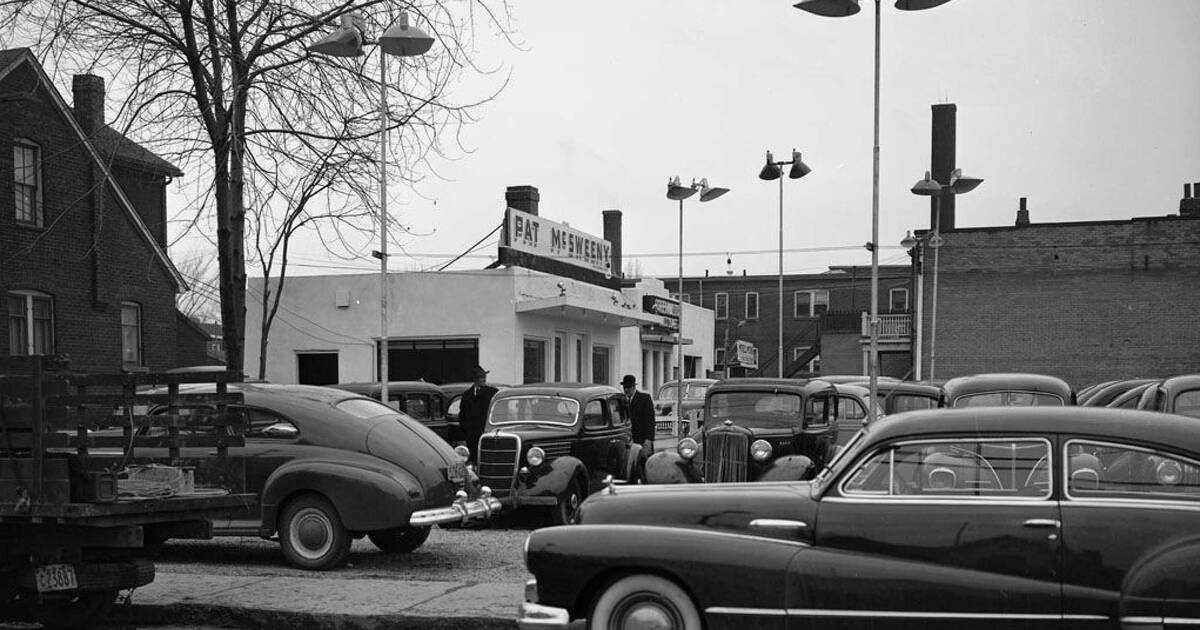
Toronto of the 1940s was a tale of two halves. The draining effects of the second world war kept the city in a state of austerity until 1945, when the six-year conflict finally drew to a close.
In the years that followed, an uptick in the economy saw the construction of new affordable housing, the start of building work on the Yonge subway line, and increased attention to solving slum conditions in the inner city.
The decade also brought unspeakable tragedy. In 1949, 118 people died when the SS Noronic, a lake steamer docked overnight on the Toronto waterfront, caught fire and rapidly burned. The disaster is still the worst loss of life from a single event in the history of the city.
Here's a look back at Toronto of the 1940s.
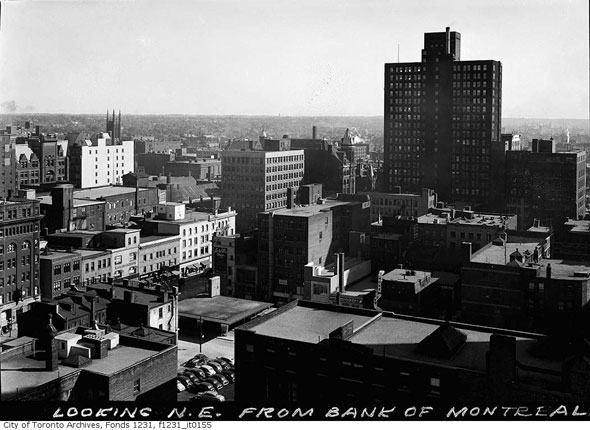
Northeast from the old Bank of Montreal building at the corner of King and Bay, demolished for First Canadian Place.
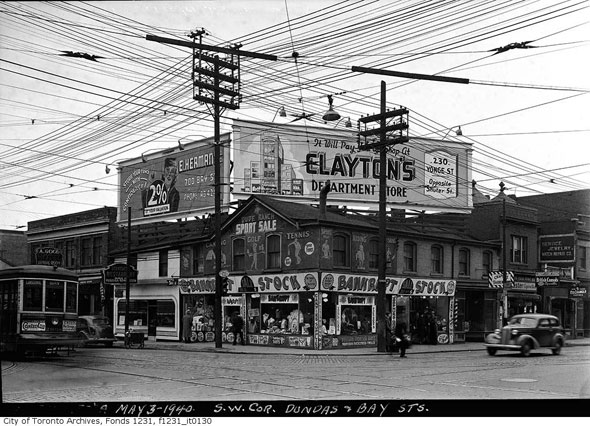
Store selling bankrupt stock at Dundas and Bay carrying an ad for Clayton's department store.
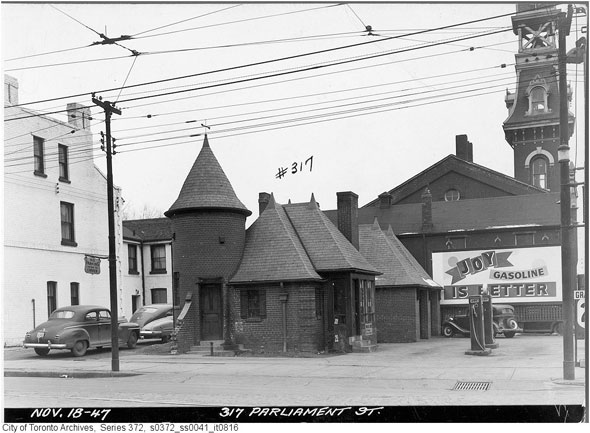
A Joy Oil gas station earmarked for demolition at Dundas and Parliament prior to construction of Regent Park.
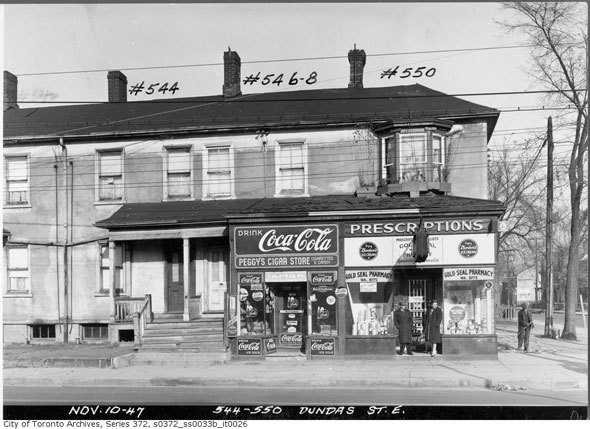
Peggy's Cigar Store and Gold Seal Pharmacy on Dundas St. E. in Regent Park.
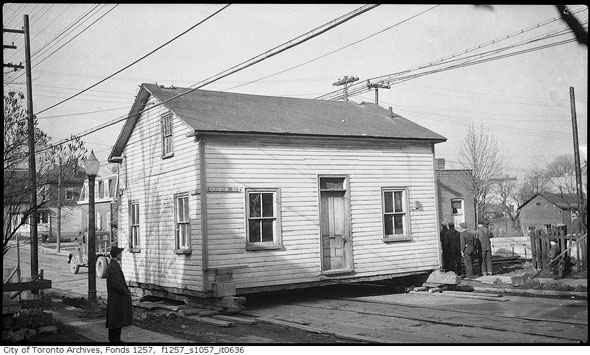
Moving house.
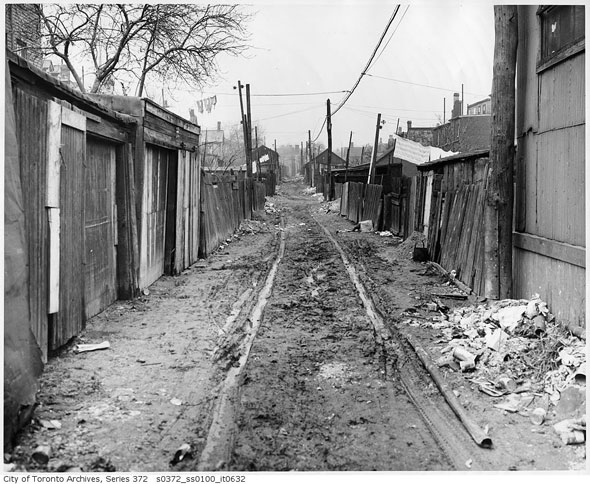
A muddy laneway that had drawn the attention of the Department of Street Cleaning.
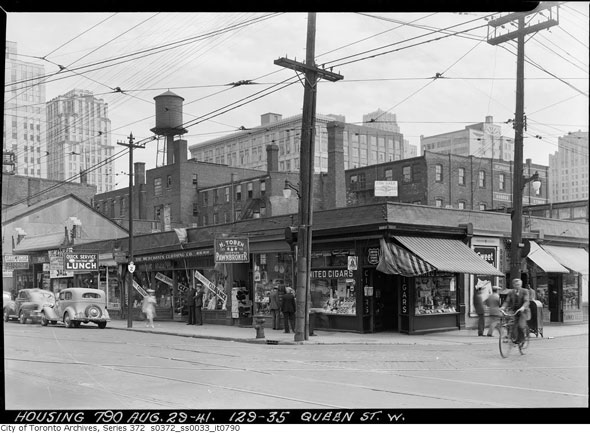
South side of Queen Street W. at York. Now the site of the Sheraton Hotel.
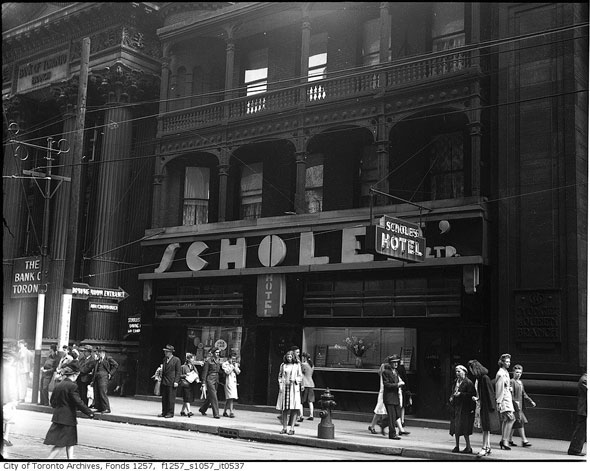
The Scholes Hotel on Yonge St.
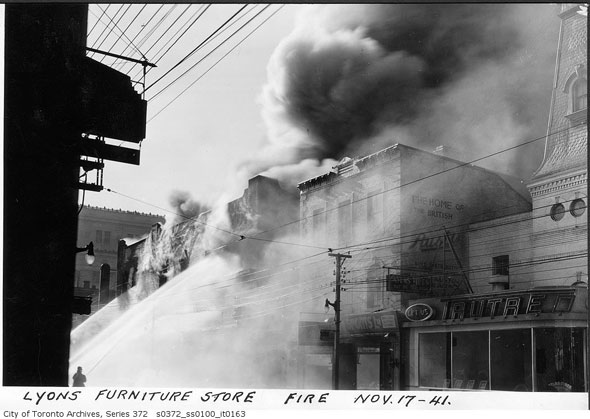
Fire at Lyons Furniture Store.
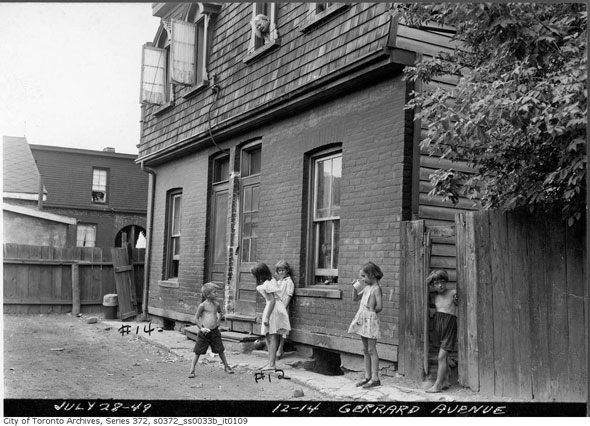
Kids playing on Gerrard.
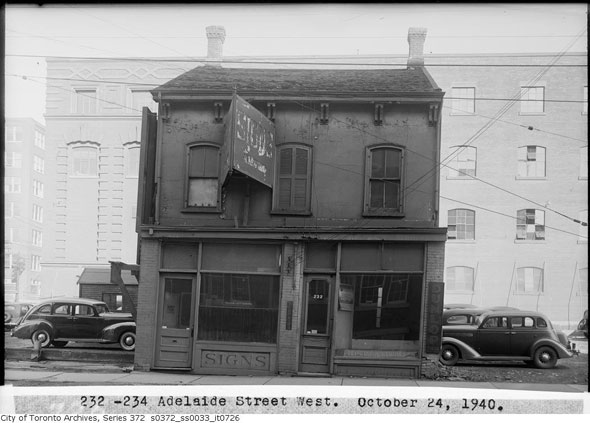
Crooked store on Adelaide St. W.
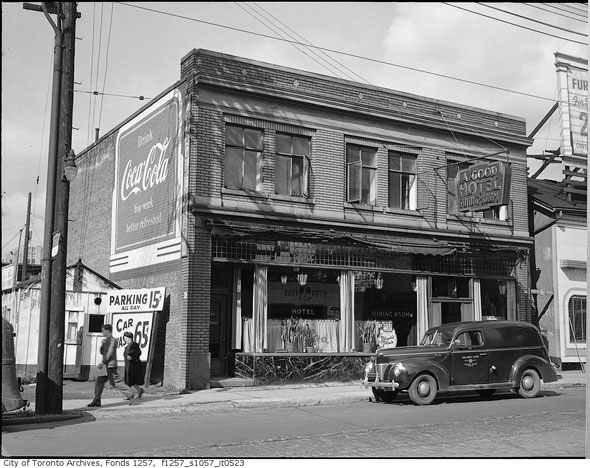
"A Good Hotel"
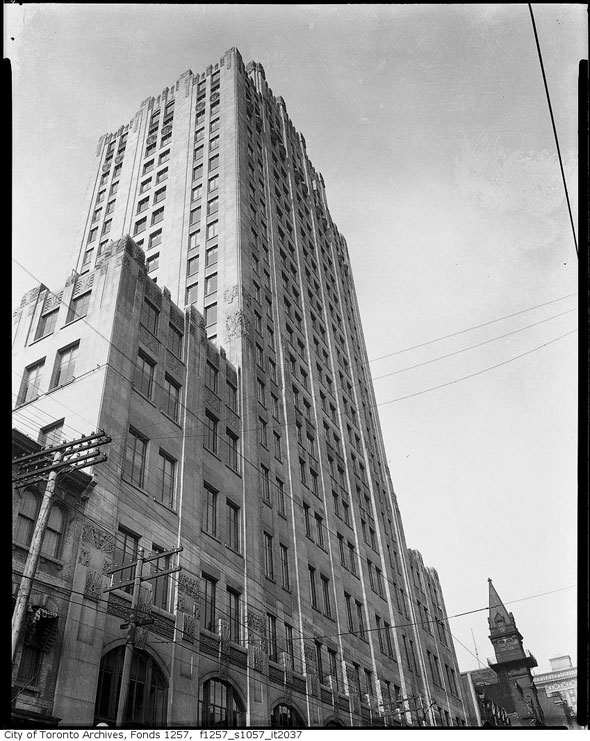
The old Toronto Star Building on King Street W. near Bay.
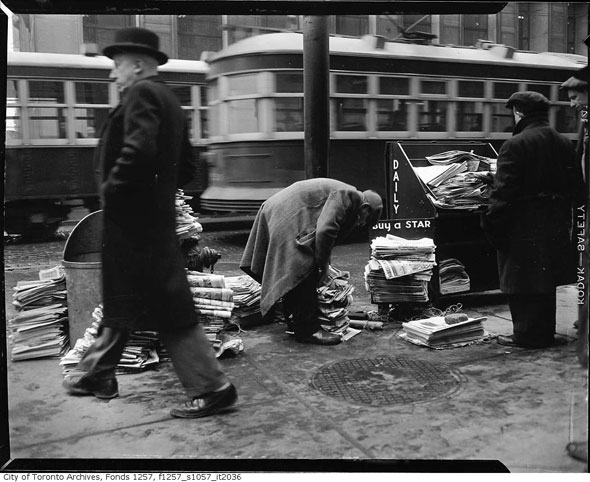
A Toronto Star newspaper stand.
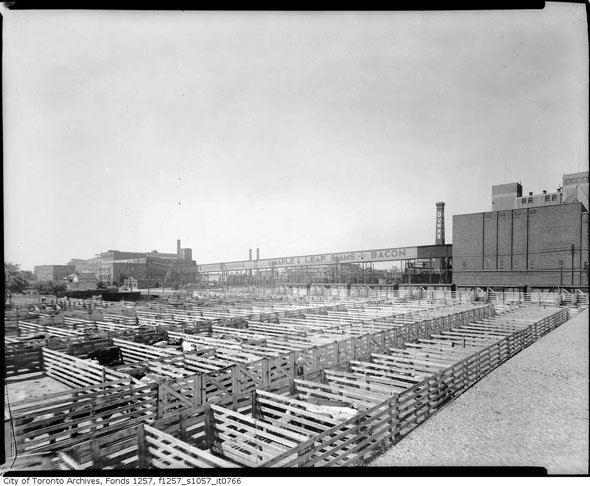
The Maple Leaf stockyards in the Junction.
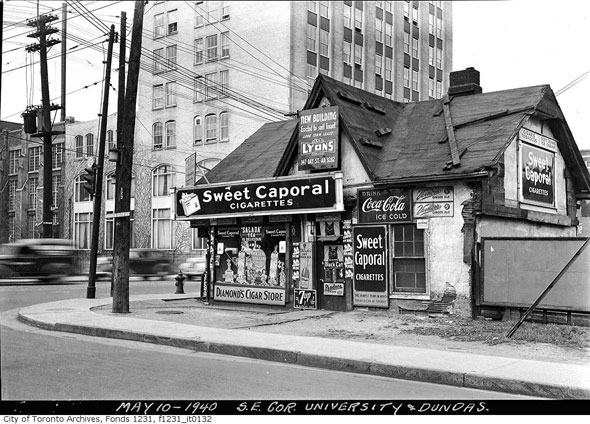
Sweet Caporal cigarettes for sale at University and Dundas.
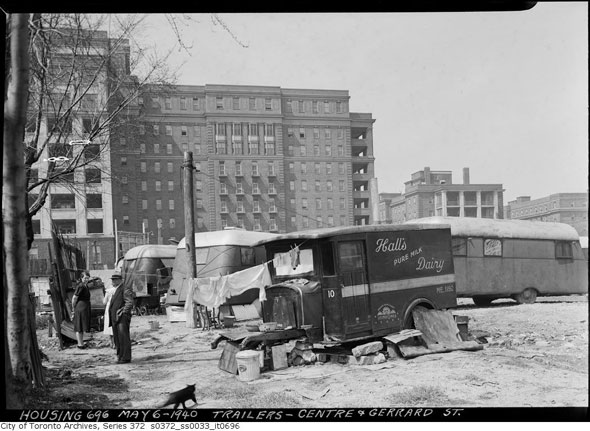
Collection of trailers being used as homes near Centre and Gerrard streets.
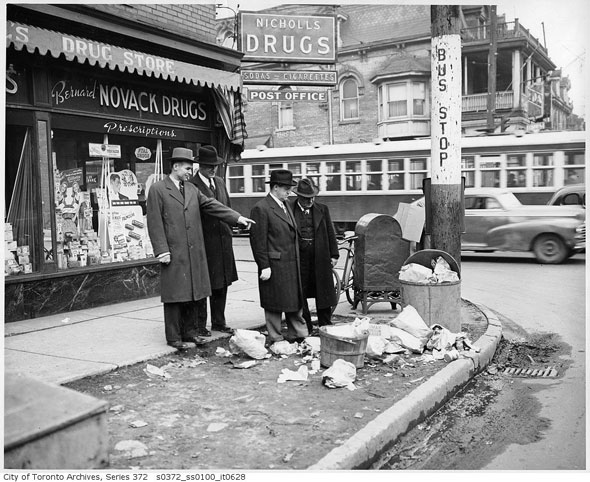
Street cleaning team inspects a pile of garbage.
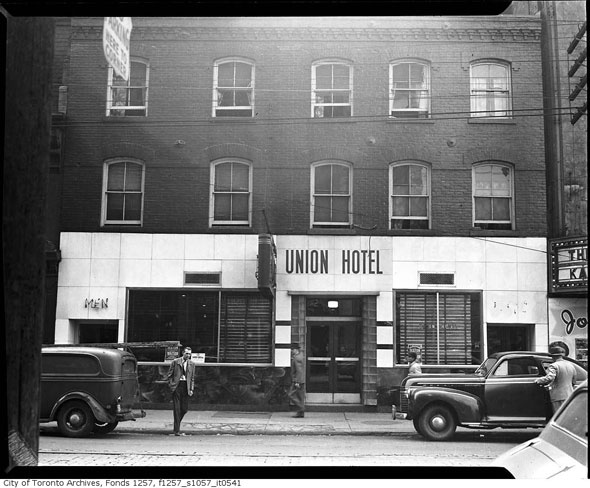
The exterior of the Union Hotel.
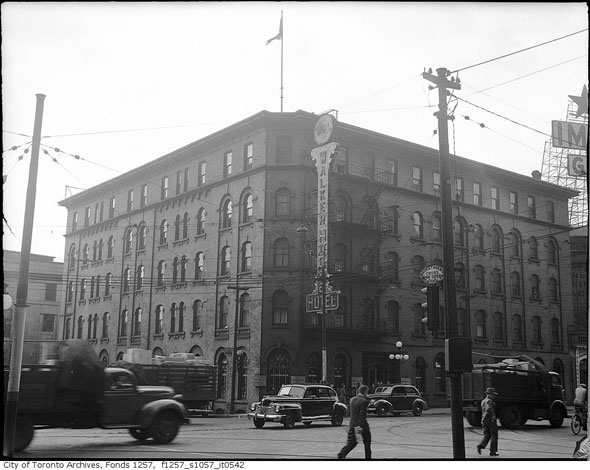
The historic Walker House hotel at Front and York streets.
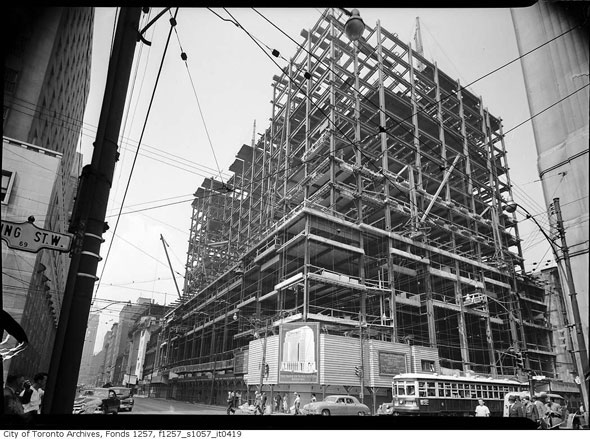
Construction of the Bank of Nova Scotia building on the northeast corner of King and Bay.
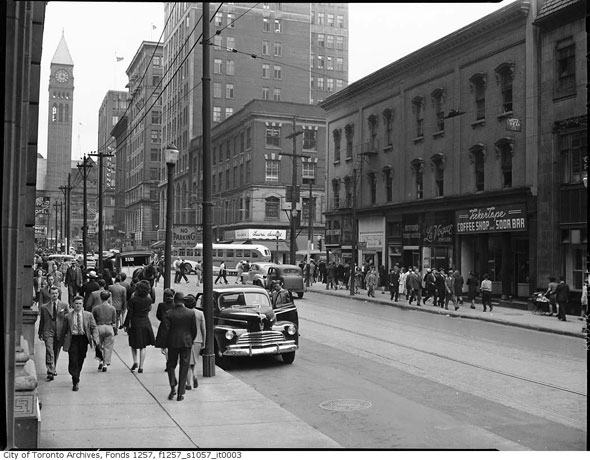
North up Bay from Adelaide.
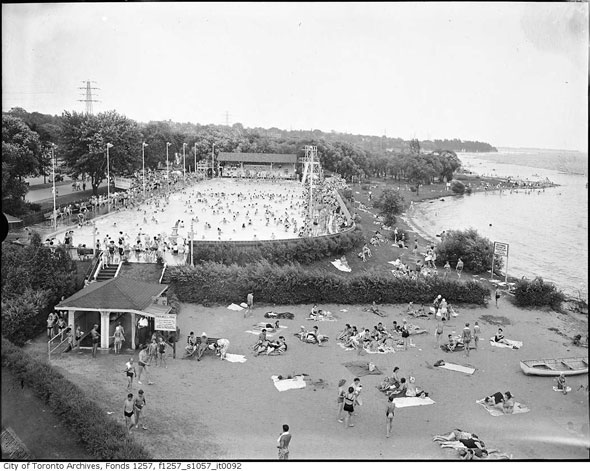
The pool at Sunnyside.
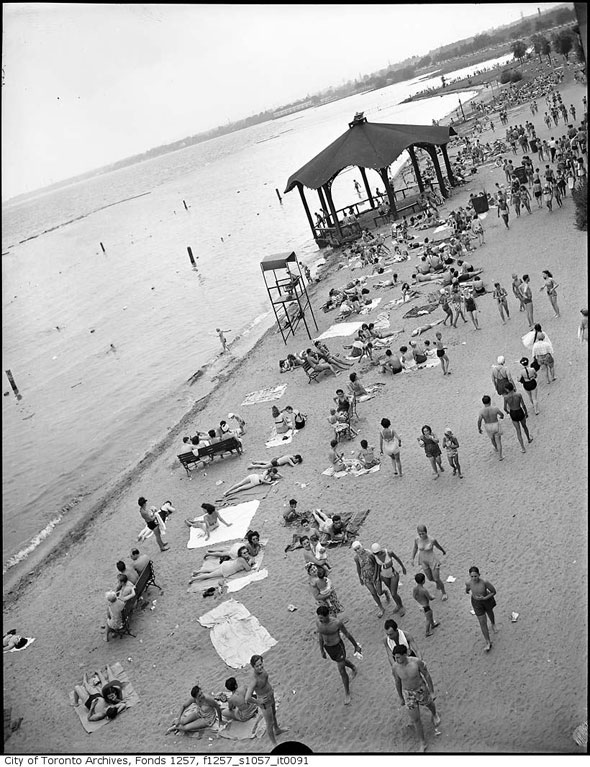
Bathers on Sunnyside beach.
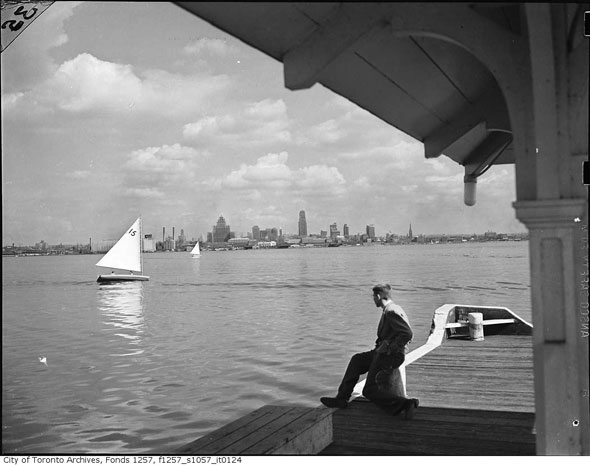
Boathouse on the Toronto Islands.
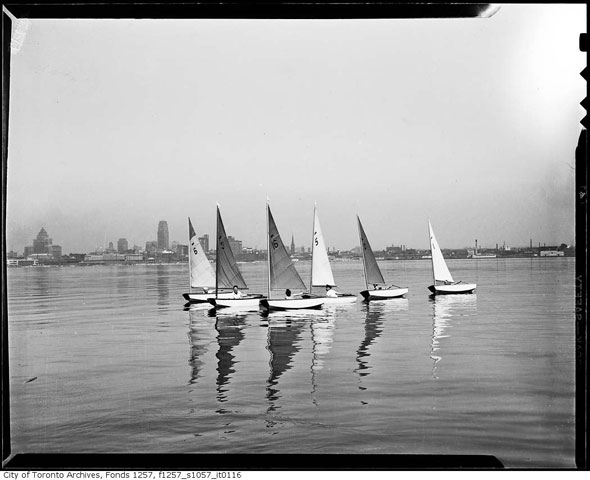
Sailboats on a tranquil Toronto bay.
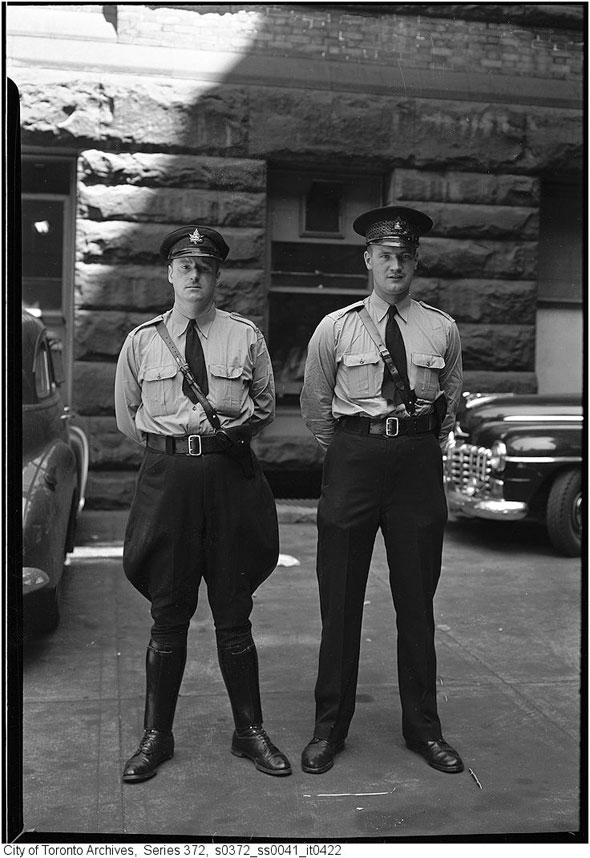
Toronto police show off their new uniforms,

Kids in a "typical classroom," 1940.
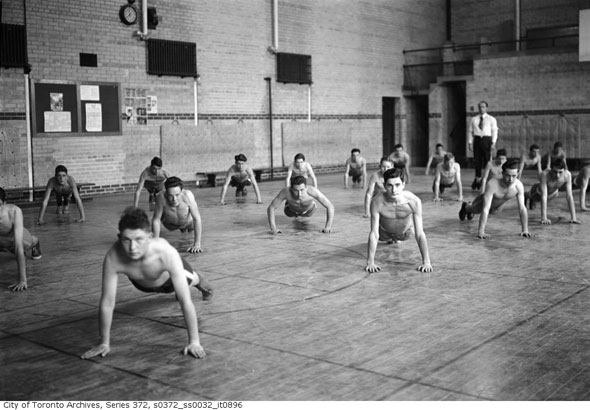
High school fitness class, 1942.
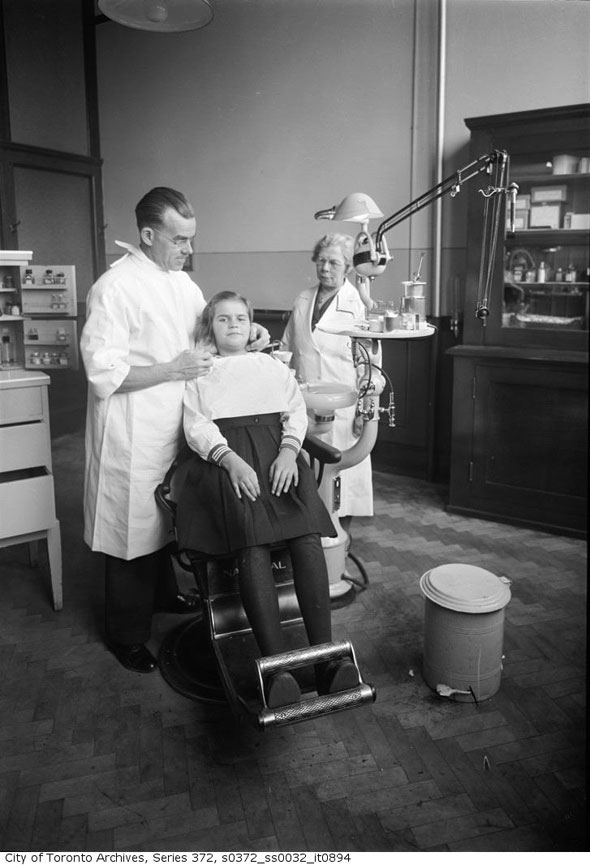
Dentist prepares to examine a girl at a high school clinic.
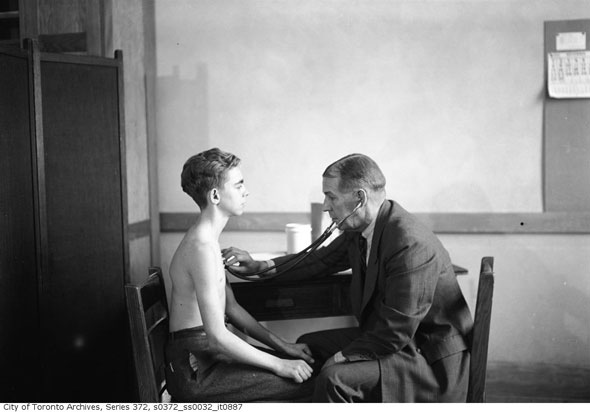
Doctor performs a routine health examination at a Toronto school.
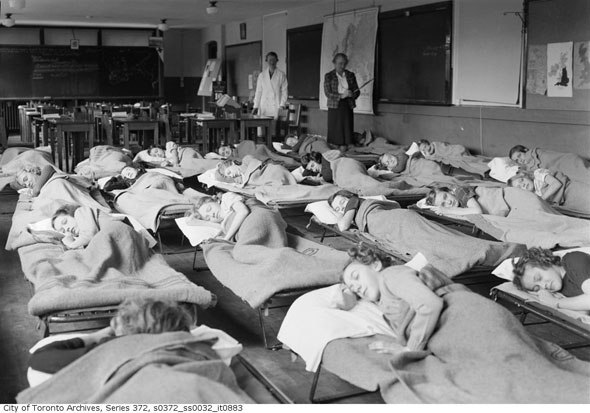
Kids sleeping on cots at the Wilkinson Open Air School. Outdoor educational facilities were established to help combat tuberculosis on the assumption fresh air and good ventilation would be beneficial to health.

Visiting nurse feeds a baby.
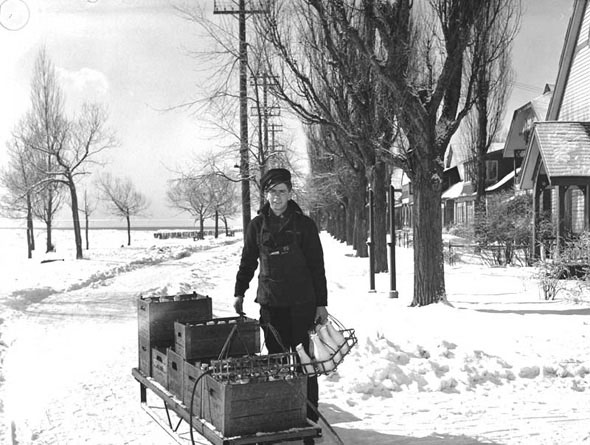
Toronto Island milkman makes deliveries using a sled.
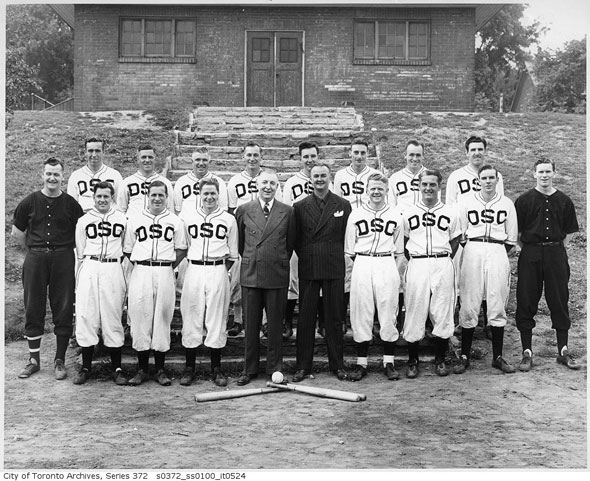
Toronto's Department of Street Cleaning's baseball team.
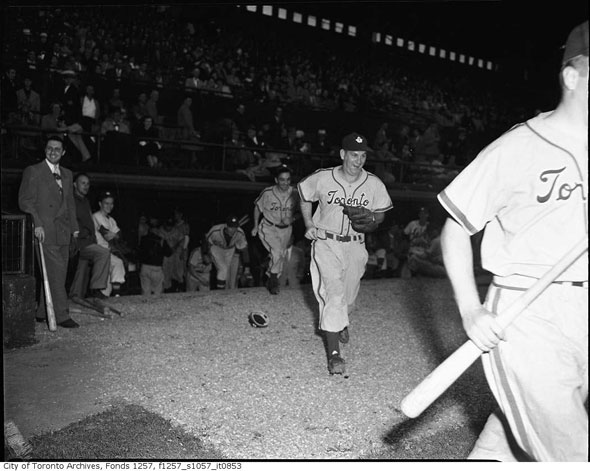
The baseball Toronto Maple Leafs take to the field.
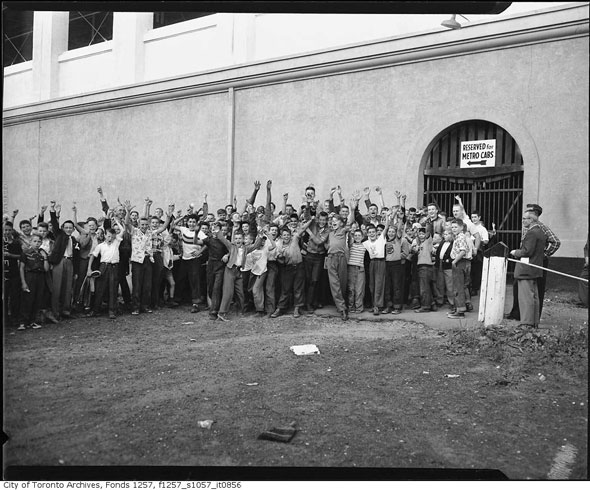
Ticket lineup at Maple Leaf Stadium at Bathurst and Lake Shore.
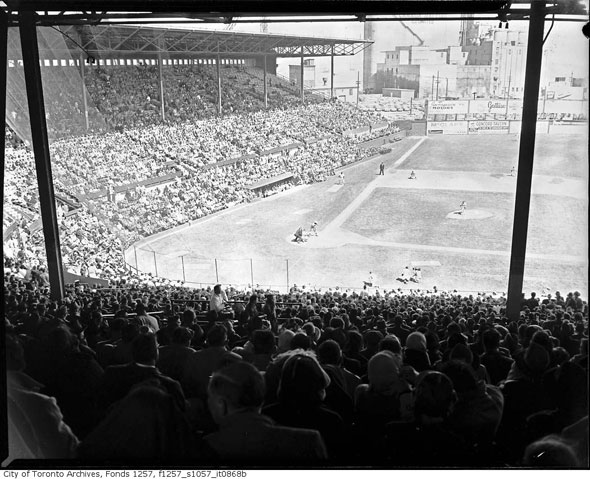
The view from the stands.
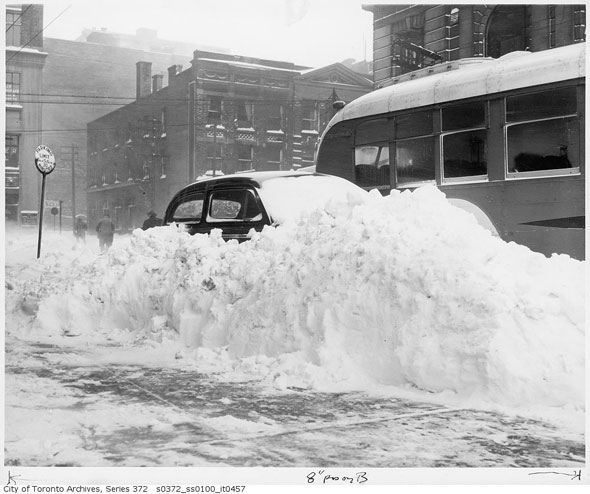
The Toronto snowstorm of December 11, 1944 is a contender for the worst of all time. In just over 72 hours, 55 cms of snow fell on the city, burying streets waist-deep. The wind and weight of snow was so severe that a Queen streetcar was knocked on its side, killing one. 21 people died as a result of the weather, 13 of them from cardiac arrest while shovelling.
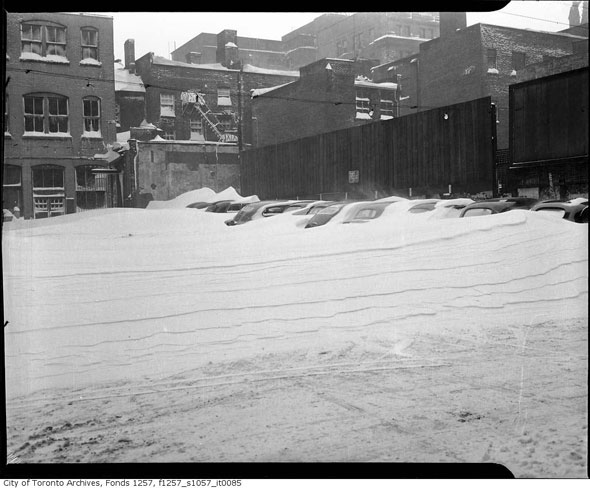
A snow-covered parking lot during the storm of 1944.
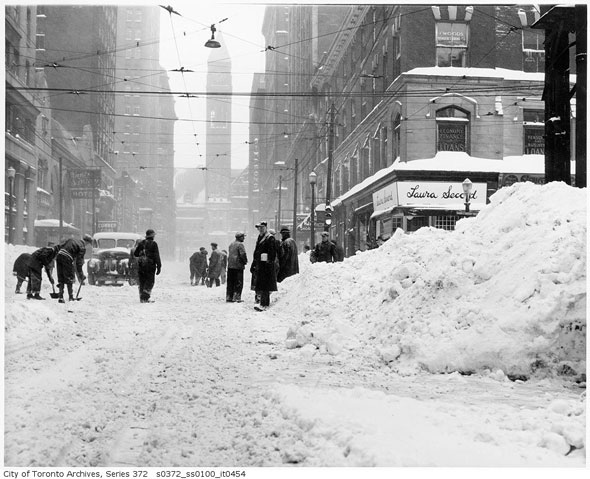
Crews armed with shovels attempt to dig out a clear path on Bay Street.
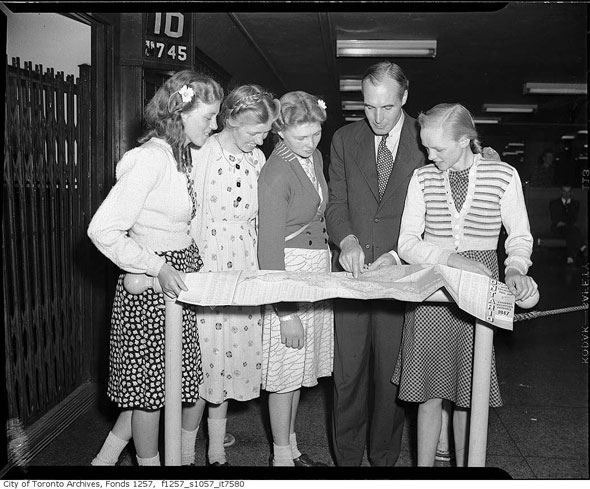
Dutch immigrants at Union Station puzzle over a 1947 Ontario road map.
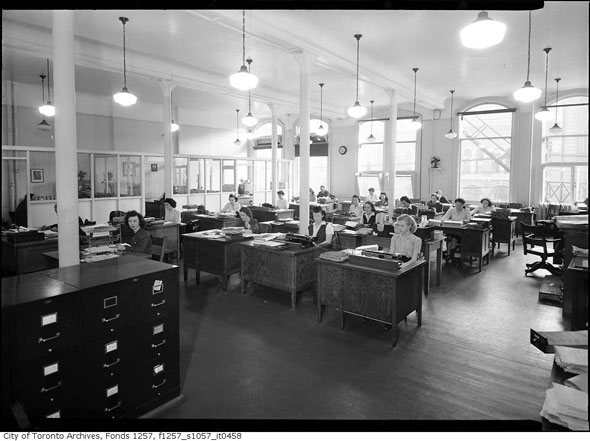
The typing pool at in unidentified office building.
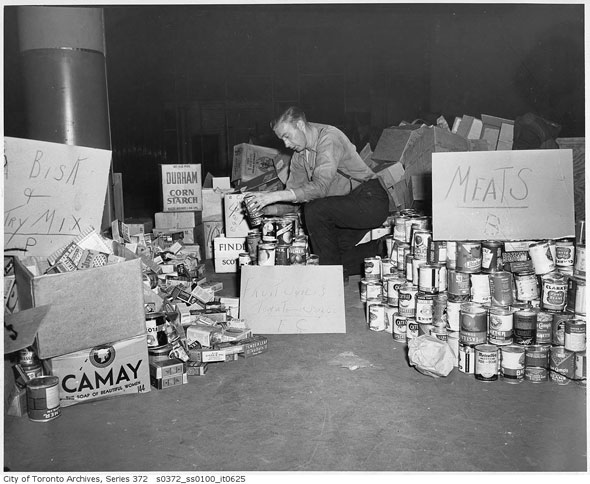
Wartime "Food for the People of Britain" drive by the city's Department of Street Cleaning.
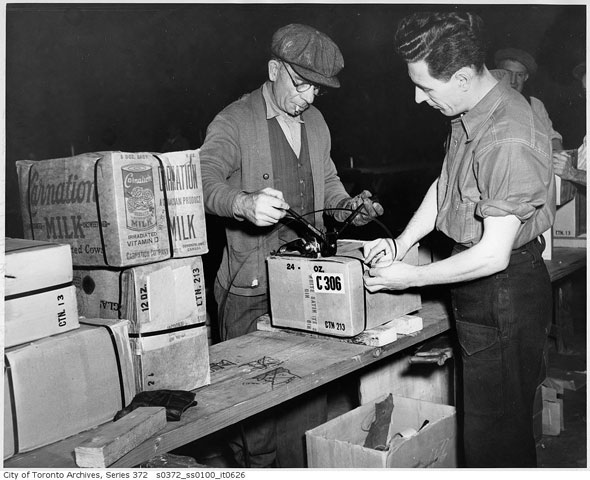
Food packages being wrapped for shipment to the UK.
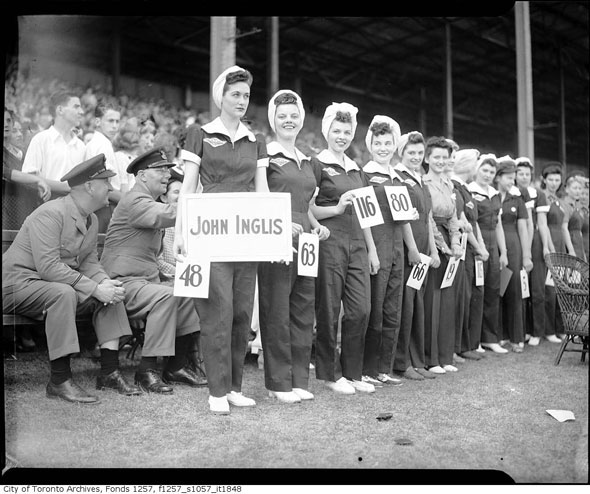
Contestants in the Miss War Worker beauty contest.
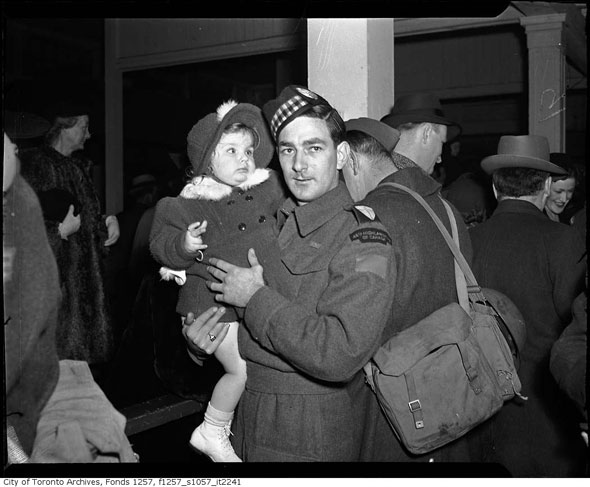
Soldier with a baby at Union Station.
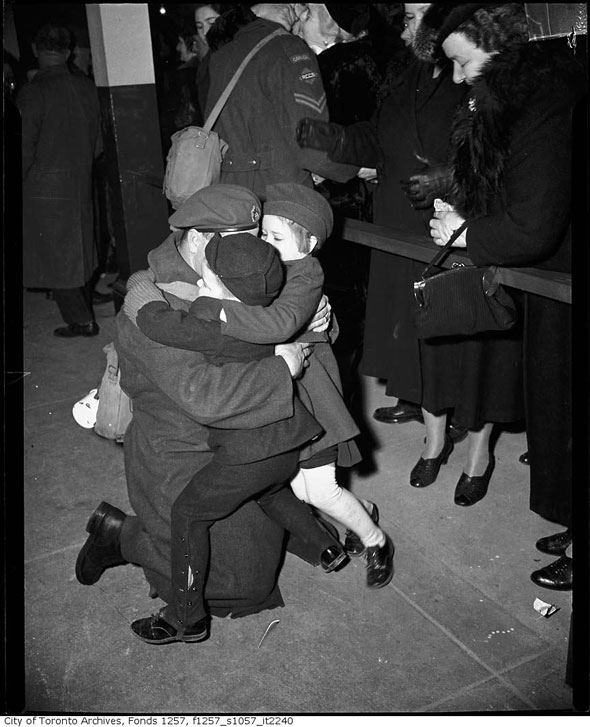
Returning soldier embraces children at Union Station.
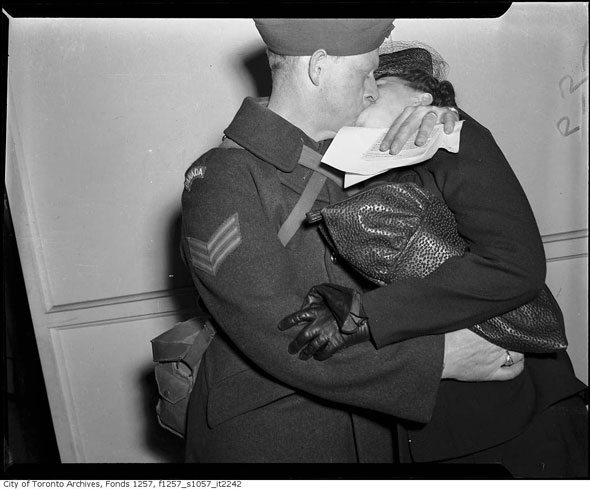
Soldier locked in a passionate embrace on return to Toronto.

All smiles as a soldier returns from the second world war.
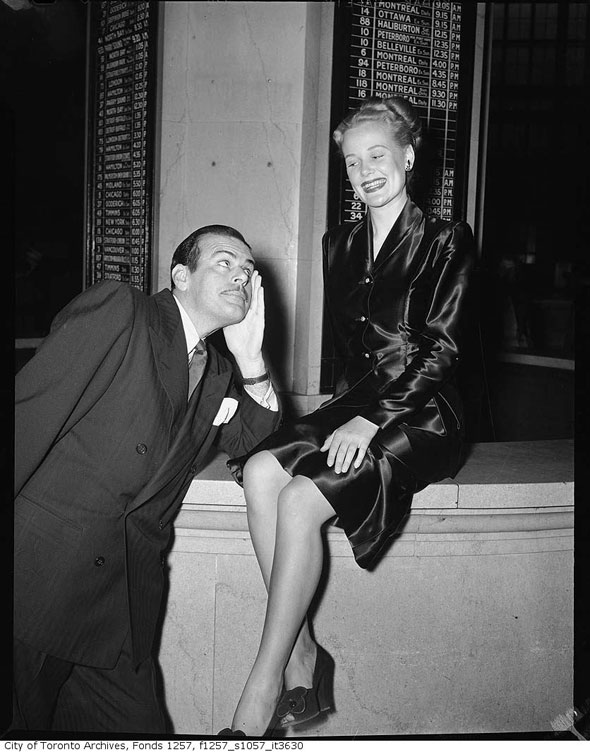
Miss Toronto 1947 poses for photos at Union Station.
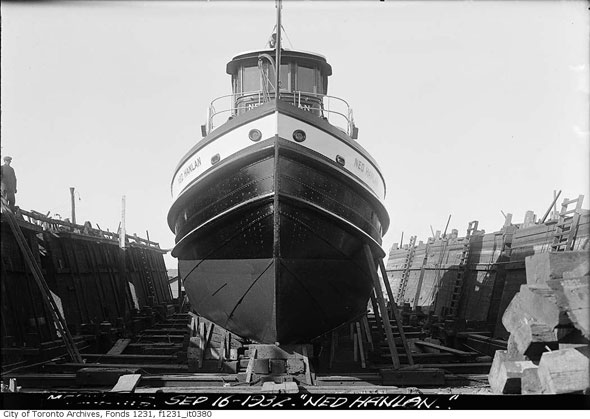
City of Toronto tug "Ned Hanlan" in dry dock.
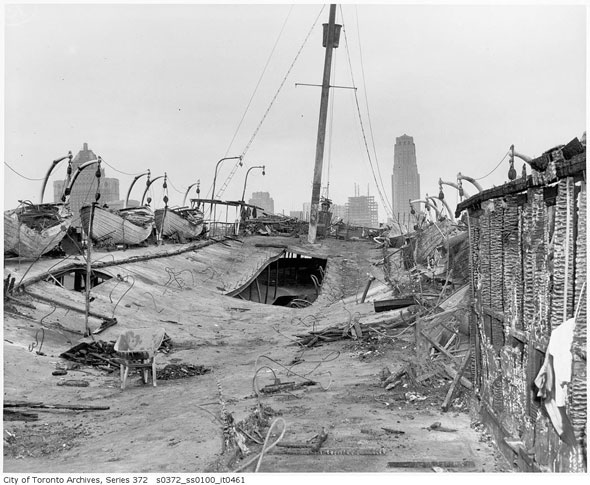
The Royal York hotel and skyline from the gutted upper deck of the SS Noronic. The lake steamer nicknamed The Queen of the Lakes caught fire while docked on the Toronto waterfront in early hours of September 17, 1949, killing 118 people.
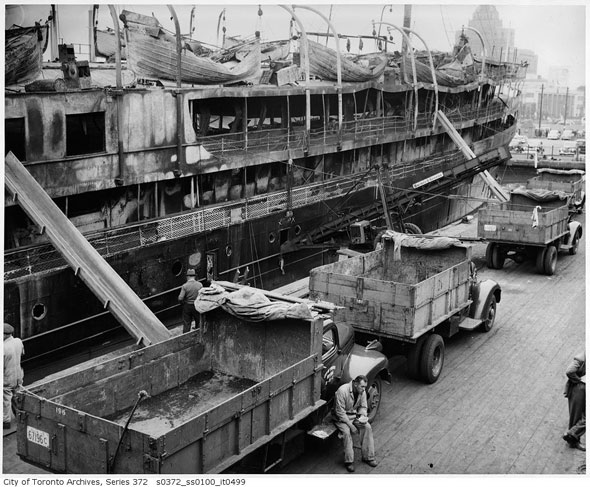
The side of the burned out SS Noronic. In the aftermath of the fire, an investigation found the design of the ship was partly to blame for the high death toll. Many people leapt to their death on the dockside, others died from smoke and burns.
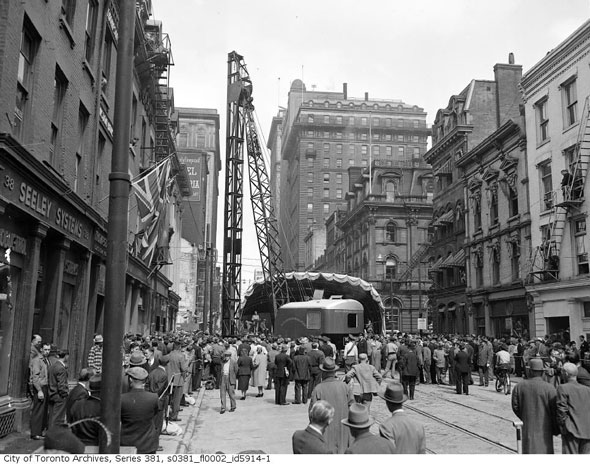
A machine prepares to break ground for construction of the Yonge subway in 1949.
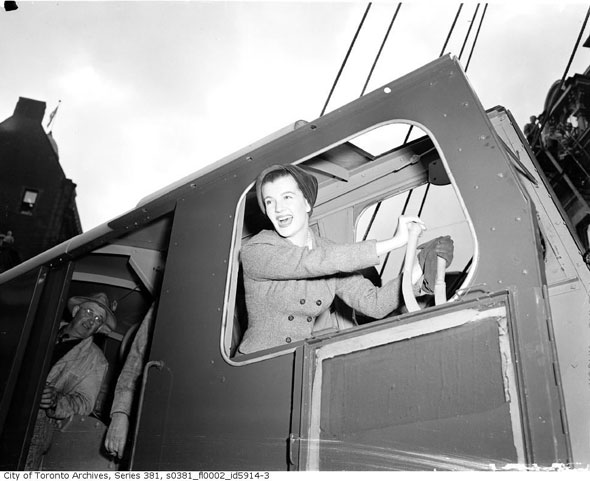
Dignitaries pose for ceremonial groundbreaking photos in the cab of a digger.
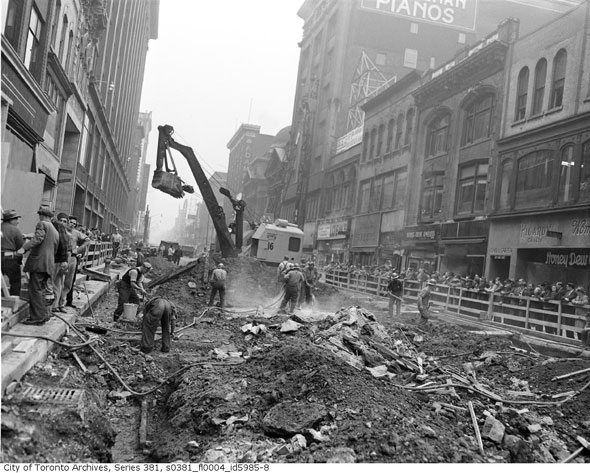
Subway construction workers begin digging down on Yonge St.
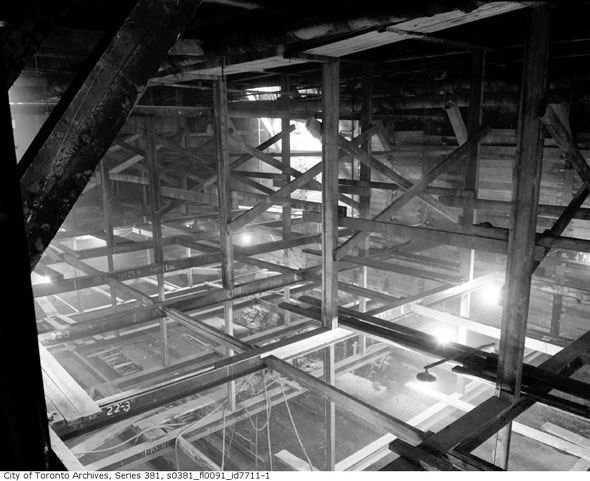
The excavated ground beneath Yonge St. in the late 1940s.

Although the former municipalities of Etobicoke, North York, York, and Scarborough are sometimes still referred to as suburbs of Toronto, development in these areas over the last 30 years and the sprawl that's given birth to the Greater Toronto Area should probably mute such references.
While not as dense as the downtown core, wide areas of Toronto's former suburbs have become more and more urbanized over the years, a process which continues to take place as steep real estate prices drive would-be home owners further and further from the core.
But what did they look like before this process took place?
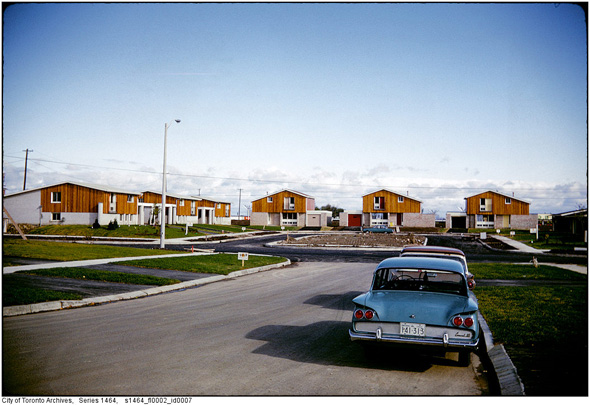
Mid-century suburban cul-de-sac, 1961.
Let's be honest, there aren't a lot of surprises here. Sure there are a few shots of streets and intersections that have changed dramatically over the years, but the thing about suburban architecture is that its individual features tend to blend in with one another.
Are we in North York or Etobicoke? It's tough to tell once you get to the residential streets. The design of these places speaks more to the time period in which they were built rather than the specific place they're located.
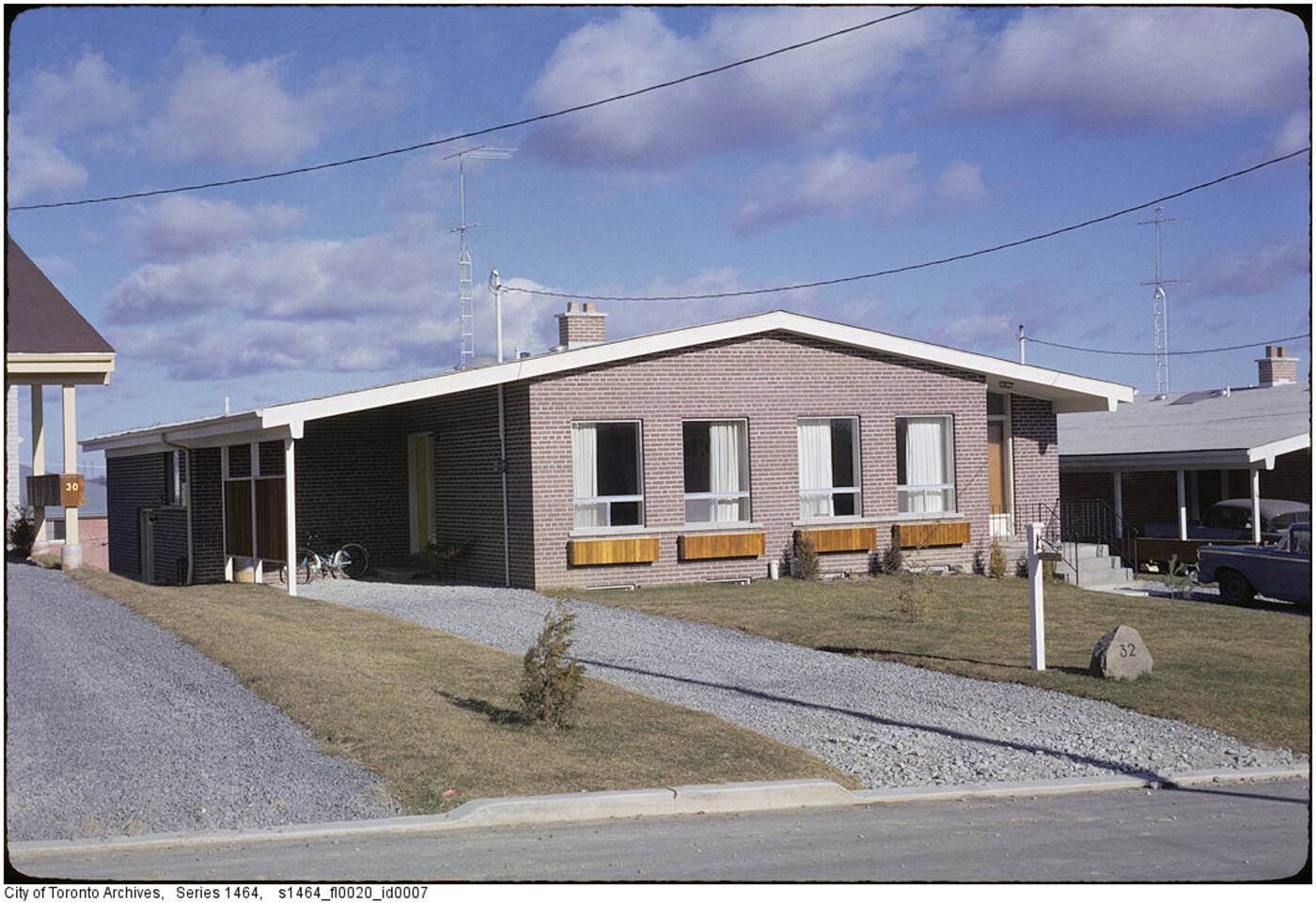
Car-ports were standard issue in North York back in the 1950s.
There is, however, plenty that's fascinating about the birth of the suburbs in Toronto. In addition to demonstrating how mass car ownership transformed planning principles, there's something else to be spotted in these photos.
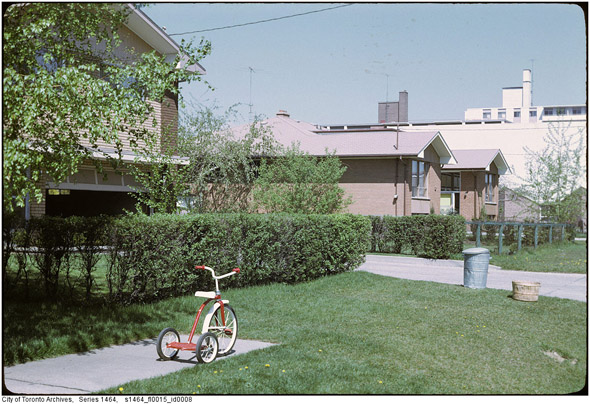
There's this strange combination of optimism and fear that seems built into the very form of these communities, from their well manicured but generally empty front yards to the eerie preponderance of abandoned tricycles. This is the stuff nostalgia is made out of.
Here's what Toronto's suburbs used to look like.
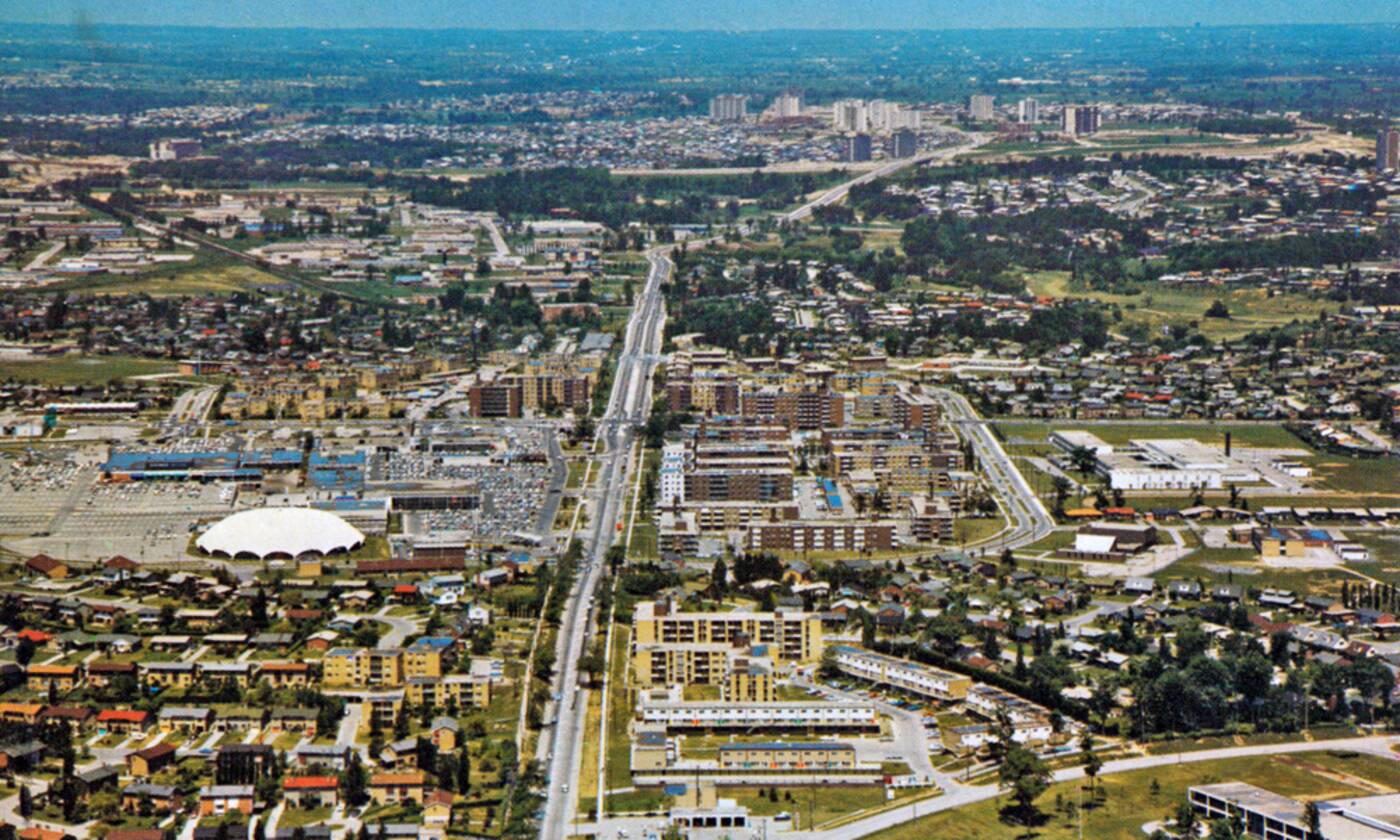
Looking down on Don Mills in 1968.
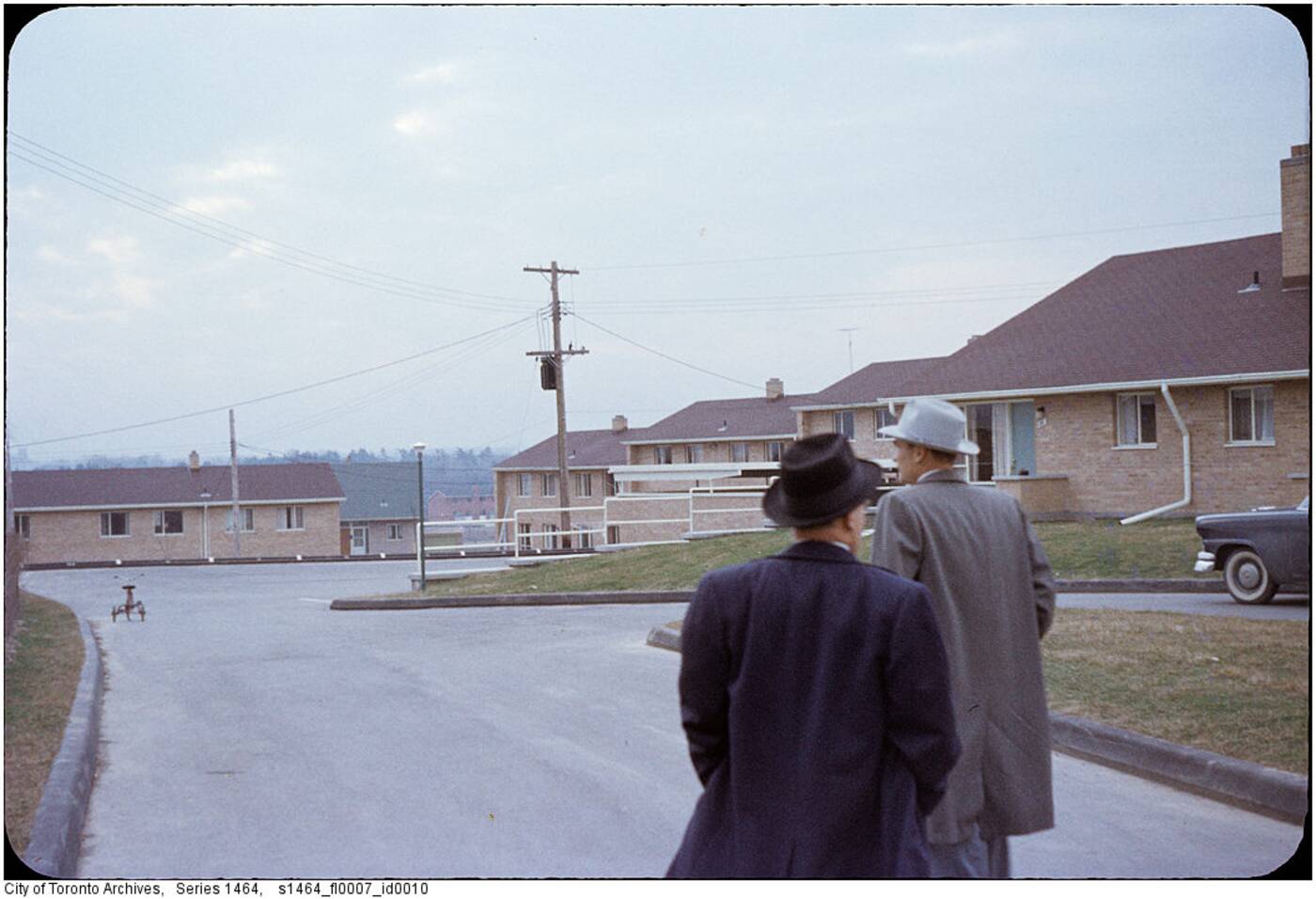
Urban planners survey their work in Don Mills, ca. 1950s.
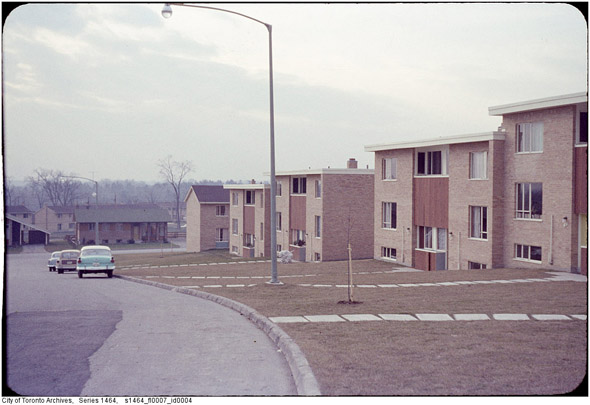
Unidentified Don Mills street in 1956.
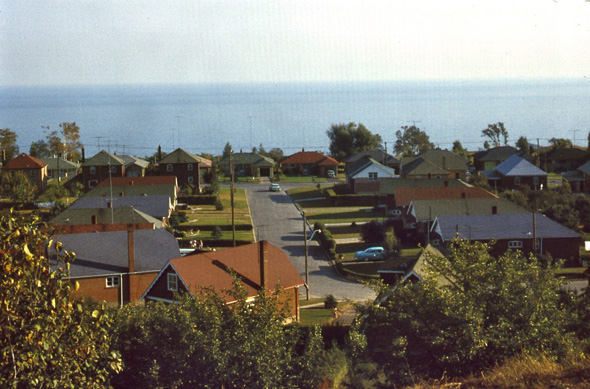
Cliffside Drive, 1961.
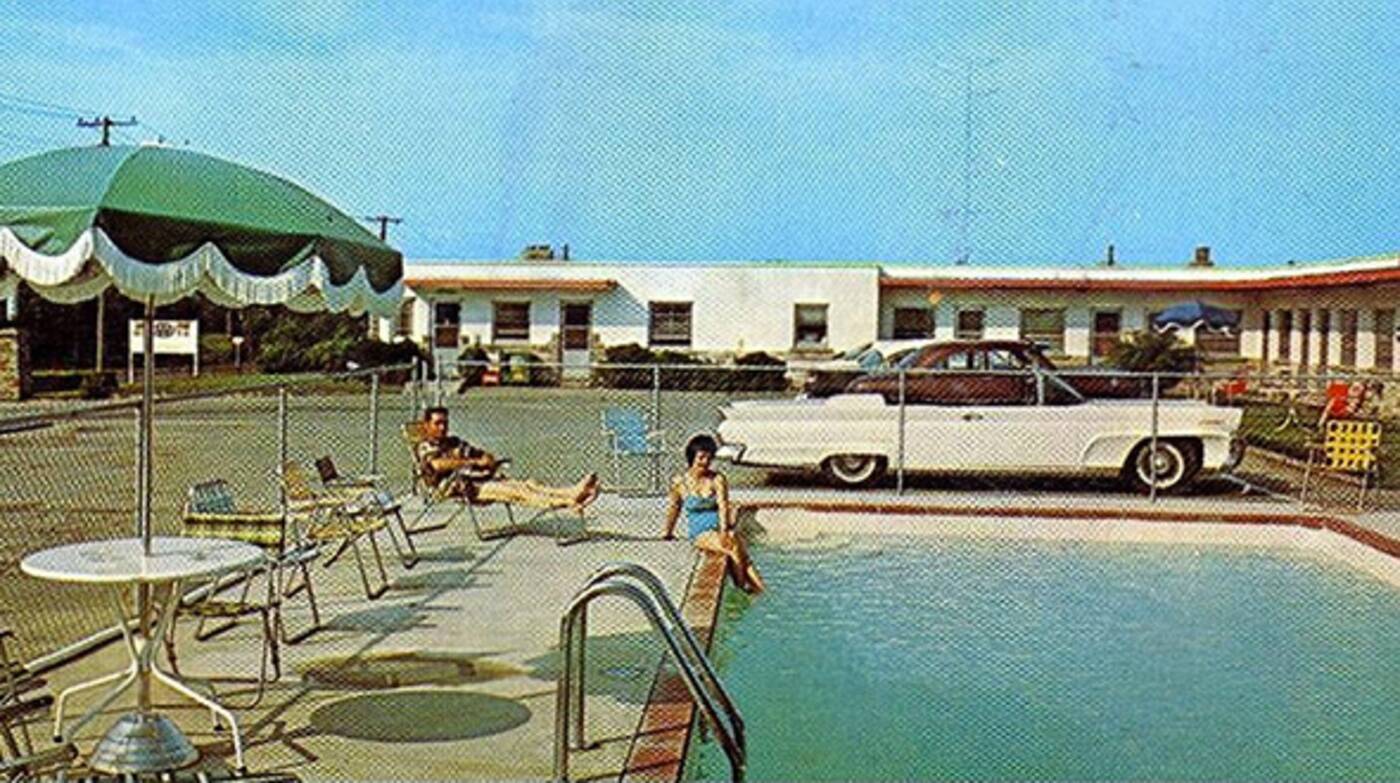 Better days at the Roycroft Motel, Kingston Road.
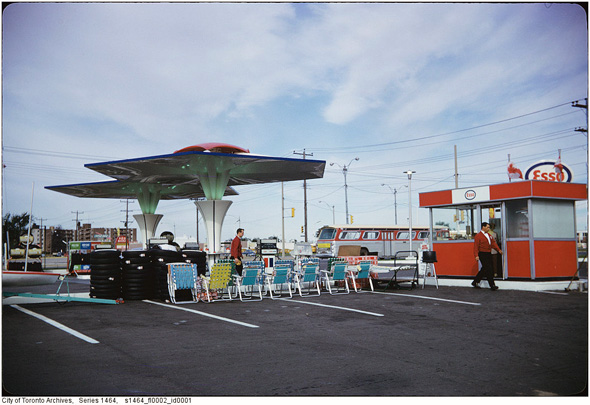
Esso gas station on Kingston Road.
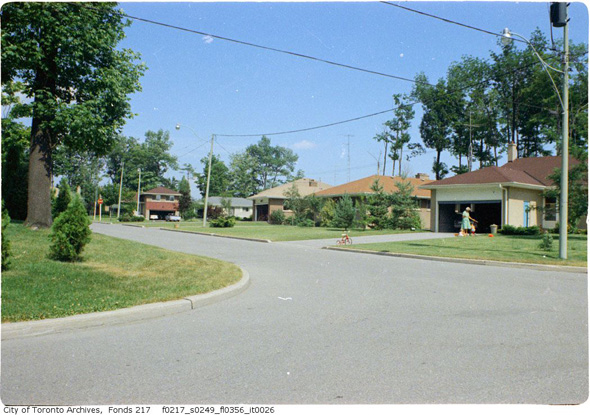
Another abandoned tricycle, 1961.
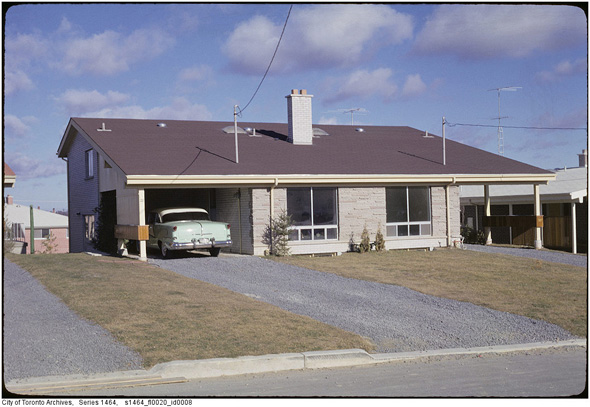
Now that's a nice car-port, 1961.
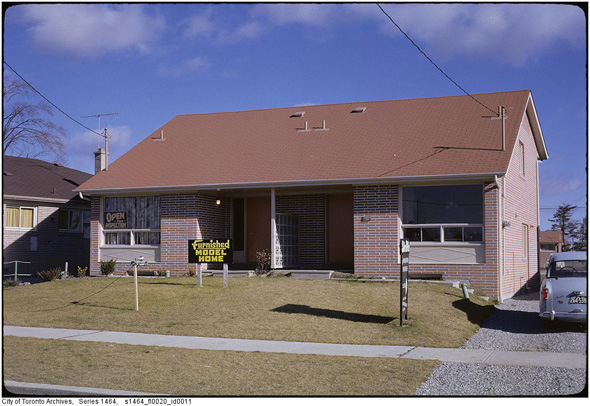
North York model home, 1961.
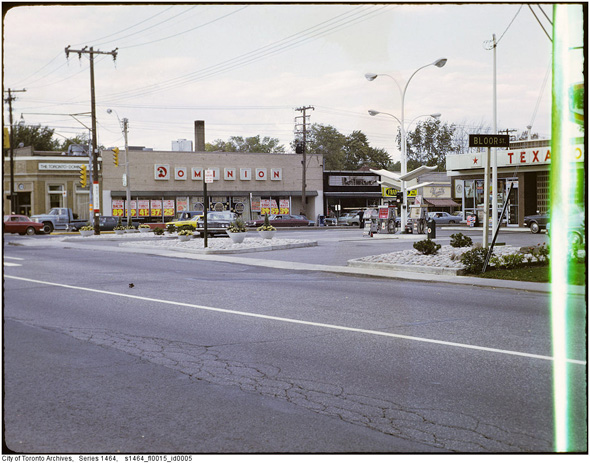
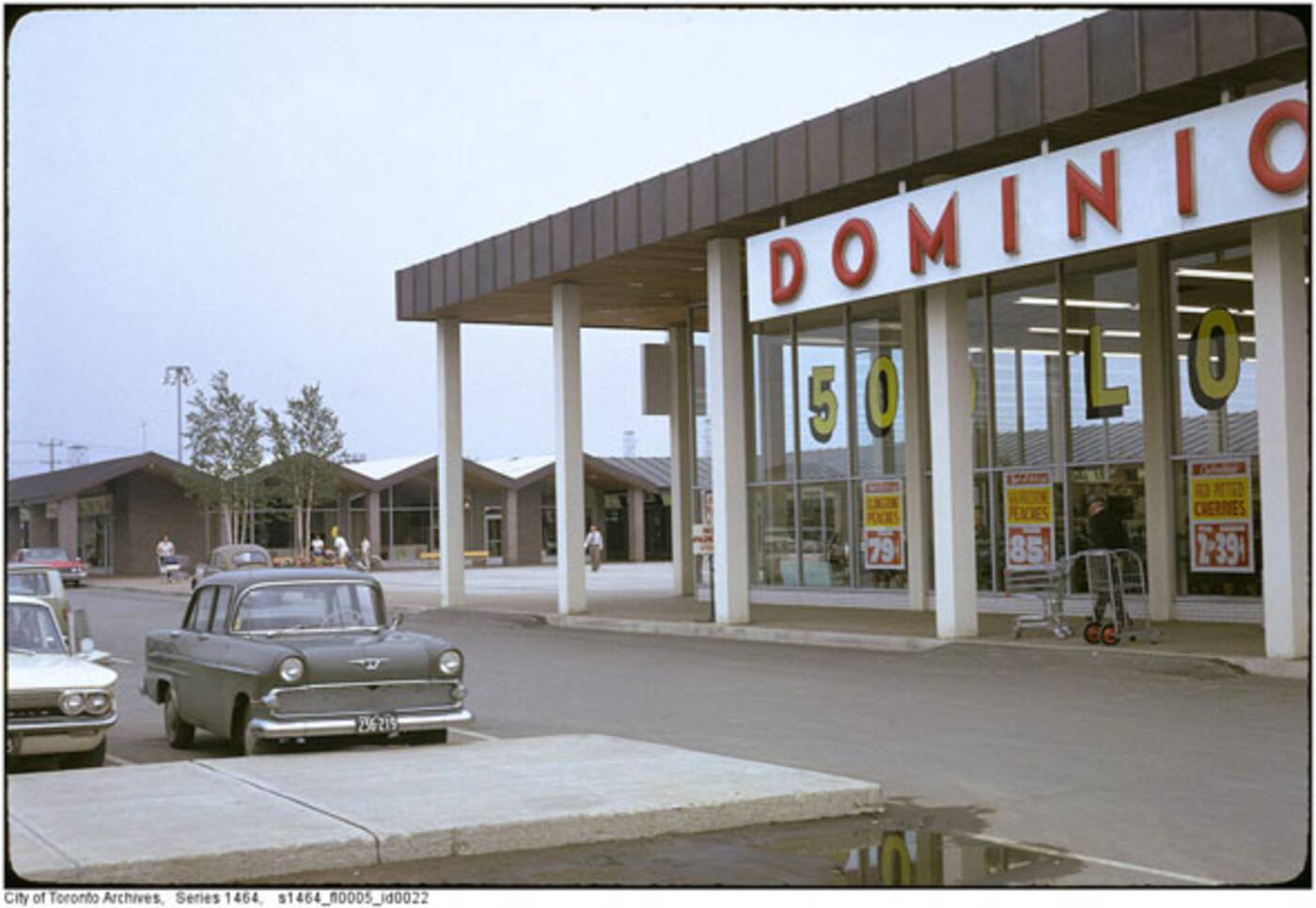 Dominion at Parkwoods Plaza.
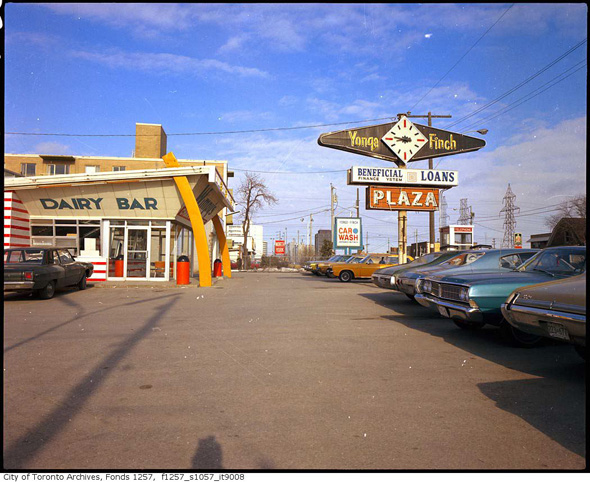
Yonge-Finch plaza, 1972.
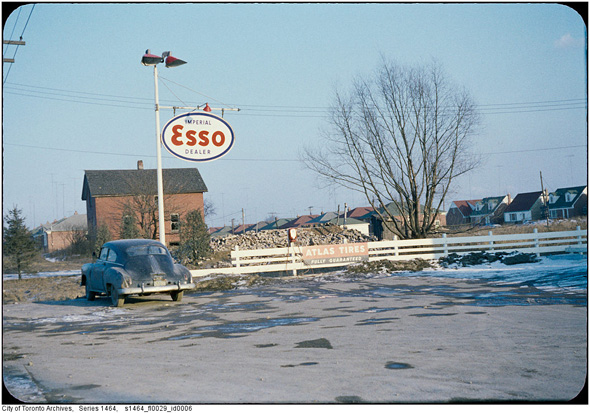
Rexdale, 1950s.
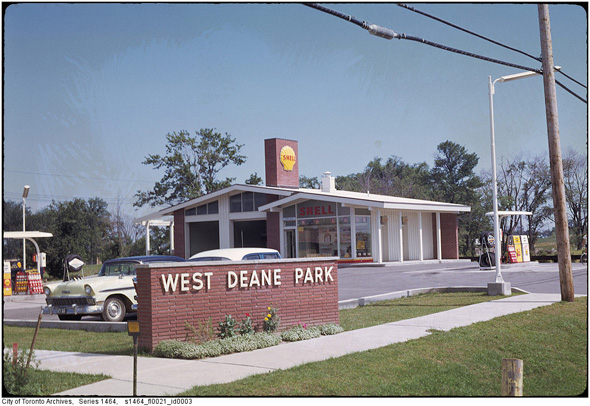
West Deane Park, 1961.

Near Queensway and Royal York, 1961.
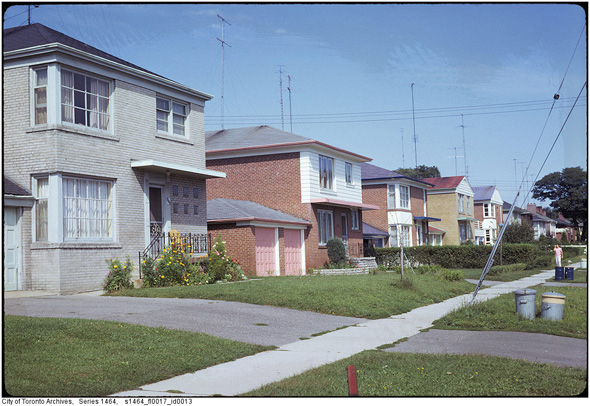
Near Queensway and Royal York, 1961.
Alderwood area, 1968.
Alderwood area, 1968.
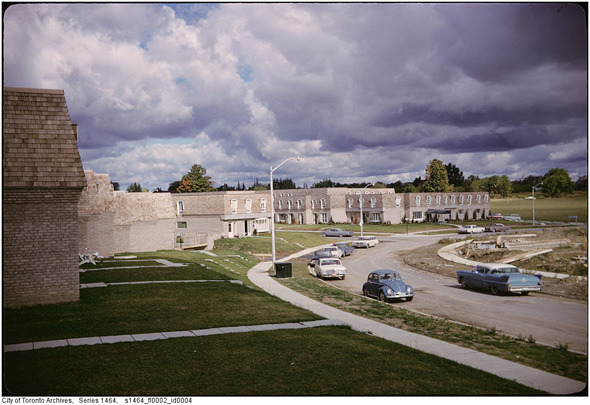
Thistletown, late 1960s.
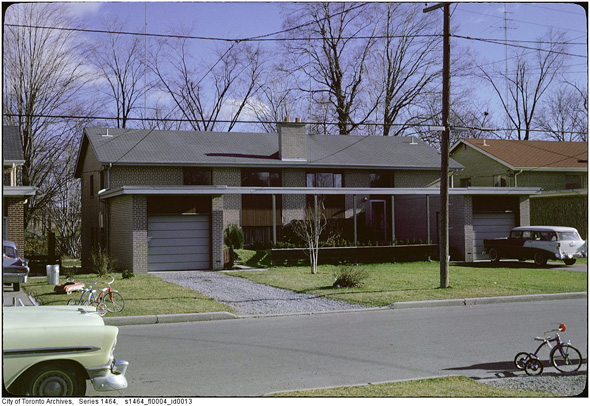
Near Martingrove and Westway, 1960s.
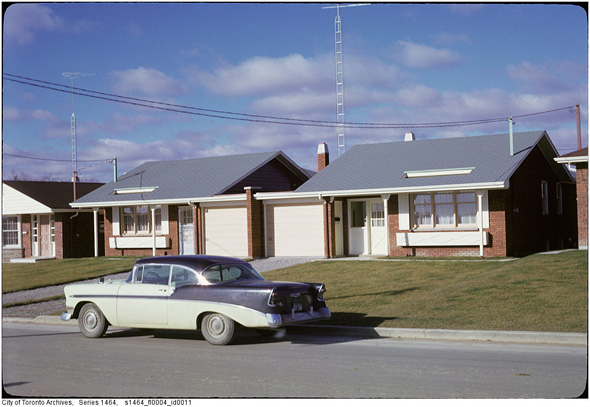
Near Martingrove and Westway, 1960s.
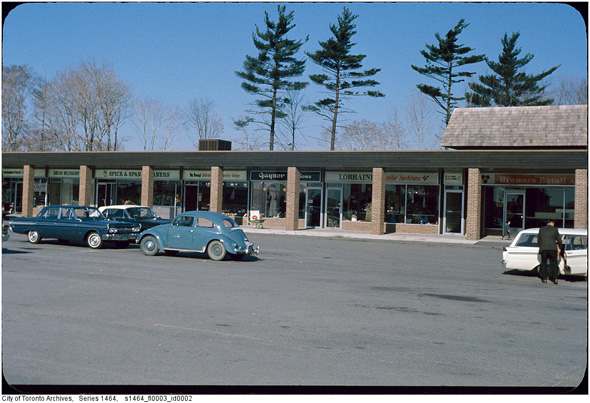
Richview Plaza, 1960s.
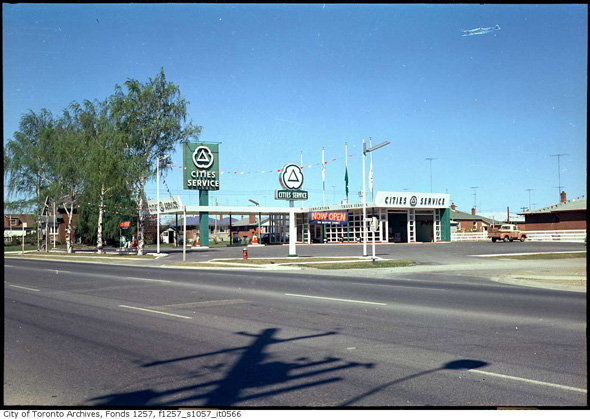
Queensway and Wolgar, 1960s.
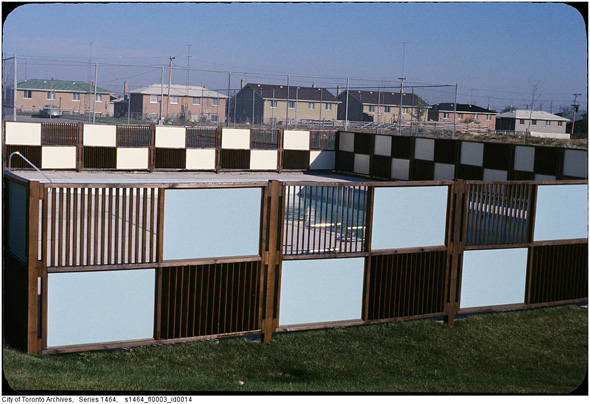
Unidentified communal pool, 1960s.
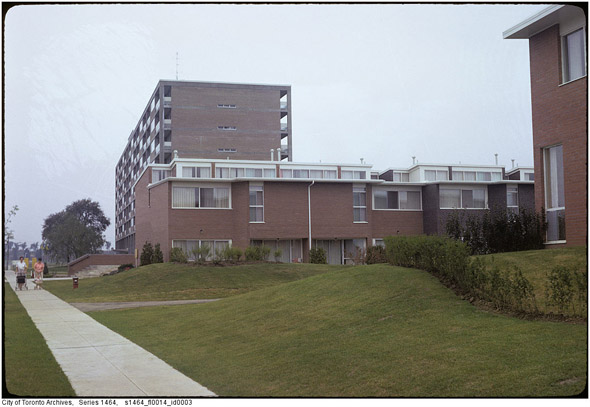
The apartment building arrives on the scene in Flemingdon Park, 1960s.
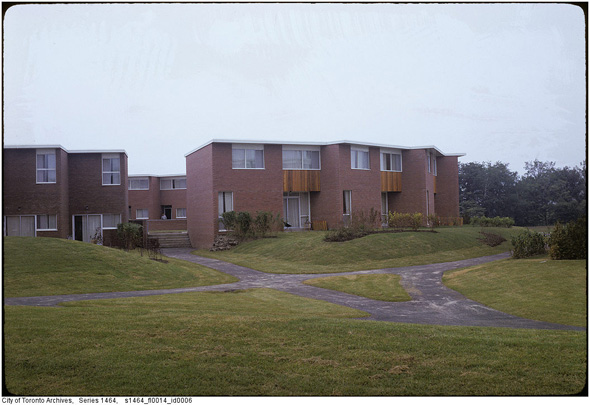
Townhouse complex in Flemingdon Park, 1961.
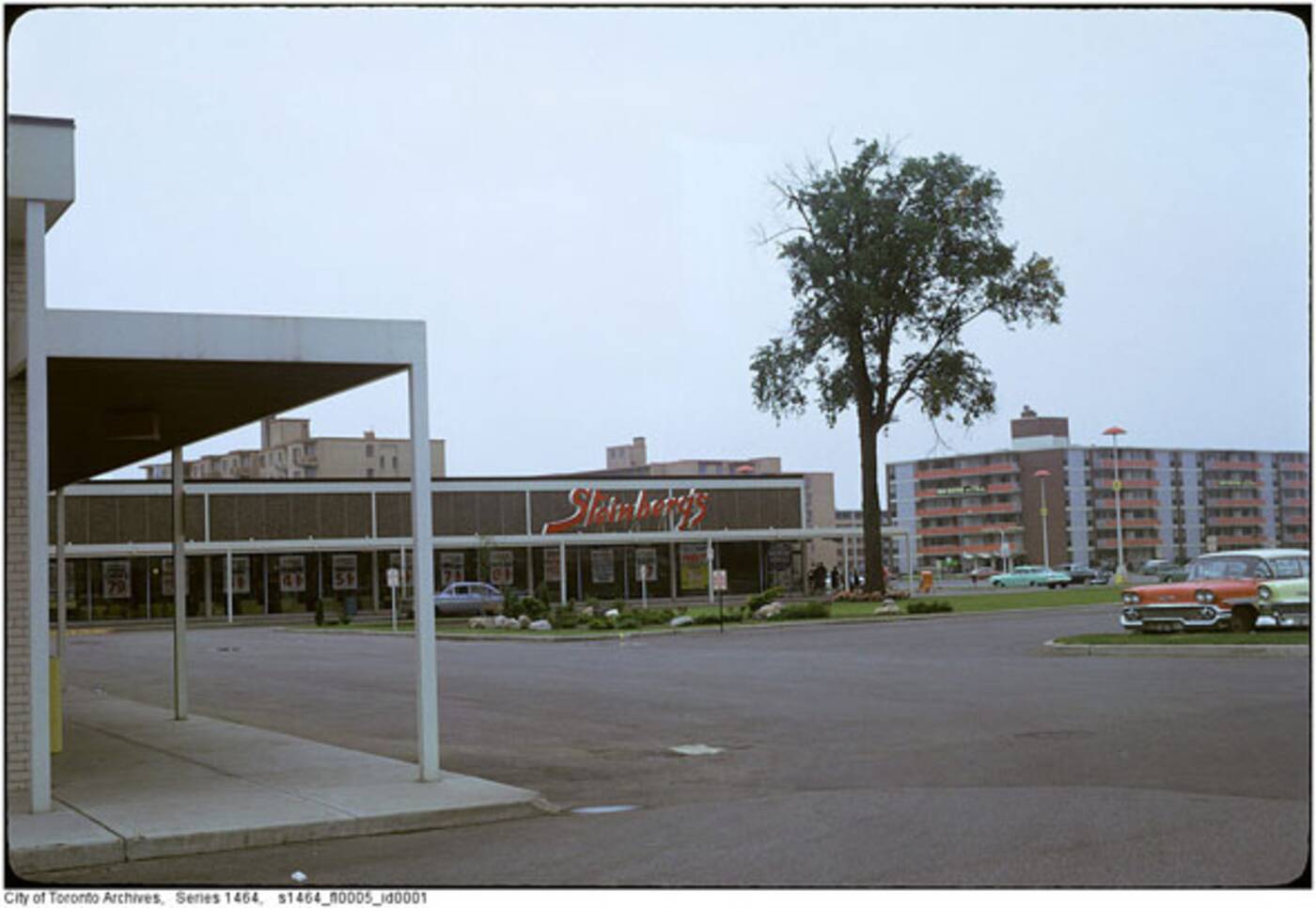 Steinbergs' at Thorncliffe Plaza.
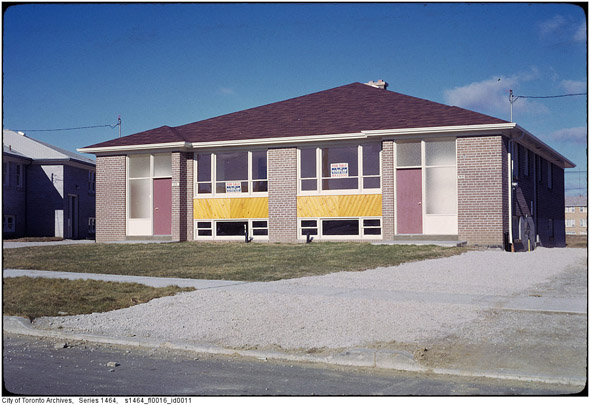
Unidentified development, 1961.
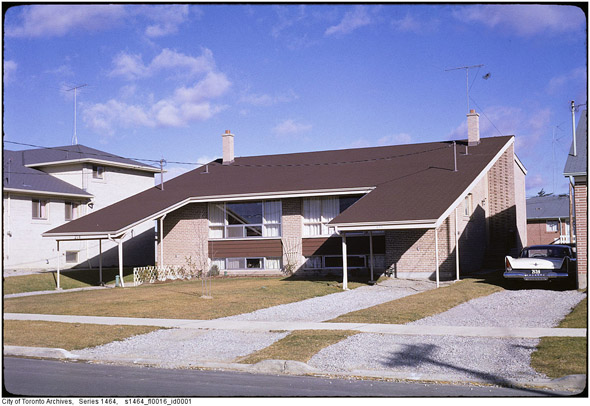
Mid-century architecture at its finest.
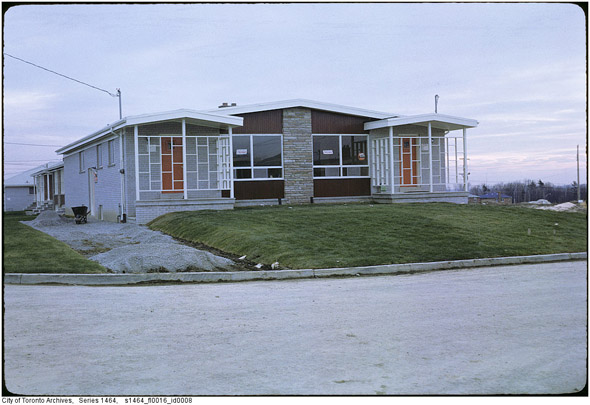
More mid-century residential architecture.

Image via Conrad Benner / Streets Dept
Twenty inflatable tentacles extend from the roof and several windows of a two-story warehouse in Philadelphia’s Navy Yard, making it appear as if sea monsters have attacked the former naval storehouse in an installation titled Sea Monsters HERE. The massive work is the largest inflatable sculpture ever created by UK-based artists Filthy Luker (previously) and Pedro Estrellas. It was produced in partnership with Group X, an anonymous collective of local artists and curators, and the Navy Yard which extends along the Delaware River.
The purple tentacles range from 32 to 40 feet, and curl upwards to reveal green suction cups lining their inner surface. Luker and Estrellas have been collaborating on inflatable sculptures since 1996, you can see more of their recent works on Instagram and their website, Designs in Air. Sea Monsters HERE will be on view both day and night through November 16, 2018. You can view a video tour of the installation in a video produced by Foxx below.


Swedish photographer Håkan Strand works with old analog cameras and black and white film to capture landscapes that exude the serenity of a time past. The photographs often center around rural roads and explore the stillness that exists when one reaches the fringes of civilization. His recently published book Silent Moments will soon be available to purchase on his website, where you can find further studies of back roads and long desert highways in landscapes in the US, UK, and throughout Scandinavia. (via This Isn’t Happiness)


Glass sculptor Wesley Fleming creates life-size and anatomically correct sculptures of a variety of bizarre and well-known insects. The colorful creatures are small enough to balance gently on the tip of his finger, like a neon orange spider barely larger than his nail. The artist began working with the medium more than 15 years ago at the MIT Glass Lab and has pushed his technique ever since, learning flameworking, sculpting with borosilicate, and the Italian technique of sculpting soft glass on the Venetian island of Murano in 2005. You can see more of his work with insects and other creatures on his website and Instagram, and view glass sculptures for sale on Etsy. (thnx, Diana!)


A new miniature city has sprung up near Tommy Thompson Park, and it's the work of a local artist.
JD Craig, the mind behind the project, has been collecting construction stones and erecting them in the sand like skyscrapers, forming a large sprawling metropolis on the beach.
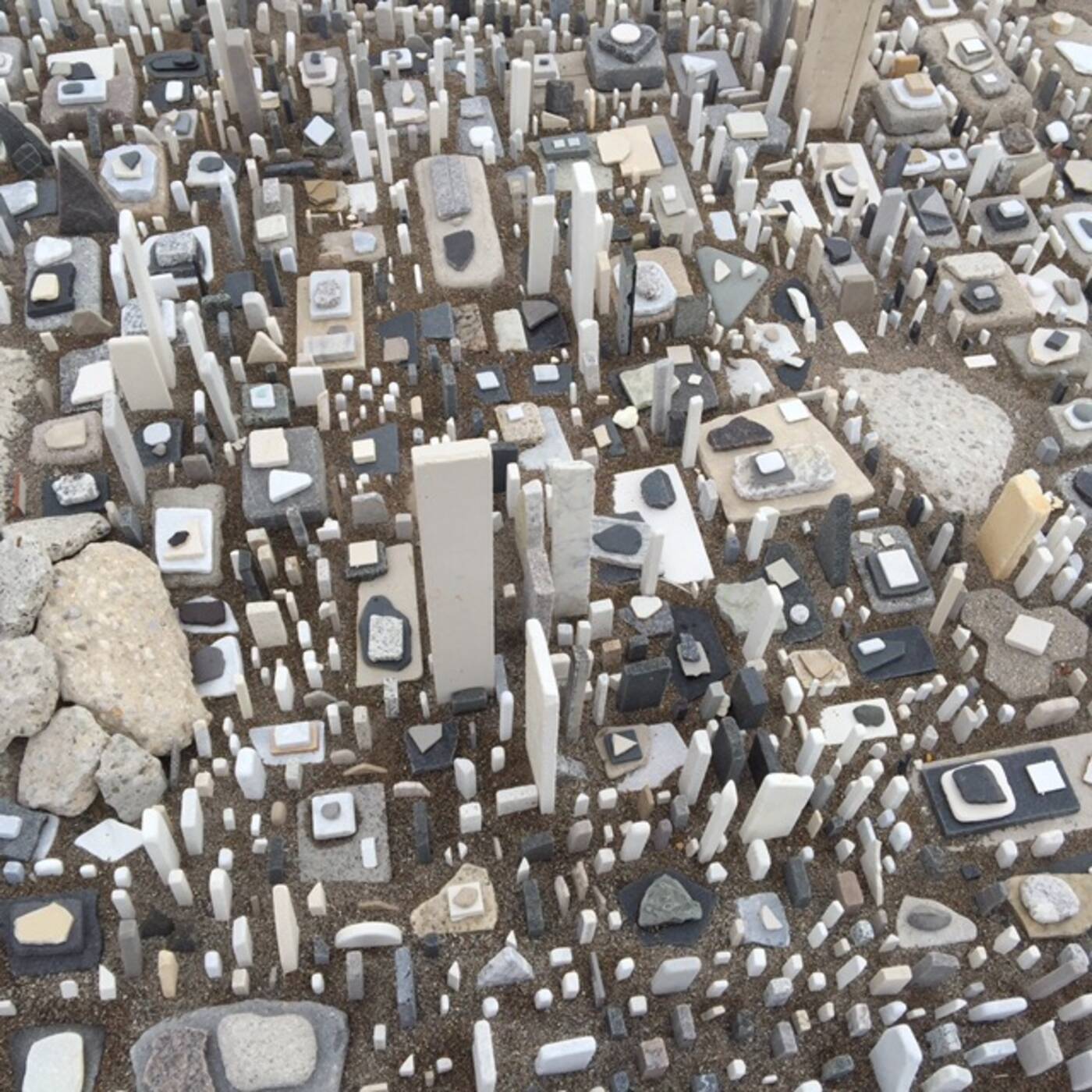
All the pieces are created from leftover construction stone. Photo by JD Craig.
The pieces are all beige, white, grey, and black, and surrounded by a "border" of terracotta bricks.
Craig says he didn't plan the city in advance, it just kept growing larger as he worked.
"I started it August 5, walking along the rocky beach picking up stones as I went along," he explains.
He says the piece has only been noticed by a few people, and is about 10 metres from the shoreline.
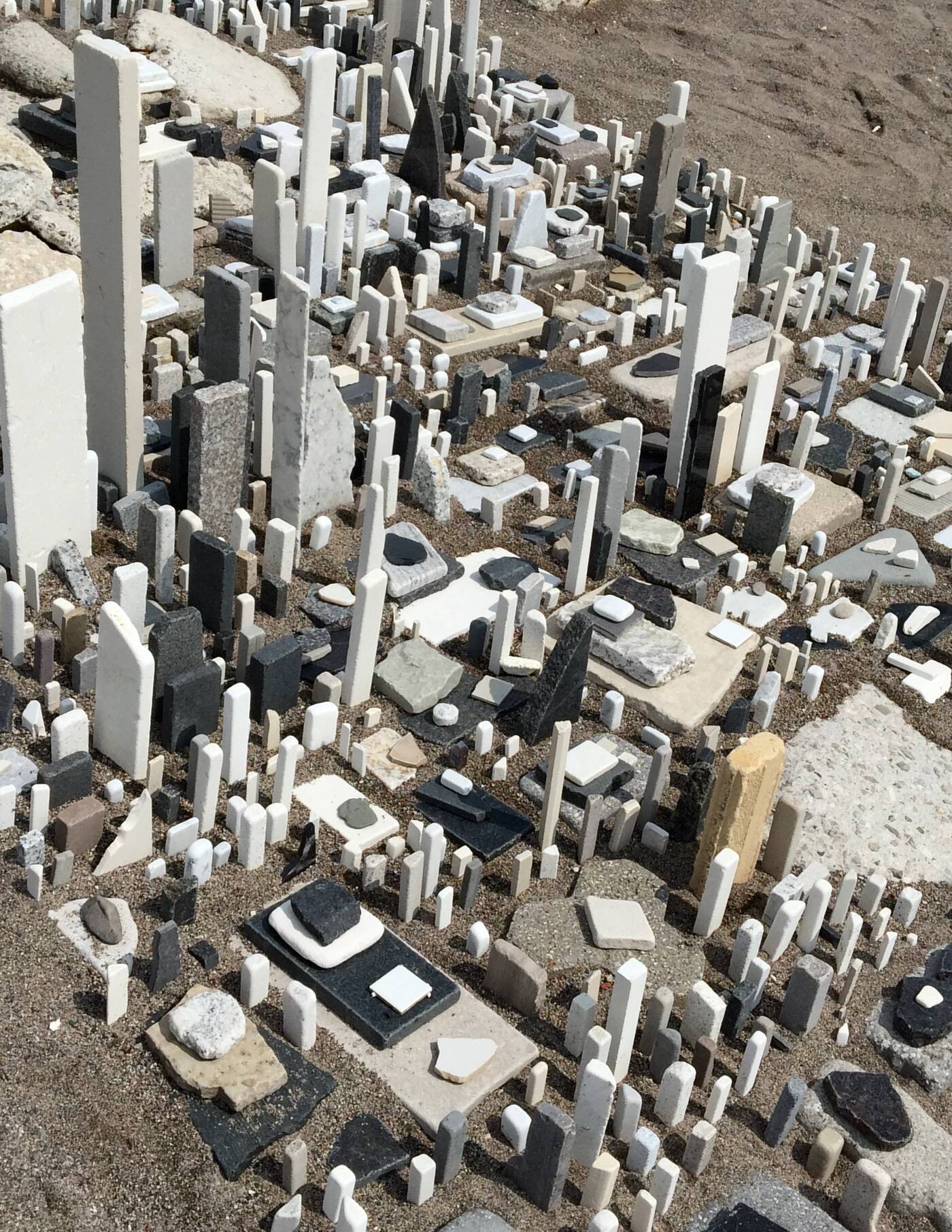
Craig says he didn't plan the city, and let it form naturally. Photo by JD Craig.
The conditions this winter and the level of the tides may affect how long it stands, Craig says.