Shared posts
Belgian robbers asked to come back - and arrested on their return
Making coral grow 50 times faster than nature
Going, Going, Gone: Banksy Artwork Self-Destructs the Moment it’s Sold
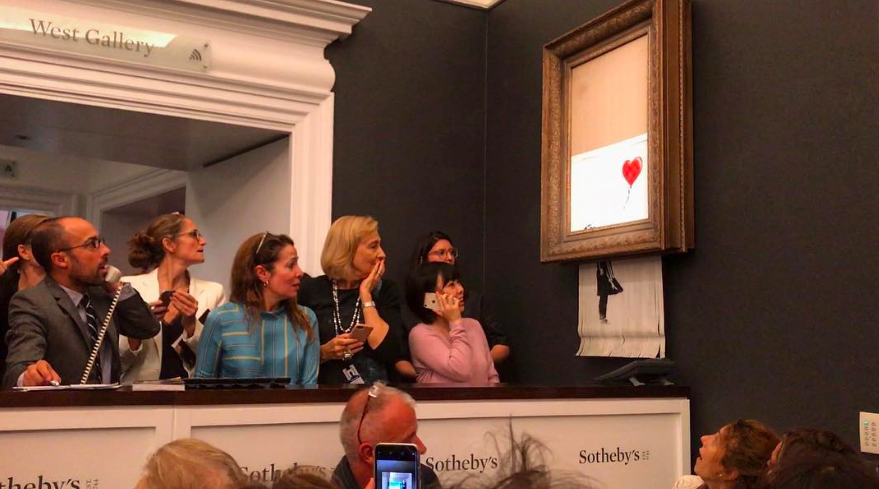
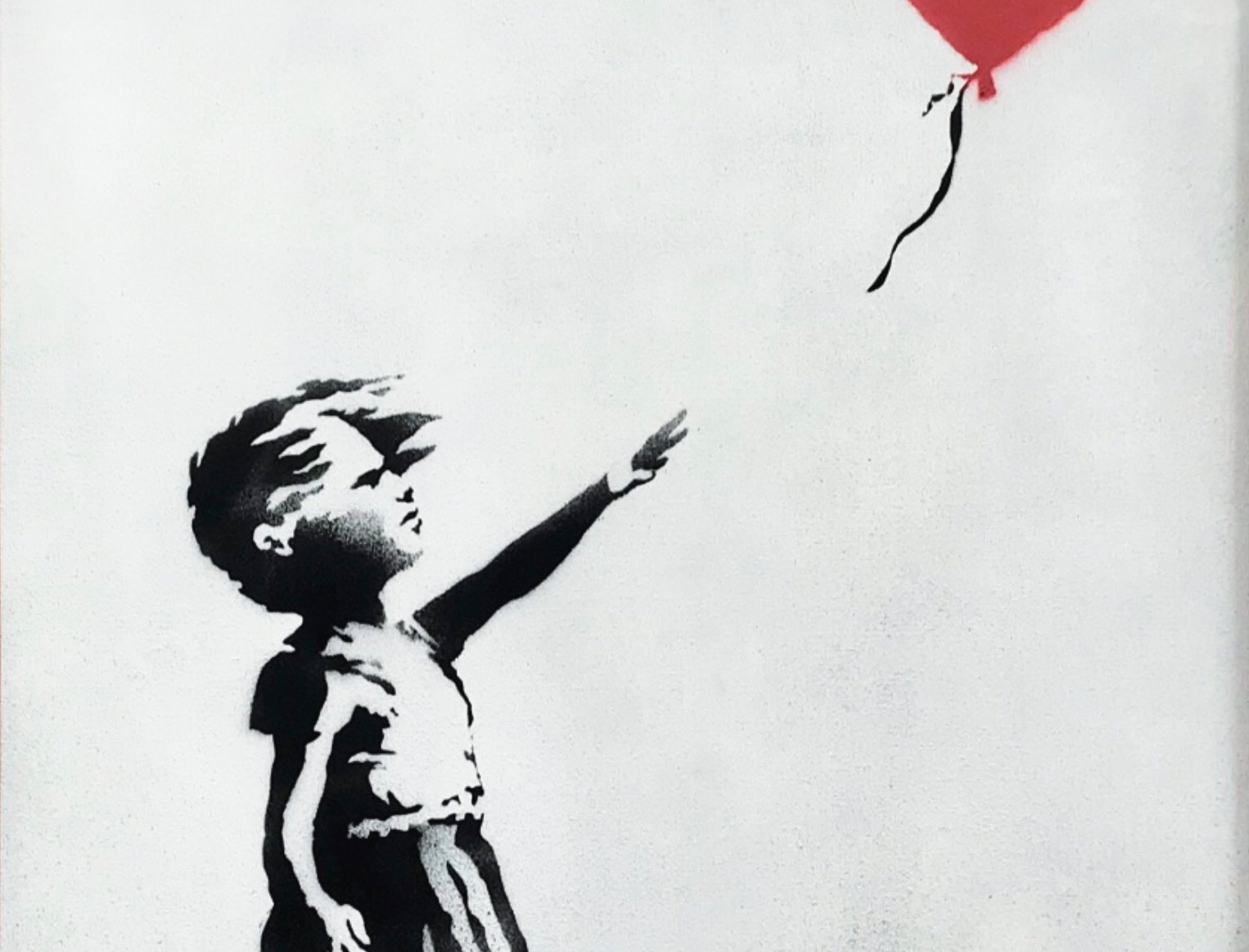
In a stunt that should surprise absolutely no one who knows anything about Banksy, the elusive street artist’s iconic work Girl with Balloon literally self-destructed the moment it was sold at auction for more than £1 million on Friday. “It appears we just got Banksy-ed,” said a Sotheby’s official afterward. Yep, it appears you did.
View this post on InstagramA post shared by Casterline | Goodman Gallery (@casterlinegoodmangallery) on
The framed work, consisting of spray paint and acrylic on canvas, was the last piece to go up for sale that evening in London. The typical controlled chaos of the auction house was punctuated by the clap of the auctioneer’s gavel, and at that very second, the work slipped through its frame in shreds. Almost nobody noticed at first, but gasps from the crowd alerted the room to the situation.

Banksy himself released a video on Instagram that showed him building the shredder into the painting’s frame, “in case it ever sold at auction.” He deleted it soon afterward, but it had already circulated on the internet. The YouTube clip above edits this clip side-by-side with a video capturing the moment of the big reveal.
Ironically, the artwork might be worth even more now than it was at the moment it sold thanks to all the attention it got, but it seems likely that Banksy expected as much, and it’s part of the overall point. A perpetual critic of the commercialization of his own work, Banksy is no stranger to trolling the public. Even when he turns a profit from the sales, he often does so while essentially ridiculing the purchaser.
Learn more at WebUrbanist’s Banksy archive.






[ By SA Rogers in Art & Drawing & Digital. ]
[ WebUrbanist | Archives | Galleries | Privacy | TOS ]
Russia-Trump: Who's who in the drama to end all dramas?
Children 'attempting suicide' at Greek refugee camp
Microsoft Removes Device Install Limits For Office 365 Subscribers


Read more of this story at Slashdot.
Google Bug Hunter Urges Apple To Change Its iOS Security Culture; Asks Tim Cook To Donate $2.45 Million To Amnesty For His Unpaid iPhone Bug Bounties
Read more of this story at Slashdot.
Audubon Mural Project in New York, New York

While wandering West Harlem, murals of birds will begin to catch your eye. The more you explore, the more you'll spot storefronts and apartment buildings decorated with these colorful depictions of various avian species.
In a fairly concentrated area, there are 88 paintings to be found, but this is just the beginning. An ambitious project engineered by the National Audubon Society aims to complete 314 in total, with each one representing a North American species threatened by climate change.
Gitler &_____ Gallery has partnered with the organization to commission artists, and each mural showcases a distinctive style. Some only appear at night, when shops are closed and locked up. Others are small and hidden in windows, while still more stretch across multi-story buildings. Once you've admired the prominent paintings, you'll find yourself searching street-by-street for the more subtle pieces.
Why Harlem? This area was home to John James Audubon, who is famous for meticulously documenting and illustrating hundreds of North American bird species in a series published in 1827. His passion for the natural world has made him a heroic figure in the eyes of later environmentalists.
As Audubon is buried in Trinity Cemetery on 155th and Broadway, West Harlem is the perfect spot for the project. Just across the street from his gravesite is the most dramatic mural of the initiative, Swallow-tailed Kite (and Others).
The man who saved Bulgaria's dancing bears
Zero Tolerance for Zero Tolerance

EU Elite on the (Far) Right Side of History
England beaten by Croatia at World Cup: 'It's the what-ifs that hurt the most'
US, UK divers join search for kids' football team trapped in Thai cave
The unheralded story of Australia's indigenous cricketers
Intelligence gaps may have helped Afghan Taliban breach NATO fortress
 By Mirwais Harooni and Qiamuddin Shams BAGRAM, Afghanistan (Reuters) - In the year before Qari Naib blew himself up on Nov. 12 inside a NATO base near Kabul killing four Americans, Afghan intelligence warned the U.S. military at least twice that a worker could be planning an attack, government and security officials said. The Afghan officials also said they repeatedly asked Western forces to share information about local employees at the vast Bagram air base in order to check for "suspicious people among them", but were refused. When asked about the information sharing, NATO spokesman Captain William Salvin said NATO forces "routinely partner with ANDSF (Afghan National Defence and Security Forces) on all elements of security, to include information sharing.
Willebrord Snellius' Grave in Leiden, Netherlands
There is a church in Leiden called Pieterskerk, or the Church of St. Peter. It’s a 900 year old Gothic beauty, the oldest church in this small city half way between Amsterdam and The Hague. It’s also known as the Church of the Pilgrim Fathers, most famous to Americans as the Dutch refuge where the Mayflower separatists briefly hung out after leaving England, but before sailing to Massachusetts.
The church has been deconsecrated as a religious space since the early 1970s, so you can’t attend services there any more, Calvinist or otherwise. But you can visit the final resting place of one of the world’s great mathematicians, an All-Star named Willebrord Snellius.
Willebrord Snel van Royen is buried under the floor at Pieterskerk, his spot marked by a simple flat stone and small plaque. Snell, as he’s known to physics and astronomy students everywhere, is the brains behind the law of refraction, one of the fundamental laws of physics.
That alone would have secured his math chops, but his reach goes much further. Of his many milestones, he’s also credited with basically inventing triangulation as we know it, managing to figure out the circumference of the Earth to a remarkably accurate degree for the time.
In the Netherlands he is remember with particular fondness and pride for drafting the first accurate map of the country. He achieved it with his new brand of triangulation, climbing up a series of church towers to measure their distances with a giant quadrant. The map was so accurate—and therefor valuable to the Dutch military—that it was kept secret and unpublished until years later.
For all who aren’t familiar with Snell’s Law of refraction or may have forgotten it, there will be no pop quiz. Here you go:
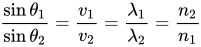
Got it? Good.