Nature Materials, Published online: 01 April 2024; doi:10.1038/s41563-024-01827-x
Non-layered transition metal carbides (TMCs) and layered transition metal dichalcogenides (TMDs) can form various heterostructure configurations through chemical conversion. This Review highlights the progress in the fabrication and control of TMC/TMD heterostructures and the exotic properties arising from these interfaces.jinzhitong
Shared posts
03 Jun 01:01
Heterostructures coupling ultrathin metal carbides and chalcogenides
by Alexander J. Sredenschek
Sonny Rhim, ChenDH likes this
01 Apr 01:50
Atomically precise semiconductor clusters of rare-earth tellurides
by You-Song Ding
Nature Synthesis, Published online: 28 March 2024; doi:10.1038/s44160-024-00511-x
A series of molecular rare-earth telluride clusters incorporating a three-centre, four-electron, tri-tellurido ligand (Te34−) are reported. These atomically precise clusters, possessing ultralow band gaps comparable to those of monocrystalline silicon and gallium arsenide, are potentially applicable as quantum materials and for optoelectronic applications.
huangpanqi, loveWang likes this
01 Apr 01:38
Graphene edge interference improves single-molecule transistors
by Héctor Vázquez
Nature Nanotechnology, Published online: 25 March 2024; doi:10.1038/s41565-024-01634-0
The performance of three-terminal molecular transistors is enhanced through the harnessing of quantum interference in the edges of graphene electrodes.
01 Apr 01:32
Defect-induced helicity dependent terahertz emission in Dirac semimetal PtTe2 thin films
by Zhongqiang Chen
Nature Communications, Published online: 23 March 2024; doi:10.1038/s41467-024-46821-8
Defect engineering of topological materials provides an avenue for the controllable manipulation of optoelectronic properties. Here, the authors introduce a defect gradient into a Dirac semimetal to control the Berry curvature dipole-driven THz emission in the material.
ytdcty likes this
01 Apr 01:31
High-performance ferroelectric field-effect transistors with ultra-thin indium tin oxide channels for flexible and transparent electronics
by Qingxuan Li
Nature Communications, Published online: 27 March 2024; doi:10.1038/s41467-024-46878-5
Using Zr-doped HfO2 and ultra-thin indium tin oxide, Li et al. develop flexible field-effect transistors with a memory window of 2.78 V and bending reliability to enable high-performance back-end-of-line compatible wearable devices.
01 Apr 01:28
Weird new electron behaviour in stacked graphene thrills physicists
by Dan Garisto
Nature, Published online: 25 March 2024; doi:10.1038/d41586-024-00832-z
This 2D material is only the second to exhibit the fractional quantum anomalous Hall effect, and theorists are still debating how it works.
01 Apr 01:26
Graphene nanoribbons grown in hBN stacks for high-performance electronics
by Bosai Lyu
Nature, Published online: 27 March 2024; doi:10.1038/s41586-024-07243-0
A strategy for the transfer-free direct growth of ultralong, high-quality graphene nanoribbons, which have desirable electronic properties, between layers of a boron nitride insulator is reported.
25 Mar 02:00
Wetting and Contact-Angle Hysteresis: Density Asymmetry and van der Waals Force
by Fei Wang (王飞) and Britta Nestler
Author(s): Fei Wang (王飞) and Britta Nestler
A droplet depositing on a solid substrate leads to the wetting phenomenon, such as dew on plant leaves. On an ideally smooth substrate, the classic Young’s law has been employed to describe the wetting effect. However, no real substrate is ideally smooth at the microscale. Given this fact, we introd…
[Phys. Rev. Lett. 132, 126202] Published Mon Mar 18, 2024
25 Mar 02:00
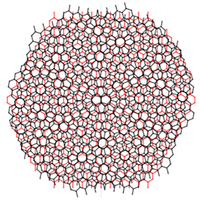
Topological Flat Bands in Graphene Super-Moiré Lattices
by Mohammed M. Al Ezzi, Junxiong Hu, Ariando Ariando, Francisco Guinea, and Shaffique Adam
Author(s): Mohammed M. Al Ezzi, Junxiong Hu, Ariando Ariando, Francisco Guinea, and Shaffique Adam
A super-moiré lattice in monolayer graphene generates flat bands, providing a viable platform to engineer its correlated states.
[Phys. Rev. Lett. 132, 126401] Published Mon Mar 18, 2024
25 Mar 01:59
Two-Dimensional Moiré Polaronic Electron Crystals
by Eric A. Arsenault, Yiliu Li, Birui Yang, Xi Wang, Heonjoon Park, Edoardo Mosconi, Enrico Ronca, Takashi Taniguchi, Kenji Watanabe, Daniel Gamelin, Andrew Millis, Cory R. Dean, Filippo de Angelis, Xiaodong Xu, and X. Y. Zhu
Author(s): Eric A. Arsenault, Yiliu Li, Birui Yang, Xi Wang, Heonjoon Park, Edoardo Mosconi, Enrico Ronca, Takashi Taniguchi, Kenji Watanabe, Daniel Gamelin, Andrew Millis, Cory R. Dean, Filippo de Angelis, Xiaodong Xu, and X. Y. Zhu
Two-dimensional moiré materials have emerged as the most versatile platform for realizing quantum phases of electrons. Here, we explore the stability origins of correlated states in WSe2/WS2 moiré superlattices. We find that ultrafast electronic excitation leads to partial melting of the Mott states…
[Phys. Rev. Lett. 132, 126501] Published Wed Mar 20, 2024
25 Mar 01:58
Giant Spin-Orbit Induced Magnon Nonreciprocity in Ultrathin Ferromagnets
by Khalil Zakeri and Albrecht von Faber
Author(s): Khalil Zakeri and Albrecht von Faber
The propagation characteristics of fermionic and bosonic quasiparticles determine the fundamental transport properties of solids and are of great technological relevance for designing logic devices. In particular, nonreciprocity, which describes that a quasiparticle flows preferably along a certain …
[Phys. Rev. Lett. 132, 126702] Published Thu Mar 21, 2024
25 Mar 01:58
Variational Tensor Wave Functions for the Interacting Quantum Spin Hall Phase
by Yixin Ma, Shenghan Jiang, and Chao Xu
Author(s): Yixin Ma, Shenghan Jiang, and Chao Xu
The quantum spin hall (QSH) phase, also known as the 2D topological insulator, is characterized by protected helical edge modes arising from time reversal symmetry. While initially proposed as band insulators, this phase can also manifest in strongly correlated systems where conventional band theory…
[Phys. Rev. Lett. 132, 126504] Published Thu Mar 21, 2024
25 Mar 01:46
Melting of the charge density wave by generation of pairs of topological defects in UTe2
by Anuva Aishwarya
Nature Physics, Published online: 20 March 2024; doi:10.1038/s41567-024-02429-9
A mechanism for the phase transition of charge density wave states via the generation and proliferation of topological defects with opposite phase windings is demonstrated in a heavy-fermion superconductor.
25 Mar 01:45
Engineering interfacial polarization switching in van der Waals multilayers
by Madeline Van Winkle
Nature Nanotechnology, Published online: 19 March 2024; doi:10.1038/s41565-024-01642-0
Operando transmission electron microscopy imaging reveals that modifying interlayer rotations alters both the spatial arrangement and switching dynamics of polar domains in artificially stacked trilayers of WSe2.
25 Mar 01:38
Highly reversible extrinsic electrocaloric effects over a wide temperature range in epitaxially strained SrTiO3 films
by S. Zhang
Nature Materials, Published online: 21 March 2024; doi:10.1038/s41563-024-01831-1
Electrocaloric effects are large in a limited set of materials that display hysteretic first-order phase transitions. Here epitaxial SrTiO3 thin films are strain engineered to achieve anhysteretic second-order phase transitions, with electrocaloric effects enhanced by one order of magnitude over bulk.
25 Mar 01:38
Author Correction: Local atomic stacking and symmetry in twisted graphene trilayers
by Isaac M. Craig
Nature Materials, Published online: 22 March 2024; doi:10.1038/s41563-024-01868-2
Author Correction: Local atomic stacking and symmetry in twisted graphene trilayers
25 Mar 01:37
Ultrafast magnetization enhancement via the dynamic spin-filter effect of type-II Weyl nodes in a kagome ferromagnet
by Xianyang Lu
Nature Communications, Published online: 18 March 2024; doi:10.1038/s41467-024-46604-1
Magnetic type-II Weyl semimetals host a variety of intriguing physical phenomena due to the combination of magnetic ordering and the electronic properties of the Weyl nodes. Herein, the authors explore the ultrafast spin dynamics of the magnetic Weyl semimetal, Co3Sn2S2, observing a transient enhanced magnetization as a result of laser excitation.
Sonny Rhim likes this
25 Mar 01:33
Evidence of the fractional quantum spin Hall effect in moiré MoTe2
by Kaifei Kang
Nature, Published online: 20 March 2024; doi:10.1038/s41586-024-07214-5
Transport evidence of a fractional quantum spin Hall insulator is reported in 2.1°-twisted bilayer MoTe2, which supports spin-Sz conservation and flat spin-contrasting Chern bands.
25 Mar 01:32
All-electrical skyrmionic magnetic tunnel junction
by Shaohai Chen
Nature, Published online: 20 March 2024; doi:10.1038/s41586-024-07131-7
Wafer-scale realization of a nanoscale magnetic tunnel junction hosting a single, ambient skyrmion enables its large readout, efficient switching, and compatibility with lateral manipulation, and thereby provides the backbone for all-electrical skyrmionic device architectures.
25 Mar 01:31
Dual quantum spin Hall insulator by density-tuned correlations in TaIrTe4
by Jian Tang
Nature, Published online: 20 March 2024; doi:10.1038/s41586-024-07211-8
A study reports a dual quantum spin Hall insulator in monolayer TaIrTe4, arising from the interplay of its single-particle topology and density-tuned electron correlations.
19 Mar 05:51
Electron-Induced Nonmonotonic Pressure Dependence of the Lattice Thermal Conductivity of $θ$-TaN
by Ashis Kundu, Yani Chen, Xiaolong Yang, Fanchen Meng, Jesús Carrete, Mukul Kabir, Georg K. H. Madsen, and Wu Li
Author(s): Ashis Kundu, Yani Chen, Xiaolong Yang, Fanchen Meng, Jesús Carrete, Mukul Kabir, Georg K. H. Madsen, and Wu Li
Recent theoretical and experimental research suggests that θ-TaN is a semimetal with high thermal conductivity (κ), primarily due to the contribution of phonons (κph). By using first-principles calculations, we show a nonmonotonic pressure dependence of the κ of θ-TaN. κph first increases until it r…
[Phys. Rev. Lett. 132, 116301] Published Fri Mar 15, 2024
19 Mar 05:46
Superconducting stripes induced by ferromagnetic proximity in an oxide heterostructure
by Xiangyu Hua
Nature Physics, Published online: 11 March 2024; doi:10.1038/s41567-024-02443-x
Copper-based and iron-based compounds exhibit an interplay between magnetism and superconductivity. Now, this idea is extended to two-dimensional oxide heterostructures, where a spatially varying superconducting order is demonstrated at the EuO/KTaO3 interface.
19 Mar 05:46
Manipulation of chiral interface states in a moiré quantum anomalous Hall insulator
by Canxun Zhang
Nature Physics, Published online: 13 March 2024; doi:10.1038/s41567-024-02444-w
The local electronic structure of interface states between topologically distinct domains is imaged and controlled, allowing visualization of the interplay between strong interactions and non-trivial topology.
19 Mar 05:45
Ultrafast atomic-scale scanning tunnelling spectroscopy of a single vacancy in a monolayer crystal
by C. Roelcke
Nature Photonics, Published online: 14 March 2024; doi:10.1038/s41566-024-01390-6
Time-resolved lightwave-driven scanning tunnelling spectroscopy is developed to investigate how the spin–orbit-split energy levels of a selenium vacancy within a WSe2 monolayer shift under phonon displacement. Ultrafast snapshots of the electronic tunnelling spectra reveal transient energy shifts up to 40 meV.
19 Mar 03:58
Near-room-temperature water-mediated densification of bulk van der Waals materials from their nanosheets
by Jiuyi Zhu
Nature Materials, Published online: 15 March 2024; doi:10.1038/s41563-024-01840-0
Strong bulk van der Waals materials are fabricated by the compressive moulding of two-dimensional nanosheets near room temperature through water-mediated densification, providing an energy-efficient way for synthesizing various van der Waals materials and a potential for tailoring compositions.
19 Mar 03:58
Semiconducting black phosphorus nanoribbons grown on insulating substrates
Nature Materials, Published online: 18 March 2024; doi:10.1038/s41563-024-01844-w
Single-crystal black phosphorus nanoribbons have been grown through chemical vapour transport, using black phosphorus nanoparticles as seeds. The nanoribbons orient exclusively along the zigzag direction and have good semiconductor properties that render them suitable for use as channel material in field-effect transistors.
19 Mar 03:57
Float-stacked graphene–PMMA laminate
by Seung-Il Kim
Nature Communications, Published online: 11 March 2024; doi:10.1038/s41467-024-46502-6
To maximize composite reinforcing efficiency, a semi-infinite reinforcement should be aligned in the matrix. Here, the authors report a float-stacking strategy for graphene-PMMA laminate with precisely aligned monolayer graphene in a polymer matrix.
19 Mar 02:23
Quantum spin liquid signatures in monolayer 1T-NbSe2
by Quanzhen Zhang
Nature Communications, Published online: 15 March 2024; doi:10.1038/s41467-024-46612-1
Recently, signatures of quantum spin liquid have been reported in monolayer transition metal dichalcogenides. Here the authors report evidence of such state in 1T-NbSe2 via the measurements of the Kondo effect in a 1T-1H heterostructure, further supported by measurements for magnetic molecules on 1T-NbSe2.
ytdcty likes this
19 Mar 02:23
Universal growth of perovskite thin monocrystals from high solute flux for sensitive self-driven X-ray detection
by Da Liu
Nature Communications, Published online: 16 March 2024; doi:10.1038/s41467-024-46712-y
Liu et al. report a universal solution growth method for perovskite thin monocrystals by improving the mass transfer in the high solute flux system. The approach is applied to 29 types of perovskites with growth velocity up to 27.2 µm min-1 and enables efficient self-driven X-ray detectors.
19 Mar 02:22
Broadened quantum critical ground state in a disordered superconducting thin film
by Koichiro Ienaga
Nature Communications, Published online: 16 March 2024; doi:10.1038/s41467-024-46628-7
The authors present Nernst measurements on a 2D film of amorphous MoxGe1−x, which shows a magnetic-field-induced superconductor-metal-insulator transition. The intermediate metal phase is known as the “anomalous metal” (AM) state. The authors conclude that the AM state originates from broadening of the superconductor-insulator transition.
ytdcty likes this