Nature Materials, Published online: 24 April 2024; doi:10.1038/s41563-024-01858-4
By combining nano-spot angle-resolved photoemission spectroscopy and atomic force microscopy, the authors resolve the fine electronic structure of the flat band and remote bands of twisted bilayer graphene as the twist angle varies, revealing a spectral weight transfer between remote bands that is attributed to lattice relaxations.jinzhitong
Shared posts
03 Jun 01:00
Evolution of the flat band and the role of lattice relaxations in twisted bilayer graphene
by Qian Li
03 Jun 00:59
Bulk van der Waals materials by low-temperature moulding
by Tom Lawson
Nature Materials, Published online: 03 May 2024; doi:10.1038/s41563-024-01872-6
Strong bulk van der Waals materials can be created from water-mediated densification of two-dimensional nanosheets by near-room-temperature moulding, establishing a pathway for the energy-efficient fabrication of a wide range of bulk van der Waals materials and even composites for various applications.
Jade likes this
03 Jun 00:59
Giant electron-mediated phononic nonlinearity in semiconductor–piezoelectric heterostructures
by Lisa Hackett
Nature Materials, Published online: 03 May 2024; doi:10.1038/s41563-024-01882-4
Efficient phononic nonlinear processes are demonstrated in an acoustoelectric heterostructure combining a high-mobility semiconductor indium gallium arsenide film heterogeneously integrated onto a lithium niobate thin film.
03 Jun 00:59
Exceptional electronic transport and quantum oscillations in thin bismuth crystals grown inside van der Waals materials
by Laisi Chen
Nature Materials, Published online: 13 May 2024; doi:10.1038/s41563-024-01894-0
Ultrathin and flat crystals of bismuth are grown between the atomically flat layers of a van der Waals material. These crystals exhibit outstanding electronic properties, including gate-tunable quantum oscillations of the magnetoresistance.
20 May 01:34
Giant optical nonlinearity of Fermi polarons in atomically thin semiconductors
by Liuxin Gu
Nature Photonics, Published online: 14 May 2024; doi:10.1038/s41566-024-01434-x
Exploiting the interactions between bright excitons and free carriers in an atomically thin semiconductor of trilayer tungsten diselenide WSe2 results in Fermi polarons that exhibit unusually large nonlinearity.
Alex Strasser likes this
20 May 01:32
Superionic fluoride gate dielectrics with low diffusion barrier for two-dimensional electronics
by Kui Meng
Nature Nanotechnology, Published online: 15 May 2024; doi:10.1038/s41565-024-01675-5
Superionic fluoride dielectrics with a low ion migration barrier are capable of excellent capacitive coupling and are highly compatible with scalable device manufacturing processes for integrated electronics.
20 May 01:32
Atomic-force-microscopy-based time-domain two-dimensional infrared nanospectroscopy
by Qing Xie
Nature Nanotechnology, Published online: 15 May 2024; doi:10.1038/s41565-024-01670-w
Integrating atomic force microscopy with time-domain two-dimensional infrared spectroscopy provides insights into molecular structures, mode coupling and energy transfers with high spatial resolution.
20 May 01:32
Giant electron-mediated phononic nonlinearity in semiconductor–piezoelectric heterostructures
by Lisa Hackett
Nature Materials, Published online: 03 May 2024; doi:10.1038/s41563-024-01882-4
Efficient phononic nonlinear processes are demonstrated in an acoustoelectric heterostructure combining a high-mobility semiconductor indium gallium arsenide film heterogeneously integrated onto a lithium niobate thin film.
20 May 01:32
Exceptional electronic transport and quantum oscillations in thin bismuth crystals grown inside van der Waals materials
by Laisi Chen
Nature Materials, Published online: 13 May 2024; doi:10.1038/s41563-024-01894-0
Ultrathin and flat crystals of bismuth are grown between the atomically flat layers of a van der Waals material. These crystals exhibit outstanding electronic properties, including gate-tunable quantum oscillations of the magnetoresistance.
20 May 01:31
Tailoring amorphous boron nitride for high-performance two-dimensional electronics
by Cindy Y. Chen
Nature Communications, Published online: 13 May 2024; doi:10.1038/s41467-024-48429-4
Here, the authors demonstrate a wafer-scale, low-temperature process using atomic layer deposition, for the synthesis of uniform, conformal amorphous boron nitride (aBN) thin films. They further fabricate aBN-encapsulated monolayer MoS2 field-effect transistors.
20 May 01:30
Spin-orbit torque manipulation of sub-terahertz magnons in antiferromagnetic α-Fe2O3
by Dongsheng Yang
Nature Communications, Published online: 14 May 2024; doi:10.1038/s41467-024-48431-w
Antiferromagnetic spintronics offer high speed operations, and reduced issues with stray fields compared to ferromagnetic systems, however, antiferromagnets are typically more challenging to manipulate electrically. Here, Yang, Kim, and coauthors demonstrate electrical control of magnon dispersion and frequency in an α-Fe2O3/Pt heterostructure.
Sonny Rhim likes this
13 May 01:28
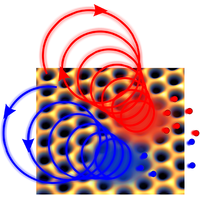
Bias-Free Access to Orbital Angular Momentum in Two-Dimensional Quantum Materials
by Jonas Erhardt, Cedric Schmitt, Philipp Eck, Matthias Schmitt, Philipp Keßler, Kyungchan Lee, Timur Kim, Cephise Cacho, Iulia Cojocariu, Daniel Baranowski, Vitaliy Feyer, Louis Veyrat, Giorgio Sangiovanni, Ralph Claessen, and Simon Moser
Author(s): Jonas Erhardt, Cedric Schmitt, Philipp Eck, Matthias Schmitt, Philipp Keßler, Kyungchan Lee, Timur Kim, Cephise Cacho, Iulia Cojocariu, Daniel Baranowski, Vitaliy Feyer, Louis Veyrat, Giorgio Sangiovanni, Ralph Claessen, and Simon Moser
A universal and fully experimental algorithm allows for extraction of orbital angular momentum from 2D quantum materials.
[Phys. Rev. Lett. 132, 196401] Published Mon May 06, 2024
13 May 01:26
Rotational symmetry influences the mechanical properties of graphene
Nature Physics, Published online: 06 May 2024; doi:10.1038/s41567-024-02442-y
Rotational symmetry is shown to protect the quadratic dispersion of out-of-plane flexural vibrations in graphene and other two-dimensional materials against phonon–phonon interactions, making the bending rigidity of these materials non-divergent. The quadratic dispersion is then consistent with the propagation of sound in the graphene plane.
13 May 01:26
A quantum critical Bose gas of magnons in the quasi-two-dimensional antiferromagnet YbCl3 under magnetic fields
by Yosuke Matsumoto
Nature Physics, Published online: 09 May 2024; doi:10.1038/s41567-024-02498-w
Some magnetic phase transitions can be understood as Bose–Einstein condensation of magnons. Close to a quantum critical point, YbCl3 now provides a realization of a Bose–Einstein condensate that is dominated by two-dimensional physical behaviour.
13 May 01:25
Single-component superconductivity in UTe2 at ambient pressure
by Florian Theuss
Nature Physics, Published online: 09 May 2024; doi:10.1038/s41567-024-02493-1
The symmetry of the superconducting order parameter in UTe2 is still debated. Now ultrasound experiments suggest that the order parameter can only have one component.
13 May 01:23
Topologically trivial gap-filling in superconducting Fe(Se,Te) by one-dimensional defects
by A. Mesaros
Nature Communications, Published online: 06 May 2024; doi:10.1038/s41467-024-48047-0
Previous measurements of FeSe0.45Te0.55 found one-dimensional (1D) defects that were interpretated as domain walls hosting propagating Majorana topological modes. Here, the authors reveal that these 1D defects correspond to sub-surface debris and show that the filling of the superconducting gap on these defects is topologically trivial.
Alex Strasser, Sonny Rhim likes this
13 May 01:21
Addendum: Solution epitaxy of polarization-gradient ferroelectric oxide films with colossal photovoltaic current
by Chen Lin
Nature Communications, Published online: 08 May 2024; doi:10.1038/s41467-024-47238-z
Addendum: Solution epitaxy of polarization-gradient ferroelectric oxide films with colossal photovoltaic current
13 May 01:21
Observation of interlayer plasmon polaron in graphene/WS2 heterostructures
by Søren Ulstrup
Nature Communications, Published online: 08 May 2024; doi:10.1038/s41467-024-48186-4
Here, the authors report the observation of an interlayer plasmon polaron in heterostructures composed of graphene and monolayer WS2. This is manifested in the ARPES spectra as a strong quasiparticle peak accompanied by several carrier density-dependent shake-off replicas around the WS2 conduction band minimum.
13 May 01:12
Elastic films of single-crystal two-dimensional covalent organic frameworks
by Yonghang Yang
Nature, Published online: 08 May 2024; doi:10.1038/s41586-024-07505-x
Elastic films of single-crystal two-dimensional covalent organic frameworks
06 May 01:16
Bulk van der Waals materials by low-temperature moulding
by Tom Lawson
Nature Materials, Published online: 03 May 2024; doi:10.1038/s41563-024-01872-6
Strong bulk van der Waals materials can be created from water-mediated densification of two-dimensional nanosheets by near-room-temperature moulding, establishing a pathway for the energy-efficient fabrication of a wide range of bulk van der Waals materials and even composites for various applications.
06 May 01:14
Revealing hidden spin polarization in centrosymmetric van der Waals materials on ultrafast timescales
by B. Arnoldi
Nature Communications, Published online: 27 April 2024; doi:10.1038/s41467-024-47821-4
A major challenge for spin-based information technologies is the generation of spin polarization in otherwise nonmagnetic materials. Here, Arnoldi et al. demonstrate how ultrafast laser excitations can be used to generate spin polarization in a fullerene/tungsten diselenide heterostructure.
Guanzhao Wen likes this
06 May 01:13
Tunneling current-controlled spin states in few-layer van der Waals magnets
by ZhuangEn Fu
Nature Communications, Published online: 01 May 2024; doi:10.1038/s41467-024-47820-5
Magnetic tunnel junctions consist of two magnetic layers, separated by a thin insulator. The simplicity belies the industrial importance: magnetic tunnel junctions have a very wide variety of applications in contemporary society. Here, Fu et al present a magnetic tunnel junction composed of single van der Waals magnetic insulator, CrI3, exhibiting remarkably low power consumption.
06 May 01:12
Giant dielectric tunability in ferroelectric ceramics with ultralow loss by ion substitution design
by Ruitao Li
Nature Communications, Published online: 04 May 2024; doi:10.1038/s41467-024-48264-7
The authors realize composite optimization in dielectric tunable materials by simultaneously achieving low electric field, large tunability, and low loss through ion substitution design in ferroelectric tunable materials.
06 May 01:11
Dynamic two-dimensional covalent organic frameworks
by Florian Auras
Nature Chemistry, Published online: 03 May 2024; doi:10.1038/s41557-024-01527-8
Two-dimensional covalent organic frameworks (2D COFs) enable the construction of bespoke functional materials, but designing dynamic 2D COFs is challenging. Now it has been shown that perylene-diimide-based COFs can open and close their pores upon uptake or removal of guests, while fully retaining their crystalline long-range order. Moreover, the variable COF geometry enables stimuli-responsive optoelectronic properties.
06 May 01:07
Bevel-edge epitaxy of ferroelectric rhombohedral boron nitride single crystal
by Li Wang
Nature, Published online: 01 May 2024; doi:10.1038/s41586-024-07286-3
Centimetre-sized single-crystal rhombohedral boron nitride layers are achieved through bevel-edge epitaxy, and the resulting material exhibits robust, homogeneous and switchable ferroelectricity with a high Curie temperature.
29 Apr 01:22
Picosecond Spin Current Generation from Vicinal Metal-Antiferromagnetic Insulator Interfaces
by B. Yang, Qing Ji, F. Z. Huang, Jiacong Li, Y. Z. Tian, B. Xue, Ruxian Zhu, Hui Wu, Hanyue Yang, Y. B. Yang, Shaolong Tang, H. B. Zhao, Y. Cao, J. Du, B. G. Wang, Chunfeng Zhang, and D. Wu
Author(s): B. Yang, Qing Ji, F. Z. Huang, Jiacong Li, Y. Z. Tian, B. Xue, Ruxian Zhu, Hui Wu, Hanyue Yang, Y. B. Yang, Shaolong Tang, H. B. Zhao, Y. Cao, J. Du, B. G. Wang, Chunfeng Zhang, and D. Wu
We report the picosecond spin current generation from the interface between a heavy metal and a vicinal antiferromagnet insulator Cr2O3 by laser pulses at room temperature and zero magnetic field. It is converted into a detectable terahertz emission in the heavy metal via the inverse spin Hall effec…
[Phys. Rev. Lett. 132, 176703] Published Thu Apr 25, 2024
29 Apr 01:16
Evolution of the flat band and the role of lattice relaxations in twisted bilayer graphene
by Qian Li
Nature Materials, Published online: 24 April 2024; doi:10.1038/s41563-024-01858-4
By combining nano-spot angle-resolved photoemission spectroscopy and atomic force microscopy, the authors resolve the fine electronic structure of the flat band and remote bands of twisted bilayer graphene as the twist angle varies, revealing a spectral weight transfer between remote bands that is attributed to lattice relaxations.
29 Apr 01:14
Collapse of carbon nanotubes due to local high-pressure from van der Waals encapsulation
by Cheng Hu
Nature Communications, Published online: 25 April 2024; doi:10.1038/s41467-024-47903-3
vdW assembly of low-dimensional materials has proven the capability of creating structures with on-demand properties. Here, the authors report on the structural collapse of CNTs in conjunction with a metal-semiconductor junction induced by the VdW encapsulation.
Guanzhao Wen likes this
29 Apr 01:11
Valleytronics in bulk MoS2 with a topologic optical field
by Igor Tyulnev
Nature, Published online: 24 April 2024; doi:10.1038/s41586-024-07156-y
We develop an optical method that can set and read the state of electrons in the valley polarization of bulk transition metal dichalcogenide semiconductors, with potential utility as digital storage at quantum coherent timescales and application in quantum computing.
29 Apr 01:11
One-dimensional proximity superconductivity in the quantum Hall regime
by Julien Barrier
Nature, Published online: 24 April 2024; doi:10.1038/s41586-024-07271-w
We show that domain walls in minimally twisted bilayer graphene support exceptionally robust proximity superconductivity in the quantum Hall regime.