Shared posts

03 May 23:53

Judge mulls sanctions over Google’s “shocking” destruction of internal chats

by Ashley Belanger
James.galbraith

No shit

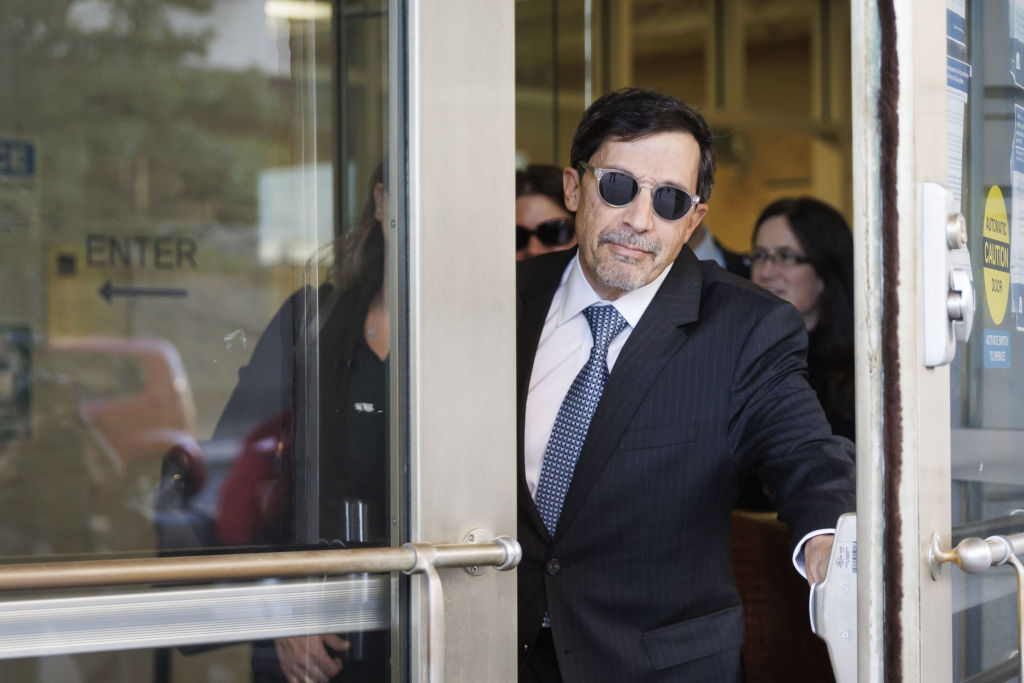
Kenneth Dintzer, litigator for the US Department of Justice, exits federal court in Washington, DC, on September 20, 2023, during the antitrust trial to determine if Alphabet Inc.'s Google maintains a monopoly in the online search business.

Enlarge / Kenneth Dintzer, litigator for the US Department of Justice, exits federal court in Washington, DC, on September 20, 2023, during the antitrust trial to determine if Alphabet Inc.'s Google maintains a monopoly in the online search business. (credit: Bloomberg / Contributor | Bloomberg)

Near the end of the second day of closing arguments in the Google monopoly trial, US district judge Amit Mehta weighed whether sanctions were warranted over what the US Department of Justice described as Google's "routine, regular, and normal destruction" of evidence.

Google was accused of enacting a policy instructing employees to turn chat history off by default when discussing sensitive topics, including Google's revenue-sharing and mobile application distribution agreements. These agreements, the DOJ and state attorneys general argued, work to maintain Google's monopoly over search.

According to the DOJ, Google destroyed potentially hundreds of thousands of chat sessions not just during their investigation but also during litigation. Google only stopped the practice after the DOJ discovered the policy. DOJ's attorney Kenneth Dintzer told Mehta Friday that the DOJ believed the court should "conclude that communicating with history off shows anti-competitive intent to hide information because they knew they were violating antitrust law."

Read 19 remaining paragraphs | Comments

03 May 17:55

The Supreme Court: The most powerful, least busy people in Washington

by Ian Millhiser
James.galbraith

Hacks in black

The justices standing in their robes in the crowded House Chamber.
Six Supreme Court justices attend President Joe Biden’s 2024 State of the Union address. | Shawn Thew/Pool/AFP via Getty Images

The justices are quietly quitting their day jobs as judges, even as they become more and more political.

Young John Roberts was a funny guy.

“The generally accepted notion that the court can only hear roughly 150 cases each term,” the future chief justice wrote while he was an early-career lawyer working in the Reagan White House, “gives the same sense of reassurance as the adjournment of the court in July, when we know that the Constitution is safe for the summer.”

Roberts, of course, wrote this at a time when Republicans could not rely on the federal judiciary to advance its policy goals — something that Roberts has done much to change in his current job. The justices are in the middle of an unusually political term, fraught with cases that tweak many of America’s most bitter divides on issues like guns or abortion, and that seek to fundamentally restructure who wields power in the United States.

That includes two cases — one already decided, the other still pending — which seem engineered to shield Donald Trump from any meaningful consequences from his attempt to overturn the 2020 presidential election. The coming weeks will see decisions in two cases that are likely to shift an extraordinary amount of policymaking authority away from an elected president and toward an unelected judiciary.

Yet, while the justices seem eager to be the final word on America’s most intractable political divides, they’ve increasingly stopped doing the traditional work of judges — resolving often technical, boring legal disputes that arise between litigants whose names will never be mentioned on cable news.

The Supreme Court used to do this work. But it avoids it more and more now. Indeed, one striking thing about Roberts’s Reagan-era quip about the Court’s docket is that he describes a Court that “can only hear roughly 150 cases each term.” Now, the Court is hearing barely more than 60.

Consider this chart, which was produced by Adam Feldman, a lawyer and political scientist who publishes empirical work on the Supreme Court. Although slightly dated (it ends with the Court’s 2016–17 term), the chart shows the total number of cases that the Court handed down in each of its annual terms on its merits docket — the cases that typically receive full briefing and oral argument before the justices:

 Adam Feldman/Empirical SCOTUS

Feldman’s data shows a steady decline in the Supreme Court’s workload since the 1960s. By the mid-2010s, the Court was deciding fewer cases than it had since the Civil War and Reconstruction.

And this trend is continuing. In the Court’s 2013 term, it decided 79 cases on its merits docket. This term, assuming that none of the Court’s pending cases are dismissed, it will only hand down 61 decisions.

Because the size of the Court’s docket has been in steady decline for many decades, there’s been a great deal of scholarship examining why this decline is happening. The striking thing, however, is that the size of the Court’s docket continues to shrink, even after many of the most likely explanations fade into the past.

Many scholars, for example, point to the Supreme Court Case Selections Act of 1988, a federal law that gave the justices more ability to turn away cases they don’t want to hear, as a significant driver of the Court’s reduced caseload. Yet, while a 1988 law can certainly explain why the Court is hearing fewer cases today than it did in the early 1980s, it does little to explain why the Court heard about 23 percent fewer cases in its 2023 term than it did in its 2013 term.

It is unlikely that there’s a single explanation for the Court’s shrinking docket. Scholars and other legal experts have all proposed numerous overlapping explanations for the reduced caseload.

One thing is clear, however. The overall decline in the Court’s docket does not appear to be matched by a decline in the number of political cases heard by the justices. That is, while the justices are hearing fewer total cases than they used to, they are avoiding the kind of technical legal disputes that rarely garner headlines — all while vacuuming up more power to decide the kind of political disputes that divide Democrats from Republicans.

The many explanations for the Court’s diminished docket

Until the late 19th century, the justices had very little control over their docket. Litigants who lost in a lower court typically could bring their case to the Supreme Court whether the justices wanted to hear that case or not. This changed in 1891, when Congress enacted legislation creating mid-level courts that would hear most federal appeals and gave the Court discretion to turn away at least some cases.

Two subsequent laws, enacted in 1925 and 1988, further reduced the Court’s mandatory jurisdiction. The justices now have the freedom to turn away nearly all of the cases that are brought to their attention. Today, in the overwhelming majority of cases, four justices must agree to hear the case or the lower court’s decision stands.

Beyond this 1988 law, an internal change in the Court’s process for deciding which cases to hear may contribute to its reduced caseload.

In a typical year, the Court receives thousands of petitions — known as petitions for a “writ of certiorari” — asking it to hear a particular case. Prior to the 1970s, at least one law clerk in each of the nine justices’ chambers would typically review each of these petitions and advise their justice on whether the petition should be granted. After Justice Lewis Powell joined the Court in 1972, he decided that this process was needlessly inefficient, and urged his colleagues to pool their chambers’ resources.

The result was the “cert pool.” Under this process, petitions asking the Court to hear a case would be randomly assigned to just one clerk among all the justices who participate in the pool. These justices would all rely on a memo drafted by that one law clerk to advise them on whether to hear the case. Initially, five justices joined the pool, though that number has fluctuated, and it now includes every member of the Court except for Justices Samuel Alito and Neil Gorsuch.

Several court-watchers have blamed this process for the Court’s reduced docket. As Ken Starr, the former federal judge and US solicitor general best known for investigating President Bill Clinton in the 1990s, wrote in a 2006 essay, “this efficiency-driven device has been inadequately studied, but what is commonly understood is that the prevailing culture within the pool is to ‘just say no.’”

That is, law clerks are reluctant to recommend that the Court hear a case because they don’t want to be embarrassed if the case turns out to be a dud. And with so many justices participating in the pool, many justices’ decisions will be influenced by a single timid clerk.

Yet, while policy changes like the 1988 law and the implementation of the cert pool might explain why the Court hears fewer cases now than it did in the 1970s, they cannot explain why the size of the Court’s merits docket continues to decline to this day. These are, by now, well-entrenched, decades-old reforms. Whatever impact they might have had in the past is now baked into the Court’s year-to-year work.

Other scholars point to changes in the Court’s personnel to explain the shrinking docket. In a 2010 essay, David Stras, a former law professor who Trump later put on the federal bench, argued that, in the early 1990s, three justices who voted to hear a relatively large volume of cases were replaced by justices who wanted the Court to hear fewer cases.

The most dramatic shift was the replacement of Justice Byron White, who believed that the Supreme Court had an obligation to resolve disagreements among lower courts very quickly, with Justice Ruth Bader Ginsburg. According to Stras, White voted to hear a case an average of 215.6 times per Term between 1986 and 1992. When Ginsburg joined the Court, by contrast, she voted to hear only 63 cases during the 1993–94 term, “or 29.2% as often as her predecessor.”

Yet, again, while these personnel changes might explain why the Court’s docket shrunk in the mid-to-late 1990s, they do not explain why the trend continues nearly four years after Ginsburg’s death.

In a 2012 essay, scholars Ryan Owens and David Simon offer another explanation for the diminished docket. For much of the post-1960s period when the Court’s docket steadily declined, the justices were ideologically divided. As a result, any individual justice would “be less sure of outcomes and will anticipate more dissents and internal strife” if they agree to hear many cases. Owens and Simon argued that “such a Court will decide fewer cases” because justices will be reluctant to hear a particular dispute if they cannot predict how their colleagues will view the case.

This thesis made a lot of sense in 2012, when the Court was divided 5-4 between conservatives and liberals, and when the balance of power had long been held by “swing” justices like Powell or Justices Sandra Day O’Connor or Anthony Kennedy, who were relatively moderate conservatives who frequently made common cause with the Court’s more liberal bloc.

But the Court in 2024 is vastly different from the one that existed a dozen years ago. Now, Republicans enjoy a 6-3 supermajority on the Court, and moderate Republicans like O’Connor and Kennedy are an increasingly distant memory. The Court is far more ideologically cohesive than it was in 2012, and yet its docket continues to shrink.

When I asked Owens and Simon if their views have evolved since they published their 2012 paper, Owens pointed to the Court’s decision in Bostock v. Clayton County (2020), an LGBTQ rights victory authored by the Trump-appointed Gorsuch, as evidence that there are still “sufficient differences among the conservatives that nothing is guaranteed.”

But even though real divides do exist among the Court’s Republican appointees, the Court certainly has not become less ideologically coherent than it was a dozen years ago. And yet the size of the merits docket continues to shrink.

So a complete explanation for why Court’s caseload has almost relentlessly declined over the course of the last six decades remains elusive — although, as Owens said to me over email, there is probably a good explanation for why the Court is unlikely to reverse course. “A small docket has become the new norm.” he told me. “It’s been so small for so many years now that going back to > 100 would be really odd.”

Inertia is a powerful force, and increasing the size of the docket today would require a critical mass of new justices to break with a well-established status quo.

The increasingly partisan Supreme Court appointments process may explain the Court’s behavior

One area where Owens and I seem to agree is that, while the overall size of the Court’s docket is in decline, the Court continues to hear at least as many politically contentious cases as it did in previous decades. As Owens put it in his email to me, “the Court has decided to hear fewer cases—but a greater percent of cases with national importance.”

Even if the current term, which has been mired in the giant sucking vortex that is Donald Trump, is an outlier, the last several terms have featured an array of highly partisan cases that have fundamentally reworked some of the most contentious areas of US law. Roe v. Wade is gone. So is affirmative action at nearly all universities. Thanks to the Supreme Court’s decision New York State Rifle & Pistol Association v. Bruen (2022), gun regulations of all kinds are now in jeopardy. The Court keeps inching us closer to a world where religious conservatives can simply ignore anti-discrimination laws.

The Court’s current majority has flooded the zone with decisions remaking the law in areas that the Republican Party cares deeply about. Just one month after Justice Amy Coney Barrett’s confirmation gave Republican appointees a supermajority on the Court, for example, the Court handed down one of its most significant religion cases in three decades — giving religious conservatives a broad new right to ignore state laws they object to on religious grounds.

And this decision was only the first in a wave of cases revolutionizing the Court’s approach to religion. As I wrote in a 2022 article, the Supreme Court heard only seven religious liberty cases during the Obama presidency. By contrast, it decided just as many religious liberty cases before Barrett celebrated the second anniversary of her confirmation to the Court.

One possible explanation for why political disputes dominate so much of the Court’s docket, even as the volume of ordinary legal cases diminish more and more with each passing year, is that the process for selecting justices has become far more political — and far more partisan — than it used to be.

When you consider just how much power is wielded by the Supreme Court, it’s astonishing how little thought many US presidents put into their judicial appointments. President Woodrow Wilson, for example, appointed Justice James Clark McReynolds — a lazy, tyrannical jurist that Time magazine once described as a “savagely sarcastic, incredibly reactionary Puritan anti-Semite” — in large part because the president found the future justice, who previously served as attorney general, to be so obnoxious that Wilson promoted McReynolds to get him out of the Cabinet.

Similarly, President Dwight Eisenhower complained in 1958 that appointing Justice William Brennan, a titan of American liberalism who was extraordinarily effective in moving the law to the left, was one of the two biggest mistakes he made as president (the other was appointing Chief Justice Earl Warren, another highly consequential liberal appointee). But the Eisenhower White House did very little to vet Brennan ideologically, and Eisenhower selected him in large part because Brennan was Catholic and Ike wanted to appeal to Catholic voters.

To this day, many Republican judicial operatives still use the battle cry “No More Souters” to describe their approach to Supreme Court nominees, a reference to Justice David Souter, a George H. W. Bush appointee who turned out to be a moderate liberal after he was appointed to the Court.

Since Souter’s appointment, both political parties have grown far more sophisticated at vetting potential nominees to ensure that they won’t stray from their party’s ideological views after their elevation to the bench. On the Republican side, organizations like the Federalist Society begin to vet potential nominees almost as soon as they enter law school. And it's notable that every Republican justice except for Barrett served as a political appointee in a GOP administration, where high-level Republicans could observe their work and probe their ideological views.

The Democratic vetting operation, meanwhile, is more informal but no less successful. None of President Clinton’s, Obama’s, or Biden’s Supreme Court appointments have broken with the Democratic Party’s general approach to judging in the same way that Souter broke with Republicans.

So it shouldn’t surprise anyone that justices chosen largely because of their political ideology, rather than because of their records as neutral and impartial jurists, appear to be more interested in deciding political questions than they are in resolving legal disputes.

A version of the story appeared in Today, Explained, Vox’s flagship daily newsletter. Sign up here for future editions.

03 May 17:41

Two seconds of hope for fusion power

by Jacek Krywko
image of a person in protective clothing, standing in a circular area with lots of mirrored metal panels.

Enlarge / The interior or the DIII-D tokamak. (credit: General Atomics)

Using nuclear fusion, the process that powers the stars, to produce electricity on Earth has famously been 30 years away for more than 70 years. But now, a breakthrough experiment done at the DIII-D National Fusion Facility in San Diego may finally push nuclear fusion power plants to be roughly 29 years away.

Nuclear fusion ceiling

The DIII-D facility is run by General Atomics for the Department of Energy. It includes an experimental tokamak, a donut-shaped nuclear fusion device that works by trapping astonishingly hot plasma in very strong, toroidal magnetic fields. Tokamaks, compared to other fusion reactor designs like stellarators, are the furthest along in their development; ITER, the world’s first power-plant-size fusion device now under construction in France, is scheduled to run its first tests with plasma in December 2025.

But tokamaks have always had some issues. Back in 1988, Martin Greenwald, a Massachusetts Institute of Technology expert on plasma physics, proposed an equation that described an apparent limit on how dense plasma could get in tokamaks. He argued that maximum attainable density is dictated by the minor radius of a tokamak and the current induced in the plasma to maintain magnetic stability. Going beyond that limit was supposed to make the magnets incapable of holding the plasma, heated up to north of 150 million degrees Celsius away from the walls of the machine.

Read 18 remaining paragraphs | Comments

03 May 16:30

An Open Database Leaked Submissions To Utah's 'Bathroom Bill' Snitch Form

by msmash
James.galbraith

lol idiots

samleecole writes: Utah set up an online form for people to accuse other citizens and public establishments of violating the state's recently-enacted transphobic "bathroom bill." The submission form is being flooded with memes and troll comments, and the auditor also left the submissions database open to the public -- without a password, authentication, or any other protections that would keep anyone from viewing other people's submissions. After 404 Media contacted the auditor's office for comment, they changed the permissions to require authentication. The form link has been posted to Twitter, and people have repeatedly posted screenshots of themselves uploading memes. In the database, those included photos of Barry Wood, characters from Bee Movie, and Shutterstock images of bull testicles. Twitter users have also found a link to the database that the form is connected to, which is hosted on a public Google cloud console bucket that as of Thursday, required no authentication to view. I tested the form, and found that my submission -- a photo of the yelling table cat meme -- appeared instantly in the Google Console bucket. The submission form offers anonymity with the option for the state auditor to contact submitters for more details. I haven't seen names and contact information shared in the database, but comments and image attachments were easily viewable.

Read more of this story at Slashdot.

02 May 21:54

Hades II’s new combat options enhance an already great game

by Kyle Orland
James.galbraith

Impressive

New gods, same old drama.

Enlarge / New gods, same old drama. (credit: Supergiant)

Here at Ars, we were obviously excited by the late 2022 announcement of Hades II as a follow-up to our favorite game of 2020. But when early coverage of that sequel suggested major changes to the game's core combat, we were a bit worried that the developers at Supergiant risked messing up the core gameplay loop that made the original game so satisfying.

So far, it seems like those worries were unfounded. After spending a few hours playing through the game's recent technical test—which covers content up through the game's first major "boss" character—we found a confident sequel that keeps the original games familiar flow while adding just enough changes to avoid feeling like a rehash. If anything, the new systems in Hades II make the original game's positional combat more satisfying than ever.

Spoiler warning: The rest of this piece offers minor spoilers for the early parts of Hades II.

Read 11 remaining paragraphs | Comments

02 May 21:53

Storing energy with compressed air is about to have its moment of truth

by Inside Climate News
James.galbraith

This will be fascinating

rendering of energy plant

Enlarge / A rendering of Silver City Energy Centre, a compressed air energy storage plant to be built by Hydrostor in Broken Hill, New South Wales, Australia. (credit: Hydrostor)

The need for long-duration energy storage, which helps to fill the longest gaps when wind and solar are not producing enough electricity to meet demand, is as clear as ever. Several technologies could help to meet this need.

But which approaches could be viable on a commercial scale?

Toronto-based Hydrostor Inc. is one of the businesses developing long-duration energy storage that has moved beyond lab scale and is now focusing on building big things. The company makes systems that store energy underground in the form of compressed air, which can be released to produce electricity for eight hours or longer.

Read 26 remaining paragraphs | Comments

02 May 19:23

AM radio law opposed by tech and auto industries is close to passing

by Jonathan M. Gitlin
James.galbraith

Fucking ridiculous to require this antiquated mess still

Woman using digital radio in car

Enlarge / Congress provides government support for other industries, so why not AM radio? (credit: Getty Images)

A controversial bill that would require all new cars to be fitted with AM radios looks set to become a law in the near future. Yesterday, Senator Edward Markey (D-Mass) revealed that the "AM Radio for Every Vehicle Act" now has the support of 60 US Senators, as well as 246 co-sponsors in the House of Representatives, making its passage an almost sure thing. Should that happen, the National Highway Traffic Safety Administration would be required to ensure that all new cars sold in the US had AM radios at no extra cost.

"Democrats and Republicans are tuning in to the millions of listeners, thousands of broadcasters, and countless emergency management officials who depend on AM radio in their vehicles. AM radio is a lifeline for people in every corner of the United States to get news, sports, and local updates in times of emergencies. Our commonsense bill makes sure this fundamental, essential tool doesn’t get lost on the dial. With a filibuster-proof supermajority in the Senate, Congress should quickly take it up and pass it," said Sen. Markey and his co-sponsor Sen. Ted Cruz (R-Texas).

About 82 million people still listen to AM radio, according to the National Association of Broadcasters, which as you can imagine was rather pleased with the congressional support for its industry.

Read 6 remaining paragraphs | Comments

02 May 19:22

Windows 10 Reaches 70% Market Share as Windows 11 Keeps Declining

by msmash
Windows 11's market share dropped in April 2024, falling below 26% after reaching an all-time high of 28.16% in February. According to Statcounter, Windows 11 lost 0.97 points, while Windows 10 gained 0.96 points, crossing the 70% mark for the first time since September 2023. Neowin adds: Some argue that Windows 11 still offers little to no benefits for upgrading, especially in light of Microsoft killing some of the system's unique features, such as Windows Subsystem for Android. Add to that the ever-increasing number of ads, some of which are quite shameless, and you get an operating system that has a hard time winning hearts and minds, and retaining its customers.

Read more of this story at Slashdot.

02 May 19:20

Is Self Hosting Going Mainstream?

by Slashdot Staff
James.galbraith

As long as there's more protection for those externally-exposed IPs, sure

An anonymous reader shares that IPv6rs has debuted a new one-click self hosting system: Everyone seemed like they were talking about self hosting, but we didn't understand why it wasn't more prolific. Thus, we conducted a survey to hear reasons. It turned out the two most common reasons were: 1. Lack of an external IP address 2. Too difficult to setup and maintain Our service already solves the first issue. We set out with a self-hostathon to figure out what the blockers were in setting up and running a self-hosted server. ... writes IPv6rs on their blog. We needed to make things easier, so we created Cloud Seeder, a one click installer that instantly launches a fully encapsulated server appliance that is externally reachable. At the time of launching, the current version of Cloud Seeder supports 20+ different appliances - from Mastodon which federates with Meta's Threads to Nextcloud which provides an enterprise-level, self-hosted alternative to the big-name collaboration suites. It also automatically handles updates/maintenance. We hope this will bring a new era to self hosting and, in turn, will bring the decentralized internet forest back. Is the self hosting era making its return?

Read more of this story at Slashdot.

02 May 19:12

9 of Trump’s most disturbing responses from his terrible Time interview

by Aldous J Pennyfarthing
James.galbraith

Horrifying

The best way to interview Donald Trump is to … not interview him.

Unless you’re a particularly ardent supporter of vicious, kindergarten-level lies—such as “I won the election because I was ahead on election night” or “immigrants ate my health care plan”—there’s really no reason to listen to, much less solicit, any of his so-called opinions. But Time magazine did just that.

Since his latest fibs are just fragrant fish heads in a whopping seafood ‘n’ BS paella, it’s important to at least take a taste if we want a full picture of his depravity. Or a sniff. Or, if possible, a six-month-long nap until this is all over and Joe Biden is reelected.

Ah, but there’s no sleeping on Trump and his march to Putin-style autocracy, so we have to stay awake. And—hoo-boy—did he ever just give an eye-opening interview. 

RELATED STORY: 3 ways Trump dodged a ‘yes or no’ question on abortion

In case your time is short and you don’t have 83-minutes to read the raw transcripts, here’s a summary of the interview from Eric Cortellessa, the Time staff writer who took precious minutes out of his day to probe the mind of the crotch grabbing, four-times indicted coup plotter-cum-business fraudster.

What Cortellessa describes are the “outlines of an imperial presidency that would reshape America and its role in the world.”

To carry out a deportation operation designed to remove more than 11 million people from the country, Trump told me, he would be willing to build migrant detention camps and deploy the U.S. military, both at the border and inland. He would let red states monitor women’s pregnancies and prosecute those who violate abortion bans. He would, at his personal discretion, withhold funds appropriated by Congress, according to top advisers. He would be willing to fire a U.S. Attorney who doesn’t carry out his order to prosecute someone, breaking with a tradition of independent law enforcement that dates from America’s founding. He is weighing pardons for every one of his supporters accused of attacking the U.S. Capitol on Jan. 6, 2021, more than 800 of whom have pleaded guilty or been convicted by a jury. He might not come to the aid of an attacked ally in Europe or Asia if he felt that country wasn’t paying enough for its own defense.

In addition, notes Cortellessa, Trump would “gut” the U.S. civil service, send the National Guard to U.S. cities “as he sees fit,” close the White House pandemic-preparedness office (because apparently we were more than adequately prepared last time), and “staff his administration with acolytes who back his false assertion that the 2020 election was stolen.”

In other words, he wants to be a dictator on Day One … and day two … and day 365 ... and every day after that until God decides to reincarnate him as a severely undernourished infant forcibly taken from his mother at the U.S.-Mexico border.

Ah, but reading is believing. With that in mind, here are nine of the most frightening excerpts from Trump’s Time interview. (And in case you’d prefer to skip ahead to the fact check, that’s here.)

1. 

Asked whether he’d override the Posse Comitatus Act, which makes it illegal to use the U.S. military against civilians in order to deport immigrants, Trump said this:

Well, these aren’t civilians. These are people that aren't legally in our country. This is an invasion of our country. An invasion like probably no country has ever seen before. They're coming in by the millions. I believe we have 15 million now. And I think you'll have 20 million by the time this ends. And that's bigger than almost every state.

Of course, if anyone should know what a “civilian” is, it’s Bonnie Prince Bone Spurs. As Time noted in its fact check, “a civilian is commonly defined as anyone who is not an active member of the armed forces. Immigration status does not factor into whether someone is a civilian. Any person in the U.S., regardless of their immigration status, may be entitled to many of the same constitutional rights as U.S. citizens.”

Also, not sure why you’d want to deport the very people who’ve helped make our economy the “envy of the world,” as the far-left Wall Street Journal recently described it.

Then again, Trump appears far more interested in empty xenophobic gestures than actually helping the economy grow.

2. 

Trump wants more tariffs, and to this day no one’s been able to dislodge from his head the (extremely) false notion that the cost of tariffs falls on exporters rather than importers. That said, it’s clear he’s been told that tariffs represent an added cost to consumers, because in this interview he attempts to preemptively debunk that fact:

I also don't believe that the costs will go up that much. And a lot of people say, “Oh, that's gonna be a tax on us.” I don't believe that. I think it's a tax on the country that's doing it.

Well, Trump also believes windmills kill whales and exercise is bad for you. (Neither of those things is true, but if Trump is elected again you can expect the NIH to spend millions of taxpayer dollars studying those theories.)

Of course, listening to Trump is bad for the health of your economy. As Mary Amiti, an economist at the Federal Reserve Bank of New York, wrote in 2020 for the New York Times, “U.S. tariffs continue to be almost entirely borne by U.S. firms and consumers.”

So if you like the pandemic-related inflation we saw after Trump left a flaming bag of fiscal poo on Joe Biden’s doorstep in 2021, you may be in luck. Trump wants to bring it back—and make it permanent—by deporting millions of willing workers and adding unnecessary costs to thousands of consumer goods.

3. 

Of course, if Americans decide to resist mass deportations and/or the White House’s unilateral decision to make everything more expensive, they can expect an emboldened police force to push back. Because Trump wants to give police a lot more leeway to take matters into their own hands:

Police have been—their authority has been taken away. If something happens with them, even if they're doing a very good job, they take away their house, they take away their pension, they take away their, I mean, essentially, they end up losing their families over it. They take away everything. They prosecute people. And we have to give the police back the power and respect that they deserve. Now, there will be some mistakes, and there are certain bad people and that's a terrible thing. But there are far more problems with what's happened now, where police are standing outside of a department store as it’s being robbed and 500 mostly young people are walking out carrying air conditioners and televisions and everything else. And the police would like to do something about it. But they're told to stand down. They said don't do it. And if you do anything about it, if you stop crime, we're going to go after your pension, your home, your family, your wife or your husband. And you know, police are being prosecuted all the time. And we want to give them immunity from prosecution if they're doing their job.

Yes, clearly the problem with police these days is they’re far too accountable. But you know what they say: You can’t run a police state without police. It’s right there in the name! What ever will we do if every police officer who murders a citizen is simply shipped off to jail? It would be anarchy!

By the way, if police are really standing around watching 500 people cart air conditioners and TVs out of department stores, they should probably be fired. And I’m as liberal as they get.

4.

There’s been some really good news on crime lately. Following a spike in violent crime that began under, erm, Trump, crime has dropped precipitously. But this is bad news for Trump, who wants to pretend crime is worse than ever. His solution? Claim the decline isn’t happening. (You may recall he pulled this same nonsense with respect to official unemployment figures while running in 2016—before suddenly becoming a believer in government data the moment he stepped into the White House.)  

Violent crime is going down throughout the country. There was a 6% drop in—

Trump: I don't believe it.

You don’t believe that?

Trump: Yeah, they’re fake numbers.

You think so?

Trump: Well it came out last night. The FBI gave fake numbers.

I didn't see that, but the FBI said that there was a 13% drop in 2023. [Editor's note: This statistic refers specifically to homicides.]

Trump: I don’t believe it. No, it’s a lie. It’s fake news.

Sir, these numbers are collected by state and local police departments across the country. Most of them support you. Are they wrong?

Trump: Yeah. Last night. Well, maybe, maybe not. The FBI fudged the numbers and other people fudged numbers. There is no way that crime went down over the last year. There's no way because you have migrant crime. Are they adding migrant crime? Or do they consider that a different form of crime?

“Do they consider that a different form of crime?” You were president, dude. You don’t know?

Of course, since migrants commit crimes at significantly lower rates than native-born Americans, welcoming more immigrants into the country would only serve to lower crime rates. As it is, we don’t know exactly why crime rates went down under Biden. We just know they did. Maybe the improved economy has made it easier for people to maintain their $2,000-a-month horse paste habits, and so they no longer need to gather 499 of their friends together to steal shit from Big Lots. Or maybe people are just a lot calmer since that big orange head stopped screaming at them from the TV every day.

5.

Of course, just because violent crime is down doesn’t mean Trump can’t ratchet it up a notch or two. Assuming he loses the election … again. 

Mr. President, in our last conversation you said you weren't worried about political violence in connection with the November election. You said, “I think we're going to win and there won't be violence.” What if you don't win, sir?

Trump: Well, I do think we're gonna win. We're way ahead. I don't think they'll be able to do the things that they did the last time, which were horrible. Absolutely horrible. So many, so many different things they did, which were in total violation of what was supposed to be happening. And you know that and everybody knows that. We can recite them, go down a list that would be an arm’s long. But I don't think we're going to have that. I think we're going to win. And if we don't win, you know, it depends. It always depends on the fairness of an election. 

Got that? There will only be violence if Trump loses. Because if he loses, the results will obviously be fake. Dictators always win, after all. Hasn’t America figured that out by now?

6.

Of course, Trump is such a diligent crime fighter, he’d be fine with states monitoring women’s pregnancies to make sure they don’t get abortions. And he still somehow thinks “everyone” wanted to see Roe v. Wade struck down. 

Do you think states should monitor women's pregnancies so they can know if they've gotten an abortion after the ban?

Trump: I think they might do that. Again, you'll have to speak to the individual states. Look, Roe v. Wade was all about bringing it back to the states. And that was a legal, as well as possibly in the hearts of some, in the minds of some, a moral decision. But it was largely a legal decision. Every legal scholar, Democrat, Republican, and other wanted that issue back at the states. You know, Roe v. Wade was always considered very bad law. Very bad. It was a very bad issue from a legal standpoint. People were amazed it lasted as long as it did.

Sheesh. Every time this dingbat sings, a Democratic attack ad gets its wings.

7.

Meanwhile, Trump is promising another big announcement in just ... two weeks! And because he announced the arrival of his announcement during the first part of this two-part interview—and since the two interviews were conducted two weeks apart—for once we get a timely update!

Do you think women should be able to get the abortion pill mifepristone?

Trump: Well, I have an opinion on that, but I'm not going to explain. I'm not gonna say it yet. But I have pretty strong views on that. And I'll be releasing it probably over the next week.

Well, this is a big question, Mr. President, because your allies have called for enforcement of the Comstock Act, which prohibits the mailing of drugs used for abortions by mail. The Biden Department of Justice has not enforced it. Would your Department of Justice enforce it?

Trump: I will be making a statement on that over the next 14 days.

Two weeks later …

Last time we spoke, you said you had an announcement coming over the next two weeks regarding your policy on the abortion pill mifepristone. You haven't made an announcement yet. Would you like to do so now?

Trump: No, I haven’t. I’ll be doing it over the next week or two. But I don't think it will be shocking, frankly. But I'll be doing it over the next week or two. We’re for helping women, Eric. I am for helping women.

So his answer to “did you formulate the policy that you promised, two weeks ago, to tell us about in two weeks?” was … “I’ll let you know in two weeks.”

Something tells me his answer will arrive six weeks after the heat death of the universe.

8. 

Of course, while President Biden has been careful not to interfere in DOJ decisions, Trump has no such qualms. In fact, he’s outright promised to go after Biden. In this interview, he kinda, sorta, but not really walked that back:

Okay, so sir, you said that you would appoint a real special prosecutor to go after Biden and his family—

Trump: Well, it depends what happens with the Supreme Court. Look, a president should have immunity. That includes Biden. If they've ruled that they don't have immunity, Biden, probably nothing to do with me, he would be prosecuted for 20 different acts, because he's created such. You take a look at not only his criminal acts of taking a lot of money and being a Manchurian Candidate.

In other words, if Toddler Trump doesn’t get immunity for trying to end America and refusing to return top secret government documents, Biden shouldn’t get immunity for all the crimes Trump wants to pretend he committed. And the charges Trump believes Biden will face over all that nothing will “probably” have nothing to do with him.

Very reassuring. It’s clear how much this guy loves liberal democracy and the rule of law—or would, anyway, if he knew what either of those things were.

9. 

Meanwhile, Trump is certain that all the cases against him were orchestrated by a shrewd and calculating Joe Biden, the senile old man who doesn’t know he’s alive

His head of the Justice Department, one of the top few people, was put into the DOJ. Fani, Mr. Wade, Fani’s lover, spent hours in Washington with the DOJ working on my case. The DOJ worked with Leticia James on my case. The DOJ worked with deranged Jack Smith. He's a deranged person on my case. No, no, this is all Biden—

In case you’re wondering why nearly that entire excerpt is hyperlinked, well, it’s because it’s all bullshit. And it directs the reader to this fact check:

In November 2022, Attorney General Merrick Garland appointed Jack Smith as Special Counsel overseeing the federal investigations into Trump’s attempt to overturn the 2020 election, and Trump’s handling of classified documents after he left office. The announcement came shortly after Trump announced he was running for the 2024 GOP presidential nomination. Special Counsels are appointed to ensure the independence of prosecutors when there is the potential for a conflict between the attorney general, who is a political appointee, and the subject of the investigation.

AND A BONUS

Of course, no rundown of Trumpian madness would be complete without his threats to destroy the post-World War II order that’s preserved decades of peace in Western Europe. But in this excerpt, Trump unwittingly (does he ever do anything anything wittingly?) makes his opponents’ argument for him. Because not only would other NATO countries come to our help if we were invaded, the only time NATO did act to defend one of its member states was when America was attacked. 

Do you want to maintain 80 years of American leadership in defending the West, especially Europe, or do you want to change the architecture of the post-war world that has kept us out of a World War for the last 80 years?

Trump: I want them to pay their bills. Very simple. NATO is fine. See, the problem I have with NATO is, I don't think that NATO would come to our defense if we had a problem.

You don't?

Trump: No, I don't believe that. I know them all. It's a one-way street, even if they paid. I want them to pay. But I believe if we were attacked, NATO wouldn't be there. Many of the countries in NATO would not be there.

Time’s fact check:

Since its adoption in 1949, Article 5 has only been invoked once: immediately after the Sept. 11, 2001 terrorist attacks in the United States. The other 18 member nations of NATO launched a number of operations in response, including the deployment of air forces to secure the skies over the U.S. and naval anti-terrorism efforts. NATO members also participated in the ensuing ground war in Afghanistan.

Gee, maybe we owe them money. Nah, because NATO dues aren’t a thing. You’d think someone who was president might know that, huh? You’d think.

RELATED STORY: Trump says states can decide to monitor pregnant women

Check out Aldous J. Pennyfarthing’s four-volume Trump-trashing compendium, including the finale, Goodbye, Asshat: 101 Farewell Letters to Donald Trump, at this link.

Campaign Action
30 Apr 22:53

Researchers make a plastic that includes bacteria that can digest it

by John Timmer
James.galbraith

fascinating

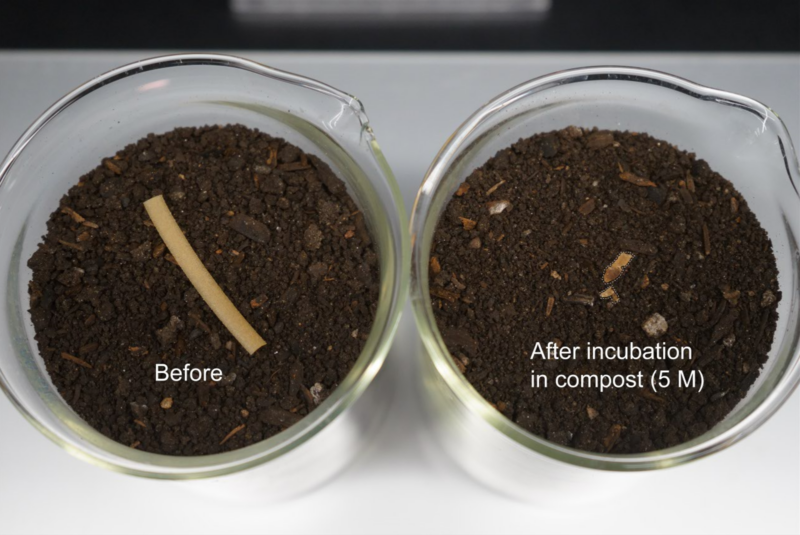
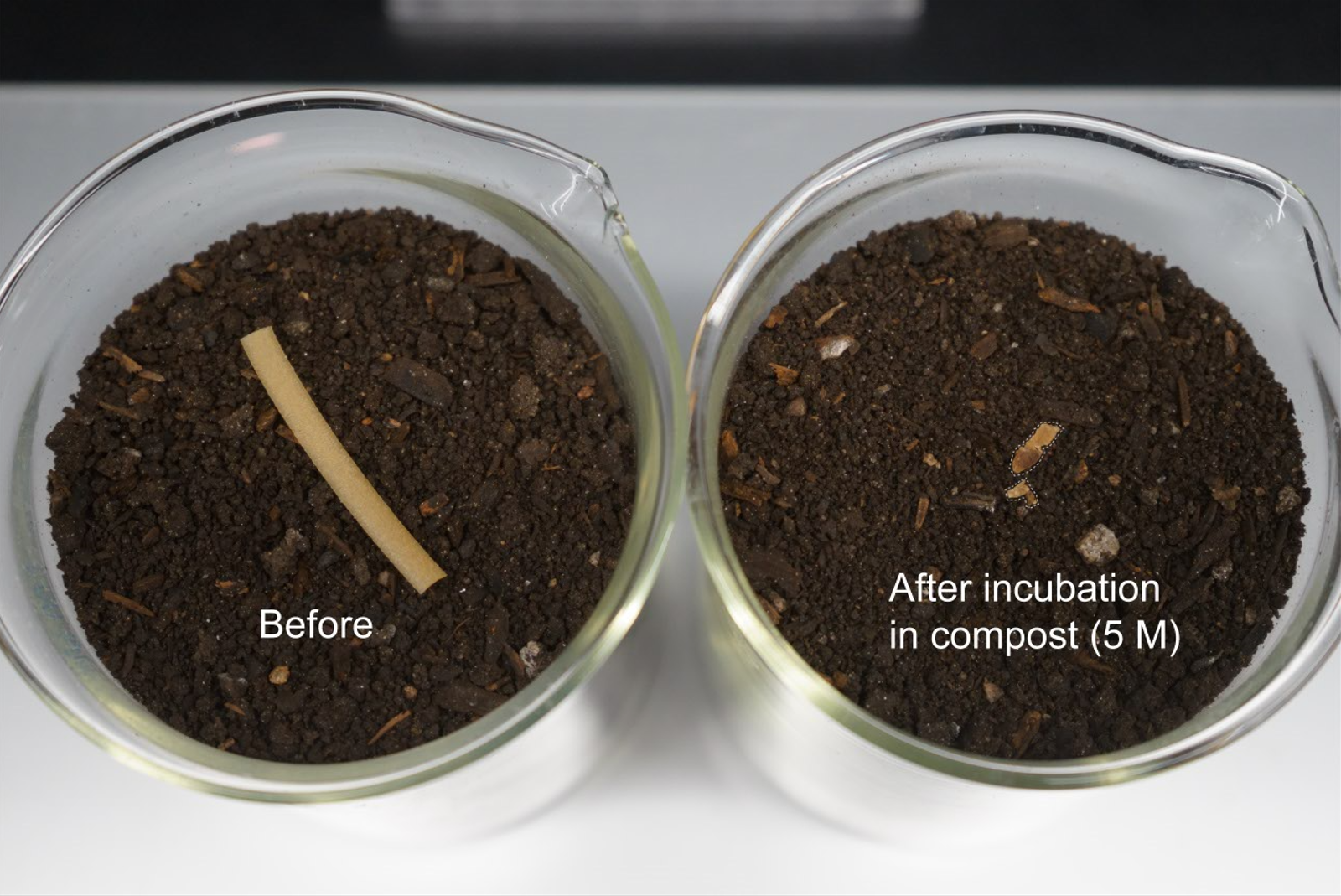
Image of two containers of dirt, one with a degraded piece of plastic in it.

Enlarge (credit: Han Sol Kim)

One reason plastic waste persists in the environment is because there's not much that can eat it. The chemical structure of most polymers is stable and different enough from existing food sources that bacteria didn't have enzymes that could digest them. Evolution has started to change that situation, though, and a number of strains have been identified that can digest some common plastics.

An international team of researchers has decided to take advantage of those strains and bundle plastic-eating bacteria into the plastic. To keep them from eating it while it's in use, the bacteria is mixed in as inactive spores that should (mostly—more on this below) only start digesting the plastic once it's released into the environment. To get this to work, the researchers had to evolve a bacterial strain that could tolerate the manufacturing process. It turns out that the evolved bacteria made the plastic even stronger.

Bacteria meet plastics

Plastics are formed of polymers, long chains of identical molecules linked together by chemical bonds. While they can be broken down chemically, the process is often energy-intensive and doesn't leave useful chemicals behind. One alternative is to get bacteria to do it for us. If they've got an enzyme that breaks the chemical bonds of a polymer, they can often use the resulting small molecules as an energy source.

Read 11 remaining paragraphs | Comments

30 Apr 22:52

The NRA is falling apart, and the gun cult may be going with it

by Mark Sumner
James.galbraith

well it's a bit of good news

It would be hard to find an organization more corrupt and incompetent than the NRA, though a few individuals on a certain court sure come to mind. In January, chief executive Wayne LaPierre ended three decades of control when he resigned ahead of a trial over tapping organization funds to treat himself to yacht trips, African safaris, and regular use of a private jet. In February, that trial ended with LaPierre being ordered to pay back almost $4.4 million

In the wake of LaPierre’s resignation, the organization has reportedly descended into infighting. Finding a new leader has proven so difficult that not even Donald Trump Jr., who spent years talking himself up as the NRA’s next leader, is willing to take the job. Or at least, he says he wouldn’t, though no one has actually asked him to step in.

Leadership aside, the NRA now has only a fraction of the funds they had to sling around in past election seasons. They’ve declined from the $50 million they put into races in 2016 to only $11 million in their PAC and SuperPAC combined as of the last filing. Membership is also down by over a million, to around five million, which is half the goal LaPierre set for 2023 a decade ago. 

And that’s not all that’s declined. So have gun sales. So what does that mean for the gun lobby?

GOP candidates routinely place guns right next to God in their campaign material, and Republican Christmas cards feature every family member clutching a ridiculous weapon.

Rep. Thomas Massie’s 2023 Christmas card

But it appears that Republican members of Congress aren’t putting enough guns in the hands of their adolescent children. According to the FBI, gun sales in the United States have declined for three straight years. The Trace estimates that Americans bought 665,000 fewer guns in 2023 than in 2022. That trend is continuing. Comparing year-over-year data, sales in March of 2024 were down 5% from the same month in 2023. 

There are reasons other than the declining influence of the NRA for that drop in sales. The truth is only about 6% of Americans hunt, and even for them an expensive assault weapon is rarely, if ever, the right tool. While an AR-15-style weapon may be the perfect tool for war, it’s a poor choice for personal defense. 

Buying guns like the trendy AR-15 can be an expensive hobby, especially for those who don’t use them beyond a temporary enthusiasm for the local gun range. A $650 Yeti cooler may at least contribute to a tailgate party, but a $1,000 assault rifle is just an expensive—and dangerous—decoration for the vast number of those who own them. 

In short, not every gun buyer goes on to be the industry's serial-killing dream customer. Many may not be inclined to buy another copy of a weapon they aren’t using, no matter how many guns Massie or Colorado Rep. Lauren Boebert have on their Christmas cards.

With the NRA fading, there are other gun lobby groups working to gain more influence. However, none of them seem to have the level of influence, extensive finances, and highly effective lobbyists that the NRA had a few years ago. Those other organizations haven’t spent decades nurturing relationships with both politicians and deep-pocketed donors. The decline of the NRA seems like a genuine moment of weakness in the pro-gun lobby.

There is certainly no shortage of Republican-dominated state legislatures standing by to pass stupid laws. But hopefully, it doesn't matter how tightly Republicans dig in their cold, dead fingers. America may have passed Peak Gun.

But of course that doesn’t mean it’s time to relax about gun control legislation. It means that it’s time to push harder.

RELATED STORY: Tennessee governor thinks schools need more guns to prevent shootings

Campaign Action

30 Apr 16:20

Arizona GOP gives indicted 'fake elector' a new RNC gig

by Walter Einenkel
James.galbraith

AZ GOP, proudly losing their minds in full public view

The Arizona GOP has tapped state Sen. Jake Hoffman, a prominent Freedom Caucus member of the legislature, for a position with the Republican National Committee. This comes less than a week after Hoffman’s indictment on multiple felony charges for his part in a “fake elector” scheme connected to the 2020 election. 

An Arizona grand jury indicted Hoffman and 17 others for their part in the massive scheme that sent lists of “alternate electors” from seven states to the National Archives after the 2020 election, according to the Arizona Mirror. The plan was to use those fraudulent documents to shift the states’ Electoral College votes from Joe Biden to Donald Trump.

The Arizona GOP did not respond to a CNN inquiry about why they chose one of two state senators charged in this scheme to represent the party at the national level. Maybe it’s because of Hoffman’s important efforts on behalf of the Arizona Freedom Caucus, like trying to keep Satan off of public property.

Whatever the reason, the winner here is the MAGA faction of election deniers. Along with a relentless campaign to harass Republicans who dared to certify the actual results of the 2020 election, the extremist election deniers have been diligently working to take control of Arizona’s GOP apparatus since 2020. While the state’s voters have continued to reject many of these extremists, the national GOP leaders seem to have resigned themselves to supporting election deniers.

Hoffman and his co conspirators have been under fire since the forged documents appeared. The grand jury indictment targeting Hoffman also included fellow Arizona Freedom Caucus member and state sen. Anthony Kern, as well as former Arizona Republican Party Executive Director Greg Safsten.

Only the best people.

Here's one way to avoid dealing with election results you don't like: just wipe them from the record books. It's not Orwell—it's Arizona, and we're talking all about it on this week's episode of "The Downballot." This fall, voters have the chance to deny new terms to two conservative Supreme Court justices, but a Republican amendment would retroactively declare those elections null and void—and all but eliminate the system Arizona has used to evaluate judges for 50 years. We're going to guess voters won't like this one bit … if it even makes it to the ballot in the first place.

Campaign Action

30 Apr 16:10

Why we keep seeing egg prices spike

by Whizy Kim
James.galbraith

If only there were a functioning legislative body

Cartons of eggs are seen stacked on the shelf of a grocery store cooler.
With a new wave of bird flu affecting hens, egg prices are ticking up again. | Matthew Hatcher/Bloomberg via Getty Images

How corporate greed plays a role in making bird flu outbreaks — and egg prices — worse.

Egg prices are rising again. The culprit, again: bird flu.

At least, that’s the surface-level reason. In the current wave, according to the CDC, the H5N1 bird flu has been found in over 90 million poultry birds across almost every state since 2022, and has even spread to dairy cattle, with over 30 herds in nine states dealing with an outbreak at the time of this writing.

The last time bird flu struck US farms, in early 2022, egg prices more than doubled during the year, reaching a peak of $4.82 for a dozen in January 2023. During the bird flu outbreak in 2014 to 2015, egg prices also briefly soared.

While prices now are still nowhere near the peak they reached in January 2023, they’ve been creeping up again since last August, when a dozen large eggs cost $2.04. As of March, we’re bumping up against the $3 mark, which is a nearly 47 percent increase. It’s also a huge increase from the price we were used to a few years ago: In early 2020, a dozen eggs were just $1.46 on average.

The H5N1 strain of bird flu is highly contagious and obviously poses a big risk to hens. But the fact that bird flu outbreaks keep battering our food system points to a deeper problem: an agriculture industry that has become brittle thanks to intense market concentration.

The egg market is dominated by some major players

The egg industry, like much of the agricultural sector, is commanded by a few heavyweights — the biggest, Cal-Maine Foods, controls 20 percent of the market — that leave little slack in the system to absorb and isolate shocks like disease.

Hundreds of thousands of animals are packed tightly together on a single farm, as my colleague Marina Bolotnikova has explained, where disease can spread like wildfire. According to the government and corporate accountability group Food & Water Watch, three-quarters of the country’s hundreds of millions of egg-laying hens are crammed into just 347 factory farms.

The system also uses genetically similar animals that farms believe will maximize egg production — but that lack of genetic diversity means animal populations are less resistant to disease.

When a hen gets infected, stopping the spread is an ugly, cruel business; since 2022 it has led to the killing of 85 million poultry birds. For the consumer, it often means paying a lot more than usual for a carton of eggs.

Preventing any outbreaks of disease from ever happening isn’t realistic, but the model of modern industrial farming is making outbreaks more disruptive.

And it’s not just these disruptions driving price spikes. Egg producers also appear to be taking advantage of these moments and hiking prices beyond what they’d need to maintain their old profit margins.

“It is absolutely a story of corporate profiteering,” says Rebecca Wolf, senior food policy analyst at Food & Water Watch.

Cal-Maine’s net profit in 2023 was about $758 million — 471 percent higher than the year prior, according to its annual financial report. Most of this fortune was made through hoisting up prices; the number of eggs sold, measured in dozens, rose only 5.9 percent.

Last year, several food conglomerates, including Kraft and General Mills, were awarded almost $18 million in damages in a lawsuit alleging that egg producers Cal-Maine and Rose Acre Farms had constrained the supply of eggs in the mid- to late 2000s, artificially bumping prices. A farmer advocacy group last year called on the FTC to look into whether top egg producers were price gouging consumers.

Are we doomed to semi-regular price surges for eggs?

Our food system didn’t become so consolidated — and fragile — by accident. We got here because of three big reasons, Wolf says: by not enforcing environmental laws, by not enforcing antitrust laws, and by giving away “tons of money” to the agriculture industry.

During the New Deal era, the federal government put in place policies that would help manage food supply and protect both farmers and consumers from sharp deviations in what the former earned and the latter paid. Under Secretary of Agriculture Earl Butz in the 1970s, though, those policies started getting chipped away; Butz’s famous motto was for farmers to “get big or get out.” The spread of giant factory farms is in part a product of this about-face in managing supply.

Because our food system is so concentrated and intermingled, it also means any single supply chain hiccup — whether due to disease, wars, or any other reason — can have ripple effects on others, affecting prices in a vast number of essential consumer goods and services. “When we have things like E. coli outbreaks, it’s hard to know where the problem lies because the way that we process and manufacture is so hyper-industrialized that you then have a problem with millions of pounds of food,” says Wolf.

Thankfully, the Biden administration has been making some strides in loosening up food industry consolidation, often by shoring up enforcement of long-existing antitrust laws. But there’s still more we could do. There are bills that have been introduced to Congress, like Sen. Elizabeth Warren’s Price Gouging Prevention Act, that would give the FTC the authority to first define what counts as price gouging and then crack down on companies that raise prices excessively.

The cycle of food chain snags and higher prices doesn’t have to keep repeating.

“We are maximizing profit truly over everything else — over the welfare of the animals, over the rights and wages of people who work in the food system, for even consumers who are at the grocery store,” Wolf says. “None of this is inevitable — we shouldn’t have to be here.”

This story appeared originally in Today, Explained, Vox’s flagship daily newsletter. Sign up here for future editions.

29 Apr 23:59

Trump immunity case shows why we need to reform the Supreme Court

by Joan McCarter
James.galbraith

No shit

The U.S. Supreme Court heard Donald Trump’s immunity claim in his federal criminal trial for trying to overturn the 2020 election Thursday, and the conservative majority is likely going to give Donald Trump what he wants: a delay of the trial until after the election. If Trump wins again, the conservatives have essentially signaled that they would be open to blanket immunity for him against any future criminal charges. 

 The fact that Supreme Court justices are suggesting that the president is above the law proves why the court must be reformed.

Four of the justices—Clarence Thomas, Samuel Alito, Brett Kavanaugh, and Neil Gorsuch—even went so far as to suggest that Prosecutor Jack Smith’s entire prosecution is unconstitutional, and they reinforced Trump’s argument that the president is immune.

Kavanaugh even told Michael Dreeben, a lawyer from Smith’s office, that it’s a “serious constitutional question whether a criminal statute can apply to the president’s criminal acts.”

That would be the ultimate get-out-of-jail-free card for the chief executive, rubber stamped by the highest court of the land.

It’s worth remembering that Thomas refused to recuse himself from this—and most of the Trump election interference cases—despite the fact that his wife Ginni Thomas was deeply involved in Trump’s coup attempt. When she testified to the Jan. 6 special congressional committee, she maintained that the election was stolen

His failure to recuse himself comes after a new ethics code has supposedly been enforced, saying that “a Justice should disqualify himself or herself in a proceeding in which the Justice’s impartiality might reasonably be questioned, that is, where an unbiased and reasonable person who is aware of all relevant circumstances would doubt that the Justice could fairly discharge his or her duties.”

So much for that suggestion from Chief Justice John Roberts. His code has no teeth, which is yet another reason why ethics reform—and indeed court reform and expansion—is essential. 

Senate Majority Leader Chuck Schumer tweeted a prescient broadside against the court before arguments began, writing “SCOTUS speeds up trials when it wants—but not in this case.” 

By all accounts, the court’s conservative majority is doing everything in its power to delay this one.

Today, SCOTUS hears Trump’s ridiculous claim of total immunity. He's obviously not immune. SCOTUS is only protecting Trump and slowing his trial. SCOTUS should not have taken this case or frozen the district court. SCOTUS speeds up trials when it wants—but not in this case.

— Chuck Schumer (@SenSchumer) April 25, 2024

If the Senate retains the majority in 2025, Schumer is going to have to follow up on that: the Supreme Court is going to have to be reformed and expanded. Nothing less than the survival of this democracy demands it.

RELATED STORIES:

Ginni Thomas wanted to overturn the election. About Clarence Thomas' Jan. 6 documents dissent ...

Texts between Ginni Thomas, Meadows reveal an extraordinary effort to destroy democracy

Pressure grows for Clarence Thomas to recuse himself from Trump cases

Campaign Action
29 Apr 23:53

Dead Boy Detectives turns Neil Gaiman’s ghostly duo into “Hardy Boys on acid”

by Jennifer Ouellette
James.galbraith

It's quite fun and unsurprisingly easy on the eyes ;)

Edwin (George Rexstrew) and Charles (Jayden Revri) are the Dead Boy Detectives, ghosts who solve paranormal mysteries.

Enlarge / Edwin (George Rexstrew) and Charles (Jayden Revri) are the Dead Boy Detectives, ghosts who solve paranormal mysteries. (credit: Netflix )

For those eagerly anticipating the second season of Netflix's stellar adaption of Neil Gaiman's Sandman graphic novels, Dead Boy Detectives—the streaming plaform's new supernatural horror detective series—is a welcome return to that weird magical world. Co-showrunner Steve Yockey (Supernatural), who created the series, aptly describes it as "the Hardy Boys on acid." You've got vengeful witches, demons, psychic mediums, cursed masks, foul-mouthed parasitic sprites, talking cats—and, of course, the titular ghostly detectives, intent on spending their afterlife cracking all manner of mysterious paranormal cases.

(Some spoilers below, but no major reveals.)

Sandman fans first encountered the Dead Boys in the "Seasons of Mist" storyline, in which the ghost Edwin Paine and Charles Rowland meet for the first time in 1990. Edwin had been murdered at his boarding school in 1916 and spent decades in Hell. When Lucifer abandoned his domain, Hell was emptied, and Edwin was among the souls who returned to that boarding school. Charles was a living student whom Edwin tried to protect. Charles ultimately died and chose to join Edwin in his afterlife adventures. The characters reappeared in the Children's Crusade crossover series, in which they decided to become detectives.

Read 12 remaining paragraphs | Comments

29 Apr 20:13

Medical records for out-of-state abortions will now be protected by HIPAA

by The19th

Shefali Luthra, The 19th

This story was originally published by The 19th.

Health care providers aren’t allowed to tell law enforcement about a patient’s abortion if they received the procedure in a state where it is legal, it is protected by federal law, or it is permitted by state law, the Biden administration said Monday.

The new rule is based on the federal Health Insurance Portability and Accountability Act, or HIPAA. It could shield patients’ medical information if they live in a state with an abortion ban and travel elsewhere to seek care. Those are details that could show up in their health records if they seek subsequent medical care in their home state.

But it’s unclear whether it will protect medical data for people who self-manage their abortions by receiving medication in the mail, often from a prescribing physician in a state with laws protecting reproductive rights.

The rule will take effect in 30 days, and it represents a meaningful shift. Though HIPAA generally protects medical information stored by health plans and health providers, it has historically included a carveout for law enforcement. While health care providers are not obligated to turn over a patient’s medical records to law enforcement, they are generally allowed to.

The new federal rule closes that loophole for abortions that were clearly legal in the state where  they were provided, along with medical information regarding other forms of reproductive health care, such as pregnancy tests or contraceptive care. It should provide a level of protection for physicians who may feel pressure to cooperate with a law enforcement investigation, said Melanie Fontes Rainer, head of the Health and Human Service Department’s Office of Civil Rights.

“We want to make sure people can go to the doctor and not be scared to talk to the doctor,” Fontes Rainer told The 19th.

That could extend privacy protections to countless Americans. In the time since Roe v. Wade has been overturned, thousands of patients in states with abortion bans have traveled elsewhere to seek the procedure in a place where it remains legal. One study from December 2023 found that 1 in 5 abortions performed in the first six months of 2023 were for people who traveled out of state.

Though abortion is an incredibly safe and effective procedure, patients may want to seek follow-up care — to ensure that they are no longer pregnant, or if they are concerned about bleeding after a medication abortion. But doctors in states with legal abortion have reported many patients voicing anxiety that going to a physician in their home state could put them in legal jeopardy.

“Women are scared to go get follow-up care because they now have an electronic health record, they have something in their file that says they’ve had an abortion. We’ve heard firsthand of these experiences,” Fontes Rainer said. “That protected health information would be protected from those fishing expeditions.”

Patients who believe their rights under HIPAA have been violated can file a complaint with the Office of Civil RIghts.

Fontes Rainer declined to answer questions about how the rule could affect self-managed abortion specifically, and the rule is silent on that issue.

Ambiguity on that matter could leave thousands more patients afraid, confused, or even at legal risk. Pregnant patients who cannot travel,  perhaps because of the financial cost, or inability to find the time off from work or child care, have in growing numbers relied on new mechanisms to acquire medication abortion pills in their home states, either from a prescribing doctor in another state or country, or through more local community networks.

Per one study, provision of those pills increased by almost 28,000 in the first six months after Roe’s overturn. Not all those pills are immediately used — some patients order pills to make sure they have them on hand if they need an abortion later on. But they indicate just how meaningful this avenue has become for people seeking abortions from states with bans.

It’s not clear if those abortions would fall under the federal rule’s definition of “legal” reproductive health care. Though state abortion bans do not criminalize pregnant patients’ behavior, they do restrict when and how medication abortion can be prescribed.

Federal rules and regulations will not be able to address all implications from overturning Roe v. Wade, a decision made in the case Dobbs v. Jackson Women’s Health Organization, HHS Secretary Xavier Becerra told reporters at a press conference Monday.

“We have no illusion that everything that the president has urged us to do with our authorities is going to undo Dobbs. Dobbs took away rights,” Becerra said. “Until we have a national law that re-institutes Roe v. Wade, we’re going to have issues.”

Campaign Action

29 Apr 19:59

'The Apple Vision Pro's eBay Prices Are Making Me Sad'

by msmash
An anonymous reader shares a report: I paid a lot of money for the privilege of getting an Apple Vision Pro brand-new in February. All-in, with optical inserts and taxes, I financed a little over $3,900 for the 256GB version of the headset. A day or so ago, I made a mistake that I'm sure many early adopters are familiar with: I looked up how much it's been selling for on eBay. On Wednesday, a 1TB Vision Pro, complete with all the included gear, Apple's fluffy $200 travel case, $500 AppleCare Plus, and claimed to have been "worn maybe about an hour" sold for $3,200 after 21 bids. The listed shipping estimate was $20.30. Brand new, that combination is $5,007.03 on Apple's site for me. Another eBay listing, this one with my headset's configuration (but sans optical inserts) went for just $2,600 -- again with most, if not all, of the included accessories. Several other 256GB and 512GB models sold for around that amount this week. The story is no different over on Swappa, a popular reselling site among Apple users. Bloomberg News, over the weekend: In related news, employees at some Apple retail stores are now being asked to fill out surveys after giving Vision Pro demonstrations to potential buyers. Apple wants to know if they were able to close a sale and get any feedback from the would-be buyer. Apple also wants to ensure employees are following the 20-minute demo script. As I wrote last week, Vision Pro demand has dropped considerably at many Apple stores. One retail employee says they haven't seen one Vision Pro purchase in weeks and that the number of returns equaled the device's sales in the first month that it was available.

Read more of this story at Slashdot.

29 Apr 19:59

Razer Made a Million Dollars Selling a Mask With RGB, And the FTC is Not Pleased

by msmash
Razer will have to fork over $1.1 million in refunds to customers who purchased its RGB-clad Zephyr face mask, according to a proposed settlement announced by the Federal Trade Commission on Monday. From a report: The company claimed the face mask used N95-grade filters, but the FTC alleges Razer never submitted them for testing and only "stopped the false advertising following negative press coverage and consumer outrage at the deceptive claims." Razer first released its Zephyr face mask in 2021 as a nifty, cyberpunk-esque alternative to traditional face masks worn during the covid-19 pandemic. Although Razer initially marketed the $100 mask as having N95-grade filters, it scrubbed any mention of the grade after YouTuber Naomi Wu tore down the mask and found that it wasn't N95 certified after all. N95 masks are supposed to filter out at least 95 percent of airborne particles, according to the Centers for Disease Control and Prevention. Razer also planned on launching a $150 Zephyr Pro with a voice amplification feature, but that never panned out. At the time, Razer addressed claims about its Zephyr masks, saying in a post on X that "the Razer Zephyr and Zephyr Pro are not medical devices, respirators, surgical masks, or personal protective equipment (PPE) and are not meant to be used in medical or clinical settings."

Read more of this story at Slashdot.

29 Apr 19:57

Bezos, Other Amazon Execs Used Signal - a Problem for FTC Investigators

by EditorDavid
James.galbraith

Of course

Pursuing an unfair business practices case against Amazon, America's Federal Trade Commission has now "accused" Amazon of using Signal, reports the Seattle Times: The newspaper notes that the app "can be set to automatically delete messages, to hide information related to the FTC's ongoing antitrust investigation into the company." In a court filing this week, the FTC moved to "compel" Amazon to share more information about its policies and instructions related to using the Signal app... The FTC accused Amazon executives of manually turning on the feature to delete messages in Signal even after the company learned that the FTC was investigating and had told Amazon to keep documents, emails and other messages. Many of Amazon's senior leaders used Signal, according to the FTC, including former CEO and current chair Jeff Bezos, CEO Andy Jassy, and general counsel David Zapolsky, as well as Jeff Wilke, former head of Amazon's worldwide consumer business, and Dave Clark, former worldwide operations chief. "Amazon is a company that tightly controls what its employees put into writing," FTC attorneys said in a court filing Thursday. "But Amazon's senior leadership also used another channel for internal communications and avoided the need to talk carefully by destroying the records of their messages...." In the court filing Thursday, the FTC asked Amazon to provide two troves of documents related to its use of Signal: Amazon's document preservation notices and its instructions about the use of "ephemeral messaging applications, including Signal." The FTC said Amazon waited for more than a year after it learned of the investigation to instruct its employees to preserve Signal messages. "It is highly likely that relevant information has been destroyed as a result of Amazon's actions and inactions," the FTC wrote in court records.

Read more of this story at Slashdot.

29 Apr 19:57

Plunge in Storage Battery Costs Will Speed Shift to Renewable Energy, Says IEA

by EditorDavid
James.galbraith

No shit

"In less than 15 years, battery costs have fallen by more than 90%," according to a new report from the International Energy Agency, "one of the fastest declines ever seen in clean energy technologies." And it's expected to get even cheaper, reports Reuters: An expected sharp fall in battery costs for energy storage in coming years will accelerate the shift to renewable energy from fossil fuels, the International Energy Agency (IEA) said on Thursday... The total capital costs of battery storage are due to tumble by up to 40% by 2030, the Paris-based watchdog said in its Batteries and Secure Energy Transitions report. "The combination of solar PV (photovoltaic) and batteries is today competitive with new coal plants in India," said IEA Executive Director Fatih Birol. "And just in the next few years, it will be cheaper than new coal in China and gas-fired power in the United States. Batteries are changing the game before our eyes." [...] The global market for energy storage doubled last year to over 90 gigawatt-hours (GWh), the report said... The slide in battery costs will also help provide electricity to millions of people without access, cutting by nearly half the average electricity costs of mini-grids with solar PV coupled with batteries by 2030, the IEA said. The Los Angeles Times notes one place adopting the tech is California: Standing in the middle of a solar farm in Yolo County, [California governor] Newsom announced the state now had battery storage systems with the capacity of more than 10,000 megawatts — about 20% of the 52,000 megawatts the state says is needed to meet its climate goals. Although Newsom acknowledged it isn't yet enough to eliminate blackouts...

Read more of this story at Slashdot.

26 Apr 19:58

Trump Is Getting What He Wants

by Ronald Brownstein
James.galbraith

Hacks back at it

At today’s hearing on Donald Trump’s claim of absolute immunity from criminal prosecution, the Republican-appointed Supreme Court majority appeared poised to give him what he most desires in the case: further delays that virtually preclude the chance that he will face a jury in his election-subversion case before the November election.

But the nearly three hours of debate may be even more significant for how they would shape a second Trump term if he wins reelection. The arguments showed that although the Court’s conservative majority seems likely to reject Trump’s claim of absolute immunity from criminal prosecution, four of the justices appear predominantly focused on limiting the possibility that future presidents could face such charges for their actions in office, with Chief Justice John Roberts expressing more qualified sympathy with those arguments. Among the GOP-appointed justices, only Amy Coney Barrett appeared concerned about the Court potentially providing a president too much protection from criminal proceedings.

The conservative majority appeared determined to draw a lasting line between presidential actions that could and could not be subject to criminal prosecution; Justice Neil Gorsuch at one point insisted, “We’re writing a rule for the ages.” But many observers fear that any grant of immunity, no matter how the majority tries to limit it, would enormously embolden a reelected Trump to barrel through constraints of custom and law in pursuing his self-described agenda of “retribution.”

“The Supreme Court may be inclined to split hairs, but Donald Trump is not,” Deana El-Mallawany, the counsel for the bipartisan group Protect Democracy, told me after the hearing. “The arguments today made clear that Trump seeks absolute unchecked power. Trying to rein in an imperial vision of presidential power like that with an opinion that draws fine lines would be akin to trying to hold water with a net.”

After today’s hearing, the hope that a trial could proceed expeditiously now “seems fruitless, and the question is whether the Court will issue an opinion that will provide expansive, albeit not unlimited, immunity, which would be a giant step toward rejecting the idea the president is not a king, a fundamentally anti-constitutional principle,” the former federal prosecutor Harry Litman, the host of the podcast Talking Feds, told me.

In claiming absolute immunity from criminal prosecution, Trump’s lawyers relied heavily on the 5–4 1982 Supreme Court decision Nixon v. Fitzgerald, which ruled that former presidents could face civil suits only for actions that could not be defined as official, even under a very broad definition of that term.

Although providing that expansive protection from civil litigation, the Court in that earlier case did not address whether the president should enjoy comparable immunity from criminal prosecution. The majority opinion dropped only fleeting and somewhat contradictory breadcrumbs about the Court’s view on criminal prosecution. At one point, the decision implied that the president deserves less protection from criminal charges. But later, the decision omitted criminal charges when it listed means other than civil suits that could hold a president accountable for his actions.

The three-judge panel on the Washington, D.C., Circuit Court of Appeals, in its ringing ruling earlier this year denying Trump’s immunity claim, concluded that the Nixon v. Fitzgerald limits on civil cases should not apply to criminal allegations against a former president. At the hearing, though, Roberts openly disparaged the circuit-court opinion for failing to provide enough protection to a president.

[Read: The Supreme Court goes through the looking glass on presidential immunity]

Groups of both constitutional-law scholars and historians of early America filed briefs to the Supreme Court arguing that there is no evidence that the Founders intended to provide the sweeping protection Trump is seeking and asserting that they had consciously omitted from the Constitution any grant of immunity to the president for official acts. “The President’s susceptibility to prosecution was an express theme of the ratification debates,” the historians wrote in their brief. “Critical figures in multiple [state ratifying] conventions converged on the same understanding: The President can be prosecuted.”

To varying degrees, the Republican-appointed justices seemed to accept the idea that former presidents could be prosecuted in theory, while devoting much of their question time to minimizing the circumstances in which they actually would be. Today’s hearing validated the predictions of legal analysts who told me earlier this week that the conservative majority would be drawn to a version of the Fitzgerald distinction immunizing the president against legal challenge for some circle of acts within his official responsibilities but not against acts that fall outside that boundary.

“I think they will do what they should do, which is they will hold that Nixon v. Fitzgerald applies to criminal as well as civil matters against the president, which means that Trump will get part but not all of what he wants,” Michael McConnell, the director of the Constitutional Law Center at Stanford Law School, told me before the hearing. “Nixon v. Fitzgerald distinguishes between presidential acts that are within ‘the outer perimeter’ of his presidential authority and acts that are private. I think it is clear that some of what he is being charged with falls into each category.”

If, as seems likely after today’s hearing, the Court majority seeks to establish such a distinction between some official acts that are protected and private acts that are not protected, it would virtually extinguish the chances that Trump will face a trial before the November election on the charges that he tried to overturn the 2020 election.

“Even if it’s pellucidly clear that the standard [for immunity] wouldn’t apply to Trump, I do think he likely would get another trip back up and down the federal courts, very likely dooming the prospect of a trial in 2024,” Litman said.

The longer-term implications of a ruling providing immunity for some substantial portion of official conduct, though, could be even more profound. The hearing suggested that the conservative Supreme Court majority is unwilling to consider, or simply unconcerned, that the real-world political context of a second Trump term could undermine any distinction it draws between presidential behavior that is and is not protected from criminal prosecution.

“As we heard today, Donald Trump is trying to take the most maximal approach to executive power,” El-Mallawany told me. “If the Supreme Court is willing to give an inch, then I think he’ll take a mile in a second term.”

Trump has already made clear that he views presidential authority as essentially unlimited. Responding to the dramatic hypothetical that Judge Florence Pan raised during the proceedings in the D.C. Circuit Court, Trump’s lawyer D. John Sauer said that a president could not be criminally prosecuted unless first impeached and convicted even if he ordered SEAL Team Six to assassinate a political rival.

[Read: Trump’s misogyny is on trial in New York]

At today’s hearing, Sauer again insisted that Trump could not be criminally prosecuted for killing a rival, selling nuclear secrets to an enemy, or even staging a coup unless he was first impeached and convicted. “They took assassinating an opponent and upped it to a full-bore coup,” John Dean, the White House counsel under Richard Nixon who helped expose the Watergate scandal, told me after the hearing.

Even short of that extreme, Trump has indicated that in a second term he intends to send federal forces into blue states and cities over the objections of local officials and deploy the Justice Department and the FBI against his political opponents.

If he wins in November, Trump would inevitably interpret the victory as a public endorsement, or at least acceptance, of his views about presidential power. And all signs suggest Trump has already concluded that hardly any elected officials in his party have the stomach to confront him. That degree of loyalty functionally eliminates the possibility that Congress could impeach him and remove him from office, almost no matter what he does.

As El-Mallawany told me, that means the reality facing the Supreme Court as it considers this case is that a second Trump term would come only after “defeat at the ballot box, impeachment by Congress, and self-policing by the party” are all effectively eliminated as prospective checks on Trump’s actions.

If, against that backdrop, the Court also chooses to weaken rather than fortify the last legal barriers against egregious presidential actions, Trump could easily conclude that he faces few practical limits on his authority. Given Trump’s baseline inclination to view his presidential authority as virtually unlimited, Dean said he didn’t think the Court could distinguish between protected and unprotected presidential actions in a manner that will constrain Trump’s behavior if he wins again.

“That’s why it is very troublesome for the Court to try to fashion some sort of immunity even with the core functions [of the presidency], because it’s all hypothetical and speculative at this point as to what it would mean, and lawyers have a wonderful facility for finding permission for actions that are not really permissible,” Dean told me.

Justice Ketanji Brown Jackson, echoing such concerns, forcefully raised the risk in the hearing that broad immunity from criminal prosecution could leave a president “emboldened” to undertake illegal acts, because he would arrive in office aware that he was immune from criminal accountability. Maintaining the possibility of criminal charges, she argued, was essential to deterring a president inclined to misuse his or her authority.

But several justices in the conservative majority seemed more concerned, however implausibly, about the opposite risk. Justice Samuel Alito argued that opening a president to criminal liability would not deter illegal activity but actually increase the risk that he or she would break the law. In Alito’s somewhat head-spinning logic, a president who feared potential criminal prosecution after he left office would undertake illegal acts to stay in power and avoid that legal exposure.

After the hearing, the prospect that Trump would face trial before November seemed minimal. Barrett surprisingly joined Jackson in suggesting that while the courts sorted out which of a president’s official actions deserved immunity, a trial could proceed around the elements of Trump’s behavior that were clearly private in nature. However, four of the other Republican-appointed justices appeared entirely uninterested in that idea, and Roberts seemed more inclined to send the case back to lower courts.

As Harry Litman noted, those who went into the hearing wishing to preserve a preelection trial against Trump emerged from the proceedings reduced to hoping that the Court doesn’t eviscerate the possibility of criminal consequences for any president who breaks the law. Even a decision that allows Trump to delay any further criminal trials until after the election could look relatively small next to the consequences of a ruling that causes him to conclude that, if he wins again, the Supreme Court would lack the will to restrain him.

26 Apr 15:54

20% of grocery store milk has traces of bird flu, suggesting wider outbreak

by Beth Mole
20% of grocery store milk has traces of bird flu, suggesting wider outbreak

Enlarge (credit: Getty | Jeffrey Greenberg)

The Food and Drug Administration reported late Thursday that about 20 percent of retail milk samples from around the country tested positive for genetic fragments of the bird flu, aka highly pathogenic avian influenza (HPAI) virus H5N1. While retail milk is still considered to be safe, the finding suggests that the spread of the virus in cows is more extensive than is currently known.

The FDA used a test called quantitative polymerase chain reaction (qPCR), which can only detect the presence of genetic fragments. In pasteurized retail milk, it is highly likely that those genetic snippets are merely remnants of virus particles destroyed during pasteurization. The FDA is currently conducting additional testing using egg inoculation tests, a gold standard for detecting a live virus, to confirm the effectiveness of pasteurization. Meanwhile, the director of the National Institute of Allergy and Infectious Diseases, Jeanne Marrazzo, told reporters Wednesday that tests at the agency's federal labs so far did not identify live virus from any of its sampling. Additionally, several previous studies have found that pasteurization of eggs—which is done at a lower temperature than it is for milk—was effective at destroying H5N1.

While experts are largely unconcerned with the safety of commercial milk, the potential for wide, unrecognized spread of bird flu in dairy herds is alarming. To date, the US Department of Agriculture has only confirmed infections in 33 herds in eight states. The FDA acknowledged that of its positive samples, "a greater proportion of positive results [are] coming from milk in areas with infected herds." But with tens of thousands of dairy herds in the US, the finding suggests that infections are being missed. It does not necessarily suggest that 20 percent of all cows are affected, since milk is pooled for commercial distribution. But 33 herds alone are unlikely to explain the high prevalence.

Read 2 remaining paragraphs | Comments

26 Apr 00:58

Cartoon: If David Pecker still ran National Enquirer

by Mike Luckovich
25 Apr 23:27

Mass graves at two hospitals are the latest horrors from Gaza

by Ellen Ioanes
James.galbraith

Surprise, more israeli war crimes, but can't bring that up because Israel Can Do No Wrong

Emergency vehicles and workers outside a bombed hospital.
Gazan teams, civil defense, crime scene investigation, and forensics continue to carry out investigation at the scene after Israeli siege and attacks that destroyed Gaza’s al-Shifa Hospital in Gaza City, Gaza, on April 17, 2024. | Dawoud Abo Alkas/Anadolu via Getty Images

What we know — and what we don’t — about the mass graves at Gaza hospitals.

A mass grave with 324 bodies was uncovered at Gaza’s Nasser Hospital, members of Gaza Civil Defense said over the weekend. The discovery follows reports of similar mass graves at the al-Shifa Hospital complex, where some 381 bodies have been exhumed since Israeli troops withdrew from the facility at the beginning of April.

As part of its ongoing war in Gaza following Hamas’s October 7 attack on Israel, the Israeli military conducted extensive raids at both hospitals earlier this year.

There’s a lot that’s unknown about the victims, including their causes of death. Some bodies had been buried at and around the hospital grounds because they could not safely be interred at cemeteries. But the sharp increases in the number of dead raise concerns that both hospitals could be the sites of serious crimes, including possibly extrajudicial killings, that require an independent investigation, according to the UN High Commissioner for Human Rights.

That’s why the discovery of hundreds of bodies in the grave sites is so alarming. There are allegations that IDF soldiers moved bodies that were temporarily buried at the hospital, which could lead to families losing track of remains, among other issues. Hospitals are supposed to be protected spaces under international humanitarian law, with an exceptionally high legal bar for carrying out military operations there. And if people were killed during those raids, authorities must be able to determine who they were and how they died, as the intentional killing of civilians is a war crime. In the near term, the ongoing conflict will make it difficult to determine exactly what happened, hindering accountability efforts if wrongdoing occurred.

Some of the victims “were allegedly older people, women and wounded, while others were found tied with their hands ... tied and stripped of their clothes,” Ravina Shamdasani, spokesperson for the UN High Commissioner for Human Rights, said Tuesday in a press release. (The UN has not said if it has independently verified these reports but has said they have “renewed concerns about possible war crimes amid ongoing Israeli airstrikes.”)

The Israeli military has rejected the idea that its soldiers buried the bodies, calling such accusations ”baseless and unfounded.” The IDF told CNN that it had examined some bodies in their search for the remains of Israeli hostages, but returned the remains “to their place.”

Here’s what we know about the graves

Starting last fall, Israeli forces targeted Gaza’s hospitals with bombing campaigns and with weeks-long raids at Nasser and al-Shifa, on the premise that Hamas uses civilian infrastructure like hospitals to plan and conduct operations. After a siege on al-Shifa Hospital and a later raid, as well as one on Nasser Hospital in Khan Younis, medical officers suggested many had died. It is not clear how many people were killed in each hospital, how they died, or who they were.

Here’s what we do know about what happened at each hospital.

Al-Shifa Hospital

At al-Shifa Hospital, the IDF says that it killed 200 “terrorists” hiding at the facility and has for months alleged that the hospital was a base of Hamas operations. Hamas media officials say that 400 people were killed during the raid, including at least 20 patients who died from lack of access to medical care, according to the WHO.

Hospital staff have denied that Hamas fighters were at the hospital, according to Reuters. Al-Shifa was destroyed, rendered essentially inoperable during the raid.

Nasser Hospital

According to the IDF, its February attack on Nasser Hospital in Khan Younis was an operation to recover the remains of Israeli hostages thought to be at the facility.

At the time, the IDF told Vox, without providing any evidence to support this assertion, that “Hamas terrorists are likely hiding behind injured civilians inside Nasser Hospital right now and appear to have used the hospital to hide our hostages there too.” The IDF later claimed to have detained 200 “terrorists and suspects in terrorist activities,” but when contacted this week, the IDF did not provide information about what happened to those detained.

Some bodies had been buried at a temporary site at Nasser Hospital during the Israeli siege and raid in February, according to Gaza Civil Defense. But the number of bodies discovered after the raids surpasses the number previously thought to be buried at either site, and it’s not clear where the new bodies came from.

Furthermore, Col. Yamen Abu Suleiman, head of Gaza Civil Defense in Khan Younis, said some of the bodies at the mass grave at Nasser Hospital show signs of summary execution, and some bodies had their hands and feet bound. “We do not know if they were buried alive or executed,” he told CNN. “Most of the bodies are decomposed.” (CNN and other media organizations have not been able to independently verify these allegations.) The group is also searching for the bodies of about 400 people missing since Israeli forces left Nasser Hospital.

The broader picture

Those allegations — and the uncertainty around where the unexpected bodies came from — prompted UN human rights commissioner Volker Türk’s call for “a clear, transparent and credible investigation” into how the people buried at the sites died.

“What appears to have happened, or what is alleged to have happened, is that the IDF dug up many of those bodies, removed identifying information, and then put the bodies back in the grave,” Adil Haque, an international humanitarian law professor at Rutgers University, told Vox. “So now people can’t identify their loved ones without great difficulty.”

There are provisions in international law regarding the dignity of the dead; people should, whenever possible, be buried in marked graves, and their families and loved ones should be able to engage in mourning practices. The presence of mass graves can indicate improper burials, though that is not always the case.

Very little is known about the mass graves so far, especially what happened to the new people buried within them — and that is what’s alarming.

“The question is, what happened during the IDF takeover of the hospital that explains why there’s so many more bodies in the grave than were originally there?” Haque said.

And it’s not clear that the justification for the raids on the hospitals was legal under international humanitarian law, given that medical facilities and personnel receive special protection.

“You cannot attack a hospital, medical services, medical units; medical personnel and medical institutions must be protected,” Anjli Parrin, director of the Global Human Rights Clinic at the University of Chicago Law School, told Vox. “That you’re seeing large numbers of deceased individuals at a hospital is very troubling. There’s a question not just of the bodies but why did you attack these places? Who were the civilians harmed? Was it really the only option? Was it under the legal standard of hostile acts harmful to the enemy?”

Mass graves show a real need for an independent investigation

What happened to the people in the mass graves and why they are there is difficult to understand in part because of the lack of independent information coming out of Gaza. No outside reporters have been allowed in, almost a hundred Palestinian journalists have been killed in Gaza since the start of the war, aid groups struggle to operate, and independent investigative bodies have not been able to access the territory.

“That we don’t know is not good enough,” Parrin said. “The discovery of these mass graves suggests that there’s a really urgent need to carry out investigations, one, but even before you get to that point, to preserve evidence, which the International Court of Justice has ordered Israel to do” following the court’s January ruling that Israel was not doing enough to prevent genocide in Gaza.

If the IDF indeed willfully killed civilians or even militants hors de combat — meaning they’re not on the battlefield due to injury, for example — at the hospitals, that would be a crime. All of the parties to combat are obligated to make sure that evidence is preserved for later investigations and prosecution per IHL.

But getting that investigation into motion will be difficult; for one, it’s not clear who would carry it out, though Haque suggested that the UN Independent International Commission of Inquiry on the occupied Palestinian Territory, including East Jerusalem and Israel, or the Office of the High Commissioner for Human Rights would be the appropriate bodies. And there would need to be a ceasefire, or at the very least guarantees that the investigators could carry out their work safely.

But there is still the question of why Israel has raided so many hospitals in Gaza, which, as Parrin said, is highly unusual in conflict.

“There’s a risk [that] this kind of conduct becomes normalized,” she said. “It would be very worrying for other conflicts. It shouldn’t be the situation that attacks on a hospital are somehow justified.”

25 Apr 23:03

Tech brands are forcing AI into your gadgets—whether you asked for it or not

by Scharon Harding
James.galbraith

Yeah hard pass

Tech brands love hollering about the purported thrills of AI these days.

Enlarge / Tech brands love hollering about the purported thrills of AI these days. (credit: Getty)

Logitech announced a new mouse last week. A company rep reached out to inform Ars of Logitech’s “newest wireless mouse.” The gadget’s product page reads the same as of this writing.

I’ve had good experience with Logitech mice, especially wireless ones, one of which I'm using now. So I was keen to learn what Logitech might have done to improve on its previous wireless mouse designs. A quieter click? A new shape to better accommodate my overworked right hand? Multiple onboard profiles in a business-ready design?

I was disappointed to learn that the most distinct feature of the Logitech Signature AI Edition M750 is a button located south of the scroll wheel. This button is preprogrammed to launch the ChatGPT prompt builder, which Logitech recently added to its peripherals configuration app Options+.

Read 28 remaining paragraphs | Comments

25 Apr 17:42

New Rule Compels US Coal-Fired Power Plants To Capture Emissions - or Shut Down

by msmash
Coal-fired power plants would be forced to capture smokestack emissions or shut down under a rule issued on Thursday by the Environmental Protection Agency (EPA). From a report: New limits on greenhouse gas emissions from fossil fuel-fired electric plants are the Biden administration's most ambitious effort yet to roll back planet-warming pollution from the power sector, the nation's second-largest contributor to the climate crisis. The rules are a key part of Joe Biden's pledge to eliminate carbon pollution from the electricity sector by 2035 and economy-wide by 2050. The rule was among four separate measures targeting coal and natural gas plants that the EPA said would provide "regular certainty" to the power industry and encourage them to make investments to transition "to a clean energy economy." They also include requirements to reduce toxic wastewater pollutants from coal-fired plants and to safely manage so-called coal ash in unlined storage ponds. The new rules "reduce pollution from fossil fuel-fired power plants, protect communities from pollution and improve public health -- all while supporting the long-term, reliable supply of the electricity needed to power America forward," the EPA administrator, Michael Regan, told reporters at a White House briefing.

Read more of this story at Slashdot.

25 Apr 17:38

How the Supreme Court weaponizes its own calendar

by Ian Millhiser
James.galbraith

Yep, it's more unaccountable power by Republican hacks

President Trump Gives State Of The Union Address
Former President Donald Trump greets his own appointee, Justice Neil Gorsuch, ahead of the State of the Union address in the chamber of the U.S. House of Representatives on February 04, 2020. | Photo by Mario Tama/Getty Images

The justices already effectively gave Trump what he wants in his Supreme Court immunity case.

Today, the Supreme Court will hear what might be one of its least consequential arguments in modern history.

I’m referring, of course, to Trump v. United States, the case asking whether former President Donald Trump is immune from a federal criminal prosecution arising out of his failed attempt to overturn President Joe Biden’s victory in the 2020 election.

This is one of the most widely followed cases the Supreme Court has heard in recent memory. For the first time in American history, a former president faces criminal charges. And these charges are a doozy, alleging that Trump targeted our democracy itself.

So why is this argument so inconsequential? The answer is that Trump has already won everything he could reasonably expect to win from the Supreme Court, and then some.

Even this Supreme Court, with its 6-3 Republican-appointed supermajority, is unlikely to buy Trump’s argument that former presidents enjoy broad immunity from criminal prosecution. Trump’s lawyers have not even attempted to hide the implications of this argument. When the case was heard by a lower federal court, a judge asked Trump’s lawyer if the former president was immune from prosecution even if he’d ordered “SEAL Team 6 to assassinate a political rival.”

Trump’s lawyer responded that Trump was immune, unless he were first impeached and convicted by the Senate.

If you’re curious about the legal arguments in this case, I dove into them here. But again, they are a sideshow. Trump’s goal is to delay his trial for as long as possible — ideally, from his perspective, until after this November’s election.

And in this respect, the Supreme Court has already given him what he wants. So long as this case is sitting before the justices, that trial cannot happen. And the justices have repeatedly refused special prosecutor Jack Smith’s requests to decide this immunity question on an expedited schedule that would ensure that Trump’s criminal trial can still happen before November.

This decision to put Trump’s appeal on the slow track is part of a much larger pattern in this Supreme Court:

The justices do not always need to rule in favor of a conservative party on the merits in order to achieve a conservative result. They can do so simply by manipulating their own calendar.

How the Court games its calendar to benefit litigants on the right

By handling requests from Republican litigants with alacrity, while dragging their feet when a Democrat (or someone prosecuting a Republican) seeks Supreme Court review, the justices can and have handed big victories to right-wing causes while simultaneously sabotaging liberals.

Before the Trump case reached the Supreme Court, this penchant for manipulative scheduling was most apparent in immigration cases.

During the Trump administration, lower courts often handed down decisions blocking the former president’s immigration policies, and the Court (often over the dissent of several justices appointed by Democrats) moved quite swiftly to put Trump’s policies back in place.

In Barr v. East Bay Sanctuary (2019), for example, after a lower court blocked a Trump administration policy locking many migrants out of the asylum process, the Court reinstated this policy about two weeks after the administration asked it to do so. Similarly, in Wolf v. Cook County (2020), the Court reinstated a Trump administration policy targeting low-income immigrants just eight days after Trump’s lawyers sought relief from the justices.

Once Biden came into office, however, the Court hit the brakes. In August 2021, for example, Judge Matthew Kacsmaryk — a Trump appointee who is known for handing down poorly reasoned decisions implementing right-wing policy preferences — ordered the federal government to reinstate a Trump-era immigration policy known as “Remain in Mexico.” Though the Supreme Court eventually reversed Kacsmaryk’s decision, it sat on the case for more than 10 months, effectively letting Kacsmaryk dictate the nation’s border policy for that whole time.

Similarly, after another Trump-appointed judge struck down a Biden administration memo laying out enforcement priorities for Immigration and Customs Enforcement, the Court waited about 11 months before finally intervening and restoring the administration’s longstanding power to set priorities for law enforcement agencies.

The point is that, even in cases where the justices ultimately conclude that a conservative litigant should not prevail, they frequently hand that litigant a significant victory by sitting on the case and allowing a Republican policy to remain in effect for sometimes more than a year. (Given the slow pace of most litigation, this might not be particularly remarkable — except for the stark difference in how the Court has treated suits against Trump and Biden’s policies.) The Court’s ability to set its own calendar allows it to manipulate US policy without actually endorsing lower court decisions that cannot be defended on the merits.

The Court’s behavior in the Trump immunity case is a close cousin to this tactic. Again, it is difficult to imagine even this Supreme Court ruling that presidents may commit crimes with impunity. But the Court does not need to explicitly declare that Trump is above the law to place him above the law.

All it has to do is string out his immunity claim for as long as possible.

This story appeared originally in Today, Explained, Vox’s flagship daily newsletter. Sign up here for future editions.

25 Apr 17:36

In the face of bans, ByteDance tightens grip over US TikTok operations

by Financial Times
James.galbraith

Perfect timing to remind everyone that this ban is needed.

montage of users and tiktok logo

Enlarge (credit: FT/Getty Images)

TikTok’s Beijing-based owner ByteDance tightened its grip over its US operations over the past two years, according to company insiders, even as momentum to ban the short-video app grew in Washington.

The US government passed legislation this week aimed at forcing TikTok to divest from its parent or face a countrywide ban, but prising the viral video app from its $268 billion parent company would present a formidable challenge.

More than two dozen current and former employees told the Financial Times that TikTok has only become more deeply interwoven with ByteDance as tensions over the app’s ownership escalated.

Read 32 remaining paragraphs | Comments

25 Apr 06:58

Almost Every Chinese Keyboard App Has a Security Flaw That Reveals What Users Type

by BeauHD
James.galbraith

lol is it a flaw though? That seems like a design issue

An anonymous reader quotes a report from MIT Technology Review: Almost all keyboard apps used by Chinese people around the world share a security loophole that makes it possible to spy on what users are typing. The vulnerability, which allows the keystroke data that these apps send to the cloud to be intercepted, has existed for years and could have been exploited by cybercriminals and state surveillance groups, according to researchers at the Citizen Lab, a technology and security research lab affiliated with the University of Toronto. These apps help users type Chinese characters more efficiently and are ubiquitous on devices used by Chinese people. The four most popular apps -- built by major internet companies like Baidu, Tencent, and iFlytek -- basically account for all the typing methods that Chinese people use. Researchers also looked into the keyboard apps that come preinstalled on Android phones sold in China. What they discovered was shocking. Almost every third-party app and every Android phone with preinstalled keyboards failed to protect users by properly encrypting the content they typed. A smartphone made by Huawei was the only device where no such security vulnerability was found. In August 2023, the same researchers found that Sogou, one of the most popular keyboard apps, did not use Transport Layer Security (TLS) when transmitting keystroke data to its cloud server for better typing predictions. Without TLS, a widely adopted international cryptographic protocol that protects users from a known encryption loophole, keystrokes can be collected and then decrypted by third parties. Even though Sogou fixed the issue after it was made public last year, some Sogou keyboards preinstalled on phones are not updated to the latest version, so they are still subject to eavesdropping. [...] After the researchers got in contact with companies that developed these keyboard apps, the majority of the loopholes were fixed. But a few companies have been unresponsive, and the vulnerability still exists in some apps and phones, including QQ Pinyin and Baidu, as well as in any keyboard app that hasn't been updated to the latest version.

Read more of this story at Slashdot.