Shared posts

27 Feb 23:45

Mitch McConnell is more interested in political sniping than fighting a pandemic

by Joan McCarter
James.galbraith

Fuck you, Mitch

Two days after Moscow Mitch McConnell wasted a day in the Senate on partisan politics with extreme anti-abortion bills that had no chance of passing either in the Senate or in the House, he is accusing Democratic Minority Leader Chuck Schumer of (checks notes) "political game-playing" over coronavirus.

Enough of this. Please give $1 to our nominee fund to help Democrats and end McConnell's career as majority leader.

Yes, McConnell is using the unfolding COVID-19 pandemic to attack Democrats—because of course, he is. Schumer and House Speaker Nancy Pelosi have released their recommendation for funding to combat the potential epidemic and say that "we stand ready to work in a bipartisan fashion in Congress and with the administration to achieve this necessary goal. […] Lives are at stake—this is not the time for name-calling or playing politics."

Unless you're Senate Majority Leader Mitch McConnell. If you're McConnell, you say, "Everyone from his fellow Democrats to President Trump have seemed perplexed by the Democratic leader's political game-playing." That game playing he is referring to consists of Democrats insisting that our country’s health infrastructure is adequately funded. "It's not clear to anyone why he's prioritized fighting with the White House over simply letting the appropriators do their work," McConnell continued.

It's not clear how saying "we stand ready to work in a bipartisan fashion in Congress and with the administration" is fighting with the White House, either, but McConnell is not going to let anything like inconvenient truths get in the way of his own toxic partisanship. Not even when lives might be at stake.

27 Feb 22:53

Trump's COVID-19 press conference was incoherent and contentless. Shouldn't that be news?

by Hunter
James.galbraith

Yes, yes it should

For anyone who actually watched Donald Trump's yet-again-bizarre performance in yesterday's supposed COVID-19 press briefing, the takeaways were predictable—but unambiguous. Trump gave approximately zero actual information, other than announcing Mike Pence would be in charge of it all. If anything, and as usual, Trump un-informed the public about the spread of COVID by making bizarrely false claims about the borders and arbitrarily declaring there to be "15" infected patients in the United States, despite the actual known number being, at the time of his speech, at least 60. Everything else was generalities of the usual Trump sort when he has no actual information to convey, and has had no interest in collecting information that should be conveyed.

He bashed critics. He gave false assurances that were contradicted by the public health officials he introduced. He fidgeted in the background like a bored child as others talked. But mostly, when faced with a public health crisis that could swiftly reach pandemic proportions and kill millions in worst-case scenarios, he said nothing.

At Press Watch, Dan Froomkin runs down the list of big media responses to Wednesday's baffling Donald Trump presser about the emerging COVID-19 pandemic.

The problem, as Froomkin sees it: The press continues to cover up Trump's "terrifying incoherence" even now. They’re doing so even though Trump's obvious incoherence may be zero point zero hours away from killing people.

That Trump has nothing to say, even on this, is news, but reporters are by widespread media convention largely restrained from saying so. I don't quite agree with Froomkin that the press is "covering up" for Trump; it might be more accurate to say they are covering up for their own outlets, and for stylistic conventions which have at this point utterly failed them. The edicts of journalism insist on content "neutrality" to such an extent that reporters scrub vital public information from their stories if that vital public information might be considered "partisan."

There's not much that would raise shouts of "partisan" quite like the press writing down on paper what the rest of us watched on our own television screens, though: The sitting president seems unable to convey a coherent, accurate-to-the-facts summary of what the current danger even is, much less mount a response. It is partisan to believe your own eyes and ears.

America is now in yet another patch of familiar but unpleasant territory: A national emergency that requires the government to, at the very least, not be Incredibly Damn Stupid in its response. This is largely the only requirement of the White House at this juncture, or would be had the White House not previously cut from government the group of people devoted to handling new disease outbreaks to begin with.

Instead, let's look at what actually happened, when you strip out all of the indecipherables.

Donald Trump announced that Mike Pence would now be in charge of coordinating the national response to COVID-19. All fine and good, but we got next to no information about what that would entail. (As of today it seems to consist of a new firewall between the public and new information about the virus, requiring all new government interviews about the pandemic be cleared through Mike Pence's office.) Trump talked for a good long time, giving out false information and claiming that a vaccine would be coming "very soon"—a statement contradicted by other speakers who noted that there would be no available vaccine for at least 18 months.

No other information was conveyed. If anything, it was the last moments of the appearance that were most telling. As Trump was preparing to leave the room, he pointed a finger at Pence. "Wish him good luck," Trump said about Pence's new role leading the nation's response to a potential human health catastrophe. As Trump fielded a shouted question about whether he still had "confidence" in Health and Human Services Secretary Alex Azar, Azar himself quickly slid behind the now-vacant podium to very awkwardly say that the press was misunderstanding Trump. "I think you're not getting the point here of this," he admonished reporters. "I'm still chairman of the task force." Mike Pence, said Azar, was just there to give him "the biggest stick one could have in government" for helping him.

If it looked like members of Trump's coronavirus "task force" couldn't even get themselves out the briefing room door before contradicting each other, you may be right: Multiple media sources quickly confirmed that Azar was "blindsided" by Trump's announcement that Mike Pence was now supposedly in charge. Well, there’s a confidence builder.

"Top news organizations," says Froomkin in his piece, "rather than accurately representing Trump's alarming behavior, made it sound like nothing untoward happened at all." This is true. The point of Donald Trump's press conference was to stabilize the markets and calm public fears by showing that Donald Trump and his team were thoroughly in charge of things while presenting absolutely no evidence for it. The press has done him a small favor in that regard: If more of the public had actually watched Trump's presser, rather than merely read about it the next morning, the stock market might have fallen twice as far.

27 Feb 22:52

U.S. workers didn't get protective gear to assist coronavirus evacuees, new whistleblower says

by Laura Clawson
James.galbraith

Oh for fucks sake

The Trump administration has another whistleblower, only this one isn’t about Ukraine and political corruption: It’s about coronavirus and life-threatening levels of incompetence.

According to the whistleblower, who is a senior official in the Department of Health and Human Services (HHS), more than a dozen workers were “improperly deployed” and “not properly trained or equipped to operate in a public health emergency situation” when they received Americans evacuated from Wuhan, China, the first center of the coronavirus outbreak. The workers didn’t wear protective gear as they met face-to-face with the evacuees, The Washington Post reports after viewing a redacted copy of the whistleblower’s complaint.

It wasn’t just in the moment the workers were in contact with the Americans returned from Wuhan, as “appropriate steps were not taken to quarantine, monitor, or test [the workers] during their deployment and upon their return home,” the whistleblower complaint alleges. Around 27 employees of the Administration for Children and Families, part of HHS, were potentially exposed at two different sites.

After their deployments in late January and early February, “the workers returned to their normal duties, some taking commercial airline flights to return to their offices around the country, the lawyers said.” 

The whistleblower says she has faced retaliation for reporting her concerns and, despite an exemplary career including two awards just last year, has been reassigned to a new job and told she will be terminated if she doesn’t accept the new assignment by March 5.

27 Feb 22:52

America is about to get a godawful lesson in why health care should never be a for-profit business

by Mark Sumner

For four decades, American corporations have been caught up in a whole series of refinements that are intended to improve efficiency and productivity. Our processes are lean. Our efficiency is six-sigma. Our productivity has mysteriously run far ahead of employee compensation in a way that has made CEOs billionaires while leaving workers on food stamps.

It’s a system that maximizes profit. But it’s also a system that assumes that everything can be stripped to the bare bones; that business can make do with minimal staffing, minimal supplies, minimal alternatives. Nothing is there that makes the system in the least unprofitable. The system stands like a house of glass, waiting for something to challenge its fragility.

And in the United States, health care is just that kind of system.

Campaign Action

Like every other system in America, we now have a super-lean, infinite-sigma healthcare system, absolutely dependent on every cog remaining in place. It’s one in which there are fewer than a million hospital beds for the entire nation; one in which many, many rural counties have no hospital at all. Because that’s the most profitable way of running the system, and that’s what happens when health care is subjected to the winnowing of the marketplace—just barely enough health care, at the highest possible prices people will tolerate without demanding a change.

It’s exactly where a nation does not want to be when encountering a health crisis. And it’s why America is, unfortunately, about to get a lesson in why there is much more to a national health system than whether you pay for it in taxes or with checks to an insurance company.

In the 1960s, astronauts used to joke about flying on a giant rocket built by a collection of contractors who submitted the lowest bids. But NASA had a safety culture then, and now, that demanded each of those components be tested and retested until its function was as near certain as possible. A spacecraft is the opposite of “lean,” with a backup, and a backup, and a backup to the backup’s backup at every possible point—and a massive staff of very smart people standing by to get creative if Murphy scores a perfect strike.

None of this is true for our healthcare system. Failure very much is an option at every clinic and hospital in America. A certain level of failure is even assumed. Building a system with redundancies and experts who were not always pushed to their absolute limits would cost more. Every intern, doctor, and nurse (especially nurse) who you ever met was overworked, because running the system on the ragged edge of failure is exactly the sweet spot. Or at least it is as far as corporations whose goal is to milk every penny from the process are concerned. In the average hospital visit, there are more people involved in billing you than in treating you.

This thinking isn’t just pervasive and accepted—it’s also actively considered a very good thing. During his press event on Wednesday afternoon, before fumbling the hot coronavirus potato into the waiting hands of Mike “Smoking is good for you” Pence, Donald Trump defended the cuts he had made to the CDC and the experts on pandemics he had dropped from the National Security Council and the epidemiologists he had flushed from his planning team. He didn’t want those people sitting around when they weren’t needed, said Trump. Besides, he claimed, you could always go and get them when they were needed. Because somewhere, somehow, there is a system that keeps vital specialists waiting in hermetically sealed containers, fresh, ready, and informed to meet the nation’s needs.

That is, it goes without saying, bullshit. But let me say it again. Bullshit. The value of an expert brought in to repair a system after disaster strikes is so much less than the value of having that person on hand to plan that the old ounce of prevention being greater than pound of cure formula doesn’t begin to cover it. You cannot decide to hire some pilots after the plane has crashed.

The thing about extraordinary events is that they’re extraordinary. Planning for them will never improve profits. It will only save lives.

By treating health care like a business, Americans have already seen one of the first people who dared ask to be tested for COVID-19 get handed a bill for thousands of dollars, the primary result of which will be to dissuade other Americans from asking to be tested. Which is, right there, exactly the result that is best for insurance companies—and worst for the nation.

It’s an absolute certainty that Americans will hide their sniffles, drown their symptoms in over-the-counter drugs, and try to “tough it out” because they can’t afford health care. Besides, they have no paid sick leave, no paid child care, and no guarantee that missing a day’s work won’t mean being cast to the curb. All that “socialist” crap.

And because our whole system runs so excellently lean, American hospitals are already seeing shortages of everything from gowns to masks to painkillers, because the single-source, lowest-price vendor of those items happens to be in an area that’s already been overrun with the coronavirus. Not only have those factories on the far side of the planet been sitting idle for weeks, but what production has been available has been needed close to home. 

Right now in Hubei province, Chinese healthcare workers are staggering around in exhaustion. Or, as American hospital workers call it, Thursday. Our understaffed, undersupplied, overworked facilities spend every day running at their limits. That’s what is considered normal.

The concern about dollars over people is so accepted that on Thursday the White House announced two new members of the Coronavirus Task Force—Treasury Secretary Steven Mnuchin and National Economic Council chief Larry Kudlow. Though to be fair, it’s not as if they completely lack expertise. Kudlow does have long familiarity with taking nasally administered drugs from rolled $100 bills. So there’s that. And if in this version of The Stand the role of the Rat Man is to be played by Mnuchin … no one can say that this is not good casting.

Disaster is far from certain. Local and state officials can still take measures that will slow the impact of COVID. And antiviral medicines may prove effective, or maybe a vaccine will come along more quickly than expected— though, should either happen, you can assume there will be a line of Pharma Bros on hand to buy the companies involved and raise the prices to eye-watering levels. After all, holding people’s lives hostage is exactly what our healthcare system is all about.

COVID-19 is going to swing a big hammer at the glass house of American health care. All anyone can do is hope they don’t get cut in the process.

And then vote to change the damn system.

27 Feb 20:23

White House mobilizes to stunt information flow to the public on coronavirus

by Kerry Eleveld
James.galbraith

Of course. Priority #1 has nothing to do with health or safety.

If there's one axiom for governing in the midst of a life-threatening crisis, it's to keep the public in the dark. Or at least, that's the way Donald Trump sees it. All government health officials have now been ordered to get clearance from public health mastermind Mike Pence before issuing any statements or making any public appearances related to the coronavirus, according to The New York Times. In other words, scientists will now have their conclusions about a potential pandemic censored by politicians when it comes to public dissemination. 

As Obama administration alum Ron Klain noted on Twitter, when he served as the White House Ebola Response Coordinator in 2014-15, they "never told" the Centers for Disease Control (CDC) or National Institutes of Health (NIH) what to say. "If the WH is doing that now, it is a danger to public health," he wrote.

But that's exactly what the White House is doing. The Times writes that Dr. Anthony S. Fauci, a leading expert on viruses and the director of the National Institute of Allergy and Infections Diseases, has told colleagues the White House ordered him not to talk on the topic without first getting approval to do so.

The move is apparently an effort to blunt the conflicting signals coming from the White House versus those who actually know something about science, particularly at the CDC and NIH. After the director of the National Center for Immunization and Respiratory Diseases, Dr. Nancy Messonnier, indicated in a press briefing Tuesday that the spread of the coronavirus in the U.S. wasn't so much a matter of if it would happen but when, the stock market plummeted. Trump has been pretty rage-y ever since.

During his coronavirus briefing Wednesday, Trump disputed the idea that spread of the virus in the United States was inevitable. Instead he floated the idea that the threat of an outbreak "remains very low," even as he conveyed a sense of uncertainty about how the virus would play out. 

On any level, Trump's "low" prediction was classically stupid. Over-promising and under-delivering in a crisis situation could result in panic. But then again, Trump also tapped Pence as the point person on the issue after Pence pretty much singlehandedly botched the response to an HIV outbreak in Indiana while he was serving as governor. Based on Pence's handling of that crisis, the cases of new HIV infections in rural Scott County outpaced the number of new infections through injection drug use in New York City the previous year, according to USA Today. Heckuva job, Mikey.

Still, Trump thinks Pence is a genius pick.

"I’m having everybody report to Mike," Trump told White House reporters Wednesday. "Mike has been very good, very adept. Anybody that knows anything about healthcare, they look at the Indiana model, and it’s been a very great success. It’s been a tremendous model in terms of healthcare. And this is really an offshoot of that."

For all of our sakes, let's hope Pence's handling of this situation is nowhere near an "offshoot" of his nimble work in Indiana. 

27 Feb 20:20

Face mask respirator and its usefulness with different beard styles

by Nathan Yau

The Centers for Disease Control and Prevention made this graphic to show what beard styles work and do not work with a respirator. If there is hair in the way, the seal breaks. The CDC made it a couple of years ago for No-shave November, hence the playful tone, but with coronavirus concerns, it’s once again made relevant.

It reminds me of the trustworthiness of beards.

Also, wash your fingers.

Tags: beards, CDC, coronavirus, mask

27 Feb 18:07

Wisconsin rejected new gun control laws. Then a mass shooting happened.

by Farah Al Sharif
James.galbraith

Yeah, there are words: stop voting for Republicans you idiots otherwise you'll keep dying.

Milwaukee Police Chief Alfonso Morales speaks to the media following a shooting at the Molson Coors Brewing Co. campus on February 26, 2020, in Milwaukee, Wisconsin. | Nuccio DiNuzzo/Getty Images

It’s at least the 11th mass shooting in the state since 2004.

Five people were killed Wednesday when a shooter opened fire at the Molson Coors beer company complex in Milwaukee, Wisconsin.

According to local police chief Alfonso Morales, the shooter, a 51-year-old former employee of the brewery, also died as a result of a self-inflicted gunshot wound.

Police began receiving reports of the shooting at around 2 pm local time Wednesday. Shortly after, employees at Molson Coors began receiving text messages warning them of the active shooter.

All five victims were employees of Molson Coors. None of the victims have been named thus far. Police have not yet discussed possible motives.

Molson Coors president and CEO Gavin Hattersley said that “corporate offices will be closed for the rest of the week and the breweries will remain closed for the time being” according to CNN.

“There are no words to express the deep sadness many of us are feeling right now,” Hattersley said.

President Donald Trump expressed his condolences during a coronavirus briefing on Wednesday afternoon:

Our hearts go out to the families of those whose lives were senselessly taken, all of the folks and workers at Molson Coors, and the Milwaukee community as we grapple with yet another act of gun violence that will have long-lasting consequences for this community and our state.

It was at least the 11th mass shooting in Wisconsin since 2004. There have been 45 mass shootings in the US since the beginning of 2020.

And just hours before the shooting, Wisconsin’s Democratic Gov. Tony Evers called on lawmakers to push forward legislation aimed at tightening the state’s gun laws.

In response to Evers, “Senate Majority Leader Scott Fitzgerald, R-Juneau, made it clear that Wisconsin’s gun laws would not change under a Republican-controlled Legislature,” USA Today reported, “reminding voters of the longstanding divide that all but ensures deadly incidents like Wednesday’s aren’t going to spur new gun policies anytime soon.”

For more coverage on gun violence, visit Vox’s gun violence section.

27 Feb 18:05

Trump just pushed one of his worst conspiracy theories yet

by Greg Sargent
James.galbraith

Welcome to the GOP

Everything is absolutely fine, and anyone who says otherwise is out to get Trump.
27 Feb 18:05

Trump has put a known enemy of science and public health in charge of coronavirus response

by Laura Clawson

For some mysterious reason, Donald Trump did not put Jared Kushner in charge of coronavirus response, but rather Mike Pence. And what an issue to elevate Pence on, since he has repeatedly shown himself to be hostile to public health and medicine and science.

Pence’s most notorious public health disaster was an HIV outbreak in Indiana while he was governor, which was made much worse by his policies and failure to act in a science-based way. During Pence’s first year as governor, public health spending cuts contributed to the closure of the only HIV testing center in Scott County. Two years later, when an HIV outbreak began in that area, Pence sat on his hands while loudly rejecting science-based policy to combat the outbreak.

“I don’t believe effective anti-drug policy involves handing out drug paraphernalia,” Pence said, rejecting the idea of a needle exchange program to combat an HIV outbreak driven by needle sharing. Pence may not believe it, but public health experts know that clean needle exchange is an important tool to prevent the spread of HIV among intravenous drug users. Pence did eventually give in and allow needle exchange programs in Indiana, but not until hundreds of people had been infected.

A study on the Indiana outbreak pointed a finger squarely at Pence (and his predecessor). “Our findings suggest that with earlier action the actual number of infections recorded in Scott County—215—might have been brought down to fewer than 56, if the state had acted in 2013, or to fewer than 10 infections, if they had responded to the HCV outbreak in 2010-2011,” said one of the study’s authors, Yale statistician Forrest Crawford. “Instead they cut funding for the last HIV testing provider in the county.” Pence became governor in 2013.

That one Scott County HIV testing center that closed, by the way, was a Planned Parenthood clinic—and as a member of Congress, Pence had also voted in 2011 to defund Planned Parenthood. Pence’s war on Planned Parenthood doesn’t just affect HIV testing, it affects testing for other sexually transmitted infections and cancer and measures to prevent all of the above. But hey, Mike Pence also doesn't believe condoms are effective against STIs. Literally, he said in 2002, “Frankly, condoms are a very, very poor protection against sexually transmitted diseases.” 

Pence’s opposition to science-based public health doesn’t stop with things sexual or even involving illegal drug use. In the year 2000, decades after the dangers of smoking were widely known, Pence offered what he called a “reality check”: “Despite the hysteria from the political class and the media, smoking doesn't kill. In fact, 2 out of every three smokers does not die from a smoking related illness and 9 out of ten smokers do not contract lung cancer.”

So this is the guy who’s supposed to save us all from coronavirus. Scary, scary times. And as a bonus:

Today at the corona virus press conference, @VP wiped his nose with his hands then proceeded to shake everyone�s hands �� Pence is leading the response against #coronavirus pic.twitter.com/Bb54CzXsUe

— Nathaniel #purplewaveUSA ðÂ�Â�Â�ðÂ�Â�Â� (@NewGopforUSA) February 27, 2020

27 Feb 18:04

GOP Lawmaker Whines About Being Labeled a ‘Homophobe’ After Filing Horrific Anti-Gay Bill: VIDEO

by John Wright
James.galbraith

You mean "accurately identified" as a homophobe after shit like this

A Republican state lawmaker in Missouri wants to give parents the right to sue school districts that allow their children to be exposed to LGBT-related material, without first notifying them.

House Bill 1565, from GOP state Rep. Chuck Basye, would require districts to give parents an opportunity to opt their children out if class material, guest speakers, or displays mention sexual orientation or gender identity. 

Basye says he filed the bill, part of a resurgence of “don’t say gay” legislation around the country this year, in response to a Gay Straight Alliance putting up posters at a Columbia middle school. However, Basye insists the bill isn’t anti-gay.

“There’s already a sign on the Business Loop (in Columbia) that labels me as a homophobe,” Basye told KOMU-TV. “This is exactly why people don’t want to speak out, because they don’t want to be labeled.” 

“A lot of people, a lot of parents feel that they’re not listened to, by whether it’s the school board, the administration, or what have you,” Basye told Missourinet.com. “That’s the design of the last part of this bill is to give this a little bit of teeth so parents can take action if they feel that they’re not being listened to or their child is subjected to something they don’t agree with.”

Jay-Marie Hill, a representative from the ACLU of Missouri, said HB 1565 is likely unconstitutional. Among other things, it would make teachers responsible for what guest speakers say, and possibly result in their termination.

“This is not only way too far-reaching, but absolutely censorship of essentially livelihoods and existence at all,” Hill told MIssourinet.com.

Basye’s Democratic opponent in the 2020 election, Adrian Plank, also slammed the proposal.

“The bill would deem LGBTQ content in our public schools ‘inappropriate,'” Plank wrote on Facebook. “What I find inappropriate is a legislator that spends his time trying to pass bills that uses the power of the government to treat those most vulnerable like they are lesser human beings, or even worse, that they don’t exist.”

HB 1565, one of 15 anti-LGBT bills in the Missouri Legislature this year, has been referred to the House Elementary and Secondary Education Committee.

Watch KOMU-TV’s report below.

The post GOP Lawmaker Whines About Being Labeled a ‘Homophobe’ After Filing Horrific Anti-Gay Bill: VIDEO appeared first on Towleroad Gay News.

27 Feb 18:02

Trump didn't just hand off the coronavirus epidemic to Pence—he lied about the threat to Americans

by Mark Sumner
James.galbraith

Of course it's based on lies

One Wednesday evening, Donald Trump held a press conference to announce how the United States would address the looming threat of the 2019 novel coronavirus. Trump’s primary action was to place Mike Pence—a man who not only directly intervened to help make an HIV epidemic in Indiana worse, but also wrote columns expressing doubt about the link between cigarettes and cancer—in charge of the epidemic. Why Pence? According to Trump, people with actual experience in the area were too busy. So apparently Pence will handle what could be the most pressing issue facing the nation because he has some free time.

For nearly an hour, Trump rambled in a terrifyingly incoherent appearance that sent the stock markets into an after-hours nosedive. Again and again, Donald Trump insisted that there were 15 cases of COVID-19 in the United States, listing off the outcome of some of the first cases to be diagnosed, and ignoring the fact that the actual number is 60. And that 60 includes the first case in the United States to have no known contact with someone who traveled to a region where the infection is rampant. While Trump was waving off the crisis as something that would never happen, it gave every appearance of already being in the room.

This is an accurate transcript of a small portion of Trump’s press event. See if you can discover the true number of coronavirus cases in the United States from listening to what he told the public.

Uh, as most of you know, uh, the ... the level that we've had in our country is very low and those people are getting better, or we think that in almost all cases they're better or getting better. We have a total of 15. We took in some from Japan, you heard about that, because they were American citizens and they were in quarantine. And, uh, they're getting better too.

But we felt we had an obligation to do that, it could have been as many as 42. And uh, we found that ... we were ... it was just an obligation we felt that we had. We could have left them and that would have been very bad. Very bad, I think. American people. And ... they're recovering.

Of the 15 people, the original 15 as I call them, uh, eight of them have returned to their homes, to stay in their homes, until fully recovered. One is in the hospital. And five have fully recovered. And one is, we think, in pretty good shape. In between hospital and going home.

So we have a total of ... but we have a total of 15 people. And, uh, they're in the process of recovering. Some having already fully recovered.

Again, the number of coronavirus cases in the United States at the time of the press event was 60. In order to try to make the number seem smaller, Trump, along with Department of Health and Human Services Secretary Alex Azar, continually left out not only cases that had been diagnosed on board the Diamond Princess cruise ship before being returned to the United States, but both cases from diplomatic flights and the Diamond Princess passengers who had been tested and confirmed after returning the United States. The whole “15 cases” thing appears to be an arbitrary division created simply to make the incidence sound small—in spite of reality.

And here’s something critical that seems to be getting overlooked. Those “original 15” that Trump mentioned included the case in California that appears to be the first known case of possible community spread within the United States. Here is Azar speaking on Wednesday morning, hours before Trump’s press event: 

As of this morning, we still had only 14 cases of the novel coronavirus detected in the United States involved travel to or close contacts with travelers. Coming into this hearing, I was informed that we have a 15th confirmed case, the epidemiology of which we are still discerning.

That case that they were “still discerning” was the California case. As UC Davis Medical Center has made clear, that patient was transferred to it from another hospital on Feb. 19—over a week ago. It requested testing for COVID-19 at that time, but was turned down because the CDC was not looking for community-spread cases. However, after UC Davis insisted, the CDC did conduct a test on Sunday. The results of that test were confirmed on Wednesday. 

Not only did Trump and Azar handle their press events by deliberately underplaying the number of cases being treated in the United States, but they were also aware that coronavirus was circulating in the population before Trump stepped behind the podium. That patient was one of the “total of 15” that Trump kept talking about. He just didn’t share that with the public.

27 Feb 18:00

The Supreme Court will decide if Trump can fire the head of the CFPB. The implications are enormous.

by Ian Millhiser
James.galbraith

Yeah this case is gonna be interesting

President Trump Delivers State Of The Union Address To Joint Session Of Congress President Donald Trump greets Supreme Court Justice Brett Kavanaugh, with Justices Elena Kagan and Neil Gorsuch looking on. | Alex Wong/Getty Images

Trump wants to be able to fire the CFPB director. He could get a whole lot more.

Next Tuesday, the Supreme Court will hear Seila Law v. CFPB, which asks whether the president is allowed to fire the head of the Consumer Financial Protection Bureau (CFPB) at will. That question may seem minor and esoteric, but the stakes underlying Seila Law are enormous.

There is an off chance that the Court could use this lawsuit to strike down the entire CFPB — a decision that would dismantle much of the infrastructure Congress built in response to the 2008 financial crisis. Meanwhile, there’s a much greater chance that the Court will use this case to fundamentally alter the balance of power between the president and the federal government’s “independent” agencies.

The “Seila Law” in the Seila Law case is a law firm that is being investigated by the CFPB for allegedly engaging “in unlawful acts or practices in the advertising, marketing, or sale of debt relief services.” This lawsuit is its Hail Mary attempt to end that investigation by having the entire agency conducting the investigation struck down. Yet, while that outcome is unlikely, the Court’s decision in Seila Law is likely to fundamentally rework the balance of power between the president and various “independent agencies.”

Various federal officials, ranging from the CFPB director, to Federal Reserve governors, to members of the Federal Trade Commission, serve in independent agencies. That means that the agency’s leaders enjoy a certain amount of job security. They can be fired by the president, but only “for cause” or for “inefficiency, neglect of duty, or malfeasance in office.”

The legal theory animating Seila Law is that the CFPB director, at least, may not be given this kind of job security. As a constitutional matter, the lawyers behind Seila Law argue, the president has the authority to oversee the CFPB — and that includes the power to fire its director if the president objects to how the CFPB is being run.

In the short term, a decision allowing the CFPB director to be fired at will by the president could benefit Democrats — the current director, Kathy Kraninger, is a Trump appointee whom a Democratic president would probably prefer to replace as soon as possible. But there are also very good reasons why the heads of independent agencies are protected from being fired. And, if the Supreme Court strips these agency heads of their protection, President Trump could easily find new ways to abuse his power.

If the president had the power to fire Federal Reserve governors at will, for example, he could remove Fed governors unless they goose the economy by keeping interest rates low during a presidential election year — potentially changing the outcome of that election.

The “unitary executive,” explained

Seila Law could be the culmination of a conservative crusade that began more than three decades ago, with Justice Antonin Scalia’s dissenting opinion in Morrison v. Olson (1988).

Morrison involved a federal law, which expired in 1999, that provided for “independent counsels” — a kind of special prosecutor who could only be fired for cause. The Court upheld this law in a 7-to-1 decision, with Scalia the only voice in dissent.

As Scalia argued, the Constitution provides that “the executive Power shall be vested in a President of the United States.” This provision, according to Scalia, “does not mean some of the executive power, but all of the executive power.” Thus, because the power to bring prosecutions is vested in the executive branch, there cannot be a prosecutor who is “independent” of the president. Under Scalia’s view, federal officers must either serve at the pleasure of the president, or be responsible to an official who serves at the will of the president.

Scalia’s Morrison dissent laid out the “unitary executive” theory of the presidency. Under this theory, the president sits at the top of the executive branch’s org chart — and everyone beneath him must be accountable to that president.

Justice Scalia’s Morrison dissent, it should be noted, is a dissent. Scalia’s idea of a unitary executive lost out in 1988 — he couldn’t even convince a single one of his colleagues to join his jeremiad against agency officials who act independently from the president.

But Scalia’s dissent has also garnered a cult following among conservatives in the more than three decades since it was written, and many of its most loyal fans are now in very powerful jobs. One of them is Justice Brett Kavanaugh, who said in 2016 that he wanted to “put the final nail” in the Morrison majority opinion’s coffin.

Significantly, the Trump Justice Department also filed a brief arguing that the CFPB director’s job protections are unconstitutional. The unitary executive may not be the law of the land, yet, but it is the dominant viewpoint in conservative legal circles.

Two big questions at the heart of Seila Law

Though it is likely that five members of the Supreme Court will agree that the president should be allowed to fire the CFPB director, it is less clear whether the Court’s decision will have significant implications beyond the CFPB.

In Humphrey’s Executor v. United States (1935), the Supreme Court held that Congress could create independent agencies led by multi-person, bipartisan boards — and that the members of these boards could be given job security protections. But the CFPB is not led by such a board. It is led by a single director.

According to the Trump administration, this unusual arrangement, a single director shielded from accountability to the president, is different in kind from a multi-member board. “A single-headed independent agency presents a greater risk than a multimember independent agency of taking actions or adopting policies inconsistent with the President’s executive policy,” the Trump administration argues in its Seila Law brief.

Thus, it’s possible that the Supreme Court could preserve the core holding of Humphrey’s Executor — that independent agencies are fine so long as they are led by a multi-member board — while also striking down the CFPB’s single-director structure.

Another open question is whether the Court will hand down a sweeping invalidation of the CFPB, or merely change the rules governing when its director may be fired.

The lawyers challenging the CFPB’s single-director structure suggest that the agency should cease to exist. “Congress’s foremost goal in structuring the CFPB was to create an agency independent from outside influence,” they claim. So if the agency cannot be independent, it should be struck down in it entirety (or, at least, it should be prevented from bringing enforcement actions).

Realistically, there are unlikely to be five votes for such a radical outcome. Even the Trump administration rejects the argument that the entire agency should be struck down — it argues in its brief that there is “no basis to conclude that Congress would have preferred to have no Bureau at all rather than a Bureau headed by a Director who would be removable.” Similarly, though Kavanaugh is one of the Court’s most outspoken defenders of the unitary executive theory, he also heard a very similar lawsuit to Seila Law when he was a lower court judge — and his opinion in that case was relatively measured.

Although Kavanaugh agreed that the president should have the power to fire the CFPB director, he also wrote that the CFPB may continue to operate with the president able “to remove the Director at will at any time.” Thus, Kavanaugh would keep the agency largely intact.

Without Kavanaugh’s vote, it’s difficult to see how litigants hoping to kill the CFPB in its entirety will find a majority on this Supreme Court.

The short term effect of Seila Law, in other words, could potentially be very good for Democrats. As a practical matter, the Court may simply allow the next Democratic president to fire Trump’s CFPB director on day one of the new administration.

But the Court could also give Trump broad new powers to intimidate members of the Federal Reserve board and other key agencies. And there is, at least, a small chance that it will strike down the CFPB in its entirety.

27 Feb 17:58

Video Captures Brutal Assault of Transgender Student; School Says Attacker Won’t Face Discipline (WATCH)

by John Wright
James.galbraith

Because fuck Texas

Video of a high-school student brutally assaulting a transgender classmate has gone viral on social media.

However, the school superintendent in Alpine, Texas, says the attacker won’t face discipline because the incident occurred off-campus and on a weekend.

The victim told CBS 7 the attack “came out of nowhere” one recent Sunday on the football field at Saul Ross University in Alpine, when he was approached by three classmates. The attacker cursed at the victim before becoming violent, throwing numerous punches before wrestling him to the ground, then continuing to pummel him in the head. The other two classmates stood nearby laughing, with one apparently filming the incident on a cell phone.

“He said it was because he didn’t like me, and he didn’t like who I was, that I just pissed him off,” the victim said.

The victim and his attacker are both students at Alpine High School. Superintendent Becky McCutchen said while the school district would never condone such violence, the attacker likely won’t face consequences unless police make an arrest.

“People need to understand this happened off campus and the school district, we’ve done everything we can to ensure the safety of all our students,” McCutchen said.

But the victim told CBS 7 the violent attack was “only the beginning.” Anti-trans bullying has continued at school, where he no longer feels safe.

“I had kids pretty much saying I deserve to be dead, and that he [the attacker] should have killed me,” the victim said. “It’s definitely going to happen again.”

The victim’s family reportedly plans to hire an attorney to file a lawsuit against the three students involved in the attack.

“All that bullying, it just needs to stop,” the victim’s mother said. “They brush it to the side like nothing’s going on, but something is going on. That’s why all these kids are getting hurt. These kids are taking their own lives because of that.”

Equality Texas is encouraging people to show their support for the victim.

“Alpine ISD Superintendent McCutchen said that her hands were tied because the attack didn’t take place on school property or during school hours,” Equality Texas wrote in an email Wednesday. “But we know that an inclusive school environment and enumerated anti-bullying policies can help set the tone for student behavior both inside and outside a school’s doors. The school district can send a message to the community that anti-LGBTQ attitudes and actions will not be tolerated by them. You can send a message to Superintendent McCutchen and all members of the Alpine ISD School Board right now asking them to take steps to support their LGBTQ students and create a safer school environment.”

Texas has been a hotbed for anti-trans violence in recent years, which is hardly surprising given hateful rhetoric from GOP state leaders who have repeatedly attempted to pass an anti-trans “bathroom bill.”

On Super Tuesday, GOP primary voters in Texas will weigh in on a fear-mongering proposition that seeks to ban “chemical castration” and “genital mutilation” of minor children “given that Texas children as young as three (3) are being transitioned from their biological sex to the opposite sex,” according to a report from OutInSA.com.

Watch CBS 7’s report on the attack below.

The post Video Captures Brutal Assault of Transgender Student; School Says Attacker Won’t Face Discipline (WATCH) appeared first on Towleroad Gay News.

27 Feb 17:55

Trump puts Pence in charge of coronavirus response

by Matthew Choi
James.galbraith

The guy who oversaw and refused to respond to an outbreak of HIV because he hates drug users and gays? Yeah, that guy.

Trump responds to coronavirus conflict


President Donald Trump on Wednesday appointed Vice President Mike Pence to lead a task force to combat the spread of the coronavirus, defying calls to appoint an outside expert to coordinate the response.

Speaking during a rare appearance in the White House briefing room, Trump said Pence's experience handling health crises as Indiana governor qualified him to spearhead the growing threat of a global coronavirus outbreak. The move came as the Centers for Disease Control confirmed a coronavirus infection in California that was not linked to overseas travel, a concerning development that brought the total number of U.S. infections to 15.

The White House had been weighing the appointment of a coronavirus czar in the lead up of the announcement as it faced criticism over its inconsistent messaging during the emerging crisis. Still, Trump said Pence would not be a “czar” because “he is a part of the administration.” Instead, he will apparently oversee the task force currently managing Trump's response to the virus.

Trump praised Pence's handling of health crises during his time as Indiana governor.

"Look at the Indiana model, they have been very successful there,” Trump said. The White House is “using Mike because he’s very good at doing what he does," he added.

At the press conference, the vice president talked about his experiencing handling the first case of MERS, a viral respiratory illness, when it emerged in Indiana in 2014. Pence said he would be working with the Department of Health and Human Services, Centers of Disease Control and Prevention, State Department and White House advisers to combat coronavirus. Pence added that he would continue coordinating with state and local officials to curb the spread of the virus.

"I know full well the importance of presidential leadership, the importance of administration leadership and the vital role of partnerships of state and local governments and health authorities in responding to the potential threat of dangerous infectious diseases," Pence said.

Health and Human Services Secretary Alex Azar was previously leading the administration's coronavirus response. Trump said later during the news conference that he wanted Azar to focus on other items on his agenda, including lowering drug prices and running the department. But Azar noted that he was still chair of the government task force coordinating the coronavirus response, indicating Pence would play a supervisory role.

Health experts are likely to quibble Trump's assessment of Pence's record as governor overseeing health epidemics.

While Pence was governor of Indiana, the state’s Scott County experienced the largest HIV outbreak that Indiana had seen in decades — an outbreak public health experts said was preventable. Nearly 200 people using opioids got sick after people contracted the virus by sharing dirty needles. Pence eventually lifted a ban on sterile needle exchange programs in the state at public health advocates’ urging.

More broadly, Trump boasted about the country's ability to fend off the coronavirus. He cited Johns Hopkins University rankings showing the United States was among the most thoroughly prepared countries to handle a viral outbreak. And he tried to allay concerns by arguing the flu has had a significantly higher impact on U.S. public health this year.

The White House's messaging of all things being under control has clashed with more wary warnings from elsewhere in the federal government. Nancy Messonnier, the director of the CDC’s National Center for Immunization and Respiratory Diseases, told reporters Tuesday that a widespread outbreak in the United States was an inevitability — remarks that outraged Trump.

More than 50 people have been diagnosed with coronavirus in the United States, many of whom were returning to the country after being quarantined on the cruise ship Diamond Princess.

Trump said of the 15 people currently infected, eight have left the hospital and five others have fully recovered. He did not address the California case, which may be the first U.S. coronavirus infection without a known link to travel abroad.

Trump lauded efforts by his administration to contain the spread of the disease, including barring entry to foreign citizens coming from China, and vowed a vaccine was being developed.

"Because of all we've done, the risk to the American people remains very low," Trump said.

Trump said there were no plans to lift travel restrictions from China.

"That's what saved us," he said.

Other countries have also reported more cases of the disease, including one in Brazil and several in the Lombardy region of Italy. France announced the first death of one of its citizens Wednesday, in addition to a Chinese citizen who had died in a Parisian hospital. Cases in South Korea have grown to more than 1,200.

When asked if he would impose travel restrictions on South Korea and Italy, Trump said he was not the president of those countries and was not responsible for their response. He did however admit travel restrictions were not off the table.

Trump also did not directly rule out quarantining cities if the outbreak were to drastically advance, similar to the quarantine imposed on Wuhan, China, where the outbreak started.

“I think every aspect of our society should be prepared,” Trump said. “I don’t think it’s going to come to that. … The words are, 'Just in case.'”

Sarah Owermohle contributed to this report.

27 Feb 17:46

Biden announces 'six figure' Super Tuesday ad campaign

by Zach Montellaro
James.galbraith

6 figures for super tuesday is a handful of fliers in TX and CA. Not exactly the sign of a strong campaign.


Joe Biden’s campaign is launching advertising in Super Tuesday states — but the small ad buy leaves the former vice president significantly outmatched by most of his Democratic rivals as 14 states prepare to vote on March 3.

The buy, details of which were shared first with POLITICO, primarily targets Southern states voting next week with ads touting the former vice president’s relationship with former President Barack Obama.

The campaign is airing a television ad that features Obama praising Biden in early 2017, when Obama awarded his right-hand man the Presidential Medal of Freedom. The ad will air in Alabama, Arkansas, Georgia, North Carolina, Tennessee, Texas and Virginia on shows and stations “that overperform with African American viewership,” according to the campaign — a constituency that Biden’s team believes remains a strength for their campaign and a decisive force in the Democratic nominating process.

In North Carolina and Texas, the campaign will run radio ads saying Biden will build on the work of the Obama-Biden administration, and the campaign is running digital ads in California, North Carolina and Texas. An announcement from the campaign said the advertising is to “encourage early voting” in those eight states; an aide declined to share an exact figure attached to the buy.

“Joe Biden has built the broad and diverse coalition that we know it will take to beat Donald Trump, and these resources will allow us to continue to bring the Vice President’s message to the voters that we know make up the base of our party,” Molly Ritner, Biden’s director of Super Tuesday states, said in a statement.

According to data compiled by Advertising Analytics, an ad tracking firm, Biden is spending by far the least on Super Tuesday TV ads out of all the candidates who participated in Tuesday night’s debate in South Carolina.

Bernie Sanders, the current frontrunner for the Democratic nomination who has blown by Biden in both national polling and the hunt for national convention delegates, has aired or reserved roughly $13.5 million worth of airtime across all 14 of the Super Tuesday states. He’s dropped at least seven figures in three states — Texas, North Carolina and Colorado — and mid-six figures in three additional states.

Amy Klobuchar’s campaign has booked about $3.5 million worth of television time, and her campaign says it has invested more in digital spending. Pete Buttigieg, another campaign that went up late in Super Tuesday states, hits about $1.6 million in TV spending, and Elizabeth Warren comes in at a bit over $916,000.

All of them are dwarfed by the two self-financing billionaires in the race. According to Advertising Analytics, Mike Bloomberg has spent over $183 million on blanketing the airwaves in Super Tuesday states — en route to spending over half a billion dollars in total on advertising for his campaign so far — while Tom Steyer has spent over $35 million, more than double what Sanders dropped.

Also missing from Biden’s Super Tuesday ad mix is any outside support.

Super PACs — which legally cannot coordinate with campaigns — supporting several of his opponents have announced significant advertising campaigns in Super Tuesday states, but Unite the Country, the group backing Biden, has not gotten involved. According to Advertising Analytics, Unite the Country has not made a television buy in any Super Tuesday state.

Persist PAC, which backs Warren, said it will spend $3 million on television and digital ads in eight Super Tuesday states, while the pro-Buttigieg VoteVets promised “seven figures” worth of television ads backing the former South Bend, Ind., mayor. Kitchen Table Conversations PAC, a new super PAC that supports Klobuchar, has spent $408,000 on television in three Super Tuesday states so far.

The Biden campaign believes he's in it for the long haul, however. His campaign is riding high in South Carolina, where he was endorsed by local kingmaker Rep. Jim Clyburn on Wednesday. The campaign hopes to use a strong performance in South Carolina to spring him into contention in Super Tuesday states and beyond. The Biden campaign announced state leadership groups in six states — Illinois, Ohio, Michigan, Arizona, Missouri and Washington — all of which vote after Super Tuesday.

27 Feb 17:44

Trump administration robs health programs for poor to pay for coronavirus response

by Joan McCarter

The Trump administration is robbing the Low Income Home Energy Assistance Program, which pays for heating and cooling assistance to the poor (which in turns helps keep them healthy), of $37 million to go toward its COVID-19 response. It's taking $139 million away from health programs in total, The Hill reports. This is money the administration can move around without congressional approval. "[That] is reprogramming we believe undermines health care protections for the American people. […] It's out of one pocket, into the other. Robbing Peter to pay Paul, we think, is not a good policy," House Majority Leader Steny Hoyer told The Hill.

That includes $63 million from the National Institutes of Health; $4.9 million from Substance Abuse and Mental Health Services Administration (because we can't fight both the opioid epidemic and coronavirus at the same time with Trump in the White House); and $4.2 million from the Aging and Disability Services Programs (because why help elderly and disabled people in an epidemic?). No money will be diverted from Trump's border wall, Health and Human Services Secretary Alex Azar told Congress Wednesday.  

Azar also told the House appropriators that there are only 17 million masks for use by medical professionals in the U.S. stockpile of medical supplies, and 5 million may have expired. He said we need 300 million, and will need to ramp up production of them in the U.S. because we rely on China for many of them. So that's great. Peter Marks, head of the FDA's Center for Biologics Evaluation and Research, told Bloomberg News, "We're dependent, for some of our medical products 90 percent or more, on imports" including gowns, masks, and syringes.

27 Feb 17:42

Court Says Removing a Police GPS Tracker From Your Car Isn't Theft

by msmash
James.galbraith

Finally, a bit of sanity

Karl Bode, reporting for Vice: Back in 2012, the US Supreme Court declared it was illegal for law enforcement to attach a GPS tracker to a suspect's car without first getting a warrant. But in 2018, cops in Indiana charged a suspected drug dealer with theft after he removed such a tracking device from his SUV, triggering a legal debate over whether you can legally remove such devices. As it turns out, you most assuredly can. A new unanimous ruling from the Indiana Supreme Court has declared that the suspect in question did not "steal" the government-owned device, and that law enforcement should have known better before bringing the charges. The case started back in July of 2018, when the Warrick County, Indiana Sheriff's Office obtained a warrant to attach a GPS tracking device to an SUV belonging to Derek Heuring, after receiving a tip from a confidential information who claimed he used the vehicle to sell meth. While the attached device delivered Heuring's location data to police for around a week, it stopped transmitting shortly thereafter -- leading police to suspect it had been removed. Police waited another 10 days to see if the device would start transmitting again, then applied for a new search warrant to search both Heuring and his parents' homes. Under US law, law enforcement has to show probable cause that a crime has been committed before performing a property search. In Heuring's case, police declared that the probable cause was the suspicion that Heuring had committed a crime by removing the device, something the court was skeptical of from the start.

Read more of this story at Slashdot.

27 Feb 17:42

Mac Pro's $400 Wheels Have No Locks to Prevent Rolling

by Juli Clover
James.galbraith

That seems...problematic

Since launch, Apple's Mac Pro has been the butt of jokes because of some of its expensive add-ons, such as the option to purchase wheels for an additional $400.


As pointed out by MKBHD in a review published this morning, those super pricy wheels have no locking mechanism, which could be major problem if a wheel-equipped ‌Mac Pro‌ is placed on a desk or a slick floor.


In a demonstration video, MKBHD shows the ‌Mac Pro‌ rolling freely on a slick floor because of the lack of wheel locks.

Those who want to secure their wheeled ‌Mac Pro‌ models will need to use some kind of stopper to prevent accidents, though no lock won't be an issue on many surfaces as long as the ‌Mac Pro‌ is on the floor.


Right now, wheels have to be purchased as a $400 add-on when ordering a ‌Mac Pro‌ for the first time, but in a recent technical overview of the Mac Pro, Apple confirmed plans to begin offering feet and wheels as a "customer installable kit" in the future.

Related Roundup: Mac Pro
Buyer's Guide: Mac Pro (Buy Now)

This article, "Mac Pro's $400 Wheels Have No Locks to Prevent Rolling" first appeared on MacRumors.com

Discuss this article in our forums

27 Feb 17:41

Schumer: Investigate Trump's acting director of national intelligence as unregistered foreign agent

by Mark Sumner
James.galbraith

This is insane

It’s not enough that, in grabbing Twitter troll Richard Grenell as his new acting director of national intelligence, Donald Trump has installed someone who has no knowledge of intelligence and no experience running an organization larger than a phone booth. In fact, Grenell’s only obvious skill set seemed to be promoting xenophobic dictators and offending the leaders of allied nations.

But it turns out that’s not the case. Grenell is a renaissance man after all. He’s also a foreign agent who worked for both the Hungarian government and Moldovan oligarch Vladimir Plahotniuc—though exactly what he did for them is not clear. What is clear is that he failed to report this work, or to register as a foreign agent, before Trump made him ambassador to Germany. Now Senate Minority Leader Chuck Schumer has asked for an investigation into how it is that Grenell never registered as required by law.

As CBS reports, Schumer sent a letter on Tuesday to the assistant attorney general for national security seeking an investigation into Grenell’s work. Past associates of Trump, including Paul Manafort and Rick Gates, had also failed to register as foreign agents. And, as Schumer noted in his letter, failure to register as a foreign agent opens Grenell not just to civil penalties, but to criminal charges. Also, being an unregistered foreign agent does not seem like a quality that should be sought when naming a director of national intelligence.

And it’s not just any random oligarch that hired Grenell to write flaming op-eds in support of his white nationalist political positions. Plahotniuc was prohibited from entering the United States in January after the State Department called him out for “involvement in significant corruption.”  According to the State Department’s public designation, “Plahotniuc was involved in corrupt acts that undermined the rule of law and severely compromised the independence of democratic institutions in Moldova.”

But the person who assisted Plahotniuc in those corrupt acts now has his hands on not just the fruits of America’s intelligence operations around the world, but also the controls of those operations. Trump has taken someone who was already involved in helping to overthrow a democratic government on the border of Ukraine and supercharged him with the ability to gather information, spread propaganda, and conduct covert operations.

CBS also reports that Grenell failed to note any of his work for Plahotniuc or others in the background forms he submitted following his nomination to be ambassador. His confirmation in that role—over the objections of Democrats in the Senate—is what now makes it possible for Trump to position Grenell as the acting DNI without having to seek Senate approval.

Republicans have once again done what they did in previous cases of Trump going off the rails or making an appointment that’s completely inappropriate: Many have simply stayed quiet, while those most determined to show their loyalty have rushed in to praise Grenell as a great choice because … Trump chose him.

27 Feb 17:38

The world’s scariest facial recognition company is now linked to everybody from ICE to Macy’s

by Sara Morrison
James.galbraith

Least surprising article of the day

Macy’s flagship store in New York City. Macy’s is reportedly one of Clearview AI’s paying customers. | Scott Heins/Getty Images

Clearview said it only sold facial recognition tech to cops. Its leaked client list says otherwise.

Open Sourced logo

Clearview AI, the controversial and secretive facial recognition company, recently experienced its first major data breach — a scary prospect considering the sheer amount and scope of personal information in its database, as well as the fact that access to it is supposed to be restricted to law enforcement agencies. BuzzFeed News says it gained access to the leaked documents, and indeed, it looks like Clearview was working with everyone from US Immigration and Customs Enforcement (ICE) to the NBA.

The new BuzzFeed report paints a chilling picture of Clearview’s scope and ambition to market its all-powerful facial recognition technology. Not only does the client list revealed in the leaked documents include references hundreds of local police departments as well as federal agencies like ICE, Customs and Border Patrol (CBP), and the US Attorney’s Office for the Southern District of New York, but it also shows that retail companies like Best Buy, Walmart, and Macy’s have conducted trials with Clearview. There are also international entities like Interpol and a research center in Saudi Arabia not to mention some private investigators in the mix.

All this information flies in the face of Clearview’s previous claims that it only worked with domestic law enforcement agencies. It also raises questions about Clearview’s plans to make a publicly available facial recognition app, which experts have described as dangerous. BuzzFeed News reports:

For a company that maintains its tools are for law enforcement, Clearview’s client list includes a startling number of private companies in industries like entertainment (Madison Square Garden and Eventbrite), gaming (Las Vegas Sands and Pechanga Resort Casino), sports (the National Basketball Association), fitness (Equinox), and even cryptocurrency (Coinbase). The logs also show that the startup is particularly interested in banking and finance, with 46 financial institutions trying the facial recognition tool.

There’s more:

Employees at big-box retailers, supermarkets, pharmacy chains, and department stores have also trialed Clearview. Company logs reviewed by BuzzFeed News include Walmart (nearly 300 searches), Best Buy (more than 200 searches), grocer Albertsons (more than 40 searches), and Rite Aid (about 35 searches). Kohl’s, which has run more than 2,000 searches across 11 different accounts, and Macy’s, a paying customer that has completed more than 6,000, are among the private companies with the most searches.

Several of the companies listed above have distanced themselves from Clearview. Others, like the NBA and Coinbase, admitted to conducting trials of the software.

“While we conducted a limited test as we do with an array of potential vendors, we are not and have never been a client of this company,” the NBA said in a statement to Recode.

“We are not Clearview AI clients,” Best Buy said in an email to Recode, “We don’t use Clearview AI and don’t plan on using it in the future.”

A day before these details emerged, the Daily Beast reported that an intruder gained “unauthorized access” to Clearview’s client list, its number of user accounts, and a number of searches its customers have conducted. That client list now appears to be particularly sensitive, especially since it contradicts Clearview’s earlier statements about working with a limited number of law enforcement agencies.

For now, there is no evidence that Clearview’s database of 3 billion photos was hacked. But the fact that the company could be breached at all is worrisome enough. Clearview says it obtained these photos by scraping publicly available images from all over the internet. The company’s software uses proprietary facial recognition technology to help law enforcement agencies identify suspects by matching their images with those in the database.

Clearview’s lawyer, Tor Ekeland, seemed blasé about the news in his response to Recode.

“Security is Clearview’s top priority,” he said. “Unfortunately, data breaches are part of life in the 21st century. Our servers were never accessed. We patched the flaw, and continue to work to strengthen our security.”

Sen. Edward J. Markey, who has been highly critical of the company, said in his own statement that Clearview’s comments would be “laughable” if its “failure to safeguard its information wasn’t so disturbing and threatening to the public’s privacy.”

“This is a company whose entire business model relies on collecting incredibly sensitive and personal information, and this breach is yet another sign that the potential benefits of Clearview’s technology do not outweigh the grave privacy risks it poses,” Markey said.

Though Clearview is playing the breach off as a minor and quickly solved problem, it brings up larger issues that have been bubbling under the surface since Clearview’s existence was made widely known last month in a New York Times report. Those include worries about what would happen should Clearview’s data fall into the wrong hands, and how much confidence we should really have in the cybersecurity practices of a private company we know little about and have no reason to trust.

If security is indeed Clearview’s top priority, this data breach doesn’t bode well. If the client list really does represent the number and type of companies and agencies with access to Clearview’s powerful technologies, this situation might be much more serious than previously thought.

Update, February 27, 2020, 7:45 pm ET: Updated to include a statement from the NBA.

Open Sourced is made possible by Omidyar Network. All Open Sourced content is editorially independent and produced by our journalists.

27 Feb 17:38

Texas GOP Official: Recognizing Gay Republicans Would Be Like Approving ‘Advocacy Groups for Murderers, Burglars, Adulterers or Fornicators’

by Andy Towle
James.galbraith

More reasons why any gay republican needs to rethink their life ASAP

log cabin republicans

The Texas chapter of the gay conservative group Log Cabin Republicans has been trying to be recognized as a party affiliate by Texas GOP officials for years. They have been denied a hospitality booth at state conventions.

This year is no different. The State Republican Executive Committee is expected to deny the LCR credentials at the Texas GOP State Convention. Why Log Cabin Republicans continue to show fealty to a party that hates gay people and wants to deny them rights is a good question, but former LCR Houston official Marco Antonio Roberts let his frustrations be known about the stonewalling of the group in a lengthy post on Facebook.

Sue Evenwel / Facebook

Sue Evenwel, the chairwoman of the Titus County Republican Party and a member of the State Republican Executive Committee filled Roberts in.

“LCR members have total access to the entire Republican party experience.,” Evenwel wrote in a comment on Roberts’ post. “As individuals they are Pct. Chairman, Deputy Volunteer Voter Registratrs, Republican election workers, convention delegates, convention committee members and are able to testify during hearings. The only thing being questioned is Republican convention booth policy. That’s the big issue and difference. As a group it is no longer about an individual participating, but it is an express advocacy group, and the LCR’s unique identity is homosexuality which is in conflict with the principles & platform of the Republican Party.”

Added Evenwel: “The party would also not allow express advocacy groups for murders, burglars, adulterers or fornicators, yet there may be some among us dealing with those issues who are also Republicans working and voting for our candidates.”

The post Texas GOP Official: Recognizing Gay Republicans Would Be Like Approving ‘Advocacy Groups for Murderers, Burglars, Adulterers or Fornicators’ appeared first on Towleroad Gay News.

27 Feb 17:08

Clarence Thomas regrets ruling that Ajit Pai used to kill net neutrality

by Jon Brodkin
James.galbraith

No shit, GOP policies have bad results. We have known this for years you idiot.

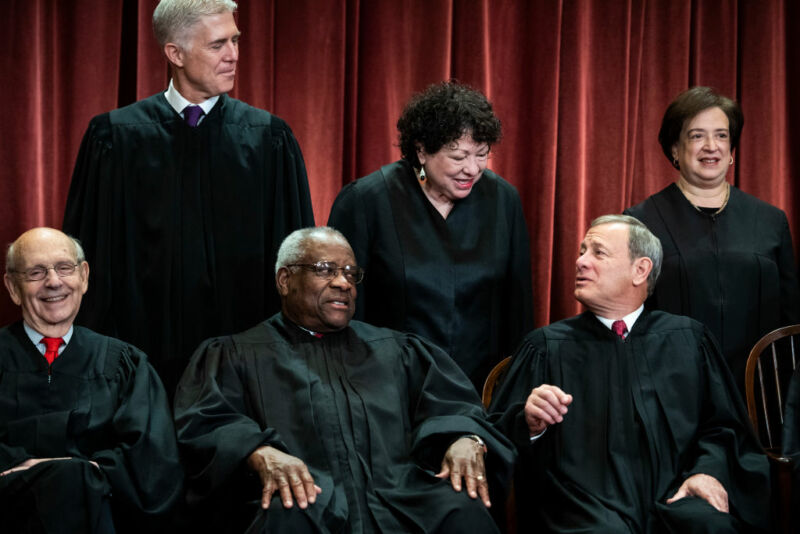
Six Supreme Court justices pose for an official group photo.

Enlarge / US Supreme Court justices sit for their official group photo on Friday, Nov. 30, 2018 in Washington, DC. Seated from left, Associate Justice Stephen Breyer, Associate Justice Clarence Thomas, and Chief Justice of the United States John Roberts. Standing from left, Associate Justice Neil Gorsuch, Associate Justice Sonia Sotomayor, and Associate Justice Elena Kagan. (credit: Getty Images | The Washington Post)

Supreme Court Justice Clarence Thomas wants a do-over on his 2005 decision in a case that had a major impact on the power of federal agencies and regulation of the broadband industry.

In National Cable & Telecommunications Association v. Brand X Internet Services, better known as Brand X, Thomas wrote the 6-3 majority opinion that upheld a Federal Communications Commission decision to classify cable broadband as an information service. But in a dissent on a new case, released Monday, Thomas wrote that he got Brand X wrong. Thomas regrets that Brand X gave federal agencies extensive power to interpret US law, a power generally reserved for judges.

"Regrettably, Brand X has taken this Court to the precipice of administrative absolutism," Thomas wrote. "Under its rule of deference, agencies are free to invent new (purported) interpretations of statutes and then require courts to reject their own prior interpretations."

Read 26 remaining paragraphs | Comments

27 Feb 17:02

Trump’s Intelligence War Is Also an Election Story

by Mike Giglio
James.galbraith

Of course

“I believe him.”

It was November 2017, after a meeting with Vladimir Putin in Vietnam, and Donald Trump was telling reporters he was convinced by the Russian president’s denials about interfering in the 2016 election. “He said he didn’t meddle,” Trump said. “And I believe, I really believe, that when he tells me that, he means it.”

U.S. intelligence agencies, of course, had concluded the opposite. Shortly before Trump’s inauguration, the office of the country’s top intelligence official published a report saying that not only had Putin ordered an influence campaign aimed at the 2016 election—he did so in part to help Trump win.

From the start of his presidency, Trump has pummeled away at that finding—sending flurries of tweets, sidelining officials who wouldn’t toe his line—in an effort to cloud and undermine it. As Special Counsel Robert Mueller highlighted the magnitude of Russia’s 2016 efforts, Trump stood beside Putin in Helsinki, Finland, in the summer of 2018, and again cast doubt on Moscow’s culpability. He continued to muddy the waters amid warnings about Russian meddling in new elections in 2018 and 2020, questioning Moscow’s involvement and even doubling down on a theory, itself the product of Russian disinformation, that Ukraine interfered in 2016 to help Hillary Clinton.

With each move by Trump, the U.S. intelligence community has provided a counter-narrative, putting reports, statements, and congressional testimony into the public record that unequivocally lay out Russia’s role. But Trump’s appointment of a new acting director of national intelligence, Richard Grenell, an outspoken loyalist who now heads the same office that published the 2017 report on Russian meddling, raises a question: Will Trump finally seek to muzzle his spies as he pushes to control the narrative in his reelection campaign?

[Quinta Jurecic and Benjamin Wittes: Trump’s most dangerous destruction yet]

Grenell, the U.S. ambassador to Germany, has not yet had the chance to write his legacy in the job. But the circumstances surrounding his appointment have intelligence veterans worried that Trump wants a partisan in the job to do his bidding. It was Trump’s ongoing fixation on the Russia narrative, in fact, that got Grenell’s predecessor removed. Trump reportedly became incensed with Joseph Maguire after an intelligence official said, in a classified briefing to Congress, that Russia is again interfering in the presidential election and again has a preference for Trump.

Joshua Geltzer, who was a senior national-security official in the Obama administration, told me that Grenell’s appointment fits with a purge in the executive branch, in which Trump, emboldened by his impeachment acquittal, is determined to install more loyalists. He noted that the U.S. intelligence community has been saying publicly for three years that Russia’s interference efforts are ongoing. “So it’s nothing new,” he said. “What’s new is, Trump believes that he’s at the point where he can strangle the executive branch to keep it from saying things he doesn’t like.”

What’s especially notable about Maguire’s ouster is what reportedly made Trump so upset: the fact that the briefing in question was attended by Adam Schiff, the Democratic chairman of the House Intelligence Committee, whom Trump accuses repeatedly of press leaks. (Schiff has denied this.) According to The Washington Post, Trump “believed that the information would be helpful to Democrats if it were released publicly.” The same motivation played a role in Trump’s dismissal of two key witnesses from the impeachment trial whose testimony about his conduct in withholding aid to Ukraine cut against his narrative: Gordon Sondland, who was U.S. ambassador to the European Union, and Alexander Vindman, a military officer assigned to the White House. These people not only said things that Trump didn’t want to hear. They said things that Trump didn’t want the public to hear.

It’s clear that controlling the narrative will be central to Trump’s reelection campaign. The Ukraine scandal centered on his efforts to get its president to announce an investigation into discredited allegations about Joe Biden, then the Democratic front-runner, in hopes of legitimizing the claims about Biden and weakening his candidacy. As my colleague McKay Coppins has reported, Trump’s campaign will rely on a billion-dollar effort to bombard the electorate with not just standard political ads but disinformation. And removing or at least weakening the intelligence community’s resistance by installing a partisan director would potentially help Trump in his efforts to rewrite the facts around Russia’s meddling. The DNI is the principal intelligence adviser to the president and serves as the intelligence community’s main liaison to the commander in chief. In addition to his influence over the information the president receives, though, the DNI can also influence what information is shared and collected elsewhere within the government—and, often, what reaches Congress and the public.

[Read: America’s Trumpiest ambassador ]

In steps Grenell, who has no intelligence background but has made it clear he will aggressively push Trump’s line. The Wall Street Journal called him “Trump’s favorite ambassador,” reporting that the president is impressed with his combative tone on TV and social media and has called Grenell someone who “gets it.” To be fair, it’s still unclear what kind of DNI Grenell will be or even how long his tenure will last. Under federal guidelines, Grenell can stay in his post only until mid-March, unless Trump nominates a permanent director by then. This would allow his tenure to continue for months as the confirmation process plays out, and as Wired noted, if a “nomination fails or other nominations come and go, Grenell could stay on indefinitely.” Grenell has a history of hawkish views on Russia, though in a 2016 opinion piece for Fox News he minimized Russia’s interference efforts, writing that it has been employing such tactics for decades. One of his first moves as acting DNI was to install Kash Patel, a partisan warrior who played an important role in Republican efforts to push back against the FBI’s Russia probe, as a senior adviser. Patel reportedly has a mandate to “clean house.”

Robert Litt, who served as general counsel to the DNI during the Obama administration, told me that if Trump does find a willing partisan for the director’s job—in Grenell or another candidate—he or she would hold the power to interfere with the intelligence community’s work to combat and monitor Russia’s meddling efforts. “The DNI is responsible for setting priorities for intelligence collection. And if you’re not looking for something, you’re not going to find it,” said Litt, now a lawyer with the firm Morrison and Foerster. “The DNI could deprioritize looking for information and direct intelligence assets away from that.”

Even without such a clear-cut move, he noted, collection and analysis could see a chilling effect. “If people think their careers are going to be at stake if they talk about these things, there’s going to be a natural inclination to shade your findings,” he said. Hypothetically, for instance, “you might say the Russians are looking to interfere in the elections, and you might omit that they’re trying to help the president, even though the evidence says they are.”

The DNI also influences what information reaches Congress and the public. The 2017 report, for example, established a frame of reference on Russia’s 2016 efforts. Intelligence officials’ testimony at hearings, Litt said, “shapes congressional and public understanding of these important issues.” He added: “If nobody’s saying those things, then it’s hard for the narrative to take hold.”

A pliant DNI could also go beyond withholding information to “skewing the story,” Douglas London, a professor at Georgetown who recently retired from a 34-year career in the CIA, told me. “This could be picking facts, suppressing what he doesn’t like and emphasizing what he does like”—and in the process building a narrative that “supports the president’s preferences.”

[Read: Revenge of the intelligence nerds]

This sort of political warfare is already under way—and it predates Grenell’s tenure. The Trump administration’s willingness to bend intelligence was on full display last month, after the targeted killing of Iranian General Qassem Soleimani. Trump as well as Secretary of State Mike Pompeo insisted that the killing had been justified because of intelligence showing that Soleimani was planning an imminent attack against Americans, a contention that met with skepticism in Congress; later, it emerged that the White House’s own legal justification for the strike made no mention of such a threat.

And the administration’s politicization of intelligence is already factoring into the 2020 elections. On Saturday, Robert O’Brien, Trump’s national security adviser, cast doubt on the reported intelligence linking Russian interference and Trump in 2020. Speaking on ABC News, he instead sought to redirect the spotlight to the new Democratic front-runner, Bernie Sanders, noting his infamous honeymoon to the Soviet Union in 1988. Trump had also chosen to highlight this at a rally the previous day: “Wouldn’t [Putin] rather have Bernie?”

Both O’Brien and Trump were responding to new reports about Russia interference—this time saying that Moscow is also looking to boost Sanders in the Democratic primaries. Sanders was quick to confirm that U.S. officials had briefed him on this, and issued a statement condemning Putin. Meanwhile, Trump, rather than undermine the intelligence assessment, as he has done so often, chose a different strategy: to amplify it for his campaign.

26 Feb 22:43

A new senior leader at the White House personnel office: A college senior

by Daniel Lippman and Meridith McGraw
James.galbraith

Fucking ridiculous


The White House has hired a college senior to be one of the top officials in its powerful Presidential Personnel Office, according to three administration officials familiar with the matter.

James Bacon, 23, is acting as one of the right-hand men to new PPO director John McEntee, according to the officials. Bacon, a senior at George Washington University pursuing a bachelor’s degree, comes from the Department of Transportation, where he briefly worked in the policy shop. Prior to that role, while still taking classes, he worked at the Department of Housing and Urban Development, where he was a White House liaison, according to two other officials. At HUD, he distinguished himself as Secretary Ben Carson’s confidential assistant, according to two other administration officials.

Bacon worked for McEntee on the Trump campaign’s earliest days and also did some work on the advance team. He later did operations on the Trump transition. Bacon would have graduated on time if he had not taken time off from school to work on the campaign, an official said.

Bacon will be PPO’s director of operations overseeing paperwork and will assist on vetting. The role was previously filled by Katja Bullock, who is in her late 70s and was a veteran of the office in both Bush administrations, as well as the Reagan administration.

The White House has not yet sent around any formal internal notice of Bacon’s new role. A White House spokesman declined to comment.

McEntee replaced Sean Doocey, who is heading to the State Department.


McEntee, 29, held a meeting in a conference room in the Eisenhower Executive Office Building last Thursday with White House liaisons of Cabinet departments where he asked officials to find Trump appointees who may be anti-Trump, according to an administration official familiar with the meeting. McEntee also told them that PPO was going to take a look at all appointees at some point and re-vet them to see if they’ve been disloyal in any way.

More dramatic changes are likely to be delayed until after November but the agency liaisons have been told to stop moving around officials who are viewed as anti-Trump to other agencies. (Axios first reported the details of the meeting.)

Another administration official described the meeting as “very positive” and McEntee reassured colleagues that there won’t be delays even though some PPO officials are leaving.

At least during his transition into the office, McEntee has for now kept on Michael Burley, who is associate director of presidential personnel and a special assistant to the president, but Burley is trying to figure out his next steps if he decides to leave.

After his acquittal, the president — emboldened and increasingly skeptical of anyone not a part of his original team — has relied on people like McEntee to act on his unofficial edict to fill the White House with loyalists and get rid of anyone feared to be part of the “deep state.”

McEntee worked on the Trump campaign in 2016 as the president’s body man, and in his role at the White House had constant access to the president, flying with him on Marine One and Air Force One, and at the president’s side to assist with any needs. He was fired from his role in 2018 by former chief of staff John Kelly because of security concerns tied to gambling allegations.


But McEntee wanted to return to the White House and is trusted by Trump, his family, and senior staff, was brought back earlier this year as the president is about to head into a reelection year and personnel changes are expected at the White House.

Despite having the trust of the president, McEntee’s lack of experience has raised concerns among some White House staff about his ability to run a critical White House office. One White House official pointed out that loyalty, in this case, trumped age and experience.

“He will do a great job because he has trust with POTUS,” said one former White House official.

The PPO office has been the subject of complaints and finger-pointing by some in the administration over its “frat-house” reputation, but serves an important function for vetting and hiring appointees. With McEntee at the helm of the office, however, it’s expected the president will take a more direct role than he has before.

“After three years of allowing others to control who would be around him and have power, he’s trying to take back some of the power and have a say in the staffing in the White House and administration,” a person close to the White House said. “A lot of the people in there weren’t actual allies of Trump, and didn’t actually support his agenda but had significant roles in his administration.”

Nancy Cook contributed to this report.

26 Feb 22:42

Kudlow breaks with CDC on coronavirus: ‘We have contained this’

by Eli Okun
James.galbraith

Just lies


White House National Economic Council Director Larry Kudlow said Tuesday that the U.S. has “contained” the threat of a domestic coronavirus outbreak, breaking with the warnings of officials from the Centers for Disease Control and Prevention.

“We have contained this, I won’t say airtight but pretty close to airtight,” Kudlow told CNBC’s Kelly Evans on Tuesday afternoon.

Kudlow’s confidence was set against U.S. stocks, which suffered their worst day in two years on Monday and were down again Tuesday amid fears that the coronavirus could mushroom into a pandemic. But the White House economic adviser suggested that the virus’ impact is “not going to last forever.”

“This is a human tragedy,” particularly in China, Kudlow emphasized multiple times. But warning against overreaction, he added, “The business and the economic side, I don’t think it’s going to be an economic tragedy at all. There’ll be some stumbles.”

Though he acknowledged supply chain disruptions as a result of the virus may yet arrive, Kudlow also downplayed the possibility of medicine and other shortages as the crisis in China continues. “I think we can deal with those issues at a later time when the emergency passes, as it will,” he said. “But I’m not at all convinced that we can’t get hold of what we need here in the U.S. We have stockpiles. We also have the capacity to produce more in all these areas.”

Some of his comments stood in contrast to public pronouncements from CDC officials Tuesday that painted the coronavirus’ health threat to the U.S. as the most serious it‘s been.

Nancy Messonnier, who heads the National Center for Immunization and Respiratory Diseases, warned that American communities need to prepare now for the possibilities of remote work, teleschooling and other provisional measures when the disease starts spreading domestically.

And the White House on Tuesday asked Congress for an emergency $2.5 billion to fight the coronavirus.

Kudlow lauded public health officials’ proactive planning against the virus, “but that does not mean that all this will come to pass” economically, he said. “I just think people should be as calm as possible in assessing this.”

26 Feb 22:41

The next Democratic debate will feature a much smaller stage

by Cameron Peters
James.galbraith

It bloody well should

Senator Bernie Sanders and former Vice President Joe Biden stand onstage behind podiums with their arms raised. Sen. Bernie Sanders and former Vice President Joe Biden at the 10th Democratic debate in South Carolina on February 25, 2020. | Win McNamee/Getty Images

Joe Biden and Bernie Sanders will be onstage in Arizona for the 11th debate of the primary.

Believe it or not, there are still more Democratic debates: After three in quick succession in February, the next debate — No. 11 — will take place on Sunday, March 15, in Phoenix, Arizona.

The debate will be co-hosted by CNN and Univision and is two days ahead of a busy election night, when Arizona, Florida, Illinois, and Ohio vote. CHC Bold — a political action committee affiliated with the Congressional Hispanic Caucus — has partnered with the Democratic National Committee (DNC) for the debate. The debate starts at 8 pm ET and will run for about two hours; Dana Bash and Jake Tapper of CNN, along with Jorge Ramos of Univision, will moderate.

To qualify, candidates will need to have earned at least 20 percent of all delegates available from the primary so far. Right now, that means only two candidates have qualified: former Vice President Joe Biden and Sen. Bernie Sanders.

The new debate criteria also mean that it’s all but impossible for Rep. Tulsi Gabbard to qualify. While she’s technically still in the race, she’s won just two delegates so far and hasn’t been a factor in the race for a while.

The new qualifying standard represents a stark change from past debates, where only a single delegate was enough for candidates to make the stage. Candidates were also able to qualify for previous debates by meeting a polling threshold; a fundraising requirement to appear on stage was done away with earlier this year.

As Super Tuesday results rolled in on Tuesday night, DNC communications director Xochitl Hinojosa tweeted that “of course the threshold will go up” ahead of the March debate.

“By the time we have the March debate, almost 2,000 delegates will be allocated,” she said. “The threshold will reflect where we are in the race.”

The March debate (probably) won’t be the last. The DNC’s plan calls for 12 debates in the 2020 Democratic presidential primary, with the last on a yet-to-be-announced date in April.

A smaller field of candidates

From the ninth Democratic debate to the 10th, the debate stage actually grew, from six candidates to seven. That’s not going to happen this time: Since the debate in South Carolina, five candidates — former South Bend, Indiana, Mayor Pete Buttigieg; Sens. Elizabeth Warren and Amy Klobuchar; and billionaires Tom Steyer and Mike Bloomberg — have bowed out of the race, leaving the Democratic field at just three.

Of those three, only two — Biden and Sanders, the two frontrunners for the Democratic nomination — will be on stage, and that could make for an eventful debate.

After outperforming expectations on Super Tuesday, Biden is firmly back in contention for the nomination with a consolidated moderate lane behind him. With California still counting votes, it’s still unclear whether he or Sanders holds the lead in delegates, but it’s unquestionably a two-man race, and the reduced debate stage could give both candidates plenty of chances to take each other on directly.

So while there are still a few unknowns, we can certainly look forward to a smaller — and probably much punchier — debate in March.

26 Feb 22:40

Warren: 'Who funded Lindsey Graham’s campaign?' That would be Republican-in-hiding Mike Bloomberg.

by Lauren Floyd
James.galbraith

Excellent points.

Former New York City Mayor Mike Bloomberg is clearly running to represent the wrong party, and Sen. Elizabeth Warren came with facts to back that up at Tuesday night’s Democratic presidential debate. During the first hour of the debate, she listed Republican legislators Bloomberg shelled out big bucks to support, including Sen. Lindsey Graham. 

”Let’s think of it this way. We’re here in Charleston, and you know who is going to be in Charleston later this week, is Donald Trump,” Warren said. “He’s going to be here to raise money for his buddy Senator Lindsey Graham.” She then asked: “Who funded Lindsey Graham’s campaign for re-election last time? It was Mayor Bloomberg.”

YouTube Video

Bloomberg donated $250,000 to a PAC backing Graham in 2014, and two years later, he gave $11.7 million to back Republican incumbent Sen. Pat Toomey’s reelection instead of challenger and policy expert Katie McGinty, according to The New York Times. Warren called the challenger “terrific.” “She lost by a single point,” the Massachusetts senator said, adding another name to the list of Republicans Bloomberg supported.

“In 2012, he scooped in to try to defend another Republican senator against a woman challenger. That was me,” Warren said. “It didn’t work, but he tried hard.”

The audience responded with applause, and Warren continued. “I don’t care how much money Mayor Bloomberg has. The core of the Democratic party will never trust him,” she said. “He has not earned their trust. I will.”

26 Feb 20:21

Trump ally Ratcliffe again being eyed for top intelligence spot despite humiliation last time around

by Hunter

Donald J. Trump has a problem. His current grotesquely unqualified partisan jackass pick for "acting" Director of National Intelligence, tweet-troll Richard Grenell, cannot remain in his "acting" role unless Trump nominates an actual, non-acting DNI by March 11. (This presumes, of course, that the Trump administration does not simply ignore the law based on a new William Barr-led reinterpretation that renders it, like all other oversight-based laws, invalid.)

Trump is therefore going to need a new, Senate-confirmable, grotesquely unqualified partisan jackass for the role. One of the names coming up yet again: vigorous boot-polisher Rep. John Ratcliffe. You may recall that Ratcliffe, who shares his family name with one of the least popular tourist attractions in Europe(*), was nominated for this very same position just a half-year ago, and that his nomination crashed and burned in rather spectacular fashion. Only days after his nomination, press outlets began to report that Ratcliffe appeared to have embellished his resume (lied, that means lied) and claimed national security experience he did not have.

Lying about your own past is one of the biggest red flags possible for anyone reaching for the top rungs of the U.S. intelligence community, and Ratcliffe's bid for the post ended near-immediately. So why is his name still in contention now?

One guess: This is yet another example of a Senate-emboldened Trump that no longer cares about keeping up appearances. Ratcliffe has been a staunch Trump defender, which Trump considers the one and only requirement for any administration post. Whether or not he is unqualified, or a liar, or a trenchcoat-wearing beaver standing on a badger standing on a wolverine is inconsequential so long as he can give Trump that sweet, sweet Fox News praise. Trump may nominate his ally and dare Senate Republicans to rebuff him, since they are now doing his bidding on, evidently, literally everything else.

An equally likely possibility, though, is that Trump's meeting with and "interview" of Ratcliffe is just his way of stringing Ratcliffe along while getting a new dose of Dear Leader praise injected into his hardened arteries. There is no praise like the praise an interviewee can give when they are looking for a new, much-desired position in Dear Leader's upper ranks, and Trump is likely to "interview" as many supplicants as his schedule allows before calling up Sean Hannity or Lou Dobbs to get the name he will eventually announce. We do not know. We do not know because the man is flighty at best, and off his rocker the rest of the time, and still seems to have such seething contempt for the U.S. intelligence community in general that he appears to be looking for hires that will do active damage to those agencies.

(*) I do not know this trivia tidbit for certain, but am channelling my inner White House press secretary to deduce it from a dream I think I possibly remember, or maybe do not. That is how these things work now.

26 Feb 20:19

Cartoon: Repeat after me

by keefknight
James.galbraith

Seriously

26 Feb 20:19

Why Twitter says Bloomberg’s fake Sanders tweets don’t break its rules

by Shirin Ghaffary
James.galbraith

Because Twitter is a cancer

Mike Bloomberg speaking at a campaign rally in Salt Lake City. Facing criticism, the campaign of Mike Bloomberg deleted a series of fictitious quotes by Bernie Sanders, which the campaign said was satire. | Getty Images
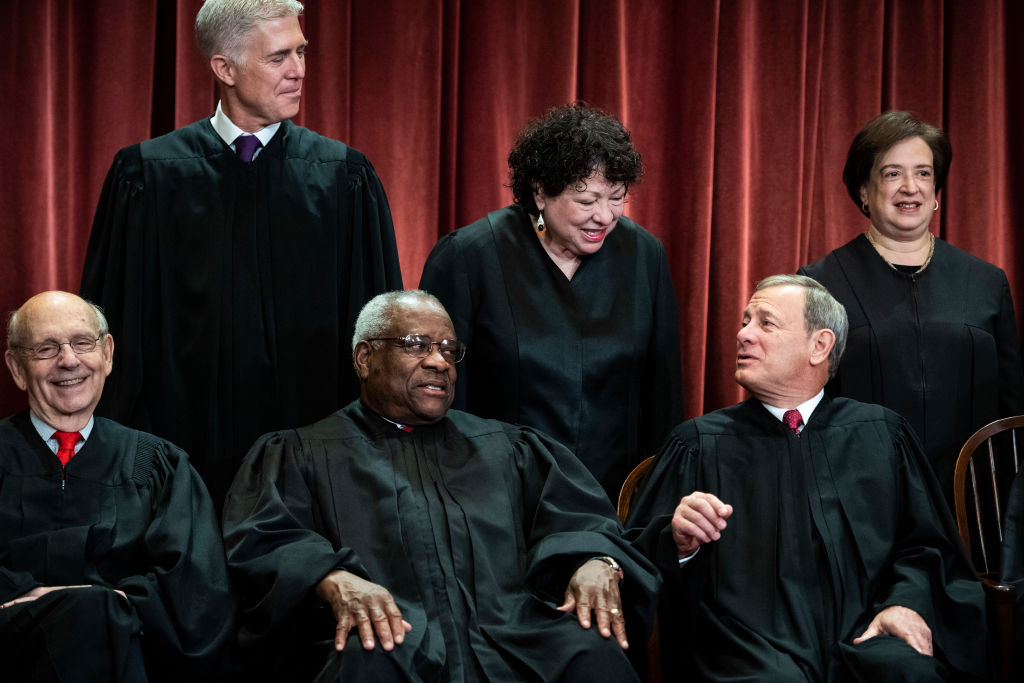
The Bloomberg campaign’s controversial tweets fictitiously quoting Bernie Sanders, briefly explained.

On Monday, presidential hopeful and former New York City Mayor Mike Bloomberg’s campaign posted — and then deleted — several controversial tweets about rival Sen. Bernie Sanders that prompted confusion and tested the rules of what political campaigns can share on social media.

The tweets, which Bloomberg’s campaign called satire, featured fictitious quotes attributed to Sanders, in which Sanders appeared to praise dictators like Kim Jong Un, Bashar al-Assad, and Vladimir Putin, with the hashtag “#BernieonDespots.”

While the tweets are now gone, people are continuing to debate social media companies’ responsibilities when it comes to policing political speech online. Though Twitter and other platforms have implemented rules that limit the sharing of certain types of political misinformation, controversy abounds.

The Bloomberg campaign posts are another example of how much confusion exists online about what’s true and what’s not, and what’s the difference between a joke or an attack — and how finding a clear answer often depends on context and nuance that doesn’t always come through clearly in a tweet or a Facebook update.

With the Bloomberg campaign’s tweets about Sanders, for example, the account followed up on the thread by tweeting, “To be clear — all of these are satire — with the exception of the 60 Minutes clip from last night.” (Sanders recently said on the CBS program that he opposes the authoritarian regime of Cuba’s late Fidel Castro, but that it’s “unfair to simply say everything is bad” about the leader, such as a mass literacy program he implemented).

To many, it was obvious these tweets were an attempt at a joke. But others criticized the Bloomberg campaign for posting what they saw as a misleading attempt to smear Sanders using fabricated quotes.

When the series of tweets were viewed together, it was more obvious that they were satirical. But the fake Sanders quotes appeared on some people’s Twitter feeds in isolation — lacking context, seemingly serious to some, and all the more confusing. It’s just one of several recent instances where Bloomberg’s tweets, sponsored memes, and other social media activity have tested the boundaries about what is allowed on social media.

Even when they’re not being satirical, politicians generally have a lot of leeway in what they can say on social media without violating company rules around misinformation or hate speech. President Trump has repeatedly tweeted false statements about everything from his impeachment proceedings to immigration, and he has posted media that some see as inciting violence toward political opponents. All of this has remained on Twitter because the company considers Trump’s posts newsworthy, despite calls for the company to take them down.

And Facebook (unlike Twitter and YouTube) continues to enforce a controversial policy that allows lies in political ads, such as the Trump campaign’s ad making false claims about the activities of former Vice President Joe Biden and his son in Ukraine. Democratic candidate Sen. Elizabeth Warren has tested those boundaries by running a fake ad claiming Facebook CEO Mark Zuckerberg endorsed Donald Trump for president, meant to be a critique of the rule.

Twitter, like other major social media companies, doesn’t ban content just because it’s false or potentially misleading, but it does have a set of rules barring any content that’s considered “platform manipulation” or “spam.” A spokesperson for Twitter told Recode that the Bloomberg campaign’s specific tweets falsely quoting Sanders didn’t violate any of its current rules on the site.

If Bloomberg’s campaign had posted an edited image, like a fake screenshot (as opposed to text) of Bernie making fictitious statements, then it would likely be a violation of Twitter’s upcoming manipulated media policy that is rolling out on March 5.

The spokesperson also told Recode, “Admittedly, satire is a challenging one. Context of the content is important. As it pertains to the synthetic and manipulated media rule it is pretty well explained in the blog in that we evaluate the potential impact of the media i.e. is the content in question ‘shared in a deceptive manner.’”

Twitter’s policy is far from clear and will continue to require some subjective calls on what is and isn’t a joke. The rules on Facebook or YouTube are not much clearer because every major tech company is grappling in 2020 with how to balance users’ free speech with their ability to do harm.

Meanwhile, Bloomberg consistently (and perhaps smartly) continues to push the boundaries of these platforms’ rules — garnering criticism, but also getting free publicity.

Last Friday, Twitter suspended 70 pro-Bloomberg accounts run by people paid by the Bloomberg campaign who were posting identical tweets in favor of the candidate. Twitter said the accounts violated its policies on “platform manipulation and spam.” In this case, because the language of many of the posts were word-for-word copies of the same coordinated language, it was a clear violation of the platform’s rules.

The campaign also posted a doctored video of the last Democratic presidential debates that made it seem as though Bloomberg had an “epic mic drop” moment that stumped his opponents — even though, as my colleague Alex Ward explained, he didn’t.

The campaign has more broadly been paying people $2,500 a month to post positive content about Bloomberg on social media and text their friends about him. And it’s paying much more to big-name influencer Instagram accounts to post ironic memes about the candidate.

In every case, Bloomberg has received criticism, and in some cases, social media companies have hit the candidate with a slap on the wrist for these tactics that blur the lines between spam, misinformation, and clear advertising.

But in the end, the publicity may be well worth any criticism. Whether you agree with it or not, Bloomberg is smartly exploiting the gray areas social media companies have established around politics and free speech online. It’s a difficult problem that will only get more complicated for social media platforms as we get closer to Election Day.