Shared posts

15 Mar 21:59

Trump tells a nation terrified of coronavirus that none of this is his fault

by Ian Millhiser
James.galbraith

Seriously

President Trump arrives with Vice President Mike Pence to a news conference about the ongoing global coronavirus pandemic in Washington, DC, on March 13, 2020. | Drew Angerer/Getty Images

Trump lied, insulted reporters, and explicitly refused to take responsibility for his own actions.

President Trump held a remarkable press conference Friday afternoon. It began with a parade of corporate CEOs who briefly took the podium to explain efforts their companies would take to improve coronavirus screening. But it quickly progressed into a parade of lies, insults, and buck passing by the president himself.

Trump’s core message: All of this is someone else’s fault.

One of the biggest failures — possibly the single biggest failure — of the United States’ response to coronavirus pandemic is our failure to deploy tests that will allow doctors, patients, and public health officials to determine who is infected. The United States has tested far fewer people per capita than any of its peer nations, and by a wide margin.

 Christina Animashaun/Vox

At one point, Trump was asked about the admission of Dr. Anthony Fauci, director of the National Institute of Allergy and Infectious Diseases, that our lag in testing was “a failing.” And he was asked if he takes responsibility for this failure.

Trump’s response: “I don’t take responsibility at all.”

The president claimed that “we were given a set of circumstances and we were given rules and regulations and specifications from a different time,” and this existing legal infrastructure “wasn’t meant for this kind of event with the kind of numbers that we’re talking about.”

It’s an astonishing claim, and it’s astonishing because Trump has spent the better part of his term dismantling the federal government’s pandemic fighting infrastructure.

How Trump made the government less able to respond to a pandemic

In 2005, the US Agency for International Development developed a program to help detect and research infectious diseases that arise in animal populations and eventual jump to humans — it’s likely that coronavirus is such a disease. This program, which was set up in response to the H1N5 bird flu scare, continued through the rest of the Bush administration and through the entire Obama administration.

The Trump administration shut it down last fall.

Trump has also repeatedly proposed budgets — he most recently did so last month — calling for sharp cuts to the Centers for Disease Control and the National Institutes of Health, although Congress resisted such cuts. Former CDC Director Tom Frieden warned that the public health cuts in Trump’s first budget were “unsafe at any level of enactment.”

In 2018, Trump ordered the White House National Security Council’s (NSC) entire global health security arm shut down. And that’s only part of what Trump’s done to hollow out the nation’s public health infrastructure. As Foreign Policy’s Laurie Garrett reports:

Neither the NSC nor [the Department of Homeland Security’s] epidemic teams have been replaced. The global health section of the CDC was so drastically cut in 2018 that much of its staff was laid off and the number of countries it was working in was reduced from 49 to merely 10. Meanwhile, throughout 2018, the U.S. Agency for International Development and its director, Mark Green, came repeatedly under fire from both the White House and Secretary of State Mike Pompeo. And though Congress has so far managed to block Trump administration plans to cut the U.S. Public Health Service Commissioned Corps by 40 percent, the disease-fighting cadres have steadily eroded as retiring officers go unreplaced.

And yet, despite his own efforts to dismantle so much of the nation’s public health infrastructure, Trump spent much of his press conference attacking the Obama administration’s response to the 2009 swine flu outbreak, claiming that “if you go back to the swine flu, it was nothing like this. They didn’t do testing like this and actually they lost 14,000 people and they didn’t do the testing.”

Trump lashed out at a reporter who pointed out his actual record

Not long after Trump refused to take responsibility for the lag in testing, a reporter asked him whether he takes responsibility for disbanding the White House pandemic office.

Trump responded by labeling this inquiry a “nasty question.” He then repeatedly deflected blame for closing down the White House’s pandemic response team to some other, unidentified person.

“I didn’t do it,” Trump claimed. He added that “I don’t know anything about it” and “it’s the administration, perhaps, they do that, you know, people let people go.”

Presumably, the “administration” that Trump referred to here is the Trump administration.

President Harry Truman famously displayed a sign on his desk with a simple message: “The buck stops here.” The point was that, by accepting the awesome responsibility of the presidency, Truman also had to acknowledge that the nation’s welfare was his responsibility. It is the president’s duty to monitor his own administration. And it is the president’s fault if that administration is malicious or incompetent.

Trump himself expressed a similar sentiment in 2013.

Now that Trump is president, however, anything that goes wrong is someone else’s fault.

15 Mar 21:58

Trump says Google is building a site to help people find coronavirus tests

by Peter Kafka
James.galbraith

grossly overstated, as always

Dr. Debbie Birx, White House coronavirus response coordinator, speaks at a White House press conference on Friday, March 13, 2020. | SAUL LOEB/AFP via Getty Images

The president said the site, which is supposed to direct people to drive-through test sites, should be ready soon; Google seemed less clear about that.

Alphabet, Google’s parent company, is working with the White House and private companies to create a website that will help Americans find screening tests for the Covid-19 coronavirus.

Plans for the site are being overseen by Verily, an Alphabet subsidiary that focuses on health care and life science.

The White House said the site is meant to steer Americans who need testing to drive-through clinics that are supposed to start popping up around the US in the parking lots of retailers like Target and Walmart, which are also working on the effort.

But messaging from Alphabet reps, after President Donald Trump and others described the effort at a White House press conference, stressed that the project the company is working on is in its early stages and will initially be offered to residents in and around San Francisco and Silicon Valley.

At the press conference, Trump said Google had “1,700 engineers working on this right now.”

Trump didn’t say when the site would be up, but Vice President Mike Pence said that, by Sunday evening, the White House “will be able to give specific guidance on when the website will be available.”

Update, March 14, 2020, 1:25 pm ET: Asked again about Google’s plans to launch a site at a press conference on Saturday, Pence said Google had told them the site would launch Monday, and that the White House would have detailed information about the site and testing plan at 5pm Sunday.

Recode hasn’t yet been able to verify that with Alphabet or Verily reps, or anything else about how the site is supposed to work — including any efforts Verily and the associated companies will use to protect the privacy of the site’s users.

It’s possible that the White House announcement took Verily and Google by surprise. About an hour after Trump talked about the website, Google sent out a statement, attributed to Verily, that said the company was in “early stages” on “a tool to help triage individuals for Covid-19 testing” and that it would start using it in the Bay Area before rolling it out widely.

Debbie Birx, the White House’s coronavirus response coordinator, held up a flowchart at the press conference that was meant to illustrate the steps users will take to get tested, but didn’t go into any detail. The chart appears to indicate that users will find their test results on the same site they used to see if they needed a test.

 SAUL LOEB/AFP via Getty Images
Dr. Debbie Birx, White House coronavirus response coordinator, holds up a flow chart.

“I want to thank Google. Google is going to develop a website — it’s going to be very quickly done, unlike websites of the past — to determine if a test is warranted and to facilitate testing at a nearby convenient location,” Trump said. “Google has 1,700 engineers working on this right now. They’ve made tremendous progress. Our overriding goal is to stop the spread of the virus and to help all Americans who have been impacted by this.”

On Thursday, Alphabet CEO Sundar Pichai sent out a company-wide email calling for volunteers to “assist in the effort to test people for Covid-19;” he said the idea was to “develop a pathway for public health and healthcare agencies to direct people to our Baseline website, where individuals who are at higher risk can be directed to testing sites based on the latest guidance from public health authorities. ... Verily is part of the Alphabet family and could use our help in the coming days and weeks.”

That effort seems separate from a Verily project to build a physical patch that could detect signs of a fever and transmit that health data to a person’s phone. Pichai mentioned that effort last week in a blog post about various efforts his company had taken to fight the spread of the coronavirus.

Here’s Pichai’s memo asking his employees to help with the Verily website.

Hi everyone,

Yesterday at TGIF, someone had a question about whether Verily could assist in the effort to test people for COVID-19. I know we are all looking for ways to help right now, so I checked in with their team to see if they could use support from Google and our other bets for a new effort being planned.

The good news is that a planning effort is underway to use the expertise in life sciences and clinical research of Verily in partnership with Google to aid in the COVID-19 testing effort in the US. As more test kits becomes available, the planners are looking to develop a pathway for public health and healthcare agencies to direct people to our Baseline website, where individuals who are at higher risk can be directed to testing sites based on the latest guidance from public health authorities.

Verily is part of the Alphabet family and could use our help in the coming days and weeks to respond as quickly as possible to the rapidly evolving situation of the COVID-19 pandemic. For those interested in volunteering for this effort, please complete this form and they will be in touch.

- Sundar

Correction: An earlier version of this story incorrectly reported that Debbie Birx said the Google site would be available on Sunday.

15 Mar 04:36

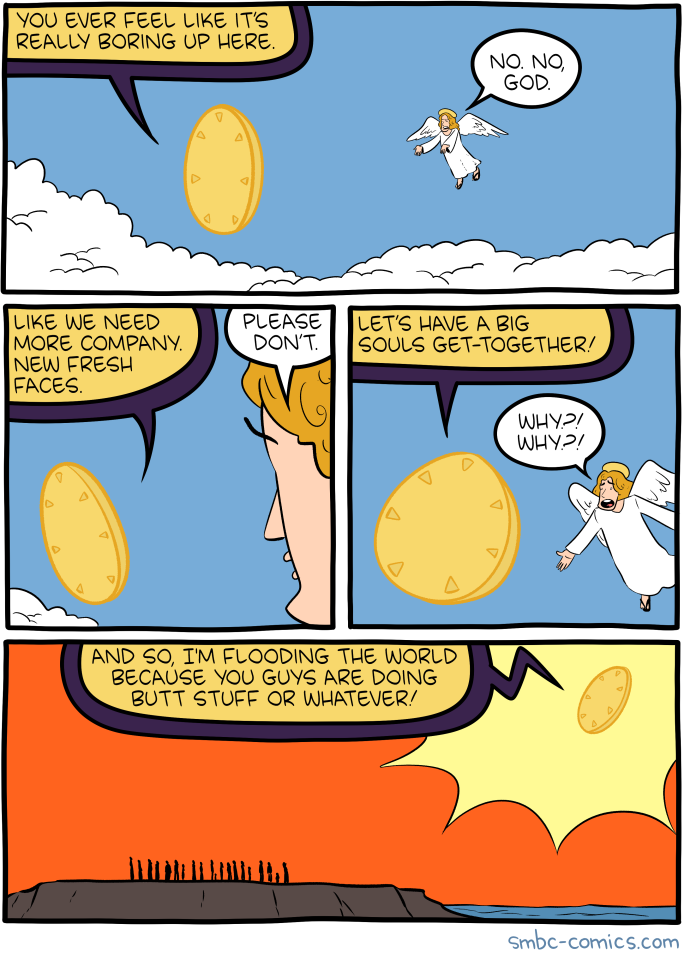
Saturday Morning Breakfast Cereal - All Souls

by tech@thehiveworks.com


Click here to go see the bonus panel!

Hovertext:
You can do a lot of theodicy if you just assume God likes parties.


Today's News:
14 Mar 22:36

Man Who Overdosed in Hotel Room with Andrew Gillum is a Gay Escort: VIDEO

by John Wright
James.galbraith

Well that got interesting in a hurry.

Travis Dyson

Rising Democratic star Andrew Gillum was discovered by police in a Miami hotel room with suspected crystal meth early Friday. And the man whose overdose prompted authorities to respond to the hotel room, 30-year-old Travis Dyson, reportedly is a gay escort.

Gillum, the former Tallahassee mayor and Democratic nominee for Florida governor, was too intoxicated to answer questions, but was not arrested.

“I was in Miami last night for a wedding celebration when first responders were called to assist one of my friends. While I had too much to drink, I want to be clear that I have never used methamphetamines,” Gillum said later in a statement. “I apologize to the people of Florida for the distraction this has caused our movement.”

Gillum, also a CNN contributor, is married to a woman and has three children.

Andrew Gillum

The Miami Herald reports: Police say they were called to the Mondrian South Beach early Friday morning and found paramedics treating Travis Dyson, a 30-year-old Miami man, for an apparent heart attack. They say two other men were in the room: Aldo Mejias and Gillum. … Attempts to reach Mejias and Dyson by phone on Friday were not immediately successful. Dyson told Miami New Times that he has been friends with Gillum “for a while,” but did not know anything about a wedding. According to public records, Dyson is a registered nurse who lives in Brickell. His Instagram account features selfies in scrubs and a medical coat. The page also features numerous photos of Dyson, clearly a body builder, posing on the beach, on boats or at night spots with friends, including his fiance. His public Instagram account was turned private sometime Friday afternoon.

According to the Daily Mail, “Dyson describes himself as a trauma certified ER nurse on social media, where he posts photos of himself working out in the gym, partying at gay nightspots and lounging on luxury yachts. 

“But DailyMail.com can reveal he also posts explicit photos and homemade porn movies online and has previously had a profile on the Rent.men website, which advertises male escorts and sex workers,” the site reports.

Dyson’s Instagram handle linked to his Rent.Men profile, where he went by “Brodie Scott,” and described himself as a “pornstar performer” who offered “gay massage,” according to Red State.

“Multiple pornographic videos of Dyson and his boyfriend/fiance … were posted to that site and even to Twitter,” Red State reports. “Those have all been deleted as of Friday afternoon. On a fan thread referencing Dyson’s Rent Men profile, there is a photo of Dyson in his scrubs.”

“I like kissing and foreplay… lots of kissing and foreplay,” Dyson wrote in the bio section of the Rent.men page, according to Heavy.com. “I enjoy my nipple rings lightly played with. Mutual touch and intimacy goes a long way.”

According to Heavy.com, Dyson also wrote that he was formerly in the military.

“If it is a dating atmosphere you desire, I definitely have an eclectic taste for dates,” he wrote. “I don’t only enjoy one type of fun… but the type of fun we have is definitely up to you. Let’s have fun💋.”

The post Man Who Overdosed in Hotel Room with Andrew Gillum is a Gay Escort: VIDEO appeared first on Towleroad Gay News.

13 Mar 23:58

“I don’t take responsibility at all”: Trump continues downplaying coronavirus threat

by German Lopez
James.galbraith

Such a leader...fuck this idiot

President Trump said “I don’t take responsibility at all” for the testing shortage that has left the US unable to accurately track the coronavirus pandemic during a press conference at the White House on March 13, 2020. | Saul Loeb/AFP via Getty Images

Even as he declares a national emergency, Trump continues to downplay the risk of the coronavirus.

President Donald Trump on Friday took to the podium during a Rose Garden press conference to allay concerns about the growing coronavirus outbreak in the US.

But even while announcing new measures against Covid-19, the disease caused by the virus, Trump continually downplayed the threat the country is facing and refused to take responsibility for the testing shortage that has left the US unable to track the unrolling pandemic.

Asked about whether he takes any blame for the botched testing process, Trump said, “I don’t take responsibility at all.”

The big announcement came when Trump announced a national emergency, unlocking billions of dollars in disaster aid to help combat the virus. The administration previously declared a public health emergency in January, but that didn’t tap into as much money as the new declaration under the 1988 Stafford Act, which is typically used for natural disasters like hurricanes and tornadoes, will allow.

Trump, flanked by the leaders of Target, Walmart, and Walgreens, announced several other measures, including a public-private partnership to boost testing capacity by setting up drive-through testing sites at some pharmacies and major store chains. That includes up to 5 million more tests and a website, developed with the help of Google, to help connect people to nearby testing stations.

He also announced efforts to relax laws and regulations that can limit health care capacity, including the greater use of telehealth and the elimination of some restrictions on hospital stays. He suggested that these changes will help build up capacity — a critical element to mitigating the outbreak — but it’s not clear if these will succeed.

At the same time, Trump acknowledged that there’s still no agreement with Democrats in the House about a package to deal with the crisis.

Some of this is in line with what experts have called on to deal with the crisis, but given the administration’s history in dealing with the pandemic, it’s unclear if these measures will work as planned. And the lack of a broader deal between Trump and House Democrats means more comprehensive action isn’t quite here yet.

Trump continually downplayed the pandemic, even while trying to address it

In between these announcements, Trump seemingly couldn’t help but downplay the risk of the crisis, while repeatedly shaking hands with other people present at the press conference.

Immediately after announcing the federal government will get 5 million test kits out, he said, “I doubt we’ll need anywhere near that.”

Trump also cautioned against too much testing capacity: “We don’t want people to take a test if we feel that they shouldn’t be doing it. And we don’t everyone running out, only if you have certain symptoms.” But while it’s true that not everyone needs to be tested, it’s these kinds of roadblocks that have led to report after report of doctors and patients struggling to get access to tests. On social media, doctors regularly complain that they can’t obtain tests for patients even if the patients display symptoms.

Testing is crucial to slowing epidemics. First, it lets public health officials identify sick people and subsequently isolate them. Second, they can trace that sick person’s recent contacts to make sure those people aren’t sick and to get them to quarantine as well. It’s one of the best policy tools we have for an outbreak like this.

Trump, however, suggested that all this testing is not going to be necessary, because the pandemic will reside.

“Again, we don’t want everybody to take this test, it’s totally unnecessary and this will pass,” he said. “This will pass through, and we’ll be even stronger for it.”

This viewpoint isn’t new to Trump. He previously tweeted comparisons to the common flu, which in fact appears to be less deadly and spread less easily than the coronavirus. He called concerns about the virus a “hoax.” He said on national television that, based on nothing more than a self-admitted “hunch,” the death rate of the disease is much lower than public health officials projected. And in February, he said of the coronavirus, “One day it’s like a miracle, it will disappear.” (As of March 13, the country has more than 1,200 confirmed cases, according to Johns Hopkins’s interactive map.)

Experts have been critical of the messaging. Ashish Jha, director of the Harvard Global Health Institute, called it “deeply disturbing,” adding that it’s “left the country far less prepared than it needs to be for what is a very substantial challenge ahead.”

But even as he declares the outbreak a national emergency, Trump continues to deny and downplay the growing dangers of a major public health crisis.

13 Mar 23:29

Fox News’s dangerous decision to downplay the threat of coronavirus

by Nicole Narea
James.galbraith

Fine, kill off their viewers. Time for some personal responsibility for believing stupid shit.

Steve Doocy, Ainsley Earhardt, and Brian Kilmeade of Fox & Friends at Fox News Studios on March 19, 2018. | Roy Rochlin/Getty Images

The US needs to brace for coronavirus. But Fox News is framing efforts to prepare as a partisan fight.

Conservative commentators on Fox News are downplaying the potential risk of the novel coronavirus spreading throughout the US — describing the panic over the pandemic as a partisan tool that has been used to attack President Donald Trump.

On his evening show Thursday night, host Sean Hannity spent the bulk of his opening monologue accusing detractors of Trump’s response to Covid-19 of sowing partisanship and hysteria — a message that has resonated with the president, who is an avid viewer and tweeted about it after the show.

“Since the beginning, all they’ve done is use the virus, politicize the virus to bludgeon President Trump,” Hannity said, referring to Democrats. “All the same people who have done the same thing for three straight years. ... Russia, Russia. Ukraine, Ukraine. And impeach, impeach. Now, corona, corona.”

Friday morning, Fox & Friends suggested that it’s safe to travel.

“It’s actually the safest time to fly,” host Ainsley Earhardt said.

And Jerry Falwell Jr., the president of the evangelical Liberty University, spread unfounded conspiracy theories about how Democrats are playing up the virus to attack Trump and how it could potentially be a bioweapon.

Fox News is communicating that panic over the virus is the problem. But at this point, the American public needs to take the threat of the virus seriously.

The Centers for Disease Control and Prevention reported more than 1,200 cases nationwide as of March 12, but due to insufficient testing, there are likely many more cases that have gone unidentified. Congress’s in-house doctor told staffers on Wednesday that 70 million to 150 million people in the US could eventually be infected. Experts recommend that people practice social distancing, but if they fail to do so, the virus could spread too quickly, overwhelming medical resources and leading to unnecessary deaths.

What Fox News has been publicly telling viewers is very different from how the network has been responding to the virus internally: Network executives have taken a number of significant precautions, the Daily Beast’s Maxwell Tani reported. They told employees in a memo that they would implement work-from-home policies, decrease the number of in-studio guest bookings, and deep-clean their offices, and urged staff to keep in mind that they are “providing an important public service to our audience by functioning as a resource for all Americans.”

But at least some Fox shows haven’t heeded that advice.

On Friday morning as a guest on Fox & Friends, Falwell claimed that the public was overreacting to the threat of virus, incorrectly likening it to the flu. He suggested that Democrats’ attempts to raise alarm over coronavirus is just their latest ploy against Trump following their failed effort to impeach him. He even proposed, without any evidence, that North Korea could be behind the virus.

And Fox & Friends’ Earhardt claimed that it’s not just a safe time to fly but the safest time to fly, even though the Centers for Disease Control and Prevention has been urging Americans to avoid nonessential travel and practice social distancing. With reports that one passenger who tested positive for coronavirus was on a recent JetBlue flight, it’s even more concerning.

Just as the American public was coming to grips with the reality of the virus on Thursday, Hannity made it about partisan politics: He accused Democrats and the media of “working hand-in-hand to smear the president” and using coronavirus as a “bludgeon” against him. Yet he even acknowledged that some of the critiques of the administration’s response have been valid, including the frustrating lack of testing.

He also sought to contrast then-President Barack Obama’s response to the 2009 pandemic of H1N1, also known as “swine flu,” to the way that Trump has acted on coronavirus, imposing a ban on travelers who had recently traveled to China in January and then another ban on Europeans (with some exceptions) effective Friday at midnight. He accused Obama, by comparison, of not acting quickly enough to avert the nearly 274,000 Americans hospitalized and nearly 13,000 deaths in 2009 alone.

But Obama did act quickly on H1N1. In April 2009, when there were only 20 cases nationwide, the administration declared it a public health emergency and days later made a funding request to Congress for the response. It wasn’t until that June that the World Health Organization declared it a pandemic. In late October, after more than 1,000 people in the US had died, Obama then escalated it to a national emergency.

Hannity also attempted to liken H1N1 to coronavirus:

But comparing coronavirus to H1N1 is misleading. H1N1 posed a smaller threat than coronavirus — as my colleague Dylan Matthews writes, it was “not very deadly, with an overall mortality rate estimated at 0.02 percent, so the societal disruption was limited and the loss of lives, while tragic, didn’t overwhelm medical systems.”

As far as we know now, the mortality rate of coronavirus is much higher, estimated at about 3 to 4 percent by the WHO, and it is already causing a much bigger disruption to everyday life, resulting in widespread school closures, event cancellations, workplaces sending employees home, and calls for social distancing. If it continues to spread, there are concerns that there could be shortages of medical equipment, such as respirators to help patients breathe and capacity at medical facilities.

Trump nevertheless repeated Hannity’s talking points on H1N1 on his Twitter account on Thursday night, using it as an opportunity to lob an attack on Obama’s vice president, Joe Biden, who is a frontrunner for the Democratic nomination.

13 Mar 20:06

If you can stay home now, you make things safer for the people who can’t

by Kelsey Piper
A customer sits inside a nearly empty restaurant in Cambridge, Massachusetts, on March 11, 2020. Harvard announced it would be sending students home for the rest of the semester due to coronavirus concerns. | Jessica Rinaldi/The Boston Globe via Getty Images

Some mild inconveniences this month could save the lives of vulnerable people.

There are now more than 1,100 identified coronavirus cases in the US, up from 500 just a couple of days ago. The outbreak is getting worse, what’s happening in other countries tells us it will soon get worse still, and public health experts have started asking people to practice social distancing more isolation from each other, more holing up in your place for days, much less physical contact with the world.

Those measures have some people who are in low-risk groups — young, in good health, not living with anyone more vulnerable — asking an uncomfortable question: Wait, is this all worth it? Maybe I’d rather risk getting the coronavirus and have a bad flu for a couple of weeks instead of dealing with all this disruption to my life?

That’s not a bad question. But one reason so many people are asking it is because of a big failure in communication about the coronavirus. From the White House on down, most communication has been about how to reduce your personal risk of getting the coronavirus. The virus, which is much more dangerous than the flu even for young, healthy people, does warrant strong precautions for your own sake.

 Spencer Platt/Getty Images
Empty streets, restaurants, and cafes make up the business area in the one-mile containment zone in New Rochelle, New York, on March 11, 2020.

But that’s not the whole story. The fact is that social distancing and other preparations that are being recommended aren’t just about protecting yourself. They’re about protecting the people in your community, especially the vulnerable ones.

Here’s another way to think about this: If you are young and healthy, you ought to take precautions because doing so can end up saving someone’s life. In fact, taking precautions like social distancing is likely one of the more important things you can do to protect sick and older people in your community, and to shield our society from the kind of catastrophic effects the virus has had in countries where it has overwhelmed first responders, hospitals, and morgues.

In the US, we’re unaccustomed to framing individual choices in this kind of language. It would be jarring (for many reasons) to hear Trump appear on TV pleading with us to work from home and cancel parties as an act of patriotism, as an act of altruism, as a sacrifice the healthy need to make for the sake of the less healthy and uninsured.

But that’s exactly what taking these precautions is: an act of altruism. As Zeynep Tufekci argued in Scientific American in February, “We should prepare, not because we may feel personally at risk, but so that we can help lessen the risk for everyone. We should prepare not because we are facing a doomsday scenario out of our control, but because we can alter every aspect of this risk we face as a society.”

The crisis in front of us isn’t just one of practical inconveniences; it has a moral dimension we can no longer look away from. Yes, it’s really inconvenient. Yes, it’s not yet mandated by law — and if all goes well, we might improve things before it has to be. And yes, it may get a bit embarrassing and socially awkward to take such precautions if the people around you haven’t realized yet that it’s necessary.

But those inconveniences should pale beside what we stand to lose if we keep spreading coronavirus: our grandparents, our parents, the doctors and nurses who’ll care for them, our friends who are fighting cancer or recovering from surgery or immunosuppressed or dependent on someone who is. If you’re young and healthy, social distancing might be a pain for you. But it’s a chance, in the midst of the one of greatest pandemic crises in a century, to be a hero for other people.

We need to make it easier for vulnerable people to avoid getting sick

One aim of public health experts now that containment is largely out of reach in much of the US should be to ensure that people for whom it is more dangerous to get sick have the ability to stay healthy.

The Centers for Disease Control and Prevention (CDC) has identified persons who are over 60 years old or immunocompromised as a high-risk group. The agency recommends this group largely stay home, but some of them will need to leave the house at some point — for groceries that can’t be delivered in their area, for necessary doctor’s appointments, for jobs they cannot quit.

The more the virus spreads, the riskier these unavoidable activities become. A trip that brings you into contact with 10 people is pretty safe if only a few people in your metropolitan area have the virus — but potentially deadly if many more of them do. On top of that, some people with virus may be asymptomatic, so it’s possible you could spread the virus without knowing you are sick.

At least 20 percent of the population is in an at-risk group for getting coronavirus, which includes older adults, but also people who are undergoing chemotherapy, are living with HIV/AIDS, have preexisting respiratory issues, or are just recovering from another serious illness. That means that if you get coronavirus and spread it to three other people — and statistically, the average person who catches it and doesn’t take any social distancing measures does spread it to two or three people — there’s a scarily decent chance that you will spread it to someone for whom it might be deadly.

That’s a risk you would hopefully never take casually.

Javier Zarracina and Christina Animashaun/Vox

But that’s not the only consideration. There’s also the risk that the people you spread it to will then spread it to at-risk people. Overall, one way to think about what happens when you get and spread the coronavirus is that the epidemic’s doubling time in your region shortens. And that faster spread can cost lives.

We need to slow down coronavirus cases

If you get the coronavirus right now, even if you require hospitalization — and evidence suggests as many as 15 percent of infected people might — you will probably survive. From events like the Diamond Princess cruise ship disaster and from reporting from countries that have contained their outbreaks well (see Taiwan and Singapore), we have reason to believe the mortality rate from coronavirus may be below 1 percent when there’s adequate health care available.

But what about when there isn’t? In Wuhan, China, when the crisis got severe, patients were turned away from hospitals because there were no beds for them. In Iran, scenes of hundreds of people desperately trying to reach the hospital were shared online. In Italy, doctors are warning that they’re setting up critical care services in hallways and that ICUs are so overwhelmed that many patients are dying needlessly.

Could problems like these happen in the US? Yes. A paper released last month by the Center for Health Security examined the burden on hospitals should the coronavirus spread widely here.

Even if you aren’t among the 38 million Americans who will need medical care if the virus spreads undisrupted throughout our population, you likely know someone who will. And if things get this bad, the pace at which the virus spreads through the population will determine whether our medical system is overloaded.

“It’s impossible to avoid an epidemic here in the US,” former Food and Drug Administration Commissioner Scott Gottlieb told USA Today on Monday in an interview where he called for much more comprehensive social distancing measures nationwide. “We do have the potential to limit the scope of the epidemic, but we need to be taking more aggressive steps. If you implement mitigation steps, you slow the rate at which people get the virus. You end up extending the epidemic, it lasts longer, but it doesn’t peak as high. You want to slow the rate of infection here so that you can manage it with the health care system.”

That point is illustrated in this adaptation of a chart from the CDC:

Taking steps to make the outbreak happen slower — like taking precautions yourself as a healthy person — will reduce the odds that we overwhelm our hospital system, which increases the likelihood that everyone who needs hospitalization gets it. Delaying the peak of the epidemic by even a few weeks can save lives by ensuring that a greater percentage of the cases have access to medical care.

There’s historical data to back up this graph. In 2018, researchers compared the effects of the 1918 influenza in St. Louis, which implemented social distancing measures, and Philadelphia, which didn’t.

A chart showing a peak of the death rate from the 1918 Spanish flu epidemic in Philadelphia and a lower rate in St. Louis.
From “Public health interventions and epidemic intensity during the 1918 influenza pandemic,” PNAS. Richard J. Hatchett, Carter E. Mecher, and Marc Lipsitch

You can see that the measures taken in St Louis saved lives, and also delayed and smoothed the peak of the outbreak. That’s what we’re aiming for, and it’s something you can personally help achieve by taking precautions.

We aren’t often asked to help other people

Many public health announcements about the virus have assured people that their personal risk is likely low. This is, of course, true — if you are young and healthy. But this may be interpreted by some people that because their personal risk might be low, they don’t need to take any precautions.

Here’s a better message: Coronavirus is a high-risk threat to too many of our family members, friends, and neighbors. The risk to our country and to our communities is high. The risk to our parents and grandparents is high. The risk to those of us undergoing chemotherapy or immunocompromised for other reasons or with underlying health conditions is high.

And the rest of us can help. Rarely does the normal person have the opportunity to, with small sacrifices, save the lives of their friends, neighbors, and relatives. But right now, we do have that opportunity. By taking strong social distancing measures before they’re mandated in your community — by canceling or not attending parties and large events; by changing religious services to reduce disease-transmitting activities; by, if you are lucky enough to be in a job that permits it, working from home or letting your employees work from home — you can save people’s lives.

If you don’t have reason to be scared individually, that’s great, but our fellow citizens who are vulnerable matter too, and we can help save them. Take measures for people who are sick or weak or old and build a country that’ll be there for you when you’re sick or weak or old, because someday you will be.


Sign up for the Future Perfect newsletter and we’ll send you a roundup of ideas and solutions for tackling the world’s biggest challenges — and how to get better at doing good.

Future Perfect is funded in part by individual contributions, grants, and sponsorships. Learn more here.

13 Mar 18:17

Trump's failure to take aggressive action on viral outbreak much worse than simple neglect

by Meteor Blades

Whether chosen democratically or by some other means, a leader’s true character comes out in a crisis. It’s then that people find out whether the person they have entrusted or acquiesced to be in charge is up to the job. In a democracy, thoughtful and decisive action not only is required of leaders, but it must also be carefully explained, with rationale provided. “We can get through this” is not a bad message to deliver as long as it’s backed by facts, even if those have more than a tinge of grimness. Blood, sweat, and tears kind of stuff, when necessary. Happy talk, on the other hand, is not helpful. And lies—well, lies can be lethal.

Credibility in a crisis matters a great deal even for an autocrat. If people believe what their leader tells them, then they’ll be far more willing to sacrifice to meet a crisis, whatever it is. They will strive to adjust their lives to protect themselves and others. There is a can-do spirit when they can trust that sacrifice hasn’t been forced on them by incompetence or abuse of power. When they sense that their leaders are depending on the advice of wise and compassionate minds to guide them past the shoals, the result is a tamping down of panic and overreaction. People will lay aside deep differences for the duration of a crisis and pull together to conquer something that knows no ideological lines.

But we, unfortunately, in the pandemic now underway have people in charge at the top who don’t have a shred of credibility or trust, except among the terminally gullible or venal, which, unfortunately, is still a substantial part of the American population. 

The string of lies and dissembling we’ve heard for weeks from Donald J. Trump and some of his minions regarding the coronavirus has been bad enough. Far worse on Thursday, however, was an interview on NPR in which Politico reporter Dan Diamond said that Trump not only ignored warnings two months ago, but he also worked to keep testing to a minimum so as to ensure the case numbers remained low, in order not to tarnish his image as the best-ever president in an election year.

Diamond told Fresh Air’s Terry Gross that Trump “did not push to do aggressive additional testing in recent weeks, and that’s partly because more testing might have led to more cases being discovered of coronavirus outbreak, and the president had made clear—the lower the numbers on coronavirus, the better for the president, the better for his potential reelection this fall.” Thus did Trump guarantee that the virus would be spread to far more people.

Let that sink in. Trump didn’t just want to keep the numbers low; he made an effort to see that they stayed that way, all so it would be easier for him to preen on the campaign trail. While this intentional failure to test was underway, so was the spread of the virus across America, now confirmed in all but two states. We don’t know how many cases there are. We can’t—because mass testing has still not occurred. Containment was always a myth here because of the lack of early response, and now it’s utterly busted, no matter what Larry Kudlow says. This failure will cost dollars and lives. Very possibly lots of both. On Trump’s watch. 

As for his character? His second response to the crisis, after first calling it a Democratic and media hoax, was the usual: How can I turn this to my personal advantage? The guy who claims the informal title of “leader of the free world” will. never. ever. change. 

Either through neglect or—if the reports of test suppression prove accurate—with malicious intent, Trump abused his authority in a manner that hampered the early taking of preventative measures that could have stopped people from spreading the virus, which is now rampant and killing. This isn’t incompetence, or sloppiness, or too much on his plate. It’s sociopathy. 

It’s hard to see how Trump can hang on to all his fans when he can’t bullshit them with tales about something going on outside their experience or view. The infection is happening here. How long will it be before most Americans know somebody with the coronavirus? How long before many know somebody who died of it? It’s hard to believe that that won’t pry at least a few more people out of his thrall. But it’s frankly depressing that so many didn’t long ago see this dangerous parasite for what he is. So maybe even this failure won’t do the trick. 

Lots of the people he stiffed or grifted or committed fraud against have known about Trump’s character since long ago. But he made it super-clear to the rest of America and the world when he became the king of birtherism, with his vile and relentless othering of Barack Obama with a bogus claim promoted by dishonest conspiracymongers displaying the morality if not the regalia of Klansmen. 

Since then he has flashed that character to the nation repeatedly, from tossing paper towels at suffering Puerto Ricans after Hurricane María, while othering them as foreigners despite their U.S. citizenship, to charging the taxpayers for the room and board of Secret Service agents that must accompany him on visits to his own resort, Mar-a-Lago. If they didn’t already know, people who read the Mueller report or watched the impeachment testimony and Democratic prosecutors in the Senate with an open mind know what he’s about, just as do the students he ripped off at Trump U and the folks his charitable foundation was supposed to help when he illegally helped himself to the money instead.

Here’s a guy who operates by bribes and hush payments, a sexual predator who treats women like meat; approves of putting kids in cages; thinks there are some good American Nazis; incites mayhem at rallies; spouts racist slurs; and has a white supremacist adviser just down the hall. He holds secret tête-à-têtes and makes secret deals with dictators, including the Russian one Trump knows meddled in the 2016 U.S. election and, new reports assert, is meddling again now as he works to remain top dog in the Kremlin for another 16 years. He gives cover to the Saudi autocrat Mohammed bin Salman even when brutal assassination is involved. 

Trump shatters international agreements and endangers Americans and other world citizens, essentially flipping off the Paris climate accord as a favor to the science deniers and fossil fuel industry, and bringing us to the brink of war with Iran in great part because he couldn’t stand the fact that President Barack Obama was key to getting the multilateral nuclear pact negotiated, signed, and working as intended. 

As if that wasn’t enough, we’ve got Trump’s incessant bragging and bullying, his self-pitying, his grandstanding, his tiresome demands for constant, abject adoration … and his unstoppable daily tsunami of lies, big ones and small, silly and conniving, eye-rolling and infuriating, probably more lies than all the other American presidents combined—a one-man disinformation machine pushing an extremist agenda the Republican Party has been sculpting for decades. 

An awful lot of Americans have been okay with all this. Including just about the entire Republican He’s-a-Crook-and-an Autocrat-So-What? Senate caucus. 

Trump had a chance to prove himself in a crisis to be the best helmsman who, he almost daily informs fans and foes alike, has ever steered the nation. Two months ago he could have called in a few of the world’s most-skilled medical professionals and had them brief him on what course to take and then taken it. Quick action might well have averted what we’re faced with now. Trump could have set up a virus task force instead of seeing the front-running Democratic presidential candidate Joe Biden do it instead.  

Donald J. Trump could have shown he had what it takes to handle a crisis. But that would have required him not to be Trump. So he sought to cover his flanks, to lie and happy-talk the nation in hopes of keeping the stock market high, and to bolster his chances of another four years to use the power of his office to pad his pockets and rip off whoever crosses his path. 

No amount of hand sanitizer will wash the blood off his hands. 

13 Mar 18:15

Anthony Fauci’s latest interview is just devastating for Trump

by Greg Sargent
On coronavirus, we may be on a course like that of Italy.
13 Mar 18:13

Katie Porter, Tom Hanks, Ted Cruz, Joy Behar, Gloria Gaynor, Andrew Gillum, Chelsea Manning, Mandy Moore, Donald Trump: HOT LINKS

by John Wright
James.galbraith

Verma needs to just stop. What a horrendous dodge of very basic questions.

GHOULISH: Trump administration blocks states from using Medicaid to respond to coronavirus crisis. In previous emergencies, including the 9/11 terrorist attacks, Hurricane Katrina and the H1N1 flu outbreak, both Republican and Democratic administrations loosened Medicaid rules to empower states to meet surging needs

AMERICAN SHERO … : Katie Porter Drags CDC Chief Redfield Into Saying ‘Yes’ to Free Coronavirus Testing After Brutal Grilling

BUT WHERE ARE THE TESTS?: Confusion over the availability and criteria for coronavirus testing is leaving sick people wondering if they’re infected

YIKES: Are hospitals ready for coronavirus patients? A Trump health official ducks questions 4 times during Fox News interview

SCHOOLS SHUT DOWN: Six states, Los Angeles’ LAUSD close K-12 schools

ELECTION DELAYED: Louisiana postpones Democratic primary over coronavirus, the first state to do so

MASTERS POSTPONED: Augusta National announces Masters will be postponed

WINGNUT OF THE DAY: Jerry Falwell Jr. Floats Conspiracy Theory That Coronavirus Is North Korean Bioweapon 

‘BETTER SAFE THAN SORRY’: Gun and ammo sales surge in US with coronavirus fears

DOWN UNDER THE WEATHER: Tom Hanks wants us to know that he & Rita Wilson are fine in their corona-isolation

EXTENDED STAY: Ted Cruz extends self-quarantine after second coronavirus interaction

NO JOY: Joy Behar Is Temporarily Stepping Back From ‘The View’ Over Coronavirus

SHE WILL SURVIVE: Gloria Gaynor, 70, Goes Viral For WashingHer Hands To ‘I Will Survive’ During Coronavirus Outbreak

FREE AT LAST: Federal judge orders Chelsea Manning’s release from jail 

BLASPHEMY: Exclusive: ‘Dead Sea Scrolls’ at the Museum of the Bible are all forgeries

SAVAGE: Lincoln Project’s Latest Ad Takes On The Trump Kid Grifters

MIAMI, PART I: Andrew Gillum Involved in Alleged Crystal-Meth Incident in Miami Beach. “I was in Miami last night for a wedding celebration when first responders were called to assist one of my friends. While I had too much to drink, I want to be clear that I have never used methamphetamines.”

MIAMI, PART II: Miami mayor tests positive for coronavirus

PANIC SHOPPING PIC OF THE DAY:

ON THE RAG: A weekly look at what’s making news in the gay magazines

LATE-NIGHT PERFORMANCE OF THE DAY: Mandy Moore Performs ‘When I Wasn’t Watching’ When No One Is Literally Watching During Empty ‘Fallon’ Audience!

FRIDAY FUR: Ace Cee

View this post on Instagram

Daddy on duty #Rocco #shibainu #puppiesofinstagram

A post shared by Ace Cee (@acecee_) on

The post Katie Porter, Tom Hanks, Ted Cruz, Joy Behar, Gloria Gaynor, Andrew Gillum, Chelsea Manning, Mandy Moore, Donald Trump: HOT LINKS appeared first on Towleroad Gay News.

13 Mar 18:13

Nine reasons Trump is uniquely incapable of managing crises — including this one

by Paul Waldman
James.galbraith

No shit

All his character flaws, pathologies and managerial weaknesses are coming disastrously together.
13 Mar 18:12

How the US stacks up to other countries in confirmed coronavirus cases

by Dylan Scott
James.galbraith

Not a great trajectory

Chart: Number of confirmed coronavirus cases, by days since 100th case. Data through May 10. Rani Molla

The United States has about a third of the world’s coronavirus cases.

The United States has the most confirmed Covid-19 cases in the world, with more than 15 times the number of cases reported in China and about six times as many cases as Italy and Spain, other epicenters of the global outbreak. Confirmed infections in the US make up around a third of the world’s coronavirus cases.

America started off testing people for the coronavirus at a slower rate than most other developed countries, but the number of people diagnosed with Covid-19 in the US has risen more quickly than the country’s peers abroad. We don’t yet know the full extent of the outbreak, but America remains a focal point of the coronavirus pandemic.

The US health system was less prepared for a pandemic than those of other wealthy nations. A high uninsured rate, high out-of-pocket health care costs, and low medical system capacity together make the country more vulnerable to a pathogen before the coronavirus ever came to our shores. America’s lax response in the early days of the outbreak only compounded those structural problems.

“Everyone working in this space would agree that no matter how you measure it, the US is far behind on this,” Jen Kates, director of global health and HIV policy at the Kaiser Family Foundation, told Vox in mid-March of the initial coronavirus response.

Here’s how the number of confirmed cases in the US compares to select other countries, based on days since each country reached 100 confirmed cases, according to data we analyzed from the Johns Hopkins University coronavirus dashboard.

Note that the chart uses a log scale, meaning that the Y-axis goes up in equal distances between 100, 1,000, and 10,000 to mimic the exponential rate at which a contagion like the coronavirus spreads.

Here’s that same chart on a traditional linear scale.

As of May 11, the Johns Hopkins research data shows more than 4.1 million confirmed cases worldwide, about 1.3 million of which were in the US. The actual number of cases is likely much higher. About 280,000 people have died across the world from Covid-19, including nearly 80,000 in the United States. There are signs that social distancing measures in the US are making an impact, but the country surpassed Iran, Italy, and China to have the highest number of confirmed cases in the world.

As the Wall Street Journal has reported, Chinese health officials have acknowledged they did not include 1,500 asymptomatic cases in their previous national tallies, but said that such cases would be counted starting on April 1. Based on reporting by the South China Morning Post, China may be undercounting asymptomatic cases to an even greater degree. But remember, most countries’ numbers are probably low because people who have no or mild symptoms often don’t get tested.

Case numbers in the US have also far outpaced places like South Korea, Hong Kong, and Singapore, where the governments mobilized more quickly and certain cultural norms (like mask-wearing) may have helped slow the spread. (Early signs of a second wave of cases have appeared in Singapore, however; this was a fear among public health experts who worried societies would be too quick to reopen.)

Japan’s case numbers have started rising more quickly in recent weeks, and the government has been criticized over not having enough tests to properly judge the number of cases.

As America implements dramatic measures to control the spread of Covid-19, with schools and businesses closing and general social distancing underway, the country is still struggling to understand the full scope of the outbreak because of the slow start of testing. It has undeniably hindered the US response.

“The testing failure is putting additional strain on our already challenged health system,” Cynthia Cox, director of the Peterson-Kaiser Health System Tracker, said in March. “The combination of all of these factors will make the US worse off than similar countries.”

Testing is not only important because it gets people diagnosed and appropriate treatment if they have an infection, it also establishes how widespread a virus actually is. Experts know the size of the problem, they know the rate at which people are being hospitalized or dying, and they can follow its movements.

But the United States faltered in rolling out coronavirus tests, initially putting America behind its economic peers in tracing the outbreak. A manufacturing problem with the test kits that were initially sent out in the field, and a delay in approving commercial tests, set the nation back in stopping or slowing down Covid-19.

Even as testing capacity has ramped up in the US, as of May 4 America is still lagging behind other places in the world hit hardest by the virus in the share of its population being tested. The US has still tested fewer people per million residents than Italy, a focal point of Europe’s outbreak, and Germany, which is considered a model of rapid and widespread testing.

There have been about 9 million tests conducted in the US for its population of 329 million, but the number of tests per capita conducted varies greatly by state.

The US has finally started to catch up to the rest of the developed world in responding to Covid-19. But as case numbers and deaths continue to increase, we’re still learning the full scope of the crisis.


Support Vox’s explanatory journalism

Every day at Vox, we aim to answer your most important questions and provide you, and our audience around the world, with information that has the power to save lives. Our mission has never been more vital than it is in this moment: to empower you through understanding. Vox’s work is reaching more people than ever, but our distinctive brand of explanatory journalism takes resources — particularly during a pandemic and an economic downturn. Your financial contribution will not constitute a donation, but it will enable our staff to continue to offer free articles, videos, and podcasts at the quality and volume that this moment requires. Please consider making a contribution to Vox today.

13 Mar 18:07

After deregulatory blitz, FCC scrambles to prevent ISP abuse during pandemic

by Jon Brodkin
James.galbraith

Oh, you mean not all regulation is freedom-destroying socialism? idiots

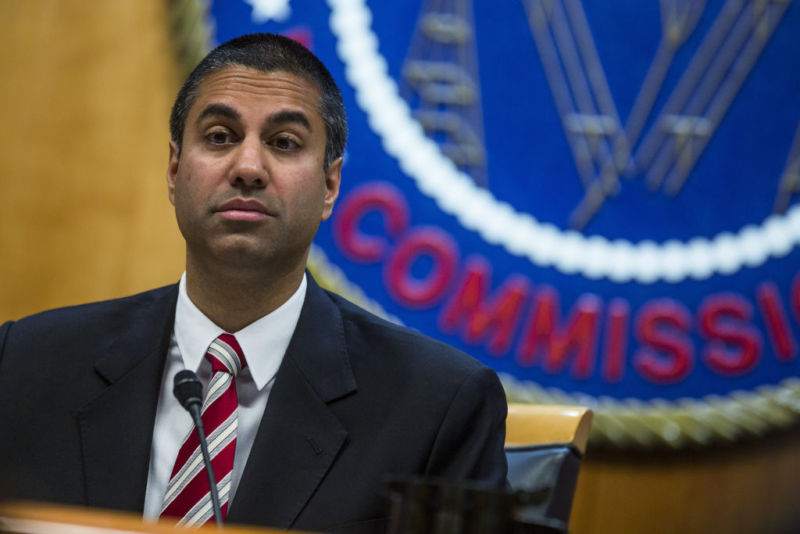
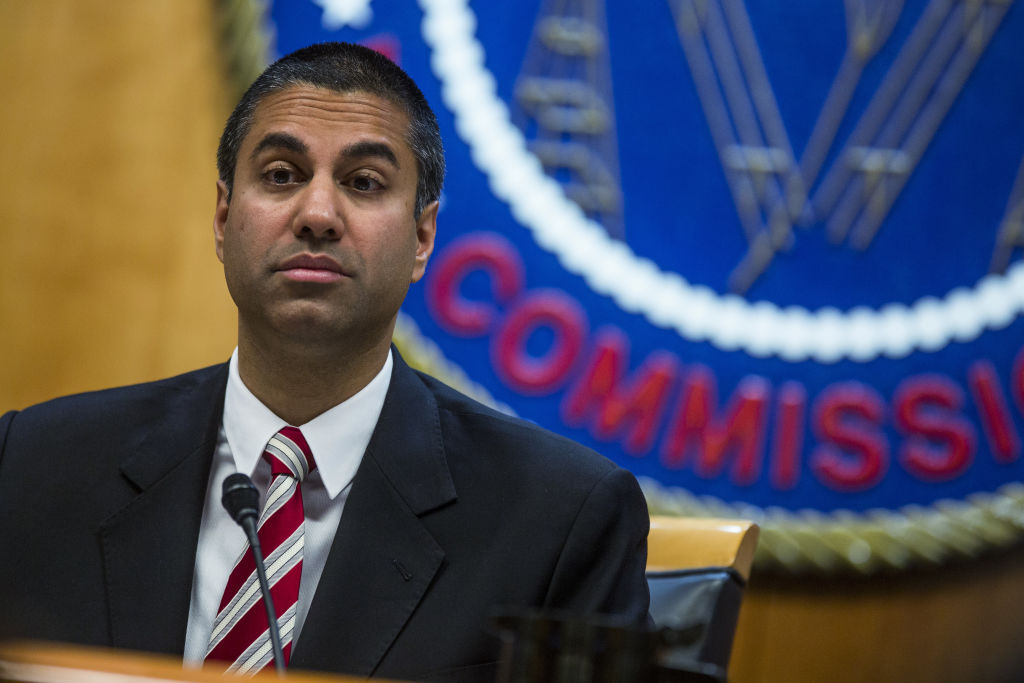
FCC Chairman Ajit Pai at a meeting, sitting in front of the FCC seal.

Enlarge / FCC Chairman Ajit Pai. (credit: Getty Images | Bloomberg)

Under pressure from the Federal Communications Commission, Internet service providers today pledged to waive late fees and keep customers connected when they miss payments due to the coronavirus pandemic. FCC Chairman Ajit Pai announced that many ISPs signed his "Keep Americans Connected Pledge." But while the pledge prevents disconnections and late fees, Pai was unwilling or unable to convince ISPs to waive data caps during the pandemic.

The full pledge reads as follows:

Given the coronavirus pandemic and its impact on American society, [Company Name] pledges for the next 60 days to:

(1) not terminate service to any residential or small business customers because of their inability to pay their bills due to the disruptions caused by the coronavirus pandemic;

(2) waive any late fees that any residential or small business customers incur because of their economic circumstances related to the coronavirus pandemic; and

(3) open its Wi-Fi hotspots to any American who needs them.

Home-Internet and mobile providers that signed the pledge include Altice, AT&T, CenturyLink, Charter, Comcast, Cox, Frontier, Mediacom, Sprint, T-Mobile, TracFone, US Cellular, Verizon, and Windstream. Dozens of others signed as well (see full list).

Read 10 remaining paragraphs | Comments

13 Mar 18:07

If the United States is a week behind Italy … brace yourself for horror that still seems impossible

by Mark Sumner
James.galbraith

Seriously...Italy is a shitshow, and it's amazing how quickly things can go bad

On Tuesday, the University of California, San Francisco, conducted a little-reported panel on COVID-19. That panel came before Donald Trump’s address to the nation introducing an arbitrary ban on visitors from some European nations. But the statements produced by that panel were both illuminating and a terrifying indication of what to expect. The doctors and scientists on the panel indicated that America had reached a point at which “containment is basically futile” and won’t reduce the spread of future cases in the U.S. 

And they said this: "We in the U.S. are currently where Italy was a week ago. We see nothing to say we will be substantially different." That statement alone should be enough to sober anyone who still doubts the seriousness of what is happening. Because what is going on in Italy right now is a horror show, one that many never thought could happen.

That UCSF panel didn’t break new ground with the information it was sharing, but it was starkly straightforward in presenting the information that many news accounts continue to tiptoe around.

At this point, coronavirus is past containment. “Now we’re just trying to slow the spread, to help healthcare providers deal with the demand peak to … ‘flatten the curve’” and buy time for the healthcare system to respond. We don’t know the true extent of infection in the United States. No one knows. In the next 12-18 months, 40-70% of the U.S. is likely to be infected, because it takes that kind of number to develop any “herd immunity” that will prevent further epidemic outbreaks. At the moment 0% of the population is immune. Not only is the U.S. just days behind Italy, there is no reason to expect that things in the U.S. will not follow the same trends displayed in Italy.

Those numbers, combined with a 1% case fatality rate, mean 1.6 million die in the next year. Italy is currently experiencing a case fatality rate of 5%.

The reason that number is so terrible in Italy was detailed this week by The Atlantic. When Italy was experiencing a few hundred cases two weeks ago, each of those patients was getting the attention they needed, including respiratory specialists and specialized equipment. A week later, over 2,000 COVID-19 patients were still getting access to artificial ventilation for breathing difficulties. 

But a week after that, over 10,000 patients had overrun available ICU beds in northern Italy. Not only were there no longer enough respirators to go around, there also weren’t enough doctors. Or beds. Patients were left gasping for air in waiting rooms … and there was absolutely nothing that could be done for them.

In fact, the death rate directly attributable to COVID-19 doesn’t reflect the real scope of the problem. It wasn’t just that the number of patients meant that all those infected with coronavirus could not get the treatment they needed. Those beds were also full for patients coming in with heart attacks, strokes, and having been in car accidents. The survival rate for every serious medical issue plummeted because of novel coronavirus.

Italian doctors have been forced into a terrible position of triaging patients, not over the seriousness of their illness, but over their age and prospect for “remaining life years.” In some locations, patients over 65, or with additional medical complications like diabetes or heart disease, are simply being left to die. That’s not happening out of cruelty. It’s happening because there are other, younger patients at the same hospital who need the respirators … or they would die.

This is only getting worse. Not just because since that article was written cases in Italy have soared past 15,000, but because younger victims who initially tried to handle their illness at home are now struggling into hospitals after their symptoms worsened. Doctors there are now faced with the challenge of not just refusing treatment, but removing treatment so they can deal with patients with potentially better outcomes.

It’s an insidious, awful math—and a crushing moral burden—that no doctor wants to face. And, unfortunately, it could be coming very, very soon to a town very, very near you.

Friday, Mar 13, 2020 · 5:31:11 PM +00:00 · Mark Sumner

On Friday, Italy reported another 2,547 cases.

13 Mar 16:47

‘A New Low’: Trump Campaign Refers to Biden as ‘Rotting Corpse’ in Disgusting Tweet

by John Wright
James.galbraith

Fuck the GOP

President Donald Trump’s campaign, on its official Twitter account, referred to former Vice President Joe Biden, the likely Democratic nominee, as a “rotting corpse” and “the dead guy” on Friday:

“Joe Biden is the same rotting corpse of a candidate he was three weeks ago. It’s just that Democrats have decided that they would be better off with the dead guy than with Crazy Bernie,” Team Trump wrote.

Although Trump’s campaign was quoting directly from a Washington Times column by Charles Hurt, Twitter wasn’t having any of that possible excuse:

The post ‘A New Low’: Trump Campaign Refers to Biden as ‘Rotting Corpse’ in Disgusting Tweet appeared first on Towleroad Gay News.

13 Mar 16:45

[Paul Cassell] U.S. Soccer's Offensive Defense of the Women's National Team Equal Pay Lawsuit

by Paul Cassell
James.galbraith

Yep, US Soccer should get gutted for this

[The President of U.S. Soccer resigns last night--in no small part because of bad lawyering.]

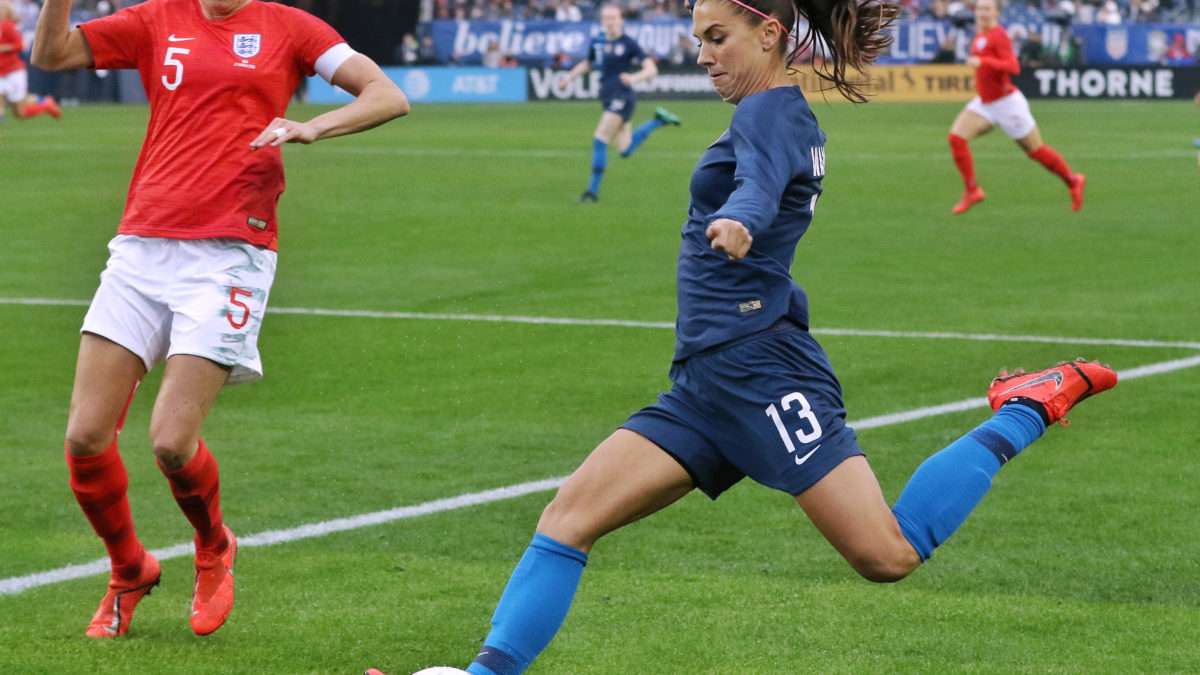
Want to see a classic example of bad lawyering with a terrible argument?  Consider the U.S. Soccer Federation's defense of the lawsuit filed by Alex Morgan and other members of the U.S. Women's National Team (USWNT) alleging sex discrimination in violation of the Equal Pay Act (EPA) and Title VII.  In the last few days, U.S. Soccer's attorneys generated a firestorm of controversy in responding to the players' summary judgment motion.  On Monday night, U.S. Soccer filed a brief arguing that a USWNT player's job does not require equal "skill" and "responsibility" to that of a member of the U.S. Men's National Team (USMNT).   On Wednesday night, the President of U.S. Soccer, Carlos Cordeiro, apologized for the filing–and last night he resigned. His resignation resulted, in significant part, from his lawyers making a terrible argument directly contrary to their client's long term goals.

The underlying lawsuit was filed in March 2019 by the 28 all members of the USWNT (the current world champions).  The complaint compared the USWNT and the USMNT and argued that "[d]espite the fact that these female and male players are called upon to perform the same job responsibilities on their teams and participate in international competitions for their single common employer, [U.S. Soccer], the female players have been consistently paid less money than their male counterparts."

The case has proceeded through discovery for the last year, with the case set for trial in early May.  The recent filings that have generated controversy are cross-motions for summary judgment by the USWNT and U.S. Soccer.   The USWNT has argued that there is no genuine factual dispute that the USWNT and USMNT players perform "equal work," which under the EPA's implementing regulations is defined as work that requires "equal skill, effort and responsibility."

In response to this argument, many options were available to U.S. Soccer's attorneys (from the law firm of Seyfarth Shaw).  For example, they could have simply stipulated to this point about equal "skill"–which is not dispositive in the case.  Indeed, the case's central issue concerns whether the USWNT bargained for alternative pay arrangements from the men's team.  But instead of setting to the side the issue of the comparative skills involved in men's and women's soccer, U.S. Soccer's attorneys rashly choose to argue for the men's absolute superiority.  Here is the passage from the response brief that has generated controversy by suggesting that the U.S. women have less "skill" (some legal citations omitted and emphasis rearranged):

Plaintiffs ask the Court to conclude that the ability required of an WNT player is equal to the ability required of an MNT player, as a relative matter, by ignoring the materially higher level of speed and strength required to perform the job of an MNT player. The EPA does not allow this. Nor is it a "sexist stereotype" to recognize the different levels of speed and strength required for the two jobs, as Plaintiffs' counsel contend. On the contrary, it is indisputable "science," as even Plaintiff Lloyd described it in her testimony. See also Doriane Lambert Coleman, Sex in Sport, 80 LAW AND CONTEMPORARY PROBLEMS 63-126 (2017) (available at: https://scholarship.law.duke.edu/lcp/vol80/iss4/5) (describing the scientific basis for "the average 10-12% performance gap between elite male and elite female athletes," which includes differences between males and females in "skeletal structure, muscle composition, heart and lung capacity including VO2 max, red blood cell count, body fat, and the absolute ability to process carbohydrates," …).…

The point is that the job of MNT player (competing against senior men's national teams) requires a higher level of skill based on speed and strength than does the job of WNT player (competing against senior women's national teams). …

Alert VC readers will recall that Professor Coleman (cited above) has previously blogged here on the topic of scientifically based strength differentials between men's and women's athletes.  But whatever the merits of this point, in using this differential as a basis for unequal pay, U.S. Soccer's lawyers appear to have forgotten that one of U.S. Soccer's missions is to promote gender equality in soccer.  Thus, regardless of the argument's legal merits, it directly contradicts U.S. Soccer's values.

This view about the argument's incongruity is not just mine.  In a statement released Wednesday night (as the USWNT was winning its most recent competition by defeating Japan 3-1), U.S. Soccer President Carlos Cordeiro formally apologized for U.S. Soccer's brief.  He said that he "sincerely apologized for the offense and pain caused by language in this week's court filing, which did not reflect the values of our Federation or our tremendous admiration of our Women's National Team. Our WNT players are incredibly talented and work tirelessly, as they have demonstrated time and again from their Olympic Gold medals to their World Cup titles."

In light of that apology, commentators called for Cordeiro to resign. For example, Grant Wahl (one of America's foremost soccer observers) wrote in Sports Illustrated on Thursday morning that Cordeiro "who presided over a disgraceful legal strategy citing 'science' to belittle the world champion U.S. women's national team based on its gender, should resign immediately."  Former members of the USWNT criticized the sexist language.  And making the criticism near universal, the USMNT player's association joined in the attack.

To his credit, Cordeiro realized his responsibility for the filing and, last night, he resigned.  In his letter of resignation, Cordeiro explained that he failed to fully review the brief quoted above and the he took responsibility for failing to do so. Cordeiro stated that, "[h]ad I done so, I would have objected to the language that did not reflect my personal admiration for our women's players or our values as an organization."

The lack-of-equal-skill argument strikes me as one of the worst ever advanced by skilled lawyers in complex litigation.  In a scorched earth defense, they raised every conceivable argument that could have led to a favorable verdict–even an argument that flatly contradicted U.S. Soccer's goals.  Against a backdrop of well-documented second-class treatment of the women's team, arguing that the team (the defending world champions) somehow possessed a lower level of "skill" was worse than tone deaf.  Not only has it led to the resignation of the head of U.S. Soccer, but it will now lead to complicated questions of how to unwind the damage.

U.S. Soccer has plausible arguments to explain any pay differential (a fact that itself is in dispute).  For example, the strongest argument for U.S. Soccer is that the women players bargained for an alternative pay structure.  Given the fact that women's professional soccer leagues do not pay nearly as much as do men's leagues, the women have sought guaranteed annual salaries.  But whatever the strength of U.S. Soccer's argument on that point (I take no position on that here), U.S. Soccer's attorneys have now created an issue of fact about whether the purported lack of "skill" was the true basis for the alternative arrangements.  Given that U.S. Soccer has been forced to admit that this position was sexist and inconsistent with its values, the finder-of-fact in the case will presumably have to weigh that point in deciding the case.

As of this writing, U.S. Soccer has yet to withdraw the offensive language from its brief.  Perhaps a short submission to that effect will come soon from U.S. Soccer's new legal team (Latham & Watkins).  Until the language is formally withdrawn, it is hard to disagree with the USWNT that the apologies thus far have been nothing but cheap talk.

No doubt, even with a withdrawal, lawyers for USWNT will not let the matter disappear so quickly.  In view of the factual disputes, look for U.S. Soccer's summary judgment motion to be denied and for the case to head in the direction of a trial.

13 Mar 16:33

What to do with your kids when schools are canceled

by Alexandra Stockwell
James.galbraith

Assuming you're fortunate enough to have a stay at home parent...

Creating a schedule for the day — but not being too rigid about it — can be helpful for kids and parents. | Getty Images

A mom who homeschools shares her secrets for getting through weeks at home with your children.

On Thursday, the state of Ohio shut down its schools as a precautionary measure around the spread of Covid-19. Maryland, New Mexico, Michigan, and more soon followed, with more states to come, leaving millions of students home for the foreseeable future, and their parents and guardians scrambling to know what to do next.

From a public health standpoint, closing schools is a useful measure. From a parenting standpoint? It’s more likely to be incredibly stressful and logistically challenging.

But it doesn’t have to be. For the past 10 years, I’ve homeschooled my four children and understand how to survive several weeks at home with a houseful of kids — even if you have your own work to do.

Granted, getting through a school closure is not the same as choosing to homeschool your kid. But my experience, both as a doctor whose children attended a traditional school and now as a homeschooling mom running a growing business, means I am well aware of the underlying tensions of having children at home full time while also managing work responsibilities — not to mention the stress resulting from uncertainty about the future.

Here are five lessons I learned as a homeschooling parent that can make the time you spend with your children during school cancellations less stressful, more enjoyable, and maybe even educational.

Instead of trying to create “school at home,” readjust (and relish) the newfound freedom

Think of this time as an unanticipated staycation, where your family gets to spend time together and have some fun.

One amazing benefit of having children at home is that it eliminates the stress that comes with getting everyone out of the house each morning. Before I started homeschooling, we spent our mornings fighting about getting shoes on and not forgetting backpacks. Suddenly, mornings were peaceful, with children cozy on the couch in their pajamas for a few extra hours. (Your kids, like mine, may want to wear their PJs all day, and why not? Save yourself the power struggle.)

Start by having a family meeting. Let every family member talk about what they want to get out of this break. In my family, we do this for vacations and before we start a new school year. It creates buy-in from my kids and results in great ideas I wouldn’t have thought of. (In the past, my kids have wanted to play Apples to Apples, organize a chess tournament, and eat French toast.) If you’re not taking time off, use this meeting to establish that you’ll be working for part of the day, and that the kids need to make space for that.

Some children know exactly what they want to do during the time off. Other children are so used to having their days planned that it may take a while before they can answer the question, so let them know they can respond later.

Create a schedule for your day — but don’t put too much pressure on yourself to stick to it

When I first started homeschooling, I mapped out our days from 8 am until 4 pm by the quarter-hour. I figured that’s how it’s done in school, so that’s what we would do at home. But that level of detail applied to just a few kids at home (rather than hundreds in a school building) was too restrictive. We were all stressed out by it, transitions were a lot harder, and it kept me focused on the clock rather than on my family. After a lot of trial and error (including swinging the other way and having no schedule), I find the best schedule is one that is spacious and flexible, and builds in plenty of independent learning and play time for kids, and reliable break times for me. Here’s a sample:

Breakfast to 10 am: Play inside

10 am to noon: Group project

Art, cooking, jigsaw puzzle, work assigned by the school, multi-age learning kit

Depending on how self-sufficient the children are, this may be an opportunity to work part of the time, or it could be some designated face time with your kids so you can disappear behind your office door later in the day.

Noon to 12:30 pm: Lunch

12:30 to 2:30 pm: Alone time for everyone

Books, educational tablet time, coloring, crafts, infuriating Zoom call with Steve from accounting

2:30 to 4:30 pm: Outside play

Depending on the age of your kids, you can keep an eye on what’s happening but only get involved as needed

4:30 pm until dinner: Regroup time

TV, video games, books

Be responsive to your children’s ages

For K-5 kids, the transition to being at home is probably easiest. They may miss their friends and feel concerned about so many changes, but they will enjoy the novelty of the new routine.

Middle schoolers may resist being at home and away from friends. Your family meeting is an important opportunity for your middle schooler to brainstorm on how to stay connected with friends (the answer will probably be TikTok).

High schoolers are most likely to need to keep up with their schoolwork to complete the semester on time. Their schools should provide information on expected academic progress and what kind of support your kid will need to do it. So many high schoolers have such busy days that having a break in the pace may actually be welcome, and their independence means you should have more time on your own.

Having multiple children at different ages can be challenging. At one point, I was dealing with a toddler and children in third, eighth, and 10th grades, while also working 20 hours a week. I learned how to make the age range work to my advantage: Older children helped younger ones with their lessons, and the younger children prepared snacks for the family.

No matter the age, the whole day is much smoother for everyone when you connect deeply with each child at least once a day. Set up siblings with something that will occupy them so you can have uninterrupted one-on-one time.

Go off-book, especially if you need to get your own work done

Some schools may send home work or institute e-learning, but it’s unclear if that will fill all the hours of a traditional school day. Consider other ways to divert your curious kids’ attention that will be beneficial (and engaging) to them without you feeling like a substitute teacher.

In addition to some of the activities suggested above, take advantage of the many excellent online learning platforms, like outschool.com (which covers a wide range of topics), and brainpop.com (which focuses on the STEM fields: science, technology, engineering, and math). My kids especially liked the rancher who gave a lesson on horse husbandry and the beginner’s calligraphy class.

Use the time to train the kids on skills like cooking and laundry, and any other chores you can’t fit in during the busyness of the school year. While most children are no longer taking classes in home economics, such skills are still necessary — and can take chores off your plate.

When it’s time to work, make sure your kids know what to do in the meantime, preferably something they look forward to. I deliberately only let my kids play on my phone when I need to get work done.

Look on the bright side

Don’t forget: This is going to be a formative time for your child. What do you hope they’ll say when their grandkids ask them what they remember about the coronavirus outbreak of 2020? Make this time special. Do projects together such as filming a movie about your family or making cards for isolated elders in your area. Share stories about your childhood and teach them games you enjoyed as a kid.

In some families, the first days of being at home together may be the hardest. In others, the first days may be quite fun, but once the whole experience is no longer novel, it will become harder. Put in the time to figure out what works, because the return is more ease for everyone and more time to do your own projects (but try to make sure that some of those “projects” are things like a bath or a walk, and not just endless work).

Most of all, be compassionate — toward yourself and your children. We have never experienced anything like the current crisis, and all of us are pioneers.

Alexandra Stockwell is a physician turned relationship and intimacy expert and the author of Uncompromising Intimacy. She builds connected and happy families through facilitating healing and transformation for couples, teaching them how to bring pleasure and purpose into all aspects of life.

13 Mar 16:32

Trump Falsely Claims Obama Caused CDC’s Coronavirus Debacle: ‘Blame the Black Man. AGAIN.’

by John Wright
James.galbraith

Fuck this guy and everyone who supports him

President Donald Trump took to Twitter on Friday morning and attempted to blame — you guessed it, Barack Obama — for the federal government’s disastrous response to the coroanvirus outbreak.

The Washington Post fact-checked Trump’s claims, giving them its highest “whopper” rating of Four Pinocchios: When things get tough in the Trump administration, the president has a default position — blame Barack Obama. The administration has been under fire for its failure to quickly expand testing for coronavirus across the United States; the Centers for Disease Control and Prevention had distributed flawed tests to state and local health departments. The lack of tests, compared with countries like South Korea that have tested tens of thousands of people, has meant the possible spread of the virus in the United States may be hidden. Trump suggested the problem instead was an “Obama rule” on testing that his administration had recently overturned. But this is completely wrong. … Trump is looking for scapegoats to excuse his administration’s sluggish efforts to expand testing. But he cannot blame Obama. There was no “Obama rule,” just draft guidance that never took effect and was withdrawn before Trump took office.

Here’s how Twitter reacted:

The post Trump Falsely Claims Obama Caused CDC’s Coronavirus Debacle: ‘Blame the Black Man. AGAIN.’ appeared first on Towleroad Gay News.

13 Mar 16:31

Trump administration won't let states use Medicaid to ramp up the fight against coronavirus

by Laura Clawson
James.galbraith

This is what happens when a country is run by ghouls

Donald Trump’s refusal to admit that coronavirus is a real and growing problem that needs to be tackled now, with every tool at the disposal of the government, is combining with the general Republican hatred of low-income people in a dangerous way. The Trump administration is refusing to allow states the flexibility to use Medicaid in responding to the crisis, the Los Angeles Times reports.

During disasters such as Hurricane Katrina and the 2009 H1N1 outbreak, presidents have granted waivers to states so they could quickly enroll people in Medicaid or so medical providers could quickly treat people. The Trump administration is not doing that.

This failure to act comes against the backdrop of Trump having spent weeks downplaying the seriousness of the COVID-19 outbreak, which is now classified as a pandemic. His ongoing refusal to declare a national emergency also factors in to the way states’ hands are tied when it comes to leveraging Medicaid to improve their coronavirus response. But that’s not all. Seema Verma, the head of the Centers for Medicare and Medicaid Services, wants to cut the number of people on Medicaid, so that pre-existing ideological disdain for the health of low-income people is likely playing a role in the refusal to empower states to fight the pandemic.

”Medicaid could be the nation’s biggest public health responder, but it’s such an object of ire in this administration,” George Washington University’s Sara Rosenbaum told the Los Angeles Times. “Their ideology is clouding their response to a crisis.”

13 Mar 16:30

Brazil’s President Tests Positive for Coronavirus Days After Meeting with Trump: BREAKING

by John Wright
James.galbraith

Imagine that

Brazil President Jair Bolsanaro has tested positive for coronavirus, days after he met with President Donald Trump at Mar-a-Lago.

The Mirror reports: [Bolsanaro] awaits the results of a second test on Friday to confirm the diagnosis. Bolsonaro dined with US President Donald Trump at Mar-a-Lago resort in Florida on Saturday night, along with his press secretary, who was diagnosed with the disease following the trip. Pictures and video show the Trump, Bolsonaro and his press secretary all in close proximity. Trump however told reporters on Thursday: “I’m not concerned.”

UPDATE: Bolsanaro now claims he tested negative for coronavirus.

The post Brazil’s President Tests Positive for Coronavirus Days After Meeting with Trump: BREAKING appeared first on Towleroad Gay News.

13 Mar 16:29

Pelosi reaches deal with White House for free coronavirus testing, paid sick leave, and more

by Laura Clawson
James.galbraith

Yeah, because only one party gives a shit about the country. The GOP only exists to perpetuate white corporate power.

Speaker of the House Nancy Pelosi and Treasury Secretary Steven Mnuchin are reportedly on the verge of an agreement on a coronavirus response package that would protect working families from the worst of the pandemic’s economic impact. The deal, as reported, includes versions of many of the provisions of the House Democrats' bill unveiled earlier. 

“We’ve resolved most of our differences, and those we haven’t we’ll continue to have a conversation—because there will obviously be other bills,” Pelosi told reporters.

The deal, as reported, includes 14 days of paid sick leave for workers who are sick or quarantined, with tax credits to smaller businesses to cover those costs. It expands unemployment benefits, lifts work requirements for the Supplemental Nutrition Assistance Program, adds funding for food aid programs, and adds funding for Medicaid. The key piece still unresolved Thursday night was family and medical leave. The Democrats’ plan had included up to three months of such leave not just for when workers themselves are sick but also for caring for family members, including kids who are home due to school closures. Coronavirus testing would be free for everyone, including uninsured people.

Presumably the devil is in the details, but it sure sounds like Democrats got a lot of what they wanted to do to help people struggling to get by.

While the House will vote Friday, Senate Majority Leader Mitch McConnell has adjourned the Senate for the weekend and gone home to Kentucky, so the Senate won’t take up the bill until at least Monday. And, speaking of McConnell, here’s an important reminder:

The difference between the two parties: - Seven months before Trump is up for reelection, Dems offer to pass an economic recovery package. - One month after Obama is elected during a global financial crisis, the Republicans refuse to lift a finger to help the country

— Dan Pfeiffer (@danpfeiffer) March 12, 2020

13 Mar 16:28

Trevor Noah Brutally Dissects Trump’s Coronavirus Speech: ‘It Was An Absolute Disaster’ (WATCH)

by John Wright

Calling the speech “as calming as a bag of fireworks dropped into a bag of cocaine,” The Daily Show host Trevor Noah picked apart President Donald Trump’s fact-challenged emergency address on the coronavirus on Thursday night.

Mocking the futility and xenophobia of Trump’s 30-day ban on travel from Europe, Noah said closing borders has become the president’s “go-to solution for everything.”

“Does he do this in his personal life, too? Is Melania just like, ‘I don’t love you anymore, Donald.’ And he’s like, ‘Close the borders. No one’s getting in or out of this marriage,'” Noah said, before highlighting three major fact errors in the pre-written speech.

“Donald Trump’s presidential address turned about as calming as a pack of fireworks dropped into a bag of cocaine, because not only did he surprise everyone with this announcement, but it turns out he almost got everything wrong,” Noah said. “I’m sorry, but this is unbelievable. I would understand if Trump made mistakes if this whole thing was off the cuff, but how is it possible to get so many things wrong in a pre-written speech? This is crazy. Watching on Oval Office address shouldn’t be a game of two truths and a lie.”

Noah also pointed out that Trump exempted the United Kingdom from his travel ban, for one obvious reason: He owns three golf courses there.

“If Iran thought about it, they would just put a Trump golf course in Tehran,” Noah said. “They’d have a nuclear deal tomorrow. Trump would be like, ‘Now you’re enriching me and uranium. It’s a win-win.'”

Finally, Noah played a “blooper reel” of hot-mic outtakes, including when the president exclaimed, “Oh f–k” shortly before the address.

“Despite the efforts of sports leagues, amusement parks, and state and local governments, unfortunately, the man at the top just does not seem to have his shit together,” Noah concluded. “And with coronavirus now in full pandemic mode, all I have to say to that is, ‘Oh f–k!'”

The post Trevor Noah Brutally Dissects Trump’s Coronavirus Speech: ‘It Was An Absolute Disaster’ (WATCH) appeared first on Towleroad Gay News.

13 Mar 16:27

Trump’s 7 worst statements on the coronavirus outbreak

by Katelyn Burns
James.galbraith

Lies and idiocy. I'm just shocked they got it down to 7 statements

President Trump addresses the nation from the Oval Office. President Donald Trump addresses the nation from the White House’s Oval Office about the widening coronavirus crisis, March 11, 2020, in Washington, DC. | Doug Mills-Pool/Getty Images

The president has misled the public on the number of testing kits, the virus’s death rate, and a possible vaccine.

In the novel coronavirus, President Donald Trump has finally met a problem that can’t be solved with his usual bag of political tools: obfuscation, denial, deflecting blame, and misinformation.

That hasn’t stopped him from trying, even if it means saying things that endanger public health.

As of March 12, the US has seen 1,323 confirmed cases of Covid-19, the disease stemming from the coronavirus, and 38 deaths, according to the Johns Hopkins tracker. Public health officials, including those in his own administration, now estimate that millions of people may eventually be infected with Covid-19.

“If we are complacent and don’t do really aggressive containment and mitigation, the number could go way up and be involved in many, many millions.” Dr. Anthony Fauci, director of the National Institute of Allergy and Infectious Diseases and a member of the White House coronavirus task force, told the House Oversight Committee yesterday.

Trump, who addressed the nation from the Oval Office Wednesday night, has consistently sought to downplay the public health risk of the burgeoning pandemic while his administration has been slow to respond to the crisis.

Perhaps most concerning has been Trump’s instinct to outright contradict the facts and statements of the government’s top infectious disease experts as his administration has struggled to contain the outbreak. Here are seven of his coronavirus lies.

1) Trump’s Wednesday address to the nation

Trump’s statement to the nation Wednesday evening was his most serious treatment of the outbreak to date. He “injected gravity and even a sense of crisis into a topic that he and right-wing media have downplayed for weeks,” making it a “critical step in the right direction,” Vox’s Kelsey Piper explained.

Unfortunately, it was also deeply flawed. Several of his statements, like a trade restriction with Europe along with his travel ban, had to be swiftly walked back by White House officials. Trump was unclear about exempting American citizens and permanent residents from the ban, leading to panicked crowds congregating in enclosed spaces at many European airports like Charles de Gaulle in Paris, France.

Perhaps most egregious was his claim that major insurance companies would cover treatment for Covid-19 free of charge, when in actuality they had agreed only to coronavirus testing without a co-pay.

While Trump’s speech Wednesday evening finally sent a signal to the American public that the novel coronavirus is very serious, the mixed-up details undermined the endeavor.

2) Death rate hunch

In a phone interview with Sean Hannity on March 4, Trump contradicted public health experts’ estimates of the death rate for Covid-19 — based on a “hunch.”

To be sure, a precise death rate for Covid-19 is difficult to measure, in part because testing hasn’t been done on a large enough scale to measure accurately. Earlier this month, the World Health Organization had the death rate pegged at about 3.4 percent. Many experts think that number may be too high, given the struggles with adequate testing, putting the true number likely closer to 1 percent.

Trump, however, told Fox viewers that the death rate was even lower — a “fraction of 1 percent” — based on his “hunch.” Here’s the rest of the quote:

Now, this is just my hunch, but based on a lot of conversations with a lot of people that do this, because a lot of people will have this and it is very mild... So if, you know, we have thousands or hundreds of thousands of people that get better, just by, you know, sitting around and even going to work, some of them go to work, but they get better and then, when you do have a death like you had in the state of Washington, like you had one in California, I believe you had one in New York, you know, all of a sudden it seems like 3 or 4 percent, which is a very high number, as opposed to a fraction of 1 percent.

Trump may have sought to downplay the mortality risk of Covid-19 in order to reassure nervous Americans and a jittery economy, but instead created a much more dangerous situation where people weren’t taking the virus seriously enough. It’s true that the risk of dying is highest for elderly people and immunocompromised people (the US has plenty of both), but as Vox’s Dylan Scott and Eliza Barclay explained,the speed at which the outbreak plays out matters hugely for its consequences”:

What epidemiologists fear most is the health care system becoming overwhelmed by a sudden explosion of illness that requires more people to be hospitalized than it can handle. In that scenario, more people will die because there won’t be enough hospital beds or ventilators to keep them alive.

So not taking the virus seriously — at the bureaucratic and individual levels — means fewer people taking suitable precautions, and possibly more cases and more deaths.

3) “It’s going to disappear. One day, it’s like a miracle, it will disappear”

On February 28, Trump said that coronavirus will “disappear” like a “miracle” while speaking at a press conference for his coronavirus task force. On Tuesday, he told reporters on Capitol Hill that coronavirus “will go away.” In late February, he speculated that warm weather would kill the virus and stop its spread. None of these statements are backed by science or infectious disease experts within his own administration. (Though some diseases — like the seasonal flu — do diminish in warmer seasons, there is currently no evidence the novel coronavirus will behave this way.)

Experts all along have predicted that without drastic measures to prevent outbreaks from growing bigger or the rapid development of a vaccine, the novel coronavirus will likely continue spreading and become endemic, a regular disease like the common cold.

4) “Anyone who wants a test can get one”

On March 7 while visiting the CDC in Atlanta, Georgia, Trump said that anyone who wants a test for Covid-19 can get one.

As countless viral Twitter threads, local news stories, and more have recounted, that promise has not rung true. Take the “Kafkaesque” story physician’s assistant Julie Eaker told Vox’s Brian Resnick and Dylan Scott about trying to get one patient tested in California:

First, Eaker called her local health department and was told her patient didn’t qualify for testing since they hadn’t traveled to China, per the guidelines from the Centers for Disease Control and Prevention at the time. After the CDC relaxed its testing criteria, the patient was still sick, so Eaker called again. “I didn’t receive a phone call back,” she says.

The patient thought they had pneumonia and asked to be tested for peace of mind. Finally, last week, after Eaker ordered some test kits herself from a private lab, she got a call back. “The health department told me I was not allowed to use those test kits — that I ordered — without their permission!”

Eaker was horrified. So she called the CDC to confirm if the local health department was correct. “I did not get through,” she says. “I spent hours and hours and hours on hold. … So I thought I would just call the White House and talk to Vice President Pence, who is in charge of the coronavirus task force.“

She didn’t get Pence, but a White House switchboard operator told her to call the CDC.

“Somebody has got to help us,” she says, exasperated. “We’re out here on the front lines trying to take care of people.”

But the problem has been bigger than that. The administration had promised to quickly deliver 1 million testing kits to private labs. But on March 6, the White House announced that it would fall far short of that goal for testing kit distribution.

According to virologists, the best way to prevent an outbreak of a highly contagious virus like coronavirus is through aggressive testing. Knowing who is infected and when they became infected allows traditional measures like quarantines to work more effectively. If people don’t know they have it, they aren’t able to take their own steps to prevent spreading it to others.

In that, the administration has failed. So far, the US only has a limited capacity to process coronavirus tests every day, meaning we likely don’t have accurate numbers for the scale of this virus’s spread. The CDC has recommended that hospitalized patients displaying Covid-19 symptoms, as well as those who belong to at-risk populations, should get priority for testing, but anecdotal accounts of people with symptoms being denied a test have begun popping up on social medial.

At first, Trump blamed an Obama-era FDA rule for its slow response in distributing test kits, but experts have since revealed that claim to be false.

5) The flu is worse

During that March 4 call with Hannity, Trump also compared coronavirus with the flu. He mentioned that the flu kills anywhere between 27,000 and 77,000 people every year, implying that coronavirus isn’t as serious of a threat to public health as Influenza.

Trump’s own infectious disease experts have said that idea is wrong. Dr. Fauci told Congress on March 11 that “the mortality of [Covid-19] is multiple times what the seasonal flu is.”

The reason why lies in the numbers. The CDC estimates that the seasonal flu has resulted in between 9.3 million and 49 million illnesses in the US each year since 2010, putting the flu’s death rate at about 0.1 percent. Even if WHO’s 3.4 percent death rate for coronavirus is high due to inadequate testing capacity, using other public health expert’s estimations of around 1 percent would mean that Covid-19 could be as much as 10 times deadlier than the seasonal flu.

If 49 million Americans were to be infected with the coronavirus, a 1 percent death rate would cause 490,000 deaths, much more than the flu.

6) A vaccine will be available soon

On February 25, Trump promised that a vaccine would be available soon. “Now they have it, they have studied it, they know very much, in fact, we’re very close to a vaccine,” Trump said during a state visit to India. That simply isn’t possible even if development of a vaccine were prioritized and pushed through the regulatory process as fast as possible — as pharmaceutical executives explained to Trump himself.

Dr. Fauci estimates that it would be at least a year or a year and a half before a vaccine would be available to the general public. Several potential vaccine solutions for coronavirus are in early development in China, but Daniel O’Day, CEO of Gilead Sciences, told Trump that those are only now entering clinical trials. It’s likely that a vaccine will eventually be developed and available to the general public, but it’s not going to save us from this current outbreak.

7) The US was “most prepared country in the world”

Trump has repeatedly claimed that the US was the most prepared country in the world. This is, frankly, Trump’s usual political bluster. The reality is that his administration, with the help of a Republican-controlled Congress, hampered the country’s ability to fight pandemics like Covid-19, as explained by Vox’s Matthew Yglesias:

That’s part of a broader pattern of actual and potential Trump efforts to shut down America’s ability to respond to pandemic disease.

Trump’s first budget proposal contained proposed cuts to the CDC that former Director Tom Frieden warned were “unsafe at any level of enactment.”

Congress mercifully didn’t agree to any such cuts, but as recently as February 11 — in the midst of the outbreak — Trump proposed huge cuts to both the CDC and the National Institutes of Health.

Perhaps because his budget officials were in the middle of proposing cuts to disease response, it’s only over this past weekend that they pivoted and started getting ready to ask for the additional money that coping with Covid-19 is clearly going to cost. But experts say they’re still lowballing it.

In early 2018, my colleague Julia Belluz argued that Trump was “setting up the US to botch a pandemic response” by, for example, forcing US government agencies to retreat from 39 of the 49 low-income countries they were working in on tasks like training disease detectives and building emergency operations centers.

Instead of taking such warnings to heart, later that year, “the Trump administration fired the government’s entire pandemic response chain of command, including the White House management infrastructure,” according to Laurie Garrett, a journalist and former senior fellow for global health at the Council on Foreign Relations.

In fact, the Trump administration remains committed to cutting funding to fight potential pandemics. When confronted in a congressional hearing about a 15 percent cut of $1.2 billion to the CDC and a $35 million decrease to the Infectious Diseases Rapid Response Reserve Fund’s annual contribution in the White House’s proposed 2021 budget, acting director of the White House Office of Management and Budget Russ Vought defended the proposed cuts.

13 Mar 16:18

The Michigan primary results raised a striking question about sexism

by Li Zhou
James.galbraith

No shit

Supporters cheer for Sen. Bernie Sanders during a campaign rally in Ann Arbor, Michigan, on March 8, 2020. | Brittany Greeson/Getty Images

The parallels between 2016 and 2020 proved to be quite telling.

Joe Biden outperformed Hillary Clinton in county after county in the Michigan Democratic primary on Tuesday, raising questions yet again about whether “electability” really is just about sexism.

Overall, Clinton lost by less than 2 percentage points in the state. Biden won by 16.

The difference in these outcomes was made all the more stark by the similarities between the candidates. New York Times columnist Charles Blow pointed out what many former Clinton fans were thinking: “Biden isn’t that much different from Hillary Clinton on the issues. Big difference: she was a woman and he isn’t.”

Former Clinton communications staffer Jess McIntosh had a grim read of the situation, too. “I’m more likely than most to blame sexism for the 2016 race, and it appears I underestimated it,” she told Vox.

The swing toward Biden in 2020 was driven by white voters: Both white men and white women backed the former Vice President by 10 points more than they did Clinton in 2016, according to CNN exit polls. Sanders, notably, saw double-digit dips in support across the two groups after winning them last cycle. Meanwhile, support for Clinton and Biden among black voters was about the same.

Given the support he saw, Biden’s win in Michigan wound up being decisive. Rural counties including Huron, Luce, and Marquette, which went for Sanders in 2016, flipped for Biden. Biden also won white college graduates and white voters with no degree, two groups that Clinton lost by more than 10 points.

As Vox’s Ezra Klein put it, the parallels between the two cycles seem to set up a “natural experiment” to examine the “role gender plays in voter preferences and judgments about electability.”

It’s worth noting that there are some key differences this time around, however. For one, Democratic voters are much more eager to defeat Trump.

“Female voters and African American voters went for Biden in pretty large numbers. Part of the calculus those groups are making is not necessarily ‘We love Joe Biden,’ it’s probably ‘we’re in an emergency, and who do I think is going to beat Donald Trump,’” says writer Jill Filipovic.

And that’s far from the only other variable at play. In 2016, Clinton put her progressive stance on social issues including gender and racial equity at the forefront of her campaign — and researchers theorized that these positions contributed to pushback from more socially conservative voters. Additionally, she dealt with a set of political baggage that some have viewed as uniquely polarizing. (Biden has also been in politics for decades and has been dogged by critiques of his own policy track record.)

Ultimately, it’s tough to parse out exactly how much the difference in the Michigan results was driven by sexism, but it’s a pretty sure bet that it was a factor.

“When a man runs against a woman in a head-to-head contest for a male-coded position like the presidency, he reliably gets a boost due to prevalent gender biases,” says philosopher Kate Manne, the author of Down Girl, a book that examines the impact of misogyny on public life. “The fact that Sanders did so well against Clinton and so much worse against a fairly comparable male candidate in the form of Biden serves as some confirmation of this.”

Sexism was undoubtedly a factor in 2016

Gender biases, conscious or unconscious, were pervasive in the 2016 election, a fact that’s well-documented by research.

In the general election, political scientists found that voters who backed Trump were more likely to score higher on a “hostile sexism” scale, which attempts to measure unconscious biases that voters may have about women. Relatedly, those who opted to switch from backing Sanders in the primary to Trump in the general election, rather than Clinton or a third party candidate, were also more sexist.

 Brooks Kraft/Corbis via Getty Images
Hillary Clinton arrives in Grand Rapids, Michigan, on November 7, 2016.

For members of Clinton’s team — and the candidate herself — the presence of these biases was evident. Whether it was the uneven scrutiny of her plans compared to those of her competition, or the ongoing skepticism she faced from a subset of white male voters, they saw her being held to a different standard.

“In 2016, we knew we were bumping up against a lot of these theories of misogyny, no doubt,” says Clinton’s former political director Amanda Renteria, who’s now a senior adviser for Emerge, an organization dedicated to electing more women to public office.

In Michigan specifically, Renteria cited the obstacles Clinton encountered as she courted labor union members for their support. As CNN exit polls show, Clinton fared worse than Biden did this time around with union members. Forty-six percent of voters in a union household went for Clinton in 2016 while 55 percent voted for Biden in 2020.

“It is easier for guys to create that connection within that union movement in places in the Midwest,” says Renteria. “It’s one of the things we faced. Women are not at gender parity in the labor movement.” According to People’s World, women make up 45 percent of union membership nationally but comprise a much smaller share of its leaders.

In 2016, union members highlighted Clinton’s support for the Trans-Pacific Partnership — a position she later changed — as part of their opposition. Biden, too, once supported the agreement, but he hasn’t seemed to face the same pushback.

Neera Tanden, the president of the Center for American Progress and a prominent Clinton surrogate, also points to broader biases in the framing of media coverage. “Do you cover emails as a Lady Macbeth plot or is it just that Hillary didn’t ascribe to email protocols delineated by the State Department?” she said.

The groups that moved away from Sanders and in favor of Biden this cycle are among those more likely to be sexist, according to a study of general election voters conducted by University of Arkansas political scientist Angie Maxwell. “White respondents were more sexist than black Americans,” Rebecca Onion wrote in a write-up describing the findings for Slate; this analysis, though, included Republican as well as Democratic voters.

Gender biases have been apparent in 2020, too. Throughout the primary, women candidates have been scrutinized for their likability, trustworthiness, and qualifications in ways that men simply haven’t been.

“I think the proof of the argument that it was not unique to Hillary is that the women candidates have all faced difficult challenges,” says Tanden.

YouGov’s Sam Luks and Tufts University’s Brian Schaffner found that likely Democratic primary voters who were more likely to agree with statements tied to hostile sexism were less likely to consider the top women candidates as their pick in 2020.

There are other factors at play, too

Political scientists acknowledge the presence of gender bias in the Michigan primary outcome, but also caution that its effects can be tough to pin down among myriad other factors.

“I am not sure how we parse out how much of [the result] might have been related to reaction to Clinton and how much of it is motivated by the panic so many Democratic voters seem to be expressing in their desperate search to decide which candidate will beat President Trump,” University of Wisconsin political science professor Kathleen Dolan tells Vox.

 Mandel Ngan/AFP via Getty Images
Joe Biden greets supporters after a campaign rally in Detroit, Michigan, on March 9, 2020.

According to CNN exit polls, the majority of Michigan primary voters were interested in a candidate who could beat Trump, and 62 percent of people who said that was a priority ended up choosing Biden this year. During the Michigan primary in 2016, which also took place in March, Trump had yet to be selected as the nominee.

“At that point, there wasn’t as clear of an opponent,” says Kelly Dittmar, a political science professor at Rutgers and scholar at the Center for American Women and Politics. Dittmar notes that Biden’s success across voting groups including men and women could be indicative of the broader momentum he’s picked up — and his higher favorability ratings, which are also inextricably tied to gender.

Political scientists Brian Schaffner, Matthew MacWilliams and Tatishe Nteta have also concluded that another issue may have affected Clinton’s reception by socially conservative voters in the 2016 general election: the messaging she put forth that focused on gender and racial equity. This same approach could have affected how these voters responded to her — compared to Biden — in the primary as well.

Additionally, the University of Virginia’s Jennifer Lawless argues that Clinton’s tenure in politics played a big role. “Hillary Clinton was an imperfect candidate with 25 years of very public baggage. It’s impossible to know whether voters chose Sanders over her because of sexism or ‘Clintonism,’” she says.

Biden, of course, has also been in politics for decades and has faced scrutiny for an array of actions including his treatment of Anita Hill during the Clarence Thomas hearings in the 1990s, his role in authoring the 1994 crime bill, and his multiple failed presidential bids — one of which involved a plagiarism scandal.

Sanders struggled with a gender gap in both years

There were some trends that stayed consistent across 2016 and 2020, including the gender gap that Sanders faced in Michigan. Clinton beat him with women voters by six points in 2016, and Biden did the same by 23 points in 2020.

There are a couple reasons for this that have been floated by political observers. Concerns about electability are chief among them — particularly because women and voters of color may feel as though they have more to lose in the case of another Trump term.

Public perceptions about the misogyny of a small subset of Sanders supporters and the fierce competition between Clinton and Sanders in 2016 also likely influenced some voters. Earlier in this campaign cycle, Sanders dealt with allegations of sexism and harassment levied by aides about the culture of his 2016 campaign, all of which he has condemned.

“I think a lot of women who were inspired by Hillary Clinton’s run remember 2016 and perhaps don’t look too kindly to Sanders because of that,” Filipovic told me.

Renteria credits the endorsements of Michigan Gov. Gretchen Whitmer and the in-state campaigning conducted by other surrogates of the Biden campaign like Sens. Amy Klobuchar and Kamala Harris as factors that may have also helped him boost his numbers with women.

Beyond the questions of if sexism played a role in 2016 and 2020 — ones that are increasingly settled — there’s a big outstanding one about how to deal with it. At this point, that question centers on how best to combat sexism in the presidential race and acknowledge it without forcing women candidates into fielding subsequent questions about electability.

“How do you accurately describe the misogyny in America without reaffirming the risk that misogyny creates?” Tanden asks.

The solution, for now, seems to be continuing to call it out — and to continue running more women candidates.

13 Mar 15:50

[Eugene Volokh] "The Number of Recoveries Continues to Rise Above Its Death Toll"

by Eugene Volokh
James.galbraith

Oh it's telling us something more important: a LOT of people are still very sick even if they're not corpses yet.

[An odd statistic.]

Newsweek writes: "While cases continue to soar in Italy, which has now reported more than 12,000 infections, the number of recoveries continues to rise above its death toll, with 1,045 recoveries versus around 800 deaths in the country."

Does that mean something that I'm missing? Of course the number of recoveries should eventually rise above the death toll, so long as the mortality rate is under 50% (and the evidence seems to suggest it's much lower than that).

Now at any particular time, the ratio may be sharply different, depending on factors such as how long it takes for those who recover to recover (and perhaps how one defines recovery), and how long it takes for those who die to die. But that right now in Italy the recoveries barely exceed the deaths strikes me as telling us very little; or am I mistaken?

13 Mar 00:56

Disney delays Mulan due to coronavirus

by Aja Romano
James.galbraith

Damn it I was looking forward to Mulan

Disney’s Mulan. | Disney

Disney is delaying its live-action Mulan remake, along with X-men installment New Mutants and the horror film Antlers.

Disney is postponing the highly anticipated live-action remake of Mulan in the wake of growing concerns about the novel coronavirus.

Disney not only delayed Mulan, which would have been released March 27, but also two other upcoming films: the teen X-Men movie New Mutants (previously scheduled for April 3), and the horror film Antlers, which Disney acquired when it acquired Fox Searchlight (previously scheduled for April 17). New release dates for the films have not yet been announced.

“As you know, this has been a rapidly evolving situation,” a Disney spokesperson stated in a March 12 press email. “We are postponing the releases of Mulan, New Mutants, and Antlers out of an abundance of caution.”

Press screenings of Mulan have been delayed until further notice, and some premieres for the film were also unscheduled in Europe and China, where theaters have already been closed for over a month.

Disney has slowly begun to shut down some of its theme park attractions as well. The company had already shut down two theme parks in Shanghai and Hong Kong earlier his year, as Asia was hit hardest by the virus. As it spread, Disney closed more parks in Japan. On March 12, despite an earlier statement from California governor Gavin Newsom exempting Disney from a general ban on crowd gatherings throughout the state, the company announced that it would close its Anaheim, California-based theme park Disneyland indefinitely as well. The shutdown marks just the third time in its history the Anaheim theme park has gone dark.

A few hours after the first March 12 announcement, the company released an update that Walt Disney World and other Disney-owned theme parks in Orlando would be closing as well. Disneyland Paris, where three staff members tested positive for coronavirus, will also be closing.

The back-and-forth over the theme parks illustrates just how rapidly and uncertainly the situation surrounding Disney’s properties has unfolded. As of Thursday morning, premieres for Mulan were scheduled to move ahead with merely a “downscaling” of plans. With a $200 million production budget, Mulan has been one of the buzzier recent Disney films.

Meanwhile, New Mutants fans just can’t catch a break: The film had already spent years weathering delays due to development and acquisition setbacks prior to its now-postponed April 3 release date — including five release delays. Now, make that an even six.

Disney’s decision to cancel the films could have repercussions for the wider entertainment industry. The question of whether or not to force movie theaters to close due to Covid-19 is a polarizing one for Americans — but with one less film juggernaut to draw them to the box office, the choice might have just gotten a little easier.

13 Mar 00:35

Pelosi works to cut emergency deal. McConnell skips town till Monday

by Kerry Eleveld
James.galbraith

GOP priorities

This really says it all: Speaker Nancy Pelosi has reportedly been working all day to cut an emergency deal with the White House to address the coronavirus. Majority Leader Mitch McConnell, after saying earlier Thursday that he had delayed a scheduled Senate recess, went ahead and left town anyway

That means anything the House passes either Thursday night or Friday will sit for several days until McConnell cares enough to come back from his vacation to pass it. Or not. Maybe Senate Republicans will simply kill the deal that they made no effort to negotiate. Who knows? Senate Republicans clearly aren’t feeling a lot of urgency.

Friday, Mar 13, 2020 · 1:14:58 AM +00:00 · Kerry Eleveld

UPDATE

NEWS.... PELOSI: �we have or near to an agreement. ... we hope to have an announcement tomorrow�

— Jake Sherman (@JakeSherman) March 13, 2020

As @SpeakerPelosi & Steve Mnuchin negotiate, @senatemajldr has left the building to head home for the weekend. Senate to address any House coronavirus legislation next week

— Kasie Hunt (@kasie) March 12, 2020

Senate is leaving town till Monday, meaning whatever the House passes tonight or tomorrow on the coronavirus outbreak will have to wait till then https://t.co/DKYfwMpHCo

— Igor Bobic (@igorbobic) March 12, 2020

From earlier Thursday, when it looked like maybe Senate Republicans might attempt to be useful (things have changed since then).

Senate scraps its recess amid growing pressure to pass an economic relief package - and amid a push by House Dems to pass their own bill today. GOP senators up for re-election did not want to go home without passing a bill https://t.co/bsu5McmSsb

— Manu Raju (@mkraju) March 12, 2020

12 Mar 23:08

Sen. Udall uses gov't report of 1000s of polluting mine sites to push reform of antique mining law

by Meteor Blades
James.galbraith

Public resources pillaged for private profit. Welcome to the GOP.

Nearly a century and a half ago, as part of Washington’s effort to encourage settlement in the West, President Ulysses S. Grant signed the General Mining Act of 1872. This granted individuals (and corporations) the right to stake exclusive claims to mineral resources like gold, copper, zinc, cinnabar, and “other valuable resources” on public land, which today include uranium and platinum. Since then, it’s estimated that about $300 billion in minerals have been extracted with no royalty paid to the government. And the way federal land managers currently operate, preference is given to mining over all other land uses, including everything from recreation to protection of drinking water supplies.

The price for acquiring federal land under the act until a moratorium imposed in 1994 was $2.50-$5 an acre and $100 of work annually. Not only are no royalties collected, but there was also originally no requirement to clean up the mess left behind when mined-out claims were abandoned. If those messes were confined to the sites themselves, cleanup might not be a big deal. But these old mines often pollute streams and rivers well beyond the boundaries of the claims despite reclamation law. Democratic Sen. Tom Udall of New Mexico, the ranking member of the Subcommittee on Interior, Environment, and Related Agencies, is determined to change that.

Over the years, the Government Accountability Office has issued a number of reports detailing the impacts of hundreds of thousands of such mines. The GAO on Wednesday released yet another one, and it’s a doozy, although hardly a surprise. 

The short version: 140,000 abandoned sites have been identified by five government agencies; 67,000 of these may pose physical safety risks, and 22,500 may pose environmental hazards with risks to the health of humans and wildlife; the agencies estimate that there may be as many as 390,000 abandoned hardrock mining sites on federal land that are not included in their databases. Between 2008 and 2017, the report found, the government spent $2.9 billion for reclamation of such mines, with former mine owners kicking in a billion. Federal authorities naturally expect many more billions in tax revenue will have to be spent given the huge backlog of unreclaimed sites.

The GAO report was requested by Udall, who has introduced numerous pieces of legislation over the years to modernize the legislative relic that spawned this situation, including bills he proposed in 2017 and again in 2019. Neither made it out of committee. Given the current make-up of the Senate, there’s also zero chance his latest proposal will clear either. Indeed, Udall failed in his attempt this week to get it attached to the now-stalled bipartisan Senate energy bill as the Hardrock Royalty and Reclamation Fee Amendment. Among other things, this would have imposed a 5%-8% royalty fee and a reclamation fee of 1%-3%. A bill in the House, H.R. 2579, proposed by Natural Resources Chairman Raúl Grijalva of Arizona, would mandate a 12.5% royalty—the same as on oil and gas from federal land—and a 7-cent reclamation fee for every ton of dirt displaced.

Said Udall in a release posted on his Senate webpage: “This unbiased report underscores that it is past time to update our antiquated hardrock mining laws. It’s simply outrageous—mining companies have stripped gold, silver and other valuable minerals from our public lands without paying a dime for the privilege for nearly 150 years, and federal taxpayers get stuck footing the bill for billions in cleanup costs. Meanwhile, these mines poison our waterways, our land, and our communities. As Congress considers legislation that would give the mining industry a new benefit in the form of fast-tracked permits, we absolutely must bring federal hardrock mining laws into the twenty-first century. And we have to start by telling these largely foreign mining companies that they need to pay their fair share to deal with the toxic legacy that mining has left across the West and the nation.”

Numerous attempts beside Udall’s have been made previously to reform the mining law. On its 100th anniversary, nearly 50 years ago, environmentalists made the case for change, but industry managed to keep the law intact. In the later 1970s, the government established requirements and parameters for reclamation.

Since 1980, cleanup of old sites has been required under the Comprehensive Environmental Response, Compensation, and Liability Act (CERCLA), known as Superfund. In 1994, as noted above, Congress put a moratorium on allowing claimants to buy staked claims for a pittance. In 2001, the Bureau of Land Management began requiring reclamation bonds from companies before any exploration or mining is allowed. A comprehensive reform of the old mining law passed the House of Representatives by a large margin in 2008 but never got out of committee in the Senate. And there was another attempt in 2014. 

So why is this obsolete giveaway law still on the books? Thank industry lobbying. Extracting royalty-free billions in minerals from publicly owned land is a perk worth fighting for fang and claw—as the decades of unsuccessful reform attempts so frustratingly prove.

12 Mar 23:06

Fox News hosts and others scoffed at COVID-19 warnings, putting their own audience in danger

by Hunter
James.galbraith

I'm ok with that. At some point personal responsibility becomes a thing...even for conservatives.

In the critical early weeks, the conservative media's top-paid mouthhavers responded to the outbreak of a new potential pandemic in the usual, now-rote way. The thought of a new deadly virus touching down in America was deemed to be possibly a hoax, intended to damage Donald Trump by intentionally harming the national economy. The coronavirus was thought to be a foreign bio-weapon, not because there was even a stitch of evidence but because much of the movement is now so wrapped around conspiracy theories that they can no longer view any news event except through that lens. The virus was thought to be an exaggeration peddled by Democrats and Dear Leader's other enemies to make Dear Leader look weak.

The result is the expected one: Americans who follow conservative news sources are now far less likely to take the warnings of public officials seriously. The drive to insist on Dear Leader's brilliance will now be killing people, potentially in great numbers, and you can give Fox News and other conservative crank outlets the blame.

New polling (conducted before Trump's Wednesday speech) shows that 58% of Democrats believe coronavirus will become a pandemic. Only 28% of Republicans do. 55% of Democrats believe more than 1,000 Americans will die from the virus; for Republicans, it's 34%. 58% of Republicans claim the threat of the virus is being "exaggerated"; for Democrats, it’s 29%.

One day later, most major sports leagues are putting their seasons on hold, Broadway shows are shuttered, conventions are being postponed, schools and universities are closing, and the numbers of infected Americans continue to rise, likely far slower than a "true" count would show because even now this nation cannot test more than handfuls of suspected cases. In Ohio, the Health Department director warns that community spread analysis indicates 1% of Ohio's residents may now be carrying the virus.

There has never been any accountability for the conspiracy pushers of Fox News, no matter how much damage their malevolent bending of facts to benefit their own ideological interests does. There will likely be none this time either; if they suffer damage, it will only be due to falling advertising rates as their most loyal viewers ignore coronavirus precautions, on their say-so, and die.

Meanwhile, Fox News itself will now be reducing staffing levels in network offices and "instituting telecommuting starting Monday" in response to the virus' very real threat.

For weeks, Fox News host Greg Gutfeld attacked those that warned of the failing U.S. response, saying "the Times and CNN can't be trusted on any topic" and boasting that Trump's "feistiness will not slow our country's great ability to handle this threat."

The Greg Gutfeld Show will now be broadcasting without a live audience, after Fox News executives barred that audience from the building.

As is also now rote for the conservative movement, the perpetually sketchy Media Research Center has been insisting that virus fears are being overblown in an attempt to damage Trump—while partnering with advertisers to sell a scammy-sounding "financial planning guide" to conservative subscribers under the pretense that the government intended to use the crisis to wipe out their retirement savings.

It will unfortunately not be up to us to enforce consequences for the widespread disinformation campaign that has been peddled to the American public by Fox News, richly-paid and now wealthy Fox News hosts, and the wide, greasy underbelly of the conservative conspiracy movement. That is on their own conservative audiences. They will have to realize who has lied to them and who has not, and assign blame, and get angry, and seek punishments.

In the meantime, social distancing may mean avoiding not just crowds, but Fox News viewers. If that identifiable segment of the population is not taking the threat of the virus seriously even now, due to the blustering of wealthy, pompous hosts who don't give a particular damn which of their own audience members are put at risk by their false information, "conservative" becomes a disease vector.

That is not an exaggeration. You know it, and I know it.

12 Mar 22:41

Trump 'not concerned' about contact with Brazilian official with coronavirus

by Kelly Hooper
James.galbraith

What a fucking idiot


President Donald Trump Thursday said he is “not concerned” about reports that Brazilian President Jair Bolsonaro’s press secretary has tested positive for coronavirus, just days after the two met at Mar-a Lago.

"Let's put it this way: I'm not concerned," Trump told reporters at the White House.

Multiple media outlets reported Thursday that Fabio Wajngarten, Bolsonaro’s aide who accompanied his boss on a U.S. visit to Miami last weekend, has tested positive for the coronavirus. Wajngarten and Trump had dinner together Saturday at Mar-a Lago, Trump confirmed Thursday.

Wajngarten posted a photo of himself standing with President Donald Trump and Vice President Mike Pence on Saturday during meetings.

“We did nothing very unusual. We sat next to each other for a period of time and had a great conversation,” Trump told the press Thursday. “He's doing a terrific job in Brazil. We'll find out what happens.”

White House press secretary Stephanie Grisham said in a statement Thursday that the White House is aware of reports that a Brazilian delegation member who on Saturday visited Mar-a Lago tested positive for coronavirus. She said both Trump and Pence had "almost no interactions" with the individual and do not require coronavirus testing at this time.

“As stated before, the White House Medical Unit and the United States Secret Service has been working closely with various agencies to ensure every precaution is taken to keep the First & Second Families, and all White House staff healthy," Grisham said in the statement.

She said the White House will continue to closely monitor the situation and provide updates as more information becomes available.

Sen. Rick Scott (R-Fla.) said in a statement Thursday that he will self-quarantine after coming in contact with a Brazilian delegation member who tested positive for coronavirus.


"My office was alerted today by the Brazilian Embassy that a member of President Bolsonaro’s delegation tested positive for Coronavirus. On Monday, I met with the President in Miami, and while I do not believe I interacted with the infected person, that individual was in the same room as me," Scott said in the statement.

Scott said he is not experiencing symptoms at this time and has been told by the Senate’s attending physician and his personal doctor that his risk is low. He added that his offices in D.C. and throughout Florida will still be operational.

Bolsonaro is currently being monitored and tested for coronavirus, Brazilian newspaper O Estado de S. Paulo reported. The far-right Brazilian president played down the threat of the coronavirus pandemic during his U.S. visit Tuesday, calling out Monday’s crash in global oil prices as being fueled by the media, according to a Reuters report.

“During the past year, obviously, we have had moments of crisis. A lot of that is fantasy. And coronavirus, which is not all the mainstream media makes it out to be,” he said.

While the White House has not said whether Trump has been tested for coronavirus, the president said Tuesday that he is open to being tested.