Shared posts

13 Apr 17:58

Trump knew: New York Times lays out solid proof Trump's incompetence allowed U.S. pandemic spread

by Hunter
James.galbraith

It is quite damning

A weekend New York Times report lays out key dates, meetings and documents to prove a devastating case. Donald Trump was indeed warned, repeatedly, of the true dangers of the likely pandemic. Even in January, Trump was warned that without action, a half a million Americans could die in the pandemic.

The Times' evidence appears to convincingly prove the worst-case speculations of Trump's critics. The federal government was indeed on top of the emerging pandemic, ready to adopt plans developed from previous government exercises to contain the virus and mitigate its effects. Those plans were thwarted by Trump himself due to Trump's unwillingness to listen to their warnings, his personal grievances and hostility towards individual staffers, and his incompetent, buffoonish insistence that he could simply power through the whole episode by denying that it was happening.

Among the facts the Times was able to confirm: Trump was told "at the time" of a January 29 memo by trade adviser Peter Navarro warning that half a million U.S. deaths were possible—Trump later denied this. Trump was also personally warned by Health and Human Services Secretary Alex Azar on Jan 30: Trump called him "alarmist."

In February, the Azar-led White House Task Force "gathered for a tabletop exercise" replaying past pandemic wargaming, says the Times. The exercise resulted in the conclusion that "aggressive" social distancing would have to be adopted "soon" to avoid catastrophic effects. But their recommended course of action collapsed—because National Center for Immunization and Respiratory Diseases director Dr. Nancy Messonnier publicly issued those warnings while Trump was still in India, before the task force had been able to get his "consent" for the warning.

Trump had a fit, blew up at Azar, and that was the end of the Task Force's ability to get through to the narcissistic incompetent. It was over. Trump put Mike Pence in charge of the group, and "the [new] focus was clear," reports the Times: "no more alarmist messages."

Over three weeks were lost, from February to March, with Pence's new mandate to fluff Trump's incompetent public assurances that little action was needed taking precedence over all those prior warnings. All of them. The federal response to a national crisis collapsed, because Donald Trump dismissed all warnings, became furious when those warnings went public without him, and tasked Mike Pence with sabotaging future warnings.

Pence's office pushed back mightily against initial reports that government officials had been barred from making public appearances about the pandemic without Pence's approval. In actuality, that was exactly the intent. Mike Pence's job was to act as a firewall between the dire warnings of government experts who knew what was happening and the public, because Donald Trump was angry that those warnings were being made.

Pence's use of that power to block administration experts from giving the public accurate advice, instead seeking to elevate Trump's false pronouncements, continues even now: Last week Pence's office told CNN that government experts Drs. Anthony Fauci and Deborah Birx would be withheld from the network unless CNN agreed to not cut away from task force briefings for realtime factchecking of Trump's claims.

"Over nearly three weeks from Feb. 26 to March 16, the number of confirmed coronavirus cases in the United States grew from 15 to 4,226," notes the Times. That was the difference. That was the ballgame; in three weeks, the United States had completely lost control of the pandemic.

This paragraph, however, deserves special focus. It is the Trump defense, and it is unforgivable.

"Mr. Trump’s allies and some administration officials say the criticism has been unfair. The Chinese government misled other governments, they say. And they insist that the president was either not getting proper information, or the people around him weren’t conveying the urgency of the threat. In some cases, they argue, the specific officials he was hearing from had been discredited in his eyes, but once the right information got to him through other channels, he made the right calls."

The Chinese government may have misled about the pandemic—but the Trump administration knew about it anyway, from U.S. intelligence reports. Trump was absolutely getting proper information, and being told the "urgency" of the threat: If even trade adviser Peter Navarro was warning Trump directly of half a million possible U.S. dead, it is on Trump that Trump did not find that "urgent."

But the last part, the part that seems specifically aimed at deflecting from Trump ignoring the warnings of Azar and the rest of the Task Force because he was upset with them—that is unforgivable. That is not leadership. That is a pissant little hissy-fit in the middle of crisis, an episode of pouting that has now killed over 20,000 Americans. Trump ignored a crisis already unfolding, blocking government action, to demand instead that Americans be fed false reassurances. Trump's personal narcissism committed the greatest act of political terrorism the United States has ever seen.

That is not the only conclusion we can draw from the Times' dates, names, and unearthed documents. To be sure, the botched pandemic response was also due to infighting between Trump's myriad incompetent factions, with a "travel ban" being pushed by China hawks after the virus had already landed in the United States even as Azar's team struggled to get Trump's attention. But is absolutely clear that the Trump White House had all necessary information to act on the emerging pandemic in January, and that it was Trump's own pathologies that prevented action from being taken. Trump's intolerance for bad news or unflattering information meant government experts needed to walk on eggshells to even broach the subject; Trump's paranoid insistence on a "Deep State" conspiracy against him meant he steadily ignored expert warnings in the apparent sincere, idiotic belief that government experts were out to sabotage him. In his delusions and incompetence, Trump actively blocked government from executing already-laid plans to prevent the pandemic's spread.

It took until mid-March, until the stock market had collapsed, the virus was widespread and states were issuing shelter in place orders until a "shellshocked and deflated" Trump finally absorbed that the reality of mass deaths were not something he could hate-tweet his way around. But it is not over, and he is not done doing damage. He remains paranoid, delusional and defiant, continuing to threaten to "re-open" the economy regardless of expert advice.

It is unforgivable incompetence. It is unforgivable arrogance and self-dealing and cheap, nasty careerism, on the part of each and every grotesque administration toady allowing Trump to kill Americans, willingly, through intentional inaction. Mike Pence's eagerness to step in to facilitate Trump's propaganda-laced sabotage of government action is unforgivable. It is unforgivable that Senate Republicans nullified criminal acts by Trump with the explicit intent of allowing him to get away with the same, or worse, a bargain that within months brought on both a pandemic and an economic depression when Trump took them up on their invitation, treating an emerging global crisis as, once again, fodder for self-promotion, falsehoods, and patronage.

It is absolutely clear that Trump, Mike Pence, and the rest of the White House knew in January that a deadly pandemic was coming, and that the Trump administration united to allow Trump to sabotage federal response efforts. It is absolutely unforgivable.

12 Apr 23:34

DeSantis general counsel reaches down to squash Miami Herald lawsuit probing senior care deaths

by Hunter
James.galbraith

There's literally skeletons in those closets...and hopefully lots of pissed off relatives.

In Florida, Gov. Ron DeSantis' handling of the COVID-19 pandemic continues to be real damn dodgy, with DeSantis resisting statewide closures and distancing measures every step of the way in the apparent Trumpian belief that what you don't know won't hurt you, until it does, upon which it becomes somebody else's fault.

The Miami Herald brings us a new story of what Floridians don't know, thanks to DeSantis: They don't know which of the state's thousands of elder-care facilities currently have confirmed COVID-19 outbreaks, because DeSantis' government seems to be taking some unusual steps to hide it.

The Herald reports that after the Herald signaled their intention to file a public records lawsuit obliging the state to release the names of elder-care facilities in which a staffer or resident has tested positive for the virus, DeSantis' general counsel contacted a legal ally inside the Herald's law firm, the well-connected Holland & Knight, after which the firm told senior partner Sanford Bohrer to "stand down and abandon" the Herald suit.

Which the partner was indeed obliged to do, they report. The Herald will still be filing the suit, but they're now forced to do it with a different law firm. Holland & Knight won't be a part of it.

What exactly happened here is still a bit murky. The state has so far given no reason for withholding the information—information which would seem to fall squarely in line with what the public ought to know, during a life-threatening pandemic. The paper was not seeking the names of patients, which could violate privacy, but the list of which facilities had infections at all—part of the paper's reporting on recent senior care deaths in the state.

Why hide that information? We don't know, and DeSantis' government doesn't seem interested in explaining it.

It seems quite possible that DeSantis' counsel told Holland & Knight that if they wanted to keep representing the state in myriad state actions, they would have to abandon the Herald on this one. What's not clear is why DeSantis' team would feel the need to make such a threat. This is not information that can be hidden for long; there is an unquestionable public reason for families of senior care residents to want to know it in a timely fashion.

So the reason for withholding it is ... what? What's the logic? We'll have to add this to the pile of mysteries surrounding DeSantis' behavior during this crisis. Florida's uniquely incompetent handling of the early days of the pandemic has set them up to be a national hotspot for deaths in coming weeks; if that comes to pass, it's not likely even DeSantis' government could cover up the numbers for long.

12 Apr 23:30

Boris Johnson’s recovery a bright spot, but dark clouds ahead for Britain

by Charlie Cooper
James.galbraith

Yeah, that's going to be ugly


LONDON — Boris Johnson is back — and he's hugging the National Health Service tighter than ever.

The U.K. prime minister was discharged from hospital on Easter Day, having endured 48 hours earlier this week when, in his own words, "things could have gone either way."

"The NHS has saved my life, no question," he said, in an unusually personal video statement which he typed out, aides said, on a laptop computer from his bed in London's St, Thomas' Hospital, and delivered from Downing Street before he was taken to his country residence Chequers to rest.

Make no mistake, the U.K. nearly lost its leader to Covid-19. That Johnson pulled through will be a bright spot for the country — but the bigger picture is dark indeed.

Earlier Sunday, one of the government's top advisers on coronavirus, epidemiologist Jeremy Farrar, stated plainly in a BBC interview that the country is now on course to be “one of the worst, if not the worst-affected country in Europe.”

The U.K. government's response has been called into question by many experts, with unfavorable comparisons drawn with other similar countries. Ministers have been dogged by criticisms that they failed to quickly ramp up testing capacity in late February and early March; that they introduced lockdown measures and social distancing too late; that politicians leading Britain's response, including Johnson himself, appeared slow to recognize the seriousness of the threat. Even now there are numerous reports of frontline health workers not having adequate personal protective equipment.

The task facing Johnson, when he takes full charge of the government again after a period of recuperation, will be to restore confidence in the U.K.'s ability to weather the crisis.

Despite the global nature of the threat, his core message — as signaled by Sunday's video statement — will be a singularly domestic one: To raise morale, to give a clear sense of purpose, to point to an area where the country's response is strong by rallying the public around the "beating heart of this country," the National Health Service.

The U.K.'s taxpayer-funded, free-at-the-point-of-use health service was once described as the closest thing the increasingly secular country has to a religion. On Easter Sunday, Johnson invoked the national faith.

Just days ago it was commonplace for commentators to ask whether the U.K. was going the way of Spain, where nearly 17,000 have died after contracting coronavirus, or Italy, which has lost nearly 20,000. That the country's experience will be as bad, if not worse, no longer seems in question.

On Sunday, the number of recorded deaths in hospitals rose above 10,000, with 737 deaths reported that day, taking the total number of people who have died with Covid-19 in hospital to 10,612. The true figure of coronavirus deaths is likely to be higher, with fatalities in nursing homes and other care settings not recorded in the same way and only reported after a significant time lag.

At the daily Downing Street press conference, Health Minister Matt Hancock called it a "somber day."

A plateau in the number of new daily infections recorded suggests that lockdown and social distancing measures introduced three weeks ago are starting to "flatten the curve." The increase in the number of people in hospital with Covid-19 also shows signs of slowing. But this appears to have come too late to spare the U.K. from the high mortality figures seen in the worst-hit countries and the government is yet to articulate a strategy for resuming daily life in any meaningful way.

The debate about how well the government responded to coronavirus has centered on how they can make up for past mistakes. Reflecting how quickly the mood is changing, the new leader of the opposition Labour party, Keir Starmer, who said only last week that he would work constructively with the government and only criticize when it was in the national interest to call out mistakes, said on Sunday that there would be "difficult questions about whether the government was too slow" in its initial response, though he added that now was not the time for the debate.

One area, however, where the government can point to positives is the NHS.

Efforts to increase capacity have been successful, Hancock said Sunday, adding that despite ever-rising case numbers, there are now more critical care beds available (2,295) than there were at the start of the outbreak. This is before east London's NHS Nightingale Hospital — effectively a field hospital built in days by the armed forces — and six other such hospitals under construction around the country are taken into account.

"At the start of this crisis, people said the NHS would be overwhelmed. And we've seen that, and we've seen the risk of that elsewhere. But not here," Hancock said, apparently referring to other countries' experiences.

On the NHS, ministers clearly believe, the government still has a good story to tell, despite the ongoing criticism about the lack of protective equipment for healthcare workers. Johnson's personal experience of its care has only amplified the message.

Long before the pandemic, Johnson had placed the U.K.'s health system at the heart of his political message. In his speech after winning a decisive victory in December's election, Johnson said the NHS would be his government's first priority after delivering Brexit.

Polls consistently showed the service, under pressure after years of austerity, was top of mind for many voters, surpassing even Brexit, and although health care was traditionally viewed as a Labour Party strength, Johnson hoped to reset the narrative.

If it was important before coronavirus, affection for the NHS has exploded through the crisis, with millions applauding healthcare workers on Thursday nights in symbolic shows of support.

"We are making progress in this national battle because the British public formed a human shield around this country’s greatest national asset — our National Health Service," Johnson said Sunday. "We understood and we decided that if together we could keep our NHS safe, if we could stop our NHS from being overwhelmed, then we could not be beaten, and this country would rise together and overcome this challenge, as we have overcome so many challenges in the past."

His Conservative party was once ambivalent about the health service; some in its ranks questioned whether the taxpayer-funded model (unthinkable for right-wingers in some national political cultures) was sustainable. No more.

However, with Johnson's chief scientific adviser Patrick Vallance saying on Thursday that it could still be two weeks before the daily death toll begins to fall, the NHS — like every health system in the world — faces many dark days ahead.

Cristina Gallardo contributed reporting.

**For deep analysis on how coronavirus is impacting the global economy, health care, supply chains, industry and more, request a trial of POLITICO Pro, POLITICO’s premium service for policy professionals.**

12 Apr 22:29

A new investigation reveals Trump ignored experts on Covid-19 for months

by Aja Romano
James.galbraith

In a sane world this would be the immediate end of his presidency.

US Secretary of Health and Human Services Alex Azar led the White House coronavirus task force that tried to set early Covid-19 measures in place. | Win McNamee/Getty Images
In the pandemic’s early days, Trump heeded friends and political whims over his own medical and security experts.

As the coronavirus pandemic spreads, new details continue to emerge about the way President Donald Trump mishandled the United States’ response.

An investigation by the New York Times has revealed that experts and administration officials tried to warn Trump of the serious nature of the coronavirus pandemic early on. Alerts from high-ranking government experts began as far back as January, six weeks before his administration finally sprang into action on March 16, when he issued concrete guidelines for the public.

The report exhaustively outlines numerous ways in which Trump avoided listening to government authorities as they proposed strategies for dealing with the pandemic. It also details an administration mired in political bickering, which hamstrung officials at every phase of their response. The report prompted epidemiologist Anthony Fauci, director of the National Institute of Allergy and Infectious Diseases, to respond that “obviously” lives could have been saved if the government had taken the warnings seriously.

The report paints a portrait of Trump as being swayed by things like petty politics, one-upmanship, advice from his uninformed business associates, and his annoyance at inconsequential conspiracy theories, rather than the strenuous and sustained advice of experts — most of which he ignored for weeks. The delay resulted in a lack of effective quarantining measures, a dearth of testing centers and equipment, a failure to reallocate existing resources, and widespread confusion about how seriously the public should be taking the disease.

Here are a few of the most revealing warnings that Trump ignored or dismissed.

Trump was telling officials to stop panicking — even after he’d banned travel from China

The first reported instance of a Covid-19 case in the US was confirmed on January 21. On January 31, Trump announced a restriction on all incoming travel from China, effective on February 2.

But according to the Times, even though his own proclamation declared that “the Centers for Disease Control and Prevention (CDC) has determined that the virus presents a serious public health threat,” Trump himself was simultaneously telling administration officials not to “panic” over Covid-19.

Trump reportedly delivered this statement to his own health and human services secretary, Alex Azar, after Azar tried to warn him that Covid-19 could escalate into a pandemic, the night before Trump issued the ban. It was his second such warning, but Trump was dismissive:

Mr. Azar was blunt, warning that the virus could develop into a pandemic and arguing that China should be criticized for failing to be transparent.

Mr. Trump rejected the idea of criticizing China, saying the country had enough to deal with. And if the president’s decision on the travel restrictions suggested that he fully grasped the seriousness of the situation, his response to Mr. Azar indicated otherwise.

Stop panicking, Mr. Trump told him.

Trump would repeatedly display this attitude in public throughout the pandemic’s spread. Nearly a month later, he continued to claim to reporters that the coronavirus would simply vanish by April: “One day, it’s like a miracle, it will disappear.”

Trump ignored early urgent advice to institute social distancing guidelines, in part because he was throwing a political tantrum

Multiple groups, working together and independently, attempted to alert Trump to the need for extreme action, taken early. As early as January 29, Trump received a memo from trade official Peter Navarro urging serious action to fight the virus or “leave Americans defenseless.” On February 14, another memo circulated by a group of administration experts urged social distancing, quarantining, and preparedness.

The White House’s coronavirus task force included a number of top-ranking officials who were convening to roleplay response preparedness scenarios, even before it was widely known that Covid-19 was often asymptomatic, meaning it could spread before signs of illness were detected. Then led by Azar, the task force included representatives from the CDC and the Department of Health and Human Services, as well as Fauci, representing the National Institutes of Health.

On February 24, members of the task force decided to present to Trump a plan for mitigation — a comprehensive strategy for containing the effects of the virus once it began to spread within the country. The plan, called “Four Steps to Mitigation,” called for “school dismissals and cancellations of mass gatherings,” as well as aggressive testing, quarantining, and social distancing efforts.

But the group never got to present the plan, because Trump was simultaneously infuriated over a CDC statement. Dr. Nancy Messonnier, the director of the CDC’s National Center for Immunization and Respiratory Diseases, announced in a press conference on February 26 that the virus was here and it was spreading. She also publicly announced a version of the plan that had yet to be presented to Trump, called “Community Mitigation Guidelines to Prevent Pandemic Influenza.”

Trump’s anger at the announcement of these guidelines, and the effect it had on a plummeting stock market, prompted him to demote Azar as the leader of the White House’s response, replacing him with Vice President Mike Pence. He then stalled the White House’s efforts to enact social distancing measures and other community-level actions until March 16.

Political squabbling over China meant the earliest warnings about the coronavirus went dismissed while conspiracy theories were taken seriously

Deputy National Security Adviser Matthew Pottinger had been investigating news of the outbreak since early January, suspecting correctly that China had restricted reports of the outbreak’s severity and spread.

But his efforts to get news and updates about the outbreak through to senior officials and health administration officials constantly met with political obstacles. Health officials downplayed his information and politicians attempted to spin the information to benefit the US in its ongoing complicated relationship with China.

The result was that Pottinger’s warnings, one of the earliest clear warnings within the administration about the coronavirus, went unheeded, as well as warnings from the National Security Council. The security experts went dismissed even as an unfounded conspiracy theory about the virus’s origin spread among some government officials and economic advisers pushed back against taking drastic measures to thwart China.

Ironically, another conspiracy theory that the virus had come from the US, floated in a single tweet by a random Chinese official, angered Trump so much that it apparently altered his entire approach toward China. After the tweet, he shifted from tentatively praising the country’s response to calling Covid-19 “the Chinese virus” in press conferences.

The internal fighting and politicization among Trump’s administration, as well as Trump’s own capriciousness, wreaked havoc on the country’s ability to adequately prepare for the virus in time to ameliorate lost lives and widespread damage.

Dr. Fauci: If Trump had acted earlier, lives could have “obviously” been saved

The Times report aligns with predictions prior to the coronavirus pandemic that President Trump was setting the US up to botch its reaction to a hypothetical future outbreak, as well as criticisms once Covid-19 began to spread. “If we’d jumped into contract tracing and testing, social distancing, and health system preparedness as soon as we heard reports from China, we’d be in a very different situation now,” Céline Gounder, an epidemiologist at New York University, told Vox’s German Lopez in early April.

In the wake of the Times report, medical officials echoed the opinions experts had voiced from the beginning. This morning, Fauci, the now-famous epidemiologist on the coronavirus task force, told CNN’s Jake Tapper that the US “obviously” could have saved lives, if it had “started mitigation earlier.”

“Could you have done something a little bit earlier? Would it have had an impact? Obviously.”

Fauci went on to stress that many factors were involved in the US response. But when Tapper asked if a more strenuous US response could have saved lives, he reiterated, “Obviously,” and added, “There was a lot of pushback about shutting things down back then.”

Fauci stressed that a huge number of considerations, from economic to logistical concerns, hampered the efforts, none of which are under Trump’s direct control.

But Trump also directly impeded efforts to fight the disease beginning years before the outbreak, when he eliminated the department of the National Security Council which would have been responsible for pandemic preparedness. He likewise worked to erode the CDC’s budget and autonomy, and when the outbreak began, he allowed petty internal infighting to take precedence over swift and effective responsiveness.

Some of this was well-known before the Times report. But the Times report makes clear just how many people in Trump’s administration understood and correctly foresaw the need to act to prepare for the pandemic. It reveals just how much opportunity there was to have changed course much, much earlier. Instead, Trump’s delays and refusal to listen to experts may have led the country to a worst-case scenario — one that’s not over yet.

Read the full Times report here.


Support Vox’s explanatory journalism

Every day at Vox, we aim to answer your most important questions and provide you, and our audience around the world, with information that has the power to save lives. Our mission has never been more vital than it is in this moment: to empower you through understanding. Vox’s work is reaching more people than ever, but our distinctive brand of explanatory journalism takes resources — particularly during a pandemic and an economic downturn. Your financial contribution will not constitute a donation, but it will enable our staff to continue to offer free articles, videos, and podcasts at the quality and volume that this moment requires. Please consider making a contribution to Vox today.

12 Apr 21:46

Four High Frequency Indicators for the Eventual Recovery

by Calculated Risk
James.galbraith

Well those are horrifying

These indicators are for travel and entertainment - some of the sectors that will probably recover very slowly.

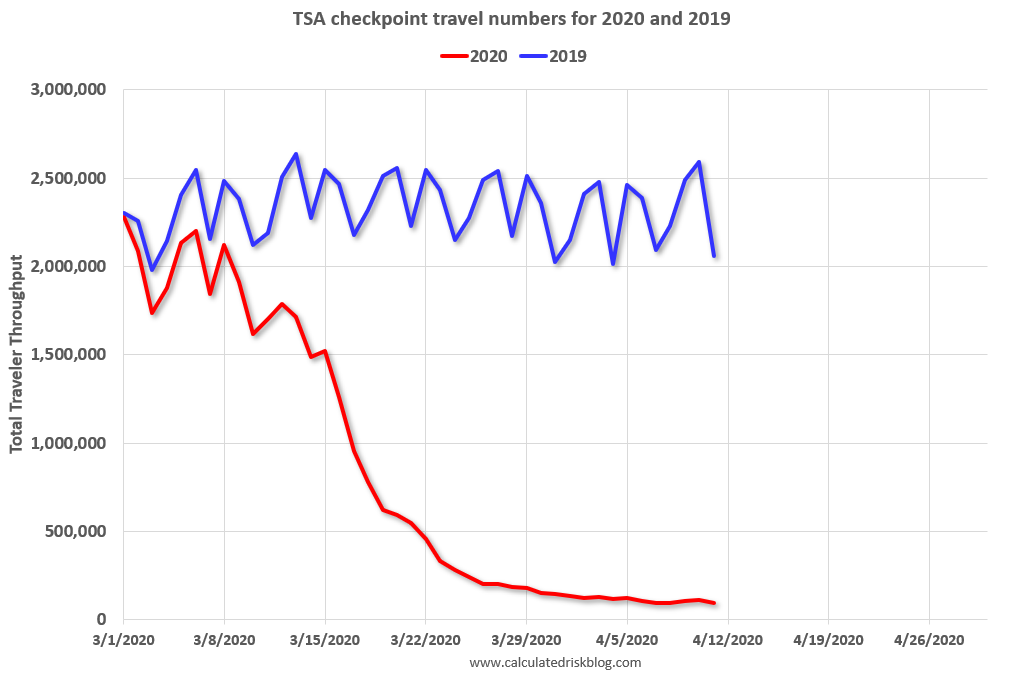
The TSA is providing daily travel numbers.

TSA Traveler Data Click on graph for larger image.

This data shows the daily total traveler throughput from the TSA for 2019 (Blue) and 2020 (Red).

On April 11th there were 93,645 travelers compared to 2,059,142 a year ago.

That is a decline of over 95%.

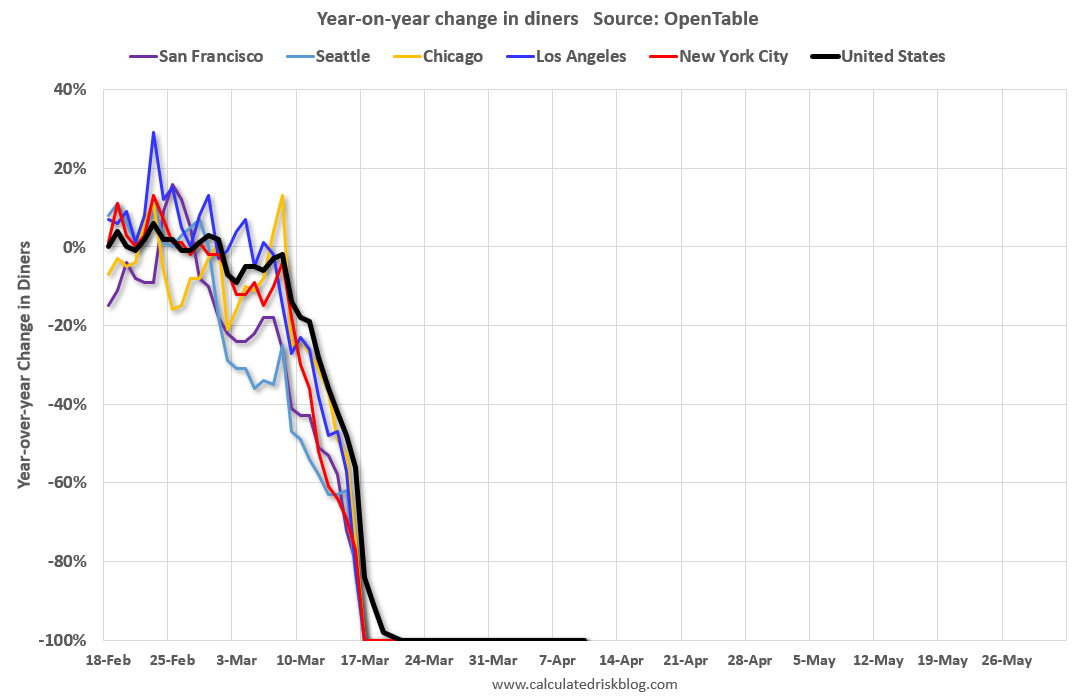
The second graph shows the year-over-year change in diners as tabulated by OpenTable for the US and several selected cities.

Move Box OfficeThanks to OpenTable for providing this restaurant data:

This data is updated through April 11, 2020.

The US was off 100% YoY as of March 21st, although NYC, LA, Chicago, Seattle and San Francisco were all off 100% as of March 17th.

Dining in Seattle and San Francisco declined sharply a week or two ahead of most of the country - and acting early has been shown to minimize the spread of the virus.

As the recovery begins in some areas, I'll include the cities that open first.

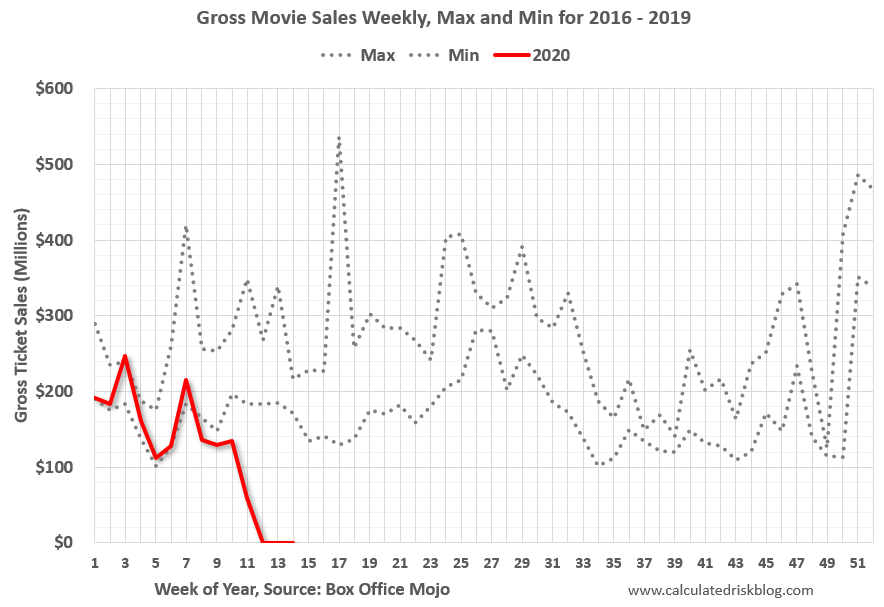
Move Box OfficeThis data shows domestic box office for each week (red) and the maximum and minimum for the previous four years.  Data is from BoxOfficeMojo.

Note that the data is noisy and depends on when blockbusters are released.

This data is through the week ending April 9, 2020.  Movie ticket sales have been essentially at zero for three weeks.

Basically movie theaters are closed all across the country, and will probably reopen slowly (probably with limited seating at first).

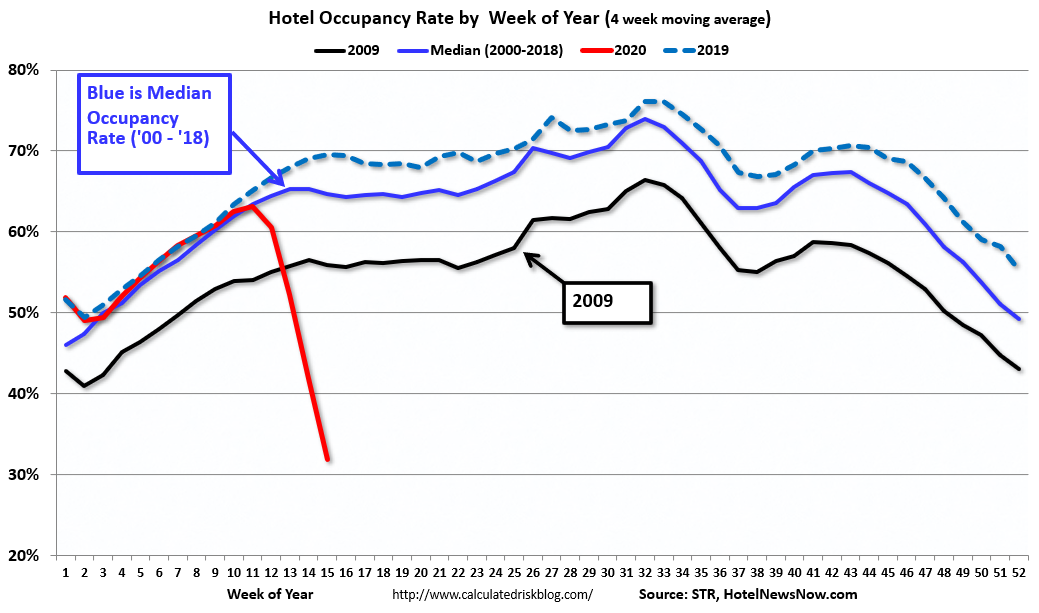
The following graph shows the seasonal pattern for the hotel occupancy rate using the four week average.

Hotel Occupancy RateThe red line is for 2020, dash light blue is 2019, blue is the median, and black is for 2009 (the worst year probably since the Great Depression for hotels).

2020 was off to a solid start, however, COVID-19 has crushed hotel occupancy.

Note: Y-axis doesn't start at zero to better show the seasonal change.

STR reported hotel occupancy was off 68.5% year-over-year last week, declining to an occupancy rate of 21.6%. This is the lowest weekly occupancy rate on record, even considering seasonality.
12 Apr 21:01

Dr. Fauci reminds us of the obvious: Earlier coronavirus measures 'could have saved lives'

by Marissa Higgins
James.galbraith

And there should be consequences for the denial

When speaking to Jake Tapper on CNN’s State of the Union this Sunday, Dr. Anthony Fauci, a top specialist in infectious diseases, admitted what just about every progressive has been thinking when it comes to protection against the novel coronavirus pandemic. The host asked Fauci if he believed that establishing social distancing regulations, as well as and stay-at-home orders, in February instead of March perhaps would have helped curb the number of deaths. In a word: “Obviously.”

"I mean, obviously,” Fauci replied. “You could logically say that if you had a process that was ongoing and you started mitigation earlier, you could have saved lives. Obviously, no one is going to deny that.”

Fauci, who has been the director of the National Institute of Allergy and Infectious Diseases for decades, told the network: "We look at it from a pure health standpoint. We make a recommendation. Often, the recommendation is taken. Sometimes, it's not. But ... It is what it is. We are where we are right now."

As The New York Times reported, Fauci, along with other top officials close to the Trump administration, tried to get Trump to implement social distancing measures and non-essential business closures in February. As we know, Trump resisted and resisted. 

Tapper and Fauci also talked about the other big issue on everyone’s mind: reentry. It’s “not one size fits all,” he stressed. “We are hoping by the end of the month we can look around and say, ‘OK, is there any element here that we can safely and cautiously start pulling back on.’ If so, do it. If not, then just continue to hunker down.”

“If you just say, ‘OK, it's whatever, May 1, click,’ turn the switch on, obviously, if you do it in an all-or-none way,” Fauci stressed. “There's an extraordinary risk of there being a rebound.”

Fauci also said he hopes, but can’t guarantee, that it will be safe for people to vote in the “standard way” in November. Still, as he pointed out, “there is always the possibility, as we get into next fall and the beginning of early winter, that we could see a rebound."

When asked about a comparison with how South Korea is handling its outbreak, Fauci pushed back, saying it wasn’t quite fair to put the countries up against one another. “They had the capability of immediately, essentially, shutting it off completely in a way that we may not have been able to do in this country,” he stated. “Obviously it would have been nice if we had a better head start, but I don't think you could say that we are where we are right now because of one factor."

Here is the clip that is now going viral on Twitter. 

DR. FAUCI on CNN: "You could logically say that if you had a process that was ongoing and you started mitigation earlier, you could have saved lives. Obviously no one is going to deny that ... But there was a lot of pushback about shutting things down back [in February]." pic.twitter.com/KpUDCrkS64

� Aaron Rupar (@atrupar) April 12, 2020

Here is the full conversation on YouTube.

Dr. Thomas Inglesby, an infectious disease expert and director of the Johns Hopkins Center for Health Security expressed a similar sentiment about earlier measures when speaking with Chris Wallace on Fox News Sunday this morning, saying, “If we’d acted on some of those warnings earlier, we’d be in a much better position in terms of diagnostics and possibly masks and possibly personal protective equipment and getting our hospitals ready… It’s possible we would have seen enough disease to get the will to do that in February, and, yes, the earlier we put in place social distancing, the earlier we would have gotten to a peak,” he continued.

Here is that clip.

Dr. Thomas Inglesby: "If we had acted on some of those warnings earlier we�d be in a much better position." pic.twitter.com/K6G8H7Kj30

� FoxNewsSunday (@FoxNewsSunday) April 12, 2020

12 Apr 20:52

Team Trump threatened to kill pandemic relief bill if it included help for the U.S. Postal Service

by Hunter
James.galbraith

Call that fucking bluff

The rank malevolence of the Trump administration continues. The Washington Post reports that lawmakers fully intended to provide emergency funding to the U.S. Postal Service in pandemic stimulus measures, but the Trump White House made it clear Trump would not sign it. Why?

As with most things in the Trump administration, the logic behind such a bizarre move is somewhat of a mystery. The short answer, though, is that hard-right Republicans and their advisers have steadily sought to kill off and/or privatize one of the government's oldest, most visible and most popular services, and Trump's personal animosity towards Amazon founder and Washington Post owner Jeff Bezos, expressed in (yes, this is the sort of nonsense that our lives now revolve around) hostility towards the Postal Service for cheaply delivering Amazon packages, means those arsonists haven't needed to try very hard to manipulate Dear Leader into their line of thinking.

Campaign Action

The crux of the Post report is a quote from an (again) anonymous "senior" official who says the administration told Congress "very clearly that the president was not going to sign the bill" if money was included for the U.S. Postal Service. Senators were able to wedge a $10 billion Treasury Department loan into the bill, after Treasury Secretary Steven Mnuchin told them they "can have a loan, or you can have nothing at all," but adding $10 billion of debt to an essential government agency while Mnuchin demands an unfettered ability to dole out government dollars to private industry however he sees fit is, to put it mildly, a curious stance.

Whether Trump himself made it clear to his subordinates that he would rather see America burn down than save a service that rudely delivers packages for one of his many, many self-identified enemies or whether Mnuchin is the saboteur, using Trump's name and pathologies for his own ends, is unclear. It's always unclear, every time. It would be surprising if Donald Trump had enough interest in pandemic relief efforts to even know what might be included in the huge bill; it would not be surprising in the least, though, if Trump was obsessively following the bill's progress explicitly to make sure nothing in it did a damn bit of good for anyone, anywhere who might have ever said a bad thing about him.

The U.S. Postal Service was established by the Constitution; Benjamin Franklin himself was the first colonial postmaster. Despite the existence now of private firms like FedEx and UPS, the Postal Service remains the only entity that delivers mail to all of the United States, rather than just the profitable parts. That makes it an essential service, still, but it may become even more essential in the months ahead.

There is a very good likelihood that social distancing measures will be in place in November, for this year's national elections. There is a very, very good likelihood that each of the American states will be forced to conduct those elections primarily via vote-by-mail, sending out ballots and collecting them via the USPS.

If, that is, the USPS is still solvent and still sending out workers. That the White House seems either indifferent to or eager to sabotage the very framework of the upcoming elections is ... curious? Bumbling? Insane?

Treasonous?

What are the words to use here? And is there any bottom to the bizarre half-incompetent, half-malevolent failures of this White House, fully aided by Mike Pence, by Mitch McConnell, by the money-grubbing Murdochs, and by every last Republican leader?

12 Apr 20:47

Virginia Gov. signs sweep of progressive bills, including Confederate monuments and LGBT rights

by Marissa Higgins
James.galbraith

nice to see positive election consequences

Virginia Governor Ralph Northam, a Democrat, signed dozens of progressive, exciting, and long overdue bills into law on Saturday, April 11, as reported by The Richmond Times-Dispatch. All of the bills are rooted in social justice and sorely needed, but of particular interest are bills that home in on racial justice, giving localities power to alter or remove the Confederate monuments that are all over the state, and leading the South’s way when it comes to protections for the LGBTQ community.

One bill allows cities and counties in Virginia (as is the norm in most other states) to vote to remove Confederate statues and monuments. In the past, localities in the state were not only not allowed to remove war monuments, but they weren’t even allowed to change or add historical context. Northam also signed a bill into law that removes racist language from Virginia’s Acts of Assembly, as reported by WSET. In terms of LGBTQ equality, he signed a measure known as the Virginia Values Act into law that expands protections for LGBTQ people from employment, housing, and public space discrimination. All go into effect on July 1, 2020.

The Confederate monuments feel particularly relevant to Virginia after the deadly white nationalist Charlottesville rally took place in the state in the summer of 2017. Since then, white supremacist James Fields has been sentenced to life in prison after killing protester Heather Heyer when he drove into a crowd of peaceful counter-protestors, including Heyer. The state has more than 100 public Confederate monuments. 

How will these monuments actually get removed? In practice, according to the measure, the individual locality will first host a hearing open to the public before they vote to alter or remove a monument. If the locality moves to get rid of one, it must offer the monument a historical society, government or military battlefield, or museum, as reported by local outlet NBC29.

Senator Mamie Lock and Delegate Dolores McQuinn sponsored Senate Bill 183 and House Bill 1537, respectively, which overturn the state’s previous ban on getting rid of war memorials. House Bill 1519, also sponsored by McQuinn, was signed into law as well. This measure is to create a commission for investigating the long-term racial and economic discrimination in Virginia that stems from the state’s history of slavery. Another bill establishes a commission to put forth a replacement for Virginia’s statue of Robert E. Lee that currently sits in the United States Capitol, as reported by DCist.

“Today I am thinking about all those who came before us, and what this means for the black Virginians who have struggled, and continue to struggle, in the pursuit of justice and equity,” stated the chair of Virginia’s Legislative Black Caucus, Delegate Lamont Bagby. “I am grateful for the opportunity to partner with Governor Northam to make these laws a reality in our Commonwealth.”

In terms of racist language, Northam signed bills that repeal discriminatory language from a number of state laws involving interracial marriage, banning different races from living in the same neighborhoods and segregation that were technically still on the books. You might remember that last year, a number of couples in Virginia actually sued because of an archaic state law that required them to disclose their race in order to get a marriage license. 

I am proud to sign new laws that repeal discriminatory language from Virginia�s books, give localities control over Confederate monuments in their communities, and begin the process of replacing Virginia�s statue of Robert E. Lee in the U.S. Capitol. https://t.co/MbMo7F85MV

� Ralph Northam (@GovernorVA) April 11, 2020

In a statement, Northam commented: “Racial discrimination is rooted in many of the choices we have made about who and what to honor, and in many of the laws that have historically governed this commonwealth. These new laws make Virginia more equitable, just, and inclusive, and I am proud to sign them.” People would also be able to sue over alleged discrimination.

On the LGBTQ equality measure, he said in part, “No longer will LGBTQ Virginians have to fear being fired, evicted, or denied service in public places because of who they are.” 

“In this period of uncertainty, it is vital that we are all protected from bias as we earn a living, access housing and healthcare, and seek goods and services,” President of the Human Rights Campaign, Alphonso David, said in a statement as reported by WDTV. Virginia is the first Southern state to offer LGBTQ protections as comprehensive as these, according to Northam.

Today, I signed the Virginia Values Act, making Virginia the first Southern state to enact comprehensive non-discrimination protections for LGBTQ people��and sending a strong, clear message that this is an inclusive Commonwealth where all are welcome.https://t.co/2ppfc627lA

� Ralph Northam (@GovernorVA) April 11, 2020

Why is this protection so important? As we already know, under federal law, there are no discrimination protections based on sexual orientation or gender identity for housing or employment. Until now, that had also been the case in Virginia. While federal protections for housing and employment matters are really ideal, state by state is certainly better than nothing. 

12 Apr 20:45

Why some churches are holding in-person Easter services in defiance of federal guidelines

by Zeeshan Aleem
James.galbraith

All these idiots think the first amendment magically protects them from laws generally, which just isn't true. I'm hoping for mass casualties in 3 weeks from these congregations, maybe they'll learn something.

A few worshipers in a dim church; light filters through stained glass. Seven people stand as a pastor leads the service from a stage; each separated by three rows of pews. Maryland’s The Friendship Baptist Church conducts a socially distant Easter service on April 12, 2020. | Alex Edelman/AFP/Getty Images

Some argue social distancing guidelines are limiting their First Amendment rights.

A number of churches across America are holding in-person services to celebrate Easter Sunday, despite federal guidelines calling for people to avoid public gatherings.

The issue of whether to hold in-person Easter services has revealed a split among top conservatives, with President Donald Trump encouraging Christians to worship from home while observing social distancing protocols, and members of the House Freedom Caucus arguing that restrictions on church services are an affront to First Amendment rights of freedom of religion and assembly.

While many churches are remaining closed as part of a nationwide effort to slow the spread of coronavirus, there are numerous reports of churches and even megachurches deciding to hold services.

In at least eight states, religious organizations have been deemed essential services, allowing them to be exempt from stay-at-home orders. While the majority of churches around the country have experimented with alternatives to conventional services — things like livestreamed prayers and drive-in services in parking lots — there have been clashes over restrictions on Easter Sunday, which would in normal circumstances lead to a huge boom in church attendance.

State and local officials have begun taking action to limit attendance at religious services, with mixed results. For example, the mayor of Louisville, Kentucky, issued an order prohibiting drive-in church services for Easter weekend, but a church sued the mayor and the city — and won a temporary restraining order from a federal judge who deemed the policy unconstitutional. US District Judge Justin Walker wrote in his order: “On Holy Thursday, an American mayor criminalized the communal celebration of Easter.”

In Kansas, state lawmakers overturned the governor’s executive order restricting religious gatherings to 10 people ahead of Easter, calling the order “a blatant violation, of our fundamental rights.”

And other religious leaders have held services in violation of state orders.

The Life Tabernacle Church near Baton Rouge, Louisiana expected a crowd of more than 2,000 on Easter Sunday despite a ban on gatherings of over 50 people in the state.

The church’s pastor, Rev. Tony Spell, said his faith would protect him and his attendees from falling ill. “God will shield us from all harm and sickness,” Spell told Reuters. “We are not afraid. We are called by God to stand against the Antichrist creeping into America’s borders.”

Spell made this proclamation despite having faced legal consequences for defying state restrictions in the past: He has already been charged with six misdemeanors for holding services.

As Slate’s Daniel Politi reports, some churches think of Easter as simply too important of a day to conduct services online, and are trying to find ways to offer socially distant in-person services. The Glorious Way Church in Houston will split its services into two sessions, offer hand sanitizer, and limit a 1,000-person space to 100 congregants.

“If it’s a crisis, the church should be able to dispel fear and panic and not join in with the fear and panic,” the church’s pastor John Greiner told the Texas Tribune. “We can’t really make a difference in our world just online.”

In Washington, there’s a split on Easter Sunday social distancing

House Freedom Caucus Chairman Andy Biggs (R-AZ) and Rep. Jody Hice (R-GA) wrote a letter to Trump, Vice President Mike Pence, and Attorney General William Barr on Saturday arguing against prohibiting services at places of worship.

“Calling on individuals to have greater awareness of their environments, keep reasonable distance from others, and strive to maintain better hygiene may all be warranted as we continue to confront the many unknowns of this virus,” Biggs and Hice wrote. “Prohibitions on worship have no place in these restrictions.”

“Members of many faiths are called upon to gather in community to worship,” they continued. “And the First Amendment protects their right to do so. Sadly, many leaders around the country have taken this pandemic as an opportunity to deem worship gatherings non-essential.”

In particular, Biggs and Hice decried that Kentucky Gov. Andy Beshear’s ban on mass gatherings applies to church services, and that Beshear has pledged to record the license plates of people attending Easter services and impose a quarantine order on them. “There is no place for this behavior in America,” Biggs and Hice wrote.

While Trump said in March he hoped to have “packed churches” on Easter, he has in more recent days encouraged people to continue observing social distancing orders on the religious holiday. On Saturday, he tweeted that he would be tuning into a livestream at Dallas’s First Baptist Church rather than attending a service in person.

And on Sunday, he tweeted out a video message encouraging people to continue social distancing practices despite it being Easter.

“[T]his Easter will be much different than others, because in many cases we will be separated physically only from our churches,” Trump said. “We won’t be sitting there next to each other which we’d like to be. And soon we’ll be again. But right now we’re keeping separation.”

Clearly, not everyone agrees with the president on this issue. But should he want to ease social distancing in the weeks to come — as he has suggested is the case — Trump will have to find a way to convince the public not to gather in close spaces. Should such gatherings continue, reductions the country has seen in confirmed cases could halt, making the case for “reopening” parts of the country far more difficult to make.


Support Vox’s explanatory journalism

Every day at Vox, we aim to answer your most important questions and provide you, and our audience around the world, with information that has the power to save lives. Our mission has never been more vital than it is in this moment: to empower you through understanding. Vox’s work is reaching more people than ever, but our distinctive brand of explanatory journalism takes resources — particularly during a pandemic and an economic downturn. Your financial contribution will not constitute a donation, but it will enable our staff to continue to offer free articles, videos, and podcasts at the quality and volume that this moment requires. Please consider making a contribution to Vox today.

12 Apr 20:36

Trump Wanted to Let Coronavirus ‘Wash Over’ America Before Fauci Pointed Out That ‘Many People Would Die’ – WaPo

by Andy Towle
James.galbraith

Well that's horrifying

In a Situation Room meeting last month, Donald Trump told Dr. Anthony Fauci that he wanted to let coronavirus “wash over the country” before it was pointed out to him that “many people would die.”

The Washington Post reports: “It was the day the administration was adding Ireland and the United Kingdom to its travel restrictions, and Trump wanted to understand why talk of ‘herd immunity’ — allowing the coronavirus to sweep a nation largely unchecked, with the belief that those who survived would then be immune — was such a bad idea. ‘Why don’t we let this wash over the country?’ Trump asked, according to two people familiar with his comments, a question other administration officials say he has raised repeatedly in the Oval Office.”

ICYMI: Dr. Fauci Reflects on Gay Community’s Battle Against HIV/AIDS in Remarks About COVID-19’s Disproportionate Toll on Black People: WATCH

The paper adds: “Fauci initially seemed confused by the term “wash over” but became alarmed once he understood what Trump was asking. ‘Mr. President, many people would die,’ Fauci said. The president said he understood but since then has repeatedly made clear he wants to reopen things soon — although significant roadblocks remain.”

Read the full story HERE.

The post Trump Wanted to Let Coronavirus ‘Wash Over’ America Before Fauci Pointed Out That ‘Many People Would Die’ – WaPo appeared first on Towleroad Gay News.

12 Apr 19:55

'No Clear Evidence' Hydroxychloroquine Works Against COVID-19

by EditorDavid
James.galbraith

no surprise there, just horrible side effects

This week the Washington Post asked their "business of health care" reporter to explain the true status in the scientific community of hydroxychloroquine, an already-approved malaria drug also used to control inflammation in lupus and rheumatoid arthritis patients. "There is no clear evidence that the drugs work against the coronavirus," he writes, "despite their use by hospitals and doctors in the United States and other countries since the outbreak began." Their antiviral properties have been proved in test tubes, but rigorous clinical trials to test their effectiveness in humans have not been completed. Limited studies on coronavirus patients have been published by researchers in France and China, but their extremely small size and other problems prevented them from being statistically significant. The French study included a combination of hydroxychloroquine with the antibiotic azithromycin that showed benefit in six patients... Another study in 11 patients in France showed no evidence the regimen works. A Chinese study also showed no benefit over the standard course of treatment. Mainstream scientists caution against using the drugs without more evidence they are effective... The dangerous side effects of the drugs are much better known. Most seriously, the drugs can trigger arrhythmia, which can lead to a fatal heart attack in patients with cardiovascular disease or who are taking certain drugs, including anti-depression medications. Doctors recommend screening with an electrocardiogram to prevent the drug from being given to the 1 percent of patients at the greatest risk of a cardiac event. The drugs also can cause vision loss called retinopathy with long-term use, and chloroquine has been associated with psychosis... As the coronavirus has spread from China across the world and to the United States, the dire reality is that there is no vaccine and no approved drug available to treat the serious respiratory symptoms that are claiming thousand of lives. Long-time Slashdot reader UnknowingFool shares doubts raised about that small French study, as even its publisher now acknowledges it "does not meet" their own expected standards. The Post does note that multiple trials are "ongoing" (though six different research centers testing the drug told CNN it would be "months" before results were known). But the Post adds that already "public and political interest has caused runs, hoarding and severe shortages in recent weeks."

Read more of this story at Slashdot.

12 Apr 18:54

How a Corporation Suddenly Faced 'Flood' of Lawsuits From Thousands of Gig Workers

by EditorDavid
Long-time Slashdot reader PalmAndy shared the New York Times profile of two pioneers in "mass arbitration." One Silicon Valley founder created FairShake, an automated system to help consumers launch hundreds of arbitration cases against corporations like Comcast and AT&T. And then there's attorney Travis Lenkner (and his firm Keller Lenkner), who says most companies never thought consumers would actually use arbitration. "We don't see it that way." Keller Lenkner's first wave of cases have focused on workers in the gig economy. [Alternate version of article] Many of these workers, particularly at food delivery companies, have been thrust onto the front line of the coronavirus crisis by ferrying food and supplies to housebound consumers, while risking getting sick. A large number of their employers require these workers to sign arbitration clauses... One of the firm's latest showdowns is with DoorDash, a leading food delivery app in the United States. It shows the traction that mass arbitration is gaining with judges and the lengths that companies will go trying to stop it. It began last summer when Keller Lenkner filed more than 6,000 arbitration claims on behalf of couriers for DoorDash, known as "dashers...." The cases were taken to the American Arbitration Association, an entity that provides the judges and sets up the hearings for such disputes. DoorDash specified in its contracts with its roughly 700,000 dashers that they had to use the association when filing an arbitration claim. The company also told the dashers that it would pay any fees that the association required to start the legal process. Then DoorDash got the bill for the 6,000 claims — more than $9 million. DoorDash balked, arguing in court that it couldn't be sure that all of the claimants were legitimate dashers. The American Arbitration Association said the company had to pay anyway. It refused, and the claims were essentially dead... But a federal judge in San Francisco wasn't willing to go along with it. The judge, William Alsup, ordered DoorDash in February to proceed with the American Arbitration Association cases and pay the fees... "Your law firm and all the defense law firms have tried for 30 years to keep plaintiffs out of court," the judge told DoorDash's lawyers at the Gibson Dunn firm late last year. "And so finally someone says, 'OK, we'll take you to arbitration,' and suddenly it's not in your interest anymore. Now you're wiggling around, trying to find some way to squirm out of your agreement." "There is a lot of poetic justice here," the judge added.

Read more of this story at Slashdot.

12 Apr 04:22

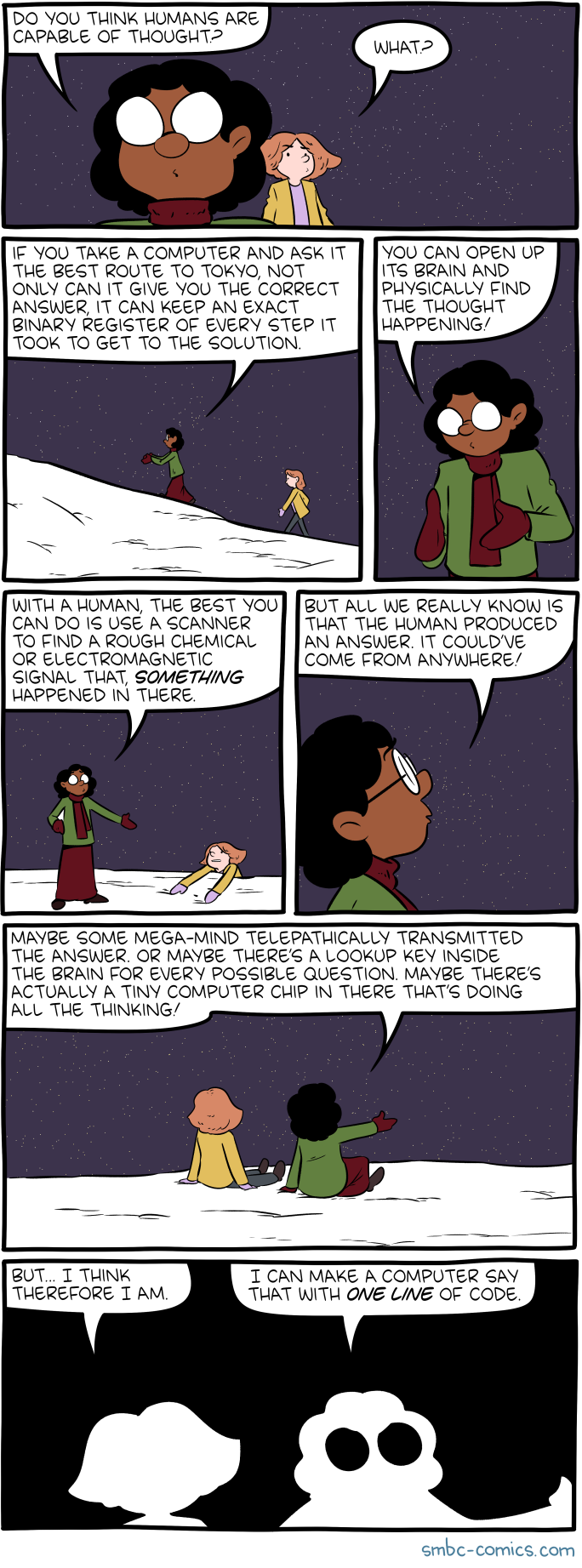
Saturday Morning Breakfast Cereal - Thought

by tech@thehiveworks.com


Click here to go see the bonus panel!

Hovertext:
I'm gonna be so well-positioned when the robot revolution comes.


Today's News:
12 Apr 04:21

Surgeon General Adams asks people of color to increase anti-coronavirus efforts “for your big mama”

by Zeeshan Aleem
James.galbraith

good lord

US Surgeon General Jerome Adams, flanked by President Trump and Vice President Pence, during a press briefing at the White House on April 10. | Jim Watson/AFP/Getty Images

Adams’s remarks caused controversy, with his critics accusing him of discounting the effect systemic racism has had on Covid-19 deaths.

US Surgeon General Jerome Adams is facing criticism for controversial remarks he made during a White House coronavirus press conference on Friday, during which he discussed how communities of color can fight the spread of coronavirus and asked them to observe social distancing protocols “for your big mama.”

Adams made the remarks as he worked to address that the Covid-19 death rate is higher for Americans of color than it is for white Americans, pointing out, for example, that in Wisconsin’s Milwaukee County, African Americans make up 25 percent of the population, but 75 percent of the confirmed deaths.

But while Adams brought up a number of underlying issues that contribute to this tragic reality, his remarks on those issues were ultimately overshadowed by rhetoric many found offensive — and that appeared to suggest minority Covid-19 deaths were a matter of personal responsibility rather than part of an ongoing crisis public health experts have said they are struggling to control.

Adams, who is a member of the White House’s coronavirus task force and often speaks during its daily briefings, ended his remarks Friday by telling communities of color they “are not helpless” in working to limit the spread of the virus. After prescribing social distancing and hand-washing, the surgeon general said:

Avoid alcohol, tobacco, and drugs. And call your friends and family. Check in on your mother; she wants to hear from you right now.

And speaking of mothers, we need you to do this, if not for yourself, then for your abuela. Do it for your granddaddy. Do it for your Big Mama. Do it for your Pop-Pop. We need you to understand — especially in communities of color, we need you to step up and help stop the spread so that we can protect those who are most vulnerable.

Adams’s comments swiftly received sharp pushback from progressive commentators. Given that this kind of rhetoric has generally not been targeted at general audiences or white communities, it implicitly seems to hold people of color to a uniquely high bar.

When Yamiche Alcindor, White House correspondent for PBS NewsHour, asked Adams to respond to criticism that his language was “offensive,” he said he was simply trying to be targeted in his communication.

“We need targeted outreach to the African American community, and I use the language that is used in my family. I have a Puerto Rican brother-in-law. I call my granddaddy ‘granddaddy.’ I have relatives who call their grandparents, ‘big momma’,” Adams said. “So that was not meant to be offensive. That is the language that we use, and that I use, and we need to continue to target our outreach to those communities.”

He added, “We need everyone, black, brown, white, whatever color you are, to follow the president’s coronavirus guidelines.”

Adams’s clarification did little to address the pressing social inequities that are contributing to the disparity in health outcomes — and ultimately, his attempt to “target our outreach” obscured the portion of his address that did begin to speak to the larger problems that have led Covid-19 to kill minorities more often than white Americans.

Adams touched on a number of factors contributing to health disparities

Adams began his remarks by saying communities of color are more vulnerable to coronavirus complications and fatalities because they suffer disproportionately from chronic health conditions, and due to the “burden of social ills.”

He pointed out that Latinos represent a majority of Covid-related deaths in New York City, the epicenter of the American coronavirus crisis, even though they make up less than a third of the population.

“People of color experience [are] both more likely [to have] exposure to Covid-19 and increased complications from it,” Adams said. “But let me be crystal clear: We do not think people of color are biologically or genetically predisposed to get Covid-19. There is nothing inherently wrong with you. But they are socially predisposed to coronavirus ... exposure and to have a higher incidence of the very diseases that put you at risk for severe complications of coronavirus.”

And this is true due to a long history of institutional racism and economic inequity, as Vox’s Anna North explained:

[B]lack Americans are more likely to have underlying conditions because of widespread racism and inequality, experts say. Many differences in health outcomes in America are “produced by access to things like adequate time to prepare healthy foods at home” and “adequate money to not be working three shifts and have really high stress levels,” Lynch said — access that white people are just more likely to have. As [Fabiola] Cineas notes, 22 percent of black Americans lived in poverty in 2018, compared with 9 percent of white Americans.

Beyond poverty, a number of factors contribute to poor health among black people, from racism in medical settings to the physical health effects of discrimination. Redlining and other forms of housing discrimination have made black Americans more likely to live in neighborhoods affected by environmental contamination, which federal and state officials have been slow to respond to, in turn raising rates of chronic illness.

Adams did not clarify precisely what he meant by “social ills” or “socially predisposed,” but he mentioned — among other things — that people of color are more likely to live in multigenerational homes and that “only one in five African Americans and one in six Hispanics has a job that lets them work from home.”

“We tell people to wash their hands, but as studies showed, 30 percent of the homes on Navajo Nation don’t have running water. So how are they going to do that?” Adams said.

So Adams’s remarks did acknowledge that there are structural socioeconomic factors like housing and job conditions contributing to the acute vulnerabilities of communities of color. But he didn’t get into why they exist and how much of it doesn’t come down to individual behavior. Instead, his talk of personal responsibility — a familiar trope that’s often used to blame communities of color for their suffering — obscured the fact that a lot of these issues stem from a history of institutional racism.


Support Vox’s explanatory journalism

Every day at Vox, we aim to answer your most important questions and provide you, and our audience around the world, with information that has the power to save lives. Our mission has never been more vital than it is in this moment: to empower you through understanding. Vox’s work is reaching more people than ever, but our distinctive brand of explanatory journalism takes resources — particularly during a pandemic and an economic downturn. Your financial contribution will not constitute a donation, but it will enable our staff to continue to offer free articles, videos, and podcasts at the quality and volume that this moment requires. Please consider making a contribution to Vox today.

10 Apr 22:07

Disney’s CGI-remake-mania continues with a live-action fox as Robin Hood

by Sam Machkovech
James.galbraith

Ugh, just no

Disney has yet to formally announce a remake of 1973's <em>Robin Hood</em>, but THR has confirmed it's being made. In the meantime, we've come up with our own guess of how the reported film, a "hybrid" of live-action footage and CGI characters, will look in action.

Enlarge / Disney has yet to formally announce a remake of 1973's Robin Hood, but THR has confirmed it's being made. In the meantime, we've come up with our own guess of how the reported film, a "hybrid" of live-action footage and CGI characters, will look in action. (credit: Getty / Aurich Lawson)

The Walt Disney Company has now remade nearly a dozen animated classics as feature-length, live-action films—and that's not counting spinoffs (Maleficent), semi-sequels (102 Dalmatians), or completed films yet to reach theaters (Mulan). Unsurprisingly, Disney isn't stopping there, and its next expected remake will be part of another new trend for the company: a straight-to-Disney+ launch plan.

The Hollywood Reporter had Friday's scoop: Disney has begun pre-production on a live-action, CGI-filled remake of 1973's Robin Hood. Since the film's planning was reportedly finalized before a wave of set shutdowns across Hollywood, major details such as casting decisions and timeline estimates are not yet available. So far, only a director (Blindspotting's Carlos Lopez Estrada) and a writer (Kari Granlund, from last year's Lady and the Tramp remake) are attached.

THR believes this remake will play out as a musical, much like the first Disney version, and will star "anthropomorphic" animals "in a live-action/CGI hybrid format." It has not confirmed whether fans should expect the same casting of animal species to key roles, including Robin Hood and Maid Marian as foxes, Friar Tuck as a badger, and Little John as a shameless repeat of the popular Baloo from 1967's Jungle Book. (THR also didn't have any comment on whether to expect these remade CGI animals to wear tights or otherwise become enduring sex symbols for a generation.)

Read 2 remaining paragraphs | Comments

10 Apr 19:13

Watchdog finds Trump admin spent $66 million jailing a few dozen at a time at migrant prison camp

by Gabe Ortiz
James.galbraith

Racist right wing welfare

The nonpartisan Government Accountability Office (GAO) says the Trump administration wasted nearly $70 million over a period of five months to jail fewer than 70 people at a tent city in Tornillo, Texas last year, including shelling out over $5 million for hundreds of thousands of meals that were never actually ordered because there were no detainees. We know mass detention has always been cruel and unnecessary—and as the report also shows, a complete waste of your money and mine.

“Based on our analysis, [Customs and Border Protection] paid approximately $5.3 million for meals it did not need during the initial period of performance,” the GAO said in the report. While CBP ordered meals for Tornillo’s full 2,500 capacity, in reality, only a couple dozen people were detained at a time during the prison camp’s five months of operation. “As such, CBP paid for about 675,000 meals during the initial period of performance despite only ordering 13,428 meals.”

“During the initial period of performance,” the GAO continued, “CBP paid the contractor to operate the facility at full capacity, including food and guard services, regardless of the number of individuals housed in the facility, due to the terms of the delivery order it negotiated with the contractor.” So few people were jailed at Tornillo that the round-the-clock guards vastly outnumbered the number of people, with quite a few left over.

“Based on our analysis, CBP paid approximately $6.7 million for 75 unarmed contract security guards on-site at the Tornillo facility at all times to report any situations with individuals held in the facility and provide facility and perimeter security, though the facility had an approximate average daily population of 28 adults,” the report said. In addition to about two dozen CBP and Immigration and Customs Enforcement (ICE) officers, nearly 120 Texas National Guardsmen were dispatched to assist in “logistical support, such as meal distribution and monitoring security cameras, among other things.”

Tornillo should have been thrown into the dustbin of history after it was previously used to jail thousands of migrant kids who came to the U.S. alone. During that period, congressional Democrats who tried to conduct their oversight responsibilities were blocked from entering. “We wanted to talk with the young people here and when I asked why we couldn’t talk to them, I was told that we shouldn’t interrupt their schedule," Sen. Mazie Hirono said at the time. "There’s probably a word for that and it’s called BS.” 

Meanwhile, a report revealed the administration waived FBI background checks for staffers tasked with supervising kids, as BCFS, the organization contracted to run the prison camp, “filed more than 30 reports on ‘significant incidents’ at Tornillo ... some involving interactions between children and staff, but none of a sexual nature,” the AP reported in 2018. “I feel so bad for the kids who are still there,” a teen who had been freed from there told the AP at the time. “What if they have to spend Christmas there? They need a hug, and nobody is allowed to hug there. Following the children’s release, the administration kept Tornillo in place to instead jail adults.

In its report’s conclusions, the GAO said: “CBP ultimately paid millions of dollars for food service it did not need and allocated personnel resources to the facility that, as Border Patrol El Paso sector officials noted to us, could have been allocated to other missions.” But this can also be said about many of the administration’s actions, including keeping thousands of asylum-seekers who passed their initial interviews in detention, keeping up mass raids where ICE agents are tricking immigrants into thinking they’re police, and spending billions that could be used for ventilators and medical gear on a stupid wall.

10 Apr 18:27

Saturday Morning Breakfast Cereal - Inching

by tech@thehiveworks.com


Click here to go see the bonus panel!

Hovertext:
Just kidding, the real physicist would say 'It's 10 of something long.'


Today's News:
10 Apr 17:19

Trump is trying to kill the USPS as vote-by-mail becomes the best chance to save our democracy

by Laura Clawson
James.galbraith

Of course he'll destroy the postal service if he thinks it lets him cling to power

Though the novel coronavirus has Americans more reliant on package delivery than ever—including for prescription medications—it has put the future of the U.S. Postal Service in danger. Not distant, far-in-the-future danger, but could-stop-operating-in-June danger. And the Trump administration, which wants to bail out foreign-flagged cruise lines, is saying the postal service is on its own.

“I spoke with the Postmaster General again today,” Rep. Gerry Connolly tweeted Thursday afternoon. “She could not have been more clear: The Postal Service will collapse without urgent intervention, and it will happen soon. We’ve pleaded with the White House to help. @realDonaldTrump personally directed his staff not to do so.”

Campaign Action

What’s on the line here? Those prescription medications so many people get by mail. Delivery to rural areas that the for-profit companies don’t think are worth delivering to; in many cases, the USPS brings UPS or FedEx packages the last leg to people’s actual doors, or to tiny rural post offices. Vote-by-mail, which will be essential this November, is—as David Nir put it—“our last best chance to save democracy.”

Why is the novel coronavirus crisis such an immediate, life-or-death crisis for USPS, a part of the federal government that is actually written into the Constitution? Mail volume is already down by nearly a third and could be down by half by the end of June. But the origin of the crisis comes from Congress—specifically from a congressional mandate for the USPS to prepay its retiree health obligations decades into the future and from congressional blocks on the postal service doing things like online bill-paying, money transfer services, postal banking, copy and fax services, phone cards, notary public services, and hunting and fishing licenses. There are so many things that post offices, which are located in nearly every community in the nation, could do that would help Americans out by providing affordable services they need, and at the same time the USPS would be strengthened. But Congress won’t allow it. 

And now in the current crisis, Congress would have passed a bill including at least part of what the USPS needs to survive—but Donald Trump wasn’t having it, in part because he’s angry that the postal service doesn’t charge enough to deliver packages for Amazon, which was founded by Jeff Bezos, who owns The Washington Post, which has published stories Trump didn’t like.

So the postal service’s ability to continue delivering the mail as it has done for hundreds of years is in immediate danger at the moment when, without vote-by-mail, we might face the choice between risking our lives and giving up our democracy.

10 Apr 17:16

Trump campaign wants us talking about the racism in its Biden attack ad so we won't notice the lies

by Laura Clawson
James.galbraith

Of course they're racist shitheads

The Trump campaign is trying to call attention to its own racism with a video attacking former vice president Joe Biden for being insufficiently anti-China. The video accuses Biden of having “protected China’s feelings” during the novel coronavirus crisis, and of having used his connections to benefit his son Hunter. It uses racism to draw attention to these things. Because Trump supporters will get all butt-hurt about the word “racism” but embrace the lies being pushed.

The key thing that has drawn attention to the video is an extremely brief image—in a montage of images of Biden with Chinese officials—of Biden with a man implied to be Chinese who is in fact Chinese-American: former Washington governor, commerce secretary, and ambassador to China Gary Locke. But that’s probably what the Trump campaign wants us talking about, at least to get us talking about the video. Let’s talk instead about the substance of what Biden is shown saying in the ad—and what Trump has said about China.

Text on the screen accuses Biden of having “protected China’s feelings” just before Biden is shown calling out “hysterical xenophobia.” The implication is that Biden opposed Trump’s ban on travel from China to slow the spread of COVID-19. Except he didn’t. At any point. When Biden said “hysterical xenophobia,” he wasn’t talking about those travel restrictions. Elsewhere in the ad, Biden is shown saying: “Banning all travel will not stop it.” Except the full quote was: “Banning all travel from Europe, or any other part of the world, may slow it, but as we have seen, it will not stop it.”

The Washington Post’s Aaron Blake tracks these and other massive pieces of dishonesty in the video, but one of the most interesting bits is the comparison between what it attacks Biden for saying about China and what Donald Trump has said.

”They’re not bad folks, folks,” Biden is shown saying, which is supposed to make us very angry that he doesn’t hate Chinese people enough. “They’re very smart, and they’re good people,” Donald Trump said in 2017. “I’m also standing with President Xi. He’s a friend of mine. He’s an incredible guy,” Trump said in 2019. “I like China. The Chinese people are phenomenal people,” Trump said on Tuesday, presumably as his campaign was putting together this ad attacking Biden for saying: “They’re not bad folks, folks.” 

We’re to be angry that Biden said: “It is in our self-interest that China continue to prosper.” Trump has said: “And, by the way, I want China to do well” and “I want China to do well; I don’t want them to do as well as us,” (hmm, is that a statement about “our self-interest?”) and: “So let today be the beginning of a brighter future, more prosperous for the American people, the Chinese people, and the world.”

How dare Biden share a toast with Chinese president Xi and say “what a beautiful history we wrote together” when what he was supposed to say, by the Trump standard, was: “Keeping these two giant and powerful nations together in harmony is so important for the world—not only for us, for the whole world.” Among other things.

This ad is all about stoking racism, not only toward China but toward Chinese-American (and by extension, other Asian-American) people. It is trying to use racist divisiveness to attack Biden using an unwieldy mess of lies about novel coronavirus and alleged corruption, most of it pinned onto Biden saying exactly the same sort of stuff when he was vice president that Trump has said again and again. And it comes at a time when Asian-American people are facing physical violence—and buying guns to protect themselves—in part thanks to exactly this kind of stuff from Trump.

10 Apr 17:13

Franklin Graham Defends Anti-Gay Pledge for NYC Tent Hospital Workers: We Don’t Want Drunks or Drug Users Either

by John Wright
James.galbraith

This is using "religious liberty" as a sword instead of a shield, and used to be forbidden.

Evangelist Franklin Graham is defending a requirement that volunteers at a New York City tent hospital run by his charity adhere to an anti-LGBT pledge.

Samaritan’s Purse, which operates the hospital for coronavirus patients in Central Park, mandates that healthcare workers and others read and adhere to a statement of faith defining marriage as “exclusively the union of one genetic male and one genetic female” and saying the unrighteous are sentenced to “everlasting punishment in hell.”

In an interview Thursday with the Charlotte Observer, Graham justified the requirement by comparing LGBT people to drunks, drug users and those who might use the tent hospital as an opportunity to “pick up girls.”

“All of our doctors and nurses and staff, (they’re) Christians,” Graham said. “We believe it’s very important that — as we serve people and help people — we do it in Jesus’ name. …

“Of course, I believe marriage is between a man and a woman,” Graham added. “That’s part of who we are. So we have a long list of things we want people to understand and agree with before we take them to work with us. I don’t want a person who is going to be on the job and drinks; that’s not a good witness. I don’t want a person who’s going to be using drugs to be part of our team. I don’t want someone who’s going to be swearing to be part of our team. I don’t want someone who is trying to pick up girls, and using this as an opportunity to do those kinds of things.

“So, we try to screen the people that work with us,” he said. “And we want men and women who believe the way we do and have the same core values that we have.”

Graham also doubled down on his recent assertion on Fox News that the coronavirus pandemic is God’s punishment for sin.

“When God made man, he never intended for man to have disease,” Graham told the Observer. “And to have death. He put us in a perfect world. The climate was perfect. The conditions were perfect. The food to eat. But man rebelled against God. And the Bible is very clear that, as a result of this rebellion against God, we live in what we call ‘a fallen world.’ So we have cancer. We have the coronavirus. We have diabetes. We have all of the other problems we have as a society. We have murder, we have thefts. …

“But that wasn’t God’s intention,” Graham added. “That’s why God sent his son Jesus Christ to take our sins. And Christ died for our sins. That’s why we celebrate Easter.

“So I see the coronavirus, I see the wars of this world, I see the economic problems — I see all these other things — as just a result of the fallen world in which we live,” he said. “And that’s as a result of sin that came into the world and has infected the entire human race.”

Read the Observer‘s full story here.


The post Franklin Graham Defends Anti-Gay Pledge for NYC Tent Hospital Workers: We Don’t Want Drunks or Drug Users Either appeared first on Towleroad Gay News.

10 Apr 17:10

Popular facial recognition software designed to target immigrants has deep white-nationalist roots

by David Neiwert
James.galbraith

Is anyone surprised?

White supremacists of all stripes—fully cognizant that ordinary people are repelled by the writhing ball of hatred at the essence of their ideology—talk amongst themselves constantly about ways to infiltrate mainstream institutions incognito and wreak havoc on behalf of their agenda from there. Some even have adopted a “secret agent” strategy that aims for white-nationalist workers—particularly in the tech industry—to infiltrate the workforce.

But what if white nationalists actually had penetrated the tech industry at its highest levels, involving technology that can and will directly impact the privacy of every citizen in a modern society, potentially controlling their lives? That appalling prospect raises its head in a wide-ranging deep-dive investigation by Luke O’Brien in Huffington Post of the very alt-right-friendly overseers of Clearview AI, the facial recognition technology now being wielded as an arrest tool by Immigration and Customs Enforcement (ICE) agents.  

O’Brien’s investigation makes clear that this infiltration of the software industry is not simply an outcome of a deliberate white-nationalist strategy, but also a product of the industry’s culture, one dominated by a brand of libertarianism that’s conducive to fascist ideas.

Nowhere is this more evident than in the person of Clearview AI’s CEO and founder, a former hacker from Australia named Hoan Ton-That. Not only does Ton-That have a history of close associations with a number of white nationalists and far-right operatives—including the infamous neo-Nazi hacker Andrew “Weev” Auernheimer, “Pizzagate” advocate Mike Cernovich, extremist political figure Charles “Chuck” Johnson, and many others—he also clearly favors their far-right views, including an ethnic nationalism that would make the United States a white homeland.

Ton-That’s relationship with the far right entailed shared ideas, as his exchange with notorious white nationalist Richard Spencer suggested:

“He was smart,” Spencer told HuffPost of Ton-That. “He was into this esoteric reactionary sphere stuff. I remember he was talking about celibacy and the priestly order being celibate and thinking for the group and not having mundane concerns. He was into quasi-Catholic neo-trad[itional] reactionary type stuff.”

Ton-That operates in an elite circle in the tech industry, the so-called “Dark Enlightenment” or "neoreactionary" set based in Silicon Valley, much of it built around “libertarian entrepreneur” Peter Thiel, a Donald Trump adviser and one of the chief funders of the “Intellectual Dark Web.”

Ton-That obtained funding from Thiel while developing Clearview AI—with people like “Chuck” Johnson, “Weev,” a devoted white nationalist named Tyler Bass, alt-right figure Douglass “Ricky Vaughn” Mackey, and alt-right financier/Thiel operative Jeff Giesea directly involved—not just along for the ride, but making command decisions. And the software they set about creating had a specific purpose in mind: Namely, to be able to use facial recognition technology to create a database that can track illegal immigrants and enable their arrest and deportation.

Johnson boasted on Facebook that he was “building algorithms to ID all the illegal immigrants for the deportation squads.” In the end, that’s precisely what their project—first named SmartCheckr, then rebranded as Clearview AI—has become.

A typical Clearview AI appeal to law enforcement.

The Clearview team proved highly successful at building a clientele within law enforcement, eventually including ICE and Customs and Border Protection, both of which began using the company’s impressive database to identify and begin rounding up immigrants it had identified for investigation.

How did it build that far-reaching database? By scraping social media websites—Facebook, Twitter, Instagram, YouTube, and others—and collecting people’s selfies and group portraits, identifying potential suspects with facial recognition software, and then providing those identifications for investigating agencies.

Jacinta González, a senior campaign director at Mijente, a Latinx advocacy group, told BuzzFeed News she is troubled by ICE’s use of Clearview, an information-gathering system for which there is no regulatory framework: “This tool goes way beyond anything that is legal, and there is literally no accountability for how they're going to use this tool,” she said. “They could walk into a supermarket, scan people, see if it matches up, and deport them immediately.”

“The weaponization possibilities of this are endless,” Eric Goldman, co-director of the High Tech Law Institute at Santa Clara University, told The New York Times. “Imagine a rogue law enforcement officer who wants to stalk potential romantic partners, or a foreign government using this to dig up secrets about people to blackmail them or throw them in jail.”

One of the more chilling aspects of the Clearview app’s spread is that it is being sold to private companies as well. Moreover, while it has in fact led to a number of arrests and successful investigations, its soft underbelly is still just waiting to be exposed.

“We have no data to suggest this tool is accurate,” Clare Garvie, a researcher at Georgetown University’s Center on Privacy and Technology, told the Times. “The larger the database, the larger the risk of misidentification because of the doppelgänger effect. They’re talking about a massive database of random people they’ve found on the internet.”

As the Times story notes, this technology would “herald the end of public anonymity”:

Searching someone by face could become as easy as Googling a name. Strangers would be able to listen in on sensitive conversations, take photos of the participants and know personal secrets. Someone walking down the street would be immediately identifiable — and his or her home address would be only a few clicks away.

In many regards, Clearview AI’s success and spread is the realization of a white-nationalist dream: that is, for its followers and operatives not only to have serious roles within the industry, but that the software that they would then produce would advance a white-nationalist agenda. Movement leaders have talked about doing this for some time, advancing a “secret agent” strategy of infiltrating tech industry workplaces, which later affects who they hire.

Counter Currents publisher Greg Johnson in particular has been an ardent promoter of this strategy. Based in Seattle but with a global reach, Johnson believes white nationalists need to keep low profiles while advancing within the industry. “We need to keep building our network until we become strong enough, and the system becomes weak enough, for open struggle to have a chance of success,” Johnson told an audience in Oslo, Norway. “Until then, most of us will have to remain publicly silent, sharing our views with only small circles of trusted friends.”

“Basically, white nationalists meet in secret at conventions like Northwest Forum while paying ‘lip service to diversity’ at their day jobs,” a reporter who infiltrated one of their Seattle-area gatherings, David Lewis, explained. “They move into positions of power where they can hire other racists and keep non-whites from getting into the company. Two years ago, this method would have seemed like a total joke, but these guys really do mostly work in tech, and they were doing a lot of networking.”

As Lewis noted, Johnson has written that the ranks of his “secret agents” include “college professors, writers, artists, designers, publishers, creative people working in the film industry, businessmen, and professionals, some of them quite prominent in their fields.”

10 Apr 17:02

Trump's White House is finally preparing for something: Beating back oversight of coronavirus relief

by Laura Clawson
James.galbraith

You can tell their priorities

Coronavirus is going to give the Trump White House another opportunity to put into play the obstruction tactics it honed during the impeachment inquiry. There’s $2 trillion in economic stimulus, including a $500 billion relief fund for businesses, about which Trump told reporters “Look, I’ll be the oversight. I’ll be the oversight.” Which, no.

Trump then nominated a White House lawyer, i.e. someone who’s been selected for loyalty to Trump, as special inspector general for pandemic recovery. Brian Miller helped obstruct investigations into Trump’s extortion of Ukraine, and now Trump wants him to do the same for investigations into pandemic recovery funds, in the guise of an inspector general—someone who’s supposed to exercise oversight rather than defend against it.

House Democrats have already started asking for documents relating to Jared Kushner’s work on supply chains for personal protective equipment and ventilators. “We are troubled by reports that Mr. Kushner’s actions—and those of outside advisers he has assembled and tasked—may be ‘circumventing protocols that ensure all states’ requests are handled appropriately,’” Reps. Bennie Thompson and Carolyn Maloney wrote. “We are particularly troubled that Mr. Kushner’s work may even involve ‘directing FEMA and HHS officials to prioritize specific requests from people who are able to get Kushner on the phone.’”

But while the Trump White House wasn’t prepared to fight coronavirus, it’s certainly prepared to fight attempts at congressional oversight, including subpoenas.

Much of the House oversight will be run through a special select committee Speaker Nancy Pelosi announced last week, to be headed by Rep. Jim Clyburn. Expect it to involve a series of protracted legal battles as White House lawyers move to block any and all information. Can’t have the peons knowing what Prince Jared’s been doing, after all. Let alone the would-be king, Donald.

10 Apr 16:58

How Trump turned ventilators into a form of patronage

by Aaron Rupar
James.galbraith

It's pretty blatant

PRESIDENT DONALD J. TRUMP, COLORADO SPRINGS COLORADO President Trump and Sen. Cory Gardner shake hands during a Trump rally in Colorado in February 2020. | Aaron Ontiveroz/The Denver Post

It isn’t supposed to work like this.

A seemingly innocuous tweet President Donald Trump posted about Colorado receiving ventilators from the government actually raises troubling questions about the extent to which the president is using lifesaving medical equipment as a form of political patronage.

On Wednesday Trump announced that he was sending 100 ventilators to Colorado — a development he credited to a request from a Republican senator facing an uphill reelection campaign this year, Cory Gardner.

That tweet might look unproblematic, and perhaps even praiseworthy on its face. Colorado is one of many states asking for more lifesaving supplies in the middle of a global pandemic.

But recent reports have suggested Trump has been playing politics with the allocation of medical supplies. CNN broke news last Friday that the federal government swooped in and blew up a deal that Colorado’s state government, led by Democratic Gov. Jared Polis, made with a private company to acquire 500 ventilators. FEMA, instead, seized the ventilators for itself, leaving Colorado high and dry.

“A congressional source told CNN that many of the orders Colorado places for supplies, including an order for 500 ventilators, has been canceled, because the items are being bought by FEMA,” CNN reported.

Polis subsequently confirmed the report during a CNN appearance in which he criticized the move, saying of the federal government, “either you’re buying them and you’re providing them to states and you’re letting us know what we’re going to get and when we’re going to get them. Or you stay out, and let us buy them.”

Trump has repeatedly deflected criticism that the federal government is doing more to help states by insisting the feds are just a “backup” and states should be doing more on their own. But in Colorado’s case, when the state tried to help itself, it was stymied by the feds.

Viewed in that context, Trump’s tweet giving Gardner credit for Colorado receiving ventilators has a whiff of impropriety. Colorado ended up with 400 fewer ventilators than it would’ve had without federal bigfooting, and instead of Polis getting credit for his efforts, all of it was given to a senator from Trump’s party who could use the boost.

In response to Trump’s tweet, Polis said he was “grateful” for the ventilators. But Rep. Diana DeGette (D-CO) was less diplomatic.

“Governor Polis and our Congressional delegation have been working to get more ventilators to Colorado for weeks. In fact, Colorado was set to receive 500 ventilators until FEMA blocked the shipment. Now, President Trump says we will get 100 as a courtesy to Senator Gardner,” DeGette said in a statement. “That means, because the president is playing politics with public health, we’re still 400 ventilators short from what we should have received. His mismanagement of this crisis is costing lives and livelihoods.”

The timeline surrounding Trump’s tweet prompted the Denver Post to write a scathing editorial headlined, “Trump is playing a disgusting political game with our lives.”

“President Donald Trump is treating life-saving medical equipment as emoluments he can dole out as favors to loyalists,” the editorial begins. “It’s the worst imaginable form of corruption — playing political games with lives. For the good of this nation during what should be a time of unity, he must stop.”

Colorado’s experience in this regard isn’t unique. The Los Angeles Times noted on Tuesday that hospitals and clinics in seven states reported having medical supplies seized in a manner similar to what Polis described.

“Officials who’ve had materials seized also say they’ve received no guidance from the government about how or if they will get access to the supplies they ordered,” the Times reported. “That has stoked concerns about how public funds are being spent and whether the Trump administration is fairly distributing scarce medical supplies.”

On Thursday, the Bellingham Herald reported that a delivery of Covid-19 test kits that were on their way to Washington state “were seized and diverted by the federal government to the East Coast.” FEMA denied the report, even though it was confirmed by a local hospital system.

It’s not totally clear what’s going on — but it doesn’t look good

Throughout the coronavirus crisis, Trump has attacked Democratic governors like Andrew Cuomo (NY), Gretchen Whitmer (MI), and Jay Inslee (WI) for not being “appreciative” enough of federal efforts.

Late last month, Trump even admitted that he’d directed the official running the White House’s response effort, Vice President Mike Pence, to not call Inslee and Whitmer — even as hospitals in their states approached the point of being overwhelmed by coronavirus cases — because they’ve had the gall to publicly criticize the president for not doing more, leaving their states to largely fend for themselves.

“I tell him — I mean I’m a different type of person — I say, ‘Mike, don’t call the governor in Washington, you’re wasting your time with him. Don’t call the woman in Michigan,’” Trump said. “If they don’t treat you right, I don’t call.”

At the very least, Trump’s disparate treatment of officials who have either been critical of him or aren’t politically useful for him is unseemly. But a Washington Post report last week sounded an alarm that the situation is more serious than that.

The Post reported that while staunch Trump ally Florida Gov. Ron DeSantis “promptly” received all of the supplies he asked for from the federal government, states with Democratic governors such as Wisconsin and Illinois (not to mention New York and Michigan) were not having the same luck. It’s not clear that Trump’s political grudges are driving that disparity, but the Post reported some officials are “wondering whether politics is playing a role in the response.”

Put it all together and the picture that emerges is one where the federal government is seizing orders of medical supplies from hospitals and states, and then at least in some instances, redistributing in a way that gives the appearance of Trump doing favors for his Republican supporters.

The government denies that this is what’s going on. A FEMA representative told the Los Angeles Times that the agency developed a system of identifying needs based on “high-transmission areas” and “populations,” not politics, but they didn’t share any details about “how these determinations are made or why it is choosing to seize some supply orders and not others.”

“Administration officials also will not say what supplies are going to what states,” the Times added. But if everything is really above board, why not be transparent about it?

Gardner, meanwhile, took to Twitter to express thanks for Trump sending Colorado ventilators.

What he didn’t mention, however, is that the federal government’s interference actually cost his state 400 of them.


Support Vox’s explanatory journalism

Every day at Vox, we aim to answer your most important questions and provide you, and our audience around the world, with information that has the power to save lives. Our mission has never been more vital than it is in this moment: to empower you through understanding. Vox’s work is reaching more people than ever, but our distinctive brand of explanatory journalism takes resources — particularly during a pandemic and an economic downturn. Your financial contribution will not constitute a donation, but it will enable our staff to continue to offer free articles, videos, and podcasts at the quality and volume that this moment requires. Please consider making a contribution to Vox today.

10 Apr 16:55

#TrumpBurialPits Trends in Response to Mass Grave for Coronavirus Victims in NYC (VIDEO)

by John Wright
James.galbraith

Seriously. Wow

The hashtag #TrumpBurialPits was trending Friday morning on Twitter after New York City began burying coronavirus victims in a mass grave on Hart Island.

Syracuse.com reports: Aerial photos taken Thursday by the Associated Press shows workers wearing hazmat suits or other personal protective equipment (PPE) while digging graves on NYC’s Hart Island, the largest public burial ground in the U.S. with more than 1 million people laid to rest over 131 acres. About 40 wooden caskets were seen lined up for burial on Thursday, and two new trenches have been dug in recent days.

The post #TrumpBurialPits Trends in Response to Mass Grave for Coronavirus Victims in NYC (VIDEO) appeared first on Towleroad Gay News.

10 Apr 03:57

The End of Handshakes As a Gesture

by BeauHD
James.galbraith

Good riddance

jmcbain writes: In many societies, handshakes are a gesture of friendliness. How many times have you shaken hands when meeting new engineering professionals? Probably quite a lot. However, given what we've seen with the SARS-CoV-2 coronavirus, it's time for a new way to greet people. According to a CNBC article, Anthony Fauci, the head advisor of the USA's task force on the coronavirus, says "I don't think we should ever shake hands ever again, to be honest with you. Not only would it be good to prevent coronavirus disease, it probably would decrease instances of influenza dramatically in this country." Other scientists agree with Fauci. Gregory Poland, director of the Mayo Clinic Vaccine Research Group has been trying to put an end to handshakes for nearly three decades. He suggests tilting or bowing your head to greet another person like people did many decades ago. "When men greeted other people [back in the day], they raised tor tipped their hat," he says. Bruce Farber, chief of infectious diseases at Northwell Health in New York, thinks Americans need to start implementing other ways to great each other "like [with] a head bob or wave of a hand. This act would maintain proper distance, avoid contact and potential spread of COVID-19," Farber says. Peter Pitts, former FDA associate commissioner, says shaking hands transmits germs and viruses "as swiftly as kissing and hugging" and until we develop a vaccine against COVID-19, the new normal will have to be "verbal greetings and long-sleeved elbow bumps." He adds: "The social theme song for right now is 'I wanna, but better not, hold your hand.' Love doesn't conquer all."

Read more of this story at Slashdot.

10 Apr 00:53

Report: Korean CDC investigates possible reactivation as 51 patients retest positive after recovery

by Marissa Higgins
James.galbraith

Well shit

As the United States faces the novel coronavirus pandemic, most people are wondering how to actually access a test, how to make up lost income, and, if ill, whether to battle it out at home or risk adding to already over-congested hospitals. Assuming one can get a test in the first place, though, there are some ongoing questions: Is a negative (or a positive) always reliable? Once cured and back in the general public, can you become reinfected? Can the virus become reactivated, even if you’ve been quarantined? According to Korea’s Centers for Disease Control and Prevention (CDC), as reported by Bloomberg, the novel coronavirus might be “reactivating” in dozens of people who were believed to be cured, similarly to recent reports out of China and Japan.

According to a press briefing on Monday, April 6, 51 patients in Korea who were recorded as cured of the virus—and were subsequently let out of quarantine—have now tested positive again. However, this doesn’t necessarily mean they’re infected again—the CDC says it is now looking into whether the virus has been reactivated in these patients.

Director general of the CDC, Jeong Eun-kyeong reportedly pointed out that “there have been cases when a patient during treatment will test negative one day and positive another.” One possible explanation for this comes down to simple test inconsistencies. However, he said in part, “we are putting more weight on reactivation as the possible cause.” They promise a “comprehensive study” on this phenomenon.

Now, this isn’t the first time this concern has been floated. Some recovered patients in China, for example, tested negative, only to later test positive. As NPR reported, it’s possible patients initially received a false-negative test result. It’s also possible that “residual virus” could result in a false positive on the additional testing. As reported by Reuters, this has also happened with at least one patient in Japan. 

This conversation, of course, brings a fresh concern while here in the U.S., federal funding for test sites are being pulled in spite of rising case numbers. An additional 6.6. million people have filed for unemployment benefits. While stimulus checks are in the works, countless vulnerable people are left out of the aid, including undocumented workers and college students. Medical staffs are struggling with minimal if any, personal protective equipment. Other front-line workers, including grocery employees, are testing positive for the virus—and dying

As people slowly come around to social distancing and self-isolation, studies about possible reactivation are incredibly important. What else is incredibly important? Having enough tests—and making them actually accessible to everyone. We don’t know for sure why some recovered people are testing positive again. But we do know that practicing social distancing, washing our hands, and self-isolating can help mitigate getting, and spreading, the virus to begin with. 

09 Apr 23:16

Study from China raises serious questions about both COVID-19 immunity and vaccine effectiveness

by Mark Sumner
James.galbraith

Well that's potentially problematic

Since the early weeks of the COVID-19 outbreak in Hubei province, China, there have been reports of patients who were released after testing negative for the virus, only to test positive again at a later date. There are a lot of possible reasons for this, including testing error and lack of sufficient sensitivity in a test. But in some small studies, the number of people who were negative then positive again was as high as 15%, which seems like a lot to miss even for a sloppy, badly-pressed testing system.

These numbers have definitely raised concerns over whether it is possible to be reinfected by 2019 novel coronavirus, and whether having the disease and recovering really confers lasting immunity. On the other hand, there has been every reason to expect that immunity is a given, based on the example of many similar viruses. However, a new study in Shanghai may have the answer: Having COVID-19 provides lasting, strong immunity … for most people. But there may actually be a group that’s vulnerable to reinfection, and that group may not be what anyone was expecting.

After multiple attempts to figure out just how many people have few or no symptoms from an infection of novel coronavirus, the consensus remains that this fraction represents about one-half of those carrying COVID-19. Identifying just why some people have a very mild case has been much more difficult to determine, but these patients seem as likely to be 60 years old as 30. It’s among this group of asymptomatic to very mild cases that a study reported in the South China Morning Post found some puzzling results. 

The study, which was not random and has not been subject to peer review, looked at blood samples taken from 175 patients who had at some point tested positive for COVID-19, but who had never developed critical symptoms. Of this group, one-third had very low levels of antibodies. Some were so low that the blood test did not detect them.

While this number—one-third of a group that represents about one-half of those who catch COVID-19—comes very close to the 15% number some earlier studies had indicated as people who subsequently tested positive a second time, this doesn’t definitely mean that the group with the very low antibody count is subject to being reinfected. The chance of errors in testing at some point in the process remains, and many of those who tested negative then positive may have experienced a rebound of the same infection rather than a genuine reinfection from another source.

But while the distribution of those catching COVID-19 may be more or less even across age brackets, the distribution of these “low antibodies” cases was not. Most of those who had low antibodies were young. In fact, the study showed the level of antibodies increased with age. Patients over 60 had three times the amount of antibodies as those under 40, even though both groups had mild cases of COVID-19.

If accurate, these results have a number of considerations:

A portion of low-symptom COVID-19 patients may be subject to reinfection or rebound. It’s completely unclear whether a second round of infection is more or less mild than the first round, or whether this second round would increase the number of antibodies present. This weak response to the virus may also have implications for teams working on vaccines for COVID-19. If the fragments of the virus chosen for vaccine mimic this result, some portion of those vaccinated might not develop sufficient antibodies to proof them against infection. This may lead to suggestions for increased dosages or multiple-shot vaccines. A portion of those now considered “safe” because they’ve had the disease and recovered may be subject to reinfection, representing a danger to both themselves and acting as a vector to others. Vaccines may actually work better for the older population most at risk from the COVID-19 infection.

All of this is very early, unconfirmed research and 175 patients is still a very small group to characterize the tens of thousands who have already recovered from COVID-19 or the millions who will follow. Nothing about this study suggests that it was done in any randomized way, and the lack of peer review on the published paper means that there could be serious issues in methodology, even aside from some obvious issues with how the test group was defined.

One very interesting point: The researchers in Shanghai excluded any patients who had more serious cases of COVID-19 from the study exactly because use of plasma or antibodies from recovered patients has become common in treatment of critical cases there. So in anyone who had a more serious cases of COVID-19, they would have a mix of their own antibodies and those given to them as treatment. That this treatment has become so common in the country where the pandemic began may suggest that they’ve seen good results with these treatments. But, just as with the antibody study covered here, those results don’t seem to be well-documented.

09 Apr 20:30

As U.S. Death Toll Hits 15,000, Trump Boasts About TV Ratings for Coronavirus Press Briefings

by John Wright

Shortly after the U.S. death toll from coronavirus surpassed 15,000, President Donald Trump took to Twitter on Thursday afternoon to attack the Wall Street Journal over an editorial criticizing his daily press briefings.

“The Wall Street Journal always ‘forgets’ to mention that the ratings for the White House Press Briefings are ‘through the roof’ (Monday Night Football, Bachelor Finale, according to @nytimes) & is only way for me to escape the Fake News & get my views across. WSJ is Fake News!” Trump wrote.

The editorial, titled “Trump’s Wasted Briefings,” accused the president of making the briefings about himself — and that bit of irony was not lost on the New York Times‘ Maggie Haberman.

“‘I’m getting good ratings therefore it’s praiseworthy’ is in fact confirmation of what the WSJ wrote about how potus sees the briefings,” Haberman wrote in response to Trump’s tweet.

More reactions below.

The post As U.S. Death Toll Hits 15,000, Trump Boasts About TV Ratings for Coronavirus Press Briefings appeared first on Towleroad Gay News.

09 Apr 20:09

Former acting Navy secretary's embarrassing 35-hour round trip to Guam cost taxpayers $243,000

by Walter Einenkel
James.galbraith

All to benefit Trump's reelection

When Capt. Brett Crozier, the former commander of the USS Theodore Roosevelt, was fired after a leaked letter he wrote to higher ups pleading for help with COVID-19 infections on his ship leaked, former acting Navy Secretary Thomas Modly proceeded to fly to Guam. The USS Theodore Roosevelt and its 4,000-member crew was harbored at an American base there and Modly wanted to explain the investigation-less and unceremonious relieving of Capt. Crozier from his position. Then-acting Navy Secretary Modly proceeded to badmouth Crozier to his former sailors—receiving in-house backlash as he did.

The audio of Modly’s disgraceful leadership leaked as well, leading to pressure from all corners for Modly to resign. Earlier this week, Modly did indeed tender his resignation and it was accepted. This ill-advised trip, spanning 35 hours between Washington and Guam and back again, only cost taxpayers $243,000. According to The Washington Post, the exact amount of the trip, which featured a refueling in Hawaii on a military version of the Gulfstream G550, was $243,151.65—around $6,946.19 per hour. Good money if you can spend it.

Sailors working under Capt. Crozier gathered to see him off in a boisterous showing of appreciation for what one sailor called “one of the greatest captains you ever had.” Respect is earned through action. So while autocrats, and the cowardly genuflecting to incompetent wanna be dictators may seem the best way to get ahead these days, it will not solve the problems we have. Capt. Crozier knew that. Modly needs to learn it.

09 Apr 18:29

Trump to launch second pandemic task force, one that does away with irritating medical experts

by Hunter
James.galbraith

What could possibly go wrong? jesus motherfucking christ

Trump's Mike Pence-led pandemic task force may still be a bungling mess with no clear objectives, still-murky powers, and a continued inability to put together any coherent message that can last longer than it takes Trump to wander back to the podium, but now it's getting a spin-off. CNN reports that Trump is "preparing to announce" a second coronavirus task force, this one devoted to "reopening the nation's economy."

If you're wondering whether that's good news or bad news: This is Team Trump. It's bad news. Though we're not yet even at the pandemic's peak, Team Trump is getting together a team to speed the "reopening" of the economy that would assemble not pandemic experts, but economic officials and advisers. Freed from having to deal with the irritating facts and figures spouted by pandemic experts like Dr. Anthony Fauci, the new task force would devote themselves to the goal shared by forever-catastrophically wrong Trump advisers like Larry Kudlow and Peter Navarro to put everyone back to work and see what happens.

Other than the major gaping hole in this new "task force"—the seeming lack of any voice who might tell them which of their proposals are medically insane—there are two other reasons to be especially alarmed here.

The first is that it's fairly clear that the task force's mandate is to start reopening things next month, whether that is advisable or not. Trump has signaled, repeatedly, that he believes we are on the home stretch of a pandemic that experts warn will likely be with us for at least another year, and he is bent on declaring victory, then campaigning on the same. By separating out Trump's economic voices from the medical experts, Team Trump can give those advisers a weight equal to government pandemic voices—with, perhaps, double the daily rally time for Trump.

Frustrated with the slow pace of a global pandemic and irritated with the experts trying to explain it to them, the Team Trump response is to start a new task force, this one with blackjack, and—sorry, this one comprising solely advisers who agree with them.

So we can expect the "economic" task force to quickly be promoted alongside—or perhaps to eclipse—the current Pence-led Birx-Fauci group. It will also provide a venue for the Peter Navarros of the White House to promote fraudulent medical cures and similar without having a Fauci alongside to rebut; that is really the only reason you might separate out the two efforts.

That brings us to the second major reason for alarm: Trump’s continued devotion to surrounding himself with some of the biggest idiots in America. If anything, the new "task force" seems bent on doubling their ranks. CNN reports that the administration is eyeing nongovernment types such as CEOs and "even major sports teams and well-known athletes" to fill out the group. Floated as the task force's leader:

Art Laffer.

Yes, that Art Laffer. The same. The napkin guy.

Now, Art Laffer's prescriptions for "reopening" the economy have been, in recent works, what for simplicity we shall call Batshit Insane. A partial Reuters rundown of his recommendations: "Tax non-profits. Cut the pay of public officials and professors." Laffer is an opponent of stimulus and relief to workers left unemployed by business closures during the pandemic, saying we instead need to "make it more unattractive to be unemployed."

Instead, he's a proponent of a "payroll tax holiday" for those who still have jobs. That and taxing nonprofits. And ... cutting professors' pay, for some reason?

To say these are not serious policy prescriptions is an understatement. To say this is setting America on fire for the insurance money is closer to the mark—though it still implies more gravitas than Laffer’s farcical nonsense deserves.

So no, none of this looks like good news. As the Trump administration zeros out federal funds for COVID-19 testing, a vital component of actually getting businesses back open and the economy back on track, the Trump Team's latest reactionary twitch is to start up a new coronavirus task force that leaves out all the irritating medical expertise of the current version and is instead focused on cutting salaries, raising taxes, and putting a knife to the back of unemployed workers, telling them to find new work during the pandemic or else.

The only way it does not end in disaster is if by some miracle the pandemic does indeed disappear over the next few weeks, as Trump is demanding of it. If not? All hell breaks loose. Yet again.