Shared posts

14 Apr 20:32

Wisconsin judges who forced election to go on during pandemic all voted absentee themselves

by Laura Clawson
James.galbraith

To the surprise of absolutely no one.

Four Wisconsin state Supreme Court justices blocked Gov. Tony Evers’ effort to delay the April 7 election—and all four protected themselves by voting absentee. In fact, all seven justices voted absentee. It’s just that the two who voted to protect other voters from coronavirus by delaying the election weren’t being raging hypocrites.

“In the previous five elections, a majority of the justices voted in person at the polls on election day,” the Milwaukee Journal-Sentinel’s Daniel Bice reports.

The court’s order to hold the election as originally scheduled despite the pandemic showed up just below a giant red warning on the court’s website: “In an effort to protect the public, attorneys, court staff, and judges from the health risks associated with COVID-19, the Wisconsin courts have issued orders temporarily suspending in-person proceedings statewide, with certain limited exceptions”—but no exceptions for voters in an election in which huge numbers of polling locations had closed.

Happily, this blatantly partisan effort by a conservative majority failed, and Judge Jill Karofsky beat Scott Walker's pick, bringing progressives one step closer to flipping the court.

14 Apr 20:06

How to spin a giveaway to the rich

by Paul Waldman
James.galbraith

No shit

The real story wasn't the Kennedy Center getting $25 million in the rescue package. It was wealthy people getting tens of billions.
14 Apr 19:09

Experts Think We Need An Army Of Public Health Workers To Safely Return To Normal

by Anna Maria Barry-Jester
James.galbraith

Yeah we're going to be stuck inside for a very long time

This story first appeared on Kaiser Health News, a nonprofit news service covering health issues, and California Healthline, an editorially independent publication of the California Health Care Foundation.

Last month, facing the prospect of overwhelmed hospitals and unchecked spread of the novel coronavirus, seven Bay Area county and city health departments joined forces to become the first region in the nation to pass sweeping regulations ordering millions of people indoors and shuttering the local economy.

It shocked people, but health experts around the country applauded the bold step, which since has been broadly replicated.

They also say it can’t go on forever. And so Bay Area leaders, along with others around the nation, are trying to figure out how we can resume something akin to normal life without triggering a catastrophic wave of illness and death.

The shelter-in-place orders were a sledgehammer response to two colliding realities: a little-understood virus that is proving ferociously deadly in vulnerable populations and a withered public health infrastructure that has made it impossible to track and contain the spread of the virus that causes COVID-19.

For all the light the new virus has shone on vulnerabilities of the U.S. hospital system — shortfalls in hospital capacity, ventilators and protective gear — what many officials see are the cracks in the foundations of public health.

“Nothing should come as a surprise,” said Laura Biesiadecki, senior director for preparedness, recovery and response with the National Association of County and City Health Officials, which works with more than 3,000 local health departments. “What you’re seeing in COVID-19 is an exacerbation of existing fault lines that everyone in the public health community has recognized over the years.”

Still, there’s broad agreement that core public health work — the ability to find people with the virus and prevent them from passing it to others — will be essential to reopening schools and businesses. That strategy is endorsed by the director of the Centers for Disease Control and Prevention, who recently told NPR the agency was working on a plan to deploy more disease investigators.

We spoke with more than two dozen health experts to get their thoughts on what public health resources will be needed to reopen the economy.

1. What works?

It may be rare that the World Health Organization and experts on the right and left in the U.S. see the same solutions to a problem, but that’s the case when it comes to reopening the economy in the face of COVID-19. The principles are simple: Stabilize the number of people who have the virus (through the strict social distancing measures already in place), and ensure hospitals can handle the cases they have. Then, put tools in place to stop new infections in their tracks so there isn’t a renewed outbreak.

It all starts with testing, and several countries that revamped their public health programs in the wake of the deadly 2003 SARS or 2015 MERS epidemics seem to be reaping the benefits now. That includes Singapore, which quickly ramped up testing for both active infections of COVID-19 and an antibody test to show previous infection, and South Korea, which tested tens of thousands of people in the weeks after it detected its first cases.

South Korea, like many other Asian countries, is also relying on hundreds of workers armed with phone location data, credit card information and security footage to try to reach everyone who has come into contact with an infected person. Authorities release detailed information to the public whenever someone infected has been in their area. Though South Korea and Singapore reported a recent surge in cases imported from abroad, both countries have seen far more moderate economic and health fallouts than has the U.S.

Politically and culturally, European nations make for an easier comparison with the U.S. Germany not only deployed widespread testing early on, but it also has sent health teams to people’s homes to check for symptoms and initiate aggressive interventions if symptoms arise.

Italy, which has had more than six times the deaths of China despite having less than 5 percent of its population, has lessons for the U.S. as well — and not all grim.

The scenes from Lombardy, where doctors have rationed care for weeks, making decisions about who lives and who dies, are bleak. But neighboring Veneto, which found its first case of the virus on the same day as Lombardy, is faring much better, said Dr. Nancy Binkin, a professor at the University of California San Diego who spent 12 of her 20 years at the CDC embedded in Italy’s public health system.

Binkin and colleagues suspect the difference lies in the extensive use of public health tools to contain the initial outbreak in Veneto. That included testing nearly everyone in the town of Vò where the first cases were found, quarantining that city, and making heavy use of assistenti sanitari, or health assistants, to track down people with the virus and make sure they stay isolated.

There have been far fewer infected health workers in Veneto, and deaths overall, than in Lombardy, which is renowned for the quality of its hospitals and health care.

What the places with fewer cases have in common is not just social distancing measures, said Binkin, but also aggressive tactics to identify and isolate people with the virus.

2. How does the U.S. compare?

U.S. public health budgets and staff have hemorrhaged over the years, accompanied by a steady stream of warning calls that the U.S. was not ready to face a pandemic.

When COVID-19 arrived, identifying and tracking everyone with the virus was all but impossible for local health departments because of flawed tests and narrow guidelines for who should get tested. Compounding the problem was a beleaguered public health infrastructure.

The stay-at-home orders are largely about slowing the spread of the virus — to keep hospitals from being overwhelmed — not necessarily about preventing cases, said Adia Benton, an anthropologist at Northwestern University who studies inequalities in global health. Mobilizing a massive workforce to isolate everyone with the virus could prevent infections, Benton said. “The interventions we see reflect what we value,” she said.

Public health is run locally, and health departments have different resources and organization. They are also confronting different degrees of outbreak.

In Tennessee, front-line health workers still are contact tracing everyone who gets the virus. To do so, many employees are working seven days a week, 12 hours a day, said Dr. Mary-Margaret Fill, a physician and epidemiologist with the state who is helping coordinate its emergency response. “They are the internal cog in this response; without them we fall apart,” she said.

In California, public health is the responsibility of counties, and resources vary wildly. Many, including Sacramento and Orange counties, moved away from contact tracing weeks ago, citing minimal access to testing and a surge in cases. (A lack of testing is one thing nearly all health departments have in common.)

Even San Francisco, with its abundant wealth and renowned expertise in HIV, was relying on a skeleton staff to track routine communicable diseases like measles, tuberculosis and sexually transmitted diseases, according to the city and county’s health officer, Dr. Tomás Aragón.

Los Angeles County, with its 4,000 public health employees, is still doing some contact tracing for every person who tests positive, said Dr. Barbara Ferrer, director of the Los Angeles County Department of Public Health. Rural Tulare County is trying to do the same, but has pinpointed the need for more people to trace cases as its greatest hurdle.

Those techniques matter everywhere. “Social distancing, contact tracing, identification, quarantine and isolation. We need all of those tools,” said Ferrer.

3. How do we ramp up?

Experts say the situation necessitates, at least temporarily, adding thousands of people to the ranks of public health. Three former Obama administration officials called for a “public health firefighting force” via a program like AmeriCorps or the Peace Corps.

Others suggest we make use of programs already in place. The Medical Reserve Corps program, a national network of volunteer medical and public health professionals, has 175,000 volunteers, some of whom have already been deployed to state health departments, said Biesiadecki. That program could be expanded.

“We need a Marshall Plan. We need a New Deal. We need a WPA for public health,” said Gregg Gonsalves, a Yale epidemiologist who won a MacArthur Fellowship for his work on global health and justice.

And it doesn’t necessarily require M.D.s, Ph.D.s or even public health degrees. In many countries, governments have trained community health workers in situations like these.

But in the absence of a federal program, some local departments in the U.S. are already taking up the cause. San Francisco, for example, is planning to recruit around 160 people to keep tabs on people diagnosed with the virus. Aragón said he hopes to repurpose staff from within the county where possible, and hire where necessary.

“We started off with a scarcity mentality,” Aragón said. “We have to have an abundance mentality. The amount of money that’s being lost economically, if we put just a fraction of that into our public health workforce, we could get the economy back up and running.”

Massachusetts asked the global health nonprofit Partners in Health to help it hire 1,000 people to carry out mass contact tracing.

In Connecticut, Yale University faculty said they realized the state had the capacity to contact trace only in Fairfield County, a wealthy bedroom community of New York, leaving few resources for much poorer New Haven, where the university is located. So they recruited more than 100 public health, nursing and medical students, said Dr. Sten Vermund, dean of the Yale School of Public Health. The volunteers were trained online by the state and, working alongside university staff, have been doing contact tracing for the local hospital.

But he doesn’t think these volunteer efforts are the solution. Vermund called it “the definition of insanity” if the U.S. didn’t take this moment to reinvest in public health. “There is no greater threat to the economic well-being of planet Earth,” he said, “than pandemic respiratory viral illness.”

Kaiser Health News is an editorially independent program of the Kaiser Family Foundation, which is not affiliated with Kaiser Permanente.

14 Apr 19:06

Charter still hates broadband competition, asks FCC to help prevent it

by Jon Brodkin
James.galbraith

How about no.

A Charter Spectrum service vehicle.

Enlarge / A Charter Spectrum vehicle. (credit: Charter)

Charter Communications is asking the Federal Communications Commission to block government funding for ISPs that want to build networks in parts of New York where Charter is required to offer broadband.

An FCC rule for Phase 1 of the commission's $20.4 billion Rural Digital Opportunity Fund (RDOF) bans funding in census blocks where at least one ISP has been awarded money from any federal or state broadband-subsidy program "to provide 25/3Mbps or better service," and it also bans funding in areas that already have home-Internet access at those speeds. But that rule would not prevent ISPs from getting funding to serve parts of New York where Charter is required by the state government to offer service but in which it hasn't yet finished construction.

Charter on Friday thus petitioned the FCC for a rules waiver that would ban funding in 2,400 census blocks "in which Charter has unfunded but nonetheless binding state obligations to deploy at least 25/3 Mbps broadband service." Charter, which sells broadband and other cable services under its Spectrum brand name, said it is deploying speeds of at least 300Mbps downstream and 10Mbps upstream, far above the FCC's 25/3Mbps standard.

Read 12 remaining paragraphs | Comments

14 Apr 18:53

Google wants to dump Qualcomm, launch smartphone SoC as early as next year

by Ron Amadeo
James.galbraith

It was only a matter of time til they realized they needed to break free of outside silicon

Google wants to dump Qualcomm, launch smartphone SoC as early as next year

(credit: Ron Amadeo/Intel)

A new report from Axios claims that Google has "made significant progress toward developing its own processor to power future versions of its Pixel smartphone" and that a Google-made SoC could debut in a phone as early as next year. Google is apparently teaming up with Samsung, which is providing design support and manufacturing for the project, codenamed "Whitechapel."

The report says the Google SoC is an eight-core ARM processor with hardware "optimized for Google's machine learning technology" and the always-on capabilities of the Google Assistant. The chip would be built at Samsung's foundries on the firm's upcoming 5nm process, and, in addition to being aimed at the Pixel, the report says that "subsequent versions" of the chip could be used in Chromebooks.

Google has been building custom smartphone silicon for a while now. It debuted a custom camera SoC—not a main system SoC—in the Pixel 2, called the "Pixel Visual Core," which was built in collaboration with Intel. The Pixel 3 and 4 have had similar photography-focused chips, now called the "Pixel Neural Core." Since the Pixel 3, the phones have had Google's "Titan M" security module, an isolated chip that handles the phone's verified boot and cryptographic key storage. In the Pixel 4, there's also Project Soli, a radar system that was shrunken down to a tiny piece of silicon. You can see how Google building its own system SoC could be a natural step after all this other silicon work. The company has been hiring chip designers from Intel and Qualcomm for some time now.

Read 4 remaining paragraphs | Comments

14 Apr 18:34

Capt. Crozier took one for the ship, refused to let senior officers sign letter that got him fired

by Jen Hayden
James.galbraith

And this is who the Navy wanted to crucify to protect Trump

The details of the coronavirus outbreak on the USS Theodore Roosevelt continue to unravel. On March 30, Capt. Brett Crozier wrote to senior Navy officials about the deadly coronavirus outbreak aboard the nuclear aircraft carrier. The virus was quickly spreading amongst the crew of nearly 5,000 sailors. 

According to The New York Times, by the time Capt. Crozier penned the letter, eight sailors had already been evacuated to Guam because of the severity of their COVID-19 symptoms. In fact, one as-of-yet unidentified sailor who tested positive on the very day Capt. Crozier sent that letter passed away this Monday. 

That now infamous letter was leaked to The San Francisco Chroniclewhich set off a chain reaction. First, Capt. Crozier was almost immediately relieved of duty on the carrier. Video of his send-off went viral as sailors could be heard cheering him and chanting his name. Next, acting Navy Secretary Thomas Modly personally flew to the USS Roosevelt to address the sailors, at a cost of $243,000 to U.S. taxpayers. Modly created even more outrage when he told the crew the revered captain was “naive” or “stupid.” That sunk like a lead balloon—in leaked audio of the address, sailors shouted back at him in disgust, with one even yelling “What the fuck!” When that audio leaked, the writing was on the wall and it was crystal clear Modly did not have the confidence of the sailors he was entrusted to lead, nor did he have the confidence of the public at large. Modly resigned within hours. 

Former naval officials and members of both the House and the Senate have called for an investigation into Crozier’s dismissal. The Navy has promised details on their internal investigation soon. 

But there was another detail in the New York Times report that hasn’t gotten very much attention. Not only did Capt. Crozier risk his own career—he protected the senior officers below him. They asked to sign on to the now infamous letter, and he refused. He showed the kind of selflessness that is at the core of military and civic duty. He sacrificed his entire career for the sailors on that ship. Is it any wonder they cheered him so enthusiastically as he departed? 

14 Apr 18:22

Trump and Mnuchin are letting the banks steal your COVID-19 $1,200

by Joan McCarter
James.galbraith

Jesus, no.

Even Republicans wanted to do something to help the plebes in their big coronavirus stimulus boon to the super rich, like Sen. Josh Hawley of Missouri wanted a direct cash payment to everyone. A bipartisan Congress intended to help the now masses of newly unemployed buy food, or pay rent or utilities. But Treasury Secretary Steven Mnuchin's department is telling banks something else.

At the Prospect, friend of Daily Kos David Dayen reports that Treasury is allowing banks to seize the money to pay off debts account holders owe them, like delinquent loans, overdrafts, or past-due fees. While lawmakers made sure the cash payment couldn't be seized for public debts—anything owed to federal or state agencies, other than child support—it didn't include that exemption for private debt collection, instead but instructed the Treasury to write rules exempting them.

But audio Dayen obtained from a webinar Ronda Kent, chief disbursing officer with Treasury's Bureau of the Fiscal Service, had with banking officials the official message was that "there's nothing in the law that precludes" banks from collecting the money. She didn't say straight out "the money is yours" but that was the message received, one official told Dayen. What the banks heard from her was "We don't want to say anything explicitly and are telling you to make a business decision," or as Dayen says "a green light for banks to take advantage of the coronavirus crisis to collect prior debt."

The official Dayen spoke with said the payments should be considered federal benefits, like Social Security, disability, and veterans payments and exempted from private collection. "This makes complete sense because we don't want people to die because they have a late loan payment," they said. That's exactly what Congress intended, and in fact have asked Treasury to do. Even Hawley teamed up with Democrat Sherrod Brown in asking Mnuchin to exempt the payments. So have 23 Democratic and 2 Republicans attorneys general.

Banks that have accounts customers have abandoned, or "zombie" accounts, are one possibility the official who spoke with Dayen is concerned about. "If you have direct deposit on file with the IRS, the payment is going to that institution even if the account is closed," the source told Dayen. If the account is actually closed, the money will go back to the government. If it is just inactive, without funds or in overdraft, the bank can take the payment. "There are hundreds of thousands of people out there who use overdraft services all the time," Dayen's source told him. "We allow it up to $1,000. Because of the fees involved, the people can't keep up and inevitably they abandon it, taking the loss and the hit to their credit. I can't tell you how many accounts we have charged off with $1,000 in them. With those accounts, if that was where you had direct deposit, the stimulus payment will still post to them." And the bank will keep it. "It's outrageous, especially since people are forced by the way the program is set up to have the payments go through a financial institution not of their own choosing."

The immediate fix is simple. This is entirely in Mnuchin and Treasury's hands—it is absolutely clear that it can and should write rules to make sure the $1,200 goes where Congress intended, into people's pockets. The longer-term fix is slightly more complicated; finding a way for direct cash payments to go directly to everyone without the complicated route through the banks demands a public banking system. One example Dayen notes is giving everyone an account with the nation's central bank, the Federal Reserve. Postal banking, where the Postal Service offers basic financial services like checking and savings accounts and short-term loans, is another. There's existing legislation for that that could be folded into the next big stimulus bill, and it would help save the post office.

But right now, this minute, the Trump administration could fix this. That they're not, that they're willing to rob people of the measly $1,200 that could feed their families this month, tells you everything you need to know about the monsters in charge.

14 Apr 18:14

States are facing a budgetary cataclysm. Will Republicans be willing to help?

by Paul Waldman
James.galbraith

Only if we can make sure that TX and FL are casualties without help to blue states.

They need $500 billion to avoid disaster, if only Trump and his party will go along.
14 Apr 18:13

The most dangerous man in America right now isn't Trump. It's McConnell

by Joan McCarter

If you've got an hour or so to spare, this deep dive into the life and times of Sen. “Moscow Mitch” McConnell from investigative reporter Jane Mayer is worth all of it. It took me an hour, anyway, because I had to keep surfacing for clean air. Because the portrait that emerges is of a power-hungry, principle-free sociopath without a single redeeming quality. Just what you always imagined of McConnell, and so much worse. To distill it all down is near-on impossible; the entire story is most definitely a must-read. But revisiting why he's called Moscow Mitch is probably the most instructive part of the story for the moment we're in now. It lays out the lengths to which he'll sacrifice anything—including the integrity of a presidential election—to grasp more personal power. It illustrates just how incredibly dangerous he is in a crisis, because if he'll sell out our democracy, he'll happily sacrifice hundreds of thousands of lives.

Enough of this. Please give $1 to our nominee fund to help Democrats and end McConnell's career as majority leader.

After all, he's as responsible as anyone for giving the White House to Trump. Mayer reports that "several members of McConnell's innermost circle" told her that "behind Trump's back McConnell has called the President 'nuts,' and made clear that he considers himself smarter than Trump, and that he 'can't stand him.'" But McConnell is more responsible than anyone for helping him achieve the White House and enabling him there. Remember what we've learned about the summer and fall of 2016, and who knew what when about Russia's interference in the election on Trump's behalf? Throughout the late summer of that year, "for 'four or five weeks,' a former White House national-security official" told Mayer, "McConnell deflected (then-CIA Director John) Brennan's requests to brief him. Susan Rice, Obama's former national security adviser, said, 'It's just crazy.' McConnell had told Brennan that 'he wouldn't be available until Labor Day.'"

When he finally did come back for that briefing, "McConnell expressed skepticism about the intelligence. He later warned officials 'not to get involved' in elections, telling them that 'they were touching something very dangerous,'" the former national security official told Mayer. "If Obama spoke out publicly about Russia, McConnell threatened, he would label it a partisan political move, knowing that Obama was determined to avoid that." As the intelligence community became increasingly alarmed at the brazen interference from Russia, President Obama made a direct appeal for a joint statement from the bipartisan leadership of the House and the Senate. Mayer writes that "Denis McDonough, Obama's former chief of staff, Ryan, Pelosi, and Reid agreed to work together, but 'McConnell said nothing,'" according to her source, the former intelligence official. "It took weeks to get the letter."

Mayer obtained a log of private correspondence between the staff of the leaders showing that McConnell edited the draft of the letter and rejected any other leaders proposals. "He was dead set against designating U.S. voting systems as 'critical infrastructure' or urging election officials to seek assistance from the Department of Homeland Security," Mayer concludes. He refused to allow Russia to be mentioned, just saying "malefactors" were attempting to "disrupt the administration of our elections," with no elaboration. Harry Reid told Mayer Reid: "The letter was nothing like what Obama wanted. It was very, very weak." Susan Rice, Obama's national security adviser, says: "I don't know for sure why he did it. […] But my guess, particularly with the benefit of hindsight, is that he thought [identifying Russia] would be detrimental to Trump—so he delayed and deflected. It's disgraceful."

It's beyond disgraceful—it's nigh on treasonous in retrospect. If McConnell was so anxious to allow a foreign adversary steal a presidential election, he's more than willing to allow hundreds of thousands of Americans to die in a pandemic if he thinks it can consolidate his power. Kentucky Democratic Rep. John Yarmuth, who has known McConnell well for 50 years, tells Mayer: "He was just driven to be powerful. […] He never had any core principles. He just wants to be something. He doesn't want to do anything."

He will sell our very lives for his base—the millionaires and billionaires—because that's how he got power and that's how he's keeping it. We have to stop him.

14 Apr 18:07

Trump’s video of coronavirus actions accidentally reveals how he mishandled things in February

by Aaron Rupar
James.galbraith

He'll just keep repeating it and hope that his idiot base of 38% keeps nodding.

The White House Holds Daily Briefing On Coronavirus Pandemic President Trump during the White House coronavirus briefing on Monday. | Alex Wong/Getty Images

The propaganda package basically skips from January to March. That’s not an accident.

A campaign-style video President Donald Trump is promoting in an attempt to rewrite the history of his coronavirus response accidentally reveals the truth — that he didn’t really do much during a crucial period in February and early March when the virus was spreading undetected in America, besides downplaying the threat.

The video, which premiered during Monday’s unhinged White White coronavirus task force briefing and was then posted to Trump’s Twitter account, features a timeline of what the video refers to as the president’s “DECISIVE ACTION” during that period. But the list of Trump’s anti-coronavirus actions is far shorter than it might appear as it ticks by your screen.

For one thing, Trump had little to do with a number of the “actions” highlighted in the timeline. For another, the video includes a number of developments that are really nothing to brag about, such as the first US case being reported on January 20 and the CDC testing debacle that put the US behind the curve compared to other countries that have more successfully handled the coronavirus. And it skips right from early February to March, thereby revealing Trump didn’t do much during a period in which proactive measures could’ve been taken, saving lives and ensuring the country didn’t need to practice the sort of drastic social distancing we’re now enduring in a last-ditch effort to slow the spread.

Here are some of the things mentioned in the timeline, followed briefly by the ways they actually illuminate the administration’s failings:

  • January 7: The CDC established a Covid-19 response team to track cases in the US. It’s unclear if Trump had anything to do with this — in fact, in early January, the president was ignoring classified briefings warning that the coronavirus had the potential to turn into a pandemic.
  • January 20: The first reported case of Covid-19 in the US. This isn’t something to brag about, and is something Trump downplayed during an interview with CNBC two days later, saying, “It’s one person coming in from China, and we have it under control. It’s going to be just fine.”
  • January 31: President Trump announces travel restrictions from China. This is one thing that Trump can take credit for — but the fact of the matter is the virus was already spreading within US borders by this time, so at best, the travel restrictions bought the federal government time that it didn’t use particularly well.
  • February 6: The CDC ships the first testing kits. These were the testing kits that didn’t function properly and as a result, gave US officials little visibility into how the virus was spreading — so again, this isn’t really something to brag about.
  • March 2: Pharmaceutical companies begin developing a potential vaccine. It’s unclear why Trump deserves credit for this.
  • March 11: President Trump announces travel restrictions from Europe. These restrictions were implemented in such a chaotic manner that a number of airports in the US became packed with travelers desperately trying to make their way back from Europe — situations that in and of themselves created public health problems.
  • March 13: President Trump declares a national emergency. By this point, the virus had already spread so widely that the social distancing guidelines Trump recommended three days later were inevitable.

That’s a pretty underwhelming set of actions. And what the video doesn’t include are all the statements Trump made between January and March downplaying the coronavirus — such as his February 26 comment that “when you have 15 [coronavirus cases], and the 15 within a couple of days is going to be down to close to zero, that’s a pretty good job we’ve done.” Or his comment the next day that the virus would go away on its own “like a miracle.”

As of April 14, the US now has more than 587,000 confirmed cases and over 23,500 Covid-19 related deaths. Now, instead of saying coronavirus will magically go away, Trump has tried to redefine success as keeping the death toll under 100,000.

Later Monday, the Trump campaign followed up on the campaign-style video (one that was apparently produced by White House staff) by posting a list of Trump’s coronavirus accomplishments including similarly dubious things, like Trump mentioning the virus during the State of the Union and him talking about it with Indian Prime Minister Narendra Modi during a February trip.

But instead of being focused on the coronavirus during that India trip, upon his February 26 return, Trump reportedly chastised a number of government officials over the CDC’s February 25 warning that the virus might cause “severe” disruption to American life — not because he thought the analysis was inaccurate, but because it hurt the stock market.

Up is down

Heading into a tough reelection contest against former Vice President Joe Biden, Trump is hoping to turn weakness into strength by convincing people that, unlike some in the media, he took the coronavirus seriously from the beginning.

The reality, of course, is that Trump was unprepared. He disbanded the White House’s pandemic preparedness team in 2018, ignored warnings from his top advisers in January and February that the coronavirus could be devastating to the US economy and kill a million or more people, and engaged in wishful thinking until the last possible moment that the coronavirus would miraculously disappear without doing damage to the US economy.

Trump’s meltdown on Monday — and seemingly, his “accomplishments” video — was a reaction to an in-depth story the New York Times published over the weekend that examines his coronavirus failures in-depth. The piece is packed with documents, email threads, and on-and-off-the-record quotes from government officials — but instead of responding to it on the merits, Trump spent the weekend accusing the Times of fabricating sources.

At this late date, it’s no longer a surprise that Trump is fundamentally incapable of being accountable for anything. (Monday’s briefing came on the one-month anniversary of his proclamation on the state of the US coronavirus crisis: “I don’t take responsibility for anything at all.”) But the new coronavirus timeline video illustrates both the brazenness of Trump’s attempt to rewrite history and the sheer laziness of it. It tries to create the optics of action, but a close look at the things being highlighted as accomplishments reveals there’s really nothing there beyond bluster.


The news moves fast. To stay updated, follow Aaron Rupar on Twitter, and read more of Vox’s policy and politics coverage.


Support Vox’s explanatory journalism

Every day at Vox, we aim to answer your most important questions and provide you, and our audience around the world, with information that has the power to save lives. Our mission has never been more vital than it is in this moment: to empower you through understanding. Vox’s work is reaching more people than ever, but our distinctive brand of explanatory journalism takes resources — particularly during a pandemic and an economic downturn. Your financial contribution will not constitute a donation, but it will enable our staff to continue to offer free articles, videos, and podcasts at the quality and volume that this moment requires. Please consider making a contribution to Vox today.

14 Apr 18:06

While you got an emergency $1,200, 43,000 millionaires got a massive tax break

by Joan McCarter
James.galbraith

Fucking appalling

Enjoy your $1,200 one-time consolation prize for losing your livelihood, your way of life, and your economic security in this pandemic. And don't think about the 43,000 millionaires and billionaires who got a $90 billion tax break for 2020 courtesy of the Republican Senate. That's right: 43,000 people making more than $1 million annually are getting 82% of the benefit from the tax change Republicans wedged into the CARES stimulus package. And thanks to Democratic Sen. Sheldon Whitehouse for uncovering it for us.  

"It's a scandal for Republicans to loot American taxpayers in the midst of an economic and human tragedy," said Whitehouse, who requested the Joint Committee on Taxation analysis that enumerated the tax change. "Congress should repeal this rotten, un-American giveaway and use the revenue to help workers battling through this crisis." It is a scandal, it is un-American, and it is absolutely what Republicans are.

Mitch McConnell's Senate is an immediate danger to the people. Please give $1 to our nominee fund to help Democrats end their majority.

The 2017 tax scam law from Republicans mistakenly (according to them) included a limit on how much owners of businesses that were formed as "pass-through" entities—where the income is taxed as the owner's personal income at the individual rate rather than as business income for federal income taxes—can deduct against nonbusiness income like capital gains. This mostly helps out hedge fund investors and real estate business owners, experts at the Tax Policy Center say. (Because the hedge fund investors and real estate tycoons are the people who really need relief right now.) Republicans argue that the increased "liquidity" will help somehow. You know, trickle down.

Republicans from Trump on down are using this crisis to steal absolutely everything that's not nailed down. And throwing crumbs to the rest of us. So yeah, Whitehouse is right. This giveaway needs to be repealed and the revenue regained from it targeted to where it needs to go—the people.

14 Apr 18:02

Coronalinks 4/10: Second Derivative

by Scott Alexander

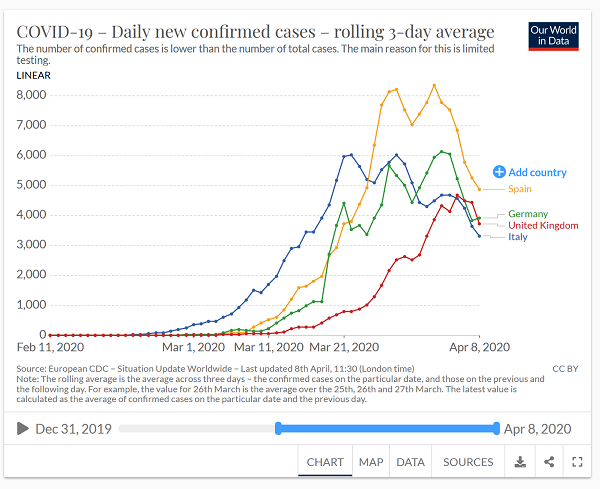
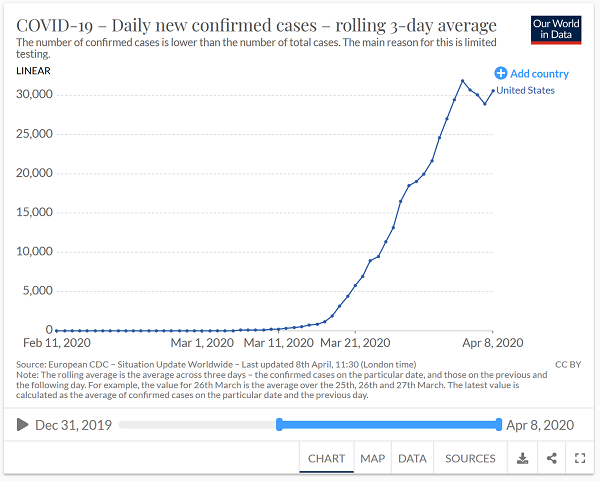
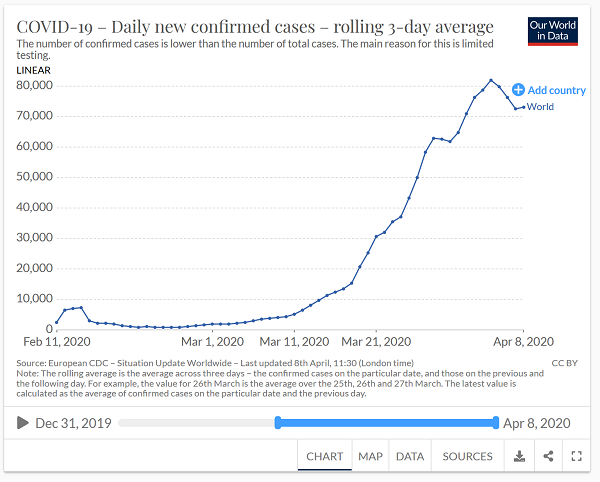
The second derivative is the rate of growth of the rate of growth. Over the past few weeks, the second derivative of total coronavirus cases switched from positive (typical of exponential growth) to zero or negative (typical of linear or sublinear growth) in most European countries. Over the past few days, it switched from positive to zero/negative in the United States and the world as a whole. These are graphs of the rate of growth – notice how they go from shooting upward to being basically horizontal or downward-sloping (source).
This graph shows the numbers a little differently, (source), but you can see the same process going on in individual US cities:

It would be premature to say we’re now winning the war on coronavirus. But we’ve stopped actively losing ground. If we were going to win, our first sign would be something like this. Current containment strategies are working.

As before, feel free to treat this as an open thread for all coronavirus-related issues. Everything here is speculative and not intended as medical advice.

The Bat Flu

SSC reader Trevor Klee has a great article on why humans keep getting diseases from bats (eg Ebola, SARS, Marburg virus, Nipah virus, coronavirus). He explains that because bats expend so much energy flying, they run higher body temperatures than other mammals, which degrades their DNA. Their DNA is such a mess that the usual immune system strategy of targeting suspicious DNA doesn’t work, so they accept constant low-grade infection with a bunch of viruses as a cost of doing business. Sometimes those viruses cross to humans, and then we get another bat-borne disease.

Subreddit user nodding_and_smiling doesn’t quite buy it:

I don’t think deep-diving into the bat immune system, while certainly very interesting, is necessary to explain the number zoonotic diseases from bats. I think a more important point is there is just a crazy number of bats, and the post doesn’t seem to fully appreciate this.

There are over 1,250 bat species in existence. This is about one fifth of all mammal species. Just to get a sense of this, let me ask a modified version of the question in the title:

“Why do human beings keep getting viruses from cows, sheep, horses, pigs, deer, bears, dogs, seals, cats, foxes, weasels, chimpanzees, monkeys, hares, and rabbits?”

That list contains species from four major mammal clades: ungulates (257 species), carnivora (270), primates (~300), and lagomorphs (91). Adding all these together, we don’t even get to 3/4 of the total number of bat species…

Read the full comment (and the ensuing discussion) for more, including whether biodiversity vs raw numbers is the appropriate measure here.

Mail Suffrage

The Wisconsin Democratic primary (plus some unrelated elections) went ahead as usual this week, with people going out to voting booths instead of voting by mail. Democrats wanted to allow (mandate?) mail voting, but Republicans refused.

Presumably Republicans assumed mail voting would benefit Democrats? The last time a state instituted vote-by-mail, in New Jersey, it did seem to increase the Democratic share of the vote.

I’m surprised by this, because I would have expected mail voting, as opposed to booth voting, benefits people with good executive function who are familiar with doing things by mail – ie older, richer people, ie Republicans. It would appear that I am wrong.

What if the epidemic isn’t done by November? There will probably be a discussion of lifting the shutdown to have a normal election, vs. voting entirely by mail, vs. combination where people who want to vote by mail can but the polls are open for everyone else. I don’t know if the second option is in the Overton Window right now (or if it should be). The party lines here seem to be the same: Nancy Pelosi is already pushing for it, and conservatives are already denouncing it as a liberal plot.

I’m in favor, obviously, but also terrified that something goes wrong. In one scenario, failure to agree on vote-by-mail rules (or failure to implement them competently) delays the election, with no clear way to get it back on track. In another, the sudden panicked switch to a less-tested voting method goes wrong in unpredictable ways and creates ambiguity over election results. It could be Bush v. Gore x 1000.

The Neoliberal Project has an analysis of what we should do and how to make postal voting work. I just really hope it doesn’t come to this.

Charity Update

Last week I linked a list of potentially good coronavirus charities cobbled together by some random people on the EA forum. Now a more serious organization, 80,000 Hours, has posted their own list.

The top option is still the Johns Hopkins Center for Health Security, which researches and advocates for biosecurity policy. Last week someone in the comments doubted the quality of their work, pointing out that one of their flagship efforts is a ranking of how prepared different countries are for a global pandemic; their 2019 listing put the US at the top, which now feels like a cruel joke. But I’m not sure how much to hold it against them. Looking at their webpage, it mostly investigates whether a country has good plans addressing various issues of a crisis, and lots of resources that it can deploy if needed. As best I can tell, the US had great plans and didn’t follow any of them, and lots of resources which it totally failed to deploy effectively. Responsible think tanks are probably not allowed to add a -10000 points at the end of their analysis for “but its leaders are idiots”. This might still be a good time to reread Samzdat on hokey country rankings and no_bear_so_low on hokey country rankings.

Speaking of charity, you can read on Twitter about the trials and tribulations of people trying to donate face masks to hospitals, and here’s an article from three years ago about issuing pandemic bonds as a novel insurance-type way of funding global disease response. Pretty neat.

And you might think that a page called The COVID Challenge where you sign up to deliberately get infected with coronavirus is a bad idea, but it’s actually some volunteers trying to make a list of people who would be willing to get deliberately infected (if it came to that) in order to test vaccines, which they will hand over to vaccine-makers once they get to the testing stage. Rationalist John Beshir did something like this for a malaria vaccine last year and earned $3200 (plus the warm glow of having made a difference) by letting himself getting bitten by infected mosquitoes in an Oxford laboratory.

There Is No Coronavirus In Ba Sing Se

Turkmenistan is a strange country. You probably remember it for its wacky former dictator Turkmenbashi, who among other things renamed the month of March after his mother, and told citizens that anyone who read his book three times would enter Heaven. Or for its wacky current dictator Gurbanguly Berdymukhamedov, who NPR describes as a “dentist/rapper/strongman”. Or for its impressive accomplishment of beating out North Korea to be named the most repressive country on Earth by Reporters Without Borders.

Its coronavirus response will do nothing to improve its reputation: early reports claimed it had banned mentioning the word ‘coronavirus’ or acknowledging its existence in any way.

The Diplomat argues this is not quite true; some state media seems to be using the word. But they are definitely arresting people for talking about it outside official government organs, and they are definitely denying that there are any cases in the country. Since Turkmenistan is right next to Iran, which has had thousands of cases for months, this is pretty implausible.

The Diplomat also requests that people try not to focus on the country’s wacky dictators so much every time they talk about it, since that makes it hard to get people to take its suffering seriously. Sorry, Diplomat and Turkmen people 🙁

And SSC reader Castilho describes their home country of Brazil, which seems to be right up there with Turkmenistan:

We’re one of the few countries in the developing world that actually could handle the pandemic reasonably well (We have around 61.000 ventilators, or 1 ventilator per 3.300 people, which isn’t actually that bad and could be expanded for a decent epidemic response)…

However, our president has decided to go all-in on denying how serious the virus is. The Atlantic even called him “the new leader of the Coronavirus denial movement“. He’s accusing local politicians who have instituted lockdowns of plotting to destroy the country’s economy in order to use it against him later. His sons, who are local politicians in the wealthy parts of the country, have been saying this is all a plot by leftist politicians together with the People’s Republic of China to make him and Trump look bad. I wish I was kidding…

The worst part is that he’s led a nationwide movement telling people to leave their homes and go back to their normal lives. The government actually wanted to make “Brazil can’t stop” into a nationwide campaign, but when a significant part of the population didn’t appreciate it, they just deleted the social media posts and now they claim there never was such a campaign.

Read the full comment for more.

And last month I wondered about the surprisingly slow spread of cases in Iran. I can’t find anyone saying so outright, but it seems like the numbers are probably wrong. At least that’s what I gather from articles like this and Twitter accounts like this highlighting the scale of the crisis there, which seems at least as bad as anywhere in the world. I don’t know if they’re deliberately lying about case numbers (why start now, after the numbers were so bad a few weeks ago?) or if testing has just completely broken down there. See also this article on how their form of government has led to power struggles and a garbled response. I would say something mean about radical Islamic fundamentalism, except that the whole thing mirrors blow for blow what happened between Cuomo and de Blasio in New York.

And finally, here’s a great article on the mystery of Japan. Tl;dr: cultural traditions like mask-wearing and bowing helped it for a while, crowded trains aren’t as bad as you’d think because nobody’s talking, banning large gatherings very early was a really good move, their weak half-hearted version of test-and-trace worked for a while out of sheer luck, but now cases are finally starting to rise and there probably won’t be a mystery to explain for much longer.

Economic Unanimity

The IGM Economics Experts Panel surveys a view dozen top economists on the issues of the day. This month they’re focusing on coronavirus. Here are some sample results:
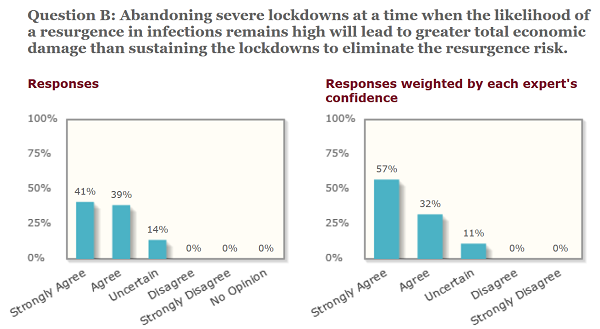
…they pretty unanimously support the lockdown, even when asked only to reflect on its economic impact.

Some socialists on social media are trying to spread a narrative where capitalists think the economy is more important than lives and want to lift the lockdown immediately, and it’s only socialists who are standing up for the importance of saving people. Top economists aren’t a perfect stand-in for capitalists, but it’s still pretty clear that they’re wrong.

Also, there are starting to be some econ papers trying to more rigorously analyze the pros and cons of lockdown. The Benefits and Costs of Flattening the Curve for COVID-19 says that “assuming that social distancing measures can substantially reduce contacts among individuals, we find net benefits of roughly $5 trillion in our benchmark scenario”.

USA! USA!

Is there anything Americans can be proud of here?

@noahpinion reminds us of America’s long history of being late on the trigger but doing a great job once we get started (Churchill: “You can always count on Americans to do the right thing – after they’ve tried everything else.”). We were late entrants into both World Wars but had an outsized effect on both of them. In that spirit, although we were very slow to start testing, we’ve ramped up impressively fast – from almost none to 1/3 of South Korean levels per capita within a few weeks.

Also worth celebrating – during the Wuhan phase of the pandemic, China built an impromptu 1,000 patient hospital in ten days. US media reported this as unbelievable – a sign that a young and vigorous country could accomplish feats that a decadent America could never dream of. But last week in New York, the Army Corps of Engineers converted the Javits Convention Center into an impromptu 2,000 patient hospital in…about ten days.

I don’t know, maybe this was easier because they’re converting an existing structure instead of building a whole new one (though even the Chinese used prefab units). But it’s nice to know we still have it in us to do things quickly. There’s no civilizational decline. If the government ever legalized building things quickly again, we’d be mopping the floor with China within weeks.

Legal Immunity

There’s a Jewish legal principle called marit ayin, which means that it’s illegal to do something which is legal but looks illegal. For example, you can’t eat some kind of plant-based Impossible Bacon, because it would look like you were eating real bacon. Some authorities say it is sometimes permissible to eat the Impossible Bacon if you leave the box out in a prominent position so that it doesn’t look illegal; I’m not sure of the details.

The argument is that widespread flagrant unpunished violation of the law makes the law uncompelling and unenforceable, and this is true whether the violation is real or imagined. If you never see anyone eat bacon, you probably won’t eat it yourself; if everyone around you seems to be eating bacon all the time, it feels less taboo. Also, if you’re a police officer, it’s hard to identify the real bacon eaters if there are a bunch of people eating Impossible Bacon who get annoyed every time you question them.

I was thinking about this recently with the news that Germany is considering issuing immunity certificates for people who have gotten coronavirus, recovered, and are now safe to do normal activities. It’s a good idea, but suffers from the same problem as Impossible Bacon – if there are hundreds of people going outside maskless, eating at restaurants, and sunning themselves on the beach, it’s going to be hard for the rest of us to take lockdown seriously enough.

The equivalent of the rabbis’ put-the-box-out solution would be for governments to issue not just a certificate but some kind of unique article of clothing people could wear to mark their status. For example, they might give an unusually shaped red cap – if the beaches are full of people in red caps, that’s fine and doesn’t say anything about whether you personally should go sunbathe. And if the beachgoers see someone without a red cap, they can question them or keep their distance.

This would take a lot of centralized coordination, though. I’m not sure how you could send the same message without a government order explaining what the cap meant to everybody. Though (as per this Onion article) wearing a fake pangolin snout over your nose would send a strong signal.

A reader who has overcome the disease emailed me to ask whether there are any useful volunteer opportunities for people like him – anyone have any advice?

Short Links

Last week I expressed confusion about how to measure population density so that arbitrary choices of border don’t distort the results. Commenters delivered by finding me this article on population-weighted density, which solves my theoretical concerns but doesn’t really change any of the numbers much.

The Netherlands is another country which, like Sweden and Brazil, is volunteering to be the control group for the great experiment of whether national lockdowns work. Maybe someone should compare them to Belgium or somewhere like that in a few months and see how they did.

An aircraft carrier captain publicly complained that the Navy was failing to address an epidemic aboard his ship; the Navy fired him for whistleblowing. I’m having a hard time thinking of any perspective other than “the Navy is bad and should be torn down totally to the foundations, preferably using some sort of land-based weapon so they can’t fight back”, but here’s a different ex-captain trying his best to give a nuanced perspective.

Say what you will about the New York Times’ coverage lately, but their cover design remains second to none.

This Tumblr post has a discussion of how/whether a Clinton administration might have responded differently to the pandemic, but the part I like is the discussion of the phrase “follow the pandemic response playbook”. It turns out this is a literal document, called the Playbook For Early Response To High Consequence Emerging Infectious Disease Threats And Biological Incidents, and you can read it here.

Marginal Revolution: are hospitals really saving that many people?

UK clinical guideline body NICE now officially recommends against using NSAIDs for coronavirus. Still not completely proven, but I think they’re right to advise caution. While most experts themselves behaved appropriately, this is more egg on the face of the media, which until a few weeks ago was running stories telling people this was a myth and they should ignore it.

538 surveyed infectious disease experts around the US, asking them to predict the number of cases in X days’ time, with confidence intervals. The results are in, and the experts did worse than just continuing the exponential curve on the graph would have. EDIT: But see here.

If you’re following Robin Hanson’s variolation proposals, you can watch Hanson debate vs. Zvi Moskowitz and vs. Greg Cochran (and here’s Cowen on Hanson). Anyway, viral dose seems to have gone mainstream, though nobody seems to be doing anything about it yet.

The two different interpretations of “flatten the curve”. I think this explains why so much of the discussion around this phrase has been confusing.

Trump Asks Medical Supply Firm 3M To Stop Selling N95 Respirators To Canada, and also Key Medical Supplies Were Shipped From US Manufacturers To Foreign Buyers. I think we’re supposed to be outraged about both of those things simultaneously but I can’t manage it, maybe some of you will have better luck.

How much risk do young people really face from coronavirus? What are the risks of long-term complications? Sarah C investigates.

Last week, Elon Musk got widespread praise (including here) for donating a thousand ventilators he managed to procure through his Tesla supply chain. Now the picture has become more confusing. Reporters looking at a picture of his shipment noticed that the boxes pictured are for BiPAP machines – technically a kind of ventilator, but not the kind hospitals need to fight coronavirus. Was the whole thing a giant mistake or cynical PR stunt? But then some hospitals tweeted thanking Tesla specifically for delivering “Medtronic invasive ventilators”, which are the kind hospitals need to fight coronavirus. Some people are theorizing that maybe hospitals don’t want to offend Musk since he might have real ventilators later, other people that maybe Musk got both some useful and some non-useful ventilators in his shipment. I dunno. In any case, he’s still promising to make some at Tesla factories, though.


14 Apr 18:00

America has never embraced bidets. The toilet paper shortage could change that.

by Alex Abad-Santos
James.galbraith

Pretty much, though it's worth quantifying the environmental impact of the water as well.

A bidet and toilet side by side in harmony | John Greim/LightRocket via Getty Images

Why Americans have long been reluctant to adopt bidets, and why they shouldn’t be.

The best item I’ve ever bought for my home is a machine that shoots warm water at my bare butt.

Its formal name is the Toto Washlet, a realization of a vision first set forth by fancy Japanese toilet manufacturer Toto and Toto president Kazuchika Okura in 1917. Okura’s original dream was a future of cleaner living and a more pleasant bathroom experience. The first Washlet came out in 1980. Today, not only does the Toto have a heated water feature, it also heats its seat, dries your butt, and deodorizes the toilet bowl, too. Some models even have more features like playing music to hide the sounds of defecation.

Standalone bidets and bidet attachments like the Toto aren’t by any means new. Bidets appear to have been invented in the late 17th century; in the 18th century, Marie Antoinette apparently owned a bidet trimmed in red. These days, bidets and bidet attachments are common throughout the world from Europe to Asia. Bidets have been touted to be more sanitary than toilet paper alone and more sustainable since people don’t have to use as much toilet paper to clean themselves.

For more than a century, the promises of living more cleanly and sustainably, and of improving one’s toilet experience, have not been enough for bidets to achieve mainstream success in the US.

But now that toilet paper has become difficult to find amid the coronavirus pandemic, that might be changing, as consumers face the prospect of shortages lasting for while.

The effort and expense required to add a bidet to your bathroom will vary according to the type of product and experience you’re looking for. But there’s really no better time to get acquainted with the idea.

Here’s what to know about bidets, their advantages, and why American hard-headedness has made Americans so reluctant to adopt them — even though they’re a clearly superior option than the toilet paper status quo.

1) What is a bidet?

The term bidet can refer to either the standalone type commonly found across Europe — which looks kind of like a sink for toddlers — or an attachment to an existing toilet. Though they are different apparatuses, all bidets and bidet attachments share a common goal: to wash your genitalia (for women), perineum, inner buttocks, and anus after you go to the bathroom.

There are variations depending on the type and model. Some bidets are sophisticated enough to heat water and control pulsation and water pressure, while others just give you a simple fresh stream of water to clean yourself. The idea is that a rinse gets your backside cleaner than you would be able to achieve with dry toilet paper. But despite how sensible that sounds, the concept hasn’t ever really caught on in America.

2) Is it weird to spray water at your butt after you use the toilet?

No, I don’t think so.

Every time we step into the shower or sink into a bath or a hot tub, water comes into contact with our butts, without a second thought about whether it’s weird or not. Using a bidet isn’t really that much different, it’s just a bit more targeted.

If you’re afraid of throttling your backdoor with intense water pressure, rest easy, because most bidets allow you to adjust the pressure and intensity of the spray. Higher-end models even have features like oscillation and nozzle positioning to customize the experience and make it as comfortable as possible.

I realize this might sound over-the-top, or awkward, or even embarrassing to anyone who isn’t familiar with how bidets work. For many people, changing their behaviors and cultural norms is extremely difficult — even if those behaviors and norms involve pooping and then using only dry paper to clean themselves.

Research has shown that Americans tend to shower more than people in other countries. But most Americans also don’t use bidets. There’s a reason the term “skid marks” — which describes literally poop-streaked underwear — exists. Still, as disgusting as soiled undergarments are, to many people, bidets seem bizarre.

If Americans got poop on any other part of their body they would repeatedly wash it and not rub it around with paper, so why don’t they care about their butts?

3) Why don’t Americans customarily use bidets?

Bidets have been common in France since the late 1600s, spread further into Western Europe during the 1700s, and eventually made their way to Latin America, the Middle East, and Asia. Today, around 80 percent of households in Japan have a toilet with a bidet function or attachment.

Bidets haven’t ever been widely embraced in American culture. A common origin story for this reluctance is that bidets were seen as lascivious because they were used in brothels as a form of emergency contraception. And because Puritanism was entrenched (voluntarily or not) in American culture, there was little chance that Americans would allow a device associated with brothels and sex into their homes.

“American soldiers first saw bidets in French brothels, which made them think they were naughty,” Kate Murphy wrote in the New York Times earlier this month. “An often-told joke was that a wealthy American tourist in Paris assumed the bidet in her hotel room was for washing babies in, until the maid told her, ‘No, madame, this is to wash the babies out.’”

What Murphy is referencing is the standalone type of bidet that looks like a mini-sink for children, rather than more modern toilet attachments. Those came with their own barriers; after World War II, if Americans were able to set aside the bidet’s morality-challenging associations, they’d likely have to renovate their bathrooms — by adding plumbing, moving fixtures, and more — to accommodate the free-standing device.

“To install one and retrofit an existing bathroom with one of them [would have been] really costly — you have to knock into the floor and into the wall and you need to hire a plumber to do it,” Jason Ojalvo, CEO of Tushy, a company that sells bidet attachments, told Vox. “It would end up costing you thousands of dollars.”

Because bidets weren’t a part of American bathroom culture, bathrooms weren’t really designed with space for two toilet-sized units. But bidet innovators eventually realized that adding a bidet could be as simple as incorporating a hose attachment that hooks up into the water line — and in 1980, the Toto Washlet was born.

The Washlet offered rear cleansing, a dryer, and a heated seat. Installing it was as simple as replacing one’s toilet seat with the Washlet, hooking up a few tubes, and plugging it in. Washlets now start at around $325 for the most basic models, and competitors like Kohler have models beginning at around $575.

A more inexpensive bidet attachment is the Tushy, which launched in 2015. The Tushy, whose basic model sells for $89, is a small device that attaches under the toilet seat. You can also purchase a variety of low-cost bidet sprayer attachments online.

These simple devices and their relatively nimble installations make them less of a burden than a standalone booty-washing station. Many newer, fancy toilets made by Toto and Kohler also have built-in bidet options, but according to Vice, Kohler found in a 2016 survey that 53 percent of Americans were unwilling to use a bidet.

“Toilet paper was invented in 1857 and nothing’s changed,” Ojalvo told me. “And I feel like just the way Americans are, they think everything they do is the best. There’s just this mindset where it’s just like, that’s just the way it’s done and I don’t care that other cultures have embraced the bidet and think it’s cleaner. It’s just like no one wants to change.”

4) Are bidets more sanitary than just using toilet paper?

Because of the coronavirus pandemic, people have been told over and over to wash their hands and wash them properly. But pandemic or not, washing your hands is the most important thing to do after you go to the bathroom since fecal matter is how some germs spread. A bidet washes your backside, reducing the risk of excrement-to-hand contact. However, a bidet is not going to wash your hands for you. So bidets plus proper hand-washing make a great combo. But a toilet-paper-only human who washes their hands thoroughly is likely to be more sanitary than a bidet user who doesn’t wash their hands at all.

Additionally, there have been studies that show how bidets can mimic the beneficial effects of a sitz bath like reducing anal pressure. For women, cleansing with clean water is generally seen as less abrasive than toilet paper or vaginal wipes on sensitive areas — though there are studies that warn against over-washing. And as a colorectal surgeon recently told the New York Times, bidets can also reduce skin irritation because they’re made to be less abrasive than toilet paper.

“A lot of people who come to see me have fairly significant irritation of their bottoms,” Dr. H. Randolph Bailey told the Times. “Most of the time it has to do with overzealous cleaning” — wiping too vigorously with toilet paper or using wipes, which often contain harsh fragrances and chemicals.”

From personal experience, I can tell you there is no comparison between the alleged “clean” you get from dry toilet paper versus the combined power of a rinse and a wipe.

5) Are bidets more environmentally friendly than toilet paper?

When I was speaking to Ojalvo, he made clear that Tushy’s marketing is aimed at environmentally conscious consumers. The main selling point of the Tushy is that it allows you to use less toilet paper; the company essentially says that the Tushy minimizes the environmental impact of using the toilet because it only requires, on average, one pint of water to clean your bum.

“The average American uses 57 sheets of toilet paper every single day,” Ojalvo told me, referencing Tushy’s statistics. “That comes out to like 36 billion rolls of toilet paper every year just for Americans. And those are made from 15 million trees. So if everyone overnight adopted Tushy then there’d be 15 million more trees.”

According to Tushy, cutting down our use of toilet paper would also save 437 billion gallons of water, and 253,000 tons of bleach that are used to produce said toilet paper. Toto touts the same basic idea, proclaiming on its website that “there’s no need to use toilet paper, so you’re saving trees and the water used to manufacture each roll.” And after a 2019 study, Ethical Consumer magazine found that many toilet paper brands have decreased their use of recycled paper to produce their products, meaning more trees are being consumed to make toilet paper.

One important thing to keep in mind for bidet neophytes: You will still need some toilet paper, albeit a much smaller amount, to finish the drying process, even with a device like a Toto or Tushy. One could ostensibly air dry, but sitting on a toilet with a damp crack seems like a commitment too far for most, including me.

6) Are bidets easier to find than toilet paper right now?

Thanks to a perfect storm of hoarding, stay-at-home guidance, and disruptions in supply chains, there’s currently a toilet paper shortage in parts of the United States and manufacturers don’t know when it’ll reliably be back on shelves. The result, Ojalvo says, has been a huge surge in sales at Tushy.

“I’ve been the CEO for two years and we’ve more than doubled every year anyway,” Ojalvo told Vox. “But then even on top of that, just in March, our revenues went up about 10 times. It went up like 10 times what it had in February.”

Ojalvo said he thought that there would be an interest in bidets and Tushy during the early stages of the pandemic because of people wanting to be as sanitary as possible. All of the directives from health authorities have involved frequent hand-washing, and he predicted that people would want to be more sanitary and hygienic in all aspects of their lives.

But he said the push didn’t come until toilet paper grew scarce.

“We’ve always had an outside following in areas where people care about sustainability,” Oljavo said. “New York, LA, San Francisco, Austin, Seattle, Portland — the usual suspects. But then with the toilet paper shortage, it’s spread out even more.”

While Tushy and simpler bidet attachments like it are seeing a surge in sales, more expensive apparatuses with features like heated water, like the Toto Washlet, might see similar interest but not see the same sales effect right now, Ojalvo theorized.

You can still purchase a Toto Washlet online, but in order to install one, you must have an electrical outlet within three feet of the toilet. Similarly, Tushy’s $109 upgraded warm water “spa” bidet requires a hookup to your bathroom sink’s hot water line. For some consumers, that may require renovations or plumbing assistance that wouldn’t necessarily possible at the moment.

7) Even if there wasn’t a toilet paper shortage, would you recommend buying a bidet?

If you were looking to break my heart by eliminating one thing in my apartment, that item would be the Toto. I don’t bake enough, so my oven can go. Take my dishwasher and my rice cooker; I can do dishes by hand and make rice on the stove poorly. I’m fine with showers so I don’t need a tub, and I could sleep on my couch if you wanted to take away my mattress.

Taking away my Toto would sentence me to the insidious feeling of walking around with a dirtier butt. And that’s not even taking into consideration the reduced environmental impact that having a bidet achieves.

Toilet paper shortage or not, Americans should seriously consider the beauty of the bidet. We live in a world full of modern conveniences that would have been unimaginable to our ancestors. We can control lighting from our phones and have robots that vacuum our floors, yet we still wipe our butts with dry paper — just like our ancestors did. Perhaps a toilet paper shortage is the shock to the system Americans need to realize the joys of having a clean, non-irritated, environmentally friendly butt.


Support Vox’s explanatory journalism

Every day at Vox, we aim to answer your most important questions and provide you, and our audience around the world, with information that has the power to save lives. Our mission has never been more vital than it is in this moment: to empower you through understanding. Vox’s work is reaching more people than ever, but our distinctive brand of explanatory journalism takes resources — particularly during a pandemic and an economic downturn. Your financial contribution will not constitute a donation, but it will enable our staff to continue to offer free articles, videos, and podcasts at the quality and volume that this moment requires. Please consider making a contribution to Vox today.

14 Apr 17:56

This is awkward: CIA warned employees against Trump's wonder drug

by Laura Clawson

Donald Trump has pushed hydroxychloroquine as a potential coronavirus treatment so hard that he actually got the Centers for Disease Control to modify its website with anecdotes about the drug and COVID-19. One government agency that isn’t going along with Trump’s push for an unproven treatment in which he has a financial stake, though, is the CIA.

A CIA website for the agency’s own employees added a strong warning against hydroxychloroquine—including a warning about “sudden cardiac death”—about a week after Trump said of the drug that “I think it could be, based on what I see, it could be a game changer.”

“At this point, the drug is not recommended to be used by patients except by medical professionals prescribing it as part of ongoing investigational studies. There are potentially significant side effects, including sudden cardiac death, associated with hydroxychloroquine and its individual use in patients need to be carefully selected and monitored by a health care professional,” the CIA website warns. Then, in bold type: “Please do not obtain this medication on your own.”

”What do you have to lose?” Trump asked, as he promoted hydroxychloroquine despite a lack of evidence that it works. Well, “sudden cardiac death” means there’s something to lose. 

14 Apr 17:53

(612): Fursuit judi Dench just...

James.galbraith

Yeah, don't watch Cats high

(612): Fursuit judi Dench just stared directly at me for 3 solid minutes telling me that cats arent dogs and i believe her because if i dont cat jason derulo might try to have sex with me.
14 Apr 17:52

Florida Governor Deems WWE an ‘Essential Service’ Amid Coronavirus Crisis

by Andy Towle
James.galbraith

Florida priorities

Florida Governor Ron DeSantis has deemed World Wrestling Entertainment (WWE) an “essential service” like pharmacies and grocery stores in that state and gave the organization the go-ahead to resume production. Officials told CNN “it is critical to Florida’s economy.”

Out WWE wrestler Jake Atlas faced off against Dexter Lumis on April 1.

Said WWE in a statement to CNN: “We believe it is now more important than ever to provide people with a diversion from these hard times. We are producing content on a closed set with only essential personnel in attendance following appropriate guidelines while taking additional precautions to ensure the health and wellness of our performers and staff.”

Orange County Mayor Jerry Demings told the Miami Herald that WWE’s status was changed to essential after a conversation with DeSantis’s office.

The post Florida Governor Deems WWE an ‘Essential Service’ Amid Coronavirus Crisis appeared first on Towleroad Gay News.

14 Apr 17:52

Multilayered

James.galbraith

Seriously...not subtext at all lol

subtext???

14 Apr 17:49

The controversy over a Trump judge’s oddly partisan “religious liberty” opinion, explained

by Ian Millhiser
James.galbraith

And the GOP wants to reward that with a seat on a Circuit court for this assclown and religious bigot.

Senate Majority Leader Mitch McConnel talks with Justin Reed Walker before a Senate Judiciary Committee hearing on Walkers nomination for US district judge for the Western District of Kentucky. | Caroline Brehman/CQ Roll Call

If you want to be taken seriously as a judge, maybe don’t use your opinion to list the names of Democrats who were in the Klan?

Judge Justin Walker, a very recent 38-year-old Trump appointee to a federal court in Kentucky, begins his opinion in On Fire Christian Center v. Fischera case brought by a Christian minister that claims the center was preventing from hosting an Easter service — as if he is the only thing protecting civilization from a cartoonishly evil tyrant.

“On Holy Thursday, an American mayor criminalized the communal celebration of Easter,” Walker begins. adding that “that sentence is one that this Court never expected to see outside the pages of a dystopian novel, or perhaps the pages of The Onion.”

Not long after Walker tossed this grenade into a brewing culture war, serious doubts emerged that the attack on Easter that the judge warned of actually ever existed. At the very least, it is fairly clear that Walker did not take some basic steps to ensure that the facts of this case are what Walker claimed that they are.

The case involves Louisville, Kentucky, Mayor Greg Fischer’s efforts to keep individuals from spreading the coronavirus. On Fire Christian Center wished to hold drive-in Easter services. It claims that parishioners would be required to remain in their cars, and that the pastor and other church employees would be appropriately socially distanced from the parked worshipers. Nevertheless, On Fire claimed that Fischer attempted to shut down these services.

After seeking relief in federal court, On Fire wound up before the unusually pugnacious conservative Judge Walker.

Walker has lived a charmed life for a man only 38 years of age. A former intern to Senate Majority Leader Mitch McConnell and law clerk to future Supreme Court Justice Brett Kavanaugh, Walker has never tried a case and was confirmed to the federal trial bench despite the American Bar Association’s determination that he is “not qualified” for the job. Then, just months after Walker began his current job, President Trump nominated him for the United States Court of Appeals for the District of Columbia Circuit, arguably the second-most-powerful court in the country.

Much of Walker’s opinion in On Fire is devoted to largely irrelevant history about pilgrims (“according to St. Paul, the first pilgrim was Abel”) and even more irrelevant reminders that, in the past, some prominent Democrats were members of the Ku Klux Klan (“just over three decades ago, another ex-Klansman was the Majority Leader of the United States Senate”). Walker does not turn to the facts of the On Fire case until page seven of his opinion.

There, only after he juxtaposes tales of slaves being beaten for “attending prayer meetings” alongside reminders that some long-dead Democrats were once Klansmen, the judge describes what he claims to be the dispute at the heart of this case: A Christian ministry wanted to hold a kind of drive-in Easter Sunday service, where parishioners would remain in their cars and social distancing guidelines will be respected, but Fischer, a Democrat, issued an order that bans such services.

If Walker is correct about what is actually at stake in this case, then he is most likely correct that Fischer may not forbid this ministry from holding Easter services under these very limited conditions. But it is far from clear that Walker accurately described the facts of this case. And even if he did, his opinion reads less like a judicial decision and more like a screed against Democrats published in an outlet like Breitbart.

This is indicative of a pattern that seems to be emerging among many of Trump’s appointees to the federal bench. Judges throughout the federal bench appear to be auditioning for higher jobs by broadcasting their conservative credentials, even when such auditioning requires them to write sloppy or poorly reasoned opinions.

Walker may have misrepresented the facts of this case.

In order to challenge a government action in federal court, a plaintiff must show that they were injured in some way by that government action, and that injury has to be more than speculative.

This is why, for example, lawyers who wished to challenge state bans on contraception in the mid-20th century had to find a person who’d actually been prosecuted under those laws to proceed with their challenge. It’s also why lawyers challenging Texas’s ban on “sodomy” had to find a client who had actually been prosecuted under that ban.

Which brings us back to the On Fire case. Walker claims that “Louisville has targeted religious worship by prohibiting drive-in church services,” but it’s not at all clear that such prohibition exists.

Mayor Fischer, for his part, says that he “attempted twice to contact the court” so that he could “present evidence that would have demonstrated there has been no legal enforcement mechanism communicated” regarding the drive-in services that were supposedly being banned.

If the city wasn’t enforcing any kind of ban against drive-in services, or if it would have only enforced a ban on services that violated social distancing guidelines, then the apocalyptic dispute Walker describes in his opinion simply doesn’t exist.

As Josh Blackman, a conservative law professor, wrote at the Volokh Conspiracy, if Walker had “held a 15 minute telephonic status conference,” meaning if Walker had simply called the lawyers on both sides of the case and allowed Fischer’s attorneys to explain what was going on, “any doubts about the proposed enforcement could have been resolved.” The judge likely would have determined that no court order was necessary because there was no real dispute between the two parties.

The particular court order On Fire Christian Center sought from Walker is known as a “temporary restraining order,” which is a form of very short-term relief that judges may hand down without speaking to the opposing party — at least in rare emergencies where time is of the essence.

But in this case, On Fire requested its temporary restraining order on Friday, and Walker did not rule on it until Saturday. Walker appears to have spent the intervening day writing a 20-page opinion and order and researching details about Plymouth Colony Gov. William Bradford’s views about pilgrims and St. Paul, rather than holding a brief phone call with Fischer’s lawyers.

Walker appears to be “auditioning” for a higher job

When I speak to sitting judges, I frequently hear them use a derisive word for the kind of opinion Walker handed down in On Fire:auditioning.” To audition is to loudly and proudly advertise your conservative views in the hopes that you will be nominated to a higher court — or maybe even to the highest Court.

These judges may have learned to behave this way from a very high-profile role model: Justice Neil Gorsuch. As the 2016 election drew close, then-federal appellate Judge Gorsuch behaved like he was actively campaigning for a promotion.

At the time, the conservative Federalist Society, which plays a significant role in choosing Trump’s judicial nominees, was loudly signaling that it wanted judges and justices who would limit federal agencies’ power to create binding regulations. So Gorsuch started writing gratuitous opinions laying out the new limits he would impose on federal agencies. In one case, he even attached a separate concurring opinion to his own majority opinion.

As David Kaplan reports in The Most Dangerous Branch: Inside the Supreme Court’s Assault on the Constitution, these opinions were “a way for Gorsuch to call attention to himself, and it worked.” Kaplan writes that one of the future justice’s anti-regulatory opinions “proved decisive in clinching” the Trump White House’s decision to name Gorsuch to the Supreme Court.

Auditioning seems to be an increasingly widespread practice among Trump judges with Supreme Court ambitions, and why wouldn’t it be? By selecting Gorsuch, Trump signaled that he is prone to reward judges who display their most conservative views like a peacock seeking a mate.

There are also some signs that the youngest group of these judges are combining a writing style more typically associated with conservative media with their ostentatious displays of conservatism. Gorsuch is often derisive of his colleagues’ views in his judicial opinions, but his writing style is fairly academic. Indeed, shortly after he joined the Supreme Court, his turgid prose inspired the mocking hashtag #GorsuchStyle.

To put it mildly, judges — not even Gorsuch — typically do not use their judicial opinions to suggest that the Democratic Party is actually the party of the KKK.

Yet Walker is not alone with his unusually harsh writing style. Late last month, Judge Brantley Starr, a 41-year-old Trump appointee to a federal court in Texas, wrote an opinion in an important guns case that is as larded down with unprofessional swipes at the Justice Department’s lawyers as it is with historical errors about the way 19th-century judges understood a particular legal term.

“The federal government forgot the Tenth Amendment and the structure of the Constitution itself,” Starr writes in his opinion. At another point, he blasts the government’s lawyers for failing to consider “one more place, where the collective will and knowledge of the people is expressed, that might indicate if the federal government has seized the police power from the states: the Constitution Wikipedia.”

This kind of behavior is unfortunate because judges are supposed to follow the law, not use their opinions as a vehicle to demonstrate how snarkily they can own the libs. If Walker or Starr wanted a job as a conservative commentator, they picked the wrong career.

But it is also unfortunate for another reason. Setting aside the question of whether Walker decided a made-up case in On Fire, he is correct on the merits that, at least in Kentucky, a city mayor may not ban drive-in church serves so long as those services adhere to social distancing guidelines.

Judges are often called on to resolve tense disputes between ordinary citizens and powerful officials, sometimes in cases where many lives are on the line. We trust judges with this power because we expect them to do so in a way that is both nonpartisan and primarily concerned with the law. And government officials obey those decisions because they also trust that the judge is motivated by something more than pure politics or personal advancement.

But if judges do not hold up their part of this bargain — if they behave in a transparently partisan way, or if they place their desire for career advancement before their obligations to the law — then they undercut the basic claim that we should obey judges at all. They also invite defiance from government officials.

As Alexander Hamilton wrote in the Federalist Papers, “the judiciary ... has no influence over either the sword or the purse; no direction either of the strength or of the wealth of the society; and can take no active resolution whatever. It may truly be said to have neither FORCE nor WILL, but merely judgment; and must ultimately depend upon the aid of the executive arm even for the efficacy of its judgments.”

By transforming a legal dispute into another battle in the culture war, Walker undermined his own authority. And he undermined the judiciary itself.


Support Vox’s explanatory journalism

Every day at Vox, we aim to answer your most important questions and provide you, and our audience around the world, with information that has the power to save lives. Our mission has never been more vital than it is in this moment: to empower you through understanding. Vox’s work is reaching more people than ever, but our distinctive brand of explanatory journalism takes resources — particularly during a pandemic and an economic downturn. Your financial contribution will not constitute a donation, but it will enable our staff to continue to offer free articles, videos, and podcasts at the quality and volume that this moment requires. Please consider making a contribution to Vox today.

14 Apr 17:39

Cartoon: Poetic justice

by Jen Sorensen
James.galbraith

Seriously

As some of my newspaper clients are shrinking or shutting down right now, if (and only if) you are able, please consider joining the Sorensen Subscription Service!

Follow me on Twitter at @JenSorensen

14 Apr 17:32

Scientists Develop Potentially Vital Nasal Vaccine For Treating Alzheimer's

by BeauHD
James.galbraith

fascinating

Researchers have developed a nasal Alzheimer's vaccine that was successful in reducing atrophied brain matter in mice by blocking a protein that causes the disease. It also reduced changes and abnormal behavior in the brain normally associated with the disease. The study was published in the journal Nature. Interesting Engineering reports: "Much more research is necessary for the vaccine to be used in humans, but it is an accomplishment that can contribute to the development of a dementia cure," team member Haruhisa Inoue, a professor at Kyoto University, told The Asahi Shimbun. Alzheimer's disease and other forms of dementia are characterized by an abnormal accumulation of tau proteins in the brain. In the study, the research team incorporated a gene into a harmless virus to make it produce tau. They then administered the virus nasally to mice with genes that made them prone to developing dementia. The vaccine proceeded to stimulate the mice's immune system, causing them to build antibodies that removed the tau proteins. These antibodies were more than double in mice who had the vaccine administered compared to those that did not. In addition, the vaccinated mice's brain areas were only two-thirds as atrophied as those who were not vaccinated. Finally, no detrimental side effects were recorded during the eight months the scientists observed the mice.

Read more of this story at Slashdot.

14 Apr 05:02

Press Griefing

by jon

Hey everyone! We’re all going to die.

See you next time, when we are dead

14 Apr 04:05

CNN's chyron writer has had enough, goes to town during Trump's coronavirus press conference

by Walter Einenkel

Donald Trump’s daily coronavirus task force report sessions have been an unhealthy public disservice from the start. Every day Trump comes out to the press, the United States is a little worse for it. Whether it’s the bald faced lying, the misinformation, the gaslighting history, or the random useless non-experts paraded in front of cameras, there’s nothing worthwhile coming out of this low-minded conman’s mouth. On Monday, April 13, whoever is writing CNN’s chyrons, the short information captions that run at the bottom of the screen, had had enough.

As you can see from the image above, the results were extraordinary.

CNN chyron cranking it up pic.twitter.com/KAHwqzuArG

— Sam Ro ðÂ�Â�Â� (@SamRo) April 13, 2020

There’s only so much of Trump’s words one wants to write before they just cut to the chase.

What a time to be alive and a chyron writer pic.twitter.com/LiXTuZPWHy

— Tom Weber (@tweber) April 13, 2020

LIke Trump’s inability to reckon with his shortcomings.

CNN's chyron: pic.twitter.com/F959i7eWav

— Vicky Ward (@VickyPJWard) April 13, 2020

His gaslighting.

CNN should give their chyron writer a raise. #PressBriefing pic.twitter.com/OGtfYkKYZy

— Drinks and Wings (@DrinksandWings) April 13, 2020

His inability to control his emotions.

The CNN chyron peeps really wanted to write: Bat. Shit. Crazy. #PressBriefing pic.twitter.com/8FchNkwx8c

— doodle-nightly live #DJ JAM 8pm EST-hedz (@smallpencilclub) April 13, 2020

And the all-around swampy nature of Trump’s presidency.

NOW WE'RE TALKING, @CNN. Give chyron person a raise. pic.twitter.com/Ezl6z35R5K

— âÂ�Â�ï¸Â�ðÂ�Â�¼ðÂ�Â�Â�ðÂ�Â�Â�ðÂ�Â�Â�ðÂ�Â�Â�ðÂ�Â�Â� ðÂ�Â�²ðÂ�Â�Â�ðÂ�Â�Â�ðÂ�Â�Â�ðÂ�Â�Â� ðÂ�Â�±ðÂ�Â�Â�ðÂ�Â�Â�ðÂ�Â�Â�ðÂ�Â�Â�âÂ�Â�ï¸Â� (@CrankyAssCajun) April 13, 2020

13 Apr 23:55

Progressive judge unseats Scott Walker's pick in major race for Wisconsin Supreme Court

by David Nir
James.galbraith

That's some fucking fantastic news

Dane County Circuit Court Judge Jill Karofsky has unseated Wisconsin Supreme Court Justice Dan Kelly in a key race that will narrow the court’s conservative majority in this crucial swing state. The victory also sets progressives up to take control of the court when its next member is up for election.

Tuesday’s contests went ahead amidst the coronavirus pandemic despite a last-minute order from the state’s governor, Democrat Tony Evers, seeking to postpone it. Evers’ order, however, was quashed by the conservatives on the state Supreme Court, forcing Wisconsinites to choose between exercising their right to vote and protecting their health. An extreme shortage of poll workers led to excessively long lines in the few precincts that were able to open.

In a separate case, conservatives on the U.S. Supreme Court overturned a federal judge’s ruling that extended the deadline to return absentee ballots, instead mandating that they be postmarked by Election Day, April 7. That decision disenfranchised an untold number of voters, including some who only received ballots after the deadline and others whose ballots, for a variety of reasons, failed to acquire a postmark. Some voters reported never receiving a ballot altogether.

Litigation has already been filed over the way the election was handled, though it’s not clear what sort of remedy, if any, a judge might fashion, or whether the courts would be willing to step in to set aside the results.

Should Karofsky’s victory stand, however, conservatives will now hold just a 4-3 edge on the Supreme Court, which has, over the last decade, never restrained the extremist legislative agenda pushed through by state Republicans. That includes efforts to suppress the vote, undermine workers’ rights, and gerrymander electoral maps. With only a one-seat advantage, Republicans may encounter legal roadblocks they had long grown unaccustomed to.

And in a few years’ time, they could be facing a liberal court. In 2023, Chief Justice Patience Roggensack, another conservative, will see her current 10-year term expire. If progressives can flip her seat, they’ll gain a majority on the bench and finally be able to place a check on the GOP. Most importantly, if Republicans are able to gerrymander yet again following this year’s census, a progressive state Supreme Court would be able to revisit any unfair maps.

The outcome is also a black eye for Donald Trump, who repeatedly touted his support for Kelly and is counting on victory in Wisconsin—which he carried four years ago by a margin of less than 0.8 percent—to win a second term. While the electorate could look different in the fall, Republicans cannot be happy to lose a statewide race in one of their most important November battlegrounds.

13 Apr 23:54

Trump Shuts Down Reporter After She Challenges His Lie That He Has ‘Total Authority’ as President: ‘Enough!’ — WATCH

by Andy Towle
James.galbraith

Trump really is just a spoiled stupid child

Donald Trump snapped at CNN reporter Kaitlan Collins after she questioned a false claim he made earlier in Monday’s press briefing that he has “total authority” as president.

Said Trump earlier in the briefing, about his authority to open the country amid the coronavirus crisis should he so wish: “When somebody’s the president of the United States, the authority is total … and the governors know that. The authority of the president of the United States is total.”

CNBC notes that Trump is full of sh*t as usual: “Legal experts say Trump is wrong. For one, they note that U.S. law gives state governors wide latitude to protect the health and safety of their constituents. Secondly, they point out that Trump never declared a nationwide lockdown, so there’s no mechanism by which he could order a nationwide reopening now, namely.”

Later, when CNN’s Kaitlan Collins questioned his statement, he shut her down with a pointed finger: “Enough!”

Earlier on Monday, governors on both coasts formed alliances to decide when to reopen their economies.

Washington, Oregon, and California created a ‘Western States Pact’ while governors of six states in the northeast formed a similar pact.

The post Trump Shuts Down Reporter After She Challenges His Lie That He Has ‘Total Authority’ as President: ‘Enough!’ — WATCH appeared first on Towleroad Gay News.

13 Apr 23:19

Senate Republicans plan coronavirus probe — with a focus on China

by Burgess Everett and Marianne LeVine
James.galbraith

more blatantly political cover. The GOP Senate is just an extension of the Trump reelection campaign.


The Senate's main oversight committee is beginning a wide-ranging probe into the origins of and response to the coronavirus pandemic, Senate Homeland Security and Governmental Affairs Committee Chairman Ron Johnson said in an interview on Monday.

Johnson (R-Wis.) said his committee is "going to conduct oversight on this thing in its entirety." He listed several elements of the probe: Why the national stockpile wasn't "better prepared," why pharmaceutical ingredients and medical devices are manufactured overseas, the World Health Organization's response to the virus and how the virus spread in the first place.

But it’s not clear how closely President Donald Trump’s performance is going to come under the microscope from the GOP-led panel, with Johnson and other Republicans mainly focused on China and the WHO.

"Where did this all start from? Was this transferred animal to human? Was this from a lab in China? Might have been the best of intentions trying to come up with the different cures, with the different therapies for the coronavirus in general," Johnson said, echoing some conservative theories. "We need to know what role WHO might have had in trying to cover this thing up."

The United States' testing system was caught flatfooted by the coronavirus, and Johnson said faster international information would have helped develop "an accurate lab test sooner than we did."

Johnson also said he had tasked Sen. Rick Scott (R-Fla.) with spearheading the investigation into the WHO, which has come under relentless attack from GOP lawmakers and the White House for not doing more to draw out accurate information from China at the onset of the virus. The two senators spoke about the probe on Monday.

Scott is a noted China hawk and said in a separate interview that when it comes to the coronavirus “we can't trust communist China, we've learned we can't trust the WHO because they lie to us.” He said he would delve into what the WHO's plan was, when it knew how the virus was transmitted and when the organization grew skeptical of China's numbers showing the virus was contained.


"Let's create a new organization if this is important to us because it clearly didn't work," Scott said of the WHO. Republicans have suggested it should be defunded and that its director should resign; some Trump aides are also weighing creation of a WHO alternative. Director-General Dr. Tedros Adhanom Ghebreyesus has said he believes the U.S. will continue its funding.

House Democrats have vowed stiff oversight of Trump's handling of the pandemic, and there are even some bipartisan bills to establish a 9/11-style commission to investigate the government's missteps.

Democrats have also declined to embrace the GOP critiques of the WHO, and instead have focused their rage on Trump for downplaying the virus’ impacts over the past two months.

"Lack of action, where the president was basically telling us all that everything was going to be fine, was two months that we needed to get ready," said Sen. Tina Smith (D-Minn.). "And we’re paying the price now, people are paying the price right now."

13 Apr 22:02

Governors On East and West Coasts Form Pacts To Decide When To Reopen Economies

by BeauHD
James.galbraith

That's what a giant middle finger to the White House looks like

gollum123 shares a report from CNN: States on the country's East and West coasts are forming their own regional pacts to work together on how to reopen from the stay-at-home orders each has issued to limit the spread of the novel coronavirus. The first such group to be announced came Monday on the East Coast. Democratic New York Gov. Andrew Cuomo said his state, New Jersey, Connecticut, Pennsylvania, Delaware and Rhode Island each plan to name a public health and economic official to a regional working group. The chief of staff of the governor of each state also will be a part of the group, which will begin work immediately to design a reopening plan. Later on Monday, the West Coast states of California, Washington and Oregon also announced they are joining forces in a plan to begin incremental release of stay-at-home orders. When announcing the three-state coordination of the western governors during his midday briefing on Monday, Newsom quoted an old proverb: "If you want to go fast, go alone, but if you want to go far, go together." The report notes that other regional pacts could be in the works as well. "Minnesota Gov. Tim Walz told reporters on Monday that he spoke with Michigan Gov. Gretchen Whitmer and Wisconsin Gov. Tony Evers about working together to open those states from their respective stay-at-home orders," reports CNN. "But the only way that this can happen is if we have widespread testing," Walz said.

Read more of this story at Slashdot.

13 Apr 20:00

After forsaking the states on coronavirus, Trump declares ultimate authority to reopen them

by Kerry Eleveld
James.galbraith

More in a long line of the GOP only pretending to give a shit about federalism when it's convenient.

Donald Trump spent the two most precious early months of the national coronavirus response telling states to take the lead on the coronavirus. In a March phone call with governors, Trump famously told the governors, "We're not a shipping clerk." Instead, Trump said his administration was a "backup" for the states if they needed help, to which Washington Gov. Jay Inslee responded, "We don't need a backup. We need a Tom Brady," referring to the clutch New England Patriots quarterback. 

But far from even playing a decent backup to the states, Trump has kneecapped governors' ability to get the supplies they need at every turn. Trump repeatedly declined to use his inherent authority to centralize the supply chain for critical medical gear, then he assailed governors for failing to have the necessary materials on hand, and finally, after washing his hands of taking any responsibility for delivering supplies, Trump directed FEMA to start seizing supplies governors had ordered—once again depriving them of lifesaving materials.

But now that Trump is pushing to reopen America for business at the expense of human life, Trump is declaring that he and he alone has the authority to tell states when to relax their social distancing orders. On Monday, Trump complained in a tweet that "the Fake News Media" was saying it was the "Governors decision to open up the states, not that of the President of the United States & the Federal Government." 

"Let it be fully understood that this is incorrect. It is the decision of the President, and for many good reasons,” Trump added.

To be clear, Trump has not provided a single good reason in the last several months why any governors should cede their authority to him. Trump has proven to be a fantastic failure in every aspect of the national coronavirus response. But first and foremost for the purposes of freeing up public movement again, the Trump administration still has not provided adequate testing to track who has the virus, who's had it, where it exists, and where it's spreading. They've had more than two f*cking months to get widespread testing up and running and the federal government is still failing in this most basic aspect of battling any epidemic. In fact, many states are now taking testing into their own hands because the federal government has failed so miserably.

So no, Trump, hard pass. Get back to us when you've done even one f*cking useful thing in helping America combat the virus. Until then, no governor who's focused on saving lives will be ceding their authority to you. Go take a long walk on a short pier, as they say.

13 Apr 19:59

Trump sent Arizona a fraction of the ventilators it sought. Republicans still framed it as a big win.

by Aaron Rupar
James.galbraith

Appalling

US-POLITICS-TRUMP McSally speaks at a Trump rally in February. | Jim Watson/AFP via Getty Images

Martha McSally is the latest GOP senator to crow about a ventilator deal that’s less than it appears.

Amid the coronavirus pandemic, President Donald Trump has been using lifesaving medical equipment as a way to score political points for Republicans at risk of losing their seats in November.

On Friday evening, Sen. Martha McSally (R-AZ) became the latest Republican senator to trumpet the federal government sending fewer ventilators than are needed — and that were promised — to her state.

“Huge news for Arizona,” tweeted McSally, who lost to Democrat Kyrsten Sinema in 2018 but was subsequently appointed to the Senate seat vacated by the death of John McCain. “I spoke with @realDonaldTrump on Wednesday afternoon to request additional ventilators from the Strategic National Stockpile. Today, POTUS delivers with 100 ventilators headed to AZ. Thank you to President Trump and @VP for hearing our call.”

To be clear, with more than 3,500 confirmed coronavirus cases and growing in Arizona, the federal government coming through with 100 ventilators is preferable to none at all. But it’s also worth examining how McSally’s announcement isn’t all it’s cracked up to be.

The state of Arizona, led by Republican Gov. Doug Ducey and Health Services Department Director Dr. Cara Christ, initially asked the federal government for 5,000 ventilators. That ask was approved by federal officials. But Arizona’s request was dramatically downsized to just 500 ventilators last week as it became clear that the federal government didn’t actually have the resources to follow through on its original agreement. By ultimately sending 100, the feds are fulfilling just 2 percent of what they initially agreed to send and only 20 percent of the request the state made just last week.

So while Ducey praised Trump for his “urgent action and real leadership” in sending ventilators to Arizona and thanked McSally for “advocating for these ventilators and helping to make this happen,” the Associated Press reported that the shipment “falls far short of the number originally approved by federal officials for Arizona and is just one-fifth what the state’s top public health official said is needed quickly.”

Ventilators seem to be doled out based on praise and patronage

Republicans like Ducey and McSally — who currently trails Democratic candidate Mark Kelly by somewhere between five and 12 points — have gone out of their way to avoid criticizing the president. And Trump has made it clear that avoiding criticism is a viable path to receiving what tools a state needs. During an interview with Fox News late last month, he responded to Democratic governors like Andrew Cuomo (NY), Gretchen Whitmer (MI), and Jay Inslee (WA) criticizing his coronavirus response by describing his relationship with blue state leaders as “a two-way street.”

“They have to treat us well, also. They can’t say, ‘Oh, gee, we should get this, we should get that,’” Trump added.

Trump took things up a notch by telling reporters he had directed the official running the White House’s response effort, Vice President Mike Pence, to not call Inslee and Whitmer — even as hospitals in each of their states approached the point of being overwhelmed by coronavirus cases — because they aren’t “appreciative” enough of his efforts.

“When they’re not appreciative to me, they’re not appreciative to the Army Corps, they’re not appreciative to FEMA,” Trump said. “It’s not right.”

As a result, state leaders have been reluctant to criticize Trump — even as some of them respond to the federal disfunction by banding together on their own.

Last month, the Post reported that while staunch Trump ally Florida Gov. Ron DeSantis “promptly” received all of the supplies he asked for from the federal government, states with Democratic governors, such as Wisconsin and Illinois (not to mention New York and Michigan), were not having the same luck. It’s not clear that Trump’s political grudges drive disparities of this sort, but the Post reported some officials are “wondering whether politics is playing a role in the response.”

Also of concern is the appearance that Trump is using the equipment in a bid to help the campaigns of imperiled lawmakers like McSally. Her ventilator announcement came two days after another Republican senator facing an uphill battle to keep their seat, Cory Gardner (CO), posted a similar tweet touting a federal shipment of 100 ventilators to his state.

As is the case with Arizona, however, Gardner’s announcement is not all that it might appear to be. CNN broke news on April 3 that the federal government swooped in and blew up a deal that Colorado’s state government, led by Democratic Gov. Jared Polis, made with a private company to acquire 500 ventilators. FEMA, instead, seized the ventilators for itself, leaving Colorado high and dry.

So the federal government ultimately provided Colorado with only one-fifth of the machines it would’ve acquired on the open market. Trump and Gardner, however, tried to reframe that development as a reflection of how the federal government and states are working together on the coronavirus response.

Some were clear-eyed about what seems to be going on. Following Gardner’s announcement, Rep. Diana DeGette (D-CO) released a statement accusing Trump of “playing politics with public health” and adding that the president’s “mismanagement of this crisis is costing lives and livelihoods.” The Denver Post published a scathing editorial accusing Trump of treating lifesaving medical equipment “as emoluments he can dole out as favors to loyalists. It’s the worst imaginable form of corruption — playing political games with lives. For the good of this nation during what should be a time of unity, he must stop.”

Colorado’s tale has served as a cautionary one for other states. The Washington Post reported on Saturday that officials in one state are worried enough about the federal government interfering in their efforts to buy medical supplies that “they are considering dispatching local police or even the National Guard to greet two chartered FedEx planes scheduled to arrive in the next week with millions of masks from China, according to people familiar with the planning. These people, who spoke on the condition of anonymity, asked that their state not be identified to avoid flagging federal officials to their shipment.”

Put it together and the picture that emerges is one where the federal government is seizing orders of medical supplies from hospitals and states, and then at least in some instances, redistributing in a way that gives the appearance of Trump doing favors for his Republican supporters. And in a quintessentially Trumpian twist, even the Republicans who reap the rewards of this flawed system aren’t getting all that much. It’s the Trump University of pandemic responses.


The news moves fast. To stay updated, follow Aaron Rupar on Twitter, and read more of Vox’s policy and politics coverage.


Support Vox’s explanatory journalism

Every day at Vox, we aim to answer your most important questions and provide you, and our audience around the world, with information that has the power to save lives. Our mission has never been more vital than it is in this moment: to empower you through understanding. Vox’s work is reaching more people than ever, but our distinctive brand of explanatory journalism takes resources — particularly during a pandemic and an economic downturn. Your financial contribution will not constitute a donation, but it will enable our staff to continue to offer free articles, videos, and podcasts at the quality and volume that this moment requires. Please consider making a contribution to Vox today.

13 Apr 19:56

Sailor on USS Roosevelt dies, Spain eases some lockdown measures: Monday’s coronavirus news

by Jen Kirby
James.galbraith

Nice to hear Bocelli still singing. He's kept his voice remarkably youthful despite the obvious ravages of time.

In this handout released by the US Navy, the aircraft carrier USS Theodore Roosevelt (CVN 71) leaves its San Diego homeport on January 17, 2020. | US Navy via Getty Images


Here’s what you need to know today.

The number of confirmed coronavirus cases worldwide has now exceeded 1.8 million. The United States makes up more than a quarter of those cases, with more than 558,000 confirmed infections.

The US reached the highest number of reported deaths in the world over the weekend, surpassing Italy (although Italy still has more deaths per capita). More than 22,000 people have died from coronavirus in the US as of April 13.

Among those is the first sailor from the USS Theodore Roosevelt — the aircraft carrier whose large coronavirus outbreak raised serious questions about the Navy’s handling of the crisis — to die of coronavirus-related complications.

Elsewhere in the world, UK Prime Minister Boris Johnson was released from the hospital after spending a week there, including a few days in the ICU. And Spain, which has seen its daily death toll and infection rate from coronavirus slow in recent days, is partially easing some of its lockdown restrictions in an attempt to help the economy.

Here’s what you need to know today.

Sailor from USS Theodore Roosevelt dies of coronavirus

The first sailor from the USS Theodore Roosevelt has died of complications related to the coronavirus. More than 580 sailors of the ship’s 4,800 crew members have tested positive for the coronavirus, but this is the first known death. The sailor’s identity has not been released.

According to the Navy, the sailor tested positive for Covid-19 on March 30 and was placed in isolation on a naval base in Guam. He was found unconscious on April 9 and hospitalized.

On March 30, Brett Crozier, the captain of the USS Theodore Roosevelt, wrote a letter to top Navy officials warning that the measures in place to protect his crew from the spread of the coronavirus were insufficient and pleading for help. The letter, which was unclassified, was quickly leaked to the press and was published by the San Fransisco Chronicle the next day.

Crozier was promptly removed from his post, with then-acting Navy Secretary Thomas Modly saying Crozier had shown “poor judgment” in disseminating the letter too widely (he’d copied some 20 to 30 people on it, according to CNN) and had violated the chain of command.

Modly then delivered a speech to the Roosevelt’s 4,000 crew members in which he called Crozier “stupid” — and then that speech leaked. Modly handed in his resignation on Tuesday, which Secretary of Defense Mark Esper accepted.

The saga raised a lot of questions about the Navy’s handling of the coronavirus and the endangered crew members, as it looked as though they were trying to silence Crozier for having sounded the alarm. (Crozier himself tested positive for Covid-19 earlier this month.)

What’s more, it highlighted the dearth of permanent leadership at the top of the Navy, which hasn’t had a Senate-confirmed secretary since November.

More broadly, the Pentagon’s overall lack of transparency in its Covid-19 response has come under scrutiny, as Esper had previously directed commanders to stop publicly announcing Covid-19 cases, saying it threatened operational security.

Boris Johnson is out of the hospital, as the UK’s coronavirus crisis escalates

British Prime Minister Boris Johnson was released from St. Thomas’s hospital in London on Sunday after spending a week in the facility because of his coronavirus symptoms. Johnson, who spent about three days total in the intensive care unit, was moved to a regular ward on Thursday and has now been discharged.

Johnson is now recovering at Chequers, the prime minister’s country estate in England. Right now, one of his cabinet ministers, Dominic Raab, is running things in his absence; a spokesperson for the prime minister said Monday that Johnson is recuperating and not doing any government work right now.

Johnson put out a video Sunday thanking the staff at the National Health Service, whom he later specifically thanked by name, for saving his life. “It’s hard to find the words to express my debt, but before I come to that I want to thank everyone in the entire UK for the effort and the sacrifice you have made, and are making,” Johnson said, referring to the country’s still-in-place lockdown measures.

Johnson’s statement raised some concerns among reporters that the prime minister’s office had not been fully forthright about the seriousness of Johnson’s condition, but his office pushed back on those characterizations.

The UK is considering whether and for how long to extend its lockdown measures, which are currently in place but up for review. A decision is expected Thursday, and, as in the United States, there’s vigorous debate about whether the public health measures should be eased to try to rescue a floundering economy. The United Kingdom has confirmed nearly 90,000 cases of coronavirus as of April 13 and reported more than 11,000 coronavirus deaths.

Spain eases lockdown restrictions

Spain and Italy have been the two European countries hardest hit by the coronavirus so far. Spain has recorded 169,000 confirmed coronavirus cases as of April 13, with more than 17,400 deaths.

The country has been under stringent lockdown measures since March 15, with most businesses closed except essential shops like grocery stores and pharmacies, and people ordered to stay home unless they need food, medicine, or money; need to seek medical care or take care of a dependent; or are part of the workforce deemed essential. Spain later tightened those measures at the end of March, basically putting all nonessential work on pause.

But now the Spanish government is pulling back on those measures slightly in an attempt to ease some of the economic pressure from this expansive shutdown. Spain’s death rate appears to be slowing, as does the rate of new infections, offering an optimistic — if still uncertain — sign that the coronavirus might have reached its peak in the country.

As of Monday, workers in construction and manufacturing will be allowed to return to their jobs or reopen their businesses. Stay-at-home measures will remain in place for everyone else, though, and all other businesses, including bars and restaurants, are still closed through April 26.

Prime Minister Pedro Sánchez warned that the country was “still far from victory, from the moment when we will recover normality in our lives.” He added that any moves to continue easing the lockdown would be done gradually.

And some good news

On Easter Sunday, Italian opera singer Andrea Bocelli gave a performance from the Duomo di Milano, a famous cathedral in Milan. He performed alone, except for the organist who accompanied him. The performance was livestreamed, with 22 million viewers tuning in on Easter, according to the Washington Post.

Milan, the capital of Lombardy, is the epicenter of Italy’s coronavirus outbreak.

13 Apr 19:12

Trump’s latest rage-fest is one of his most absurd and dangerous yet

by Greg Sargent
James.galbraith

No shit

The new narrative covering up Trump's catastrophic failures is utter nonsense.