Shared posts

14 May 17:39

Cartoon: Legal trouble? Better buzz Barr!

by RubenBolling
James.galbraith

Seriously

Because of the COVID mess, the two upcoming Tom the Dancing Bug books, Tom the Dancing Bug: Into the Trumpverse, and The Super-Fun-Pak Comix Reader, will now be available by online pre-order only.

Information about the books, including how to pre-order, and special offers here. The deadline for ordering is June 30, 2020.

"That fact that Tom the bug can keep dancing in this day and age is a testament to Ruben Bolling’s skills as a cartoonist!" -Seth Meyers

JOIN Tom the Dancing Bug's INNER HIVE. Get exclusive access to comics before they are published, sneak peeks, insider scoops, and lots of other stuff. JOIN TODAY.

FOLLOW @RubenBolling on the Twitters and a Face Book perhaps some Insta-grams, and even my/our MeWe.

13 May 22:52

Wisconsin's conservative Supreme Court strikes down governor's coronavirus stay-at-home orders

by Walter Einenkel
James.galbraith

That court is just another partisan exercise.

The Wisconsin Supreme Court voted to strike down Gov. Tony Evers stay-at-home order on Wednesday. The conservative-controlled court voted 4-3, with four conservative judges writing the ruling you can read here. Those judges, Chief Justice Patience Roggensack, Justices Rebecca Bradley, Daniel Kelly, and Annette Ziegler, argued around Gov. Tony Evers’ Emergency Order and instead went at Secretary-Designee of the Department of Health Services Andrea Palm.

The court—who heard oral arguments remotely due to this virus thing—found that “Palm's order confining all people to their homes, forbidding travel and closing businesses exceeded the statutory authority of Wis. Stat. §252.02.” At the same time, the court acknowledges that Gov. Evers did declare an emergency order, but they were not going to address that.

The Milwaukee Journal Sentinel reports that this is the first time a statewide order of its kind has ever been struck down “by a court of last resort.” Over 400 people have died from COVID-19 in Wisconsin since March. Republican lawmakers were responsible for the lawsuit, and, being in control of the state’s legislature, have now been handed partial control over the state’s response to the pandemic.

The paper also reports that recent polling by Marquette University Law School show that most Wisconsinites support Gov. Evers’ stay-at-home order, and more than half trust the Governor to make decisions versus the measly 33% that trusted the Republican-controlled legislature.

13 May 19:54

Joe Biden and Bernie Sanders are building new, policy-focused task forces

by Ella Nilsen
James.galbraith

It's a good idea, and should help provide a policy platform to a candidate who has never really cared that much about particular policy.

Former Vice President Joe Biden and Sen. Bernie Sanders on June 27, 2019, in Miami. | Drew Angerer/Getty Images

The unity task forces could have a big hand in shaping Democratic policy in 2020. Here’s who’s on them.

Former Vice President Joe Biden and progressive Sen. Bernie Sanders are teaming up to create joint “unity” task forces that will have a direct hand in shaping Democratic policy and the party’s agenda in 2020 and beyond.

The group of 48 lawmakers, labor leaders, economists, academics, and activists signals what the Democratic Party platform might look like going forward. Each campaign selected representatives to serve on six policy-specific committees: climate change, criminal justice reform, education, the economy, health care, and immigration.

Sanders’s allies seem encouraged about the names on the task force, which include vocal proponents for progressive policies like Medicare-for-All and a Green New Deal, like Reps. Alexandria Ocasio-Cortez (NY) and Pramila Jayapal (WA). Sanders’s former campaign manager Faiz Shakir, who has been leading negotiations with the Biden campaign, told Vox that Biden’s team has been very “amenable and open” to working with progressives throughout the process.

“[Biden] has some room to run in terms of building a more fleshed-out policy agenda to campaign upon,” Shakir told Vox. “Because he hasn’t fleshed it out as deeply as some other candidates over the course of the primary, that’s an opportunity.”

Shakir sees an opportunity for progressives to not only make their mark on Biden’s policy agenda over the coming months, but also develop lasting relationships with the Biden campaign that could lead to having input over who joins Biden’s administration if he wins in November.

“The way in which we know it succeeded is if the policy is married with personnel who can execute that policy,” Shakir said.

Though the ability to pass any bold policy depends largely on the political make-up of Congress after the 2020 election, this is a big first step, and a sign that the progressive and moderate wings of the Democratic Party seem intent on working together.

“From health care to reforming our justice system to rebuilding a more inclusive and fair economy, the work of the task forces will be essential to identifying ways to build on our progress and not simply turn the clock back to a time before Donald Trump, but transform our country,” Biden, the presumptive Democratic presidential nominee, said in a statement.

The task forces will meet ahead of the Democratic National Convention in August and will present policy recommendations to both Biden and the DNC’s Platform Committee.

As the nation struggles with the coronavirus pandemic, longstanding inequalities around jobs and health care have created only more urgency for meaningful change. Sanders talked about the need for Democrats to create a policy agenda with working-class people in mind.

“I commend Joe Biden for working together with my campaign to assemble a group of leading thinkers and activists who can and will unify our party in a transformational and progressive direction,” Sanders said in a statement.

Biden and Sanders are building a coalition

This task force was a large part of the reason Sanders formally endorsed Biden soon after he exited the 2020 Democratic primary. Sanders wanted to a guarantee his progressive vision would have a tangible impact on policy in a Biden administration.

The people Sanders selected to serve on the task forces will not only have input when it comes to policy but may also have a say on who might serve in Biden’s White House if he is elected president.

Sanders’s team could exert its influence in other ways as well. Sanders is still on the ballot in many states, which could allow him to pick up delegates that can be used as bargaining chips when it comes to updating the party platform at the DNC, as he did in 2016. But actually having a seat at the table well before the DNC happens is a huge win for progressives.

The task forces also speak to Biden’s style as a politician. As Vox’s Ezra Klein points out, Biden is known for his skill at making deals and building coalitions. It helped him during the primary season, when he built coalitions with moderate competitors like Pete Buttigieg and Sen. Amy Klobuchar. Now it could help him win over a progressive movement he needs on his side in order to beat Trump in November.

Klein wrote this about Biden in April:

He’s eager to cut deals, form coalitions, and make compromises to win support. For the most part, those deals dogged Biden during the primary, and his senatorial instincts were seen as a weakness. His long record and conciliatory temperament gave opponents reams of ammunition with which to attack him.

No one would say Biden became the presumptive Democratic nominee because of his glittering speeches or razor-sharp debate performances. At crucial moments in the primary, he outmaneuvered his competitors through transactional, coalitional politics. He won them over rather than ran them over.

Sanders spoke to that when he endorsed Biden last month.

“I know you are the kind of guy who is going to be inclusive,” Sanders said during a video discussion with Biden. “You want to bring people in, even people who disagree with you. You want to hear what they have to say. We can argue it out. It’s called democracy. You believe in democracy. So do I ... And in that regard, Joe, I very much look forward to working with you.”

Shakir told Vox that spirit has continued as the two campaigns set out to build the task forces.

“They’ve been extremely amenable and accepting and not striking anybody for ideological reasons at all,” Shakir said. “My own sense of it is they’re really eager and hopeful this does work out quite well and people build this camaraderie.”

Here’s who’s on each task force

Climate Change

Biden’s picks:

  • Former Secretary of State John Kerry, task force co-chair
  • Rep. Kathy Castor (D-FL), chair of the House Select Committee on the Climate Crisis
  • Kerry Duggan, former deputy director for policy to Vice President Biden
  • Former EPA administrator Gina McCarthy
  • Rep. Donald McEachin (D-VA), member of the House Committee on Energy and Commerce and co-founder of the United for Climate and Environmental Justice Congressional Task Force

Sanders’s picks:

  • Rep. Alexandria Ocasio-Cortez (D-NY), task force co-chair and co-author of the Green New Deal resolution
  • Varshini Prakash, co-founder of youth activist group Sunrise Movement
  • Catherine Flowers, founder of the Center for Rural Enterprise and Environmental Justice

Criminal Justice Reform

Sanders’s picks:

  • Chiraag Bains, task force co-chair and director of legal strategies at progressive think tank Demos
  • Stacey Walker, supervisor in Linn County, Iowa, and Iowa co-chair of Sanders’s campaign
  • Civil rights attorney and South Carolina state Rep. Justin Bamberg

Biden’s picks:

  • Rep. Bobby Scott (D-VA), task force co-chair and chair of the House Committee on Education and Labor
  • Tennessee state Sen. Raumesh Akbari, chair of the Senate Democratic Caucus in Tennessee
  • Vanita Gupta, former acting assistant attorney general
  • Former Attorney General Eric Holder
  • Biden campaign adviser Symone Sanders

Economy

Sanders’s picks:

  • Sara Nelson, task force co-chair and president of the Association of Flight Attendants-CWA
  • Stephanie Kelton, professor of economics and public policy at Stony Brook University and an expert on modern monetary theory
  • Darrick Hamilton, economic professor at Ohio State University whose work focuses on income inequality and socioeconomic stratification

Biden’s picks:

  • Rep. Karen Bass (D-CA), task force co-chair and current chair of the Congressional Black Caucus
  • Jared Bernstein, former chief economist and economic adviser to Vice President Biden
  • Ben Harris, former chief economist and chief economic adviser to Vice President Biden
  • Lee Saunders, president of the American Federation of State, County and Municipal Employees
  • Sonal Shah, policy director for Pete Buttigieg’s 2020 presidential campaign

Education

Sanders’s picks:

  • Heather Gautney, task force co-chair and Sanders policy adviser
  • Alejandro Adler, Center for Sustainable Development, Columbia University
  • Hirokazu Yoshikawa, New York University professor

Biden’s picks:

  • Rep. Marcia Fudge (D-OH), task force co-chair and former chair of the Congressional Black Caucus
  • Lily Eskelsen García, president of the National Education Association
  • Randi Weingarten, president of the American Federation of Teachers
  • Maggie Thompson, executive director of Generation Progress
  • Christie Vilsack, literacy advocate

Health Care

Sanders’s picks:

  • Rep. Pramila Jayapal (D-WA), task force co-chair, co-chair of the Congressional Progressive Caucus, and author of the House’s Medicare-for-All bill
  • Dr. Donald Berwick, former director of the Centers for Medicare & Medicaid Services
  • Dr. Abdul El-Sayed, former Michigan gubernatorial candidate in 2018 and single-payer advocate

Biden’s picks:

  • Former US Surgeon General Vivek Murthy, task force co-chair
  • Mary Kay Henry, president of the Service Employees International Union
  • New York University professor Sherry Glied, who served in the Department of Health and Human Services during the Obama administration
  • Chris Jennings, former health care policy adviser during the Obama administration
  • Rep. Robin Kelly (D-IL), who sits on the House Energy and Commerce Committee

Immigration

Sanders’s picks:

  • Marielena Hincapié, task force co-chair and executive director of the National Immigration Law Center
  • Marisa Franco, director of progressive Latinx group Mijente
  • Javier Valdés, co-executive director of progressive immigration group Make the Road

Biden’s picks:

  • Rep. Lucille Roybal-Allard (D-CA), task force co-chair and an original co-author of the Dream Act
  • Cristóbal Alex, Biden campaign adviser
  • Rep. Veronica Escobar (D-TX)
  • Juan Gonzalez, adviser to Vice President Biden
  • Nevada Lt. Gov. Kate Marshall

Update, May 13, 4:30 pm Eastern: This story has been updated with an interview with Sanders’s former campaign manager Faiz Shakir.


Support Vox’s explanatory journalism

Every day at Vox, we aim to answer your most important questions and provide you, and our audience around the world, with information that has the power to save lives. Our mission has never been more vital than it is in this moment: to empower you through understanding. Vox’s work is reaching more people than ever, but our distinctive brand of explanatory journalism takes resources — particularly during a pandemic and an economic downturn. Your financial contribution will not constitute a donation, but it will enable our staff to continue to offer free articles, videos, and podcasts at the quality and volume that this moment requires. Please consider making a contribution to Vox today.

13 May 19:53

Fox News asks lawyer about #Obamagate and gets answer it wasn’t looking for

by Walter Einenkel

The Trump administration—in hopes of both deflecting focus from their catastrophic handling of our country’s public health and economic well-being while creating some kind of faux scandal placing blame on former President Obama that they can connect to Democratic candidate Joe Biden—have begun something they are branding “Obamagate.” The basic premise is that then-President Barack Obama illegally created an FBI witch hunt to illegally wiretap and entrap Trump’s criminal national security adviser, Michael Flynn, in a crime. 

Lawyer Bradley Moss was brought on to discuss the legal ramifications of a possible Obamagate. Asking what Mr. Moss thought of all the “transcripts, the notes we found the week before. Texts all kinds of things that now are raising a lot of questions from people about the Flynn prosecution and the Russia investigation.” Arming himself with every Trump law team argument over the past three years, Moss launched into a 60 second shutdown of every stupid conservative talking point on Obamagate.

BRADLEY MOSS: Yeah, I'm sitting here trying to figure out what exactly constitutional deprivation was there? What is the crime that people think, you know, Barack Obama and Joe Biden are going to be  prosecuted under? To be clear—and this is using the words of President Trump and his lawyers for the last three years—any sitting president can get any classified information they want. According to Donald Trump, they can launch any investigation they want. They can tell the FBI to pursue only particular individuals. This is not me saying it. This is what Donald Trump's been saying for three years.

This was their argument during the Mueller probe. This was their argument during the impeachment investigation. That the president has this kind of authority. So what did we find out? That Barack Obama was aware about intelligence intercepts on the Russian ambassador when he was talking with General Flynn? That there had just been an attack on our election a couple months earlier? We were still dealing with the fallout of Russian election interference in 2016. There was a concern about a counterintelligence prom with Michael Flynn, and they had a discussion.

I'm shocked. I can't believe they had that conversation. What is the crime?

You know who was really shocked? Fox News, who quickly did what they do best: throw to a pillow commercial.

Host: Well, ah, we’re gonna have to leave it there.

Enjoy!

13 May 19:38

Trump has a major vulnerability. Democrats should keep pounding it.

by Greg Sargent
James.galbraith

Seriously

Trump is trying to destroy health protections for millions amid a global pandemic and a depression.
13 May 18:45

Donald Trump Is Scared Of Reporters' Basic Questions

James.galbraith

No shit

By Dan Duddy  Published: May 12th, 2020 
13 May 18:43

CDC guidelines warn that reopening will lead to new coronavirus surges

by Laura Clawson
James.galbraith

You mean the Trump administration is intentionally risking people's lives for short term political gain? I'm shocked, just shocked I tell you ;)

The CDC guidelines shelved by the White House had more detail on what safe reopening would look like than previously reported—and in those details are more reasons the White House wouldn’t have wanted the guidelines released

The overarching reason to hide the detailed advice is that the White House doesn’t want to take responsibility for decisions, which it wants made by state and local governments so that Donald Trump can blame those leaders. But the White House also would not have liked that the CDC said nonessential travel shouldn’t even be considered until after 42 days of declining COVID-19 cases when the White House’s much more sketchy, politicized “Opening Up American Again” plan gives it the go-ahead after 28 days of declining rates.

The Associated Press obtained the expanded 63-page guidance after reporting on a 17-page version which scientists were told “would never see the light of day.” After that report, the White House did allow select parts of it to be brought back from the dead. But will the White House be adopting things like a 42-day recommendation for even consideration of nonessential travel? Ha. Unlikely.

Another thing the Trump White House isn’t exactly racing to embrace is a recognition, in the CDC guidance, that once states start reopening, there will be a surge of COVID-19 cases. To control such outbreaks, state and local governments will need to continuously monitor for new outbreaks—and that means testing, contact tracing, and the willingness to respond quickly at the first sign of a surge. Those aren’t possibilities Trump wants the public thinking about as he tries to sell “transition into greatness” as a hot new thing.

13 May 18:34

Tucker Carlson Trashes ‘Chief Buffoon’ Anthony Fauci in Wild Rant: ‘We’re Not Doing This to Mock the Guy’ — WATCH

by Andy Towle
James.galbraith

Which means they've officially moved to the "nope, don't believe the experts when they tell you red states are suffering" phase

tucker carlson anthony fauci

FOX News host Tucker Carlson spewed red hat bait in a whining, sarcastic rant meant to delegitimize Dr. Anthony Fauci on Tuesday night after Fauci took a cautious approach to reopening schools and the economy amid the coronavirus crisis.

“Fauci says the children must stay home or countless people could die, that’s the message,” said Carlson. “It’s time to ask a very simple question: how does he know this exactly? Is Tony Fauci right about the science? Do we have any particular reason to think he is right? Right now there is an awful lot of evidence indicating that America should cautiously reopen.”

Carlson pointed to the fact that Sweden never closed and many schools in Europe have reopened. Carlson then mocked Fauci’s statement that we don’t know whether “children are completely immune to the virus.”

But Fauci actually told Rand Paul “we better be careful, that we are not cavalier in thinking that children are completely immune to the deleterious effects” based on the fact that “right now, children presenting with COVID-19 who actually have a very strange inflammatory syndrome, very similar to Kawasaki syndrome.”

But Carlson went on, also ignoring the fact that children come into contact with adults who are far more susceptible: “Complete immunity? Since when is that a requirement? Children are not completely immune indeed they’re vulnerable to countless diseases many of which are far more dangerous than this one. The flu, for example, is much more dangerous for young people than the Wuhan coronavirus. That’s not a talking point. It’s factually true.”

Carlson then showed Senator Rand Paul’s remarks to Fauci, and mocked the fact that Paul actually showed a modicum of respect to the nation’s leading expert on contagious disease.

Quipped Carlson: “Every sentence to Dr. Fauci must be prefaced with ‘as much as I respect you.’ That’s required by federal law. But Senator Paul was on to something. A lot of wrong predictions have come out of Washington on the question of the coronavirus and quite a few of them came from Dr. Fauci himself.”

Carlson then cherry-picked some clips that had run on FOX News about shaking hands and social networks that he characterized as “buffoon-level stuff,” adding, “we’re not doing this to mock the guy.” He also played a clip from January, when there was one known case of coronavirus in the U.S. of Fauci saying Americans shouldn’t be worried at that time.

“This might be painful for some people, it’s kind of like learning a religion is fake,” said Carlson. “But this religion is fake! It shouldn’t be a religion in the first place. It’s supposed to be science. You are supposed to admit when you are wrong and you are supposed to be totally transparent with your reasoning.”

“Anybody who talks as much as Anthony Fauci does is apt to say some stupid things,” Carlson added. “The point is — is this the guy into whom you want to vest all of your trust? Is this the guy you want to chart the future of the country? Maybe not. This is a very serious matter, the decisions we’re making right now. Tony Fauci has not been elected to anything. He’s had the same job for nearly 40 years. That means the majority of American voters never even indirectly picked him for the role he has now. This is not the result of any kind of democratic process at work at all. Yet, in the last four months, Dr. Fauci has become one of the most powerful people in the world.”

“Some, particularly in our media and in our Democratic establishment, are clamoring to give Dr. Fauci even more power,” Carlson continued. “Why? Some people think that he should be dictator for the duration of this crisis. That’s insanity! Dr. Fauci, like every other human being, is flawed. He says things that are wise, he says things that are profoundly silly. He is not, and no one should is, the one person who should be in charge when it comes to making long-term health recommendations. This guy, Fauci, may be even more off-base than your average epidemiologist. Plenty of doctors by the way think it’s time for most, even all the country, to cautiously reopen.”

Carlson later welcomed conservative activist Ned Ryun on the show to trash Fauci, and called the doctor, “The chief buffoon of the professional class.”

Carlson did get objections from Republicans after his rant.

Liz Cheney tweeted: “Dr. Fauci is one of the finest public servants we have ever had. He is not a partisan. His only interest is saving lives. We need his expertise and his judgment to defeat this virus. All Americans should be thanking him. Every day.”

The post Tucker Carlson Trashes ‘Chief Buffoon’ Anthony Fauci in Wild Rant: ‘We’re Not Doing This to Mock the Guy’ — WATCH appeared first on Towleroad Gay News.

13 May 06:05

Fauci warns reopening country too fast could be 'really serious' for states

by Adam Cancryn
James.galbraith

No shit


The Trump administration’s top infectious disease expert testified Tuesday that the consequence of reopening the country too early could be "really serious" if states don't have the capability to respond to new coronavirus infections.

The warning issued by Anthony Fauci offered a stark contrast to the case made in recent weeks by President Donald Trump, who has pushed to quickly restart the economy in spite of a mounting death toll and few signs that the monthslong pandemic is beginning the subside.

“My concern is that we will start to see little spikes that then turn into outbreaks,” Fauci told the Senate HELP Committee during a hearing on how to safely reopen the nation. “The consequences could be really serious.”


The vast majority of states have yet to meet the most basic reopening benchmarks set out by the White House by last month, even as most move in stages toward lifting their social distancing guidelines.

That means that new outbreaks are likely as public life resumes, Fauci said, prolonging the coronavirus fight if states are not adequately prepared to respond. Already, more than 80,000 Americans have died from the disease — a figure that most public health experts agree likely undercounts the true toll.

“There is no doubt even under the best of circumstances when you pull back on mitigation, you will see some cases appear,” he said.

Fauci, director of the National Institute of Allergy and Infectious Diseases, added it's almost certain the death toll is higher than recorded.

He said that schools and businesses hoping to open their doors any time soon should not count on therapeutics or vaccines, saying that public safety hinges on the nation’s ability to regularly test Americans.

“The idea of having treatments available or a vaccine to facilitate the reentry of students into the fall term would be something that would be a bit of a bridge too far,” he said.

The White House has shifted its focus over the last few weeks to reopening the nation’s economy, contending that the worst of the pandemic is over and that states have the supplies and testing capacity to manage the disease over the next several months.

Yet Fauci’s testimony came on the heels of a series of events that appeared to undermine the administration’s argument and underscore Fauci’s own concerns, including the infection of two aides who work in close proximity to Trump and other top administration officials.

The virus’ spread within the White House forced Fauci and two other witnesses who were scheduled to appear in front of the HELP Committee — CDC Director Robert Redfield and FDA Commissioner Stephen Hahn — to enter partial or full quarantines, and deliver their testimony remotely.

HELP Chairman Lamar Alexander also chaired the session remotely, after one of his staffers tested positive for coronavirus over the weekend. Still, the Tennessee Republican emphasized the need to begin a return to normalcy, and called for speeding a ramp-up of the nation’s testing and tracing capabilities.

“Staying at home indefinitely is not the way to end this pandemic,” Alexander said. “There is not enough money available to help all those hurt by a closed economy.”


His remarks echoed the sentiments many Republicans have expressed in recent weeks while warning about long-term damage lockdowns and other restrictions have had on the economy while downplaying fears of additional outbreaks.

“The silver lining to so many infections in the meat processing industry Is that a larger portion of these workers now have immunity,” Sen. Rand Paulsaid on Tuesday, highlighting researchers’ assumption that those who have recovered from Covid-19 cannot contract the disease again. Paul in March became the first senator known to have tested positive for the virus.

Fauci agreed that all evidence so far indicates that people should not be able to be infected a second time, though he cautioned that it will take years to confirm that belief.

“When you have an antibody present, it very likely indicates a degree of protection,” he said. “You can make a reasonable assumption that it would be protective, but natural history studies over a period of months or years will then tell you if that’s the case.”

13 May 01:07

2 Georgia prosecutors investigated for 'possible prosecutorial misconduct' in Ahmaud Arbery case

by Lauren Floyd
James.galbraith

There better be some fucking consequences

Two different Georgia district attorney offices are being investigated for “possible prosecutorial misconduct” after the tragic death of Ahmaud Arbery, a Black man shot and killed for doing little more than jogging in a coastal Georgia community. Arbery, 25, died Feb. 23, 2020 after a violent encounter in the Satilla Shores neighborhood of Brunswick left him with two "gaping" shotgun wounds in his chest and a graze wound on his right wrist, according to an autopsy report the Georgia Bureau of Investigation (GBI) emailed Daily Kos Tuesday. 

Even though a witness captured footage of the moments leading up to the shooting and the Glynn County Police Department obtained the video the same day, suspects Gregory and Travis McMichael weren't arrested until Thursday, May 7, the GBI said. That was a full 74 days after Arbery’s death, which was ruled a homicide.

Georgia Attorney General Chris Carr requested that the GBI open an investigation into the offices of the district attorneys of the Brunswick and Waycross Judicial Circuits Monday. ”The Attorney General is concerned that the actions of these offices in possibly misrepresenting or failing to disclose information during the process of appointing a conflict prosecutor to investigate the death of Ahmaud Arbery may have constituted unprofessional conduct (...) or other crimes,” Carr said in his letter.

His office had earlier received a letter from Brunswick District Attorney Jackie Johnson on Feb. 27 advising of a conflict of interest “because the investigation into Mr. Arbery’s death involved Greg McMichael, a former investigator with her office," Carr said in his letter. Johnson contacted George Barnhill, the district attorney of the Waycross Judicial Circuit, and he agreed to take on the case.

"Not long after Mr. Barnhill’s appointment, he and Ms. Johnson learned that Mr. Barnhill’s son, an assistant district attorney in Ms. Johnson’s office, had worked with Mr. McMichael on a prosecution involving Mr. Arbery,” Carr said. “Mr. Barnhill, however, held onto the case for several more weeks after making this discovery." 

Lee Merritt, an attorney representing Arbery's family, said last Tuesday that Barnhill did not disclose the conflict of interest to Carr's office until after Arbery’s mother, Wanda Cooper, discovered the connection. Barnhill reported a conflict of interest involving his son April 7, but the district attorney's letter "failed to disclose his involvement in this case prior to his appointment," Carr said. 

Barnhill told the Glynn County Police Department on Feb. 24 that "he did not see grounds for the arrest of any of the individuals involved in Mr. Arbery’s death," Carr said. "He additionally stated his opinion to the Glynn County Police Department in writing that there was insufficient probable cause to make any arrests in the case and that he would be asking the Attorney General to appoint another prosecutor," Carr added. Barnhill's letter, however, conflicted with Johnson's claim that police were "currently investigating" the shooting. 

After the inconsistent accounts, District Attorney Tom Durden was assigned to take over the case, and he recommended it be presented to a grand jury for criminal charges last Tuesday in a news release. He also requested the GBI look into Arbery’s case Thursday, according to the agency. Six days later, a new prosecutor, Cobb County District Attorney Joyette Holmes, was assigned to the case.

“This case has grown in size and magnitude since he accepted the appointment on April 13, 2020, and as an experienced District Attorney, Tom has recognized that another office is better suited from a resource perspective to now handle the case,” Carr said in a news release Monday. “As a result, he has requested our office to appoint another District Attorney.”

Holmes is the first Black woman to serve as Cobb County’s district attorney, according to the county. “Our office will immediately gather all materials related to the investigation thus far and continue to seek additional information to move this case forward,” Holmes said.

Merritt called the decision to appoint a new prosecutor, “another huge WIN” in getting justice for Arbery Monday. He said Holmes’ office is “being reviewed for conflicts.” 

The case has attracted national media attention with statements of support for the Arbery family pouring out from politicians, activists, and celebrities alike. Even President Donald Trump took his best swing at empathy when questioned Monday at a news conference about the Arbery case.

In response to a reporter’s question, Trump said: "As far as the incident you're talking about, I think it's horrible, and it's certainly being looked at by many people. I'm speaking to many people about it."

Trump described a portion of the shooting video that caught his attention, when those depicted moved outside of the frame. "Nobody saw what was going on. Nobody saw," he said. "It's an empty spot on the tape I guess." He mentioned additional tapes and said "it doesn't look good."

"It breaks your heart to watch it. It breaks your heart, and certainly the video was a terrible looking video to me, but you have a lot of people looking at it,” Trump went on. “And hopefully an answer's going to be arrived at very quickly, but it's something that is heartbreaking."

Detroit Lions safety Tracy Walker, Arbery’s cousin and former high school teammate, told ESPN he watched the video "no exaggeration, over 100 times." “I couldn't grasp it,” he said.

In the video, partly shot from a moving vehicle, a gunshot rings out and a man later identified as Arbery is shown jogging. By the time the vehicle appears to have stopped, Arbery had changed course, heading toward a man holding a shotgun, the video shows. Another gunshot sounds in the footage, which cuts away from the encounter, and when it returns, Arbery and another man appear to be fighting for the gun.

Regional Medical Examiner Edmund Donoghue said in his report that Arbery died of “multiple shotgun wounds sustained during a struggle for the shotgun.”   

RELATED: Father and son FINALLY arrested on murder and aggravated assault charges in Ahmaud Arbery case

RELATED: Questions abound for the man whose leaked video resulted in the arrest of Ahmaud Arbery's murderers

RELATED: 'It was a lynching': Ex-Georgia cop and son accused of tracking down and killing Black jogger

RELATED: 'Killed in cold blood': Joe Biden advocates for justice in death of unarmed Black man in Georgia

12 May 23:00

Should Biden pardon Trump?

by John Aravosis
James.galbraith

FUCK NO

In today’s free podcast episode, below, guest Greg Pinelo chats with us about whether Biden should — and will — prosecute and/or pardon Trump and his collaborators if Biden wins in November. We also talk about the Supreme Court case over Trump’s taxes, yesterday’s racist press conference, and Trump losing it over sinking poll numbers.

To hear the rest of our shows, and support our work, please become a subscriber over at Patreon, thanks. Play

The post Should Biden pardon Trump? appeared first on AMERICAblog News.

12 May 22:54

More polling shows voters age 75 and up souring on Trump's death march to reelection

by Kerry Eleveld
James.galbraith

Go figure

Amid the ongoing pandemic, new polling from the Public Religion Research Institute shows Donald Trump's favorability among voters 75 and older has suffered a significant double-digit tumble in the last month, from 56% approval in March to just 34% in April. Civiqs polling has similarly shown an erosion among voters 65 and older, particularly white independents.

Donald Trump won the age 65 and over voting bloc by 7 points in 2016, which is why top aides have reportedly become alarmed by internal polling showing a similar downturn among the must-get demographic. The softening in approvals has driven several recent White House decisions, such as the idea of scrapping the daily White House task force briefings and declaring May to be “Older Americans Month,” among others.  

In the PRRI graph below, there's a split between 75 and over voters in the Silent Generation and voters 65-74 in the upper tier of the Baby Boomers. In 2019, support from the two groups was nearly lockstep, with Trump averaging 47% support among 75 and up voters and 46% support among the 65-74 demographic. In March, Trump was similarly enjoying a bump in support among both groups, at 56% and 54% approval respectively. But by April, Trump had taken a big 22-point slide down to 34% among 75 and up voters while experiencing a slightly more modest 9-point dip among voters 65-74, from 54% to 45%. Either way, Trump isn’t headed in the right direction with the group as older voters appear to be rejecting the idea of becoming sacrificial lambs in Trump’s reelection bid.  

12 May 22:53

COVID-19 resurges in reopened countries; Wuhan sees first cluster in a month

by Beth Mole
James.galbraith

That's not good

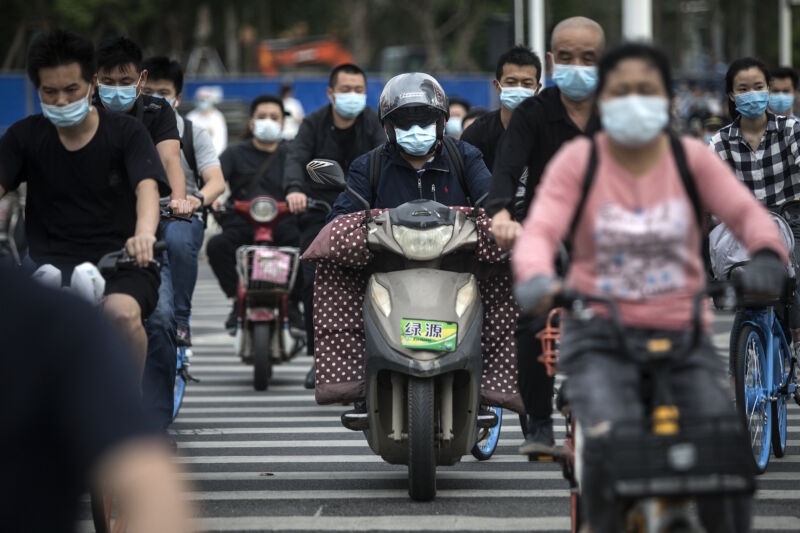
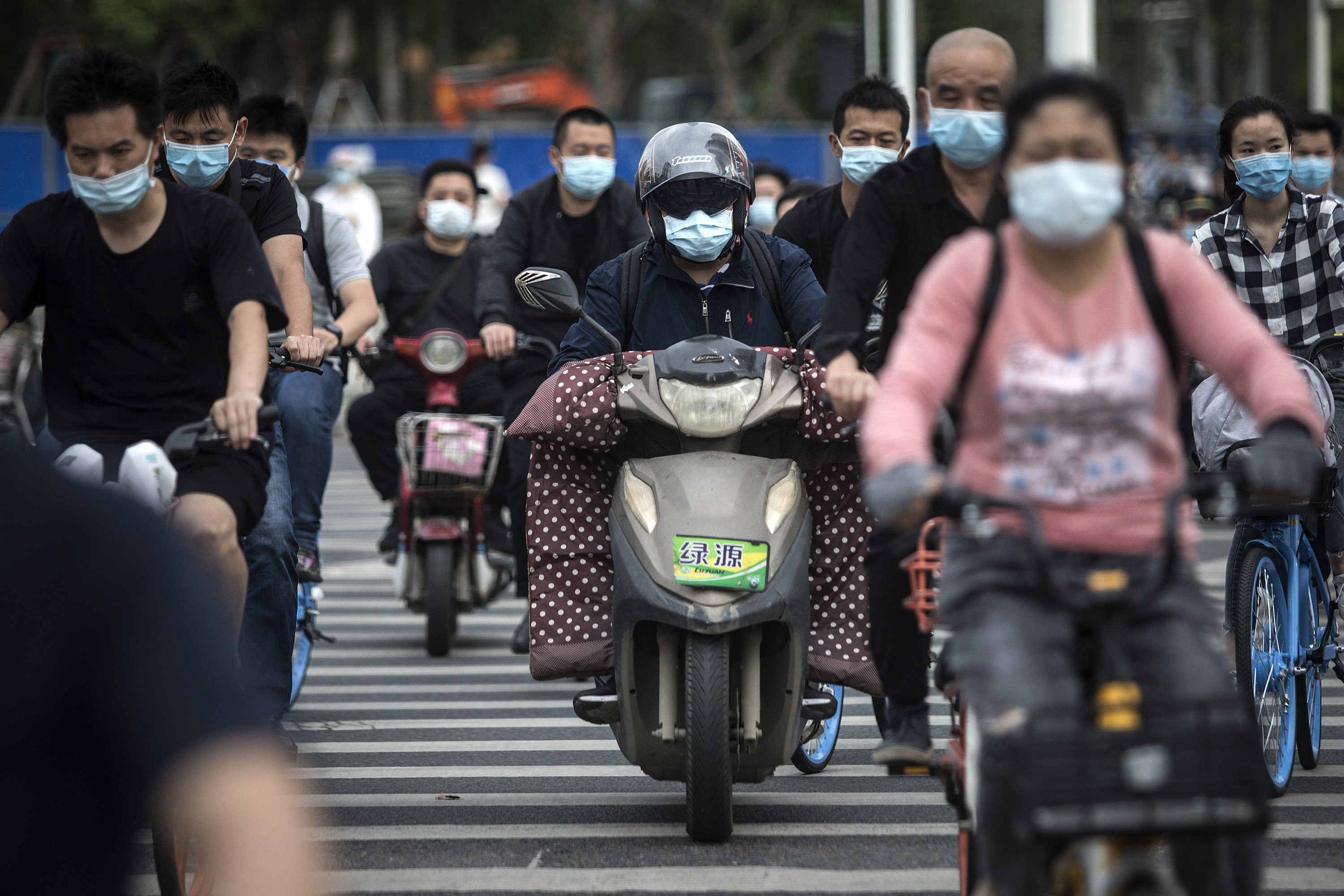
A road is full of masked people on scooters and bikes.

Enlarge / WUHAN, CHINA - MAY 11: Residents wears face masks while riding their bicycles and scooters. The government has begun lifting outbound travel restrictions after almost 11 weeks of lockdown to stem the spread of COVID-19. (credit: Getty | Stringer)

The World Health Organization on Monday called for continued vigilance as several areas that have eased lockdown restriction began to see a resurgence in COVID-19 cases—and the United States begins unbuttoning as well.

The Chinese city of Wuhan—where the pandemic began last December—saw its first cluster of cases in at least a month. The city began reopening in early April.

The cluster was just six cases: an 89-year-old symptomatic man and five asymptomatic cases. All of the infected lived in the same residential community. However, it was enough to spook government officials.

Read 8 remaining paragraphs | Comments

12 May 22:52

After Trump executive order, COVID-19 cases soar 40% in counties with meat processing plants

by Hunter
James.galbraith

Gee, who could have foreseen this

In the wake of Donald Trump's executive order demanding the reopening of the nation's meat processing plants, a new Bloomberg News analysis shows that the COVID-19 pandemic is now spreading at "more than twice the national rate" in counties with major plants.

COVID-19 infections are rose 19% in the week after Trump's April 28 order. In counties with large-scale meat processors, cases rose 40%. It’s not clear yet, however, just how much we can glean from that data.

Upon examination, it's not clear the soaring infections can be directly tied to Trump's order yet. The incubation period for the virus is thought to last up to 14 days, so infections caused by reopening closed plants would only just begin to be seen after a week, and can be more properly measured a week from now.

Bloomberg also cites a rebutting spokesperson from the Meat Institute (cough) who claims the soaring cases are due to the industry's "diligent" testing efforts, which is a good argument if you ignore every uncomfortable question about how the meat industry became a nationwide infection hotspot to begin with.

The truth is likely to be a combination of all of the above. After the deaths of 30 employees and infection of hundreds at individual plants, the industry is indeed eager to test its own workers rather than remain shuttered. It may not be just that cases in rural meat processing-reliant counties have jumped 40% in the last week: it may be that cases in entire regions have soared to higher numbers than we think, but that forced-back-to-work meat processors are the only ones being tested regardless of symptoms.

It also may be that the 40% number represents soaring cases among workers who were already exposed to the virus, introducing wider community spread before Trump ordered them back to work—meaning that the number of cases in those same plants and counties are about to skyrocket now that the same workers have been told to work despite the dangers, and with few changes in actual plant conditions.

We don't know. We can make guesses, but we don't know, and the only way to find out would be to provide all surrounding counties with the same heightened rate of asymptomatic testing that now-panicking meat producers are now providing. That's not going to happen. It also doesn't mean that meat processors are suddenly being "responsible" by agreeing to the testing of their workers; it's the practices of the industry itself that led to these companies and these plants becoming hotspots in the first place, resulting in community spread throughout their counties.

Instead, the Trump-to-Tyson action is a large-scale human experiment. Trump ordering workers back to work even though the industry remains an indisputable virus hotspot is an estimation that the products and profits produced by the reopenings will produce more value than will be offset by assuredly increased COVID-19 deaths in surrounding communities. While the workers themselves remain unconvinced, the White House, Republican campaign strategists, and plant owners seem confident the math will work out right.

The initial figures suggest that it's going to go very wrong. They only way to argue it is not going very wrong is to make the case that the industry itself is making: It's not that COVID-19 cases are absolutely skyrocketing in meat processing-reliant counties—it's that COVID-19 cases are absolutely skyrocketing everywhere in those rural states. We just don't know it yet because the meat processing plants are the only ones forced into testing for it.

That's not better. That's not at all better.

In a few more weeks there may be a fairly definitive answer as to who is right. If deaths, rather than confirmed infections, soar evenly across each state, then the Meat Institute is right: pandemic infections have been evenly spreading everywhere, but were identified mostly just in the handful of places where we were looking. If deaths remain clustered in the counties surrounding meat processors, then the industry’s many critics are right, and the reopening of already-hit plants is the disproportionate cause of those new deaths.

Trump, his team, and Republican governors are all insisting on a third possibility: Actually, maybe the virus is no longer dangerous and deaths will be minimal everywhere because shut up, that’s why. Of all of the possibilities, that is the one with the least evidence behind it, but now that conservatism has dived so deeply into the realms of fantasy and conspiracy, it can’t really counted as a surprise that they are banking on the Magic Unicorn theory.

12 May 19:55

Trump’s lawyers just made appalling arguments to the Supreme Court

by Paul Waldman
James.galbraith

And the hacks were clamoring to support his shit

He'll be the judge of whether your motives in questioning him are good enough.
12 May 19:49

Former supporter of Graham: 'What is the character of a man who will not defend his best friend?'

by Joan McCarter
James.galbraith

God that would be fantastic. Send that twit packing.

Richard Wilkerson, the retired chairman and president of Michelin North America, used to be a big supporter of Sen. Lindsey "Huckleberry" Graham. The South Carolinian bigwig has decided this cycle he's endorsing Graham's Democratic challenger Jaime Harrison, and he's doing it in a big way. That includes an op-ed in the Greenville News.

Wilkerson writes that he started have "real misgivings" about Graham, who he supported until 2017, when Donald Trump attacked the man who was supposedly Graham's friend, the Sen. John McCain. "I asked myself, 'What is the character of a man who will not defend his best friend? If he won't defend John McCain, why would I expect him to defend any of us in South Carolina?'" He concluded that Graham "was more interested in currying favor than in honoring the memory of a true American hero whom he had described as his best friend." The man Wilkerson previously thought of as a moderate who would put country first became "a leader of […] divisiveness," and "his criticism of the behavior of the president morphed into blind defense." In other, non-Wilkerson words, Graham turned into Trump's toady.

Help South Carolina boot Graham. Help the nation boot McConnell and his majority, with your $3.

Coming from a really rich guy, this part is stunning, too: Wilkerson abandoned Graham because "he supported tax change that disproportionately favored those who are financially well off while providing a comparatively small benefit to working people." He's also appalled that Graham opposed increased unemployment payments to workers left out of jobs because of the COVID-19 crisis. "Apparently, he feels that it is OK to share government dollars with those who don’t truly need the money, but deny any small windfall to working people who have lost their jobs. These two actions tell me who is important to him, and I do not agree with his direction."

Wilkerson's not just done with Graham, he's genuinely excited about Harrison. "I had known Jaime for years," he writes, "and had been impressed with his intelligence, his genuine warmth and concern for all people, and his moderate stance on the issues that confront us." Yes, Wilkerson is another one of those never-Trumper Republicans who imagines a happier world gone by in which the Republicans hadn't made political life in the U.S. so toxic.

But this is a never-Trumper who's actually doing something helpful for the nation. He's using his megaphone and his money where it can help—taking out a really, really obnoxious Republican and, just maybe, ending Mitch McConnell's majority.

12 May 19:33

The US House’s Supreme Court defense of its Trump investigation was a disaster

by Ian Millhiser
James.galbraith

Fuck the GOP. Everything is suddenly different when a Republican is being investigated, but mandating a deposition of a sitting president? Totally ok if it's a democrat.

President Trump Gives State Of The Union Address President Donald Trump shakes hands with Supreme Court Chief Justice John Roberts before the State of the Union address in the House chamber on February 4, 2020 in Washington, DC. | Photo by Leah Millis-Pool/Getty Images

This should be a slam-dunk case, but the House’s lawyer seemed evasive and unprepared.

Trump v. Mazars and Trump v. Deutsche Bank should be very easy cases.

Both involve congressional subpoenas seeking, among other things, many of President Trump’s financial documents. The subpoenas target banks and an accounting firm that possess many of Trump’s documents; Trump sued them to prevent them from complying with the subpoena.

The Supreme Court has said repeatedly, over the course of many decades, that courts owe tremendous deference to congressional investigators. The Court held in Quinn v. United States (1955) that congressional power to conduct investigations is “co-extensive with the power to legislate.” Legislative subpoenas are permissible, the Court later explained, whenever that subpoena is “intended to gather information about a subject on which legislation may be had.”

And yet, at Tuesday’s oral arguments on both cases, a majority of the Court seemed concerned that the House has too much power to investigate the president. The Supreme Court appears likely to create a special rule for Trump — or, at least, for sitting presidents — that it wouldn’t apply to any other person.

Part of the story here is that Douglas Letter, the lawyer for the US House, delivered a disastrous performance at Tuesday’s oral argument. Not long after Letter began his argument, Chief Justice John Roberts expressed disagreement with the Court’s longstanding rule giving Congress broad power to conduct investigations, and asked Letter if he could suggest any limits on congressional investigatory power. Letter had no good answer to that question, and he stumbled over various versions of it again and again as the argument wore on.

For someone who cares about presidential accountability, or about precedent, or about the basic rule that no one should be above the law, it was a torturous spectacle. It’s clear that a majority of the Supreme Court believes that decades of prior decisions were wrongly decided, at least when President Trump is involved. And Letter did nothing to allay their concerns.

The one silver lining for anyone troubled by the argument in Mazars and Deutsche Bank, is that the Court appeared more measured in a third case that was also argued on Tuesday, Trump v. Vance. Vance involves a New York grand jury’s investigation into possible criminal activity by the Trump Organization, and the justices appeared more sympathetic to the Manhattan district attorney’s arguments that this investigation should not be shut down than they were to Letter’s arguments in Mazars and Deutsche Bank.

But even if Trump does not prevail in Vance, it’s not clear that such a decision will matter very much in the short term. As several justices emphasized, documents obtained in a grand jury investigation are typically confidential unless they are introduced as evidence in a criminal proceeding. So, if Trump or the Trump Organization is engaged in criminal activity, it is unlikely that the public will see the evidence of that activity any time soon.

Existing law is very unfavorable to Trump

It’s tough to exaggerate just how thoroughly current Supreme Court precedents cut against Trump. The Court has repeatedly emphasized that Congress must have a broad power to conduct investigations, because it is not possible for Congress to make informed law-making decisions without such investigations.

As the Supreme Court explained in Eastland v. United States Servicemen’s Fund (1975), “the power to investigate and to do so through compulsory process ... is inherent in the power to make laws.” Without such a power, “a legislative body cannot legislate wisely or effectively in the absence of information respecting the conditions which the legislation is intended to affect or change.”

Eastland is one of many Supreme Court decisions emphasizing that Congress may conduct nearly any investigation, so long as that investigation is “intended to gather information about a subject on which legislation may be had.”

Courts, moreover, are forbidden to dig into the legislature’s reasons for conducting a particular investigation. “So long as Congress acts in pursuance of its constitutional power,” the Court held in Barenblatt v. United States (1959), “the Judiciary lacks authority to intervene on the basis of the motives which spurred the exercise of that power.”

So that’s what the law says. And under that law, the House wins both Mazars and Deutsche Bank. The first case involves a House Oversight Committee investigation targeting the president’s accounting firm, Mazars USA. It seeks information on whether existing presidential financial disclosure laws are sufficiently robust, or whether they need to be stricter.

Similarly, the Deutsche Bank case involves two parallel House investigations targeting banks that possess some of Trump’s financial records. Among other things, those investigations seek information on whether there are “any links and/or coordination between the Russian government, or related foreign actors, and individuals associated with Donald Trump’s campaign, transition, administration, or business interests, in furtherance of the Russian government’s interests.” These investigations could inform legislation seeking to reduce foreign money laundering and to reduce foreign interference in US elections.

The Court appears to believe that existing law should not apply to the president

Not long after Letter began his argument, Chief Justice Roberts revealed just how sympathetic he is to Trump’s position. Letter’s brief, Roberts noted, states that a congressional investigation must “concern a subject on which legislation can be had.” According to Roberts, this “test is really not much of a test” because it doesn’t impose significant limits on congressional investigations of the president.

Roberts isn’t wrong that the test laid out in Letter’s brief is very permissive of congressional investigations. But it’s not like Letter just made that test up. The idea that Congress may conduct any investigation that concerns “a subject on which legislation can be had” was endorsed by many prior Supreme Court decisions over the course of many decades.

Roberts’s disdain for this longstanding standard was echoed by several of his colleagues. Justice Neil Gorsuch dismissed it as “limitless.” Justice Brett Kavanaugh worried that it would permit congress to declare “open season” on presidents. And Letter was unable to offer a new limit on congressional investigations that would satisfy these justices.

Meanwhile, Justice Samuel Alito repeatedly accused the House of issuing these subpoenas to harass the president — a fact that is irrelevant under Barenblatt’s holding that the Judiciary lacks authority to intervene on the basis of the motives which spurred the exercise of that power.”

Even Justice Stephen Breyer, a Clinton appointee, appeared to lose confidence in Letter’s arguments. Shortly before those torturous arguments came to an end, Breyer said that he’s concerned that the House is seeking “a lot of information and some of it is pretty vague,” and that the task of sorting through these requests and figuring out what information is being turned over could prove too much of a distraction.

It would be hard to sugarcoat this: It was a disaster for Letter and the House. Letter began his argument with a wealth of precedents that clearly support his client’s position, and he appeared completely unprepared for a Court that just does not believe that existing law should apply to President Trump.

With great power comes great immunity

A majority of the justices appeared very sympathetic to an argument, pushed by Trump’s Justice Department, that the president is special and should enjoy special immunity. “The President occupies a unique position in the constitutional scheme,” Trump’s solicitor general argued in his brief, and thus the president must enjoy “immunity from any process that would risk impairing the independence of his office or interfering with the performance of its functions.”

Such immunity is a precious thing indeed, as the Court has historically allowed Congress to conduct investigations that truly did appear to be motivated entirely by political animus.

Consider the facts of Eastland. The “Eastland” in that case was James Eastland, a Mississippi senator and a staunch segregationist whose disdain for civil rights was matched by his passionate support for the Vietnam War. In a 1972 Senate hearing, Eastland spoke of “the almost certain probability that a Communist victory” in Vietnam “would be followed by a bloodletting that would rival the worst bloodlettings that have taken place in Communist countries to date.”

As chair of the Senate Subcommittee on Internal Security, Eastland subpoenaed financial records from anti-war groups that organized opposition to the Vietnam War among servicemembers, and that published newspapers expressing an anti-war viewpoint. The almost certain purpose of these subpoenas was to reveal the group’s donors, and intimidate those donors from making future donations. As one witness testified, Eastland’s subpoenas resulted in “approximately a 50 percent curtailment in money” distributed to the targeted organization’s anti-war activities.

And yet, the Supreme Court upheld this subpoena in Eastland, and it warned future judges against going “beyond the narrow confines of determining that a committee’s inquiry may fairly be deemed within its province.” So long as a subpoena “may fairly be deemed” to support a legislative investigation, the courts may not second-guess that subpoena.

Perhaps Eastland was wrongly decided. Perhaps men like James Eastland should not have this power to harass political enemies into oblivion. But that was emphatically not the posture that the Supreme Court appeared to adopt in the Mazars and Deutsche Bank arguments.

Rather, the Court’s primary concern seemed to be that the most powerful man in the world — the president of the United States — must be given extraordinary immunity from an investigation that could potentially reveal corruption or worse.

The Court probably won’t shut down investigations of the president altogether

It should be said that, while the Court appears likely to give Trump special immunity from investigations, it is still unlikely that he will be given total immunity. Justice Kavanaugh, for example, suggested that a congressional investigation could still go forward if the information sought was “demonstrably critical” to a broader investigation of whether a particular bill is necessary.

Similarly, in Vance, the Court appeared unmoved by Trump’s argument that he should be completely immune from any criminal investigation while in office. Instead, several of the justices appeared to believe that an investigation could move forward, but only if the prosecutor could show that there was a solid basis to believe that the investigation would uncover evidence of wrongdoing — and potentially that there was no other way to obtain relevant evidence, and that this evidence could be lost if the investigation didn’t move forward right away.

It is unlikely, in other words, that the Supreme Court will toss out either the House’s subpoenas or the grand jury subpoenas in Vance altogether. But it is very likely that the Court will announce that the president enjoys special protections against investigations, and then send the cases back down to a lower court to determine if those protections can be overcome in these cases.

That means months, or even years, of additional litigation before these cases are resolved. Enough to push any final resolution past the November election. And enough to ensure that voters will go to the polls without knowing what evidence might have been revealed if the Supreme Court applied the same law to Trump that it applies to anyone else.


Support Vox’s explanatory journalism

Every day at Vox, we aim to answer your most important questions and provide you, and our audience around the world, with information that has the power to save lives. Our mission has never been more vital than it is in this moment: to empower you through understanding. Vox’s work is reaching more people than ever, but our distinctive brand of explanatory journalism takes resources — particularly during a pandemic and an economic downturn. Your financial contribution will not constitute a donation, but it will enable our staff to continue to offer free articles, videos, and podcasts at the quality and volume that this moment requires. Please consider making a contribution to Vox today.

12 May 19:25

Republicans paint COVID-19 as a blue-state problem while White House hides red-state warning signs

by Laura Clawson
James.galbraith

They won't be able to hide the corpses

Donald Trump declared victory on coronavirus testing without talking much about the 80,000 Americans who’ve died of COVID-19 so far. Another thing he didn’t talk about at that Monday press briefing? An unreleased coronavirus task force report finding that infection rates have spiked in new areas in what the media and politicians like to call the heartland.

The May 7 report shows a week-over-week increase of 72.4% or greater in 10 top areas including Nashville, Tennessee; Des Moines, Iowa; Amarillo, Texas; and Central City, Kentucky. That last city had a 650% increase—a huge percentage increase from a low starting point, but the thing about exponential growth is that the raw numbers are small until they suddenly aren’t.

“Locations to watch” include Charlotte, North Carolina; Kansas City, Missouri; Minneapolis, Minnesota; Montgomery, Alabama; Columbus, Ohio; Phoenix, Arizona; and both Lincoln and Omaha, Nebraska. 

You wouldn’t know any of that to listen to either Trump or Republican senators like Rand Paul, who said at a Senate hearing Tuesday, “Really, outside of New England, we've had a relatively benign course for this virus nationwide. And I think the one-size-fits-all that we could have a national strategy and nobody is gonna go to school is kind of ridiculous.”

Even if you discount the possibility that the virus could continue to spread, what is this “relatively benign outside of New England” business? For one thing, neither New York nor New Jersey is in New England, and they lead the nation for deaths. Other non-New England states with more than 1,000 deaths include Illinois, California, Pennsylvania, Michigan, Texas, Florida, Maryland, Georgia, Louisiana, Indiana, and Ohio. And while Paul might discount Illinois, California, and Maryland as practically New England on account of being blue states, and he might discount Michigan, Louisiana, and Georgia as not counting because COVID-19 is so disproportionately killing Black people in those states … well, that still leaves a lot of deaths a Republican like Rand Paul should at least pretend to care about.

And if that unreleased report showing big increases in the proverbial heartland is accurate, and if the Trump administration continues its path of incompetence in fighting the spread of the disease, and Republican governors keep pushing to reopen before it’s safe to do so … if those things are even partially true, then the U.S. is in for a long, long summer.

12 May 18:03

Texas salon owner who was arrested for breaking quarantine admits she received $18,000 in funding

by Aysha Qamar
James.galbraith

To the surprise of absolutely no one.

The Texas salon owner who was sentenced to seven days in jail last week for refusing to close her business amid the novel coronavirus pandemic was released Thursday following a state Supreme Court ruling. According to court documents, Shelley Luther was taken into custody on Wednesday and fined $3,500 for ignoring a temporary restraining order that prohibited her business from operating while a statewide stay-at-home order was in place. Orders to release Luther followed a modification in Texas Gov. Greg Abbott’s executive order in which Abbott removed “confinement as a punishment for violating the order,” BuzzFeed News reported.

“Throwing Texans in jail who have had their businesses shut down through no fault of their own is nonsensical, and I will not allow it to happen,” Abbott said in a statement on Wednesday. “That is why I am modifying my executive orders to ensure confinement is not a punishment for violating an order.” Abbot’s order allowed salons and barbershops to reopen on May 8.

Luther’s case gained quite a following. After her arrest, Texas Republicans demanded her immediate release. The local salon owner has attended a number of anti-lockdown protests, garnering support from residents and Republicans who consider her an “American Hero.” Some even volunteered to pay her fines in addition to contributing to a GoFundMe that raised approximately $500,000 before being removed from the site.

Conservative icons, including Sen. Ted Cruz, went to her salon for a cut following her return. Cruz had formerly tweeted that the decision to jail Luther was “nuts” and criticized the judge for a requesting an apology for Luther’s selfish behavior. Wearing a face mask, Cruz got the ugliest haircut anyone has ever seen on Friday. The Republican said this was his first cut for three months and he traveled all the way to Dallas to have it done. (Judging by the way it looks now, he’s going to want to grow it for another three months.) "Hair salons & barbershops are open in TX today. Just got my hair cut for first time in 3 months at Salon ALa Mode to support Shelley Luther, who was wrongly imprisoned when she refused to apologize for trying to earn a living," Cruz tweeted Friday. "Glad Shelley is out of jail & her business is open!"

Hair salons & barbershops are open in TX today. Just got my hair cut for first time in 3 months at Salon ALa Mode to support Shelley Luther, who was wrongly imprisoned when she refused to apologize for trying to earn a living. Glad Shelley is out of jail & her business is open! pic.twitter.com/yJD8fWb84W

� Ted Cruz (@tedcruz) May 8, 2020

Luther told CBS News that the support she was receiving was not political but given with “true authenticity.” Other “celebrities” in Luther’s eyes also paid her a visit, including former governor of Alaska Sarah Palin."We don't know what to do with all of these celebrities coming in lately. I missed Mrs. Palin when I was held up for a little couple days," Luther told Cruz.

Of course, Donald Trump didn’t want to be left out of jumping on the Republican bandwagon of praise for those who put others in harm’s way. In an interview with Fox News on Friday, Trump called Judge Eric Moyé, who presided over Luther’s case, a “terrible judge” while applauding Luther for being an “incredible representative” for Americans who wish to return to work.

But while Luther claims she had “no choice” but to stay open and is being applauded by conservatives nationwide for her “selfless” act of defying the government to feed her family, many are forgetting that she did in fact receive government funding. During her court hearing, Luther argued that she had to stay open in order to feed her children in addition to supporting the hairstylists she had who “are going hungry because they’d rather feed their kids.”

While Luther stood strong in her stance that her actions were unselfish and she needed to provide her workers with financial support, she later admitted on ABC’s The View that she received stimulus funds prior to her hearing. “You applied for small business loans and unemployment, and you did receive some aid from the government,” said The View host Sunny Hostin. “You received $18,000 from the government.” Hostin added: “So I understand why people feel so strongly about going back to work because they feel that the government isn’t doing its job and taking care of people, but in this instance, two days before you went to court, the money went into your account. So I’m troubled by that.”

The View's Sunny Hostin to Shelley Luther, the Texas salon owner briefly jailed for violating restraining order by keeping hair salon open: Didn't you receive $18,000 in PPP funds before your court date? Luther: Yeah, but I didn't know what to do with the money. pic.twitter.com/HeHcKbQkqZ

� Justin Baragona (@justinbaragona) May 11, 2020

Luther replied that while she understood why some may feel troubled by this revelation, she was unsure what to do with the money, claiming it appeared in her bank account with no instructions. Luther’s lie could not be more obvious—the funds were received from the Paycheck Protection Program (PPP), which distributes funds based on how many employees a business has and what their salaries are. Applicants must declare the information themselves during the vigorous application process, and it’s clearly explained what the funds can be used for. But of course, despite applying for the loan and certifying she understood the terms while doing so, Luther claimed she did not want to spend the money until she was sure how to do so without going into debt.

In addition, Luther added that the very hairstylists who she argued in court that she was supporting by staying open are not actually her employees. “And giving me $18,000 to spend when my stylists aren’t actual employees of mine, they’re actually subleasing,” she said. “So I wasn’t sure if I was even able to give them any of that money as employees because I don’t pay them.”

According to the U.S. Small Business Administration, the PPP program is designed for businesses to keep workers on the payroll. Employers are encouraged to apply for the loan in order to pay employees for at least eight weeks amid the current crisis, and the employers are rewarded with loan forgiveness for doing so. If Luther really does not have any employees, why did she receive $18,000 for a loan that represents at least 75% of employees’ salaries? As Luther’s lies continue, we wonder which Republican will come to her defense next.

12 May 18:02

Fox News urges viewers to 'put freedom before fear,' then extends its own work-from-home order

by Laura Clawson
James.galbraith

Rules aren't for republicans, duh

Fox News personalities have been urging governors to reopen states and telling viewers things like “put freedom before fear” and “herd immunity is our friend.” Anyway, they say, the virus is “easing” and will “eventually burn out.” Meanwhile, the Fox News offices will remain closed to the vast majority of the network’s employees until June 15, CNN’s Brian Stelter reports.

A memo from Fox’s chief operating officer, John Nallen, extended the network’s work-from-home order to June 15, but a source told Stelter: “We were originally told of a potential return to the office in mid-May back in late March, so I wouldn't be surprised if we don't make [the June 15 date] and we push it to late summer.”

Currently, a skeleton staff of technical workers and anchors is operating out of the network’s New York headquarters. From there, reopening would happen in phases … whenever it starts.

But in the meantime, Fox News personalities are going to keep calling this a war not in an effort to argue for fighting it more effectively and seriously, but to convince Americans to just accept tens of thousands more deaths.

12 May 18:00

Trump is badly botching the virus. New polls show Americans know it.

by Greg Sargent
James.galbraith

No shit. Now hopefully they'll vote on it

Trump is losing the argument over coronavirus on just about every level.
12 May 17:49

Clarence Thomas wants to shrink your free speech rights — unless you are a rich donor

by Ian Millhiser
James.galbraith

Yep, another GOP hack

Donald Trump Is Sworn In As 45th President Of The United States Vice President Mike Pence takes the oath of office from Supreme Court Clarence Thomas. | Joe Raedle/Getty Images

Clarence Thomas has an expansive view of free speech for campaign donors. For most everyone else, not so much.

Last Thursday, Justice Clarence Thomas suggested that a major First Amendment doctrine should be abandoned, and that the right to free speech be significantly shrunk in the process. It’s the second time he’s done so in a little over a year, and at least the third time Thomas has called for a major slice of Americans’ free speech rights to be cut away.

His latest call to reduce free speech rights came in United States v. Sineneng-Smith, a case involving an immigration lawyer who fraudulently charged her clients a total of $3.3 million to file for a change in their immigration status that she knew they were ineligible to receive. The Court ruled unanimously, and on narrow procedural grounds, to toss out a ruling benefiting this immigration lawyer.

Though Thomas joined Justice Ruth Bader Ginsburg’s unanimous opinion, he also wrote a separate opinion joined by no other justice. In it, he calls for the Court to reconsider its “overbreadth” doctrine, a First Amendment doctrine that allows courts to cast an especially skeptical eye on laws that restrict free speech. In doing so, Thomas admitted that he is now calling for the Court to reconsider a doctrine that he’s supported in the past.

As a general rule, courts are reluctant to accept “facial” challenges to an allegedly unconstitutional law — challenges that seek to invalidate the law in all of its applications — rather than simply holding that the court will not apply that particular law to a particular plaintiff. The overbreadth doctrine makes it easier to bring a facial challenge under the First Amendment, and thus provides heightened protection against laws that burden free speech. Thomas’s opinion would permit many laws that burden free speech to remain on the books, even after a court determines that they would chill a significant amount of free expression.

It’s not the first time Thomas has articulated a narrow vision of the First Amendment. In 2019, he attacked his Court’s decision in New York Times v. Sullivan (1964), one of the Supreme Court’s foundational First Amendment decisions, which protects journalists against malicious libel suits that could stifle a free press.

Likewise, in Brown v. Entertainment Merchants Association (2011), Thomas suggested that children and teenagers have no First Amendment rights whatsoever. “The practices and beliefs of the founding generation establish that ‘the freedom of speech,’” he wrote in his Brown dissent, “does not include a right to speak to minors (or a right of minors to access speech) without going through the minors’ parents or guardians.” No other justice joined Thomas’s opinion in Brown.

These are serious attacks on the right to free speech. Thomas’s Brown opinion alone, if it were embraced by a majority of his Court, would strip free speech rights from nearly 74 million individuals.

So it’s striking that there is one other case where Thomas took a very expansive view of the First Amendment. In Citizens United v. Federal Election Commission (2010), the Supreme Court held that the right to free speech includes the right of corporations to spend unlimited money on influencing elections. In a partial dissenting opinion, Thomas complained that Citizens United “does not go far enough.”

Justice Thomas, in other words, envisions a much weaker First Amendment for children, journalists, and, indeed, for much of the country. But when wealthy donors seek relief from campaign finance restrictions, Thomas takes a maximalist view of their First Amendment rights.

The overbreadth doctrine, briefly explained

Thomas’s opinion in Sineneng-Smith involves a fairly technical doctrine, but it’s worth taking a moment to understand that doctrine, and Thomas’s critique of it, because that critique is at odds with the view Thomas takes in Citizens United.

As a general rule, federal courts hear two types of constitutional challenges claiming that a federal or state law violates the Constitution. “Facial” challenges seek to invalidate a specific legal provision in its entirety. If a plaintiff prevails in such a challenge, then the legal provision they challenged ceases to operate altogether.

By contrast, when a court declares that a law is invalid “as applied” to a particular plaintiff, that means the law cannot be applied in the specific circumstances that arose in that particular case. But there may still be other circumstances where the law can constitutionally be applied to other individuals.

Ordinarily, courts are reluctant to declare a law invalid on its face. As the Supreme Court explained in United States v. Salerno (1987), “a facial challenge to a legislative Act is ... the most difficult challenge to mount successfully, since the challenger must establish that no set of circumstances exists under which the Act would be valid.”

Think of it this way. Suppose a state passes a law providing that bail for all persons charged with theft shall be at least $100,000. Now suppose that two different criminal defendants challenge this law under the Eighth Amendment, which prohibits “excessive bail.”

The first defendant is a teenager charged with shoplifting a pack of gum from a convenience store. The second is a notorious art thief, with multiple aliases and connections across the globe, who is charged with stealing tens of millions of dollars’ worth of famous paintings. In these circumstances, a $100,000 bail would clearly be excessive for the first defendant. But, if anything, it’s probably too low for the second defendant.

Because there are at least some sets of circumstances where a $100,000 bail would be appropriate for a criminal defendant charged with theft, no one could bring a facial challenge to the state law setting this minimum bail amount. But the shoplifiting defendant could bring an as-applied challenge claiming that, as applied to their rather insignificant offense, a bail of $100,000 is excessive.

And that brings us to the overbreadth doctrine. That doctrine provides that Salerno’s high bar for facial challenges does not apply to First Amendment lawsuits. Rather, as the Supreme Court explained in United States v. Stevens (2010), a law that burdens free speech may sometimes be facially invalidated if “a substantial number of its applications are unconstitutional.”

The reason for this overbreadth doctrine is that the Court believes free speech rights to be particularly fragile. If courts allow statutes that ban some forms of speech to stand, the mere existence of those laws could frighten individuals away from exercising their First Amendment rights. As the Court explained in Broadrick v. Oklahoma (1973), “the possible harm to society in permitting some unprotected speech to go unpunished is outweighed by the possibility that protected speech of others may be muted and perceived grievances left to fester because of the possible inhibitory effects of overly broad statutes.”

Nevertheless, Thomas raises a number of objections to this overbreadth doctrine in his Sineneng-Smith opinion. He claims it is “untethered from the text and history of the First Amendment,” and that, rather than being rooted in the way the First Amendment was originally understood, the overbreath doctrine “first emerged in the mid-20th century.”

One of Thomas’s primary objections to the doctrine is that he believes the Salerno standard should apply universally — indeed, Thomas criticizes the very idea that anyone could bring a facial challenge against any law. “Our ‘modern practice of strik[ing] down’ legislation as facially unconstitutional bears little resemblance to the practices of 18th and 19th century courts,” according to Thomas.

Fair enough. Read in isolation, the new viewpoint that Thomas announced in Sineneng-Smith could be seen as a call for judicial restraint — an assertion that courts should be more cautious before they toss out an act of a legislature altogether.

But in Citizens United, Thomas sang a very different tune.

Thomas’s hypervigilant approach to campaign finance laws

The thrust of Thomas’s opinion in Citizens United, the landmark Supreme Court decision that gutted much of America’s campaign finance laws, is that as-applied challenges are insufficient to protect donors whose political spending is disclosed to the public, and that the Supreme Court should have declared a federal campaign finance disclosure law facially invalid.

The bulk of Thomas’s partial dissent in Citizens United tells horror stories about conservative donors whose donations became public, and who then suffered social or financial consequences. Thomas alleges that a handful of donors to a campaign opposing marriage equality received threats, and he claims that the director of a musical theater company who donated to this campaign “was forced to resign after artists complained to his employer.” Thomas also claims that a restaurant manager who donated to this anti-LGBTQ campaign was “forced to resign” after protesters targeted the restaurant.

A majority of the Court concluded that these incidents were insufficient reason to strike down disclosure laws on their face — although the Citizens United majority added that “as-applied challenges would be available if a group could show a ‘reasonable probability’ that disclosure of its contributors’ names ‘will subject them to threats, harassment, or reprisals from either Government officials or private parties.’”

Thomas, however, rejected this conclusion. “The Court’s promise that as-applied challenges will adequately protect speech is a hollow assurance,” he wrote, adding that “‘the advent of the Internet’ enables ‘prompt disclosure of expenditures,’ which ‘provide[s]’ political opponents ‘with the information needed’ to intimidate and retaliate against their foes.”

In Thomas’s view, disclosure laws must be struck down on their face, in order to prevent campaign donors from facing harassment.

Whatever the merits of this position — which was rejected by all eight of Thomas’s colleagues in Citizens United — it is difficult to reconcile the position Thomas took on disclosure laws in Citizens United with the broad concerns with “our ‘modern practice of strik[ing] down’ legislation as facially unconstitutional” that he announced in Sineneng-Smith.

In fairness, Thomas does concede in his Sineneng-Smith opinion that he has “previously joined the Court in applying” the overbreadth doctrine. So his current opposition to First Amendment facial challenges appears to be a recent development. Perhaps, when Thomas hears another campaign finance case, he will rebuke his own analysis in Citizens United and admit that it is inconsistent with the views he expressed in Sineneng-Smith.

But, at the very least, it is enough to point out that Thomas took a maximalist approach to the First Amendment in Citizens United, and then took such a radically different approach in a more recent opinion.

History is a poor guide for judges interpreting the First Amendment

A common thread running through Thomas’s First Amendment decisions — indeed, a thread that runs through Thomas’s decisions on many topics — is his belief that the Court has departed from the way the Constitution was understood by the generation that framed it. His primary complaint in Sineneng-Smith is that the overbreadth doctrine “is untethered from the text and history of the First Amendment.” Similarly, in McKee v. Cosby (2019), Thomas argues that a venerable Supreme Court decision protecting journalists from malicious libel suits was wrong because it did not apply “the First Amendment as it was understood by the people who ratified it.”

One overarching problem with Thomas’s project of trying to interpret that First Amendment as it was originally understood by the framing generation is that it is far from clear that such a thing is possible. And, if it is possible, there is considerable evidence that the framers’ understanding of the amendment was so narrow that modern-day Americans would find it unacceptable.

Under the English common law, which informed much of the founding generation’s understanding of early American law, the freedom of speech and of the press was largely understood as a right not to have the government stop an individual from publishing a particular statement. But once that statement became public, the individual who made it could still face legal consequences for their speech.

Early Supreme Court decisions interpreting the First Amendment accepted this limited view of free speech. As the Supreme Court concluded in Patterson v. Colorado (1907), the “main purpose” of the First Amendment’s guarantee of free speech and a free press “is ‘to prevent all such previous restraints upon publications as had been practiced by other governments,’ and they do not prevent the subsequent punishment of such as may be deemed contrary to the public welfare.”

Of course, modern Supreme Court decisions reject this narrow view of the First Amendment, but they did not do so because modern-day justices developed a better understanding of how the framers understood the freedom of speech. Many First Amendment scholars have concluded that the task of figuring out that amendment’s original meaning is impossible. As Judge Robert Bork, the failed Supreme Court nominee and godfather of the conservative originalist movement, wrote in 1971, “the framers seem to have had no coherent theory of free speech and appear not to have been overly concerned with the subject.”

Yet while there is little clarity regarding the original understanding of the First Amendment, the framing generation does appear to have had very robust ideas about the legal rights of corporations. And these ideas are hard to square with the expansive vision of corporate rights that the Supreme Court, with Thomas’s enthusiastic support, embraced in Citizens United.

In a 2016 law review article, former Delaware Chief Justice Leo Strine and his former law clerk Nicholas Walter explain that “there were no business corporations operating under so called general corporation statutes“ in the early United States. Rather, corporations were created by the government, and given “detailed charters that their managers were obligated to follow with fidelity.”

As the Supreme Court held in Dartmouth College v. Woodward (1819), “a corporation is an artificial being, invisible, intangible, and existing only in contemplation of law. Being the mere creature of law, it possesses only those properties which the charter of its creation confers upon it either expressly or as incidental to its very existence.”

For this reason, Strine and Walter conclude, Citizens United is out of step with the original understanding of the First Amendment, not because it reads the amendment itself too expansively, but because the framers would not have understood the modern Supreme Court’s conclusion that a corporation possesses constitutional rights.

Thomas claims to root his opinions in the original understanding of the First Amendment, but it’s far from clear that the framing generation had a coherent understanding of that amendment. And in the one area where Thomas takes an unusually expansive approach to the First Amendment — campaign finance — there is considerable evidence that early Americans rejected Thomas’s understanding of corporate rights.


Support Vox’s explanatory journalism

Every day at Vox, we aim to answer your most important questions and provide you, and our audience around the world, with information that has the power to save lives. Our mission has never been more vital than it is in this moment: to empower you through understanding. Vox’s work is reaching more people than ever, but our distinctive brand of explanatory journalism takes resources — particularly during a pandemic and an economic downturn. Your financial contribution will not constitute a donation, but it will enable our staff to continue to offer free articles, videos, and podcasts at the quality and volume that this moment requires. Please consider making a contribution to Vox today.

12 May 17:48

Trump still has a lead among older voters — but Biden is hoping to cut into it

by Sean Collins
James.galbraith

Racism > death for boomers. Just go away already.

Trump, in a navy suit and solid blue tie, looks at the camera with a serious expression on his face, seated at a table. President Donald Trump in the White House cabinet room in May 2020. | Mandel Ngan/AFP/Getty Images

Coronavirus has older adults concerned, but many are still supporting Trump.

President Donald Trump needs older voters to win reelection in November. Some of his senior aides, however, are now reportedly worried about losing them — in part because of how he’s handled the coronavirus pandemic.

According to the New York Times’s Annie Karni and Maggie Haberman, aides like Kellyanne Conway have told the president his internal polling shows him losing the support of Americans 65 and older, whom he won by a 7 percentage-point margin in the 2016 election, at alarming rates. And that a recent poll conducted on behalf of his reelection campaign showed him losing that demographic to presumptive Democratic presidential nominee Joe Biden by at least 10 percentage points.

While Trump’s coronavirus response does seem to have some older adults worried, publicly available national polls haven’t registered a significant decline in older Americans’ support of the president. There seems to be a shift in key swing states, but in national polls, Trump is still leading Biden with that demographic.

The president’s and his team’s response to this internal polling is telling. It reportedly factored into the decision to suspend the president’s daily coronavirus press conferences, with aides concerned Trump’s statements on matters such as injecting bleach to cure Covid-19 and his tendency to downplay the seriousness of the pandemic were causing older backers to question their support of him.

Trump has also done things like proclaiming May “Older Americans Month,” with more pomp than it has sometimes been marked, and has begun to speak directly to older adults about the risks Covid-19 poses to them. He held a press conference on Monday, but seemed to have trouble staying on the messaging about US testing.

It is true older adults are disproportionately at risk for coronavirus complications — the Centers for Disease Control and Prevention has found nearly 80 percent of all confirmed US Covid-19 deaths have been among those above 65, for example — making a renewed focus on them laudable.

But it is not clear that this focus would help the president politically much, as publicly available polls do not overwhelmingly show that they are defecting from him.

National polling suggests Trump is doing okay with seniors — other demographics, not so much

Recent polling shows Biden with a strong national advantage over Trump. The Democrat’s RealClearPolitics polling average puts him 4.4 percentage points ahead of the president. No major poll taken in the past month has shown Trump ahead — the president’s best results have been ties.

Looking only at age, much of what is driving Biden’s advantage appears to be support among Generation Z and millennial voters; for instance, a Monmouth University poll of 739 registered voters taken April 30 to May 4 found 56 percent of voters ages 18-34 backed Biden, while only 29 percent supported Trump, a gap made no less stark by the poll’s 3.6 percentage point (plus or minus) margin of error.

But the poll found Trump did slightly better with older voters (Monmouth groups those 55 and above into this category), with 50 percent support to Biden’s 45 percent.

That lead is within the margin of error, but does represent an improved result compared to a Monmouth poll taken April 3 to 7, back when Trump was still having daily press conferences and when the US death toll was nearing 15,000. In that poll, Biden was ahead of Trump among voters 55 and older, with 49 percent to Trump’s 46 percent.

These numbers, and similar ones, like those found by a YouGov poll taken May 3 to 5 (which found Trump with a weak lead over Biden among voters 65 and older — 3 percentage points in a poll with a 3.3. percentage-point margin of error) would seem to paint a somewhat brighter picture of Trump’s support among older voters than the internal polling cited by the Times. But both polls show Biden winning the popular vote overall. And the Biden overall lead Monmouth’s pollsters recorded — 9 percentage points — is outside that poll’s margin of error.

Older adults’ approval of Trump’s coronavirus response has been fairly stable

The Times notes polls about Trump’s coronavirus response have his campaign concerned about his older adult support. The president’s net approval of his coronavirus response among those 65 and above has been decreasing, according to a Morning Consult tracking poll.

The Morning Consult polling shows data through April 19, making it difficult to draw conclusions from, given the speed at which the pandemic — and the federal government’s messaging about it — have changed. But data from YouGov polls shows a similar downward trajectory: A poll taken March 29 to 31 found the president’s net coronavirus approval rating among voters 65 and older to be 9 percentage points; a poll taken about one month later, from April 26 to 28, found it to be 6 percentage points among the same demographic; and YouGov’s most recent poll, taken May 3 to 5 found approval among voters 65 and above to be 4 percentage points.

But that trend comes with some important caveats.

Net approval rating is calculated by subtracting the number of those who disapprove from the number of those who approve. And the president’s coronavirus approval ratings — at least in YouGov’s work — haven’t changed very much with time.

In the March 29 to 31 poll, 36 percent of voters over 65 said they “strongly” approved of Trump’s handling of the virus; in the April 26 to 28 poll that number fell to 35 percent; and in the most recent poll, it is back to 36 percent. The number that “somewhat” approves has changed slightly — it was 17 percent in the March and April polls, and was recorded to be 14 percent in the most recent work — but what has really changed is the number of people who disapprove.

In March, 34 percent strongly disapproved, a figure that rose to 41 percent in April, before falling to 36 percent in May. These fluctuations are notable, but didn’t appear to arise due to any significant erosions of support — instead respondents who were ambivalent or told pollsters they “weren’t sure” how they felt appeared to decide they believed Trump was doing a poor job. In May, for instance, the number of respondents above 65 telling pollsters they only somewhat disapproved of Trump’s response increased, up to 10 percent from April’s 5 percent.

It is true these previously undecided voters could represent valuable swing voters, but Trump’s core base of support appears unchanged in this polling — particularly considering the margins of error (3.2, 3.2, and 3.3 percentage points for each month).

One other bright spot for Trump in recent polling is that his coronavirus approval rating among Republicans of all ages remains strong — in YouGov’s May survey, it is at 84 percent.

But Monmouth’s polling does reveal one general area of concern: Voters in swing districts appear to increasingly be favoring Biden; the university’s April 3 to 7 poll found Biden leading among swing voters (those living in counties in which neither Trump nor former Secretary of State Hillary Clinton won by a double-digit margin) by 4 percentage points. In their April 30 to May 4 poll, the school’s pollsters found Biden beating Trump among swing voters by 16 percentage points.

All this suggests that the Trump campaign’s internal concern over the president’s standing with older adults may not reflect the whole picture. But overall national polling would seem to indicate Trump does have good reason to be worried about his reelection prospects.


Support Vox’s explanatory journalism

Every day at Vox, we aim to answer your most important questions and provide you, and our audience around the world, with information that has the power to save lives. Our mission has never been more vital than it is in this moment: to empower you through understanding. Vox’s work is reaching more people than ever, but our distinctive brand of explanatory journalism takes resources — particularly during a pandemic and an economic downturn. Your financial contribution will not constitute a donation, but it will enable our staff to continue to offer free articles, videos, and podcasts at the quality and volume that this moment requires. Please consider making a contribution to Vox today.

12 May 03:32

Tesla drops lawsuit against Alameda County [Updated]

by Timothy B. Lee
James.galbraith

where the fuck is his board of directors?

A casually dressed man appears flip during a presentation.

Enlarge / Elon Musk in 2020. (credit: BRENDAN SMIALOWSKI / Getty)

Update (May 21): Tesla's lawsuit against Alameda County has been dismissed at Tesla's request. The move comes a week after Alameda County signaled that it wasn't going to try to stop the company from re-opening its Fremont factory despite a continued shelter-in-place order in the San Francisco Bay Area.

Original story (May 11) follows:

Elon Musk is planning to defy county officials as he battles to reopen Tesla's Fremont factory in the face of a continued shelter-in-place order in Alameda County, California, Musk announced on Twitter on Monday.

Read 14 remaining paragraphs | Comments

11 May 23:29

It took one question for a reporter to expose Trump’s latest baseless Obama conspiracy theory

by Aaron Rupar
James.galbraith

What an idiotic child

Trump arrives for his Rose Garden news conference on Monday. | Drew Angerer/Getty Images

Monday’s news conference ended with Trump melting down in response to questions from female reporters.

On Monday, a reporter exposed President Donald Trump for yet again peddling a nonsensical conspiracy theory about Barack Obama.

Hours after Trump posted a string of tweets and retweets about “Obamagate” — a new conspiracy theory that holds Obama responsible for masterminding the Russia investigation and railroading former Trump administration National Security Adviser Michael Flynn into a guilty plea for lying to the FBI (never mind that there’s no evidence of investigatory misconduct) — Philip Rucker of the Washington Post called Trump’s bluff.

“In one of your Mother’s Day tweets, you appeared to accuse President Obama of ‘the biggest political crime in American history, by far’ — those were your words. What crime exactly are you accusing President Obama of committing, and do you believe the Justice Department should prosecute him?” Rucker asked, during a news conference that was ostensibly about the coronavirus.

Trump had nothing.

“Uh, Obamagate. It’s been going on for a long time,” he began. “It’s been going on from before I even got elected, and it’s a disgrace that it happened, and if you look at what’s gone on, and if you look at now, all this information that’s being released — and from what I understand, that’s only the beginning — some terrible things happened, and it should never be allowed to happen in our country again.”

Of course, “Obamagate” does not involve a crime, and there’s no evidence that Obama or his top officials conspired against Trump — quite the opposite. So when Rucker pressed the point by asking what exactly the ostensible crime was, Trump resorted to smears.

“You know what the crime is. The crime is very obvious to everybody. All you have to do is read the newspapers, except yours.”

You might be wondering why this even came up during a press conference about coronavirus testing. The answer appears to be that with the US leading the world in deaths and the number of new cases in the country not yet showing a strong downward trend, Trump believes fresh conspiracy-mongering about Obama is politically useful for him — even if there is no basis for them.

The rest of the press conference proved the point: After repeating misinformation about testing and the state of coronavirus cases, he abruptly ended the event and huffed off the stage when two female reporters asked him pointed questions.

If the press conference was meant to show that Trump has things under control, it failed spectacularly

After Trump prematurely declared victory over the coronavirus, lied about US testing capacity, and misled people about how America’s response stacks up to other countries in the world, Monday’s news conference ended with a bang.

His meltdown began when Weijia Jiang of CBS asked him to explain why he seems to be fixated on competing with other countries while 2,000 or so Americas continue to lose their lives each day from the coronavirus. Trump fired back by telling her to “ask China.”

“Don’t ask me — ask China that question,” Trump said.

Jiang, who is Asian American and who previously said that a White House official referred to the coronavirus as the “Kung-Flu” to her face, followed up by asking Trump, “Sir, why are you saying that to me, specifically?”

“I’m telling you,” Trump said, “I’m not saying it specifically to anybody. I’m saying it to anybody who would ask a nasty question like that.”

Trump followed that seconds later up by throwing a tantrum when Kaitlan Collins of CNN tried to ask him a question, then storming away.

In sum, Trump’s performance featured a baseless conspiracy about America’s first black president, incendiary comments toward an Asian American journalist, and then a press conference-ending fit. This shtick may have served him well at times, but in the context of the pandemic, one can see why his advisers reportedly concluded weeks ago that these press conferences are doing him no favors.


Support Vox’s explanatory journalism

Every day at Vox, we aim to answer your most important questions and provide you, and our audience around the world, with information that has the power to save lives. Our mission has never been more vital than it is in this moment: to empower you through understanding. Vox’s work is reaching more people than ever, but our distinctive brand of explanatory journalism takes resources — particularly during a pandemic and an economic downturn. Your financial contribution will not constitute a donation, but it will enable our staff to continue to offer free articles, videos, and podcasts at the quality and volume that this moment requires. Please consider making a contribution to Vox today.

11 May 21:34

Elon Musk Restarts Tesla Factory In Defiance of County Orders

by BeauHD
James.galbraith

That seems unwise

Tesla CEO Elon Musk said Monday that the company's factory in Fremont, California is open and has restarted production despite a stay-at-home order issued by Alameda County. TechCrunch reports: Musk said in tweet Monday afternoon that he will "be on the line," a reference to the assembly line at the factory where Tesla makes the Model X, Model S, Model 3 and Model Y. He added "if anyone is arrested, I ask that it only be me." Musk's reopening follows days of public venting on Twitter as well as a lawsuit all aimed at pressuring Alameda County officials to allow the company to reopen its factory. Tesla filed a lawsuit Saturday against Alameda County seeking injunctive relief, an effort to invalidate orders that have prevented the automaker from reopening. Tesla had planned to bring back about 30% of its factory workers Friday as part of its reopening plan, after California Gov. Gavin Newsom issued new guidance that would allow manufacturers to resume operations. However, the governor's guidance included a warning that local governments could keep more restrictive rules in place. Alameda County, along with several other Bay Area counties and cities, last week extended the stay-at-home orders through the end of May. The orders were revised and did ease some of the restrictions. However, it did not lift the order for manufacturing.

Read more of this story at Slashdot.

11 May 21:17

Trump’s White House banner claims “America leads the world in testing.” That’s wrong.

by German Lopez
James.galbraith

no shit

President Donald Trump delivers remarks at the White House about coronavirus testing on May 11. | Drew Angerer/Getty Images

Other countries are still doing much better with Covid-19 testing.

As President Donald Trump spoke at the Rose Garden on Monday about coronavirus testing, a banner behind him made a bold claim: “AMERICA LEADS THE WORLD IN TESTING.”

That claim, however, is very misleading.

It’s true that the US leads the world in total number of tests, in large part because it’s a big country and has the most confirmed Covid-19 cases and deaths globally. But when controlling for population, America is behind several countries in terms of Covid-19 testing: As of May 9, the US testing rate is roughly 26 per 1,000 people, according to Our World in Data; in comparison, Denmark’s rate is 53, Italy’s is 42, New Zealand’s is 39, Germany’s is 33 (as of May 3), and Canada’s is 28.

A chart showing different countries’ testing rates. Our World in Data

Testing is crucial to controlling the coronavirus pandemic. When paired with contact tracing, testing lets officials track the scale of an outbreak, isolate the sick, quarantine those with whom the sick came in contact, and deploy community-wide efforts as necessary. Aggressive testing and tracing is how other countries, including South Korea and Germany, got their outbreaks under control, allowing them to start reopening in the past couple of weeks (though even they have scaled back their reopenings after new spikes in Covid-19 cases).

“The whole point of this social distancing is to buy us time to build up capacity to do the types of public health interventions we know work,” Natalie Dean, a biostatistics professor at the University of Florida, told me. “If we’re not using this time to scale up testing to the level that we need it to be … we don’t have an exit strategy. And then when we lift things, we’re no better equipped than we were before.”

The US still falls short on testing overall

There’s no widely accepted standard for this, but experts generally agree that the US needs to be doing much more testing. Some have called for conducting as little as 500,000 tests a day, while others have called for up to tens of millions.

Nationwide, the US is not hitting the proposed minimum. Based on data from the Covid Tracking Project, America averaged roughly 276,000 tests a day during the week of May 3. That’s up from an average of 150,000 a day in the first half of April, but only a little more than half of the bare minimum experts recommend.

A chart showing the number of coronavirus tests in the US each day. German Lopez/Vox

At the state level, the Times estimated that the daily minimum of 500,000 tests amounts to about 152 tests per 100,000 people. Only two states, Rhode Island and North Dakota, met this standard as of May 7. Again, this is the proposed minimum; some experts argue the US needs multiple times that number of tests.

Still, there are some signs of things getting a bit better. Not only has the number of daily new tests nationwide increased in recent weeks, but states have also seen an improvement in another important metric: the positive rate.

This standard measures what percent of people test positive for the coronavirus among all tests done. If the positive rate is high, it’s likely not enough people are being tested, since it suggests that only people with a high chance of infection are getting tested, potentially missing a lot of people without significant symptoms. Experts recommend a positive rate no higher than 10 percent — and preferably much lower.

In recent weeks, the nationwide positive rate has fallen below 10 percent — hitting 9 percent the week of May 3, based on Covid Tracking Project data. Most states have seen their positive rates fall below that threshold, too. It’s a sign that states are now getting enough testing capacity to match their outbreaks.

As promising as that might be, experts caution that improvements in the positive rate have to be matched with adequate numbers of tests and sustained decreases in Covid-19 cases to safely reopen parts of the economy. Testing also has to be paired with contact tracing — which might require hiring 100,000-plus “disease detectives” — to truly control outbreaks.

When all those other factors are taken into account, the US is still playing catch-up to other countries.


Support Vox’s explanatory journalism

Every day at Vox, we aim to answer your most important questions and provide you, and our audience around the world, with information that has the power to save lives. Our mission has never been more vital than it is in this moment: to empower you through understanding. Vox’s work is reaching more people than ever, but our distinctive brand of explanatory journalism takes resources — particularly during a pandemic and an economic downturn. Your financial contribution will not constitute a donation, but it will enable our staff to continue to offer free articles, videos, and podcasts at the quality and volume that this moment requires. Please consider making a contribution to Vox today.


Correction: This article originally misstated the day, because time has become incomprehensible.

11 May 17:47

Republicans have already decided Trump is going to lose

by Paul Waldman
James.galbraith

Which means more obstruction, bad faith, and gerrymandering. Hopefully someone on the Dem side will have a fucking spine this time.

Instead of pulling out all the stops to save the economy, Republicans are preparing for life under President Biden.
11 May 17:47

Trump’s latest effort to gaslight America is falling apart

by Greg Sargent
James.galbraith

Funny how biology does that

Trump and his own aides are terrified of the coronavirus he's relentlessly downplaying.
11 May 17:43

Colorado Cafe Packed with Unmasked Customers, Employees at Illegal Mother’s Day Reopening in Defiance of State’s COVID-19 Regulations: WATCH

by Andy Towle
James.galbraith

Fucking idiots

A Colorado cafe was flooded with unmasked Mother’s Day customers when it reopened in defiance of the state’s COVID-19 public health orders which allows only takeout and delivery services.

Nick Puckett, a reporter’s for Colorado Community Media filmed the crowd packing the cafe. One customer cheered for Puckett, flashing a ‘thumbs-up’ sign.

Governor Jared Polis issued a statement through his deputy press secretary Shelby Wieman: “These restaurants are not only breaking the law, they are endangering the lives of their staff, customers, and community. Under Safer at Home, restaurants, food courts, cafes, coffeehouses, and other similar places of public accommodation offering food or beverage for on-premises consumption are still closed.  Delivery and drive-up service is available. Coloradans can contact their local public health department if they believe someone is violating Safer at Home.”

The restaurant released a statement on Twitter, saying, “We are standing for America, small businesses, the Constitution and against the overreach of our governor in Colorado!!”

The post Colorado Cafe Packed with Unmasked Customers, Employees at Illegal Mother’s Day Reopening in Defiance of State’s COVID-19 Regulations: WATCH appeared first on Towleroad Gay News.