Shared posts

02 Jun 22:46

[Eugene Volokh] "When There's an Unarmed Person Coming at Them with a Knife or Something, You Shoot Them in the Leg"

by Eugene Volokh
James.galbraith

Which begs the question, why the fuck give these shitheads guns?

[Advice from Vice-President Biden.]

From Yahoo News (David Knowles):

"Instead of standing there and teaching a cop, when there's an unarmed person coming at them with a knife or something, you shoot them in the leg instead of in the heart is a very different thing. There's a lot of different things that could change," Biden said in a meeting with community leaders at Bethel AME Church in Wilmington, Del.

I don't fault Biden much for the "unarmed person coming at them with a knife" slip—that happens in oral remarks—but I think his broader advice doesn't make sense. Most studies suggest that most police officers, even with substantial training, miss with 50-75% of their shots; here, for instance, is the RAND report on the NYPD:

As has been reported nationally, police officers often miss their targets (Morrison,
2006, p. 332). The NYPD reports hit-rate statistics both for officers involved in
a gunfight and for officers who shoot at subjects who do not return fire. Between
1998 and 2006, the average hit rate was 18 percent for gunfights. Between 1998
and 2006, the average hit rate in situations in which fire was not returned was
30 percent. In 2006, the hit rate against subjects who did not return fire was 27
percent.

The LAPD reported a hit rate of 48% in 2016, 38% in 2015, 34% in 2014, 20% in 2013, and 27% in 2012; I suspect that the 48% is at least as much random variation as real improvement. Politifact reports similarly low numbers from other studies (with a couple of highly questionable 1991 100%s in San Antonio and San Francisco, and an outlier 56% in 1970s L.A.).

And this isn't surprising; most police officers have never fired a gun in a combat situation. When someone is charging at you with any weapon, and the adrenaline is pumping, you're not going to be a cool sniper-level shooter, especially if this has never happened to you before. Going to the range will only do so much to improve your performance in such situations.

Now imagine what would happen if police officers shifted from how they're trained to shoot—for the center of mass in the torso, where if you miss your specific target you still have a good chance of hitting some part of the attacker's body—to shooting at the leg. Not going to turn out well, I think; fewer hits on the attacker, more dead police officers, and probably more bullets hitting bystanders, where there are bystanders present.

Police officers shouldn't shoot at all at people who aren't really posing a serious threat to them or to others. But if they reasonably fear death or serious injury—and a "person coming at them with a knife" would surely qualify—they should shoot in the way that's most likely to hit and stop their attacker. And that's in the torso, not the leg.

Obligatory citation: Vice-President Biden's previous gun advice.

02 Jun 22:46

U.S. officials flat-out lie about their assault on First Amendment peaceful assembly

by Kerry Eleveld
James.galbraith

Fucking insane

U.S. officials crossed the Rubicon this week when they not only abetted and perpetrated an assault on peaceful protesters Monday evening outside the White House but subsequently lied on Tuesday about their role in the attack. 

The chaotic scene of federal police using shields, batons, tear gas, and rubber bullets to clear Lafayette Park of peaceful citizens played out on TV screens across America, conveniently coming during dinner hour on the East Coast. The lack of provocation or aggression of any kind was clear as police armed in riot gear gassed protesters, ramming them with their shields to push them back. 

Inside the White House Rose Garden, Donald Trump was simultaneously declaring himself the "president of law and order" and promising that "thousands and thousands of heavily armed soldiers, military personnel and law enforcement officers" would be deployed to stop the rioting and looting. Trump then exited the White House and shuffled across a cleared square of the park flanked by an entourage of Secret Service agents and the nation's top military and law enforcement officials, including Attorney General William Barr, Secretary of Defense Mark Esper, and Joint Chiefs Chairman Gen. Mark Milley, who was dressed in combat fatigues rather than the dress uniforms always donned by active-duty military officers visiting the White House. 

Trump looked like a buffoon but the message was clear: He was declaring war on the constitutionally guaranteed right of The People to peaceably assemble. And Barr, Esper, and Milley were all there to help prop up draft dodger Trump's show of of force. 

Once the reviews were in, however, everyone but Barr quickly made flimsy efforts to distance themselves from one of the most deeply un-American abuses of power by a president in modern memory. 

Esper and Milley deployed a Pentagon spokesperson on background to claim they had no idea they were being used as props in Trump's militaristic fantasy. Really, an anonymous DOD official was the best they could do to disavow their involvement? That is just pathetic. If they had any integrity whatsoever, they would hold a press conference or, at the very least, issue a joint statement. Until they do: complicit. Period.

Park police similarly lied about the event, claiming they hadn't deployed tear gas, when everyone at the scene was perfectly clear that tear gas was exactly what had been hurled at them.

The only participant who was overtly giddy about the entire episode was Barr, who issued a statement Tuesday calling the previous evening "a more peaceful night" in D.C. and thanking Esper and Milley by name for their "support." Barr personally ordered the violent assault on the protesters, according to reporting from The Washington Post.

"There will be even greater law enforcement resources and support in the region tonight," Barr ominously promised in his statement.

Top U.S. military and law enforcement officials have placed themselves clearly and indisputably on the side of authoritarianism. Godspeed to all peaceful protesters tonight.

02 Jun 22:37

Mark Zuckerberg on leaked audio: Trump’s looting and shooting reference “has no history of being read as a dog whistle”

by Shirin Ghaffary
James.galbraith

Christ what an idiot. And obviously Facebook stands for the proposition that Trump can directly quote whatever racist he wants and promote violence, and Facebook is completely fine with it.

Facebook co-founder and CEO Mark Zuckerberg testified before the House Financial Services Committee in October 2019. | Chip Somodevilla/Getty Images

On a tense call with employees, the Facebook CEO defended his decision not to moderate Trump’s posts.

In an internal video call with Facebook employees on Tuesday obtained by Recode, CEO Mark Zuckerberg doubled down on his controversial decision to take no action on a post last week from President Donald Trump. In the post, Trump referred to the ongoing protests in the US against racism and police brutality and said, “when the looting starts, the shooting starts.”

Facebook’s handling of Trump’s post — which included language similar to what segregationists used when referring to black protesters in the civil rights era — has divided employees at Facebook and prompted them to openly criticize Zuckerberg in a way they never have before. Around 400 employees staged a virtual walkout of work on Monday, at least two employees have resigned in protest, others have threatened to resign, and several senior-level managers have publicly disagreed with Zuckerberg’s stance — calling for him to take down or otherwise moderate Trump’s post, as Facebook’s competitor Twitter already has.

This tension spilled over into the Tuesday Q&A meeting that around 25,000 employees tuned into — with several employees’ posing questions that were highly critical of the company’s actions and policies, and scrutinized whether the company is listening to racially diverse voices in its upper ranks.

“I knew that the stakes were very high on this, and knew a lot of people would be upset if we made the decision to leave it up,” Zuckerberg said on the call. He went on to say that after reviewing the implications of Trump’s statement, he decided that “the right action for where we are right now is to leave this up.”

Zuckerberg said that he did a thorough analysis of the history around the apparent reference in Trump’s post, which he called “troubling,” but ultimately did not find it to be an incitement of violence under Facebook’s policies.

“We basically concluded after the research and after everything I’ve read and all the different folks that I’ve talked to that the reference is clearly to aggressive policing — maybe excessive policing — but it has no history of being read as a dog whistle for vigilante supporters to take justice into their own hands,” Zuckerberg said on the call. He also said that, overall, Facebook still reserves the right to moderate Trump.

“This isn’t a case where [Trump] is allowed to say anything he wants, or that we let government officials or policy makers say anything they want.”

Facebook has largely avoided moderating Trump’s posts on its platform. In March, however, after Recode and other outlets reported on deceptive advertisements that made a Trump campaign questionnaire appear to be the official 2020 census, Facebook removed these ads from its platform.

After opening the call, Zuckerberg went on to take questions from a preselected list, with employees asking questions via videoconference. In one of several tense exchanges, an employee asked Zuckerberg to confirm how many black people were involved in Zuckerberg’s final decision not to take down Trump’s post. Zuckerberg’s answer: just one person (Facebook’s global diversity officer, Maxine Williams). Zuckerberg said only a small group of people were involved in the decision-making process, including Facebook COO Sheryl Sandberg and policy VP Joel Kaplan, who has come under scrutiny for reportedly stymieing efforts to reduce polarization on the platform and openly supporting Supreme Court Justice Brett Kavanaugh during his controversial Senate hearings.

The employee pressed why Facebook’s head of integrity, Guy Rosen, who is tasked with overseeing efforts around general user safety on the platform, wasn’t in the final group of decision-makers.

In response, Zuckerberg appeared to stumble with his reasoning, first saying that he wasn’t sure if Rosen was a part of the final decision. He then saying that he wasn’t, but that ultimately Rosen is responsible for building and enforcing policies overall and not this particular decision.

“I don’t think it’s great that we’re not super clear on whether the VP of integrity was included on a matter of voter suppression and societal violence,” the employee said on the videoconference.

“How can we trust Facebook leadership if you show us a lack of transparency?” asked another employee.

When asked about the criticism Facebook faced in the meeting, a spokesperson for the company sent Recode the following statement: “Open and honest discussion has always been a part of Facebook’s culture. Mark had an open discussion with employees today, as he has regularly over the years. He’s grateful for their feedback.”

In an acknowledgement of employees’ anger over the situation, Zuckerberg outlined several areas of self-designated improvement for Facebook on the call, including being more transparent around the decision-making process for moderating contentious posts.

Most notably, Zuckerberg said the company is considering adding labels to posts by world leaders that incite violence, instead of simply leaving them up or taking them down. He also said that since the US may be entering a “prolonged period of civil unrest,” they may change their policy on what kind of announcements government leaders can make about state violence, such as excessive use of police force.

While Zuckerberg was at times conciliatory, he was defensive of Facebook’s stance not to make what he views as knee-jerk decisions against content that people could find personally offensive. He said even if they do change their policies around moderating potentially violent political speech like Trump’s post, it would not happen overnight.

“These policies have to be developed,” Zuckerberg said. There’s “no way we can do something like that on the fly.”

That brings up the question of why Facebook isn’t more prepared to moderate political speech that pushes the boundaries of its platform’s rules on inciting and glorifying violence. Since the 2016 US presidential election, how Facebook moderates content has come under fire, and the company has promised to do better. Its long-awaited independent oversight board meant to review controversial cases like Trump’s post still hasn’t officially launched; meanwhile, the next US presidential election is less than six months away.

On the call, Zuckerberg acknowledged that this is only the beginning of employee discussion on the company’s handling of the very real controversies coming its way around race, politics, and police violence.

“I know we’re going to keep talking about this, some of the issues, they’re deep and they’re not going to go away any time soon,” Zuckerberg said.


Support Vox’s explanatory journalism

Every day at Vox, we aim to answer your most important questions and provide you, and our audience around the world, with information that has the power to save lives. Our mission has never been more vital than it is in this moment: to empower you through understanding. Vox’s work is reaching more people than ever, but our distinctive brand of explanatory journalism takes resources — particularly during a pandemic and an economic downturn. Your financial contribution will not constitute a donation, but it will enable our staff to continue to offer free articles, videos, and podcasts at the quality and volume that this moment requires. Please consider making a contribution to Vox today.

02 Jun 22:15

6 Atlanta officers have been charged in violent tasing incident

by Katelyn Burns
James.galbraith

Sue them into oblivion. Qualified Immunity must go.

Police officers advance after firing tear gas during a demonstration on May 31 in Atlanta, Georgia. | Elijah Nouvelage/Getty Images

A 22-year-old student was left with a fractured arm and needed 20 stitches from the encounter, according to his attorney.

Arrest warrants have been issued for six Atlanta police officers who were caught on video tasing two college students Saturday. The students were stopped for violating curfew, Georgia’s Fulton County District Attorney Paul Howard Jr. said Tuesday.

The officers stand accused of aggravated assault, illegally pointing a taser, and criminal damage to property, said prosecutors. Video of the brutal arrest went viral over the weekend, leading to the firing of two officers involved; three others were placed on desk duty.

“The conduct involved in this incident is not indicative of the way that we treat people in the city of Atlanta,” Howard said in a news conference on Tuesday.

As seen in police body camera footage, a group of officers surrounded a car that 22-year-old Messiah Young was driving. They opened the passenger’s side door, and demanded 20-year-old Taniyah Pilgrim, who was sitting the passenger’s seat, get out.

Although Pilgrim asked repeatedly what was going on, she did not receive an answer. As officers attempted to pull her from the still-moving car, she screamed for Young to stop the vehicle.

That’s when police, without giving her time to get out, hit her with a taser. Separate body camera footage shows another officer used his baton to smash out the driver’s side window before tasering Young. The two were subsequently dragged out of the car and placed under arrest. All of this occurred as other officers on the scene slashed the tires on the car — which can be seen in the video that went viral.

According to his attorney, Young suffered a fractured arm and needed 20 stitches as a result of the incident.

“We felt like we were going to die in that car,” Pilgrim said Monday.

The incident has brought widespread condemnation from city leaders. “I know that we caused further fear to you in a space that’s already so fearful for so many African Americans, and I am genuinely sorry,” Atlanta Police Chief Erika Shields said in a news conference Sunday. “This is not who we are. This is not what we’re about.”

Atlanta Mayor Keisha Bottoms said Sunday that charges against both students were dropped and that Young was released from police custody.

The arrest warrants come amid outcry over how police have responded to protests around the nation — and as videos of violent police interactions with protesters go viral. In New York City, video of two police SUVs plowing into protesters went viral, prompting an excuse from Mayor Bill de Blasio that he later tempered. Dozens of journalists have been assaulted and arrested by police while covering the protests. Monday, law enforcement officials in Washington, DC, were criticized for using military tactics on protesters and for clearing a peaceful protest in front of the White House with tear gas in order to facilitate photographs of the president.

Several officers have faced disciplinary action over their behavior patrolling protests

While few law enforcement officers have faced formal charges over excessive force while patrolling the anti-police brutality protests, several have faced less serious consequences.

The most high-profile case is perhaps that of Steve Conrad, who was fired from his post as Louisville, Kentucky, police chief after it was discovered that two officers involved in the fatal shooting of area businessman David McAtee failed to turn on their body cameras. Protests in Louisville have been prompted in part by the death of Breonna Taylor, who was killed after police executed a no-knock warrant on her home in the middle of the night.

“This type of institutional failure will not be tolerated,” Louisville Mayor Greg Fischer said on Monday.

Also in Louisville, an officer who was caught on camera firing pepper balls at a local TV news crew on Saturday has been reassigned pending an investigation.

“Officers do have orders not to fire pepper balls at media,” said Assistant Police Chief Lavita Chavous Monday, as she asked the public for understanding over the media being hit, saying when “protesters are doing something unlawful or something they are not supposed to do it’s sometimes an unintended consequence when we fire the pepper balls into the crowd.”

In Denver, Colorado, Officer Thomas McClay was been reassigned to desk duty after posting a picture of himself and two colleagues in riot gear with the caption “let’s start a riot.” An internal affairs investigation of the incident has been ordered.

And an investigation into San Jose police officer Jared Yuen has begun after video emerged of the officer swearing at protesters. He was later identified as the officer who shot a rubber bullet at a peaceful protester.


Support Vox’s explanatory journalism

Every day at Vox, we aim to answer your most important questions and provide you, and our audience around the world, with information that has the power to save lives. Our mission has never been more vital than it is in this moment: to empower you through understanding. Vox’s work is reaching more people than ever, but our distinctive brand of explanatory journalism takes resources — particularly during a pandemic and an economic downturn. Your financial contribution will not constitute a donation, but it will enable our staff to continue to offer free articles, videos, and podcasts at the quality and volume that this moment requires. Please consider making a contribution to Vox today.

02 Jun 20:27

Scott Walker Trashed After Hailing Trump’s Bravery for Walking Across the Street Behind a Phalanx of Police and Tear Gas

by Andy Towle
James.galbraith

Meet the reason Wisconsin is such a shithole

Former Wisconsin Governor Scott Walker was trashed on social media Tuesday after praising Donnie Bone Spurs’ bravery.

Tweeted Walker with a photo of Trump on his way out of the White House for a photo op across the street after streets had been cleared by a phalanx of military police beating up journalists and spraying tear gas: “Hard to imagine any other @POTUS having the guts to walk out of the White House like this: @realDonaldTrump”

The post Scott Walker Trashed After Hailing Trump’s Bravery for Walking Across the Street Behind a Phalanx of Police and Tear Gas appeared first on Towleroad Gay News.

02 Jun 20:26

Deputy Treasury Secretary Justin Muzinich is Running the Bailout. It’s Been Great for His Family.

by Justin Elliott, Lydia DePillis and Robert Faturechi, ProPublica
James.galbraith

Is anyone surprised?

Justin Muzinich
ProPublica is a Pulitzer Prize-winning investigative newsroom. Sign up for The Big Story newsletter to receive stories like this one in your inbox.

Federal Reserve Chairman Jerome Powell and Treasury Secretary Steven Mnuchin have become the public faces of the $3 trillion federal coronavirus bailout. Behind the scenes, however, the Treasury’s responsibilities have fallen largely to the 42-year-old deputy secretary, Justin Muzinich.

A major beneficiary of that bailout so far: Muzinich & Co., the asset manager founded by his father where Justin served as president before joining the administration. He reported owning a stake worth at least $60 million when he entered government in 2017.

Today, Muzinich retains financial ties to the firm through an opaque transaction in which he transferred his shares in the privately held company to his father. Ethics experts say the arrangement is troubling because his father received the shares for no money up front, and it appears possible that Muzinich can simply get his stake back after leaving government.

When lockdowns crippled the economy in March, the Treasury and the Fed launched an unprecedented effort to buy up corporate debt to avert a freeze in lending at the exact moment businesses needed to borrow to keep running. That effort has succeeded, at least temporarily, with credit continuing to flow to companies over the last several weeks. This policy also allowed those who were heavily invested in corporate loans to recoup huge losses.

Muzinich & Co. has long specialized in precisely this market, managing approximately $38 billion of clients’ money, including in riskier instruments known as junk, or high-yield, bonds. Since the Fed and the Treasury’s actions in late March, the bond market has roared back. Muzinich & Co. has reversed billions in losses, according to a review of its holdings, with 28 of the 29 funds tracked by the investor research service Morningstar Direct rising in that period. The firm doesn’t publicly detail all of its holdings, so a precise figure can’t be calculated.

The Treasury is understaffed, and Muzinich was overseeing two-thirds of the department before the crisis hit. He spent his first year as the Trump administration’s point man on its only major legislative achievement, the landmark $1.9 trillion tax cut that mainly benefited the wealthy and corporations.

As the markets panicked about the economic impact of the coronavirus, Muzinich’s responsibilities expanded. The Treasury worked with the Fed on the emergency lending programs, and the agency has ultimate power to sign off. Muzinich was personally involved in crafting the programs, including the effort to bail out the junk bond market, The Wall Street Journal reported in April. He communicates with Fed officials daily by phone, email or text, the paper said.

That effort has manyskeptics. The Fed has never bought corporate debt in its more than 100 years of existence, much less that of the indebted and fragile companies that raise money through the sale of junk bonds. Private equity firms, hedge funds and specialty investment firms like Muzinich & Co. dominate the market for junk-rated debt. In effect, the Fed has swooped in to protect the most sophisticated investors from losses on some of their riskiest bets.

Muzinich & Co. Profited From the Government’s Actions

Muzinich & Co.’s largest fund, with over $10 billion in assets, jumped in value when the Treasury and the Federal Reserve announced plans to buy bonds

Justin Muzinich’s ongoing ties to the family firm present a thicket of potential conflicts of interest, ethics lawyers said. Instead of immediately divesting his stake in the firm when he joined the Trump administration in early 2017, Muzinich retained it until the end of that year. But even then, he did not sell his stake and use the proceeds to buy broad-based securities such as index funds, as is common practice. Instead, he transferred his piece of the company to his father, who owns Muzinich & Co. In exchange, he received what amounts to an IOU — a written agreement in which his father agreed to pay him for the shares, with interest, but with no principal due for nine years.

“This is something akin to a fake divestiture,” said Kathleen Clark, a law professor and ethics specialist at Washington University in St. Louis. “It sure looks like he is simply parking this asset with a relative, and he will likely get it back after he leaves the government.”

A Treasury spokeswoman declined to say whether Muzinich has pledged not to take back the stake in the family firm once his public service ends. Muzinich “takes his ethics obligations very seriously” and “any suggestion to the contrary is completely baseless,” she said.

She added the arrangement with his family firm was approved by the Office of Government Ethics and agency ethics lawyers, who recently reexamined the setup given Muzinich’s role in the economic crisis response. They concluded that there is no currently envisaged scenario in which Muzinich would make decisions as a government official that would affect his father’s ability to repay the money he owes under the IOU.

“Treasury’s career Designated Agency Ethics Official has determined that there is no such conflict of interest, as there are no current or reasonably anticipated matters in which Deputy Secretary Muzinich would participate that would affect the note obligor’s ability or willingness to satisfy its financial obligations under the note,” she said in a statement. (The note obligor is Muzinich’s father.)

Muzinich & Co. did not respond to multiple requests for comment.

Muzinich’s relationship with the family firm also creates potential conflicts related to Muzinich & Co.’s clients. The firm makes money by charging investment management fees to several dozen wealthy individuals, insurance companies, pension funds, as well as what filings describe as a “quasi foreign government corporation.” The client list is not public and it’s unclear whether Muzinich would know about clients that came on board since he left. But any large investor has much to gain, or lose, from decisions being made by the Treasury about the bailout policies.

“The clients of this firm, I imagine, must be thrilled that Muzinich has this vitally important, powerful position with a huge amount of discretion and authority,” Clark said.

The Treasury spokeswoman declined to answer a question about the firm’s clients.

Even as Justin Muzinich has presided over bailout policies criticized by some observers, Muzinich & Co. executives have praised the government’s actions in recent briefings for investors. One described the interventions “as providing somewhat of a floor underneath the high yield market.”

Another Muzinich executive, David Bowen, who manages one of the firm’s high-yield bond portfolios, said during a May 20 webinar, “The Fed has been about as supportive, helpful, accommodative — whatever word you want to use — as anyone could imagine.”

Untangling the Financial Relationship

When Treasury Secretary Steven Mnuchin hired Justin Muzinich as counselor in early 2017, in many ways he was selecting a younger version of himself.

Like Mnuchin, Muzinich grew up in New York City, the son of a wealthy finance executive. Also like his boss, Muzinich spent years collecting a series of elite credentials: He attended Groton and holds degrees from Harvard College, the London School of Economics, Yale Law School and Harvard Business School. He worked at Morgan Stanley and spent a few months at a hedge fund associated with billionaire Steven A. Cohen, followed by a few years at EMS Capital, which invests the money of the wealthy Safra family.

Colleagues praise Muzinich as hardworking and serious, and Democrats have expressed relief that he isn’t as inflammatory as many other Trump appointees. Powell, the Fed chair, called Muzinich “creative and extremely capable” in a statement to The Wall Street Journal in April.

In 2010, he joined the family firm and became its president. His father, George, founded the company in 1988, specializing in handling portfolios of American high-yield bonds for European pension funds. The company expanded to offer funds to other institutional investors and wealthy individuals, but it stuck to its focus on corporate credit — particularly the riskier type that pays higher interest rates. Headquartered in New York and London, the firm has eight offices across Europe and one in Singapore.

“Talking about credit all the time might sound boring, I’m sure it does,” Justin Muzinich said in a 2014 interview, “but that is what makes you good.”

As he rose in the family business, Muzinich also launched himself into GOP policy circles, advising the presidential campaigns of Mitt Romney in 2012 and Jeb Bush in 2016. He owns a $20 million ultramodern beachfront house in the Hamptons and a $4.5 million Park Avenue apartment and commutes from New York City to work in Washington.

When Muzinich entered the Trump administration, he reported owning stock and stock options in the family firm collectively worth at least $60 million. The true value could be much higher, but disclosure rules don’t require officials to give a specific figure for any asset worth more than $50 million.

The Treasury’s ethics officers are frequently called on to rule on complex questions, given that the department tends to attract people from careers on Wall Street who have large, complicated financial holdings — from ex-Goldman Sachs Chairman Hank Paulson to banker and Hollywood financier Mnuchin.

Stakes in individual companies can create conflicts of interest. So incoming Treasury officials typically sell those stocks and invest in broad-based options like mutual funds. Ownership in private investment funds can be particularly thorny because ethics rules treat each of the fund’s investments in specific companies as sources of potential conflicts. Sarah Bloom Raskin, who preceded Muzinich as deputy secretary in the Obama administration, reported holding only a collection of index and mutual funds that either track the whole stock market or a large basket of companies.

But government ethics officials did not require Muzinich to sell his stake in the family firm through his first year in office as counselor to Mnuchin.

According to ethics filings, Muzinich said that he did not divest it until December 2017, the month the tax law was signed. (Several months later, in April 2018, Trump nominated him to be deputy secretary.)

Muzinich did not receive cash for most of his stake in the family firm. Instead, his more recent financial disclosures show that the stake, held in a family trust, was replaced with an opaque asset described as a “receivable from family,” valued at over $50 million.

Muzinich’s disclosure filings don’t reveal much about this asset at all. They don’t say who the family member is or explain the arrangement. They don’t say how the terms were negotiated, or even if the valuation of the deal was vetted by an independent third party.

It turns out that Muzinich transferred his stake to his father. But his father didn’t have to pay him right away. According to a Senate Finance Committee memo obtained by ProPublica, Justin received two promissory notes from his father in return for the shares. The notes pay Justin between $1 million and $5 million in interest over a year, at a rate of 2.11%. Moreover, his father does not have to pay any principal on the loan for nine years.

Neither the financial disclosure forms nor the Senate memo say how long the agreement is supposed to last. Neither addresses the possibility of his getting the shares back after he leaves the government. The Treasury says the transaction is “not reversible” but did not elaborate.

In other words, Justin still has an ongoing long-term stake in the financial well-being of Muzinich & Co., since his father now owes him more than $50 million. If the company were to plummet in value or even go under, it could cost Justin. Actions the Treasury and the Fed take can either enhance the chances he gets his money back or lower them.

The Treasury defended the IOU transaction as an appropriate remedy for any conflicts of interest. The agency provided a statement from Elizabeth Horton, an ethics attorney who left the agency in 2019 and who worked with Muzinich on the divestiture from his family business. Horton said that when Muzinich first joined the agency, “the Treasury ethics office correctly advised him that he did not need to divest his holdings in his family business because of the generalized nature of his work on tax reform legislation.” She said that when his duties changed, “I advised Mr. Muzinich that an exchange for a fixed value note was an appropriate way to divest.”

Horton said that advice was “consistent with practice in previous administrations” — though the Treasury declined to cite similar cases. “Muzinich worked very closely with the ethics office and was extremely attentive to his ethics obligations,” Horton said.

ProPublica reached out to four ethics officials, including two former Treasury ethics lawyers. None could recall a similar divestment transaction. Three of the four disagreed that it resolved Muzinich’s conflicts, while one said that turning it into an asset with a value that doesn’t fluctuate with future developments should shield him from any allegations of impropriety.

The deal does not look like an arms-length transaction, said Virginia Canter, who served as a career ethics attorney at Treasury during the George W. Bush administration and is now at the watchdog group Citizens for Responsibility and Ethics in Washington.

“The terms of the loan suggest something less than a bona fide transaction,” she said. “Once he leaves office, nothing in the arrangement appears to preclude Muzinich from forgiving the debt owed to him by his father so they can amicably agree on returning to Muzinich the interest in the Muzinich family business.”

As ranking member of the Finance Committee, Sen. Ron Wyden opposed Muzinich’s nomination as deputy secretary because of his role in crafting the tax bill. Although he would have preferred a cash sale of the Muzinich & Co. stock, Wyden said in a statement that in July 2018 Muzinich had agreed to “strengthen his recusal commitments to include matters where his family’s company is a party.”

That satisfied Wyden at the time, but it is a very narrow restriction. A vast range of issues before the Treasury could affect Muzinich & Co. regardless of whether the firm was directly a party to any of them.

How Justin Muzinich treated the transaction for tax purposes could reveal whether it was a true and final sale or not.

Ordinarily, a sale of an asset such as equity in a company would trigger a capital gains tax bill. In Muzinich’s case, that could run into the tens of millions of dollars, even though his father paid him no cash upfront. But there is an exception if the asset in question is merely transferred with a commitment to have it returned, said Steve Rosenthal, a tax law expert at the Urban-Brookings Tax Policy Center.

“If you are merely parking or pledging securities, and you are going to get them back, that’s not viewed as a taxable transaction,” he said.

It is not clear how he reported the transaction to the IRS, and whether he was left with a huge tax bill. The Treasury declined to comment on the tax issues.

Tax Reform — for Friends and Family

Through his first year in the administration, even as Muzinich continued to own his stake in the family firm, he met with a wide range of business executives to hash out major tax provisions that would affect them, according to his 2017 calendars that ProPublica obtained after suing the Treasury last year under the Freedom of Information Act. Others were obtained by the watchdog group American Oversight. The Treasury redacted large sections of the calendars, saying that they required consultation with the White House before they could be released.

One of the most important principles in the federal government ethics rules covers whether an official is dealing with a “particular matter” that would affect a discrete group of people with specific interests or a “general matter” that affects a larger and more diverse group.

The Treasury spokeswoman said the tax reform bill was to affect a very large and diverse group, so ethics rules did not prevent Muzinich from working on it. He was allowed to keep his equity in the company while working on the tax bill because his “duties did not include particular matters that required divestiture of certain assets.”

But many industries had specific interests in the tax bill that they lobbied on — industries that may include clients of Muzinich & Co. Insurance companies, for example, featured prominently. Muzinich met with trade groups representing insurers as well as Liberty Mutual, The Hartford, Zurich and Blue Cross Blue Shield. In the final tax bill, property and casualty insurers fared particularly well by dodging new limitations on deductions that applied to other companies.

Insurance companies invest their premiums in order to increase their profits. In its regulatory filings, Muzinich & Co. reports that 17 of its 89 clients are insurance companies, which have given the firm more than $1.4 billion to invest. Muzinich & Co. did not provide a list of its clients.

Some of the companies Muzinich & Co. has stakes in also have been lobbying the Treasury on their own behalf. For example, Muzinich & Co. helps its clients invest in business development companies, a type of investment fund that enjoys lower taxes in exchange for providing capital to medium-sized companies. The firm itself owns stock in BDCs, many of them run by private equity companies such as Ares Capital Corporation, which has paid millions of dollars to lobby for looser rules governing the BDC industry.

Even beyond any overlap with the family firm’s interests, Muzinich’s calendars, which cover the period from February to September of 2017, reflect the administration’s priorities in negotiating the tax deal. Muzinich spent long days in meetings with private equity titans, energy company CEOs and heavy-hitting interest groups like the Business Roundtable and the anti-tax group Americans for Prosperity. His calendar shows no meetings with labor unions or progressive groups.

Muzinich did meet often with the Treasury’s in-house tax experts but frequently didn’t follow their recommendations. Richard Prisinzano, who served in the agency’s tax analysis office until August 2017, recalled trying to tell Mnuchin and Muzinich that drastically lowering corporate tax rates would likely prompt businesses to transform into C corporations, which often pay lower rates under the new law.

He argued that such a change would further reduce tax revenues. Muzinich disagreed, Prisinzano said, protesting that businesses wouldn’t change their corporate form just to lower their taxes. “He really pushed back,” Prisinzano recalled. “He said to me, ‘The secretary is a numbers person, and the numbers don’t make sense to him.’”

“‘I’m a numbers person, and they make perfect sense to me,’” Prisinzano said he responded. “That was not an answer that they liked.”

In the following two years, many large businesses did indeed convert into C corporations, including private equity giants Ares, Blackstone and KKR. The government hasn’t produced an estimate of how big a hit taxpayers took from these conversions.

During his confirmation hearing as deputy secretary in July 2018, Democratic senators pressed Muzinich on whether he agreed with the White House that the tax bill would “pay for itself,” despite the dire projections of independent forecasters such as the nonpartisan Congressional Budget Office. “Yes,” Muzinich responded.

It has not come close, as corporate tax collections plunged and left the national debt at historic levels on the eve of the pandemic.

Muzinich Takes on the COVID-19 Crisis

As the economic response to the novel coronavirus consumed Washington in March, Mnuchin turned again to Muzinich to negotiate with Congress over the shape of a bailout intended to sustain companies as they weathered the worst part of the crisis.

Ultimately, Trump administration officials and lawmakers settled on a package worth more than $2 trillion, divided into aid regimens for different sectors of the economy. While setting general parameters, the Coronavirus Aid, Relief and Economic Security Act gives the Treasury wide latitude over how the money is to be distributed. It calls for $50 billion in grants and loans for the airline industry, for example, with few rules on who should get what. (In another potential intersection with Muzinich’s Treasury work, Muzinich & Co. started a new business line to loan money to airlines to buy planes in February.)

Perhaps the greatest power the Treasury now has is the authority to sign off on Fed loan programs funded with CARES Act money. The Fed has said it will leverage that money to lend up to several trillion dollars.

Among their biggest decisions: Which firms to include in the $600 billion Main Street Lending Program, which will lend directly to mid-sized businesses, and how to structure two programs that will purchase up to $750 billion in corporate bonds.

The Main Street program, which has yet to launch, changed substantially after it was first announced to sweep in bigger companies and those with heavier debt loads. Offering a glimpse into how the Treasury directly shaped the Fed programs, Energy Secretary Dan Brouillette told Bloomberg the change was made in part to make sure beleaguered oil companies had access to the program’s favorable terms. Muzinich & Co.’s U.S.-based funds include dozens of energy companies.

Mnuchin also deputized Muzinich to fix problems that arose during the first round of funding for the Paycheck Protection Program, which offers forgivable loans to small businesses. The government hasn’t said who got money through the program, but Muzinich & Co.’s portfolio includes many companies that are small enough to be eligible.

The Fed’s bond purchasing programs will go even further to help companies with poorly rated credit.

On March 23, the Fed and the Treasury announced a sweeping stimulus program that would involve buying hundreds of billions of dollars of investment-grade bonds. Selling bonds is a way for large companies like Boeing or PepsiCo to raise money for new investments, to fund day-to-day operations or to pay back older loans. Companies that are strong and profitable are expected to be able to pay back the borrowed money. Their bonds are deemed “investment grade” and come with lower interest rates. The news of the Fed program on its own heralded a dramatic recovery in the bond market, which in three weeks recovered nearly all of the 13.6% it had lost since the plunge began on March 6, according to one index.

Then, on April 9, the Fed announced, with the Treasury’s approval, that it would expand its efforts to buy some junk bonds. These carry higher interest rates because the borrowing companies are viewed as riskier and may already be heavily in debt. One index tracking that market segment surged nearly 8% on the news, the most in a decade. This risker category of bonds has expanded dramatically in recent years as companies took on higher debt burdens to do things like acquire competitors and buy back stock. These are the bonds in which Muzinich & Co. has long specialized.

At the end of 2019, Muzinich & Co. reported it had $2.8 billion of assets under management in its U.S. high-yield bond strategy. A Muzinich fund that focuses specifically on those bonds took significant losses in March, as companies like oilfield services provider Targa Resources and Caesars Entertainment saw the price of their bonds fall 30% and 35% respectively.

The government’s announcement buoyed Muzinich & Co.’s high-yield holdings along with everyone else’s. The portfolio manager for the firm’s U.S. high-yield offering also praised CARES Act’s tax provisions that would “help high yield companies.”

In a separate development in May, the Fed expanded another Treasury-backed lending program in a way that could help Muzinich & Co.’s portfolio. The central bank said May 12 it would support “syndicated loans,” another form of corporate debt often in which riskier firms borrow money from multiple lenders. Muzinich & Co. had more than $3 billion in assets under management in U.S. and European syndicated loans at the end of last year.

The good news for Muzinich & Co. keeps coming. As the firm’s head of investment strategy, Erick Muller, told investors in a May 13 webcast about the junk bond market: “The recovery is pretty spectacular.”

Doris Burke and Hannah Fresques contributed reporting.

Do you have access to information about the economic crisis response by the Treasury or Fed that should be public? Reach Justin Elliott at justin@propublica.org or via Signal at 774-826-6240 and Lydia DePillis at lydia.depillis@propublica.org or via Signal at 202-913-3717. Here’s how to send tips and documents to ProPublica securely.

Did Your Company Get Bailout Money? Are the Employees Benefiting From It?

ProPublica is reporting on the government’s various programs to support businesses amidst the epidemic. We want to know what these programs mean for your workplace. Please help us report.

The post Deputy Treasury Secretary Justin Muzinich is Running the Bailout. It’s Been Great for His Family. appeared first on Towleroad Gay News.

02 Jun 20:25

Civil Rights Leaders Blast Mark Zuckerberg After Meeting: ‘He Refuses to Acknowledge Facebook is Facilitating Trump’s Call for Violence Against Protesters’

by Andy Towle
James.galbraith

Pure evil. GTFO

Mark Zuckerberg CNN

Vanita Gupta, Sherrilyn Ifill and Rashad Robinson, the heads of The Leadership Conference on Civil and Human Rights, the NAACP Legal Defense and Educational Fund and Color of Change, blasted Mark Zuckerberg after an hour-long teleconference with the Facebook CEO on Monday night.

Said the three civil rights leaders in a joint statement published by Axios: “He did not demonstrate understanding of historic or modern-day voter suppression and he refuses to acknowledge how Facebook is facilitating Trump’s call for violence against protesters. Mark is setting a very dangerous precedent for other voices who would say similar harmful things on Facebook.”

Robinson told Bloomberg News in an interview after the call: “The problem with my ongoing conversations with Mark, is that I feel like I spent a lot of time, and my colleagues spent a lot of time, explaining to him why these things are a problem, and I think he just very much lacks the ability to understand it. … His employees are outraged. I’ve got outreach from some of them. Saying Black Lives Matter, saying I’m going to give money, but having your policies actually hurt black people, people will know the difference.”

Hundreds of Facebook employees on Monday staged a virtual walkout in protest of the company’s facilitation of Trump’s posts inciting violence.

The NYT reports: “Many of the employees, who said they refused to work in order to show their support for demonstrators across the country, added an automated message to their digital profiles and email responses saying that they were out of the office in a show of protest. The protest group — conducting a virtual ‘walkout’ of sorts since most Facebook employees are working from home because of the coronavirus pandemic — was one of a number of clusters of employees pressing Facebook executives to take a tougher stand on Mr. Trump’s posts.”

The post Civil Rights Leaders Blast Mark Zuckerberg After Meeting: ‘He Refuses to Acknowledge Facebook is Facilitating Trump’s Call for Violence Against Protesters’ appeared first on Towleroad Gay News.

02 Jun 20:24

As Trump deploys military against U.S. protesters, Pompeo meets with Tiananmen Square survivors

by Hunter
James.galbraith

Because irony is dead

The day after the Trump administration attacked the protesters around St. John's Church with flash-bang grenades and tear gas on the orders of Attorney General William Barr, Trump’s Secretary of State, Mike Pompeo, met with Chinese survivors of the 1989 Tiananmen Massacre.

That was genuinely what the propagandizing criminal did. The ex-House Republican—who in his Trump administration role facilitated the extortion of Ukraine in Trump’s attempt to secure election help, who lied about it, and who continues to refuse to appear before Congress to testify about it to this day—chose to deliver statements of empty concern over other nations mounting military attacks on their citizens to punish them for protesting against corrupt, authoritarian leadership.

Pompeo is an evil man. He is evil, and contemptuous, and corrupt, and still mired in yet another scandal over his use of federal officers as his own personal errand boys. But for him to pretend at any moral authority fewer than 24 hours after he abetted yet another attack on American democracy, and Americans themselves, only adds to our national shame.

Is Trump going to come and rough them up so he can look tough? https://t.co/WTs2VF5m0D pic.twitter.com/bVIcbIHcUH

— Kevin M. Kruse (@KevinMKruse) June 2, 2020

02 Jun 20:23

Washington Post confirms Barr ordered attack on protesters to allow Trump photo op

by Hunter
James.galbraith

SO FUCKING DO SOMETHING

The Washington Post has now confirmed from two sources that Trump Attorney General William Barr personally ordered the violent clearing of Lafayette Square and St. John's Church in the minutes before Trump walked to the church to hold up a Bible.

Barr personally gave the order to clear the park immediately for Trump's "walk," resulting in local, federal, and military police attacking the peacefully gathered protesters and the St. John's Church reverend, on church property for Trump's speech.

Campaign Action

Even the justification is horrific. The claim, according to the Post's sources, was that the no-protest "perimeter" around the White House was supposed to be extended by one block, but that when Barr arrived on the scene for Trump's speech he found the planned perimeter was not in place.

So: "This needs to be done. Get it done," Barr ordered, according to the Post's Justice Department source.

If anything, that makes Barr's order worse and confirms, as a certainty, that the attack was indeed coordinated to allow Trump's planned photo op, the one he announced as the last line of his turgid Rose Garden speech. When the attorney general found that the assembled crowd was in Trump's way, rather than cancelling the planned stunt, Barr instead ordered an attack on the crowd so that the stunt could go forward.

That result, widely documented by perhaps a hundred on-scene cameras, shows the assembled officers and troops firing flash-bang grenades, gas canisters, advancing on the crowd with riot gear and on horseback, sending them fleeing from the park and from church property.

William Barr is—remains—a traitor to this nation. He gave an order to attack Americans so that the now-invalid "president" could hold up a Bible where the protesters were peacefully standing. He has betrayed his oath and country and must be immediately be removed from his position by Congress. He should be treated as a criminal. As, in fact, one of the "domestic terrorists" he now claims were impeding his ability to commandeer a place of worship for a cheap stunt, even if it required an act of violence to do it.

02 Jun 20:19

Traitors: Esper, Milley claim they didn't know Trump was attacking Americans for their 'walk'

by Hunter
James.galbraith

Bullshit. Just straight up lying. Time for Congress to get a fucking spine

A "senior" Defense Department official has been eagerly telling multiple reporters that Secretary of Defense Mark Esper and Chairman of the Joint Chiefs of Staff Gen. Mark Milley were "unaware" that peacefully demonstrating Americans were being attacked by police and military forces to clear a path for a Trump photo-op that both of them took part in only minutes later. It is an obvious, brazen lie from both Esper and Milley.

We know it is a lie. They know it is a lie. The whole nation watched, on television, and can confirm that they are lying. Both were fully complicit in Trump's act.

Tuesday, Jun 2, 2020 · 5:54:48 PM +00:00 · Hunter

Notable: Even as Esper and Milley deny involvement, AG Barr releases a statement explicitly thanking them by name for “their support” in his actions.

According to reporter Nick Schifrin, Esper and Milley's "understanding was they were walking out of the White House to walk through Lafayette Park to review efforts to quell the protests."

The further claim: "They were not aware that the park police and law enforcement had made a decision to clear the square. ... Once they walked out, they continued with him."

Reporter Paul Shinkman, speaking with the same or a different "senior" anonymous defense official, reports both were summoned to the White House while en route to the FBI to "work with the director and AG." (But the attorney general, however, was himself heading to the White House at the same time.) As their White House meeting with Trump concluded, "the president indicated an interest in viewing the troops that were outside. And the secretary and chairman went with him to do so."

This is so obvious and brazen a lie from the Defense Department that it defies words. Esper and Milley were with Trump, in the White House. At the precise time Trump's Rose Garden speech was intended to start (presumably, a horrific White House tactic to ensure live television coverage), flash-bang grenades were detonated directly next to the White House, rattling reporters waiting in the Rose Garden. Smoke rose from the area.

We are expected to believer that neither of the two military men noticed or were alarmed by explosions going off, repeatedly, immediately next to the White House. That they had no awareness that an action was taking place directly adjacent to the building. That they thought nothing of it.

After fifteen minutes of explosions, smoke, and advancing riot-gear clad police and soldiers, Trump stepped out for a brief teleprompter-based speech that concluded with the announcement that he would be walking to the church that had just been cleared of worshippers, through the park that had just been cleared with flash-bang grenades.

And both Esper and Milley accompanied him as he walked through that park, smoke still in the air, and did not make the connection that the numerous explosions rattling the area and the military force surrounding the area were unconnected with Trump's announced walk.

Bullshit. There is lying, and then there is lying, and this is absolute nonsensical bullshit from Esper and Milley. It is lying propaganda.

It is the claims of two sniveling cowards who took part in an illegal act against American citizens.

There is no plausible way that Esper and Milley both did not know, with absolute certainly, that the White House had just used force to clear the path Trump walked. It is impossible. And yet they walked beside him.

For participating, they are traitors to their oaths and their nation. For lying about it, they are propagandists and cowards.

BREAKING: Extraordinary. Senior Defense Official distances @EsperDoD @thejointstaff Milley from @realDonaldTrump photo op outside St. Johns. �Their understanding was they were walking out of the White House to walk through Lafayette Park to review efforts to quell the protests�

— Nick Schifrin (@nickschifrin) June 2, 2020

NEW: A senior defense official indicates @EsperDoD and Joint Chiefs Chairman Gen. Milley didn't plan to accompany @realDonaldTrump on his walk across Lafayette Park for a photo op outside St. John's Church yesterday. THREAD:

— Paul D. Shinkman (@PDShinkman) June 2, 2020

02 Jun 20:18

Rep. Ocasio-Cortez slams CBP deployment to nation's capital: 'This is dangerous'

by Gabe Ortiz
James.galbraith

SO FUCKING INVESTIGATE ALREADY

Apparently Customs and Border Protection (CBP) has more than enough taxpayer funding to deploy a large number of personnel to Washington, D.C. and help impeached president Donald Trump suppress protests over the police murder of George Floyd. On Monday, the agency’s acting commissioner, Mark Morgan, tweeted an image of agents lined up ready to terrify communities there, claiming: “These ‘protests’ have devolved into chaos & acts of domestic terrorism by groups of radicals & agitators. CBP is answering the call and will work to keep DC safe.” 

But anyone who’s paid attention to the record knows safety and CBP don’t go together. “Last year CBP officers circulated mockup images of my violent rape ahead of my visit to their facilities,” Rep. Alexandria Ocasio-Cortez tweeted in response to Morgan. “They hung framed photos of officers aiming guns at people on the walls […] CBP is the largest law enforcement agency in the country, & it very well may be one of the most dangerous.”

Last year, ProPublica reported on the existence of a violent and racist Facebook group where members, including dozens of border agents, shared racist and violent content, including posts mocking the death of 16-year-old Carlos Gregorio Hernández Vásquez while in Border Patrol custody, and shared a faked image of Donald Trump sexually assaulting Ocasio-Cortez.

Then-Border Patrol Chief Carla Provost was herself a member of the group for a short time but denied to Congress that she knew this racist and violent Facebook group was in fact racist and violent, saying: “I didn’t think anything of it at the time.” Rather than resign outright over her involvement and the existence of the group, Provost quietly retired, penning a CNN op-ed as sort of a farewell where she urged “all of us, as a nation, to resume civil debate” on immigration.

Right. Instead, these agents have been deployed to help suppress peaceful protests over state-sanctioned murders that horrifically continue to repeat. “They do NOT have oversight,” Ocasio-Cortez continued in her series of tweets. “Not even the measures local PDs have. Their culture is toxic, they have 0 accountability, & Congress gave them a blank check. This is dangerous.”

CBP is the largest law enforcement agency in the country, & it very well may be one of the most dangerous. They do NOT have oversight. Not even the measures local PDs have. Their culture is toxic, they have 0 accountability,& Congress gave them a blank check. This is dangerous.

— Alexandria Ocasio-Cortez (@AOC) June 2, 2020

200 million Americans live within the 100 mile zone where officials claim border agents can demand your papers, fanning their lawlessness, chaos, and violence far into the U.S. The American Civil Liberties Union Border Rights Center tweeted CBP is “the largest and least accountable law enforcement agency in the country, has a long track record of abuse and violence. Their presence at marches further terrorizes and militarizes communities who are exercising their right to protest and demand justice.”

02 Jun 20:17

Traitors: Park Police denies coordinating with Trump to attack Americans, but evidence is clear

by Hunter
James.galbraith

Stop quoting Trump sources anonymously, and start fucking reporting the facts.

On Twitter, WTOP reporter Neal Augenstein reports what is self-evidently lies from the Park Police involved in the gassing of protesters outside the White House last night. Augenstein reports that "Park Police didn't know President Trump would be walking across the park several minutes later," when clearing the crowd but did it because "water bottles" were being thrown.

This is no doubt because at least some in the command structure now realize that the White House gave an illegal order, in using local and military police to clear a peaceful crowd assembled on the property of St. John's Church so that Donald Trump could use the grounds for a photo-op, and are attempting to now dodge responsibility. But the claim that the two events were not connected is an obvious and offensive lie.

We know the two events were coordinated because we saw the White House coordinating them, in real time, on television. "Given that the attorney general was just looking this scene over moments before it began, it’s safe to assume the administration wanted this backdrop," tweeted The New York Times' Maggie Haberman. And that is precisely what William Barr did.

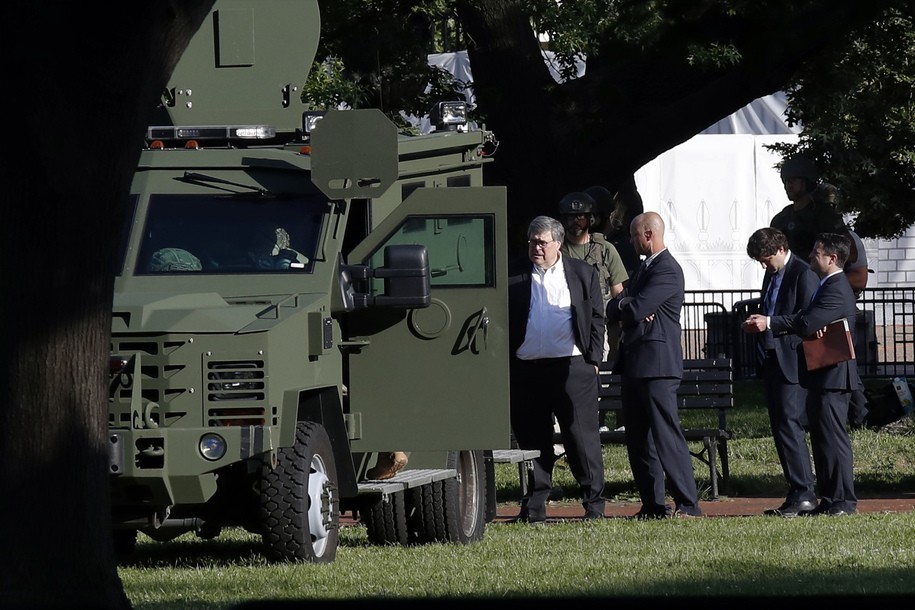
The picture on this post is from Barr surveying the scene and speaking with military and/or police officials immediately before gas canisters, flash-bang grenades, and military police were used to forcibly clear both church property and the park between the White House and it. The Rose Garden speech was delayed for fifteen minutes—those fifteen minutes, when the television networks had assembled their reporters in the Rose Garden and were broadcasting from it, is when the operation began.

And Trump's last line of his speech was a line announcing that he would now be walking to the church. The church that had just been cleared for him by Park Police. The church whose priest had just been gassed and driven off by Park Police in the minutes, the minutes, before Trump announced on live television that he was now heading there.

Police and military officials who followed the administration's order to clear the park for a planned event, violating the rights of the peaceful protesters, gassing Americans as an orchestrated propaganda event, betrayed their oaths. For following an illegal order, they must be charged and, as the evidence supports, convicted. An inquiry of the entire chain of command is in order.

This administration has lost all legitimacy. Chairman of the Joint Chiefs of Staff Gen. Mark Milley betrayed his country in abetting a clearly illegal act and must resign. William Barr, who from initial evidence may have been the very person to give the "green light" to begin the operation, must be forced to resign by Congress or through relentless public action.

There is nobody left in this White House but traitors. They allowed an attack on peaceful Americans so that Trump could stage a belligerent television moment. As of today, every person in the building, from Trump to the Secret Service agents to the secretaries and chefs, are traitors to their country for remaining in the building today.

Hey Neal. I was there. Tear gas was definitely used, and park police can�t ����� that. And there was no object-throwing before the mounted park police moved in. Don�t want to tell you how to do your job, but using a background source to deny observable fact seems like a bad call.

— Garrett Haake (@GarrettHaake) June 2, 2020

02 Jun 20:16

The Christians Who Loved Trump’s Stunt

by McKay Coppins
James.galbraith

Hint: they're not Christians. They're racists and taliban members

He wielded the Bible like a foreign object, awkwardly adjusting his grip as though trying to get comfortable. He examined its cover. He held it up over his right shoulder like a crossing guard presenting a stop sign. He did not open it.

“Is that your Bible?” a reporter asked.

“It’s a Bible,” the president replied.

Even by the standards of Donald Trump’s religious photo ops, the dissonance was striking. Moments earlier, he had stood in the Rose Garden and threatened to unleash the military on unruly protesters. He used terms such as anarchy and domestic terror, and vowed to “dominate the streets.” To clear the way for his planned post-speech trip to St. John’s Church, police fired tear gas and rubber bullets into a crowd of peaceful demonstrators.

A few hours after the dystopian spectacle, I spoke on the phone with Robert Jeffress, a Dallas megachurch pastor and indefatigable Trump ally. He sounded almost gleeful.

“I thought it was completely appropriate for the president to stand in front of that church,” Jeffress told me. “And by holding up the Bible, he was showing us that it teaches that, yes, God hates racism, it’s despicable—but God also hates lawlessness.”

“So,” he added, “I’m happy.”

In many ways, the president’s stunt last night—with its mix of shallow credal signaling and brutish force—was emblematic of his appeal to the religious right. As I’ve written before, most white conservative Christians don’t want piety from this president; they want power. In Trump, they see a champion who will restore them to their rightful place at the center of American life, while using his terrible swift sword to punish their enemies.

[Read: This is how Trump wants to be seen]

This dynamic was on vivid display throughout the night. Even as cities across the country once again spiraled into chaos, prominent conservative evangelicals cheered Trump’s performance on Twitter.

“I don’t know about you but I’ll take a president with a Bible in his hand in front of a church over far left violent radicals setting a church on fire any day of the week,” wrote David Brody, a news anchor at the Christian Broadcasting Network. (Trump selected St. John’s, which has hosted presidents since James Madison for worship services, because protesters had set a fire in its nursery the night before.)

“I will never forget seeing [Trump] slowly & in-total-command walk … across Lafayette Square to St. John’s Church defying those who aim to derail our national healing by spreading fear, hate & anarchy,” wrote Johnnie Moore, the president of the Congress of Christian Leaders.

In an email to me, Ralph Reed, the chairman of the Faith and Freedom Coalition, heaped praise on Trump for his visit: “His presence sent the twin message that our streets and cities do not belong to rioters and domestic terrorists, and that the ultimate answer to what ails our country can be found in the repentance, redemption, and forgiveness of the Christian faith.”

Andrew Whitehead, a sociologist at Clemson University, has argued that Trump’s religious base can best be understood through the lens of Christian nationalism. In his research, Whitehead has found that white Protestants who believe most strongly that Christianity should hold a privileged place in America’s public square are more likely than others to agree with statements such as “We must crack down on troublemakers to save our moral standards and keep law and order” and “Police officers shoot blacks more often because they are more violent than whites.”

Whitehead told me in an interview that Christian nationalism is often not really about theology (and thus can’t be ascribed to all conservative churchgoers): “It’s about identity, enforcing hierarchy, and order.”

That Trump’s religious posturing has little to do with religion has long been a matter of conventional wisdom (see: Corinthians, Two); fewer have grasped the extent to which that’s true of Trump’s “religious” base as well.

[Read: History will judge the complicit]

After the president’s unannounced visit to St. John’s, Mariann Budde, the Episcopal bishop of Washington, D.C., gave an outraged interview to The Washington Post. “Everything he has said and done is to inflame violence … We need moral leadership, and he’s done everything to divide us, and has just used one of the most sacred symbols of the Judeo-Christian tradition,” she said.

But, of course, sacredness has never been a concern of Trump’s. He didn’t open the Bible he was brandishing for the cameras, because he had no use for its text. He didn’t go inside the church he was using as a backdrop, because he had no interest in a sermon.

To Trump, the Bible and the church are not symbols of faith; they are weapons of culture war. And to many of his Christian supporters watching at home, the pandering wasn’t an act of inauthenticity; it was a sign of allegiance—and shared dominance.

02 Jun 20:14

Kentucky barbecue owner and ‘community pillar’ shot dead by police—police chief fired

by Walter Einenkel
James.galbraith

Cops have lost their fucking minds. They're playing Call of Duty on our streets

Just after midnight on Monday morning, David McAtee, the owner of a barbecue business in Louisville, Kentucky, was shot and killed by law enforcement officers. According to the the Courier Journal, McAtee’s popular barbecue business was located next to Dino’s Food Mart in Western Louisville. It was the site of a gathering crowd of people late Sunday night. Former Louisville Metro Police Chief Steve Conrad told reporters that when the LMP and National Guard showed up to break up the gathering, someone shot at them and McAtee was killed in the return of fire from law enforcement. 

These details, however, are very slim, and many in the community want answers. What is known is that on Saturday, Louisville Mayor Greg Fischer implemented a 9 PM to 6:30 AM curfew. What is also known is that McAtee’s body was still at the scene, lying in the street, hours after the incident. Some reports say his body was moved inside for forensic investigation. A crowd had gathered at the site and McAtee’s mother, Odessa Riley, came down, asking to see his body and telling reporters: "Right now, I can't tell you the feeling I have. All I can say -- when a mother loses her child, a piece of you goes along with that child."

"Right now, I can't tell you the feeling I have. All I can say -- when a mother loses her child, a piece of you goes along with that child." -- Odessa Riley, #DavidMcAtee's mother #Louisville #BreonnaTaylor pic.twitter.com/jdtI4mqcZL

— Philmonger (@phillipmbailey) June 1, 2020

McAtee’s sister spoke to local news station Wave 3, telling them that her brother “didn’t hurt nobody. He didn’t deserve to get shot down like he did. I don’t know what happened, but whatever happened here, my brother didn’t do nothing wrong. He really didn’t do nothing wrong. He was an innocent person. An innocent bystander. He did not deserve this at all.”

McAtee and others were reportedly gathered in the area—just as many groups of Americans have gathered across the country—protesting racial injustice and law enforcement violence against people of color. In April, Louisville police busted into 26-year-old EMT Breonna Taylor’s apartment and opened fire, shooting her at least eight times, killing her. The police were at the wrong place and their story has been contradicted by other evidence.

Odessa Riley told the Courier-Journal that her son was a pillar of the community: "He left a great legend behind. He was a good person. Everybody around him would say that. My son didn't hurt nobody. He didn't do nothing to nobody." She told reporters that police frequented her son’s barbecue and her son did not charge at them. “My son was a good son […] And they come along and they killed my son."

Metro Council President David James told the news that McAtee was a personal friend and “just a good, decent person,” who believed in and supported his neighborhood. “He’s just a great guy.” Gov. Andy Beshear released a statement saying he had “authorized the Kentucky State Police to independently investigate the event.” 

Mayor Greg Fischer and other city officials held a press conference explaining that Kentucky very specifically has laws that do not allow police officers to be fired until an investigation is complete, and that he and others were pushing for expediting the process. Mayor Fischer did announce that after discovering that there was reportedly no body camera footage of the shooting, he had fired Louisville Metro Police Chief Steve Conrad.  According to officials, two Metro police and two Kentucky National Guard officers returned fire during the incident. In a Facebook live video shot at the time, a single shot can be heard. Police officers then line up and seemingly return about eight shots. Another two shots can be heard after that. The man filming the video can be heard saying the police came out and started firing shots. During the press conference, the acting police chief, Robert Schroeder, said they did not know whether or not any one of the numerous law enforcement officers on site activated their body cameras.

Schroeder addressed the death of Breonna Taylor and spoke about the aggressive stance taken by the Louisville Metro police and Kentucky National Guard. He also called for law enforcement to make it more clear to the Black community that they were there to protect and not attack.

David McAtee was 53-years-old.

So far, right-wing anti-coronavirus-public-health-measure gun nuts have been silent on Breonna Taylor, George Floyd, and David McAtee’s deaths.

02 Jun 20:09

What Really Brought Down Steve King

by Elaine Godfrey
James.galbraith

Of course not, because Iowa Republicans are racist

In the 24 years he’s been in politics, Steve King, the Iowa Republican who has spoken of immigrants with “calves the size of cantaloupes” and cautioned that Americans cannot “restore our civilization with somebody else’s babies,” had never lost an election. Last night, as Americans across the country continue to march in the streets, protesting racism and police brutality, that changed.

The 71-year-old, who faced a slew of well-qualified candidates in the state’s GOP primary, lost to State Senator Randy Feenstra by more than nine points, with almost all districts reporting. “I am truly humbled,” Feenstra wrote on Twitter. “Thank you to each and every person who supported us on this journey against all odds.”

The campaign may have been the fight of King’s political life, but it didn’t actually involve much talk of his racism. Throughout the past few months, King’s Republican opponents chose not to focus on King’s rhetoric; instead, they endeavored to portray the congressman, who has been removed from three committee positions, as just another ineffective, complacent career politician. Which is to say that the message Republicans sent to King was not a condemnation of his racist comments, but rather a broader denunciation for an even graver political sin: putting a safe seat in danger. That concern has now decreased significantly. Many Republicans I talked with believed that any other nominee would have a better chance to beat the Democrat.

King first flew onto the nation’s radar back in 2013, when he made the “cantaloupes” comment during an interview with Newsmax. Three years later, he warned on Twitter that “cultural suicide by demographic transformation must end.” In 2018, he met with a member of a Nazi-linked party in Austria, just after 11 worshippers were killed in an attack on a Pittsburgh, Pennsylvania, synagogue. That year, King attracted a formidable challenge from the Democrat J. D. Scholten, a former Minor League baseball player from the area who’s running for the seat again this year. King defeated Scholten in the November midterm election—but only by three points, his closest margin of victory ever, and in a heavily Republican district.

[Read: Why does Steve King keep winning?]

The closeness of the race alarmed Republicans nationwide, and spurred King’s opponents in Iowa to action. Four Republicans announced challenges to King: Feenstra; Jeremy Taylor, a former state legislator; Bret Richards, a local businessman and former mayor; and Steve Reeder, a real-estate developer. Feenstra, who outraised King in the first quarter of the year by nearly $400,000, earned the endorsement of party leaders such as former Iowa Governor Terry Branstad and the National Right to Life Committee, and by the end of the campaign he had caught up to King in the polls.

Another fear for many Iowa Republicans: Scholten is better known now than he was two years ago. “King is a boogeyman and a fundraising motivator,” Douglas Burns, an Iowa columnist and a co-owner of Herald Publishing House, told me last week. “If King is the candidate for the Republicans, there will be a massive amount of outside money that comes in to support Scholten.” Tuesday’s contest was about more than the Fourth Congressional District too. Some GOP strategists worried that a King nomination would increase Democratic turnout, jeopardizing Donald Trump’s chances of winning the state in November—and the reelection of Senator Joni Ernst, who is facing a strong challenge from the Democratic real-estate developer Theresa Greenfield.

But unseating an incumbent, even one like King, is a struggle. Back home in Northwest Iowa, he still has many loyal supporters—people who feel devoted to him in much the same way that President Trump’s supporters have remained faithful through wave after wave of controversy. They view King as a victim of baseless media smears and political-correctness culture run amok. It’s just Steve being Steve, I heard over and over in August, during a reporting trip to the district. “What is a racist anymore?” one Woodbury County man told me then. “Racist in the liberal logic is just somebody that doesn’t agree with what you say.”

Since his narrow victory over Scholten, though, King has seen much of his political power wash away like Iowa topsoil. Republican leadership removed him from his posts on the House Judiciary, Agriculture, and Small Business Committees in January 2019, after King questioned the offensiveness of the term white supremacist in an interview with The New York Times. Representative Cindy Axne, the freshman Democrat from Iowa’s Third District, was appointed to the Agriculture Committee in his place. (In a dustup last month, King claimed to have reached an agreement with House Minority Leader Kevin McCarthy to be reinstated to those committees, but McCarthy has denied making any such agreement.)

King’s declining influence in Washington gave his GOP foes an opening. The campaign against him was “not about relitigating the controversial things he said,” David Kochel, a GOP strategist originally from Iowa, told me last week. It was easier for his opponents to make the case “that it doesn’t do any good for the district if he can’t get things into legislation or be on the committees that have the biggest impact on our communities.”

Many high-profile Republicans abandoned their long-held support for King to embrace Feenstra in the past year, including Bob Vander Plaats, the Iowa-based head of the Family Leader, a social-conservative umbrella organization. “Not only should a person be a respected representative in D.C., but they should have a leadership position in D.C.,” Vander Plaats told me.

Even the U.S. Chamber of Commerce, which rarely endorses against Republican incumbents, backed Feenstra, spending $200,000 in advertising on the race and airing an ad to remind voters that King was kicked off the Agriculture Committee in the middle of a farming crisis. It chose to altogether avoid King’s past comments. “We like to stick to our lane,” Scott Reed, the chamber’s senior political strategist, told me.

King’s primary opponents, too, chose to lean into their conservative bona fides rather than delve into the fraught territory of the congressman’s social-media posts and rhetoric. Feenstra spent the campaign touting his A+ rating from the National Rifle Association (compared with King’s A–) while condemning King for failing to deliver for the district. Taylor, another King opponent, demurred when I asked last week why he didn’t talk about King’s rhetoric on the trail: “He’s a decent man,” he said, but “we’ll lose this seat if he’s the nominee.” Richards, the former businessman, said that he made a conscious choice to avoid condemning King’s comments during the campaign. “Congressman King’s granddaughter and my daughter will play volleyball and softball against each other,” he told me. “I’m not going to say anything bad where I can’t sit in the gym and look at his granddaughter at the end of the day.”

[Read: The moral urgency of voting by mail]

The candidates, in other words, were engaging in a form of triangulation—attempting to endear themselves to King’s supporters while positioning themselves as a safe and preferable alternative. Nathan Lichter and Mark Saunders, two Feenstra supporters who work as feed-truck drivers in the district, told me they understood that strategy. “A lot of King supporters have no problem with his racist comments, so it’s more trying to get them on board with I can do a better job,” Saunders told me.

The approach clearly ended up working for Feenstra. Nearly 60,000 Republicans in the district mailed in absentee ballots, according to the Iowa secretary of state’s office. An additional 19,000 people voted in person. Compare that with the 2018 GOP primary, when a total of just 39,000 votes were cast. But while Democrats may cast King’s defeat as a small victory over racism, they may have just lost an opportunity to flip a House seat.

02 Jun 20:06

Some senators want to stop police from getting military-grade equipment or weapons

by Katelyn Burns
James.galbraith

Yep stop police militarization

Police officers gaze towards protesters after firing rubber bullets and tear gas in Philadelphia, Pennsylvania, on June 1. | Mark Makela/Getty Images

Brian Schatz and Rand Paul have worked together before trying to end the military-to-police equipment pipeline.

A small group of lawmakers is working on legislation to slow down the militarization of local police departments, in the wake of nationwide uprisings against police violence.

Hawaii Sen. Brian Schatz (D) announced Monday that he would be introducing an amendment in the National Defense Authorization Act (NDAA) to end the 1033 Program, which enables the US military to sell outdated equipment, like armored vehicles and bayonets, to local law enforcement agencies. The nearly 30-year-old program is a chronic thorn in the side of police reform activists. And though Barack Obama restricted the program, it was reinvigorated under President Donald Trump, who has taken pains over the last week to stress to local leaders and law enforcement that the George Floyd protests must be forcibly suppressed.

“It is clear that many police departments are being outfitted as if they are going to war, and it is not working in terms of maintaining the peace,” Schatz told the New York Times. “This is not the only thing we need to do, but as our country sees these images on television that remind us of some countries far, far away, it’s time to recalibrate this program. Just because the Department of Defense has excess weaponry doesn’t mean it will be put to good use.”

Though it’s not clear how much support Schatz’s proposal will find across the aisle, at least one Republican got on board: Sen. Rand Paul. The Kentucky libertarian, who has long called for demilitarizing the police and reining in the US military, has teamed up in the past with Schatz to try to end the program.

Paul’s chief strategist, Doug Stafford, showed support for Schatz’s proposal on Twitter. “We’ve been doing this one [for] years. Happy to help,” he tweeted.

Rep. Ruben Gallego (D-AZ), a former Marine, said he would introduce similar legislation in the House.

The country has been shocked by viral photos and videos showing police using tear gas and flash-bangs, including on peaceful protests. In New York City, video of two police SUVs plowing into protesters went viral, prompting an excuse from Mayor Bill de Blasio. Dozens of journalists have been assaulted and arrested by police while covering the protests.

The 1033 Program was first instituted in the 1990s and later expanded in the early 2000s, as Vox’s Amanda Taub explained:

The 1033 program’s roots lie in the drug war — hence the counter-narcotics impetus. It was originally created in 1990, as part of the National Defense Authorization Act, which authorized the Pentagon to transfer military equipment to local law enforcement if it was “suitable for use in counter-drug activities.” In the wake of the September 11 attacks, the program’s focus has expanded to include counter-terrorism activities as well.

While the 1033 program’s intent may have been to equip specialized units for extreme, dangerous situations, fighting al-Qaeda sleeper cells, or powerful drug cartels, the effect has been to incorporate SWAT-style raids into ordinary police operations. That includes, but is certainly not limited to, the serving of search warrants. This may partly be because the program requires that all equipment issued through the 1033 program be used within one year of the date it is granted. That means that if police departments want to keep their new gear, they can’t wait for a rare emergency like an active shooter or hostage situation in order to use it.

Further, the law never required that local police be trained on the proper use or deployment of the equipment.

The Obama administration curtailed the program in 2015 after local police suppressed the Ferguson, Missouri, protests using armored vehicles and other military-grade equipment. But President Donald Trump reinstated the program in 2017, saying it was necessary for protecting the police and the life and property of Americans.

It’s unclear at this point whether there will be enough votes to pass legislation ending the program, and the next NDAA likely won’t be voted on until later this year. Some lawmakers’ responses — like that of Senate Majority Leader Mitch McConnell (R-KY) — have acknowledged the gravity of the protests and the system that prompted them, without proposing any action on legislation.

“In no world whatsoever should arresting a man for an alleged minor infraction involve a police officer putting his knee on the man’s neck for nine minutes while he cries out ‘I can’t breathe’ and then goes silent,” McConnell said Monday.

Other legislators have proposed different solutions to the police violence problem. Party leaders from both sides have called for congressional hearings on police violence, and Sen. Cory Booker (D-NJ) proposed a series of reforms, including a national police misconduct database, in response to the protests.

Rep. Justin Amash (I-PA) has proposed ending qualified immunity for police. In a letter to colleagues, he said that police misconduct continues “because police are legally, politically and culturally insulated from consequences for violating the rights of the people whom they have sworn to serve. This must change so that these incidents of brutality stop happening.”

Despite the many calls for reform, many are skeptical that legislators will do anything more than just listen and release statements. Washington Post reporter Jeffrey Stein reached out to several Hill staffers Sunday to see if there was an appetite for legislation in response to the protests.

“‘No chance,’” one says of a legislative response,” Stein tweeted.


Support Vox’s explanatory journalism

Every day at Vox, we aim to answer your most important questions and provide you, and our audience around the world, with information that has the power to save lives. Our mission has never been more vital than it is in this moment: to empower you through understanding. Vox’s work is reaching more people than ever, but our distinctive brand of explanatory journalism takes resources — particularly during a pandemic and an economic downturn. Your financial contribution will not constitute a donation, but it will enable our staff to continue to offer free articles, videos, and podcasts at the quality and volume that this moment requires. Please consider making a contribution to Vox today.

02 Jun 20:05

Why the policing problem isn’t about “a few bad apples”

by Sean Illing
James.galbraith

Yeah this isn't a "few bad". This is entire departments view themselves as warriors for Trump and the right wing.

Police shoot pepper bullets into a crowd of people demonstrating against police violence in Los Angeles on June 1. | Robert Gauthier/Los Angeles Times via Getty Images

“The system was designed this way”: A former prosecutor on the fundamental problem with law enforcement.

Every time a cop is caught brutalizing a black or brown person, I hear the same argument: “It’s just a few bad apples.”

I’m hearing this again in the wake of George Floyd’s murder. On Sunday, to take one example, National Security Adviser Robert C. O’Brien said, “We have got great law enforcement officers, not — not the few bad apples, like the officer [Derek Chauvin] that killed George Floyd. But we got a few bad apples that have given — given law enforcement a bad name.”

When asked by CNN’s Jake Tapper if he thought systemic racism was a problem for law enforcement, O’Brien replied: “No, I don’t think there’s systemic racism.”

Curiously, the people who recite this trope rarely reflect on the second half of the expression: “A few bad apples spoil the bunch.” But let’s set that aside.

No matter how you look at it, the American criminal justice system is riddled with biases. As the Washington Post’s Radley Balko cataloged, we know that black people are nearly twice as likely to be pulled over and more likely to be searched once they’re stopped even though they’re less likely to have contraband; and that unarmed black people are more than three times as likely to be shot by police as unarmed whites.

So how do we explain this reality?

Paul Butler is a law professor at Georgetown, a former federal prosecutor, and the author of the 2017 book Chokehold: Policing Black Men. His work has long focused on the fundamentals of America’s criminal justice system and why they keep reproducing the same outcomes for black Americans. I talked to him about how we got here, why he thinks the criminal justice system is working exactly as designed, and why the “few bad apples” argument is complete bullshit.

A lightly edited transcript of our conversation follows.

Sean Illing

I’d like this conversation to speak as much as possible to people like me — a white guy who grew up in a small town in the South — who has no experience with any of this, whose life is untouched by this kind of threat, who may not understand why anyone would treat cops like an occupying force and is therefore skeptical of the sort of arguments you’re making.

What do you say to that person?

Paul Butler

I’m glad you started there. I saw a compelling example of this on live TV last Saturday that helps to make the point. MSNBC’s Ali Velshi was reporting live from the protest in Minneapolis, and as he was reporting, he said, “They’re starting to shoot.” The cops were starting to fire rubber bullets. And the protesters were totally nonviolent. They weren’t doing anything provocative, and the police just opened fire. And we see it all live on TV.

As he’s running away, Velshi’s shot in the leg, but he just keeps reporting. Later, after he’s retreated, he sees the cops advancing again and he looks terrified in a way he hadn’t before. That’s the impact of violent policing on African Americans — and black men disproportionately bear the cost of that.

The point of policing the hood is to demonstrate that the police officer dominates. That he’s the man, regardless of gender, that the officer is the boss, and that everybody else is subordinate. The way that that message is communicated is with fear. Fear for your physical safety. I called this “torture lite” in my book Chokehold, and some people thought that that was extreme. But I was actually thinking about a specific thing in international human rights law, and a specific evolution of torture, from the horrible pulling out of your fingernails to the way it works now — which is to make people feel both humiliated and terrified that anything could happen to them at any moment.

Sean Illing

A kind of psychological warfare —

Paul Butler

Exactly. This attitude is present in a lot of police officers who work in communities of color, and it defines the dynamic between them and the people they’re supposed to be serving. It impacts all of us. I went to a fancy college and law school; I have a good job and drive a nice car. But every time there’s a police car behind me, my heart starts beating quickly. Every black man I know has the same story. Because you just never know.

“I don’t think those police officers saw Mr. Floyd as human. And I’m not sure that’s a problem that can be solved by a reform.”

Sean Illing

That is such a wildly different dynamic than most white people have experienced. And for those people, many of them at least, there’s a reflexive dismissal of it. They’ll read this as hyperbole or anecdotal and in that sense refuse to grapple with the fundamental claim about the role law enforcement plays in black communities.

Paul Butler

Let’s think about the Floyd case. Before we get to the killing, let’s think about the arrest. The store owner called the police and said that someone had tried to pass a fake $20 bill. The police respond, and what they do is virtually impossible to imagine happening to a white person. What they do is to approach Mr. Floyd’s car like he’s a violent thug. They order Mr. Floyd and the passengers to exit the car. One officer has his hand on his gun. They put Mr. Floyd in handcuffs. When he falls to the ground, they leave him on the ground in handcuffs, and then, as the whole world knows, they hold him down by his back and knee and legs for 10 minutes until he dies. I just can’t imagine that happening to a white person over a $20 bill.

Black and brown people experience very different treatment from the police than white people do, and it’s so endemic that the police just can’t help themselves. I thought the most compelling example of that was how differently the CNN reporters were treated in Minneapolis. A white CNN reporter is basically on the same ground, doing the same thing — while cops roll up on the black reporter and arrest him, cops go to the white reporter and say, “We’d like you to move, please,” and he says, “Okay.” But he doesn’t move as far as they would like and they say, “Could you please move some more?” And he says, “Sure.”

The thing that’s so revealing about that is that it all happens on national television, at a rally about excessive force and racist policing. I could just imagine, at the roll call that morning for the officers, when they’re getting their instructions from the sergeant, the sergeant says, “Okay, guys, we know that we’re guarding this rally about police brutality and discriminatory enforcement; let’s not be racist, don’t be racist, it’s really important that we not be racist today.” And they still can’t help themselves.

Sean Illing

You say we don’t merely have two systems of justice, one for white people and one for black and brown people, but instead we have “opposite” systems of justice. And the system for black and brown people isn’t broken — it’s working exactly as designed. What does that mean?

Paul Butler

Part of the evidence that the system was designed this way, and one of the reasons it recurs over and over again, is because a lot of the conduct that people of color complain about is totally legal. So I don’t think the case against the officers in the Floyd case is a slam-dunk by any means. The defense will be that their use of force was reasonable. And they have a case to make. They don’t have a great case, given that Mr. Floyd was handcuffed, but what they will say is that he was resisting arrest and they used reasonable force to subdue him. And obviously there comes a point where the reasonableness of that force is extinguished by the fact that his body is lying limp and motionless on the ground. But up until then, I think they have an argument that what they were doing was legal.

Outside of that case, in theory, the power that police have is unreal. I have a police officer buddy who comes and visits my criminal law class, and to demonstrate how much power he has, he invites my students to go on a ride-along in his car, to see what it’s like to patrol the streets of DC. He plays a game with them called Pick That Car. He tells the student, “Pick any car that you want, and I’ll stop it.” So the student will say, “How about that white Camry over there.”

He’s a good cop. He waits until he has a legal reason. But he says that he could follow any car, and after five minutes or three blocks, the driver will commit some traffic infraction, and then under the law he has the power to stop the car, to order the driver and the passengers to get out of the car. If he has reasonable suspicion that they might be armed or dangerous, he could touch their bodies, he can frisk them, he can ask to search their car. And it’s totally legal. That’s an example of the extraordinary power that police have.

And that extraordinary power, that constitutional power, is used more aggressively against black and brown men than against white soccer moms.

“I went to a fancy college and law school; I have a good job and drive a nice car. But every time there’s a police car behind me my heart starts beating quickly.”

Sean Illing

In a way, that gets to the heart of this. Because the difference here is how the same laws are applied differently to different people. We’re not talking about different rules for different people formally codified into law. We’re talking about the enormous discretion cops have and how, for too many reasons to count, they apply it unevenly.

Paul Butler

That’s exactly right. I know it sounds kind of conspiratorial when I say it’s designed that way, but one reason I think that is because it happens so often and it’s so predictable. And in these kinds of cases, advocates tell the Supreme Court that if you give the police this kind of power, they’re going to use it unfairly against people of color. And we have tons of data backing that up. And the Court either discounts that concern or says, “There’s nothing that we can do about it.”

So everybody knows how the police will use this power, and true enough, they do. That’s why I think that the Ferguson report, which is the report that the US Department of Justice wrote after the uprising in Ferguson, and after Michael Brown was killed, I think that’s one of the defining artifacts of our time.

Sean Illing

Why?

Paul Butler

A hundred years from now, when people want to know what it was like to be alive in 2020, the Ferguson report is one of the things they’ll look at. It’s this amazing synthesis of data and stories. The data includes the fact that every single time the police used a dog in Ferguson, they used it against a black person.

Can I give you just one quick story from the report to show you why I think it’s so revealing?

Sean Illing

Please.

Paul Butler

So there’s one story in there in which a woman calls the police because her boyfriend’s beating her up. By the time the police get there, he’s gone. The police look around the apartment and they say, “Does he live here?” And she says, “Yes, he does.” The police say, “You’re under arrest for occupancy permit violation, because his name isn’t on the lease.” When that happened to another woman in Ferguson, she said she would never call the police again, she didn’t care if she was being killed. Again, this is how the police do black people and brown people. They don’t treat white people like this, certainly not as systematically as they do black and brown people.

Sean Illing

I want to ask you about this argument that the policing problem can be reduced to “a few bad apples.” Your book is largely about this, and I’d like to know why you think it’s bullshit.

Paul Butler

For one, it’s insulting to police officers. I don’t think police officers are any more racist than law professors or doctors or anybody else. In fact, I think that some people go into that work because they want to be warriors, and that’s not constructive, so when we think about change, we need to think about guardianship as a model, not war.

But I think a lot of people go into the work because they really want to help communities, and they really want to make a difference, and this belief is based on my experience as a prosecutor working with police officers of all backgrounds and of all races. So I don’t think that police officers are especially racist. But I do think we give them tools and authority in a context that leads them to deploy it unjustly against people of color.

Sean Illing

The real question we need to answer isn’t, “Why are racist cops doing racist things?” (that question answers itself) but rather how is it that non-racist cops, or cops who set out with good intentions, succumb to perverse incentives and end up enforcing inequalities they themselves would probably reject in the abstract.

Paul Butler

Right, and I think it’s about the workplace culture. I tell the story that after I graduated from law school, I worked for a law firm for a couple of years, and then I decided I wanted to be a prosecutor. So I was lucky enough to get a job with the Department of Justice, where they have drug tests. I had been smoking weed recreationally before I joined the Justice Department. When I joined the Justice Department, because I didn’t have any trial experience, they sent me to the local prosecutor’s office in DC to learn how to try a case. You start out doing low-level cases, including, at that time, marijuana possession and marijuana distribution. I stopped smoking weed just because I knew that there were drug tests, and I didn’t want to lose my job. But I prosecuted people for smoking weed. So I understand workplace incentives, and none of us are immune to it.

The culture of law enforcement is very much a paramilitary culture. You’re part of a team and you have to have each other’s back. Part of the reason your question is so important is that we’re not just talking about white cops, we’re also talking about black cops. Police officers of color get caught up in the same loops. In hip-hop, there’s a lot of interest in black police officers, and the message you often hear is that black officers are actually worse than white officers, because they want to show off for the white cops.

So the problem is about culture, and it runs much deeper than a few racists here and there.

“I don’t think police officers are any more racist than law professors or doctors or anybody else”

Sean Illing

If the problem were merely racist cops, the solution would be easy: screen for racists and remove them. But if the real problem isn’t bad cops or bad policing so much as a culture built on a racial hierarchy that law enforcement has historically protected and reinforced, then it’s hard to see a path forward.

Paul Butler

It’s a huge problem and I don’t know how to solve it, but what I do know is how to make a difference in individual cases in a way that will prevent people from getting killed or beat up, or having the law selectively applied to them. I know that there are reforms that can save lives, and even if they’re not going to crush white supremacy, if Sandra Bland and George Floyd can live rather than die, I’m cool with that on the way to transformation.

Sean Illing

What sort of reforms?

Paul Butler

In Chokehold, I argue that people tend to see the problems between black people and police in four different ways. So really quickly, the first way is that the problem is black men. It’s the way that we perform masculinity. If we would just pull up our pants, we wouldn’t have to worry about being stopped and frisked. There are quite a lot of people who think that.

The second framing is that the problem is under-enforcement of law, not over-enforcement. That what the black community needs even more than other communities is law and order. So when police selectively enforce the law in those communities, it’s actually a kind of reparations, it’s a payback for the time when 911 was a joke. And my friends who are prosecutors and police officers of color, that’s what they say. They say, “Hell yeah, I’m tougher in the hood than I am in the suburbs, because that’s my community.” That’s how they think.

Then there’s what I’d call a more liberal framing, which focuses on the relationship between black people and cops, like the problem is that they’re in a bad marriage and they just need to understand each other. This was very much the approach of the Obama administration, emphasizing the need to bring people together alongside tangible reforms like more body cameras and better training.

The fourth way of thinking about the problem is the focus on white supremacy. This is the new Jim Crow idea. Here, what people suggest is that if you only work on the police, that’s treating the symptom. But the disease will metastasize. So in this telling, it started with slavery, went to the old Jim Crow, and now it’s the new Jim Crow, enforced via a racially biased criminal justice system. And so the only way things will truly get better is to crush white supremacy.

I’m sympathetic to the new Jim Crow point of view, but at the same time, we can save lives in other ways before we crush white supremacy. That’s why I think the third framing through a liberal lens remains very useful, even if at the end of the day it’s not going to create the transformation we need, it’s worth it if it will save lives.

So in the meantime, we can make a difference by teaching cops to intervene when their peers are crossing the line, by teaching them how to deescalate, by changing our entire approach to nonviolent criminal arrests. These things are not going to bring the revolution, but they can save lives.

Sean Illing

Do you think it’s possible for us to break this cycle?

Paul Butler

To me, that’s almost a question about faith. About your belief in humanity. Martin Luther King says the arc of the moral universe bends toward justice. I hope that’s right. One of the most poignant moments of that horrific video [of Floyd’s death] is there’s a bystander who says to the cop, “Bro, he’s human.” The truth is that I don’t think those police officers saw Mr. Floyd as human. And I’m not sure that’s a problem that can be solved by a reform.


Support Vox’s explanatory journalism

Every day at Vox, we aim to answer your most important questions and provide you, and our audience around the world, with information that has the power to save lives. Our mission has never been more vital than it is in this moment: to empower you through understanding. Vox’s work is reaching more people than ever, but our distinctive brand of explanatory journalism takes resources — particularly during a pandemic and an economic downturn. Your financial contribution will not constitute a donation, but it will enable our staff to continue to offer free articles, videos, and podcasts at the quality and volume that this moment requires. Please consider making a contribution to Vox today.

02 Jun 20:04

How medical racism explains Covid-19 in America

by Marya T. Mtshali
James.galbraith

It's a huge fucking issue

Burnetta Kinsey, a resident of Compton, Los Angeles, describes her symptoms at a mobile Covid-19 testing station on April 28. | Robyn Beck/AFP via Getty Images

Throughout US history, Black people have endured a medical system that has been simultaneously exploitative and dismissive.

The protests that have ignited across the country have been fueled by a powder keg built not just on human rights abuses like police brutality, but also on the disproportionate and dire economic and health impacts of Covid-19.

While the novel coronavirus has negatively impacted the entire nation, Black, Brown, and Indigenous communities are being devastated. Recent data shows that the Covid-19 mortality rate for Black Americans is about 2.4 times higher than for whites. Black people have also been less likely to be referred for Covid-19 testing and medical care.

The discussion around these stark realities — in the media, as well as from government experts such as the National Institute of Health’s Dr. Anthony Fauci and Surgeon General Jerome Adams — has primarily fallen into two categories: the role of individual behavior of Black people (a line of reasoning that is highly problematic), and the role of systemic racism in the labor and housing markets.

Surprisingly, what hasn’t been talked about much is the role of systemic and institutional racism within medical institutions. Throughout American history, Black people have endured a medical system that has been simultaneously exploitative and dismissive. And the damaging implicit and explicit biases present in our medical system do not suddenly vanish because we are in the middle of a pandemic. In fact, the pandemic has made them impossible to ignore.

We are already seeing preliminary evidence of these biases playing out with treatment and care for Black people in response to the Covid-19 pandemic in three key ways:

1) Black people’s health complaints are taken less seriously

According to pilot study data from the Boston-based biotech research firm Rubix Life Sciences, Black patients that exhibited Covid-19 symptoms were six times less likely to receive testing or treatment, in comparison to white patients who exhibited symptoms.

Although this study has not yet been peer-reviewed, it reflects the anecdotal evidence from Black patients and their families who report being refused tests multiple times or being given little to no treatment. Considering the history of medical professionals dismissing the health complaints of women, Black women may be uniquely impacted by this minimization.

2) Black communities are less likely to have the testing and medical supplies they need

In parts of the country, white communities are more likely to have testing sites than predominantly minority communities. For example, according to NPR, Nashville, Tennessee, was unable to get testing equipment and personal protective equipment like masks and gloves to testing centers in neighborhoods of color. And Black neighborhoods in Chicago have experienced lower testing rates than white neighborhoods.

3) Federal and local government has failed to gather the demographic data needed to protect these communities

The Centers for Disease Control and Prevention, as well as many state and local governments, failed to collect and report race and ethnicity information about Covid-19 cases at the beginning of this pandemic. And a significant number of them, like Nebraska and North Dakota, still fail to do so.

According to FiveThirtyEight, 18 states and US territories are not reporting this data, and of those that are reporting this information, “almost every state is missing varying amounts of race and ethnicity data.”

The CDC’s website only provides racial data for approximately half the people diagnosed with Covid-19. (Additionally, the CDC has removed language from its site that prioritizes Covid-19 testing for groups that have been at higher risk for Covid-related death, like Black, Brown, and Indigenous communities.)

Considering the long history between race and disproportionate health impacts and medical treatment in the country, getting these statistics is crucial for protecting marginalized communities. It was, after all, the few places reporting these racial statistics that helped sound the alarm that Black communities were being so severely impacted.

On a local level, this information can assist public health officials in ensuring that communities that are being disproportionately impacted can get the resources they need.

Unfortunately, this is not surprising when looking at the history of how the United States has regarded Black people’s health. The Tuskegee syphilis experiments come to mind, in which Black men were knowingly allowed to suffer from the disease despite the existence of an available treatment.

In the experiment, which ran for almost half of the 20th century, the US Public Health Service and the Tuskegee Institute told Black men in the study they were being treated for “bad blood.” In fact, the men were primarily being observed while they suffered from the disease and unknowingly spread it to their family and members of their community — even after penicillin was found to be a cure.

And that study is only the tip of the iceberg.

The American medical system has a long history of using Black people as experimental subjects while also keeping them from receiving adequate medical care. During the 19th century, J. Marion Sims, who is considered the father of modern gynecology, conducted experimental surgeries on enslaved Black women without anesthesia.

Harriet A. Washington details in her book Medical Apartheid the many US medical schools that conducted experiments on enslaved Black people they purchased who were no longer fit for physical labor. Furthermore, many of these institutions purchased stolen bodies of deceased enslaved people and, after emancipation, those of free Black people, to use as medical cadavers.

Throughout American history, Black people have endured a medical system that has been simultaneously exploitative and dismissive

The larger American public views this abuse as a thing of the distant past. However, sadly, that is not the case. For example, in the 1990s, the Kennedy Krieger lead abatement repair and maintenance study intentionally exposed Black youths to lead in their homes to study the effects of partial lead abatement.

In the same decade, the fenfluramine study was attempting to explore potential links between genetics and aggression in a disproportionate number of Black and Latino boys. Those conducting the study told caregivers that they were investigating the emotional and physical welfare of families with children in the court system while actually subjecting these children to a drug that was later discovered to have negative cardiac impacts. (Also, let’s not overlook the racist assumption that aggression may be genetic in Black and Latino people.)

All of these — and, sadly, many more — are examples of the many ways in which our medical system has gained knowledge about health and the human body from the suffering of Black people.

What is more, Black people also do not tend to reap the benefits of this knowledge to the same degree as whites.

Research shows that medical students and residents still inaccurately believe that Black people have “thicker skin” and experience less pain than whites. A 2018 study found that Black people are more likely to be involved in studies that have been exempted from requiring informed consent (which would fully describe the potential risks of the research to participants). Black communities are more likely to lack emergency medical care and maternity wards. And Black women are more likely to not receive adequate prenatal care from health care providers, which may play a role in the higher maternal mortality rate for Black mothers.

This systemic racism is so pervasive that researchers even found an algorithm used throughout many US hospitals that is “less likely to refer Black people than White people who were equally sick to programmes that aim to improve care for patients with complex medical needs.”

These examples are problems within themselves: Black people are not receiving equal and adequate care. However, this can snowball into even larger problems that compound health care inequalities.

Perceived discrimination correlates to less adherence to medical guidance. Additionally, these experiences — along with this known history of systemic maltreatment and abuse — has resulted in an understandable level of skepticism and fear from many Black people when it comes to medical institutions.

This can translate into a reluctance for Black people to engage with these institutions in times of need or to give up in frustration. For instance, Black people have been shown to be more distrustful of doctors than whites and are less likely overall to participate in medical studies. This, of course, then further results in poorer health outcomes and less empirical information on health issues and medication effects in Black people.

As much of the country looks forward to the arrival of a vaccine for the novel coronavirus, even that may not be of an equal benefit to Black people. Considering that Black communities have lower rates of influenza immunizations, which may be related to a distrust of the health care system, there is cause for concern that Black people may be more likely to exhibit Covid-19 vaccine hesitancy or resistance.

There are many brave first responders and health care workers who are currently risking their lives to ensure our country’s safety during this health crisis. Many have lost their lives to save the lives of others, and many more are continuing to risk their lives every day.

This is not an admonishment of them — it is a plea to ask them, their institutions, and our government to address these biases clearly, to help ensure that more lives are saved. These problems have solutions. Black, Brown, and Indigenous lives are not more expendable than any other racial group.

Marya T. Mtshali, PhD, is a lecturer in studies on women, gender, and sexuality at Harvard University. Her areas of specialty include intersectionality and inequality.

02 Jun 20:04

“The presidency is a duty to care”: Read Joe Biden’s full speech on George Floyd’s death

by Ella Nilsen
James.galbraith

Actual presidential behavior.

Candidate Joe Biden Delivers Remarks On Coronavirus Outbreak Democratic presidential candidate and former Vice President Joe Biden delivers remarks about the coronavirus outbreak at the Hotel Du Pont in Wilmington, Delaware, on March 12, 2020. | Drew Angerer/Getty Images

Biden criticized Trump’s response to nationwide protests and called for Congress to take up policing reforms.

Former Vice President Joe Biden criticized President Donald Trump Tuesday morning for leaving America leaderless in a moment of domestic crisis, one day after federal officers tear-gassed peaceful protesters to disperse them and make way for Trump to take photos in front of St. John’s Church in Washington, DC.

“When peaceful protestors are dispersed by the order of the president from the doorstep of the people’s house, the White House — using tear gas and flash grenades — in order to stage a photo op at a noble church, we can be forgiven for believing that the president is more interested in power than in principle,” Biden said.

“More interested in serving the passions of his base than the needs of the people in his care,” he continued. “For that’s what the presidency is: a duty of care — to all of us, not just our voters, not just our donors, but all of us.”

As widespread protests and unrest continued Monday night in multiple American cities following the death of George Floyd at the hands of Minneapolis police officer Derek Chauvin, Biden attempted to draw a contrast with Trump — who on Monday did not call for peace, but instead threatened to use military force to dispel protests if governors didn’t call on their National Guards to do so first.

“The country is crying out for leadership...leadership that brings us together,” Biden said, adding he would recognize the First Amendment rights of peaceful protesters if elected president. “We can’t leave this moment thinking we can turn away and do nothing. The moment has come for our country to deal with systemic racism.”

Standing in front of a backdrop of American flags, Biden gave a somber address from the Mayor’s Reception Room in Philadelphia City Hall, surrounded by state and city officials, including Philadelphia Mayor Jim Kenney and Rep. Brendan Boyle. On Monday, Biden met with local black leaders in his home city of Wilmington, Delaware, and took a knee — a sign of protest against police brutality toward black people — at the end of the meeting.

Philadelphia itself experienced three days of sometimes violent clashes between police officers and protesters. On Monday, protesters blocking the Vine St. Parkway in the city were met with tear gas by police. And further south, Washington, DC, was the site of massive peaceful protests on Monday at times violently dispersed by police.

Biden called for an end to riots and looting that many cities have experienced over the past week, but he also called for an end to police using excessive force to halt protests. The former vice president accused Trump of fanning the flames of violence between police and protesters, rather than using his leadership to quell it.

“When he tweeted the words, ‘When the looting starts, the shooting starts’ — those weren’t the words of a president,” Biden said. “They were the words of a racist Miami police chief from the 1960s.”

The former vice president also called on Congress to swiftly enact policing reforms in the coming days and weeks, including outlawing police use of chokeholds and enacting standards for use of force. He also appealed to the country to come together and begin to heal.

“We’re a nation enraged, but we can’t let our rage consume us. We’re a nation exhausted, but we can’t let our exhaustion defeat us,” he said. “I truly believe in my heart of hearts, we can overcome.”

Following are Biden’s full remarks, as prepared for delivery.

Biden’s full remarks in Philadelphia

“I can’t breathe.” “I can’t breathe.” George Floyd’s last words. But they didn’t die with him. They’re still being heard. They’re echoing across this nation.

They speak to a nation where too often just the color of your skin puts your life at risk. They speak to a nation where more than 100,000 people have lost their lives to a virus — and 40 million Americans have filed for unemployment — with a disproportionate number of these deaths and job losses concentrated in black and brown communities. And they speak to a nation where every day millions of people — not at the moment of losing their life – but in the course of living their life — are saying to themselves, “I can’t breathe.”

It’s a wake-up call for our nation. For all of us. And I mean all of us. It’s not the first time we’ve heard these words — they’re the same words we heard from Eric Garner when his life was taken six years ago. But it’s time to listen to these words. Understand them. And respond to them — with real action.

The country is crying out for leadership. Leadership that can unite us. Leadership that can bring us together. Leadership that can recognize the pain and deep grief of communities that have had a knee on their neck for too long. But there is no place for violence. No place for looting or destroying property or burning churches, or destroying businesses — many of them built by people of color who for the first time were beginning to realize their dreams and build wealth for their families. Nor is it acceptable for our police — sworn to protect and serve all people — to escalate tensions or resort to excessive violence. We need to distinguish between legitimate peaceful protest — and opportunistic violent destruction.

And we must be vigilant about the violence that’s being done by the incumbent president to our democracy and to the pursuit of justice. When peaceful protestors are dispersed by the order of the President from the doorstep of the people’s house, the White House — using tear gas and flash grenades — in order to stage a photo op at a noble church, we can be forgiven for believing that the president is more interested in power than in principle. More interested in serving the passions of his base than the needs of the people in his care.

For that’s what the presidency is: a duty of care — to all of us, not just our voters, not just our donors, but all of us. The President held up a bible at St. John’s church yesterday.

If he opened it instead of brandishing it, he could have learned something: That we are all called to love one another as we love ourselves. That’s hard work. But it’s the work of America. Donald Trump isn’t interested in doing that work.

Instead he’s preening and sweeping away all the guardrails that have long protected our democracy. Guardrails that have helped make possible this nation’s path to a more perfect union. A union that constantly requires reform and rededication – and yes the protests from voices of those mistreated, ignored, left out and left behind. But it’s a union worth fighting for and that’s why I’m running for President.

In addition to the Bible, he might also want to open the US Constitution. If he did, he’d find the First Amendment. It protects “the right of the people peaceably to assemble, and to petition the government for a redress of grievances.” Mr. President: That is America. Not horses rising up on their hind legs to push back a peaceful protest. Not using the American military to move against the American people.

This nation is a nation of values. Our freedom to speak is the cherished knowledge that lives inside every American. We will not allow any President to quiet our voice. We won’t let those who see this as an opportunity to sow chaos throw up a smokescreen to distract us from the very real and legitimate grievances at the heart of these protests.

And we can’t leave this moment thinking we can once again turn away and do nothing. We can’t. The moment has come for our nation to deal with systemic racism. To deal with the growing economic inequality in our nation. And to deal with the denial of the promise of this nation — to so many.

I’ve said from the outset of this election that we are in a battle for the soul of this nation. Who we are. What we believe. And maybe most important — who we want to be. It’s all at stake. That is truer today than ever. And it’s in this urgency we can find the path forward.

The history of this nation teaches us that it’s in some of our darkest moments of despair that we’ve made some of our greatest progress. The 13th and 14th and 15th Amendments followed the Civil War. The greatest economy in the history of the world grew out of the Great Depression. The Civil Rights Act of 1964 and Voting Rights Act of 1965 came in the tracks of Bull Connor’s vicious dogs. To paraphrase Reverend Barber — it’s in the mourning we find hope.

It will take more than talk. We’ve had talk before. We’ve had protests before.

Let us vow to make this, at last, an era of action to reverse systemic racism with long overdue and concrete changes. That action will not be completed in the first 100 days of my Presidency — or even an entire term. It is the work of a generation. But if this agenda will take time to complete, it should not wait for the first 100 days of my Presidency to get started. A down payment on what is long overdue should come now. Immediately.

I call on Congress to act this month on measures that would be a first step in this direction. Starting with real police reform. Congressman Jeffries has a bill to outlaw choke holds. Congress should put it on President Trump’s desk in the next few days. There are other measures: to stop transferring weapons of war to police forces, to improve oversight and accountability, to create a model use of force standard — that also should be made law this month. No more excuses. No more delays.

If the Senate has time to confirm Trump’s unqualified judicial nominees who will run roughshod over our Constitution, it has time to pass legislation that will give true meaning to our Constitution’s promise of “equal protection of the laws.”

Looking ahead, in the first 100 days of my presidency, I have committed to creating a national police oversight commission. I’ve long believed we need real community policing. And we need each and every police department in the country to undertake a comprehensive review of their hiring, their training, and their de-escalation practices. And the federal government should give them the tools and resources they need to implement reforms.

Most cops meet the highest standards of their profession. All the more reason that bad cops should be dealt with severely and swiftly. We all need to take a hard look at the culture that allows for these senseless tragedies to keep happening. And we need to learn from the cities and precincts that are getting it right. We know, though, that to have true justice in America, we need economic justice, too. Here, too, there is much to be done.

As an immediate step, Congress should act to rectify racial inequities in the allocation of COVID-19 recovery funds. I will be setting forth more of my agenda on economic justice and opportunity in the weeks and months ahead. But it begins with health care. It should be a right not a privilege.

The quickest route to universal coverage in this country is to expand Obamacare. We could do it. We should do it. But this president — even now — in the midst of a public health crisis with massive unemployment wants to destroy it. He doesn’t care how many millions of Americans will be hurt — because he is consumed with his blinding ego when it comes to President Obama.

The President should withdraw his lawsuit to strike down Obamacare, and the Congress should prepare to act on my proposal to expand Obamacare to millions more. These last few months we have seen America’s true heroes. The health care workers, the nurses, delivery truck drivers, grocery store workers.

We have a new phrase for them: Essential workers. But we need to do more than praise them. We need to pay them. Because if it wasn’t clear before, it’s clear now. This country wasn’t built by Wall Street bankers and CEOs. It was built by America’s great middle class — by our essential workers.

I know there is enormous fear and uncertainty and anger in the country. I understand. And I know so many Americans are suffering. Suffering the loss of a loved one. Suffering economic hardships. Suffering under the weight of generation after generation after generation of hurt inflicted on people of color — and on black and Native communities in particular.

I know what it means to grieve. My losses are not the same as the losses felt by so many. But I know what it is to feel like you cannot go on. I know what it means to have a black hole of grief sucking at your chest. Just a few days ago marked the fifth anniversary of my son Beau’s passing from cancer. There are still moments when the pain is so great it feels no different from the day he died. But I also know that the best way to bear loss and pain is to turn all that anger and anguish to purpose.

And Americans know what our purpose is as a nation. It has guided us from the very beginning. It’s been reported. That on the day John F. Kennedy was assassinated, little Yolanda King came home from school in Atlanta and jumped in her father’s arms. “Oh, Daddy,” she said, “now we will never get our freedom.” Her daddy was reassuring, strong, and brave. “Now don’t you worry, baby,” said Martin Luther King, Jr. “It’s going to be all right.” Amid violence and fear, Dr. King persevered.

He was driven by his dream of a nation where “justice runs down like water and righteousness like a mighty stream.” Then, in 1968 hate would cut him down in Memphis. A few days before Dr. King was murdered, he gave a final Sunday sermon in Washington. He told us that though the arc of a moral universe is long, it bends toward justice. And we know we can bend it — because we have. We have to believe that still. That is our purpose. It’s been our purpose from the beginning.

To become the nation where all men and women are not only created equal — but treated equally. To become the nation defined — in Dr. King’s words — not only by the absence of tension, but by the presence of justice. Today in America it’s hard to keep faith that justice is at hand. I know that. You know that. The pain is raw. The pain is real.

A president of the United States must be part of the solution, not the problem. But our president today is part of the problem. When he tweeted the words “When the looting starts, the shooting starts” — those weren’t the words of a president. They were the words of a racist Miami police chief from the 1960s. When he tweeted that protesters “would have been greeted with the most vicious dogs … that’s when people would have been really badly hurt.” Those weren’t the words of a president — those were the kind of words a Bull Connor would have used unleashing his dogs.

The American story is about action and reaction. That’s the way history works. We can’t be naïve about that. I wish I could say this hate began with Donald Trump and will end with him. It didn’t and it won’t. American history isn’t a fairytale with a guaranteed happy ending.

The battle for the soul of this nation has been a constant push-and-pull for more than 240 years. A tug of war between the American ideal that we are all created equal and the harsh reality that racism has long torn us apart. The honest truth is both elements are part of the American character.

At our best, the American ideal wins out. It’s never a rout. It’s always a fight. And the battle is never finally won. But we can’t ignore the truth that we are at our best when we open our hearts, not when we clench our fists.

Donald Trump has turned our country into a battlefield riven by old resentments and fresh fears. He thinks division helps him. His narcissism has become more important than the nation’s well-being he leads. I ask every American to look at where we are now, and think anew: Is this who we are? Is this who we want to be? Is this what we pass on to our kids’ and grandkids’ lives? Fear and finger-pointing rather than hope and the pursuit of happiness? Incompetence and anxiety? Self-absorption and selfishness? Or do we want to be the America we know we can be. The America we know in our hearts we could be and should be.

Look, the presidency is a big job. Nobody will get everything right. And I won’t either. But I promise you this. I won’t traffic in fear and division. I won’t fan the flames of hate. I will seek to heal the racial wounds that have long plagued this country – not use them for political gain. I’ll do my job and take responsibility. I won’t blame others. I’ll never forget that the job isn’t about me. It’s about you. And I’ll work to not only rebuild this nation. But to build it better than it was. To build a better future. That’s what America does. We build the future. It may in fact be the most American thing to do.

We hunger for liberty the way Harriet Tubman and Frederick Douglass did. We thirst for the vote the way Susan B. Anthony and Ella Baker and John Lewis did. We strive to explore the stars, to cure disease, to make this imperfect Union as perfect as we can. We may come up short — but at our best we try.

We are facing formidable enemies. They include not only the coronavirus and its terrible impact on our lives and livelihoods, but also the selfishness and fear that have loomed over our national life for the last three years. Defeating those enemies requires us to do our duty — and that duty includes remembering who we should be.

We should be the America of FDR and Eisenhower, of Rosa Parks and Martin Luther King Jr., of Jonas Salk and Neil Armstrong. We should be the America that cherishes life and liberty and courage.

Above all, we should be the America that cherishes each other – each and every one. We are a nation in pain, but we must not allow this pain to destroy us. We are a nation enraged, but we cannot allow our rage to consume us. We are a nation exhausted, but we will not allow our exhaustion to defeat us.

As President, it is my commitment to all of you to lead on these issues — to listen. Because I truly believe in my heart of hearts, that we can overcome. And when we stand together, finally, as One America, we will rise stronger than before.

So reach out to one another. Speak out for one another. And please, please take care of each other. This is the United States of America. And there is nothing we can’t do. If we do it together.


Support Vox’s explanatory journalism

Every day at Vox, we aim to answer your most important questions and provide you, and our audience around the world, with information that has the power to save lives. Our mission has never been more vital than it is in this moment: to empower you through understanding. Vox’s work is reaching more people than ever, but our distinctive brand of explanatory journalism takes resources — particularly during a pandemic and an economic downturn. Your financial contribution will not constitute a donation, but it will enable our staff to continue to offer free articles, videos, and podcasts at the quality and volume that this moment requires. Please consider making a contribution to Vox today.

02 Jun 19:53

Coronavirus Patients Lose Senses of Taste, Smell -- and Haven't Gotten Them Back

by BeauHD
James.galbraith

Well that's distressing

An anonymous reader quotes a report from The Wall Street Journal: Clinicians racing to understand the novel disease are starting to discern an unusual trend: one common symptom -- the loss of smell and taste -- can linger months after recovery. Doctors say it is possible some survivors may never taste or smell again. Out of 417 patients who suffered mild to moderate forms of Covid-19 in Europe, 88% and 86% reported taste and smell dysfunctions, respectively, according to a study published in April in the European Archives of Oto-Rhino-Laryngology. Most patients said they couldn't taste or smell even after other symptoms were gone. Preliminary data showed at least a quarter of people regained their ability to taste and smell within two weeks of other symptoms dissipating. The study said long-term data are needed to assess how long this can last in people who didn't report an improvement. Anyone who has had the sniffles knows a stuffy nose impedes smell and taste; the novel coronavirus's ability to break down smell receptors is puzzling because it occurs without nasal congestion. One theory is that the "olfactory receptors that go to the brain -- that are essentially like a highway to the brain -- commit suicide so they can't carry the virus to the brain," said Danielle Reed, associate director of the Monell Chemical Senses Center. "It could be a healthy reaction to the virus. If that doesn't work, maybe people do get sicker," she said. "It might be a positive takeaway from what is obviously a devastating loss to people."

Read more of this story at Slashdot.

02 Jun 17:23

When police officers are told they’re in a war, they act like it

by Ezra Klein
James.galbraith

They have to be completely reformed

Police officers stand, surrounded by protesters, during an anti-police brutality demonstration in Sacramento, California on May 29. | SOPA Images/LightRocket via Getty Images

“We are the action arm for a fucked-up national mindset”: A CIA officer turned cop speaks out.

Patrick Skinner spent a decade running counterterrorism operations overseas for the CIA. He worked in Afghanistan, Iraq, and Jordan; met with kings and presidents; rose through the ranks. But he came to believe he was part of the problem, that the very premise of the work was flawed. So he came home, and joined the police force in Savannah, Georgia, where he grew up.

I first learned about Skinner in a New Yorker profile. Then a friend mentioned his Twitter feed to me: There, Skinner reflects, in a thoughtful, continual stream, on the work of policing, the importance of treating your neighbors like neighbors, the daily work of deescalation, and the behavior of his menagerie of pets.

Skinner has been particularly outspoken in the aftermath of George Floyd’s death. “We have to change our profession,” he wrote. “We aren’t warriors. We aren’t at war with our neighbors.”

I spoke with Skinner by phone on Sunday. He emphasized that his views are his own, and he wasn’t speaking on behalf of his department, or all police. But what he has to say is, I think, important. A transcript of our conversation, edited for length and clarity, follows.

Ezra Klein

What did you see when you watched the video of George Floyd’s death?

Patrick Skinner

A murder. No semantics. No justification. They just killed that guy. I drove home and in a six-minute commute, I was in tears. And it was that I saw the other cops in the video. One of them even looked like me. They were stopping the bystanders, telling them to get back. It’s not just that this cop did this. The other cops stopped anyone from stopping him.

Ezra Klein

What should they have done?

Patrick Skinner

They should have arrested the cop! Ideally, you’d just push the cop off. Tell him to knock it off. That would’ve ended it. When people have handcuffs on, they are legally in your custody. You have to care for them. What happens to them is your fault. If someone is kicking the windows out of the car, which I’ve had done, you need to take them out of the car. You need to do something. But this wasn’t that. And even if there had been, there was no justification. He just sat on his back. Floyd said he was dying, and he died.

If a police officer sees another police officer doing that, they are bound to stop him. I could see that cop, who was younger than me, he keeps looking back at what’s happening. The people in the community are yelling. They’re saying, “You’re killing him.” You can see this cop — I want to be charitable, he was torn, but he wasn’t torn enough to act. The crime had switched from counterfeit [Floyd was suspected of trying to pass a fake $20 bill] to an assault. And the assaulter was the cop. There is nothing to say to justify it. Nothing.

Ezra Klein

Over the past couple of nights, as you’ve seen the collisions between police and protesters, what has that looked like to you?

Patrick Skinner

It looks like what we designed. I’m a big believer that the police shouldn’t act like the military. We shouldn’t dress like the military. We shouldn’t have military weapons. When you can’t tell the difference between the police and the National Guard, that’s a big problem. But police have been militarized. This is the result of that. And I’m sympathetic to the police. When a protest tips into a riot, when you have thousands of people who’re screaming, and it’s a visceral, pulsing thing, it’s terrifying. But the whole point is you can defuse it. And the time for deescalation is years ahead of that. And a lot of places aren’t doing that.

So the police are now in a terrible position. Ninety-nine percent of the people are protesting. And it’s a protest, not a parade. For anything to change, there has to be annoyance and conflict. I get that. But the people who are throwing rocks and bricks and setting fires, that’s a big deal. And then the focus will quickly be on how to handle people setting fires. It’s sad. It’s already happening. We’re already talking about the response to the riots, not the cause of the protests.

Ezra Klein

You did counterinsurgency work overseas for a decade, as part of the CIA. how much of that thinking do you see here? How much are American communities treated like an internal insurgency that needs to be restrained?

Patrick Skinner

I see it 100 percent. It’s the same thing. I got more hazard pay over there, I guess. We spent so much money to do so much damage. We kept saying we needed the community on our side, but everything we did made sure we wouldn’t get the community on our side. We put all our efforts and money into whoever supported us. We go for the leader or alleged leader who agrees with us most. We’re trying to say we’re in a war zone, but they should like us. The answer overseas was to leave. If you don’t want to be seen as an occupying army, don’t occupy the country. But we live here. We can’t leave.

Ezra Klein

You write often about policing with “neighbor” mindset and training others to do the same. What is neighbor mindset?

Patrick Skinner

It’s the exact opposite. I don’t think of it as a mindset; I just think of it as a truth. The neighbor mindset sounds so cheesy, but it’s so powerful: We all matter or none of us do. I live here. I can’t know everybody in Savannah. But I call everyone my neighbor, because they literally are. And I can’t put my knee on the neck of my neighbor. He might resist arrest. I get that. But you don’t sit for eight minutes with your knee on the neck of your neighbor.

I do a lot of recruit training and I say: This is not semantics. If they’re your neighbors, you can’t treat them this way. There’s going to be a task force and recommendations, and they’ll sound really good. But a friend told me once: Grand gestures are for assholes. You need to do the right thing every day. You need the kind of connection built off a thousand days of not being an asshole. That’s what buys you time.

But this is not a training issue. People want it so badly to be an issue of training. Training is part of it. We train for our goals. Our goal is a war on crime. And we’re getting a war. I saw the war on terror; it was horrible. Now I see the war on crime, and it’s just as bad.

Ezra Klein

A lot of the war-on-crime mindset and all of the worst instances of police violence are justified by fear: fear that police have that they’ll be shot on a stop, that they need to act like soldiers because they are in a war even if the rest of us aren’t. How do you think about that?

Patrick Skinner

Last year, my sergeant was murdered on the job. There is no lesson to be learned from that. What happened was a bad guy jumped out of the car and shot him in the stomach. But the lesson isn’t to approach everyone with a gun out.

I’m a training officer now. I always ask: If you didn’t have a badge and a gun, how would you handle that situation? Because I guarantee you, if you walk into that situation with your gun and badge out, you’ll use them. People kill cops, they do. But we are teaching ourselves to be afraid. In my experience, the closer I get to people, the safer I am. I reject the idea that everyone wants to kill us. And if I get killed, I’ll be able to say, at least I didn’t handle 99.9 percent of calls wrong.

Ezra Klein

I’ve seen you talk about “intentionality” as a key to good policing. What intentions do you bring to a stop?

Patrick Skinner

Our job is not to bring more drama into the situation. We speed to an uncertainty and jump out and act with certainty; it’s crazy. If someone is shooting at me, that’s easy, I take cover. But when we get into these environments where people are screaming, we just need to slow down. The information in 911 calls is almost always wrong. And I hate when people say there’s no time to think. We’re the ones rushing into it. We’re amped up on adrenaline. We show up and immediately [start] telling people to do stuff. I find it very beneficial to just ask, “What’s going on?”

Ezra Klein

You wrote on Twitter that “The time for de-escalation is long before the riot ... My job is to work with my neighbors every single day to reduce the fuel/dry tinder that catches fire from a spark.” How do you do that?

Patrick Skinner

I remember I saw a bunch of people in a car. It was three other people. They saw me and really quickly put on their seatbelts. So I started laughing and made a big show of putting on my seatbelt. And we all giggled and no one got a ticket. You can’t treat people like an ATM machine, and that’s what other departments have done. They fine them for everything. But we have no idea, a lot of the time, what’s going on. And unless you’re shooting at me, I can take some time to figure it out.

Ezra Klein

You said earlier you’re not optimistic a task force will change any of this. So how does it change? What needs to happen?

Patrick Skinner

People need to imagine the end of a war. That’s what they need to accept. Our training is spot on: We’re in a war on crime, and it’s us versus them, and our neighbors are sheep we need to protect. You hear the term civilians. I thought we were all civilians! Our training fits the mindset.

The question we need to ask is: What’s the point? What do we want to see happen? It’s about what we expect the police to do. If I was commissioner of all police on the planet, I’d say there’s a ceasefire in the war on crime. We’re going to work for the 99 percent of people instead of against the 1 percent. Most 911 calls I go to are not crimes. They may become crimes, but our job is to stop it. We’re taught that it’s a war. It’s not. But it’s becoming a war.

We are the action arm for a fucked-up national mindset. This doesn’t exist in isolation. America has the police force that it votes for, that it funds. This system is what we set up. We spent a lot of money and a lot of time over hundreds of years to have this police force. We are trained for what we’re hired for, and what we’re hired for is war.


Support Vox’s explanatory journalism

Every day at Vox, we aim to answer your most important questions and provide you, and our audience around the world, with information that has the power to save lives. Our mission has never been more vital than it is in this moment: to empower you through understanding. Vox’s work is reaching more people than ever, but our distinctive brand of explanatory journalism takes resources — particularly during a pandemic and an economic downturn. Your financial contribution will not constitute a donation, but it will enable our staff to continue to offer free articles, videos, and podcasts at the quality and volume that this moment requires. Please consider making a contribution to Vox today.

02 Jun 17:17

How Trump’s crusade against mail ballots is making his own defeat more likely

by Paul Waldman
Making mail ballots a partisan symbol is incredibly stupid, even for him.
02 Jun 17:16

Trump’s threat to send in troops just got more ugly and dangerous

by Greg Sargent
Trump is threatening to use the military against a threat that's largely fabricated.
02 Jun 17:16

Battle of the Bully: Trump assaults protesters to occupy church over objections of priests

by Mark Sumner
James.galbraith

Seriously. This is infuriating

His all-consuming vanity stung by public knowledge that he had spent two nights huddled in the White House bunker with the lights turned off, Donald Trump decided to show the nation what a tough guy he was on Monday by … walking across the street. On Monday afternoon, thousands of peaceful protesters outside the White House were surprised when, without warning, they were struck by a sudden barrage of rubber bullets, flash-bang grenades, and tear gas. As protesters reeled from that assault, hundreds of federal police and National Guard forces, including troops mounted on horseback, drove into the protesters pushing them away from the area. All of this was done so that Donald Trump could cross the street and wave a bible. At a church where he was not invited.

Trump’s demonstration that he was willing to put lives at risk to ease the slightest wound to his ego grew even more transparent on Monday evening as it developed that some of those people who were driven away from the church … were the priests. In harrowing accounts, those priests recounted how both clergy and layworkers at the church were working and speaking with a medical team from Black Lives Matter when Trump’s assault began. And those priests recount how Trump’s federal troops seized the church, drove away those who belonged there, and staged an assault on religion that was far more than a metaphor.

Donald Trump wasn’t invited into St. John’s Church. He didn’t tell the people inside St. John’s Church that he was coming. Instead, Trump surprised the priests, workers, and members of the church with a shocking assault in which they were driven from the building by tear gas, explosives, and rubber bullets. Then shield-swinging federal forces pushed those who were still hanging on from the building and occupied the position.

It was nothing short of a battle, waged against peaceful protesters, priests, and ordinary citizens—on the sole command of Donald Trump, for the express purpose of allowing Trump to walk across the street and hold a bible over his head. That was Trump’s victory; he drove away those who were actually using that church for worship and for following their Christian values, and claimed it for himself.

As one of those priests, Rev. Gini Gerbasi, recounts, “I am deeply shaken. … I am shaken not so much by the taste of tear gas and the bit of cough I still have, but by the fact the show of force was for a photo opportunity. The patio of St. John’s, Lafayette Square, had been holy ground today. But that man turned it into a battle ground first, and a political stunt second. I am deeply offended ...”

Episcopal Bishop Mariann Edgar Budde was equally outraged. “Let me be clear, “ said Budde, “The president just used a Bible, the most sacred text of the Judeo-Christian tradition, at one of the churches of my diocese, without permission, as the backdrop to a message antithetical to the teachings of Jesus and everything that our churches stand for.”

A short time before, Trump had issued a blazing, fascist diatribe from the Rose Garden, claiming that he supported the right of peaceful protest, then giving the green light to anyone who wanted to assault those protesters. That included a deliberate mention of “Second Amendment rights” that was a clear signal to every Trump supporter who has been waiting for the call to unlimber their AR-15.

In a day and a situation when “unprecedented” seems far from adequate, Trump’s march to St. John’s stands out as a signal moment in American history—an image of total disregard for the rights of citizens, for the symbolism of the church, and for the genuine religious concerns of those who worked and worshiped there. The protesters were peaceful; Trump brought violence. The priests sought unity; Trump brought division. The church was a sanctuary; Trump made it a battleground. 

On the basis of this single event alone, Trump should be removed from office. November is far too long to wait.

02 Jun 17:14

DOD's Third Attempt To Implement IPv6 Isn't Going Well

by msmash
James.galbraith

shocking

The US Department of Defense is woefully behind on its plan to upgrade its IT infrastructure to support the newer IPv6 protocol, according to a government report published on Monday. From a report: This current effort is the third time the DOD attempts to upgrade its infrastructure to support IPv6 over in the past 17 years. The first two attempts took place in 2003 and 2010, respectively. The 2003 effort was abandoned with the DOD citing security risks and a lack of personnel trained in IPv6, while the second attempt was also abandoned, similarly on the grounds that IPv6 was not yet secure enough for the DOD's sensitive networks. On Monday, the Government Accountability Office (GAO), the auditing agency of the US government, said that the DOD's third attempt isn't doing any better either. GAO officials said the DOD failed to follow four basic requirements that were set out by the White House Office of Management and Budget (OMB) in 2006. The four requirements were part of an OMB guideline sent to all federal agencies detailing the proper procedure for upgrading networks from IPv4 to IPv6. "For its current [third] initiative, DOD has not completed three of four longstanding OMB requirements," GAO auditors said in a report published on Monday.

Read more of this story at Slashdot.

02 Jun 14:53

The Best OLED TV

by Chris Heinonen
James.galbraith

it's getting close to upgrade time anyway :)

An OLED TV displaying an image of sheep in a forest.

OLED TVs are the best-looking TVs you can buy, capable of delivering extremely high image contrast, rich colors, smooth motion, and much better viewing angles than LCD TVs offer. They carry a higher price, but they’re a worthwhile upgrade for anyone who is truly passionate about picture quality.

For most people, we recommend the LG C5 Series because it provides a great-looking picture for a more reasonable price than the competition. But we also have pricier recommendations for hardcore videophiles and gamers willing to pay a premium for the absolute best.

02 Jun 04:46

Public radio producer beaten by white vigilante group in Philadelphia

by Walter Einenkel

After Donald Trump’s new nadir of cowardice, white supremacy, and fascistic sentiment and action today, white vigilante groups around the country began the process of colluding with local law enforcement like an amateur brown shirt brigade. In Philadelphia, social media posts showed a group of white folks, armed with all kinds of blunt objects, all itching for a fight, all completely supported by the police around them.

There are now two all white armed vigilante groups roaming Fishtown with the blessing of the @phillypolice pic.twitter.com/csGWCDZ6Nw

— Josh Albert (@jpegjoshua) June 1, 2020

The evening was kicked off with Donald Trump’s press conference and press op, where the streets were cleared of peaceful protesters by federal law enforcement using tear gas and “non-lethal” projectiles. One public radio producer in Philadelphia, Jon Ehrens, was using his phone to cover a simmering confrontation in the Fishtown neighborhood. White residents, sat around threatening to hurt protesters, who stood across the street, with posters reading “I can’t breathe.” Ehrens covered the situation for about two hours before the crowd slowly dispersed. It was then that Ehrens reported he was attacked and beaten for recording them.

huge congregation of agitated white people with bats, golf clubs and billy clubs. n-words flying. overheard: �I�m ready to fuck shit up. you know ive been looking for a fight for the past 6 months.� pic.twitter.com/UHOTWMSWDT

— Jon Ehrens (@jwehrens) June 1, 2020

I got called out for recording them and they beat the shit out of me and pushed my girlfriend pic.twitter.com/JMeR4SJ7y9

— Jon Ehrens (@jwehrens) June 2, 2020

Ehrens says he was okay and headed to the hospital. He thanked the many well-wishers he had.

Th Trump administration has not simply signaled to law enforcement that abuses of power are condoned, they have openly said they expect it. To be clear, Trump’s military use of “non-lethal” projectiles to clear the streets for his photo op is probably more practical at this point than what Trump would like. Trump’s overtaxed body wasn’t going to likely be able to step over bodies on his way to perform a sacrilege.

02 Jun 04:45

Wisconsin sees daily record of new cases and deaths since Court struck down stay-at-home orders

by Dartagnan
James.galbraith

imagine that

Wisconsin Republicans now have some new data to chew on. It was predictable, preventable, and it’s probably going to get worse.

From NBC News:

Wisconsin saw a record number of new coronavirus cases and deaths reported in a single day on Wednesday, two weeks after the state’s Supreme Court struck down its statewide stay-at-home order.

The state reported 599 new known COVID-19 cases on Wednesday with 22 known deaths, according to Wisconsin’s Department of Health Services, the highest recorded daily rise since the pandemic began there. As of Wednesday, the state had more than 16,460 known cases and 539 known deaths, according to the department.

In some respects the higher numbers for positive tests were to be expected since the state exceeded 10,000 tests for the first time, a factor yielding the 599 positive test findings. The number of deaths, however, remains a record for those Republicans eagerly keeping score. So while the increase in positive test results itself is not necessarily attributable to the openings, the fact that these fatality numbers are appearing within a two-week timeframe after the lockdowns ended should give some pause to the Republicans responsible for the state’s current “open” status.

That is, assuming they actually care one way or another. But it seems that the spread of the virus in Wisconsin is not slowing down since the lockdowns ended. Which was the point of the stay at home orders in the first place—to stave off the influx of patients into the state’s medical system while keeping the infection numbers as contained as possible.

On May 13 a cabal of right-wing Wisconsin Supreme Court Justices—after hearing oral arguments remotely from the safety of their homes—jumped at the opportunity to take out their political ideology on the state’s Democratic governor, Tony Evers, whom they and their accomplices in the Wisconsin state Senate considered weak and illegitimate (because he is a Democrat). In a 4-3 ruling, an all-Republican majority of that Court nullified the governor’s “stay-at-home” order, which he had issued to protect the state’s citizens from the spread of the COVID-19, unless the order received the approval of the state’s Republican-dominated legislature.

Only hours after the Court’s edict freeing Wisconsinites from the burden of eating and drinking at home, the state’s citizens flooded into bars and restaurants, eager to celebrate their newfound “freedoms.” Many business establishments paid but scant lip service to “social distancing,” and while several municipalities fought back with their own ordinances, they were overwhelmed with the glorious sounds of shot glasses clinking and the uproarious mirth of the crowds that suddenly appeared.

Gov. Evers continues his patient efforts to try to save people’s lives. On Wednesday he plaintively urged people to wear masks whenever possible.

"One of the most important things you can do to help others is to wear a mask or other face-covering in public," he said. "Wearing a mask shouldn't be a political statement. It isn't controversial, and it's not hard to do."

But the fact that a governor has to point out to his citizens during a viral pandemic that wearing a mask shouldn’t be a “political issue” demonstrates just how far down the rabbit hole of Republican-inspired lunacy many in this country have fallen.

And those people in the bars right now? They aren't listening anyway.

02 Jun 04:37

Trump used a damaged DC church for a photo op. The bishop is furious.

by Ian Millhiser
James.galbraith

Again, in a sane world, this would end an administration

President Trump holds up Bible while visiting St. John’s Church across from the White House after the area was cleared of people protesting the death of George Floyd by police and tear gas. | Brendan Smialowski/AFP via Getty Images

Law enforcement used tear gas and rubber bullets on peaceful protesters so that Trump could have his photo op.

The Right Rev. Mariann Budde, the Episcopal bishop for Washington, DC, condemned President Trump shortly after law enforcement officers used tear gas and rubber bullets to disperse a peaceful protest — all so that Trump could have a photo op in front of a church.

Sunday night, as large groups of peaceful protesters and much smaller groups of less peaceful demonstrators filled the streets of DC, a fire was set in the basement of St. John’s Church, an Episcopal church located near the White House. The fire was extinguished, and the church reportedly suffered only minor damage.

Nevertheless, Trump decided to visit the church Monday evening and stand outside it while holding a Bible. Shortly before this visit, he delivered a brief address that quickly slipped into authoritarian rhetoric. “If a city or state refuses to take the actions necessary to defend the life and property of their residents,” Trump proclaimed, “then I will deploy the United States military and quickly solve the problem for them.”

Around the same time that Trump began this address, protesters were peacefully gathered in Lafayette Park near the White House. But they were cleared out of the park by federal law enforcement officers, who used tear gas and rubber bullets to remove the crowd.

Several minutes later, Trump emerged from the White House to have his photo op in front of the nearby church.

In response to this incident, Budde told the Washington Post that she is “outraged” by the president’s actions. “I am the bishop of the Episcopal Diocese of Washington and was not given even a courtesy call that they would be clearing with tear gas so they could use one of our churches as a prop,” Budde told the Post.

She also denounced Trump for holding a Bible “that declares that God is love and when everything he has said and done is to enflame violence.”


Support Vox’s explanatory journalism

Every day at Vox, we aim to answer your most important questions and provide you, and our audience around the world, with information that has the power to save lives. Our mission has never been more vital than it is in this moment: to empower you through understanding. Vox’s work is reaching more people than ever, but our distinctive brand of explanatory journalism takes resources — particularly during a pandemic and an economic downturn. Your financial contribution will not constitute a donation, but it will enable our staff to continue to offer free articles, videos, and podcasts at the quality and volume that this moment requires. Please consider making a contribution to Vox today.

02 Jun 04:36

The White House’s explanation for a tear gas attack on peaceful protesters doesn’t add up

by Alex Ward
James.galbraith

Outrageous

Police officers used tear gas and batons on anti-police brutality protesters demonstrating near the White House on June 1. | Jose Luis Magana/AFP via Getty Images

And the White House still won’t answer the most important question: Who ordered the attack?

Just minutes before President Donald Trump was scheduled to give a speech in the White House Rose Garden about the anti–police brutality protests, law enforcement officers outside the White House launched tear gas at hundreds of peaceful protesters gathered in neighboring Lafayette Square.

It produced a shocking scene of federal officials shooting a weapon banned from warfare at Americans. The crowd scattered, allowing Secret Service, National Guard, and Park Police personnel to make a path for Trump and his team to visit a nearby church after his address.

That led to widespread speculation that Trump or someone else at the White House had ordered the tear gas attack solely to give Trump the photo op he wanted with his team at St. John’s Episcopal Church, a recent cause célèbre among the right after its basement was partially burned during the unrest on Sunday night.

 Brendan Smialowski/AFP via Getty Images
President Trump holds up a Bible outside of St. John’s Episcopal church across from Lafayette Park on June 1.

All of this seemed surreal, and deeply disturbing if true. Did the White House purposely have federal officials shoot at American citizens with tear gas solely to benefit Trump?

So I asked the White House, via email, a simple question: “Do [you] know who gave the order to clear the crowd in Lafayette Square with tear gas?”

Here’s the response from Judd Deere, a White House spokesperson: “The perimeter was expanded to help enforce the 7:00 pm curfew in the same area where rioters attempted to burn down one of our nation’s most historic churches the night before. Protesters were given three warnings by the US Park Police.”

This explanation is suspect for several reasons — the most important being that, although DC Mayor Bowser had ordered a curfew for DC starting at 7 pm, video of the incident shows that law enforcement fired the tear gas well before then.

Second, the statement did not address the question of who gave the order.

And third, the statement explicitly mentions the church, which seems to signal that the goal of the whole ordeal was to get Trump to St. John’s no matter what.

I followed up with Deere in an email, asking two questions: “1) The tear gas was shot well before 7pm. Was it necessary to launch?” and (again), “2) Who ordered the tear gas launch?”

“You have my statement,” he responded. “I have nothing further to share.”

Let’s be clear about what this means: The White House is explicitly not denying that Trump or another administration official greenlit the tear gas attack, and there’s no clear explanation why anyone thought using tear gas on peaceful protesters was warranted just so the president could have a photo op.

At a time when citizens across the country are taking to the streets by the thousands to demand accountability for unchecked police violence, the White House — perhaps even the president himself — seems to have made a conscious decision to respond to one of those (entirely peaceful) protests with more unchecked police violence.


Support Vox’s explanatory journalism

Every day at Vox, we aim to answer your most important questions and provide you, and our audience around the world, with information that has the power to save lives. Our mission has never been more vital than it is in this moment: to empower you through understanding. Vox’s work is reaching more people than ever, but our distinctive brand of explanatory journalism takes resources — particularly during a pandemic and an economic downturn. Your financial contribution will not constitute a donation, but it will enable our staff to continue to offer free articles, videos, and podcasts at the quality and volume that this moment requires. Please consider making a contribution to Vox today.