Shared posts

22 Sep 00:58

Trump’s weekend rallies showed just how unhinged his campaign is

by Aaron Rupar
James.galbraith

This is what the GOP stands for

President Trump Holds Campaign Rally In Fayetteville, North Carolina Trump speaks in Fayetteville on Saturday. | Melissa Sue Gerrits/Getty Images

Trump’s Minnesota rally featured praise of “good genes” and an extended apologia for Robert E. Lee.

President Donald Trump is traveling around the country and holding packed campaign rallies in the middle of a pandemic with few masks and no social distancing. These campaign rallies serve as snapshots of the president’s messaging as he heads into the home stretch of his flagging reelection campaign. The picture isn’t pretty.

From the podium, Trump routinely mocks local regulations against large gatherings, which he refers to without a sense of irony as “protests against stupidity.” Instead of touting his accomplishments or outlining a second-term agenda, Trump is praising white people for their genes and suggesting women of color who serve in Congress should be prosecuted. He’s offering apologia for the Confederacy while barely trying to conceal his authoritarian designs.

Those tuning in to Trump’s rallies will see a power-hungry president who is increasingly turning up the race-baiting and attacks on the free press. His base loves it, but it should worry everyone else.

Trump turns the racism up to 11 in Minnesota

Trump’s Friday evening speech in Bemidji, Minnesota, began just before news of Ginsburg’s passing broke. Trump made it through his more than two hour speech without learning about it, which resulted in surreal scenes of him talking about his two Supreme Court nominations in the past tense as people yelled out things like, “Ginsburg is dead!

Speaking in a white part of a white state, the big takeaway from Trump’s speech was how many different forms of racism it featured. He began by alluding to Minnesota’s Somali population and said, sarcastically, “Are you having a good time with your refugees?”

The Minneapolis part of that community is represented in Congress by Rep. Ilhan Omar, a Somali refugee who Trump has demonized for years. During his Bemidji speech, Trump pushed unproven conspiracy theories about Omar’s personal life and suggested she and two other women of color who serve in Congress should be prosecuted.

“We’ll prosecute ‘em. Yeah. Why not?” Trump said to cheers.

Then there was the sight of a US president campaigning on a pro-Confederate platform. Minnesota fought valiantly as part of the Union during the Civil War, but Trump heaped praise on Confederate general Robert E. Lee, who he said would’ve “won except for Gettysbury” and described as “incredible.”

Things somehow got even worse. Toward the end of his speech, Trump praised his mostly white audience for their “good genes” — comments that left open the question of what genes the president thinks are bad.

“You have good genes, you know that, right? You have good genes. A lot of it is about the genes, isn’t it, don’t you believe? The racehorse theory. You think we’re so different? You have good genes in Minnesota,” he said.

Of course, it’s not exactly breaking news at this late date that Trump uses racist rhetoric. But it’s remarkable just how racist his reelection campaign is. And by pitting his supporters against Minnesota’s Somali community, his strategy of using race to divide and conquer was on full display.

The authoritarianism is barely hidden

If Trump’s Friday speech was about racism, his showing the next night in Fayetteville, North Carolina, was about authoritarianism.

Trump began with a brief tribute to Ruth Bader Ginsburg, but quickly pivoted to talking about his plans to fill her seat as soon as possible as his fans chanted, “Fill that seat!”

If anyone was hoping that Trump’s motives are untainted, he quickly disabused them of the notion, saying, “We’re gonna have a victory on November 3rd the likes of which you’ve never seen.” He quickly added that “we’re counting on the federal court system to make it so we can actually have an evening where we know who wins.”

These comments alluded to Trump’s insistence that mail voting, which has proven to be safe and effective in a number of states and is in higher demand than ever because of the coronavirus pandemic, is being used by Democrats to “rig” the 2020 election against him. He wants people to believe that any delay in tallying results is tantamount to fraud, and is hoping the Supreme Court will have his back.

That wasn’t the only corrupt quid pro quo Trump boasted about during that speech. He also said that as a condition of Oracle’s involvement in a TikTok sale, he’s demanding that Oracle’s leadership “do me a favor” and “put up $5 billion into a fund for education so we can educate people as to real history of our country, not the fake history.”

Trump doesn’t have the power to extort private companies like that. But he wants you to think he does, and his supporters may think so too.

Trump all but incites violence against the press

Another element of Trump’s authoritarianism was evidence in remarks he made in both Minnesota and North Carolina about MSNBC host Ali Velshi, who was tear-gassed and shot by a rubber bullet live on air while covering the George Floyd protests in Minneapolis.

“It was the most beautiful thing,” Trump said in Bemidji, alluding to video of Velshi getting shot. “It’s called law and order.”

On Saturday — hours before Trump again lauded the law enforcement officials who shot Velshi — MSNBC sent a statement to Vox characterizing the president’s comments as a threat against free speech.

“Freedom of the press is a pillar of our democracy,” it said. “When the president mocks a journalist for the injury he sustained while putting himself in harm’s way to inform the public, he endangers thousands of other journalists and undermines our freedoms.”

But what one person views as a threat to constitutional liberties another views as an applause line at a campaign rally. The events themselves are a public health risk taken as the president has mockingly flouting public health regulations during a pandemic. In that sense, perhaps what Trump’s latest rallies showed most clearly is America’s polarization between people with a sense of empathy on one hand, and the president’s base on the other.


Will you help keep Vox free for all?

The United States is in the middle of one of the most consequential presidential elections of our lifetimes. It’s essential that all Americans are able to access clear, concise information on what the outcome of the election could mean for their lives, and the lives of their families and communities. That is our mission at Vox. But our distinctive brand of explanatory journalism takes resources. Even when the economy and the news advertising market recovers, your support will be a critical part of sustaining our resource-intensive work. If you have already contributed, thank you. If you haven’t, please consider helping everyone understand this presidential election: Contribute today from as little as $3.

22 Sep 00:56

To achieve racial justice, America’s broken democracy must be fixed

by Roge Karma
James.galbraith

No shit

People gather at the US Capitol during a peaceful protest against police brutality on June 4, 2020, in Washington, DC. | Sarah Silbiger/Getty Images

Why 30 Black- and brown-led organizations are coming together to demand bold democracy reform.

Maurice Mitchell first became an organizer almost twenty years ago. After a Howard University classmate of his was killed by police officers, Mitchell began campaigning against police brutality and for divestment from private prisons. He would go on to help build the Movement for Black Lives, and today he serves as the national director of the Working Families Party, which works to elect progressive candidates to offices across the country.

But Mitchell’s sense of the problem has changed over the years. He used to think if he could just mobilize enough support and change enough minds, that would be enough to make progress on the issues that mattered most to his community. Now he knows that was wrong. If you want to change the outcomes the political system produces, you need to change the political system itself.

“As an organizer your job is to build collective power in order to improve the lives of people like my mom, a Caribbean, working-class person,” Mitchell tells me. “But when you’re doing that organizing, you quickly come up against the structural boundaries and limitations of our political system.” He points out that, for instance, despite overwhelming support for police reform in the wake of the national protest movement this summer, Congress has failed to pass a single bill on the subject.

“You can choose to either keep banging your head up against that wall, or break that wall down,” he says.

On Monday, Mitchell’s Working Families Party joined a total of 30 Black- and brown-led racial justice organizations to form Just Democracy: a multiracial coalition dedicated to advancing bold structural changes to America’s core political institutions.

The coalition is knitted together by a particular shared experience. Its members have all spent years — decades, even — building support and organization around the issues that drive them, from police brutality and mass incarceration to gun violence, environmental justice, health care, and reproductive rights. In many cases, they succeeded at generating supermajority public support for policy changes like universal gun background checks, greater accountability for abusive police officers, or a public option for health insurance. Then, over and over again, they watched the political system shrug off public opinion.

The premise of Just Democracy is that those failures aren’t aberrations but a direct function of how our political institutions were designed. The Senate and Electoral College systematically underweight the votes of people of color — and the judiciary operates directly downstream of those biases. Washington, DC, home to the largest plurality of Black Americans in the country, is excluded entirely from federal representation. The filibuster has historically been used to block or delay anti-lynching laws and civil rights legislation, and continues to halt progress on the issues closest to home for marginalized communities.

“We all have a shared challenge: a broken democracy,” says Stasha Rhodes, the campaign director at 51 for 51, which advocates for DC statehood. “Most of us are organizers who for a long time believed that if we got enough people to make phone calls and sent enough emails that change would happen. But how do you fix police violence or gun violence or the criminal justice system when the rules are rigged against you? We are done pretending we are playing in a game with fair rules, so it’s time to change the rules.”

Just Democracy’s members advocate for four pillars of democracy reform: eliminate the filibuster, pass DC statehood, abolish the Electoral College, and reform the federal court system. Together, they believe these changes are essential first steps toward making American political institutions more representative of the people they are supposed to serve, and ensuring that the needs of Black and brown Americans are met.

“For Black and brown folks, fixing our democracy is not some abstract thing,” says Stephany Spalding, founder of Truth and Conciliation. “The Electoral College, the filibuster, the justices on federal courts impact our lives every day. None of the issues that affect whether we eat at night or how safe we feel in our homes and communities will be addressed if we don’t deal first with structural change.”

By bringing together Black- and brown-led organizations focused racial justice to demand structural reform to US political institutions, Just Democracy hopes to send a clear message to the Democratic politicians who want their support: It’s no longer enough to claim solidarity with their goals; they must be willing to democratize America to make those goals achievable.

American political institutions systematically underweight nonwhite interests

America is, even as we speak, gripped by a crisis that perfectly illustrates Just Democracy’s critique: Justice Ruth Bader Ginsburg’s death has opened a Supreme Court seat that will likely be filled by a president who lost the popular vote and a Senate majority that represents a minority of Americans — cementing a conservative majority on the bench for decades to come, with untold ramifications for everything from voting rights to gun control to health care.

Since 2000, 40 percent of presidential elections have been won by the loser of the popular vote. A 2019 study found that Republicans should be expected to win 65 percent of presidential contests in which they narrowly lose the popular vote, and could potentially win while losing the popular vote by as much as 6 percentage points. And this November, FiveThirtyEight’s Nate Silver calculates that Democratic nominee Joe Biden only has a 6 percent chance of winning the Electoral College if he wins the popular vote by 0 to 1 points, a 22 percent chance if he wins by 1 to 2 points, and less than a 50 percent chance if he wins by 2-3 points.

The Senate is even more extreme. In a 2019 Data for Progress analysis, Colin McAuliffe found that the Senate has a 3 percentage point tilt toward Republicans (double the 1.5 percent skew in the Electoral College). And this is probably an understatement — Silver recently calculated that the Senate is “effectively 6 to 7 percentage points redder than the country as a whole.” As my colleague Matt Yglesias points out, in 2014, Republican candidates won 52 percent of the popular Senate vote and gained nine Senate seats; in 2016, Democrats won 54 percent of the vote and gained only two seats; and in 2018, Democrats won 54 percent of the vote and lost two seats.

Because the president appoints federal judges and the Senate confirms them, these biases are also reflected in the judiciary, where the Trump administration has already filled federal court benches with an unprecedented number of young, highly ideological conservative judges, including two Supreme Court justices.

It’s important to underscore the mechanism that generates and sustains this partisan bias: US political institutions systematically underweight the interests of nonwhite Americans.

The Electoral College’s Republican tilt is driven, in part, by racial bias. Analyzing the results of the 2016 presidential election, statisticians Andrew Gelman and Pierre-Antoine Kremp found that “per voter, whites have 16 percent more power than blacks once the Electoral College is taken into consideration, 28 percent more power than Latinos, and 57 percent more power than those who fall into the other category.”

Behind the Senate’s partisan tilt is that it overrepresents people living in small states who tend to be whiter, on average, than people living in larger states. California, which has large Black and brown populations, and Wyoming, a predominantly white state, have equal representation in the Senate, despite the former having over 60 times more people than the latter.

The result, as the New York Times’s David Leonhardt calculates, is that the Senate gives the average Black American only 75 percent as much representation as the average white American, the average Asian American 72 percent, and the average Latino 55 percent.

 Data for Progress

McAuliffe finds that this racial skew distorts policy preferences on issues ranging from gun control to the minimum wage to environmental policy. For instance, 48 percent of Americans believe controlling gun ownership is more important than protecting gun rights; however, when you weigh voter preferences as the Senate does — giving equal representation to each state — support for gun control drops a whopping 5 points, to 43 percent.

Why? Because the Senate overweights the preferences of white Americans, who tend to favor gun rights, and underweights the preferences of Black and brown Americans, who tend to favor gun control. By that same mechanism, McAuliffe finds that support for a $15 minimum wage also drops 5 points (from 58 to 53 percent), and a $100 billion yearly investment in green social housing drops 3 points (63 to 60 percent).

Across the board, American political institutions are structured in ways that diminish Black and brown voices, make legislative reform supported by marginalized communities more difficult to get through the system, and ensure that even if those reforms somehow make it through the legislative process, they can be gutted by a hyper-conservative federal judiciary.

This is the status quo that Just Democracy’s coalition members aim to change — and they have a few proposals to do so. First, they want to see DC become America’s 51st state, which would give the capital’s 700,000 predominantly Black and brown residents the right to vote in federal elections and begin to rebalance the Senate’s racial and partisan skew (although it wouldn’t come close to fully fixing it).

“The Senate does not represent the diversity of our country,” says Rhodes. “Out of the over 2,500 senators in American history, only 10 have been Black. If Washington, DC, were to become a state, it would have the largest plurality of Black voters in the country. This is about giving the voters who have been most left out greater equity in an institution that has historically excluded us.”

They also call for getting rid of the Electoral College — a difficult demand, given that the Electoral College is written into the Constitution. However, as my colleague Ian Millhiser points out, it can be done without a constitutional amendment: If a bloc of states that control a majority of electoral votes all agree to allocate those votes to the winner of the national popular vote, they can effectively neutralize the Electoral College and ensure that the popular vote winner wins the election (this is called the National Popular Vote Compact).

Third, Just Democracy advocates for reforming the federal court system, beginning with an expansion of the Supreme Court. There are multiple ways to do this, but the aim of each is to reverse the impact that an undemocratically elected Senate and president have made on the courts, prevent future administrations from completely reshaping the entire federal judiciary, and ultimately ensure that the fate of issues closest to home for Black and brown communities aren’t dictated by a conservative court majorities for decades to come.

“I think what Democrats need to realize is that even if we win back both the Senate and the White House come November, we could lose everything if we don’t reform the courts,” Rhodes tells me. “Voting rights, reproductive justice, gun violence prevention — every progressive policy is at risk. And the people who are going to bear the brunt of those decisions are Black and brown people.”

The reform on which everything else hinges

While DC statehood, Electoral College abolition, and court expansion are all important, the Just Democracy coalition members I spoke to agreed there was one reform more important than all the others: eliminating the filibuster.

“Getting rid of the filibuster is our number one priority because without eliminating it, we can’t do anything else,” says Rhodes. “When people talk about Just Democracy, if they say 30 Black and brown organizations came together to eliminate the filibuster and nothing else, that’s enough for me.”

The filibuster has an odd, idiosyncratic history, but the important thing to know about it is that it prevents any legislation from passing through the Senate without a 60-vote supermajority (save a handful of policies that can be passed through the much more limited budget reconciliation process).

Democrats may win back the White House come November. They might even secure a slim majority in the Senate (although it won’t be easy). But they aren’t going to win 60 seats. That means basically everything Democrats have sworn to do come January 2021 — massively expand voting rights, mandate universal background checks for guns, implement sweeping police reform, offer statehood to DC and Puerto Rico, decarbonize the US economy, introduce a public option for health insurance, lower prescription drug costs, raise the minimum wage, make housing more affordable — and things they haven’t (like expanding the Supreme Court) depends on whether they choose to eliminate the filibuster.

The good news is that if Democrats retake the Senate, this really will be a choice — all it takes to eliminate the filibuster is 51 votes. And in our conversations, Just Democracy coalition members were clear about what this choice represents: a test to see whether Democratic senators care about democracy, and actually intend to fulfill the promises they’ve made to the activists in their base.

“What I want people to realize is that it’s not enough for politicians to say they support working people or support Black people,” says Mitchell. “If they don’t take seriously the need to reform the filibuster, they aren’t serious about getting anything done. Period.”

In this sense, Just Democracy is not only advancing a bold democracy reform agenda — it is trying to redefine what it means to care about racial justice in America. “There is an asterisk next to American democracy,” says Rhodes. “Land of the free, except if you’re Black. If we’re serious about how we challenge racism, just saying ‘Black Lives Matter’ doesn’t get us there. We need real structural reform.”

You can learn more about Just Democracy by visiting their website, or by following them on Twitter, Facebook, or Instagram.


Help keep Vox free for all

Millions turn to Vox each month to understand what’s happening in the news, from the coronavirus crisis to a racial reckoning to what is, quite possibly, the most consequential presidential election of our lifetimes. Our mission has never been more vital than it is in this moment: to empower you through understanding. But our distinctive brand of explanatory journalism takes resources. Even when the economy and the news advertising market recovers, your support will be a critical part of sustaining our resource-intensive work. If you have already contributed, thank you. If you haven’t, please consider helping everyone make sense of an increasingly chaotic world: Contribute today from as little as $3.

22 Sep 00:55

How the Supreme Court revived Jim Crow voter suppression tactics

by Ian Millhiser
James.galbraith

Because the GOP wants it that way

Residents from Alabama stand in line outside the Supreme Court for a chance to hear oral arguments in Shelby County v. Holder, a legal challenge to Section 5 of the Voting Rights Act. | Chip Somodevilla/Getty Images

Carol Anderson explains what happens when our voting rights laws start to crumble.

In 1965, the United States began a grand experiment: We decided to finally have free and fair elections.

Before President Lyndon Johnson signed the Voting Rights Act of 1965, the United States was more or less a white ethnostate. As Johnson explained in an address to Congress proposing that law, “every device of which human ingenuity is capable” was used in the South to deny Black people the right to vote.

The Voting Rights Act, and especially a provision of that act requiring states with a history of racism to “preclear” new voting laws with federal officials before those laws could take effect, may be the most effective civil rights law in American history. On the day the Voting Rights Act was signed, only about 5 percent of Black Mississippians were registered to vote.

Two years later, that number was 60 percent.

Yet in decisions like Shelby County v. Holder (2013) and Abbott v. Perez (2018), the Supreme Court dismantled much of this landmark voting rights law.

The first episode of By the People?, a new podcast miniseries that I’m hosting, lays out what happens when the United States abandons its brief commitment to ending race discrimination at the polls. I spoke with Carol Anderson, a professor of African American studies at Emory University and the author of One Person, No Vote: How Voter Suppression Is Destroying Our Democracy.

In this conversation, we examine the tactics Southern racists used to disenfranchise voters prior to the Voting Rights Act — and the unsettling similarities between those tactics and the methods of voter suppression that have proliferated since Shelby County.

An edited transcript of our conversation follows.

By the People? is a special podcast miniseries associated with Vox’s podcast The Weeds. You can listen to future episodes of By the People? by subscribing to The Weeds wherever you listen to podcasts, including Apple Podcasts, Google Podcasts, Spotify, and Stitcher.


Ian Millhiser

Walk our listeners through how the Voting Rights Act is supposed to operate. And then what happened to it after the Supreme Court got its hands on it.

Carol Anderson

So the Voting Rights Act came into being in 1965 and then was reauthorized several other times.

What made it so different than anything that had been done before, in this area, was that it was a preemptive strike. The previous attempts had been where states would implement a racially discriminatory voting law. Then there would have to be a lawsuit, and years would go by while elections based on that discrimination are going on.

What the Voting Rights Act did was it required preclearance, so that states that had fewer than 50 percent of their age-eligible adults registered to vote and had used one of the devices coming out of a thing we call the Mississippi Plan, which was put in place to disenfranchise Black voters. So if they use the poll tax, if they use the literacy test, it suggested that something was really foul in the way that they were handling their elections.

And so it required, then, that any time that they wanted to make a change to their voting laws, they had to get the okay, first from the US Department of Justice or from the federal courts in DC. What that did was it stopped these nasty laws from being implemented and taking hold and shaping and cauterizing the electorate. And by stopping the bad stuff before it can happen, all of a sudden you saw a change.

In Mississippi, for instance, prior to the Voting Rights Act in early 1960, only 5 percent of Black adults were registered to vote. Two years after the Voting Rights Act, it was almost 60 percent. That’s the power of the Voting Rights Act.

So when you remove that kind of block from the states who are trying to figure out how do we stop Black people from voting, how do we stop Latinos from voting, how do we stop Asian-Americans from voting? When you prevent that kind of short-circuiting of racism, you can allow democracy to work. And that creates this environment that we’re in right now.

Ian Millhiser

So, on that note, I want to read you a quote from Chief Justice Roberts that I think you’re going to recognize. He said that “things have changed in the South. Voter turnout and registration rates” — and here he means between Black and white voters — “now approach parity. Blatant discriminatory evasions of federal decrees are rare, and minority candidates hold office at unprecedented levels.”

The chief would go on to argue that because America just isn’t as racist as it used to be, some of the voting rights measures we implemented to combat Jim Crow are no longer justified.

So what’s wrong with the chief justice’s assessment of racism in America?

Carol Anderson

There were so many things wrong with his decision. One about somehow the — the diminution of racism in America, given the vitriol that the Obamas had to deal with in that time, given the rise of right-wing militias in that time, given the fact that you even had over 700 proposed changes blocked by the US Department of Justice because of racial discrimination.

And the Voting Rights Act didn’t just pick on the South. I mean, that’s a really nice narrative. But there were bail-in and bail-out provisions. So the bail-out provisions basically said all you have to do if you’re already under the preclearance provisions of the Voting Rights Act is not act a fool. [Laughs] Right. All you had to do.

Ian Millhiser

What was it? It’s like 10 years that you had to just not be racist.

Carol Anderson

Try it, try it. You might like it. Right. So that’s all you have to do. And you could get bailed out.

And then there were also bail-in provisions so that there were areas in California, areas in New York, areas in Arizona that were getting bailed in because they were discriminating against their population.

Ian Millhiser

And so bail-in means that it’s a state that wasn’t subject to preclearance. It didn’t have to get its laws approved by people in DC, but because it showed a pattern of racism, they said, guess what, guys, now you’re under preclearance as well.

Carol Anderson

Exactly. And so these weren’t these entire states, but they were jurisdictions within the states like counties and things like that within California, because it was really clear that something really foul and wicked, racially discriminatory was happening consistently.

And so the Voting Rights Act wasn’t this kind of calcified, archaic ... you know, you almost get this — this, this image of a grandpa on the porch, you know, a 109-year-old grandpa in the rocking chair who’s arthritic and can’t move anymore when you’re reading John Roberts’s decision. But that’s not the Voting Rights Act. It was vibrant, and it worked. And the moment that the Supreme Court gutted the preclearance provision of the Voting Rights Act, it was bad.

Ian Millhiser

So we’re now about a little more than five years out from Shelby County. Can you tell me what that fallout looks like now that states have had some time to not be under preclearance?

Carol Anderson

You mean, states have had the time to really act a fool without having the US Department of Justice go, oh, you are acting a fool.

Two hours after the Shelby County v. Holder decision, Texas implemented its voter ID law. And it is a voter ID law that has been back and forth in the courts. That same kind of litigation that we had before the Voting Rights Act and the courts have ruled that that voter ID law was racially discriminatory and that it had a racially discriminatory intent. And it’s the way that the laws are written so that it sounds fair. “Everybody has an ID. I mean, how hard is it to show an ID?” I mean, how many times have we heard this? Like, so if you don’t want to show ID, there must be something wrong with you. But it’s not. It’s the way that they write these laws.

Ian Millhiser

What is it about voter ID? I do think that if you’re a middle-class American, it’s just so obvious to you that people have IDs. It takes some explaining for a lot of people to understand how these things function as voter suppression laws. So walk listeners through that.

Carol Anderson

I sure will. And I can go state by state by state. So let’s take Texas first.

So what Texas did in its law, it said you must have a government-issued photo ID, but your student ID from a state university doesn’t count. But your gun registration does.

And so you can see how you can begin to shape your electorate by shaping the kinds of IDs that are eligible, that are viable to access the ballot box and the kinds of ID that aren’t.

The other thing that it did is it knew that one-third of its counties didn’t have a Department of Motor Vehicles. And as the NAACP Legal Defense Fund identified, that affected about 1.6 million voters who were overwhelmingly Hispanic, African American, and poor. Texas, originally in its law, its draft law, realized that because one-third of its counties didn’t have a Department of Motor Vehicles, that people were going to have to make about a 250-mile round trip to get a driver’s license.

And so they had reimbursement language in there. Before the bill passed, they drew a red line through the reimbursement. So now think about this. You don’t have a driver’s license. The nearest driver’s license bureau is 125 miles away. So you’re gonna have to make a 250-mile round trip, but you don’t drive and you don’t have public transportation that can take you 250 miles. How do you get there? How do you get the driver’s license, as an American citizen, for you to be able to vote?

Ian Millhiser

So I’d like to draw out a distinction between racism and just partisan hackery here. You look at student IDs — I actually don’t know, I haven’t seen data on whether Black people or white people are more likely to have student IDs. But I do know that college students, when they vote, are more likely to vote for Democrats.

And this is something I see over and over again. I see laws that have racial implications. But the purpose isn’t necessarily to disenfranchise Black and brown people. The purpose is to disenfranchise Democrats.

I might be asking you to practice law without a license here, but we have a Constitution that forbids race discrimination. We have a Voting Rights Act, what’s left of it, that prohibits race discrimination. There actually isn’t a provision in the Constitution that says that you can’t disenfranchise someone for being a Democrat. So how do you deal with that when you have these provisions that appear to be race-neutral and sometimes are race-neutral, but there’s still voter suppression?

Carol Anderson

Thank you. Thank you. Thank you for that question. Because this is, you know, it’s apocryphal, but they say that Mark Twain said history may not repeat itself, but it sure do rhyme.

When Mississippi in 1890, and so, yes, I’m taking us back to the original massive disfranchisement coming after the Civil War. And in the Mississippi Plan of 1890, Mississippi said, we don’t want Black folk to vote, but we cannot write a law that says we don’t want Black folk to vote because we’ve got this 15th Amendment thing now that says you cannot write a law saying we don’t want Black folk to vote.

So we’re going to use these legacies of slavery. We’re going to use these euphemisms and we’re going to make these keys to access the ballot box while not saying we don’t want Black folk to vote.

And so this is why you get the poll tax, which is based on wealth. And if you’ve had centuries of slavery, followed by the Black Codes, followed by sharecropping, being able to spend 2 to 6 percent of your farm family annual income is well nigh impossible in terms of being able to vote.

But it didn’t say we don’t want Black folk to vote. It just said we want people to be able to pay for the elections.

And so we’ve got to understand that we’re dealing in a world where we’ve mastered the synonyms for race, like the voter ID. It sounds reasonable and like everybody has an ID, but you take North Carolina. North Carolina looked at data and said who has what types of ID by race? And then we’re going to privilege the kinds of ID that whites have, and we’re going to exclude the kinds of ID that African Americans overwhelmingly have.

What we also need to understand is that we’re in this moment because when we’re looking at a lot of voter suppression, a lot of these techniques are coming through the Republican Party. And that is because, again, history. The Southern strategy, where toward the late 1960s, after Lyndon Johnson has signed the Civil Rights Act and the Voting Rights Act, Southern Democrats were apoplectic because they’re like, wait a minute, let me see if I get this right? We’re supposed to be in a party that has the federal government saying they recognize and will enforce the citizenship rights of Black people? What are we supposed to do?

And the Republicans said, come to me. Okay. And the Southern Strategy wooed them in saying that you have a home here.

What happened is that when the Republicans wooed that toxin — a frankly pure, uncut white supremacy — into the Republican Party, the Republicans thought that they could handle it. But that toxin was so virulent that what it’s done is it has driven the moderates out of the Republican Party and the Republicans have moved further and further to the right as America has become more racially diverse.

And so then the question is that you get this weird linkage where by saying we’re only going after Democrats because the Democrats are much more diverse as a party that it looks like, oh, we’re going after Democrats. So this is really just a partisan issue when in fact, it’s absolutely racialized.

Ian Millhiser

One of the most remarkable legal briefs I’ve ever read was Texas was sued over a racial gerrymander. And what they said in their brief is oh, this isn’t a racial gerrymander, we didn’t disenfranchise these people — in this case it was Latinos — we didn’t disenfranchise them because of their skin color. We disenfranchised them because they’re Democrats.

And the Supreme Court said that’s okay.

Carol Anderson

Right!

So, I mean, you think about the punt that the Supreme Court did on extreme partisan gerrymandering up in Wisconsin. Now that extreme partisan gerrymandering, what they were arguing is that this is just political. It’s just political, as the Republicans drew a map that eliminated as many competitive districts as possible, which was going to reduce the voter turnout.

But they also drew the maps with incredible powerful software and almost Cambridge Analytica data about who lived where, in such a way that they said, regardless of the vote, we will always have the majority of the power.

I mean, think about that as a concept in democracy, regardless of the vote, We will always have the majority of the power. And it worked, so that first time that that map ran, Democrats received, I think, 52 percent of the vote and 38, 39 percent of the seats. And it got worse ever since.

But when you looked at those maps, what they were really doing was just diluting the power coming out of, say, Milwaukee, where 70 percent of the state’s Black population lives. So if you can dilute the power where 70 percent of the state’s Black population lives, you can do some damage in the Supreme Court. This really looks like a partisan issue that has nothing to do with, I don’t know, one person, one vote — one of your foundational principles in law. But I digress.

Ian Millhiser

So I wanted, for a moment, to take the conservative argument seriously here.

The argument I hear over and over again is voter fraud. That we need a voter ID law because someone might pretend to be someone else at the polls. We are afraid of voting by mail because someone might gather up a bunch of people’s ballots and not vote for the people that they want to vote for. And so how concerned should I be that voter fraud is poisoning our elections?

Carol Anderson

Thank you for that question.

So first, I’m going to talk about a study done by a law professor out of California, Justin Levitt. And he added up all of the votes cast between 2000 and 2014. And he found that a billion votes — that’s Carl Sagan-ish — a billion votes had been cast in elections in the United States. And there were 31 cases of voter impersonation fraud in that 15-year span with a billion votes.

But if you don’t believe a California law professor, let’s actually listen to the vote suppressors themselves when they have to go into, say, federal court. And they’re arguing for voter ID because we have all this massive, rampant voter fraud — [Texas Gov.] Greg Abbott, and he’s arguing we’ve got massive, rampant voter fraud.

And the judge is like, how many? Massive! How many? Rampant! How many? How many?

Two.

Two cases out of 20 million votes.

You take Kris Kobach out of Kansas who is arguing for the barriers that he put in place to access the vote and that led to 35,000 people being pushed off. And he’s like, we’ve got all of these noncitizens who are just poised to steal our elections.

And the judge said, how many? How many? Massive! How many?

One.

Ian Millhiser

So one problem that I think I hear about after every single election is that there’s always some precinct where there’s a five-hour line. And it seems to happen in one of two places. It happens in communities of color, and it happens on college campuses. So, like I gather from reading your book, this isn’t an accident. And I wonder if you could walk me through how it happens.

Carol Anderson

You know, I’m in Atlanta. I understand why Ray Charles sings Georgia.

How it happens, it deals with resource allocation. So in predominantly minority precincts, you don’t put enough working machines in. You don’t put enough poll workers in. And so it creates these lines that stretch from here to eternity by not having working machines, by not having enough poll workers, by not having enough polling places for the density of the population.

One of the things that happened after Shelby County v. Holder is that Georgia closed over 200 polling places, 75 percent of which were in minority and poor communities. So when you begin to limit the number of places where you can vote and you start funneling a population into fewer and fewer spaces, and then you put fewer machines and fewer poll workers, I liken it to — it’s a couple of days before a big holiday, and you run into the store to get the groceries for the big meal, right? There’s supposed to be 22 cash registers open. Instead, there are four.

Four where they’re supposed to be 22, what do you think that line looks like? And you begin to start making these calculations as you’re looking at these lines of, wow, that line is stretching all the way back into the other aisle.

Ian Millhiser

Yeah, maybe I don’t need Stovetop this year.

Carol Anderson

Right?

So this is how it works. So here, I mean, a recent report has come out that African-Americans and Hispanics spend the most time in line [at polling places]. ...

We saw that here in the 2020 primary in an area in Atlanta that is very diverse, the lines were up to about five hours. In Chastain, which is a wealthier, predominantly white neighborhood, the line was six minutes. So five hours, six minutes.

And what that is designed to do, it is designed to say, I don’t need Stovetop. Right? It is designed to dissuade people from standing in that line. And what we know from the research is that not only does it dissuade them, but they’re telling their community, they’re telling their families, they’re telling their friends, you know, “I was in line for five hours.” And it has a depressive effect. That’s what it’s designed to do.

Ian Millhiser

One thing that I really struggle with as a journalist is the research that I’ve seen on when people hear about voter suppression — it suggests that the mere fact that someone is hearing this conversation that we’re having can potentially deter someone from voting. But I feel like we’ve got to tell this truth because nothing will be done if we don’t.

So let’s take this in a somewhat more hopeful direction.

Carol Anderson

Absolutely.

Ian Millhiser

What do we want people to hear so that they know that despite all these obstacles, they can be overcome?

Carol Anderson

To me, the first thing, and one of the reasons I wrote the book — so let me talk about the reason why I wrote the book and then move through there — is that I was watching too many of the pundits after the 2016 election just say, “Well, you know, Black folks just didn’t show up,” you know?

And they just stayed home because, “well, they weren’t feeling Hillary. I mean, you know, she’s not Obama.”

This narrative that those Black folks just didn’t show up — so, yes, Black voter turnout went down by 7 percent. But this was the first presidential election in 50 years without the protection of the Voting Rights Act. And these states, over half of the states in the United States, had some voter suppression law in place. And so part of this is for folks to understand that there is a system that is doing this. And so it’s not just you that somehow individually didn’t get your absentee ballot mailed to you or got kicked off of the rolls and you thought it was just you.

Between 2014 and 2016, I believe the Brennan Center had it — [almost] 16 million people have been purged off the voter rolls. So the first thing is to understand is it’s not a kind of individual thing, but that there’s something out there. And once we know there’s something out there, then we know how to attack it. We know what it is. We know how to go for it.

So I have in the book the special election in Alabama in 2017. Right? So this is that special election for the US Senate. And it has Judge Roy Moore, who’s got [racism and] every -ism dripping off of him? Right. But he’s the frontrunner. The polls show that he’s going to win.

I don’t even know whether it’s despite or because of his -isms. And he’s coming up against Doug Jones, and that Black community that had every method of voter suppression applied against them and civil society rose up.

They understood how the methods worked and how to get around them, over them, through them. It was beautiful. It was beautiful.

They went after the issue of felony disenfranchisement. They went after the issue of poll closures. They went after the issue of wrong information. They did the heavy lifting of democracy. And in that election, John Merrill, who’s the secretary of state, thought that voter turnout would be about 25 percent. Actually was 40 percent, but in the Black Belt counties, it was 45 percent, 5 percentage points higher.

So the folks who had had the most done against them rose up because of all of the grassroots mobilizing and organizing that was happening. And this is why we do not have US Sen. Roy Moore. Thank you, Jesus.

What happens then in these elections? We have to mobilize and organize so that we get policymakers in place who actually believe in democracy. This is part of what we saw happening in Virginia. Virginia had had all of these voter suppression laws in place.

But people organized and mobilized and turned out to vote. Virginia started doing away with felony disenfranchisement, started putting in measures dealing with voter registration and dealing with measures that really opened up democracy. And so it can be done.

And it means that we have to fight that initial battle of moving through all of this voter suppression and basically ridding our system of those who don’t believe in democracy, who don’t believe that American citizens have the right to vote, and who treat the right to vote as a privilege that you have to earn by ... figuring out how to go 250 miles to go get a driver’s license or figuring out how to stand in line on a workday for five hours to vote.

So that’s how we win. That’s how we rid this system of this ick. It’s getting people in Congress who believe in voting rights, who will therefore pass the John Lewis Voting Rights Act so we can begin to get the kind of protection we need.

Ian Millhiser

So that’s a great place to stop. I want to ask you one more question, which is — this is the question I’m gonna ask everyone at the end of the podcast — what is your plan that you have planned out in advance to make sure that your vote will be counted?

Carol Anderson

I have decided to go paper.

So I requested my absentee ballot in July for the November election. And I’m tracking it, I’m tracking the status of that request online. And I’m making a screenshot of that request. So I have documentation.

I’m doing it that way. I’m not going to do it via the mail. I’m going to go to the drop box and put my absentee ballot in the drop box. That is my plan to vote, so I can ensure, a) that my vote is counted, b) that I can track it, and c) if all hell breaks loose, that we have an auditable paper trail of the votes. So that is my plan for voting.


Help keep Vox free for all

Millions turn to Vox each month to understand what’s happening in the news, from the coronavirus crisis to a racial reckoning to what is, quite possibly, the most consequential presidential election of our lifetimes. Our mission has never been more vital than it is in this moment: to empower you through understanding. But our distinctive brand of explanatory journalism takes resources. Even when the economy and the news advertising market recovers, your support will be a critical part of sustaining our resource-intensive work. If you have already contributed, thank you. If you haven’t, please consider helping everyone make sense of an increasingly chaotic world: Contribute today from as little as $3.

22 Sep 00:45

Senate Republicans promise a quick floor vote on a Trump Supreme Court nominee

by Katelyn Burns
James.galbraith

Spineless hacks

Sen. Lindsey Graham (R-SC) listens during a hearing of the Senate Appropriations subcommittee reviewing coronavirus response efforts on September 16. | Anna Moneymaker/Getty Images


Many Republicans want a swift vote. Sen. Susan Collins, however, has argued for a different approach.

The prognosticating over how quickly a replacement justice would be nominated to the US Supreme Court began immediately as news of Justice Ruth Bader Ginsburg’s death broke late Friday evening. Saturday, Senate Republicans intensified that speculation as they increased calls to rapidly ram a conservative judge through the nominating process ahead of the upcoming election.

Senate Majority Leader Mitch McConnell and many of his Senate Republican colleagues have signaled they would work quickly to ensure a Supreme Court nominee receives a floor vote. Maine Sen. Susan Collins, locked in a tight reelection campaign, has urged a more deliberative process, however, and Alaska’s Sen. Lisa Murkowski has advocated for waiting until after the election.

Other senators facing tough races announced their support for a vote on President Donald Trump’s eventual nominee. Sen. Thom Tillis (R-NC), who is trailing Democratic challenger Cal Cunningham in North Carolina, went one step further and pledged to vote for the nominee — even though Trump hasn’t named one yet. Tillis, a member of the Senate Judiciary Committee, would be able to help steer any nominee to a full Senate vote.

“There is a clear choice on the future of the Supreme Court between the well-qualified and conservative jurist President Trump will nominate and I will support, and the liberal activist Joe Biden will nominate and Cal Cunningham will support, who will legislate radical, left-wing policies from the bench,” he said Friday evening.

Arizona Republican Sen. Martha McSally also indicated she supports a floor vote for Trump’s nominee, tweeting, “This U.S. Senate should vote on President Trump’s next nominee for the U.S. Supreme Court.”

McSally, who was appointed to fill the late Sen. John McCain’s seat, faces a difficult race — recent polls show her down significantly against Democratic challenger Mark Kelly.

Questions around how Supreme Court nominations should be handled in an election year were raised four years ago, when Justice Antonin Scalia died nine months before the election. Following Scalia’s death, McConnell refused to hold confirmation hearings for Judge Merrick Garland, who was nominated to the Supreme Court by then-President Barack Obama, arguing that it was unfair to voters to seat a new justice ahead of the election.

But Friday, McConnell reversed his position on Supreme Court nominations in an election year, essentially arguing that the rule only applied when the Senate and presidency are held by opposing parties.

Several other senior Senate Republicans who had previously argued against a vote on Garland’s appointment have also reversed their positions, now arguing for a vote on Trump’s nominee.

Regardless of past statements, most GOP senators want a new justice as soon as possible

Four years ago, Sen. Lindsay Graham (R-SC) — who currently chairs the Senate Judiciary Committee — openly promised that he would not vote on a Supreme Court nominee in the final year of a Republican president’s term.

“I want you to use my words against me. If there’s a Republican president in 2016 and a vacancy occurs in the last year of the first term, you can say Lindsay Graham said, ‘Let’s let the next president, whoever that might be, make that nomination,’” he said at the time during a Senate Judiciary Committee hearing.

Graham tweeted a statement Saturday noting he said more recently that a vacancy in Trump’s final year is different from the Garland situation. Like McConnell, Graham has argued a delay is only warranted when opposing parties control the Senate and the White House. (Recent polls suggest Graham is facing an unexpectedly close race in South Carolina against Democratic challenger Jaime Harrison.)

McConnell and company were able to get away with blocking Obama’s Supreme Court pick in 2016 because they had the votes to do so — and they hold the majority this year as well, meaning if they decide to hold a vote on a new justice, there is likely little to stop them. On Friday, McConnell urged any wavering colleagues to not “prematurely lock yourselves into a position you may later regret.”

There are, however, a number of Senate Republicans who are on the record with recent statements indicating it would be inappropriate to hold a Senate confirmation vote so close to the election.

Susan Collins said earlier this month that she would not seat a new justice before the election or in the lame-duck session. “I think that’s too close, I really do,” she said. Collins took heat from her constituents in Maine over her vote to confirm Justice Brett Kavanaugh in 2018 as well as her stance during President Trump’s impeachment trial, and, like Tillis, has struggled in recent polls on her reelection campaign.

Collins, who won her last reelection campaign in Maine by 37 percentage points, trailed Democratic challenger Sara Gideon by 5 points in a recent New York Times/Siena poll. And a Quinnipiac University poll showed Gideon leading by 12 percentage points.

On Saturday, Collins suggested a middle-of-the-road approach: that the Senate Judiciary Committee begin consideration of a Trump nominee, but that no floor vote be held until after a new Congress is in session.

“I would have no objection to the Senate Judiciary Committee’s beginning the process of reviewing [Trump’s] nominee’s credentials,” Collins wrote in a statement. “In fairness to the American people ... the decision on a lifetime appointment to the Supreme Court should be made by the President who is elected on November 3rd.”

Alaska Sen. Lisa Murkowski didn’t address the issue of succession in her statement on Ginsburg’s death. But earlier this year, and just ahead of the justice’s death, she said she would not be in favor of appointing a new justice so close to the election.

Sunday, she stood by her previous remarks: “What was then a hypothetical is now our reality, but my position has not changed,” she said in a statement.

To prevent a new nominee from being seated before the election — or during the lame-duck session — four Republicans would need to vote against confirmation. It’s unclear at this point if there are four willing to buck the party to do so.

As figures like Collins and Graham worked to clarify their positions, some Republicans — like Texas Sen. Ted Cruz, who is on a shortlist of potential new justices Trump released recently — simply pressed ahead in calling for an immediate vote.

In an appearance on Fox News, Cruz argued that seating a new justice is necessary because there will likely be a challenge to November’s election results and an eight-person Court would be insufficient to settle such a conundrum.

The only candidate who has consistently stated he would contest a lost or close election has been Trump, who is currently trailing Democratic nominee Joe Biden in most national polls. And should a new Trump-appointed justice choose to weigh in on a contested election, the president could be at an advantage in any ruling, given a third Trump appointee would give conservatives an expanded majority on the Court. (A justice appointed ahead of the election would face pressure to recuse themselves, however, leaving the issue to the eight other justices.)

And, of course, Cruz’s argument is curious, given that his colleagues were fine with an eight-person court during the 2016 election.


Will you help keep Vox free for all?

The United States is in the middle of one of the most consequential presidential elections of our lifetimes. It’s essential that all Americans are able to access clear, concise information on what the outcome of the election could mean for their lives, and the lives of their families and communities. That is our mission at Vox. But our distinctive brand of explanatory journalism takes resources. Even when the economy and the news advertising market recovers, your support will be a critical part of sustaining our resource-intensive work. If you have already contributed, thank you. If you haven’t, please consider helping everyone understand this presidential election: Contribute today from as little as $3.

22 Sep 00:41

Feds issue emergency order for agencies to patch critical Windows flaw

by Dan Goodin
James.galbraith

Yeah we patched this weekend

Close-up photograph of computer networking components.

Enlarge (credit: Sebastian Kahnert/picture alliance via Getty Images)

The US Department of Homeland Security is giving federal agencies until midnight on Tuesday to patch a critical Windows vulnerability that can make it easy for attackers to become all-powerful administrators with free rein to create accounts, infect an entire network with malware, and carry out similarly disastrous actions.

Zerologon, as researchers have dubbed the vulnerability, allows malicious hackers to instantly gain unauthorized control of the Active Directory. An Active Directory stores data relating to users and computers that are authorized to use email, file sharing, and other sensitive services inside large organizations. Zerologon is tracked as CVE-2020-1472. Microsoft published a patch last Tuesday.

An unacceptable risk

The flaw, which is present in all supported Windows server versions, carries a critical severity rating from Microsoft as well as a maximum of 10 under the Common Vulnerability Scoring System. Further raising that stakes was the release by multiple researchers of proof-of-concept exploit code that could provide a roadmap for malicious hackers to create working attacks.

Read 9 remaining paragraphs | Comments

22 Sep 00:40

Everyone loves the new couple on the block in first WandaVision trailer

by Jennifer Ouellette
James.galbraith

It looks fantastic

Elizabeth Olsen and Paul Bettany reprise their roles as Wanda Maximoff/Scarlet Witch and Vision, respectively, in Marvel’s spinoff series WandaVision.

If you were watching the virtual 72nd Primetime Emmy Awards last night, you no doubt caught the debut of a new trailer for WandaVision, the first standalone series to be released in Phase Four of the MCU. The studio offered a sneak peek last year during D23 Expo 2019, Disney's annual fan extravaganza. Lacking any actual footage, that teaser was just snippets of The Dick van Dyke Show interspersed with snippets of the Scarlet Witch (Elizabeth Olsen) and Vision (Paul Bettany) from the various MCU films. At the time, I was skeptical of the concept, but this new trailer is quite promising and gives me hope that Marvel can pull it off.

WandaVision is meant to be a kind of sitcom/epic superhero mashup, with Kat Dennings reprising her role as Darcy from the Thor films, alongside Randall Park reprising his Ant Man and the Wasp role as FBI agent Jimmy Woo. Kathryn Hahn (Crossing Jordan) will play a "nosy neighbor," and Teyonah Parris (Mad Men) plays a grown-up Monica Rambeau, daughter of Carol Danvers' BFF Maria Rambeau, introduced in Captain Marvel. Within the MCU timeline, it takes place after the events of Avengers: Endgame, and its events will directly tie in to Doctor Strange in the Multiverse of Madness, currently slated for a 2022 release. 

Per the official description: "WandaVision will follow the story of Elizabeth Olsen and Paul Bettany's superhero characters, the Scarlet Witch and Vision. The series is a blend of classic television and the Marvel Cinematic Universe in which Wanda Maximoff and Vision—two super-powered beings living idealized suburban lives—begin to suspect that everything is not as it seems."

Read 4 remaining paragraphs | Comments

22 Sep 00:40

Nikola founder abruptly resigns amid fraud allegations

by Timothy B. Lee
James.galbraith

About fucking time

A casually dressed man gives a presentation in front of a semitruck.

Enlarge / Nikola Chairman Trevor Milton unveils the Nikola One truck in December 2016. (credit: Nikola)

Trevor Milton, founder of electric truck startup Nikola, resigned his job as executive chairman of the company on Sunday—effective immediately. Nikola's stock plunged after the news and is currently trading at around $28 per share, which is down 18 percent.

Milton's resignation came just 10 days after a bombshell research report revealed that Milton wasn't telling the truth in 2016 when he unveiled the company's first product, the Nikola One, and claimed that it "fully functions." The report from short-selling firm Hindenburg Research also revealed that a Nikola One truck that appeared to be driving down a highway under its own power in a 2018 promotional video was actually rolling down a hill. Nikola acknowledged last week that it never got the Nikola One working.

The Hindenburg revelations put Nikola's management under immense pressure. Both the Securities and Exchange Commission and the Department of Justice have reportedly opened investigations into possible fraud by the company. Over the weekend, Milton offered (voluntarily, he says) to resign as executive chairman, and Nikola's board accepted his offer. Milton will also relinquish his seat on Nikola's board.

Read 13 remaining paragraphs | Comments

22 Sep 00:39

Facebook Threatens To Pull Out of Europe If It Doesn't Get Its Way

by msmash
James.galbraith

good luck with that

Facebook has threatened to pack up its toys and go home if European regulators don't back down and let the social network get its own way. From a report: In a court filing in Dublin, Facebook said that a decision by Ireland's Data Protection Commission (DPC) would force the company to pull up stakes and leave the 410 million people who use Facebook and photo-sharing service Instagram in the lurch. If the decision is upheld, "it is not clear to [Facebook] how, in those circumstances, it could continue to provide the Facebook and Instagram services in the EU," Yvonne Cunnane, who is Facebook Ireland's head of data protection and associate general counsel, wrote in a sworn affidavit. The decision Facebook's referring to is a preliminary order handed down last month to stop the transfer of data about European customers to servers in the U.S., over concerns about U.S. government surveillance of the data. Facebook hit back by filing a lawsuit challenging the Irish DPC's ban, and in a sworn affidavit filed this week, the company leveled some very serious accusations about the Irish data-protection commissioner, including a lack of fairness and apparent bias in singling out Facebook. Cunnane points out that Facebook was given only three weeks to respond to the decision, a period that is "manifestly inadequate," adding that Facebook wasn't contacted about the inquiry prior to judgment being handed down. She also raises concerns about the decision being made "solely" by Helen Dixon, Ireland's data protection commissioner.

Read more of this story at Slashdot.

22 Sep 00:37

Microsoft purchases Bethesda Softworks in industry-changing acquisition [Updated]

by Kyle Orland
James.galbraith

Yeah this is a big deal

Just a few of the gaming franchises Microsoft now owns.

Enlarge / Just a few of the gaming franchises Microsoft now owns.

Major game franchises like Doom, Fallout, The Elder Scrolls, and more will soon be Microsoft properties. That's because the Xbox and Windows maker announced Monday morning it is buying the corporate parent of Bethesda Softworks, ZeniMax Media.

"Like us, Bethesda are passionate believers in building a diverse array of creative experiences, in exploring new game franchises, and in telling stories in bold ways," Microsoft wrote in its announcement. "All of their great work will of course continue and grow and we look forward to empowering them with the resources and support of Microsoft to scale their creative visions to more players in new ways for you."

From many platforms to one?

Bethesda has confirmed an acquisition price tag of $7.5 billion. For context, that's three times the price Microsoft paid for Minecraft maker Mojang back in 2014. Mojang, of course, continued to be a multiplatform developer after its Microsoft acquisition—a decision that led to the odd sight of Microsoft publishing a Mario-themed "Mash-Up Pack" for Minecraft on Nintendo consoles.

Read 8 remaining paragraphs | Comments

22 Sep 00:32

Should Employers Cut Your Salary If You Change Cities?

by EditorDavid
James.galbraith

Fuck no. Either the services are worth the price agreed to or not. It's not an employer savings to be had

CNN reports: Stripe is paying employees $20,000 if they relocate from expensive cities such as San Francisco, Seattle and New York, where the company has offices. But workers who make the move will have to take a 10% pay cut. "Twitter Inc. and ServiceNow Inc. have all considered similar measures," reports Bloomberg. And Forbes notes that other companies are also grappling with similar policies: According to Bloomberg, "employees who worked at VMware's Palo Alto, California, headquarters and go to Denver, for example, must accept an 18% salary reduction. Leaving Silicon Valley for Los Angeles or San Diego means relinquishing 8% of their annual pay." Rich Lang, VMware's senior vice president of human resources, offered a positive alternative. When a person relocates and works remotely, they "could get a raise if they chose to move to a larger or more expensive city..." Facebook CEO Mark Zuckerberg forewarned his personnel, saying those who flee to lower-cost cities "may have their compensation adjusted based on their new locations." The chief executive added, "We'll adjust salary to your location at that point. There'll be severe ramifications for people who are not honest about this."

Read more of this story at Slashdot.

22 Sep 00:26

Government public relations mandude gets outed as frothing conservative anti-mask troll

by Hunter
James.galbraith

No one is surprised

There is no point in feigning seriousness over this story: It is self-parodying to begin with. The Daily Beast has uncovered a true member of the deep state, a government operative who moonlights in his off hours as an internet troll dreaming of, er, the violent but justified overthrow of the gubbermint for which he works. Yeah, it's a conservative. Yeah, it's a conservative blogger. Yeah, he's been deep into the conspiracy-nut weeds, a la Michael Caputo, with the idle suggestions that maybe it's going to soon be time to start killing liberals but without the self-reflection that allowed Caputo to acknowledge that maybe his mental faculties were no longer fully facultied if he was thinking such things.

Meet William B. Crews, a public relations mandude at the National Institute of Allergy and Infectious Diseases (NIAID), one of those science-riddled government organizations that conservatives despise for having so many damn ideas about things. Crews works for Dr. Anthony Fauci, currently the conservative posterchild for power-mad thing-knowing on account of his various suggestions on ways we could make Americans, you know, not die so much. And when Crews is not doing that, he's launching furious tirades about "mask nazi" Fauci on the decidedly mid-tiered conservative not-that-crazy "RedState" blog, where he suggests that scientists warning of the "Wuhan virus scare" were engaged in a "massive fraud" to Destroy Our Wayz Of Life.

If there were "justice," says Crews in his RedState persona, we would be sending a "few dozen" of these scientists "to the gallows and gibbet their tarred bodies in chains until they fell apart."

Crews seems especially vexed about advice to wear masks—literally the least invasive possible means of ending the entire damn pandemic whenever the hell we wanted to, but in the pro-Trumper mind, a "Gestapo" move by the mask Nazis that is only one step removed from sending his burping patriot allies to "the boxcar." Jeebus Emphysema McRib, we can only thank heaven above that Trump’s roving worshippers haven't begun to have similar deep convictions about wearing pants.

Upon Mr. Crews’ outing at the hands of cruel and uncaring journalists, the NIAID told the Beast that Crews had decided to "retire" from his government job, presumably to avoid having to repeatedly explain at the office water cooler and in the elevators which of his agency colleagues Crews believes ought to be "gibbetted" and for what precise reasons. Or maybe Crews simply feared that he was about to have his body donated to science against his will. It is impossible to say, so we may speculate wildly.

The Daily Beast also notes, however, that the "vast majority" of Crews' posts for RedState were published "during the work week, often during normal business hours," which suggests that Crews might have been writing about the need to execute scientists over their pandemic advice while huddled in his government office, banging merrily away at an government computer, collecting government paychecks. Oh, and that Crews secretly passed internal National Institutes of Health (NIH) "information" to his fellow bloggers, which is in any other context only something that filthy anti-Trump traitors would do, et cetera, and so forth.

That, too, would explain why Crews decided to very bravely run from the job rather than face questions from Ye Gibbet-Happy Human Resources Department.

As punishment for his various actions, we sentence Mr. Crews to absolutely no consequences whatsoever. There is literally nothing anyone could do that could humiliate Crews more than being exposed as the crackpot who wrote the things he wrote, or anything more embarrassing than losing your posh government job for the sake of complaining on RedState.

He will likely go on to be interviewed by Fox News, which will put up chyrons decrying "cancel culture" for the cruelty of Crews having to flee his job before his superiors could investigate whether he was using government computers to call for the execution of his fellow workers, and ... God knows. It's sure to be proof positive that the deep state is powerful, all-knowing, and absolutely bent on humiliating C-grade crackpots whose contempt for booklearning is so consuming that they want to see heads in nooses and bodies rotting in the public square, rather than daring to suggest that people cover their face-holes during a worldwide deadly pandemic LiKE CoMmUNisTs WoULd.

Jeebus McClowncar, these people. Put a tax-dodging rapist scumbag reality show carnival barker on the political stage and they'll scoop out their own brains and pour syrup into their skulls in fevered admiration.

It's a pandemic. It's a virus. It has no brain; it doesn't give a flying damn whether Donald Trump is in office or if we've nominated Shoo-Bob the Talking Shoe to be our national leader. Not every event here on planet Earth has popped into existence only as secret worldwide conspiracy by lobster-clawed anarchists to damage Dear Leader's Unassailable Bone-Spurred Brilliance.

If science tells you to wear a mask, don't drink bleach, and maybe don't drill three holes in your head and call yourself a bowling ball, you don't have to immediately do the opposite just to prove the eggheads wrong. Looking at you, here, William.

22 Sep 00:24

Even Republicans don’t buy Trump’s spin on the pandemic

by Paul Waldman
James.galbraith

Because he's lying

Only a tiny number of people believe him when he says no country has done as well as us.
22 Sep 00:20

Nightmare ahead: Imagine the damage a 6-3 conservative Supreme Court could do

by Paul Waldman
James.galbraith

Fucking horrifying

That's an argument the GOP is happy to lose, because it distracts us from the real issues at stake.
22 Sep 00:16

[Josh Blackman] Expanding the Bench, Physically

by Josh Blackman
James.galbraith

Who the fuck thinks it's going to 11 members? That'd just turn things to 6-5 conservative. Try 13-15 at least.

[Congress may pack the Court. But how will everyone fit on the bench?]

If the Supreme Court is expanded to eleven members, where would everyone sit? As things stand now, the Justices have some breathing room between them. They can recline, move from side-to-side, and chat with their neighbors. But it would get cozy by sliding in two more chairs.

Plus, in the COVID-era, will the Justices install plexiglass shields between their stations?

22 Sep 00:13

What Republican Senators Say in Private

by Edward-Isaac Dovere
James.galbraith

Of course the GOP will cave. They have no principles

Updated on September 19, 2020, at 6:08 p.m. ET.

Nearly every reporter in Washington has experienced it: A Republican member of Congress says “off the record,” shifts into a quieter voice, and expresses how much he or she doesn’t like President Donald Trump. Soon after, you watch this same elected official speak up in favor of the president—or, more often, avoid saying anything meaningful at all. Sometimes about the same issue that they were complaining about to you in private. Sometimes within the same day. Sometimes within the same hour.

The battle to fill the Supreme Court vacancy created by Ruth Bader Ginsburg’s death is a pivotal moment for these whispering Republicans in the Senate.

The prospect of a conservative-heavy Court persuaded many Trump-wary conservatives to support him in 2016. This election, Ginsburg’s death will likely energize Biden-wary Democrats—millions of dollars have been raised online since news of her death broke last night—but Trump will also hope for an enthusiasm boost. He’ll aim to shift the conversation away from his mismanagement of the coronavirus pandemic toward an ideological battle for the future of abortion rights and other contentious issues in American culture.

The secretly apostate Republican senators have two choices: They can support a president they think is a threat to American democracy while also violating Senate Majority Leader Mitch McConnell’s invented 2016 rule about not confirming justices in an election year, or they can oppose Trump, enraging both him and their progressively cultish base while giving up what might be their last chance to secure a conservative majority for a generation.

For McConnell, this is principle versus power, and the golden rule is “Whoever has the gold makes the rules.” And it’s happening as the next generation of ambitious Republicans looks to a future in which Trumpism remains a dominant force within the party no matter what happens in November.

[Read: What Ruth Bader Ginsburg’s death means for America]

Don’t expect many Republicans—even those who want to stick it to Trump—to be direct with their commitments. “If they try to shove something through, I think you’re going to see some of these Republicans who hate Trump fall on the horrible sword of ‘This country is dangerously divided right now; the hypocrisy is horrible; if we do something like this, it will tear the country apart,’” says Joe Walsh, the former Republican representative from Illinois, who briefly ran a primary campaign against Trump that went nowhere earlier this year. Based on conversations he’s had, Walsh estimates that, of the current Republican senators, “if you put a gun to their head privately, I would say more than 40 of the 53 would like to see him lose.”

Walsh insists that Republicans didn’t want this vacancy—not now. “This is political death for the Republicans,” he told me.

This is not the time for Republicans to insist that they haven’t “seen the latest tweet.” This is where they either will or will not give Trump the boost that he needs weeks before the election. Now, more than ever, they are either with him or against him. “This,” Senator Amy Klobuchar of Minnesota, a Democrat, said on CNN last night, “is my colleagues’ moment of reckoning.”

Just hours before Ginsburg’s death, Republican Senator Lisa Murkowski of Alaska said, “I would not vote to confirm a Supreme Court nominee. We are 50-some days away from an election.” (We’re actually 45 days out.) That left the decision in the hands of just three Republican senators.

Susan Collins, the senator from Maine who is famous for prevaricating statements about Trump but who voted for both of his Supreme Court picks, wouldn’t even say last week whether she will be voting for Trump this fall. She had to more explicitly back away from Trump today, announcing that she doesn’t think there should be a nominee before the election. Senator Cory Gardner of Colorado is facing a tough reelection race, but given the composition of his state, he will almost certainly need voters who will be going with Biden. Senator Martha McSally of Arizona, in a similar position in the polls, already said yesterday that she wants to push ahead with a confirmation.

Senator Joni Ernst, in a tight reelection race in Iowa, said in July that she would support a nomination process if an opening occurred. But that puts her at odds with her fellow Iowa senator, Chuck Grassley, who said in August that he couldn’t support a confirmation in an election year if he was going to be consistent with the position he took in 2016. He stood then with McConnell’s adamant refusal to give Merrick Garland a hearing after Antonin Scalia’s sudden death in 2016, though Garland was nominated nine months before Election Day. Of course, the question becomes whether Grassley will hold to his position now that the question is no longer theoretical.

The bind is even more acute for Senator Lindsey Graham of South Carolina, who said in 2016, “I want you to use my words against me. If there’s a Republican president in 2016 and a vacancy occurs in the last year of the first term, you can say Lindsey Graham said, ‘Let’s let the next president, whoever it might be, make that nomination.’” In case this wasn’t clear, he reiterated the point in an interview with The Atlantic in 2018: “If an opening comes in the last year of President Trump’s term and the primary process is started, we’ll wait for the next election.” But now Graham is up against newcomer Jaime Harrison, with polls surprisingly tight and his opponent outraising him by millions of dollars. Graham is also the chairman of the Judiciary Committee and the senator who has shape-shifted the most, from Trump critic to Trump golf buddy and ally in the Senate. In a tweet this morning, he said he understood Trump’s argument that the GOP has “an obligation” to fill the seat “without delay.”

[Read: Can Lindsey Graham be beat?]

Late yesterday, I asked a former Republican House member what an anti-Trump Republican senator would do when facing a choice that sounds more out of a novel than anything Goethe might have come up with if he’d ever wandered around Capitol Hill.

“The Republican senator,” said the person, who requested anonymity to speak directly about old colleagues, “will do what they must in the name of self-preservation.”

“Guess what?” the former House member said of Graham. “He’s going to do it. You know he is. He’s up for reelection in South Carolina. He needs his base. He’ll flip on this.”

McConnell, in his Rube Goldberg–machine statement explaining why Trump’s nominee will get a vote on the floor of the Senate but Obama’s didn’t, left the door open to having a vote in a potential lame-duck session after the election.

Maybe it’ll all come down to Senator Mitt Romney, who is publicly offended by pretty much everything Trump stands for but whose spokesperson shot down rumors last night that he would oppose a confirmation before the election. Or maybe, if Mark Kelly wins his Senate race in Arizona, it will all hinge on a legal dispute over whether he would get to immediately be sworn into the seat because his opponent was appointed to it. Or maybe by then we’ll be in a country where the November 3 votes are taking weeks to count, rioters and militias are out on the streets, and, as in 2000, the election will head to the Supreme Court, which now is without a tiebreaker vote.  

In 2016, from the minute he learned of Scalia’s death, Obama knew that Republicans would try to prevent him from appointing a justice and flipping the balance to a 5–4 liberal majority. He nominated Garland anyway and threw himself into the fight, daring the GOP senators to oppose a middle-of-the-road, accomplished judge whom so many had voted for in his confirmation to a lower court. Working the phones for a few senators he dreamed might buck McConnell, he pleaded with them: Don’t do this.

I remember speaking with one of the Republican senators struggling with breaking the process then. The senator, though torn, ultimately did not say anything publicly, and didn’t invite Garland in for a meeting.

Last night, Obama closed his statement mourning Ginsburg with, “As votes are already being cast in this election, Republican senators are now called to apply that standard.” Don’t hold a confirmation hearing, he said. Always an institutionalist with his eye toward history, Obama was admitting that the process breakers had won.

Now the question is, what else will Trump, the ultimate process breaker, win?

21 Sep 21:55

Trump brags about how he's 'broken every record' on judges, destroyed an independent judiciary

by Joan McCarter
James.galbraith

and dems pretend this is normal

The orange-tinged heap of rancid lard squatting in the White House had a particular accomplishment he wanted to brag to journalist Bob Woodward about. In the very first interview of the 18 interviews Woodward conducted, Trump "brought up judicial appointments four times and even had a list of judicial appointment orders displayed, prop-like, on the Resolute Desk—'kind of like he was cherishing it,'” Woodward said to The Washington Post. Not because Trump gives a damn about jurisprudence or has any kind of lofty visions about the courts in America. It's about how he's "broken every record" on confirmations. "The only one that has a better percentage is George Washington, because he appointed 100 percent," Trump told Woodward. "But my percentage is, you know, like, ridiculous."

He couldn't have done it he says, without Sen. Mitch McConnell. "You know what Mitch's biggest thing is in the whole world? His judges," Trump said. He explained that if he approached McConnell with 10 ambassador appointments and one judge, "he will absolutely ask me, 'Please, let's get the judge approved instead of 10 ambassadors.'" That sounds suspiciously like one of Trump's "please, sir" stories, but yeah, McConnell probably would grovel like that. In a later interview, Trump returned to the theme when he "crowed" about all the vacancies President Barack Obama had left open, calling them "golden nuggets." Vacancies left open, of course, in large part by McConnell's refusal to act on Obama's nominees.

We'll never get out of this crisis without taking back the Senate. Donate now to help make that happen.

Trump being Trump, he lied about this too, telling Woodward in March he'd just had his 220th judge confirmed and said by the end of 2020, he'd have "260, 270, maybe even 280, maybe even 300." Instead, as of this week the Senate has confirmed 216 Trump judges. That's plenty bad. When Woodward quipped after all of Trump's bragging that "Maybe they'll put a statue of you outside the Supreme Court," Trump leapt on the idea. "I think I'll have it erected tomorrow. What a great idea. I'll think I'll use it. […] I won't say it came from me."

Woodward apparently enjoyed winding Trump up just to see how ridiculous it could get, just how freed from the moorings of reality this man is. He raised a hypothetical of how Trump may have voted on a case if he were on the court. After considering the idea, Trump said: "Well, I’ll never get that vote." Pushing, maybe just to see how out there the boat would float, Woodward joked: "Well, maybe you can appoint yourself." It wasn't taken as a joke. "I am what's good for the people," he replied. "All people. So, you know, that's where I am."

And that's where we are. A fascist in the White House enabled by a fascist Senate majority. There's only one way to fix it: Get rid of them both while we still have elections free enough to do so.

21 Sep 20:58

It's propaganda, not hypocrisy: Republicans use lying as primary governing technique

by Hunter
James.galbraith

And the media is utterly incapable of dealing with a torrent of lies. They just turn everything into a "both sides" story

There is no point in accusing Republican senators of hypocrisy. Absolutely none. Only hours after the death of Supreme Court icon Ruth Bader Ginsburg, Republicans—who had previously gnashed their teeth at the audacity of the suggestion that the nation's first nonwhite president had the constitutional power to make nominations to the court at any point during the final year of his term—began declaring that this time around, obviously that new rule no longer applies. And obviously the president of their own party, impeached and transparently corrupt, must be granted a scrambling court even as voters line up to cast early ballots.

Hypocrisy implies there’s a previous ideology being upset; there wasn't one, and isn't one, and no serious politics-watcher ever thought otherwise. The principle being upheld by Sen. Mitch McConnell and clan then and now was more simple: Retain power using all available tools, and deny the opposition power using all available tools. There is no "ideology" inside the modern conservative movement, either before Trump's arrival or afterwards, that can survive its first brush with expediency. Each argument lasts only as long as the soundbites require and will be replaced with a new one immediately, without hesitation, when required.

Expediency as ideology is not a senate-only device. Former Supreme Court Justice Antonin Scalia practiced it with aplomb, often resulting in lawyers and courts using his past words against him in new cases—a futile gesture. Of his "originalist," "textualist," or "institutionalist" allies, the same approach is used by All Of Them.

It's not hypocrisy if the principle all along was "whatever best increases power." And it is irrelevant if it is.

The relevant part is that it is accomplished by lying. The practitioners claim some bold new notion of how the world should work, and it is an absolute, baldfaced, bullshit-laden public lie. Those who watch McConnell or Sen. Lindsey Graham in their public appearances can easily identify, at this point, the schtick that makes up their entire persona.

They look the American public in the eye, and they simply lie to them.

“I want you to use my words against me. If there’s a Republican president in 2016 and a vacancy occurs in the last year of the first term, you can say Lindsey Graham said let’s let the next president, whoever it might be, make that nomination." pic.twitter.com/quD1K5j9pz

— Vanita Gupta (@vanitaguptaCR) September 19, 2020

It was a lie from the moment he uttered it, and there was not a person in the room who didn’t know it from the outset. The movement is devoted to lying as governing principle. It works because there are countless channels through which those lies can be disseminated, and amplified, and praised. It will continue for as long as it works.

Over and over. About everything, all the time. The Moscow Turtle has never cried a sincere tear in his life, but according to him all Democratic actions are Devastation, all Republican actions are Sorrowfully Required Due To Democratic Existence, and the rest is puppet show. Graham is superb at being outraged in showy defense of the outrageous. Sen. Marco Rubio's usual deployed device is to respond to each act of corruption or depravity with a Bible verse, typically as non sequitur, and wiping his hands of the rest of it. Sen. Susan Collins is forever concerned by gross incompetence or criminality within her movement, and remains equally as concerned the next time around, and will make good on that "concern" exactly zero times as she votes to enable each concerning act one-by-one-by-one.

It's not hypocrisy. They're just liars. Conservatism is a movement of fictions, a series of nonsense falsehoods deployed like a squid ejects ink. Nobody asks the squid whether it stands by the cloud ejaculated in the last crisis. It would be pointless. The squid doesn't remember, and can't tell you.

It is not that the nation is run by a movement of "hypocrites." The nation is run by a collection of liars.

Propagandists.

Those who issue false statements and make false claims relentlessly in order to deceive the public, or to stir their base into new heights of feverishness, or—and this is rather more to the point in this particular year—to justify and endorse criminality in service to the movement. Incompetence, if in service to the movement. A quarter million deaths, if in service to the movement.

The lies are consequential. McConnell and his allies lied their way through the impeachment of a president, simply insisting that the evidence was not evidence and the testimony not testimony. The movement has lied its way through a pandemic, turning even the most rote of pandemic safety precautions—masks, even—into conspiracies and partisan litmus tests.

When Michael Caputo and his aides insisted that children were nearly immune to the virus and could not spread it, it was not ideology. It was a lie meant to keep more of the "economy" open even if the more pertinent metric—deaths—was multiplied.

When the movement claims "antifa"—a group that does not actually exist—is behind police reform protests, it is a lie. It is propaganda intended purely to discredit protestors, and better facilitate state and militia violence against them.

When Sen. Ron Johnson pipelines the work of known Russian operatives into his committee to declare that he has discovered very serious doings, doings that suggest his opponents are secretly corrupt in ways no American law enforcement has ever been able to find, he is fully aware of his own actions. He is not stupid.

When Attorney General William Barr releases a document that grossly undermines a report on Russian election interference that benefited his party, and follows up by launching conspiracy after conspiracy all premised on the notion that it is American law enforcement that is corrupt for going after Republican targets, he is lying to the public for the sake of the party.

The movement of Republicanism is propagandistic in nature. Lies are deployed towards political ends. All involved know they are lies. All involved spread the lies willingly. Fox News exists as propaganda factory. Donald Trump exists as propaganda factory. McConnell exists as propaganda factory. The sitting attorney general, the president's odd private lawyer—the only through line is relentless lying to the public about everything, all the time, for power.

There's no textualist in conservatism. Nonsense about precedents and institutions is barely even given lip service. There are no "deficit hawks," or "small government" idealism. None of those things have survived. The only takeaway from White House press briefings is a single, fundamental point: These are today's lies. If you don't like them, there will be others tomorrow.

There is a word for all of this. Declaring that your leaders are allowed to commit crimes while demanding the arrest of enemies on false charges; the rejection of facts and the explicit declaration that the free press is an enemy of the people for presenting information that conflicts with the state's own preferred interpretations; the altering and realtering of supposed norms so that the opposition is, invariably, declared to be out of control in their requests, so out of control that it is now necessary to alter the rules of government to properly constrain them:

It is authoritarianism. The party is a propaganda movement devoted only to self-preservation. There is not a stitch of prior ideological principle that will survive from 2016 to 2020—or from 2018 on a Monday to 2018 on a Tuesday. The rules are whatever they need to be to suppress the movement's perceived enemies. Not merely for a desperately needed Supreme Court seat, but for the now-existential election and all its myriad details.

21 Sep 20:53

Elizabeth Warren on the race to replace RBG: 'This is the last gasp of a desperate party'

by Mark Sumner
James.galbraith

Good for Warren

Stop me if you’ve heard this before, but … Elizabeth Warren speaks for me. Addressing our loss and the challenges we—as a party, as a nation, as a people—are facing following the death of Justice Ruth Bader Ginsburg, Warren captures both the emotional impact of the loss and the importance of what happens now.

“Our grief is real, but we cannot slip into despair. We simply can’t afford it, because too much is at stake. The Republicans are attacking so much that we hold dear. Roe vs. Wade. Voting. The fight to be an America where no one is discriminated against because of the color of their skin, because of how they worship, or because of who they love. Ruth defended it all … and now she is gone.

Four years ago, Mitch McConnell refused to move forward on President Obama’s nominee because the president had only one year left on his term. Ruth understood the impact of McConnell’s decision on our democracy, and she left the nation a note saying that ‘her most fervent wish’ was for her replacement not to be named ‘until a new president is installed.’ 

But Mitch McConnell isn’t listening. He has already made it clear that he and Donald Trump will try to name a new Supreme Court justice with only 45 days until the election. This is the last gasp of a desperate party that is overrepresented in the halls of power; the last gasp of a corrupt Republican leadership that doesn’t reflect the views of the majority of our people.” 

Ruth was a fighter. No matter how hard the battle, she didn’t give up—and neither do we. pic.twitter.com/taflxbXq3i

— Elizabeth Warren (@ewarren) September 19, 2020

21 Sep 20:53

Trump and GOP rush on replacing RBG out of weakness and fear

by kos
James.galbraith

Enraging beyond words

To Republicans, the rush to replace Supreme Court Justice Ruth Bader Ginsburg is a simple proposition: If they don’t replace her right now with a conservative jurist, they’ll lose their chance to replace her. 

In other words, they think they’re going to lose in November.

Their behavior makes this obvious. Consider, Donald Trump used the prospect of replacing an empty Supreme Court seat in 2016 as a way to rally a skeptical Christian conservative base. It was the smart electoral play. If Trump and his party were confident of victory they would: 

1) Invoke the McConnell Rule, which claims that a Supreme Court seat shouldn’t be filled in the last year of a president’s term. 

2) Use that empty seat as a way to deflect from Trump and the GOP’s pandemic response disaster, which has now claimed over 200,000 lives. 

3) Go to their hardcore base and say, “We need you to secure this seat next year.” 

And then, after winning in November, they would have the moral and political high ground to add Tom Cotton or Ted Cruz or whatever other crazy right-winger they could muster up for the seat. 

But, they know they’re going to lose, and they know the electoral politics of this Supreme Court seat are a loser

So if you’re going to lose, why not rush to fill this seat? As they see it, the math is either

  • 6-3 conservative majority in 2020, or
  • 5-4 conservative majority next year

In that equation, rushing to fill the seat now makes all the sense in the world.

And this is why Democrats must scramble that math now. And it goes like this: 

“If you fill that seat this year, we expand the court next year.”

That’s it! We can make the potential pain even worse by promising to expand not just the Supreme Court, but every appellate and circuit court  as well! 

Suddenly, the GOP’s equation looks like this: 

  • 5-4 conservative majority in 2021, or
  • 7-6 or even 9-6 liberal majority 

In other words, Democrats would expand the court to either 13 or 15 seats to secure the majority. That 6-3 conservative majority would be short-lived, and the entire court system would be expanded by hundreds of new liberal judges, swamping out the advantages secured in the last four years by Republican Senate Majority Leader Mitch McConnell’s relentless efforts to reshape the judiciary. 

The only thing preventing Democrats from expanding the courts is precedent, tradition, and political considerations. Trump, McConnell, and the rest of the GOP have made it clear that they don’t give a damn about those traditions, nor do they care about being massive hypocrites when it comes to control of the courts. 

So the question Republicans need to ask themselves is, do they surrender this seat and live to fight another day, or do they blow all traditions up and open the doors for Democrats to undo all that conservative hard work to remake the judiciary, including the Supreme Court, for a generation?

Let there be no doubt: The only reason Republicans are even thinking about rushing this is because they have zero confidence in actually winning this election.

P.S. To those who worry that the GOP might just turn around and do the same the next time they have a trifecta—control of the House, Senate, and White House, the answer is simple—don’t give Republicans control of the trifecta. We, as a movement, have to learn to fight every election as though the judiciary is on the line, because you know what? It is. The alternative is to let Republicans do what they did—steal a seat from President Barack Obama, then let Russia help steal an entire election, as we sit there pretending that there are norms and traditions worth preserving.

21 Sep 20:43

Will Republicans stand by their own statements, or join McConnell in the most profound hypocrisy?

by Mark Sumner
James.galbraith

Please, is that even a question?

Four years ago, Mitch McConnell infamously refused to consider the nomination of Merrick Garland to the Supreme Court. Instead, McConnell twisted a never-employed 1992 comment from Joe Biden into a “rule”: Nominees to the Court should not be considered in the year before an election. There was absolutely no justification, in law or in practice, for this rule, and while Republicans trotted out statement after statement claiming that they were following some sort of “tradition,” the truth was that McConnell invented this faux tradition whole cloth. 

Even before Donald Trump, McConnell recognized the fundamental flaw in the American Constitution—at too many points, it counts on the participants in the process of government to act with a sense of honor and commitment to the nation. The authors of that document assumed that commitment to country, and a fair dose of public pressure, made it unnecessary to cross every “T” on the to-do list. They did not contemplate the kind of men who were perfectly willing to ignore a president’s nominee to the Court, or to dismiss an impeachment without hearing a single witness. They didn’t contemplate the depth of partisanship that would make these cowardly actions something Republicans would celebrate and encourage.

Like Donald Trump and William Barr, Mitch McConnell saw that the rules as written gave him the power to grab hold of the process of democracy and strangle it. But McConnell wasn’t alone in the fantasy he spun in 2016; a long line of Republicans joined him in fabricating claims and statements, and went before the nation under the pretense of a rule that never existed. It’s clear—it’s long been clear—that McConnell is unconcerned about being caught in his lies. He’s a happy hypocrite, unconcerned with either public scorn or the verdict of history. After all, he expects the nation he’s creating through corruption of the judiciary to write that history. The questions now are: Who will join him, and can they be stopped?

As McConnell spun his rule straight from his nethers, Republicans in 2016 did the same thing that Republicans have long demonstrated as their primary attribute: They fell in line. And if falling in line required lying about Senate rules, the Constitution, or history, they were willing to go there, even if the lies were obvious. Mother Jones has compiled a list of Republican senators who, four short years ago, engaged in chest pounding over the wrong, wrong, wrongness of voting on a Supreme Court nominee in an election year. FactCheck.org has also compiled a set of statements made by Republicans in 2016—and after—that definitely need to be on the lips of every reporter, and constituent, who speaks to them from now until January. Finally, Cosmopolitan put together such a list back in February of 2017, for the express purpose of holding Republicans true to their own statements.

Of course every list is headed by McConnell.

Morning Joe put together a montage documenting Mitch McConnell's shameless flip-flop about the appropriateness of filling a SCOTUS seat in a presidential election year pic.twitter.com/Czc6dmPGbS

— Aaron Rupar (@atrupar) May 29, 2019

John Cornyn (from his own website): “I believe the American people deserve to have a voice in the selection of the next Supreme Court Justice, and the best way to ensure that happens is to have the Senate consider a nomination made by the next President.”

Ted Cruz:  “It has been 80 years since a Supreme Court vacancy was nominated and confirmed in an election year. There is a long tradition that you don’t do this in an election year.”

Marco Rubio: “The Senate is not moving forward on it until after the election. Senator McConnell, the majority leader, has already made that clear. And I agree with that. There’s been precedent established over 80 years that, in the last year, especially in the last 11 months, you do not have a lame-duck president make a lifetime appointment to the highest court on the land.”

Also Marco Rubio: “Number one, I don’t think we should be moving on a nominee in the last year of this president’s term—I would say that if it was a Republican president."

Lindsey Graham: “If an opening comes in the last year of President Trump’s term, and the primary process has started, we’ll wait to the next election.”

“I want you to use my words against me. If there’s a Republican president in 2016 and a vacancy occurs in the last year of the first term, you can say Lindsey Graham said let’s let the next president, whoever it might be, make that nomination." pic.twitter.com/quD1K5j9pz

— Vanita Gupta (@vanitaguptaCR) September 19, 2020

Cory Gardner: "I think we’re too close to the election. The president who is elected in November should be the one who makes this decision." (This statement was made in February 2016, 10 months before the upcoming election. Gardner at first said he would consider a nominee for Obama, before McConnell forced Gardner to recant.)

Jim Inhofe: “It makes the current presidential election all that more important as not only are the next four years in play, but an entire generation of Americans will be impacted by the balance of the court and its rulings. I will oppose this nomination as I firmly believe we must let the people decide the Supreme Court's future.”

Chuck Grassley: “Following the death of Justice Scalia, as Americans were beginning to cast their votes for the next President, I said that we’d move forward with the next President’s nomination to the Supreme Court, regardless of who won. The President has made his selection and that’s what we’ll do."

Also Chuck Grassley: “A lifetime appointment that could dramatically impact individual freedoms and change the direction of the court for at least a generation is too important to get bogged down in politics. The American people shouldn’t be denied a voice.”

Still more Grassley: Grassley invited Merrick Garland to a breakfast meeting, not to consider him as a candidate, but to ”explain why he will not hold hearings.”

Joni Ernst: “We will see what the people say this fall and our next president, regardless of party, will be making that nomination.” 

Thom Tillis (from his own web site): “The campaign is already under way. It is essential to the institution of the Senate and to the very health of our republic to not launch our nation into a partisan, divisive confirmation battle during the very same time the American people are casting their ballots to elect our next president.” 

Ron Johnson: “I strongly agree that the American people should decide the future direction of the Supreme Court, by their votes for president and the majority party in the U.S. Senate.”

In 2016, Susan Collins called for public hearings on Merrick Garland and praised the nominee. This was, of course, pre-falling in line.

Ditto for Lisa Murkowski, who at first supported holding hearings, only to come back and “revoke” her support after a conversation with Grassley. “Senator Murkowski respects the decision of the chair and members of the Judiciary Committee not to hold hearings on the nominee.” 

As a special bonus, here’s Ted Cruz—not just proclaiming that there should be no vote before the election, but warning about how Merrick Garland is exactly the kind of nominee you could expect … from Donald Trump: "Merrick Garland is exactly the type of Supreme Court nominee you get when you make deals in Washington D.C. A so-called ‘moderate’ Democrat nominee is precisely the kind of deal that Donald Trump has told us he would make—someone who would rule along with other liberals on the bench like Justices Ginsburg and Sotomayor. We cannot afford to lose the Supreme Court for generations to come by nominating or confirming someone that a dealmaker like Donald Trump would support ... I proudly stand with my Republican colleagues in our shared belief—our advice and consent—that we should not vote on any nominee until the next president is sworn into office. The people will decide. I commend Mitch McConnell and Chuck Grassley for holding the line and ensuring that we the people get to exercise our authority to decide the direction of the Supreme Court and the Bill of Rights.”

21 Sep 20:41

Biden implores key Republicans: 'Follow your conscience' on Ginsburg replacement

by Christopher Cadelago
James.galbraith

oh please. Republicans don't have a conscience, just a gaping hole they're trying to fill with unearned power


Joe Biden personally appealed to the handful of Republican senators who control the fate of Donald Trump’s upcoming Supreme Court nominee and framed the firestorm over the vacancy as a referendum on Obamacare, union rights and Dreamers.

In his first extended remarks following the death Friday of Justice Ruth Bader Ginsburg, Biden accused Republicans who would "jam this nomination through" of hypocrisy, while seeking to reason with other GOP senators to heed her final wishes — "not as a personal service to her, but as a service to the country at a crossroads."

“Please follow your conscience,” Biden said from the National Constitution Center in Philadelphia. “Don't vote to confirm anyone nominated under the circumstances President Trump and Senator McConnell have created. Don't go there. Uphold your constitutional duty, your conscience, let the people speak. Cool the flames that have been engulfing our country. We can't ignore the cherished system of checks and balances.”

Biden’s speech, measured in tone and scope, encapsulated the foundation for his campaign. He did not hint at any plans to break from his traditionalist mold to back progressive-favored proposals like packing the high court. He also resisted calls from Republicans and some Democrats to release a list of potential Supreme Court nominees, arguing it could influence their decision-making and needlessly subject them to months of unfair scrutiny.

Instead, Biden said if he wins, he’ll make his choice after consulting Republicans and Democrats in Senate and seeking their advice and asking for their consent.

“If Donald Trump wins the election, then the Senate should move on his selection and weigh the nominee he chooses fairly," Biden said. "But if I win this election, President Trump’s nominee should be withdrawn and I should be the one who nominates Justice Ginsburg’s successor.”


While engaging holdout Republicans, Biden repeatedly painted the Trump-Mitch McConnell position to swiftly fill the seat as driven by a craven thirst for power.

He pointed to McConnell’s refusal to take up former President Barack Obama's nominee to replace Justice Antonin Scalia in 2016, Merrick Garland. McConnell held up the nomination starting about nine months before that election, Biden noted; this opening comes less than seven weeks before the election.

"To jam this nomination through the Senate is just an exercise in raw political power," Biden said. And "I don’t believe the people of this nation will stand for it."

Biden referred to the 2016 precedent created by the GOP leader as “the McConnell Rule: absolutely no hearing and no vote for a nominee in an election year. Period. No caveats.” He also called out then-chair of the Judiciary Committee, Sen. Chuck Grassley, as well as Sen. Lindsey Graham, the current chair, for piously taking similar positions at the time.

Biden declined to weigh in on the possibility of the Senate confirming a successor to Ginsburg on the eve of the election — or in lame duck this fall session should Trump. Even going there would concede that Democrats have already lost, he said.

"And I’m not going to assume failure at this point," Biden said. "I believe the voices of the American people should be heard."

To that end, he specifically pointed to the millions of Americans who are already voting in states that allow it.

Before Biden's address, Sen. Lisa Murkowski became the second Republican to oppose moving forward with a nomination, complicating McConnell’s effort to fill the vacancy before Election Day.

McConnell can only lose three Republicans, as every Democrat is expected to back Minority Leader Chuck Schumer in urging Ginsburg’s seat not be filled until 2021. But they were dealt a blow when Sen. Lamar Alexander (R-Tenn.) announced on Sunday that he's comfortable with moving forward. Attention now shifts to Sen. Mitt Romney (R-Utah) and Grassley, among others.

Biden, his running mate Kamala Harris, who serves on the Senate Judiciary Committee, and their staffs have been in close contact and are coordinating regularly with Democratic leaders on Capitol Hill, aides said.

A Biden aide described them as unified in the belief that the Supreme Court fight underscores the importance of the election, particularly around health care during the pandemic, with the Trump administration trying to undermine the Affordable Care Act in the courts.

While Trump has pivoted hard to the nomination fight, trying to turn the page in an election dominated by the pandemic and spiraling economy, Biden in the speech sought to set the vacancy among a broader array of policies that are on the line this fall.

"There is so much at stake — the right to health care, clean air and water, and equal pay for equal work," he said. "The rights of voters, immigrants, women, and workers. And right now, our country faces a choice. A choice about whether we can come back from the brink."

Biden said he attended mass Sunday morning and prayed for the late justice who has become a cultural icon. As hundreds gathered outside the Supreme Court for a candlelight vigil, Biden spoke Saturday evening with Ginsburg's family. They told him that until the end, she held their hands and gave them strength and purpose to carry on.

Turning again to the Republican senators who could foil a confirmation, Biden said the country should be guided by her example — her willingness to listen to opposing viewpoints.

He noted that Ginsburg developed friendships with some of the most conservative justices, including Scalia.

"She did it without compromising her principles — or clouding her moral clarity — or losing her core principles," Biden said. "If she could do this, so can we."

19 Sep 06:37

If Senate Republicans steal another Supreme Court seat, Democrats absolutely must expand the court

by Kerry Eleveld
James.galbraith

Yep. Pack the fuck out of it

At the very least, Senate Republicans stole one seat from the American people in 2016 when they refused to fill the seat of Justice Antonin Scalia, who died in February that year fully nine months before the November election.

Within hours, Senate Majority Leader Mitch McConnell pledged that his GOP caucus would refuse to replace Scalia until the presidential election took place. “The American people should have a voice in the selection of their next Supreme Court Justice. Therefore, this vacancy should not be filled until we have a new president,” McConnell said, as Democratic lawmakers were still offering condolences to Scalia’s family. And after President Barack Obama nominated a relatively moderate judge, Merrick Garland, to fill Scalia's seat, McConnell refused to even give him a hearing, let alone a vote. 

So that was the McConnell rule then. But now that liberal justice, women’s right icon, and all-around general badass Ruth Bader Ginsburg has passed, it's something different. After ABC News reported that Donald Trump would nominate a new justice to fill the seat "in the coming days," McConnell issued a statement promising, "President Trump’s nominee will receive a vote on the floor of the United States Senate.” Now, apparently, the American people don’t get to have a voice in the selection of their next Supreme Court justice because, explained McConnell, Republicans retained their majority. 

Whether McConnell can line up all the votes he needs to confirm Trump's nominee remains to be seen. But the bottom line is, there's simply no way a Supreme Court packed with conservative ideologues can coexist with an overwhelmingly diverse and increasingly liberal American public. It simply cannot stand.

If Republicans refuse to follow their own precedent about not filling a Supreme Court seat in a presidential election year, as they appear poised to do, Democrats will have no choice but to expand the court as soon as they are granted the power to do so by the American people. 

That could be as soon as November with the potential elevation of former Vice President Joe Biden and Sen. Kamala Harris to the White House and Democrats reclaiming the Senate majority. As I wrote following the confirmation of Brett Kavanaugh to the high court: "Our elected leaders are the recourse. They have to and can serve as a check on a Supreme Court that’s severed from prevailing public opinion in the same way President Franklin Delano Roosevelt’s court-packing threat to a right-leaning Supreme Court did in 1937. Electoral redress isn’t a sure bet, but it’s a fair prospect when the vast majority of Americans agree on the issues, see the threat that is posed to the foundations of our democracy, and engage in the hard work of generational change.

In fact, some Senate Democrats are already headed in that direction. 

Mitch McConnell set the precedent. No Supreme Court vacancies filled in an election year. If he violates it, when Democrats control the Senate in the next Congress, we must abolish the filibuster and expand the Supreme Court.

— Ed Markey (@EdMarkey) September 19, 2020

At the top of this piece, I noted that Republicans had already stolen one Supreme Court seat from the American people “at the very least.” Given what we know now, particularly in light of the recently released Senate Intelligence Committee report on the Russia investigation, it’s clear the Trump campaign illegally colluded with Russia to win the 2016 election. Given that reality, Trump and Senate Republicans have already stolen two Supreme Court seats and are trying to notch a third.

Justice Ginsburg’s parting hope, as dictated to her granddaughter days before her death, was this: "My most fervent wish is that I will not be replaced until a new president is installed." Donald Trump and Mitch McConnell will now do everything in their power to violate that wish.

RBG went out swinging. Now it’s on us to go out there and win this thing for the sake of our children and future generations. Let’s fucking go.

Ready to hand Trump—and every Republican—a HUMILIATING defeat? Sign up with Vote Forward to write personalized letters to infrequent, but Democratic-leaning, voters in swing states. Help us wash Trump out of office with a big blue wave of record-breaking turnout.

19 Sep 00:13

What Ruth Bader Ginsburg’s Death Means for America

by Russell Berman
James.galbraith

It's a fucking disaster

Updated on September 18, 2020, at 8:47 p.m. ET.

A furious battle over a Supreme Court vacancy is arguably the last thing the United States needs right now.

The death of Justice Ruth Bader Ginsburg today represents a devastating loss for feminists who held up the 87-year-old as an icon of women’s rights, and as a bulwark protecting abortion rights and a wide range of other progressive ideals on a conservative Supreme Court. The Brooklyn-born jurist became one of the nation’s foremost advocates against gender discrimination as a lawyer for the ACLU, decades before President Bill Clinton appointed her to be the second woman to sit on the high court.

But her passing less than two months before the presidential election also tosses one more lit match into the tinderbox of national politics in 2020: It will surely inflame a deeply polarized country already riven by a deadly pandemic, a steep economic downturn, and civil unrest in its major cities.

In Washington, the vacancy fight could ratchet up tensions to a level unseen even in the tumultuous Trump era. President Donald Trump will be eager to fill Ginsburg’s seat immediately, seizing an opportunity to rally his base before the election and to cement his legacy in the event that he is defeated in November. He could also become the first president since Richard Nixon to install three justices on the high court in a single four-year term. Senate Majority Leader Mitch McConnell has already indicated that he’s ready for another confirmation battle, either before or immediately after the election. Republicans might be hard-pressed to consider and approve a Trump nominee in the eight weeks before November, but even a victory by Vice President Joe Biden and a Democratic takeover of the Senate might not prevent Trump from successfully appointing another justice. Republicans would still control both the White House and the Senate until a new Congress takes office in early January.

Ginsburg made her own desire clear in the days before her death, NPR’s Nina Totenberg reported today. She dictated a statement to her granddaughter that read: “My most fervent wish is that I will not be replaced until a new president is installed.”

Whether that final wish will be granted is unclear. McConnell has insisted that the precedent he created in denying former President Barack Obama’s nomination of Judge Merrick Garland in the final year of Obama’s term—to fill a vacancy that occurred nearly nine months before the 2016 election—no longer applies, because the same party controls both the White House and the Senate majority. “Oh, we’d fill it,” the Kentucky Republican promised in May 2019, more than a year before Ginsburg announced the cancer recurrence that would take her life. He reiterated that position in the hours after Ginsburg’s death was announced, saying American voters had given Republicans a mandate to fill judicial vacancies by expanding the party’s Senate majority in 2018. “We will keep our promise,” McConnell said in a statement. “President Trump’s nominee will receive a vote on the floor of the United States Senate.” Never mind that the rationale McConnell gave in 2016—that voters should have the chance to weigh in on their next Supreme Court justice—would seem to apply even more strongly during an election in which the first ballots have already been cast.

[Read: Mitch McConnell’s grand plan was obvious all along]

The more salient question is not whether McConnell would try to confirm Trump’s nominee but whether his GOP majority would go along with it—either before the election ends in November or in a lame-duck session of Congress afterward. A number of Republican senators have already said they’d want to fill a Supreme Court vacancy while Trump is still in office. But McConnell would need the votes of 50 out of his 53 members to allow Vice President Mike Pence to break a tie (assuming all Democrats voted against Trump’s nominee), and the numbers may not be on his side. One Republican, Senator Lisa Murkowski of Alaska, voted against the president’s last Supreme Court nominee, Brett Kavanaugh, who won confirmation by a single vote in 2018. Another, Senator Susan Collins of Maine, supported Kavanaugh but is now in danger of losing her bid for a sixth term this fall. And a third Republican, Senator Mitt Romney of Utah, voted to convict Trump during the president’s impeachment trial earlier this year; having already tried to remove Trump from office, Romney might be disinclined to give him another lifetime appointment to the Supreme Court.

The Supreme Court has now seen three vacancies in the past five years. Because of her age and ill health, Ginsburg’s is the least surprising. But it may be the most consequential. Justice Antonin Scalia’s 2016 death did not change the balance of power on the court (he was replaced not by Garland but by the conservative Justice Neil Gorsuch), and Kavanaugh is only somewhat more conservative than the justice he succeeded, Anthony Kennedy, who was an appointee of President Ronald Reagan. Should Trump pick Ginsburg’s replacement, however, the ideological shift rightward it represents would likely be the largest for a single Supreme Court seat since the conservative Clarence Thomas succeeded the liberal Thurgood Marshall nearly three decades ago. And that opportunity could be too enticing for Republicans to pass up.

McConnell, backed by the Senate Republicans who have ratified his decisions, has shown above all a willingness to wield power to its fullest extent when it comes to the federal judiciary, to interpret as widely as possible the Constitution’s delegation to the Senate of the authority to “advise and consent” on presidential nominations. He cares more about the confirmation of conservative judges than anything else the Senate does, and historically, conservative leaders and voters have seemed to care more about the judiciary, and the Supreme Court, than their progressive counterparts. Republicans saw the vacancies on the high court during both the 2016 and 2018 elections as boosting their base’s turnout, including in key Senate races, while Democrats were unable to parlay the anger over McConnell’s handling of Garland into sufficient turnout to elect Hillary Clinton or a Democratic Senate majority four years ago.

Republicans may hope the vacancy caused by Ginsburg’s death will have the same mobilizing effect this year, especially in states such as Arizona, North Carolina, Iowa, Maine, and Colorado, where both Trump and GOP Senate candidates are at risk of losing. But the Ginsburg seat holds even more significance for Democrats, who have panicked about her health scares and advancing age for years. They fear not only the rollback of progressive gains—including restrictions on abortion rights and the possible invalidation of the Affordable Care Act—but also the potential that a 6–3 conservative majority could hand Trump virtually unchecked power or overturn any major achievement a President Biden could hope to accomplish. The vacancy thus might provoke the turnout boost for Democrats that previous court battles did not, as well as a push for retribution if Republicans are seen as ignoring the will of the voters. A successful GOP effort to replace Ginsburg with a conservative before or immediately after a Democratic victory will almost certainly lead to more progressive calls for Biden—along with a willing Democratic Senate—to simply pack the Supreme Court with more seats to offset the conservative advantage.

The stakes of the next two months—with hundreds dying daily from the coronavirus, with an incumbent president fanning violence and undermining the integrity of a national election—could hardly have been higher before Ruth Bader Ginsburg succumbed to cancer. Into that cauldron now goes a Supreme Court fight, with an outcome that could alter American society not only for the next four years, but for a generation to come.

18 Sep 23:41

NPR: Ruth Bader Ginsburg, women's rights icon, dies at 87

by Kerry Eleveld
James.galbraith

MOTHERFUCKER

NPR is reporting that Supreme Court Justice Ruth Bader Ginsburg has died at 87. 

BREAKING: Justice Ruth Bader Ginsburg, who charted a course for women’s rights at the U.S. Supreme Court and became a legal, cultural and feminist icon, has died from complications from cancer. She was 87.https://t.co/3mOL0L0fUs

— NPR (@NPR) September 18, 2020

Also confirmed by New York Times Supreme Court reporter Adam Liptak.

RBG has died of "complications of metastatic pancreas cancer,” Supreme Court says

— Adam Liptak (@adamliptak) September 18, 2020

Story developing. More to come.

Friday, Sep 18, 2020 · 11:49:39 PM +00:00 · Kerry Eleveld

UPDATE: In a statement dictated to her granddaughter Clara Spera days before her death, Justice Ginsburg said, “My most fervent wish is that I will not be replaced until a new President is installed.” Per NPR reporter Susan Davis.

18 Sep 23:05

White House blocked FDA commissioner from testifying to House panel

by David Lim
James.galbraith

Surprise


The White House has blocked FDA Commissioner Stephen Hahn from testifying to a House committee about his agency’s pandemic response, angering the panel's top Democrats who said they have pressing questions about political interference at the agency.

“The American people deserve to hear Commissioner Hahn’s response to those concerns during a public hearing and what actions he is taking to ensure that the agency’s COVID-19 decisions remain science-based,” said Frank Pallone (D-N.J.), chair of the Energy and Commerce Committee, and Anna Eshoo (D-Calif.), who heads its health subcommittee.

FDA did not immediately respond to questions. Hahn briefed members of the committee during a private Aug. 31 teleconference, but there is “bipartisan interest” in holding a public hearing, the Democrats said.

A White House spokesperson confirmed that Hahn was blocked from testifying, calling the decision "part of the administration’s existing protocol to make sure health officials can keep their time and energy focused on responding to the coronavirus." The spokesperson noted Hahn has testified to Congress four times in the past six months, including before Pallone's committee in June.


Hahn, who is scheduled to testify before a Republican-led Senate panel next week, in recent weeks has worked to reestablish his agency's independence amid pressure from President Donald Trump to deliver faster on coronavirus vaccines and treatments. Hahn ousted the agency's top spokesperson, a Trump appointee, after a disastrous rollout of an emergency use authorization for convalescent plasma. He also has repeatedly pledged the FDA will be transparent about how it evaluates Covid-19 vaccine candidates.

“I am often asked about how and when FDA will authorize or approve a vaccine to protect against [Covid-19]. Here is my answer: when the agency’s scientific experts have completed their review and are ready to do so, and not a moment before,” Hahn tweeted Friday.

Background: Hahn appears to be the most recent administration official blocked from testifying before a House panel on the administration's coronavirus response. The White House earlier this week prevented trade adviser Peter Navarro from testifying before a House Oversight subcommittee about the administration’s use of the Defense Production Act to manufacture ventilators.

What’s next: Hahn is still scheduled to appear at a Senate HELP Committee hearing on Sept. 23 alongside infectious disease expert Anthony Fauci, CDC Director Robert Redfield and HHS testing czar Brett Giroir.

18 Sep 20:54

CDC reverses guidelines, telling people to get tested for Covid-19 even without symptoms

by German Lopez
James.galbraith

About fucking time

Centers for Disease Control and Prevention Director Robert Redfield testifies in front of the US Senate on June 30, 2020. Centers for Disease Control and Prevention Director Robert Redfield testifies in front of the US Senate on June 30, 2020. | Al Drago/Pool via Getty Images
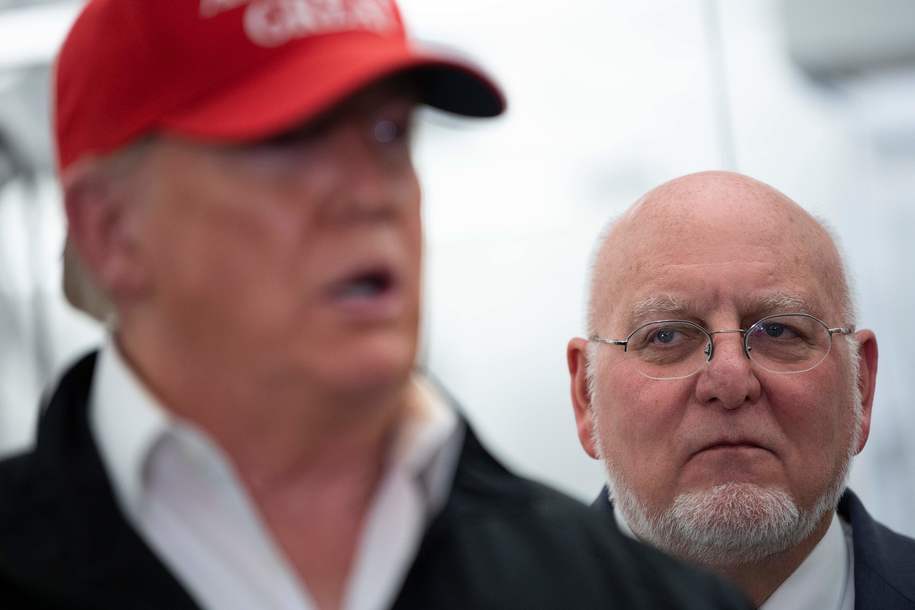
The previous changes seemed to be politically motivated to favor Trump. The CDC just walked them back.

The Centers for Disease Control and Prevention (CDC) on Friday reversed changes to its Covid-19 testing guidelines, once again recommending that people without symptoms get tested for the coronavirus if they have come into close contact with someone known to be infected.

The CDC’s new guidelines now state, “If you have been in close contact, such as within 6 feet of a person with documented SARS-CoV-2 infection for at least 15 minutes and do not have symptoms. You need a test. … Because of the potential for asymptomatic and pre-symptomatic transmission, it is important that contacts of individuals with SARS-CoV-2 infection be quickly identified and tested.” It also calls for such people to self-isolate for 14 days, even if the test comes back negative.

Recent guidelines suggested that people without symptoms who have come into close contact with others known to be infected “do not necessarily need a test.” The new guidance, in effect, returns the CDC to a recommendation for more testing.

Public health experts and officials criticized the previous revisions. They noted that people without symptoms can still spread the coronavirus, and, in fact, people may be at greatest risk of spreading the virus before they develop symptoms. For those without symptoms, the test may be the only way to confirm an infection — and, as a result, get people to isolate to stop further spread of the disease.

The previous changes to not recommend testing, however, appeared to be politically motivated. President Donald Trump, arguing that more tests make the US look bad by exposing more Covid-19 cases, previously said that he told his people to “slow the testing down, please.” Media reports confirmed the White House and Trump’s Department of Health and Human Services forced and oversaw the previous changes to recommend less testing — even as CDC officials objected. That fell into broader efforts by the Trump administration to muzzle and warp the CDC to downplay Covid-19 and Trump’s botched response.

The latest revisions to the guidelines amount to the CDC rebuking Trump and his officials’ politically motivated efforts.

Since the start of September, the number of people getting tested for Covid-19 in the US has stalled out and even fallen. Some experts said that the previous revisions to the CDC guidelines were partly to blame.

Testing is crucial to stopping Covid-19 outbreaks. When paired with contact tracing, tests allow officials to isolate the sick, track down close contacts and get them to isolate as well, and deploy other public health measures as necessary. Aggressive testing and tracing were key to controlling Covid-19 outbreaks in other countries, such as Germany and South Korea.

The US, however, has struggled to build up its testing capacity. In the spring, the country was slow to do so due to a mix of federal screw-ups and bureaucratic hurdles, resulting in a “lost month” for confronting Covid-19. In the months after, testing did increase. But then, when cases started to spike nationwide in the summer, there were more testing shortages as some labs reported delays for results as long as weeks. Starting this month, testing appeared to decline again.

The testing failures are one reason the US, which is now nearing 200,000 confirmed Covid-19 deaths, has struggled so much to contain the virus. While the US hasn’t seen the most coronavirus deaths of wealthy nations, it’s in the bottom 20 percent for deaths since the pandemic began, and reports seven times the deaths as the median developed country. If the US had the same death rate as, say, Canada, 115,000 more Americans would likely be alive today.

The recent drop in testing is particularly concerning now: The fall and winter threaten another wave of rising Covid-19 cases — as people return to school, the holidays bring families and friends close together, the cold pushes people into indoor spaces where the virus is more likely to spread, and a flu season looms.

At least with its new guidance, the CDC is pushing for the kind of testing that could help America get control over future outbreaks and, hopefully, prevent them from becoming dire.


Help keep Vox free for all

Millions turn to Vox each month to understand what’s happening in the news, from the coronavirus crisis to a racial reckoning to what is, quite possibly, the most consequential presidential election of our lifetimes. Our mission has never been more vital than it is in this moment: to empower you through understanding. But our distinctive brand of explanatory journalism takes resources. Even when the economy and the news advertising market recovers, your support will be a critical part of sustaining our resource-intensive work. If you have already contributed, thank you. If you haven’t, please consider helping everyone make sense of an increasingly chaotic world: Contribute today from as little as $3.

18 Sep 20:54

$100,000 in bribes helped fraudulent Amazon sellers earn $100 million, DOJ says

by Jon Brodkin
James.galbraith

Well that's a problem

A pile of Amazon boxes in front of the door of a house.

Enlarge / Amazon boxes. (credit: Getty Images | Julie Clopper)

Six people were indicted on allegations of paying over $100,000 in bribes to Amazon employees and contractors as part of a scheme to give third-party sellers unfair advantages on the Amazon marketplace. Among other things, the indictment says that Amazon workers who accepted bribes reinstated sellers whose accounts had been suspended for offering dangerous products, and these workers suspended the seller accounts of fraudulent sellers' competitors.

The US Department of Justice today announced the indictment handed down by a grand jury in the Western District of Washington. The "defendants paid bribes to at least ten different Amazon employees and contractors," the DOJ said. In one case, a 31-year-old defendant named Nishad Kunju "accepted bribes as a seller-support associate in Hyderabad, India, before becoming an outside consultant who recruited and paid bribes to his former colleagues," the DOJ said.

In exchange for bribes, Amazon workers "baselessly and fraudulently conferred tens of millions of dollars of competitive benefits upon hundreds of [third-party] seller accounts that the Defendants purported to represent," the indictment said. The DOJ said that workers "helped reinstate products and merchant accounts that Amazon had suspended or blocked entirely from doing business on the Amazon Marketplace" and that "the fraudulently reinstated products included dietary supplements that had been suspended because of customer-safety complaints, household electronics that had been flagged as flammable, consumer goods that had been flagged for intellectual-property violations, and other goods." These fraudulently reinstated seller accounts included ones Amazon had "suspended for manipulating product reviews to deceive consumers, making improper contact with consumers, and other violations of Amazon's seller policies and codes of conduct," the DOJ said.

Read 7 remaining paragraphs | Comments

18 Sep 19:51

Major vaccine manufacturers release plans showing that vaccines are unlikely before spring of 2021

by Mark Sumner
James.galbraith

No shit

With rising concern that Donald Trump would attempt to push out a vaccine ahead of the election, despite a lack of data on safety and efficacy, nine leading vaccine researchers and manufacturers signed a pledge earlier this month not to submit their vaccine candidates to the FDA until large-scale “Phase 3” trials have been completed. However, with Trump promising a vaccine “very soon” since the beginning of March, and the CDC shocking states by telling them to prepare for a vaccine by Nov. 1, restoring faith in the vaccine process called on many to demand that the manufacturers practice radical transparency by releasing their plans for testing.

On Thursday, two of the leading vaccine manufacturers—Moderna and Pfizer—did exactly that by releasing detailed plans for their Phase 3 testing. Moderna’s 135-page description covers how they plan to distribute vaccines among 30,000 volunteers, with results expected in November. Pfizer’s plan includes 44,000 volunteers and does not give an expected date for completion of Phase 3.

Both companies have triggers that could end the trial early, including triggers that might show the vaccine was ineffective. However, even if the trials ended in the next two months, the companies acknowledge that analysis of the data—an absolute necessity to properly assess safety, efficacy, and proper dosage—could take several months more.

All of this supports previous statements by National Institute of Allergy and Infectious Disease Director Dr. Anthony Fauci and CDC Director Robert Redfield, both of whom have said that vaccines are not likely to be available to the general public until sometime well into 2021.

Moderna’s candidate vaccine involves messenger RNA enclosed in a lipid shell. It’s a form of vaccine that has never been approved before in humans. A 2017 review of the company’s efforts suggested that Moderna had “run into troubling safety problems with its most ambitious therapy” and that in order to get its vaccine technology approved the “unicorn” biotech startup was “in need of a Hail Mary” to survive. 

For Moderna, their COVID-19 vaccine is that Hail Mary. They really, really need this to work. That could lead to a company pushing too hard for success, and Moderna’s rapid release of early data from Phase 1 and 2 trials only amplified those concerns. However, the Phase 3 trial looks to be, if anything, conservative in its approach. 

At this point, Moderna has already enrolled over 25,000 volunteers, 10,000 of whom have received their first dose of vaccine. The plan is to enroll 5,000 more, with half of volunteers eventually receiving an initial shot of vaccine followed by a booster, with a total dosage of 100 μg. That dosage is in the middle of the levels used in Phase 2 testing, where some patients who received a higher dose reported moderate reactions. The other half of volunteers will receive a placebo.

COVID-19 infection rates among patients receiving the vaccine vs. those receiving the placebo will be compared after 53 cases of COVID-19 have been diagnosed. This point represents a potential early stopping point at which the vaccine may be found to be particularly effective or ineffective. Moderna is shooting for a minimum of 74% efficacy to consider the vaccine a success. So, if the magic number of 53 cases is reached, and more than 74% of those are among the placebo group, that could be a point where the company declares “good enough.” Likewise, if the vaccine proves less than 74% effective at that point, the trial could be suspended or halted. As was recently seen with the AstraZeneca trial of the vaccine developed at Oxford, any safety issue that pops up could also suspend or halt the trial.

Pfizer, which has partnered with German tech firm BioNTech, has a similar plan overall. Their vaccine is also using a new technology based on messenger RNA, and while this is not a make-or-break moment for this large, established pharmaceutical company, there’s little doubt they want a share of the multibillion dollar pie for COVID-19, as well as the chance to fast track future mRNA vaccines using their technology, which involves a different delivery system than Moderna. Both of these companies aren’t just competing to deliver a vaccine for COVID-19: They’re hoping to open the door to a whole new approach to vaccines that could greatly extend the range of what we think of as a “vaccine.”

Pfizer plans to enroll 44,000 volunteers, also equally split between those receiving the vaccine and the placebo. And, like Moderna, they also have a number of cases that will trigger a first analysis. In Pfizer’s case, that number is 32. With a larger number of volunteers and a smaller number of cases required to trigger a possible halt, it can be argued that Pfizer is actually hurrying things along more aggressively than Moderna.

Moderna’s plan also includes a timeline that suggests that first analysis of Phase 3 results is not likely before November, and may not happen until some time in late December. Final analysis before distribution of vaccine is not expected before spring of 2021.

Pfizer does not provide a detailed timeline for its plan, but it’s safe to assume it cannot possibly meet Donald Trump’s claims that a vaccine would be available as soon as October, because Pfizer is not even halfway through enrolling people for their trial. Their overall timeline is likely to be similar to that of Moderna, putting a vaccine on the street (i.e. at your local clinic) around the second quarter of 2021.

Earlier this week, after Redfield once again testified to Congress that a vaccine was unlikely to be available this year and stated that a mask may be more effective than a vaccine, Trump hurried to contradict the CDC director, saying, “It’s just incorrect information.” Which is exactly the kind of statement that has half of American adults unwilling to take a COVID-19 vaccine under Trump.

Note: The vaccine trial that I’ve signed up with has now been confirmed to be a trial of the AstraZeneca/Oxford vaccine. This trial is still suspended in the U.S. pending investigation of a potentially serious reaction in one U.K. volunteer. AstraZeneca has stated that it cannot provide more public information about the incident due to international laws around privacy of medical data. Assuming the trial resumes, it’s my intention to go forward as a participant, and I will report on the experience within the limits of any agreements involved.

18 Sep 19:50

Trump’s dark National Archives speech was white resentment run amok

by Aaron Rupar
James.galbraith

The GOP is the party of blatant white supremacy

US-POLITICS-TRUMP-HISTORY Trump speaks at the National Archives on Thursday. | Saul Loeb/AFP via Getty Images

Trump’s screed against “critical race theory” is the real cancel culture.

President Donald Trump on Thursday used the National Archives Museum as a backdrop to make a case that educating students about racism in American society is a dangerous heresy that needs to stop.

In somber, almost sedated tones, Trump signaled to his white base that he doesn’t think structural racism is to blame for any social inequities. In short, not only is the summer’s national reckoning over police violence and racism unnecessary in his book, it’s also un-American.

“Students in our universities are inundated with critical race theory. This is a Marxist doctrine holding that America is a wicked and racist nation, that even young children are complicit in oppression, and that our entire society must be radically transformed,” Trump said. “Critical race theory is being forced into our children’s schools, it’s being imposed into workplace trainings, and it’s being deployed to rip apart friends, neighbors, and families.”

The solution, Trump claimed, is to “restore patriotic education to our schools.” He said he’ll create a new “1776 Commission” to “encourage our educators to teach our children about the miracle of American history and make plans to honor the 250th anniversary of our founding.”

“Our heroes will never be forgotten. Our youth will be taught to love America with all of their heart and all of their soul,” he added.

What this will end up meaning in practice isn’t clear, and isn’t really important. For Trump, what matters is to signal to racial reactionaries that he’s on their side.

It’s just nonsense to believe that America isn’t racist

The United States of America, of course, was founded with slavery at the core of its socioeconomic system. Conversation about slavery’s foundational role in the US has been reinvigorated by the New York Times Magazine’s 1619 Project, which, as J. Brian Charles wrote for Vox, “marks the 400th anniversary of the arrival of African slaves to Virginia” by seeking “to reframe the country’s thinking about slavery and how intertwined the practice of slavery has been in shaping the nation.” (Trump’s “1776 Commission” is meant to allude to the 1619 Project, which Trump has railed against.)

Even after slavery was abolished, Jim Crow laws made Black people second-class citizens in much of the country. Today, Black Americans have to deal with voter suppression efforts aimed at making it difficult to them to vote in areas where their votes threaten Republican control.

This legacy of racism has tangible consequences. Black Americans have lower life expectancies and make less than whites, even adjusted for education. (And adjusting for education is important, because in this area as well Blacks fare worse than whites.)

Black Americans are also far more likely, per capita, to be victims of police violence than White Americans. This disparity in particular became a major topic of public attention this summer as protests erupted following the police killings of Breonna Taylor and George Floyd, and more recently the shooting of Jacob Blake.

But instead of even paying lip service to structural racism, Trump has consistently denied that such a thing exists. In a July interview with CBS, for instance, Trump responded to a straightforward question about why he thinks Black people continue to be killed by police by lashing out — at the questioner.

“And so are white people. So are white people,” Trump said. “What a terrible question to ask.”

Even worse, he defended a supporter of his who has been charged with murder for killing two protesters in Wisconsin, while using the killing of a right-wing counter-demonstrator in Portland at the hands of a Black Lives Matter sympathizer to advocate for extrajudicial killings.

Trump’s speech on Thursday was attended by supporters of his who, despite his bizarrely monotone delivery, cheered throughout. But the ABC town hall he did on Wednesday illustrated how little resonance his effort to rewrite history has in other settings.

Host George Stephanopoulos confronted Trump with statistics pointing toward the reality of systemic racism — “Black Americans [are] more than three times [as] likely to be killed by police,” he noted, for example — and asked him what he plans to do (if anything) to rectify the situation.

But instead of engaging with the substance of the question, Trump immediately steered the discussion toward polling.

A voter then asked Trump to explain when America has ever been great for Black people. Again, Trump tried to twist the question into an opportunity to talk about polling.

“Well, I can say this, we have tremendous African American support,” Trump claimed, but polls friendly to him peg his job approval with Black voters at under 25 percent. (About 10 percent of Black voters say they intend to vote for Trump, which in fairness would be higher than the 8 percent Black support he had in 2016.)

But the voter pushed back, noting that Trump “has yet to address and acknowledge that there has been a race problem in America.”

“I hope there’s not a race problem,” Trump replied. And if there was any hope that exchange would prompt Trump to reexamine his priors, his speech on Thursday put them to rest.


Help keep Vox free for all

Millions turn to Vox each month to understand what’s happening in the news, from the coronavirus crisis to a racial reckoning to what is, quite possibly, the most consequential presidential election of our lifetimes. Our mission has never been more vital than it is in this moment: to empower you through understanding. But our distinctive brand of explanatory journalism takes resources. Even when the economy and the news advertising market recovers, your support will be a critical part of sustaining our resource-intensive work. If you have already contributed, thank you. If you haven’t, please consider helping everyone make sense of an increasingly chaotic world: Contribute today from as little as $3.

18 Sep 19:49

Confirmed: Barr's Justice Department explored prosecuting Portland officials over protest handling

by Kerry Eleveld
James.galbraith

Burn the entire thing to the ground

In case you were wondering whether Attorney General William Barr has turned the U.S. Justice Department into a rank political weapon, here's your answer: A DOJ spokesperson admitted Thursday the department had explored bringing criminal or civil charges against local officials in Portland, Oregon, for their handling of the ongoing protests there.

Barr's Justice Department sought to make a connection between local officials' rhetoric and actions and the clashes that played out between protesters and law enforcement, according to Politico

The clashes have occurred in a limited radius spanning several blocks around a federal courthouse in Portland, and most of the protesting has been peaceful, as it has been nationwide. But Trump has sought to scare white suburbanites into voting for him by playing up isolated instances of violence and casting them as the norm rather than the exception.

But the latest revelations about Barr's off-the-rails stewardship of the Justice Department reek of a pure political ploy, particularly because the chances of succeeding in such a lawsuit are exceedingly unlikely. As Politico writes, "Bringing criminal civil rights charges against city officials for protest-related violence would likely present an uphill court battle for federal prosecutors."

Department spokesperson Kerri Kupec has declined to comment on whether charges are still under consideration or might ultimately be brought, but she disputed reports that Barr had told federal prosecutors to look into bringing charges against Seattle Mayor Jenny Durkan for allowing a protest zone to be established in the city this summer. 

Portland Mayor Ted Wheeler issued a statement calling the Justice Department effort "ridiculous on its face."

“The administration has made the cynical decision that the suffering of others is politically beneficial, regardless of the cost,” he said. "The people of this city — and throughout the nation — will not be intimidated, and I remain committed to doing my part as mayor to work with local partners to advance racial justice, and address the pandemic and economic challenges facing our community.”

The Portland revelation is just the latest instance of Barr bending justice to his increasingly extremist will. Barr's rant on Wednesday night in which he compared the department's attorneys to preschoolers, said social distancing guidelines were akin to slavery, and declared himself the ultimate decider just firmly established him as a complete wingnut on a power trip who is currently in charge of administering American justice. Really, anything at all is possible under Barr. He's both wicked and unraveling.