Shared posts

07 Dec 17:54

Passengers Applaud as ‘Karen’ is Escorted Off Frontier Airlines Flight for Refusing to Wear Mask, Cursing at Flight Attendant: WATCH

by Andy Towle
Frontier Karen

A woman on a Frontier Airlines flight from Cincinnati to Tampa was removed on Thursday after refusing to wear a mask and cursing at a flight attendant.

“Ma’am, I’m speaking to you. Ma’am?” said the flight attendant, in a video shared to Twitter. “You have to wear your mask the whole entire flight. If you’re unable to do so you will be removed from the flight.”

As the flight attendant walked away the woman yelled after her, “Thanks, a**hole.”

“Okay, you’re done. Let’s go,” said the flight attendant, returning. “You’re getting off the aircraft. Come on. You’re done, you’re not going to speak to me like that. You have to comply. You agreed to this when you checked into our flight and you bought your ticket so I need you to get off the aircraft at this time.”

Karen said she was refusing so airport security was called to remove her.

As she left, the cabin applauded and someone said “bye Karen.”

The post Passengers Applaud as ‘Karen’ is Escorted Off Frontier Airlines Flight for Refusing to Wear Mask, Cursing at Flight Attendant: WATCH appeared first on Towleroad Gay News.

07 Dec 17:07

Idaho Republican took $314,727 PPP loan, then wrote an op-ed decrying people wanting ‘handouts’

by Walter Einenkel
James.galbraith

Of course

The Idaho Statesman has a heartwarming story of a small business owner that was able to get through the red tape that has frozen out more than 50% of small business owners to get $314,727 from the Paycheck Protection Program (PPP). (Disclosure: Kos Media received a Paycheck Protection Program loan.) The small business owner was none other than Republican Idaho Lt. Gov. Janice McGeachin.

Lt. Gov. McGeachin is a stellar example of the Republican ethos: hypocrisy. In fact, a couple of months after taking some of that PPP money, McGeachin penned an op-ed for numerous publications to run, titled “For some, more is never enough.” In this little ditty of an opinion piece McGeachin decries “those who advocate socialized medicine, unearned income and other handouts,” saying  “there really is no amount of spending that would satisfy them.” I guess since the Lt. Gov. was able to clear a cool 300 G’s, it’s time to turn off that “handout” faucet she was drinking from?

The best part of this all is that later in the hypocrite’s oath she talks about all of the small business owners she’s been talking to who are worried about deficits and debts. Like most conservative opinion pieces, McGeachin seems to have confused a big business donor at some GOP fundraiser with her actual Idaho constituents.

After reports came out exposing McGeachin for being the phony baloney person she is, she went to her social media accounts to make a statement. She defended her decision for taking the money because she needed it. Hehe. Then she called this all a witch hunt and a liberal media conspiracy to attack her. Before climbing onto her wooden cross, she finished her long-winded and point-free statement by saying that if we had a “truly free market devoid of government lockdowns and other mandates,” businesses would be thriving and no one would need PPP loans.

She should go and ask Sweden about how well that worked for both its economy and public health. Spoiler alert: It’s been bad. Very bad. As in, government-officials-admitting-they-made-big-mistakes bad.  

You might remember Janie McGeachin from such greatest hits as, women who have abortions should face the death penalty, and I love the militia so much that I’m willing to overthrow the government so that 97% of the country can be ruled by a minority of violent men with beards. Recently, McGeachin was appearing in videos holding a gun and whining about government public health measures. She also appears to question whether or not the COVID-19 pandemic is real in that video.

Lt. Gov. Janice McGeachin: hypocrite with a capital “FULL OF S---.”

05 Dec 01:31

JavaScript Turns 25

by msmash
James.galbraith

feeling positively ancient lol

The programming language JavaScript emerged 25 years ago and has grown to become one of the most important pieces of the web and browser applications we use today. From a report: JavaScript is the go-to language for front-end development and has spawned Microsoft's Typescript, a superset of JavaScript with a stronger optional type system for developers that compiles to JavaScript when run in the browser. Both JavaScript and TypeScript conform to ECMAScript, the standard for JavaScript and node.js, the runtime for running applications outside of the browser thanks to Google's powerful V8 JavaScript engine. JavaScript's impact on the web cannot be understated. Tech giants have thrown their weight behind the language. Besides Google's V8, there are open source projects like React from Facebook and Angular from Google, which help spread web applications across smartphones and desktop. After Netscape and Sun Microsystems -- where Java was hatched in May 1995 by James Gosling -- announced JavaScript in December 1995, Microsoft promoted Visual Basic (VB) as a standard for creating web applications using VB Script for its Internet Explorer browser. Oracle would go on to buy Sun Microsystems in 2008 largely to get its hands on Java and its huge development ecosystem. The press release about its launch from 25 years ago.

Read more of this story at Slashdot.

04 Dec 23:08

Federal judge orders Trump administration to fully reopen DACA to new applications

by Gabe Ortiz
James.galbraith

About fucking time

A federal judge has ordered the Trump administration to fully reopen the Deferred Action for Childhood Arrivals (DACA) program as it was prior to its 2017 rescission and accept new applications, CBS News reports:

BREAKING — US Judge Nicholas Garaufis has ordered the Trump administration to fully restore DACA, instructing DHS to open the Obama-era program to new applicants for the first time since 2017. Follow @CBSNews for more. pic.twitter.com/QpExWvY4WS

— Camilo Montoya-Galvez (@camiloreports) December 4, 2020

Federal judge Nichola Garaufis had last month ruled that because Chad Wolf was unlawfully appointed acting secretary of the Department of Homeland Security (DHS), the memo he signed this past summer refusing to accept new applications was also invalid. Advocates say that Garaufis’ Friday order states that “[b]y the end of the day on Monday, USCIS must put a public notice on their website declaring that DACA is back to the status it had before it was ended in 2017.”

04 Dec 23:06

Why are Republicans moving toward a stimulus compromise? Here’s a clue.

by Greg Sargent
James.galbraith

No shit.

Red states are facing some of the worst fiscal crunches.
04 Dec 23:06

'Tough choices on border wall' actually not tough at all: Stop construction and cancel the contracts

by Gabe Ortiz
James.galbraith

Seriously. It comes to a dead stop and all the money gets returned to the departments from where it was stolen.

President-elect Joe Biden has previously vowed to end construction on Donald Trump’s stupid border wall after he takes office next month, saying this past August that “[t]here will not be another foot of wall constructed in my administration.” In his immigration plan, Biden said he’d end the “national emergency” that the impeached president has used as a lousy excuse to build the damned thing.

But, a report from the Associated Press claims that the president-elect will be facing some “tough choices” when it comes to the wall, “with construction in full swing, billions of dollars in contracts at stake and his word on the line,” a tweet said. I’m really trying to figure out why it’ll be so hard, because it all seems pretty clear-cut to me: stop the construction, cancel the contracts, and knock the motherfucker down. See, what’s so tough about that?

Of course, those massive contracts are cited as a main concern, but the federal government has the power to end those. “Biden’s administration could exercise termination clauses in the contracts,” the AP report said. Yes, it could mean that the new administration will have to fork over additional fees that could go to useful things, like pandemic relief. But either we’re serious about ending construction on this racist abomination, or we’re not.

What many of folks would in fact like to see is the fucking thing come down, something that could happen under a favorable Supreme Court decision. “If Biden wins election next month, his administration could do the same,” USA Today reported last month. Guess what? We won, and by a massive margin of votes. 

But even if we get our wildest wish and see fencing begin to be pulled down come noon on January 20, there’s already been—and continues to be—so much destruction. NPR reported last month that the administration is rushing to build more fencing before Biden is inaugurated, bulldozing mountains and roads even though it’s clear it doesn’t have enough time to complete the project. In fact, environmental activist Laiken Jordahl called it “destruction for destruction's sake.”

“The damage the border wall has inflicted in just the past year is incalculable,” Jordahl wrote in an op-ed in The New York Times last month. “Much of it will last forever. No amount of money could repay the O’odham and all Indigenous people of the borderlands for the sacred sites, cultural history and natural heritage that’s been destroyed. To right these wrongs, we must start somewhere. Tearing down the wall would be a good start.”

“Stopping the work could force crews to leave projects half-finished and abandon steel and concrete already purchased,” the AP also cites as a problem for Biden, but I think stopping construction dead in its tracks is just one of many, many reasons millions of people voted for Biden in the first place. Nor do these materials need to remain there, or remain unused! We also have to remember that the whole fucking thing has been illegitimately constructed from the start, with Trump unlawfully stealing billions from other areas of the government. Now it’s Biden’s turn to use the full force of the government to put an end to this racist project. 

04 Dec 20:09

How Melbourne eradicated Covid-19

by Dylan Scott
James.galbraith

Doable if we didn't have huge herds of idiots

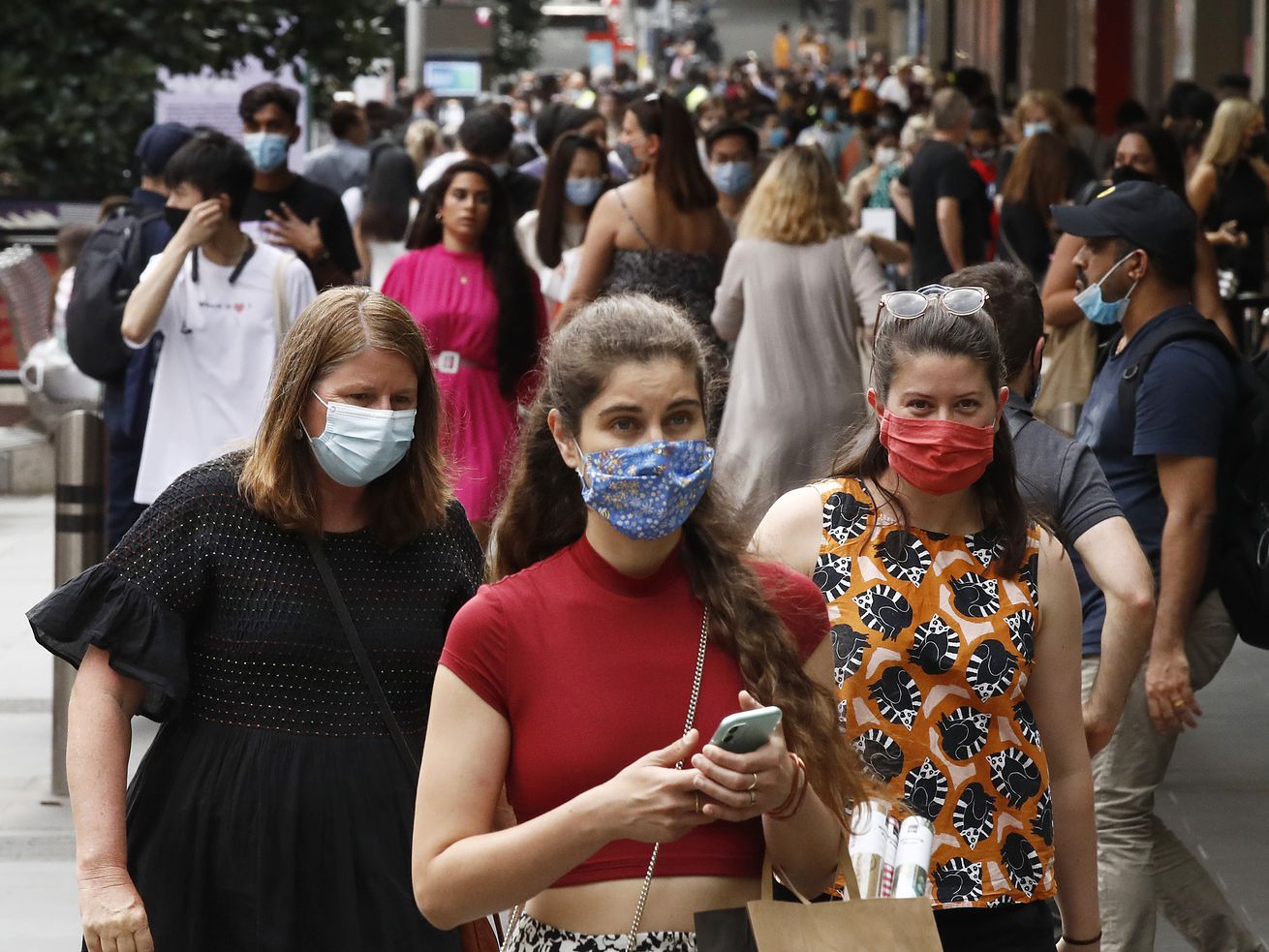
Melbourne and the rest of Victoria have totally eliminated Covid-19, allowing most everyday activities to resume. | Daniel Pockett/Getty Images

Life is almost back to normal in Melbourne, Australia. Here’s how they did it.

In July and August, the Australian state of Victoria was going through a second Covid-19 wave. Local leaders set an improbable goal in the face of that challenge. They didn’t want to just get their Covid-19 numbers down. They wanted to eliminate the virus entirely.

By the end of November, they’d done it.

They have seen no active cases for a full four weeks. Melbourne, the state’s capital and a city with about as many people as the greater Washington, DC, area, is now completely coronavirus-free.

Australia enjoyed plenty of advantages over the United States in containing Covid-19. It has no land borders to speak of. Its population density is very low (though the population is concentrated on the coasts). Its outbreak never got nearly as bad as the US’s did. On its worst days, Victoria saw about 700 new cases; Missouri, with (very roughly) a similar population and landmass, is currently averaging more than 3,000. Some of the Australian states also closed their borders to the others, which lowered the risk somebody might bring covid from one part of the country to another.

But the Australian epidemic has also mirrored America’s in important ways. Once the coronavirus arrived in the spring, the country went into lockdown. When cases abated, some of those restrictions were eased — and, before too long, Covid-19 cases were spiking again. Each state was responsible for its own response, with the federal government playing an advisory role outside of obviously national issues like foreign travel.

In the second wave, Victoria was by far the hardest-hit state. Its case numbers were dwarfing those in every other state including New South Wales, home to the country’s other great metropolis, Sydney.

 Grattan Institute

Policymakers dreaded an endless cycle of lockdown-reopening-lockdown — exactly the situation the US finds itself in. They realized that amorphous goals of “slowing the spread” or “flattening the curve” had been ineffective in mustering public support for the stringent mitigation measures that would be necessary to contain the virus.

So they went big. The state’s roadmap largely followed a policy proposal laid out in September by the Grattan Institute (a nonprofit think tank supported by the state and federal governments): “Go for zero.”

The goal was not just to slow Covid-19 down. It was to eradicate the virus. The state had gone into a Stage 4 lockdown — most businesses closed, there was a nightly curfew, and residents were ordered to stay within five kilometers of their home — in August, and it was then extended in September, with the explicit goal of eventually reaching zero new cases.

“Ideally, lockdowns are only done once and done well,” the proposal’s authors, Stephen Duckett and Will Mackey, explained. “The benefit of zero is to reduce the risk of ‘yo-yoing’ between virus flare-ups and further lockdowns to contain them.”

They treated the threats to public health and the economy as intertwined, which most experts agree they are. The Australian states that contained Covid-19 best also saw the strongest economic recoveries. Victoria, with the worst outbreak among the states, was lagging behind in consumer spending and business revenue.

People will stay home and spend less if they are worried about the virus. The Grattan authors cited a study comparing Denmark (which established a lockdown) and Sweden (which took the more relaxed “herd immunity” strategy) and found that their economies suffered about the same in the early months of the pandemic. But later in the year, when Denmark had its outbreak under control but Sweden did not, unemployment claims were almost back to pre-Covid levels in the former but remained elevated in the latter.

“Without elimination, the third, fourth, or fifth wave is an inevitability. This will either involve more lockdowns or the government will lose the social license to do lockdowns and the virus will spread indiscriminately,” Duckett told me over email, perhaps unwittingly describing the very challenge before the United States during this winter surge. “A hard lockdown in the early stages of the virus gives a chance for elimination, and that gives the chance for business certainty and a full recovery.”

Melburnians are now enjoying the benefits of their sacrifices. Duckett said he had just gone to lunch with a few friends before responding to my email.

The US probably cannot achieve zero Covid-19 cases anytime soon. But it could embrace the spirit of the Victorian model: a clear goal, support for the proven mitigation strategies, and a commitment from the public.

“Having a clear, uniform goal – that everyone could work toward – was critical to Victoria’s success,” Jennifer Kates, director of global health policy at the Kaiser Family Foundation, told me. “But they didn’t just have a goal. They established the underlying components that were needed and provided strong social support.”

“All of this,” she continued, “has been mostly absent in America.”

There is no secret sauce to Covid-19 containment. It just takes commitment.

There was nothing particularly novel about Victoria’s containment strategy. They just dedicated themselves to what works.

They expanded testing, including random pooled testing and testing for workers in essential industries and of people attending schools or other indoor events. They achieved 24-hour turnarounds for test results, so if a person tested positive, they could quickly isolate. Once cases reached zero, the state was planning to start testing sewage for Covid-19 to get a head start on any resurgence.

The Grattan Institute also recommended ramping up contact tracing, another established part of an effective Covid response, and mandatory isolation. Australia had problems earlier in the year with international travelers breaking their quarantines and introducing the virus into the community. The experts advised having people scan QR codes if they entered any public venues, so they could be contacted if a related case was detected. They also noted that other Australian states had police do spot checks of people who were supposed to be in isolation.

“A system that relies on self-isolation in which people are unable or refuse to self-isolate cannot succeed,” Duckett and Mackey wrote.

That probably sounds draconian to Americans. Certainly, the harshest lockdown measures taken in Victoria — requiring people to stay within a few miles of their house and stay inside completely at night — would be politically challenging in the US.

But Australians took it in stride because they knew the goal they were working toward.

“I think being obedient is definitely part of the Australian psyche,” Eloise Shepherd, who lives in the Melbourne suburbs (and whom I met for our feature on Australian health care published earlier this year), told me over text. “It was really hard, but I’m so grateful we did it.”

The government there made it easier for businesses and workers by providing subsidies to businesses to keep people employed and by increasing their unemployment benefits — the same policies that the US has let lapse and is now struggling to reinstitute even during this devastating winter wave.

As cases dwindled, the lockdown measures were relaxed in a clear, tiered fashion. The extreme travel restrictions were the first to go. Schools and businesses could reopen with spacing. Masks continued to be required indoors and on public transportation. Eventually, all restrictions except for international quarantine could be lifted.

Things could still go wrong for Victoria and the rest of Australia. The state has started prioritizing having “normal” conditions for the Christmas shopping season over maintaining zero new cases. But it is easier to focus on reopening when community spread is eliminated — rather than pushing forward with reopening in spite of sustained spread, as the US has done.

“We know that we’re going to basically have a much easier life now that the pandemic is under control,” Duckett said. “We still celebrate the fact that we’ve had so many days with no new infections and no deaths. The community is very proud of itself.”

Victoria’s Covid-19 restrictions were controversial with some residents, but Australia in general enjoys more political homogeny than the US does. That must make it easier to build solidarity for these extraordinary measures. America is deeply polarized, and that has been reflected in our scattered policy responses and in the differing attitudes of Democrats and Republicans toward mask-wearing and other restrictions.

But I don’t believe it was impossible for America to execute a similar strategy to the one that has succeeded in Victoria. Polls showed most Americans did support wearing masks and other mitigation measures, even if there was some divide among partisans. They worried that social distancing would be relaxed too quickly, not too slowly, much like the Australians did.

The problem, or one of them, is that the US just never set a clear goal for Covid-19 suppression. It was understandably hard to ask people in Wisconsin to abide by social distancing restrictions back when they thought the coronavirus was just a New York City problem — and when they didn’t know what the plan was.

Today, of course, the pandemic is a very real problem for every American. So as we try to bring the winter wave under control, we might benefit from taking a lesson from the Aussies and coming up with a specific objective that all of us, together, can work toward.

04 Dec 18:32

David Perdue’s smarmy new Fox News interview showcases the Trump effect

by Greg Sargent
James.galbraith

No shit. And the GOP voters are stupid enough to fall for it

Republicans are not the victims of the irrationality of Trump voters. They're cynically exploiting them.
04 Dec 18:31

Tucker Carlson: Christmas COVID Lockdowns are Absurd Because ‘Death is Inevitable’ — WATCH

by Andy Towle
James.galbraith

Great, fewer republicans. Go for it.

tucker carlson death

Tucker Carlson denounced COVID lockdowns during the holiday season on his FOX News show Thursday night, saying, “if death is inevitable — and that may be the one thing you’re not allowed to say in this country, but it’s still true — then maybe we should pause before we destroy the living in the name of trying to eliminate it.”

The U.S. recorded more than 2,500 COVID deaths in a single day on Thursday.

“Christmas is almost here, the best week on the American calendar, the happiest time that we have,” Carlson began. “This year, of all years, Christmas has a deeper resonance, maybe closer to its original meaning. In a time of crisis, you inevitably start thinking about those things you otherwise might ignore if you are busier and more content — things like, what’s the purpose of all of this? What matters most in my life? And what happens when it ends?”

“In general, people tend to become more spiritual, more openly religious, when they’re suffering,” Carlson argued. “It’s not an accident. In fact, it may be the upside. You get to think beyond the next Amazon delivery for a minute. Of course, not everyone is in favor of that. All of the focus on the big, enduring things, the focus on our families, the focus on what’s true and what’s not true, the focus on eternity itself, all of that tends to diminish the power of the people in charge of our temporal world, for obvious reasons. We take our leaders less seriously when we’re reminded that they’re just people. Slightly ludicrous, just like we are. When we’re reminded that they too will pass, all of us will.”

“Politicians understand this threat,” Carlson added. “They’ve figured out that Christmas is bigger than they are, and therefore, it’s a threat to them. Better cancel it — and, in fact, they’re trying hard.”

Full segment:

The post Tucker Carlson: Christmas COVID Lockdowns are Absurd Because ‘Death is Inevitable’ — WATCH appeared first on Towleroad Gay News.

04 Dec 18:17

Trump Considering Pardons for at Least 20 People But Worried it Might Make Him Look Guilty

by Andy Towle
James.galbraith

Because he is guilty lol

Trump gay power couple

Trump is considering pardons for at least 20 of his associates, family members, and friends, but is worried “these pardons would look like an admission of guilt.”

Politico reports: “GOP senators said Trump would be stepping on political landmines if he grants clemency to his family and associates, even as they noted presidents have broad pardon authority. Sen. Josh Hawley (R-Mo.), a Trump ally and a former state attorney general, acknowledged that such a move by the president would be unprecedented. … [Trump]is hesitant to pardon any of them, particularly Giuliani, because it may appear that members of his inner circle are criminals, said one of the three people, who spoke to Trump this week.”

The “evolving” list includes Rudy, Donald Jr., Eric, Ivanka, Jared, and himself.

The post Trump Considering Pardons for at Least 20 People But Worried it Might Make Him Look Guilty appeared first on Towleroad Gay News.

04 Dec 18:16

Trump’s New Citizenship Test Is Full of Conservative Bias—And Dotted With Mistakes

by Steven Lubet
James.galbraith

Fucking idiots


On December 1, 2020, the U.S. Citizenship and Immigration Service began administering a new naturalization test to those hoping to become U.S. citizens. The test draws from 128 potential civics questions, with the approved answers posted on the USCIS website. The test is given orally, and all applicants for naturalization will have to answer 20 of those questions chosen at random, with a passing score of 12.

When the test was first released a few weeks ago, many critics focused on its needless difficulty and complexity. The previous iteration of the test, last revised in 2008, required applicants to answer six of 10 questions, drawn from a pool of only 100. Several new questions call for biographical details about Alexander Hamilton, James Madison and Dwight Eisenhower, while another asks for “the purpose of the 10th Amendment.” Critics of the new test believe that it is intended to create an additional and unnecessary barrier to naturalization.

But perhaps the most significant feature of the test is its decidedly conservative political tilt, sometimes to the point of inaccuracy.

Certain questions, for example, reflect the Trump administration’s position in a case that is currently under Supreme Court review. Earlier this week, the court heard oral argument in a challenge to Trump’s unprecedented attempt to exclude unauthorized immigrants from the census count for the purpose of apportioning seats in the House of Representatives. All nine justices seemed fairly skeptical of Trump’s plan, with Justice Amy Coney Barrett observing that “a lot of the historical evidence and longstanding practice really cuts against [Trump’s] position.” After all, the 14th Amendment provides that representatives be apportioned according to “the whole number of persons in each State,” which has always previously been thought to mean exactly what it says.

We are unlikely to get a definitive answer from SCOTUS any time soon. (It appears probable that a host of complex procedural issues will send the case back to the lower courts for further consideration.) But fiddling with the census was not the Trump administration’s only opportunity to change our understanding of representation by limiting it to U.S. citizens. Here are two questions on the new naturalization test, as well as the only approved answers from the USCIS study guide, now embodying the Trump administration’s revisionist approach to government:

31. Who does a U.S. senator represent?

· Citizens of their state

33. Who does a member of the House of Representatives represent?

· Citizens in their [congressional] district

The acceptable answers have been changed from the 2008 iteration of the test, which accurately (at least for now, unless the Supreme Court decides otherwise) stated that U.S. senators represent “all people of the state.”

Does that mean anyone who answers “all people” rather than “citizens” will be marked incorrect? The examinations are administered orally by individual USCIS officers, who have some discretion, so it is impossible to know how often “all the people of the state” would be considered wrong, perhaps leading to a flunked test. But the instructions on the USCIS website explain that while “there may be additional correct answers to the civics questions, applicants are encouraged to respond” using only the sample answers. Regardless, the quite evident intent of the drafters was to change the model answer, from which applicants study for the exam, as part of a larger attempt to transform the government’s approach to representation.

It’s not hard to find more evidence of the test’s pronounced conservative bent. There are five questions and answers that include the Federalist Papers, revered by today’s American conservatives, including the Federalist Society, a legal organization whose members have included many of Trump’s judicial nominees, and The Federalist, a right-wing magazine. In contrast, there are only two questions about the civil rights movement and three about women’s suffrage. The study guide’s obsession with the Federalist Papers even leads to the inclusion of one acceptable answer that is flatly incorrect:

14. Many documents influenced the U.S. Constitution. Name one.

• Declaration of Independence
• Articles of Confederation
• Federalist Papers
• Anti-Federalist Papers
• Virginia Declaration of Rights
• Fundamental Orders of Connecticut
• Mayflower Compact
• Iroquois Great Law of Peace

The Federalist Papers, however, were published to urge adoption of the Constitution, which had already been written and circulated, and therefore could not have “influenced” the Constitution. (The same is true of the Anti-Federalist Papers.)

The conservative spin does not stop there. For example,

65. What are three rights of everyone living in the United States?

• Freedom of expression
• Freedom of speech
• Freedom of assembly
• Freedom to petition the government
• Freedom of religion
• The right to bear arms

Notably missing from the UCSIS answer list are the rights to counsel, due process, equal protection, and freedom from cruel and unusual punishment or unreasonable search and seizure. An aspiring citizen who gave one of those responses could presumably be marked wrong. Nor does “everyone” have the right to bear arms. It is a felony under current federal law for convicted felons, among others, to possess firearms or ammunition.

Here is another incomplete answer from the study guide:

2. What is the supreme law of the land?

• [U.S.] Constitution

In fact, Article VI provides that the supreme law of the land additionally includes the “Laws of the United States [and] all Treaties made.” While the Constitution is the most supreme of our laws, it also clearly provides that “Judges in every state shall be bound” by federal statutes and treaties. That is no doubt upsetting to extreme states’ rights advocates, which may explain why the test includes a specific question about what the 10th Amendment provides—answer: “powers not given to the federal government belong to the states or to the people”—but none about the 5th (the right to avoid self-incrimination) 6th (the right to counsel), or 8th (the ban on cruel and unusual punishment).

There are other problems with the civics test, including its unnecessary complexity, its obsession with battles and wars, and the fact that only a single answer set includes any women by name (there are 11 naming men). The word “democracy” appears just once. The first section on the 2008 test was titled “Principles of American Democracy,” now ominously replaced by “Principles of American Government.”

The most recent time the test was revised, the Bush administration posted an advance “pilot” of 144 proposed questions, many of which included errors, omissions and shortcomings. The 100 questions that made the final cut corrected most of the mistakes—after I pointed them out in an article for Salon, although I have no way of knowing whether I actually deserve any credit. The Trump administration created no similar opportunity for correction, instead publishing an overtly partisan test that is sometimes just plain wrong.

Successful applicants will have studied hard to obtain their cherished U.S. citizenship, and it is a shame for USCIS to mislead them so badly about the nature of the government to which they will soon pledge allegiance.

04 Dec 17:45

Rep. Katie Porter serves Trump's Treasury Secretary Steve Mnuchin his pink slip during hearing

by Walter Einenkel
James.galbraith

She's a gem

Treasury Secretary Steven Mnuchin appeared Wednesday in front of the House Financial Services Committee for a hearing on the handling of American taxpayer money during our current economic and public health crisis. Many Americans would like to know why Mnuchin is trying to sabotage the economy by cutting off the emergency lending programs and clawing back $455 billion into the General Fund. This move would force future Treasury Secretary Janet Yellen to negotiate the already-legislated use of CARES Act money with Senate Majority Leader Mitch McConnell. Federal Reserve Chair Jerome Powell has tried to nicely discourage this ill-advised and illegal move. After Donald Trump and the Republican Party insisted on having no strings attached to how they blackmailed distributed funds to people and companies in dire need of financial help, Mnuchin is now attempting to attach all sorts of strings before he leaves the office in January.

Democratic Rep. Katie Porter of California is no stranger to making powerful men look as craven and pedestrian as they really are. Her very simplified way of exposing the hypocrisies of not simply this administration, but the leaders of the corrupt industries leeching off of the American public, is very effective. It exposes the hypocrisies and corruption of those in power while also exposing how mediocre these (usually) men are. On Wednesday, it was Mnuchin’s integrity’s turn to get served a pink slip. Mnuchin was on the defensive quite quickly, after Rep. Porter explained the logic Mnuchin seems to be working with in his attempt to override the use of the remaining CARES Act stimulus package. But since people like Steve Mnuchin only get ahead when no one stands up to their transparently mediocre minds, they are frequently unable to handle themselves when they are called out on their activities. This is when things heated up, and this is when Rep. Porter shines.

Mnuchin attempted to argue he wasn’t asking for $450+ billion, but Rep. Porter wanted to know one thing: Is it the year 2026? It’s a simple question, but an important one legally. The CARES Act, a law written and passed by the Legislative branch and signed into law by the Executive branch, stipulates that whatever funds are left over from the coronavirus pandemic are not allowed to be moved back to the Treasury until “on or after Jan. 1, 2026.” Now, you don’t have to be a lawyer to understand that the year 2026 is not 2020, or even 2021. And after pouting a bit, Mnuchin moped that he knew it wasn’t 2026, complaining that it was “ridiculous to ask me that question and waste our time.”

Rep. Porter explained to Mr. Mnuchin that she was only wasting his time because he was insisting on “play-acting to be a lawyer.” Hehe. That stung The Lego Movie producer, and he interrupted Porter to say that he had “plenty of lawyers” at the Treasury. Okey dokey! Get nice and comfortable, maybe pour yourself a drink (if you like to have a nice drink), and put on some cozy slippers, because that is when this exchange took place.

REP. KATIE PORTER: Secretary Mnuchin. Are you in fact a lawyer?

TREASURY SEC. STEVEN MNUCHIN: Ah, I do not have a legal degree. I have lawyers that report to me.

After asking Fed Chair Powell if he was a lawyer—Powell was indeed a former lawyer—she turned back to Mnuchin to explain how he was arguing law with a lawyer. Ready for Mnuchin to expose his tiny brain and big ego—all at the same time?

SEC. MNUCHIN: Are you a lawyer?

In fact, Rep. Katie Porter is a professor of law (on leave) from the University of California, Irvine. She graduated from Harvard Law School magna cum laude, which means she is totally a lawyer. Steven Mnuchin is barely like a Treasury secretary, let alone a lawyer. These guys can’t leave the White House soon enough.

Porter begins around the 1:15:00 mark. Enjoy.

04 Dec 01:50

Warner Bros. To Debut Entire 2021 Film Slate, Including 'Dune' and 'Matrix 4,' Both on HBO Max and In Theaters

by msmash
James.galbraith

That's the sound of theaters shitting bricks

When Warner Bros. announced that "Wonder Woman 1984" would land on the streaming service HBO Max on Christmas, the same time it debuts in theaters, many expected it to be an isolated case in response to an unprecedented pandemic. From a report: Instead, the studio will deploy a similar release strategy for the next twelve months. In a surprising break from industry standards, Warner Bros.' entire 2021 slate -- a list of films that includes "The Matrix 4," Denis Villeneuve's "Dune" remake, Lin-Manuel Miranda's musical adaptation of "In the Heights," Sopranos prequel "The Many Saints of Newark," and "The Suicide Squad" -- will debut both on HBO Max and in theaters on their respective release dates. The shocking move to simultaneously release movies day-and-date underscores the crisis facing movie theaters and the rising importance of streaming services in the wake of a global health crisis that's decimated the film exhibition community.

Read more of this story at Slashdot.

04 Dec 01:28

Georgia leaders don't blink at some 700K voter roll purges, but outdated mailers spark felony threat

by Lauren Floyd
James.galbraith

Of course

Georgia Secretary of State Brad Raffensperger is apparently working overtime to get back in the good graces of President Donald Trump while at the same time playing good cop when the president asks him to directly disenfranchise the state’s 4.9 million voters. Silly Trump: Georgia Republicans prefer the indirect route. Hence, Raffensperger announced Monday that he “launched an investigation” into at least four grassroots organizations turning out voters. That, of course, includes former congresswoman Stacey Abrams’ New Georgia Project, which many have credited with helping flip Georgia blue in the recent presidential election. Raffensperger said the state has 250 open cases claiming violations of election law.

The Georgia runoff is Jan. 5. Click here to request an absentee ballot. Early in-person voting starts Dec. 14. And REGISTER TO VOTE here by Dec. 7.

“I have issued clear warnings several times to groups and individuals working to undermine the integrity of elections in Georgia through false and fraudulent registrations,” Raffensperger said in a press release Wednesday. “The security of Georgia’s elections is of the utmost importance. We have received specific evidence that these groups have solicited voter registrations from ineligible individuals who have passed away or live out of state. I will investigate these claims thoroughly and take action against anyone attempting to undermine our elections.”

Nsé Ufot, chief executive officer of the New Georgia Project, called Raffensperger’s true intentions to suppress voters obvious in a press release Monday. “As Georgians are turning out in record numbers to have their voices heard at the polls, the Secretary of State is resorting to desperate attempts to smear law-abiding organizations and scare eligible Georgians from registering to vote in critical upcoming elections. We will not be deterred,” she said. “This attack on our organization comes at a time when people across the country have witnessed the strength of our program and the collective power of a new Georgia electorate that embraces a system of inclusivity and opportunity for all Georgians. The timing is not accidental.”

In a state riddled with allegations of vote suppression, the New Georgia Project nonprofit registered more than 500,000 people from underrepresented communities in Georgia. But instead of applauding the organization’s work, Raffensperger accused it along with a group called Operation New Voter Registration Georgia and nonprofits America Votes and Vote Forward, of “repeatedly and aggressively” seeking to register “ineligible, out-of-state, or deceased voters” before the Senate runoff.

“Over the past several weeks, individuals in Georgia and around the country have reported voter registration solicitations sent by The New Georgia Project to individuals living out of state and people who have passed away,” Raffensperger’s office said. “One Fulton County resident reported receiving 5 postcards from The New Georgia Project soliciting a registration ‘for the same dead person.’” 

The Secretary of State’s Office said a Cherokee County resident also received a voter registration solicitation from The New Georgia Project for his spouse, who is ineligible to vote. “A third complaint said The New Georgia Project sent a voter registration solicitation to his daughter who is not registered to vote in Georgia and had not lived in a different state for five years,” the state office said. “A fourth individual reported receiving a ‘package of postcards’ at her home in New York City from The New Georgia Project encouraging people to register to vote in the Georgia Senate runoffs.”

The New Georgia Project called Raffensperger’s claims “tired and false.” “More than one million Georgians have registered to vote since the 2018 voter registration deadline, and over 846,000 have requested an absentee ballot for the upcoming runoff election on January 5th,” the nonprofit said. “The New Georgia Project will continue its mission to register eligible voters in advance of the December 7th deadline, so that Georgians can have their voices heard at the polls and freely and fairly cast their ballots for those who would represent them.”

I would have hoped Raffensperger’s quest to right election wrongs would have started last January, directly following unchecked voter suppression efforts believed to have cost Abrams the gubernatorial election against then-Secretary  of State Brian Kemp. Kemp won by about 55,000 votes in an election he refused to recuse himself from overseeing. When Raffensperger took office in January 2019, he just kept announcing investigations, none of which centered on Gov. Kemp.

As secretary of state, this man allowed an estimated 107,000 Georgia residents to be purged from voter rolls simply for failing to vote in past elections, according to a report by the nonprofit American Public Media. And that's only 15% of the nearly 700,000 total voters purged from rolls before the gubernatorial election.

Kemp also allowed more than 200 polling places across the state to be shut down, mostly in poor communities of color. It led to an estimated 54,000 to 85,000 voters prevented from casting ballots, the Atlanta Journal-Constitution reported.

And if that wasn’t enough proof of the governor’s racist efforts to suppress the Black vote, he put 53,000 voter registrations of mostly Black voters “in electoral limbo” last October, The Washington Post reported. “The move was the result of an ‘exact match’ policy in which even a single digit or a misplaced hyphen could derail the registration,” the Post added.

Don’t, however, count on Raffensperger to do as much as bat an eye when claims of voter suppression efforts impact Black communities. Instead, he’s taken to threatening small grassroots organizations with the possibility of up to 20 years in prison, a felony racketeering charge, and a fine of up to $25,000 per count for mailers that rubbed unnamed accusers the wrong way.

Raffensperger detailed in a televised press conference an allegation that Operation New Voter Registration Georgia, an organization with a practically nonexistent digital footprint, encouraged “Emory students to register fraudulently to vote” in the runoffs by changing their residences to reflect where they live currently. Raffensperger also detailed claims that Vote Forward encouraged a long-deceased Alabama resident to vote and that the progressive organization America Votes sent two absentee ballots to someone who hasn’t lived in Georgia since July 1994.

Vote Forward emailed its statement to Daily Kos Thursday:

"Vote Forward empowers volunteers to send heartfelt, handwritten letters to encourage their fellow citizens to participate in our democracy. Writing letters has quickly become one of the most popular and effective grassroots voter contact tools this past year. More than 180K volunteers used Vote Forward to write more than 19 million letters to voters ahead of the 2020 elections. The letters our volunteers are mailing in advance of the January 5th special election are being sent only to Georgia addresses, not to any other state. These letters do not include registration applications and do not directly register anyone to vote. We rely on a third-party vendor for voter information and try to make sure this data is as accurate as possible. However, the data is imperfect and there are some inconsistencies that we can neither predict nor control. If any letter recipient has moved out of state or passed away, they will of course be unable to register to vote in Georgia, and the letter itself will have no effect."

Sahil Mehrotra, the America Votes spokesperson, said in another email to Daily Kos the Georgia Secretary of State’s Office maintains the list of registered voters that America Votes used to mail absentee ballot applications. "The forms we send are valid, blank absentee ballot request forms like application mailings the Secretary of State sent voters in Georgia’s primary election, but not the general and runoff elections,” Mehrotra said. “We’re pleased that so many Georgians have already applied to vote by mail for the January runoff and will continue our work to make sure every voice is heard in January."

I wish the secretary of state could honestly say the same.

Let’s give GOP Leader Mitch McConnell the boot! Give $4 right now so McConnell can suffer the next six years in the minority.

RELATED: Want to flip a state blue? Stacey Abrams drops major key, and she would know

04 Dec 01:27

The Supreme Court is ready to revive a policy to make 'most of the government unconstitutional'

by Mark Sumner
James.galbraith

no shit

When Congress passed the Affordable Care Act (ACA), the final bill was 974 pages long. That does put it on the longer side of congressional bills, but it was definitely not the longest. The Energy Policy Act passed under George W. Bush was longer. The No Child Left Behind Act that set up a series of tests designed to topple public education was much longer. But since those were Republican-authored bills, there was a lack of drama involving people thumping piles of paper on a desk and complaining about all those pages, all those words.

In the case of the ACA, as with almost all legislation, the bill that passed the Congress was just the start. Four years after the passage of the legislation, around 20,000 pages of regulations had been authored to put into practical terms what the text of the bill means when it comes down to providing specific coverage in particular situations. Despite the length of the original bill, without the ability of executive agencies to author regulations, it would be impossible to actually deploy the authority which is only outlined in the legislation itself.

But the conservative majority on the Supreme Court has made it explicitly clear that it wants to make it impossible. Even if the fight over the ACA ends with every remaining piece of the legislation intact, it may not matter. Because the Court is just looking for an opportunity to make every regulation obsolete.

The key lies in something called the nondelegation doctrine. Under this theory, Article I of the Constitution gives Congress the right to exercise all legislative powers, but it doesn’t give it the authority to delegate any of that power to any other branch. So, for example, Congress could pass a law saying “greenhouses gas emissions have to be kept at the level of 1980,” but it could not leave it to the EPA to determine what emissions are covered by the phrase “greenhouse gases” or anything about how levels should be maintained. Congress would have to define all the gases, all the levels, all the methods of reduction, all the means of testing, all the … everything. Right in the bill.

This theory of how the government should operate would have even broader consequences on agencies like the FDA, which has broad and general powers to determine whether or not a drug is effective, or a food product is safe. Under nondelegation doctrine, every one of these situations could require specific legislation.

If that sounds like a situation in which regulation becomes essentially impossible, and bad actors of all types can manufacture loopholes infinitely faster than government can provide a response … that’s exactly right. This is why the Supreme Court has rarely dipped its toes anywhere near these waters since the 1930s, when a similarly radical conservative court used its power to push back on programs supported by Franklin Roosevelt. The last time the doctrine was deployed by the Court was in 1935. Since then, innumerable rulings have directly refuted this idea for reasons that include the simple fact that without administrative agencies, governance of a modern state is impossible.  

But as Slate reports, the current 6-3 conservative court hasn’t just hinted that it wants to revive this long-abandoned and intrinsically impractical doctrine, it has said so openly. A five-justice majority has already signed on to the idea of reviving a judicial approach that has been dead for over 80 years. 

In 2019, four conservative members joined a dissent authored by Neil Gorsuch, who wrote that “the court should revive the dormant nondelegation doctrine.” Samuel Alito authored a separate opinion that also praised the nondelegation doctrine, and wished for an opportunity to make that clear in a case that was not about expanding prosecution of sex offenders. Since then both Brett Kavanaugh and Amy Coney Barrett have joined the nondelegation chorus.

What case could trigger a flip which would turn the Biden administration from an opportunity to move the nation forward, into a mad scramble to prevent a tumble into the abyss? Try almost any. A challenge to any regulation, by any agency, might give the back-to-the-1930s crowd an opportunity to sign their names on a decision that guts everything from Fair Housing to the Clean Air Act in one go. If it was difficult to pass the ACA at 974 pages, imagine the difficulty, the compromises, and the failings that would occur if the legislation itself had to clock in at 21,000 pages in an effort to do the job of regulatory agencies. And even then, the results might last a day before insurance agencies and healthcare providers took advantage of a nuance of language to simply leave the legislation behind. By fixing regulations in the language of the original legislation, rather than allowing agencies to adapt them to changing conditions, many would be made moot or impractical. 

Justice Elena Kagan made it clear in that 2019 decision that using the nondelegation doctrine would, at a single blow, make “most of Government is unconstitutional.” Even though the justices who used the theory against Roosevelt recognized that agencies might be allowed to “fill in the details” of legislation, Kavanaugh has made it clear that, so far as he is concerned, those details can’t extend to “major policy questions.” Which is, of course, a difference without definition.

Should the court revive nondelegation as a legitimate cause for overturning regulations, every regulation would be challengeable on that basis. Every change, and every existing rule, would be subject to fresh court review. And every new piece of legislation would  become … impossible. 

Rediscovering nondelegation in 2021 is not just a ridiculous effort to hobble any progress by the the Biden administration, and not just an open challenge to the possibility of a modern state. It’s also a huge power grab by the court itself. It creates a whole new category of court review in which some regulations would be permissible, and others unconstitutional, based on whether the Court believes they step over a line that cannot be defined.

If the current conservative Supreme Court members want to all but guarantee that they will soon find themselves the minority on a significantly expanded Court … they know which button to push.

04 Dec 01:27

America’s failures have led to a new daily record in Covid-19 deaths

by Dylan Scott
James.galbraith

very very bad

A hospital worker walks through a tented opening.
The US set a new record for daily Covid-19 deaths on December 2, with nearly 2,900 new fatalities reported. | Go Nakamura/Getty Images

The number of daily Covid-19 deaths in the US is now about the same as the number of people who died on 9/11.

On December 2, a stunning 2,885 Americans were reported to have died from Covid-19, according to the New York Times. It was the highest single-day toll of the year.

It was nearly the same number of people who died in the 9/11 attacks (2,977). And it was far more than the estimated 1,800 Americans who died over a matter of days when Hurricane Katrina struck the Gulf Coast in 2005. During World War II, from the Pearl Harbor attacks in December 1941 to Japan’s surrender, about 300 US soldiers died every day on average (and about 407,000 were dead in total by August 1945).

Unfortunately, the coronavirus pandemic has more in common with a slow-motion tragedy, like a war, than an acute event like 9/11. More than 2,600 deaths were reported on December 1, the day before the US set its new record for daily deaths; the previous high had been 2,752 back on April 15. With the number of daily new cases and hospitalizations still rising across the country, public health experts expect new terrible death records will be set over the coming winter.

Coronavirus pandemic metrics are slippery things, however. America was so bad at testing during the first few months of the virus’s spread that there were likely quite a few cases and deaths that were caused by Covid-19 but were not counted as such. Even today, the US positive test rate is so high that experts say the statistics aren’t coming close to capturing every case or death.

According to the Johns Hopkins University tracker, the official number of total deaths attributed to Covid-19 in the US is 274,121. But total excess deaths — the number of deaths above what would be expected in a normal year — has reached 345,000, according to the Times. Most, though not all, of those deaths are likely uncounted Covid-19 fatalities.

At a certain point, this is all academic. What’s undeniable is that America is entering a period of mass death unlike anything we’ve seen so far in the pandemic. Cases and hospitalizations have still been steadily rising, and deaths always follow. Improvements in treatment have lowered the fatality rate, but a higher number of hospitalized patients will inevitably mean more deaths. And it is the elderly, the poor, and minorities who are dying at disproportionate rates from the coronavirus.

 Covid Tracking Project

The US also set a new single-day record for current hospitalizations on December 2, topping 100,000 for the first time, according to the Covid Tracking Project. Hospitals all across the nation are under tremendous strain.

The US is going to lose a lot more people before the Covid-19 pandemic ends

As hospital beds fill up and staff is stretched thin, the likelihood of losing people who otherwise might have survived under normal circumstances increases.

Ashish Jha, dean of the Brown University School of Public Health, explained the risks in a recent Twitter thread. He started by pointing out that the percentage of new Covid-19 cases who end up in the hospital is actually shrinking. That would suggest people who would have been hospitalized earlier in the year are now being turned away from the emergency room or asked to stay at home because they’re not yet in critical condition.

Some of this is good public health practice — you want to keep beds open for the sickest patients — but it also creates a situation where somebody who’s at the margins could be denied entry to the hospital and their condition might deteriorate more quickly at home.

Full hospitals could also be left without enough room or staff for patients with other serious conditions, and some of those people could die without access to the medical care they need. They may not die from Covid-19, but they would still be victims of the pandemic.

On Twitter, Kari Jerge, a surgeon in Kansas City, Kansas, described recent dilemmas doctors are facing: a non-Covid patient who died because he needed an emergency kidney replacement with a dialysis machine but there were no nurses available to run the machine, and having to turn down a transfer of another patient in critical condition because there were no ICU beds left.

This is likely only going to get worse over the holiday season. Many states and cities still refuse to take the mitigation measures necessary to control the virus, even though none of them meet the benchmarks for safely staying open. Vox’s German Lopez painted the grim picture in his most recent update on how each state is faring in containing the coronavirus:

Across these benchmarks, zero states fare well on all three metrics, suggesting no state has its outbreak under control right now. In fact, no state meets even two of three benchmarks — only Washington, DC, does. (Washington state is excluded due to recent problems with its testing reports.)

One caveat: Because of Thanksgiving, states are likely underreporting Covid-19 tests and cases. So as bad as things may already seem, they’re likely even worse than reported.

America’s outbreaks, reaching from California to Florida, are the result of the public and the country’s leaders never taking the virus seriously enough and, to the extent they did, letting their guard down prematurely. States, with the support of President Donald Trump, moved to reopen — often before they saw sizable drops in daily new Covid-19 cases, and at times so quickly they didn’t have time to see if each phase of their reopening was leading to too many more cases.

The public embraced the reopenings, going out and often not adhering to recommended precautions like physical distancing and wearing a mask.

Even as cases began to fall later in the summer, America’s overall caseload remained very high. And yet many states moved to reopen once again, with much of the public embracing the looser restrictions and subsequently going out.

It’s this mix of government withdrawal and public complacency that experts have cited in explaining why states continue to struggle with getting the coronavirus under control.

There is still time to soften the blow, with states and cities implementing more social distancing restrictions and requiring better mask adherence. But barring a sudden change in public behavior and public policy, America’s outbreak is not going to get better any time soon.

At this point, we appear to be waiting for the vaccine to be widely distributed to bring the virus under control — something that may not happen for another six months or longer. Prioritizing the most vulnerable populations for vaccination should help reduce the death toll, but there is no avoiding the fact that tens of thousands of Americans are likely to die over the next few months.

CDC director Robert Redfield said on Wednesday that the US Covid-19 death toll could reach 450,000 by March 1 without better social distancing and mask-wearing. That would mean about 175,000 more deaths between now and then.

In that scenario, the number of Americans who died from Covid-19 would surpass the number of American soldiers who died in all of World War II — and across a much shorter time frame (about one year versus four). In terms of mass-death events in America’s history, the coronavirus pandemic would rank behind only the Civil War and the 1918 Spanish flu pandemic.

As other parts of the developed world celebrate the complete eradication of the virus, America is still reaching the worst kind of milestones. And there are still more to come.

03 Dec 23:53

What’s the future of the GOP? You’re looking at it — and it’s bonkers.

by Paul Waldman
James.galbraith

lol yup

If you thought things would calm down after Trump lost, I have some bad news.
03 Dec 23:53

Pence attempts disappearing act, trying to avoid going down with Trump's ship

by Joan McCarter
James.galbraith

No separating now, kiddo. You're stuck.

The second to the two-time popular vote sore loser impeached Donald Trump, Mike Pence, has been slowly and quietly backing away from the train wreck that is his boss's "legal" efforts to overturn the election. Pence, sources tell the Daily Beast, "doesn't want to go down with this ship […] and believes much of the legal work has been unhelpful." His name has been disappeared from the Trump-Pence campaign logo that's been sent out on some of the fundraising emails, and since November 25 none of the fundraising pushes have included his name in the "from" field.

A source told the Daily Beast that that's because they've just been testing a new logo and that they haven't been sending emails to Pence's team for clearance. Some of the joint RNC/MAGA emails have been using the old logo, with Pence, but a number of Daily Beast's sources say that the change in the graphic is no coincidence, and that Pence's name hasn't been on the FRAUD emails for a reason. He doesn't want anything to do with Trump's increasingly frantic and unhinged claims. "It is an open secret [in Trumpworld] that Vice President Pence absolutely does not feel the same way about the legal effort as President Trump does," said a senior administration official.

Pence is also reportedly "particularly uncomfortable" with Trump's ferocious attacks on Republican governors. "Pence deeply understands the position that [Ohio Gov. Mike] DeWine, [Arizona Gov. Dave] Ducey and [Georgia Gov. Brian] Kemp are in. He has tried to be an effective mediator and communicator between those parties and the president back and forth," a source close to Pence said.“Any time he’s played that role, it’s gone well. The president is satisfied with the facts they’ve provided." Then the unloading, as this source becomes Pence's anger translator. "And then somehow, without hours or days, the president is publicly attacking them by being fed inaccurate information from other White House sources, which frustrates the VP. It's not a good look for the president. And it's only created division in the party at a time when unity is very important."

If Pence had a spine, or an ounce of real concern for the country and constitution he swore an oath to, he'd go public. He would stand up to Trump and say it's time to end this farce for the good of the nation. Instead, he's just fading into the background so that he doesn't wreck his political future, just in case Trump manages to keep the party his.

03 Dec 23:31

COVID-19 deaths on a single day exceed the total loses of 9/11

by Mark Sumner
James.galbraith

Yep, one 9/11 a day, and the GOP just can't be bothered to take any action. Because freedom

The attacks of September 11, 2001, cost the lives of 2,977 people—not including the 19 terrorists. More than 6,000 were injured. It was a total that galvanized the nation, altered the shape of government, and ultimately generated two wars in which over 8,500 more Americans have fallen. But it’s also a total smaller than the numbers of American deaths attributed to COVID-19 on Wednesday alone.

Different sites—from Johns Hopkins to WorldOMeters—report different numbers each day, but CNN set Wednesday’s number at a ghastly value of 3,157 COVID-19 deaths. WorldOMeters set the number at a slightly sub-9/11 value of 2,831 deaths, but even that number represents a new record high, surpassing the worst days of the initial surge.

On the same day, hospitalizations from COVID-19 exceeded 100,000 for the first time. The 203,427 new cases logged on Wednesday was another record. One week after Thanksgiving, any additional cases from the ill-advised travel are only starting to appear, and deaths from those gatherings of families and friends are still days or weeks from contributing to the totals.

The real horror of Wednesday’s record numbers is not that they were elevated by the widespread disregard for caution around the holiday. It’s that they were not. Whatever price the nation will pay for millions of travelers and outsized get togethers, is still to come.

That these grim numbers are coming at the same time that the first vaccines are just weeks from arriving only makes it more disheartening. And frustrating. National leadership at this time—an announcement of consistent guidelines and restrictions to address what is undoubtedly the worst moment to date—could go a long way toward applying the brakes to a pandemic raging out of control.

And on the day of this newest national tragedy, Donald Trump did take the stage to deliver what he called his “most important speech.” Unfortunately, that speech was a rambling tirade of lies about voter fraud; one that contained all the ridiculous assertions, and terrifying threats, of Trump’s assault on democracy.

On 9/11, the nation looked on in horror, but also with a sense of national unity. After four years of Trump, in a pandemic that has been as great as 9/11 times ten, every death only seems to drive more division.

03 Dec 23:29

Iowa Is What Happens When Government Does Nothing

by Elaine Godfrey
James.galbraith

Personal responsibility to kill watch them die. And these fuckwits are so prized as serious individuals for first in the nation presidential decisions? no fucking thank you.

Updated on December 7, 2020 at 1:07 p.m. ET.

IOWA CITY, IOWA—Nick Klein knew the man wasn’t going to make it through the night. So the 31-year-old nurse at the University of Iowa ICU put on his gown, his gloves, his mask, and his face shield. He went into the patient’s room, held a phone to his ear, and tried hard not to cry while he listened to the man’s loved ones take turns saying goodbye. When they were finished, Klein put on some music, a muted melody like you might hear in an elevator. He pulled up a chair and took the man’s hand. For two hours that summer night, there were no sounds but soft piano and the gentle beep beep beep of the monitors. Klein thought about how he would feel if the person in the bed were his own father, and he squeezed his hand tighter. Around midnight, Klein watched as the man took one last, ragged breath and died.

“I still don’t know if I’ve fully processed everything that’s going on,” Klein told me the day before Thanksgiving, as we talked about what the past few weeks and months at the hospital have been like. And with COVID-19 infections skyrocketing in his state, he added, “I don’t know when I will.”

[Read: How many Americans are about to die?]

To visit Iowa right now is to travel back in time to the early days of the coronavirus pandemic in places such as New York City and Lombardy and Seattle, when the horror was fresh and the sirens never stopped. Sick people are filling up ICUs across the state. Health-care workers like Klein are being pushed to their physical and emotional limits. On the TV in my parents’ house in Burlington, hospital CEOs are begging Iowans to hunker down and please, for the love of God, wear a mask. This sense of new urgency is strange, though, because the pandemic isn’t in its early days. The virus has been raging for eight months in this country; Iowa just hasn’t been acting like it.

The story of the coronavirus in this state is one of government inaction in the name of freedom and personal responsibility. Iowa Governor Kim Reynolds has followed President Donald Trump’s lead in downplaying the virus’s seriousness. She never imposed a full stay-at-home order for the state and allowed bars and restaurants to open much earlier than in other places. She imposed a mask mandate for the first time this month—one that health-care professionals consider comically ineffectual—and has questioned the science behind wearing masks at all. Through the month of November, Iowa vacillated between 1,700 and 5,500 cases every day. Between November 23 and November 29, the state’s test-positivity rate reached 50 percent, according to data compiled by Reuters. Iowa is what happens when a government does basically nothing to stop the spread of a deadly virus.

“In a lot of ways, Iowa is serving as the control group of what not to do,” Eli Perencevich, an infectious-disease doctor at the University of Iowa Hospitals and Clinics, told me. Although cases dropped in late November—a possible result of a warm spell in Iowa—Perencevich and other public-health experts predict that the state’s lax political leadership will result in a “super peak” over the holidays, and thousands of preventable deaths in the weeks to come. “We know the storm’s coming,” Perencevich said. “You can see it on the horizon.”

Warnings from doctors like Perencevich are what prompted my visit to Iowa City, a college town in eastern Iowa that serves as a sort of liberal sanctuary in a mostly red state. The city is home to the University of Iowa, and also to its public teaching hospital, which employs 7,000 people and has more adult ICU beds than most other state hospitals. I spent two days there just before Thanksgiving, interviewing doctors and nurses outside the brick walls of the hospital in the frigid November weather, standing six feet apart in the front garden or, when it rained, near a vent shooting out warm air on the building’s south side. Through the glass windows of the lobby, I watched as nurses in face shields pushed sick people around in wheelchairs. Once, I stepped inside to thaw and was startled by how quiet it was, and how the silence belied the suffering going on just a few floors above.

The first cases of the coronavirus in Iowa were recorded here in early March, when a group of infected locals returned home from an Egyptian cruise. As cases rose, Reynolds closed schools for the rest of the school year and most businesses for about two months. But by May 15, she’d allowed gyms, bars, and restaurants in all of Iowa’s 99 counties to open up again. She did not require Iowans to wear a mask in public, ignoring requests from local public-health officials and the White House Coronavirus Task Force and arguing that the state shouldn’t make that choice for its people. “The more information that we give them, then personally they can make the decision to wear a mask or not,” Reynolds said in June. She also wouldn’t require face coverings in public schools, where she ordered that students spend at least 50 percent of their instructional time in classrooms. When Iowa City and other towns began to issue their own mask requirements, Reynolds countered that they were not enforceable, undermining their authority. (The governor’s office did not respond to multiple requests for comment for this story.)

The rest of the summer and early fall brought on a mix of business closings and reopenings in counties around the state. (Complicating the picture, a data glitch at the Iowa Department of Public Health deflated case numbers in late summer.) Infections exploded in meatpacking plants, where managers were allegedly taking bets on how many workers would get sick. After students returned to schools and universities in the early fall, Iowa had the highest rate of COVID-19 infections in the country. In October, when Iowa was in the thick of community spread, Reynolds showed up, maskless and smiling, at a campaign rally for Trump at the Des Moines airport. (Her let-them-get-sick attitude toward the pandemic hasn’t been unusual among Republican governors, though there have been exceptions, including Mike DeWine of Ohio and Larry Hogan of Maryland.)

By November, the number of new COVID-19 cases in Iowa was higher than at any other point in the pandemic, and as many as 45 Iowans were dying of the disease every 24 hours in a state of just 3 million people. Outbreaks were reported in 156 nursing homes and assisted-living facilities in Iowa, and the virus ran rampant in the state’s prisons.

Doctors have been warning for weeks that the state’s health-care system is close to its breaking point. The University of Iowa hospital reached a peak of 37 COVID-19 inpatients in April, but by Thanksgiving, it had 90. That number may not seem overwhelming until you consider that COVID-19 patients require dozens of staff and that many spend weeks or months in hospital care. To meet the demand, administrators have had to reschedule hundreds of nonessential surgeries and converted multiple wards into COVID-19 units. Doctors told me that they’re already short on ICU beds, and are having to decide which critically ill patients receive one. There are not enough specialists to oversee common life-support techniques, such as extracorporeal membrane oxygenation, or ECMO, for people with severe cases of COVID-19.

And the University of Iowa hospital is actually in a better position than many others in the state. Smaller institutions, which have fewer specialized doctors and fewer staff overall, are being overwhelmed across Iowa, and many face bankruptcy, in part because they’ve been forced to cancel elective procedures.

[Read: Hospitals know what’s coming]

Worst of all, health-care workers are sapped. They are used to death. But patients don’t usually die at this pace. They don’t usually die in this way, with tubes sticking out of their throats and sucking machines clearing the mucus from their lungs. They don’t usually die all alone.

Joe English, a 37-year-old respiratory therapist, spends every day traveling between hospital units, hooking up seriously ill COVID-19 patients to ventilators or ECMO machines. When there’s nothing left to be done, English is the one who turns off those machines; he’s done so at least 50 times in the past few months. “What I’m seeing [among health-care workers] is just frustration, desperation,” English told me. “People have been acting like we’ve been fighting a war for months.”

There is a name for this feeling, says Kevin Doerschug, the director of the hospital’s medical ICU: moral distress, or the sense of loss and helplessness associated with health-care workers navigating limitations in space, treatment, and personnel. Just a few weeks ago, a man in his 30s with no medical problems arrived in Doerschug’s unit with a severe case of COVID-19. After a week on a ventilator, the man’s health had greatly improved. Nurses removed his breathing tube, and his vitals were stable. But just a few hours later, the man was dead. “Our whole team just sat down on the ground and cried,” Doerschug told me outside the hospital, his voice muffled by his mask and the sound of the heating vent. Trauma like that compounds when a hospital fills up with critically ill patients. “The sheer enormity of it—it’s just endless,” Doerschug said.

What makes all of this suffering and death exponentially more painful is the simple fact that much of it was preventable. A recent New York Times analysis clearly showed that states with the tightest COVID-19 restrictions have managed to keep cases per capita lower than states with few restrictions. Reynolds is in an admittedly complicated situation. She, like other governors, is facing enormous pressure to protect people’s livelihoods as well as their health. But a mask mandate is free. And failing to control the virus is, unsurprisingly, very bad for business. “We want to take care of people ... It shouldn’t be this hard, and that makes us mad,” Dana Jones, a nurse practitioner in Iowa City, told me. “There are people to blame, and it’s not the patients.”

When Reynolds finally announced a spate of new COVID-19 regulations on November 17, the rules limited indoor gatherings to 15 people, and required that Iowans wear masks inside public places only under a very specific set of conditions.* Four of the doctors and nurses I interviewed laughed—actually laughed—when I asked what they thought of the new regulations. The policies will do basically nothing to prevent the spread of the virus, they told me.

State lawmakers’ response to Reynolds’s handling of the pandemic breaks down along partisan lines. “She’s done a good job balancing people’s constitutional rights with a few restrictions that have been commonsense,” Representative Dave Deyoe, a Republican from central Iowa, told me, arguing that tighter restrictions in more liberal states haven’t led to lower death rates. Although this is a common argument among Iowa Republicans, it’s an unfair one. Many Northeast and West Coast states have had more total deaths because they were badly hit by the virus early in the pandemic, before strong measures were put in place. In the past seven days, Iowa’s death rate has been at least twice as high as that of New York, New Jersey, and California.

Democrats in Iowa believe that Reynolds’s inaction has always been about politics. Early on, she’d assumed an important role making sure that Trump would win Iowa in the November election, State Senator Joe Bolkcom, who represents Iowa City, told me. “She did that by making people feel comfortable” about going out to eat, going to bars, and going back to school. “She mimicked Trump’s posture” to get him elected. Ultimately, Reynolds was successful in her efforts: Trump won Iowa by 8 points. But Iowans lost much more.

Iowa’s problem is not that residents don’t want to do the right thing, or that they have some kind of unique disregard for the health of their neighbors. Instead, they looked to elected leaders they trust to tell them how to navigate this crisis, and those leaders, including Trump and Reynolds, told them they didn’t need to do much at all. (Although some residents have certainly deliberately ignored the advice of public-health experts.) “When our strategies are not consistent with CDC evidence, when we are not adhering to even the advice of the White House task force, it raises questions in people’s minds on the seriousness of the pandemic and the validity of the mitigation strategies,” Lina Tucker Reinders, the executive director of the Iowa Public Health Association, told me. “People don’t necessarily know what the right thing to do is.”

Which means that not only are health-care professionals tasked with saving sick Iowans’ lives, but it’s also fallen on them to communicate the truth about the pandemic.

Before last spring, Brian Gehlbach told me he was decidedly not a “social-media person.” Now, though, the 51-year-old critical-care physician spends hours on the weekends carefully crafting long Facebook posts about COVID-19. He writes about masks’ effectiveness in preventing the virus’s spread, attaching illustrations and graphs as evidence; he offers warnings about the precarious state of Iowa’s intensive-care units; and he patiently unpacks the concept of the tragedy of the commons. (Occasionally he throws in a photo of his cat for levity.)

Gehlbach told me about his weekend routine while we sat outside the hospital on a cold park bench, as the straps of his mask pulled down on his ears, making him look like a gray-haired elf. In his posts, which are public and in many cases widely shared, Gehlbach never mentions Trump or Reynolds by name, and he doesn’t refer to Republicans or Democrats. Framing the pandemic around partisan politics makes Iowans tune out, he says, and right now, health-care workers desperately need them to listen. “I just feel compelled to try to reach as many people as I can so that we can save lives, so they won’t have regrets, so we have beds, so that my colleagues will suffer a little bit less,” Gehlbach told me.

The crisis in Iowa’s hospitals could be improved in a matter of weeks if Iowans started wearing a mask whenever they leave the house and stopped spending time indoors with people outside their households. But doctors posting diagrams to Facebook can do only so much, Gehlbach acknowledges. Without state leadership on board, none of those changes will happen. “The endgame of uncontrolled spread is a choice between massive death and suffering and overflowing hospitals, or shutting things down,” he said. “This is the equivalent [of] choosing between death or amputation—when you could have had an earlier surgery, which would have been painful but would have prevented this scenario from developing in the first place.”

Reynolds needs to order bars closed and restaurants to move to takeout only, at least until the surge is over, public-health experts told me. Reynolds and other state leaders could frame mask wearing and self-isolation as a matter of patriotic duty. “We need to make the right thing to do the easy thing to do,” Tucker Reinders said.

An end to the pandemic is in sight: The United States is mere weeks away from being able to vaccinate health-care workers and vulnerable members of the public. It would be helpful if, when it’s time to distribute those vaccines, local hospitals were not on the verge of collapse. But right now, Iowa is on a disastrous path. Experts expect to see a spike in COVID-19 cases in the state roughly one week from now, two weeks after the Thanksgiving holiday. That spike will likely precede a surge in hospitalizations and, eventually, a wave of new deaths—maybe as many as 80 a day, Perencevich, the infectious-disease doctor, estimates. Add Christmas and New Year’s to the mix, and Iowans can expect to see nothing less than a tsunami, Perencevich says.

[Read: A tragic beginning to the holiday season]

Every day after work, Klein, the ICU nurse, goes for a run. He laces up his sneakers and follows the trail along the river through City Park and past the disc-golf course, a three-and-a-half-mile loop around town. He runs even if he’s already bone-tired after a 12-hour shift, where he spends all day on his feet. He runs because it’s the only way he can process his emotions these days.

Klein won the DAISY Award, part of a national nursing recognition program, for his “ultimate compassion and kindness” in refusing to let his patient die alone over the summer. But since then, Klein has sat with more dying Iowans as they’ve taken their last breaths, including two the week before Thanksgiving. His biggest fear now is the coming holidays, and more nights spent silently in the ICU, holding the hands of Iowans who did not need to die this way.


*This article previously misstated Iowa's limits on indoor gatherings.

03 Dec 23:22

Pro-Trump legal crusade peppered with bizarre blunders

by Zach Montellaro and Kyle Cheney
James.galbraith

Look, you think a mind diseased enough to marinate in Q Anon is going to turn out high quality legal work? Why is anyone surprised?


Sidney Powell released the Kraken. And it turns out the mythological sea beast can't spell, is terrible at geography and keeps mislabeling plaintiffs in court.

A congressional candidate Powell claimed to represent in one lawsuit said that, in fact, he had nothing to do with Powell or her quixotic effort, which she dubbed “the Kraken,” arguing the election was stolen from President Donald Trump. An expert witness cited in another suit named a nonexistent county in Michigan. A Wisconsin lawsuit sought data on alleged irregularities at a voting center in Detroit, which is in Michigan. And a filing in federal district court signed by Powell misspelled “district” twice in the first few lines.

The sloppy mistakes aren’t just a sideshow, despite Powell’s quip on Twitter when a POLITICO reporter took note of the mangled words: “No extra charge for typos.” Judges also have been flummoxed by the procedural moves and errors committed by Powell, who was booted from Trump’s legal team in November but still is crusading to overturn the election results.

“While the caption of the motion includes the word ‘emergency’ and the attached proposed order seeks an ‘expedited’ injunction, neither the motion nor the proposed order indicate whether the plaintiffs are asking the court to act more quickly or why,” Pamela Pepper, chief judge of the U.S. District Court for the Eastern District of Wisconsin, wrote in an order issued on Wednesday. “As indicated, the motion does not request a hearing. It does not propose a briefing schedule.”


Yet despite the deficiencies of her legal efforts, Powell’s mythology has gained traction with a slice of the MAGA orbit, from well-known Trump allies like former national security adviser Michael Flynn, a Powell client who last week won a presidential pardon, to hundreds of attendees at a Wednesday rally Powell and fellow Trump-supporting lawyer Lin Wood held in Georgia. They solicited donations and urged Republicans to withhold their votes from the GOP senators engaged in January runoffs in the state, saying they have been insufficiently supportive of Trump, whom both senators back.

The call set off a wave of concern among Republicans trying to defend their Senate majority. But Trump himself is giving oxygen to some of Powell’s theories, alluding to them during a 45-minute speech he posted online later on Wednesday. Trump claimed votes were switched by voting machines — a debunked conspiracy theory that’s at the center of Powell’s case.

Powell and Wood allege a vast conspiracy in which states' electronic voting systems have been manipulated by a company with ties to the late Venezuelan president Hugo Chávez. What has set them apart from Trump’s official legal team, which has offered similarly unsupported claims of fraud, is their willingness to accuse sitting Republican officials of committing crimes to aid Biden’s election.

“We will give all our evidence to the Department of Justice as soon as we get it pulled together,” Powell said at the rally. “I wish I could say I didn’t have concerns about how that would be handled, but unfortunately I still do.”

Federal and state officials have described the allegations as absurd and lacking any concrete evidence. Georgia election officials pleaded with Republicans across the country to call out the baseless claims. On Tuesday, Attorney General William Barr became the latest to reject the idea that evidence of widespread fraud has been discovered.

“There’s been one assertion that would be systemic fraud and that would be the claim that machines were programmed essentially to skew the election results,” Barr said in an interview with The Associated Press earlier in the week. “And the DHS and DOJ have looked into that, and so far, we haven’t seen anything to substantiate that.”


Powell acknowledged the errors in an email but dismissed them as "typos" and said they're the result of round-the-clock work and will be corrected "as needed."

"Humans make mistakes. We're human beings. We will correct them as needed and appropriate,” she said. “Wish we had you working 22 hours a day like our little team is to help proofread and get it all right.”

“It does not change the substance of the claims or the evidence,” she continued. “Perhaps you all should consider focusing on the evidence and facts instead of typos.”

But the evidence Powell cites, mainly from affidavits filed by election volunteers, observers and outside analysts, has similarly failed to show the fraud she claims should not only overturn the election but give it to Trump in a landslide.

At least twice, Powell has sued on behalf of a party that did not agree to be a part of the case. In a filing in Wisconsin, Powell included Derrick Van Orden, a Republican candidate who narrowly lost to Rep. Ron Kind (D-Wis.), as a plaintiff. But Van Orden said he had nothing to do with the suit in a statement on Twitter.

“I learned through social media today that my name was included in a lawsuit without my permission,” he tweeted on Tuesday. “To be clear, I am not involved in the lawsuit seeking to overturn the election in Wisconsin.” Van Orden, who could not be reached by POLITICO, told the AP that he had spoken with someone in Powell’s office about the case but had not given permission to be added to it, and he tried calling her to ask to have his name removed but couldn’t get through.


It was the second time Powell had done this. In a suit in Georgia, she listed Cobb County Republican Party Chair Jason Shepherd as a plaintiff, acting on behalf of the local party. Shepherd initially put out a statement saying she had done so preemptively and without his final sign-off, though Shepherd and the county party then agreed to stay on the suit.

Meanwhile, in a suit in Michigan, Powell included a “decleration” [sic] from a so-called cybersecurity expert, Navid Keshavarz-Nia, that hits on a popular conspiracy theory — Hammer and Scorecard — alleging that vote totals were hacked.

Chris Krebs, the former director of the Cybersecurity and Infrastructure Security Agency whom Trump fired for declaring the election secure, called this particular conspiracy theory “nonsense.” But in his declaration, Keshavarz-Nia alleges a pattern of improbable vote reporting in “Edison County, MI” that backs up his theory.

The only problem: No county by that name exists in Michigan.

In the Wisconsin lawsuit that incorrectly included Van Orden as a plaintiff, the suit asks for a judge to order the “immediate production of 48 hours of security camera recording of all rooms used in the voting process at the TCF Center.” But the TCF Center is not in Wisconsin. It is in Detroit, and was the center of other election-related conspiracy theories.

Another brief from Powell in the Wisconsin case misattributes Biden’s margin of victory in the state to Georgia, writing “Biden has been declared the winner of Georgia’s General Election for President by a difference of 20,585 votes.” The brief also mixes up the two states at one point.


“Defendants failed to administer the November 3, 2020 election in compliance with the manner prescribed by the Georgia legislature,” reads the memorandum targeting Wisconsin election officials who are defendants in the case. “This conduct violated Plaintiffs’ equal protection and due process rights as well their rights under Wisconsin law.”

A lawsuit filed by Wood, a Powell collaborator, made a similar mistake. A suit he filed in Georgia included an affidavit from Russell James Ramsland Jr., who represented himself as a security expert. But, while alleging some type of fraud in Michigan, he instead included towns that are from Minnesota, which was first noticed by the conservative Powerline Blog. In the Michigan case from Powell, she calls Ramsland an “expert witness,” with a new affidavit that does include towns that are actually in Michigan.

Powell has also misrepresented government documents. The Georgia lawsuit alleges that “a certificate from the Secretary of State was awarded to Dominion Voting Systems but is undated,” attaching a copy of the certificate.

The reality is more prosaic. As Reuters first reported, the actual certificate from the secretary’s office is both dated and publicly available online.

03 Dec 23:15

Physicists Nail Down the 'Magic Number' That Shapes the Universe

by BeauHD
James.galbraith

fascinating

Natalie Wolchover writes via Quanta Magazine: As fundamental constants go, the speed of light, c, enjoys all the fame, yet c's numerical value says nothing about nature; it differs depending on whether it's measured in meters per second or miles per hour. The fine-structure constant, by contrast, has no dimensions or units. It's a pure number that shapes the universe to an astonishing degree -- "a magic number that comes to us with no understanding," as Richard Feynman described it. Paul Dirac considered the origin of the number "the most fundamental unsolved problem of physics." Numerically, the fine-structure constant, denoted by the Greek letter a (alpha), comes very close to the ratio 1/137. It commonly appears in formulas governing light and matter. [...] The constant is everywhere because it characterizes the strength of the electromagnetic force affecting charged particles such as electrons and protons. Because 1/137 is small, electromagnetism is weak; as a consequence, charged particles form airy atoms whose electrons orbit at a distance and easily hop away, enabling chemical bonds. On the other hand, the constant is also just big enough: Physicists have argued that if it were something like 1/138, stars would not be able to create carbon, and life as we know it wouldn't exist. Today, in a new paper in the journal Nature, a team of four physicists led by Saida Guellati-Khelifa at the Kastler Brossel Laboratory in Paris reported the most precise measurement yet of the fine-structure constant. The team measured the constant's value to the 11th decimal place, reporting that a = 1/137.03599920611. (The last two digits are uncertain.) With a margin of error of just 81 parts per trillion, the new measurement is nearly three times more precise than the previous best measurement in 2018 by Muller's group at Berkeley, the main competition. (Guellati-Khelifa made the most precise measurement before Muller's in 2011.) Muller said of his rival's new measurement of alpha, "A factor of three is a big deal. Let's not be shy about calling this a big accomplishment."

Read more of this story at Slashdot.

03 Dec 03:43

Once a Democratic bastion, West Virginia is now one of the GOP's best states up and down the ballot

by Jeff Singer
James.galbraith

racism in action

Our project to calculate the 2020 presidential results for all 435 congressional districts nationwide hits West Virginia, a once solidly blue state that has become one of the most Republican areas in the country. You can find our complete data set here, which we're updating continuously as the precinct-level election returns we need for our calculations become available.

Donald Trump carried West Virginia 69-30, which was slightly narrower than his 69-26 victory in 2016, but he nevertheless scored more than 65% of the vote in all three congressional districts. Republicans have also controlled the state's trio of House seats since the 2014 elections. You can find a larger version of our map here.

Rep. David McKinley’s 1st District in northern West Virginia backed Trump 68-30, which was likewise just a small shift from his 68-26 win four years ago. Rep. Alex Mooney’s 2nd District in the center of the state, meanwhile, supported Trump 65-33 after going for the top of the ticket 66-29 in 2016.

Trump’s best showing in both of his races, though, was in Rep. Carol Miller’s 3rd District in the south, a once heavily Democratic area that routinely backed the party down-ticket into the early 21st century; Trump won 73-25 here, compared to 73-23 last time.

Below the presidential level, the 18 counties that make up the current 3rd District supported only a single Republican candidate for statewide office from 1930 until 2014, Republican Gov. Arch Moore in 1972. (West Virginia is one of just two states that doesn't split counties in congressional redistricting, along with Iowa.) Longtime Democratic Rep. Nick Rahall lost reelection in 2014, though, and as Trump’s performance shows, the area is now extremely hostile for Democrats.

Democrats controlled redistricting a decade ago, but they made minimal adjustments to the state's map and did little to stop the GOP from sweeping the delegation, though at this point, it's unlikely any district lines could have saved even a single Democrat. Republicans will now be in charge of the process at a time when the state looks likely to lose a seat.

03 Dec 01:48

‘They were wearing rhinestones’: Trump’s witnesses in Michigan fraud hearing make ridiculous claims

by Walter Einenkel
James.galbraith

If only the GOP were capable of shame

On Tuesday, Michigan lawmakers dedicated more than six hours to allowing evidence-free testimony on the unproven and, frankly, unprovable election fraud claims of Trump supporters. A good summary of these kinds of events came from a man named Bill Schmidt, who according to The Detroit News, had considered himself a lifelong Republican before this year’s election.

"Evil can be seen by evil people,” he said. Schmidt reportedly told officials that while he saw people make mistakes, he didn’t believe he saw anything nefarious or illegal take place. "Good people see goodness. What I saw is, I saw hardworking people working hard," he continued. "That’s what I saw. That’s America. That’s democracy.” Schmidt sounds like a reasonable person. But not everyone claiming fraud is as reasonable, and thinking about or watching or reading about the conspiracy-laden, fact-free bullshit that some believe is worth destroying our democracy for can be frustrating. Luckily, someone running a satirical account decided to produce a very sobering set of reports on the testimony in Michigan, so that you and I need not watch it all.

First off: The account, @TepidButterASMR, while satirical in general, really did just report what people were telling the Michigan state senators they were testifying in front of. Satire in the time of Trump is a very fine slice of pastry.

This man walked up, swore himself in, and he's talking about his internet radio show. pic.twitter.com/DHYFAknPic

— Sandwich Breathe (@TepidButterASMR) December 1, 2020

He is now crying because he needs proof the votes are valid (not that they were fraudulent) or they will not accept the results. Now getting applause.

— Sandwich Breathe (@TepidButterASMR) December 1, 2020

pic.twitter.com/eKtpaRnnaI

— Sandwich Breathe (@TepidButterASMR) December 1, 2020

But this is a multicultural group of people. There are women with different hair colors.

This is Holly there was fraud because she felt like the democrat watchers were looking at her. pic.twitter.com/ucrh4eDbhg

— Sandwich Breathe (@TepidButterASMR) December 1, 2020

And even one with glasses.

She keeps going over her time and everyone wants her to stop.

— Sandwich Breathe (@TepidButterASMR) December 1, 2020

I’m not saying that these are the same guy with and without hair, but I’m also not convinced they aren’t the same guy.

Here's Matt, he loves FREEDOM. He was at the stop the steal rally. He wasn't a poll watcher. He is saying Obamas reign of destruction was caused by dominion voting machines. His testimony is about signs he saw at a rally. pic.twitter.com/zVlMiNzyzv

— Sandwich Breathe (@TepidButterASMR) December 1, 2020

Polly. She said that so many ballots were only for Biden with nothing down ballots selected. She says the electors should elect Trump because that means it's fraud. pic.twitter.com/M8fF4qthR4

— Sandwich Breathe (@TepidButterASMR) December 1, 2020

But there’s more.

Vickie. A lot of the ballot envelopes were closed with packaging tape. She saw workers that had pens. pic.twitter.com/vLi5I4Z6fB

— Sandwich Breathe (@TepidButterASMR) December 1, 2020

No. Seriously. There’s more.

Terri said she saw a video at someones house that poll workers were told to be mean to her, she thinks maybe on YouTube. pic.twitter.com/vxRKjEd83d

— Sandwich Breathe (@TepidButterASMR) December 1, 2020

Where do these folks get their information?

Eugene Greenstein. Absentee ballots are all fraudulent. He said he hadn't heard anyone else say this. pic.twitter.com/k1M6xllw8Z

— Sandwich Breathe (@TepidButterASMR) December 1, 2020

Here’s a bit of video just in case you think he’s simply making it all up.

Sufficient number of people have asked me if its real or what. pic.twitter.com/8G1b2mG0GP

— Sandwich Breathe (@TepidButterASMR) December 2, 2020

03 Dec 01:46

Perdue's prolific and well-timed stock trades raise questions about just how corrupt he might be

by Joan McCarter
James.galbraith

Of course

The New York Times has what you could call an explosive report on Sen. David Perdue's apparent corruption as the Senate's "most prolific stock trader by far, sometimes reporting 20 or more transactions in a single day." When did he get any other work done? Perdue's stock trading, The Times reports, "far outpaced those of his Senate colleagues and have included a range of companies within his Senate committees’ oversight, an analysis shows." It's not just the volume of Perdue's trades that is noteworthy, though. It's the timing of them and the fact they seem inextricably tied to the companies he's overseeing in his committees.

Perdue alone accounts for a third of all the trades made by all the senators in the past six years, according to data compiled by Senate Stock Watcher, a nonpartisan watchdog group. "His 2,596 trades, mostly in stocks but also in bonds and funds, roughly equal the combined trading volume of the next five most active traders in the Senate." That's 2,596 trades in just one term, and a hell of a lot of them "well-timed," and with companies over whose business dealings his committees have oversight. The Times highlights FireEye, a federal contractor that provides malware detection and threat-intelligence services. Perdue "bought and sold FireEye stock 61 times, at one point owning as much as $250,000 worth of shares in the company," whose information he was using in the Senate cybersecurity committee to encourage the National Guard to beef up protections against overseas hackers—using FireEye technology, of course. During Perdue's tenure on the committee, "FireEye landed a subcontract worth more than $30 million with the Army Cyber Command, which had operations at Fort Gordon, in Mr. Perdue’s home state."

Perdue reported as much as $15,000 in capital gains just from FireEye trades in 2018.

Had enough of GOP corruption? Give $4 right now to fire Perdue and Loeffler, two of the most Republican senators, in January.

Ready to reach voters in Georgia, whether by phonebanking or textbanking, for the Jan. 5 runoff? Click to sign up for a training with Fair Fight—the voting rights group founded by Stacey Abrams—and they will set you up with what you need to start effectively reaching out to Georgia voters.

That's not all, of course. Perdue is also on the Senate banking committee and has "bought and sold shares of a number of financial companies his panel oversaw, including JPMorgan Chase, Bank of America and Regions Financial." This has definite echoes with Perdue's very well-timed investment in BWX Technologies, a submarine parts manufacturer. That happened just before he took over as  chair of the Senate Armed Services Subcommittee on Seapower in 2018. This was his first investment in the company, and lo and behold, guess which company got a boost in the budget bill Perdue helped craft? The Times reported last month that "Perdue bought a total of $38,000 to $305,000 worth of BWX on dates when prices averaged about $40 per share and never closed above $43, according to a Times analysis of Senate filings. He sold his stock on dates in 2019 when prices averaged more than $50 per share and never closed below $49."

It's the timing of all of his trades—"buying and selling stocks at just the right moment"—as well as the trades that involve industries and companies that are within his direct oversight in Senate committees that are raising eyebrows, as much as the sheer volume of his trades. When Senate challenger Jon Ossoff says Perdue is "using his office to enrich himself," he's on pretty solid ground.

Members of Congress aren't prohibited from trading, though many have ceased doing so since the 2012 STOCK Act, which prohibited members of Congress from using the non-public information they have access to, in the conduct of their duties, to influence their trading. Public Citizen found that, five years after the STOCK Act passed, there was a 50% decline in trading activity by senators. Perdue seems to have stepped into the void and filled it singlehandedly.

Perdue is worth $15 million, and he's been adding to that while supposedly acting as a public servant. Clearly his bottom line is a higher priority to him than his work on behalf of Georgians, given how much time he's devoted to it.

It’s time for him to go.

02 Dec 23:47

Is Sony Developing a Dual-GPU PS5 Pro?

by BeauHD
James.galbraith

Well that'd be interesting, and hilarious overkill

According to a Sony patent spotted by T3, the console maker may be working on a new PlayStation 5 with two graphics card. From the report: The patent describes a "scalable game console" where "a second GPU [is] communicatively coupled to the first GPU" and that the system is for "home console and cloud gaming" usage. To us here at T3 that suggests a next-gen PlayStation console, most likely a new PS5 Pro flagship, supercharged with two graphics cards instead of just one. These would both come in the APU (accelerated processing unit) format that the PlayStation 5's system-on-a-chip (SoC) do, with two custom made AMD APUs working together to deliver enhanced gaming performance and cloud streaming. The official Sony patent notes that, "plural SoCs may be used to provide a 'high-end' version of the console with greater processing and storage capability," while "the 'high end' system can also contain more memory such as random-access memory (RAM) and other features and may also be used for a cloud-optimized version using the same game console chip with more performance." And, with the PlayStation 5 console only marginally weaker on paper than the Xbox Series X (the PS5 delivers 10.28 teraflops compared to the Xbox Series X's 12 teraflops), a new PS5 Pro console that comes with two APUs rather than one, improving local gaming performance as well as cloud gaming, would be no doubt the Xbox Series X as king of the next-gen consoles death blow. The cloud gaming part of the patent is particularly interesting, too, as it seems to suggest that this technology could not just find itself in a new flagship PS5 Pro console, but also in more streamlined cloud-based hardware, too. An upgraded PS5 Digital Edition seems a smart bet, as too the much-rumored PSP 5G. [...] Will we see a PS5 Pro anytime soon? Here at T3 we think absolutely not -- we imagine we'll get at least two straight years of PS5 before we see anything at all. As for a cloud-based next-gen PSP 5G, though...

Read more of this story at Slashdot.

02 Dec 22:05

Joe Biden has to move fast

by Paul Waldman
James.galbraith

Yep there's no good faith in the GOP.

The Republican strategy will be to obstruct and delay, dragging out appointments and legislation as long as possible. He shouldn't fall for it.
02 Dec 20:15

Senate rushes to confirm Trump FCC nominee in order to hinder Biden admin

by Jon Brodkin
James.galbraith

Is anyone surprised?

Senator Richard Blumenthal (D-Conn.) speaking at a Senate hearing.

Enlarge / Sen. Richard Blumenthal (D-Conn.) at an FCC oversight hearing held by the Senate Commerce Committee on June 24, 2020. (credit: Getty Images | Washington Post)

Senate Republicans are rushing to confirm President Donald Trump's nominee to the Federal Communications Commission in order to create a 2-2 deadlock for the Biden FCC.

In a 14-12 party-line vote today, the Senate Commerce Committee approved Trump's nomination of Nathan Simington. If Simington is confirmed by the full Senate, the FCC would be deadlocked at two Republicans and two Democrats after the upcoming departures of Chairman Ajit Pai and Michael O'Rielly. To get a 3-2 majority on the FCC, President-elect Joe Biden would have to nominate a Democrat after taking office and hope that the Senate confirms the nomination.

Senate Democrats said today that Simington is not qualified to be an FCC commissioner and that he misrepresented his work in the Trump administration during the committee's confirmation process.

Read 18 remaining paragraphs | Comments

02 Dec 20:03

Trump to Congress: Repeal Section 230 or I’ll veto military funding

by Timothy B. Lee
James.galbraith

Go for it.

A man in a suit points from a small desk.

Enlarge / Donald Trump speaks from the White House on Thanksgiving Day. (credit: Erin Schaff - Pool/Getty Images)

President Donald Trump has long been an outspoken foe of big technology companies. And in recent months, he has focused his ire on Section 230, a provision of the 1996 Communications Decency Act that shields online platforms from liability for content posted by their users.

In May, Trump called on the Federal Communications Commission to reinterpret the law—though it's not clear the agency has the power to do that. Since then, he has tweeted about the issue incessantly.

On Tuesday evening, Trump ratcheted up his campaign against Section 230. In a tweet, he called the law "a serious threat to our National Security & Election Integrity." He warned that "if the very dangerous & unfair Section 230 is not completely terminated as part of the National Defense Authorization Act (NDAA), I will be forced to unequivocally VETO the Bill."

Read 18 remaining paragraphs | Comments

02 Dec 17:31

Tom Cotton’s dumb attack on a Biden nominee hints at the future of Trumpism

by Greg Sargent
James.galbraith

If you're surprised, you haven't been paying attention.

Cotton and fellow conservative populist Josh Hawley engage in gutter Trumpism.