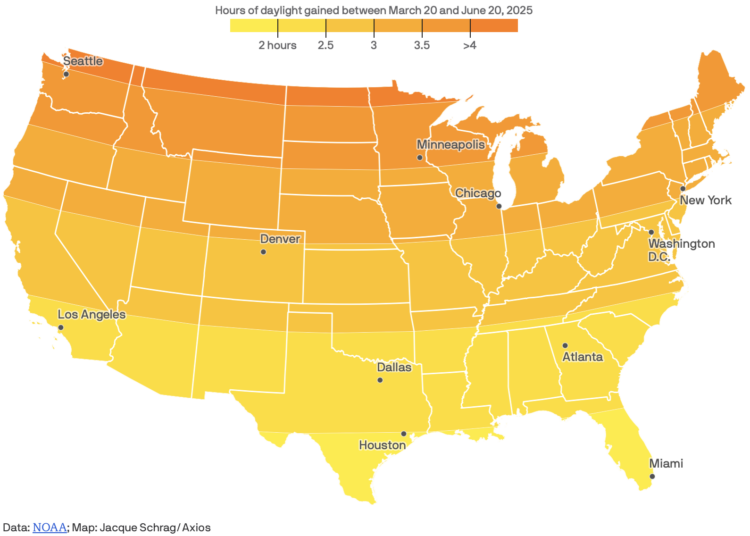
Spring officially started last week here in the Northern Hemisphere. For Axios, Jacque Schrag mapped the hours of daylight gained in between the spring equinox on March 20, 2025 and summer solstice on June 20, 2025.
A discredited anti-vaccine advocate who has no medical background and who has been disciplined for practicing medicine without a license will reportedly lead a questionable federal study on vaccines and autism—despite a large volume of existing research that has found no link between the two and despite a thorough debunking of claims that vaccines cause autism.
Late Tuesday, The Washington Post reported that David Geier has been hired as a "data analyst" by the Department of Health and Human Services, which is now headed by Robert F. Kennedy Jr., a prominent and fervent anti-vaccine advocate. Kennedy and Geier have both long touted the false claim that vaccines cause autism, despite the extensive evidence showing that they do not. In March, HHS directed the Centers for Disease Control and Prevention to reexamine the nonexistent link between vaccines and autism, using funds from taxpayers that could have been directed at other research.
David Geier earned a Bachelor of Arts degree from the University of Maryland, Baltimore County, in 2002. Since then, he has largely worked with his father, Mark Geier, also an anti-vaccine advocate who falsely blames vaccines for autism. In 2011, Mark Geier was stripped of his medical license by the Maryland State Board of Physicians for misrepresenting his credentials, failing to meet state and federal regulations on safety oversight, and allegedly putting the safety and welfare of autistic children at risk.
A major national security scandal is still unfolding after top-level Trump administration officials accidentally invited a journalist to a private text chat being used to plan a military strike in Yemen.
As President Donald Trump and his ever-loyal Republican Party try to minimize the incident, it has fallen on congressional Democrats to probe what happened and to protect the public from the administration’s operational failures.
Republicans have long used congressional investigations to effectively attack their political opponents over foreign policy controversies. In 2015, after the attack on two U.S. government facilities in Benghazi, Libya, and subsequent rush to assign blame on Secretary of State Hillary Clinton, then-House Majority Leader Kevin McCarthy told Fox News exactly how the GOP playbook worked.
“Everybody thought Hillary Clinton was unbeatable, right? But we put together a Benghazi Special Committee, a select committee,” McCarthy bragged. “What are her numbers today? Her numbers are dropping.”
Here are 10 things that Democratic lawmakers can do in the days and weeks and months ahead, including borrowing some tactics from the scandal playbook that Republicans have used against Democrats in the past.
1. Keep it simple and explain the scandal to a busy public
The technology and issues involved in the leak are somewhat complex and involve issues like the Signal messaging app and U.S. policy in the Middle East. But that doesn’t mean Democrats’ rhetoric about the incident can’t be simple.
For instance, when Republicans raked the Biden administration over the coals for withdrawing from Afghanistan or the Obama administration for the Benghazi attack, they did not get into the weeds about policy—and those attacks frequently resonated as a result.
Most Americans use messaging apps. They wouldn’t want their secrets exposed to the world. It’s even worse when thousands of lives are on the line. That’s what the Trump administration did, and that’s how Democrats can make a big issue understandable.
2. Oppose Trump’s nominees—all of them
Just two months into Trump’s new presidency, Senate Democrats have already been burned by their appetite for bipartisanship. Despite Trump’s open disdain for the rule of law, his embrace of misogyny and bigotry, and his disinterest in basic facts, the party has voted to confirm several of his Cabinet nominees—only to later express regret for doing so.
Even as the leak details were becoming public, members of the Senate Democratic caucus voted for Trump nominees Christopher Landau (to the State Department) and John Phelan. Phelan, who will become secretary of the Navy, is a major Trump donor with no military experience. Voting for him after the text leak is a particularly odd choice for Democrats.
After then-President Joe Biden withdrew from Afghanistan, Republicans blocked him from promoting military officers. Democrats can do the same to Trump now.
3. Be aggressive when talking about a national security crisis
Senate Minority Leader Chuck Schumer called for a “bipartisan investigation” of the text chat. While it would seem right to call for national unity on an issue of this magnitude, Schumer’s rhetoric is as out of step with reality as his recent vote in favor of Trump’s cruel budget priorities.
As the controversy over the Benghazi attacks raged, Republican voters viewed the scandal as important as Watergate and the Iran-Contra affair, according to opinion polls. Despite the tragedy of the attacks, Republican leaders constantly distorted the magnitude of the incident. Former Vice President Dick Cheney said it was “one of [the] worst incidents I can recall in my career.” Cheney, of course, was vice president on Sept. 11.
Democrats can discuss the possibility that foreign intelligence and other bad actors may have had access to the chat or possibly other, undisclosed chats. That isn’t hyperbole. The Trump administration already did it once.
A good example of this: Democratic Sen. Jon Ossoff of Georgia noted that this kind of thing occurs when a leader like Trump picks his Defense Secretary Pete Hegseth from the ranks of Fox News talking heads.
Ossoff: This is what happens when you have Fox News personalities cosplaying as government officials. [image or embed]
4. Hold the media accountable for ignoring or downplaying the story
As the initial shock of the leak wears off, the mainstream media is likely to return to form by minimizing the severity of the incident. In fact, major media outlets like The New York Times, which amplified multiple stories about Hillary Clinton’s email server in 2016, are already downplaying it.
Democrats can highlight this problem while stressing the importance of the incident. By noting that a breach of this caliber may risk American lives, Democrats can ask the press to question key officials like Hegseth, Trump, and Director of National Intelligence Tulsi Gabbard (who has ahistory of propagandizing for hostile foreign governments).
5. Demand answers about the scandal and fallout from government agencies
Members of Congress have the power to request information and documentation from government agencies. Republicans bombarded the Biden administration with such requests after the Afghanistan withdrawal.
Not only can the defense and intelligence agencies be the subject of such requests, but Democrats can ask other unaffiliated agencies and even projects like Elon Musk’s so-called Department of Government Efficiency to disclose how they are communicating, if any secret backchannels are in use, and to ask what is being discussed and why it is outside of public review.
Congress has the constitutional mandate of oversight, and that comes into play here. Already, Rep. Maxwell Frost of Florida has issued a demand for officials involved in the “Hegseth Disaster Signal Chat” to retain records in anticipation of possible litigation and a Congressional investigation.
6. Demand hearings, and follow up with more hearings
It is already unlikely that congressional Republicans will open hearings into the leak, as leaders like House Speaker Mike Johnson are already trying to turn the page on the embarrassing debacle.
But Democrats shouldn’t accept just one investigation. House Republicans launched five committee investigations into the Benghazi attack and also set up a House Select Committee on the issue. There was a Senate investigation as well.
The playbook is wide open, with multiple aspects of this incident to be sorted out across a host of committees, and as new information and witnesses surface, the scope of which committees can best handle an investigation could expand.
7. Use the media to push concerns about the scandal
In addition to pushing journalists and news organizations to cover the story, Democrats can use multiple media appearances to forward their narrative surrounding the leak. Republicans have made considerable hay out of any number of Democratic actions, from the Afghanistan withdrawal, to Benghazi, to President Obama’s decision to wear a tan suit, and particularly former President Bill Clinton’s infidelity while in office.
Mainstream news networks book members of Congress and other political leaders for appearances constantly. Even if the main topic is completely unrelated, Democrats can note how one area of Trump administration incompetence or malfeasance echoes the chat leak controversy.
8. Amplify veterans’ concerns about the national security breach
To attack the Biden administration over the Afghanistan withdrawal, Republicans solicited testimony from veterans who witnessed some of the tactical mistakes made. Military security is directly in the crosshairs of the chat leak, and Democrats should take note.
Veteran advocacy groups like VoteVets are already pushing for answers about the incident, and Democrats would do well to take up their cause. Similarly, there are multiple Democratic officeholders who are veterans and have already spoken out about the problems involved in the leak. There can never be too many voices like this, which attract public and media attention.
“This isn’t about party—it’s about country.” - Rep. Pat Ryan
Democratic Veterans are demanding answers after Trump’s SecDef mishandled sensitive military info.
American lives are at risk. We need accountability. We need a hearing. [image or embed]
9. Send criminal referrals related to the leak and possible cover-up
In the course of investigating the leak, there is an extremely high possibility that someone involved will lie or mislead.
Stymied by their failure to turn Biden’s son Hunter into a liability, Republicans referred him and his uncle James Biden to the Department of Justice on the claim that they lied to Congress (a crime). While this did not result in charges, it generated coverage and renewed interest in the story.
If people lie about the leak—and figures like Hegseth have already lied to reporters about it—this is another avenue Democrats can travel down.
10. Never be satisfied with the administration’s spin, and keep pushing for more answers
President Donald Trump and Defense Secretary Pete Hegseth.
Questions about the chat leak will inevitably lead to more questions. Based on the track record of Trump and his underlings, this group chat from hell surely isn’t the only backchannel of communication that exists in the administration.
Democrats can ask about and investigate this phenomenon and all the other subsequent questions it raises. Were other agencies involved? Were key GOP figures like Elon Musk and Mike Johnson connected? Are there ongoing text chats about national security with conservative media figures like Sean Hannity who are known to have Trump’s ear? Did Trump or anyone under him use this information and sharing of information for personal financial gain?
Trump has shown absolutely zero interest in moral or ethical boundaries, even when the lives of Americans are on the line. These questions aren’t out of bounds, but well within his existing and well-known pattern of behavior.
In an ideal world the Republicans would come clean about what they’ve done, heads would roll, and the American public would be educated about what is being done in their name. But that world does not exist, so Democrats should mirror what Republicans have done in the past to fan the flames of scandal and further their agenda—and use those tactics to protect America from Team Trump’s incompetence.
Great, but can we get something anywhere near MSRP? It's fucking ridiculous. If we got a reference card sold by AMD, this would fix the issue.
"In a conversation with Tony Yu from Asus China, AMD CEO Lisa Su shared that the Radeon RX 9000 series graphics cards have quickly become a huge hit, breaking records as AMD's top-selling GPUs within just a week of release," writes Slashdot reader jjslash. TechSpot reports: AMD CEO Lisa Su has confirmed that the company's new Radeon RX 9000 graphics cards have been a massive success, selling 10 times more units than their predecessors in just one week on the market. Su also stated that more RDNA 4 cards are on the way, but did not confirm whether the lineup will include the rumored Radeon RX 9060. When asked about the limited availability of the new cards, Su said that AMD is ramping up production to ensure greater supply at retailers worldwide. She also expressed hope that increased availability would help stabilize pricing by discouraging scalping and price gouging.
As the news reverberated around the country that top Trump administration officials had illegally discussed classified war plans on an unsecured messaging app, Republican lawmakers shrugged their shoulders, engaged in whataboutism, and even tried to justify the behavior that jeopardizes America’s national security.
On Monday, The Atlantic’s Jeffrey Goldberg reported that he’d been accidentally added to a secret group that included the vice president, secretary of defense, national security adviser, secretary of state, director of national intelligence, and other high-level officials, all of whom were discussing the intricacies of a planned military attack. And Republicans’ collective yawn is a marked shift from how many of these same lawmakers reacted to Democrat Hillary Clinton’s use of a private email server when she was secretary of state.
And it’s likely because President Donald Trump and the White House are trying to downplay the seriousness of the screwup.
Trump told NBC News on Tuesday that Goldberg’s inclusion in the chat had "no impact at all" on the attack on the rebel Houthi group in Yemen. He also said that national security adviser Mike Waltz “learned a lesson” and that he won’t call for him to resign.
Mike Waltz, national security adviser to President Donald Trump
In another statement, White House press secretary Karoline Leavitt lied about what happened to make it seem less severe than it really is.
“Jeffrey Goldberg is well-known for his sensationalist spin. Here are the facts about his latest story: 1. No ‘war plans’ were discussed. 2. No classified material was sent to the thread. 3. The White House Counsel’s Office has provided guidance on a number of different platforms for President Trump’s top officials to communicate as safely and efficiently as possible,” Leavitt wrote in a post on X—a blatant lie as Goldberg has receipts of the information that was discussed and that a national security official confirmed was legitimate.
“As the National Security Council stated, the White House is looking into how Goldberg’s number was inadvertently added to the thread,” she added. “Thanks to the strong and decisive leadership of President Trump, and everyone in the group, the Houthi strikes were successful and effective. Terrorists were killed and that’s what matters most to President Trump.”
Many Republican lawmakers agreed that the text chain was a mistake, but they couldn’t bring themselves to call for consequences for the administration officials on the thread.
“Do I wish it hadn't happened? Of course. Do they wish it hadn't happened? Of course. But this is not keeping the American people up at night,” Republican Sen. John Kennedy of Louisiana told HuffPost’s Igor Bobic. “Obviously a mistake was made. But mistakes happen, and this is, trust me, this is not going to lead to the apocalypse, okay?”
Sen. Josh Hawley, Republican of Missouri, also tried to downplay the seriousness of the fact that Trump administration officials were using cellphones—which are vulnerable to hacking from America’s adversaries—to discuss classified information.
"This is what the leftist media is reduced to,” Hawley said in an appearance on Fox News. “So now we are griping about who is on a text message and who is not. I mean, come on.”
Meanwhile, House Speaker Mike Johnson tried to spin the debacle by saying that the thread showed the thoughtfulness of the Trump administration’s approach to foreign policy—an insane defense.
"What you did see, though, I think, was top-level officials doing their job, doing it well, and executing on a plan with precision,” Johnson said in an interview with CNN. “That mission was a success, no one was jeopardized because of it, we’re grateful for that. But they’ll certainly, I’m sure, make sure that doesn’t happen again.”
Other Republicans used whataboutism to defend the Trump administration’s actions.
"A vegetable in the White House sat on his hands while Houthi terrorists attacked U.S. warships 174 times (and commercial vessels 145 times) since 2023. [Trump] has taken decisive action to re-establish deterrence and accountability for foreign terrorists who threaten Americans,” Sen. Markwayne Mullin, Republican of Oklahoma, wrote in a post on X.
Rep. Paul Gosar, an Arizona Republican with deep ties to white nationalists, had a similar line of attack.
"Where was the outrage or calls for resignations from the left when Biden's SecDef, Lloyd Austin, disappeared for days without telling anyone? Or how about the four yrs Biden was in office asleep at the wheel with the nuke codes?” Gosar wrote in a post on X.
Republican Rep. Paul Gosar of Arizona
Of course, a handful of Republicans did criticize the administration—albeit tepidly.
“The real issue is putting top secret information on an unclassified device, talking about war plans that are imminent,” Rep. Don Bacon, Republican of Nebraska, told CNN’s Manu Raju. “And I am a signals intelligence officer by trade, I will guarantee you, 99.99% with confidence, Russia and China are monitoring those two phones. So I just think it's a security violation, and there's no doubt that Russia and China saw this stuff within hours of the attacks on Yemen or the Houthis. So that's wrong. Everyone should know better than putting top secret war plans on an unclassified phone. Period. There is no excuse.”
But Bacon refused to call for Defense Secretary Pete Hegseth—who had put the war plans in the text chain—to resign.
“I've always had concerns, but I wish him success,” Bacon told Raju. “He got confirmed. So once he got confirmed, I turned the page and tried to move forward. This is a gross error, and it's intentional. They intentionally put highly classified information on an unclassified device. I would have lost my security clearance in the Air Force for this and for a lot less.”
Democrats, meanwhile, are aghast at the security disaster. Many are calling for heads to roll and criticizing their Republican counterparts for not doing the same.
“We all know if a Democrat had started that group chat, there would be wall-to-wall hearings, people would get fired, careers would end,” Sen. Mark Warner, Democrat of Virginia, wrote in a post on X. “Today, we’re starting that accountability with an open hearing in the Intel Committee.”
Indeed, on Tuesday, two of the people on the text thread—Director of National Intelligence Tulsi Gabbard and CIA Director John Ratcliffe—will testify before the Senate Intelligence Committee, where lawmakers can grill them on the security lapse.
Senate Democrats also put together a compilation of Republicans criticizing Clinton’s use of an email server.
“It’s hard to fathom how this wouldn’t undermine our national security. If the average American did that, they’d lose their clearance, their job, and might even go to jail.” If this is how GOP Senators felt in the past, they must be OUTRAGED right now. Oh. Wait. pic.twitter.com/D9KBzfYuMc
And others slammed the White House’s lies about the text chain.
“They shared specific plans to bomb foreign actors, discussing targets, strategy, diplomacy, timing, and munitions—before the strike. War plans,” Democratic Rep. Don Beyer of Virginia said in response to Leavitt’s statement. “If our adversaries had those plans American soldiers' lives would've been at risk. If you're going to lie at least lie better.”
For a group that voted for Trump 2:1, sounds like chickens coming home to roost. Have fun.
Donald Trump’s secretary of veterans affairs is bragging about his plans to make more cuts to the department and its health care system.
Doug Collins told the New York Post in an interview published March 22 that the VA is “not an employment agency” as the department scurries to cut hundreds of contracts and slash various programs from available health coverage.
While the former House member claimed he wasn’t getting rid of vital veterans’ health care, he quickly added that treatment for transgender veterans did not fit the bill of necessary medical care.
Collins specifically targeted gender-affirming care and medical services offered to transgender people. According to data supplied to the Post by the agency, transgender veterans make up one-tenth of 1% of 9.1 million veterans enrolled in the VA’s health care program.
But Collins also bragged about cutting out some other egregious contracts that he claimed were mucking up the budget.
“The VA was paying for PowerPoint slides and meeting notes, for the watering of plants, and consulting contracts to do the work that we should be doing ourselves,” he told the Post.
Like his fellow Trump Cabinet members, Collins has targeted agency employees under the guise of stomping out diversity, equity, and inclusion, or DEI. The secretary slashed a chunk of his workforce and canceled contracts that were allegedly related to the Trump-hated acronym.
Per the outlet, Collins’ planned cuts will save $914 million. But the information provided by the Post cannot be independently verified by Daily Kos at this time.
Due to many other instances in which multibillionaire Elon Musk’s so-called Department of Government Efficiency and other federal agencies have incorrectly reported “savings,” it is unclear whether these numbers are accurate.
It’s also not uncommon for departments to brag about cutting funding for alleged wasteful programs that turned out to be something arguably different.
As for the man behind these cuts, Collins is a former Baptist minister with an interesting story behind his rise to Trump’s Cabinet. Collins was in Georgia politics for quite some time, but he really made a name for himself during the 2019 probe by special counsel Robert Mueller into Russian election interference. The Republican congressman was one of Trump’s biggest allies during the probe and eventually wrote a book claiming Democrats sought to impeach Trump as revenge for his victory over Hilary Clinton in the 2016 presidential election.
But ass-kissing books aside, now that Collins has his dream gig of making veterans’ lives worse, Democrats are demanding that he answer for his actions.
Unsurprisingly, Collins is expected to turn down the invitation.
Many groups and agencies have been hit hard since Trump took office in January, but veterans seem to be one of his administration’s bigger targets. Not only is their health care coverage and workforce being gutted, but the population is taking other hits as well.
The quality of mental health care provided to veterans has taken a nosedive in the name of “efficiency,” and a department that investigates disparities in how the government provides disability compensation has been shuttered.
It’s unclear what the Trump administration’s end goal is, but those who advocate for veterans are all too aware of the potentially catastrophic impacts.
“It’s a first step toward gutting the second-largest agency in our federal government,” Richard Brookshire, co-founder of the Black Veterans Project, said to ProPublica on the closure of the VA's Office of Equity Assurance.
“The consequences will be dire, wide-reaching and deadly,” he warned.
I'm not sure the right has thought this through...this is just opening the door to wars on the right's favorite arenas: churches and their associated entities. Religious universities have a whole host of exceptions from federal law. Time to get rid of those and watch BYU and the others have to follow civil rights law.
Students walk through a nearly empty Columbia University campus after police cleared out a Gaza protest encampment on May 6, 2024, in New York City. | Spencer Platt/Getty Images
The second Trump administration has shown remarkable aggression in abruptly canceling hundreds of millions of dollars in research grants at elite universities — in an effort to force them to make major policy changes in line with the president’s politics.
The administration’s demands on these schools include cracking down on protesters of Israel’s war in Gaza, disallowing trans women athletes from women’s sports teams, and ending the practice of diversity, equity, and inclusion (DEI) in admissions and campus life. For Columbia, Trump officials even demanded the Middle Eastern, South Asian, and African studies department be taken out of the hands of its current leadership — a threat to academic freedom from the state.
All this fits into a larger strategy. Right-wingers have increasingly come to believe that elite universities are one of the main incubators of “woke” cultural progressivism; that, by advancing left-wing ideas about various issues and socializing young Americans into believing them, they help progressives dominate the culture.
Winning the culture war, they believe, requires a more aggressive attack on elite universities — to hurt them, and to coerce them into being more sympathetic to the right.
They are apparently correct in this belief. On Friday, Columbia agreed to give in to various demands Trump officials had made, including giving campus police new powers to arrest student protesters and taking its Middle Eastern studies department away from its current leadership. (Trump officials have not yet said they’ll restore the revoked $400 million.)
All this comes at a cost to the nation. One key reason Republican presidents haven’t tried anything like this before: This research funding is largely for scientific and medical research, generally not for “woke” or political stuff. Until recently, there was bipartisan agreement that such research funds shouldn’t be used to play political games. Now, though, it’s being used as a weapon in the right’s war against the left.
“I think that putting the universities into contraction, into a recession, into declining budgets, into a greater competitive market pressure, would discipline them,” conservative activist Christopher Rufo said recently. He wanted to threaten federal funding to universities, he said, to put them “in an existential terror.” Which is exactly what’s happening.
How elite universities came to rely on federal funding — and how conservatives realized this was leverage
As World War II made the US a global superpower and the Cold War pitted it against the Soviet Union, the federal government provided a huge commitment of research funds to try to make the US the global leader in science and technology. Much of that funding went to higher education institutions, funding for labs, experiments, and other studies from university-affiliated researchers. (Student loans, meanwhile, became another hugely important source of federal funds to universities.)
For nearly as long, elite universities have drawn the ire of conservatives who have argued that they’re poisoning the minds of America’s youth with their far-left ways, while being intolerant toward the right. For instance, when protests over the Vietnam War and other social justice issues dominated campuses in the late 1960s and early 1970s, President Richard Nixon seethed in the Oval Office: “The professors are the enemy. Professors are the enemy. Write that on the blackboard 100 times and never forget it.”
Though Nixon’s administration and state governments wanted new laws punishing universities, “few of these measures passed and fewer were enforced,” historian Ellen Schrecker has written. Further national controversies in which conservatives wereangry about happenings at elite universities also tended to fizzle out.
Over the past decade, though, elite universities have become increasingly central to the right’s narrative about what ails America — and conservatives have gotten more serious about trying to do something about it.
Many on the right have spent much of the past decade seething about the Great Awokening — the leftward move of the culture around race, gender, and sexuality in the mid-to-late 2010s.
Incidents at colleges and universities involving the alleged mistreatment of conservatives or people with non-left views got attention in the national media, and similar controversies soon unfolded across American society.
Influential voices on the right argued that “wokeness” was in large part created by elite universities. Rufo, for instance, argued that it was the evolution of a legal scholarship school known as “critical race theory,” and that to defeat it, conservatives needed to go after elite universities.
The blogger Curtis Yarvin, meanwhile, had argued for years that progressives dominated the country’s culture because of “the Cathedral” — elite academic and media institutions that, in his telling, set the bounds of acceptable political discourse and distort reality to fit their preferred ideological frames.
Such explanations like these seemed to ring true to those on the right frustrated by the leftward cultural shift. It named a specific enemy that could be fought against, as part of a strategy for gaining cultural power for the right.
So by 2021, then-Senate candidate (and Yale Law School alum) JD Vance was arguing that conservatives “have to honestly and aggressively attack the universities in this country.” So much “of what drives truth and knowledge as we understand it in this country,” Vance said, is fundamentally determined by universities who are “very hostile” to the right. Why, he asked, had conservatives accepted that state of affairs? Wasn’t it time to do something about it?
Why the second Trump administration finally went through with trying to defund universities
The idea of pulling federal research funding from universities due to excessive wokeness was kicking around during the first Trump administration. Trump even signed an executive order that he claimed would do this back in 2019. But this turned out to be mostly toothless. The appetite to punish universities was not yet so strong to make it really happen.
In the early 2020s, though, the right’s backlash against academia intensified further, due to new controversies.
The second Trump administration is far more willing to bend — and blatantly break — the law, to try and get what they want.
Part of this was specifically a backlash against the medical establishment. During the Covid-19 pandemic, the right’s distrust of scientists and public health experts deepened, due to vaccine skepticism and other controversies. So putting medical research funding at risk no longer seemed so unthinkable to them; indeed, it was arguably desirable.
Meanwhile, a separate backlash began, in response to campus protests against Israel’s war in Gaza. Many students and faculty members supported the protests, but others — including major donors — opposed them, and argued Jewish students had become newly unsafe on campus. Trump took this up as a cause: His threats to Columbia came through his new “Task Force to Combat Anti-Semitism.”
A final reason this attack on universities is happening now is that the second Trump administration is far more willing to bend — and blatantly break — the law, to try and get what they want.
The revocation of Columbia’s funds, analysts have said, is illegal. Cornell Law School professor Michael Dorf wrote that the federal government can cut off funding to punish civil rights violations, but only after a lengthy process. Instead, perhaps inspired by Elon Musk’s “move fast and break the law” approach, Trump officials just went ahead and did it.
Where’s the pushback?
All this seems to be working out quite well for the administration so far, as universities appear to be conceding to their demands.
And despite the seeming illegality of Trump revoking Columbia’s funds, the school didn’t sue in court to try and stop it. Columbia instead opted to seek an agreement with Trump officials. Per the Wall Street Journal’s Douglas Belkin, the university feared that a court fight would simply spur Trump’s team to find other legal avenues to take back those or other funds. (Columbia receives far more in federal funding that wasn’t yet revoked.)
So it seems that Trump officials and right-wing activists really did figure out how to effectively use federal funds as leverage to coerce universities. Such cuts would be devastating and universities deeply want to avoid them.
But Belkin’s Columbia sources cited another reason for the school’s concession: The school’s leadership also “believed there was considerable overlap between needed campus changes and Trump’s demands.”
So university trustees and administrators, according to this reporting, believed the Gaza war protests had gone too far and needed to be reined in. At least in part, they were using Trump’s demands as an excuse to make changes they wanted to make anyway.
This is part of a broader dynamic, in which many elites formerly sympathetic to left causes — or at least unwilling to fight them — have turned against the left. Many progressives, meanwhile, seem exhausted and disillusioned, and are no longer fighting back with much fervor. It isn’t the first Trump administration anymore, when social justice activists felt the arc of history was bending in their direction.
The implications here are ominous. Trump’s research funding extortion worked so well that he (and future Republican presidents) will surely be encouraged to use similar tactics again and again. Could a precondition for future federal funds be obeisance to the conservative agenda? How in the world can a situation where universities are so dependent on federal cash coexist with long-term academic freedom?
And conducting gov't business on Signal..."but her emails" my fucking ass
A prominent journalist knew the US military would start bombing Houthi targets in Yemen two hours before it happened on March 15 because top Trump administration officials accidentally included the reporter on a Signal text chain in which they discussed the war plan.
Jeffrey Goldberg, editor-in-chief of The Atlantic magazine, described the surprising leak of sensitive military information in an article today. The National Security Council confirmed that the messages were real and said it is investigating how Goldberg was added to a thread in which the war information was discussed.
"The world found out shortly before 2 p.m. eastern time on March 15 that the United States was bombing Houthi targets across Yemen," Goldberg wrote. "I, however, knew two hours before the first bombs exploded that the attack might be coming. The reason I knew this is that Pete Hegseth, the secretary of defense, had texted me the war plan at 11:44 a.m. The plan included precise information about weapons packages, targets, and timing."
Editor’s Note: This article is the first in a series about the Trump administration's use of Signal group chatting. Read the next story in the series here.
The world found out shortly before 2 p.m. eastern time on March 15 that the United States was bombing Houthi targets across Yemen.
I, however, knew two hours before the first bombs exploded that the attack might be coming. The reason I knew this is that Pete Hegseth, the secretary of defense, had texted me the war plan at 11:44 a.m. The plan included precise information about weapons packages, targets, and timing.
This is going to require some explaining.
This article was featured in the One Story to Read Today newsletter. Sign up for it here.
The story technically begins shortly after the Hamas invasion of southern Israel, in October 2023. The Houthis—an Iran-backed terrorist organization whose motto is “God is great, death to America, death to Israel, curse on the Jews, victory to Islam”—soon launched attacks on Israel and on international shipping, creating havoc for global trade. Throughout 2024, the Biden administration was ineffective in countering these Houthi attacks; the incoming Trump administration promised a tougher response.
This is where Pete Hegseth and I come in.
On Tuesday, March 11, I received a connection request on Signal from a user identified as Michael Waltz. Signal is an open-source encrypted messaging service popular with journalists and others who seek more privacy than other text-messaging services are capable of delivering. I assumed that the Michael Waltz in question was President Donald Trump’s national security adviser. I did not assume, however, that the request was from the actual Michael Waltz. I have met him in the past, and though I didn’t find it particularly strange that he might be reaching out to me, I did think it somewhat unusual, given the Trump administration’s contentious relationship with journalists—and Trump’s periodic fixation on me specifically. It immediately crossed my mind that someone could be masquerading as Waltz in order to somehow entrap me. It is not at all uncommon these days for nefarious actors to try to induce journalists to share information that could be used against them.
I accepted the connection request, hoping that this was the actual national security adviser, and that he wanted to chat about Ukraine, or Iran, or some other important matter.
Two days later—Thursday—at 4:28 p.m., I received a notice that I was to be included in a Signal chat group. It was called the “Houthi PC small group.”
A message to the group, from “Michael Waltz,” read as follows: “Team – establishing a principles [sic] group for coordination on Houthis, particularly for over the next 72 hours. My deputy Alex Wong is pulling together a tiger team at deputies/agency Chief of Staff level following up from the meeting in the Sit Room this morning for action items and will be sending that out later this evening.”
The message continued, “Pls provide the best staff POC from your team for us to coordinate with over the next couple days and over the weekend. Thx.”
The term principals committee generally refers to a group of the senior-most national-security officials, including the secretaries of defense, state, and the treasury, as well as the director of the CIA. It should go without saying—but I’ll say it anyway—that I have never been invited to a White House principals-committee meeting, and that, in my many years of reporting on national-security matters, I had never heard of one being convened over a commercial messaging app.
One minute later, a person identified only as “MAR”—the secretary of state is Marco Antonio Rubio—wrote, “Mike Needham for State,” apparently designating the current counselor of the State Department as his representative. At that same moment, a Signal user identified as “JD Vance” wrote, “Andy baker for VP.” One minute after that, “TG” (presumably Tulsi Gabbard, the director of national intelligence, or someone masquerading as her) wrote, “Joe Kent for DNI.” Nine minutes later, “Scott B”—apparently Treasury Secretary Scott Bessent, or someone spoofing his identity, wrote, “Dan Katz for Treasury.” At 4:53 p.m., a user called “Pete Hegseth” wrote, “Dan Caldwell for DoD.” And at 6:34 p.m., “Brian” wrote “Brian McCormack for NSC.” One more person responded: “John Ratcliffe” wrote at 5:24 p.m. with the name of a CIA official to be included in the group. I am not publishing that name, because that person is an active intelligence officer.
The principals had apparently assembled. In all, 18 individuals were listed as members of this group, including various National Security Council officials; Steve Witkoff, President Trump’s Middle East and Ukraine negotiator; Susie Wiles, the White House chief of staff; and someone identified only as “S M,” which I took to stand for Stephen Miller. I appeared on my own screen only as “JG.”
That was the end of the Thursday text chain.
After receiving the Waltz text related to the “Houthi PC small group,” I consulted a number of colleagues. We discussed the possibility that these texts were part of a disinformation campaign, initiated by either a foreign intelligence service or, more likely, a media-gadfly organization, the sort of group that attempts to place journalists in embarrassing positions, and sometimes succeeds. I had very strong doubts that this text group was real, because I could not believe that the national-security leadership of the United States would communicate on Signal about imminent war plans. I also could not believe that the national security adviser to the president would be so reckless as to include the editor in chief of The Atlantic in such discussions with senior U.S. officials, up to and including the vice president.
The next day, things got even stranger.
At 8:05 a.m. on Friday, March 14, “Michael Waltz” texted the group: “Team, you should have a statement of conclusions with taskings per the Presidents guidance this morning in your high side inboxes.” (High side, in government parlance, refers to classified computer and communications systems.) “State and DOD, we developed suggested notification lists for regional Allies and partners. Joint Staff is sending this am a more specific sequence of events in the coming days and we will work w DOD to ensure COS, OVP and POTUS are briefed.”
At this point, a fascinating policy discussion commenced. The account labeled “JD Vance” responded at 8:16: “Team, I am out for the day doing an economic event in Michigan. But I think we are making a mistake.” (Vance was indeed in Michigan that day.) The Vance account goes on to state, “3 percent of US trade runs through the suez. 40 percent of European trade does. There is a real risk that the public doesn’t understand this or why it’s necessary. The strongest reason to do this is, as POTUS said, to send a message.”
The Vance account then goes on to make a noteworthy statement, considering that the vice president has not deviated publicly from Trump’s position on virtually any issue. “I am not sure the president is aware how inconsistent this is with his message on Europe right now. There’s a further risk that we see a moderate to severe spike in oil prices. I am willing to support the consensus of the team and keep these concerns to myself. But there is a strong argument for delaying this a month, doing the messaging work on why this matters, seeing where the economy is, etc.”
A person identified in Signal as “Joe Kent” (Trump’s nominee to run the National Counterterrorism Center is named Joe Kent) wrote at 8:22, “There is nothing time sensitive driving the time line. We’ll have the exact same options in a month.”
Then, at 8:26 a.m., a message landed in my Signal app from the user “John Ratcliffe.” The message contained information that might be interpreted as related to actual and current intelligence operations.
At 8:27, a message arrived from the “Pete Hegseth” account. “VP: I understand your concerns – and fully support you raising w/ POTUS. Important considerations, most of which are tough to know how they play out (economy, Ukraine peace, Gaza, etc). I think messaging is going to be tough no matter what – nobody knows who the Houthis are – which is why we would need to stay focused on: 1) Biden failed & 2) Iran funded.”
The Hegseth message goes on to state, “Waiting a few weeks or a month does not fundamentally change the calculus. 2 immediate risks on waiting: 1) this leaks, and we look indecisive; 2) Israel takes an action first – or Gaza cease fire falls apart – and we don’t get to start this on our own terms. We can manage both. We are prepared to execute, and if I had final go or no go vote, I believe we should. This [is] not about the Houthis. I see it as two things: 1) Restoring Freedom of Navigation, a core national interest; and 2) Reestablish deterrence, which Biden cratered. But, we can easily pause. And if we do, I will do all we can to enforce 100% OPSEC”—operations security. “I welcome other thoughts.”
A few minutes later, the “Michael Waltz” account posted a lengthy note about trade figures, and the limited capabilities of European navies. “Whether it’s now or several weeks from now, it will have to be the United States that reopens these shipping lanes. Per the president’s request we are working with DOD and State to determine how to compile the cost associated and levy them on the Europeans.”
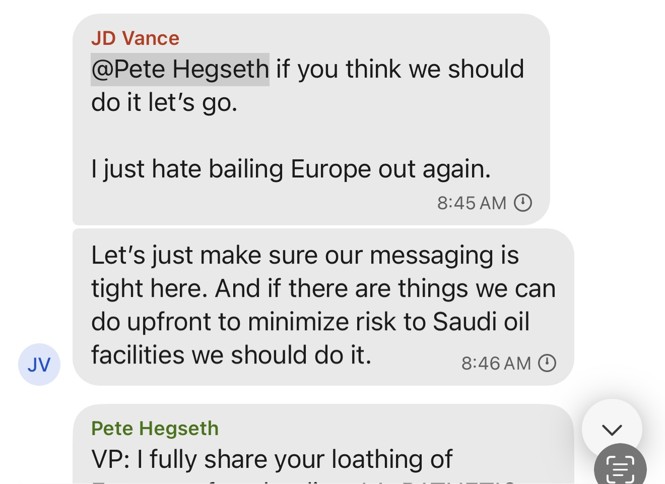
The account identified as “JD Vance” addressed a message at 8:45 to @Pete Hegseth: “if you think we should do it let’s go. I just hate bailing Europe out again.” (The administration has argued that America’s European allies benefit economically from the U.S. Navy’s protection of international shipping lanes.)
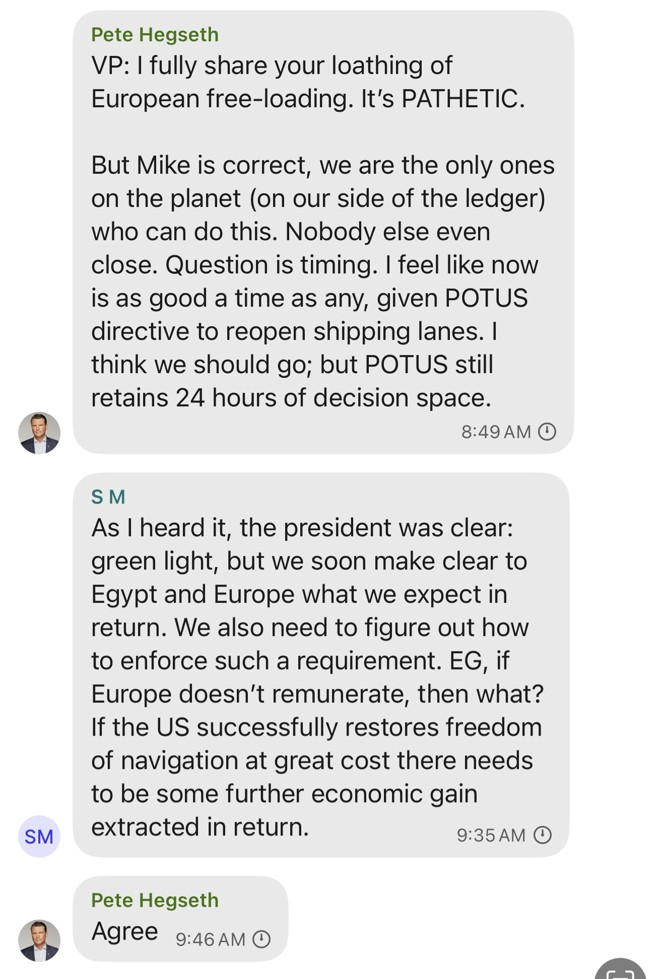
The user identified as Hegseth responded three minutes later: “VP: I fully share your loathing of European free-loading. It’s PATHETIC. But Mike is correct, we are the only ones on the planet (on our side of the ledger) who can do this. Nobody else even close. Question is timing. I feel like now is as good a time as any, given POTUS directive to reopen shipping lanes. I think we should go; but POTUS still retains 24 hours of decision space.”
At this point, the previously silent “S M” joined the conversation. “As I heard it, the president was clear: green light, but we soon make clear to Egypt and Europe what we expect in return. We also need to figure out how to enforce such a requirement. EG, if Europe doesn’t remunerate, then what? If the US successfully restores freedom of navigation at great cost there needs to be some further economic gain extracted in return.”
A screenshot from the Signal group shows debate over the president’s views ahead of the attack.
That message from “S M”—presumably President Trump’s confidant Stephen Miller, the deputy White House chief of staff, or someone playing Stephen Miller—effectively shut down the conversation. The last text of the day came from “Pete Hegseth,” who wrote at 9:46 a.m., “Agree.”
After reading this chain, I recognized that this conversation possessed a high degree of verisimilitude. The texts, in their word choice and arguments, sounded as if they were written by the people who purportedly sent them, or by a particularly adept AI text generator. I was still concerned that this could be a disinformation operation, or a simulation of some sort. And I remained mystified that no one in the group seemed to have noticed my presence. But if it was a hoax, the quality of mimicry and the level of foreign-policy insight were impressive.
It was the next morning, Saturday, March 15, when this story became truly bizarre.
At 11:44 a.m., the account labeled “Pete Hegseth” posted in Signal a “TEAM UPDATE.” I will not quote from this update, or from certain other subsequent texts. The information contained in them, if they had been read by an adversary of the United States, could conceivably have been used to harm American military and intelligence personnel, particularly in the broader Middle East, Central Command’s area of responsibility. What I will say, in order to illustrate the shocking recklessness of this Signal conversation, is that the Hegseth post contained operational details of forthcoming strikes on Yemen, including information about targets, weapons the U.S. would be deploying, and attack sequencing.
The only person to reply to the update from Hegseth was the person identified as the vice president. “I will say a prayer for victory,” Vance wrote. (Two other users subsequently added prayer emoji.)
According to the lengthy Hegseth text, the first detonations in Yemen would be felt two hours hence, at 1:45 p.m. eastern time. So I waited in my car in a supermarket parking lot. If this Signal chat was real, I reasoned, Houthi targets would soon be bombed. At about 1:55, I checked X and searched Yemen. Explosions were then being heard across Sanaa, the capital city.
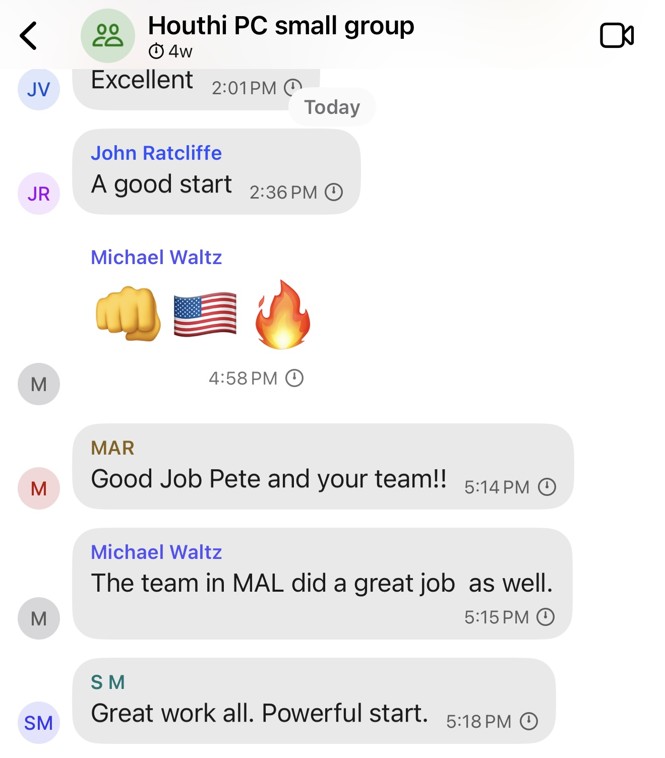
I went back to the Signal channel. At 1:48, “Michael Waltz” had provided the group an update. Again, I won’t quote from this text, except to note that he described the operation as an “amazing job.” A few minutes later, “John Ratcliffe” wrote, “A good start.” Not long after, Waltz responded with three emoji: a fist, an American flag, and fire. Others soon joined in, including “MAR,” who wrote, “Good Job Pete and your team!!,” and “Susie Wiles,” who texted, “Kudos to all – most particularly those in theater and CENTCOM! Really great. God bless.” “Steve Witkoff” responded with five emoji: two hands-praying, a flexed bicep, and two American flags. “TG” responded, “Great work and effects!” The after-action discussion included assessments of damage done, including the likely death of a specific individual. The Houthi-run Yemeni health ministry reported that at least 53 people were killed in the strikes, a number that has not been independently verified.
A screenshot from the Signal group shows reactions to the strikes.
On Sunday, Waltz appeared on ABC’s This Week and contrasted the strikes with the Biden administration’s more hesitant approach. “These were not kind of pinprick, back-and-forth—what ultimately proved to be feckless attacks,” he said. “This was an overwhelming response that actually targeted multiple Houthi leaders and took them out.”
The Signal chat group, I concluded, was almost certainly real. Having come to this realization, one that seemed nearly impossible only hours before, I removed myself from the Signal group, understanding that this would trigger an automatic notification to the group’s creator, “Michael Waltz,” that I had left. No one in the chat had seemed to notice that I was there. And I received no subsequent questions about why I left—or, more to the point, who I was.
Earlier today, I emailed Waltz and sent him a message on his Signal account. I also wrote to Pete Hegseth, John Ratcliffe, Tulsi Gabbard, and other officials. In an email, I outlined some of my questions: Is the “Houthi PC small group” a genuine Signal thread? Did they know that I was included in this group? Was I (on the off chance) included on purpose? If not, who did they think I was? Did anyone realize who I was when I was added, or when I removed myself from the group? Do senior Trump-administration officials use Signal regularly for sensitive discussions? Do the officials believe that the use of such a channel could endanger American personnel?
Brian Hughes, the spokesman for the National Security Council, responded two hours later, confirming the veracity of the Signal group. “This appears to be an authentic message chain, and we are reviewing how an inadvertent number was added to the chain,” Hughes wrote. “The thread is a demonstration of the deep and thoughtful policy coordination between senior officials. The ongoing success of the Houthi operation demonstrates that there were no threats to troops or national security.”
William Martin, a spokesperson for Vance, said that despite the impression created by the texts, the vice president is fully aligned with the president. “The Vice President’s first priority is always making sure that the President’s advisers are adequately briefing him on the substance of their internal deliberations,” he said. “Vice President Vance unequivocally supports this administration’s foreign policy. The President and the Vice President have had subsequent conversations about this matter and are in complete agreement.”
I have never seen a breach quite like this. It is not uncommon for national-security officials to communicate on Signal. But the app is used primarily for meeting planning and other logistical matters—not for detailed and highly confidential discussions of a pending military action. And, of course, I’ve never heard of an instance in which a journalist has been invited to such a discussion.
Conceivably, Waltz, by coordinating a national-security-related action over Signal, may have violated several provisions of the Espionage Act, which governs the handling of “national defense” information, according to several national-security lawyers interviewed by my colleague Shane Harris for this story. Harris asked them to consider a hypothetical scenario in which a senior U.S. official creates a Signal thread for the express purpose of sharing information with Cabinet officials about an active military operation. He did not show them the actual Signal messages or tell them specifically what had occurred.
All of these lawyers said that a U.S. official should not establish a Signal thread in the first place. Information about an active operation would presumably fit the law’s definition of “national defense” information. The Signal app is not approved by the government for sharing classified information. The government has its own systems for that purpose. If officials want to discuss military activity, they should go into a specially designed space known as a sensitive compartmented information facility, or SCIF—most Cabinet-level national-security officials have one installed in their home—or communicate only on approved government equipment, the lawyers said. Normally, cellphones are not permitted inside a SCIF, which suggests that as these officials were sharing information about an active military operation, they could have been moving around in public. Had they lost their phones, or had they been stolen, the potential risk to national security would have been severe.
Hegseth, Ratcliffe, and other Cabinet-level officials presumably would have the authority to declassify information, and several of the national-security lawyers noted that the hypothetical officials on the Signal chain might claim that they had declassified the information they shared. But this argument rings hollow, they cautioned, because Signal is not an authorized venue for sharing information of such a sensitive nature, regardless of whether it has been stamped “top secret” or not.
There was another potential problem: Waltz set some of the messages in the Signal group to disappear after one week, and some after four. That raises questions about whether the officials may have violated federal records law: Text messages about official acts are considered records that should be preserved.
“Under the records laws applicable to the White House and federal agencies, all government employees are prohibited from using electronic-messaging applications such as Signal for official business, unless those messages are promptly forwarded or copied to an official government account,” Jason R. Baron, a professor at the University of Maryland and the former director of litigation at the National Archives and Records Administration, told Harris.
“Intentional violations of these requirements are a basis for disciplinary action. Additionally, agencies such as the Department of Defense restrict electronic messaging containing classified information to classified government networks and/or networks with government-approved encrypted features,” Baron said.
Several former U.S. officials told Harris and me that they had used Signal to share unclassified information and to discuss routine matters, particularly when traveling overseas without access to U.S. government systems. But they knew never to share classified or sensitive information on the app, because their phones could have been hacked by a foreign intelligence service, which would have been able to read the messages on the devices. It is worth noting that Donald Trump, as a candidate for president (and as president), repeatedly and vociferously demanded that Hillary Clinton be imprisoned for using a private email server for official business when she was secretary of state. (It is also worth noting that Trump was indicted in 2023 for mishandling classified documents, but the charges were dropped after his election.)
Waltz and the other Cabinet-level officials were already potentially violating government policy and the law simply by texting one another about the operation. But when Waltz added a journalist—presumably by mistake—to his principals committee, he created new security and legal issues. Now the group was transmitting information to someone not authorized to receive it. That is the classic definition of a leak, even if it was unintentional, and even if the recipient of the leak did not actually believe it was a leak until Yemen came under American attack.
All along, members of the Signal group were aware of the need for secrecy and operations security. In his text detailing aspects of the forthcoming attack on Houthi targets, Hegseth wrote to the group—which, at the time, included me—“We are currently clean on OPSEC.”
yup, the hacks in black do not care about any principle other than "this is what we want to do today". That degree of capriciousness is really poisonous
Justice Neil Gorsuch, left, and Chief Justice John Roberts, right, on the steps of the Supreme Court in June 2017. | Win McNamee/Getty Images
The Supreme Court sent a rather unfortunate message during Monday’s argument in a racial gerrymandering dispute called Louisiana v. Callais: Do not trust us.
To understand where that message is coming from, it’s helpful to be familiar with a case the Court decided just two years ago that is nearly identical to Callais. In Allen v. Milligan (2023), the Court ruled that Alabama’s congressional maps violated the Voting Rights Act’s protections against racial gerrymandering, and that the state must draw an additional district with a Black majority to ensure Black citizens’ political power in the state wasn’t illegally diluted.
Now the Callais case places Louisiana in the same shoes Alabama wore in Milligan. Louisiana’s own lawyers concede that Callais “presents the same question” as Millligan.
If the Supreme Court were the sort of institution that applies its own precedents in a consistent and predictable way, the outcome in Callais would be obvious. Since the Court recently decided a virtually identical case ordering the state of Alabama to draw a second Black-majority district, Louisiana should also be required to draw a second such district.
Indeed, Louisiana appears to agree. After a legal battle, it eventually had its legislature draw new maps with two Black-majority districts.
Nevertheless, at Monday’s argument in Callais, all six of the Court’s Republicans suggested the Court does not care about its recent precedent: They all appeared to be looking for a way to strike down these new maps. Four of those justices — Clarence Thomas, Samuel Alito, Neil Gorsuch, and Amy Coney Barrett — dissented in Milligan, so their questions aren’t really surprising. But Chief Justice John Roberts and Justice Brett Kavanaugh, both of whom joined the Milligan majority, also seemed highly skeptical of Louisiana’s new maps.
Monday’s argument did create some uncertainty about whether Kavanaugh will block Louisiana’s new maps in this case — or whether he will wait until a different pending case reaches the Court before attempting a ruling that would blow up nearly four decades worth of voting rights law.
Kavanaugh has made it clear he’s not entirely sure that much of the Voting Rights Act is still necessary. In the Milligan case, Kavanaugh wrote a separate concurring opinion arguing that the Voting Rights Act’s protections against racial gerrymandering must have a sunset date, and he repeatedly asked questions about whether he should impose such a date in Callais. He did, however, suggest at one point that this question may need to wait until a later date — an outcome that could leave some of the Voting Rights Act’s anti-gerrymandering safeguards in place, for now.
So there is some uncertainty about whether, in the short term, the Court will strike down Louisiana’s new maps. However, all six of the Court’s Republicans appear eager to abandon a voting rights decision they handed down less than two years ago — and in the long run, that makes the durability of any decision the Court makes questionable.
How did this messy dispute wind up before the justices in the first place?
Callais is actually one of two cases involving Louisiana’s congressional maps. Before the Callais case was even filed, a federal district judge ruled in another case, known as Robinson v. Ardoin, that Louisiana’s original maps (which had only one Black-majority district) violated the Voting Rights Act as it was interpreted in the Supreme Court’s seminal decision in Thornburg v. Gingles (1986).
There have been many twists and turns in the Robinson case since then. Indeed, the Supreme Court briefly put the Robinson litigation on ice while it considered the virtually identical dispute in Milligan. Ultimately, however, Milligan rejected Alabama’s arguments that the Court should effectively overrule Gingles and replace it with a new rule that would make racial gerrymandering suits under the Voting Rights Act virtually impossible to win.
Then, after the Court decided Milligan, a federal appeals court agreed that the original maps at issue in Robinson are illegal. At that point, the state decided to give up the fight, convene its legislature, and draw new maps that complied with the Robinson order.
Ordinarily, that would be the end of the dispute. The state had its chance to defend its old maps. It lost in multiple courts. And it made the entirely rational decision not to litigate the case any further because the Supreme Court had already signaled that it should lose in Milligan.
But then a new set of plaintiffs challenged the state’s new maps (this is the Callais case) arguing that the state violated the Constitution because it paid too much attention to race when it drew the new maps. The state absolutely did consider race when it drew those maps — it had to draw two Black-majority districts based on the Robinson court order — but the Supreme Court held in Cooper v. Harris (2017) that a state may engage in “race-based districting” when it has “a strong basis in evidence” for concluding it must do so to comply with the Voting Rights Act.
There’s no question that Louisiana had a strong basis to conclude that it had to draw a second Black-majority district when it drew its new maps, as two federal courts had ordered them to do so. But two members of the three-judge panel that heard Callais, the ones appointed by Donald Trump, nevertheless struck down Louisiana’s new maps. That left the state trapped between two competing court orders, one that forbids them from using the old maps, and another forbidding them from using the new maps.
Now that Callais is before the Supreme Court, the only question that is legitimately before the justices is whether a state may comply with a court order requiring it to draw two Black-majority districts by drawing two Black-majority districts. Because the state decided not to continue fighting the lower courts’ conclusions in Robinson, the justices should not have the authority to question what happened in that case.
But that didn’t stop many of the Court’s Republicans from trying to relitigate Robinson. Thomas, Alito, and Gorsuch all peppered the lawyers defending Louisiana’s new maps with questions about whether, in Thomas’s words, the Court must accept Robinson “as a given.” (The correct answer to Thomas’s question is “yes.”)
The Milligan dissenters already made their views clear when that case was decided, so Callais is unlikely to turn on their votes. The question is whether either Roberts or Kavanaugh have had a change of heart since Milligan was decided only two years ago. Many of their questions suggest that they have.
Roberts and Kavanaugh appear eager to blow up four decades of voting rights law
Kavanaugh’s suggestion that racial civil rights laws must sunset at some point, for example, derives from Roberts’s majority opinion in Shelby County v. Holder (2013), which concluded that a key provision of the Voting Rights Act is now unconstitutional because the United States was less racist in 2013 than it was in the 1960s.
Though Roberts asked few questions during the Callais argument, the handful of questions he did ask suggests that he wants to toss out Louisiana’s new maps. At one point, for example, he joined the Thomas/Alito/Gorsuch bloc in questioning whether Robinson was correctly decided. At another point, he suggested that the new maps are illegal because one of the districts resembles a “snake.”
It is true that the Supreme Court has said that, during cases like Robinson, the plaintiffs must demonstrate that it is possible to draw an additional majority-minority district that is reasonably compact. But the plaintiffs met that burden while Robinson was being litigated. The state says that the legislature chose not to use the plaintiffs’ more compact maps when it drew the new districts because it wanted to protect a Republican incumbent who sits on the powerful House Appropriations Committee.
Under existing law, the state is allowed to draw an uglier map than the one that was under consideration in Robinson. Indeed, the Court’s gerrymandering decisions emphasize that “redistricting is ‘primarily the duty and responsibility of the State.’” So Louisiana should have been allowed to draw any map it wants, provided that it complied with the Robinson order.
Still, Roberts’s skeptical questions about the snake-like district imply that he is looking for a reason to strike the new maps down.
Kavanaugh, meanwhile, repeatedly brought up his claim in Milligan that the Voting Rights Act’s anti-gerrymandering safeguards need an expiration date. He did, however, acknowledge that this issue was not raised by the Callais plaintiffs until fairly late in this litigation, and that there is another case making its way through the court system which raises this sunsetting issue more directly. So Kavanaugh may vote to uphold Louisiana’s new maps, with the understanding that he could potentially eliminate much of the Voting Rights Act once that other case reaches his Court.
Even if Kavanaugh does stay his hand in Callais, however, that won’t be enough to save Louisiana’s new maps. If Roberts joins the four Milligan dissenters, that’s a majority.
Ultimately, if Louisiana’s maps are struck down, one of the biggest losers will be the fairly basic proposition that the law should operate in a predictable way. Because of the Republican justices’ longstanding skepticism of the Voting Rights Act, few close observers of the Court expected it to do what it did in Milligan. But the ink on the Milligan opinion is barely dry, and lawyers and lawmakers should be able to rely on a Supreme Court decision that is less than two years old — especially given the fact that no member of the Milligan majority has left the Court.
If Monday’s oral argument is any sign, however, then it may be that Americans can’t even count on this Court to follow its own very recent decisions.
In any sane world this would be a career-ending scandal for Bondi
Texas Rep. Jasmine Crockett slammed President Donald Trump for releasing Jan. 6 criminals, then turning around days later to brand anti-Elon Musk protests at Tesla dealerships as terrorism.
Attorney General Pam Bondi appeared with Fox Business conspiracy theorist Maria Bartiromo on Sunday to issue a threat against Crockett, who had spoken before a “Tesla Takedown” protest.
Bondi described vandalism of Tesla dealerships as “domestic terrorism,” adding, “Now you have this congresswoman, Crockett, who is calling for attacks on Elon Musk on her birthday? Let’s take him out on my birthday, she says? Yet she turns and says, ‘Oh I’m not calling for violence’? Well, she is an elected public official and so she needs to tread very carefully.”
In an interview later in the day on MSNBC, Crockett made clear that she was discussing destroying Tesla stock, which has cratered over the last year, in her speech about taking down Musk. Crockett explained that she and protest organizers have called for nonviolent protests and that the Trump administration and its supporters have continually mischaracterized her remarks, taking them out of context.
“Just in case the slow people listening decide to clip this up later, I just want to say that I have never promoted violence whatsoever, yet I’ve also never made excuses for those violent actors, such as the ones on Jan. 6,” Crockett said.
“So Pam Bondi, if you have an issue with terrorism, maybe you should talk to your boss about locking back up those guys that he let out that participated in Jan. 6.”
Trump and his team have been obsessed with defending Musk and his Department of Government Efficiency group from criticism, and have now resorted to open advocacy for Tesla, Musk’s most visible business. Trump recently used the White House for a Tesla sales pitch, reading from marketing copy to promote his billionaire benefactor’s private business.
Trump and Musk speak to reporters near a red Model S Tesla vehicle on the South Lawn of the White House on March 11, 2025, in Washington.
The message has been amplified in Congress, where Republican leaders like Rep. Marjorie Taylor Greene have argued that peaceful anti-Musk protests are acts of “terrorism.”
Trump has even floated deporting people for the purported sin of protesting at Tesla dealerships.
Voters are using Tesla locations as a local venue to express their dissatisfaction with Musk’s assault on the federal government, which has now cost thousands of jobs and is projected to result in at least a half a trillion shortfall in federal revenue.
Meanwhile, Trump has been soft on crime—as long as it was done in his name.
Trump triggered the Jan. 6, 2021, attack on the U.S. Capitol after he lost the 2020 election to Joe Biden. The attack was an attempt to stop the certification of the election result and Trump was later impeached and indicted for his role in the assault (charges were dropped after he won reelection).
When he got back in office, Trump pardoned the attackers—releasing hundreds of convicted criminals, including some who had been found guilty in federal court of sedition. Some of those who he released have gone on to commit more crimes, returning to the pattern of behavior that got them in trouble in the first place.
Trump was even criticized by the Fraternal Order of Police and the International Association of Chiefs of Police for showing leniency toward convicted criminals who have assaulted law enforcement officers, who were guarding the Capitol on Jan. 6.
Even his close political ally, Sen. Lindsey Graham, admitted that Trump’s actions were a mistake.
“Pardoning the people who went into the Capitol and beat up a police officer violently, I think was a mistake, because it seems to suggest that’s an okay thing to do,” Graham said.
It's all part of the Hungary playbook. Attack the Courts, attack the universities, attack the lawyers
When President Donald Trump started his attack on Columbia University, educators across the U.S. saw the writing on the wall: If an Ivy League school with massive funding could falter, then other schools will likely fall in line with Trump’s ridiculous demands, too.
Cracks in the foundation of higher education have already started to appear. One professor, who asked to remain anonymous out of fear of losing her job, teaches gender studies at a university being targeted by Trump.
It started with the name change of offices that might be considered to promote diversity, equity, and inclusion. Then, programs intended to hire and retain faculty of color were shuttered.
Graduate students, namely people of color and students on visas, were advised by professors to start using code words in the titles of their research papers out of fear that the Trump administration would flag their studies.
Reminiscent of colleagues who teach in Iran, the professor told Daily Kos about her concerns as she notices her own actions mirroring her friends who live under an authoritarian regime.
"Seeing some of the same considerations that my friends enact in places like Iran is just deeply upsetting,” she said. “And I don't like to make those sort of comparisons, because I think the words that we use should be really intentional so they don't lose power.”
Continuing, she said, "But you know, advising students not to travel, advising students to erase their social media accounts, advising students to title their research projects in coded ways. I mean, that's all stuff that my friends at Iranian universities would always do for self-protection."
In addition to Trump’s investigation of Columbia, eyes have been on Mahmoud Khalil—a legal permanent resident who was arrested and detained for his involvement in pro-Palestinian protests—and Trump’s travel ban that’s reminiscent of his 2017 Muslim ban.
Mahmoud Khalil, a legal permanent U.S. resident, was arrested, detained, and labeled a “terrorist” for his involvement in pro-Palestinian protests at Columbia University.
Khalil has now been labeled a “terrorist” by the Trump administration.
“We’re professional nerds. We argue over the difference between rhetoric and discourse. To be described as ‘terrorists’ is crazy to me,” the professor told Daily Kos.
Trump has targeted universities in a couple of different ways.
On one hand, he is claiming that universities are participating in “race-exclusionary” practices that leave out white students through programs that specifically seek to include diverse students. On the other hand, he also purports that universities are creating antisemitic environments through their teachings on Palestine and Israel and ongoing protests on college campuses.
But the professor said that these claims are simply an attempt to—at the very least—censor higher education. At most, they could lead to shuttering the higher education system entirely.
“We’re sort of bracing for greater censorship. I think we're bracing for greater levels of surveillance. I think we're bracing for widespread cuts, which have already started,” she said.
In her own studies, she says she has been the target of right-wing attacks. Through closed-door meetings with an ethics review board, she discovered that she was being targeted because her research included keywords such as “women,” “muslim,” and “LGBTQ.”
Meanwhile, her university—like many others—has been silent as Columbia has given in to Trump’s demands.
On March 21, Columbia agreed to implement policy changes to its Middle East program and to change rules regarding on-campus protests.
“I haven't seen many comforting statements from universities that would convince me that we're protected, just as I haven't seen many comforting statements from elected officials,” the professor said.
Another professor of queer and trans studies, who also requested to remain anonymous, told Daily Kos that they’re scared of what’s happening at Columbia, and their own university’s silence hasn’t offered them any peace.
“I'm not a U.S. citizen, and I’m a nonbinary person, they said. “I feel like a lot of the concerns my students and I have are the same. I'm looking for someone else to tell me that I'll be supported, and I haven't gotten that yet.”
But, while the outcome in Catholic Charities seems unlikely to be a surprise, the stakes in the case are still quite high. Catholic Charities seeks an exemption from Wisconsin’s law requiring nearly all employers to pay taxes that fund unemployment benefits. If the Court grants this exemption, the justices could give many employers a broad new power to evade laws governing the workplace.
Like every state, Wisconsin taxes employers to fund benefits for workers who lose their jobs. Like most states, Wisconsin’s unemployment benefits law also contains an exemption for church-run nonprofits that are “operated primarily for religious purposes.”
The state’s supreme court recently clarified that this exemption only applies to nonprofit employers that primarily engage in religious activities such as holding worship services or providing religious education. It does not apply to employers like Catholic Charities, which provide secular services like feeding the poor or helping disabled people find jobs — even if the employer is motivated by religious faith to provide these secular services.
None of its arguments are persuasive, at least under the Supreme Court’s existing decisions. But precedent plays hardly any role in how this Court decides religion cases. The Republican justices routinely vote to overrule, or simply to ignore, religion cases that they disagree with. The Court’s very first major decision after Justice Amy Coney Barrett’s appointment gave Republicans a supermajority on the Court effectively overruled a decision governing worship services during the Covid-19 pandemic that was only a few months old.
Realistically, in other words, the Court will likely decide Catholic Charities based on the justices’ personal preferences, rather than by following the doctrine of stare decisis, which says that courts should typically follow their own precedents.
That said, it remains to be seen how far this Court might go in its ruling. It could choose to distinguish Catholic Charities — which is a legitimate charity that does genuinely admirable work — from employers who claim religious exemptions only to hurt their own employees. But if it chooses to be expansive, it could overrule a line of precedents that protect workers from exploitative employers who claim a religious justification for that exploitation.
“Religious liberty” doesn’t mean religious organizations get civil society’s benefits and none of its costs
In order to understand the Catholic Charities case, it’s helpful to first understand the legal concept of a “corporation.” Corporations are entities that are typically easy to form under any state’s law, and which are considered to be entirely separate from their owners or creators. Forming a corporation brings several benefits, but the most important is limited liability. If a corporation is sued, it can potentially be liable for all of its assets, but the owners or controllers of that corporation are not on the hook for anything else.
Corporations can also create their own corporations, thus protecting some of their assets from lawsuits.
Think of it this way: Imagine that José owns two businesses, one of which sells auto parts, and another that fixes cars. If these businesses are incorporated, that means that José’s personal assets (such as his house) are protected if one of his businesses are sued. Moreover, if both businesses are incorporated as two separate entities, a lawsuit against one business cannot touch the other one. So if, say, the auto parts company sells a defective part, that company could potentially be put out of business by a lawsuit. But the car repair company will remain untouched.
Catholic Charities is a corporation that is controlled by the Roman Catholic Church. According to its lawyers, the president of Catholic Charities in Superior, Wisconsin, is a Catholic bishop, who also appoints its board of directors. The Catholic Church gains significant benefits from this arrangement, because it means that a lawsuit against Catholic Charities cannot touch the church’s broader assets.
Under Wisconsin law, however, the church’s decision to separately incorporate Catholic Charities also has a cost. Wisconsin exempts employers that engage in religious activity such as worship services from its unemployment regime, but it does not give this exemption to charitable corporations that only engage in secular activity. Because Catholic Charities is a separate legal entity from the church itself, and because it does not engage in any of the religious activity that would exempt it from paying unemployment taxes, it does not get an exemption.
Presumably, the church was aware of all of these consequences when it chose to separately incorporate Catholic Charities. The Catholic Church has very good legal counsel, and its lawyers would have advised it of both the benefits of separate incorporation (limited liability) and the price of that benefit (no unemployment exemption). Notably, Catholic Charities has paid unemployment taxes since 1972.
But Catholic Charities now claims that this decades-old arrangement is unfair and unconstitutional. According to its brief, “the Diocese of Superior operates Petitioners as separately incorporated ministries that carry out Christ’s command to help the needy,” but “if Catholic Charities were not separately incorporated, it would be exempt.” That very well may be true, but if Catholic Charities were not separately incorporated, it also would not benefit from limited liability.
That brief alleges three separate constitutional violations — it claims that Wisconsin discriminates “against religious groups with more complex polities” (that is, with more complex corporate structures), and it also raises two claims that both boil down to an allegation that Wisconsin is too involved with the church’s internal affairs because its law treats Catholic Charities differently if that entity were not separately incorporated.
The discrimination claim is weak, because the Constitution does not prohibit discrimination against entities with complex corporate structures, it prohibits discrimination on the basis of religion. Wisconsin law treats Catholics no differently than anyone else. If a Muslim, Hindu, Protestant, Jewish, or nonreligious charity also provides exclusively secular services, it also does not receive an exemption from the state’s unemployment law.
Similarly, Wisconsin law does not entangle the state in the church’s internal affairs, or otherwise dictate how the church must structure itself and its subordinate entities. It merely offers the church a bargain that it is free to turn down — the church may have limited liability, but only if it accepts the consequences of separate incorporation.
A decision for Catholic Charities could have disastrous consequences for workers
Realistically, the immediate consequences of a decision for Catholic Charities would be virtually nonexistent. The church maintains its own internal program that pays unemployment benefits to laid off workers, and it claims that this benefit program “provides the same maximum weekly benefit rate as the State’s system.” So it appears that, no matter who prevails before the Supreme Court, unemployed former employees of Catholic Charities will still receive similar benefits.
But other religious employers may not offer benefits to their unemployed workers. If Catholic Charities prevail in this case, that victory would likely extend to all organizations which, like Catholic Charities, engage in secular charitable work motivated by religious belief. So workers in other organizations could be left with nothing.
Historically, the Supreme Court was reluctant to allow religious employers to seek exemptions from laws that protect their workers, and for a very good reason — abandoning this reluctance risks creating the situation the Court tried to ward off in Tony and Susan Alamo Foundation v. Secretary of Labor (1985).
Tony Alamo was often described in news reports as a cult leader. He was convicted of sexual abuse against girls he considered to be his wives. One of his victims may have been as young as nine. Witnesses at his trial, according to the New York Times, testified that “Alamo had made all decisions for his followers: who got married; what children were taught in school; who got clothes; and who was allowed to eat.”
The Alamo Foundation case involved an organization which was nominally a religious nonprofit. But, as the Supreme Court explained, it operated “a number of commercial businesses, which include service stations, retail clothing and grocery outlets, hog farms, roofing and electrical construction companies, a recordkeeping company, a motel, and companies engaged in the production and distribution of candy.” Tony was the president of this foundation, and its workers received no cash salaries or wages — although they were given food, clothing, and shelter.
The federal government sued the foundation, alleging violations of federal minimum wage, overtime, and record keeping laws. And the Supreme Court rejected the foundation’s claim that it was entitled to a religious exemption from these laws. Had the Court ruled otherwise, it could have allowed people like Tony Alamo to exploit their workers with little recourse to federal or state law.
The Alamo Foundation opinion warned, moreover, that permitting the foundation to pay “substandard wages would undoubtedly give [it] and similar organizations an advantage over their competitors.” Cult leaders with vulnerable followers would potentially push responsible employers out of the market, because employers who remained bound by law would no longer be able to compete.
Indeed, the Supreme Court used to be so concerned about religious companies gaining an unfair competitive advantage that, in United States v. Lee (1982), it announced a blanket rule that “when followers of a particular sect enter into commercial activity as a matter of choice, the limits they accept on their own conduct as a matter of conscience and faith are not to be superimposed on the statutory schemes which are binding on others in that activity.” Religious entities were sometimes entitled to legal exemptions under Lee, but they had to follow the same workplace and business regulations as anyone else.
It’s important to be clear that the Catholic Church bears little resemblance to the Alamo cult, and Catholic Charities certainly does not exploit its workers in the same way that the Tony and Susan Alamo Foundation was accused of doing.
But the Court paints with a broad brush when it hands down constitutional decisions, and the Constitution does not permit discrimination among religious faiths. So, if the Catholic Church is allowed to exempt itself from workplace regulations, the same rule will also extend to other religious employers who may be far more exploitative. Should Catholic Charities prevail, religious workers can only pray that the Court writes a cautious opinion that doesn’t abandon the concerns which drove its decision in Alamo Foundation.
More than 250 alleged gang members arrive in to a prison in El Salvador on March 13 after being sent out of the US by the Trump administration.
You’ve surely heard “First They Came,” German pastor Martin Niemöller’s famous poem about the road to Nazi Germany. It’s one of those texts quoted so often that it can feel cliché. “First they came for the communists / And I did not speak out / Because I was not a communist” the poem begins, listing off other targeted groups before its widely referenced conclusion:
Then they came for the Jews
And I did not speak out
Because I was not a Jew
Then they came for me
And there was no one left
To speak out for me
Yet despite its overexposure, there’s a subtlety to Niemöller’s poem that’s not often appreciated — something beyond the abstract “your rights depend on protecting others’” message. He is describing a specific strategy that Nazis used to dismantle German democracy.
There is a reason why the Nazis targeted the groups on Niemöller’s list: German politics made them particularly easy to demonize. They were either vulnerable minorities (Jews) or politically controversial with the German mainstream (communists, socialists, trade unionists).
After rising to power, Nazis pitched power grabs as efforts to address the alleged threat posed by menaces like “Judeo-Bolshevism,” harnessing the powers of bigotry and political polarization to get ordinary Germans on board with the demolition of their democracy.
What’s happening in America right now has chilling echoes of this old tactic. When engaging in unlawful or boundary-pushing behavior, the Trump administration has typically gone after targets who are either highly polarizing or unpopular. The idea is to politicize basic civil liberties questions — to turn a defense of the rule of law into either a defense of widely hated groups or else an ordinary matter of partisan politics.
The administration’s first known deportation of a green card holder targeted a pro-Palestinian college activist at Columbia University, the site of some of the most radical anti-Israel activity. For this reason, Columbia was also the first university it targeted for a funding cutoff. Trump has also targeted an even more unpopular cohort: The first group of American residents sent to do hard labor in a Salvadoran prison was a group of people his administration claimed without providing evidence were Tren de Aragua gang members.
Trump is counting on the twin powers of demonization and polarization to justify their various efforts to expand executive authority and assail civil liberties. They want to make the conversation less about the principle — whether what Trump is doing is legal or a threat to free speech — and more a referendum on whether the targeted group is good or bad.
There is every indication this pattern will continue. And if we as a society fail to understand how the Trump strategy works, or where it leads, the damage to democracy could be catastrophic.
During the interview, Hunt repeatedly presses Miller on whether the administration violated a court order by sending alleged Tren de Aragua members to El Salvador. Miller refuses to engage on that key issue of democratic principle. Instead, he repeatedly tries to reframe the debate around the necessity of confronting the gang, arguing that insisting on legal niceties means handing the country over to marauders.
“How are you going to expel illegal alien invaders from our country, who are raping [and] murdering little girls, if each and every deportation has to be adjudicated by a district court judge?” Miller argues. “That means you have no country. It means you have no sovereignty. It means you have no future.”
This, of course, is not a legal argument. If anything, it sounds like a parody of a political argument: “Oh, so you oppose sending people to be tortured in a Salvadoran prison camp without due process? Guess you must support Tren de Aragua killing little girls.”
But as absurd as this sounds, it’s proven to be a powerful form of logic — and not just in extreme cases like Nazi Germany.
In the years after 9/11, the Bush administration and its allies used similar arguments to discredit critics of its policies who have since been vindicated by events. Observers who warned of the threat to civil liberties from warrantless spying and Guantánamo Bay were dismissed as terrorist sympathizers. Iraq war skeptics were labeled Saddam apologists. This “you’re with us or against us” kind of moral blackmail worked on many, both at home and abroad.
The crucial role of partisan polarization
Of course, this kind of thing worked in the Bush era because there was so much hurt and anger among ordinary Americans in the wake of the 9/11 attacks. As much as many Americans may dislike Tren de Aragua or pro-Palestine campus protesters, there’s nothing like the level of public hysteria that we saw in the wake of one of the country’s greatest disasters.
Which is why the Trump administration’s rhetorical strategy also taps into another kind of dividing logic — the all-powerful force of partisanpolarization.
The Trump administration’s rhetoric doesn’t just attempt to link their opponents in general to gang members and terrorists. They also attempt to link judges and other nonpartisan authorities to Democrats. At a Wednesday press briefing, for example, press secretary Karoline Leavitt referred to the judge who weighed in on the legality of the El Salvador deportations as a “Democrat activist.”
The idea here is to assimilate a question of basic legal principles into a familiar partisan script — Democrats vs. Republicans. And by invoking the polarizing power of partisan politics, they portray what is really a fundamental clash over the rule of law as yet another spat between the two parties.
There’s substantial evidence that this approach could really work to legitimize Trump’s policies.
Eminent Holocaust historian Christopher Browning has written several essays in the New York Review of Books that document what he calls “troubling similarities” between interwar Germany and America today. One of Browning’s key points is that the rise of Nazism was, in large part, a cautionary tale about “hyperpolarization.” The German center-right elite hated the left parties so much that they preferred Hitler, who was extreme even to their tastes — and were willing to hand him exceptional powers to crack down on civil liberties in service of crushing socialism and communism.
While Browning focuses his ire on conservative elites — he compares Sen. Mitch McConnell to Paul von Hindenburg, the German president who made Hitler chancellor — social science tells us that polarization can have a similar effect on ordinary voters.
In a 2020 paper, political scientists Matthew Graham and Milan Svolik published a paper testing the effect of polarization on citizens’ views on democracy. Using unusually high-quality data, Svolik and Graham were able to show that vanishingly few Americans — roughly 3.45 percent — were willing to vote against a candidate from their preferred party even if that candidate engaged in clear anti-democratic behavior.
This, they argue, is a function of polarization. When you hate the other side enough, the policy stakes of elections feel really high — and voters are willing to overlook even egregious abuses of power.
“In sharply divided societies, voters put partisan ends above democratic principles,” they write.
This analysis was critically important to understanding why Trump could win in 2024 even after the stain of January 6. Today, it helps us understand how Trump’s rhetorical strategies hope to numb Americans — and especially fellow Republicans — to an assault on their fundamental liberties.
Hungary's Parliament not only voted to ban Pride events. They also voted to "allow authorities to use facial recognition software to identify attenders and potentially fine them," reports the Guardian.
[The nationwide legislation] amends the country's law on assembly to make it an offence to hold or attend events that violate Hungary's contentious "child protection" legislation, which bars any "depiction or promotion" of homosexuality to minors under the age of 18. The legislation was condemned by Amnesty International, which described it as the latest in a series of discriminatory measures the Hungarian authorities have taken against LGBTQ+ people...
Organisers said they planned to go ahead with the march in Budapest, despite the law's stipulation that those who attend a prohibited event could face fines of up to 200,000 Hungarian forints [£425 or $549 U.S. dollars].
In May 2024, the website of ad-tech firm Kubient touted that the company was "a perfect blend" of ad veterans and developers, "committed to solving the growing problem of fraud" in digital ads. Like many corporate sites, it also linked old blog posts from its home page, including a May 2022 post on "How to create a world free of fraud: Kubient's secret sauce."
These days, Kubient's website cannot be reached, the team is no more, and CEO Paul Roberts is due to serve one year and one day in prison, having pled guilty Thursday to creating his own small world of fraud. Roberts, according to federal prosecutors, schemed to create $1.3 million in fraudulent revenue statements to bolster Kubient's initial public offering (IPO) and significantly oversold "KAI," Kubient's artificial intelligence tool.
The core of the case is an I-pay-you, you-pay-me gambit that Roberts initiated with an unnamed "Company-1," according to prosecutors. Kubient and this firm would each bill the other for nearly identical amounts, with Kubient purportedly deploying KAI to find instances of ad fraud in the other company's ad spend.
Things have gotten a little wild in the Chicago suburb of Orland Park, Illinois, where local cops accused a former cop of impersonating a current cop on Facebook. The department also noted that a top police official had "a glitter bomb sent to him anonymously at the Police Department" and "was contacted by a suicide prevention hotline as a result of a spoofed call."
So, in a bit of a freak-out over this alleged harassment and impersonation, the Orland Park police investigated and eventually sought charges against the former cop—who said that all he had done was to create a parodic Facebook page critiquing the current departmental leadership.
The whole case was eventually tossed by a judge, who said that the Facebook page wasn't criminal, and now the former cop is suing the current cops for going after him.
President Donald Trump’s administration has made it a top priority to remove anything associated with diversity, equity, and inclusion initiatives from federal websites, regardless of the context. But in doing so, it’s erasing history—and making a compelling case for why we shouldn’t be dismantling the Department of Education.
One glaring example of this is Pete Hegseth’s Department of Defense, which, in early March, erroneously removed a historic image of the B-29 bomber, the Enola Gay, from the Pentagon’s website. (The plane dropped the first atomic bomb over Hiroshima, Japan, during World War II.) Why? Because the aircraft’s name contains the word “gay.”
The Boeing B-29 named the Enola Gay is seen on Tinian in the Marianas Islands.
This absurdity is a powerful illustration of how far Trump and his cronies will go in their quest to eliminate anything that might be construed as “inclusive.” But this particular flub reveals the administration’s true intentions: to distort historical facts for the sake of ideological purity.
More recently, on Tuesday, it was reported that the Defense Department removed articles about the Navajo Code Talkers from its website, supposedly following a directive from Trump and Hegseth to eliminate all DEI-related content from Pentagon and military sites.
As we’ve highlighted before, though, under Trump, DEI has been reduced to little more than a smokescreen. The term now serves as a tool for denying opportunities to people of color, women, and minorities—if not erasing them entirely from the history books.
So far, the Defense Department has been at the forefront of this effort to whitewash the past. But it's not just Hegseth. Trump’s America doesn’t just tolerate blatant racism—it celebrates it. Nazi salutes are casually made by presidential surrogates without consequences, and Confederate generals are celebrated as heroes. History is being erased right before our eyes.
This past Friday, the Arlington Cemetery website deleted information about certain Black, Hispanic, and female service members, according to The Washington Post. Then, on Monday, the Post reported that a webpage honoring Pfc. Ira Hayes, a Pima Indian and one of the Marines famously photographed raising the American flag at Iwo Jima in 1945, had been removed from the Defense Department’s website. After public pushback, officials stated the page would be restored.
Baseball player Jackie Robinson
Jackie Robinson, the first Black man to play Major League Baseball and a former Army lieutenant, also found himself on the chopping block. Reports indicate his story has also been erased from the Department of Defense’s website.
As one ESPN columnist wrote, “The ghouls who did this should be ashamed. Jackie Robinson was the embodiment of an American hero. Fix this now.”
After more public outcry, the article on him was restored as of Wednesday.
Robinson isn’t the first Black icon once celebrated by the president to be swept aside in this DEI purge. A webpage honoring Medgar Evers, the civil rights activist and U.S. Army World War II veteran, was also removed from the Arlington Cemetery website.
These instances raise a troubling question: Does Trump even understand the consequences of his actions, despite their apparent lack of rationality? After all, during the 2017 opening of the Mississippi Civil Rights Museum, Trump called Evers a “great American hero.” Yet now, in 2025, it’s as if that acknowledgment never occurred. What’s changed?
The administration’s actions go beyond seemingly innocuous policy directives; they represent a deliberate attempt to whitewash history and then later rewrite it in the image of those who hold power. By attacking DEI initiatives, the president is erasing the significant achievements of people of color—achievements that have shaped America’s identity.
These examples underscore the administration’s blatant disregard for history and diversity. More than that, they reveal what happens when figures like Hegseth call for the eradication of DEI: the promise of a “merit-based, color-blind” society translates into one where historically marginalized groups are denied credit and upward mobility.
There’s an irony in this. While the administration seeks to diminish the accomplishments of underrepresented groups, people like Hegseth are rewarded despite their lack of relevant qualifications. He was given his position not for experience, but because he is a white man who is loyal to Trump.
Despite all the rhetoric about wanting a colorblind society, the administration’s actions speak louder than words. The real goal is clear: a whiter America.
I want to acknowledge that most Dems actually opposed Schumer, and there have been several courageously speaking out and doing everything they can to repel this onslaught.
To support this work and receive my weekly newsletter with background on each cartoon, please consider joining the Sorensen Subscription Service! Also on Patreon.
Federal judges are still treating the Trump administration like a good-faith litigant, and that has to stop. The administration doesn’t believe it has to follow court orders it doesn’t like and keeps figuring out ways to avoid complying.
The most brazen defiance so far happened over the weekend, after Trump invoked the Alien Enemies Act of 1978 to deport more than 200 Venezuelans he claims are gang members of Tren de Aragua. At an emergency hearing on Saturday, U.S. District Judge James Boasberg blocked the deportations. Department of Justice lawyers told the court that two planes were already in the air. Boasberg verbally ordered the administration to turn those planes around. They did not.
In this photo from El Salvador's presidential press office, a prison guard transfers deportees from the U.S., alleged to be Venezuelan gang members, to the Terrorism Confinement Center in Tecoluca, El Salvador, March 16, 2025.
The lack of consequences thus far is likely partly why DOJ attorneys felt comfortable telling Judge Boasberg to pound sand during a Monday hearing. Well, first, they tried to get Boasberg thrown off the case and the hearing canceled. Now Trump is calling for Boasberg to be impeached.
When that didn’t work, the DOJ attorney who appeared at the hearing, Abhishek Kambli, refused to answer questions about the flights, invoking national security concerns. Kambli also said the administration believed they had complied with the order because the order to turn the planes around was issued verbally and didn’t appear in the written order issued later, and they only needed to comply with the written one.
The administration is really leaning into this. White House press secretary Karoline Leavitt said, “There’s actually questions about whether a verbal order carries the same weight as a written order, and our lawyers are determined to ask and answer those questions in court.”
There are, literally, no questions about this, and it doesn’t take a big DOJ lawyer brain to see why. If verbal orders had no force, there would be no point in judges ruling from the bench, which is necessary in cases where timing is urgent.
On Monday, Boasberg characterized the administration’s position as “we don’t care, we’ll do what we want.” The administration isn’t doing anything to dispel that.
Trump’s border czar, Tom Homan, told Fox, “We're not stopping. I don't care what the judges think." Stephen Miller told ABC that no district court judge has authority over the president regarding “the expulsion of terrorists from our soil.”
Tom Homan
It’s wrongheaded to continue debating things like what time, exactly, the planes to El Salvador were in the air to determine whether the administration openly defied a court order. That sort of benefit of the doubt might be warranted if administration officials weren’t doing TV hits bragging that judges can’t stop them. Or if this was the first time they appeared to ignore a court order, which it’s not.
Last month, U.S. District Judge Amir H. Ali ordered the administration to restore United States Agency for International Development funding, and it just didn’t. The plaintiffs went back to court to get Ali to basically reissue the same order, but Ali still declined to hold administration officials in contempt.
The administration also refused to follow U.S. District Judge John McConnell’s order to unfreeze billions in federal spending. In defending the refusal, the DOJ argued McConnell’s order covered only one spending freeze, not funds frozen under different memos. McConnell said his order was “clear and unambiguous,” and though McConnell said the administration defied his order, he didn’t impose penalties.
The administration also engages in courtroom tactics that no other litigant could get away with, like refusing to say who heads Department of Government Efficiency, designed to stall litigation holding Elon Musk and DOGE responsible. DOJ attorneys also pulled a stunt in the Climate United lawsuit over the administration’s freezing of climate groups' bank accounts.
Climate United moved for a temporary restraining order requiring the funds be released. DOJ attorneys asked plaintiffs’ counsel for a 24-hour extension, moving the hearing from March 11 to March 12, and moving the administration’s filing deadline back. This is common, and it’s generally expected that opposing counsel agree, which is what Climate United’s lawyers did.
Then, on the night of March 11, the administration terminated Climate United’s funding under a different provision and then argued on March 12 that the request for a TRO was now moot because Climate United no longer had any funding to unfreeze.
What can be done about this? To put it bluntly, judges must start treating the administration and its attorneys like anyone else who consistently refuses to follow court orders.
Trump and his education secretary in the first administration, Betsy DeVos.
First, federal judges can hold parties in civil or criminal contempt. Civil contempt isn’t about punishment, but about forcing a party to comply with an order or certain conditions. Courts can impose fines or even jail time, but once a party complies, civil contempt ends. Criminal contempt punishes someone for disobeying court orders, but it’s a nonstarter here because the president has complete pardon authority and could pardon anyone charged.
Civil contempt is another story. During Trump’s first term, Education Secretary Betsy DeVos was held in contempt and fined after violating a court order to stop the collection of certain student loans. In 2003, the Environmental Protection Agency was held in contempt when it failed to comply with an order about record preservation.
DOJ attorneys can be held in contempt, too. In 2009, U.S. District Judge Emmet Sullivan found federal prosecutors in contempt after they ignored his order setting a deadline to produce documents. At the hearing, Sullivan yelled, “That was a court order. That wasn’t a request. I didn’t ask for them out of the kindness of your hearts. … Isn’t the Department of Justice taking court orders seriously these days?”
Courts can also sanction DOJ attorneys under Rule 11. When lawyers sign legal filings, they certify their arguments are being brought in good faith, and the filing is not for an improper purpose like harassment. Generally, an opposing party moves for sanctions, but judges can impose sanctions without a motion.
Federal courts have previously ruled that government attorneys can be sanctioned under Rule 11. Those sanctions are usually monetary but can only be levied against attorneys, not their clients.
Finally, federal courts can also require any attorney, including government lawyers, to pay excess costs and attorney fees if they “unreasonably and vexatiously” file bad-faith motions or abuse the judicial process. This can’t be used until later in the litigation process, however, as it requires showing the behavior significantly lengthened the proceedings. Contempt and Rule 11 sanctions, though, can happen anytime.
Judges can—and should—refuse to grant the relief the administration requests when they haven’t acted in good faith. That’s what U.S. District Judge William Alsup did in denying the request to stay his order reinstating thousands of probationary employees.
The administration relied on a sworn declaration of Charles Ezell, acting head of the Office of Personnel Management, for their assertion that individual agencies, not OPM, ordered the firings. When Alsup required Ezell to appear to answer questions under oath, the administration withdrew the declaration so he wouldn’t have to.
That declaration was the only support for the administration’s argument. But when demanding a stay, the administration suddenly had six declarations from agency officials it had never previously produced.
If a judge does finally impose any sort of penalty, the Trump administration will inevitably race to the friendly confines of the United States Supreme Court to get them to undo it. That Court has ruled, though, that federal courts have inherent power to impose contempt for “disobedience to the orders of the Judiciary.”
Right now, federal courts are sending the message that court orders don’t really mean anything if the Trump administration thinks they don’t. There’s no reason to treat the government, the most powerful litigant in the country and one with boundless resources and thousands of attorneys, with kid gloves. The administration knows full well what it’s doing, and what it’s doing is mocking the authority of the federal courts. The federal courts should stop helping them.
Great, but putting this back together again is going to be very challenging. Courts need to get better about stopping things before the damage is done instead of just trying to put things back together afterwards.
Another day, another judge handing another defeat to Elon Musk and his so-called Department of Government Efficiency.
U.S. District Judge Theodore Chuang released a 68-page decision in favor of unnamed current and former U.S. Agency for International Development employees and contractors who challenged Musk and DOGE’s efforts to illegally close down the department.
In his decision, Chuang wrote that the defendants “likely violated the United States Constitution in multiple ways” and that “they deprived the public's elected representatives in Congress of their constitutional authority to decide whether, when, and how to close down an agency created by Congress.”
Flowers and a sign sit outside the headquarters of the U.S. Agency for International Development on Feb. 7, 2025, in Washington, D.C.
Restore “access to email, payment, security notification, and all other electronic systems, including restoring deleted emails, for all current USAID employees and personal services contractors ("PSCs"), whether in active status or on administrative leave”—within seven days.
Not disclose any personal information of current or former USAID workers.
Not engage in activities that would shut down USAID, such as firing employees.
Chuang also gave Musk and DOGE two weeks to submit a plan that will let USAID return to its headquarters “in the event of a final ruling in favor of Plaintiffs.”
The decision follows a federal court ruling that determined President Donald Trump did not have the authority to freeze the approximately $60 billion in foreign assistance funding Congress had earmarked for USAID and the State Department.
Musk and DOGE’s haphazard and destructive assault on federal agencies, starting with the firing of USAID’s inspector general, has been met with cheers from U.S. adversaries, all while creating the kinds of inefficiencies the GOP pretends to care about.
This latest setback for Trump and Musk comes just days after another federal judge found that thousands of workers at the departments of Agriculture, Defense, Energy, Interior, Treasury and Veterans Affairs were illegally fired during the DOGE-led purges of our government.
The progressive veterans organization Vote Vets is launching a multiplatform ad campaign focusing on Elon Musk and his so-called Department of Government Efficiency’s attacks on veterans.
The ad features a group of veterans sitting in a circle and telling their stories of being downsized by Musk. “It feels like veterans are being personally attacked by Elon Musk,” one veteran says.
“I did not put my life on the line for some tech bro billionaire from South Africa to come in here and try to destroy our country,” another veteran adds.
“I’m literally donating plasma to buy eggs,” an Air Force veteran tells the group.
“And our congressperson does absolutely nothing,” another adds.
The ad also features versions targeting five House Republicans facing tight 2026 races: John James of Michigan, Don Bacon of Nebraska, Scott Perry of Pennsylvania, Zach Nunn of Iowa, and Jen Kiggans of Virginia. Alongside the TV spot, Vote Vets will be running billboards in those markets, which feature Musk and highlight the Republican representative’s inaction.
Musk and DOGE have fired tens of thousands of federal workers. This disproportionately hurts military spouses who frequently relocate and change positions, as well as veterans who have recently received promotions. And Musk is planning to slash more than 80,000 jobs at the Department of Veteran Affairs, which provides health care services to current and former military service members.
The Trump administration has routinely lied about the departments and agencies being decimated by the DOGE bros. The vast majority of savings that DOGE claims are suspect, including many figures that are misleading or outright false.
The Republican Party’s alleged support for the troops remains a hollow platitude as they routinely undermine veterans’ services in their craven pursuit of tax cuts for the rich.
Until they need any prayer of security or reliability...jesus
Y Combinator CEO Garry Tan said startups are reaching $1-10 million annual revenue with fewer than 10 employees due to "vibe coding," a term coined by OpenAI cofounder Andrej Karpathy in February.
"You can just talk to the large language models and they will code entire apps," Tan told CNBC (video). "You don't have to hire someone to do it, you just talk directly to the large language model that wrote it and it'll fix it for you." What would've once taken "50 or 100" engineers to build, he believes can now be accomplished by a team of 10, "when they are fully vibe coders." He adds: "When they are actually really, really good at using the cutting edge tools for code gen today, like Cursor or Windsurf, they will literally do the work of 10 or 100 engineers in the course of a single day."
According to Tan, 81% of Y Combinator's current startup batch consists of AI companies, with 25% having 95% of their code written by large language models. Despite limitations in debugging capabilities, Tan said the technology enables small teams to perform work previously requiring dozens of engineers and makes previously overlooked niche markets viable for software businesses.
Roku is testing autoplaying video ads that play before users can access the home screen. While Roku claims this is just an experiment, users are threatening to abandon the platform if the change becomes permanent. Ars Technica reports: Reports of Roku customers seeing video ads automatically play before they could view the OS' home screen started appearing online this week. A Reddit user, for example, posted yesterday: "I just turned on my Roku and got an unskippable ad for a movie, before I got to the regular Roku home screen." Multiple apparent users reported seeing an ad for the movie Moana 2. When reached for comment, a Roku spokesperson shared a company statement that confirms that the autoplaying ads are expected behavior but not a permanent part of Roku OS currently. Instead, Roku claimed, it was just trying the ad capability out.
Roku's representative said that Roku's business "has and will always require continuous testing and innovation across design, navigation, content, and our first-rate advertising products," adding: "Our recent test is just the latest example, as we explore new ways to showcase brands and programming while still providing a delightful and simple user experience."
Zillow CEO Jeremy Wacksman "recently told Entrepreneur magazine that almost five years of remote work has 'been fantastic for us,'" writes the Seattle Times.
Zillow shifted to allowing people to work fully remote during the pandemic. It's been a recruiting and retention tool for Zillow as they "now see four times the number of job applicants for every job we have versus what we did before the pandemic," Wacksman said.
While Zillow still lists its corporate headquarters as Seattle, the company bills itself as "cloud-headquartered," with remote workers and satellite offices. Wacksman's comments are backed by serious real estate moves the company has made over the past five years. An annual report detailing Zillow's financial results for 2024 shows its Seattle headquarters and offices across the country are shrinking. In 2019, Zillow had 386,275 square feet of office space in Seattle after steadily gobbling up floors of the Russell Investments Center downtown over the prior five years. The company reported it had 113,470 square feet in Seattle at the end of 2024... The company has drastically cut costs by shedding offices. Zillow's total leasing costs reached $54 million in 2022 and dropped to $34 million last year... It expects those costs to decrease even further, to $18 million by 2029. Zillow is also taking advantage of subleasing some of its office space and expects $26 million in sublease income between 2025 and 2030...
Zillow's financial results from last year suggest the workforce has been productive while logging in from home. The company reported Tuesday that it beat Wall Street expectations for the last three months of 2024 with a quarterly revenue of $554 million. Wacksman said in a news release Tuesday that 2024 was a "remarkable year for Zillow," as it reached its goal of double-digit revenue growth.