Shared posts

20 May 02:07

What banning abortion at 6 weeks really means

by Anna North
James.galbraith

It'll be a shitshow

Texas Gov. Greg Abbott speaks in front of an American flag.
Texas Gov. Greg Abbott at a press conference on May 18, 2020. | Lynda M. Gonzalez-Pool/Getty Images

Texas’s so-called heartbeat law bans nearly all abortions.

On September 1, nearly all abortions became illegal in Texas.

A state law signed by Gov. Greg Abbott earlier this year bans abortions as soon as a fetal heartbeat can be detected. That’s as early as six weeks’ gestation, before many people know they are pregnant, making the bill a near-total ban on the procedure.

Earlier this week, abortion providers asked the Supreme Court to stop the ban from going into effect while legal cases continue. But the justices did not take action, allowing the six-week ban, which contains no exceptions for cases of rape or incest, to become the law of the land in Texas.

So-called heartbeat bills like Texas’s are not new. At least eight have passed in recent years, with a raft of states enacting the bans in 2019. But until the Texas law, no heartbeat bills have gone into effect — they have faced court challenges since they run directly counter to Roe v. Wade, the landmark 1973 decision that established the right to an abortion in America.

But as Vox’s Ian Millhiser explains, the Texas bill was intentionally written to prevent courts from blocking it before it takes effect. Rather than having state officials enforce the abortion ban, the bill essentially empowers private citizens to do so by suing abortion providers, according to the Texas Tribune. This unusual provision makes it harder for abortion-rights groups to sue state officials to block the law, since they aren’t technically the ones who will enforce it.

Regardless, legal challenges to the Texas law remain ongoing, and it could still be struck down. But for now, abortion providers in Texas say they will abide by the law, and most Texans will likely need to travel out of state for an abortion — if they can afford to do so.

Ultimately, what’s happening in Texas could foreshadow the collapse of abortion access across much of the country. If the six-week ban continues to hold up in court, anti-abortion lawmakers elsewhere are likely to pass their own versions, banning abortion at six weeks or even earlier. And later this year, the Supreme Court will hear Dobbs v. Jackson Women’s Health Organization, a challenge to a 15-week abortion ban in Mississippi that could provide another opportunity to strike down Roe v. Wade.

“Heartbeat” bills ban abortion very early in pregnancy

Heartbeat bills around the country are based on model legislation written by Faith2Action, which bills itself as “the nation’s largest network of pro-family groups.”

“While not the beginning of life, the heartbeat is the universally recognized indicator of life,” the group states in an FAQ on its website.

The model legislation says that if a patient is seeking an abortion, the doctor must first determine whether the fetus has a heartbeat. If a heartbeat is present, the doctor is prohibited from performing an abortion, unless it is necessary to save the mother’s life or “to prevent a serious risk of the substantial and irreversible impairment of a major bodily function.”

The bills generally do not cite a specific gestational time limit for abortions, but reproductive rights groups say the bills amount to a ban on abortion at about six weeks’ gestation. That’s when a doctor can detect “a flicker of cardiac motion” on a transvaginal ultrasound, according to Catherine Romanos, a doctor who performs abortions in Ohio and a fellow with the group Physicians for Reproductive Health.

Some reproductive rights groups argue that the term “heartbeat” bill is a misnomer, since the fetus does not yet have a heart at six weeks’ gestation — the cardiac activity detectable at that time comes from tissue called the fetal pole, as OB-GYN Jen Gunter has written. Planned Parenthood refers to the bills as six-week bans.

Under the Texas law, patients would have to know their menstrual cycle well and immediately recognize they are pregnant in order to get an abortion. They will also need to be able to travel to a clinic and get together the money for the procedure within the time allowed — six weeks’ gestation is just shortly after most pregnant people miss their first period, meaning many people don’t know they are pregnant at this stage. The law contains an exception for medical emergencies, but not for a pregnancy resulting from rape or incest.

The law also includes a provision not seen in previous bans, allowing any private citizen to sue an abortion provider or anyone who “aids and abets” a violation of the ban, according to the Dallas Morning News. The apparent aim of this provision is to make it harder for abortion-rights groups to challenge the law because it is individuals, not the state, who will have the job of enforcing it.

“Planned Parenthood can’t go to court and sue Attorney General [Ken] Paxton like they usually would because he has no role in enforcing the statute. They have to basically sit and wait to be sued,” Josh Blackman, a constitutional law professor at South Texas College of Law Houston, told the Texas Tribune.

The law also does not require that a person have any connection to the abortion provider in order to sue, which some fear could open up clinics — and even individual patients — to abuse through rounds of endless lawsuits.

Reproductive rights groups have pledged to fight the law in any case, and this week, abortion providers filed an emergency application asking the Supreme Court to stop the law from going into effect while legal challenges continued. But the Court did not act on the application, allowing the ban to become law on Wednesday morning.

The law is deeply concerning for abortion-rights groups in Texas, now faced with the prospect of getting nearly all abortion-seekers out of state for the procedure. And it’s a victory for a strategy that has been percolating in the anti-abortion movement for years but has only recently seen signs of success.

The bills have proliferated since 2016, but the Texas law is the first to go into effect

The first bill based on Faith2Action’s model legislation was introduced in Ohio in 2011. It didn’t pass. While similar laws successfully passed in North Dakota and Arkansas in 2013, the tactic was not embraced by all anti-abortion groups. Ohio Right to Life was neutral on the issue until 2018, preferring to back less sweeping restrictions like a 20-week ban.

But after the election of President Trump, who promised to appoint Supreme Court justices to overturn Roe v. Wade, anti-abortion groups began backing more restrictive laws. “Heartbeat” bills in particular began to proliferate at the state level in 2018, with Iowa passing its version in May of that year.

Similar bills later passed in Kentucky, Mississippi, Louisiana, Ohio, Georgia, and elsewhere. With the exception of Texas, none of these are in effect, with most facing court challenges from reproductive-rights groups.

But a court battle is precisely what some supporters of the bills are hoping for. Some legislators backing the heartbeat bills have said they see them as potential challenges to Roe v. Wade, which, together with the 1992 decision Planned Parenthood v. Casey, prohibits states from banning abortion before a fetus can survive outside the womb (a point known as viability). A six-week ban falls well before that limit.

Sponsors of some such bans have been explicit about their desire to challenge Roe. “The science and technology have significantly advanced since 1973,” said Iowa state Rep. Shannon Lundgren, the floor manager of the Iowa bill, in 2018. “It is time for the Supreme Court to weigh in on the issue of life.”

The Supreme Court has yet to take up a case involving a six-week ban. However, in May, the Court announced it would hear Dobbs v. Jackson Women’s Health Organization, a case involving a Mississippi law banning most abortions after 15 weeks. That case will be the first abortion case to be fully briefed and argued before the Court since the confirmation of Justice Amy Coney Barrett, a Trump nominee who has been vocal in her opposition to abortion. And the case could provide an opportunity to revisit and potentially do away with the viability standard, allowing more states to ban abortion at six weeks or before.

Dobbs is likely to be decided next summer. But even before that, patients and providers in Texas are faced with a ban on abortions unseen in America since the days before Roe. And what’s happening there could be a preview of what’s coming nationwide as legislators enact stricter and stricter laws to curb abortion — and courts continue to allow them to do so.

Catherine Kim contributed reporting to this article.

20 May 01:49

State Department ends policy that denied citizenship to children born abroad to same-sex couples

by Gabe Ortiz
James.galbraith

About fucking time

In a historic move, the Biden State Department announced on Tuesday that it will end policy that discriminated against same-sex American couples and their children. Previously, the federal government claimed that a child had to be biologically related to both married parents in order to be granted U.S. citizenship even though law does not require as such, Immigration Equality said. That rule cruelly blocked U.S. citizenship from children born via surrogacy abroad to married American parents.

But this week the administration said its “State Department will recognize the children of all married U.S. citizens who are born abroad as citizens at birth,” Immigration Equality said, a victory for couples who had sued the previous administration over the practice. “A welcome and long overdue change that respects the marriages and families of same-sex couples,” tweeted Lambda Legal attorney Omar Gonzalez-Pagan. “We at @LambdaLegal are proud to have represented, alongside @IEquality, the Kiviti and Mize-Gregg families in the fight for the recognition of the US citizenship at birth of their kids.”

Derek Mize and Jonathan Gregg’s daughter Simone was born via surrogate in England, yet the previous administration refused to issue her a U.S. passport “[b]ecause only one of Simone’s fathers has a biological connection to her,” Lambda Legal said last year. That administration instead “treated Simone as though she was born out of wedlock, a classification which requires more stringent requirements for recognition of her citizenship.” The couple sued—and won. The Kiviti family similarly sued the administration for refusing to recognize their then-two-month-old’s child U.S. citizenship, and also won.

But that administration continued fighting the cases, ultimately surrendering its effort when it dropped its appeal last fall. “Every court to have looked at this issue has concluded that the Department of State cannot refuse to recognize the U.S. citizenship of children born abroad to married same-sex couples,” Pagan said at the time. The Biden administration’s decision at the State Department this week now officially adopts that position.

“We are relieved and thankful that our fight for our family to be recognized by the government has finally ended,” said Allison Blixt, another plaintiff in litigation against the previous administration. She and her spouse, Stefania Zaccari, sued when that administration refused to recognize their son’s U.S. citizenship because his birth parent, Zaccari, was an Italian citizen. “U.S. birthright citizenship, however, does not depend on a biological relationship between the child and the U.S. citizen parent; it relies on whether the child is born of a married couple, one of whom is a U.S. citizen,” Immigration Equality said.

“We knew we would succeed eventually, as trailblazers before us fought and won marriage equality,” Blixt continued. “Our marriage is finally recognized and treated equally. Lucas, who made me a mother, will finally be treated as my son and recognized as American, as his brother always has been.” While the family’s litigation is among those that remain pending, “the guidance issued on Tuesday may soon render the litigation moot,” The New York Times reported.

“The State Department’s policy also failed to recognize the validity of the marriages between same-sex couples like Allison and Stefania,” Immigration Equality said. “It deemed their children to be born out of wedlock, and it therefore considered the biological parent as unmarried. This interpretation was at odds with the clear intent of Congress in passing the Immigration and Nationality Act, and it deprives same-sex married couples of the fundamental rights and attributes of marriage.”

The Biden administration from day one has taken a number of sweeping actions to protect the rights and dignity of LGBTQ Americans. Following his inauguration, Biden issued an order “aimed at providing protections on the basis of both sexual orientation and gender identity in employment, housing, and education,” Daily Kos’ Kerry Eleveld reported.

More recently, the president this month restored protections for LGBTQ people in healthcare settings, Daily Kos’ Marissa Higgins reported. While that restored Obama-era protections decimated by the previous administration, “[t]here’s simply no question that the Biden administration is significantly more pro-LGBTQ than the Obama administration,” legal reporter Mark Joseph Stern tweeted following news of the State Department’s decision. “It’s a remarkable shift.”

“This is a remarkable moment for all the LGBTQ families who fought the U.S. State Department’s unconstitutional policy,” said Immigration Equality executive director Aaron Morris. “It demonstrates that when our community is united, and relentlessly pushes back against discrimination, we win. We have once again affirmed that it is not biology but love that makes a family.”

20 May 01:45

Republicans really don't want the public to know what happened on Jan. 6. Democrats do

by Laura Clawson
James.galbraith

No shit

Republican congressional leaders are united: They don't want an investigation into the attack on the U.S. Capitol on Jan. 6. In the immediate aftermath of the attack, they were willing to say that Donald Trump bore responsibility. But after a few months of processing the fear they felt on that day and their fear of angering Trump, House Minority Leader Kevin McCarthy and Senate Minority Leader Mitch McConnell have landed squarely on Not Wanting to Know More. In response, Democratic leaders are talking about committee investigations in which they’d have a majority of members and subpoena power.

The bill to establish a commission will easily pass the House with at least some Republican votes. But the filibuster remains a hurdle in the Senate, where it’s far from clear that 10 Republicans will support even the extreme compromise House Speaker Nancy Pelosi agreed to, with equal representation of Democrats and Republicans and shared control of subpoena power. Let’s check in on some of the weaseling that Republican senators are engaged in.

Wednesday, May 19, 2021 · 8:49:32 PM +00:00 · Hunter

The United States Capitol Police has issued a scathing statement condemning Republican leaders for their opposition. “It is inconceivable that some of the Members we protect, would down play the events of January 6th. Member safety was dependent on the heroic actions of USCP. It is a privileged assumption for Members to have the point of view that ‘it wasn’t that bad.’”

Wednesday, May 19, 2021 · 10:54:31 PM +00:00 · Hunter

The House bill passes by a vote of 252-175. 35 Republicans and all Democrats voted yes.

Some Republicans, including McConnell, are complaining that the Democratic chair of the commission would have the power to hire and fire staff. South Dakota Sen. Mike Rounds cited that as he moved from tentative support of a commission on Tuesday to opposition on Wednesday. As PBS reporter Lisa Desjardins pointed out, though, it’s the same language about staff hires as applied to the 9/11 commission. 

Sen. Richard Shelby had one for the ages, saying, “Hell, we were all witnesses to all this. We don't need a commission to tell us what happened.” Literally a target of mob violence taking the position, “Eh, I know all I need to know, let’s move on. And please, please don’t tell us—or, more to the point, the public—how it happened, or why, or who was involved in planning it.”

Give Rep. Marjorie Taylor Greene this much: She’s more honest than many of her Republican colleagues, saying in a Facebook Live on Wednesday that the media will “use the information to just make everyone look bad.” Greene thinks this would be unfair of the media—how dare they accurately report on the violence committed by insurrectionists at a cost to the public image of said insurrectionists!—but at least she’s clear that that’s her problem, rather than whining about who hires the staff.

Sen. John Thune was also semi-honest, saying “Anything that gets us rehashing the 2020 election, I think, is a day lost on being able to draw contrast between us and the Democrats’ very radical left wing agenda.” Jan. 6 was not the election—it was, in fact, months later—and he’s admitting that he’d rather ignore political violence aimed at overturning the last election in order to campaign for the next election, but it is refreshing to see Republicans admit how morally bankrupt they are.

In response to Republicans turning against a bill that, according to House Homeland Security Chair Bennie Thompson, was negotiated with McCarthy's knowledge, Democratic leaders say they’ll go ahead with other investigations. “Of course” he’d support a select House committee, Majority Leader Steny Hoyer said. And Pelosi offered that as something of a warning to Republicans:

Pelosi “could call for hearings in the House with a majority of the members being Democrats with full subpoena power with the agenda being determined by the democrats, but that’s not the path we have chosen to go.” “I don’t want to,” but “if they don’t want to do this, we will”

— Morgan Rimmer (@morgan_rimmer) May 19, 2021

Good. Do it. Don’t let Republicans drag this out any longer.

20 May 01:44

Arizona 'auditors' miraculously find files they falsely claimed were deleted

by Laura Clawson
James.galbraith

Of course it'll be a shitshow

Whoops. One of the people carrying out the election “audit” in Maricopa County, Arizona, kinda sorta admitted yet another big error in that drive to discredit President Joe Biden’s win in that state and set the stage for further efforts to delegitimize the 2020 elections.

Arizona Senate President Karen Fann had accused county officials of deleting data before handing it over, a charge the Maricopa County Board of Supervisors fiercely rebutted this week, writing that “the failure of your so called ‘auditors’ to locate data files on the copy they made of the County’s server speaks more to their ineptitude than it does to the integrity and actions of our dedicated public employees who effectively and accurately run the elections in the fourth largest county in the United States.”

Donald Trump seized on the accusation of deleted data, claiming, “The entire Database of Maricopa County in Arizona has been DELETED! This is illegal and the Arizona State Senate, who is leading the Forensic Audit, is up in arms.”

And then, on Tuesday, the founder of CyFIR, one of the companies working on the “audit,” admitted that “subsequently I've been able to recover all of the deleted files and I have access to that data.” Which is to say, the board was right and the files were there all along:

Just want to underscore that AZ Senate’s @ArizonaAudit account accused Maricopa County of deleting files- which would be a crime- then a day after our technical letter explained they were just looking in the wrong place- all of a sudden “auditors” have recovered the files. 🤔

— Maricopa County (@maricopacounty) May 18, 2021

Mistakes are a nonstop event at the “audit,” post-election audit expert Jennifer Morrell wrote in The Washington Post in a detailed account of her time observing what was going on in Maricopa County. 

“In more than a decade working on elections, audits and recounts across the country, I’ve never seen one this mismanaged,” Morrell recounted. For instance, “I was stunned to see spinning conveyor wheels, whizzing hundreds of ballots past ‘counters,’ who struggled to mark, on a tally sheet, each voter’s selection for the presidential and Senate races. They had only a few seconds to record what they saw. Occasionally, I saw a counter look up, realize they missed a ballot and then grab the wheel to stop it. This process sets them up to make so many mistakes, I kept thinking.” 

That wasn’t the only point in the process at which mistakes were introduced or accepted—procedures for catching and correcting mistakes were seriously lacking, allowing for “a shocking amount of error. Some table managers told the counters to go back and recount when there were too many errors; other table managers just instructed the counters to fix their ‘math mistakes.’”

Morrell heard volunteers getting worked up over things they saw as evidence of suspicious ballots (Cheeto dust! Ballots cast in person that had been folded!) but that she, as an experienced auditor, knew were entirely normal things to find amidst millions of ballots. And she saw them using lots of cameras and other equipment that left her with still more concerns: “Usually, all equipment that election officials use to handle a ballot—from creating to scanning to tallying it—has been federally tested and certified; often, states will conduct further tests before their jurisdictions accept the machines. It jarred me to see volunteers using this untested, uncertified equipment on ballots, claiming that the images would be used at some point in the future for an electronic re-tally.”

Her conclusion? “This is not an audit, and I don’t see how this can have a good outcome.”

20 May 01:42

Republicans debut preposterous new argument against taxing the rich

by Paul Waldman
Imagine the terrifying "uncertainty" that would be created if the GOP's policies did not remain permanent!
20 May 01:34

Before ruining millions of vaccines, Emergent failed inspections, raked in cash

by Beth Mole
James.galbraith

jesus christ

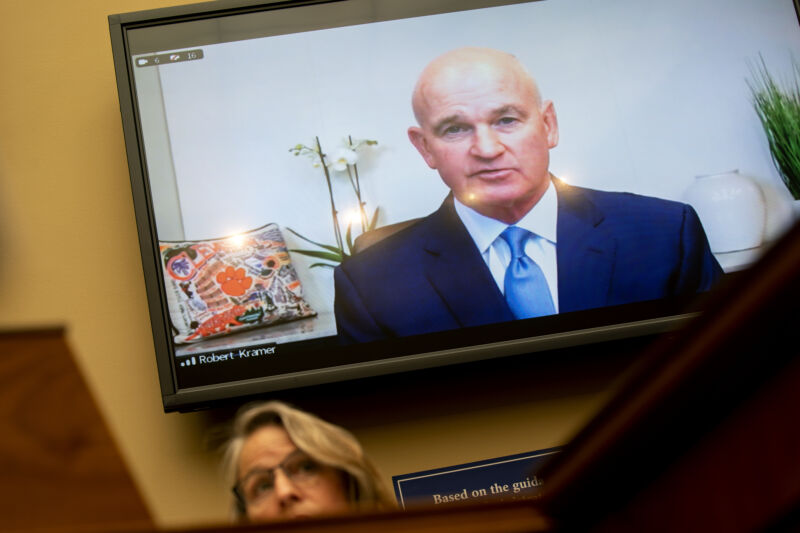
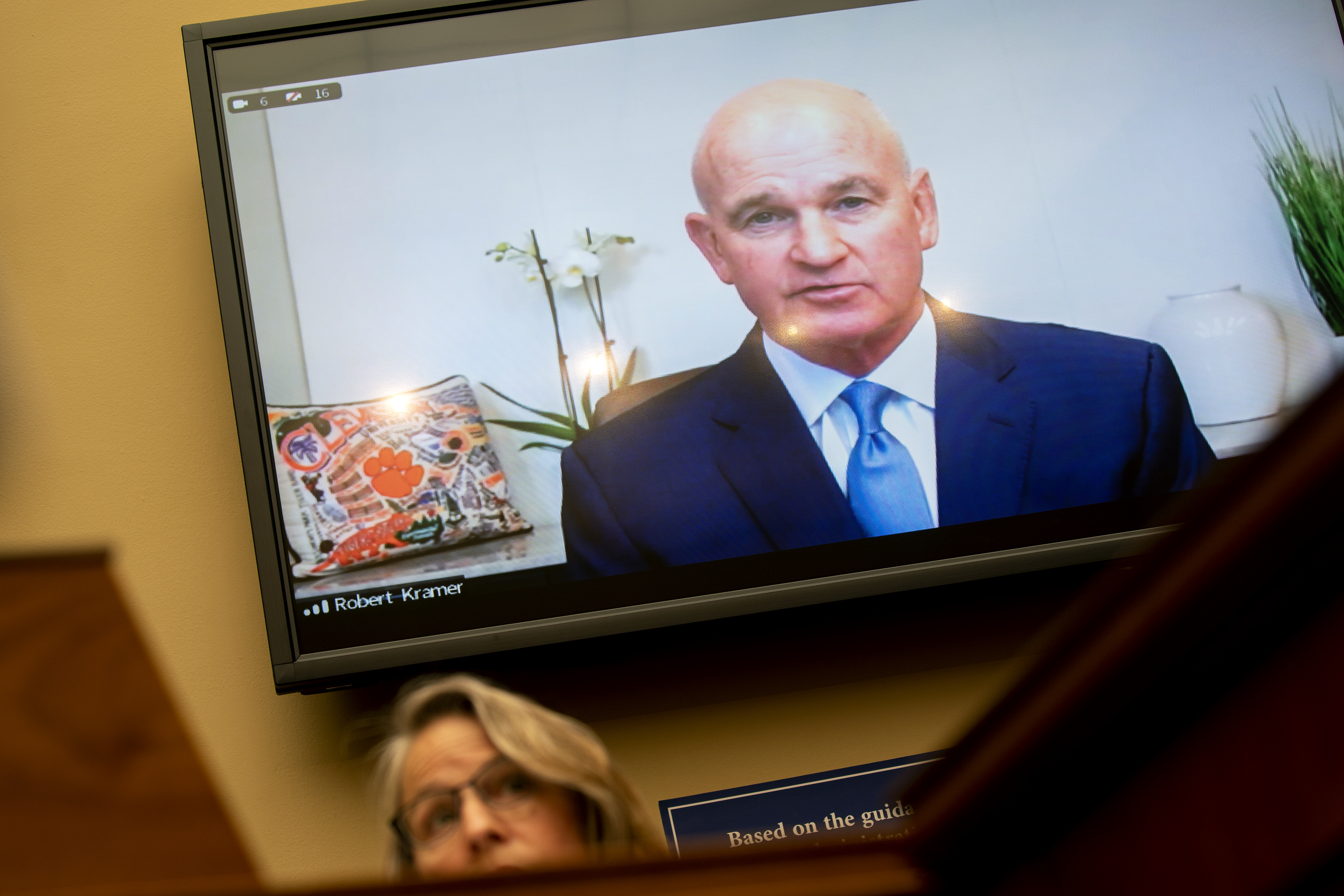
A flatscreen TV shows a serious man in a business suit.

Enlarge / Robert Kramer, president and chief executive officer of Emergent BioSolutions, speaks via videoconference during a House Select Subcommittee on the Coronavirus Crisis hearing in the Rayburn House Office Building on Capitol Hill on May 19, 2021, in Washington, DC. (credit: Stefani Reynolds-Pool / Getty Images)

When contract-manufacturer Emergent BioSolutions contaminated at least 15 million doses of Johnson & Johnson’s COVID-19 vaccine and millions more doses of AstraZeneca’s vaccine at its Baltimore facility earlier this year, the company had been collecting monthly payments of $27 million from the US government—payments intended to help Emergent avoid just such a manufacturing disaster.

That’s according to a preliminary report from a congressional investigation, conducted by two House committees—the Select Subcommittee on the Coronavirus Crisis and the Committee on Oversight and Reform. The report was released today and includes a number of troubling new details about the ongoing Emergent scandal.

The monthly “reservation fees” Emergent received were paid out of a questionable $628 million contract from May 2020. The money was intended to help Emergent maintain a state of “cleanliness and readiness” to produce vaccine under proper manufacturing standards and practices. But, as Ars previously reported, an inspection by the Food and Drug Administration in April found that to be far from the case.

Read 13 remaining paragraphs | Comments

20 May 01:32

4 vulnerabilities under attack give hackers full control of Android devices

by Dan Goodin
James.galbraith

I'll take my fruity walled garden, thanks

A computer screen filled with ones and zeros also contains a Google logo and the word hacked.

Enlarge (credit: Getty Images)

Unknown hackers have been exploiting four Android vulnerabilities that allow the execution of malicious code that can take complete control of devices, Google warned on Wednesday.

All four of the vulnerabilities were disclosed two weeks ago in Google’s Android Security Bulletin for May. Google has released security updates to device manufacturers, who are then responsible for distributing the patches to users.

Google’s May 3 bulletin initially didn’t report that any of the roughly 50 vulnerabilities it covered were under active exploitation. On Wednesday, Google updated the advisory to say that there are “indications” that four of the vulnerabilities “may be under limited, targeted exploitation.” Maddie Stone, a member of Google’s Project Zero exploit research group, removed the ambiguity. She declared on Twitter that the “4 vulns were exploited in-the-wild” as zero-days.

Read 10 remaining paragraphs | Comments

20 May 00:06

Android’s new privacy features sure look familiar

by Sara Morrison
James.galbraith

It's at least progress

Multiple Android phones showing various apps and features.
Google’s upcoming Android 12 will have several new privacy features. | Google

Google is once again playing catch-up with Apple.

Google’s latest attempt to play catch-up to the privacy features in Apple’s iOS was on display again Tuesday, when the company announced details of its Android 12 operating system.

Google is in the middle of its annual I/O developer conference, where it announces advancements in its Android, Assistant, Chrome, Search, and occasionally its hardware offerings. Some of those announcements include new privacy features on Android, features that would be more exciting if they weren’t so familiar: Most of what Google is bringing to Android devices are things that are already on iOS devices, and you have to wonder if Google would be doing them at all if Apple hadn’t done them first.

Nevertheless, Google is presenting its new privacy features as a step it happily took for the sake of its consumers.

“Android 12 is our most ambitious privacy release to date,” the company said on its blog. “Along the way, we have engaged closely with our developer community to build a platform that puts privacy at the forefront while taking into consideration the impact on developers.”

So, what will Android users be getting that iPhone users already have?

  • Phones will have visual indicators when cameras or microphones are being used. Those are nice if you’re paranoid that apps are watching or listening to you when you’re not aware, though useless if you’re so paranoid that you won’t believe the indicators in the first place.
  • Android will tell users when apps use information from their clipboards. That is, when you copy something (say, your password from a password manager app) and then paste it into something else (like the app that is asking for your password), Android will tell you that your clipboard is being accessed. That might sound like a minor thing, but apps having secret access to user clipboards and users lacking the ability to restrict clipboard permissions have been a security issue for a while, especially considering the sensitive information people might have on them (like passwords).
  • Android is also giving users the option to give apps access to their approximate location. Previously, apps got their precise location only, even if the app didn’t need such specific information to function. Precise location data is great for apps like Uber when you want to tell your driver exactly where you are and where you want to go, but location data companies have been caught taking advantage of it and even selling it to military contractors.

One nice thing that Android 12 will have that iOS doesn’t: a privacy dashboard that tells users which apps have accessed which permissions and when. According to Google’s mock-ups, users can see a list of which apps have used things like their location data, camera, and microphone. Apple’s iOS does this to a certain extent (you can see which apps have used your locations services within the last 24 hours), but not for all permissions, and it’s not laid out as simply and cleanly as Android’s.

 Google
Location usage is now in a handy list.

But what’s perhaps most notable is the iOS 14 privacy features Android 12 won’t have. These include so-called “privacy nutrition labels,” which are of dubious value to consumers, but still indicate that it’s important to the company that they be informed, and the ability to deny apps the ability to track users across other apps through its App Tracking Transparency.

That Android could come up with privacy labels of its own is still very much a possibility down the road. The anti-tracking tech that Apple has developed represents a major step toward privacy that Google is apparently considering but which would also put a dent in its business model, which uses data collected from users across its many trackers on websites, services, and apps to sell targeted ads. Apple doesn’t have the same business model, so it can take the lead without worrying about its bottom line. And it almost always does.

It’s important to keep in mind that Android is a much more popular mobile operating system, globally, than iOS. It powers the majority of the world’s smartphones, including very cheap models for people who could never in their wildest dreams afford an iPhone. So choosing an operating system based on its privacy features is not an option for many people. Assuming Android 12 is available on their devices, that means more people will finally have access to measures of privacy that they didn’t have before. They just had to wait for Apple to do them first.

20 May 00:04

Want improved fast travel in Skyward Sword HD? Buy this $25 Amiibo!

by Kyle Orland
James.galbraith

Fuck no

  • Your gateway to the skies.

The July release of The Legend of Zelda: Skyward Sword HD on the Switch will include an expanded fast-travel system that removes the need for players to trudge to specific save points before taking to the sky. But Nintendo is locking that helpful new feature behind an Amiibo figurine the company plans to sell for $25. Nintendo revealed both the Amiibo and its in-game functionality in an official blog post late Tuesday.

In the 2011 Wii release of Skyward Sword, Link could only transition between the surface areas and the airborne world of Skyloft at specific Bird Statues, which also served as save points. In the upcoming remake, Nintendo says players will be able to tap a new Zelda and Loftwing Amiibo to the controller to hit the sky "from anywhere on the surface world... even within the depths of a dungeon. Scan it again above the clouds to return to the same spot on the surface."

That's bound to be a welcome feature for many players, alleviating what Gamasutra called "boring bits of navigation back-to-back with other boring bits of navigation" upon the game's release. Nintendo itself suggests at least one practical use for the new ability: "If you run out of items while exploring the surface, for example, you can quickly return to the Bazaar in Skyloft to replenish your supplies. Once you’re done shopping, the Amiibo allows you to quickly zip back to the surface and pick up where you left off!"

Read 6 remaining paragraphs | Comments

20 May 00:04

Meet the perfect Senate candidate for today’s Trumpified GOP

by Greg Sargent
James.galbraith

It's pretty insane

As Republicans oppose a Jan. 6 commission, deranged anti-leftist hyperbole serves as their excuse.
19 May 23:59

Rep. Katie Porter unleashes whiteboard on big pharma executive over skyrocketing drug prices

by Marissa Higgins
James.galbraith

She's a godsend

On Tuesday, Democratic Rep. Katie Porter took out her famous whiteboard and gave the internet a breath of fresh air. Porter, as well as colleagues in the House Oversight Committee, grilled Richard Gonzalez, the CEO of AbbVie, a pharmaceutical company, over the increasing price of Humira—an anti-inflammatory drug used to treat conditions like Crohn’s—in the U.S. while apparently reducing the cost of the drug in other countries. While the company has argued the price increases came down to innovations in the drug, Porter and fellow Democrats on the committee were far from convinced. 

"You lie to patients when you charge them twice as much for an unimproved drug,” Porter stated in the two-minute video that’s quickly going viral. “And then you lie to policymakers when you tell us that R&D justifies those price increases.” Zing! Let’s check out the full video, and Porter’s history of grilling executives with her whiteboard in hand, below.

During the hearing, Porter asked Gonzalez how much money AbbVie spent on dividends and stock buybacks. Gonzalez didn’t have a specific number available to offer, so Porter supplied her own, saying that the company spent $50 billion between 2013 and 2018 on stocks to help shareholders. In comparison, the company contributed a far smaller amount to research and development. Mind you, research and development is the part of the company that actually improves drugs.

Porter described "the Big Pharma fairy tale” as focused on innovative research and development that theoretically justifies the high prices of these medicines, but, as she put it, “the pharma reality is that you spend most of your company's money making money for yourself and your shareholders."

"You're not honest about that with patients and policymakers,” Porter continued. “You're feeding us lies that we must pay astronomical prices to get 'innovative' treatments. The American people, the patients, deserve so much better."

Porter also asked Gonzalez to share how much the company paid its executives. Gonzalez said executives were compensated with about $60 million per year—a truly staggering number. The number Porter offered was even more staggering, bordering on the surreal: a cool $334 million. 

Here is that video.

Big Pharma says they need to charge astronomical prices to pay for research and development. Yet, the amount they spend on manipulating the market to enrich shareholders completely eclipses what's spent on R&D. Today, I confronted a CEO about the industry's lies, with visuals ⤵️ pic.twitter.com/c3jSLr0yVd

— Rep. Katie Porter (@RepKatiePorter) May 18, 2021

We’ve seen Porter absolutely skewer an oil executive who tried to explain tax law to her. We’ve seen her whiteboard previously, too, when she reminded a big pharma executive just how much of his massive salary—to the tune of $13 million—came from outrageously expensive cancer treatment drugs. Back in March, we also saw Porter push Chief of the Centers for Disease Control and Prevention Dr. Robert Redfield to promise that all testing for the novel coronavirus would be free regardless of insurance coverage. She’s annihilated former Trump Treasury Secretary Steve Mnuchin during a hearing about taxpayer funds amid the pandemic. She’s also taken to Twitter to call out Republicans like Mitch McConnell when time was of the essence.

In short, Porter taking a stand is nothing new, but it continues to be inspiring, and it’s a level of dedication to the American public that her peers on both sides of the aisle should aspire to. 

Here’s a clip of that video on YouTube.

19 May 23:58

Intelligence agencies gathered the information predicting violence on Jan. 6, then DHS sat on it

by Mark Sumner

Since hours after Trump supporters surged up the steps of the Capitol; pushed, punched, beat, and bear sprayed their way past police; smashed open windows; shattered doors; and streamed into the building to a chorus of “Hang Mike Pence,” there’s been one consistent story told about the events of Jan. 6. That story is that it was a “intelligence failure.” Again and again, police and military officials have testified that they either didn’t get the word that Trump supporters were coming to town with the intent of committing violence, or that word failed to get to the right people. 

The memo didn’t get out of the basement. Or if it did, the right people never saw it. Or if they saw it, it didn’t say anything new. Or …

Except none of that seems to be the case. As NPR reported on Tuesday, a report from the former head of the New York Police Department makes it absolutely clear that … everyone knew. Everyone knew that the Trump campaign was deeply entangled with white supremacist militias. Everyone knew that they were coming to Washington, D.C., with the intention of committing violence. Well before Jan. 6, the FBI and agencies up and down the chain at Homeland Security had compiled stacks of evidence showing that Trump’s event was going to bring violent people with violent intent.

It’s just that, having collected this information, all those agencies refused to act on it. “Intelligence collection did not fail,” says the report. The failure was that “senior government officials” failed to “issue warnings based on that intelligence." 

In particular, the report focuses on a department inside the Department of Homeland Security called the Office of Intelligence and Analysis. That’s the department that’s charged with taking all the intelligence gathered by more field-oriented agencies and synthesizing it into a useful picture of upcoming events and concerns. The “threat assessments” that seemed to give such conflicting views of what to expect on Jan. 6 were largely a product of this department. 

The problems here seem to have been plentiful. First, the Office of Intelligence and Analysis itself was treated as a junior partner for many of the agencies. As a result, it was both understaffed and populated with people who would rather be almost anywhere else. Second, even though it was the one place that was supposed to drag together information that might have been sourced by the FBI, local police, or some other intelligence agency, the feedback from the office was widely ignored.  Third, like every agency in the DHS, the Office of Intelligence and Analysis was subject to the whims of leadership. Under Trump, that included taking almost all the resources of the office and focusing them on evaluating supposed threats along the border, while barely acknowledging any threat from right-wing militia—even though agencies had long identified these militias as the nation’s greatest internal threat.

In the case of reports that should have emerged preceding the events of Jan. 6, much of the gathered information appears to have simply gone missing in action. DHS analysts were apparently pressured to “fall in line,” and provide reports that matched what the Trump White House wanted to see. That includes simply refusing to acknowledge the threat posed by violent right-wing extremists.

With a vote on the Jan. 6 commission coming Wednesday, members of the House and Senate might want to consider that there’s more to look at than the violence that happened in the Capitol that day. More to look at than the mistakes made by the Capitol Police, or even the delays in deploying the National Guard. 

By suppressing the intelligence information that had been collected by agencies across the nation, DHS essentially set up the police to fail. It’s another reason that the Jan. 6 commission is absolutely necessary, and another reason Republicans are fighting against it—which is the same thing as fighting to continue the cover-up. 

19 May 05:39

New York state investigation into Trump is now a criminal probe

by Ben Leonard
James.galbraith

halefuckinglujah


The New York state attorney general’s examination of the Trump Organization is now also a criminal investigation, a spokesperson for the attorney general said on Tuesday night.

The investigation is “no longer purely civil in nature,” Fabien Levy, the spokesperson for New York Attorney General Letitia James, confirmed to POLITICO by email. “We are now actively investigating the Trump Organization in a criminal capacity, along with the Manhattan D.A. We have no additional comment at this time.”

CNN was the first to report the news on Tuesday night.

James’ office is undertaking a sweeping probe of former President Donald Trump and his family over allegedly misstating property values to get tax benefits. In February, the Supreme Court paved the way for Manhattan District Attorney Cyrus Vance Jr.’s team to get eight years of Trump’s tax returns and financial records as a part of Vance’s criminal probe into potential tax, insurance and bank fraud.

The new development appears to expand the potential liability for Trump, who is now facing separate criminal probes from prosecutors in New York, and also suggests collaboration in the two investigations.

James’ inquiry started in 2019 after former Trump attorney Michael Cohen said in a congressional hearing that Trump had inflated the value of assets to banks to get better loans and insurance, while undervaluing them to cut his tax liability. Vance's investigation has also appeared to be focused on allegations from Cohen, who has also claimed Trump committed fraud while dealing with insurance companies, which Trump and the Trump Organization have denied.

James' office has focused on Trump properties that include the Trump International Hotel and Tower in Chicago and 40 Wall Street in New York City.

James pledged to hold Trump accountable, and she spearheaded or joined into dozens of efforts to challenge the Trump administration on a number of issues when Trump was in office. Last fall, a judge ordered the former president’s son Eric Trump to answer questions under oath as part of the investigation.

“The court’s order today makes clear that no one is above the law, not even an organization or an individual with the name Trump,” James said in a statement at the time.

Jen Weisselberg, former daughter-in-law of Allen Weisselberg, chief financial officer of the Trump Organization, has said she is cooperating with both probes.

Both James and Vance are Democrats. Trump has previously called the investigations a politically motivated "witch hunt."

Vance is stepping down Dec. 31, as he said in March that he won't be running for reelection. Vance's probe has also scrutinized possible hush-money payments to women for Trump.

A spokesperson for Vance’s office declined to comment Tuesday night.

The New York Times has reported that Trump has paid little in taxes, including just $750 in federal taxes in 2017, a report which Trump called “fake news.” Their reporting also indicated he has gotten some hefty refunds.

Law enforcement officials in Florida have been preparing for the scenario in which Vance could potentially indict Trump while he’s at his Mar-a-Lago club in Florida, sources have previously told POLITICO.

Potential extradition of Trump could be complicated, as Florida law allows Gov. Ron DeSantis, a prominent Trump ally, the ability to step in and investigate if anyone indicted “ought to be surrendered” for an out-of-state indictment. If Trump were at his golf club in Bedminster, N.J., when indicted, it would likely be different, as the state has laws similar to Florida’s on extradition but also has a Democratic governor.

Representatives for Trump and the Trump Organization did not immediately respond to requests for comment.

19 May 03:55

Ethereum Staking Will Drop Power Consumption By 99%

by BeauHD
James.galbraith

About fucking time

After Ethereum transitions to proof-of-stake, the blockchain's power consumption is expected to drop by more than 99%, making it about 7,000 times more energy efficient than Bitcoin. Crypto Briefing reports: Ethereum will reduce its energy consumption by 99.95% following its transition to proof-of-stake, according to a new blog post from Carl Beekhuizen of the Ethereum Foundation. Beekhuizen estimated there are 87,000 at-home stakers using about 100W of energy for a total of 1.64 megawatts. Additionally, there are another 52,700 exchanges and custodial services that use about 100W per 5.5 validators for a total of 0.98 megawatts. Based on those estimates, Beekhuizen says that Ethereum will consume about 2.62 megawatts when it switches to proof-of-stake. Beekhuizen added that this estimate may be too large. He noted that his own personal staking setup was optimized to use 15W, while some staking services use as little as 5W per validator. This means that Ethereum will no longer use the energy equivalent of a country or even a city. Instead, its total consumption will be comparable to a small town that contains around 2100 homes.

Read more of this story at Slashdot.

19 May 03:54

Republican governor signs anti-trans bathroom bill into law amid pandemic

by Marissa Higgins
James.galbraith

GOP priorities. Add another state to the "no fucking way" visit list

As the pandemic continues, Republicans across the country are eager to keep distracting the public from the party’s failures over the past year and a half. As Daily Kos has covered, we know state-level Republicans have pushed anti-trans legislation that rests on hysteria and misinformation, ranging from banning trans girls from participating on girls’ sports teams to making it a felony for physicians to prescribe gender-affirming health care to transgender youth. While some measures have fizzled out far before reaching a governor’s desk, a growing number of these bills have actually been signed into law. We have a fresh example of a different kind of anti-trans bill that was just signed into law in Tennessee—this time, a bathroom bill.

On Friday, Republican Gov. Bill Lee signed an anti-trans bathroom bill that targets students and faculty into law. House Bill 1233, called the Tennessee Accommodations for All Children Act, forces public schools to offer “reasonable accommodations” for students and staff who don’t use the restroom that matches their sex assigned at birth. The bill notes that this “reasonable accommodation” cannot include allowing people to use bathrooms designated for people of the opposite sex assigned at birth. What does this mean in practice? Students and faculty won’t be allowed to use the bathrooms that align with their gender identity. 

This law defines a person’s sex as the “immutable biological sex as determined by anatomy and genetics existing at the time of birth." This language means that for trans folks who do update the sex on the birth certificate or ID, for example, that official change isn’t enough—it goes back to what someone was assigned by a physician at birth, not their actual gender identity. 

So, what bathrooms would trans students be allowed to use? According to the bill text, “single-occupancy” restrooms would be fine, as would be a bathroom in the school nurse’s office or the faculty bathroom. If you’re wondering why that’s such a big deal, there are a few reasons. One, those options are far more limited, which could create inconvenience or anxiety for the student. There’s also the big concern that using these bathrooms would essentially “out” the student to their peers. There’s also the reality that access issues could come into play when bathroom options are so limited—for example if the single occupancy option isn’t designed for safe use by a student in a wheelchair. 

But that’s not all. The bill would actually students to sue their school if the school allowed trans youth to use bathrooms that matched their gender identity. Meaning, for example, if a student noticed one of their trans peers using the locker room or bathroom that matched their gender identity—a trans girl in the girls’ locker room, for instance—that student could sue the school for “harm suffered.”

Even in addition to the immense horror and stress this situation puts on trans youth, it also opens up a world of anxiety for students who may not be trans, but do not present as their peers do—for example, a cisgender girl who wears “masculine” clothes or a cisgender boy who wears makeup or “feminine” accessories. The bill offers a lot of room for people to start monitoring and reporting their peers in a way that seems ripe for bullying, harassment, and exclusion.

“By advancing hateful legislation like HB 1233 (SB 1367), Tennessee Gov. Lee and state legislators are using their power to harm and further stigmatize trans youth in Tennessee,” Alphonso David, Human Rights Campaign President, said in a statement. “The state of Tennessee is quickly becoming a national leader for anti-LGBTQ legislation, as lawmakers would rather discriminate against LGBTQ youth than focus on real problems facing Tennesseans.”

Tennessee state Rep. Jason Zachary, a Republican, originally introduced the bill. He argued the legislation offers a “path forward” for how schools can handle the issue, and that he became inspired to introduce the bill because a school told him they had a problem with “boys using the girls’ restroom.” The bill ultimately passed in the state senate with a 23-7 vote and in the House with a final vote of 70-22. The bill is expected to become law as of July 1, 2021.

Is Lee signing this legislation into law ultimately surprising? Sadly, not really, given that he signed an anti-trans sports bill into law just a few months ago. 

We must act now to urge our senators to vote “yes” to the Equality Act.

Sign and send the petition: The Senate must pass the Equality Act and stop the discrimination against LGBTQ people.

18 May 23:22

Hackers Behind Colonial Pipeline Attack Reportedly Received $90 Million In Bitcoin Before Shutting Down

by BeauHD
An anonymous reader quotes a report from CNBC: DarkSide, the hacker group behind the recent Colonial Pipeline ransomware attack, received a total of $90 million in bitcoin ransom payments before shutting down last week, according to new research. Colonial Pipeline was hit with a devastating cyberattack earlier this month that forced the company to shut down approximately 5,500 miles of pipeline in the United States, crippling gas delivery systems in Southeastern states. The FBI blamed the attack on DarkSide, a cybercriminal gang believed to be based in Eastern Europe, and Colonial reportedly paid a $5 million ransom to the group. On Friday, London-based blockchain analytics firm Elliptic said it had identified the bitcoin wallet used by DarkSide to collect ransom payments from its victims. The same day, security researchers Intel 471 said DarkSide had closed down after losing access to its servers and as its cryptocurrency wallets were emptied. DarkSide also blamed "pressure from the U.S.," according to a note obtained by Intel 471. In a blog post Tuesday, Elliptic said DarkSide and its affiliates bagged at least $90 million in bitcoin ransom payments over the past nine months from 47 victims. The average payment from organizations was likely $1.9 million, Elliptic said. "To our knowledge, this analysis includes all payments made to DarkSide, however further transactions may yet be uncovered, and the figures here should be considered a lower bound," said Tom Robinson Elliptic's co-founder and chief scientist. According to Elliptic, $15.5 million of the $90 million total haul went to DarkSide's developer while $74.7 million went to its affiliates. The majority of the funds are being sent to crypto exchanges, where they can be converted into fiat money, Elliptic added.

Read more of this story at Slashdot.

18 May 21:55

Try This One Weird Trick Russian Hackers Hate

by msmash
Brian Krebs: In a Twitter discussion last week on ransomware attacks, KrebsOnSecurity noted that virtually all ransomware strains have a built-in failsafe designed to cover the backsides of the malware purveyors: They simply will not install on a Microsoft Windows computer that already has one of many types of virtual keyboards installed -- such as Russian or Ukrainian. So many readers had questions in response to the tweet that I thought it was worth a blog post exploring this one weird cyber defense trick. The Twitter thread came up in a discussion on the ransomware attack against Colonial Pipeline, which earlier this month shut down 5,500 miles of fuel pipe for nearly a week, causing fuel station supply shortages throughout the country and driving up prices. The FBI said the attack was the work of DarkSide, a new-ish ransomware-as-a-service offering that says it targets only large corporations. DarkSide and other Russian-language affiliate moneymaking programs have long barred their criminal associates from installing malicious software on computers in a host of Eastern European countries, including Ukraine and Russia. This prohibition dates back to the earliest days of organized cybercrime, and it is intended to minimize scrutiny and interference from local authorities. In Russia, for example, authorities there generally will not initiate a cybercrime investigation against one of their own unless a company or individual within the country's borders files an official complaint as a victim. Ensuring that no affiliates can produce victims in their own countries is the easiest way for these criminals to stay off the radar of domestic law enforcement agencies. [...] Here's the thing: Digital extortion gangs like DarkSide take great care to make their entire platforms geopolitical, because their malware is engineered to work only in certain parts of the world.

Read more of this story at Slashdot.

18 May 21:21

We have a Supreme Court problem and a Senate problem, and 'deluded institutionalists' make it worse

by Joan McCarter
James.galbraith

It's all a minority rule problem, and it's only getting worse

Sen. Susan Collins must be feeling at least a tiny bit concerned right about now if she's at all capable of considering the consequences of her actions anymore. After all, she staked her reputation on the "promise" she secured from then-Supreme Court nominee Brett Kavanaugh that Roe v. Wade was "settled law," with "precedent upon precedent."

And here we are now, with the Supreme Court poised to consider a Mississippi abortion law passed for the express purpose of getting the Supreme Court to further erode abortion rights.

For eight months, the court had been sitting on this case. Eight months during which a liberal stalwart on the court died and a far-right, inexperienced ideologue took her place. The arrival of Amy Coney Barrett on the court in Ruth Bader Ginsburg's seat has sealed the conservative majority. That's after the arrival of Kavanaugh, another far-right partisan who got there because of Collins' vote. Kavanaugh wasted little time in showing his true hand on abortion, dissenting in the case of June Medical Service vs. Russo and voting to overturn four years of precedent regarding reproductive choice.

After eight months of testing the wind, the court's conservative majority has now decided to flex its muscles, and abortion is on the docket.

The same day the court announced it's taking up the case, the Harvard University Press previewed an upcoming offering from Justice Stephen Breyer, the 82-year-old justice who has been lately defending the Supreme Court against the calls for court reforms. "A growing chorus of officials and commentators argues that the Supreme Court has become too political," the press release announcing the book intones.

On this view the confirmation process is just an exercise in partisan agenda-setting, and the jurists are no more than "politicians in robes"—their ostensibly neutral judicial philosophies mere camouflage for conservative or liberal convictions. As a result of this perceived crisis, and for the first time since the New Deal era, there is serious talk of court packing in the name of ideological balance.

… Mindful of the Court's history, he suggests that the judiciary's hard-won authority would be marred by reforms premised on the assumption of ideological bias. … The peril facing the Supreme Court comes less from partisan judges than from citizens who, encouraged by politicians, equate impartial justice with agreeable judicial outcomes.

As if the Gorsuch, Kavanaugh, and Barrett confirmations weren't intended to give the far-right the judicial outcomes it's been investing so much dark money in.

The release also announces the book is coming from "sitting" Justice Breyer in September, meaning he's intending to hold out to the bitter end, arguing that "public trust would be eroded by political intervention, dashing the authority of the Court." As if the Court held the public trust. As if the body politic didn't view the court as a political entity after Donald Trump and Mitch McConnell unscrupulously and ideologically packed it already.

Breyer was there for all that. He was there when McConnell held the Scalia seat open for nearly a year after his death, refusing to allow President Obama to fill it. He was there when McConnell dropped the filibuster on Supreme Court nominees so he could rush Neil Gorsuch on to it. He was there when McConnell's Republican Senate rushed Kavanaugh onto the court despite credible allegations of sexual assault against him as well as lingering big questions about his truthfulness with the committee in confirmation hearings, and how he experienced a timely and favorable reversal of fortunes in his personal finances, wiping out years of very large debts. He was there when McConnell sped Barrett onto the court just weeks before a presidential election, in complete contradiction to the excuse he used for keeping Obama's nominee, Merrick Garland, off the court.

That Breyer actually thinks the American public saw all that happen and doesn't question the legitimacy of the court is a problem. It makes him, as The Washington Post's Paul Waldman puts it, a "deluded institutionalist," a "solitary institutionalist, so convinced that he alone can save the body to which he is devoted that he blinds himself to reality and helps those who would undermine everything he supposedly stands for."

Waldman equates what Breyer is doing with the court with what Joe Manchin is doing with the Senate: protecting an institution "that now exists only in his imagination." That's the Senate of Manchin's fever dreams in which Susan Collins acts in good faith. We’ve already seen where that gets us.

Both institutions, the court and the Senate, have to be reformed, and one can't be done without the other. Yes, there needs to be an expansion of the court to dilute the politicized poison that threatens to consume it. And yes, there needs to be a reform in the Senate to break the minoritarian rule that is threatening, well, everything.

Biden's special commission, which has been given six months to ponder these questions and which also includes some members very hostile to abortion rights, isn't the solution. It isn't going to save not just fundamental rights, but much of Biden's agenda, which Republican states and Republican judges are primed to start challenging.

As for abortion rights, here's the White House’s pat answer:

After Supreme Court takes up case about Mississippi's 15-week abortion ban, Psaki says President Biden is "committed to codifying" Roe v. Wade as law regardless of the case's outcome https://t.co/efnmUGH0mw pic.twitter.com/kZBDQi1Os4

— CBS News (@CBSNews) May 17, 2021

The problem is that abortion rights are not going to be codified by a 50-50 Senate. It's not going to happen as long as the filibuster exists.  

18 May 18:50

Bill Gates will never be the same

by Theodore Schleifer
James.galbraith

Surprise... oh wait, no.

Bill Gates is mired in deep scandal, after decades of bolstering his philanthropic image. | Indraneel Chowdhury/NurPhoto via Getty Images

The aura that Gates built over the past two decades may be permanently shattered.

For decades, Bill Gates has traveled the globe as near-royalty, knighted by Queen Elizabeth and draped in medals by President Barack Obama. And for the last year, the once pugnacious Microsoft founder has reinvented himself as one of America’s clearest, most humane voices on the Covid-19 pandemic.

It would only take two weeks for Gates to reinvent himself yet again — and not in the way that his past reinventions have gone.

For the first time since the turn of the century, Bill Gates is mired in deep scandal. And what has become clear over the past 48 hours is that Gates will never be the same.

The divorce of Gates and his wife, Melinda, was announced earlier this month but has devolved into a tabloid melodrama featuring secret boardroom investigations, hushed affairs, and the likes of Jeffrey Epstein. Gates was pummeled in a trio of stories over the weekend that detailed his alleged indiscretions, each of which began to shatter the aura that he has cultivated in the 20 years since he took his foot off the clutch at Microsoft.

That image rehabilitation largely worked. Ever since stepping back from Microsoft, Gates has grown to epitomize what might be considered the “Good Billionaire”: a civic-minded, awkward geek who showed how capitalism’s winnings can be marshaled to make the world a better place through philanthropy. No donor was more important in the world than Bill Gates, who, along with his wife, had grown to symbolize something in short supply in corporate America: role models.

And the polling reflected that: 55 percent of Americans told Recode in a survey this year that they had a positive opinion of him; only 35 percent felt the opposite.

But Gates’s world has now come crashing down with incredible speed.

To recap: Gates has apologized and been dogged for over a year by his connections to Epstein, the convicted sex offender who eventually killed himself in federal custody. But Gates is now accused of having vastly underplayed his ties to the ignominious criminal, according to one report. A second report shows a pattern of Gates acting unprofessionally around women he worked with — and handling a sexual harassment allegation against his money manager in a way that upset Melinda. And in the perhaps most damaging revelation, Gates now admits that he had an affair with an employee at Microsoft back in 2000, which triggered an investigation by the tech giant’s board of directors in 2019, a third report says.

Gates’s team denies many of these allegations. But they are sure to capture some mindshare with the American public, piercing the reputation that Gates has worked so long to cultivate. And there’s little reason to think that the last shoe has dropped in a record-setting divorce proceeding that is trending toward ugly.

Will people look at Bill Gates with the same fondness ever again?

What two weeks ago was merely a marriage that had sadly petered out has spiraled into something nastier. Gates will be shrouded in questions for the foreseeable future about his romantic life — to say nothing about the uncomfortable pecuniary and legal questions about the future of his fortune.

People do recover from scandal, especially in this news and political environment. (Philanthropists like Michael Milken were no angels.) Gates will surely have his own side of the story to tell, and the Gates Foundation will still exist, giving him wide influence over the next few decades. But more than other philanthropists, much of Gates’s soft power came from his seemingly unimpeachable public profile, which will now be more than a little tarred by the worst kind of attention.

Even if this is relegated to a rough news cycle or two in the long sweep of history, the short-term consequences are profound given where we are in that history. Gates should be at the forefront of the humanitarian crisis in India, for instance, speaking out about the massive death tolls. (He’s instead drawn controversy for his support of vaccine patent protections.) Now he is on the defensive, and any next interviewer will understandably want to ask at least in part about his private life, depleting the power of his commentary on public health.

This should be a validating moment for Bill Gates, as much as the last year has been. Instead, he will likely be silent, legalistic, and, more broadly, on the back foot. It couldn’t have come at a worse time.

18 May 18:47

Brett Kavanaugh’s latest decision should alarm liberals

by Ian Millhiser
James.galbraith

Oh it does. It's fucking enraging. We're about to see a conservative majority completely unchained and it's going to be horrifying.

Justice Brett Kavanaugh at a ceremony for the late President George H.W. Bush at the Capitol in 2018.  | Jabin Botsford/Getty Images

The Court’s new median justice really doesn’t care about precedent.

The Supreme Court took two actions on Monday that hint that many Democrats’ worst fears about the Court’s 6-3 Republican majority might come true.

The first was the Court’s announcement that it will hear Dobbs v. Jackson Women’s Health Organization, a challenge to a Mississippi law banning nearly all abortions after 15 weeks of pregnancy. Dobbs is potentially an existential threat to the constitutional right to an abortion, and it tees up the question of whether this Court is willing to overrule venerable decisions like Roe v. Wade, which are beloved by liberals and loathed by conservatives.

The second action involved a more obscure case. Last year, in Ramos v. Louisiana, the Supreme Court held that no one could be convicted of a “serious crime” unless a jury voted unanimously to convict them. On Monday, the Supreme Court held in Edwards v. Vannoy that Ramos is not retroactive — meaning that nearly all people convicted by non-unanimous jury verdicts before Ramos was decided will not benefit from the Ramos decision.

On the surface, the Court’s decision to hear a major abortion case, and its decision not to apply one of its criminal justice precedents retroactively, may appear to have little in common. But taken together, they foreshadow a world where the Court’s new majority is willing to overturn longstanding precedents, potentially with little justification for doing so other than that the Court’s Republican majority would prefer to overrule liberal decisions such as Roe.

Because here’s the thing: Edwards did not simply limit the scope of Ramos. Justice Brett Kavanaugh’s majority opinion also overruled a 32-year-old decision governing when the Supreme Court’s precedents apply retroactively. Kavanaugh did so, moreover, without following the ordinary procedures that the Court normally follows before overruling one of its previous decisions. As Justice Elena Kagan points out in dissent, no one asked the Court to overrule anything in Edwards, and the Court “usually confines itself to the issues raised and briefed by the parties.”

Edwards, moreover, is the second time in less than a month that Kavanaugh authored a majority opinion that overrules a prior decision without following the Court’s normal procedures. In late April, Kavanaugh handed down a decision in Jones v. Mississippi that effectively overruled a 2016 decision establishing that nearly all juvenile offenders may not be sentenced to life without parole.

But Jones overruled this 2016 decision in such an oblique and underhanded way that several of Kavanaugh’s colleagues came very close to accusing him of lying about what he was doing. Even Justice Clarence Thomas, the Court’s most conservative member, chided Kavanaugh for overruling a previous decision “in substance but not in name.”

The Court historically has been very reluctant to overrule precedents, both because past justices understood that the law should be predictable, and because strong norms against overruling past decisions help prevent the Supreme Court from becoming a purely partisan prize — tossing out decades’ worth of settled doctrines every time a different political party gains control of the Court.

But Kavanaugh does not appear to share his predecessors’ reluctance to overrule past decisions.

All of this matters because Kavanaugh is the median vote on the Supreme Court. Last week, SCOTUSBlog published an analysis finding that Kavanaugh voted with the majority in 97 percent of cases decided so far this Supreme Court term — more than any other justice. If you want to win a case before the Supreme Court, you’ve got a tough road ahead of you if you can’t secure Kavanaugh’s vote.

And yet, Kavanaugh is signaling in Edwards, Jones, and in a few other significant opinions that he does not particularly care about precedent, and that he is willing to overrule prior decisions for reasons that previous Supreme Courts would have deemed trivial and unwarranted.

With conservatives holding a 6-3 supermajority on the Supreme Court, that’s terrible news for liberals. And it doesn’t just mean that precedents like the Court’s pro-abortion decision in Roe v. Wade (1973) are in danger.

Kavanaugh, the closest thing that this Supreme Court has to a “swing” justice, is telling us that he’s very willing to overrule a wide range of precedents. And a majority of the Court appears to agree with his approach. That’s potentially disastrous news for anyone hoping that this Supreme Court would honor past decisions that protect liberal democratic values.

So what happened in Edwards, exactly?

Edwards involved a question that comes up fairly often in the Court’s criminal justice decisions: When the Court announces a new constitutional rule governing criminal convictions or sentences, does that rule apply retroactively to people whose convictions or sentences were already final when the new rule was handed down?

In Teague v. Lane (1989), the Supreme Court identified a few limited circumstances when a new rule should apply retroactively. The first circumstance is if the new rule places “certain kinds of primary, private individual conduct beyond the power of the criminal law-making authority to proscribe.” Thus, for example, if the Supreme Court were to hold that it is unconstitutional to convict someone for marijuana possession, then that rule would apply retroactively because it places the act of possessing marijuana “beyond the power of the criminal law-making authority to proscribe.”

Subsequent Supreme Court decisions clarified that a new criminal justice rule also applies retroactively if it forbids “a certain category of punishment for a class of defendants because of their status or offense.” Thus, for example, when the Supreme Court held in Atkins v. Virginia (2002) that intellectually disabled people are not eligible for the death penalty, that rule was retroactive because it determined that a certain class of people could not receive a certain category of punishment.

Teague held that “watershed rules of criminal procedure” are also retroactive. The Edwards case asked whether the rule announced in Ramos — the rule that no one can be convicted of a serious crime unless the jury verdict is unanimous — was such a watershed rule.

In holding that Ramos did not announce such a “watershed” rule, Kavanaugh explains that the bar for determining what constitutes a watershed rule is quite high. Indeed, in the Court’s entire history, it’s only identified one such rule: the decision in Gideon v. Wainwright (1963) holding that indigent criminal defendants are entitled to defense counsel paid for by the state.

And yet, rather than just holding that Ramos did not announce a watershed rule and leave it at that, Kavanaugh’s opinion goes much further. “Some 32 years after Teague,” Kavanaugh writes, it’s now clear that “no new rules of criminal procedure can satisfy the watershed exception.” Thus, he concludes, “we cannot responsibly continue to suggest otherwise to litigants and courts.”

Edwards holds that no new watershed rules exist, no matter what the circumstances. Teague’s verdict on watershed rules is now overruled.

Kavanaugh’s shifting justifications for overruling prior decisions

The Court’s decision to overrule part of Teague is surprising for several reasons. For one thing, as Kagan notes in her dissent, no one asked the Court to do so. Typically, before the Court overrules a precedent, it seeks out briefing from the parties on whether that precedent should be overruled — that way, if there will be some disastrous or unexpected consequence if the precedent is overruled, the parties can warn the justices about it in advance.

Kavanaugh also does not appear to have followed his own rules governing when a previous Court decision should be overruled. In Ramos, the Court effectively overruled another decision, Apodaca v. Oregon (1972), which permitted states to convict criminal defendants via a non-unanimous jury vote. Kavanaugh agreed with this result in Ramos, but he also wrote a separate opinion laying out when he thinks it is acceptable for the Supreme Court to overrule a prior decision.

When deciding whether to overrule a precedent, Kavanaugh wrote, the Court should consider whether the previous decision is “not just wrong, but grievously or egregiously wrong.” It should consider whether “the prior decision caused significant negative jurisprudential or real-world consequences,” and it should ask whether overruling the prior precedent would upset “legitimate expectations of those who have reasonably relied on the precedent.”

But Kavanaugh engaged in none of this analysis in Edwards, and it’s hard to see how Teague would qualify as worthy of being overruled under the standard Kavanaugh articulated in Ramos. Kavanaugh doesn’t claim in Edwards that Teague was egregiously wrong or that it’s led to “significant negative jurisprudential or real-world consequences.” Indeed, he claims the exact opposite — that Teague’s holding regarding “watershed” rules should be overruled because it’s had no jurisprudential or real-world consequences whatsoever.

Kavanaugh also ignored the standard he laid out in Ramos in his opinion in Jones v. Mississippi, the decision involving whether juveniles who commit homicide crimes can be sentenced to life without parole.

In Miller v. Alabama (2012), the Supreme Court held that most people who commit a crime before their 18th birthday may not be sentenced to life without parole, even if the crime is murder. And, in Montgomery v. Louisiana (2016), the Court held that Miller applies retroactively because it prohibited a certain category of offenders (nearly all juvenile offenders) from receiving a certain punishment (life without parole).

Miller and Montgomery did, however, suggest that a very small category of juvenile offenders, “those whose crimes reflect permanent incorrigibility,” are still eligible for life without parole. The issue in Jones was whether a sentencing judge must explicitly determine that a particular juvenile offender is “permanently incorrigible” before sentencing them to life without parole.

Kavanaugh’s decision in Jones doesn’t simply hold that sentencing judges do not need to make this determination; it eliminates Montgomery’s holding that nearly all juvenile offenders are categorically ineligible for life without parole. Kavanaugh’s opinion in Jones establishes that all juvenile homicide offenders may be sentenced to life without parole, so long as they are sentenced in a “discretionary” proceeding where the judge has the option to impose a lighter sentence.

“In a case involving an individual who was under 18 when he or she committed a homicide,” Kavanaugh wrote for the new, more conservative majority that decided the Jones case, “a State’s discretionary sentencing system is both constitutionally necessary and constitutionally sufficient.”

Four justices called Kavanaugh out for overruling Montgomery without being entirely honest about what he was up to. Though Thomas agreed with Kavanaugh that Montgomery should be overruled, he wrote that the Court should be more candid when it overrules a prior precedent. Hence his dig at Kavanaugh for overruling Montgomeryin substance but not in name.”

Meanwhile, the Court’s three liberal justices joined an opinion by Justice Sonia Sotomayor that walked right up to the line of accusing Kavanaugh of lying about what he was up to in his majority opinion. “The Court simply rewrites Miller and Montgomery to say what the Court now wishes they had said, and then denies that it has done any such thing,” Sotomayor wrote. “The Court,” she added, “knows what it is doing.”

Kavanaugh’s loose approach to precedent, in other words, isn’t simply being noticed by legal experts and court-watchers. It’s being noticed by Kavanaugh’s colleagues to his right and to his left — and four of them recently called him out for it.

Kavanaugh’s views on precedents endanger American democracy

There’s at least one other important case where Kavanaugh revealed that he is eager to toss out several longstanding precedents — and that case has tremendous implications for whether the United States will have anything resembling free and fair elections in the future.

In election years, state election officials and state court judges often hand down decisions implicating how the election will be run — and who will be allowed to vote in that election. This was especially true in 2020, as many state election boards and state courts tried to accommodate voters who were afraid to visit a polling place during a pandemic.

Many Republicans did not like many of these decisions by election officials and state courts, which made it easier for many voters to cast a ballot, so they brought a series of lawsuits arguing that these efforts to expand access to voting were unconstitutional. The crux of these Republicans’ arguments was that the Constitution only permits state legislatures, and not state courts or other state election officials, to determine how a state conducts a federal election.

This is not a new argument, but it’s one that the Supreme Court has repeatedly rejected in a long line of decisions that stretch back more than a century. The Court most recently rejected this argument in Arizona State Legislature v. Arizona Independent Redistricting Commission (2015), which reaffirmed that a state’s power to enact election laws is “to be performed in accordance with the State’s prescriptions for lawmaking.”

So, if a state’s constitution protects the right to vote, these protections may be enforced by the state’s courts. And if the state constitution allows statewide boards to be given the power to interpret state laws, then a state election board may be given the power to interpret state election law.

Nevertheless, in Democratic National Committee v. Wisconsin State Legislature (2020), Kavanaugh joined an opinion by Justice Neil Gorsuch that would have overruled Arizona State Legislature as well as a line of Supreme Court decisions stretching back at least as far as 1916 — though it’s worth noting that Gorsuch’s opinion was not joined by a majority of his colleagues.

“The Constitution provides that state legislatures — not federal judges, not state judges, not state governors, not other state officials — bear primary responsibility for setting election rules,” Gorsuch claimed in his opinion.

Taken to its logical extreme, Gorsuch and Kavanaugh’s approach would have profound implications for future elections. It could mean that Democratic state governors in states with Republican legislatures — such as Wisconsin, Michigan, and Pennsylvania — are not allowed to veto most state election laws, including congressional gerrymanders.

It could also mean that state courts are not allowed to enforce state constitutional provisions protecting the right to vote or forbidding gerrymandering. And it could invalidate independent redistricting commissions that take the power to draw congressional districts out of the hands of a partisan state legislature.

To date, four justices — Gorsuch and Kavanaugh, plus Justices Thomas and Samuel Alito — have endorsed the approach Gorsuch and Kavanaugh took in Democratic National Committee. Justice Amy Coney Barrett was not on the Court when Democratic National Committee was handed down, and has thus far not weighed in on the question of whether state legislatures have unchecked power over how states conduct federal elections — so the decision whether to implement this rule likely rests in her hands.

In any event, Kavanaugh, the median justice on most contentious issues that arise before the Court, is perfectly willing to overrule more than a century worth of precedent. And he’s willing to do so even when overruling those precedents would upend fundamental assumptions about how state election laws work — and who is in charge of deciding how our elections are conducted.

More broadly, much of American law — the constitutionality of the Affordable Care Act, the right to an abortion, the power of the EPA to protect the environment, the power of states to require businesses not to discriminate against LGBTQ workers and customers, and numerous other laws — hinges on the Supreme Court’s willingness to honor past decisions that Republicans don’t like very much.

Liberals, in other words, are depending on the doctrine of stare decisis — the idea that courts should typically be bound by their prior decisions — to stave off a conservative legal revolution.

And as liberals shout for stare decisis to save them, the Court’s median justice is looking down upon them, and whispering “no.”

18 May 18:46

Demeo is the best multiplayer, virtual-reality D&D clone ever made

by Sam Machkovech
James.galbraith

impressive

  • Demeo feels much like a classic, physical session of a tabletop RPG like Dungeons & Dragons—and it stars these four classes of heroes. You pick them up and move them around a board in VR, and the sensation is fantastic.

Have you ever liked something so much that it made you sad? It's that weird moment when your emotional swing goes over the bar, passing joy and turning into a strange version of regret. I've had this happen with movies I caught years too late, when finally getting a decent pair of headphones, or after learning that cool trick to instantly remove the stickers and plastic on a CD case. The sensation is something along the lines of, "I would've turned out differently as an adult if I'd had this sooner."

That's how I feel about the new virtual reality game Demeo. You can see it in the above gallery: This Dungeons & Dragons-styled video game recreates the franchise's tactile, turn-based battles with friends. And it's awesome.

I can move clunky, fantastical miniatures around a board, then watch them come to life to do battle while nearby friends scream in delight and/or agony when a dice roll changes everything at a moment's notice? And all of that happens on-demand within a genius VR implementation? Yes, please. I love this stuff—a blend of tabletop and digital co-op gaming with a dash of real-life presence—and I wish I'd had it earlier. (Specifically, I wish I'd had it for the past 15 months.)

This recent VR game, available on SteamVR and Oculus Quest for $30 as of May 6, is absolutely not perfect. In fact, it's arguably missing a critical "early access" tag. Getting through a session of this D&D facsimile without inventing a wish list of additional features may be a challenge, especially if you and your adventuring party have an established regimen of tabletop co-op adventure games.

Read 35 remaining paragraphs | Comments

18 May 18:44

Stephen Breyer and the danger of the deluded institutionalist

by Paul Waldman
James.galbraith

Another delusional person will cost the rest of the nation even more.

You can pretend you're above politics, but that doesn't mean you'll be able to escape it.
18 May 18:42

California recall candidates use auto-donation tactic Trump made famous

by Jeremy B. White

OAKLAND — California recall candidates are charging donors recurring campaign contributions through a tactic made famous by former President Donald Trump — and condemned by federal election officials.

In another break-the-bank campaign year, Republican contenders Caitlyn Jenner and Doug Ose have preset their donation pages to charge repeat contributions every month as well as a "May Money Pledge" bonus contribution. Gov. Gavin Newsom’s 2022 re-election page at one point this month defaulted to a recurring donation as well, though it no longer does.

Consumer advocates and campaign finance officials say the tactic misleads donors into giving more money than they intend because they must uncheck boxes to ensure their accounts are not regularly charged. Automatic deductions can be difficult to stop — let alone reverse — once they begin.

The Federal Election Commission recently urged Congress on a bipartisan vote to alter the law so campaigns must seek the "opt-in" consent of donors to draw monthly donations, arguing that many donors do not realize when monthly boxes are pre-checked and “are surprised by the already completed transactions appearing on account statements.”

Trump's campaign aggressively used prechecked boxes during the fall campaign stretch last year, and his campaign along with the Republican National Committee issued more than 530,000 refunds totaling $64.3 million, according to a New York Times investigation last month. They used donation processor WinRed, the same for-profit company that Jenner and Ose are relying on, with yellow prechecked boxes similar to those deployed last fall.

California’s campaign finance watchdog, the Fair Political Practices Commission, has not explicitly examined the issue. But former FPPC Chair Dan Schnur said in an interview that he wished the agency had looked into “an absolutely reprehensible practice that takes advantage of innocent people.”

“It’s an extraordinarily misleading process, and it’s a very savvy but underhanded way of taking money from well-meaning people who don’t understand the degree to which they’re being taken advantage of," Schnur said. "They’re following the letter of the law, and any voter is certainly capable of reading the fine print on an email or website, but until the practice is made illegal it would be best for good men and women in both parties to make it easier for donors to engage in the way they intended."

The Newsom recall campaign is expected to attract enormous sums of money. There is no limit on the amounts that donors can give Newsom, and he has already pulled in a series of six-figure donations — most recently a $500,000 outlay from the Democratic Governors Association that underscored the national dimensions of the race. He has also drawn large sums from agricultural power players Stewart and Lynda Resnick, San Francisco 49ers CEO Jed York, state worker unions and law firms.


Republican rivals acknowledge they are likely to be outspent by Newsom as the governor marshals the full force of California’s Democratic donor base. But they are still piling up cash as they seek to create separation from a crowded field of contenders vying to replace Newsom if voters choose to oust him. Recurring donations can both help fund campaigns and allow candidates to tout healthy donor numbers as a sign of strength.

On May 7, Newsom's "Gavin for Governor" page had an automatically checked box for monthly contributions, but his separate "Stop the Republican Recall" page did not. Both pages use ActBlue, the nonprofit processor used widely by Democrats. By May 10, the Newsom page no longer had the box automatically checked, and that was before POLITICO inquired about the approach.

The Newsom campaign did not respond to repeat inquiries about its early May use of automatic recurring donations.

The Ose and Jenner pages each have an identical pair of prechecked boxes. One says, "Make this a monthly recurring donation," while the other tells donors to "Chip in to the May Money Pledge to sustain our fight to turn things around and get California back on the right track!" The latter charges an additional automatic contribution on May 31.

Both Ose and Jenner — who are running to replace Newsom in a recall election likely to occur in the fall — defended the practice. Ose said in an emailed statement that “donors are as tired of the grifting and corruption that is occurring in political fundraising as I am” and asserted that his campaign worked “to ensure that these contributions reflect our donors’ intentions.”

“My priorities and platform are clearly shown on the website through which these donations are made. I believe donors know exactly what they are doing,” Ose said.

Jenner campaign adviser Steven Cheung said in an email that the campaign defaulted to monthly payments after determining that donors preferred that model. Cheung said the campaign had received no complaints and argued the tactic helped create an even playing field given that Newsom can raise unlimited donations to fend off the recall.

“Visitors to the donation page are given multiple opportunities to opt out even before submitting any information. They are reminded throughout the process and are given updates before any recurring charges occur,” Cheung said.

Republican candidates Kevin Faulconer and John Cox did not have the automatically-checked donation boxes on their websites.

Elsewhere, some U.S. Senate candidates are using the recurring contribution boxes. The Atlanta Constitution-Journal reported Monday that former GOP Sen. Kelly Loeffler had to refund millions of dollars to people who said they unknowingly donated repeatedly, and she eliminated the automatically checked box for recurring donations for her Greater Georgia organization after the publication asked questions about it.

California has often led the nation on consumer regulations. Two decades ago, the Legislature debated whether financial companies would have to get express permission from residents before sharing their personal data, an effort led by Rep. Jackie Speier (D-Calif.) when she was a state senator. More recently, the state in 2018 approved the nation's most stringent data privacy act to give residents greater ability to block online firms from sharing their information.

Robin Swanson, a Democratic consultant who worked on a successful 2020 campaign building on the 2018 law, said campaigns risk alienating their supporters if they use the recurring contribution as a default.

“I’d say that particular practice just seems like really bad form that could backfire and turn off your supporter base,” Swanson said in an email. “That’s not a risk I would take on any campaign.”

18 May 18:41

If Joe Manchin really believes this about the GOP, we’re in serious trouble

by Greg Sargent
James.galbraith

He's an idiot

We are not going to get a broad bipartisan solution to protecting democracy.
18 May 11:38

(817): How’s big weiner...

(817): How’s big weiner McGee?
(1-214): I’m going to ask you one last time to call him Matt and he’s fine thank you very much.
18 May 04:51

Supreme Court will hear direct challenge to Roe v. Wade

by Alice Miranda Ollstein
James.galbraith

And it will go very badly, giving the right wing what they've always wanted: another way to impose their religion on everybody else, and on women in particular.


The Supreme Court announced on Monday that it will reconsider the right to an abortion it established almost 50 years ago, agreeing to review Mississippi’s ban on the procedure after 15 weeks of pregnancy.

The court’s decision to take a case directly challenging Roe v. Wade, the landmark 1973 decision that legalized abortion nationwide, suggests that the court’s new 6-3 conservative majority is ready to eliminate or, more likely, curtail the right to terminate a pregnancy.

In a one-line order, the court said it will review just one question that cuts to the heart of Roe: whether all bans on abortion before a fetus can survive outside the womb are unconstitutional.

The Supreme Court will likely hear arguments on the case in the fall, meaning a ruling could come down in summer 2022 — just a few months ahead of midterm elections that will decide party control of the narrowly divided House and Senate. The decision to take the case also sets up a clash between a new presidential administration supportive of abortion rights and red states intent on limiting or banning the procedure outright.

Since the Mississippi ban on virtually all abortions after 15 weeks of pregnancy was enacted in 2018, it has been blocked by lower courts that have cited Roe’s viability standard. Most medical experts believe viability occurs around 24 weeks of pregnancy.

Mississippi was a part of a wave of Republican-leaning states that passed bans on abortion early in pregnancy in recent years, knowing they would be rejected by lower courts — but hoping they would provide the Supreme Court with the opportunity to revisit the Roe decision. The addition of Justice Amy Coney Barrett to the Supreme Court last fall expanded the bench's conservative majority, raising expectations that the nation’s highest court would curtail abortion access.


Anti-abortion groups on Monday celebrated the Supreme Court’s decision to take the Mississippi case.

"States should be allowed to craft laws that are in line with both public opinion on this issue as well as basic human compassion, instead of the extreme policy that Roe imposed," said Jeanne Mancini, the president of March for Life and a former George W. Bush administration health official.

Abortion rights advocates meanwhile renewed warnings that a decision gutting Roe could set off a chain reaction in conservative states. Nearly a dozen states, including several in recent years, have enacted so-called trigger bans outlawing all abortions if Roe is overturned.

“Alarm bells are ringing loudly about the threat to reproductive rights," said Nancy Northup, the president of the Center for Reproductive Rights, which is representing the Mississippi abortion clinics challenging the state's ban. "The consequences of a Roe reversal would be devastating."

Before taking the Mississippi case, the Supreme Court in recent years has largely shied away from abortion-related lawsuits, to the frustration of some conservatives on the bench and anti-abortion advocates aligned with former President Donald Trump. While the court recently took another abortion-related case out of Kentucky, the justices during those arguments will focus only a procedural question rather than consider the constitutional right to terminate a pregnancy.

Accepting the Mississippi case indicates the justices could be receptive to other challenges that could result in new curbs on the procedure. More than a dozen abortion-related lawsuits are currently one step away from Supreme Court review, including state bans on surgical abortion methods and bans based on certain reasons for terminating a pregnancy, such as a fetal abnormality.

This year has seen a new wave of state legislation targeting abortion, with hundreds of bills introduced that could limit how, when and where people can terminate a pregnancy. Several of those bills have already been signed into law and are being challenged in lower federal courts.

The Supreme Court justices for months weighed whether to take the Mississippi case — an unusually long time. They discussed the case more than a dozen times in closed-door conferences before ultimately announcing Monday that they would hear the case.

The justices refused, however, to hear arguments on two other questions Mississippi asked them to consider: whether abortion providers have standing to challenge laws on behalf of their patients, and whether courts should scrutinize whether an abortion restriction has any health and safety benefits.

Justices Clarence Thomas and Samuel Alito in recent years have led their conservative colleagues in arguing for a rollback of abortion rights. Anti-abortion groups who backed Barrett’s nomination said they hope she will join them and support overturning Roe.

While Barrett sidestepped questions during her confirmation hearings about whether she would rule against Roe, she offered she does not consider the decision a “super-precedent” that the court could never overturn.

17 May 22:46

Muller's Ratchet

Who knew you could learn so much about sexual reproduction from looking at pictures on the internet!
17 May 22:45

Nuclear Reactions at Chernobyl Are Spiking in an Inaccessible Chamber

by msmash
James.galbraith

What could possibly go wrong

Scientists monitoring the ruins of the Chernobyl nuclear power plant in Ukraine have seen a surge in fission reactions in an inaccessible chamber within the complex. They are now investigating whether the problem will stabilise or require a dangerous and difficult intervention to prevent a runaway nuclear reaction. From a report: The explosion at Chernobyl in 1986 brought down walls and sealed off many rooms and corridors. Tonnes of fissile material from the interior of a reactor were strewn throughout the facility and the heat it generated melted sand from the reactor walls with concrete and steel to form lava-like and intensely radioactive substances that oozed into lower floors. One chamber, known as subreactor room 305/2, is thought to contain large amounts of this material, but it is inaccessible and hasn't been seen by human or robotic eyes since the disaster. Now, researchers have seen a spike in neutron emissions from the room, with levels increasing around 40 per cent since the start of 2016. This points to a growing nuclear fission reaction, so researchers are trying to determine if this surge will fizzle out, as previous spikes in other parts of the ruins have done, or whether they will need to find a way to access the room and intervene. Neil Hyatt at the University of Sheffield, UK, who studies nuclear waste disposal, likens the situation to "embers in a barbecue pit" and says "it's a reminder to us that it's not a problem solved, it's a problem stabilised." One suggestion for why this is happening is that a new structure placed over the ruined reactor in 2016 is causing the plant to dry out. When uranium or plutonium fuel decay radioactively, they emit neutrons, which can promote a fission reaction if the neutrons are captured by another radioactive nuclei. However, large amounts of water slow these neutrons down, preventing them from being captured. The original shelter, which was hurriedly constructed over the reactor in the months following the accident, was riddled with holes that allowed rainwater and birds inside. If the rainwater was helping to suppress reactions in room 305/2, its absence due to the new structure could mean there is no longer enough water in the room to sufficiently slow neutrons down.

Read more of this story at Slashdot.

17 May 22:11

Remember Space Force commander Trump thanked? He's been fired for deeming diversity efforts Marxist

by Lauren Floyd
James.galbraith

no surprises there

An active-duty commander in the U.S. Space Force once applauded by former President Donald Trump was fired on Friday for accusing the U.S. government of carrying out a Marxist agenda by prioritizing diversity and inclusion. In a termination initially discovered by Military.com and confirmed by The Washington Post, Lt. Col. Matthew Lohmeier was relieved from his post by Lt. Gen. Stephen Whiting, the head of the Space Operations Command, “due to loss of trust and confidence in his ability to lead.”

"This decision was based on public comments made by Lt. Col. Lohmeier in a recent podcast," the Space Force spokesperson said. "Lt. Gen. Whiting has initiated a Command Directed Investigation on whether these comments constituted prohibited partisan political activity."

Lohmeir, who served at Buckley Air Force Base in Colorado, made the comments in question on a conservative podcast promoting his self-published book. "The diversity, inclusion and equity industry and trainings we are receiving in the military (...) is rooted in critical race theory, which is rooted in Marxism," Lohmeir said. Wrong as ever, the commander went on to defend his believed right to spread false facts.

"I was apprised of the option to have my book reviewed at the Pentagon's prepublication and security review prior to release, but was also informed that it was not required," Lohmeier said in an email Military.com obtained. "My intent never has been to engage in partisan politics.

“I have written a book about a particular political ideology in the hope that our Defense Department might return to being politically non-partisan in the future as it has honorably done throughout history.” He told The Washington Post he complied with what he understood "was required as part of the pre-publication process." “The entirety of the work was done during my free time, after duty hours and on weekends, using my own resources,” he said.

Lohmeier used part of his “free time” to interview with the conservative radio program “The Steve Gruber Show.” “What we saw taking place in the country and in the military, frankly, during this past year especially,” Lohmeier said on the show, “was reminiscent of Mao’s cultural revolution where you had to toe a certain party line.” He was referring to Mao Zedong, a Marxist theorist who led China into a deadly, communist "Cultural Revolution."

Anyone familiar with critical race theory can recognize that the comparison is as unfair as it is baseless. The race theory is more like a fact that’s been realized by some and vehemently denied by others that racism affects nearly every major system in this country from the legal system and the laws that govern it to education and health care. Kimberlé Crenshaw, a founder of the theory, defined it in an interview with CNN as a practice that rejects the stark division from past and present with regards to racism. “It's an approach to grappling with a history of White supremacy that rejects the belief that what's in the past is in the past, and that the laws and systems that grow from that past are detached from it," she said.

Marxism, conversely, is a political and economic theory used to rationalize millions of deaths for any departure from the government-established rule of thought and order. Yet it's critical race theory and not Marxism that Republican-sponsored bills in Arkansas, Idaho, Oklahoma, and Texas aim to ban in public schools. Florida Gov. Ron DeSantis supported funding that would exclude teaching the theory. “Let me be clear. There’s no room in our classrooms for things like critical race theory,” DeSantis said in March. “Teaching kids to hate their country and to hate each other is not worth one red cent of taxpayer money.”

Gov. Ron DeSantis (R-FL) says initiative to expand civics education in schools will “expressly exclude unsanctioned narratives like critical race theory.” He says: “Teaching kids to hate their country and to hate each other is not worth one red cent of taxpayer money.” pic.twitter.com/gU2d33MHLN

— The Recount (@therecount) March 17, 2021

Trump similarly described the theory in his unsuccessful attempt to hold on to his job during a presidential debate last year. “I ended it because it’s racist,” he said. “I ended it because a lot of people were complaining that they were asked to do things that were absolutely insane, that it was a radical revolution that was taking place in our military, in our schools, all over the place.”

He added: “We were paying people hundreds of thousands of dollars to teach very bad ideas and frankly, very sick ideas. And really, they were teaching people to hate our country, and I’m not going to allow that to happen.”

Priscilla Ocen, a Loyola Law School professor, refuted the general thought in a Time magazine interview. “Critical race theory ultimately is calling for a society that is egalitarian, a society that is just, and a society that is inclusive, and in order to get there, we have to name the barriers to achieving a society that is inclusive,” Ocen said. “Our government at the moment is essentially afraid of addressing our history of inequality and if we can’t address it, then we can’t change it.”

RELATED: Republicans scramble to ban 'certain messages' and 'unsanctioned narratives' from schools

17 May 21:36

Republican who deemed insurrection a ‘tourist visit’ didn’t exactly look unbothered in photos

by Walter Einenkel
James.galbraith

Racist shithead continues to be racist and shitty

The pathology involved in conservatives around the country collectively trying to gaslight Americans into believing they didn’t see what they saw and didn’t hear with heard on Jan. 6, 2021, is pretty frightening. But here we are. During “The Capitol Insurrection: Unexplained Delays and Unanswered Questions” hearings held by the House of Representatives, Republicans tried to repaint the history of the Jan. 6 attempt by MAGA types and many Republican officials to forcefully overturn millions of Americans democratically cast votes as not a big deal. In fact, if you looked at it another way, the insurrection was like a big family gathering.

One of the most egregious remembrances of that day came from Republican Rep. Andrew Clyde of Georgia. During his written statement, he said of the many trespassers and zip-tie carrying insurrections that day in the Capitol building, “You know, if you didn't know the TV footage was a video from January the 6th you would actually think it was a normal tourist visit.” It’s the kind of statement that’s so breathtaking in its denial of all evidence that it seemed to take away Clyde’s breath after he said it. The AP released a new set of images from that distressing and disappointing day that show Clyde very close to the barricaded door to the House chambers. He does not look like a man who is taking it easy as a rambunctious tourist group passes through.

Another shot of what Rep. Clyde would later call tourism.

One of the images appears at the top of this story (and down below for good measure). The second image shows the scene from inside, the one that Clyde said was a nothing burger. In the midst of a pandemic where the American public chose to change the executive branch and the legislative branch of the government in the hopes of getting the things they want out of their government legislated, Clyde’s record so far during the new year has been to vote against every single popular bill put forth by the Biden administration. Clyde, like many GOP officials in our country, is a proponent of the Big Lie. He and his colleagues do not simply promote it and misinform the public about it—they are it.

Clyde voted against the second impeachment of Donald Trump, saying: “No evidence was presented, no witness testified, no cross-examination was conducted, no due process was afforded. And that sets an extremely dangerous precedence for the future." The last quote is a reminder that Clyde is no stranger to lying about the facts. Clyde isn’t unique here. He’s following the party line, and the end game of this political party is minority rule in the form of an oligarchy made to look like a republic.

Below you can watch Clyde make his declaration. He takes a big breath break after saying it before moving on to the next section of his fascist tome to discuss, in a way that implies the whiff of de state conspiracy, the shooting death of Ashli Babbit by Capitol police. As an important reminder, 35-year-old Babbit was jumping through a recently smashed glass partition to gain entrance to a hallway where any number of representatives, senators, and their staff were holed up. The hallway had been barricaded by Capitol police and possibly Secret Service. When Babbit and the insurrectionists forced their way into the building, it was possibile that the next three Americans in the line of succession to the president of the United States were in the Capitol building.

Also important to note: Clyde has lamented Babbit’s death as an “unarmed protester,” but has seemingly forgotten to make similar statements about the shooting deaths in his own state of Ahmaud Arbery or Rayshard Brooks.