Read more of this story at Slashdot.
James.galbraithNo shit
Read more of this story at Slashdot.
James.galbraithGood :)


A new Spider-Man is coming out — and he’s gay, proud, and fabulous. Marvel is introducing its first gay Spider-Man, a character named Web-Weaver, in the upcoming “Edge of Spider-Verse #5,″ out in September. Earlier this month, writer Steve Foxe announced on Twitter that he’d “had the huge gay honor of helping to co-create WEB-WEAVER, who’ll make his debut in EDGE OF THE SPIDER-VERSE #5 this September!” The character was designed by Kris Anka, who shared on Twitter late last week that he took inspiration from the late fashion designers Alexander McQueen, from England, and Thierry Mugler, from F…
James.galbraithSo sick of so fucking many accounts

Enlarge / The Rufus tool will offer to modify your Windows 11 install media when you create it. The workaround for the Microsoft account requirement is new to the 3.19 beta. (credit: Andrew Cunningham)
Update, 7/2/2022: The final, non-beta version of Rufus 3.19 is available for download from the app's website.
One of the new "features" coming to the Windows 11 22H2 update is a Microsoft account requirement for all new installs, regardless of whether you are using the Home or Pro version of the operating system. And that's too bad, because the 22H2 update corrects a few of Windows 11's original shortcomings while adding some nice quality-of-life improvements.
An easy workaround for this requirement is the Rufus USB formatting tool, which can create USB install media for Windows and all kinds of other operating systems. Rufus has already offered some flags to remove Windows 11's system requirement checks from the installer, removing the need for clunky Windows Registry edits and other workarounds. But the beta of version 3.19 will also remove the Microsoft account requirement for new installs, making it easy to set up a new Windows PC with a traditional local account.
Read 3 remaining paragraphs | Comments
James.galbraithWe'll see. There's still a fucking tsunami of spam and fraudulent calls/texts.

Enlarge (credit: Getty Images | grinvalds)
The Federal Communications Commission today said it closed a robocall loophole by requiring small phone companies to implement the caller ID authentication technology known as STIR and SHAKEN.
Large voice providers were required to implement STIR/SHAKEN a year ago. But there was an exemption for carriers with 100,000 or fewer customers that would have given those smaller companies until June 30, 2023, to comply.
The FCC voted in December to move that deadline up to June 30, 2022, because small phone companies were apparently carrying a disproportionately high number of illegal robocalls.
Read 7 remaining paragraphs | Comments
James.galbraithFUCKING NO. The GOP ignored blue slips for 5 years and now we're putting more anti-abortion zealots on the federal bench???
President Joe Biden called for filibuster reform Thursday in order to restore abortion rights. That’s great. What’s not great is the agreement he has made with Senate Minority Leader Mitch McConnell to appoint a vehemently anti-abortion, Federalist Society-backed lawyer to a potential seat on the federal judiciary.
Biden has agreed to nominate Chad Meredith, who served as deputy counsel to former Kentucky Gov. Matt Bevin and more recently as solicitor general for Attorney General Daniel Cameron, for a seat in Kentucky’s Eastern District, when the next vacancy opens up because a sitting judge retires or moves to senior status. There isn’t an opening now, but there is one judge eligible for senior status and another potential opening on Aug. 1. In return for this nomination, McConnell has promised not to hold up future federal nominations from Biden.
U.S. Rep. John Yarmuth (D-KY) and Democratic Gov. Andy Beshear have confirmed the agreement, and both are extremely unhappy with the possibility. In a press conference Thursday, Beshear spoke of the agreement, reiterating that it hasn’t happened yet, “which I hope means in the very least it’s on pause.” He continued, “If the president makes that nomination, it is indefensible.”
“Given that a judicial position isn’t currently open on the Eastern District Court, it’s clear that this is part of some larger deal on judicial nominations between the president and Mitch McConnell,” Yarmuth told the paper. “I strongly oppose this deal and Meredith being nominated for the position. The last thing we need is another extremist on the bench.”
Yes, that is the last thing needed on the bench. It’s not just that Meredith is bad on abortion, though he is. He defended a 2017 Kentucky law requiring that doctors perform unnecessary ultrasounds on people seeking an abortion, and forcing the doctor to describe the image to the patient. He also defended a Kentucky state law that stripped the governor of his emergency powers to respond to a public health crisis in the COVID-19 pandemic.
Even more controversially, Meredith helped the extremely corrupt former Gov. Matt Bevin to issue pardons and commutations before he left office in 2019. One that he worked on included a pardon for Patrick Baker. The Guardian describes his crime, a house invasion and robbery-turned-murder: “Baker knew the hardest part of the home invasion would be getting past the front door, so he devised a plan to dress up as police officers conducting a routine investigation.”
“Once inside the Mills family home, Baker revealed his true colours. He tied up the mother of the family, ignoring the pleas of the three children present, stole money and objects, then turned a gun on the father, Donald Mills, shooting him dead.”
Bevin, with the help of Meredith, pardoned Baker. The Courier Journal uncovered what was behind that pardon. Baker’s family held a political fundraiser for Bevin, raising $21,500 to retire his campaign debt. In addition, Baker’s brother and sister-in-law gave Bevin’s campaign $4,000 that day.
The Trump White House was vetting Meredith for a federal judgeship when that story came out, and actually dropped him from consideration for the job. He was too problematic for Trump. And Biden has agreed with McConnell to nominate him in return for a promise on other nominations, and boy, you can sure count on McConnell keeping his promises.
This is so absolutely cynical on so many levels. One, it shows an assumption on Biden’s part that, while he’s exhorting Democrats to work and voter harder to increase the Democratic majority in the Senate, he’s conceding that McConnell is in charge and likely will have the majority in the next Congress. This is also happening while Republicans are blocking nominees, even their own choices, and Judiciary Committee Chair Dick Durbin is letting them do it.
Wisconsin Sen. Ron Johnson has been refusing to provide a blue slip for a nominee that he put forward for the Eastern District federal court. Durbin is honoring that, for no good reason at all.
It's way past time to ditch the district court "blue slip," an arcane Senate tradition that's giving GOP senators like Ron Johnson a veto over Biden's judicial appointments. https://t.co/j2K4N8Qnvj
— Alex Aronson (@alexaronson) June 29, 2022
A coalition of more than two dozen progressive organizations is calling on Biden to fill every single vacancy now available, so safeguard the judiciary as much as possible against Republicans. “As the number of announced judicial vacancies has risen to 119, we urge you to redouble your efforts in the final seven months of this Congress,” the organizations including Demand Justice, MoveOn and NARAL Pro-Choice America wrote. “At the current pace, dozens of these vacancies will remain unfilled at the end of the year, and we urge you to do whatever it takes to fill them all.”
James.galbraithHe's a wreck and has to be dragged kicking and screaming into anything that resembles modernity.
The White House’s response to last week’s Supreme Court decision overturning Roe v. Wade, which in 1973 established a constitutional right to abortion, once again has exposed the tension between the conciliatory instincts President Joe Biden developed during his long career in Washington, D.C., and the ferocity of the modern combat between the two major political parties.
An array of frustrated Democrats this week openly complained that Biden and other administration officials had failed, in their initial reactions to the ruling, to reflect the urgency and anguish of abortion-rights supporters. Although Biden quickly denounced the decision last week, he has avoided any broader condemnation of the Court’s direction or legitimacy and dismissed proposals for changing its structure. Biden’s aides have stressed the limits of what the executive branch can do to mitigate the impact of the ruling.
Most notably, Biden initially refused to endorse rolling back the Senate filibuster in order to pass legislation that would restore a national floor for abortion rights—before dramatically shifting gears this morning at a press conference in Madrid to endorse a change to the Senate’s filibuster rule to create a carve-out not only for abortion but potentially also for all privacy-related rights that the Republican-appointed majority on the Supreme Court might threaten. At that same press conference, he also toughened his language against the Supreme Court, calling its abortion ruling “destabilizing.”
[David Frum: A rescue package for Joe Biden]
Biden’s earlier tepid reaction had drawn loud alarms across the party. Yesterday, Representative Ted Lieu of California, a co-chair of the House Democratic Policy and Communications Committee, told me he was “mystified” as to why Biden had not endorsed a filibuster exception, which is the most plausible option to reverse the Court’s decision because it would theoretically enable this Senate, with its bare 50-seat Democratic majority, to pass a law codifying Roe.
These complaints echoed the frustration of voting-rights activists last year, when Biden was slow to resist the broad red-state push to pass laws making it more difficult to vote. And they recall the impatience among legal analysts who have questioned the pace of the Justice Department’s investigation of former President Donald Trump’s attempts to overthrow the 2020 election. Eventually, Biden did back a filibuster exception for voting rights, and the House January 6 hearings may soon galvanize the Justice Department’s investigation.
Even so, many Democrats share a sense that on all these issues, abortion included, Biden and his team have been following, not leading. And that tendency points to an enduring question about Biden, who was first elected to the Senate in 1972 and was shaped by a clubbier, more cooperative Washington. Can he be the inspirational leader his party needs to counter the aggressive moves by Republicans in Congress and in the states, together with their appointees on the Supreme Court, to reverse long-held civil rights and even threaten democracy itself?
After Biden’s statement today, Lieu tweeted that Biden had now shown “strong leadership,” and many others in the party welcomed the announcement. But Jeff Shesol, a former White House speechwriter for Bill Clinton and the author of a book on Franklin D. Roosevelt’s conflicts with the Supreme Court, noted the tension in Biden’s remarks. “As strong as that statement was, there was a sense that he had been backed into it,” Shesol told me. “It followed days of Democrats calling on him to say something along these lines. When he finally said it, there was a sense of a yielding rather than a president who is leading.” Now the real issue, Shesol said, “is whether he will sustain the argument, or will he simply issue a statement periodically when a Supreme Court decision would seem to demand it politically?”
Even many of Biden’s critics agree that his establishment pedigree, and his promises to unify the country and work with Republicans, contributed to his victory over Trump. He reassured, they concede, many center-right voters who might have preferred the former president’s policies but recoiled from his belligerent personality and style. But to frustrated Democrats, the administration’s cautious response to the abortion decision is further evidence that Biden’s roots in an earlier political order have left him slow to acknowledge, much less respond to, the radicalization of the Trump-era GOP. The growing chorus among the president’s internal critics is that even if Biden was the right man for beating Trump, he has become the wrong man for combatting Trumpism.
[David Frum: Roe is the new Prohibition]
“I go back in my mind to 2020 and ask: Could anyone else have beaten Trump? I don’t think so,” Tresa Undem, a pollster mostly for progressive causes, told me. “But from the perspective of some Democratic voters [now], he just doesn’t get it. Biden will be presiding over this critical period when so many people are losing rights. Can you imagine being the president when women lost the right to abortion, and election subversion [is advancing], and the whole country is worried about democracy, and you are like, ‘The Supreme Court is just fine’?”
Similarly, when asked on a conference call with reporters this week what Biden could be doing differently to respond to the ruling, Sarah Lipton-Lubet, the executive director of the Take Back the Court Action Fund, a group advocating for expanding the Supreme Court, told me he should “stop treating the Supreme Court like it’s some untouchable panel of demigods. This Court is brazenly political, and we have to stop pretending otherwise.” That sentiment among Democrats escalated further today, when the Court capped its term by hobbling the federal government’s ability to regulate the carbon emissions that cause climate change.
As concerned as many Democrats are about Biden’s advanced age and his diminished approval ratings, the persistent chatter among them about whether he should run again in 2024 centers as much on the fear that he’s a man out of time. Many activists express a similar frustration with the party’s politburo of aging congressional leaders. “It’s not necessarily only an age thing, but I do think the younger crop of leaders have cut their teeth during times when they never really believed our institutions were legitimate,” Adam Jentleson, a former Democratic Senate leadership aide and a co-founder of Battle Born Collective, a liberal advocacy group, told me. “They don’t have this nostalgia for a [prior] set of norms and principles, because they never experienced them.”
White House officials and others familiar with the president’s thinking insist that he recognizes the magnitude of the Republican offensive and point to strongly worded speeches he’s given on voting rights, the January 6 insurrection, and the abortion decision itself. They argue that Biden’s measured approach, rather than confronting the GOP more forcefully, offers a better chance of sustaining the broad electoral coalition that enabled him to oust Trump in 2020.
One White House official, who asked for anonymity to discuss internal deliberations, told me that when Biden returns from Europe, he will speak out further against the decision and connect it to the broader argument he made this spring that the “ultra-MAGA” GOP “is not your father’s Republican Party.”
“What you’ll see us doing is highlight that they want to go in an even more extreme direction, especially a national ban on abortion, especially the threats to marriage and contraception, and specifically some of the specific gut-wrenching attempts to force someone who is raped to go forward with a pregnancy,” the official said.
Although more confrontational tactics might make Democrats feel good, Biden sympathizers argue, they could alienate less partisan voters who want abortion to remain legal but are conflicted about its moral implications. Biden’s tempered approach may be less satisfying emotionally, they say, but it is more likely to succeed electorally.
Biden’s Democratic critics express more fear of demoralizing their own voters. For them, last week’s Supreme Court decision put an exclamation point on the feeling that Republicans are driving the national agenda even though Democrats nominally hold unified control of the White House, the House, and the Senate.
A national poll that Tresa Undem conducted this month quantified that sentiment. Among self-identified Democrats, she found that 90 percent said they were “worried about the direction of our democracy,” and 85 percent said they were “worried about losing our freedoms in America.” (The numbers were virtually identical among the broader coalition of Americans who support abortion rights.) These voters saw the abortion ruling, she said, as a harbinger of “something much bigger,” not just about personal autonomy but “about power and control, and who has power and who is losing it.”
[Read: What a story of 1970s abortion activism can teach us today]
Compounding those anxieties, Undem said, is “almost despair” among left-leaning voters that Democratic leaders seemingly have no plan for how to respond to this multipronged offensive. Jentleson likewise said that Biden has created an “enormous disconnect” and “feeling of powerlessness” among Democrats by failing to make a broader case against structural problems such as the Senate’s small-state bias or the skewing of the Supreme Court bench that the GOP may exploit for sustained minority rule.
“They feel the system is fundamentally corrupted; they are experiencing a crisis of legitimacy in our institutions,” he said—and they want the party to “craft a message around that. The failure to do that explains where we are right now.” Indeed, polling released this week by a coalition of liberal groups led by the Progressive Change Campaign Committee found strong agreement among Democrats, and even many swing voters, for the argument that the Supreme Court is “broken” and “facing a legitimacy crisis.”
Condemning institutions as broken is pretty much the opposite of Biden’s instinct. Yet by defending the legitimacy of the Supreme Court and the Senate, Shesol argued, Biden is missing the larger point. “We all understand him to be an institutionalist, but I think he has to ask himself, and we have the right to ask of him, what institution is he trying to preserve?” Shesol said. “Is it the Supreme Court with nine members? Is it the Senate with the filibuster largely intact? Or is the institution he should be trying to preserve our institution of self-government itself? It’s not hysterical or hyperbolic to say that is the institution in greatest jeopardy.”
Other Democrats have responded more aggressively. California Governor Gavin Newsom has turned heads by repeatedly condemning Republican states for infringing rights—and by criticizing his own party for not responding more effectively. House Speaker Nancy Pelosi this week announced she will bring forward a vote on codifying abortion rights and may schedule votes on measures to create a statutory right to contraception, as well as same-sex and interracial marriages. Representative Lieu said the House will vote on a package of abortion rights as soon as July.
Moving more quickly than Biden, several Democratic senators, including Tina Smith of Minnesota and Elizabeth Warren of Massachusetts, argued immediately that the party should commit to ending the filibuster to codify abortion rights if voters give them two more Senate seats. And a number of Democrats running for Republican-held Senate seats, such as Lieutenant Governor John Fetterman in Pennsylvania, have promised to vote to exempt abortion rights from the filibuster. But no work has yet begun, I heard from Senate sources, to determine how many current Democratic senators might sign such a pledge.
Biden did not want to be dragged into another doomed debate over changing Senate rules, but his announcement today reflected a reality that no plausible path to reversing the abortion decision exists with the filibuster in place. Even assuming the possible support of Republican Senators Susan Collins of Maine and Lisa Murkowski of Alaska, if the filibuster rule remains, the Senate could not pass such legislation unless nine or 10 more pro-choice senators win election. That is unlikely to happen in the near term, perhaps ever.
Biden’s embrace of the filibuster carve-out for abortion shows his incremental adaptation, however reluctant, to the feral modern combat between the parties. But will that be enough for Democrats desperately looking for leadership against a resurgent right that threatens to demolish everything they value?
James.galbraithAnd you know they wont be this narrow if a GOP priority is on the line

The Biden v. Texas decision rejects a Trump judge’s absurd reading of federal law, then sends the case right back to that same judge.
Everything about the Supreme Court’s handling of Biden v. Texas, an important immigration decision it handed down on Thursday, emphasizes how easily the Court can sabotage President Joe Biden’s policies — even as it rules narrowly in Biden’s favor.
The case involves the so-called “Remain in Mexico” program, also known as the Migrant Protection Protocols, a policy implemented by President Donald Trump that required tens of thousands of immigrants seeking asylum in the United States to, well, remain in Mexico while their cases were being processed. The Biden administration announced in a June 1, 2021 memo from Secretary of Homeland Security Alejandro Mayorkas that it would end this program — noting, among other things, that it forced many migrants to live in squalid conditions without “stable access to housing, income, and safety.”
But then Judge Matthew Kacsmaryk, a Trump judge known for his extreme ideology — Kacsmaryk has labeled being transgender a “mental disorder,” claimed that gay people are “disordered,” and denounced what he called a “sexual revolution” — ordered the Biden administration to reinstate the program last August.
In the Biden decision handed down on Thursday, six justices — the three liberal justices plus Chief Justice John Roberts, and Justices Brett Kavanaugh and Amy Coney Barrett — all agree that Kacsmaryk misread federal immigration law when he held that the federal government is required to maintain the Trump-era program. (Technically, Barrett dissented from the Court’s holding, stating in her opinion that she agrees “with the Court’s analysis of the merits,” but she would have sent the case back to lower courts to consider a jurisdictional issue.)
Indeed, as Roberts indicates in his opinion for the Court, Kacsmaryk misread a key provision of federal law so egregiously that, if the Trump judge’s reasoning is taken seriously, no president has ever complied with this law since it was enacted 26 years ago.
The Court’s decision in Biden goes a long way toward reaffirming that Joe Biden is the president, Alejandro Mayorkas is secretary of Homeland Security, and Matthew Kacsmaryk is neither of these things.
But, while the Court’s rejection of Kacsmaryk’s misreading of federal law is a victory for Biden, it is likely to be a hollow one. Although the Court decides the important issue of whether federal immigration law requires a Remain-in-Mexico-style policy (it doesn’t), the justices send the case back down to Kacsmaryk to resolve a few other lingering questions, including whether Mayorkas adequately explained the administration's decision to end the program in an October memorandum.
Given Kacsmaryk’s past behavior, and his commitment to an extraordinarily conservative ideology, it is very likely that he will find a new excuse to order the Biden administration to reinstate the Remain in Mexico program once the case is back in his hands. And Kacsmaryk’s new decisions will be reviewed by the US Court of Appeals for the Fifth Circuit, an extremely conservative court that has thus far been complicit in Kacsmaryk’s efforts to seize control of much of US border policy.
Indeed, the Supreme Court has also been complicit in these efforts. Last August, not long after Kacsmaryk handed down his initial decision appointing himself border czar, the Supreme Court rejected the Biden administration’s request to block that decision — claiming that Mayorkas made a paperwork error in his initial June memo suspending Remain in Mexico.
Kacsmaryk’s decision, in other words, has now been in effect for nearly a year. While the Biden administration most likely will take steps quickly to end Remain in Mexico, Kacsmaryk could once again put a stop to that. And it could be a year or more before the Supreme Court gets around to reversing whatever order Kacsmaryk hands down after the case is sent back to him.
By slow-walking this case, in other words, the Court has ensured that Judge Kacsmaryk, and not Secretary Mayorkas, will exercise many of the secretary of Homeland Security’s most important policymaking powers. And, at this rate, President Biden could be near the end of his term by the time this case is fully resolved and he finally regains the power to end Remain in Mexico for good.
The crux of Kacsmaryk’s decision is that federal immigration law only gives “the government two options vis-à-vis aliens seeking asylum: 1) mandatory detention; or 2) return to a contiguous territory.” That is, when a person arrives at the Mexican border seeking asylum, the government must either lock that person up, or require them to stay in Mexico until their asylum case is resolved.
Under this incorrect reading of immigration law, even the Trump administration was insufficiently cruel to asylum seekers. Trump’s version of the Remain in Mexico policy exempted non-Spanish speakers. But Kacsmaryk’s reading of federal law would not permit such exceptions.
Kacsmaryk arrived at his wrongful conclusion by looking at just two provisions of federal law. One provides that the government “may” return an immigrant who arrives on land at the Mexican or Canadian border to Mexico or Canada while that person’s immigration case remains pending in the United States. The other provision states that most such immigrants “shall be detained.”
Thus, Kacsmaryk concluded that the government has only two options, detention or return to Mexico.
But, as Roberts explains in his opinion, there are many problems with this interpretation of federal law. For starters, the law explicitly gives the government several options — not just two — when confronted with an asylum seeker at the Mexican border. Among other things, the government may “parole into the United States” an immigrant seeking admission to this country “for urgent humanitarian reasons or significant public benefit.” Kacsmaryk’s framework ignores this option.
The United States, moreover, has only a tiny fraction of the detention capacity it would need to detain every asylum seeker who arrives at the Mexican border. And the US cannot unilaterally decide to send tens of thousands of asylum seekers to Mexico — the Mexican government has to agree to such an arrangement.
That means that, under Kacsmaryk’s reading of federal immigration law, it may be impossible for the federal government to follow the law, because the Mexican government may refuse to take in immigrants that the United States lacks the capacity to detain.
As Roberts explains in his opinion, courts are supposed to “avoid ‘the danger of unwarranted judicial interference in the conduct of foreign policy.’” Kacsmaryk, by contrast, effectively forced the United States to enter into a diplomatic negotiation with Mexico — in order to reinstate a program that neither government supports.
Even though the Supreme Court rejects Kacsmaryk’s egregious misreading of federal law, it leaves him with significant power to sabotage Biden — and to order Remain in Mexico reinstated one more time.
First of all, the Supreme Court concluded last August that Mayorkas’s original June memo ending the Remain in Mexico program did not adequately explain why he did so. (It’s well established that the federal agencies must explain themselves when they change existing policies, although it’s more debatable whether the June memo failed to do so.) This is why Mayorkas issued a longer memo in October providing a more full-throated explanation for the Biden administration’s policy.
Rather than determining whether this new memo is sufficient, however, the Supreme Court sends the case back down to Kacsmaryk to consider this question. So Kacsmaryk can easily seize control of border policy again by finding some fault with this new memo.
The Supreme Court’s decision also allows Kacsmaryk to determine whether the Biden administration is properly exercising its authority to grant parole to some immigrants “for urgent humanitarian reasons or significant public benefit.” That gives Kacsmaryk another possible rationale to sabotage Biden’s policies.
Perhaps Kacsmaryk will get his hands on this case again, and suddenly decide to act like a fair and impartial judge who is loyal only to the law. Given his past behavior, however, this outcome seems unlikely.
All of which is a long way of saying that this case is likely to go on for a very long time. And for as long as it does, thousands of immigrants are at the mercy of one of the most ideological judges in the country.
James.galbraithNot anonymous kids
Read more of this story at Slashdot.
James.galbraithYep they are completely drunk on power
James.galbraithHow the fuck are there not prosecutions from this?
Conservatives have made it clear they’re more than happy to demonize LGBTQ+ people—including youth—if it means getting their voter base hyped up to show up to the polls for midterm elections. Whether it’s pushing anti-trans sports bills and bathroom bills, trying to ban gender-affirming health care, or suggesting we ban or even burn books, Republicans are not shy about wanting to isolate and dehumanize queer folks. At this point, it should be no surprise that the far right is willing to terrorize children as part of their agenda, but that doesn’t stop it from being disturbing.
One recent example comes to us out of South Bend, Indiana, where a Rainbow Storytime reading event was infiltrated by far-right Proud Boys members on Monday, June 27, per local outlet WNDU. The seven hate group members made it explicitly clear they wanted to cancel the children’s event because they were convinced the books have pornographic images in them. The half-dozen men caused such a scene the library had to cancel the event and call the police, though no one was arrested in the end.
RELATED: Kentucky Teacher of the Year leaves job thanks to anti-gay harassment and abuse
“They don’t have the right to plant a seed of doubt about one’s own personal body,” one protester said, per the local outlet. The bigot added that God gives bodies and “you don’ have the right to make them question that body.” This individual went on to describe the books as “smut.”
Mind you, this program does not contain “smut.” Hosted by the St. Joseph County Public Library in partnership between the library and the Tree House Gender Resource center (TREES), the event was meant to host a Rainbow Family Storytime along with arts and crafts for children. It’s about community, solidarity, and inclusive fun.
Just like the other LGBTQ+ story time and book events Daily Kos has covered recently, there was nothing inappropriate here. No one was “grooming” anyone. Nothing about these events is dangerous except for the protesters infiltrating them and terrorizing kids, families, and library workers. It’s evil.
You can watch footage from the invasion (titled the “Michiana Proud Boys Rainbow Crash”) via YouTube below. You’ll notice the “grooming” accusations and “perversion” rhetoric are alive and well with these folks.
Per social media posts, it appears several of the group displayed white supremacist symbols.
In a video on their public Telegram channel the Proud Boys posted a video of themselves flashing white power hand signs during the disruption. Hate like this cannot be tolerated, it is dangerous. At another disruption in Nevada a gun was pulled. 3/4 pic.twitter.com/L3HEBoffA8
— Indiana Mutual Aid Coalition (@INMutualAid) June 28, 2022
Marissa Gebhard serves as the communications manager for the library and gave a statement to a local news station, saying that while the library welcomes everyone, they ultimately “can’t have disruption” and the library abides by a “code of conduct” to keep everyone safe.
“The library is a safe place,” Gebhard continued. “And we want to continue to make it a safe place.” She went on to say the library is looking more deeply into security measures for future events after this occurrence.
The canceled event will be rescheduled for sometime in the next few months.
James.galbraithYep. The Court must be reigned in. They are going absolutely insane.
When Donald Trump led an armed mob to the steps of the Capitol and urged them to carry out an assault on the electoral process, his efforts failed in their primary goal of overturning the election and installing a single, unelected authoritarian ruler. However, it turns out we didn’t have to wait for 2024, or even the midterm elections, for Republicans to have another go at upending democracy. There’s no question about whether America will get unelected authoritarian dictators unfettered by either rules or traditions: We now have six of them.
The idea that the Supreme Court is the final and unchallenged arbiter of both which laws are valid and how they should be applied was always extraordinarily dangerous. It endows the U.S. Supreme Court with a level of control unmatched in the great majority of nations. Like the U.S. Senate, the Court has long operated on a set of understandings and traditions that have held in check that inherently unlimited power. And just as Mitch McConnell demonstrated in the Senate, understandings and traditions are less than nothing when confronting absolute zealotry and forthright disdain.
Trump’s coup attempt failed. But the Republicans have found six new despots who are cheerfully assaulting not just the rights of every American, but the foundations of democracy. They are unelected. They answer to no one. They’re there for life. In two weeks they’ve rubbed out rights that thousands fought and died to obtain over the course of decades. They have blown away the basis of functional government. They are erasing not just progress, not only democracy, but America as a nation—and they’re doing it quickly.
Campaign ActionThe only thing that makes the U.S. Supreme Court sustainable at all is the idea that the members will act in good faith to interpret and apply the law for the benefit of the nation. It has always been the case that there were Justices and Courts who ignored that constraint to reflect their own prejudices, or in the name of political expediency. The Court has made past decisions that were boneheaded in their foolishness, ghastly in their spitefulness, and also sublime in their far-reaching vision.
But there has never, in the history of the nation, been anything like what’s happening now.
The current Supreme Court is not interpreting the rules of the nation. It is redefining the nation: remaking America in the image of a radical minority over the express wishes and written law of the majority. It’s not the “Judicial activism” Republicans have fretted over so long. It’s a Court coup.
The overturning of Roe v. Wade may be the most shocking, most personal, and most powerful expression of this Court session. Stripping away a human right held for half a century, and doing so with not just evident glee, but warnings of more to come, definitely draws attention. However, it’s genuinely hard to tell if ending Roe is really the worst thing that the Court has done in the past two weeks. Maybe that moment came when the Court didn’t just blast apart the wall between church and state, but annulled its very existence. Maybe it came when the contrast between the “back to the states” ruling on Roe and the “you can’t trust the states” ruling on guns made clear that this Court is not even bothering to pretend to a measure of fairness or consistency.
As April Siese reported, on Thursday the Court ruled that the Environmental Protection Agency is no longer empowered to protect the environment. And while that ruling specifically addressed limits on greenhouse gases, its consequences are so far reaching it’s not clear that this nation, or any nation so hobbled, can withstand them. As Justice Kagan wrote in her dissent, this is a Court that is not operating according to a good faith interpretation of the Constitution, or to past understandings of the constraints set on Court actions. Instead, it is moving toward “goals.”
Today, one of those broader goals makes itself clear: Prevent agencies from doing important work, even though that is what Congress directed.
Damn the Constitution, full speed ahead … toward a nation that is, not figuratively, but literally ungovernable. The ability of regulatory agencies to investigate or enforce regulations is now not just more limited, but fundamentally subject to challenge at every step. There is no regulatory authority—on safety, on housing, on education, on hiring—that cannot be challenged under the ruling and concurrence on this case.
That the Court also devoted some time last week to gutting the protections provided over the past five decades under Miranda, but allows that you can pick the means by which you are executed after being falsely accused and convicted, barely seems worth a mention. Looking beyond just the last couple of weeks, there have been a series of cases in which this Court made clear that law enforcement agencies are allowed to operate without respect for constitutional rights.
As Joan McCarter reported last week, this is a court that has gone rogue. It has blasted out of the role the Court is supposed to perform in the system and taken on the dictatorial position of creating a wholly new United States without even a passing nod to past Court decisions or a pretense of finding justification within the Constitution. Conservative extremists have been talking about fighting a “second Civil War,” but it turns out they need not bother. This Court will give them victory over the majority without firing a shot.
On Thursday, the Court declared it would take up a case in which the ruling could allow states to redefine how they conduct elections. As Stephen Wolf reports, this case could have disastrous consequences. The same Justices who refused to glance at the relevant text when it came to the Roe or EPA decisions are likely to crack open that parchment just long enough to determine that only state legislatures are empowered to set up district boundaries, lay out how elections are conducted, and determine the winners.
Nothing the Court has done in the past weeks represents the will of the majority of Americans or the expression of that will through Congress. The Court is running roughshod over democracy, and the damage it has done—not just in Roe, but in a whole series of cases—constitutes a national emergency that must be addressed if the United States is going to maintain even a semblance of functional government.
Unlike most nations, there is very little safety net provided in case of Court gone wild. In fact, there’s only one practical answer: Expand the Court.
The only answer to the six red-hot despots now ruling the nation is to turn them back to what they are in reality—the most extreme voices of a radical minority. Expanding the Court isn’t just the only hope to reverse the disastrous ruling on Roe, it’s the last, best hope for America.
Privacy as a foundational value in a post-Roe landscape on Daily Kos' The Brief podcast
James.galbraithOf course it's a power grab, because they think they have power for a bit and want to fuck over as much as they can. If the conservatives were in the minority (as their voters are), they'd be screeching about judicial restraint nonstop. But conservative ideology feels no such constraint when they have power. They just want to rule and don't care about anything else. No principle, only power.

West Virginia v. EPA confirms that the GOP-controlled Supreme Court will veto any federal regulation it wants.
West Virginia v. Environmental Protection Agency strikes down a federal environmental regulation of power plants that never took effect, that the Biden administration has no intention of reinstating, and that would have accomplished absolutely nothing even if it had be enforced.
Nevertheless, the Court voted along ideological lines to strike down this regulation that the EPA drafted under authority granted by the Clean Air Act, claiming that it amounts to an “extraordinary” overreach by the EPA. And their decision has enormous implications both for the environment and for the federal government more broadly.
At the very least, the West Virginia decision strips the EPA of its authority to shift energy production away from dirty coal-fired plants and toward cleaner methods of energy production — although market forces have thus far accomplished much of this shift on their own, because coal-fired plants are often more expensive to operate than cleaner plants. The decision could also lead to additions limits on the EPA’s ability to regulate that industry going forward.
The West Virginia decision confirms something that has been implicit in the Supreme Court’s recent decisions governing federal agencies’ power to issue binding regulations under authority granted by Congress: When a majority of the Supreme Court disagrees with a regulation pushed out by a federal agency, the Court has given itself the power to veto that regulation — and it will do so by invoking something known as the “major questions doctrine.”
Under this doctrine, the Court explained in a 2014 opinion, “we expect Congress to speak clearly if it wishes to assign to an agency decisions of vast ‘economic and political significance.’” Thus, if a majority of the Court deems a regulation to be too significant, it will strike it down unless Congress very explicitly authorized that particular regulation.
This doctrine comes from nowhere. Last week, the Court said that abortion is unprotected by the Constitution — leaning heavily on the fact that abortion is not mentioned in the Constitution. But the the major questions doctrine is also mentioned nowhere in the Constitution. Nor can it be found in any statute. The justices made it up. And, at least during President Joe Biden’s administration, the Court has wielded it quite aggressively to veto regulations that the Court’s conservative majority finds objectionable.
Roberts’s majority opinion in West Virginia does put some flesh on the fairly bare bones the justices have previously used to describe when they will declare something to be a “major question.” Roberts faults the EPA for issuing a novel kind of regulation pursuant to a “long-extant” statute that had not previously been used to justify similar actions. He claims that the EPA relied on an “ancillary provision” of the Clean Air Act, rather than a more central provision of that law. And he criticizes the EPA for issuing a regulation which resembles bills that Congress previously considered but did not enact.
But these judgments are divorced from the text of the Clean Air Act itself. And Roberts admits that the major questions doctrine can nuke a regulation even when there is a “colorable textual basis” supporting that regulation — that is, when the actual words of a federal law could support the action taken by a federal agency.
The bottom line after the West Virginia decision is that agencies may still exercise regulatory authority, but only subject to a judicial veto. The Supreme Court has effectively placed itself at the head of much of the executive branch of the federal government.
When Congress wishes to regulate businesses or private individuals, it can do so in two ways. One way is that it can simply command a person or industry to conduct business in a specific way. Congress may, for example, order health insurers to cover people with preexisting conditions. It may require employers to pay a minimum wage. Or it could insist that all power plants to install a particular device that reduces carbon emissions.
The problem with this direct approach, however, is that when Congress issues such a specific command, it can only change that command by enacting a new federal law. Suppose, for example, that Congress had passed a law in 1978 requiring coal-fired plants to install a particular device to reduce pollution. That device would almost certainly be obsolete today. Indeed, it could potentially interfere with more recent technology that would do a much better job of limiting emissions.
So Congress also has the power to delegate regulatory authority to a federal agency: laying out a broad policy goal that the agency must try to solve, then giving the agency a fair amount of discretion to determine, in its own expert opinion, how to solve it. This allows federal law to be more adaptive, with regulations shifting as new facts justify updated rules.
Congress, for example, could not have known in 2010, when the Affordable Care Act became law, that a deadly new disease would emerge in 2019 that would paralyze much of the world economy until vaccines made it safe for most people to emerge from their homes. But Covid-19 vaccines are still covered by health insurance, partly because the Affordable Care Act contains a provision requiring the Department of Health and Human Services to maintain a list of vaccines that health insurers must cover — while also permitting HHS to add new vaccines to this list as new diseases and immunizations emerge.
The provision of the Clean Air Act at the heart of the West Virginia case functions similarly. It requires certain power plants to use the “best system of emission reduction” that can be achieved with currently available technology, while also accounting for factors like cost. The EPA, meanwhile, has the authority to determine what the “best system” is at any given moment, and it can issue new regulations requiring energy companies to adopt new systems as technology advances.
The Court’s decision in West Virginia does not strip the EPA of this authority entirely — the agency might still be able to require coal-fired plants to install certain devices, for example — but it drastically reduces the EPA’s power. And it warns the EPA — and every other federal agency — against using its regulatory power in new ways, lest the Supreme Court be tempted to invoke the major questions doctrine and veto the agency’s rule.
One irony of Chief Justice Roberts’s declaration that West Virginia is an “extraordinary case” that requires the Supreme Court to exercise its self-given veto power over federal regulations is that the actual regulation at issue in the case didn’t amount to much of anything.
The case involves the Clean Power Plan, an Obama-era effort to fight climate change, which was touted as the Obama administration’s most ambitious climate policy initiative when it was announced in 2015. Roberts’s opinion speaks of this plan in alarmist terms, pointing to seven-year-old projections which claimed that the plan “would entail billions of dollars in compliance costs,” “eliminate tens of thousands of jobs,” and “would cause retail electricity prices to remain persistently 10% higher in many States.”
Meanwhile, Obama’s EPA predicted that, by 2030, the Clean Power Plan would lower carbon emissions from power plants by about a third below where they stood in 2005.
But the Clean Power Plan never took effect; the Supreme Court voted along party lines in 2016 to temporarily block it, and it was later abandoned by the Trump administration. It also turns out that it wouldn’t have done anything even if it had been in effect.
That’s because the plan relied upon what Roberts labels “generation shifting” — shifting the production of energy from dirtier coal-fired plants to other, cleaner sources of energy. And the energy industry didn’t actually need a government regulation to force it to shift away from coal-fired plants because the oldest, dirtiest plants are more expensive to operate than cleaner plants. So the dirtiest plants were retired.
The energy industry wound up achieving the Clean Power Plan’s 2030 emissions reduction goals by 2019, not because of the heavy hand of regulation, but because of good ol’ free market capitalism. (Coal executives also complained that unrelated Obama-era rules restricting mercury emissions also led them to shut down coal plants.)
Nevertheless, West Virginia deems the Clean Power Plan to be a sin against the major questions doctrine because the impotent plan attempted to “substantially restructure the American energy market” by changing how electricity would be produced. The holding of West Virginia is that the Clean Air Act “did not clearly authorize the EPA to engage in a ‘generation shifting approach’ to the production of energy in this country.”
Again, this is a policy judgment. The text of the Clean Air Act instructs the EPA to determine the “best system of emission reduction.” It does not say that the “best system” cannot involve shifting the energy industry away from coal and toward cleaner power.
But, in inventing the major questions doctrine out of thin air, the Supreme Court gave itself the power to make these kinds of policy judgements.
James.galbraithGood
A California county has decided to do what activists are calling on cities throughout the country to prioritize, and that is to return land stolen from people of color through racist and white supremacist tactics. In a 5-0 vote, the Los Angeles County Board of Supervisors voted on Tuesday to return the land once owned by Charles and Willa Bruce to their great-grandsons and great-great-grandsons. Supervisor Janice Hahn said during the meeting The Los Angeles Times covered that although she started the process of having the land returned to the family more than a year ago, complex real estate details and legal and legislative red tape led to delays.
“We are finally here today,” the county official said. “We can’t change the past, and we will never be able to make up for the injustice that was done to Willa and Charles Bruce a century ago. But this is a start, and it is the right thing to do.”
RELATED STORY: It takes nearly 100 years for beachfront property stripped from Black family to be returned
Charles and Willa Bruce spent $1,225 to acquire the land in 1912 and used the property to allow Black beachgoers a place to swim. They also had a cafe and changing rooms added to the property, CNN reported. The lovely property became a breeding ground for white resentment, with Klan members posting "no trespassing“ signs, slashing the tires of Black beachgoers, and even burning down a neighboring home in an attempt to set the Bruces’ family property ablaze.
But even facing overt racism, the family refused to give away their land. So the city declared eminent domain in 1924 and took it from them, giving the Bruce family about $14,125, a sliver of what the property was worth.
“It is well documented that this move was a racially motivated attempt to drive out the successful Black business and its patrons,” the board of supervisors said last week in a motion The Los Angeles Times obtained starting the transfer of land.
Anthony Bruce, a descendant of the original owners, said at the meeting that the vote was "bittersweet," The New York Times reported. “On one hand, it’s the answer to our prayers,” Anthony Bruce said. “It’s the relief that we’ve been waiting for. But on the other hand, it’s a reminder of the terrible and tragic events that took place before this happened.”
George Fatheree, a lawyer who worked pro bono for the Bruce family, thanked county leaders and staff members for their work. “To our knowledge, this is the first time the government has returned property to a Black family after acknowledging it had been improperly taken,” he said. “We’re hopeful that it will not be the last.”
Fatheree said there is “no precedent or playbook” for a case like that of the Bruces.
“We remained focused on the importance of getting this exactly right,” he said, according to The New York Times. “We are very proud of the result for the Bruce family, but let’s be clear: We should not call this justice.
“No one can reverse the generations of economic loss borne by this family — it’s impossible to return to the family all that it has lost.”
Effie Turnbull Sanders, the environmental justice commissioner of the California Coastal Commission, said the board's vote shows what is possible when officials want to right the wrongs of the past.
“We see now, with the example of Bruce’s Beach, that if we want to as a society, we can find a legal way to effect justice,” she said. “We can find a way to ensure that we don’t continue to perpetuate the structural inequalities that have existed for centuries in this country.”
RELATED STORIES:
Black homeowner went to 'strike conversation' with neighbor. He responded he doesn't have any money
Turns out, fighting the temptation to strip property from Black families isn’t asking too much
James.galbraithThis case will be a disaster. The Court has to be fixed ASAP. Alito knows the writing is on the wall and is trying to do as much damage as he can.
On Thursday, the U.S. Supreme Court agreed to hear North Carolina Republicans’ appeal in a redistricting case that could have catastrophic consequences for voting rights and fair elections across the country next year in advance of the pivotal 2024 elections.
The case in question involves a Republican appeal of a state court ruling that struck down their congressional gerrymander earlier this year and replaced it with a much fairer map in a groundbreaking ruling that held that the state constitution prohibits partisan gerrymandering. Republicans are now asking the Supreme Court to rule that the U.S. Constitution gives state legislatures near-absolute power to set all manner of federal election laws, including district maps—regardless of whether state constitutions place limits on abuses such as gerrymandering.
Campaign ActionRepublicans contend that the Constitution’s Elections Clause, which states that the "Times, Places and Manner of holding Elections for Senators and Representatives, shall be prescribed in each State by the Legislature thereof" gives state legislatures—and only legislatures—the power at the state level to shape the rules governing federal elections in their states. Only Congress or federal courts, not state courts—and possibly not citizen-initiated constitutional amendment or even governors—can override such rules.
However, a long body of scholarship disputes that this position, known as the "independent state legislature doctrine," is what the Constitution’s framers intended. In fact, the Supreme Court rejected very similar arguments in a 2015 case seeking to strike down Arizona's independent redistricting commission, which was established by a voter-approved constitutional amendment in 2000.
But critically, two of the justices in the majority in that 5-4 decision, Ruth Bader Ginsburg and Anthony Kennedy, have been replaced with far-right appointees of Donald Trump who are more amenable to blowing up two centuries of the constitutional order in order to advance Republican interests. And while Chief Justice John Roberts writing for all five GOP appointees on the court in 2019 explicitly held that state courts could police partisan gerrymandering while barring federal courts from doing so, this Supreme Court has shown an unparalleled willingness to reverse prior rulings, such as in their recent decision overturning Roe v. Wade.
Indeed, four Republican-appointed justices—Samuel Alito, Clarence Thomas, Neil Gorsuch, and Brett Kavanaugh—have already indicated their support for the North Carolina GOP’s position in earlier rulings, while Roberts dissented in the 2015 Arizona case. Only Amy Coney Barrett has yet to reveal her views.
If the Supreme Court's far-right majority rules in favor of North Carolina Republicans in this case, it could fundamentally dismantle what’s left of democracy in a number of states. Such a decision would empower state lawmakers—who often owe their positions to maps that are already gerrymandered—to set federal election laws without any constraints by state judges interpreting state constitutions. In its most extreme form, such a ruling could even strip ballot initiatives and governors of their power to curtail or override legislative action.
If such a ruling comes to pass, Republican-run legislatures across the country would be free to pass even more extreme gerrymanders and voting restrictions. Fair congressional maps imposed by state courts in North Carolina and Pennsylvania would be the first to go. Republicans in Arizona, Michigan, Wisconsin, and elsewhere could join them if the Supreme Court strips governors and ballot measures of the power to shape federal election law.
Democrats in independent redistricting commission state California would also be able to gerrymander again, but far more GOP-run states would be empowered to do so. The asymmetry goes even further since only Republicans are interested in enacting laws that suppress the vote, which the independent state legislature doctrine would give them near-unfettered power to do.
Democrats in Congress have an imperative to protect our democracy before they potentially lose their majorities this November. If Senate Democrats could muster unanimous support for finally curtailing the filibuster, they could pass a federal law banning gerrymandering and protecting voting rights, as Democrats tried to do earlier this year. They were thwarted, however, because Sens. Joe Manchin and Kyrsten Sinema sided with every Senate Republican to sustain a filibuster.
The increasingly lawless Supreme Court was itself installed by Republican minority rule: Five of the six GOP appointees were confirmed by Republican Senate majorities that won fewer votes and represented fewer Americans than the Democratic minorities, and three were chosen by a president who was elected despite losing the popular vote. Democrats must therefore strongly consider expanding the Supreme Court if we’re to have any hope of constraining its full-scale assault on the right to vote in free and fair elections.
James.galbraithThis Court won't let things like the facts get in the way of their sweeping pronouncements destroying the country.

Moore v. Harper is a grave threat to US democracy, and the fate of that democracy probably comes down to Amy Coney Barrett.
The Supreme Court’s announcement on Thursday that it will hear Moore v. Harper, a case that could concentrate an unprecedented amount of power in gerrymandered state legislatures, should alarm anyone who cares about democracy.
The case is perhaps the gravest threat to American democracy since the January 6 attack. It seeks to reinstate gerrymandered congressional maps that were struck down by North Carolina’s highest court because they “subordinated traditional neutral redistricting criteria in favor of extreme partisan advantage” for the Republican Party.
The plaintiffs argue that the state supreme court didn’t have the authority to strike down these maps, and rest their claim on legal arguments that would fundamentally alter how congressional and presidential elections are conducted.
Moore involves the “independent state legislature doctrine,” a theory that the Supreme Court has rejected many times over the course of more than a century — but that started to gain steam after Republican appointees gained a supermajority on the Supreme Court at the end of the Trump administration.
Under the strongest form of this doctrine, all state constitutional provisions that constrain state lawmakers’ ability to skew federal elections would cease to function. State courts would lose their power to strike down anti-democratic state laws, such as a gerrymander that violates the state constitution or a law that tosses out ballots for arbitrary reasons. And state governors, who ordinarily have the power to veto new state election laws, would lose that power.
As Justice Neil Gorsuch described this approach in a 2020 concurring opinion in a case concerning the deadline for casting mail-in ballots in Wisconsin, “the Constitution provides that state legislatures — not federal judges, not state judges, not state governors, not other state officials — bear primary responsibility for setting election rules.”
Four justices — Gorsuch, plus Clarence Thomas, Samuel Alito, and Brett Kavanaugh — have all endorsed some version of this independent state legislature doctrine. Meanwhile, four other justices, the three liberal justices plus Chief Justice John Roberts, have signaled that they will not overrule the Court’s many precedents rejecting this doctrine.
That most likely leaves the fate of American democracy in the hands of Justice Amy Coney Barrett, a Trump appointee who typically votes with Republicans in election cases.
This said, it is unclear whether this Supreme Court would implement the most extreme version of this doctrine — with a rigid rule that a state supreme court can never strike down a state election law, or that a state governor can never veto an election bill — or a less extreme one.
Last March, the Moore case appeared on the Court’s “shadow docket.” Although a majority of the Court voted to temporarily turn the case away — with Kavanaugh explaining that he voted to do so because the case arrived at the Court at the wrong time — Alito wrote a dissenting opinion saying that he would have immediately reinstated North Carolina’s gerrymandered maps. His opinion also suggests that he wants to give himself and his fellow justices maximal flexibility to overrule state court decisions that he does not like.
So under Alito’s approach, pro-democracy state constitutional provisions might not cease to function altogether, they would only cease to function when Alito and four of his fellow Republican colleagues wish to suspend them.
Needless to say, the stakes in Moore are exceedingly high. The Court’s decision in Moore could potentially neutralize many states’ efforts to combat partisan gerrymandering. And in key swing states like Michigan, Pennsylvania, and Wisconsin — where Republicans control the state legislature and Democrats control either the governor’s mansion, the state supreme court, or both — Moore could give the Republican Party unlimited control over how federal elections are conducted.
The independent state legislature doctrine derives from a deceptively simple reading of the Constitution, which states that “the times, places and manner of holding elections for Senators and Representatives, shall be prescribed in each state by the legislature thereof.” A separate provision says that presidential elections shall also be conducted in a way determined by the state “Legislature.”
One way to read these provisions — the way that Thomas, Alito, Gorsuch, and Kavanaugh have suggested it should be read — is to say that only the body of representatives that is often described as a state’s “legislative branch” can set election rules. And that the executive branch (including the governor) and the judicial branch (including the state supreme court) may be cut out of this process entirely.
But the Supreme Court has repeatedly rejected this theory. The issue first arose in Davis v. Hildebrant (1916), which upheld a provision of the Ohio constitution permitting the people of the state to veto state election laws via a popular referendum.
Davis reasoned that the word “legislature,” as it is used by the relevant provisions of the Constitution, does not refer exclusively to the elected body of representatives who make up the state’s legislative branch. Instead, it refers more broadly to any individual or body that possesses some part of the power to make laws within a state — what the Court referred to as the “legislative power.”
Davis explained that, under Ohio’s constitution, “the referendum was treated as part of the legislative power,” and thus “should be held and treated to be the state legislative power for the purpose of creating congressional districts by law.”
This is the only reading of the relevant US constitutional provisions that makes sense because, as legal scholars (and brothers) Vikram David Amar and Akhil Reed Amar explain in a recent paper, “state people and state constitutions are masters of state legislatures,” and not the other way around.
That is, each state has the power to define, through its constitution, which body or group of bodies possesses the “legislative power” — the power to make laws. A state constitution can assign that power entirely to a body of elected representatives, but it can also give part of that power to the state governor, the state courts, to a redistricting commission, or to the people themselves through ballot initiatives and referendums.
Indeed, this is exactly how most state governments work. State constitutions — like the federal Constitution — typically permit the state’s chief executive to veto election laws. And they typically give state courts the power to resolve conflicts about how to interpret the state constitution and existing state election laws.
As the Amars write, “since the Revolution, every state legislature has been defined and circumscribed, both procedurally (e.g., What counts as a quorum? Is the governor involved in legislation?) and substantively (e.g., What rights must the legislature respect?) by its state constitution.”
The Court’s holding in Davis has been upheld many times since that decision was handed down. Most recently, in Arizona State Legislature v. Arizona Independent Redistricting Commission (2015), the Court upheld Arizona’s decision to use a bipartisan commission to draw congressional maps. In that case, the Court explained that “our precedent teaches that redistricting is a legislative function, to be performed in accordance with the State’s prescriptions for lawmaking, which may include the referendum and the Governor’s veto.”
Since four justices have already called for cases like Davis and Arizona State Legislature to be overruled or significantly altered, it’s not surprising that the Court decided to hear a case that could potentially do so — under the Supreme Court’s rules, four votes are needed to place a case on the Court’s docket of cases that receive full briefing and oral argument.
But it is surprising that the Court thought Moore was an appropriate vehicle to hear an independent state legislature doctrine case. That’s because, even if you accept Gorsuch’s theory that the state legislature and not the state judiciary bears “primary responsibility for setting election rules,” the North Carolina legislature explicitly authorized its state’s courts to hear gerrymandering lawsuits.
In other words, even if the independent state legislature doctrine is valid, North Carolina’s courts are still allowed to decide gerrymandering cases because the state legislature told them to do so.
North Carolina law provides that lawsuits challenging “any act of the General Assembly that apportions or redistricts State legislative or congressional districts” may be filed “in the Superior Court of Wake County and shall be heard and determined by a three‑judge panel.” This court’s decision may then be appealed to the state supreme court.
Indeed, North Carolina’s laws — again, laws that were written by the state legislature — provide detailed instructions on how state courts should behave when they determine that a legislative map is illegal. One statute requires state courts to “find with specificity all facts supporting” its conclusion that a map is illegal. Another provides that, after a state court strikes down a redistricting plan, it may not “impose its own substitute plan unless the court first gives the General Assembly a period of time to remedy any defects identified by the court.”
In its eagerness to hear an independent state legislature doctrine case, in other words, the Supreme Court appears to have taken up a case where there is no legitimate legal conflict. Even if state legislatures have exclusive authority to shape a state’s election law, the North Carolina state legislature used this authority to explicitly empower state courts to strike down gerrymandered maps.
And yet, it’s hard to imagine why the Court would agree to hear this case unless it is at least considering rolling back decisions like Davis and Arizona State Legislature.
James.galbraithNo shit, yet another disaster
Yet another decision we all saw coming will now limit the Environmental Protection Agency’s (EPA) ability to do its job. In a 6-3 ruling, the Supreme Court sided with polluters in the case of West Virginia v. EPA, curtailing the agency’s power to place limits on greenhouse gas emissions from power plants and narrowing—if not gutting—the Clean Air Act. Chief Justice John Roberts issued the opinion, which he called a “major questions case.” The major questions doctrine is a conservative talking point not found in the Constitution but one that, in the case, forces Congress to bear the brunt of responsibility of enforcement rules or even delegation to the EPA. Justices Amy Coney Barrett, Brett Kavanaugh, Neil Gorsuch, Clarence Thomas, and Samuel Alito all apparently sided with Roberts on this.
Per Roberts’ opinion, “Capping carbon dioxide emissions at a level that will force a nationwide transition away from the use of coal to generate electricity may be a sensible ‘solution to the crisis of the day.’ … But it is not plausible that Congress gave EPA the authority to adopt on its own such a regulatory scheme in Section 111(d). A decision of such magnitude and consequence rests with Congress itself, or an agency acting pursuant to a clear delegation from that representative body. The judgment of the Court of Appeals for the District of Columbia Circuit is reversed, and the cases are remanded for further proceedings consistent with this opinion.”
Campaign ActionExperts from the O’Neil Institute for National and Global Health Law concur that the opinion itself is devastating. Andrew Twinamatsiko, associate director of the Health Policy and the Law Initiative, worries about its far-reaching implications for other agencies:
The Court’s decision in West Virginia goes beyond the EPA’s power to fight climate change. It will limit federal agencies from implementing and interpreting federal law and give unelected judges the power to second-guess Congress and the White House. West Virginia is especially alarming for those who care about health care and public health because Congress relies on the expertise of federal agencies—such as the FDA, CDC, NIH, etc.—to interpret and implement legislation. West Virginia is sadly yet another stop on the Court’s path to handcuff federal agencies and follows recent decisions to gut the CDC and OSHA’s power to fight COVID-19.
He’s not alone in his fears. In fact, members of the court itself feel similarly.
Justice Elena Kagan wrote the dissenting opinion and clearly understands the stakes here more so than Roberts, who seems to think it would be nice in theory to reduce emissions but that twisted, conservative academic bullshit stands in the way of actually allowing the EPA to do its job. Unlike Roberts or Gorsuch, who truly do not care to understand how the climate crisis will grow all the worse with this decision, Kagan actually cites Intergovernmental Panel on Climate Change reports that say as much. In calling out the Supreme Court for its nefarious, continued stymying of the EPA, Kagan does not hold back: “This Court has obstructed EPA’s effort from the beginning. Right after the Obama administration issued the Clean Power Plan, the Court stayed its implementation. That action was unprecedented: Never before had the Court stayed a regulation then under review in the lower courts.”
True, this case stems from a plan that was never implemented and utterly destroyed by the Trump administration. In bringing it in the first place, the many attorneys general from conservative, polluting states saw an opportunity to argue harm would be done before a policy even went into effect. And it worked. This bodes terribly for the forthcoming Sackett v. EPA, a similarly “murky” case in which the question at its center is whether wetlands constitute waterways of the U.S. I’d be naive to think the Supreme Court would do anything but set its sights on destroying the Clean Water Act next.
Election law attorney Adam Bonin joins Daily Kos Elections’ The Downballot podcast to talk about what moves Democrats can make
James.galbraithTime for some consequences

JACKSON, Miss. — A team searching a Mississippi courthouse basement for evidence about the lynching of Black teenager Emmett Till has found the unserved warrant charging a white woman in his 1955 kidnapping, and relatives of the victim want authorities to finally arrest her nearly 70 years later.
A warrant for the arrest of Carolyn Bryant Donham — identified as “Mrs. Roy Bryant” on the document — was discovered last week by searchers inside a file folder that had been placed in a box, Leflore County Circuit Clerk Elmus Stockstill told The Associated Press on Wednesday.
Documents are kept inside boxes by decade, he said, but there was nothing else to indicate where the warrant, dated Aug. 29, 1955, might have been.
“They narrowed it down between the ’50s and ’60s and got lucky,” said Stockstill, who certified the warrant as genuine.
The search group included members of the Emmett Till Legacy Foundation and two Till relatives: cousin Deborah Watts, head of the foundation; and her daughter, Teri Watts. Relatives want authorities to use the warrant to arrest Donham, who at the time of the slaying was married to one of two white men tried and acquitted just weeks after Till was abducted from a relative’s home, killed and dumped into a river.
“Serve it and charge her,” Teri Watts told the AP in an interview.
Keith Beauchamp, whose documentary film “The Untold Story of Emmett Louis Till” preceded a renewed Justice Department probe that ended without charges in 2007, was also part of the search. He said there’s enough new evidence to prosecute Donham.
Donham set off the case in August 1955 by accusing the 14-year-old Till of making improper advances at a family store in Money, Mississippi. A cousin of Till who was there has said Till whistled at the woman, an act that flew in the face of Mississippi’s racist social codes of the era.
Evidence indicates a woman, possibly Donham, identified Till to the men who later killed him. The arrest warrant against Donham was publicized at the time, but the Leflore County sheriff told reporters he did not want to “bother” the woman since she had two young children to care for.
Now in her 80s and most recently living in North Carolina, Donham has not commented publicly on calls for her prosecution. But Teri Watts said the Till family believes the warrant accusing Donham of kidnapping amounts to new evidence.
“This is what the state of Mississippi needs to go ahead,” she said.
District Attorney Dewayne Richardson, whose office would prosecute a case, declined comment on the warrant but cited a December report about the Till case from the Justice Department, which said no prosecution was possible.
Contacted by the AP on Wednesday, Leflore County Sheriff Ricky Banks said: “This is the first time I’ve known about a warrant.”
Banks, who was 7 years old when Till was killed, said “nothing was said about a warrant” when a former district attorney investigated the case five or six years ago.
“I will see if I can get a copy of the warrant and get with the DA and get their opinion on it,” Banks said. If the warrant can still be served, Banks said, he would have to talk to law enforcement officers in the state where Donham resides.
James.galbraithLOL fascinating

The G-forces were out of this world.
If you’ve ever been on a modern looping roller coaster, you’ve probably experienced a thrilling, safe, and mostly comfortable ride. But this wasn’t always the case. Just over 100 years ago, loop-the-loops were painful, not sturdy, and much more dangerous than they are today.
Between the 1840s and early 1900s, loops on roller coasters were perfectly circular — meaning riders would go from traveling in a fairly straight line to immediately moving into a curve. This rapid onset of curvature caused extreme G-force spikes that rattled passengers to their core.
The first looping roller coaster in North America — Coney Island’s Flip Flap Railway — could exert up to 14 G’s on a person. For reference, astronauts in a spaceship launch experience 3 G’s. Fighter pilots with very special equipment and training can handle 10 G’s for short periods of time. Fourteen G’s was (and still is) tremendous.
/cdn.vox-cdn.com/uploads/chorus_asset/file/23661066/service_pnp_det_4a00000_4a05000_4a05500_4a05570v.jpg) Library of Congress
Library of Congress
More people paid to watch others ride these early coasters rather than ride themselves. Without sustained success, most looping coasters closed down within their first decade of operation.
Looping coasters wouldn’t find success again until the 1970s with a new loop shape, new materials, many more cars — and, thankfully, fewer G’s. In this video, we break down all the advancements that helped make looping coasters the popular ride they are today.
You can find this video and all of Vox’s videos on our YouTube channel.
James.galbraithWe shall see. I'll believe it when I see indictments
Last week, federal agents seized a cell phone belonging to former Trump attorney John Eastman. Eastman was the author of the memo creating the “January 6 scenario,” describing the steps by which Donald Trump could take the ceremonial occasion of Jan. 6 and hijack it to reverse the outcome of the 2020 election by applying a nonsensical legal theory in which slates of false electors would be provided to Mike Pence, Pence would throw out the votes in seven states, and Trump would be declared the winner with far less than the necessary number of electoral votes.
Eastman’s phone was seized by agents while carrying a subpeona on the same day that the Department of Justice was issuing subpoenas to the false electors who participated in the Jan. 6 conspiracy. Also on that day, FBI agents searched a home belonging to former Department of Justice attorney Jeffery Clark, who had conspired with Trump to replace the acting attorney general and use the department to further the scheme.
As The Washington Post reported on Monday, Eastman sued in an effort to recover his phone and to prevent the DOJ from examining his phone records. Earlier, Eastman had filed a lawsuit attempting to prevent Verizon from releasing his phone records to the House select committee on Jan. 6. But now, Eastman has dropped his lawsuit. And there are some indications that before anyone else gets a crack at them, Attorney General Merrick Garland may have something special in mind for the two attorneys at the heart of the Jan. 6 conspiracy.
Campaign ActionEastman’s role in the coup plot was to take what had been called “the Pence card,” a claim that Pence could interfere in the reporting of votes from electors that took place on Dec. 14, and refit this into a last ditch effort around the reporting of those votes on Jan. 6. To do this, Eastman met with Donald Trump and members of Trump’s campaign and legal teams and worked through a plan by which Pence would simply throw out the vote in seven states won by Biden. To support this, Eastman, Trump, and other members of his team worked to convince Republicans in those states to form slates of false electors who could then be used to support the idea that these states were “in dispute.” Trump would then be named the winner in holding the majority of votes in the 43 states that remained.
Clark’s job was to bring the DOJ in on the side of supporting this scheme. To do this, he worked directly with Trump to come up with a plan where he would replace acting Attorney General Jeffrey Rosen and send out a letter indicating—falsely—that the department was investigating serious evidence of election fraud. Clark was thwarted in his scheme by a last-minute uprising among DOJ leadership, who recognized that he was in no way qualified to lead the agency, and by public revelations of Trump’s attempts to pressure Georgia Secretary of State Brad Raffensperger, which threw a monkey wrench into a memo Clark had already pre-written specifically claiming evidence of fraud in Georgia.
The first question that springs to mind when considering either the seizure of Eastman’s phone, or the search of Clark’s property is … what took so long? Fifteen months after the assault on the Capitol, is it reasonable to believe that either man has failed to dispose of evidence that would show their roles in delivering a violent mob to Congress with the intention of pressuring Pence and lawmakers into overturning the election? Apparently the DOJ believes it’s still worthwhile.
When it comes to Eastman’s records, there may not be a whole lot to read into his dropping the suit. Eastman lost the court fight to protect a whole series of his records back in January. The court then ordered Eastman to turn over records in February, though Eastman was clearly slow-walking that delivery so that it would take months. The fact that the select committee has Eastman’s memos describing “the January 6 scenario” reflects that much of the material from these subpoenas has been provided. Having gotten its hands on Eastman’s written material, and with the DOJ having subpoenaed the false electors, it’s not clear there’s anything of interest left to find on Eastman’s phone.
Though it would certainly be interesting to see confirmation of the calls Eastman made to White House staff, his text pressing Mark Meadows to continue with the conspiracy even as the assault on the Capitol was underway, his post-Jan. 6 efforts to secure a pardon, and perhaps most of all details of his communications with Virginia Thomas, wife of Supreme Court Justice Clarence Thomas.
For Clark, it’s not clear exactly what else there is to know. Details of his plot to replace Rosen have been known since just two weeks after the Jan. 6 events. That includes memos that went back and forth between Clark and the White House, at least two private meetings with Trump, a meeting in which Rosen and the deputy attorney general made it clear that appointing Clark would result in a revolt within the DOJ, and even notes from Rosen that Clark generously offered to let him stay on as an assistant after Trump handed over the department.
Neither Clark nor Eastman was in any sense stealthy. Because they expected their coup to work.
Of all the people involved in the conspiracy, Eastman and Clark may be the easiest to tackle for a couple of simple reasons. First, they have no power. Clark may have landed a job in the Republican welfare system of “institutes” and “foundations,” and Eastman may have been around the GOP block from anti-gay groups to anti-immigrant groups, but neither really has any pull when it comes to elections or fundraising. Second, no one likes them. Both were late additions to Trump’s election scheme, brought in specifically after other options had fizzled. Eastman doesn’t seem to have made any friends among Trump’s team with his hectoring texts and memos. Clark’s deal has all the aspects of a classic quid pro quo, with the unqualified environmental lawyers seeking to advance several undeserved levels in exchange for throwing the election into chaos.
As Rebekah Sager reported last week, insiders have been indicating that Eastman could be one of the first people Trump is willing to throw under the bus if it seems like charges are looming. “Johnny does not have many friends in [the upper crust of] Trumpworld left,” said one source, “and most people loyal to the [former] president are fine with him being left out on his own, to deal with whatever consequences he may or may not face.”
With that in mind, there’s some possibility that Eastman may have decided to jump before he was pushed, and to provide evidence against Trump. After all, no matter how important it may be to hang charges on the man who wrote a detailed step-by-step plan for overthrowing the government, and who was still calling people encouraging them to go along even as the attack was underway … it would still be better to get Trump.
As The New York Times reports, Garland seems to have handed off the cases of both Eastman and Clark to U.S. attorney Thomas Windom. Windom, reportedly working closely with Garland, has been “working from the periphery of the events inward.” But now Windom has reached Clark and Eastman.
In recent weeks, the focus has shifted from collecting emails and texts from would-be electors in Georgia, Arizona and Michigan to the lawyers who sought to overturn Mr. Biden’s victory, and pro-Trump political figures like the head of Arizona’s Republican Party, Kelli Ward.
The investigation has been closing, slowly, starting with the small fish, working toward the center. He’s gone before the Grand Jury with information on the people involved in the Stop the Steal rally. He’s worked to see the Proud Boys facing charges of seditious conspiracy. With Eastman and Clark in the net, there aren’t a whole lot of bigger targets left to collect.
For everyone who has fretted while the Justice Department indicted one minor player in Jan. 6 after another, wondering when things would get serious … they’ve gotten serious.
And it’s no likely they saved these guys for last only to give them a slap on the wrist.
James.galbraithMore of the gaping maw where his self respect is supposed to be.
James.galbraithheh
Enlarge (credit: Douglas Rissing | iStock / Getty Images Plus)
Retaliating TikTok users have created an online blitz of protest videos following the Supreme Court overturning Roe v. Wade, and many of these videos claimed to be doxxing the five conservative judges who cast the votes denying the federal right to abortion.
Vice reports that some TikTok videos with thousands of likes, comments, and views had shared home addresses and "supposed credit card information" of conservative judges Supreme Court Justices Samuel Alito, Clarence Thomas, and Amy Coney Barrett. According to Snopes and Vice, it has yet to be proven whether the credit card information was accurate or not.
Some, but not all of these videos have been swiftly removed by TikTok. Even if they were removed, though, the information shared in videos is often simply reposted through "smaller and smaller accounts," Vice reported.
Read 5 remaining paragraphs | Comments
James.galbraithwell shit
Enlarge / Director of National Institute of Allergy and Infectious Diseases Anthony Fauci at Dirksen Senate Office Building on Capitol Hill May 17, 2022 in Washington, DC. (credit: Getty | Alex Wong)
The country's top infectious disease expert, Anthony Fauci, has been struck by a phenomenon that appears to be becoming more common in the latest stage of the pandemic—rebounding bouts of COVID-19 after a course of the antiviral drug Paxlovid.
In an interview Tuesday at Foreign Policy's Global Health Forum, Fauci recounted the progression of his infection to his current rebound, which he said has been much worse than his first round with the disease. Fauci—the director of the National Institutes of Health's National Institute of Allergy and Infectious Diseases (NIAID) and chief medical advisor to the president—is 81 years old and has been fully vaccinated against COVID-19 and boosted twice.
He first tested positive on a rapid antigen test on June 15 and experienced "very minimal symptoms." But his symptoms worsened and he began a five-day course of Paxlovid. "And I felt really quite well," Fauci said, adding that he just had mild nasal congestion and fatigue. When he had finished the five-day course, he had reverted to negative on antigen tests for three consecutive days. But, "then on the fourth day—just to be absolutely certain—I tested myself again, and I reverted back to positive … and then over the next day or so I started to feel really poorly, much worse than in the first go-around."
Read 7 remaining paragraphs | Comments
James.galbraithNo shit and no surprise
The deceased migrants who were sprinkled with steak seasoning and abandoned in a sweltering hot semi-truck in San Antonio, Texas, may not be identified for possibly weeks, The Washington Post reports. Officials have “potential identities” for 34 of the victims, the report said. But for a dozen others, officials have no idea of even their nationality.
“There are no names," Archdiocese of San Antonio spokesperson Jordan McMorrough said in the report. “That’s one of the tragedies of the situation, is that no one has a name.” The death toll, initially at 46 people, is now 53 people.
It is a gutting, overwhelming tragedy. Yet Texas Gov. Greg Abbott wasted no time turning it into anti-immigrant campaign fodder, immediately pinning the deaths on President Joe Biden and “open border” lies. If there were truly “open borders,” 53 people would not have paid smugglers to leave them to die in a container.
"A review of Mr. Abbott’s Twitter account shows he commented little about migrants and immigration during the Trump years,” The New York Times reported. “His approach has changed since Mr. Biden took office." That’s definitely one way to put it. While Abbott blamed Biden immediately following reporting Monday night, he did not blame the insurrectionist former president when 10 migrants died in a tractor-trailer in 2017. Nor did he tweet about it, the report said.
Yet Abbott and his defenders were apoplectic when they were confronted on gun violence following the horrific mass shooting in Uvalde that took the lives of 19 schoolchildren and two of their teachers. Why was he being confronted? Because Texas has loosened gun restrictions, even after another mass shooting in the state, at a Walmart in El Paso in 2019. Abbott has in fact been a vocal proponent of violent gun culture, tweeting in 2015 that he was “embarrassed” that the state was not No. 1 in gun purchases.
This hypocrisy isn’t solely an Abbott thing, either. Presidential wannabe Ron DeSantis has tried to gin up controversy over flights that have routinely transported asylum-seeking children and others, including during the previous administration. But only now has DeSantis decided that its controversial, and (along with his degenerate press secretary Christina Pushaw) lied about not being informed of the flights.
”I’ve been on these flights, including a late night one,” CBS News’ Camilo Montoya-Galvez tweeted earlier this year. “There’s nothing clandestine about them. On board are children—many of whom just endured traumatic experiences—who are anxious, eager to reunite with family and talk about ordinary things like soccer.”
It feels futile to be bringing up these examples of hypocrisy when 53 people are dead, and DeSantis and Abbott know they’re hypocrites but don’t give one shit about being hypocrites. Does it own the libs? Good enough. Pointing out they’re hypocrites is not going to help identify these men and women any faster, it’s not going to help ensure they’re laid to rest, and it won’t bring some semblance of peace to their loved ones. What we can do is implement humane immigration policies and get rid once and for all of hateful policies like Title 42, to ensure this sort of tragedy never happens again. Abbott is quick to blame, but he’d never be quick to fix.
“Gov. Abbott’s obscene initial response, filled with finger pointing and lies about ‘open borders,’ reminds us that dehumanizing those who seek a better life to score political points is despicable,” Texas-based America’s Voice campaigns director Mario Carrillo said. “Our elected leaders should engage in a serious reevaluation of a failed set of policies, not in cheap political mudslinging.”
James.galbraithThanks Manchin
When it was discovered that she had had been communicating with the Jan. 6 coup's major plotters and with the fraudulent "electors" Donald Trump's clan intended to substitute for actual electors in his coup, Ginni Thomas quickly declared that she would be oh-so-happy to testify to the House Jan. 6 committee to clear her name. After all, Ginni Thomas is just a regular ol’ far-right Republican activist who just happens to also be the spouse of an equally far-right Republican Supreme Court Justice Clarence Thomas. Of course she was willing to help the investigation, she said publicly.
That's a lie that we've been getting from coup-associated Trump allies, and nobody thought highly enough of Ginni Thomas at that point to believe she wasn't lying. She got a good news cycle out of pretending that she'd be willing to testify about her role in a violent attempt to stamp out the next United States government, then scuttled back behind her legal team when the House select committee took her up on her offer.
Campaign ActionGinni Thomas' new position, as clarified by her lawyers, is that she isn't going to testify because the committee has "no basis" to interview her. In a long letter to committee heads Rep. Bennie Thompson and Liz Cheney, Thomas' lawyer says the committee must provide "better justification" for why the committee wants her testimony.
So, imagine that: We've swiftly once again gone from a Republican vow to clear themselves to a clarification that they will absolutely not agree to be put under oath when declaring that innocence. What a shocker.
You can read the letter if you want the "not under oath" version of events from Thomas, or you can not bother because, again: not under oath. But Thomas' lawyer for the day got to bill some decent hours for this new demand that the House select committee investigating a violent coup against the government better explain why it wants to hear from an extremely prominent Republican activist identified as sharing anti-election conspiracy hoaxes and other forms of pressure with Trump officials now known to be at the very heart of the coup's planning, so—in the interest of squeezing more money out of whoever's funding Ginni Thomas' campaign of far-right paranoia—let's give her legal team a head start on figuring out why coup investigators might want to hear her explanations right from the horse's mouth, as it were. Shall we?
First, the committee has evidence Ginni Thomas was funneling election conspiracy hoaxes directly to the White House chief of staff, hoaxes that were being used as supposed evidence of the illegitimacy of the 2020 presidential election, and of the sort that the sitting president was himself promoting. She promoted those hoaxes as if real, even bolstering Mark Meadows, now known to have played an important role in letting the Capitol violence unfold, with assertions that fighting the election's results was a "fight of good versus evil." Those messages also advocated for White House actions that the White House later took, such as the elevation of crank lawyer and hoax promoter Sidney Powell.
Second, Thomas' similar advocacy for central figure John Eastman—architect of the plan that would have seen Vice President Mike Pence unilaterally overturn the results of a presidential election through the introduction of fake electoral slates meant to challenge the real, certified electors—likely gives her insight into how Eastman concocted the plan and, importantly, the "evidence" circulating among the coup plotters used to justify it. But Eastman also made the incendiary claim that he had been made aware of a "heated fight" inside the Supreme Court as justices privately mulled the legal questions Eastman was raising with his plan to declare the election's results invalid based on the White House's own say-so.
That claim puts Ginni Thomas squarely in the spotlight. There is likely nobody Eastman was in contact with who would have had more intimate knowledge of the Supreme Court justices’ positions. She's married to one. She's based a consulting career on selling herself as someone who knows what arguments you should use to best sway court conservatives, aka her husband, when preparing cases; her communications with Eastman during this time would therefore naturally come under scrutiny.
It's possible that Eastman was simply lying about his court access. It's possible he had insight into the court's state of mind through other channels. It is perfectly reasonable, however, for those investigating a violent coup to pose questions about the coup planners' efforts to put the nullification of an American election on some sort of legal or pseudo-legal footing.
We also know that Eastman himself believed his legalese amounted to an illegal scheme, even as he continued to push for it. That gives the committee all the more reason to want to probe all of Eastman's contacts to confirm who was telling him what, and when.
Third, Ginni Thomas' actions show her to have been vigorous in herself promoting the hoaxes that the White House was using to falsely discredit the election and goad Congress into overturning it. She personally signed a letter demanding Arizona Republican legislators toss out the state's presidential results to assign a new, pro-Trump slate of electors—the precise plan Eastman himself was basing his own efforts on. Thomas was not a bystander here, but part of a larger group of very prominent Republican pundits, consultants, and operatives who were actively promoting fraudulent hoaxes challenging the election's results and using those fraudulent claims to advocate for the Eastman plan.
That's ... a very big deal! If Thomas either herself knew those hoaxes to be fraudulent or simply did not bother to make the most minimal checks of their accuracy, that expands the bounds of the seditious conspiracy to her own social circle. She advocated, personally, for the nullification of an American election based solely on manufactured hoaxes crafted to discredit Biden (and only Biden) votes. She was in direct contact with individuals in the White House who were using those hoaxes to pressure states into changing election totals and who, when all other efforts had failed, solicited a furious mob of hoax believers for the purpose of disrupting the joint session of Congress that would formalize the election's results.
No, perhaps the committee would not be looking for Ginni Thomas' testimony if she was instead Ginni Jones, podunk gadfly tweeting Facebook memes and amplifying whatever conspiracy theories were floating through her own social circles. But none of those other people were in direct contact with multiple people inside the Trump White House who were themselves active in attempts to nullify an American election, or able to provide legal insight into strategies her own husband would be most receptive to in legal arguments justifying such nullification.
Yes, it is very tragic she has gotten involved in all of this by virtue of ... being an omnipresent voice in Trumpism who has previously advocated for purging non-Republicans from government while elevating maudlin conspiracy theories intended to justify those acts. The world is unfair. Consider an appearance before a House committee to be the price of admission, if you are a very powerful partisan advocating for very extraordinary things.
Thomas' messages indicate that she both has insight into how anti-democratic hoaxes began to percolate in the White House and considerable possible knowledge of who, inside the White House and outside it, was most supportive of those hoaxes. Given that we are investigating the origins of a violent coup attempt, it is reasonable to expect Ginni Thomas to want to testify about the origins of a plan that ended in violence. It would be the decent and patriotic thing to do, if Ginni were not notoriously averse to both of those things.
The committee is not particularly interested in what Ginni Thomas thinks or in her omnipresent efforts to ingratiate herself to Washington elites through the relentless promotion of partisan crackpottisms. The committee wants to know whether Thomas was in communication with anyone else now identified as central to election nullification efforts. It wants to know whether Thomas can provide testimony as to the state of mind of those inside the White House who are themselves refusing to testify about the sequence of events that led to deaths in the United States Capitol. It wants to know if Thomas has any insight into White House claims that the Supreme Court was signaling a willingness to debate the legal merits of declaring Mike Pence sole arbiter of our elections.
Ginni Thomas has made a Washington career asserting she has access to power and skill in bending that power, so a letter from a lawyer insisting that she is but a mere Facebook-reading bystander as the coup unfolded around her is a bit much. Thomas has every right to answer questions that would provide evidence of crimes on her part; she has no right to declare that she need not show up to be questioned at all, or to refuse questions pertaining to the possible criminality of others.
The committee is investigating a multi-pronged effort to topple the United States government through legal wrangling, weaponized disinformation, and organized efforts to put a violent mob on the steps of the U.S. Capitol. If Ginni Thomas believes that is not a serious enough investigation to merit her own cooperation—not unless she gets something of personal use to her, a "clearing" of her name—then we in the public can come to our own moral conclusions about that.
RELATED STORIES:
Jan. 6 committee wants to talk to Ginni Thomas about her role in the insurrection
Texts between Ginni Thomas, Meadows reveal an extraordinary effort to destroy democracy
Emails show Ginni Thomas pressed 29 Arizona lawmakers to turn the election in favor of Trump
Trump attorneys claimed Supreme Court justices were considering joining scheme to overturn election
James.galbraithGood
Read more of this story at Slashdot.
James.galbraithYou mean there's a slight hint of career consequences for an obnoxiously religious white guy? Time to break out the gaslighting tour.


Chris Prattshocked the world when he came out and denied going to Hillsong church or being religious altogether after catching flak for going to an anti-LGBTQ establishment — but now, after spending years preaching about his faith, his words are coming back to bite him.
TheJurassic World actor, 43, claimed he’s “not a religious person” and called religion “oppressive as f—” in his latest interview with Men’s Health, despite hijacking several interviews and social media conversations throughout the years to talk about his church and faith.
Pratt famously defended his church in 2019 after the organization was accused of being “infamously anti-LGBTQ.” Over the years, he was quoted several times saying he went to Zoe Church in Los Angeles, a facility with strong Hillsong ties.
“I never went to Hillsong,” Pratt told Men’s Health, failing to mention Zoe’s connection to Hillsong. “I’ve never actually been to Hillsong. I don’t know anyone from that church,” he insisted.
FYI — Zoe Church’s pastor Chad Veach told The New York Times that he “modeled his church after Hillsong.” Hillsong’s ex-senior global pastor Brian Houston, the one who was charged with hiding his father’s sex crimes, said, “we are not a church that affirms a gay lifestyle.”
Here are some other comments made by Pratt about his faith that’s left fans scratching their heads after his confusing “not religious” interview.
In February of this year, the Guardians of the Galaxy actor posted a photo of a cross and added a caption that sure sounds religious. “Pray, rest, renew the spirit, cast down darkness, choose positivity and trust in the knowledge that you are so loved just the way you are. Not because you’re great. Not because I’m great. Because He is great. Like if you believe,” Pratt wrote just 18 weeks ago.
In February 2019 while appearing on The Late Show With Stephen Colbert, Pratt dished about a 21-day fast that he did “through his church.” In a separate sit-down, the star got deep about praying.
“Nothing fills my soul more than to think that maybe some kid watching that would say, ‘Hey! I’ve been thinking about that. I’ve been thinking about praying. Let me try that out,” he told the cameras.
When Elliot Page, formerly known as Ellen Page, spoke up about Pratt’s church affiliation and its “anti-LGBTQ” stance, the Avengers actor didn’t hesitate to fiercely defend his house of worship.
“It has recently been suggested that I belong to a church which ‘hates a certain group of people’ and is ‘infamously anti-LGBTQ.’ Nothing could be further from the truth,” Pratt wrote in 2019.
“I go to a church that opens their doors to absolutely everyone. Despite what the Bible says about divorce, my church community was there for me every stop of the way, never judging, just gracefully accompanying me on my walk,” he insisted. “They helped me tremendously offering love and support. It is what I have seen them do for others on countless occasions regardless of sexual orientation, race or gender.”
Fans can’t help but slam Pratt on the hypocrisy of his latest interview. “Chris Pratt: ‘I’m not religious, pffft, as if.’ Also, Chris Pratt: ‘So any way, this reminds me of when I was golfing with my pastor,'” one person tweeted.
“I don’t know if this is going to make sense to everyone, but it is so weird watching Chris Pratt go through the same process I went through from back in 2003 when I was balls deep in a Christian cult telling everyone “I’m not religious”. Its like a textbook response to criticism,” shared another.
“I think you meant “Chris Pratt’s PR firm is seeking to change perceptions about his religious views because it’s detrimental to his career,” posted a third.
James.galbraiththat didn't take long. It's ridiculous and entirely predictable. It's what conservatives have always wanted.
Attacks on reproductive health and attacks on trans folks of all ages come from the same place for Republicans: demean, control, and isolate. The right to bodily autonomy and safe, accessible health care is under attack thanks to conservatives. As progressives, we must keep the big picture in mind and fight for dignity and protection for all.
A recent example of the quick domino effect between anti-abortion efforts and blocks on trans health care comes to us from Alabama. Republican Attorney General Steve Marshall is imploring the federal court to reverse its block on Alabama’s ban on gender-affirming care for trans youth in Alabama, as reported by Axios. Using the U.S. Supreme Court’s decision to overturn Roe v. Wade, Marshall is trying to argue that gender-affirming health care is not “deeply rooted” in the nation’s history, and thus is not a protected right.
In short: This is a nightmare.
RELATED: Kentucky Teacher of the Year leaves job thanks to anti-gay harassment and abuse
As some background, Senate Bill 184 makes it a felony for anyone to provide or “engage” in gender-affirming care for trans youth. The penalties for providing this safe, age-appropriate, and life-saving care are incredibly steep. Per the law, anyone in violation could face up to 10 years in prison and a fine of up to $15,000. This would apply to anyone involved in the process, including physicians, parents, and guardians.
As Daily Kos has covered, Alabama was not the first state to ban affirming care for trans youth (it followed Arkansas and Tennessee) but it was the first state to include felony penalties.
The law was enacted by Republican Gov. Kay Ivey in April, but (thankfully) blocked in May. Why? The parents of four openly trans youth, a clinical child psychologist, a pediatrician, and a pastor who provides care to families with trans youth filed a lawsuit in mid-April, and, as reported by Bloomberg, the Department of Justice argued that the law violates the equal protection clause. The department asked for a temporary and permanent injunction against enforcing the law.
So looping back to Marshall, he wants to use Roe’s fall as a basis for banning access to gender-affirming health care in the state. In a court document, Marshall argues that no “adult or child” has the “right” to gender-affirming care “deeply rooted” in our nation’s “history and tradition.” Therefore, according to Marshall, the state can “regulate or prohibit” that care in youth, even if parents consent to the medical care.
"Just as the parental relationship does not unlock a Due Process right allowing parents to obtain medical marijuana or abortions for their children,” Marshall continues, “neither does it unlock a right to transitioning treatments."
Unsurprisingly, he also repeatedly referred to youth as “minors” and “children” instead of “youth” in order to paint the Republican picture of kids accessing this care. He also described gender-affirming care as “sterilizing.”
Republicans don’t even attempt to hide their strategy at this point. LGBTQ+ people have always been an easy target and trans folks are especially vulnerable thanks to structural and systemic oppression and lack of protection. But trans issues are not a separate entity from the right to choose. It’s all about bodily autonomy, dignity, and privacy: three things conservatives don’t want anyone but themselves to have safe access to.
Sign the petition: Transgender children deserve all our love, support, and gender-affirming care
James.galbraithWhat a shitshow
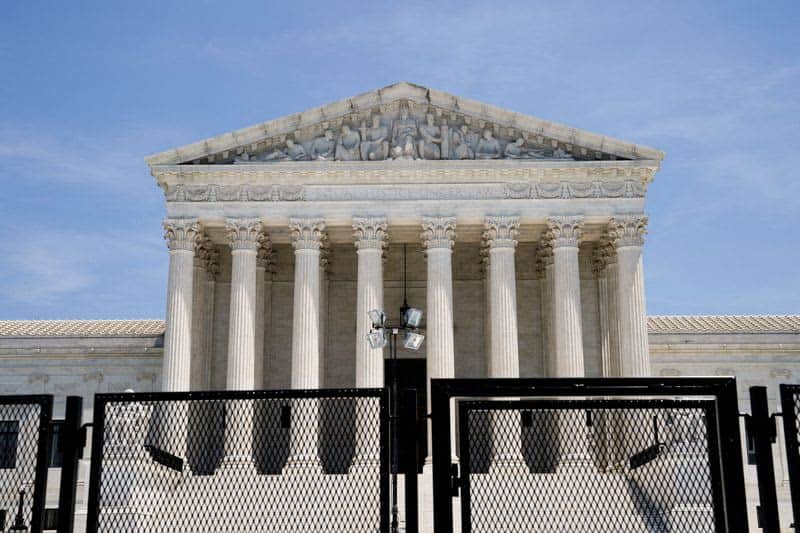
By Lawrence Hurley
WASHINGTON (Reuters) -The U.S. Supreme Court on Wednesday widened the power of states over Native American tribes and undercut its own 2020 ruling that had expanded Native American tribal authority in Oklahoma, handing a victory to Republican officials in that state.
In a 5-4 decision authored by conservative Justice Brett Kavanaugh, the court ruled in favor of Oklahoma in its bid to prosecute Victor Castro-Huerta, a non-Native American convicted of child neglect in a crime committed against a Native American child – his 5-year-old stepdaughter – on the Cherokee Nation reservation.
The change of course only two years after the previous ruling in a case called McGirt v. Oklahoma was made possible by conservative Justice Amy Coney Barrett’s 2000 appointment by Republican former President Donald Trump to replace the late liberal Justice Ruth Bader Ginsburg. Conservative Justice Neil Gorsuch, as he did in 2020, joined the court’s liberal bloc in favor of Native American interests, but its expanded conservative majority meant that this time he was in the minority.
“To be clear, the court today holds that Indian country within a state’s territory is part of a state, not separate from a state,” Kavanaugh wrote.
Kavanaugh added that “under the Constitution and this court’s precedents, the default is that states may exercise criminal jurisdiction within their territory.”
In the McGirt decision, the Supreme Court had recognized about half of Oklahoma – much of the eastern part of the state – as Native American reservation land beyond the jurisdiction of state authorities. That ruling, criticized by Governor Kevin Stitt and other Republicans, meant that many crimes on the land in question involving Native Americans would need to be prosecuted in tribal or federal courts.
Wednesday’s ruling affects Oklahoma and could be extended to other states. About 20 states where tribal reservations are located could seek new authority to exert criminal jurisdiction over crimes committed by non-Native Americans against native Americans on Native American land.
That includes western states with large Native American populations including Arizona and New Mexico. Until now, states generally lacked jurisdiction over such crimes, which were prosecuted by the federal government.
‘GRIM RESULT’
Writing in dissent, Gorsuch called Wednesday’s ruling a “grim result for different tribes in different states,” but said its impact could still be limited by individual treaties and laws passed by Congress.
“One can only hope the political branches and future courts will do their duty to honor this nation’s promises even as we have failed today to do our own,” Gorsuch added.
Chuck Hoskin, principal chief of Cherokee Nation, said in a statement that the justices had ignored court precedent and “basic principles” of law.
“While we are disappointed in this ruling, it does not diminish our commitment to meeting our public safety responsibilities and to protecting Oklahomans on our reservations and across the state,” Hoskin added.
Thirty-five states are home to federally recognized tribes, according to the National Congress of American Indians. Before the Supreme Court ruling, 16 had already been given authority by Congress to assert jurisdiction over at least some tribal land for crimes involving Native Americans.
As a result of the McGirt ruling, about 3,600 cases every year in Oklahoma were set to fall under federal instead of state jurisdiction.
Oklahoma Attorney General John O’Connor, a Republican, said in a statement that as a result of the McGirt ruling many crimes were not being prosecuted by the federal government.
“Now the state prosecutors can take up the slack and get back to what we have been doing for 113 years,” O’Connor added.
The state already prosecutes crimes committed in the affected land in which no Native Americans are involved. Tribal courts handle crimes committed by and against Native Americans.
Tribes had welcomed the McGirt ruling as a recognition of their sovereignty. The Supreme Court in January rejected Oklahoma’s request to outright overturn it.
Castro-Huerta was convicted in state court of neglecting his stepdaughter, who has cerebral palsy and is legally blind, and sentenced to 35 years in prison. The Oklahoma Court of Criminal Appeals last year threw out that conviction because of the 2020 precedent. Castro-Huerta by then was already indicted for the same underlying offense by federal authorities, transferred to federal custody and pleaded guilty to child neglect. He has not yet been sentenced.
There are 574 federally recognized tribes in total although some states have very little tribal land. The population of Native Americans and Alaska Natives combined in the United States is 3.7 million, according to the 2020 U.S. Census.
(Reporting by Lawrence Hurley; Editing by Will Dunham)
James.galbraithjesus christ
Remember how Republican Sen. Ron Johnson was exposed by the Jan. 6 committee hearings as having had an intimate part in the attempted coup d’etat of the government? This came in the form of evidence that the Wisconsin Republican’s aide was texting Vice President Mike Pence’s aide about hand-delivering a fake slate of electors from Wisconsin and Michigan. It was pretty damning stuff, as in order for the coup d’etat to work, Pence had to refuse to certify the states of the union’s votes and then use fake slates of fake electors as the new proof that disgraced former president Donald Trump was now forever president Trump.
Johnson denied any knowledge of what happens in his office or what mail is randomly delivered and sent to him to pass on to the vice president of the United States of America. Since that excuse was a monument of hot garbage, and as such couldn’t make a dent in the right-wing misinformation-sphere, Johnson had to admit that he might have had a teeny tiny bit of an idea what random package he was supposed to be delivering to the vice president of the United States on the day the vice president was certifying the 2020 election results. According to Ronny, a Wisconsin attorney named Jim Troupis, a Big Lie proponent, was directed to his office by Republican Rep. Mike Kelly of Pennsylvania and people in his office.
Kelly just went on record to say he doesn’t have any idea what Johnson is talking about.
The Heartland Signal just tweeted out an interview with Kelly where he says he hasn’t spoken to Johnson since 2011. My being a math expert, that would be more than a decade. This matches up with the statement released by Kelly’s office saying: “Mr. Kelly has not spoken to Sen. Johnson for the better part of a decade, and he has no knowledge of the claims Mr. Johnson is making related to the 2020 election.” When Kelly was asked about Johnson’s allegations against him, he smiled, laughed, and then said: “All I can tell you is that I have not talked to Ron Johnson since 2011. Never talked to him during this whole election cycle. And I think there’s a continuing difference in what he says took place.”

Kelly went on to say, “I have no knowledge of anything taking place, and quite frankly, when you ask people what is it he’s saying we did, I say ‘Really? Why would someone think a congressman from Pennsylvania would have anything to do with the election procedure in Wisconsin?’” Asked why Johnson called him out publicly, Kelly said he hasn’t talked to him and has no idea.
An important reminder here: Kelly is no fan of democracy. He has tried to squash mail-in voting in his state, and the GOP in Pennsylvania has been particularly zealous in their pursuit of MAGA-fascism. Whether or not he was promised leniency on the dubious stock purchases his wife has made while he has sat in office, his role in overturning our democracy is not known.
Regardless, Johnson has long understood beyond a doubt that the elections were not stolen, and any actions on his part—or even lip service he gave to these lies—make him an accomplice.
Rep. Mike Kelly (R-PA) on Sen. Ron Johnson (R-WI) implicating him in sending fake electors to his office: “I have not talked to Ron Johnson since 2011… There’s a continuing difference in what he says took place.” pic.twitter.com/o9E2YMNUGc
— Heartland Signal (@HeartlandSignal) June 28, 2022
Maybe Johnson can find a door to run into and lock and then pretend he isn’t even here anymore? Here’s a reminder of the fake elector machinations Trump and his minions worked tirelessly on, and their intended purpose.
RELATED STORIES:
Sen. Ron Johnson seems to have been caught red-handed by Jan. 6 committee with fraudulent docs
Ron Johnson changes his story, admits involvement in effort to hand Mike Pence fake elector slates
The House of Representatives has a serious ethics problem
Sen. Ron Johnson secretly recorded telling a constituent the truth about the Big Lie
Sen. Johnson tells radio host there was no insurrection because white people can’t break the law