Shared posts

18 Jun 17:02

The Fed Hates You

by The Lever
Tom Roche

excellent

On this week’s episode of Lever Time: David exposes the major problem with the January 6 hearings and how they may result in a better outcome for Republicans than Democrats (2:42). Then he’s joined by economics professor Joshua William Mason and The Lever’s Julia Rock to discuss Julia’s recent piece about how the Federal Reserve is planning to curb inflation… by lowering workers’ wages (16:10). After that, due to the cataclysmic failures of the two-party system, David discusses the reality of third parties in the US. To do so, he interviews Philadelphia City Councilmember Kendra Brooks (40:15) and former Vermont Lieutenant Governor David Zuckerman (1:00:35), both of whom have run successful campaigns as third party candidates.

kendraforphilly.com

zuckermanforvt.com

If you’d like access to Lever Time Premium, which includes extended interviews and bonus content, head over to LeverNews.com to become a supporting subscriber.

If you’d like to leave a tip for The Lever click the following link. We really appreciate your support :) levernews.com/tipjar

18 Jun 16:47

Mitochondria and the origin of eukaryotes

by Knowable Magazine
Tom Roche

EXCELLENT! HGT (horizontal gene transfer), endosymbionts (how archaea became animal and plant eukaryotes) ... genetics and evolution is MUCH more complex and fascinating than the way it was taught to me in secondary school (and unfortunately seems still mostly to be taught)

A cartoon image of mitochondria as green, oblong shapes on a black background.

Enlarge (credit: NIH)

For billions of years after the origin of life, the only living things on Earth were tiny, primitive cells resembling today’s bacteria. But then, more than 1.5 billion years ago, something remarkable happened: One of those primitive cells, belonging to a group known as the archaea, swallowed a different one—a bacterium.

Instead of being digested, the bacterium took up permanent residence within the other organism as what biologists call an endosymbiont. Eventually, it integrated fully into its archaeal host cell, becoming what we know today as the mitochondrion, the crucial energy-producing component of the cell.

Its acquisition has long been viewed as the key step in what is arguably the most important evolutionary leap since the origin of life itself: the transition from early primitive cells, or prokaryotes, to the more sophisticated cells of higher organisms, or eukaryotes, including ourselves.

Read 26 remaining paragraphs | Comments

17 Jun 23:46

Max Blumenthal on Censorship and Masongate

by Matt Taibbi
Tom Roche

VERY EXCELLENT, Max on fire as usual

Click here for the full episode, including the extended interview with Max on leaked emails, Bellingcat, and 60 minutes.

In secret meetings and leaked emails, Paul Mason and Nina Jankowicz work to silence journalists who don’t promote the approved message. In public, they complain that journalists bully them, and do vile things like publish past things they’ve said.

And who does Youtube side with? The supercalifragicensors.

The Grayzone’s Max Blumenthal is here to explain.

Leaked emails show that Paul Mason, a prominent UK journalist, privately discussed plans to collaborate with UK intelligence to “deplatform” independent journalists like The Grayzone and target UK’s Corbynite, anti-war left. As #Masongate trends on Twitter, Mason nonetheless got his wish: YouTube removed Max and Aaron’s livestream about it.

So, fellow Useful Idiots, listen, learn about Mason, and then tweet the hell out of #Masongate.

And hear the full interview where Max discusses deeper censorship plots, leaked emails, and a shameless 60 Minutes promotion.

Plus, Aaron just got accused of being a top Russian-influenced Twitter account for such offenses as “promoting a general mistrust in institutions and elites.” It gets crazier every week.

It’s all this, and more, on this week’s episode of Useful Idiots. Check it out.

Subscribe now

16 Jun 21:55

637 - De-evolution is Real feat. Jerry Casale (6/16/22)

Tom Roche

EXCELLENT: mostly history of Devo (still touring AND putting out new music)

Will and Chris talk to DEVO’s Jerry Casale about all things de-evolution, including media, advertising, punk rock, state violence, record industry hacks, Ohio, freaking out your audience, and whether or not humanity can escape de-evolution, or if we’re doomed to repeat until we fail.


Check out the new vinyl release of Jerry’s solo LP:  https://www.geraldvcasale.com/products/12-inch-lp-gatefold-red-vinyl?variant=42652243525819


And the video for the I’m Gonna Pay You Back single mentioned in the interview: https://www.youtube.com/watch?v=8kv2UMoynOw


Get bonus content on Patreon

Hosted on Acast. See acast.com/privacy for more information.

15 Jun 19:55

Jacobin Show: What's the Matter with California? w/ Catherine Liu

Tom Roche

1st segment is skippable (is there really anything new to say about US gun policy? not here, anyway), but Bessner is good on NATO's lack of moral legitimacy and empirical utility, and Liu does her usual mix of rational analysis and entertaining rant

Catherine Liu, author of Virtue Hoarders, joins The Jacobin Show for a discussion about the multicultural neoliberalism of California. Daniel Bessner also joins the podcast to discuss NATO and recent bids by Finland and Sweden to join the military alliance.


0:00 Jen's segment on guns and gun reform

25:00 interview with Danny

40:45 interview with Catherine


Subscribe to Jacobin for just $10: https://jacobinmag.com/subscribe/?code=JACOBINYT


Music provided by Zonkey: https://linktr.ee/zonkey


The Jacobin Show offers socialist perspectives on class and capitalism in the twenty-first century, the failures of liberalism, and the prospects of rebuilding a left labor movement in the US. This is the podcast version of the show from June 1, 2022.


Hosted on Acast. See acast.com/privacy for more information.

15 Jun 19:51

Democracy Now! 2022-06-15 Wednesday

Tom Roche

better-than-recent-usual, esp 1st segment on how Chennault Affair caused Watergate (though that's literally US history now)

Democracy Now! 2022-06-15 Wednesday

  • Headlines for June 15, 2022
  • "Conspiratorial Mindset": From Nixon to Trump, Lessons for Jan. 6 Hearing 50 Years After Watergate
  • AFL-CIO Elects 1st Woman Pres. & African American Sec.-Treasurer. Will It Organize Amazon, Starbucks?
  • Biden to Visit Saudi Arabia After Vowing to Treat Kingdom as a "Pariah" for Human Rights Violations

Download this show

14 Jun 22:58

The Implosion of Progressive Organizing

by Deconstructed

In the Biden era, progressive groups in Washington have increasingly found themselves paralyzed by internal tumult at the very moment when their efforts are needed to push the more ambitious elements of the president’s agenda through Congress. Behind the scenes, the leaders of these groups express frustration with the organizational culture wrought by their younger employees and fear of becoming embroiled in a “callout” scandal. Ryan Grim talks with The Intercept’s Nausicaa Renner about his new story on the subject.

[Phone rings.]

Loretta J. Ross: Hello?

Ryan Grim: Hey, Professor Ross. This is Ryan Grim calling. How you doing?

LJR: Hi, how you doing? Please call me Loretta.

[Deconstructed theme sting.]

RG: That’s Loretta Ross speaking. She’s an iconic and iconoclastic movement leader for decades; the kind of co-creator of the term reproductive justice and one of the leading activists in the field. I spoke to her for an article that is now out at The Intercept, that she described like this:

LJR: So, I hear you’re writing about the callout culture, and got a lot of people in the nonprofit industrial complex who are being destabilized because of it, but they don’t want to speak on the record.

RG: And I’m gonna be joined today to talk about it by my editor, Nausicaa Renner, who I’m going to mostly turn the microphone over to.

So Nausicaa, welcome to Deconstructed.

Nausicaa Renner: Thank you for having me. And thank you for being here.

RG: [Laughs.] Yes. It’s my pleasure!

NR: So I’m really excited to talk to you about this today. It’s one of those pieces that you work on. And you’re like: This is a theory of everything. This explains what’s happening in the progressive nonprofit world to a tee, but it’s also a story that really hasn’t been told by anyone, I think, because a lot of people don’t want to talk on the record about it. They don’t want to speak out publicly. It’s kind of a taboo subject.

So I wanted to start out by asking you: Do you agree with that assessment? And how did you start to kind of see the pattern and piece this together?

RG: So — yes and no. A lot of people have talked about this kind of general theme. And if you narrow the theme down to say, callout culture or cancel culture, it’s basically been fodder for endless internet debates, disputes, fights, what have you; more serious attempts at probing what’s going on had been done by Loretta Ross herself, in a widely read New York Times article back in 2019, where she said: I’m a Black feminist. And I think we need to call people in rather than call people out.

Adrienne Maree Brown, who is an abolitionist, a former executive director of the radical Ruckus Society, wrote a piece in July 2020. The title was: “unthinkable thoughts: call out culture in the age of covid-19.” It was widely read kind of in the abolition, police abolition, prison abolition spaces, and on the left. So it’s not at all like people haven’t probed this topic. But I think what we’re bringing to the fore for the first time, is the effect that it’s having on progressive institutions in Washington.

And so I think, for so long, this has been an abstract conversation. Like: Is cancel culture a real thing? Is cancel culture not a real thing? If it is a real thing, is it just an excuse for people who want to be racist, and transphobic, and misogynistic, and not be criticized and not be held accountable for it? And you go round and round with these debates. But what this brings out is that while all of that has been going on, organizations have been just utterly and completely imploding. And this may be a good thing; it may be a bad thing. It’s not a value judgment to say that they are collapsing as a result of this cultural conflict that’s going on inside these organizations.

And so we spoke to — or I spoke to — more than a dozen current and former heads of major nonprofit advocacy organizations to get their take on what has been going on over the last couple of years. And many of these people have been leaders in this field for decades, and have been supporters of the kinds of movements that have transformed into the pushes against them, like many of them have fallen victim to the forces that they helped unleash.

NR: We should say that, although I would think that you and I are neutral about it, a lot of the people that you spoke to are very upset.

RG: And I’m not so sure how neutral I am, either. I have to acknowledge my place in this universe. And one reason that I could write this story, in fact, is the fact that I’m now 44 years old, so there’s a generational component to it. I’ve been in Washington for a long time now, which makes you very likely to be white, because the diversifying of the progressive space only really began in earnest, say 10 years ago. Pre-2011, pre-2012 a lot of these institutions and a lot of the media [was] just completely white dominated — to a degree that is striking, if you go back and look at the staff photos or anything like that, and so there has been genuine progress made on that front.

But because I’ve been doing this for so long, I know these people. I know the people who have risen up through the ranks of these organizations. I’ve known them, many of them, since they were in their 20s or so. And so because this is such a forbidden topic, the fact that I have known them for so long, I think enabled them to kind of speak openly and trust that the fact that they spoke openly would not become public, it would not be used against them, either in their current jobs, which are outside of what they used to do, or, in many cases, they’re still running these organizations. And so they just certainly are not just going to talk openly, because it would just invite more turmoil.

NR: I think we should give people a more detailed sense of what we’re talking about. Do you want to describe what happened at the Guttmacher Institute?

RG: Yeah, this is a good case study. And there are a couple of different things that happened at Guttmacher. But we begin the story with a Zoom meeting that was hosted in, what, the first week of June 2020.

NR: June 2020. So two months, three months after lockdown started.

RG: Right. And so this was all reported in an outlet that I actually hadn’t heard of before, which is called Prism, which is focused — it seems like exclusively — on covering social justice organizations or social justice activism. And the story was written based on a ton of sources, from inside Guttmacher, staff inside Schumacher, who shared this with Prism. And essentially what happened across institutions — whether you’re talking about nonprofits or for-profits or educational institutions, you name it — June 2020, was a time of serious reckoning with white supremacy. Nobody who lived through that time period is going to forget that. There were huge and positive developments that emerged from that reckoning.

It began, for many organizations on Zoom, because this was still at the height of the lockdown. And so the D.C. office of Guttmacher huddles together in a Zoom; a woman named Heather Boonstra, who was the vice president of something or other, who was basically lobbying that type of thing for Guttmacher — which is an abortion rights kind of research and advocacy organization, but with a real emphasis on research — she hosts this meeting and she says: I want to ask everybody how they’re “finding equilibrium.” Like, how are people feeling?

And the staff starts very quickly talking about — which is all non-Black, as the article makes clear — internal workplace issues. They say that we ought to be loosening deadlines for workers at Guttmacher; we ought to be giving workers time off with pay without cause — people who need as much time off as they need should be able to take it.

And eventually, the article made clear that Boonstra pushes back and says, “Look” — and maybe you have the quote in front of you — but she says something like: I’m here to talk about George Floyd, and all of the African-American men who are being beaten up by society and basically what can Guttmacher do to be a part of this kind of social reckoning that’s going on right now. You guys are all talking about your workplace problems; you’re being self centered.

Like, she hits them pretty hard.

NR: Looking back, just to pause on the timing of it: The beginning of Covid was so incredible, because it simultaneously eliminated all of our freedom, but it also kind of demonstrated that society can really turn on a dime in a way that I don’t think that I was aware of before — like, everything can change in a week. And so there was that.

And then George Floyd came in, and it was sort of like: Yes, this is the moment of change. But because we were all at home, and because we were all so focused on the ways that our individual lives are changing, it’s not the whole story here for sure. But I feel like I see a lot of that.

RG: And you add into that the many weeks of lockdown. And deeper into the lockdown, people became more accustomed to what locking down meant, and people started also then developing rituals and ways to meet outside — people started breaking the lockdown and socializing again — but for a substantial amount of time, through April and May, there were many, many people in the liberal space, in particular (because we should be clear that like within two weeks, in red areas of the country, the lockdown was more or less over) following those lockdowns, as rigorously as people did, created also a lot of pent-up anxiety. Because there is, at the same time, you have — and particularly in New York, people say they’ll never forget the sound of sirens, just constantly taking people to their deaths, morgues running out of space for bodies — and so you have isolation topped with existential anxiety. Nobody knew where this was headed. Like people understood that the fatality was worse for the elderly, which doesn’t mean there’s nothing there, but there are also lots of stories of people in their 30s and 40s getting intubated and dying. And so you couple all that with this absolutely searing video of this monstrosity, this murder of George Floyd, and you have people asking: Well, what can I do? Like, what can I do about this?

NR: And I remember that the George Floyd protests, those were some of the first times that I went out under lockdown. And it was like, it felt very exhilarating, and also scary to be so close to people in front of the White House, like seeing all of this energy kind of bubbling up. It was pretty incredible.

RG: And this is also the moment where the public health officials lost a lot of the more skeptical people around the country, when they started saying that racism — systemic racism — is more harmful to your health than COVID, so therefore, that’s why these rallies are okay. But the anti-lockdown rallies were not OK. Turns out being outdoors was pretty safe.

NR: Yeah — we didn’t know that!

RG: We knew-ish, but didn’t know as much as we know now, but yes.

NR: So just to get back to Guttmacher, how did the staff then react to what Boonstra was saying?

RG: So the staff leveled a number of complaints, saying that this was basically creating a hostile and toxic work environment. And the HR department, with the support of the board, launched an investigation into this. The investigation eventually concluded that Boonstra was not at fault, that the organization was not at fault here. That this was a difference of opinion. We could read — I’ll read their statement.

And they said: “What we have learned is that there is a group of people” and this was a statement to Prism — “with strong opinions about a particular supervisor, the new leadership and a change in strategic priorities.” The new leadership, by the way, was a Black woman, lifelong activist, Dr. Herminia Palacio.

And so they said: “Those staff have a point of view. Complaints were duly investigated, and nothing raised to the level of abuse or discrimination. Rather, what we saw was distrust, disagreement, and discontent with management decisions they simply did not like,” — which is kind of a perfect framing of the management’s view of a lot of these controversies.

And the Prism reporter was able to reach out to Pamela Merritt, who is another Black woman who’s another leading reproductive justice activist who is on the board of Guttmacher. And they note that this interview happened while the Supreme Court was hearing oral arguments in Dobbs v. Jackson Women’s Health Organization, which is the case that the five Republicans on the Court are eventually going to use to overturn Roe. And she gave an extraordinarily delicate response to them. And I think in the delicacy, you can sense some of the kind of energy and fear that’s behind a lot of this. I’ll read the whole thing. She says:

“I have been in this movement space long enough to respect how people choose to describe their personal experience and validate that experience, even if I don’t necessarily agree that that’s what they experienced.” And then she adds, “It seems like there’s a conflation between not reaching the conclusion that people want and not doing due diligence on the allegations, which simply is not true.”

It’s just a beautifully parsed and respectful way of saying: You did not suffer the things that you’re saying you suffered. You’re saying there wasn’t an investigation. There was an investigation; it just didn’t find what you wanted to find, and so you’re complaining about that.

NR: And I realize that you’re upset.

RG: And I realize that you’re upset, and that’s valid, and that’s legitimate. But I don’t agree that the things that you say happened to you happened to you.

NR: But it didn’t end there, right? Now we’re into: Roe v. Wade is probably about to be overturned, most likely. And what’s happened since then. Has Guttmacher been organizing around it? Where are they now?

RG: Right and to set the context even further back, so in 2017, Guttmacher was getting some staff complaints about its coalition work with the ACLU which was getting its own complaints from staff because of its defense of the Unite the Right rally’s right to have a march in Charlottesville, Virginia in 2017, which led to at least one woman that was killed, a counter-demonstrator was killed. And they were also objecting to Guttemacher’s association with say Planned Parenthood, NARAL Pro-Choice America, which they saw as emblematic of kind of white feminism, and that they wanted to bring more reproductive justice organizations into the fold and give Guttmacher more of a reproductive justice lens to its work. And so they brought in diversity consultants, they conducted interviews with more than 100 employees, they put in place new practices and procedures that predated the blow-up after George Floyd.

All of this comes to a head in December of 2021, when the Prism article finally comes out, all this is kind of cheered on by this organization called ReproJobs, which is interesting in its own right, which has a very widely read Twitter feed and Instagram feed on on the left, and advocates for worker rights within the reproductive justice and abortion rights movement. In December, that story breaks, they begin to start organizing a union. On May 2, they’ve finally announced that they have collected enough cards, enough signatures, and they’re gonna go forward and demand voluntary recognition. That very night is when Politico reports that Roe is being overturned. That didn’t slow things down.

The last month has been a tense fight between Guttmacher staff and Guttmacher management over the terms of unionization. It’s a long story, but the staff has rejected voluntary recognition because management insisted that they pledge not to strike in exchange for recognizing the union. And so here we are.

NR: And there was a point in working on this piece when you were like: Is this a story? Isn’t this just like the caricature of the left, that the left is always navel-gazing, and thinking about itself, and thinking about its own structure and workshopping its own process?

And that is, to some extent true, but I think it seems to be worse now. And the real difference is that there’s a very small window of opportunity in Congress that we have right now, that is going to be — likely, hopefully not, but likely — closing soon.

And a quote that I wanted to pull out, is from a progressive congressional staffer, who said: “I’ve noticed a real erosion of the number of groups who are effective at leveraging progressive power in Congress. Some of that is these groups have these organizational culture things that are affecting them. Because of the organizational culture of some of the real movement groups that have lots of chapters, what they’re lobbying on isn’t relevant to the actual fights in Congress. Some of these groups are in Overton mode when we have a trifecta.”

And then they go on to pull out Sunrise, which is doing a Green New Deal pledge. And the aid says: The climate bill is still on the table. What are you doing? You should be lobbying around that, basically.

RG: Right. So, right, what Overton mode means is you’re making maximalist demands that you know aren’t going to be met by the institutions of power, but they’re going to expand what is possible in the future.

NR: Right. It’s about changing the public’s tolerance for radical policy.

RG: Right. And the aid is saying: That’s all well and good. And they’re saying, like: Look, if there were endless resources, then that would be great. But there is literally a climate bill on the table right now that is being negotiated. And we are months away from losing our majority, perhaps for 10 years or more.

And the aid also mentioned at the height of the negotiations last summer over Build Back Better, that the Sierra Club vanished from the private and public conversation, because they were so caught up in turmoil that the entire institution’s energy was all being directed inward. And this is at a time where the climate movement is saying we have 10 years left to turn this thing around. And we might have just a couple months left on a Democratic trifecta. And they’re all just utterly consumed by these internal debates.

NR: Which is where the anger comes from. And it gets framed as an employees-versus-management, typical sort of battle, but there’s actually a lot more there, I think.

[Musical interlude.]

RG: And I talked with Mark Rudd about this for this story, because I wanted to look back — not to pretend like this is necessarily the first time that this has ever happened.

And a couple of people that I spoke to for this story mentioned that after 1968, after Richard Nixon was elected president, you had this kind of collapse and demobilization of the left. There was still a war to protest. But the demonstrations against the war never reached their peak, which they hit around 1965 or so. You had major organizations like Students for a Democratic Society dissolve themselves and turn themselves into a terrorist organization, the Weather Underground, which Mark Rudd was a part of. Like, he helped to dissolve SDS: He was active in SDS, helped dissolve it, and then joined the Weather Underground as a domestic terrorist. And he was a fugitive for seven years after the townhouse blew up, and ended up serving a short prison sentence himself.

And so these things do go in waves. And so as a movement loses focus, as there’s less leadership, as there’s dissatisfaction, disenchantment, you do see a lot more infighting. And so in ’69, ’70, and through the ’70s you did see a ton of this. Loretta Ross told me that she remembers calling it “trashing.” There’s a famous article from the late 1970s in Ms. Magazine, by Jo Freeman, called “Trashing,” which was the first to really analyze this. Trashing is the ’70s-era version of what we would now call calling out, or canceling, or whatever else.

And so it’s fair to say that there are new things happening because we didn’t have Slack, we didn’t have Twitter, the world is different, we didn’t have the climate apocalypse — looming climate apocalypse — that we have now. But it’s also fair to say that there are some similarities to what has happened before. And one of the things that Mark argues, and this goes to the point that you were just making about these groups being in Overton mode, when there are actual wins on the table to possibly be had, his argument, and I heard this from a lot of people as well, is that there’s something about the left, and its hostility or its skepticism of coercion, that just makes it allergic to power, that it just doesn’t want to be in power. As one person said: If you’re not uncomfortable all of the time, then you’re not in a coalition.

Because being in a coalition means that you are in coalition with people who disagree with you on some things, because if they didn’t disagree with you on some things —

NR: They would be in the same group.

RG: [Laughs.] They would be in your group! Right! And so if you’re never feeling discomfort, you don’t have a coalition. If you don’t have a coalition, you don’t have power. And he says it this way:

Mark Rudd: We’re all engaged in something which is much bigger than any one group. And we’re all — on all sides of it including the privileged and the oppressed — we’re all sort of players in this historical drama. And so the most sophisticated of the oppressed, I think, are the people who recognize the need for solidarity and coalition building for power. My guess is that basically nobody on the left wants power. We’re allergic to it. It’s not in our DNA.

RG: Mhmm.

MR: We don’t like coercion. We don’t like hegemony.

NR: And I think this is part of the problem, too, is that people are looking at their workplaces. And I think one of the organization leaders said something to this effect, but they want their workplace to be everything for them. Like they don’t see that your political hearth, your movement home, as some people say, is not the same as — necessarily — where you get a paycheck from every month, or hopefully, more often than every month. [Laughs.] But I think the quote said something like: They want it to have healing sessions, and they want it to be their therapy, and —

RG: Oh, I found it here. And, yeah, this executive director was saying something that was echoed by a ton of others. And I think plenty of staff would say: Yes, this is right. This isn’t exactly how I would couch it.

But he said: “A lot of staff that work for me, they expect the organization to be all the things: a movement, OK, get out the vote, OK, healing, OK, take care of you when you’re sick, OK. It’s all the things,” he said. ANd then he said: “Can you get your love and healing at home, please? But I can’t say that, they would crucify me.”

And he’s saying that he wants people to see this as a workplace, and as a job where people are collectively working together to accomplish the mission of the organization. And that rhymes in an interesting way with an anecdote that I included from the 2020 Bernie Sanders campaign. Ahead of the Iowa caucus, in that year, there was a kind of staff uprising there over all sorts of different issues, which I’ve written about before. And the uprising ended up being squashed by other workers. And partly because the workers had a union. The people leading the uprising had to get a majority vote; they didn’t have a majority. The majority of the workers in Iowa said: No, our purpose here is to win the Iowa caucuses. Like, the future of the world depends on this. What are you doing? And, also, by the way, this job ends — we know when this job ends. After the caucus. And so why are you going to throw away the chance to change the future of the world over the next several weeks of working conditions?

And so when Bernie Sanders got wind of this uprising, which was not the first of the uprisings, he relayed to his leadership staff, he said, “Stop hiring activists.”

NR: It’s so funny.

RG: And that’s from Bernie Sanders. And he said: Just hire people that want to do the job. We pay well. We treat people well. It’s a good cause. Get people who want to do the job. Stop hiring activists.

NR: Yeah, I was kind of struck in reading the iterative drafts of this how the solution in the piece — or maybe not the solution, but kind of the ray of hope in the piece — is that workplaces will return to being just workplaces. And that leaders will start stepping in and saying: No. There is no space for this kind of thing.

RG: I don’t think it will be the leaders, though, that can accomplish this, I think it has to be the other workers.

And one person I spoke to used the analogy of a demonstration. So you have a non-violent demonstration, you’ve got thousands of people there, a handful of anarchists show up and they start to pick up rocks, and throw rocks at police, or they throw rocks at cars, whatever they’re up to. And they’re not going to listen to the police telling them to stop throwing rocks. They’re also not going to listen to the lead organizer of the rally. [Rev.] Al Sharpton can come down there and tell them to stop throwing rocks. They’re not going to stop throwing rocks. The way they stop throwing rocks is if the entire crowd turns on them and says —

NR: Like, shames them.

RG: Stop!

NR: Yeah.

RG: This is not why we’re here. This is not your neighborhood. We are here for x goal. This is undermining our goal. Stop. And when that happens, those anarchists or feds, half the time they’re feds, they stop because of the pressure of the crowd.

And so in places where you have had these uprisings or these callouts kind of tamp down, it’s almost always been because the rest of the staff has said no, this is not what we’re here to do. There was an example of this happening at Sunrise in June of 2021, where a high-ranking Black employee was fired, actually, and made lots of public allegations about racism at Sunrise. And the head of Sunrise, Varshini Prakash, kind of pushed back and said: Look, love you. You didn’t show up for work for three months. We tried to get in touch with you. This is not about race.

A public pushback is a part of what works in some of these situations. But by itself, it’s absolutely not sufficient. What ended up happening was that every Black employee of Sunrise decided to sign a statement denouncing those claims that he had made, saying that absolutely there’s work to be done at Sunrise, by no way saying that Sunrise was perfect on all of these questions, but saying that these particular allegations by this particular employee were not with merit. And that basically ended it.

Fox News tried to have fun with it, as Fox News does. The right, New York Post, Fox, others absolutely love to lubricate these crises. But without the crowd, without the staff joining in, they don’t fly.

NR: I think that’s a great point. And actually, not to put everything on the pandemic, but I think that as we start to leave behind the quarantine and lockdown especially, and go back to work, go back to the office, Jonathan Smucker, who wrote “Hegemony How-To: A Roadmap for Radicals,” a great organizing theorist, told you that in-person organizing is really one way out of this.

RG: Yeah. And another executive director said that one thing that he was thinking of doing is having his staff start participating directly in get-out-the-vote operations, get them out of their houses, out of their apartments, and talking to ordinary people. As he put it, so many had come straight from college into their organization, and that there’s something about face-to-face interactions with colleagues and also face-to-face interactions with ordinary people, on whose behalf your organization exists and is fighting, as a reminder of what you’re in this for?

NR: Right. When you’re speaking on behalf of an organization, when you’re representing the goals of the organization, then the tone completely changes.

RG: Right.

NR: And one thing that might not be clear to people who are looking at this just through the lens of how can we make our organizations internally just in terms of racial equality, something that people might not see is that Black leaders and leaders of color are not necessarily immune from this kind of staff criticism, and Black leaders themselves are very critical of what’s been going on.

RG: Right. Right. And as one put it to me, he’s constantly worried about those types of allegations that he said people will say: OK, yes, it’s true, he’s black. But he’s anti-Black because he just fired x black people in the organization. Or: Yes, it’s true, he’s Black, but he’s propping up structures of white supremacy, because that’s what’s hegemonic in our culture.

And it is absolutely true that people of color can participate in white supremacy and can be people who are furthering those types of inequities. All of this is true, which makes this conversation and resolving all of these controversies so much more difficult.

NR: Well, also, in the example of Guttmacher, the staff, which we don’t totally know the breakdown, but from the Prism article, it sounds like very majority white staff, at least in Washington, were the ones who are criticizing the new leadership of a Black woman.

RG: Yeah. And one Black executive director told me: Yeah, the ones who are the most vocal when it comes to race at my organization are white. That is a throughline. And multiple people talked about how, oftentimes, they’re just smuggling in efforts to protect themselves from performance reviews that they’re nervous about. And that’s when it gets really dicey.

NR: Yeah, very jaded and cynical.

RG: And so Loretta Ross speaks to this a lot. Actually, interestingly, by the way, Loretta has launched a for-profit consulting firm.

NR: Oh, really? She’s a DEI consultant now?

RG: A reverse DEI consultant in a way. She’s a champion now of what she calls “call-in culture.” When you have a controversy, when you have somebody offended, when you have something going on, you call it in, and she has an entire paradigm about how you resolve those without —

NR: Right, without alienating people —

RG: — right, massive callouts and just blowing up your entire organization. And so, a year ago, she saw that this was just getting worse and worse at organizations. And she told me that ever C-suite — well, we can play that right here, actually.

LJR: Well, it’s just not the nonprofit world, though, to be clear.

RG: Right. Mhmm.

LJR: I started a for-profit consulting firm last year with three other partners, because every C-suite that’s trying to be progressive is undergoing the same kind of callout culture.

RG: I also asked her what kind of pushback she’s gotten from people. And this is what she said.

LJR: The number one thing people fear is that I’m giving a pass to white people to continue to be racist. Because most Black people say, ‘I am not ready to call in the racist white boy.’ They think it’s a kindness lesson or a civility lesson, when it’s really an organizing lesson that we’re offering, because if someone knows if someone has made a mistake, and they know they’re going to face a firing squad for having made that mistake, they’re not gonna wanna come to you and be accountable. It is not gonna happen that way. And so the whole callout culture contradicts itself because it thwarts its own goal.

NR: So the bottom line is basically that the energy of these groups is a good energy. Like, people want to make positive change. But the energy is just being directed in the wrong way.

RG: Well, the proof is in the output, the proof is in the product. The progressive movement institutions in Washington have more or less ceased to function. They’re becoming un-leader-able, unmanageable.

And so if you believe that organizations are necessary to obtaining and wielding power, then you have to find a way for organizations to be able to function. If you don’t want power, then you don’t.

And so let’s end, like we started, with Loretta Ross. In our interview, she noted to me that she was a veteran of COINTELPRO, which was, for people who don’t know, that was the FBI scheme, FBI scam, that that would infiltrate left organizations with the explicit purpose of calling out members of those organizations, and then creating enough dissension that they completely became unable to function.

Loretta put it in these terms:

LJR: And there was COINTELPRO back then.

RG: Mhmm.

LJR: It was part of, I mean, we had so many people planted within our movements, to use gossip and the creation of dissent as a way to destabilize us from within. I mean, so we not only have the tendency, but we also were under attack as well. I said as a survivor of COINTELPRO, if you’re more wedded to destabilizing an organization than unifying it, part of me is gonna think you’re naive and the other part of me is gonna think you’re a plant, and neither one of those is going to look good on you.

RG: Well, Nausicaa, thank you so much for being here on Deconstructed.

NR: It was great to talk to you.

RG: And thank you for the terrific edit.

[End credits music.]

RG: That was Nausicaa Renner and Loretta Ross.

Deconstructed is a production of First Look Media and The Intercept. Our producer is Zach Young. Laura Flynn is our supervising producer. The show was mixed by William Stanton. Our theme music was composed by Bart Warshaw. Betsy Reed is The Intercept’s editor in chief.

And I’m Ryan Grim, D.C. bureau chief of The Intercept. If you’d like to support our work, go to theintercept.com/give — your donation, no matter what the amount, makes a real difference.

And if you enjoy this podcast, be sure to also check out Intercepted, as well as Murderville, which is now in its second season.

If you haven’t already, please subscribe to the show so you can hear it every week. And please go leave us a rating or a review — it helps people find the show. If you want to give us additional feedback, email us at Podcasts@theintercept.com. Thanks so much.

See you soon.

The post The Implosion of Progressive Organizing appeared first on The Intercept.

14 Jun 15:48

636 - Fox News feat. Stavros Halkias (6/13/22)

Tom Roche

VERY FUNNY: only implicit politics (because always ...), just the dudes and Stavros Halkias on comedy today, small dicks, small clits, Baltimore corruption, being Greek, and reverse grooming, before doing Stavvy Baby's patented advice-guy Q&A

Stavvy stops by to discuss his new YouTube stand-up special and, of course, help answer advice questions submitted to other publications. This edition features a particularly insane mix of advice seekers and includes lazy first graders, animal apparel charity fraud, and the mischievous spirit of the Fox.


Watch Stav’s special right now for free at: https://youtu.be/eNpkhX85yf0


Everything in our store is 25% off now through the end of July: https://shop.chapotraphouse.com/


And finally, keep your eyes on Patreon for information on presale tickets for our August 4th show at the Aladdin Theater in Portland, OR.


Get bonus content on Patreon

Hosted on Acast. See acast.com/privacy for more information.

14 Jun 04:06

Chris Moffitt: Using Document Properties to Track Your Excel Reports

Tom Roche

unfortunately process described uses only payware (VS Code->Excel)

Introduction

When doing analysis with Jupyter Notebooks, you will frequently find yourself generating ad-hoc Excel reports to distribute to your end-users. After time, you might end up with dozens (or hundreds) of notebooks and it can be challenging to remember which notebook generated which Excel report. I have started using Excel document properties to track which notebooks generate specific Excel files. Now, when a user asks for a refresh of a 6 month old report, I can easily find the notebook file and re-run the analysis. This simple process can save a lot of frustration for your future self. In this brief article will walk through how to set these properties and give some shortcuts for using VS Code to simplify the process.

Background

How often has this happened to you? You get an email from a colleague and they ask you to refresh some analysis you did for them many months ago? You can tell that you created the Excel file from a notebook but can’t remember which notebook you used? Despite trying to be as organized as possible it is inevitable that you will waste time trying to find the originating notebook.

The nice aspect of the Excel document properties is that most people don’t change them. So, even if a user renames the file, the properties you set will be easily visible and should point the way to where the original code sits on your system.

Adding Properties

If you’re using pandas and xlsxwriter, adding properties is relatively simple.

Here’s a simple notebook showing how I typically structure my analysis:

import pandas as pd
from pathlib import Path
from datetime import datetime

today = datetime.now()
report_file = Path.cwd() / 'reports' / f'sales_report_{today:%b-%d-%Y}.xlsx'

url = 'https://github.com/chris1610/pbpython/blob/master/data/2018_Sales_Total_v2.xlsx?raw=True'
df = pd.read_excel(url)

The important point is that I try to always use a standard naming convention that includes the date in the name as well as a standard directory structure.

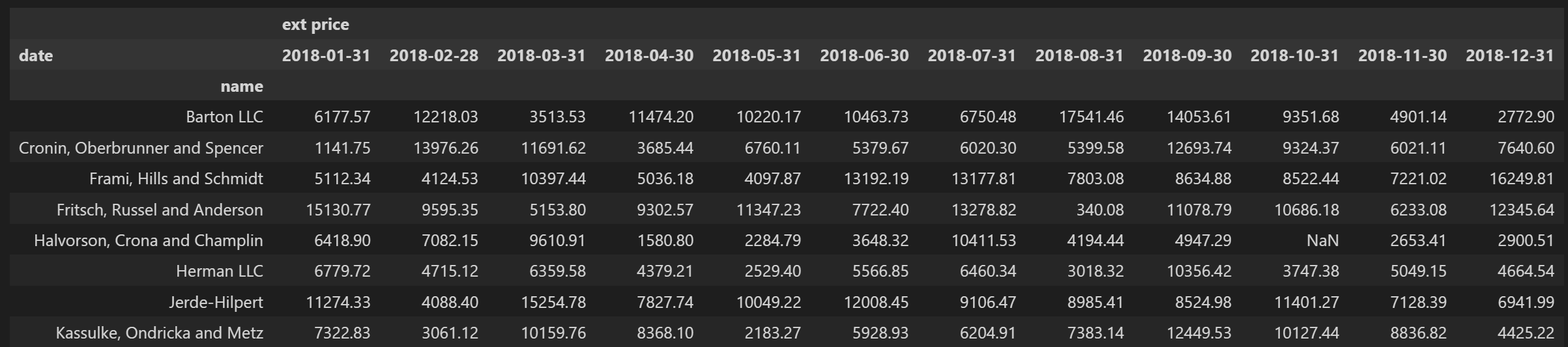
Now, I’ll do a groupby to show sales by month for each account:

sales_summary = df.groupby(['name', pd.Grouper(key='date', freq='M')]).agg({
    'ext price':
    'sum'
}).unstack()

Here’s what the basic DataFrame output looks like:

Sales summary

The final step is to save the DataFrame to Excel using the pd.ExcelWriter context manager and set the document properties:

with pd.ExcelWriter(report_file,
                engine='xlsxwriter',
                date_format='mmm-yyyy',
                datetime_format='mmm-yyyy') as writer:
    sales_summary.to_excel(writer, sheet_name='2018-sales')
    workbook = writer.book
    workbook.set_properties({
        'category': r'c:\Users\cmoffitt\Documents\notebooks\customer_analysis',
        'title' : '2018 Sales Summary',
        'subject': 'Analysis for Anne Analyst',
        'author': '1-Excel-Properties.ipynb',
        'status': 'Initial draft',
        'comments': 'src_dir: customer_analysis',
        'keywords': 'notebook-generated'
    })

Once this is done, you can view the properties in a couple of different ways.

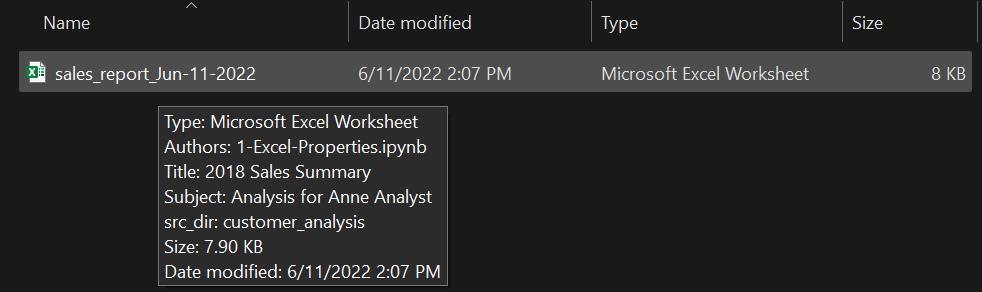
First, you can hover over the filename and get a quick view:

Excel property hover details

You can also view the details without opening Excel:

Excel property details

You can view the properties through Excel:

Excel property details

As you can see from the example, there are a handful of options for the properties. I encourage you to adjust these based on your own needs. For example, I save all of my work in a notebooks directory so it’s most useful to me to specify the src_dir in the Comments section. This will quickly point me to the right directory and the Authors property lets me know which specific file I used.

Observant readers will notice that I used this as an example to show how to adjust the date formats of the Excel output as well. As you can see below, I have adjusted the Excel output so that only the month and year are shown in the header. I find this much easier than going in and adjusting every example by hand.

Here’s what it looks like now:

Excel property details

Using VS Code Snippets

If you find this helpful, you may want to set up a snippet in VS Code to make this easier. I covered how to create snippets in this article so refer back to that for a refresher.

Here is a starter snippet to save the file to Excel and populate some properties:

"Write Excel": {
"prefix": "we",
"body": [
    "# Excelwriter",
    "with pd.ExcelWriter(report_file, engine='xlsxwriter', date_format='mmm-yyyy', datetime_format='mmm-yyyy') as writer:",
    "\t$1.to_excel(writer, sheet_name='$2')",
    "\tworkbook = writer.book",
    "\tworkbook.set_properties({'category': r'$TM_DIRECTORY', 'author': '$TM_FILENAME'})",
],
"description": "Write Excel file"
}

One nice benefit of using the snippet is that you can access VS Code variables such as $TM_DIRECTORY and $TM_FILENAME to pre-populate the current path and name.

Conclusion

When working with Jupyter Notebooks it is important to have a consistent process for organizing and naming your files and directories. Otherwise the development process can get very chaotic. Even with good organization skills, it is easy to lose track of which scripts generate which outputs. Using the Excel document properties can be a quick and relatively painless way to lay out some breadcrumbs so that it is easy to recreate your analysis.

Let me know in the comments if you have any other tips you’ve learned over the years.

13 Jun 16:13

Glenn Greenwald on Jan 6 and Ukraine

by Matt Taibbi
Tom Roche

EXCELLENT, much too short

Click here for the full episode, including the extended interview with Glenn Greenwald on Jan 6, Ukraine, and Biden’s failures.

There’s a whole lot of terrible stuff going on which means Glenn Greenwald has a whole lot to say:

•Biden’s failure at the Summit of the Americas: Latin American leaders are boycotting Biden’s summit because he refused to invite the dictatorships of Cuba, Nicaragua, and Venezuela. Meanwhile, Biden’s packing for his big trip to the dictatorship of Saudi Arabia…

•Jan 6 in Prime Time: “I don’t think dramatizing this three-hour protest from 18 months ago will do very much at all other than underscore the fact that this is the only strategy the Democrats have.”

•More Russiagate developments: “When I heard that first ad where Hillary Clinton had that sinister music playing and said, ‘What is this relationship between Donald Trump and the Russians?’ to me it just immediately sounded like the kind of McCarthyite toxicity I had spent many decades abhorring.”

Subscribe to hear the full interview with Glenn where we deep dive on January 6, play Trump vs Bernie vs Chomsky, and hear about Glenn’s animal shelter run by unhoused people in Rio.

It’s all this, and more, on this week’s episode of Useful Idiots. Check it out.

Subscribe now

11 Jun 14:31

Andre Roberge: Nicer arithmetic with Python

Tom Roche

CLI tricks to avoid the usual IEEE 754 floating-point-arithmetic problems

Beginning programmers are often surprised by floating point arithmetic inaccuracies. If they use Python, many will often write posts saying that Python is "broken" when the see results as follows:

>>> 0.1 + 0.2
0.30000000000000004

This particular result is not limited to Python. In fact, it is so common that there exists a site with a name inspired by this example (0.30000000000000004.com/), devoted to explaining the origin of this puzzling result, followed by examples from many programming languages.

Python provides some alternatives to standard floating point operations. For example, one can use the decimal module to perform fixed point arithmetic operations. Here's an example.

>>> from decimal import Decimal, getcontext
>>> getcontext().prec = 7
>>> Decimal(0.1) + Decimal(0.2)
Decimal('0.3000000')
>>> print(_)
0.3000000

While one can set the precision (number of decimals) with which operations are performed, printed values can carry extra zeros: 0.3000000 does not look as "nice" as 0.3.

Another alternative included with Python's standard library is the fractions module: it provides support for rational number arithmetic.

>>> from fractions import Fraction
>>> Fraction("0.1") + Fraction("0.2")
Fraction(3, 10)
>>> print(_)
3/10

However, the fractions module can yield some surprising results if one does not use string arguments to represent floats, as was mentioned by Will McGugan (of Rich and Textual fame) in a recent tweet.

>>> from fractions import Fraction as F
>>> F("0.1")
Fraction(1, 10)
>>> F(0.1)
Fraction(3602879701896397, 36028797018963968)

In the second case, 0.1 is a float which means that it carries some intrinsic inaccuracy. For the first case, some parsing is done by Python to determine the number of decimal places to use before converting the result into a rational number. A similar result can be achieved using the limit_denominator method of the Fraction class:

>>> F(0.1).limit_denominator(10)
Fraction(1, 10)

In fact, we do not have to be as restrictive in the limitation imposed on the denominator to achieve the same result

>>> F(0.1).limit_denominator(1_000_000_000)
Fraction(1, 10)

While we can achieve some "more intuitive" results for floating point arithmetic using special modules from Python, the notation that one has to use is not as simple as "0.1 + 0.2". As Raymond Hettinger often says: "There has to be a better way."

Using ideas

As readers of this blog already know, I created a Python package named ideas to facilitate the creation of import hooks and to enable easy experimentation with modified Python syntax. ideas comes with its own console that support modified Python syntax. It can also be used with IPython (and thus with Jupyter notebooks).

Using ideas, one can "instruct" python to perform rational arithmetic.  For example, suppose I have a Python file containing the following:

# simple_math.py

a = 0.2 + 0.1
b = 0.2 + 1/10
c = 2/10 + 1/10
print(a, b, c)

I can run this with Python, getting the expected "unintuitive" result:

> py simple_math.py
0.30000000000000004 0.30000000000000004 0.30000000000000004

Alternatively, using ideas, I can execute this file using rational arithmetic:

> ideas simple_math -a rational_math
3/10 3/10 3/10

Using a different import hook, I can have the result shown with floating point notation.

> ideas simple_math -a nicer_floats
0.3 0.3 0.3

Instead of executing a script, let's use the ideas console instead, starting with "nicer_float"

ideas> 0.1 + 0.2
0.3

ideas> 1/10 + 2/10
0.3
For "nicer_float", I've also adopted the Pyret's notation: floating-point number immediately preceded by "~" are treated as "approximate" floating points i.e. with the regular inaccuracy.
ideas> ~0.1 + 0.2
0.30000000000000004

And, as mentioned before, I can use ideas with IPython. Here's a very brief example

IPython 8.0.0b1 -- An enhanced Interactive Python. Type '?' for help.

In [1]: from ideas.examples import rational_math

In [2]: hook = rational_math.add_hook()
The following initializing code from ideas is included:

from fractions import Fraction

In [3]: 0.1 + 0.2
Out[3]: Fraction(3, 10)

Final thoughts

Given how confusing floating point arithmetic is to beginners, I think it would be nice if Python had an easy built-in way to switch modes and do calculations as done with ideas in the above examples. However, I doubt very much that this will ever happen. Fortunately, as demonstrated above, it is possible to use import hooks and modified interactive console to achieve this result.

11 Jun 01:43

Jacobin Show: Elites Are Lying About Inflation w/ Samir Sonti

Tom Roche

all 3 segments EXCELLENT

Samir Sonti argues that the causes of current inflation are supply side issues and if the Fed chooses to fight it by raising interest rates, it will only hurt workers. Jen explores the world of "anticapitalist investing". Jared Abbott comes on to talk about what makes the US public transportation system exceptionally bad.


Samir Sonti's article in the latest issue: https://jacobin.com/2022/06/what-you-...

Jared Abbott's article: https://jacobin.com/2022/06/american-exceptionalism-off-the-rails


0:00 interview with Samir

21:12 Jen's segment on "anticapitalist investing"

27:21 interview with Jared


Subscribe to Jacobin for just $10: https://jacobinmag.com/subscribe/?code=JACOBINYT

Music provided by Zonkey: https://linktr.ee/zonkey


The Jacobin Show offers socialist perspectives on class and capitalism in the twenty-first century, the failures of liberalism, and the prospects of rebuilding a left labor movement in the US. This is the podcast version of the show from June 8, 2022.


Hosted on Acast. See acast.com/privacy for more information.

10 Jun 16:15

635 - Total Recall (6/9/22)

Tom Roche

EXCELLENT, esp dunking on shitlib oligarch Nellie Bowles (posing as regular San Franciscan despite being an heiress to the "Cattle King of California" whose family owns most of the water rights in the entire *state*)

We spend the majority of this episode discussing the Chesa Boudin recall, liberal views on crime, homelessness, housing and the reality of bad vibes in urban politics. We also look at Nellie Bowles’ piece in the Atlantic declaring San Francisco a “failed city”. Also: Amy Coney Barrett Catholic sex cult, Nexium & online media drama. Get bonus content on Patreon

Hosted on Acast. See acast.com/privacy for more information.

10 Jun 02:05

Michael and Us: Pieces of Flair

Tom Roche

EXCELLENT as usual, *plus* Luke and Will share memories of their own personal grim-work experiences

Our Superdelegate patron tier has voted for us to discuss Mike Judge's workplace satire OFFICE SPACE (1999), and it leads us down a long rabbit hole of remembering bad work experiences. PLUS: We take a fond look back on the all-time classic Man of the Year (2006)


Michael and Us is a podcast about political cinema and our crumbling world hosted by Will Sloan and Luke Savage.


Hosted on Acast. See acast.com/privacy for more information.

10 Jun 02:02

Scramble for Africa 15: France Seizes West Africa

Tom Roche

yet another EXCELLENT Scramble episode from Dave and Justin

In this episode France seizes the territories of the Tukolors (overthrowing Sultan Ahmadu), battles Samori Toure, and fights a long war with King Benanzin of Dahomey. Some observations about the differences between France’s notions of colonialism and those of the British, in whose footsteps the French colonizers hoped to follow.
10 Jun 02:02

Scramble for Africa 14: France saves Sadok Bey of Tunis from a nonexistent threat and steals the country 1881

Tom Roche

another great Scramble episode from Dave and Justin

After a bit of comparing and contrasting French colonialism with the British type, Dave tells us about the French Foreign Legion; Then we’re on to a key piece in France’s Scramble for Africa, the theft of Tunis from the Bey, Muhammad Sadok. In the process, the French colonizers insisted they were saving Sadok Bey from … Continue reading "Scramble for Africa 14: France saves Sadok Bey of Tunis from a nonexistent threat and steals the country 1881"
10 Jun 02:01

Archaeologists digging into Egypt's past

Tom Roche

VERY EXCELLENT: obviously yer not gonna get a survey of Egyptology in a 53-min LNL (and this was in fact a 1-segment program) but nicely conveys the joy and intelligence of some smart people talking about doing something they love

This year marks the 200th anniversary of the Frenchman Jean-François Champollion’s decipherment of hieroglyphs and 100 years since the British archaeologist Howard Carter found King Tutankhamen’s tomb filled with all those bewitching treasures in the Valley of the Kings. To celebrate, three Ancient Egyptian scholars dust off their boots and down tools to discuss their incredible discoveries and what life is like as a contemporary archaeologist.
09 Jun 20:37

Tang Era Poetry

Tom Roche

folks less knowledgeable about the period might also wanna listen to the 2012 IOT on the (somewhat misnamed) [An Lushan Rebellion](https://www.bbc.co.uk/programmes/b01by8ms)

Melvyn Bragg and guests discuss two of China’s greatest poets, Li Bai and Du Fu, who wrote in the 8th century in the Tang Era. Li Bai (701-762AD) is known for personal poems, many of them about drinking wine, and for finding the enjoyment in life. Du Fu (712-770AD), a few years younger, is more of an everyman, writing in the upheaval of the An Lushan Rebellion (755-763AD). Together they have been a central part of Chinese culture for over a millennium, reflecting the balance between the individual and the public life, and one sign of their enduring appeal is that there is rarely agreement on which of them is the greater.

The image above is intended to depict Du Fu.

With

Tim Barrett Professor Emeritus of East Asian History at SOAS, University of London

Tian Yuan Tan Shaw Professor of Chinese at the University of Oxford and Professorial Fellow at University College

And

Frances Wood Former Curator of the Chinese Collections at the British Library

Producer: Simon Tillotson

09 Jun 20:30

Quantum computer succeeds where a classical algorithm fails

by John Timmer
Tom Roche

conclusions, heavily edited:
> [1. The authors are] claiming a quantum [compute-time] advantage rather than quantum supremacy. [... But] the quantum system didn't even have to be very good [in terms of |qubits| or lack of error (i.e., reverse of error-prone)] to generate an advantage.
> [2. These tests ran some] specific operations that can only be done on quantum computing hardware. We're not at calculations yet, but this work definitely required an ability to manipulate quantum systems.
> [3. But exploiting this advantage will require the ability to routinely and reliably] transfer the state of a quantum system into the state of the qubits[, and for many problems] we might be interested in, there's no obvious way to do that without falling back to measuring the system and then using the resulting classical information on its states to set the qubits [... which would probably give] up some or all of [the quantum] advantage over classical systems.
> [4. These tests] used a hybrid system: part quantum and part classical[:] the machine learning took place on classical hardware [since the quantum computers had such] low-qubit-count.
> [5. These tests ran] unsupervised learning[. Thus, similar hybrid systems] could potentially identify [classical-quantum] distinctions that we don't even know exist and, so, help us gain a better understanding of quantum mechanics.

Image of a chip above iridescent wiring.

Enlarge / Google's Sycamore processor. (credit: Google)

People have performed many mathematical proofs to show that a quantum computer will vastly outperform traditional computers on a number of algorithms. But the quantum computers we have now are error-prone and don't have enough qubits to allow for error correction. The only demonstrations we've had involve quantum computing hardware evolving out of a random configuration and traditional computers failing to simulate their normal behavior. Useful calculations are an exercise for the future.

But a new paper from Google's quantum computing group has now moved beyond these sorts of demonstrations and used a quantum computer as part of a system that can help us understand quantum systems in general, rather than the quantum computer. And they show that, even on today's error-prone hardware, the system can outperform classical computers on the same problem.

Probing quantum systems

To understand what the new work involves, it helps to step back and think about how we typically understand quantum systems. Since the behavior of these systems is probabilistic, we typically need to measure them repeatedly. The results of these measurements are then imported into a classical computer, which processes them to generate a statistical understanding of the system's behavior. With a quantum computer, by contrast, it can be possible to mirror a quantum state using the qubits themselves, reproduce it as often as needed, and manipulate it as necessary. This method has the potential to provide a route to a more direct understanding of the quantum system at issue.

Read 17 remaining paragraphs | Comments

09 Jun 15:12

Emacs Redux: Forever Emacs

by Bozhidar Batsov
Tom Roche

Not-quite-accurate survey of failware: Eclipse and NetBeans are still very much happening (if not nearly as hip-and-cool as say 10 years ago), and while Atom-the-editor is sunsetting, the underlying Electron framework is still very much happening, with IDEs including Visual Studio Code and Eclipse Theia (which can share plugins with VSC)

Operating systems, GUI toolkits and competing editors come and go, but Emacs is forever!

– Unknown

Yesterday it was announced that the once popular Atom editor is going to be discontinued at the end of this year.

I’ve often said that one of the great advantages of Emacs is that it has stood the test of time1 and will likely be with us for a very long time to come. During the 25 years I’ve been into computers and programming I’ve seen a lot of editors and IDEs rise and fall:

  • Komodo
  • Eclipse
  • NetBeans
  • TextMate
  • LightTable

And now Atom. Any investment you’ve made to master those tools and build additional plugins for them has been mostly wasted in the end.

This list also serves to illustrate that just being an open-source project doesn’t mean much, if there’s no real community around the project and the bulk of the development is driven by commercial interests. The moment when such projects lose their backing they typically stagnate and die. It’s not like community project don’t meet their demise from time to time as well, but they are definitely much more resilient than the typical company-driven OSS project.

Emacs is a true community-driven project and I’m certain that it will outlive many more trendy editors until all is said and done.2 If you’re playing the long game, you better pick the right tools for it.

In Emacs we trust! M-x forever!

  1. It first appeared way back in 1976! 

  2. Same goes for our evil nemesis vim

08 Jun 15:24

634 - Feelin’ Feinstein! (6/6/22)

Tom Roche

EXCELLENT 4 segments in episode#=634, very politics (if you're just here for the yuks, this ep delivers less than usual, but as always The Boyz (the full trio this time) are never unfunny) both US and global:
- still-smokin'-hot MTG grooms ex-gay Milo Yiannopoulos with unpaid internship
- liberal Zionist Matt Duss scolds US left for not being pro-Ukraine enough
- NYT mystifies Israel murder of Shireen Abu Akleh, because who can possibly know which IDF sniper killed this US citizen ?-(
- Rebecca Traister sniffs the rot in CorpDem identitarian Dianne Feinstein, then decorously turns away, because both RT and DF are shitlibs

Between a piece on “the left’s” positions on Ukraine, the NYT’s coverage of the death of Al Jazeera journalist Shireen Abu Akleh, and Rebecca Traister’s new profile of Dianne Feinstein, the theme of today’s episode is “looking the truth in the face and ignoring the most obvious conclusion.” Get bonus content on Patreon

Hosted on Acast. See acast.com/privacy for more information.

06 Jun 22:17

Michael and Us: Trust the Plan

Tom Roche

EXCELLENT, and very funny, and very *fair* (in the sense of accurate and disinterested) discussion of the rise of Trump as due *not* to Putin, social media, etc, but the fact that Trump said things that lots of Americans (note Savage and Sloan are Canadian, which gives them a *bit* of distance) liked and believed (often though not always correctly) to be true, and Trump said them in a way that many American voters enjoyed. The analysis of Trump's rhetoric as "small business" is *very* clarifying.

What is a quickly-made, low-effort documentary like ONE NATION UNDER TRUMP (2016) good for? Not a lot. But one thing that this ridiculous pro-Trump hagiography provided us with was a chance to marinate for long, unbroken stretches of time in the 45th president's rhetorical style. We made some unexpected discoveries about how his distinctive way of speaking led him to the presidency.


Michael and Us is a podcast about political cinema and our crumbling world hosted by Will Sloan and Luke Savage.


Hosted on Acast. See acast.com/privacy for more information.

05 Jun 02:48

The revival of NATO: Good or bad for world security?

Tom Roche

SINGULAR (though very short--19:20--but information-dense) Late Night Live 30 May 2022 interview with Thomas Meaney @ MPI Göttingen and the Quincy Institute (aka QIRS) on the pre/history of NATO to 2022, and its recent and present normativity. (Follows up on at least 2 articles in the Guardian--TODO: link and archive.) Following ~sequential:

- 1945: Stalin and communism 'were surprisingly popular in western Europe' for defeating Nazism, so WE elites decided they needed 'some new force to counteract this new, strong, and popular Russia'
- [1948 Treaty of Brussels](https://en.wikipedia.org/wiki/Treaty_of_Brussels) creates [Western Union](https://en.wikipedia.org/wiki/Western_Union_(alliance)) alliance
- US creates NATO ('they realized it would be more practical if they took it over and ran it as their baby rather than the Europeans') 1949 from Western Union et al (Canada, Portugal, Italy, Norway, Denmark, Iceland) specifically to fight not only USSR, but to combat European Communist parties. (Not mentioned here, but Western Union merges into NATO during Korean War.)
- Marshall Plan 'very popular in Europe, but had to be sold to the American public', and 'somewhat surreptitiously.' Meaney ascribes this to war-weariness; gotta wonder if in fact its unpopularity was due to the Marshall Plan being a massive fiscal transfer.
- NATO as "culture [and] a state of mind" with a "songbook [and] golf club [in Belgium]." Bing Crosby NATO ballad! "bases and academies ... company towns ... NATO schools [and] kindergartens."
- Eurocentric 'NATO mindset' and associated deepstate (notably 'US State Dept' and 'NATO bureaucracy') vs (e.g.) Obama 'pivot to Asia'; as a result the "[Russia-Ukraine war--'RUW' below] comes as a relief--we can focus again on Europe"
- NATO reacts to 1989-1991 collapse of Warsaw Pact and USSR: "NATO expands, its bureaucracy expands, [its membership] expands." New purpose is "certifying liberal modernity"; NATO "becomes [a] rating agency, [declaring each member is] safe for business [and] investment." Also prestage in pipeline leading to EU/Eurozone membership.
- NATO begins "humanitarian" interventions: Meaney is careful to note this as 'ideology'. US hegemony/unipolarity allows it to intervene in 'little conflicts' to 'mop up the messy spots of Europe' esp Balkans. (Meaney mentions Yugoslavia and also Iraq and Libya below, but not (IIRC) Afghanistan.)
- good side note that 7 May 1999 CIA-directed US bombing of PRC embassy in Belgrade "for a lot of Chinese people is their 1st foreign-policy memory."
- NATO continues to function despite internal disputes (e.g., 2003 US invaded Iraq 'over the objections' of some NATO members, but esp Greece-Turkey tensions esp Cyprus esp 1974): "alliance is strong because it allows for a certain degree of [internal] dissent." But the US makes final decisions, esp on most important matters: 'when push comes to shove, if a major question comes up, the buck still stops in Washington, and it will decide the order of the day'
- Trump threats of US pullout 'actually strengthened' NATO. Trump rhetoric 'terrified' 'European bureaucrats', but eventually Trump "increased [US] troops in Europe [and] conducted all the NATO exercises"
- Adams (host): "we should pause to ask whether [RUW-induced accession of Finland and Sweden into NATO] will make the world more or less safe." Meaney "argues that NATO has [net] made the world less safe":
- more safe: controlling European conflicts esp Greece-Turkey
- less safe: 'institutionalized nuclear brinkmanship' and 'proliferating nuclear weapons across Europe'
- less safe: expansion causes responses. Notably (and Meaney does a real service by pointing out this mostly-forgotten fact) the USSR creates the Warsaw Pact 1955 in response to the 1954-1955 integration of West Germany into NATO--a claim to which even [Empirepedia](https://en.wikipedia.org/wiki/Warsaw_Pact) agrees
- less safe: 'the invasion of Libya was completely disastrous', making 'North Africa much more dangerous' (and, for that matter, MENA, though Meaney does not discuss the implications of NATO's Libya intervention on, e.g., Syria). 'Malian civil war' and Sahel migration
- less safe: expansion toward Russia inflamed entire Russian people, 'obsesses' figures as diverse as Gorbachev and Putin. (Adams) "The West has been so dismissive of that anxiety." Meaney counterscenario of Cold War Soviet 'bases in Tasmania and New Zealand': "what would that have done to [Australian public opinion]." And yet Meaney /oddly/ says that the "Russian response ... is not reasonable [and should not be] sympathized with" !?! but that is their objective response: "we can wish that they were different, [...] but the people in [Russia] behave in a certain way and we've known that for years. So to press their buttons [that] way [is] irresponsible."
- less safe: when US/NATO rejects "zones of ambiguity" such that "you're either with us or against us," "solutions become total," s.t. war can only result in total victory or defeat, which is extremely dangerous when dealing with a power (Meaney alludes to this but not explicitly) which can escalate to nuclear war.
*VERY IMPORTANT* quote from Meaney @ ~15:45: "the main concern of NATO during the Cold War was not so much [Soviet] invasion[, but] Communist parties in western Europe: it was about the political way Europe was organized." Meaney argues that instead states (presumably including imperial subalterns--note Meaney never uses the word 'empire' AFAIK in this interview) "should have as much autonomy as they can in their space[, but] NATO is about restricting that autonomy," particularly Europe-specific defense agreements/organizations.
- regarding (Adams) 'alternative security orders': Meaney bemoans western-Europe-centric mindset refusing to include (e.g.) Russia (in NATO) and Morocco (in EU)
- regarding effect of (possible) Trump 2024: Meaney dismisses due to (not his words) power of the US deepstate. (Meaney instead uses the tired turning-a-battleship analogy.)

Putin's invasion of Russia has breathed new life into the alliance Trump considered 'obsolete'. As Sweden and Finland are poised to become the latest members, it's worth considering what the purpose of NATO actually is and whether it has made, and will continue to make, the world a safer place.
04 Jun 02:44

Contrary to What You Read in the Paper, People Are Not Spending Down Their Savings

by Dean Baker
Tom Roche

Excellent explainer on US econometrics (i.e., how statistics on US economy are calculated), and how the US mass-oriented corporate-funded media explains our economy wrongly--in this case, much recent (early Jun 2022) uproar regarding an allegedly-large Apr 2022 decline in the US savings rate.

Slightly-edited pullquote:

> [The US] saving rate can fall either because consumption rises rapidly or disposable income falls. [US national accounts show a recent decline in disposable income, due to] a big increase in [taxes collected]. There has been no big increase in tax /rates/ in the last three years [(i.e., during COVID-19), but the US 1%] have made large gains in the stock market over this period. [As global stock markets fall, due to the US Federal Reserve's interest-rate increases, the 1% is] cashing out some of these gains.

The most important/misunderstood part (IMHO) of Baker's argument is:

> [But capital gains are not counted] as income in the national accounts. This means that when people sell stock at a gain, and then pay income tax on it, [this causes US economic statistics to show] a decline in disposable income. If consumption is unchanged [or declining], the GDP accounts [will thus show] a drop in the saving rate. [US] saving as a percent of [US] /personal income/ [(which excludes tax payments)] for April of 2022 [was] 19.2%. That is down from the 19.5% rate for the four years prior to the pandemic, but [not much.]

The April data on consumption expenditures left many people, including economics reporters, confused about consumer behavior. The basis of the confusion was a reported decline in the saving rate in April to 4.4 percent. It had been running over 8.0 percent in 2021.

However, this reported decline in the saving rate is deceptive. The saving rate is measure as the share of disposable income that is not spent. Disposable income, in turn, is defined as personal income (wages, government transfer payments, interest, dividends etc.) minus taxes.

The saving rate can fall either because consumption rises rapidly or disposable income falls. It turns out that the story we currently have of a declining saving rate is the latter, disposable income has been rising very slowly.

But the trick here is that the slow growth in disposable income is not due to slow growth in personal income. Rather, the slow growth in disposable income is the result of a big increase in taxes. In April, people paid taxes at an annual rate of $3,089 billion.[1] This is up by more than 40.0 percent from the $2,205 billion paid in taxes back in 2019, before the pandemic.

There has been no big increase in tax rates in the last three years, so that would not explain this huge jump in tax collections. The more likely explanation is that people have made large gains in the stock market over this period. They are cashing out some of these gains and paying capital gains taxes on them.

Capital gains income does not count as income in the national accounts. This means that when people sell stock at a gain, and then pay income tax on it, we would see this as a decline in disposable income. If consumption is unchanged, the GDP accounts would be showing a drop in the saving rate.

There is a simple way to adjust for this problem. We can just look at saving as a percent of personal income, ignoring the amount paid in taxes. If we look at this figure for April of 2022, it comes to 19.2 percent. That is down from the 19.5 percent rate for the four years prior to the pandemic, but I’m not sure that drop would warrant a big story about people spending down their savings.  

[1] This refers to income and payroll taxes, it does not count taxes like sales taxes or excise taxes on items like alcohol and cigarettes.

The post Contrary to What You Read in the Paper, People Are Not Spending Down Their Savings appeared first on Center for Economic and Policy Research.

04 Jun 01:00

Dr. Gerald Horne on mass shootings at home, imperial violence abroad

Tom Roche

Maté is excellent as usual, joined by Max Blumenthal in addition to Gerald Horne. And in addition to the topics mentioned in the shownotes, the last ~13 min of the audio (from 76:32) discuss the Sussman trial verdict in the evolution of the Russiagate hoax.

Historian and author Dr. Gerald Horne joins The Grayzone's Aaron Maté and Max Blumenthal for a live stream on the political and historical context behind the recent wave of mass shootings in the US; new revelations of the imperial plunder of Haiti; and the state of US hegemony amid a spiraling proxy war against Russia in Ukraine. Guest: Dr. Gerald Horne, Moores Professor of History and African American Studies at the University of Houston. Author of more than three dozen books, including "The Counter-Revolution of 1836: Texas Slavery, Jim Crow and the Roots of U.S. Fascism."
04 Jun 00:24

Radio War Nerd EP 332 — Chechen Wars, Pt. 4: The Second Chechen War

by mail@yashalevine.com (Gary Brecher)
Tom Roche

VERY EXCELLENT: Ames and Dolan are usually reliable on post-USSR Eurasia esp Russia (and they're starting to get better on Ukraine), and this period (c1996-c2010, esp 1999-2000) is very much in their center of competence. Audio starts (1st 24 min) with discussion (also well done) of US mass shootings and politics Columbine/1999 to Uvalde/2022.

Co-hosts Gary Brecher & Mark Ames
03 Jun 17:09

633 - Here They Come to Snuff the Rooster feat. American Prestige (6/2/22)

Tom Roche

VERY EXCELLENT: consistently funny celebration of Movie Fucking Magic. Bessner and Davison fill-in for Felix, Matt *on fire*, Will keeps the train on the rails

Derek Davison & Danny Bessner from the American Prestige pod join us to discuss TOP GUN: MAVERICK. We discuss the essential dryness of modern films, how Top Gun propagandizes the insane destructive uselessness of our military, and how we can see America’s destiny in Tom Cruise’s career.


Will guested on American Prestige this week to discuss the original Top Gun. That episode will be out soon on their feed. Find all things AP over at: www.americanprestigepod.com


Get bonus content on Patreon

Hosted on Acast. See acast.com/privacy for more information.

03 Jun 15:13

Scramble for Africa 13: France in the Scramble – the Algeria Precedent and Abdelkader’s Resistance

Tom Roche

excellent

We talked about France’s colonization of Algeria back in Civilizations Episode 15 (in August 2020). We revisit it now, as France’s entry point into the Scramble for Africa. Algeria was France’s template for colonizing Africa and many of the dynamics of France’s African colonial crimes can be seen developing in Algeria. We end up focusing … Continue reading "Scramble for Africa 13: France in the Scramble – the Algeria Precedent and Abdelkader’s Resistance"
02 Jun 20:27

AER 111: Imran Khan’s Long March in Pakistan

Tom Roche

good quick update on Pakistan politics as of 1 Jun 2022 (recorded ~week before that?) from a PTI-friendly perspective

An update on the dynamic situation in Pakistan. Fan favorite Waqas Ahmad (@worqas on twitter) is back to talk about the massive march and nationwide protest of May 25 in Pakistan, which ousted Prime Minister Imran Khan called. Imran Khan called the protest off on May 26 in the face of escalation and repression, giving … Continue reading "AER 111: Imran Khan’s Long March in Pakistan"
02 Jun 17:12

Peter Singer on Consequentialism

Tom Roche

EXCELLENT: much too short, but a well-spent 20 min on utilitarianism, different ways to apply it in daily life, and ways Singer has applied it in his (and partners') academic work

Peter Singer is probably the most famous living philosopher. He recently won the million-dollar Berggruen Prize and promptly gave all that money to charity. His positions on this, on animals, poverty, altruism, and much else besides are underpinned by his consequentialism. Here, in conversation with Nigel Warburton he explains his consequentialism and its implications.