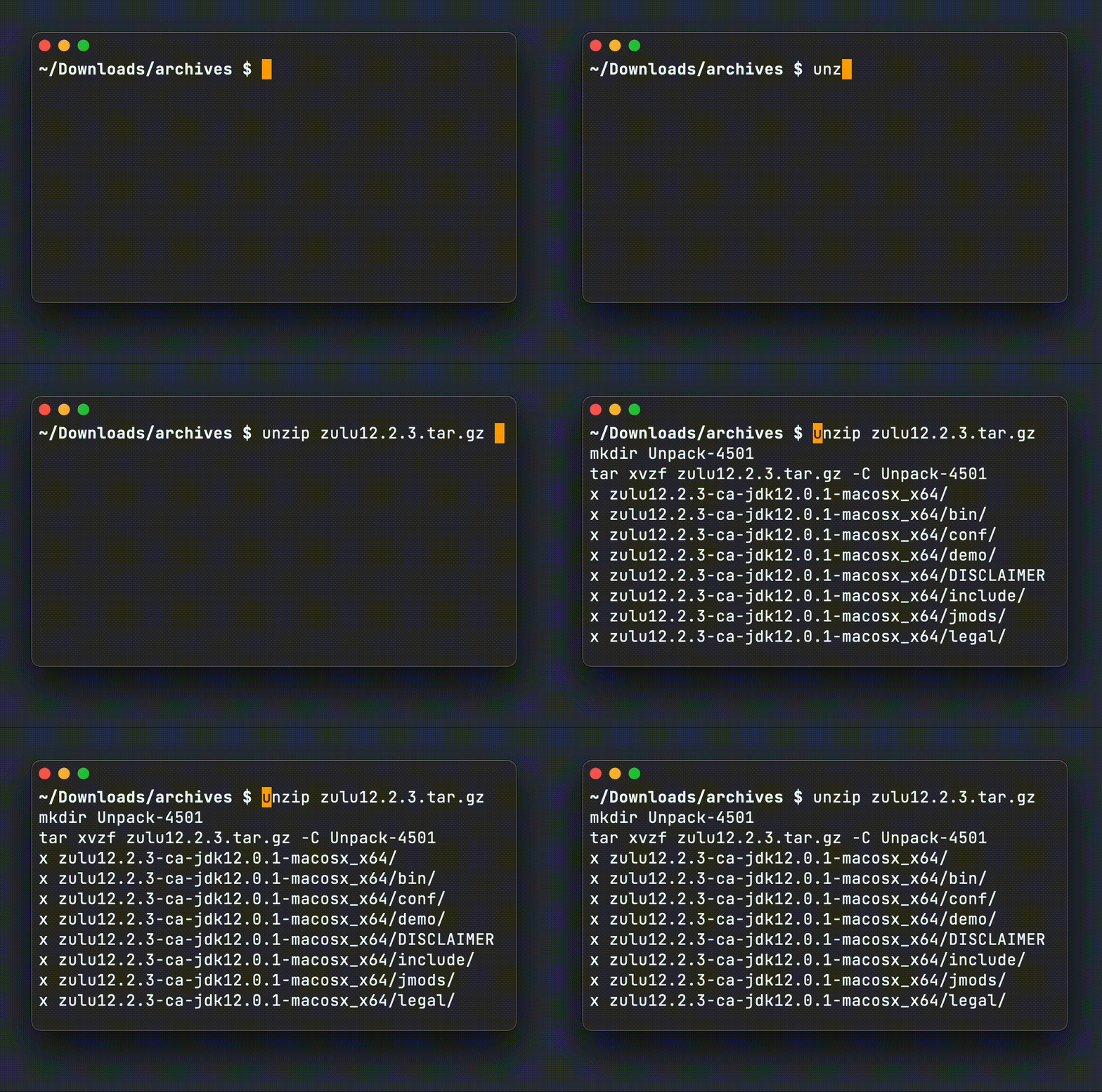
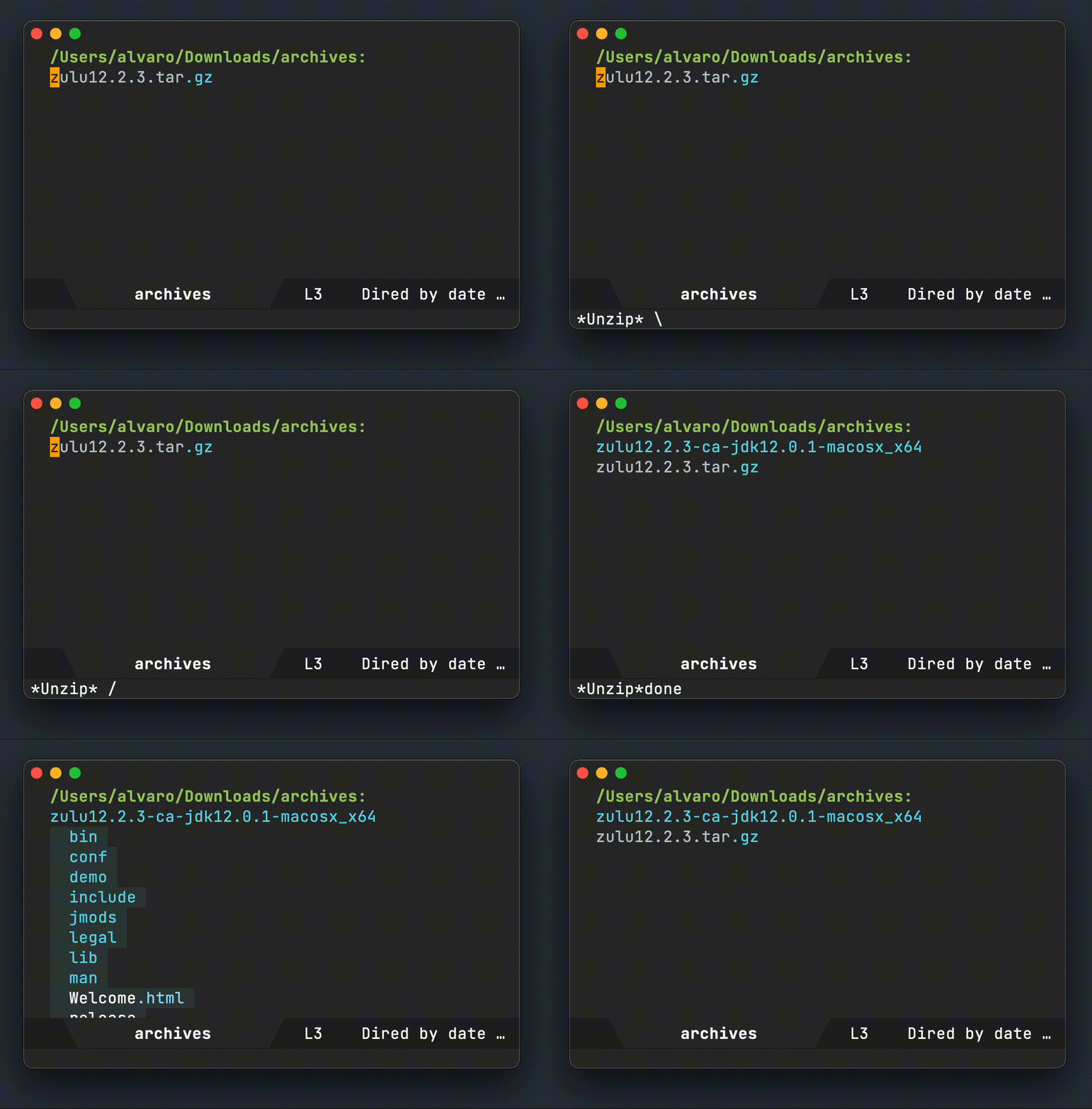
Shared posts

24 Jun 18:27

scripter.co | Emacs: View GitHub Pull Requests in Magit

by Kaushal Modi
Tom Roche

very informative on Magit-GitHub integration

How to view GitHub Pull Request branches locally in the cloned repo, and more importantly, how to do that automatically from within Emacs.

I have a few public projects in git repos, but I don’t get that much traffic in Pull Requests (PR) Gitlab calls these Merge Requests or MRs. . So when I need to add additional commits to a PR, I would just add the PR author’s remote to my local repo, check out their PR branch, add my own commits and then merge that to my project’s main branch.

As these occurrences were few and far apart, I didn’t have a need to view the PR branches directly from within Emacs/Magit. Though, I somehow knew that each GitHub Pull Request’s HEAD got assigned a git reference. But I didn’t need to use that knowledge until today 😃.

Today, when discussing PR # 20 on Prot’s Denote package’s GitHub mirror Prot uses SourceHut as the primary git forge for his Emacs packages. But I am glad that he doesn’t mind the activity in Issues and Pull Requests on the GitHub mirror. , he wrote this comment:

Now I just need to figure out how best to incorporate your changes into the org-id branch so I can add the final bits. I am not too familiar with the PR workflow …

.. and that inspired this post today.

Locally creating a branch for a PR #

From the GitHub docs, the git command to create a local branch for a PR is this:

git fetch origin pull/ID/head:BRANCHNAME

I have the denote package cloned from its GitHub mirror. So the origin remote’s url is https://github.com/protesilaos/denote.

Make sure that the remote name used in this command is pointing to a GitHub repo, and not a mirror forge like GitLab or SourceHut.

When I ran the below command, I got a new branch pr-20 pointing to the latest commit of that PR:

git fetch origin pull/20/head:pr-20

Awesome!

.. But that wasn’t good enough
    .. Now I wanted more
        .. I didn’t want to manually create a branch for each PR.

Getting references to all Pull Requests #

Now that I was on that quest of “I want more”, it didn’t take me long to re-discover this 7-year old nugget by Oleh Krehel. Here are the relevant bits from that post:

  1. Open the local repo’s .git/config file.
  2. Find the [remote "origin"] section
  3. Modify it by adding this one line with pull refs. This is the same for all GitHub repositories.
    [remote "origin"]
        url = https://github.com/USER/REPO.git
        fetch = +refs/heads/*:refs/remotes/origin/*
        fetch = +refs/pull/*/head:refs/pull/origin/*
    

With that edit in place, when I did l a (show the log for all git references), followed by f a (fetch all the remotes) in the Magit, I could see the references to the denote repo’s PRs!

Figure 1: Viewing PR references from denote package’s GitHub repo

Figure 1: Viewing PR references from denote package’s GitHub repo

.. But that still wasn’t good enough
    .. I didn’t want to manually edit the .git/config in each repo.

Automatically adding PR refs #

Of course, I wasn’t the first one to think of this!

Another Emacs veteran Artur Malabarba had already had this covered also around 7 years back. Coincidentally, that post was written as a response to that same blog post by Oleh where he shared the above .git/config tip.

In that post, Artur shares an Emacs Lisp function that uses Magit functions like magit-get, magit-get-all and magit-git-string to auto-add the fetch = +refs/pull/*/head:refs/pull/origin/* line in the .git/config. This magic happens after checking that the origin remote points to a GitHub repo, and if that line doesn’t already exist.

Here, I am lightly modifying the function shared in that post so that the origin remote name is not hard-coded The reason is that sometimes, I name the original remote as upstream and my fork as fork, and I might have no remote named origin. . Credit for the main logic in this code still goes to Artur.

(defun modi/add-PR-fetch-ref (&optional remote-name)
  "If refs/pull is not defined on a GH repo, define it.

If REMOTE-NAME is not specified, it defaults to the `remote' set
for the \"main\" or \"master\" branch."
  (let* ((remote-name (or remote-name
                          (magit-get "branch" "main" "remote")
                          (magit-get "branch" "master" "remote")))
         (remote-url (magit-get "remote" remote-name "url"))
         (fetch-refs (and (stringp remote-url)
                          (string-match "github" remote-url)
                          (magit-get-all "remote" remote-name "fetch")))
         ;; https://oremacs.com/2015/03/11/git-tricks/
         (fetch-address (format "+refs/pull/*/head:refs/pull/%s/*" remote-name)))
    (unless (member fetch-address fetch-refs)
      (magit-git-string "config"
                        "--add"
                        (format "remote.%s.fetch" remote-name)
                        fetch-address))))
(add-hook 'magit-mode-hook #'modi/add-PR-fetch-ref)
Code Snippet 1: Function to auto-add GitHub PR references to the repo's .git/config

Summary #

With the above snippet added to your Emacs config and evaluated, each time you visit a repo cloned from GitHub in the Magit Status buffer (M-x magit-status), the PR refs will get auto-added to that repo’s .git/config if needed.

After that, you can easily view the commits from all the PRs by doing l a f a.

References #

24 Jun 18:21

Duck and Cover w/Special Guest Gareth Reynolds

Tom Roche

VERY EXCELLENT, and funny. I've never been a fan of The Dollop (just doesn't WFM), but Dave Anthony's Dollop partner Gareth Reynolds is VERY FUNNY in this ep.

Will the California nuclear power plant blow up, taking most of Southern California with it? Or will the problem just go away? Who could possibly guess?

Also, Josh challenges Dan Pfeiffer to a steel cage wrestling match.

24 Jun 18:19

639 - Two Dicks, One Coup feat. Jefferson Morley (6/23/22)

Tom Roche

SINGULAR interview: somewhat funny (though no banter), VERY INFORMATIVE, esp on CIA, US-Cuba, Watergate, Nixon, Howard Hunt, James Jesus Angleton, but especially Dick Helms. Best joke, at end: guest Morley says he saw a recent CIA panel on creating a better work climate for neurodiversity; without missing a beat (perhaps edited), Christman says, "I thought that's what MKULTRA was for" [/rimshot]

Author and journalist Jefferson Morley joins the boys to talk about his new book “Scorpions' Dance: The President, the Spymaster, and Watergate” which examines the CIA’s role in Watergate and the ensuing power struggle between Nixon and his DCI Richard Helms. Morley breaks down “The Cuban Thing” and “who shot John”, as well as the the past, present and future of The Agency and the fun and colorful biographies of CIA all-stars Howard Hunt and James Jesus Angleton.


Visit https://jfkfacts.org/ for more info

Find Jefferson’s books here: https://jeffersonmorleybooks.com/

Find Jefferson on Twitter here: https://twitter.com/jeffersonmorley


Tickets to our upcoming live shows + our summer merch sale can be found over on www.chapotraphouse.com

Get bonus content on Patreon

Hosted on Acast. See acast.com/privacy for more information.

24 Jun 03:29

Internal Displacement w/Special Guest Ashley Stevens

Tom Roche

not the best WWT, but Ashley Stevens (who is AFAIK just a teacher in South Carolina, and not on any other podcasts of which I'm aware) is excellent as usual

Someone or other is having an affair or something, and there's a nuclear war brewing between China and Russia or somesuch shit... Also, even after all those farewell tears AND a new Diesel Boots song... we have a brand new Psaki Bomb. How is this even possible!

23 Jun 17:39

Radio Ecoshock: Kevin Anderson: Planning Climate Disaster

by Alex Smith
Top UK scientist Kevin Anderson gets real about our “transition” to climate horror. New full interview by Nick Breeze from the ClimateGenn podcast. Alex reviews new science: can we stabilize Earth?
22 Jun 23:30

Venezuelan's view on Gustavo Petro victory in Colombia, US sanctions, Iran pact

Tom Roche

VERY EXCELLENT, esp regarding
- diversity in Latin-American left parties and governments (what is simplistically called the 'Pink Tide') from (e.g.) the more-statist and -egalitarian (notably the ALBA bloc--Bolivia, Cuba, Nicaragua, Venezuela) to squishy-soft social-democrats (e.g., Boric in Chile, Alberto Fernández in Argentina), with many in-between (e.g., Castillo in Chile, CFK in Argentina, also (not mentioned in this episode) Lula in Brazil)
- political diversity between Petro (new Colombia president-elect) and Marquez (VP elect), and between Petro the youth and Petro today
- implications of Petro-Marquez for Venezuela
- Venezuelan politics and economy since c2013, esp effects of US hybrid war (e.g., coup attempts, sanctions, asset seizures) and now of the NATO-Russia proxy war (aka Russia-Ukraine war)
- Venezuela in a multipolar world, esp its evolving cooperation with (e.g.) PRC, Russia, Algeria, Turkey, but esp Iran

Multipolarista host Benjamin Norton speaks with Venezuelan journalist Jesús Rodríguez Espinoza, editor of independent news outlet the Orinoco Tribune, about the victory of left-wing candidate Gustavo Petro in Colombia's presidential election, the easing of a few US sanctions, and Venezuela's 20-year cooperation agreement with Iran. VIDEO: https://youtube.com/watch?v=wpouWfsvLYI Read the Orinoco Tribune at https://orinocotribune.com
22 Jun 21:22

The Social Security Chopping Block

by The Lever
Tom Roche

all 3 segments EXCELLENT, esp 3rd/Sikora when discussing importance of targeting *specific* elected officials with *specific* policies over which they have significant control

On this week’s episode of Lever Time: David speaks with Alex Lawson, the executive director of Social Security Works, to discuss Lindsey Graham’s recent comments on entitlement reform and whether the Biden administration will capitulate to Republicans (5:07). He’s then joined by Andrew Perez, whose recent Lever story explored a free medical clinic filling critical health care gaps in Sen. Manchin’s home state of West Virginia, after the corporate Democrat blocked Medicare expansion (27:40). Finally, Julia Rock interviews climate organizer Pete Sikora, a campaign director for New York Communities for Change, about New York Dems’ recent efforts to kill a renewable energy bill (45:50).

If you'd like to support the independent journalism we're doing, head over to LeverNews.com to become a supporting subscriber.


If you’d like to leave a tip for The Lever click the following link. We really appreciate your support :) levernews.com/tipjar


Head over to SheetsGiggles.com/LEVER to get 15% off your order!

22 Jun 21:20

Fresh audio product: racial wealth gap, Jack Welch

by Doug Henwood
Tom Roche

(still broken as of W 22 Jun) IIRC this is 2nd recent time that the link to the low-fi build of the audio (in this case, http://shout.lbo-talk.org/lbo/RadioArchive/2022/22_06_16_16.mp3) 404s

Just added to my radio archive (click on date for link):

June 16, 2022 Ellora Derenoncourt, co-author of this paper, on the racial wealth gap, 1860–2020 • David Gelles, author of The Man Who Broke Capitalismon Jack Welch, CEO of GE from 1981–2001

22 Jun 19:13

Australia's nuclear submarines

Tom Roche

excellent

Australia is acquiring eight nuclear powered submarines from the United States under AUKUS. The agreement is still being worked out but what are the pros and cons of stepping across the nuclear threshold?
22 Jun 17:49

Michael and Us: Metaverse of Madness

Tom Roche

VERY EXCELLENT

Long before the "metaverse" loomed over us, David Cronenberg's EXISTENZ (1999) imagined a completely immersive virtual environment that is even less cozy than our own. We discuss the film's porous boundary between reality and unreality, and explain why Cronenberg is one of the few Canadian filmmakers who really "gets" Canada. PLUS: Looking back at a moral panic over right-wing art from the early '90s.


Michael and Us is a podcast about political cinema and our crumbling world hosted by Will Sloan and Luke Savage.


Hosted on Acast. See acast.com/privacy for more information.

22 Jun 17:49

From a Real Habsburg

by The Späti Boys
Tom Roche

just bant (mostly about European politics, Russia-Ukraine, esp European online culture) but pretty-consistently funny

Nick and Ciarán return to talk shite about Bera, the posting Habsburg, Russian Fast Food, the German Greens and Draghi looking like shit.

ANNOUNCEMENTS:
We have a live show on Sunday July 17th at Noisy Rooms, Revaler Str. 99, 10245 Berlin, Patrons will get a discount on entry to our show
More details will be available here as it is part of the Podfest Berlin https://www.podfestberlin.com/

ALSO We are lowering our Patreon tier down to a $3 a month as due to our schedules we currently, sadly, can't make a bonus once a week, we will make a bonus when we can and things like Gladio Radio and Cyberpunk 2020 will happen on the bonus feed when they're available. We will return to our usual weekly bonus in Jan 2023 at the latest (hopefully before then) we understand if you delete your subscription but if you stick with us we'll do our best to make it worth your while.

HOW TO SUPPORT US:
https://www.patreon.com/cornerspaeti

HOW TO REACH US:
Corner Späti https://twitter.com/cornerspaeti
Julia https://twitter.com/KMarxiana
Rob https://twitter.com/leninkraft
Nick https://twitter.com/sternburgpapi
Ciarán https://twitter.com/CiaranDold

Support Corner Späti

22 Jun 17:42

Democracy Now! 2022-06-21 Tuesday

Tom Roche

better-than-recently-usual DN

Democracy Now! 2022-06-21 Tuesday

  • Headlines for June 21, 2022
  • Colombia Elects 1st Leftist President Gustavo Petro & 1st Black VP Francia Márquez. Can They Deliver?
  • Colombia's Incoming VP Francia Márquez in Her Own Words: "A New Form of Government Is Possible”
  • Gustavo Petro Promised a "New Progressivism." Now He's Set to Be Colombia's First Leftist President

Download this show

22 Jun 02:09

Janey Godley: Still Got It

Tom Roche

could be that I'm just not getting the Glasgow accent (rephase that--I *know* I'm not getting the accent at least some of the time), but this just Did Not Work For Me.

Revelations, reflections and laughs abound in this touching performance from the legendary comedian, who is undergoing cancer treatment and reeling from recent controversy. Janey Godley is a force of nature across the country, particularly in her hometown of Glasgow. This performance, her first live appearance in over six months, is a landmark moment in her life and her career. Time in recovery and isolation has given her a new perspective on how she lives her life, how fragile people can be, and that maybe she does care about what others think of her. Recorded live in Glasgow at Websters Theatre. Written by Janey Godley Produced by Richard Melvin A Dabster production for BBC Radio 4
22 Jun 02:08

Josie Long: What Next?

Tom Roche

Energetic, fast-paced comedy, mostly about birth and mothering while failing to prevent the destruction of one's child's planet via climate change and other environmental damage. (Plus bits about contemporary UK culture, life, and politics.) Unfortunately only moderately amusing, but worth 27.5 minutes of your time.

Three-time Edinburgh Comedy Award nominee and self-effacing national treasure Josie Long returns to the R4 airwaves to turn her sharp but affectionate eye on the state of the nation – and world, and planet – as we begin to emerge from two years of upheaval. ‘What’s Next?’ was a slogan stencilled all over major cities by climate change campaigners during the pandemic. It’s a fair question. In this stand-up masterclass – adapted from one of the most lauded Edinburgh Fringe shows in recent years – Josie considers the responsibility we have to our children with the planet in the parlous state it is. She has become a mother herself (the first person ever, to her knowledge, to have not one, but two babies) and, through the prism of new parenthood, there is a lot to be alarmed about - corrupt governments, melting icecaps, health-food entrepreneurs making unsubstantiated claims about dates. And yet, in among all the existential crisis of the world in 2022, Josie finds hope and humanity. A memoir of life-altering experiences broadened out into a manifesto for the direction we take now, post-pandemic, What’s Next deals surehandedly with both the personal and the global, showcasing the talents of a comic with an unusual and much-cherished ability to straddle the playful and the profound. She may not have all the answers to our many societal crises, but nobody poses the questions in quite such an impassioned and entertaining way. Written and performed by Josie Long Produced by Siren Turner and Lianne Coop An Impatient production for BBC Radio 4
22 Jun 01:24

Colombia's first ever left-wing president: Gustavo Petro wins historic election. What does it mean?

Tom Roche

EXCELLENT

Benjamin Norton discusses the historic victory of left-wing candidate Gustavo Petro in Colombia's June 19 presidential election, who he and his running mate Francia Márquez are, and what it means for the country, Latin America, and the world. VIDEO: https://youtube.com/watch?v=RORUdBlmmss Written analysis: https://multipolarista.com/2022/06/19/colombia-gustavo-petro-election
20 Jun 19:20

#138 A Reckoning for Rural Schools

Tom Roche

EXCELLENT

The attachment of rural communities to their local schools is intense. But that commitment may be fraying in a time of culture war, education populism and teacher shortages. Have You Heard visits western Kansas where rural school advocates are passionate about their local schools even as they fear for their future. Special guests: Matthew Clay, Krysten Clay, Stephanie Wick and Scott Gregory. The financial support of listeners like you keeps this podcast going. Subscribe on Patreon: https://www.patreon.com/HaveYouHeardPodcast or donate on PayPal: https://www.paypal.me/haveyouheardpodcast
19 Jun 19:49

jao: simple note taking

by jao
Tom Roche

for Stavrou's package=denote, see https://protesilaos.com/emacs/denote (with links to repos, etc), and blogpost about it @ https://protesilaos.com/codelog/2022-06-07-denote-introduction/

I was just watching Prot's explanation of his new package denote, a very elegant note-taking system with a stress on simplicity and, as the author puts it, low-tech requirements. Now, those are excellent qualities in my book, and i think i'd quickly become a denote user if it weren't for the fact that i already have a homegrown set of utilities following a similar philosophy. Inevitably, they differ in some details, as is to be expected from software that has grown with me, as Prot's with him, during more than a decade, but they are similar in important ways.

I've had in mind writing a brief note on my notes utilities for a while, so i guess this is a good time for it: i can, after showing you mine, point you to a polished package following a similar philosophy and sidestep any temptation of doing anything similar with my little functions :)

consult-recoll.png

As you'll see in a moment, in some ways, my note taking system is even simpler than Prot's, while in others i rely on more sophisticated software, essentially meaning that where denote is happy to use dired and filenames, i am using grep over the front-matter of the notes. So if you loved the filename-as-metadata idea in denote, you can skip the rest of this post!

These are the main ideas around which i built my note-taking workflow:

  • Personally, i have such a dislike for non-human readable identifiers, that i cannot even stand those 20221234T142312 prefixes (for some reason, i find them quite hard to read and distracting). When i evolved my notes collection, i wanted my files to be named by their title and nothing more. I am also pretty happy to limit myself to org-mode files. So i wanted a directory of (often short) notes with names like the-lisp-machine.org, david-foster-wallace.org or combinator-parsing-a-short-tutorial.org.1
  • I like tags, so all my notes, besides a title, are going to have attached a list of them (denote puts them in the filename and inside the file's headers; i'm content with the latter, because, as you'll see in a moment, i have an easy way of searching through that contents).
  • I'm not totally averse to hierarchies: besides tagging, i put my notes in a subdirectory indicating their broad category. I can then quickly narrow my searches to a general theme if needed2.
  • As mentioned, i want to be able to search by the title and tag (besides more broadly by contents) of my notes. Since that's all information available in plain text in the files, grep and family (via their emacs lovely helpers) are all that is needed; but i can easily go a step further and use other indexers of plain text like, say, recoll (via my consult-recoll package).
  • It must be easy to quickly create notes that link to any contents i'm seeing in my emacs session, be it text, web, pdf, email, or any other. That comes for free thanks to org and org-capture.
  • I want the code i have to write to accomplish all the above to be short and sweet, let's say well below two hundred lines of code.

Turns out that i was able to write a little emacs lisp library doing all the above, thanks to the magic of org-mode and consult: you can find it over at my repo by the name of jao-org-notes.el. The implementation is quite simple and is based on having all note files in a parent directory (jao-org-notes-dir) with a subfolder for each of the main top-level categories, and, inside each of them, note files in org mode with a preamble that has the structure of this example:

#+title: magit tips
#+date: <2021-07-22 Thu>
#+filetags: git tips

The header above corresponds to the note in the file emacs/magit-tips.org. Now, it's very easy to write a new command to ask for a top-level category and a list of tags and insert a header like that in a new file: it's called jao-org-notes-open-or-create in my little lib, and with it one can define a new org template:

("N" "Note" plain (file jao-org-notes-open-or-create)
 "\n- %a\n  %i"
 :jump-to-captured t)

that one can then add to org-capture-templates (above, i'm using "N" as its shortcut; in the package, this is done by jao-org-notes-setup, which takes the desired shortcut as a parameter). I maintain a simple list of possible tags in the variable jao-org-notes--tags, whose value is persisted in the file denoted by the value jao-org-notes-tags-cache-file, so that we can remember newly-added tags; with that and the magic of emacs's completing read, handling tags is a breeze.

Now for search. These are text files, so if i want to search for contents, i just need grepping, for instance with M-x rgrep or, even better, M-x consult-ripgrep. That is what the command jao-org-notes-grep does.

But it is also very useful to be able to limit searches to the title and tags of the notes: that's what the command jao-org-notes-open does using consult and ripgrep by the very simple device of searching for regular expressions in the first few lines of each file that start with either #+title: or #+filetags: followed by the terms we're looking for. That's something one could already do with rgrep alone; what consult adds to the party is the ability of displaying the matching results nicely formatted:

org-notes.png

Links between notes are simply org file: links, and having a simple "backlinks" command is, well, simple if you don't want anything fancy3. A command to insert a new link to another note is so boring to almost not meriting mention (okay, almost: jao-org-notes-insert-link).

And that's about it. With those simple commands and in about 160 lines of code i find myself comfortably managing plain text notes, and easily finding contents within them. I add a bit of icing by asking Recoll to index my notes directory (as well as my email and PDFs): it is clever enough to parse org files, and give you back pointers to the sections in the files, and then issue queries with the comfort of a consult asynchronous command thanks to consult-recoll (the screenshot in the introduction is just me using it). It's a nice use case of how having little, uncomplicated packages that don't try to be too sophisticated and center on the functionality one really needs makes it very easy to combine solutions in beatiful ways4.

Footnotes:

1

I also hate with a passion those :PROPERTIES: drawers and other metadata embellishments so often used in org files, and wanted to avoid them as much as possible, so i settled with the only mildly annoying #+title and friends at the beginning of the files and nothing more. The usual caveat that that makes it more difficult to have unique names has proven a non-problem to me over the years.

2

Currently i use work, books, computers, emacs, letters, maths, and physics: as you see, i am not making a great effort on finding the perfect ontology of all knowledge; rather, i just use the first broad breakdown of the themes that interest me most at the moment.

3

Just look for the regular expression matching "[[file:" followed by the name of the current file. I find myself seldom needing this apparently very popular functionality, but it should be pretty easy to present the search results in a separate buffer if needed.

4

Another example would be how easy it becomes to incorporate web contents nicely formatted as text when one uses eww as a browser. Or how how seamless it is taking notes on PDFs one's reading in emacs, or even externally zathura (that's for a future blog post though! :)).

19 Jun 16:58

China cracks down on billionaires and inequality, pushes for 'common prosperity'

Tom Roche

EXCELLENT: makes strong case (though I for one remain uncertain) that PRC is actually state-socialist and not state-capitalist (much less neoliberal)

Multipolarista host Benjamin Norton is joined by Beijing-based journalist Ian Goodrum to discuss the Chinese government's campaign against inequality, its crackdown on billionaires, and its push for what it calls "common prosperity." VIDEO: https://youtube.com/watch?v=TiJ2-Uw_0tA Follow Ian on Twitter at https://twitter.com/isgoodrum
18 Jun 20:36

Mini Show #40: Inflation Causes, Fed Policy, Oil Markets, Crypto Scam, Woke Activism, Union Busting, & More!

Tom Roche

very mixed quality:
+ the 2 Intercept segments (KB interviews Ryan Grim on woke activism, and RG interviews Lee Fang on "union avoidance" wokery), the 2nd-to-last segment (James Li nominally on oil markets, but actually on US capital spending vs investment), and the final segment (Matt Stoller on the crypto scam) are all VERY EXCELLENT
- ... but the KB-SE segments (on AI and mascots) are very skippable, though not quite as bad as the Kosloff interview (with some guy pushing orthodox monetarism)

Krystal and Saagar and their collaborators discuss causes of inflation, Fed policy, artificial intelligence, woke activism, union busting tactics, crypto scam, oil markets, Depp-Heard trial, & more!


To become a Breaking Points Premium Member and watch/listen to the show uncut and 1 hour early visit: https://breakingpoints.supercast.com/


To listen to Breaking Points as a podcast, check them out on Apple and Spotify


Apple: https://podcasts.apple.com/us/podcast/breaking-points-with-krystal-and-saagar/id1570045623 


Spotify: https://open.spotify.com/show/4Kbsy61zJSzPxNZZ3PKbXl 


Merch: https://breaking-points.myshopify.com/


New Yorker Feature: https://www.newyorker.com/culture/culture-desk/the-rise-of-the-internets-creative-middle-class 


Stoller: https://mattstoller.substack.com/


James Li: https://www.youtube.com/c/5149withJamesLi


The Intercept: https://theintercept.com/2022/06/07/union-busting-tactics-diversity/

https://theintercept.com/2022/06/13/progressive-organizing-infighting-callout-culture/


Kyle Kulinski: https://www.youtube.com/c/SecularTalk


Marshall Kosloff: https://www.youtube.com/channel/UC3O3P7AsOC17INXR5L2APHQ

Learn more about your ad choices. Visit megaphone.fm/adchoices

18 Jun 19:39

Fresh audio product: Colombia, elite capture

by Doug Henwood
Tom Roche

1st segment excellent, 2nd is listenable but made its case IMHO rather weakly

Just added to my radio archive (click on date for link):

June 2, 2022 Forrest Hylton on the first round of the Colombian presidential election, which was bad news for the leftist Petro • Olúfẹ́mi Táíwò, author of Elite Captureon how the ruling class has debased identity politics, and how we could reconstitute it

18 Jun 19:38

Fresh audio product: porn work and styles of economics

by Doug Henwood
Tom Roche

both segments VERY EXCELLENT

Just added to my radio archive (click on date for link, and apologies for the late posting):

May 26, 2022 Heather Berg, author of Porn Workon relations of production in sex work • Kevin Young and Leonard Seabrooke, co-authors of this paper, on the contrasting collegial styles of the Chicago and Charles River schools of economics

18 Jun 17:04

There's No Duty To Protect (also, Judd Apatow on George Carlin)

by The Lever
Tom Roche

VERY EXCELLENT esp long 3rd segment on the great George Carlin (1937-2008)

On the inaugural episode of Lever Time, David speaks with civil rights lawyer and founder of Civil Rights Corps, Alec Karakatsanis, about how police in the US are not legally obligated to protect its citizens (10:10). Next, The Lever's Julia Rock discusses her reporting on the landmark climate justice lawsuit Juliana v. United States in which a group of teenagers are suing the federal government for the right to a livable planet (35:40). Then, renowned comedian and filmmaker Judd Apatow joins us to talk about his new HBO documentary, George Carlin's American Dream (55.40).

If you'd like access to Lever Time Premium, which includes extended interviews and bonus content, head over to LeverNews.com to become a supporting subscriber.

Head over to SheetsGiggles.com/LEVER to get 15% off your order!

18 Jun 17:03

America’s Top Gun Problem

by The Lever
Tom Roche

2nd/Medicare piece is VERY EXCELLENT, rest is interesting (though in Epps' case, more for how she raises 'abolition' then drops it)

On this week’s episode of Lever Time: David is joined by author and professor Roger Stahl to discuss the “military-entertainment complex” as it relates to the recent success of Top Gun: Maverick (3:10). Then The Lever’s Matthew Cunningham-Cook stops by to talk through his recent piece about how the Biden administration is hiking the price of Medicare premiums and funneling the money to private insurers (35:58). Finally, in light of the national trend of corporate interests flooding Democratic primaries with campaign cash, David sits down with Elisabeth Epps — a progressive candidate running for a house seat in the Colorado state legislature — to talk about the monied interests attempting to crush her campaign (50:58). 

If you'd like access to Lever Time Premium, which includes extended interviews and bonus content, head over to LeverNews.com to become a supporting subscriber.

If you’d like to leave a tip for The Lever click the following link. We really appreciate your support :) levernews.com/tipjar

Elisabeth Epps’ campaign website: https://www.elisabethepps.com/

18 Jun 17:02

The Fed Hates You

by The Lever
Tom Roche

excellent

On this week’s episode of Lever Time: David exposes the major problem with the January 6 hearings and how they may result in a better outcome for Republicans than Democrats (2:42). Then he’s joined by economics professor Joshua William Mason and The Lever’s Julia Rock to discuss Julia’s recent piece about how the Federal Reserve is planning to curb inflation… by lowering workers’ wages (16:10). After that, due to the cataclysmic failures of the two-party system, David discusses the reality of third parties in the US. To do so, he interviews Philadelphia City Councilmember Kendra Brooks (40:15) and former Vermont Lieutenant Governor David Zuckerman (1:00:35), both of whom have run successful campaigns as third party candidates.

kendraforphilly.com

zuckermanforvt.com

If you’d like access to Lever Time Premium, which includes extended interviews and bonus content, head over to LeverNews.com to become a supporting subscriber.

If you’d like to leave a tip for The Lever click the following link. We really appreciate your support :) levernews.com/tipjar

18 Jun 16:47

Mitochondria and the origin of eukaryotes

by Knowable Magazine
Tom Roche

EXCELLENT! HGT (horizontal gene transfer), endosymbionts (how archaea became animal and plant eukaryotes) ... genetics and evolution is MUCH more complex and fascinating than the way it was taught to me in secondary school (and unfortunately seems still mostly to be taught)

A cartoon image of mitochondria as green, oblong shapes on a black background.

Enlarge (credit: NIH)

For billions of years after the origin of life, the only living things on Earth were tiny, primitive cells resembling today’s bacteria. But then, more than 1.5 billion years ago, something remarkable happened: One of those primitive cells, belonging to a group known as the archaea, swallowed a different one—a bacterium.

Instead of being digested, the bacterium took up permanent residence within the other organism as what biologists call an endosymbiont. Eventually, it integrated fully into its archaeal host cell, becoming what we know today as the mitochondrion, the crucial energy-producing component of the cell.

Its acquisition has long been viewed as the key step in what is arguably the most important evolutionary leap since the origin of life itself: the transition from early primitive cells, or prokaryotes, to the more sophisticated cells of higher organisms, or eukaryotes, including ourselves.

Read 26 remaining paragraphs | Comments

17 Jun 23:46

Max Blumenthal on Censorship and Masongate

by Matt Taibbi
Tom Roche

VERY EXCELLENT, Max on fire as usual

Click here for the full episode, including the extended interview with Max on leaked emails, Bellingcat, and 60 minutes.

In secret meetings and leaked emails, Paul Mason and Nina Jankowicz work to silence journalists who don’t promote the approved message. In public, they complain that journalists bully them, and do vile things like publish past things they’ve said.

And who does Youtube side with? The supercalifragicensors.

The Grayzone’s Max Blumenthal is here to explain.

Leaked emails show that Paul Mason, a prominent UK journalist, privately discussed plans to collaborate with UK intelligence to “deplatform” independent journalists like The Grayzone and target UK’s Corbynite, anti-war left. As #Masongate trends on Twitter, Mason nonetheless got his wish: YouTube removed Max and Aaron’s livestream about it.

So, fellow Useful Idiots, listen, learn about Mason, and then tweet the hell out of #Masongate.

And hear the full interview where Max discusses deeper censorship plots, leaked emails, and a shameless 60 Minutes promotion.

Plus, Aaron just got accused of being a top Russian-influenced Twitter account for such offenses as “promoting a general mistrust in institutions and elites.” It gets crazier every week.

It’s all this, and more, on this week’s episode of Useful Idiots. Check it out.

Subscribe now

16 Jun 21:55

637 - De-evolution is Real feat. Jerry Casale (6/16/22)

Tom Roche

EXCELLENT: mostly history of Devo (still touring AND putting out new music)

Will and Chris talk to DEVO’s Jerry Casale about all things de-evolution, including media, advertising, punk rock, state violence, record industry hacks, Ohio, freaking out your audience, and whether or not humanity can escape de-evolution, or if we’re doomed to repeat until we fail.


Check out the new vinyl release of Jerry’s solo LP:  https://www.geraldvcasale.com/products/12-inch-lp-gatefold-red-vinyl?variant=42652243525819


And the video for the I’m Gonna Pay You Back single mentioned in the interview: https://www.youtube.com/watch?v=8kv2UMoynOw


Get bonus content on Patreon

Hosted on Acast. See acast.com/privacy for more information.

15 Jun 19:55

Jacobin Show: What's the Matter with California? w/ Catherine Liu

Tom Roche

1st segment is skippable (is there really anything new to say about US gun policy? not here, anyway), but Bessner is good on NATO's lack of moral legitimacy and empirical utility, and Liu does her usual mix of rational analysis and entertaining rant

Catherine Liu, author of Virtue Hoarders, joins The Jacobin Show for a discussion about the multicultural neoliberalism of California. Daniel Bessner also joins the podcast to discuss NATO and recent bids by Finland and Sweden to join the military alliance.


0:00 Jen's segment on guns and gun reform

25:00 interview with Danny

40:45 interview with Catherine


Subscribe to Jacobin for just $10: https://jacobinmag.com/subscribe/?code=JACOBINYT


Music provided by Zonkey: https://linktr.ee/zonkey


The Jacobin Show offers socialist perspectives on class and capitalism in the twenty-first century, the failures of liberalism, and the prospects of rebuilding a left labor movement in the US. This is the podcast version of the show from June 1, 2022.


Hosted on Acast. See acast.com/privacy for more information.

15 Jun 19:51

Democracy Now! 2022-06-15 Wednesday

Tom Roche

better-than-recent-usual, esp 1st segment on how Chennault Affair caused Watergate (though that's literally US history now)

Democracy Now! 2022-06-15 Wednesday

  • Headlines for June 15, 2022
  • "Conspiratorial Mindset": From Nixon to Trump, Lessons for Jan. 6 Hearing 50 Years After Watergate
  • AFL-CIO Elects 1st Woman Pres. & African American Sec.-Treasurer. Will It Organize Amazon, Starbucks?
  • Biden to Visit Saudi Arabia After Vowing to Treat Kingdom as a "Pariah" for Human Rights Violations

Download this show

14 Jun 22:58

The Implosion of Progressive Organizing

by Deconstructed

In the Biden era, progressive groups in Washington have increasingly found themselves paralyzed by internal tumult at the very moment when their efforts are needed to push the more ambitious elements of the president’s agenda through Congress. Behind the scenes, the leaders of these groups express frustration with the organizational culture wrought by their younger employees and fear of becoming embroiled in a “callout” scandal. Ryan Grim talks with The Intercept’s Nausicaa Renner about his new story on the subject.

[Phone rings.]

Loretta J. Ross: Hello?

Ryan Grim: Hey, Professor Ross. This is Ryan Grim calling. How you doing?

LJR: Hi, how you doing? Please call me Loretta.

[Deconstructed theme sting.]

RG: That’s Loretta Ross speaking. She’s an iconic and iconoclastic movement leader for decades; the kind of co-creator of the term reproductive justice and one of the leading activists in the field. I spoke to her for an article that is now out at The Intercept, that she described like this:

LJR: So, I hear you’re writing about the callout culture, and got a lot of people in the nonprofit industrial complex who are being destabilized because of it, but they don’t want to speak on the record.

RG: And I’m gonna be joined today to talk about it by my editor, Nausicaa Renner, who I’m going to mostly turn the microphone over to.

So Nausicaa, welcome to Deconstructed.

Nausicaa Renner: Thank you for having me. And thank you for being here.

RG: [Laughs.] Yes. It’s my pleasure!

NR: So I’m really excited to talk to you about this today. It’s one of those pieces that you work on. And you’re like: This is a theory of everything. This explains what’s happening in the progressive nonprofit world to a tee, but it’s also a story that really hasn’t been told by anyone, I think, because a lot of people don’t want to talk on the record about it. They don’t want to speak out publicly. It’s kind of a taboo subject.

So I wanted to start out by asking you: Do you agree with that assessment? And how did you start to kind of see the pattern and piece this together?

RG: So — yes and no. A lot of people have talked about this kind of general theme. And if you narrow the theme down to say, callout culture or cancel culture, it’s basically been fodder for endless internet debates, disputes, fights, what have you; more serious attempts at probing what’s going on had been done by Loretta Ross herself, in a widely read New York Times article back in 2019, where she said: I’m a Black feminist. And I think we need to call people in rather than call people out.

Adrienne Maree Brown, who is an abolitionist, a former executive director of the radical Ruckus Society, wrote a piece in July 2020. The title was: “unthinkable thoughts: call out culture in the age of covid-19.” It was widely read kind of in the abolition, police abolition, prison abolition spaces, and on the left. So it’s not at all like people haven’t probed this topic. But I think what we’re bringing to the fore for the first time, is the effect that it’s having on progressive institutions in Washington.

And so I think, for so long, this has been an abstract conversation. Like: Is cancel culture a real thing? Is cancel culture not a real thing? If it is a real thing, is it just an excuse for people who want to be racist, and transphobic, and misogynistic, and not be criticized and not be held accountable for it? And you go round and round with these debates. But what this brings out is that while all of that has been going on, organizations have been just utterly and completely imploding. And this may be a good thing; it may be a bad thing. It’s not a value judgment to say that they are collapsing as a result of this cultural conflict that’s going on inside these organizations.

And so we spoke to — or I spoke to — more than a dozen current and former heads of major nonprofit advocacy organizations to get their take on what has been going on over the last couple of years. And many of these people have been leaders in this field for decades, and have been supporters of the kinds of movements that have transformed into the pushes against them, like many of them have fallen victim to the forces that they helped unleash.

NR: We should say that, although I would think that you and I are neutral about it, a lot of the people that you spoke to are very upset.

RG: And I’m not so sure how neutral I am, either. I have to acknowledge my place in this universe. And one reason that I could write this story, in fact, is the fact that I’m now 44 years old, so there’s a generational component to it. I’ve been in Washington for a long time now, which makes you very likely to be white, because the diversifying of the progressive space only really began in earnest, say 10 years ago. Pre-2011, pre-2012 a lot of these institutions and a lot of the media [was] just completely white dominated — to a degree that is striking, if you go back and look at the staff photos or anything like that, and so there has been genuine progress made on that front.

But because I’ve been doing this for so long, I know these people. I know the people who have risen up through the ranks of these organizations. I’ve known them, many of them, since they were in their 20s or so. And so because this is such a forbidden topic, the fact that I have known them for so long, I think enabled them to kind of speak openly and trust that the fact that they spoke openly would not become public, it would not be used against them, either in their current jobs, which are outside of what they used to do, or, in many cases, they’re still running these organizations. And so they just certainly are not just going to talk openly, because it would just invite more turmoil.

NR: I think we should give people a more detailed sense of what we’re talking about. Do you want to describe what happened at the Guttmacher Institute?

RG: Yeah, this is a good case study. And there are a couple of different things that happened at Guttmacher. But we begin the story with a Zoom meeting that was hosted in, what, the first week of June 2020.

NR: June 2020. So two months, three months after lockdown started.

RG: Right. And so this was all reported in an outlet that I actually hadn’t heard of before, which is called Prism, which is focused — it seems like exclusively — on covering social justice organizations or social justice activism. And the story was written based on a ton of sources, from inside Guttmacher, staff inside Schumacher, who shared this with Prism. And essentially what happened across institutions — whether you’re talking about nonprofits or for-profits or educational institutions, you name it — June 2020, was a time of serious reckoning with white supremacy. Nobody who lived through that time period is going to forget that. There were huge and positive developments that emerged from that reckoning.

It began, for many organizations on Zoom, because this was still at the height of the lockdown. And so the D.C. office of Guttmacher huddles together in a Zoom; a woman named Heather Boonstra, who was the vice president of something or other, who was basically lobbying that type of thing for Guttmacher — which is an abortion rights kind of research and advocacy organization, but with a real emphasis on research — she hosts this meeting and she says: I want to ask everybody how they’re “finding equilibrium.” Like, how are people feeling?

And the staff starts very quickly talking about — which is all non-Black, as the article makes clear — internal workplace issues. They say that we ought to be loosening deadlines for workers at Guttmacher; we ought to be giving workers time off with pay without cause — people who need as much time off as they need should be able to take it.

And eventually, the article made clear that Boonstra pushes back and says, “Look” — and maybe you have the quote in front of you — but she says something like: I’m here to talk about George Floyd, and all of the African-American men who are being beaten up by society and basically what can Guttmacher do to be a part of this kind of social reckoning that’s going on right now. You guys are all talking about your workplace problems; you’re being self centered.

Like, she hits them pretty hard.

NR: Looking back, just to pause on the timing of it: The beginning of Covid was so incredible, because it simultaneously eliminated all of our freedom, but it also kind of demonstrated that society can really turn on a dime in a way that I don’t think that I was aware of before — like, everything can change in a week. And so there was that.

And then George Floyd came in, and it was sort of like: Yes, this is the moment of change. But because we were all at home, and because we were all so focused on the ways that our individual lives are changing, it’s not the whole story here for sure. But I feel like I see a lot of that.

RG: And you add into that the many weeks of lockdown. And deeper into the lockdown, people became more accustomed to what locking down meant, and people started also then developing rituals and ways to meet outside — people started breaking the lockdown and socializing again — but for a substantial amount of time, through April and May, there were many, many people in the liberal space, in particular (because we should be clear that like within two weeks, in red areas of the country, the lockdown was more or less over) following those lockdowns, as rigorously as people did, created also a lot of pent-up anxiety. Because there is, at the same time, you have — and particularly in New York, people say they’ll never forget the sound of sirens, just constantly taking people to their deaths, morgues running out of space for bodies — and so you have isolation topped with existential anxiety. Nobody knew where this was headed. Like people understood that the fatality was worse for the elderly, which doesn’t mean there’s nothing there, but there are also lots of stories of people in their 30s and 40s getting intubated and dying. And so you couple all that with this absolutely searing video of this monstrosity, this murder of George Floyd, and you have people asking: Well, what can I do? Like, what can I do about this?

NR: And I remember that the George Floyd protests, those were some of the first times that I went out under lockdown. And it was like, it felt very exhilarating, and also scary to be so close to people in front of the White House, like seeing all of this energy kind of bubbling up. It was pretty incredible.

RG: And this is also the moment where the public health officials lost a lot of the more skeptical people around the country, when they started saying that racism — systemic racism — is more harmful to your health than COVID, so therefore, that’s why these rallies are okay. But the anti-lockdown rallies were not OK. Turns out being outdoors was pretty safe.

NR: Yeah — we didn’t know that!

RG: We knew-ish, but didn’t know as much as we know now, but yes.

NR: So just to get back to Guttmacher, how did the staff then react to what Boonstra was saying?

RG: So the staff leveled a number of complaints, saying that this was basically creating a hostile and toxic work environment. And the HR department, with the support of the board, launched an investigation into this. The investigation eventually concluded that Boonstra was not at fault, that the organization was not at fault here. That this was a difference of opinion. We could read — I’ll read their statement.

And they said: “What we have learned is that there is a group of people” and this was a statement to Prism — “with strong opinions about a particular supervisor, the new leadership and a change in strategic priorities.” The new leadership, by the way, was a Black woman, lifelong activist, Dr. Herminia Palacio.

And so they said: “Those staff have a point of view. Complaints were duly investigated, and nothing raised to the level of abuse or discrimination. Rather, what we saw was distrust, disagreement, and discontent with management decisions they simply did not like,” — which is kind of a perfect framing of the management’s view of a lot of these controversies.

And the Prism reporter was able to reach out to Pamela Merritt, who is another Black woman who’s another leading reproductive justice activist who is on the board of Guttmacher. And they note that this interview happened while the Supreme Court was hearing oral arguments in Dobbs v. Jackson Women’s Health Organization, which is the case that the five Republicans on the Court are eventually going to use to overturn Roe. And she gave an extraordinarily delicate response to them. And I think in the delicacy, you can sense some of the kind of energy and fear that’s behind a lot of this. I’ll read the whole thing. She says:

“I have been in this movement space long enough to respect how people choose to describe their personal experience and validate that experience, even if I don’t necessarily agree that that’s what they experienced.” And then she adds, “It seems like there’s a conflation between not reaching the conclusion that people want and not doing due diligence on the allegations, which simply is not true.”

It’s just a beautifully parsed and respectful way of saying: You did not suffer the things that you’re saying you suffered. You’re saying there wasn’t an investigation. There was an investigation; it just didn’t find what you wanted to find, and so you’re complaining about that.

NR: And I realize that you’re upset.

RG: And I realize that you’re upset, and that’s valid, and that’s legitimate. But I don’t agree that the things that you say happened to you happened to you.

NR: But it didn’t end there, right? Now we’re into: Roe v. Wade is probably about to be overturned, most likely. And what’s happened since then. Has Guttmacher been organizing around it? Where are they now?

RG: Right and to set the context even further back, so in 2017, Guttmacher was getting some staff complaints about its coalition work with the ACLU which was getting its own complaints from staff because of its defense of the Unite the Right rally’s right to have a march in Charlottesville, Virginia in 2017, which led to at least one woman that was killed, a counter-demonstrator was killed. And they were also objecting to Guttemacher’s association with say Planned Parenthood, NARAL Pro-Choice America, which they saw as emblematic of kind of white feminism, and that they wanted to bring more reproductive justice organizations into the fold and give Guttmacher more of a reproductive justice lens to its work. And so they brought in diversity consultants, they conducted interviews with more than 100 employees, they put in place new practices and procedures that predated the blow-up after George Floyd.

All of this comes to a head in December of 2021, when the Prism article finally comes out, all this is kind of cheered on by this organization called ReproJobs, which is interesting in its own right, which has a very widely read Twitter feed and Instagram feed on on the left, and advocates for worker rights within the reproductive justice and abortion rights movement. In December, that story breaks, they begin to start organizing a union. On May 2, they’ve finally announced that they have collected enough cards, enough signatures, and they’re gonna go forward and demand voluntary recognition. That very night is when Politico reports that Roe is being overturned. That didn’t slow things down.

The last month has been a tense fight between Guttmacher staff and Guttmacher management over the terms of unionization. It’s a long story, but the staff has rejected voluntary recognition because management insisted that they pledge not to strike in exchange for recognizing the union. And so here we are.

NR: And there was a point in working on this piece when you were like: Is this a story? Isn’t this just like the caricature of the left, that the left is always navel-gazing, and thinking about itself, and thinking about its own structure and workshopping its own process?

And that is, to some extent true, but I think it seems to be worse now. And the real difference is that there’s a very small window of opportunity in Congress that we have right now, that is going to be — likely, hopefully not, but likely — closing soon.

And a quote that I wanted to pull out, is from a progressive congressional staffer, who said: “I’ve noticed a real erosion of the number of groups who are effective at leveraging progressive power in Congress. Some of that is these groups have these organizational culture things that are affecting them. Because of the organizational culture of some of the real movement groups that have lots of chapters, what they’re lobbying on isn’t relevant to the actual fights in Congress. Some of these groups are in Overton mode when we have a trifecta.”

And then they go on to pull out Sunrise, which is doing a Green New Deal pledge. And the aid says: The climate bill is still on the table. What are you doing? You should be lobbying around that, basically.

RG: Right. So, right, what Overton mode means is you’re making maximalist demands that you know aren’t going to be met by the institutions of power, but they’re going to expand what is possible in the future.

NR: Right. It’s about changing the public’s tolerance for radical policy.

RG: Right. And the aid is saying: That’s all well and good. And they’re saying, like: Look, if there were endless resources, then that would be great. But there is literally a climate bill on the table right now that is being negotiated. And we are months away from losing our majority, perhaps for 10 years or more.

And the aid also mentioned at the height of the negotiations last summer over Build Back Better, that the Sierra Club vanished from the private and public conversation, because they were so caught up in turmoil that the entire institution’s energy was all being directed inward. And this is at a time where the climate movement is saying we have 10 years left to turn this thing around. And we might have just a couple months left on a Democratic trifecta. And they’re all just utterly consumed by these internal debates.

NR: Which is where the anger comes from. And it gets framed as an employees-versus-management, typical sort of battle, but there’s actually a lot more there, I think.

[Musical interlude.]

RG: And I talked with Mark Rudd about this for this story, because I wanted to look back — not to pretend like this is necessarily the first time that this has ever happened.

And a couple of people that I spoke to for this story mentioned that after 1968, after Richard Nixon was elected president, you had this kind of collapse and demobilization of the left. There was still a war to protest. But the demonstrations against the war never reached their peak, which they hit around 1965 or so. You had major organizations like Students for a Democratic Society dissolve themselves and turn themselves into a terrorist organization, the Weather Underground, which Mark Rudd was a part of. Like, he helped to dissolve SDS: He was active in SDS, helped dissolve it, and then joined the Weather Underground as a domestic terrorist. And he was a fugitive for seven years after the townhouse blew up, and ended up serving a short prison sentence himself.

And so these things do go in waves. And so as a movement loses focus, as there’s less leadership, as there’s dissatisfaction, disenchantment, you do see a lot more infighting. And so in ’69, ’70, and through the ’70s you did see a ton of this. Loretta Ross told me that she remembers calling it “trashing.” There’s a famous article from the late 1970s in Ms. Magazine, by Jo Freeman, called “Trashing,” which was the first to really analyze this. Trashing is the ’70s-era version of what we would now call calling out, or canceling, or whatever else.

And so it’s fair to say that there are new things happening because we didn’t have Slack, we didn’t have Twitter, the world is different, we didn’t have the climate apocalypse — looming climate apocalypse — that we have now. But it’s also fair to say that there are some similarities to what has happened before. And one of the things that Mark argues, and this goes to the point that you were just making about these groups being in Overton mode, when there are actual wins on the table to possibly be had, his argument, and I heard this from a lot of people as well, is that there’s something about the left, and its hostility or its skepticism of coercion, that just makes it allergic to power, that it just doesn’t want to be in power. As one person said: If you’re not uncomfortable all of the time, then you’re not in a coalition.

Because being in a coalition means that you are in coalition with people who disagree with you on some things, because if they didn’t disagree with you on some things —

NR: They would be in the same group.

RG: [Laughs.] They would be in your group! Right! And so if you’re never feeling discomfort, you don’t have a coalition. If you don’t have a coalition, you don’t have power. And he says it this way:

Mark Rudd: We’re all engaged in something which is much bigger than any one group. And we’re all — on all sides of it including the privileged and the oppressed — we’re all sort of players in this historical drama. And so the most sophisticated of the oppressed, I think, are the people who recognize the need for solidarity and coalition building for power. My guess is that basically nobody on the left wants power. We’re allergic to it. It’s not in our DNA.

RG: Mhmm.

MR: We don’t like coercion. We don’t like hegemony.

NR: And I think this is part of the problem, too, is that people are looking at their workplaces. And I think one of the organization leaders said something to this effect, but they want their workplace to be everything for them. Like they don’t see that your political hearth, your movement home, as some people say, is not the same as — necessarily — where you get a paycheck from every month, or hopefully, more often than every month. [Laughs.] But I think the quote said something like: They want it to have healing sessions, and they want it to be their therapy, and —

RG: Oh, I found it here. And, yeah, this executive director was saying something that was echoed by a ton of others. And I think plenty of staff would say: Yes, this is right. This isn’t exactly how I would couch it.

But he said: “A lot of staff that work for me, they expect the organization to be all the things: a movement, OK, get out the vote, OK, healing, OK, take care of you when you’re sick, OK. It’s all the things,” he said. ANd then he said: “Can you get your love and healing at home, please? But I can’t say that, they would crucify me.”

And he’s saying that he wants people to see this as a workplace, and as a job where people are collectively working together to accomplish the mission of the organization. And that rhymes in an interesting way with an anecdote that I included from the 2020 Bernie Sanders campaign. Ahead of the Iowa caucus, in that year, there was a kind of staff uprising there over all sorts of different issues, which I’ve written about before. And the uprising ended up being squashed by other workers. And partly because the workers had a union. The people leading the uprising had to get a majority vote; they didn’t have a majority. The majority of the workers in Iowa said: No, our purpose here is to win the Iowa caucuses. Like, the future of the world depends on this. What are you doing? And, also, by the way, this job ends — we know when this job ends. After the caucus. And so why are you going to throw away the chance to change the future of the world over the next several weeks of working conditions?

And so when Bernie Sanders got wind of this uprising, which was not the first of the uprisings, he relayed to his leadership staff, he said, “Stop hiring activists.”

NR: It’s so funny.

RG: And that’s from Bernie Sanders. And he said: Just hire people that want to do the job. We pay well. We treat people well. It’s a good cause. Get people who want to do the job. Stop hiring activists.

NR: Yeah, I was kind of struck in reading the iterative drafts of this how the solution in the piece — or maybe not the solution, but kind of the ray of hope in the piece — is that workplaces will return to being just workplaces. And that leaders will start stepping in and saying: No. There is no space for this kind of thing.

RG: I don’t think it will be the leaders, though, that can accomplish this, I think it has to be the other workers.

And one person I spoke to used the analogy of a demonstration. So you have a non-violent demonstration, you’ve got thousands of people there, a handful of anarchists show up and they start to pick up rocks, and throw rocks at police, or they throw rocks at cars, whatever they’re up to. And they’re not going to listen to the police telling them to stop throwing rocks. They’re also not going to listen to the lead organizer of the rally. [Rev.] Al Sharpton can come down there and tell them to stop throwing rocks. They’re not going to stop throwing rocks. The way they stop throwing rocks is if the entire crowd turns on them and says —

NR: Like, shames them.

RG: Stop!

NR: Yeah.

RG: This is not why we’re here. This is not your neighborhood. We are here for x goal. This is undermining our goal. Stop. And when that happens, those anarchists or feds, half the time they’re feds, they stop because of the pressure of the crowd.

And so in places where you have had these uprisings or these callouts kind of tamp down, it’s almost always been because the rest of the staff has said no, this is not what we’re here to do. There was an example of this happening at Sunrise in June of 2021, where a high-ranking Black employee was fired, actually, and made lots of public allegations about racism at Sunrise. And the head of Sunrise, Varshini Prakash, kind of pushed back and said: Look, love you. You didn’t show up for work for three months. We tried to get in touch with you. This is not about race.

A public pushback is a part of what works in some of these situations. But by itself, it’s absolutely not sufficient. What ended up happening was that every Black employee of Sunrise decided to sign a statement denouncing those claims that he had made, saying that absolutely there’s work to be done at Sunrise, by no way saying that Sunrise was perfect on all of these questions, but saying that these particular allegations by this particular employee were not with merit. And that basically ended it.

Fox News tried to have fun with it, as Fox News does. The right, New York Post, Fox, others absolutely love to lubricate these crises. But without the crowd, without the staff joining in, they don’t fly.

NR: I think that’s a great point. And actually, not to put everything on the pandemic, but I think that as we start to leave behind the quarantine and lockdown especially, and go back to work, go back to the office, Jonathan Smucker, who wrote “Hegemony How-To: A Roadmap for Radicals,” a great organizing theorist, told you that in-person organizing is really one way out of this.

RG: Yeah. And another executive director said that one thing that he was thinking of doing is having his staff start participating directly in get-out-the-vote operations, get them out of their houses, out of their apartments, and talking to ordinary people. As he put it, so many had come straight from college into their organization, and that there’s something about face-to-face interactions with colleagues and also face-to-face interactions with ordinary people, on whose behalf your organization exists and is fighting, as a reminder of what you’re in this for?

NR: Right. When you’re speaking on behalf of an organization, when you’re representing the goals of the organization, then the tone completely changes.

RG: Right.

NR: And one thing that might not be clear to people who are looking at this just through the lens of how can we make our organizations internally just in terms of racial equality, something that people might not see is that Black leaders and leaders of color are not necessarily immune from this kind of staff criticism, and Black leaders themselves are very critical of what’s been going on.

RG: Right. Right. And as one put it to me, he’s constantly worried about those types of allegations that he said people will say: OK, yes, it’s true, he’s black. But he’s anti-Black because he just fired x black people in the organization. Or: Yes, it’s true, he’s Black, but he’s propping up structures of white supremacy, because that’s what’s hegemonic in our culture.

And it is absolutely true that people of color can participate in white supremacy and can be people who are furthering those types of inequities. All of this is true, which makes this conversation and resolving all of these controversies so much more difficult.

NR: Well, also, in the example of Guttmacher, the staff, which we don’t totally know the breakdown, but from the Prism article, it sounds like very majority white staff, at least in Washington, were the ones who are criticizing the new leadership of a Black woman.

RG: Yeah. And one Black executive director told me: Yeah, the ones who are the most vocal when it comes to race at my organization are white. That is a throughline. And multiple people talked about how, oftentimes, they’re just smuggling in efforts to protect themselves from performance reviews that they’re nervous about. And that’s when it gets really dicey.

NR: Yeah, very jaded and cynical.

RG: And so Loretta Ross speaks to this a lot. Actually, interestingly, by the way, Loretta has launched a for-profit consulting firm.

NR: Oh, really? She’s a DEI consultant now?

RG: A reverse DEI consultant in a way. She’s a champion now of what she calls “call-in culture.” When you have a controversy, when you have somebody offended, when you have something going on, you call it in, and she has an entire paradigm about how you resolve those without —

NR: Right, without alienating people —

RG: — right, massive callouts and just blowing up your entire organization. And so, a year ago, she saw that this was just getting worse and worse at organizations. And she told me that ever C-suite — well, we can play that right here, actually.

LJR: Well, it’s just not the nonprofit world, though, to be clear.

RG: Right. Mhmm.

LJR: I started a for-profit consulting firm last year with three other partners, because every C-suite that’s trying to be progressive is undergoing the same kind of callout culture.

RG: I also asked her what kind of pushback she’s gotten from people. And this is what she said.

LJR: The number one thing people fear is that I’m giving a pass to white people to continue to be racist. Because most Black people say, ‘I am not ready to call in the racist white boy.’ They think it’s a kindness lesson or a civility lesson, when it’s really an organizing lesson that we’re offering, because if someone knows if someone has made a mistake, and they know they’re going to face a firing squad for having made that mistake, they’re not gonna wanna come to you and be accountable. It is not gonna happen that way. And so the whole callout culture contradicts itself because it thwarts its own goal.

NR: So the bottom line is basically that the energy of these groups is a good energy. Like, people want to make positive change. But the energy is just being directed in the wrong way.

RG: Well, the proof is in the output, the proof is in the product. The progressive movement institutions in Washington have more or less ceased to function. They’re becoming un-leader-able, unmanageable.

And so if you believe that organizations are necessary to obtaining and wielding power, then you have to find a way for organizations to be able to function. If you don’t want power, then you don’t.

And so let’s end, like we started, with Loretta Ross. In our interview, she noted to me that she was a veteran of COINTELPRO, which was, for people who don’t know, that was the FBI scheme, FBI scam, that that would infiltrate left organizations with the explicit purpose of calling out members of those organizations, and then creating enough dissension that they completely became unable to function.

Loretta put it in these terms:

LJR: And there was COINTELPRO back then.

RG: Mhmm.

LJR: It was part of, I mean, we had so many people planted within our movements, to use gossip and the creation of dissent as a way to destabilize us from within. I mean, so we not only have the tendency, but we also were under attack as well. I said as a survivor of COINTELPRO, if you’re more wedded to destabilizing an organization than unifying it, part of me is gonna think you’re naive and the other part of me is gonna think you’re a plant, and neither one of those is going to look good on you.

RG: Well, Nausicaa, thank you so much for being here on Deconstructed.

NR: It was great to talk to you.

RG: And thank you for the terrific edit.

[End credits music.]

RG: That was Nausicaa Renner and Loretta Ross.

Deconstructed is a production of First Look Media and The Intercept. Our producer is Zach Young. Laura Flynn is our supervising producer. The show was mixed by William Stanton. Our theme music was composed by Bart Warshaw. Betsy Reed is The Intercept’s editor in chief.

And I’m Ryan Grim, D.C. bureau chief of The Intercept. If you’d like to support our work, go to theintercept.com/give — your donation, no matter what the amount, makes a real difference.

And if you enjoy this podcast, be sure to also check out Intercepted, as well as Murderville, which is now in its second season.

If you haven’t already, please subscribe to the show so you can hear it every week. And please go leave us a rating or a review — it helps people find the show. If you want to give us additional feedback, email us at Podcasts@theintercept.com. Thanks so much.

See you soon.

The post The Implosion of Progressive Organizing appeared first on The Intercept.