Shared posts

29 Aug 22:50

Glyph Lefkowitz: Get Your Mac Python From Python.org

Tom Roche

EXCELLENT rules for using/installing Python, and /NOT/ just on MacOS! e.g., pullquote,
> Always, always use a virtual environment of some kind. In fact, I recommend configuring [your PIP] so that it is not even possible to [install globally], by putting this in your ~/.pip/pip.conf :
> [global]
> require-virtualenv = true

One of the most unfortunate things about learning Python is that there are so many different ways to get it installed, and you need to choose one before you even begin. The differences can also be subtle and require technical depth to truly understand, which you don’t have yet.1 Even experts can be missing information about which one to use and why.

There are perhaps more of these on macOS than on any other platform, and that’s the platform I primarily use these days. If you’re using macOS, I’d like to make it simple for you.

The One You Probably Want: Python.org

My recommendation is to use an official build from python.org.

I recommed the official installer for most uses, and if you were just looking for a choice about which one to use, you can stop reading now. Thanks for your time, and have fun with Python.

If you want to get into the nerdy nuances, read on.

For starters, the official builds are compiled in such a way that they will run on a wide range of macs, both new and old. They are universal2 binaries, unlike some other builds, which means you can distribute them as part of a mac application.

The main advantage that the Python.org build has, though, is very subtle, and not any concrete technical detail. It’s a social, structural issue: the Python.org builds are produced by the people who make CPython, who are more likely to know about the nuances of what options it can be built with, and who are more likely to adopt their own improvements as they are released. Third party builders who are focused on a more niche use-case may not realize that there are build options or environment requirements that could make their Pythons better.

I’m being a bit vague deliberately here, because at any particular moment in time, this may not be an advantage at all. Third party integrators generally catch up to changes, and eventually achieve parity. But for a specific upcoming example, PEP 703 will have extensive build-time implications, and I would trust the python.org team to be keeping pace with all those subtle details immediately as releases happen.

(And Auto-Update It)

The one downside of the official build is that you have to return to the website to check for security updates. Unlike other options described below, there’s no built-in auto-updater for security patches. If you follow the normal process, you still have to click around in a GUI installer to update it once you’ve clicked around on the website to get the file.

I have written a micro-tool to address this and you can pip install mopup and then periodically run mopup and it will install any security updates for your current version of Python, with no interaction besides entering your admin password.

(And Always Use Virtual Environments)

Once you have installed Python from python.org, never pip install anything globally into that Python, even using the --user flag. Always, always use a virtual environment of some kind. In fact, I recommend configuring it so that it is not even possible to do so, by putting this in your ~/.pip/pip.conf:

1
2
[global]
require-virtualenv = true

This will avoid damaging your Python installation by polluting it with libraries that you install and then forget about. Any time you need to do something new, you should make a fresh virtual environment, and then you don’t have to worry about library conflicts between different projects that you may work on.

If you need to install tools written in Python, don’t manage those environments directly, install the tools with pipx. By using pipx, you allow each tool to maintain its own set dependencies, which means you don’t need to worry about whether two tools you use have conflicting version requirements, or whether the tools conflict with your own code.2

The Others

There are, of course, several other ways to install Python, which you probably don’t want to use.

The One For Running Other People’s Code, Not Yours: Homebrew

In general, Homebrew Python is not for you.

The purpose of Homebrew’s python is to support applications packaged within Homebrew, which have all been tested against the versions of python libraries also packaged within Homebrew. It may upgrade without warning on just about any brew operation, and you can’t downgrade it without breaking other parts of your install.

Specifically for creating redistributable binaries, Homebrew python is typically compiled only for your specific architecture, and thus will not create binaries that can be used on Intel macs if you have an Apple Silicon machine, or will run slower on Apple Silicon machines if you have an Intel mac. Also, if there are prebuilt wheels which don’t yet exist for Apple Silicon, you cannot easily arch -x86_64 python ... and just install them; you have to install a whole second copy of Homebrew in a different location, which is a headache.

In other words, homebrew is an alternative to pipx, not to Python. For that purpose, it’s fine.

The One For When You Need 20 Different Pythons For Debugging: pyenv

Like Homebrew, pyenv will default to building a single-architecture binary. Even worse, it will not build a Framework build of Python, which means several things related to being a mac app just won’t work properly. Remember those build-time esoterica that the core team is on top of but third parties may not be? “Should I use a Framework build” is an enduring piece of said esoterica.

The purpose of pyenv is to provide a large matrix of different, precise legacy versions of python for library authors to test compatibility against those older Pythons. If you need to do that, particularly if you work on different projects where you may need to install some random super-old version of Python that you would not normally use to test something on, then pyenv is great. But if you only need one version of Python, it’s not a great way to get it.

The Other One That’s Exactly Like pyenv: asdf-python

The issues are exactly the same as with pyenv, as the tool is a straightforward alternative for the exact same purpose. It’s a bit less focused on Python than pyenv, which has pros and cons; it has broader community support, but it’s less specifically tuned for Python. But a comparative exploration of their differences is beyond the scope of this post.

The Built-In One That Isn’t Really Built-In: /usr/bin/python3

There is a binary in /usr/bin/python3 which might seem like an appealing option — it comes from Apple, after all! — but it is provided as a developer tool, for running things like build scripts. It isn’t for building applications with.

That binary is not a “system python”; the thing in the operating system itself is only a shim, which will determine if you have development tools, and shell out to a tool that will download the development tools for you if you don’t. There is unfortunately a lot of folk wisdom among older Python programmers who remember a time when apple did actually package an antedeluvian version of the interpreter that seemed to be supported forever, and might suggest it for things intended to be self-contained or have minimal bundled dependencies, but this is exactly the reason that Apple stopped shipping that.

If you use this option, it means that your Python might come from the Xcode Command Line Tools, or the Xcode application, depending on the state of xcode-select in your current environment and the order in which you installed them.

Upgrading Xcode via the app store or a developer.apple.com manual download — or its command-line tools, which are installed separately, and updated via the “settings” application in a completely different workflow — therefore also upgrades your version of Python without an easy way to downgrade, unless you manage multiple Xcode installs. Which, at 12G per install, is probably not an appealing option.3

The One With The Data And The Science: Conda

As someone with a limited understanding of data science and scientific computing, I’m not really qualified to go into the detailed pros and cons here, but luckily, Itamar Turner-Trauring is, and he did.

My one coda to his detailed exploration here is that while there are good reasons to want to use Anaconda — particularly if you are managing a data-science workload across multiple platforms and you want a consistent, holistic development experience across a large team supporting heterogenous platforms — some people will tell you that you need Conda to get you your libraries if you want to do data science or numerical work with Python at all, because Conda is how you install those libraries, and otherwise things just won’t work.

This is a historical artifact that is no longer true. Over the last decade, Python Wheels have been comprehensively adopted across the Python community, and almost every popular library with an extension module ships pre-built binaries to multiple platforms. There may be some libraries that only have prebuilt binaries for conda, but they are sufficiently specialized that I don’t know what they are.

The One for Being Consistent With Your Cloud Hosting

Another way to run Python on macOS is to not run it on macOS, but to get another computer inside your computer that isn’t running macOS, and instead run Python inside that, usually using Docker.4

There are good reasons to want to use a containerized configuration for development, but they start to drift away from the point of this post and into more complicated stuff about how to get your Python into the cloud.

So rather than saying “use Python.org native Python instead of Docker”, I am specifically not covering Docker as a replacement for a native mac Python here because in a lot of cases, it can’t be one. Many tools require native mac facilities like displaying GUIs or scripting applications, or want to be able to take a path name to a file without elaborate pre-work to allow the program to access it.

Summary

If you didn’t want to read all of that, here’s the summary.

If you use a mac:

  1. Get your Python interpreter from python.org.
  2. Update it with mopup so you don’t fall behind on security updates.
  3. Always use venvs for specific projects, never pip install anything directly.
  4. Use pipx to manage your Python applications so you don’t have to worry about dependency conflicts.
  5. Don’t worry if Homebrew also installs a python executable, but don’t use it for your own stuff.
  6. You might need a different Python interpreter if you have any specialized requirements, but you’ll probably know if you do.

Acknowledgements

Thank you to my patrons who are supporting my writing on this blog. If you like what you’ve read here and you’d like to read more of it, or you’d like to support my various open-source endeavors, you can support me on Patreon as well! I am also available for consulting work if you think your organization could benefit from expertise on topics like “which Python is the really good one”.


  1. If somebody sent you this article because you’re trying to get into Python and you got stuck on this point, let me first reassure you that all the information about this really is highly complex and confusing; if you’re feeling overwhelmed, that’s normal. But the good news is that you can really ignore most of it. Just read the next little bit. 

  2. Some tools need to be installed in the same environment as the code they’re operating on, so you may want to have multiple installs of, for example, Mypy, PuDB, or sphinx. But for things that just do something useful but don’t need to load your code — such as this small selection of examples from my own collection: certbot, pgcli, asciinema, gister, speedtest-cli) — pipx means you won’t have to debug wonky dependency interactions. 

  3. The command-line tools are a lot smaller, but cannot have multiple versions installed at once, and are updated through a different mechanism. There are odd little details like the fact that the default bundle identifier for the framework differs, being either org.python.python or com.apple.python3. They’re generally different in a bunch of small subtle ways that don’t really matter in 95% of cases until they suddenly matter a lot in that last 5%. 

  4. Or minikube, or podman, or colima or whatever I guess, there’s way too many of these containerization Pokémon running around for me to keep track of them all these days. 

29 Aug 22:46

Imperialism: How the struggle of both classes and nations creates our world

Tom Roche

another EXCELLENT [Geopolitical Economy Hour](https://geopoliticaleconomy.com/tag/geopolitical-economy-hour/)

Political economists Radhika Desai and Michael Hudson explain how imperialism is a product not only of the struggle between classes but also nations, and how the framework of geopolitical economy helps us understand the international relations of the capitalist world system. VIDEO: https://youtube.com/watch?v=vKVjpKCFd28 You can watch other episodes of their program Geopolitical Economy Hour here: https://youtube.com/playlist?list=PLDAi0NdlN8hMl9DkPLikDDGccibhYHnDP
29 Aug 19:40

Earth: A Circular History

Tom Roche

skippable

Science historian James Hannam takes Phillip on a journey spanning millennia as he traces humanity’s quest to discover the shape of the world.
29 Aug 19:38

Neocon adventure in Niger risks big conflict in West Africa

Tom Roche

particularly good 2nd half (or 3rd third?) on what I'm calling the "west Africa trilemma" (following in no particular order):

1. US and France deepstates (frenemies at the best of times) both want ECOWAS to "take care of" Niger, and just reinstall the status quo ante (Bazoum). This is because both know "it would be a bad look" for either to intervene directly.
- (anybody remember [Mr Rogers](https://en.wikipedia.org/wiki/Mr_Rogers#Mister_Rogers%27_Neighborhood)?) "Can you say 'colonial adventure', boys and girls? Sure, I knew you could."
2. US deepstate also wants (and has longtime wanted) to dislodge French economic power/influence (e.g. {UEMOA, West African Economic and Monetary Union}, {CEMAC, Economic and Monetary Community of Central Africa}) from western Africa.
3. France deepstate knows item#=2, and fears US doing in Niger specifically, and to the remnants of French Empire in western Africa generally, what
- the Biden regime did to France (2021) in western Pacific by bigfooting France out of the Australian submarines contract
- what successive US regimes (FDR to ~Nixon) did to UK Empire in west-south Asia (roughly Israel east to Burma)

Neocon adventure in Niger risks big conflict in West Africa The Duran: Episode 1681
29 Aug 18:49

NSA Orders Employees to Spy on the World “With Dignity and Respect”

by Ken Klippenstein
Tom Roche

:-) obvious pullquote:
> “This is like the CIA putting out a statement saying that going forward they’ll only waterboard people with dignity and respect,” [said] Evan Greer, director of the digital rights advocacy group Fight for the Future

The National Security Agency, the shadowy hub for the United States’ electronic and cyber spying, has instructed its employees that foreign targets of its intelligence gathering “should be treated with dignity and respect,” according to a new policy directive. The directive, released this summer as internal guidance, is for the NSA’s vaunted signals intelligence, or SIGINT, division, which is responsible for covert surveillance and data collection worldwide.

“In recognition that SIGINT activities must take into account that all persons should be treated with dignity and respect, regardless of their nationality or wherever they might reside,” says the previously unreported directive, which was issued by NSA Director Gen. Paul Nakasone. 

“Mass surveillance is fundamentally incompatible with basic human rights and democracy.”

Civil liberties experts say the PR-friendly directive is an attempt to mollify European partners and American critics amid a simmering congressional debate over whether to reauthorize the NSA’s broad surveillance authorities. Experts also pointed to the absurdity that the NSA, an intelligence agency that specializes in electronic eavesdropping including the interception of text messages and emails, could do so respectfully.

“This is like the CIA putting out a statement saying that going forward they’ll only waterboard people with dignity and respect,” Evan Greer, director of the digital rights advocacy group Fight for the Future, told The Intercept. “Mass surveillance is fundamentally incompatible with basic human rights and democracy.”

The NSA did not immediately respond to a request for comment.

Last month, President Joe Biden’s own advisers recommended imposing some limits on the warrantless surveillance programs of the U.S. intelligence community. The administration, though, rejected proposals that the U.S. obtain a warrant before sifting through certain information collected from Americans. That so-called Section 702 information, the repository of surveillance data established in the wake of the September 11 attacks, gets its name from the legal provision that authorizes it — the same statute that is being debated in Congress and among privacy advocates.

The NSA directive follows an executive order issued by Biden in October 2022 titled “Enhancing Safeguards for United States Intelligence Activities.” That directive, along with other Biden administration requirements, seeks to provide the same privacy and civil liberties protections to foreign intelligence targets — even to targets like Russian President Vladimir Putin. 

Experts, however, say the safeguards are largely window dressing intended to head off critics in Congress and Europe, where NSA surveillance is a sore issue. European governments and leaders were incensed when NSA whistleblower Edward Snowden revealed the staggering power — and lack of checks — on the spy agency.

“The U.S. government wants to be able to warrantlessly spy on whomever it wants with no independent checks, no matter the scale or threat to privacy,” Sean Vitka, senior policy counsel for Demand Progress, a civil liberties advocacy organization, told The Intercept. “The government is putting up Potemkin villages to try and trick Europe — and the American people — into thinking the U.S. government’s out-of-control spying is somehow fixed, despite the fact that Congress hasn’t even had the chance to consider any serious reforms — which, it must be noted, the government is ferociously lobbying against right now, and has been all year.”

The post NSA Orders Employees to Spy on the World “With Dignity and Respect” appeared first on The Intercept.

29 Aug 16:35

Zelensky interview. Preparing stab in the back narrative

Tom Roche

EXCELLENT Duran update on NATO proxy war on Russia aka RUW:

* Zelensky interview on Rada TV floats Israel-style permanent war with Russia based on (truly ludicrous) Ukrainian economic/military-industrial autarky
***** hosts note this also provides potential backing for upcoming stab-in-the-back narrative, after [US-NATO "pulls the plug" on Ukraine, Ukraine forced to accept humiliating defeat]
* UK doubles-down on USOF (2023 AFU southern offensive, now merely the Battle of Robatino/Robotyne) as its last gasp as a Great Power
* US-empire deepstate seems planless, except
***** Trudeau claims Canada will back AFU no matter what US does
***** UK deepstate will back AFU until they're forced to give up
* hosts claim (probably rightly) that US-empire deepstate hope Trump wins 2024 US presidential election, in order for the deepstate to subsequently blame Trump for empire loss in Ukraine

Zelensky interview. Preparing stab in the back narrative The Duran: Episode 1681
29 Aug 00:27

8/28/23: Trump DOWN After Missing Republican Debates, Trump Mugshot, Putin Confirms Prigozhin Death, Panic Over Paid UPS Drivers, Oliver Anthony Calls Out Republicans, Media Simps Nikki Haley, BRICS Expansion Threatens PetroDollar

Tom Roche

BP uneven as (recent) usual:

- segment#s 1-2 some good US politics, but mostly horserace
~ segment#s 3-4 occasionally good on NATO proxy war on Russia, mixed with lotta stupid. E.g., Enjeti once again goes on about how (he believes) neither Ukraine nor Russia is doing "combined-arms warfare," when in fact they're both doing it within the constraints of massive AFRF artillery (and substantial air) superiority.
+ segment#s 5-7 good on US political economy
~ segment#=8 (final seg, SE radar) on the just-finished BRICS Aug 2023 Johannesburg summit is mostly fairly good: some bad analysis, but is mostly just wildly incomplete (as in, missing key points, not just detail). Skip it and listen to [Ben Norton's summit review on GER](https://feeds.soundcloud.com/stream/1601088426-geopoliticaleconomy-brics-expanding-economy-petrodollar.mp3) from Friday (25 Aug 2023) instead.

Krystal and Saagar discuss Trump going down in polls after missing debates, Trump's mugshot raising millions for his campaign, Putin confirms Wagner Leader's death, US military blasts Ukraine Tactics, Bloomberg TV Panics over well paid UPS drivers, Oliver Anthony calls out Republican Elites over his song, Media simps for Neocon Nikki Haley after GOP debates, and China declares war on US hegemony with BRICS expansion.

To become a Breaking Points Premium Member and watch/listen to the show uncut and 1 hour early visit: https://breakingpoints.supercast.com/


Merch Store: https://shop.breakingpoints.com/

Learn more about your ad choices. Visit megaphone.fm/adchoices

28 Aug 23:00

BRICS expanding into economic powerhouse: Petrodollar under threat

Tom Roche

EXCELLENT review of 2023 BRICS summit speeches, results, implications

In its South Africa summit, BRICS invited six new members: Argentina, Egypt, Ethiopia, Iran, Saudi Arabia, and the UAE. The bloc now represents 37% of global GDP (PPP), over 40% of global oil production, and 1/3rd of global gas production, challenging the US petrodollar system. Ben Norton analyzes the importance of the meeting. VIDEO: https://youtube.com/watch?v=1SIfrWkQXeE BRICS debates mission at summit: Challenge West's G7 or be neutral?: https://youtube.com/watch?v=wQN7Uh_XMbA How a US debt trap in Argentina is fueling inflation, dollarization, far right: https://youtube.com/watch?v=1BRx90DhYWM US pressures Saudi Arabia to sell oil in dollars, not Chinese yuan: https://geopoliticaleconomy.com/2023/08/10/us-saudi-arabia-sell-oil-dollars-chinese-yuan Topics: 0:00 Introduction 3:21 Petrodollar under threat 7:51 BRICS+ makes up 40% of global oil production 9:00 BRICS+ makes up 1/3rd of global gas production 10:48 BRICS' massive economic weight 12:09 Will Argentina join? 18:29 De-dollarization 20:46 Saudi-Iran peace 23:35 BRICS vs. G7 30:17 Xi's speech 35:18 Putin's speech 41:06 Lula's speech 42:17 Lula calls for new BRICS currency 44:36 Lula warns of "green neocolonialism" 45:26 Africa-Latin America cooperation 47:42 Ramaphosa's speech 52:50 Venezuela 54:34 Cuba 55:37 Conclusion
28 Aug 21:20

Fresh From the Fringe, Part 1

Tom Roche

amusing-enough set of very-brief excerpts from standup sets: Novellie is the best, Wall gets points for going musical

Radio 4 brings you a live showcase spotlighting some of the best comedy acts at the Edinburgh Fringe this August. Hosted by David O'Doherty with performances from Dan Rath, Kuan-wen Huang, Micky Overman, Pierre Novellie, Lou Wall and Adam Rowe. Produced by Sasha Bobak Production Coordinator: Becky Carewe-Jeffries A BBC Studios Production for Radio 4.
28 Aug 20:50

Wikipedia: From Democratized Knowledge to Left-Establishment Propaganda, w/ co-Founder Larry Sanger. Plus: Joe Rogan on FBI in Jan 6 | SYSTEM UPDATE #121

Tom Roche

(Note that, while the {Joe Rogan, Jim Gaffigan, FBI, 6 Jan 2020} imbroglio gets mentioned at top and bottom of episode, it got bumped--Greenwald (== GG) says he will cover it in the {next, 2 Aug 2023} SUGG episode.)

EXCELLENT takedown of Wikipedia as US deepstate propaganda, including

+ interview with Wikipedia (== W) cofounder Larry Sanger (unfortunately late in episode, apparently due to "technical difficulties)
+ Google links:
+ Google gives Wikimedia Foundation (W parent org) money
+ Google boosts Wikipedia pages to top of its search results
+ W history: how it became an empire tool
+ W alternatives, esp [EncycloSearch](https://encyclosearch.org)
+ W policy on "reliable" vs "questionable" sources
+ how W smears empire and establishment critics, esp Grayzone and Max Blumenthal (as well as GG)

Unfortunately,

- this episode does not much discuss Wikipedia deepstate hires, notably [former CEO Katherine Maher](https://thegrayzone.com/2020/06/11/meet-wikipedias-ayn-rand-loving-founder-and-wikimedia-foundations-regime-change-operative-ceo/) (archived [here](http://web.archive.org/web/20230616075747/https://thegrayzone.com/2020/06/11/meet-wikipedias-ayn-rand-loving-founder-and-wikimedia-foundations-regime-change-operative-ceo/))
- in this episode, GG exhibits a too-usual tendency to go all-the-way with universal quantifiers, saying (IIRC) that nothing on Wikipedia can be trusted. This unfortunately overlooks W's /real/ utility for deepstate/establishment propaganda: slipstreaming. ~99% of W content /is/ trustworthy, if you're looking for (e.g.) the regnal dates of a Chinese emperor, or the mass (or lack thereof) of a fundamental particle, or how 2 biological species in the same genus are diffrentiated, or when a particular band recorded a particular album--and lots more. Wikipedia is weaponized only WRT content about which the {empire, establishment, 1%} cares to propagandize, which is a tiny--but /extremely/ important--fraction of the whole. As a result, my guess is lotsa folks come to trust W on most topics, and so fail to critically evaluate its content, and are thus vulnerable to slipstreamed {dis, mis, mal} information.

28 Aug 18:39

Spreading Rock Dust on Farmland Has Potential to Draw Down Huge Sums of Carbon Dioxide

Tom Roche

interesting, but only does gross benefit (i.e., spread volcanic dust on cropland -> move GTs CO2 from atmosphere to pedosphere) not net benefit (subtracting, e.g., energy/CO2 costs of [pulverizing rock, transportation to cropland)

Adding volcanic rock dust to cropland could help the world reach a key carbon removal goal, a new study finds.

Read more on E360 →

28 Aug 17:33

Eurosummer Bullying 2023

by The Späti Boys
Tom Roche

amusing Nick+Ciarán

Americans come to Europe and Nick and Ciaran, as 100% Europeans* and eurovibe experts, set them in their place.

*No, Nick is not American

HOW TO SUPPORT US:
https://www.patreon.com/cornerspaeti

HOW TO REACH US:
Corner Späti https://twitter.com/cornerspaeti
Julia https://twitter.com/KMarxiana
Rob https://twitter.com/leninkraft
Nick https://twitter.com/sternburgpapi
Uma https://twitter.com/umawrnkl
Ciarán https://twitter.com/CiaranDold

Support Corner Späti

28 Aug 01:51

Bonus - Live from Montreal: T*barnak!

Tom Roche

IMHO amusing listen: surprisingly little content matches the Toronto show exactly (and what /does/ gives insight into what Da Boyz (esp Will) find especially funny). Plus, Matt seems much more sh!tfaced in this show than the previous, and goes off several times.

These shows were both a lot of fun, so we’re just releasing this one as a subscriber bonus. The structure is 70% the same as Toronto, but the riffs are like 70% different? Consider this like our version of a Dead bootleg.


I kind of want to make a website like Fugazi has where for a one time $5 membership fee you get access to the raw unedited recordings of every live show we’ve ever done, all in one convenient player/directory. I know people are hot & cold on the live shows but would there be any interest in something like this? Also if you’re like a web design person and would like to help on such a project, hit us up.


Get bonus content on Patreon

Hosted on Acast. See acast.com/privacy for more information.

27 Aug 16:44

Oil, food, trade and people; BRICS play long game

Tom Roche

excellent

Oil, food, trade and people; BRICS play long game
27 Aug 16:44

UK Telegraph; Ukraine running out of men. NATO, all resources towards Melitopol

Tom Roche

excellent

UK Telegraph; Ukraine running out of men. NATO, all resources towards Melitopol The Duran: Episode 1680
27 Aug 16:44

8/25/23: Chaos At GOP Debate Climate Change Question, UAW Worker Interview w/ Max Alvarez, Spencer Snyder Asks New YorkersThird Party Candidates?

Tom Roche

1st 2 segments (KB+SE, Max Alvarez interview) very good ... but skip final/3rd segment (starts 50:14) which is just a voxpop and not a particularly good one.

This week we discuss the GOP debate climate change question turning the stage into chaos, Max Alvarez interviews a rank and file UAW member, Spencer Snyder hits the streets of New York to ask people their opinion on Third Party Candidates. (Note on UAW Worker interview) "This conversation was recorded on Aug 17, before voting on the UPS tentative agreement concluded on Aug 22.")

To become a Breaking Points Premium Member and watch/listen to the show uncut and 1 hour early visit: https://breakingpoints.supercast.com/


Merch Store: https://shop.breakingpoints.com/

Learn more about your ad choices. Visit megaphone.fm/adchoices

26 Aug 15:56

How Both Parties Work for ‘Tyranny, Inc.’

by Katie Halper
Tom Roche

EXCELLENT interview

Subscribe for the full episode at the bottom of the page. Watch a free preview here:

After claims of fraud in the 2020 election and the rise of Trump’s pseudo-populist wing of the GOP, Sohrab Ahmari wrote Tyranny, Inc. In the book, the journalist and founding editor of Compact magazine gives a tour of our political economy from the point of view of ordinary people who faced private tyranny and paid the price for it.

Private being the key word.

Ahmari, even as a conservative columnist for the NY Post, can sometimes sound more leftist than some Congressional progressives.

“Conservatives are quite used to thinking of government as the only potential source of coercion,” Ahmari tells us, “so the fact that a segment of the right was suddenly alert to what big tech could do to you, seemed to me an opening to say, ‘Hey, let me show you other kinds of private coercion which are less visible, but all the more insidious.’”

Sohrab Ahmari’s in-depth reporting and bipartisan critiques emerge as some mix of conservative populism and Marxist theory. It’s a fascinating perspective that, in a world ruled by tech censorship and private coercion, is increasingly rare to hear anywhere other else than on Useful Idiots.

Watch the full interview to hear his response to Jacobin excluding him from a left-right coalition because of his cultural views, Oliver Anthony’s controversial country song, the actual difference between his critique of capitalism and the leftist one, and the unprecedented support by the US so-called left of the military industrial complex and the Ukraine proxy war.

Plus, watch this week’s Thursday Throwdown: NATO Pinky Swears that it's a "Defensive Alliance."

And join the Absurd Arena live discussion board with Katie and Wilson every Tuesday at 12pm est in the Substack app.

Watch the full interview here:

Read more

25 Aug 21:40

761 - The Table of Failure (8/24/23)

Tom Roche

top-notch banter from da boyz

We discuss the first 2024 GOP Primary Debate: Losers Edition. Plus: Rudy’s downward spiral, Trump on Tucker, Prigozhin’s plane crash, and more of the alt-right losers trying to ingratiate themselves into actual politics.


NYC: Will & Hesse will be hosting a special Movie Mindset 35mm print screening of Howard Hawks’ RIO BRAVO on Saturday, September 2nd at the Roxy Theater! Tix here: https://www.roxycinemanewyork.com/screenings/rio-bravo/


Get bonus content on Patreon

Hosted on Acast. See acast.com/privacy for more information.

25 Aug 21:39

The Newsmakers with Rachel Parris

Tom Roche

amusing fake interviews

The first of our satirical specials this summer. The Newsmakers is an interview show where host Rachel Parris will deliver her views on the week's news and then talk to the people at the centre of those stories, from journalists to MPs to yacht-attacking orcas - all of whom are fictional, and played by comedians. Presented by Rachel Parris Guests: Rosie Holt Sam Pamphilion Michael Spicer Bilal Zafar Nim Odedra Additional material: Gareth Gwynn & Robin Morgan Recorded and edited by David Thomas Producer: Ed Morrish A Lead Mojo production for BBC Radio 4

25 Aug 16:52

The AMOC: tipping this century, or not?

by Stefan
Tom Roche

yet another of the already-in-view, highly-foreseeable [global climate tipping points](https://www.oecd-ilibrary.org/sites/abc5a69e-en/index.html?itemId=/content/publication/abc5a69e-en) that we==humanity collectively should be working to avoid

A few weeks ago, a study by Copenhagen University researchers Peter and Susanne Ditlevsen concluded that the Atlantic Meridional Overturning Circulation (AMOC) is likely to pass a tipping point already this century, most probably around mid-century. Given the catastrophic consequences of an AMOC breakdown, the study made quite a few headlines but also met some skepticism. Now that the dust has settled, here some thoughts on the criticisms that have been raised about this study.

I’ve seen two main arguments there.

1. Do the data used really describe changes in AMOC?

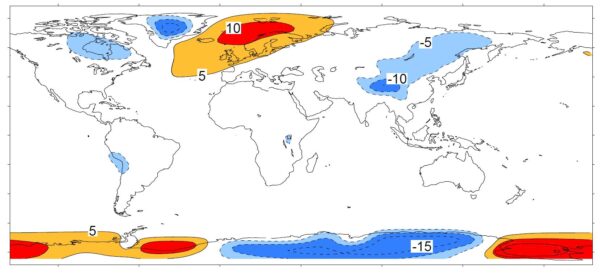
We have direct AMOC measurements only since 2004, a time span too short for this type of study. So the Ditlevsens used sea surface temperatures (SST) in a region between the tip of Greenland and Britain as an indicator, based on Caesar et al. 2018 (PDF; I’m a coauthor on that paper). The basic idea starts with the observation that this region is far warmer than what is normal for that latitude, because the AMOC delivers a huge amount of heat into the area. The following chart which I made 25 years ago illustrates this.

Temperature deviation relative to the average along each latitude circle (i.e. the zonal mean). The northern Atlantic region air temperature is a lot too warm for its latitude, which (in models) largely goes away when the AMOC is stopped. From Rahmstorf and Ganopolski 1999.

If the AMOC weakens, this region will cool. And in fact it is cooling – it’s the only region on Earth which has cooled since preindustrial times. This is commonly referred to as ‘warming hole’ or ‘cold blob’.

We argued in Caesar et al. that the sea surface temperature there in winter is a good index of AMOC strength, based on a high-resolution climate model. (Not in summer when the ocean is covered by a shallow surface mixed layer heated by the sun and highly dependent on weather conditions.) We checked this across other climate models and found that our AMOC index (i.e. based on SST in the ‘cold blob’ region) and the actual AMOC slowdown correlated highly there (correlation coefficient R=0.95).

There are some other indicators, either using measured ocean salinities or using various types of proxy data from sediment cores, e.g. sediment grain sizes at the ocean bottom as indicators of flow speed of the deep southward AMOC branch. The key point to me is: these different indicators provide rather consistent AMOC reconstructions, as we showed in Caesar et al. 2021. The sediment data go back further in time but are likely not as reliable and don’t reach up to the present.

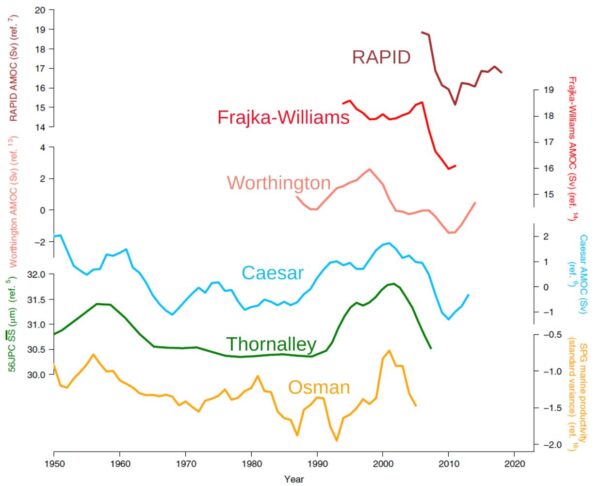
For recent decades there are potentially better approaches like ocean state estimates, and those are also consistent with the SST fingerprint – but these don’t go back far enough in time for the Ditlevsen type of study. The next graph shows a comparison of different reconstructions for the relevant time period used in the Ditlevsen study.

A comparison of direct observational AMOC data (RAPID) and two recent reconstructions to both the SST-based AMOC index (blue, used by the Ditlevsens) and two paleo-proxies that extend into the twenty-first century: the sortable-silt data and the marine productivity data. From Caesar et al. 2022.

Reconstructions based on salinity may also be good but they depend on precipitation, a notoriously variable quantity so it is rather doubtful whether analysing variance of salinity is doing any better than the SST signal.

The argument has been made that the ‘cold blob’ might not be caused by an AMOC decline but by heat loss at the ocean surface. That’s easy to check: if that were the case, then cooling in the area would be linked to increased heat loss at the surface. But if the AMOC is the culprit, then less heat should be lost, as a cooler ocean surface due to reduced ocean heat transport will lose less heat. The reanalysis data show the latter is the case.

This was shown by Halldór Björnsson of the Icelandic weather service and presented at the Arctic Circle conference 2016. I discussed this here in 2016 and also in my 2018 RealClimate article “If you doubt that the AMOC has weakened, read this”, together with possible other alternative explanations of the ‘cold blob’. We have recently repeated Halldór’s analysis at PIK and got the same results.

My conclusion: for the past century or so the SST data are probably the best AMOC indicator we have, and I don’t see concrete evidence suggesting that it’s unreliable.

2. The Ditlevsen study assumes that the AMOC follows a quadratic curve when approaching the tipping point.

That’s a more technical criticism. Their assumption follows from Stommel’s 1961 simple model of the AMOC tipping point. It results from the basic idea that (a) AMOC changes are proportional to density changes, and (b) the density change results from a balance between freshwater input and AMOC salt transport to the deep water formation (i.e. ‘cold blob’) region. Combined, these two assumptions lead to a quadratic equation.

These are very plausible basic assumptions, albeit using a linear equation of state, but we all know you can linearize things around a given point to get a first-order estimate. The argument that this is “too simple” doesn’t mean it’s wrong; rather this is correct at least to first order.

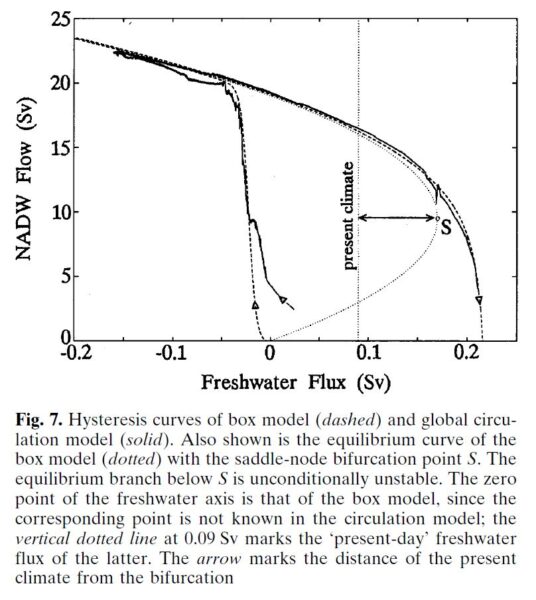
In a 1996 study I compared the results of a quadratic box model response to a fully-fledged 3D primitive equation ocean circulation model with nonlinear equation of state, the MOM model of the Geophysical Fluid Dynamics Lab in Princeton. It looks like this.

The AMOC strength (vertical axis) is shown as it depends on freshwater input (rain, meltwater) into the northern Atlantic. The box model equilibrium is shown as dotted parabola, the tipping point is S. By global warming we move from a past equilibrium toward the right – the box model run is the dashed line, the global ocean circulation model run is the solid line. Relevant is the upper branch, moving towards the right approaching the tipping point. From Rahmstorf (1996, PDF).

You can’t get a much better fit than that. A similar quadratic shape has also been found by Henk Dijkstra’s group at Utrecht University in a state-of-the-art global climate model, the CESM model (yet to be published). I have not seen any concrete evidence by the critics suggesting the shape may not be quadratic; that seems to be a purely hypothetical possibility. Also, if it is not exactly quadratic, the stated uncertainty range will be larger but it doesn’t fundamentally change the result.

What does it all mean?

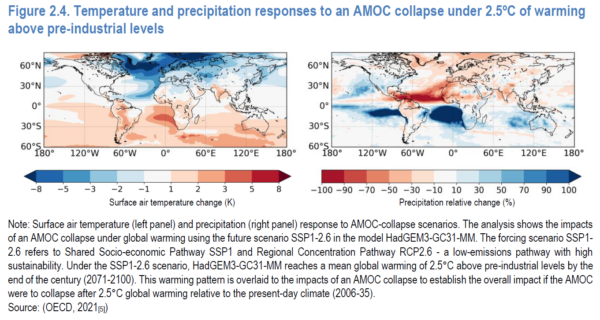
An AMOC collapse would be a massive, planetary-scale disaster. Some of the consequences: Cooling and increased storminess in northwestern Europe, major additional sea level rise especially along the American Atlantic coast, a southward shift of tropical rainfall belts (causing drought in some regions and flooding in others), reduced ocean carbon dioxide uptake, greatly reduced oxygen supply to the deep ocean, likely ecosystem collapse in the northern Atlantic, and others. Check out the OECD report Climate Tipping Points which is well worth reading, and the maps below. You really want to prevent this from happening.

A figure from the recent OECD report Climate Tipping Points, showing how an AMOC shutdown after 2.5 °C global warming would change temperature (left) and precipitation (right) around the world.

We know from paleoclimatic data that there have been a number of drastic, rapid climate changes with focal point in the North Atlantic due to abrupt AMOC changes, apparently after the AMOC passed a tipping point. They are known as Heinrich events and Dansgaard-Oeschger events, see my review in Nature (pdf).

The point: it is a risk we should keep to an absolute minimum.

In other words: we are talking about risk analysis and disaster prevention. This is not about being 100% sure that the AMOC will pass its tipping point this century; it is that we’d like to be 100% sure that it won’t. Even if there were just (say) a 40% chance that the Ditlevsen study is correct in the tipping point being reached between 2025 and 2095, that’s a major change to the previous IPCC assessment that the risk is less than 10%. Even a <10% chance as of IPCC (for which there is only “medium confidence” that it’s so small) is in my view a massive concern. That concern has increased greatly with the Ditlevsen study – that is the point, and not whether it’s 100% correct and certain.

Would you live in a village below a dammed lake if you’re told there is a one in ten chance that one day the dam will break and much of the village will be washed away? Would you say: “Not to worry, that’s 90 % chance it won’t happen?” Or would you demand action by the authorities to reduce the risk? What if a new study appears, experienced scientists, reputable journal, that says it is nearly certain that the dam will break, the question is only when? Would you demand immediate attention to mitigate this danger, or would you say: “Oh well, some have questioned whether the assumptions of this study are entirely correct. Let’s just assume it is wrong”?

For the AMOC (and other climate tipping points), the only action we can take to minimise the risk is to get out of fossil fuels and stop deforestation as fast as possible. One major assumption of the Ditlevsen study is that global warming continues as in past decades. That is in our hands – or more precisely, that of our governments and powerful corporations. In 2022, the G20 governments alone subsidised fossil fuel use with 1.4 trillion dollars, up by 475% above the previous year. They aren’t trying to end fossil fuels.

Yet, as soon as we reach zero emissions, global warming will stop within years, and the sooner this happens the smaller the risk of passing tipping points. It also minimises lots of other losses, damages and human suffering from “regular” global warming impacts, which are already happening all around us even without passing major climate tipping points.

Links

For more on this, see my long TwiX thread with many images from relevant studies.

What is happening in the Atlantic Ocean to the AMOC?

If you doubt that the AMOC has weakened, read this

AMOC slowdown: Connecting the dots

And for even more, just enter “AMOC” into the search field of this blog!

The post The AMOC: tipping this century, or not? first appeared on RealClimate.

25 Aug 14:56

Living Colour, Opinions on Blur & Claud

Tom Roche

good Blur and Claud reviews, but Living Colour tribute marred-if-not-ruined by waaay overlong discussion claiming (falsely, as I remember the 1990s) that the reason why black kids just didn't feel comfortable listening to "white" rock music was ... white supremacy. When in fact, it was mostly due to black self-policing: if you were black and didn't listen to hiphop or R&B, other black folks abused you for being an Oreo or a wannabe.

In the largely white landscape of ‘80s and ‘90s rock, Living Colour stood out with their electrifying riffs, genre blending sound and political lyrics. Decades later, professor and author Kimberly Mack talks with hosts Jim DeRogatis and Greg Kot about her recent book on Living Colour’s impact on rock music and culture as a whole. The hosts also review new albums from Blur and Claud.


Join our Facebook Group: https://bit.ly/3sivr9T

Become a member on Patreon: https://bit.ly/3slWZvc

Sign up for our newsletter: https://bit.ly/3eEvRnG

Make a donation via PayPal: https://bit.ly/3dmt9lU

Send us a Voice Memo: Desktop: bit.ly/2RyD5Ah  Mobile: sayhi.chat/soundops


Featured Songs:

Living Colour, "Cult of Personality," Vivid, Epic, 1988
The Beatles, "With A Little Help From My Friends," Sgt. Pepper's Lonely Hearts Club Band, Parlophone, 1967
Blur, "St. Charles Square," The Ballad of Darren, Warner, 2023
Blur, "The Narcissist," The Ballad of Darren, Warner, 2023
Blur, "The Heights," The Ballad of Darren, Warner, 2023
Blur, "The Ballad," The Ballad of Darren, Warner, 2023
Claud, "A Good Thing," Supermodels, Saddest Factory, 2023
Claud, "The Moving On," Supermodels, Saddest Factory, 2023
Claud, "Crumbs," Supermodels, Saddest Factory, 2023
Claud, "Every Fucking Time," Supermodels, Saddest Factory, 2023
Claud, "Wet," Supermodels, Saddest Factory, 2023
Living Colour, "Love Rears It's Ugly Head," Time's Up, Epic, 1990
Living Colour, "Solace Of You," Time's Up, Epic, 1990
Living Colour, "Time's Up," Time's Up, Epic, 1990
Living Colour, "Pride," Time's Up, Epic, 1990
Living Colour, "This Is the Life," Time's Up, Epic, 1990
Living Colour, "Information Overload," Time's Up, Epic, 1990
RVG, "Midnight Sun," Brain Worms, Fire, 2023

Support The Show: https://www.patreon.com/soundopinions

See omnystudio.com/listener for privacy information.

See Privacy Policy at https://art19.com/privacy and California Privacy Notice at https://art19.com/privacy#do-not-sell-my-info.

25 Aug 14:48

Prigozhin plane crash, domestic and external actors

Tom Roche

good survey of current etiologies, and which make most sense with current data

Prigozhin plane crash, domestic and external actors
24 Aug 20:50

8/24/23: REPUBLICAN DEBATE HIGHLIGHTS Krystal and Saagar BREAK DOWN, Winners and Losers, Trump Tucker Highlights Epstein/Civil War, Kyle and Emily Panel Debates

Tom Roche

Gotta compare 2 postgames/reviews of the 23 Aug 2023 US Republican presidential candidate debate:

+ [System Update with Glenn Greenwald (aka /SUGG/)](https://traffic.megaphone.fm/RUMBLE5669935972.mp3) (with guest Matt Gaetz) reviews the debate very briefly, but spends much more time on candidate policy positions, and especially how those mostly-2010-ish positions fail to resonate with the 2023 Repub voter base.

- [BreakingPoints (aka /BP/)](https://traffic.megaphone.fm/BRPL4439671724.mp3) (KB+SE plus Emily Jashinsky and Kyle Kulinski) by contrast go over debate performances, polling, etc for an excruciating 76 min. Unless you /really/ want horserace, do /not/ listen on any device lacking fast-forward, playback-speed-increase, or both

5 months from the 1st actual votes (Iowa caucus and NH primary in Jan 2024), I found the SUGG episode to provide /much/ higher value-per-minute.

DEBATE SPECIAL DISCOUNT: 10% OFF Yearly Memberships available at http://www.breakingpoints.com Get access to full episodes, uncut, and 1 hour early right in your inbox or Spotify.

Krystal and Saagar breakdown the highlights from the first GOP 2024 debate, they pick the Winners and Losers of the night, we go over the Trump and Tucker interview highlights, and we have Emily and Kyle on panel to debate whether Trump should have shown up to debate and if Vivek can actually beat Trump.

Learn more about your ad choices. Visit megaphone.fm/adchoices

24 Aug 20:50

Post-Debate Analysis Live from Milwaukee - SYSTEM UPDATE #136

Tom Roche

Gotta compare 2 postgames/reviews of the 23 Aug 2023 US Republican presidential candidate debate:

+ [System Update with Glenn Greenwald (aka /SUGG/)](https://traffic.megaphone.fm/RUMBLE5669935972.mp3) (with guest Matt Gaetz) reviews the debate very briefly, but spends much more time on candidate policy positions, and especially how those mostly-2010-ish positions fail to resonate with the 2023 Repub voter base.

- [BreakingPoints (aka /BP/)](https://traffic.megaphone.fm/BRPL4439671724.mp3) (KB+SE plus Emily Jashinsky and Kyle Kulinski) by contrast go over debate performances, polling, etc for an excruciating 76 min. Unless you /really/ want horserace, do /not/ listen on any device lacking fast-forward, playback-speed-increase, or both

5 months from the 1st actual votes (Iowa caucus and NH primary in Jan 2024), I found the SUGG episode to provide /much/ higher value-per-minute.

23 Aug 23:49

Democracy Now! 2023-08-23 Wednesday

Tom Roche

EXCELLENT 3rd main segment (counting headlines as 1st) on the 70th anniversary of the [US-UK overthrow of Mohammad Mosaddegh](https://en.wikipedia.org/wiki/1953_Iranian_coup_d%27%C3%A9tat#Execution_of_Operation_Ajax)

Democracy Now! 2023-08-23 Wednesday

  • Headlines for August 23, 2023
  • "They Fired on Us Like Rain": Saudis Accused of Killing Hundreds of Ethiopian Refugees at Border
  • "It's Always About Oil": CIA & MI6 Staged Coup in Iran 70 Years Ago, Destroying Democracy in Iran

Download this show

23 Aug 19:46

Grayzone Radio - Tuesday, August 22, 2023

Tom Roche

EXCELLENT update/sitrep on NATO's proxy war on Russia, as US deepstate begins to smell defeat in Ukraine, but can't leave behind those sweeeet contracting profits, even as the bodies and amputated limbs of Ukrainians pile ever higher.

Grayzone Radio with Max Blumenthal excerpts investigative reports from The Grayzone podcast.
23 Aug 00:57

Joan Williams

Tom Roche

Michael Goldfarb EXCELLENT as usual in this miniseries of 5 literary/historical/cultural essays on the US c1950-1970--but mostly the NYC area, which dominated US culture and media (hell, the world! there's a reason why the UN is in Manhattan). Short, masterful, but ... they've got issues, mostly with the concept of the series ("1960s cancel culture"). In order of presentation:

1. L'affaire Nat Turner (which I slightly remember--excepting Williams/#5, it's the least NYCish) /did/ get Styron sorta-canceled for awhile, but

- it's important to remember that, while 'Confessions of Nat Turner' got harshly criticized by the proto-identity-Left, it got boffo sales and awards (inc 1968 Pulitzer Prize)
- 12 years later (Sophie's Choice) he was very much back in public favor (not least with the very-Jewish NYC cultural elite).

Styron would have been fine, except he developed severe depression, but he turned that into even more public acclaim, even love. Sooo ... was Styron canceled? only briefly, and kinda because he "couldn't take the heat." A guy like Mailer would (and did!) have monetized it.

2. By contrast, {LeRoi Jones, Amiri Baraka} got /massively/ canceled from the mid-1960s to mid-1980s (which I very much remember), esp by that very-Jewish NYC cultural elite. Which, to his credit, Goldfarb (a very NYC Jew, though he grew up in Philadelphia (like Chomsky) and made his name in the UK) recognizes. But even Baraka (a lifelong "stroppy guy," occasionally violent) managed to earn a living after that in equally-Jewish East-Coast academia, and died in Newark Beth Israel, so props to the Tribe. That being said, Baraka mostly disappeared from mass view until his 2014 death (outside of regular scandals, many of which he deserved), only restricted to a small, Black-Power-friendly subculture. This is IMHO the only actual cancel of the 5.

3. By contrast with Baraka and Styron (both goyish), the very-though-he-tried-not-to-be-Jewish Norman (born Nachem) Mailer positively /profited/ from the brief notoriety he experienced after stabbing his wife (and almost killing her). Cancellation? /Hell/ no: Mailer was just one in a long line of New Yorkers (looking at /you/, Trump :-) who demonstrated that "all publicity is good publicity." Mailer was able to move /dogshit/ just because he was notorious (and only in certain circles, who then as now believed themselves arbiters of public morality, and who then as now are very wrong).

4. As when applied to Mailer, the idea that the also-very-Jewish-and-in-a-similar-way Philip Roth 'got canceled' is just hilarious. Yes, Roth got sternly-talked-to (and shrilly-yelled-at) by that insufferable (and very Jewish, but not insufferable for that reason) NYC media/culture police that exists in very similar form to this day. He also became /massively/ rich-and-famous, /plus/ he managed to avoid most of Mailer's self-owns (notably, stabbed nobody :-)

5. L'affaire Joan Williams is very different:

- hers is the only one of the these 5 cases that I knew nothing about before Goldfarb
- she's the only woman
- she "fell the least far," having barely "made it" before her ... what?

Goldfarb makes the case that Williams got done by the "Southern Academy" (/mostly/ not Jewish, but there's a surprising overrepresentation of Jews there too, going waaay back--looking at /you/, Judah P. Benjamin) more than by the NYC culture/media elite. But by his own admission Goldfarb's case is not very strong; plus, the only case he makes is for a sort of ostracism ("ignoring with intent"?), not cancellation.

Michael Goldfarb looks at five authors and their books on the receiving end of cancel culture in liberal America of the 1960s. Each author and the work being discussed was the subject of a controversy that altered their lives and deeply affected their careers.

In this essay, he focuses on Joan Williams and her novel Old Powder. After her first novel was shortlisted for the National Book Award, this one failed. Did her former lover William Faulkner have something to do with it? For much of the 60s, literary fiction remained a male preserve, Joan Williams looked like being the person to break that mould, then she disappeared. Why?

23 Aug 00:56

Philip Roth

Tom Roche

Michael Goldfarb EXCELLENT as usual in this miniseries of 5 literary/historical/cultural essays on the US c1950-1970--but mostly the NYC area, which dominated US culture and media (hell, the world! there's a reason why the UN is in Manhattan). Short, masterful, but ... they've got issues, mostly with the concept of the series ("1960s cancel culture"). In order of presentation:

1. L'affaire Nat Turner (which I slightly remember--excepting Williams/#5, it's the least NYCish) /did/ get Styron sorta-canceled for awhile, but

- it's important to remember that, while 'Confessions of Nat Turner' got harshly criticized by the proto-identity-Left, it got boffo sales and awards (inc 1968 Pulitzer Prize)
- 12 years later (Sophie's Choice) he was very much back in public favor (not least with the very-Jewish NYC cultural elite).

Styron would have been fine, except he developed severe depression, but he turned that into even more public acclaim, even love. Sooo ... was Styron canceled? only briefly, and kinda because he "couldn't take the heat." A guy like Mailer would (and did!) have monetized it.

2. By contrast, {LeRoi Jones, Amiri Baraka} got /massively/ canceled from the mid-1960s to mid-1980s (which I very much remember), esp by that very-Jewish NYC cultural elite. Which, to his credit, Goldfarb (a very NYC Jew, though he grew up in Philadelphia (like Chomsky) and made his name in the UK) recognizes. But even Baraka (a lifelong "stroppy guy," occasionally violent) managed to earn a living after that in equally-Jewish East-Coast academia, and died in Newark Beth Israel, so props to the Tribe. That being said, Baraka mostly disappeared from mass view until his 2014 death (outside of regular scandals, many of which he deserved), only restricted to a small, Black-Power-friendly subculture. This is IMHO the only actual cancel of the 5.

3. By contrast with Baraka and Styron (both goyish), the very-though-he-tried-not-to-be-Jewish Norman (born Nachem) Mailer positively /profited/ from the brief notoriety he experienced after stabbing his wife (and almost killing her). Cancellation? /Hell/ no: Mailer was just one in a long line of New Yorkers (looking at /you/, Trump :-) who demonstrated that "all publicity is good publicity." Mailer was able to move /dogshit/ just because he was notorious (and only in certain circles, who then as now believed themselves arbiters of public morality, and who then as now are very wrong).

4. As when applied to Mailer, the idea that the also-very-Jewish-and-in-a-similar-way Philip Roth 'got canceled' is just hilarious. Yes, Roth got sternly-talked-to (and shrilly-yelled-at) by that insufferable (and very Jewish, but not insufferable for that reason) NYC media/culture police that exists in very similar form to this day. He also became /massively/ rich-and-famous, /plus/ he managed to avoid most of Mailer's self-owns (notably, stabbed nobody :-)

5. L'affaire Joan Williams is very different:

- hers is the only one of the these 5 cases that I knew nothing about before Goldfarb
- she's the only woman
- she "fell the least far," having barely "made it" before her ... what?

Goldfarb makes the case that Williams got done by the "Southern Academy" (/mostly/ not Jewish, but there's a surprisingly overrepresentation of Jews there too, going waaay back--looking at /you/, Judah P. Benjamin) more than by the NYC culture/media elite. But by his own admission Goldfarb's case is not very strong; plus, the only case he makes is for a sort of ostracism ("ignoring with intent"?), not cancellation.

Michael Goldfarb looks at five authors and their books on the receiving end of cancel culture in liberal America of the 1960s. Each author and the work being discussed was the subject of a controversy that altered their lives and deeply affected their careers.

In this essay, he focuses on Philip Roth. Roth became permanently alienated from American Jews and even his own mother asked him if he was anti-Semitic. In light of his continuous production and the miraculous late flowering of his art, from The Counterlife to The Plot Against America, it's easy to forget that Portnoy’s Complaint, despite its sales, nearly destroyed his career within his own community. It also coloured how he was seen until his death: as a misogynist who, depending on one's view, had to be forgiven because of his talent, or could not be forgiven, because of his talent. The irony is that while many Jews at the time would like to have had Portnoy's Complaint pulled from bookshops and libraries and pulped, his authorised biography, published in 2021, actually was pulled from sale and pulped because the author, Blake Bailey, was accused of sexual assault.

23 Aug 00:55

Norman Mailer

Tom Roche

Michael Goldfarb EXCELLENT as usual in this miniseries of 5 literary/historical/cultural essays on the US c1950-1970--but mostly the NYC area, which dominated US culture and media (hell, the world! there's a reason why the UN is in Manhattan). Short, masterful, but ... they've got issues, mostly with the concept of the series ("1960s cancel culture"). In order of presentation:

1. L'affaire Nat Turner (which I slightly remember--excepting Williams/#5, it's the least NYCish) /did/ get Styron sorta-canceled for awhile, but

- it's important to remember that, while 'Confessions of Nat Turner' got harshly criticized by the proto-identity-Left, it got boffo sales and awards (inc 1968 Pulitzer Prize)
- 12 years later (Sophie's Choice) he was very much back in public favor (not least with the very-Jewish NYC cultural elite).

Styron would have been fine, except he developed severe depression, but he turned that into even more public acclaim, even love. Sooo ... was Styron canceled? only briefly, and kinda because he "couldn't take the heat." A guy like Mailer would (and did!) have monetized it.

2. By contrast, {LeRoi Jones, Amiri Baraka} got /massively/ canceled from the mid-1960s to mid-1980s (which I very much remember), esp by that very-Jewish NYC cultural elite. Which, to his credit, Goldfarb (a very NYC Jew, though he grew up in Philadelphia (like Chomsky) and made his name in the UK) recognizes. But even Baraka (a lifelong "stroppy guy," occasionally violent) managed to earn a living after that in equally-Jewish East-Coast academia, and died in Newark Beth Israel, so props to the Tribe. That being said, Baraka mostly disappeared from mass view until his 2014 death (outside of regular scandals, many of which he deserved), only restricted to a small, Black-Power-friendly subculture. This is IMHO the only actual cancel of the 5.

3. By contrast with Baraka and Styron (both goyish), the very-though-he-tried-not-to-be-Jewish Norman (born Nachem) Mailer positively /profited/ from the brief notoriety he experienced after stabbing his wife (and almost killing her). Cancellation? /Hell/ no: Mailer was just one in a long line of New Yorkers (looking at /you/, Trump :-) who demonstrated that "all publicity is good publicity." Mailer was able to move /dogshit/ just because he was notorious (and only in certain circles, who then as now believed themselves arbiters of public morality, and who then as now are very wrong).

4. As when applied to Mailer, the idea that the also-very-Jewish-and-in-a-similar-way Philip Roth 'got canceled' is just hilarious. Yes, Roth got sternly-talked-to (and shrilly-yelled-at) by that insufferable (and very Jewish, but not insufferable for that reason) NYC media/culture police that exists in very similar form to this day. He also became /massively/ rich-and-famous, /plus/ he managed to avoid most of Mailer's self-owns (notably, stabbed nobody :-)

5. L'affaire Joan Williams is very different:

- hers is the only one of the these 5 cases that I knew nothing about before Goldfarb
- she's the only woman
- she "fell the least far," having barely "made it" before her ... what?

Goldfarb makes the case that Williams got done by the "Southern Academy" (/mostly/ not Jewish, but there's a surprisingly overrepresentation of Jews there too, going waaay back--looking at /you/, Judah P. Benjamin) more than by the NYC culture/media elite. But by his own admission Goldfarb's case is not very strong; plus, the only case he makes is for a sort of ostracism ("ignoring with intent"?), not cancellation.

Michael Goldfarb looks at five authors and their books on the receiving end of cancel culture in liberal America of the 1960s. Each author and the work being discussed was the subject of a controversy that altered their lives and deeply affected their careers.

In this essay, he focuses on Norman Mailer. His reputation as a novelist had gone down the toilet before he reinvented himself with the non-fiction novel. But there was a cost. Writers should be read and not heard was the ethos of the profession. But mass media provided authors with many different platforms to reach the public. Mailer was on all of them, courting controversy - too successfully. Mailer was a monstrous misogynist before Harvey Weinstein and #metoo. For a while his talent gave him a pass, and then it didn't.

23 Aug 00:55

Amiri Baraka

Tom Roche

Michael Goldfarb EXCELLENT as usual in this miniseries of 5 literary/historical/cultural essays on the US c1950-1970--but mostly the NYC area, which dominated US culture and media (hell, the world! there's a reason why the UN is in Manhattan). Short, masterful, but ... they've got issues, mostly with the concept of the series ("1960s cancel culture"). In order of presentation:

1. L'affaire Nat Turner (which I slightly remember--excepting Williams/#5, it's the least NYCish) /did/ get Styron sorta-canceled for awhile, but

- it's important to remember that, while 'Confessions of Nat Turner' got harshly criticized by the proto-identity-Left, it got boffo sales and awards (inc 1968 Pulitzer Prize)
- 12 years later (Sophie's Choice) he was very much back in public favor (not least with the very-Jewish NYC cultural elite).

Styron would have been fine, except he developed severe depression, but he turned that into even more public acclaim, even love. Sooo ... was Styron canceled? only briefly, and kinda because he "couldn't take the heat." A guy like Mailer would (and did!) have monetized it.

2. By contrast, {LeRoi Jones, Amiri Baraka} got /massively/ canceled from the mid-1960s to mid-1980s (which I very much remember), esp by that very-Jewish NYC cultural elite. Which, to his credit, Goldfarb (a very NYC Jew, though he grew up in Philadelphia (like Chomsky) and made his name in the UK) recognizes. But even Baraka (a lifelong "stroppy guy," occasionally violent) managed to earn a living after that in equally-Jewish East-Coast academia, and died in Newark Beth Israel, so props to the Tribe. That being said, Baraka mostly disappeared from mass view until his 2014 death (outside of regular scandals, many of which he deserved), only restricted to a small, Black-Power-friendly subculture. This is IMHO the only actual cancel of the 5.

3. By contrast with Baraka and Styron (both goyish), the very-though-he-tried-not-to-be-Jewish Norman (born Nachem) Mailer positively /profited/ from the brief notoriety he experienced after stabbing his wife (and almost killing her). Cancellation? /Hell/ no: Mailer was just one in a long line of New Yorkers (looking at /you/, Trump :-) who demonstrated that "all publicity is good publicity." Mailer was able to move /dogshit/ just because he was notorious (and only in certain circles, who then as now believed themselves arbiters of public morality, and who then as now are very wrong).

4. As when applied to Mailer, the idea that the also-very-Jewish-and-in-a-similar-way Philip Roth 'got canceled' is just hilarious. Yes, Roth got sternly-talked-to (and shrilly-yelled-at) by that insufferable (and very Jewish, but not insufferable for that reason) NYC media/culture police that exists in very similar form to this day. He also became /massively/ rich-and-famous, /plus/ he managed to avoid most of Mailer's self-owns (notably, stabbed nobody :-)

5. L'affaire Joan Williams is very different:

- hers is the only one of the these 5 cases that I knew nothing about before Goldfarb
- she's the only woman
- she "fell the least far," having barely "made it" before her ... what?

Goldfarb makes the case that Williams got done by the "Southern Academy" (/mostly/ not Jewish, but there's a surprisingly overrepresentation of Jews there too, going waaay back--looking at /you/, Judah P. Benjamin) more than by the NYC culture/media elite. But by his own admission Goldfarb's case is not very strong; plus, the only case he makes is for a sort of ostracism ("ignoring with intent"?), not cancellation.

Michael Goldfarb looks at five authors and their books on the receiving end of cancel culture in liberal America of the 1960s. Each author and the work being discussed was the subject of a controversy that altered their lives and deeply affected their careers.

This essay looks at Amiri Baraka previously known as LeRoi Jones. He was seen as a genuine heir to James Baldwin. A decade younger than Baldwin, Jones/Baraka arrived in Greenwich Village just as the Beat scene was reaching its zenith. He wrote poetry and award-winning off-Broadway plays that dealt with race with the greater fire and frankness the 60s demanded. Then in one public appearance, he cancelled himself with comments about the Jewish young men Andrew Goodman and Michael Schwerner, who were murdered with James Chaney in Mississippi. The story of a career ruined and a notorious evening that split the liberal coalition in New York, a fracture that continues to this day.