Shared posts

08 Sep 22:55

765 - Searching For Sugar, Man feat. Ettingermentum (9/7/23)

Tom Roche

excellent, funny, focused: all3 plus Josh Ettinger on (mostly) DeSantis, Trump, Biden, and the continuing hell of US politics

We’re joined by elections analyst Ettingermentum for a critical look at the career of Ronald Dion DeSantis: from his rise as an marine lawyer turned Obama-era tea party author, to his now-flailing Presidential campaign, DeSantis has managed to fail upwards to the peak of Republican politics, then fumble the bag as soon as the spotlight hit him. We also touch on the seemingly inevitable Biden v. Trump rematch in 2024, and what the Dems and GOP might look like once these two mummies finally relinquish their mutual grips on their parties.


Find the Art of Losing: DeSantis series, Trump VP and Candidate tier lists, and all of Josh’s writing here: https://ettingermentum.substack.com/


Get bonus content on Patreon

Hosted on Acast. See acast.com/privacy for more information.

08 Sep 19:45

Radio War Nerd EP 395 — Afghanistan Blowback, feat. Brendan James & Noah Kulwin

by mail@yashalevine.com (Gary Brecher)
Tom Roche

SINGULAR remembrance/rumination on (what I call) the long (and not-yet-finished!) Afghan half-century. Brendan James and Noah Kulwin of the [uniquely-excellent /Blowback/](https://blowback.show/) series of audio histories ("podcast" does not do them justice) are currently (season 4) doing the history of Afghanistan, focusing on 1973-2023 but setting context from the sordid 19c British East India Company/empire. (If you haven't listened to every single ep from series#s=1-3 in [Blowback's public feed](https://feeds.redcircle.com/e30b9f10-8c86-432e-9fa0-ba287fb94e7f), do so ASAP--entertaining and informative.)

/Many/ topics of interest arise during this totally-worth-your-time, very-entertaining 113 min episode, including (in ~order of presentation, but this is 4 Great Minds In Conversation, so things go in and out, and the following is /not/ even close to representational)

* how UK-US empire weaponized Islamic radicals against secular (and esp left) movements
* the evil-and-probable-CIA-asset Hafizullah Amin (1929-1979)
* the even-more-evil-and-totally-Russophobic Zbigniew Brzezinski (1928-2017), esp as a 'bleeder' (as opposed to a 'dealer') in the Carter regime's phase of the US war on the USSR (esp the "Afghan theatre")
* the {Safari Club, BCCI, CIA} complex of evils c1974-c1994
* Ali Mohamed as [Triple Cross](https://peterlance.com/wordpress/?p=38), from post-Nasser Egyptian deepstate to post-Soviet US deepstate to al-Qaeda
* {similarity between, straight-line from} US empire {using, being used by} radical Islamists in Afghanistan and Syria to (though, shamefully, they only hint, but ~directly) US empire {using, being used by} Nazis in Ukraine

... and so much more. (If you're a good person :-) you will enjoy this, and (unless you specialize in this set of topics) you will learn something.

Co-hosts Gary Brecher & Mark Ames
08 Sep 15:48

Western sanctions failing: EU imports more Russian gas, China beats US tech war

Tom Roche

excellent geoeconomic analysis

Western sanctions are backfiring: The EU is now importing Russian liquified natural gas at record levels, and China has made high-tech breakthroughs despite US export restrictions. Ben Norton discusses how this is strengthening their economic sovereignty while blowing back on Europe. VIDEO: https://youtube.com/watch?v=U5fycw5vkjo US now world's top LNG exporter, as Europe boycotts cheaper Russian gas: https://geopoliticaleconomy.com/2023/01/04/us-lng-exporter-europe-russia-gas Europe pays more for banned Russian oil, resold by India - as EU wages fall: https://geopoliticaleconomy.com/2023/04/30/europe-russia-oil-india-wages Journalist Seymour Hersh says US blew up Nord Stream pipelines connecting Russia to Germany: https://geopoliticaleconomy.com/2023/02/08/us-nord-stream-pipelines-seymour-hersh Topics 0:00 Introduction: US economic warfare 3:49 Western sanctions on Russia backfire 20:47 China resists US tech sanctions 30:48 Outro: Sanctions are failing
07 Sep 19:04

SPECIAL EPISODE: How the ADL Abandoned its Stated Mission in Order to Weaponize Anti-Semitism Accusations for the Online Censorship Regime and the Neoliberal Establishment | SYSTEM UPDATE #142

Tom Roche

Greenwald EXCELLENT as usual

06 Sep 23:19

764 - The Schlapp’s Exorcist (9/5/23)

Tom Roche

Mostly-amusing Chris+Matt+Will ep (no Felix, not much Chris) on a variety of mostly-non-political topics. Unfortunately, there is a waaay-below-average segment reading a WaPo op-ed claiming men are anti-plants--the op-ed is as stupid as it sounds, and unfortunately Da Boyz don't bring much to their ridicule of it. So ya might wanna skip 33:44-51:42.

We hope everyone had a nice labor day.. Today, we’ve got and episode of rivalries: Musk vs. the ADL, the Schlapps vs. Demonic possession, Men (all) vs. Houseplants, Diarrhea vs. Air Travel, and Techno-Libertarians vs. Mud. Get bonus content on Patreon

Hosted on Acast. See acast.com/privacy for more information.

05 Sep 16:02

100 years since Japan's Kanto earthquake - and the massacre that followed

Tom Roche

excellent

September 1st marked 100 years since Japan's devastating Great Kantō Earthquake, a 7.9 magnitude quake which claimed over 105,000 lives. In the wake of the disaster, rumours spread about Koreans looting properties and poisoning wells, resulting in an upswell of vigilante violence that saw thousands more killed. A century on, Japan is still grappling with the commemoration of these atrocities.  Guest: Roger Pulvers, author and playwright, journalist and translator 
05 Sep 00:46

#448 - The Sound of Freedom Episode

Tom Roche

excellent, amusing even when depressing

Unfortunately, there was no avoiding it. We finally went to see the right-wing human-trafficking blockbuster SOUND OF FREEDOM (2023) and had one of our more unpleasant viewing experiences. We discuss the film's astroturfed box office, as well as the reasons for its very real cultural resonance. "Tim Ballard Has ‘Stepped Away’ From Operation Underground Railroad, Org Says" by Anna Merlan - https://www.vice.com/en/article/k7z74x/tim-ballard-sound-of-freedom-operation-underground-railroad-stepped-away Join us on Patreon for an extra episode every week - https://www.patreon.com/michaelandus
05 Sep 00:45

Stack Abuse: Guide to Profiling Python Scripts

Tom Roche

excellent concise introduction to performance measurement and optimization

Introduction

Even with a "simple" language like Python, it's not immune to performance issues. As your codebase grows, you may start to notice that certain parts of your code are running slower than expected. This is where profiling comes into play. Profiling is an important tool in every developer's toolbox, allowing you to identify bottlenecks in your code and optimize it accordingly.

Profiling and Why You Should Do It

Profiling, in the context of programming, is the process of analyzing your code to understand where computational resources are being used. By using a profiler, you can gain insights into which parts of your code are running slower than expected and why. This can be due to a variety of reasons like inefficient algorithms, unnecessary computations, bugs, or memory-intensive operations.

Note: Profiling and debugging are very different operations. However, profiling can be used in the process of debugging as it can both help you optimize your code and find issues via performance metrics.

Let's consider an example. Suppose you've written a Python script to analyze a large dataset. The script works fine with a small subset of data, but as you increase the size of the dataset, the script takes an increasingly long time to run. This is a classic sign that your script may need optimization.

Here's a simple Python script that calculates the factorial of a number using recursion:

def factorial(n):
    if n == 0:
        return 1
    else:
        return n * factorial(n-1)

print(factorial(5))

When you run this script, it outputs 120 which is the factorial of 5. However, if you try to calculate the factorial of a very large number, say 10000, you'll notice that the script takes a considerable amount of time to run. This is a perfect candidate for profiling and optimization.

Overview of Python Profiling Tools

Profiling is a crucial aspect of software development, particularly in Python where the dynamic nature of the language can sometimes lead to unexpected performance bottlenecks. Fortunately, Python provides a rich ecosystem of profiling tools that can help you identify these bottlenecks and optimize your code accordingly.

The built-in Python profiler is cProfile. It's a module that provides deterministic profiling of Python programs. A profile is a set of statistics that describes how often and for how long various parts of the program executed.

Note: Deterministic profiling means that every function call, function return, exception, and other CPU-intensive tasks are monitored. This can provide a very detailed view of your application's performance, but it can also slow down your application.

Another popular Python profiling tool is line_profiler. It is a module for doing line-by-line profiling of functions. Line profiler gives you a line-by-line report of time execution, which can be more helpful than the function-by-function report that cProfile provides.

There are other profiling tools available for Python, such as memory_profiler for profiling memory usage, py-spy for sampling profiler, and Py-Spy for visualizing profiler output. The choice of which tool to use depends on your specific needs and the nature of the performance issues you're facing.

How to Profile a Python Script

Now that we've covered the available tools, let's move on to how to actually profile a Python script. We'll take a look at both cProfile and line_profiler.

Using cProfile

We'll start with the built-in cProfile module. This module can either be used as a command line utility or within your code directly. We'll first look at how to use it in your code.

First, import the cProfile module and run your script within its run function. Here's an example:

import cProfile
import re

def test_func():
    re.compile("test|sample")

cProfile.run('test_func()')

When you run this script, cProfile will output a table with the number of calls to each function, the time spent in each function, and other useful information.

The ouptut might look something like this:

         234 function calls (229 primitive calls) in 0.001 seconds

   Ordered by: standard name

   ncalls  tottime  percall  cumtime  percall filename:lineno(function)
        1    0.000    0.000    0.001    0.001 <stdin>:1(test_func)
        1    0.000    0.000    0.001    0.001 <string>:1(<module>)
        1    0.000    0.000    0.001    0.001 re.py:192(compile)
        1    0.000    0.000    0.001    0.001 re.py:230(_compile)
        1    0.000    0.000    0.000    0.000 sre_compile.py:228(_compile_charset)
        1    0.000    0.000    0.000    0.000 sre_compile.py:256(_optimize_charset)
        1    0.000    0.000    0.000    0.000 sre_compile.py:433(_compile_info)
        2    0.000    0.000    0.000    0.000 sre_compile.py:546(isstring)
        1    0.000    0.000    0.000    0.000 sre_compile.py:552(_code)
        1    0.000    0.000    0.001    0.001 sre_compile.py:567(compile)
      3/1    0.000    0.000    0.000    0.000 sre_compile.py:64(_compile)
        5    0.000    0.000    0.000    0.000 sre_parse.py:138(__len__)
       16    0.000    0.000    0.000    0.000 sre_parse.py:142(__getitem__)
       11    0.000    0.000    0.000    0.000 sre_parse.py:150(append)
# ...

Now let's see how we can use it as a command line utility. Assume we have the following script:

def calculate_factorial(n):
    if n == 1:
        return 1
    else:
        return n * calculate_factorial(n-1)

def main():
    print(calculate_factorial(10))

if __name__ == "__main__":
    main()

To profile this script, you can use the cProfile module from the command line as follows:

$ python -m cProfile script.py

The output will show how many times each function was called, how much time was spent in each function, and other useful information.

Using Line Profiler

While cProfile provides useful information, it might not be enough if you need to profile your code line by line. This is where the line_profiler tool comes in handy. It's an external tool that provides line-by-line profiling statistics for your Python programs.

First, you need to install it using pip:

$ pip install line_profiler

Let's use line_profiler to profile the same script we used earlier. To do this, you need to add a decorator to the function you want to profile:

from line_profiler import LineProfiler

def profile(func):
    profiler = LineProfiler()
    profiler.add_function(func)
    return profiler(func)

@profile
def calculate_factorial(n):
    if n == 1:
        return 1
    else:
        return n * calculate_factorial(n-1)

def main():
    print(calculate_factorial(10))

if __name__ == "__main__":
    main()

Now, if you run your script, line_profiler will output statistics for each line in the calculate_factorial function.

Remember to use the @profile decorator sparingly, as it can significantly slow down your code.

Profiling is an important part of optimizing your Python scripts. It helps you to identify bottlenecks and inefficient parts of your code. With tools like cProfile and line_profiler, you can get detailed statistics about the execution of your code and use this information to optimize it.

Interpreting Profiling Results

After running a profiling tool on your Python script, you'll be presented with a table of results. But what do these numbers mean? How can you make sense of them? Let's break it down.

The results table typically contains columns like ncalls for the number of calls, tottime for the total time spent in the given function excluding calls to sub-functions, percall referring to the quotient of tottime divided by ncalls, cumtime for the cumulative time spent in this and all subfunctions, and filename:lineno(function) providing the respective data of each function.

Here's a sample output from cProfile:

         5 function calls in 0.000 seconds

   Ordered by: standard name

   ncalls  tottime  percall  cumtime  percall filename:lineno(function)
        1    0.000    0.000    0.000    0.000 <ipython-input-1-9e8e3c5c3b72>:1(<module>)
        1    0.000    0.000    0.000    0.000 {built-in method builtins.exec}
        1    0.000    0.000    0.000    0.000 {built-in method builtins.len}
        1    0.000    0.000    0.000    0.000 {method 'disable' of '_lsprof.Profiler' objects}

The tottime and cumtime columns are particularly important as they help identify which parts of your code are consuming the most time.

Note: The output is sorted by the function name, but you can sort it by any other column by passing the sort parameter to the print_stats method. For example, p.print_stats(sort='cumtime') would sort the output by cumulative time.

Optimization Techniques Based on Profiling Results

Once you've identified the bottlenecks in your code, the next step is to optimize them. Here are some general techniques you can use:

  • Avoid unnecessary computations: If your profiling results show that a function is called multiple times with the same arguments, consider using memoization techniques to store and reuse the results of expensive function calls.

  • Use built-in functions and libraries: Built-in Python functions and libraries are usually optimized for performance. If you find that your custom code is slow, see if there's a built-in function or library that can do the job faster.

  • Optimize data structures: The choice of data structure can greatly affect performance. For example, if your code spends a lot of time searching for items in a list, consider using a set or a dictionary instead, which can do this much faster.

Let's see an example of how we can optimize a function that calculates the Fibonacci sequence. Here's the original code:

def fib(n):
    if n <= 1:
       return n
    else:
       return(fib(n-1) + fib(n-2))

Running a profiler on this code will show that the fib function is called multiple times with the same arguments. We can optimize this using a technique called memoization, which stores the results of expensive function calls and reuses them when needed:

def fib(n, memo={}):
    if n <= 1:
       return n
    else:
       if n not in memo:
           memo[n] = fib(n-1) + fib(n-2)
       return memo[n]

With these optimizations, the fib function is now significantly faster, and the profiling results will reflect this improvement.

Remember, the key to efficient code is not to optimize everything, but rather focus on the parts where it really counts - the bottlenecks. Profiling helps you identify these bottlenecks, so you can spend your optimization efforts where they'll make the most difference.

Conclusion

After reading this article, you should have a good understanding of how to profile a Python script. We've discussed what profiling is and why it's crucial for optimizing your code. We've also introduced you to a couple of Python profiling tools, namely cProfile, a built-in Python profiler, and Line Profiler, an advanced profiling tool.

We've walked through how to use these tools to profile a Python script and how to interpret the results. Based on these results, you've learned some optimization techniques that can help you improve the performance of your code.

Just remember that profiling is a powerful tool, but it's not a silver bullet. It can help you identify bottlenecks and inefficient code, but it's up to you to come up with the solutions.

In my experience, the time invested in learning and applying profiling techniques has always paid off in the long run. Not only does it lead to more efficient code, but it also helps you become a more proficient and knowledgeable Python programmer.

05 Sep 00:44

#451 - Long Live the New Flesh

Tom Roche

VERY EXCELLENT--after a brief discussion of Trudeau's Barbenheimer politics, Will takes the lead in this discussion of the oeuvre of a Canadian Master (David Cronenberg, esp Videodrome), but Luke closes with a long (~10 min) but worthwhile soliliquy

After years of hearing from censors that violent media images cause harm, David Cronenberg made a movie... in which violent media images cause harm. We discuss VIDEODROME (1983) - its media satire, its sexual/gender politics, and its vision of how technology influences reality. PLUS: the Prime Minister enters the Barbieheimer discourse, and further thoughts on Sound of Freedom. See Will introduce Glen or Glenda?at the Fox Theatre on August 15 - https://www.foxtheatre.ca/movies/the-important-cinema-club-masterpiece-classics-glen-or-glenda/ Join us on Patreon for an extra episode every week -https://www.patreon.com/michaelandus
05 Sep 00:36

#453 - Arrested Development

Tom Roche

excellent

We've been talking about a lot of soulless, big-budget IP movies that represent a rot in our culture... so how about a how about a hand-crafted, achingly personal movie that exists as a wart on the back of that rot? We discuss Kevin Smith's CLERKS III (2022), a harrowing vision of Gen X culture trapped in amber. Join us on Patreon for an extra episode every week - https://www.patreon.com/michaelandus "Awkward Americans see themselves in Ron DeSantis" by Ben Terris - https://www.washingtonpost.com/lifestyle/2023/08/17/ron-desantis-awkward/ "Talk is Cheap" by Nick Pinkerton - https://nickpinkerton.substack.com/p/talk-is-cheap
05 Sep 00:36

#454 - The Liberal Imagination

Tom Roche

what MU does best: Luke and Will chew on a thick slice of US Corporate Party ideology in cinema form--in this case, what Hollywood Liberals (mis)thought about US politics in the middle Obama era.

Released in the middle of the Obama era, George Clooney's THE IDES OF MARCH (2011) has a lot to tell us about a time when the horizons of possibility were contracting. That's right, folks - it's time to have fun with a good, old-fashioned Politics Movie™. Join us on Patreon for an extra episode every week - https://www.patreon.com/michaelandus
05 Sep 00:34

#456 - Collect 'Em All (w/ Jesse Brenneman)

Tom Roche

Will (no Luke) and guest spend waaay too much time discussing collector culture (esp ... 3 Stooges?) before a delightful 2nd half on US 20c "industrial musicals." The ep outros with part of a song (celebrating (J.C.) Penney managers) from one showing how very well done these promotional/motivational musicals could be.

In the middle of the 20th century, some of America's biggest companies made a habit of staging Broadway-quality musicals simply to hype up their employees. The documentary BATHTUBS OVER BROADWAY (2018) chronicles the obsession that David Letterman's writer Steve Young developed with the arcane genre of the "industrial musical." Will is joined by special guest host Jesse Brenneman to discuss the film, and to hash over their experiences collecting really, really, really niche interests. Join us on Patreon for an extra episode every week - https://www.patreon.com/michaelandus Follow Jesse - https://linktr.ee/jkbrenneman Check out "Tech Talk" - https://podcasts.apple.com/us/podcast/tech-talk/id1498677455
05 Sep 00:31

My Teenage Diary

Tom Roche

amusing enough (esp if you're into foppish-though-self-aware-enough Oxbridge youth culture)

My Teenage Diary returns for a new series, with Rufus Hound meeting six more celebrities who will read from the diaries they kept during their formative years. The series opens with Ivo Graham reading from the diary of his last year at university. And he's not your average student - he reads Martin Amis in an adult bar, he eats bruschetta for brunch and he takes up pipe smoking. Host: Rufus Hound Guest: Ivo Graham Sound Production and Design: Jerry Peal Producer: Harriet Jaine A Talkback production for BBC Radio 4
04 Sep 19:04

Oil price cap collapses. Main stream media quietly reports

Tom Roche

VERY EXCELLENT, and short. As Alex and Alexander note, the G7-EU "petroleum pricecap"

1. was widely celebrated across Anglophone corporate-funded media (ACFM) as it was proposed ~Sep 2022 and "imposed" ~Feb 2022
2. has occasionally since then been celebrated for "curbing" oil export revenue to Russia (RF)
3. was 1st massively breached in Jul 2023
4. as of Sep 2023, RF continues selling crude oil above the pricecap, to (et al)
***** India (famously a Quad/QSD "partner" with the US)
***** Japan (a G7 member /and/ a QSD "partner")
***** PRC (a BRICS and SCO member alongside RF)
***** Saudi (about to join "expanded BRICS," and who (with the rest of OPEC+) were indignant at the impudence of the G7-EU's attempt to set global petroleum prices)
5. RF oil is being successfully traded and transported, and the transport insured, by companies headquartered inside the G7-EU but mostly outside (notably India and RF have massively expanded their insurance sectors, as the UK's longtime dominance of esp maritime insurance fades)
6. ... which the G7-EU will do nothing about, because their regimes (esp in EU) fear increasing energy prices
7. ... and so the collapse of the "petroleum pricecap" is being widely discussed with concern in the ACFM? Just kidding, they're mostly ignoring it, except for isolated reports in the more financially-oriented parts of the ACFM ... and alternative, empire-hostile media (e.g. The Duran).

Oil price cap collapses. Main stream media quietly reports
04 Sep 17:33

Irreal: Task Management With Org Agenda

by jcs

Denis Kyashif has a nice post on how he uses the Org mode agenda to handle his task management. He has two main requirements:

  1. It should be easy to add tasks to his task list.
  2. It should be easy to read his task list and figure out what to do next.

He said that it took him a while to find a task management system that met those needs but like many of us, he settled on Emacs and Org mode.

The salient feature of Kyashif’s Org work flow is that the Org configuration is pretty much out of the box. He doesn’t have a lot a special configurations or special functions. He just uses Org and Org agenda in its default mode. It’s a nice example of how powerful and useful Org mode is for task management.

The real structure on his workflow comes not from Org or its configuration but from his self imposed restraints. He says, for example, that not everything needs to be on the task list. He keeps everything in a single file with each “project” having a top level heading. He tags those so that each sub heading will inherit it making search for the project tasks easy.

It’s a nice workflow and his post is worth reading if you’re searching for your own task management system.

03 Sep 18:27

Radio War Nerd EP 394 — Gabon, feat. Dr Jeremy Rich

by mail@yashalevine.com (Gary Brecher)
Tom Roche

SINGULAR: an excellent example of intelligent hosts interviewing a guest (Jeremy M. Rich, professor @ Marywood_University) who is both deeply-knowledgeable and an old-school raconteur (French for "him talk good" :-), in this case regarding Gabon_c1840-2023: history, ethnography, geography, economy (esp resources), France Afrique colonialism, rise of PRC (et many al) commercial influence, 2009 succession, 2016 election, and some fascinating characters, including

* Omar Bongo (1935-2009, ruler from 1967 to death)
* his recently-couped son Ali (formerly [funkster/'Space Disco Pioneer' Alain](https://www.okayafrica.com/meet-space-disco-pioneer-just-stole-gabons-presidential-elections/) (archived [here](http://web.archive.org/web/20230531161036/https://www.okayafrica.com/meet-space-disco-pioneer-just-stole-gabons-presidential-elections/))
* the Atlantic Council (covered in their usual slime, but Rich gives great origin story)

Rich's account of "observing" the 2016 election (fraud) is not only amusing just as a story, but gives insight into US empire in decline. Totally worth not-quite-2 hours of your time.

Co-hosts Gary Brecher & Mark Ames
03 Sep 16:12

Bernie Denounces Cornel for Spoiling Biden's Chances—Completing Transformation Into Establishment Hack, w/ Sabby. Plus: Overcoming Destructive Ideological Stereotypes | SYSTEM UPDATE #140

Tom Roche

mostly excellent, though Sabrina Salvati (aka SabbySabs) is occasionally waaay hyperbolic

02 Sep 23:44

Charles Choi: Addendum - Defining Repeating Org Agenda Tasks

by Charles Choi

Karl Voit made the excellent comment on my post, “Defining Org Agenda Tasks”, that using a repeated timestamp can be more trouble than is worth. Instead, his guidance is to make multiple copies of a task using the org-clone-subtree-with-time-shift function, so that uniquely tracking each event is trivial.

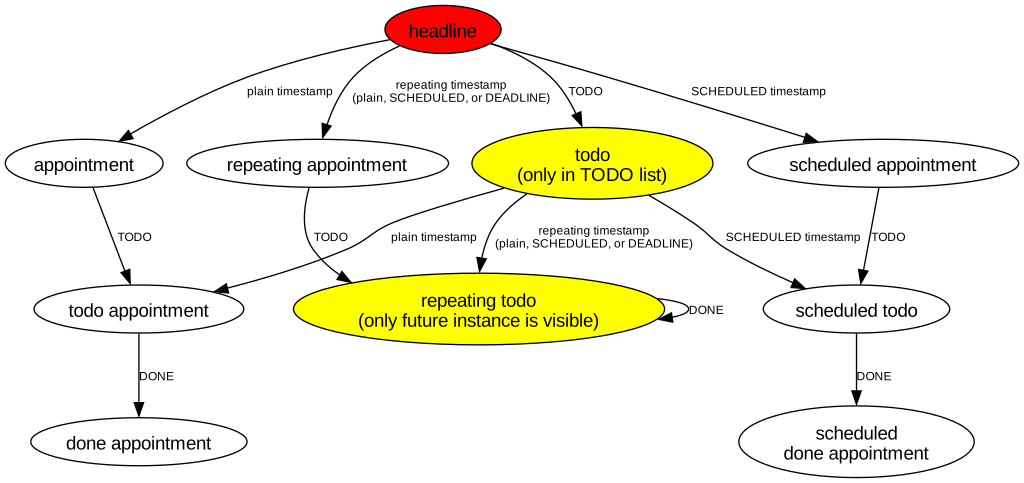
Because there are a multitude of attributes that one can apply to an Org headline, it might be instructive to draw out a state machine to see under what conditions a headline will be displayed by a default agenda view. For clarity, we will describe this state machine with an abbreviated set of transitions, where each transition is a single Org task attribute change. Transitions where an attribute change is reverted are not included also for clarity. In the diagram below, note that the states todo and repeating todo have qualifications when displayed in a default agenda view.

The following tables describe the above states and transitions respectively.

State Description Visible in Default Agenda View?
headline Headline with no attributes. No
appointment Task with plain timestamp. Yes
todo appointment TODO item/task with plain timestamp. Yes
repeating appointment Task with repeating timestamp. Yes
done appointment DONE task with plain timestamp. Yes
todo TODO item/task with no timestamp(s). Not shown in time grid; only shown in TODO list if agenda view supports it.
repeating todo TODO item/task with repeating timestamp. Only a future instance is visible in default agenda view. Setting the agenda view mode to display inactive timestamps (keyboard shortcut 'v-[') can display completed tasks.
scheduled appointment Task with scheduled timestamp. Yes
scheduled todo TODO item/task with scheduled timestamp. Yes
scheduled done appointment DONE task with scheduled timestamp. Yes
Transition Description
plain timestamp Add plain timestamp to task.
repeating timestamp Add repeating timestamp to task. Timestamp can be plain, SCHEDULED, or DEADLINE.
scheduled timestamp Add scheduled timestamp to task.
TODO Add TODO attribute.
DONE Change task state to DONE.


From the above diagram, using a repeating todo might not be the right approach to describing your task. Making copies of the same task, which Org makes easy with the command org-clone-subtree-with-time-shift, might be the better fit for you.

References

02 Sep 20:07

9/1/23: Partisan Hate Reaches New Highs, Almost Half American Homes Owned By Non Primary Resident, Millionaires Claim Financial Insecurity, Spanish Soccer Kiss Controversy, Late Night Hosts Start Podcast

Tom Roche

/totally/ skippable: no partners, 4 sub-par KB+SE, 1 /very/ low-percentile RG+EJ, don't waste your time

This week the Breaking Points team looks at Partisan hatred reaching all time highs and how we got here, a report showing less than 60% of American homes are owned by someone living in them, millionaires claiming they too feel financially insecure, Counterpoints looks at the controversial kiss from a Spanish Soccer chief, and the Late Night hosts have formed a new podcast during the strike called "Strike Force Five".


To become a Breaking Points Premium Member and watch/listen to the show uncut and 1 hour early visit: https://breakingpoints.supercast.com/


Merch Store: https://shop.breakingpoints.com/

Learn more about your ad choices. Visit megaphone.fm/adchoices

02 Sep 19:26

Episode 302 - New World Order (w /Anya Parampil)

Tom Roche

Anya Parampil ... is /not/ Radhika Desai or Ben Norton. She's just not (yet) as well-informed, possibly not as smart, so Parampil occasionally says dumb things. But /most/ of the time her analysis is good, and her politics are consistently good, and Brie-Brie Gray is an excellent interviewer (with consistently-good analysis), so /do/ devote 82 min (less if you speed it up) to this interview.

Subscribe to Bad Faith on Patreon to instantly unlock our full premium episode library: http://patreon.com/badfaithpodcast

The Grayzone's Anya Parampil joins Bad Faith fresh from her trip to South Africa for last month's BRICS summit. She weighs in on what Victoria Nuland was surprised she found there, and what it means for Argentina, Egypt, Ethiopia, Iran, Saudi Arabia, & United Arab Emirates to have joined the economic alliance. She also applies her foreign policy chops to Vivek Ramaswamy's recent takes on Taiwan/China, and the state of the 2024 primary post-RFJ Jr.s Palestine plummet.

Subscribe to Bad Faith on YouTube for video of this episode. Find Bad Faith on Twitter (@badfaithpod) and Instagram (@badfaithpod).

Produced by Armand Aviram.

Theme by Nick Thorburn (@nickfromislands).

02 Sep 17:09

What Are You Talking About?

Tom Roche

amusing solutions to Major Global Problems from Alasdair Beckett-King, Celya AB, Alex Kealy, Katie Norris, and host Rhys James

Hosted by Rhys James (Mock The Week, The Now Show), ‘What Are You Talking About?’ investigates the major issues of the week before solving them perfectly forever. Rhys will be joined by a gaggle of comedy’s fastest rising stars, including Alasdair Beckett-King and Celya AB, to look at the news and ask ‘Why?’, ‘How come?’ And ‘Why though?’

02 Sep 16:30

Can BRICS Be Anti-Imperialist With Countries Like India and Saudi Arabia? w/ Prabhat Patnaik

Tom Roche

'Untitled Episode' is actually the excellent-as-usual Prahbat Patnaik (Jawaharlal Nehru U) on BRICS, US empire, and international political economy after BRICS expansion. No hype, sober/rational analysis

Listen to the full interview on our Patreon: https://www.patreon.com/posts/full-audio-can-w-88623146

How much of a challenge to Western hegemony does the expansion of BRICS actually pose?  How much of this has been brought on by the West’s own hubris? What should we make of the ideological differences among the BRICS countries? Could India and Saudi Arabia act as spoilers? Or are we witnessing the symptomatic decline of American hegemony, with US allies turning toward Washington’s rivals? What does this mean for the rise of China? 


To discuss this and more, Rania Khalek was  joined by Prahbat Patnaik, marxist economist, professor emeritus at JNU, and author of many books including A Theory of Imperialism and the more recent Capital and Imperialism: Theory, History, and the Present, both co-authored with Utsa Patnaik. 


This is just the first half of this episode. The second half is available for Breakthrough News Members only. Become a member at
https://www.Patreon.com/BreakthroughNews to access the full episode and other exclusive content.

02 Sep 16:26

#161 AI Is Going to Upend Public Education. Or Maybe Not

Tom Roche

brief critique of the loonnngggg history of technology frauds, as US hucksters seek to replace "labor" (i.e., teachers--who do much more than teach, as HYH discusses) with their proprietary/profitable products ... which inevitably fail to improve education, but succeed in making bank

AI is about to upend teaching and learning. So tell us the techno optimists who have made essentially the same claim about every technological innovation, dating back to the film strip. Our guest, historian Larry Cuban, predicts that AI will join a long list of tech ‘silver bullets’ that have been overhyped, only to fall short of the promised utopia. Cuban argues that tech boosters are prone to such overselling because they don’t understand the nature of teaching and its reliance on human connection. The financial support of listeners like you keeps this podcast going. Subscribe on Patreon: https://www.patreon.com/HaveYouHeardPodcast or donate on PayPal: https://www.paypal.me/haveyouheardpodcast
02 Sep 15:26

World War Civ 22: Irish Home Rule and Britain’s near-civil war before 1914

Tom Roche

Dave and Justin EXCELLENT as usual

How close did Britain come to a civil war over the issue of Irish Home Rule? We talk about the long parliamentary road led by Parnell, the settler trick culminating in the seditious maneuvers in Ulster, and the final passage of the Home Rule Bill, rendered inoperative by World War I. This issue will be … Continue reading "World War Civ 22: Irish Home Rule and Britain’s near-civil war before 1914"
01 Sep 21:03

Radio War Nerd EP 393 — Philip K Dick

by mail@yashalevine.com (Gary Brecher)
Tom Roche

not the usual Nerd--instead, mostly brief appraisals (in mostly chronological order) of PKD's life and work

Co-hosts Gary Brecher & Mark Ames
01 Sep 19:03

763 - No Hogs, No Masters (8/31/23)

Tom Roche

Chris subs for Matt (get yer Christman [on Hunter and US failsons today](https://www.politico.com/news/magazine/2023/09/01/hunter-biden-lefty-fan-club-failson-00112043)) otherwise excellent {banter, {cultural, political} commentary}

Some rapid fire takes on a smörgåsbord of topics: Blake Masters eyes another Senate bid; Cruz drinks beer; cuisine culture wars; Tim Scott’s single status; BookerTok; Trump assassination threats; Vivek on castes; Will Hurd brings Afghan-style competence to the southern border; Our busted medical system.


Check out the 8-hour Rod reading supercut over on YouTube: https://www.youtube.com/watch?v=DjQOTDlw4Qg

Get bonus content on Patreon

Hosted on Acast. See acast.com/privacy for more information.

01 Sep 16:57

762 - The Safari Club feat. Brendan James & Noah Kulwin (8/29/23)

Tom Roche

VERY EXCELLENT

Brendan & Noah a.k.a. The Blowback Boys stop by to discuss their new podcast season, covering 40+ years of covert crimes and international disorder flowing through Afghanistan. We discuss the emergence of political Islam, the Soviet invasion of Afghanistan, the Safari Club, BCCI, Charlie Wilson’s War, Rambo III and much more.


Find all things Blowback & subscribe here: https://blowback.show/

Find Ben Clarkson’s amazing animated trailer, discussed in this episode, here: https://www.youtube.com/watch?v=Fb0r5aWGkCI


NYC: Will & Hesse will be hosting a special Movie Mindset 35mm print screening of Howard Hawks’ RIO BRAVO on Saturday, September 2nd at the Roxy Theater! Tix here: https://www.roxycinemanewyork.com/screenings/rio-bravo/

Get bonus content on Patreon

Hosted on Acast. See acast.com/privacy for more information.

30 Aug 21:32

Irreal: Striving For A Mouse Free Workflow

by jcs
Tom Roche

the Gwern Branwen article (on which this post is focused) is archived @
http://web.archive.org/web/20230826212009/https://gwern.net/search#preparation
https://archive.li/47gbA

As I’ve often suggested—most recently here and here—I try to minimize my use of the mouse as much as I can. Mostly that’s been in the context of Emacs where it’s easy. My desire to avoid the mouse is not ideological. It’s a matter of ergonomics. I find it faster and easier to to do my navigating from the keyboard.

Recently, I was reading an excellent article by Gwern on Internet Search Tips. It’s about how to optimize your Google-fu and search for hard to find papers, books, and other pieces of information.

One of the things that struck me was his insistence that your search has to be very easy to make or you won’t bother. The first part of his article is about keyboard shortcuts that he uses to initiate a search. He almost never needs to use a mouse for this. He’s a Linux user so much of his specific workflow doesn’t apply to me but I did take the general principle to heart.

I’ve had Alfred installed for a long time but hardly ever used it. I used it mostly to launch an application without having to click on its icon. After reading Gwern’s article, I tried to internalize this as a way of minimizing my mouse use. It turns out that the real power of Alfred resides in a subscription based plugin. I signed up for that and was amazed at how easy it made avoiding mouse use. For example, instead of clicking on 1password, scrolling down to the site I needed the password for, clicking on menu, and then clicking on the link to login page for the site, I merely brought up the Alfred prompt, typed 1p <site name> and I was taken right to the login page with all the password data filled in.

I’m still learning Alfred but already it’s essentially eliminated mouse use for everything except my browser. Browsers are the ultimate mouse-centric application for most of us and I’ve yet to find a reasonable way of avoiding the mouse when I’m in Safari. I’ve tried Keys for Safari, which tries to provide mouse free usage but it didn’t work for me.

The main point of this post is that whatever platform you’re on there’s something like Alfred that helps you avoid the mouse. If, like me, you like to avoid using the mouse, it’s worthwhile taking a look at one of the applications like Alfred that are appropriate for your platform.

30 Aug 21:13

Grayzone Radio - Tuesday, August 29, 2023

Tom Roche

repeat of last week

Grayzone Radio with Max Blumenthal excerpts investigative reports from The Grayzone podcast.
30 Aug 18:33

8/30/23: Florida Slammed By Hurricane Idalia, Biden Impeachment, DeSantis Heckled After Shooting, Park Ranger Rams Through Climate Protest, Biden Civil Rights Claim, US Declassifies Chilean Coup, Jen Psaki On Abortion, New Medicare Price Negotiations

Tom Roche

RG+EJ /almost/ consistently excellent (no horserace--see KB+SE, it can be done!). noteworthy:

+ EXCELLENT segment#=5 on Biden's latest civil-rights-movement lie, which gives esp RG the excuse to go over Biden's long, evil record pushing the crime/drug wars c1980-c2000
+ EJ unexpectedly good (but definitely not great--segment#=6) on the US war on Chile 1970-1973 and the (so-called) Cold War in South America. Not sure why RG does not push her on the fact that Allende /was elected/.
- abortion {EJ radar, seg#=7} is overlong

Ryan and Emily discuss Hurricane Idalia hitting Florida, McCarthy reportedly supporting Biden impeachment, DeSantis heckled after racist mass shooting, climate protesters confronted by police, Biden makes dubious Civil Rights Act claim, US declassifies Nixon era Chilean coup docs, Jen Psaki contradicts herself on abortion, and Alex Lawson joins to break down Biden's new pharma price negotiations.

To become a Breaking Points Premium Member and watch/listen to the show uncut and 1 hour early visit: https://breakingpoints.supercast.com/


Merch Store: https://shop.breakingpoints.com/

Learn more about your ad choices. Visit megaphone.fm/adchoices