mostly quite good (still lotta bothsides-ing on Palestine--worse later--but at least KB+SE are finally grasping not only that NATO (which they still call 'Ukraine') is losing, but that the US proxy war is a war of attrition which Russia will win) until the final segment, which interviews a hardline Zionist (Gili Roman) /very/ sympathetically, with no pushback (that I heard--admittedly I skipped over ~half the interview, but in several small steps, sampling along the way). EXCELLENT segments on (preceded by segment#)
3. Israel's plans for postwar Gaza (KB says the words 'ethnic cleansing' but not 'Lebensraum') 4. new deepstater Mike Johnson to tie Israel aid to IRS cuts, how CorpDems will respond 5. Biden regime to unleash antisemitism police (and repurposed {Title IX, MeToo} "courts") on US college anti-Zionists
Krystal and Saagar discuss Netanyahu rejecting calls for ceasefire and resignation, Hamas puts out a new hostage video, Leaked docs reveal Israeli plan to empty Gaza strip, New Speaker puts out plan to cut IRS funding for Israel Aid, Ukraine admits to "stealing like there's no tomorrow", Biden admin to unleash surveillance on protests at college campuses, New Polls show Iowans souring on Vivek, the PBD podcast confronts DeSantis over his High Heels, and we're joined in studio by Gili Roman a brother of the Israeli hostages to talk about his story, Netanyahu, Palestinian Rights, and Peace.
Subscribe for the full episode at the bottom of the page. Watch a free preview here:
“Israeli society has always been held together by scotch tape. The scotch tape is falling apart,” says Miko Peled. And he would know. Miko is the son of one of Israel's highest ranking generals and the grandson of a signatory to Israeli independence. He was raised in Israel and served in its army. And he condemns Israel's "savage" attacks on Palestinians.
He answers several questions: How was Hamas able to do what it did? Where was the Israeli army? Is the IDF prioritizing keeping the hostages alive or killing Hamas? And explains the history of Israel’s control over Gaza, how it led to the brutal massacre we’re witnessing today, and the way to end this war.
“That really is the conversation: how we bring this to an end, for real. Not a ceasefire, but a complete end to the blockade, a complete release of Palestinian prisoners, immediate aid to Palestinians. And all this with no conditions.”
He’s not stopping at just a reprieve from the bombings: “To the point that at the end of the day we bring the unconditional surrender of the apartheid state. That should be the main goal.”
Subscribe for the full episode to hear Miko’s logical plan for achieving this, and the harsh reality Palestinians face until we do.
“Between now and then, we can be certain that Palestinians are going to continue to pay a heavy price. And the world is silent.”
The world is silent, for the Palestinians at least. In the US, the president, Congress, and media brazenly cheerlead the genocide, lamenting the deaths of only Israeli citizens, understanding that referring to Palestinians as “civilians” will get you in trouble.
“One party explicitly rejects talking about Palestinian civilians and explicitly blames Hamas for whatever happens to them. The other party pays some lip service but doesn’t do anything. And that is American democracy.”
Plus, catch this week’s Thursday Throwdown: Senator Chris Murphy (D–CT) believes anything Israel says
And join the Absurd Arena live discussion board with Katie and Wilson every Tuesday at 12pm est in the Substack app.
VERY EXCELLENT. Just a Will interview (~0 jokes/bant) but politically-correct in the good sense of the term: (generally) empirically and normatively (got a few quibbles in both domains) correct on power and public morality. Perhaps the best part (other than the discussion of the (actual!) Brazilian punk band 'Anarchic Menstruation' :-) is the last ~6 min (starting 54:33) of the (total=61 min) audio on the relation between
- the Jakarta Method practiced by US vassals while the Empire was on the rise - the "rules-based [imperial] order" imposed during the US-unipolar moment (aka the 'End of History') - the Maidan and Gaza Methods (my term, not used by Bevins or Menaker) which the US empire is employing in desperate resistance to the new multipolarity
Author Vincent Bevins returns to the show to discuss his new book “If We Burn” covering the “mass protest decade.” We discuss global protest movements from Brazil to Tunisia to Egypt to Chile, how they’ve affected or failed to affect global politics, and how the last decade of protest and activism relates to the ongoing conflict in Palestine.
You can find Vincent’s book here: www.ifweburn.com
A critical component of undergraduate STEM education is understanding sets of numbers and how to process, plot, and compare them. However, most programs only scratch the surface of data analysis techniques, data visualization, and uncertainty.
A new book in AGU’s Advanced Textbook Series, Data Analysis for the Geosciences, provides a comprehensive introduction to data analysis, visualization, and data-model comparisons and metrics, within the framework of the uncertainty around the values. We asked the author to give an overview of the textbook and how it can be used.
I’m sure many students grumble about the requirement to take a statistics course. Through your teaching and this textbook, how do you make data analysis interesting and engaging for students?
I introduce this class to students as the broccoli of geoscience. The content is a superfood of analysis and will make you a better scientist, but goes down best with a lot of cheese. In this case, that special sauce is the Earth, atmosphere, space, and planetary examples interspersed throughout the book and the course, not only in the examples we assess in class but also in every homework and exam question. I try to make it real so they see how these obscure statistics concepts could help them with their research projects later in their career.
How is your textbook different from other typical undergraduate statistics and applied statistics textbooks and courses for STEM students?
When introducing a concept, I emphasize which analysis situations are best suited for each statistical technique, and how to decide which one to use in each situation.
I focus the content on understanding the scope of when, where, and how each statistical formula should be used. That is, when introducing a concept, I emphasize which analysis situations are best suited for each statistical technique, and how to decide which one to use in each situation. I only include derivations of the equations so that students can understand limitations of these tools.
There are many statistics equations out there for processing a data set or comparing two number sets, so I strive to be clear about the constraints that we should place on using and interpreting the values we get from these formulas.
Why is it important for all STEM students to know many different tools and techniques for data analysis?
In STEM careers, we make many decisions based on the analysis of a number set or the comparison of two number sets. It is difficult for the human brain to comprehend a list of a million numbers, though, or even a hundred numbers, so this assessment requires the use of techniques to distill an overwhelmingly large set down into a few understandable numbers. We have several common formulas that we love to use, but these come with caveats, embedded in their derivation and therefore critical to their interpretation. If the number set violates that underlying assumption, then our interpretation might be wrong. Furthermore, the decision at the end of our assessment might not fit well with the common metrics, and more appropriate ones should be chosen. It is useful to know about these other techniques to know which one to use for your specific purpose.
What role does uncertainty play in data analysis?
We cannot compare two numbers without knowing the uncertainty of each. If I did an analysis of two supposedly similar data sets, and I found two means of 8 and 10, are these close enough to call them equal? You have no idea without uncertainty estimates. If the uncertainties are 5 and 6, respectively, then yes, an initial guess would be that they are the similar. If the uncertainties are 0.5 and 0.6, however, then no, they are clearly different. Essentially everything about statistical analysis requires an uncertainty estimate to provide context and meaning to the base values.
Why is it important for students to have a strong foundation in data analysis, comparison, and visualization?
To make it personal, essentially all of my research involves the analysis of data sets or numerical model output. Often, I am conducting comparisons of various simulation runs against data for a specific real event or compilations of data across long timescales.
The ability to process a number set through plots, basic statistics, and advanced comparative techniques is at the core of scientific research.
The ability to process a number set through plots, basic statistics, and advanced comparative techniques is at the core of scientific research. A class that introduces students to the number set visualization and comparison is not only essential to a successful STEM career but also useful for critically evaluating statistics that we encounter in our daily lives.
Aside from STEM students, who else may find your book useful?
The process of starting with a plot, then moving on to basic analysis, and finally to more specialized comparative approaches is applicable to many disciplines. For example, it is the basis of engineering analysis of systems and of making financial decisions.
I hope that it is appealing to anyone that compares two number sets across any data science purpose, not only across all of the traditional STEM fields but also in medicine, the social sciences, and economics.
I also hope that that students from other fields find the Earth and space science examples throughout the book to be interesting sidebars about the natural world.
Editor’s Note: It is the policy of AGU Publications to invite the authors or editors of newly published books to write a summary for Eos Editors’ Vox.
Citation: Liemohn, M. W. (2023), Foundations in data analysis for undergraduate STEM students, Eos, 104, https://doi.org/10.1029/2023EO235031. Published on 31 October 2023.
This article does not represent the opinion of AGU, Eos, or any of its affiliates. It is solely the opinion of the author(s).
EXCELLENT--this is IOT at its best. Not entirely flawless (they recycle global NATO's lie that the Marshall Plan was motivated by US fear of Soviet aggression, when in fact it was part of the US Cold War aggression), but generally fair and insightful.
In an extended version of the programme that was broadcast, Melvyn Bragg and guests discuss the influential book John Maynard Keynes wrote in 1919 after he resigned in protest from his role at the Paris Peace Conference. There the victors of World War One were deciding the fate of the defeated, especially Germany and Austria-Hungary, and Keynes wanted the world to know his view that the economic consequences would be disastrous for all. Soon Germany used his book to support their claim that the Treaty was grossly unfair, a sentiment that fed into British appeasement in the 1930s and has since prompted debate over whether Keynes had only warned of disaster or somehow contributed to it.
With
Margaret MacMillan
Emeritus Professor of International History at the University of Oxford
Michael Cox
Emeritus Professor of International Relations at the London School of Economics and Founding Director of LSE IDEAS
And
Patricia Clavin
Professor of Modern History at the University of Oxford
Producer: Simon Tillotson
Reading list:
Manfred F. Boemeke, Gerald D. Feldman and Elisabeth Glaser (eds.), The Treaty of Versailles: A Reassessment after 75 Years (Cambridge University Press, 1998)
Zachary D. Carter, The Price of Peace: Money, Democracy and the Life of John Maynard Keynes (Random House, 2020)
Peter Clarke, Keynes: The Twentieth Century’s Most Influential Economist (Bloomsbury, 2009)
Patricia Clavin et al (eds.), Keynes’s Economic Consequences of the Peace after 100 Years: Polemics and Policy (Cambridge University Press, 2023)
Patricia Clavin, ‘Britain and the Making of Global Order after 1919: The Ben Pimlott Memorial Lecture’ (Twentieth Century British History, Vol. 31:3, 2020)
Richard Davenport-Hines, Universal Man; The Seven Lives of John Maynard Keynes (William Collins, 2015)
R. F. Harrod, John Maynard Keynes (first published 1951; Pelican, 1972)
Jens Holscher and Matthias Klaes (eds), Keynes’s Economic Consequences of the Peace: A Reappraisal (Pickering & Chatto, 2014)
John Maynard Keynes (with an introduction by Michael Cox), The Economic Consequences of the Peace (Palgrave Macmillan, 2019)
Margaret MacMillan, Peacemakers: Six Months that Changed the World (John Murray Publishers, 2001)
Etienne Mantoux, The Carthaginian Peace or the Economic Consequences of Mr. Keynes (Oxford University Press, 1946)
D. E. Moggridge, Maynard Keynes: An Economist’s Biography (Routledge, 1992)
Alan Sharp, Versailles 1919: A Centennial Perspective (Haus Publishing Ltd, 2018)
Robert Skidelsky, John Maynard Keynes, 1883-1946 (Pan Macmillan, 2004)
Jürgen Tampke, A Perfidious Distortion of History: The Versailles Peace Treaty and the Success of the Nazis (Scribe UK, 2017)
Adam Tooze, The Deluge: The Great War, America and the Remaking of the Global Order, 1916-1931 (Penguin Books, 2015)
In the 1000th edition of In Our Time, Melvyn Bragg and guests discuss arguably the most celebrated film of the Swedish director Ingmar Bergman (1918-2007). It begins with an image that, once seen, stays with you for the rest of your life: the figure of Death playing chess with a Crusader on the rocky Swedish shore. The release of this film in 1957 brought Bergman fame around the world. We see Antonius Block, the Crusader, realising he can’t beat Death but wanting to prolong this final game for one last act, without yet knowing what that act might be. As he goes on a journey through a plague ridden world, his meeting with a family of jesters and their baby offers him some kind of epiphany.
With
Jan Holmberg
Director of the Ingmar Bergman Foundation, Stockholm
Claire Thomson
Professor of Cinema History and Director of the School of European Languages, Culture and Society at University College London
And
Laura Hubner
Professor of Film at the University of Winchester
Producer: Simon Tillotson
Reading list:
Alexander Ahndoril (trans. Sarah Death), The Director (Granta, 2008)
Ingmar Bergman (trans. Marianne Ruuth), Images: My Life in Film (Faber and Faber, 1995)
Ingmar Bergman (trans. Joan Tate), The Magic Lantern: An Autobiography (Viking, 1988)
Ingmar Bergman (trans. Joan Tate), The Best Intentions (Vintage, 2018)
Ingmar Bergman (trans. Joan Tate), Sunday’s Children (Vintage, 2018)
Ingmar Bergman (trans. Joan Tate), Private Confessions (Vintage, 2018)
Stig Björkman, Torsten Manns and Jonas Sima (trans. Paul Britten Austin), Bergman on Bergman: Interviews with Ingmar Bergman (Da Capo Press, 1993)
Melvyn Bragg, The Seventh Seal: BFI Film Classics (British Film Institute, 1993)
Paul Duncan and Bengt Wanselius (eds.), The Ingmar Bergman Archives (Taschen/Max Ström, 2018)
Erik Hedling (ed.), Ingmar Bergman: An Enduring Legacy (Lund University Press, 2021)
Laura Hubner, The Films of Ingmar Bergman: Illusions of Light and Darkness (Palgrave Macmillan, 2007)
Daniel Humphrey, Queer Bergman: Sexuality, Gender, and the European Art Cinema (University of Texas Press, 2013)
Maaret Koskinen (ed.), Bergman Revisited: Performance, Cinema, and the Arts (Wallflower Press, 2008)
Selma Lagerlöf (trans. Peter Graves), The Phantom Carriage (Norvik Press, 2011)
Mariah Larsson and Anders Marklund (eds.), Swedish Film: An Introduction and Reader (Nordic Academic Press, 2010)
Paisley Livingston, Ingmar Bergman and the Rituals of Art (Cornell University Press, 2019)
Birgitta Steene (ed.), Focus on The Seventh Seal (Prentice Hall, 1972)
Birgitta Steene, Ingmar Bergman: A Reference Guide (Amsterdam University Press, 2014)
How important is it for movie producers to get the science right? Brian Cox and Robin Ince discover why some surprising movies have scientific advisers and ask if there is any science in The Simpsons? They question the existence of fictional wormholes, while comedian Ross Noble can’t believe there may be actually be a space time portal shaped like a pair of trousers. Some writers are even accurate by accident, as comic book author Alan Moore discovers when he tells Brian about one of his outlandish planetary plotlines… only to hear it obeys all the laws of physics. And Sir Patrick Stewart wows the panel with a little piece of plastic, but everyone agrees this Star Trek communicator is the stuff of legend.
Episodes featured:
Series 12: The Infinite Monkey Cage USA Tour: Los Angeles
Series 12: Christmas Special
Series 22: Black Holes
Series 2: Science Fiction Science Fact
Series 7: Space Exploration
New episodes will be released on Wednesdays, but if you’re in the UK, listen to new episodes, a week early , first on BBC Sounds bbc.in/3K3JzyF
Producer: Marijke Peters
Executive Producer: Alexandra Feachem
good-though-necessarily-incomplete survey of the many things one can do in Emacs instead of bailing to a console/terminal. TODO: use xref more, esp [Org-mode integration](https://github.com/jkitchin/org-ref)
…if you’re an Emacs user, that is.
You know, it’s funny, because people have opinions on why you don’t need a terminal on entirely different ends of a spectrum.
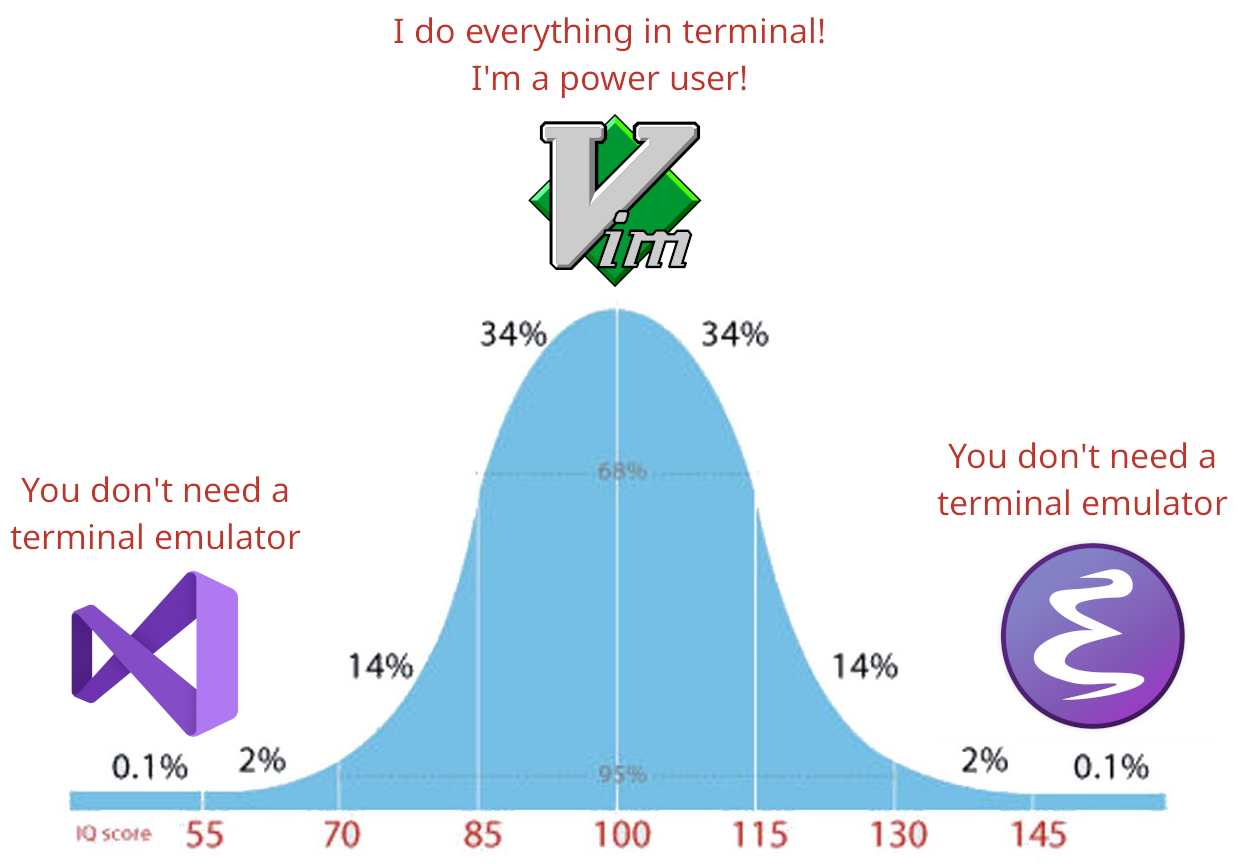
It’s like that IQ chart meme:
Figure 1: *That’s Visual Studio on the left, not VS Code
And yes, I know, there are many people who will disagree with me, probably on everything that I’m going to say next.
But hey, it’s OK to agree to disagree.
You don’t have to believe me, instead, you should try it for yourself.
I often see how young programmers walk this kind of path:
Terminals are scary.
I don’t need a terminal - my IDE does all things for me with a click of a button.
Well, I needed a terminal for some kind of task in my latest project and it wasn’t so bad.
GOSH, terminals are so powerful with all these commands available.
installs Vim
OMG, Vim is so powerful and it is a Terminal-base program!
I don’t need a fancy IDE - I’m a power user now!
And many often stop there, which is fine, but a bit sad.
I also been there, but somehow moved on.
Well, not all - some stay within the comfort zone of their IDE which is fine too, some ditch Vim for something more, or even something less, and really become power users.
Mine were:
Emacs? Eww, what’s that ugly white theme
Well, Emacs seems interesting, but it starts so slow compared to my 100+ plugins NeoVim setup.
Well, I know some people who think alike, so it’s not just me, but I do believe that it’s not a majority of Emacs users.
The Vterm package for Emacs has 1.6k stars on GitHub at the point of this article, and Emacs itself has several terminal implementations in its core.
So, where I’m coming from with this?
Basically, a few months ago I decided to stop using a terminal emulator.
At all.
I deleted my Vterm configuration from Emacs, and since I didn’t use terminal outside of Emacs it was pretty much it.
I did keep the EAT package still, as it is sometimes useful for things not so related to terminals directly, but more on that later.
Now, today I’m going to describe why terminal emulators aren’t really needed in Emacs specifically, but nothing actually prevents other software from following suit.
It just doesn’t happen that often, I guess because most of the time people freak out of non-interactive shells, even though they come with lots of benefits.
To be clear, yes, my use cases may not cover all of the workflows that involve terminals, however, I think I’m covering most of them.
For instance:
I often SSH to remote servers to browse and edit files;
More often I’m SSH’ing to remote servers to run some commands;
Sometimes even via multiple hops;
I update existing and install new system packages;
I run commands on my local machine. Things like:
project compilation;
grepping stuff;
finding files;
using things like AWK, Perl, Sed, etc.;
running servers and services in the background.
So, combined, I do both local and remote work, and I don’t need a terminal emulator for that.
How?
async-shell-command
Emacs has this command, bound by default to Alt+& (M-&), and what it does is really simple.
It runs a given command asynchronously in the background, feeding its output to the *Async Shell Command* buffer.
That’s it.
Well, in my case, I’m redirecting stderr to the *Shell Command Errors* buffer mostly for cases when stdout is somehow structured.
We’ll get to that.
What’s cool about async-shell-command is that it basically is a terminal emulator.
Well, not quite, but very close to being that.
Thing is, let’s just think about what a terminal emulator is - it’s a prompt reading a line, and text spitted between each prompt.
Well, async-shell-command is basically that, except it doesn’t have the prompt in the buffer itself - instead, it’s part of Emacs’ minibuffer.
And, unlike a terminal emulator, the result of each command is put into the dedicated buffer that you can do all of your usual Emacs operations on.
Ever wondered why things like Tmux implement things like copy-mode?
Because the terminal is interactive by nature and when you need to do non-interactive (by interactive I mean text input and command running) stuff you have to switch to a separate mode.
I don’t like separate modes that much.
So async-shell-command gives you all of the properties of a regular terminal - i.e. it displays text output from a command, and you get a prompt with history and stuff like command/file completions.
If the command requires some input from the user, Emacs will properly accept it in the said buffer - it is interactive.
However, it is not a real terminal emulator still - it can’t do TUI stuff.
So if you’ve got anything in your workflow that uses TUI async-shell-command is not the right tool for the job.
I’ll get back to the interactive TUIs in a bit, but I should say that I don’t have any such programs in my workflow.
Honestly, if I’m already using Emacs, why do I need something TUI-based, if Emacs probably already has a better graphical interface to it?
We’ll get to that.
compile & project-compile
Now let’s get to the non-interactive interactive stuff.
Earlier I mentioned that non-interactive shells (again, by interactive I mean text input and command running) have some benefits to them but it’s often hard to describe what are those to a non-Emacs user.
So, compile is very similar to async-shell-command except it doesn’t try to process any user input.
Therefore, if you ran something like scp in a compilation buffer, and forgot to place your SSH key to the machine you’re going to copy the file to, you’ll be asked for a password, but you won’t have any ability to insert it.
It’s better to use async-shell-command for stuff like that.
project-compile is exactly the same thing as compile, except it automatically detects the current project’s root directory, and runs from there.
It’s very handy to run things like make because Makefile is usually located at the project’s root.
But, why is it better than async-shell-command?
Well, compilation buffers are pretty specific - they display the log of the compilation process.
That’s why we can treat them specially too.
And Emacs does it by default, creating file links to every message in the compilation buffer.
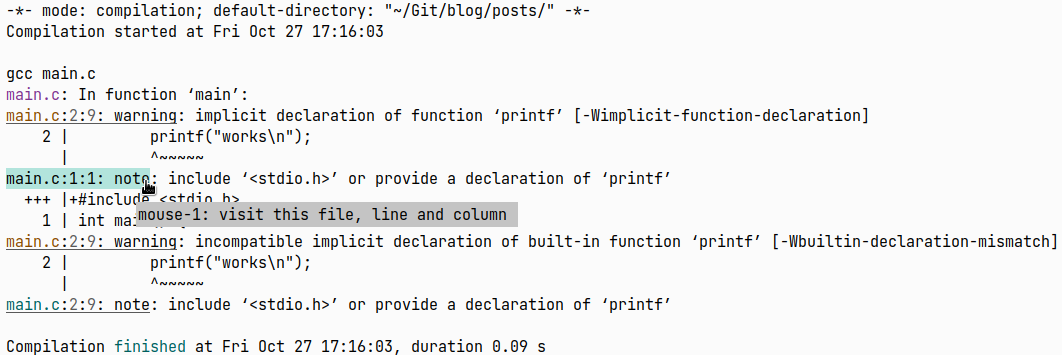
For example, if I run the M-x compile RET main.c RET with the following main.c:
int main() {
    printf("works\n");
}
We get the following buffer:
As can be seen here, each warning is highlighted with a respectful color, like notes use a teal color, and warnings are yellow.
But that can be done by terminals too, you might say.
Note, however, that when I hover my mouse over such colored text it shows up as a link that I can click.
Upon clicking it, Emacs will open that file and highlight the error.
Well, it might not be as impressive as it sounds, but this is an open interface.
You can add support for any kind of language you want, and it will work.
I have a post, describing how I’ve added support for Clojure, and went as far as searching for warnings inside dependencies stored as .jar archives in my .m2 cache.
It’s nuts how flexible this system is.
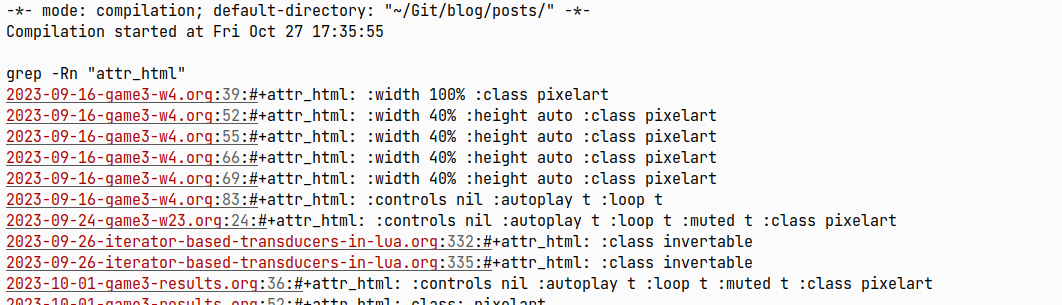
Similarly, if you run M-x project-compile RET grep -Rn "something" RET it will create a compilation buffer with the results from grep, and each result will be a clickable link:
You don’t need to click on links either, you can use n or p to go to the next link, and automatically open the file at the link’s specified position.
But running grep and other tools through the compilation buffer is a bit cumbersome, as you do have to follow a specific line format that this buffer understands.
Instead, you can use Xref.
Xref
Another thing provided by Emacs, mainly for reference navigation purposes, but extensible enough that you can make it do whatever you want.
For instance, you can run such things like grep right from Emacs, and get results in the *xref* buffer:
Figure 2: result of calling project-find-regexp which internally uses grep
Similarly to the compilation buffer, you get the same set of shortcuts to move around, but a more readable and categorized output.
And this works for many other things, like results from your language servers, tag files, etc.
Even more than that, you can do stuff like xref-query-replace-in-results from the *xref* buffer - so it can act like Sed.
And that’s my point - these tools are great, but using them from the terminal is not fun.
Emacs acknowledges that these tools are great, and provides a better interface for them without requiring you to run a terminal emulator inside Emacs.
To be fair, Emacs isn’t the only one who does this - but I find it to be the most consistent and most flexible in this regard.
But what if you need to do stuff with remote machines?
TRAMP
So, we’ve covered basic tasks involving running various commands on your local machine.
The async-shell-command can be used to run arbitrary commands and those which require some level of interactivity.
The compile command is for project compilation stuff, and Xref is for navigating references provided by some other tools or Emacs itself.
Now imagine we need to run grep on the remote - how would we do that?
TRAMP got you covered.
When opening a file in Emacs you can start the path with a forward slash / followed by a protocol, like ssh and Emacs will open a remote file for you.
For example /ssh:user@host:/home/user/.bashrc will open the .bashrc file on the remote machine if you have access to that.
If not, Emacs will ask for the password, and it is basically the same as the ssh in the terminal.
But now, when you’ve opened a file via the TRAMP, suddenly, you can use all these things I’ve been talking about before - async-shell-command, compile, project-find-regexp and it will do its work on the remote.
It’s really transparent.
More than that - if you have a remote machine, and it has something like a language server installed, Emacs will not try to run your local machine’s language server (if it even has one), instead, it will run it on the remote.
This means that you can run Emacs on your machine, but have all of the development stuff needed on the remote.
And you don’t need to run Emacs remotely, or do X over ssh, or use things like sshfs - just use TRAMP.
And TRAMP isn’t limited to just ssh.
You can enter containers as well, e.g. opening a file with /podman:container-name:/path/to/file will give you access to files and programs in a container.
And there are many more methods that TRAMP supports, so you’re probably well covered for your particular remote accessing needs.
As for me, instead of SSH’ing to a machine I just open it in DIRED via TRAMP, and run commands using async-shell-commands most of the time.
Yes, TRAMP can be slow, but I haven’t noticed that in my practice.
It depends on the connection speed, and when I do my work, all remote machines are usually in the same network.
Your case may vary.
But I can’t stress this enough - you don’t need a terminal emulator for the task of editing remote files or running commands.
Imagine this - I have to work with remote machines created by other people.
They’re set up from an arbitrary Linux image, not all of them even have Vim - only stripped down vi.
So if I were to ssh to them and run vi I would probably be bald now, because vi is terrible, and if your terminfo isn’t supported by the remote you get gibberish symbols here and there when interacting with vi or even the shell some times.
And believe me, I know how to use vi and Vim, I used them for many years prior to Emacs - I just don’t want to anymore.
So every time I hear things like: “Yeah, Emacs is cool, but I have to SSH to headless remotes and edit files, so Vim is a more fitting choice for me”, I say: “No. No it isn’t”.
And even if that’s the case - by SSH’ing to a remote, you lose your Vim configuration - you either get a pure Vim or sometimes even just a plain vi.
When I was using Vim, not having my config around was annoying, because I had many handy keybindings, helpful plugins for navigation, and so on.
So instead of SSH’ing, I used sshfs to mount the remote.
This can work, until you need to execute something on the remote - then you still need to use SSH.
With Emacs - I don’t.
TUIs
Now, let’s get back to the elephant in the room.
Running grep and other stuff is fun and all but we can’t leave out programs that use a TUI - Terminal User Interface.
I often see people running mc (Midnight Commander), some use TUI Git clients, and many find fzf very useful.
And yeah, neither async-shell-command nor compile can run those.
If I try to run mc from the former, I get this message:
Your terminal lacks the ability to clear the screen or position the cursor.
And that’s reasonable, it’s just a text buffer, not a terminal emulator, as I’ve mentioned.
However, why would you run mc if you have DIRED in Emacs?
Same with the TUI Git clients - MAGIT blows those out of the water.
FZF?
Emacs has multiple completion narrowing and filtering frameworks that integrate with the rest of Emacs, so I don’t see why would I need to use fzf specifically.
And if you want - you can, there’s a package that integrates with it.
So, my point is - most of the time, there is either a package providing a superior experience to the one that the TUI app provides.
And it’s still text - you can use all of your Emacs operations on it, like on a regular buffer, same as in a terminal, just less clunky.
Also, remember how I said that I install system packages from Emacs?
Well, package managers usually don’t have a TUI, so I do it from async-shell-command which allows me to interactively use my system’s package manager.
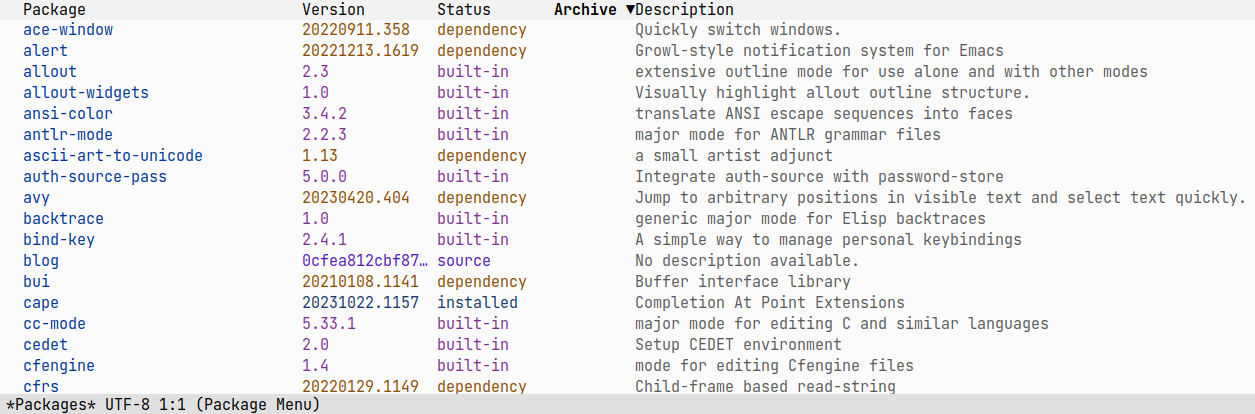
But, if I were a GNU Guix user, I could use Emacs to get an interface similar to the one you get with package.el:
So yeah, Emacs is able to give you a better interface to your tools than a terminal emulator.
And if not, which I’m yet to see, you can run a shell in Emacs.
Wait, wait, I said you can run a shell, not a terminal emulator.
That doesn’t count, right?
Eshell
Emacs has its own shell, written in Emacs lisp, that works across multiple operating systems.
It is called eshell and it is great.
You can extend it with Emacs Lisp, you can write scripts in Emacs Lisp, and it still has access to all of the other tools you use regularly.
But again, it is not a terminal emulator, it is a shell.
Like bash.
So if we try to run a program that requires terminal capabilities specifically, Eshell will automatically create a separate buffer that runs an ANSI terminal emulator, also written in Emacs Lisp.
Which means that your interactive TUI programs should run fine.
In practice, it isn’t always great.
However, recently I’ve found this package: EAT.
It is a terminal emulator that can run inside an Eshell buffer - meaning that you don’t have to deal with separate buffers and such if you happen to run a command that requires a proper terminal.
Of course, you can use EAT as a terminal emulator by itself, but I don’t find this that useful.
Instead, I use it from Eshell, although very rarely too.
It’s just a nice backup.
What are the tasks you believe you need a terminal for?
I’m genuinely interested, feel free to contact me and share your thoughts.
Or if you tried the ones I’ve provided and it wasn’t better, or if you just think that they won’t work for you - we can chat about that too.
I found myself on this weird path just a few months ago, but these were very busy months.
Meaning, I think I have enough experience with this way of doing things to say that it is good.
Again, I work with remote machines all the time, and I have to transfer files to them, edit remote files, watch logs live as the services are running, do remote development and more.
And I do it from TRAMP with the help of async-shell-command and nothing else.
For local tasks, I use project-compile and other project-related functions.
At first, it wasn’t as seamless, but I got adjusted quickly.
Yes, I felt the urge to run Vterm, and SSH from there at first - but as time went by I noticed that opening TRAMP is much easier, as it reuses the already familiar Emacs’ file prompt.
And the same goes for every other command I do.
It’s a shame that most other software I know doesn’t do this kind of integration.
Visual Studio Code just gives you an integrated terminal - which is no different from an ordinary terminal.
And in the case of Linux, probably isn’t the greatest terminal either.
IntelliJ IDEA does that too, and while their terminal tries to do some smart things, I find it inconsistent.
The same goes for other code editors, like Vim which also now has an integrated terminal.
Though running a terminal from a terminal-based editor is weird - you’re one ^Z away from your shell anyway.
And for multiplexing needs, you can always use Tmux, which again, is probably better than the integrated terminal.
Kakoune is an interesting case here, they have a similar idea to Emacs - you can run commands and pipe their output to a buffer to later process it.
And because there’s no extension language in Kakoune, it’s the primary way of adding features to the editor.
E.g. you can’t implement a fuzzy file picker in Kakscript - you gotta use fzf for that.
And while that’s a great way of handling this, I would say it’s better than how Vim handles this, I still think that it’s not as good as what Emacs does.
But Emacs is an old project, it had time to develop all of that, while Kakoune is still young.
Well, that’s it.
Feel free to share your thoughts, disagree with me, or whatnot.
I think I’m now a firm believer that terminals need to die off at this point.
A superior integration is possible, and already available.
Thanks for reading!
Julia and Nick sit down with Lena and Michael from the German language podcast, Parallelwelt Palästina, about the current war in Gaza and the response from the German state and media demonizing and criminalizing criticism of Israel.
The near-revolution in Spain in 1909 turns out to be more of a cause of World War 2 than a cause of World War 1 but it includes anarchism, conspiracy, revolution, and ends in a show trial. Our final pause before we roll into the immediate causes of WW1.
SINGULAR demolition of the homilies of the Church of Anglophone Academic Economics regarding anthropogenic climate change
William Nordhaus speaks during a press conference after winning the Nobel Memorial Prize in Economic Sciences at Yale University in New Haven, Conn., on Oct. 8, 2018. Photo: Eduardo Munoz Alvarez/Getty Images
William Nordhaus, who turned 82 this year, was the first economist in our time to attempt to quantify the cost of climate change. His climate-modeling wizardry, which won him the Nobel Memorial Prize in Economic Sciences in 2018, has made him one of the world’s most consequential thinkers. His ideas have been adopted by the Intergovernmental Panel on Climate Change, the U.S. Environmental Protection Agency, global risk managers, the financial services industry, and universities worldwide that teach climate economics. Nordhaus’s work literally could affect the lives of billions of people. This is because his quantification of the immediate costs of climate action — as balanced against the long-term economic harms of not acting — is the basis of key proposals to mitigate carbon emissions. It’s not an exaggeration to suggest that the fate of nations and a sizable portion of humanity depends on whether his projections are correct.
The Intergovernmental Panel on Climate Change has assumed Nordhaus is to be trusted. The integrated assessment models used at the IPCC are based on Nordhausian visions of adaptation to warming that only marginally reduces global gross domestic product. If future GDP is barely affected by rising temperatures, there’s less incentive for world governments to act now to reduce emissions.
Nordhaus’s models tell us that at a temperature rise somewhere between 2.7 and 3.5 degrees Celsius, the global economy reaches “optimal” adaptation. What’s optimal in this scenario is that fossil fuels can continue to be burned late into the 21st century, powering economic growth, jobs, and innovation. Humanity, asserts Nordhaus, can adapt to such warming with modest infrastructure investments, gradual social change, and, in wealthy developed countries, little sacrifice. All the while, the world economy expands with the spewing of more carbon.
His models, it turns out, are fatally flawed, and a growing number of Nordhaus’s colleagues are repudiating his work. Joseph Stiglitz, former World Bank chief economist and professor of economics at Columbia University, told me recently that Nordhaus’s projections are “wildly wrong.” Stiglitz singled out as especially bizarre the idea that optimization of the world economy would occur at 3.5 C warming, which physical scientists say would produce global chaos and a kind of climate genocide in the poorest and most vulnerable nations.
In a journal article published last year, Stiglitz and co-authors Nicholas Stern and Charlotte Taylor, of the Grantham Research Institute on Climate Change and the Environment at the London School of Economics and Political Science, declared that Nordhausian integrated assessment models are “inadequate to capture deep uncertainty and extreme risk.” They fail to incorporate “potential loss of lives and livelihoods on immense scale and fundamental transformation and destruction of our natural environment.”
Climate change is one of the instances, Stiglitz and Stern told me in an email, in which “it is generally agreed there is extreme risk — we know there are some really extreme events that could occur — and we know we cannot pretend (i.e., act as if) we know the probabilities. Nordhaus’s work doesn’t appropriately take into account either extreme risk or deep uncertainty.”
In other words, the economist who has been embraced as a guiding light by the global institution tasked with shepherding humanity through the climate crisis, who has been awarded a Nobel for climate costing, who is widely feted as the doyen of his field, doesn’t know what he’s talking about.
Farmers harvest barley and wheat in northwest Syria on May 31, 2023, crops that are being threatened by drought and climate fluctuations. Photo: Rami Alsayed/NurPhoto via Getty Images
Among most scientists, it’s lunacy to discuss optimization of anything anywhere when the globe hits even 2 C warming. Climate researchers Yangyang Xu and Veerabhadran Ramanathan, in a widely cited 2017 paper, defined 1.5 C warming as “dangerous” and 3 C or greater as “catastrophic,” while above 5 C was “beyond catastrophic,” with consequences that include “existential threats.” The late Will Steffen, a pioneering Earth systems thinker, warned alongside many of his colleagues that 2 C was a critical marker. At 2 C warming, we could “activate other tipping elements in a domino-like cascade that could take the Earth system to even higher temperatures.” Such “tipping cascades” could lead quickly to “conditions that would be inhospitable to current human societies,” a scenario known as hothouse Earth.
But the path to hothouse Earth will be long and tortured. When I interviewed him in 2021, Steffen, who died last January at age 75, was concerned about “near-term collapse” of the global food system. Drought and heat have already reduced global cereal production by as much as 10 percent in recent years, according to Steffen. “Food shocks are likely to get much worse,” he wrote in a 2019 piece co-authored with Aled Jones, director of the Global Sustainability Institute at Anglia Ruskin University. “The risk of multi-breadbasket failure is increasing, and rises much faster beyond 1.5 C of global heating. … Such shocks pose grave threats — rocketing food prices, civil unrest, major financial losses, starvation, and death.”
In a 2022 report titled “Climate Endgame: Exploring Catastrophic Climate Change Scenarios,” 11 leading Earth systems and climate scientists, Steffen among them, concluded there is “ample evidence that climate change could become catastrophic … at even modest levels of warming.” According to the report:
Climate change could exacerbate vulnerabilities and cause multiple, indirect stresses (such as economic damage, loss of land, and water and food insecurity) that coalesce into system-wide synchronous failures. … It is plausible that a sudden shift in climate could trigger systems failures that unravel societies across the globe.
What these scientists are describing is global civilizational collapse, possibly in the lifetime of a young or even middle-aged reader of this article.
According to the “Climate Endgame” report, the current trajectory of carbon emissions puts the world on track for a temperature rise between 2.1 C and 3.9 C by 2100. This is a horrific prospect. Earth systems analysts tell us that habitable and cultivable land in a 3 C to 4 C warming regime would be so reduced and ecosystem services so battered that the deaths of billions of people could occur in the next eight decades or less.
Terrible numbers get thrown around. But scientists mean what they say. Kevin Anderson, professor of energy and climate change at the University of Manchester in the U.K. and Uppsala University in Sweden, asserts that “something like 10 percent of the planet’s population — around half a billion people — will survive if global temperatures rise by 4 C.” He notes, with a modicum of hopefulness, that we “will not make all human beings extinct as a few people with the right sort of resources may put themselves in the right parts of the world and survive. But I think it’s extremely unlikely that we wouldn’t have mass death at 4 C.”
Johan Rockström, director of the Potsdam Institute for Climate Impact Research in Germany and a leading researcher on climate tipping points and “safe boundaries” for humanity, projects that in a 4 C warmer world, “it’s difficult to see how we could accommodate a billion people or even half of that.” Global population today stands at 7.6 billion, with 80 million people added every year.
By contrast, when Nordhaus looked at the effects of 6 C warming, he did not forecast horror. Instead, we should expect “damages” of between 8.5 percent and 12.5 percent of world GDP over the course of the 21st century. Writing in the Economic Journal, Stern set Nordhaus straight in the harshest terms: “We could see deaths on a huge scale, migration of billions of people, and severe conflicts around the world,” he wrote. “It is profoundly implausible that numbers around 10 percent of GDP offer a sensible description of the kind of disruption and catastrophe that 6 C of warming could cause.”
In an email to The Intercept, Nordhaus characterized his colleagues’ critiques as “a distorted and inaccurate description of the work and my views. I have long supported carbon pricing and climate-focused [research and development], which are key to slowing climate change. The proposals in my writings have pointed to targets that are FAR more ambitious than current policies.” He declined to elaborate on any distortions or inaccuracies.
To understand the gap between climate scientists and climate economists, one must first understand that most economists — the folks we call mainstream or neoclassical economists — have little knowledge of or interest in how things really work on planet Earth. The problem of their ecological benightedness starts as a matter of training at university, where a typical undergraduate course in economics prepares students for a lifetime of abject ignorance about the complex underpinnings of the thing called the “market.”
Start with your typical textbook for the dismal science — say, the definitive one by Paul Samuelson, co-written with Nordhaus, titled “Economics.” The book is considered “the standard-bearer” of “modern economics principles.” You’ll find in its pages a circular flow diagram that shows “households” and “firms” exchanging money and goods. This is called the market. Households are the owners of land, labor, and capital, which they sell to firms for the manufacture of goods. Households then buy the goods, enriching firms, which allows the firms to buy more land, labor, and capital, enriching households. The quantity in the flow diagram, in ideal circumstances, is ever expanding: The profits of firms grow and so does the income of households.
A simple, imperturbable closed system that’s also ludicrous, fantastical, a fairy tale. In the circular flow diagram of standard economics, nothing enters from the outside to keep it flowing, and nothing exits as a result of the flow. There are no resource inputs from the environment: no oil, coal, or natural gas, no minerals and metals, no water, soil, or food. There are no outputs into the ecosphere: no garbage, no pollution, no greenhouse gasses. That’s because in the circular flow diagram, there is no ecosphere, no environment. The economy is seen as a self-renewing, perpetual-motion merry-go-round set in a vacuum.
The economy is seen as a self-renewing, perpetual-motion merry-go-round set in a vacuum.
“I taught that foolish little diagram to undergraduates at Louisiana State University for 30 years,” the late Herman Daly, one of the 20th century’s great dissenters from standard economics, told me in an interview before his death at age 84 last year. “I thought it was just great. I was well beyond a Ph.D. before it came crashing in on my head that this is a very bad paradigm.”
In the 1970s, working at the University of Maryland, Daly pioneered the field of ecological economics, which models the biophysical reality that delimits all economies. “The human economy,” wrote Daly, “is a fully contained wholly dependent growing subsystem of the non-growing ecosphere” — a commonsense observation that amounted to heresy in mainstream economics. Daly emphasized that the economy depends on nonrenewable resources that are always subject to depletion and a functioning biosphere whose limits need to be respected. His most important contribution to the literature of this renegade economics was his famous (in some circles, infamous) “steady state” model that accounts for biophysical limits to growth. Daly paid the price of heterodoxy. His fellow economists declared him an apostate.
E.F. Schumacher arrived at similar conclusions about mainstream economics in his 1973 book “Small Is Beautiful,” which became a bestseller. “It is inherent in the methodology of economics to ignore man’s dependence on the natural world,” Schumacher wrote, the emphasis his. Economics, said Schumacher, only touches the “surface of society.” It has no capacity to probe the depths of the systemic interactions between civilization and the planet. Faced with the “pressing problems of the times” — the negative environmental effects of growth — economics acts “as a most effective barrier against the understanding of these problems, owing to its addiction to purely quantitative analysis and its timorous refusal to look into the real nature of things.”
Purely quantitative analysis is the amphetamine of the mainstream economist. The steady dosing keeps his pencil sharp and his eyes blind. It has not gone unnoticed that graduate schools produce a kind of ingenious hollowness in economists who race to the finish on the schools’ assembly line. As early as 1991, a report from a commission on “graduate education in economics” warned that the university system in the United States was churning out “too many idiot savants,” economists “skilled in technique but innocent of real economic issues” — unable, that is, to look into the real nature of things.
Forest fires spread due to the dry season and high temperatures in Karanganyar, Central Java, Indonesia, Oct. 6, 2023. Photo: Devi Rahman/AFP via Getty Images
By what mathemagical sorcery has Nordhaus, celebrated member of the Ivy League elite, arrived at projections that are so out of line with those of climate scientists?
The answer is in something called DICE, the mother of integrated assessment models for climate costing. It stands for dynamic integrated climate-economy. Nordhaus formulated DICE for the first time in 1992 and updated it most recently last year.
In DICE, the effect of a warmed climate is measured solely as a percentage loss (or gain) in GDP. Growth of GDP is assumed to be “exogenously determined,” in the language of economics theory, meaning it will persist at a set rate over time regardless of climate shocks. Earth systems scientists will tell you that to assume exogenously determined growth is the height of hubristic arrogance. By contrast, Nordhaus assures us in his DICE model that growth continues like a cruising Cadillac on the California coast with an occasional pothole. But the reality is rainstorms, mudslides, earthquakes, and other drivers on the road.
This blithe presumption of constant growth in a climate-damaged future is the first of Nordhaus’s errors, as Stern and Stiglitz point out. “Nordhaus’s model doesn’t fully take into account the fact that if we don’t do more to avert climate change, climate change will affect growth rates,” they told me in an email. “We will have to spend more and more repairing damage, leaving us less and less to spend on growth-enhancing investments.” And, they add, some outcomes arising from weak climate action could profoundly alter what is possible in terms of economic activity. Extreme heat, submergence, desertification, hurricanes, and so on: Such weather events and broad climatic shifts could render large areas of the world low productivity, unproductive, or uninhabitable.
The second of Nordhaus’s errors is the use of reductionist mathematical formulas. He employs something called a quadratic to calculate the relationship between rising temperatures and economic outcomes. Among the properties of a quadratic is that it permits no discontinuities; there are no points at which the relationship implied by the function breaks down. But smooth functions chart smooth progressions, and climate change will be anything but smooth. Such calculations do not account for extreme weather, vector-borne diseases, displacement and migration, international and local conflict, mass morbidity and mortality, biodiversity crash, state fragility, or food, fuel, and water shortages. There’s no measurement of amplifying feedbacks and tipping points such as Arctic sea ice loss, shutdown of vital ocean currents, collapse of the Amazon, and the like.
The third of Nordhaus’s errors is related to similarly simplistic formulas. Nordhaus calculates GDP of a particular location as fundamentally related to the temperature of that place. So, if in 2023 it’s a certain temperature in London, and the GDP in London is such-and-such, it’s reasonable to assume that when latitudes north of London rise in temperature in the future, GDP will rise to be the same as London’s today. Make of this what you will — it’s foolishness on a grand scale, and yet it’s central to the Nordhaus model.
The fourth fatal error Nordhaus makes is the most farcical. In a 1991 paper that became a touchstone for all his later work, he assumed that, because 87 percent of GDP occurs in what he called “carefully controlled environments” — otherwise known as “indoors” — it will not be affected by climate. Nordhaus’s list of the indoor activities free of any effects from climate disruption include manufacturing, mining, transportation, communication, finance, insurance, real estate, trade, private sector services, and government services. Nordhaus appears to be conflating weather with climate. The one can make trouble for outdoor dining plans on your yacht. The other sinks the yacht.
Ignorance of systems has its way of plowing forward, juggernaut-like. Nordhaus has opined that agriculture is “the part of the economy that is sensitive to climate change,” but because it accounts for just 3 percent of national output, climate disruption of food production cannot produce a “very large effect on the U.S. economy.” It is unfortunate for his calculations that agriculture is the foundation on which the other 97 percent of GDP depends. Without food — strange that one needs to reiterate this — there is no economy, no society, no civilization. Yet Nordhaus treats agriculture as indifferently fungible.
This crude mess of a model is what won him the Nobel. “It shows how little quality control goes into selecting a winner in economics that he was even nominated for the prize,” Steve Keen, a research fellow at University College London and self-described renegade economist, told me. Keen has authored numerous books that question the orthodoxy of mainstream economics. He was an early critic of the integrated assessment models at the IPCC that owe their optimistic sheen to Nordhaus’s methodology. His caustic 2021 essay, “The Appallingly Bad Neoclassical Economics of Climate Change,” delved into the problems of Nordhausian models.
“When it comes to climate, the guy is an idiot: an idiot savant, but still fundamentally an idiot.”
“Any investigative journalist who overcame a fear of equations and simply read Nordhaus’s texts would have known that his work was nonsense,” Keen told me. “Assuming that 87 percent of the economy would be ‘negligibly affected by climate change’ because it takes place in ‘carefully controlled environments’?”
“When it comes to climate,” Keen said, “the guy is an idiot: an idiot savant, but still fundamentally an idiot.”
And it’s not just Nordhaus. Climate economists have followed dutifully in his footsteps and come up with cost models that appear to have no relationship with known laws of physics, the dynamics of climate, or the complexities of Earth systems.
A 2016 study by economists David Anthoff of University of California, Berkeley; Francisco Estrada of the Institute for Environmental Studies in Amsterdam; and Richard Tol of the University of Sussex offers one of the more egregious examples of Nordhausian nonsense. (Tol is one of Nordhaus’s protégés, and Nordhaus is listed as a reviewer of the paper.) The three academics boldly assert that shutdown of the Atlantic meridional overturning circulation, or AMOC — a pivotally important Earth system that loops warm equatorial water toward the Arctic and cold water back south — could have beneficial effects on the European economy.
Over the last several thousand years, the AMOC, also known as the thermohaline circulation, has functioned to keep Europe relatively warm in winter because of the warm water it draws northward from the equator. The slowing and eventual shutdown of this system could plunge Europe and broad parts of the Northern Hemisphere into extreme cold. Such a shutdown is a growing likelihood as glacial melt pours into the North Atlantic and alters the delicate balance of salt water and fresh water that drives the looping current.
For Tol, Anthoff, and Estrada, however, collapse of one of the Earth systems that undergirds the climatic stability of the Holocene might be a good thing. “If the [AMOC] slows down a little, the global impact is a positive 0.2-0.3 percent of income,” they concluded. “This goes up to 1.3 percent for a more pronounced slowdown.” They argued that while climate heating cooks the rest of the world, European countries will benefit from a cooling effect of the current’s collapse.
This sunny assessment comes as a surprise to James Hansen, father of climate science, who has calculated that a massive temperature differential between the poles and the equator would occur with an AMOC shutdown, producing superstorms of immense fury across the Atlantic Ocean. According to Hansen, the last time Earth experienced those kinds of temperature differentials, during the interglacial Eemian era roughly 120,000 years ago, raging tempests deposited house-sized boulders on coastlines in Europe and the Caribbean. Waves from the storms were estimated to have surged inland to 40 meters above sea level.
Under these extreme conditions, what would happen to shipping lanes, coastal cities and ports, and trans-Atlantic traffic of all kinds? For the climate simpletons Tol, Anthoff, and Estrada, the question doesn’t come up. “It will be a helluva lot stormier on the North Atlantic, especially for Europeans,” Hansen told me in an email. His study team concluded that shutdown of AMOC “is in the cards this century, possibly by mid-century, with continued high emissions.”
It gets worse. Simon Dietz, at the London School of Economics and Political Science, and his fellow economists James Rising, Thomas Stoerk, and Gernot Wagner have offered some of the most ignorant visions of our climate future, using Nordhausian math models. They examined the consequences to GDP of hitting eight Earth system tipping points that climate scientists have identified as existential threats to industrial civilization. The tipping points are as familiar as a funeral litany to anybody schooled in climate literature: loss of Arctic summer ice; loss of the Amazon rainforest; loss of the Greenland and West Antarctic ice sheets; release of ocean methane hydrates; release of carbon in permafrost; collapse of the AMOC; and collapse of the Indian monsoon.
Dietz and friends came to the astounding conclusion that if all eight were tipped, the economic cost by 2100 would amount to an additional 1.4 percent of lost GDP on top of the roughly 8 to 12 percent that Nordhaus projected.
Think of this projection in commonsense terms: A negligible effect on world affairs when the Arctic during summer is deep blue rather than white; when the jungle of the Amazon is no longer green but brown savannah or desert; when in Greenland and the West Antarctic, white ice is barren rock. A transformation of immense proportions on the Earth’s surface, in the atmosphere, and in terrestrial biotic communities. Ocean methane hydrates have an energy content that exceeds that of all other fossil fuel deposits. Permafrost holds an amount of carbon roughly twice the current carbon content of the atmosphere. With the weakening or collapse of the AMOC, Europe could be plunged into conditions akin to the Little Ice Age, with drastic reduction of the land area suitable for wheat and corn farming. Increased variability of the Indian monsoon would jeopardize the lives of over a billion people.
“The claim that these changes would have effectively zero impact upon the human economy is extraordinary,” wrote Keen. The reality is that if all eight Earth system tipping points were reached, humanity would be in terrible trouble.
An aerial view of a polar bear, one of the species most affected by climate change, walking on partially melting glaciers in Svalbard and Jan Mayen on July 15, 2023. Photo: Sebnem Coskun/Anadolu Agency via Getty Images
An uncharitable view of the work of climate economists in the Nordhaus school is that they offer a kind of sociopathy as policy prescription. Nordhaus estimates that as economic activity heads poleward with warming, the massive reduction in GDP in the tropics will be offset by optimal adaptation in the Global North. “Massive reduction in GDP,” of course, is not explicitly understood by Nordhaus as food system collapse across the equator, followed by social collapse, mass death, wars, and biblical exoduses that produce cascading nonlinear effects drawing the world into a nexus of unknowns.
Nothing to worry about, assures Nordhaus: The violent extinction of low-GDP nations will hardly affect the outlook for economic growth because things will improve in the cold Global North. This is an embrace of imagined silver linings in a climate genocide.
This is an embrace of imagined silver linings in a climate genocide.
Do governments, policymakers, and the public have any clue that the message from climate economist elites is unhinged? So far, we have followed along in the belief that all is well. One of the better indicators of this lemming-like fealty to a narrative of delusory optimism is in the financial sector.
Keen authored a report for investors this year in which he noted that pension funds have swallowed whole the Nordhausian projections of our sunny future as the climate system collapses. “Following the advice of investment consultants, pension funds have informed their members that global warming of 2-4.3 C will have only a minimal impact upon their portfolios,” Keen wrote. “This results in a huge disconnect between what scientists expect from global warming, and what pensioners/investors/financial systems are prepared for.” Keen does not expect things to end well for investors.
When I asked him what needed to be done to alter policy at the IPCC, Keen replied, “We need everyone to be as angry as I am.” Negligence by economists like Nordhaus, he said, “will end up killing billions of people.”
Andrew Glikson, who teaches at Australian National University in Canberra and advises the IPCC, has written about the coming era of mass human death, what he calls the Plutocene, the natural successor to the Anthropocene. Global governments, he charges, are “criminals” for ushering in the Plutocene in pursuit of short-term political and economic gain. I first reached out to him during the black summer of bushfires that raged across Australia in 2020. Glikson’s mood was foul then, and it has not gotten better since.
“The governing classes have given up on the survival of numerous species and future generations,” he told me, “and their inaction constitutes the ultimate crime against life on Earth.” Part of the reason for inaction is the false cheer that Nordhaus has spread with his math-genius, climate-idiot models.
EXCELLENT esp regarding * Ukraine-Palestine as gutpunch to empire prestige * preview of Israel ground invasion of Gaza, predicting Israel military to use chemical weapons against Hamas tunnels
Roth week continues as we go round the horn discussing who we got in this year’s World Bible Championship. More seriously, we discuss updates on the Israel-Gaza war, including Biden’s comments doubting the accuracy of Palestinian casualties. And then later, more news on Congressman George Santos and his many criminal shenanigans, and a reading series in classic Chapo style: a right wing ghoul with bizarre opinions on candy. Get bonus content on Patreon
Krystal and Saagar do better-than-recent-usual BP. segments in order of presentation:
- mass shooter de jour: will have zero effect on US politics (and ~0 on population), so why bother? + KB and SE good on how Israel and US deepstates (including new US Speaker of the House) are going pro-Israel apocalypse as rest of world going harder pro-Palestine + KB and SE discuss US empire global military footprint, and how it's pausing Israel invasion of Gaza to prepare global protection + new US Speaker of the House (Mike Johnson) is very rightwing culture warrior: anti-gay, anti-abortion, pro-Israel, pro-rapture - KB and SE debate Jamaal Bowman fire-alarm-ing: gotta say I'm with Krystal on not caring + KB and SE pullback just a bit (KB more than SE) from their (pro tip: mistaken) conclusion (on their 18-19 Oct 2023 shows) that the 17 Oct 2023 attack on the Gaza al-Ahli hospital was a Palestinian Islamic Jihad rocket (pro tip: far more evidence indicts Israeli airburst JDAM, which KB+SE continue to ignore). KB (more than SE, who's waffling) is drawn to new NYT report blaming errant Iron Dome (failed) interceptor. ~ KB (/much/ more than SE) now admitting that ... there's actual journalists in Gaza! (now that much of bureau chief Wael Dahdouh's family as been killed) but SE is still on his anti-Qatar jihad. - Hollywood (and beyond) Israel-Palestine virtue-signaling (who cares?) + UAW seems to make big gains from tentative Ford contract
Krystal and Saagar discuss a mass shooter in Maine that's on the loose after leaving at least 16 dead, Israeli tanks enter Gaza as Netanyahu declares Holy war, 21 US troops reported injured in Iraq and Syria attacks, we look into the New House Speaker's wild past, Krystal and Saagar debate Jamaal Bowman as he's charged with a misdemeanor for pulling the fire alarm, NYT disputes Hospital strike intel from Israel, Al Jazeera Gaza Chief's family killed in Israel, Hollywood melts down with dueling Israel Palestine letters, and Ford folds to UAW demands in a historic contract.
Will & Hesse look at two starring God Tom Atkins: John Carpenter’s “The Fog” (1980) & Tommy Lee Wallace’s “Halloween III: Season of the Witch”. Also a Carpenter double feature of sorts, one from the director himself, and one continuing from his iconic Halloween (1978) film as he intended the franchise to be, an anthology. The Fog is a true American ghost story wrestling with monstrous crimes of our past, and Halloween III is an outrageous gorefest with one of the most infamously ludicrous plots in all horror cinema. Tom Atkins plays an everyman sex symbol in both, laying pipe as he’s terrorized by ghosts & robots through anonymous northern California towns.
Note: Will promised we’d timestamp the Tom Atkins Ass Shot in the description. I do not have time to do that this evening. Sorry.
In order to be a really proficient Emacs user, you’re going to have to learn at least a little bit of Elisp. As I’ve said before, Elisp is at once both easy and hard to learn. Like all Lisps, there’s not much syntax or dark corners to know. That’s simple. The hard part is the huge run time library. There are hundreds of functions performing all sorts of actions. Even after 15 years, I still don’t know all of them.
Over at Emacs Elements there’s a new video titled Great links to help you learn Emacs Lisp. The video starts off by saying that unlike many other languages you’re going to have to learn Elisp by yourself. That’s true, I guess, but no more true than for any other language. There are plenty of resources for learning Elisp—indeed, that’s the point of the video—probably not as many for learning, say, Python but still plenty.
One of the commenters complained that there was no point in having a video; all that’s really required, he says, is the list of links. I disagree with that. The video discusses each link in the list and why it’s worthwhile spending your time on. In any event, the list is here. As you can see, there are lots of way to learn Elisp but like everything else you have make the effort. I don’t know of any other way of learning anything but learning it yourself.
> 1. Kia EV6 > 2. BMW iX > 3. Genesis GV60 > 4. BMW i4 > 5. Hyundai Ioniq 6
> None of the five vehicles qualify for federal tax credits (though next year’s Equinox EV will), which can be up to $7,500 for models that meet standards for being assembled in the United States with battery components from the United States or certain other countries. [This searchable {database, tax-credit calculator}](https://fueleconomy.gov/feg/tax2023.shtml) shows which vehicles qualify.
While Tesla leads in sales, Kia, Hyundai and Genesis stand out for quality, according to a leading tester.
By Dan Gearino
General Motors CEO Mary Barra said this week that her company is “moderating the pace” of its electric vehicle rollout.
David J. Roth joins us this week as we continue discussing the relatively limp and unconvincing propaganda emerging around the Israel-Gaza war. Then, David gives us his review of “Moneyball” Michael Lewis’ new book on Sam Bankman-Fried, and we take a look at a new Washington Post piece chronicling Jim Jordan’s career arc from college wrestling champion to almost-Speaker of the House.
David’s review of Going Infinite is here: https://nymag.com/intelligencer/2023/10/how-michael-lewis-got-duped-by-sam-bankman-fried.html
Leading up to 1914 socialist movements all over Europe, notably in France and Germany, had become so strong that they were in the very halls of power. But when faced with the onset of the Great War, the established socialists blinked, unwilling to risk their heard-earned position and possibly be arrested and have their parties … Continue reading "World War Civ 24: Why socialists failed to stop the war"
AbstProcDo, like me, is a terrible artist. Sometimes, though, we need to add a diagram to our documentation, report, or Blog post. I usually use Graphviz or, when I’m in Troff mode, Pic for this. But these aren’t the only possibilities. Another that I keep meaning to try is PlantUML. Despite its name, it’s a pretty flexible drawing program—at least for the types of diagrams that I need to draw.
AbstProcDo has a short reddit post that very succinctly demonstrates using PlantUML with Org Babel. It’s by no means a complete exegesis on using PlantUML but it does give a flavor of using it with Org mode and showcases two very different types of diagrams that you can produce with it.
I like that the markup language is intuitive and probably easy to remember. Take a look at the second diagram and the markup that it generated. It would be a lot harder to generate that in Pic or even Graphviz. Don’t get me wrong, they’re both great applications that I’ve used many, many times over the years but I don’t use them everyday and I always have to refresh my memory on their use when I do.
If you occasionally have to produce line drawings in your work, PlantUML is definitely worth a look.
Afterward
After writing this post, I discovered a second reddit post by AbstProcDo that describes making Gantt-like charts with PlantUML. You can see an example of its actual use in Org Babel blocks here by clicking on the Raw button.
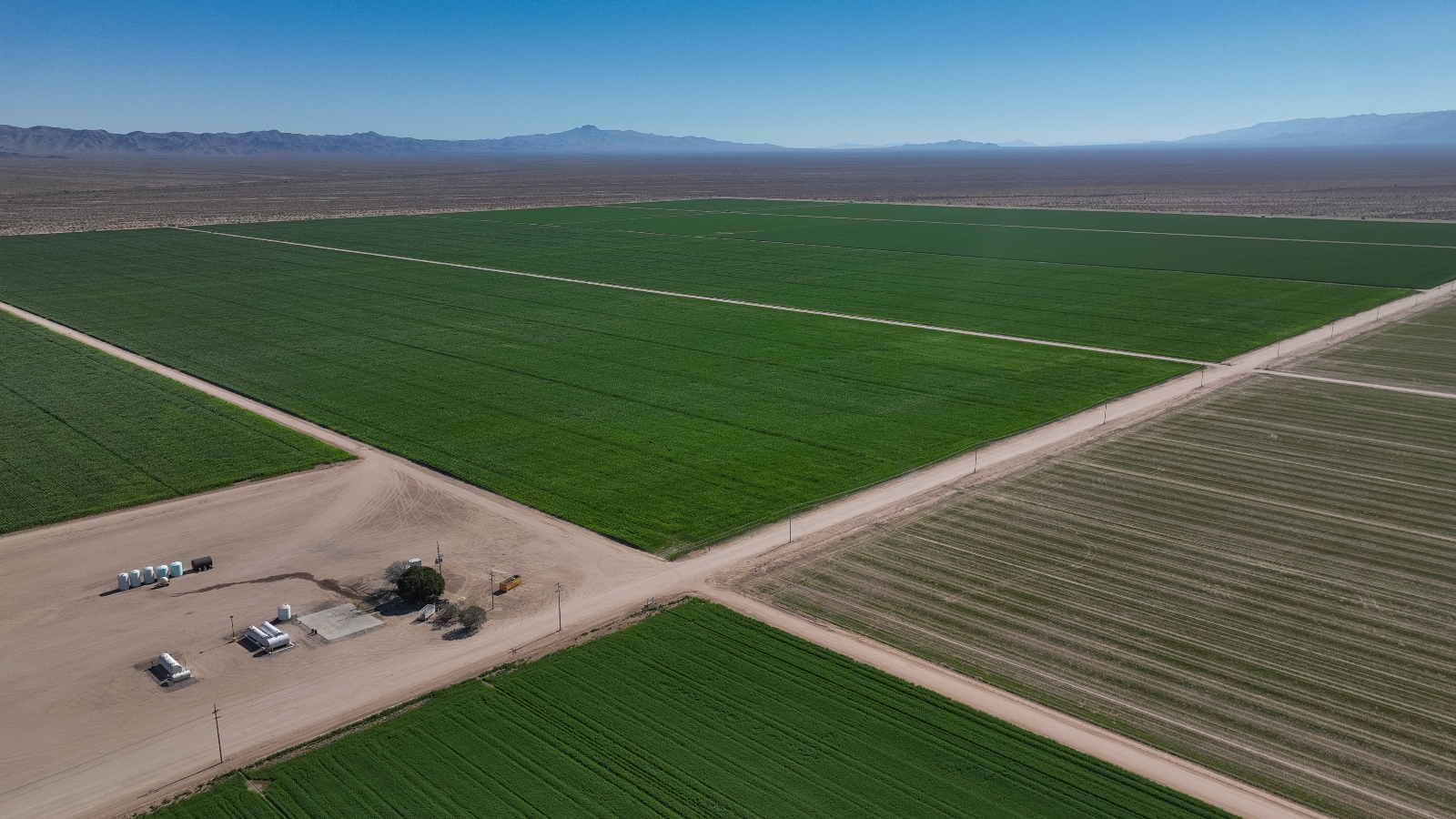
because it has vastly less agriculture, esp cotton (which was a major AZ crop into the 1970s)
> But past conditions bear a dwindling resemblance to Arizona’s future. This summer was, globally, probably the hottest that humans have ever experienced. In Phoenix, there were a record 31 consecutive days above 100 degrees F (37 degrees C) and the seasonal monsoon season was the driest since 1895. It will only get hotter and drier.
This story was originally published by The Guardian and is reproduced here as part of the Climate Desk collaboration.
Arizona, stressed by years of drought, has declared its house-building boom will have to be curbed due to a lack of water, but one of its fastest-growing cities is refusing to give up its relentless march into the desert — even if it requires constructing a pipeline that would bring water across the border from Mexico.
The population of Buckeye, located 35 miles west of Phoenix, has doubled over the past decade to just under 120,000, and it is now priming itself to eventually become one of the largest cities in the U.S. West. The city’s boundaries are vast — covering an area stretching out into the Sonoran Desert that would encompass two New York Cities — and so are its ambitions.
Buckeye expects to one day contain as many as 1.5 million people, rivaling or even surpassing Phoenix — the sixth largest city in the U.S. that uses roughly 2 billion gallons of water a day — by sprawling out the tendrils of suburbia, with its neat lawns, snaking roads, and large homes, into the baking desert.
Arizona’s challenging water situation appears a major barrier to such hopes, however. In June, the state announced that new uses of its groundwater have essentially hit a limit, placing restrictions on house building, just a few months after the state lost a fifth of its water allocation from the ailing Colorado River.
There isn’t enough water beneath Buckeye to support homes not already being built, Arizona’s water department has said. But the city is embarking upon an extraordinary scramble to find water from other sources — by recycling it, purchasing it, or importing it — to maintain the sort of hurtling growth that continues to propel the U.S. West even in an era of climate crisis.
People golf by new homes under construction at a housing development near undeveloped Sonoran Desert on June 8, 2023 in Buckeye, Arizona.
Mario Tama/Getty Images
“Personally, my view is that we are still full steam ahead,” said Eric Orsborn, Buckeye’s ebullient mayor. Orsborn said he understands the state has to be “really careful” with water resources but that the city is exploring “options to keep us going and allow us to continue to grow at the rate that we want to grow.”
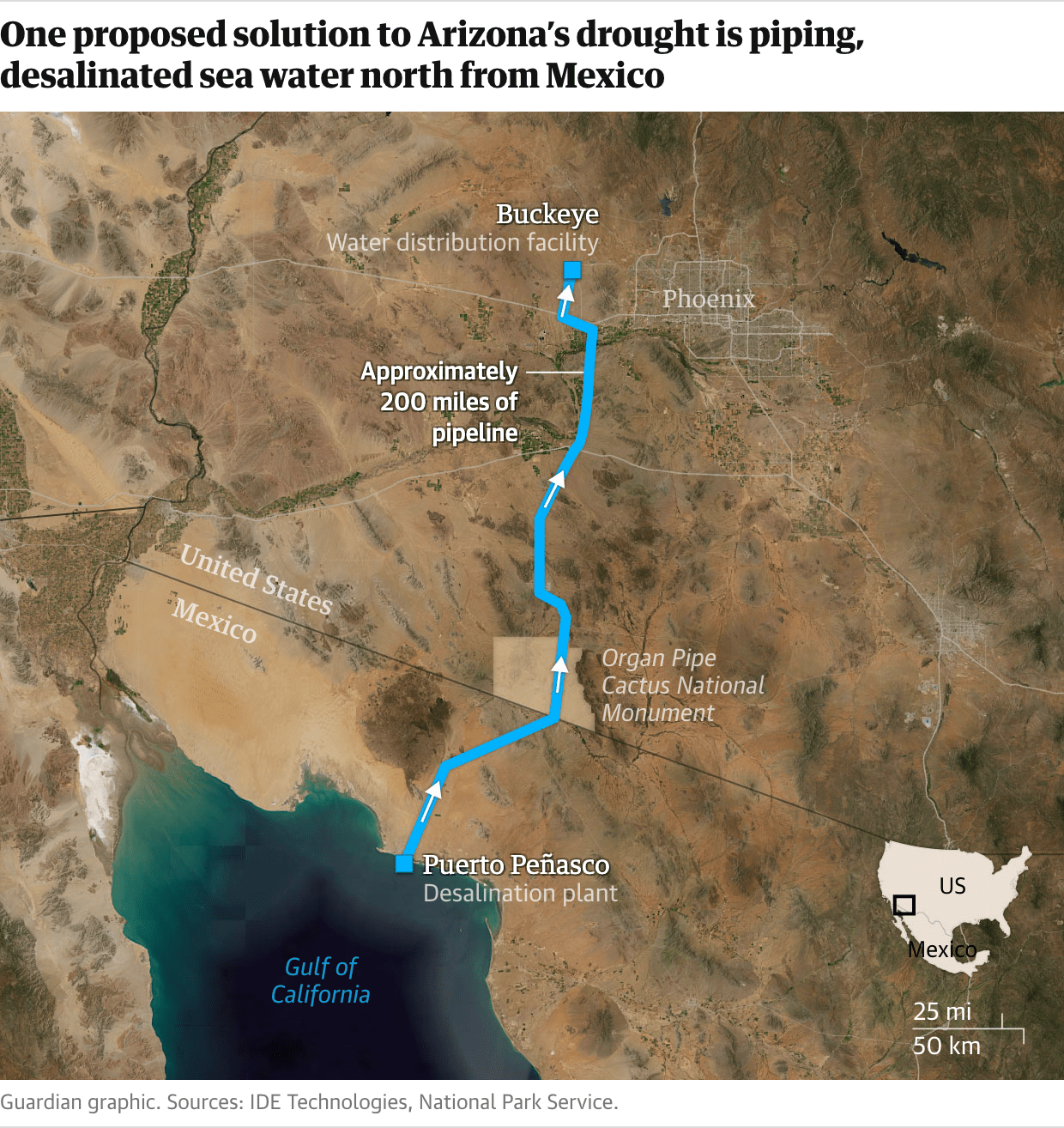
Some of the grander options are ambitious to the point of appearing outlandish, such as a plan to bring desalinated seawater from Mexico to Arizona via a lengthy, uphill pipeline. Arizona may, instead, pipe in water west from California, or from 1,000 miles east, from the Missouri River. Buckeye has already shown it is prepared to spend big to achieve its dreams — in January the city council agreed to spend $80 million for a single acre of nearby land, an area smaller than a football pitch, just to secure its attached water rights.
“We’ll be as big or larger than Phoenix, ultimately — we don’t have to have all that water solved today,” Orsborn said in city hall, which itself may have to be upsized to deal with Buckeye’s growth. On his office wall is a map of the vast expanse of untouched desert that sits within the city’s voluminous territory.
Courtesy of the Guardian
“What we need to figure out is what’s that next crazy idea that’s out there,” said the mayor, who also owns a construction company. “We’re just hustling to get to that point, to keep things moving along.”
Perhaps the most “crazy” of the ideas is the one that would involve building a desalination plant in the Mexican town of Puerto Peñasco, perched on the edge of the Gulf of California, to suck up seawater and then send the treated water in a pipeline several hundred miles north to Arizona. Much of the pipeline’s proposed route is uphill and will traverse an international border, a federally protected area famed for its cactus and several small towns.
Environmentalists have already criticized the plan for its potential ecological impact upon both land and sea — the salty brine left over would be dumped back into the Gulf of California, altering its composition and potentially harming its marine life. The odds may be against the pipeline, given the cost and opposition. But IDE, the Israeli company that proposed the $5 billion plan, has said the pipeline would be “transformative” for Arizona, would provide enough water for the entire state and “secure Arizona’s future growth.”
Arizona’sWater Infrastructure Finance Authority (or WIFA), the agency tasked with implementing a new inflow of water to the state, is assessing the Mexico idea, as well as other options. Chuck Podolak, director of the agency, has his own office map that helps him envision other possible stupendous infrastructure undertakings, such as a pipeline running from another desalination plant, in California, or a pipeline that could convey water from the distant Missouri River to the thirsty desert.
“Those are big, audacious ideas, but I don’t think any are off the table,” said Podolak. “We’re going to seek the wild ideas and fund the good ones.”
Podolak acknowledged any pipeline from Mexico will face numerous hurdles — Wifa has been in touch with lawmakers in Mexico, some of whom are unfavorable to the idea — but insisted Arizona will continue to push for a new, leviathan project to make up its water shortfall.
“I just want to see multiple projects and figure out the best one for us. If we want to have that long-term security, we do need a new bucket, so to speak, a new source of supply outside of the state. This is a fantastic place to live.”
A sign advertises land for sale in the Sonoran Desert on June 7, 2023, in Buckeye, Arizona. Mario Tama/Getty Images
Podolak points out such big ideas are in keeping with previous monumental, and seemingly impossible, projects. “We dammed up the Colorado River and built the Hoover Dam, we have an artificial river that runs from Lake Havasu to Tucson uphill 300 miles — it’s called the Central Arizona Project,” he said.
“All these things seemed audacious, but now they’re part of the landscape. We’ve been doing it for 100 years.”
Such grandiose plans are being mulled because Arizona faces pressures like never before. The state has been in the teeth of a drought, spurred by global heating, that is the worst the U.S. Southwest has seen in approximately 1,200 years. About a third of the state’s water supply comes from the Colorado River, which has shrunk as temperatures have risen. Last year, under a mechanism where Arizona shares water with other states, its allotment of Colorado River water was cut by 21 percent.
Arizona’s other major water source — from underground aquifers, sucked up by wells — has become depleted in some parts of the state and, in the rapidly growing areas on the fringes of Phoenix, have been entirely laid claim to by developers who have to show under law that there is a reliable 100-year supply of water before erecting new homes on the cheap desert land.
In June, in a sobering dose of reality, the state declared there was not enough water for all current planned construction in the Phoenix region — amounting to a 4 percent shortfall over the next century — and that all future housing developments will have to find some other source of water. Already approved projects, and new housing within Phoenix itself, could still continue, the state stressed. “We are not out of water and we will not be running out of water,” said Katie Hobbs, Arizona’s governor.
While the decision won’t halt Arizona’s growth — which has been fueled by relatively cheap housing, fine weather, and fresh jobs brought by firms such as Intel and newcomer battery manufacturers — some see the end of an era in which sprawling homes, swimming pools, lawns, and water-intensive crops could endlessly unfurl into the desert.
“It’s a clear sign that this sprawl was never sustainable and that there is just no more groundwater left to do that,” said Christopher Kuzdas, senior water program manager at Environmental Defense Fund who argues Arizona should better conserve its own groundwater before turning to new pipelines.
“We are at a real crossroads as to how Arizona grows,” he said. “There just aren’t many easy options left when it comes to water.”
For Buckeye, the conversion of farmland to new housing will subsume existing irrigation rights — agriculture takes up more than 70 percent of Arizona’s water, after all, with Hobbs recently removing state land from being used to grow alfalfa, a particularly thirsty, and controversial, crop in order to protect what she called the state’s “water future.”
Beyond that, as the city expands into virgin desert, there is water recycling, where waste water is treated and reused, or perhaps a raising of the dam on the nearby Verde River to collect more water. Any new water pipeline from further away will take many years, and billions of dollars, if it happens at all. But Orsborn insists the city will find a way.
“I’m not saying it’s not going to be a challenge, but it’s not going to break that growth,” said the mayor. “For thousands of years, water’s been moved from one point to another point. We just have to continue to do that.”
Driving around Buckeye — there isn’t really any other option to get around — can feel rather disjointed. The city’s downtown is somewhat threadbare but then at the periphery there is a frenzy of building activity, with rows of new beige and cream colored houses with piles of roof slates being put in place, swarms of machinery preparing dusty tracts of ground, flags fluttering with legends such as “new homes” and “now selling.”
Courtesy of the Guardian
Drive a further 30 minutes north into the desert, a mix of scrubland dotted with saguaro cacti and two starkly beautiful mountain outcrops, you’re somehow still in Buckeye and work is under way to conjure up a massive new development called Teravalis — meaning “land of the valley” — that calls itself a “city of the future” that will eventually house 300,000 people and various businesses.
“We are effectively building a small city,” said Heath Melton, president of the Phoenix region for the developer, the Howard Hughes Corporation. Teravalis will reclaim water and be cautious with its use of turf and irrigation, according to Melton. “We want to enrich people’s lives and be good stewards of the environment,” he said. “Buckeye is very bullish on its growth and it’s good for them to be bullish.”
For the optimists, Arizona’s past is instructive. The state has found spectacular fixes to secure the water that has catapulted its growth and is getting better at saving it — somehow Arizona uses less water than it did in the 1950s despite now having 500 percent more people.
But past conditions bear a dwindling resemblance to Arizona’s future. This summer was, globally, probably the hottest that humans have ever experienced. In Phoenix, there were a record 31 consecutive days above 100 degrees F (37 degrees C) and the seasonal monsoon season was the driest since 1895. It will only get hotter and drier. Arizona may be able to move the sea from Mexico, but somehow out-engineering the climate crisis in the longer term will be an even more grueling feat.
“I think Buckeye has some real challenges and the degree of their success will depend on the degree to which people are willing to pay for those more expensive solutions,” said Kathryn Sorensen, an expert in water policy at Arizona State University.
“But it’s absolutely feasible,” she adds. “We pave over rivers, we build sea walls, we drain swamps, we destroy wetlands, we import water supplies where they never would have otherwise gone. Humans always do outlandish things, it’s what we do.”
VERY EXCELLENT, very insightful, 92.5 min audio with no waste
As Israel’s war on Gaza heats up with the potential to escalate into a regional fight, Rania Khalek hosts a special live episode of Dispatches w/ Ali Abunimah, executive director of the @TheElectronicIntifada and author of The Battle for Justice in Palestine.
mostly EXCELLENT Nerds (no guest, recorded H 19 Oct) do 1st of promised-2-parter on Hamas. Topics discussed, in ~order of appearance in the audio
* review of Palestine war to date (7-19 Oct 2023) * currently-available books on Hamas * 17 Oct attack on al-Ahli hospital: evidence points to Israel JDAM, despite ... * ... Anglophone corporate-funded media is ~uniformly Zionist, esp the empire-{funded, cutouts} OSINT sockpuppets platformed by ACFM * Gaza as focus of Palestinian resistance from 1947 UN partition to 2023 * Palestinian resistance factions, esp Islamists vs Nasserists vs Marxists * 1973-1979: Sheikh Ahmed Yassin's establishes Islamic association/charity (basically Muslim Brotherhood chapter) in Gaza, eventually approved/funded by Israel deepstate (as manipulable divide-and-conquer opponents to mostly-secular Palestinian resistance factions) ***** (introduced during 1st-Intifada discussion below) does not adopt name=Hamas (which is Arabic acronym for Islamic Resistance Movement) until 1988 ***** 1st goal: Islamicize Gaza population: pursue social-welfare and religious-proselytization strategies, before attempting armed revolt ***** early beefs: ********* Hamas vs Palestinian Islamic Jihad (PIJ) ********* Hamas vs PLO/Fatah: latter proposed [1974 10-point program](https://en.wikipedia.org/wiki/PLO%27s_Ten_Point_Program) to 1st focus on liberation of 1967 occupied territories ('2-state solution') before 1947 occupied territories * 1982-1983 Lebanon war: Israel and Christian militias destroy Beirut Palestinian camps, PLO Beirut-based "standing army" and HQ * Dec 1987: 1st Intifada starts in Gaza ***** 1988: Gaza MB renames itself Hamas (see above), attracts secular militants away from (e.g.) PFLP and PLO, begins violent anti-Israel anti-occupation insurgency
With the crisis in Gaza on our minds, we spend a little time with one of the most acclaimed Palestinian filmmakers, Elia Suleiman, and his lovely film IT MUST BE HEAVEN (2019).
*
"We Cannot Cross Until We Carry Each Other" by Arielle Angel - https://jewishcurrents.org/we-cannot-cross-until-we-carry-each-other
*
Order Luke's new book "Seeking Social Democracy: Seven Decades in the Fight for Equality," coauthored with Ed Broadbent - ecwpress.com/products/seeking-s…cracy-ed-broadbent
TORONTO: See Luke and Ed Broadbent in conversation at the Toronto Reference Library on October 22 - www.eventbrite.ca/e/seeking-social…ets-713793665067
VANCOUVER: See Luke and Ed at the Central Library on November 1 - vpl.bibliocommons.com/events/650b36e…0219cf8b5cf95f
Join us on Patreon for an extra episode every week - https://www.patreon.com/michaelandus
Another BP "mixed bag." Krystal and Saagar are definitely better than USCFM (mass-oriented corporate-funded media), and good on the US deepstate's insane pro-Zionism, and esp the fact that the deepstate can always find money for empire but never for working/underclass Americans ... but then KB doubles-down on yesterday's claim that there are no journalists in Gaza, and (while backing off a bit) that the al-Ahli hospital attack was an Islamic Jihad misfire. TOTALLY skip last ~40 min (67:41 to end of audio):
- pathetic "power panel"==KB+SE+Emily Jashinsky+Kyle Kulinski on ticktock/horserace bullshit (US House speakership, RFK Jr candidacy, 2024 US presidential race in general) - more excerpts from the BP Atlanta focus group, this time regarding Kamala Harris: can you say, "shoot fish in a barrel"? sure, I knew you could.
Krystal and Saagar discuss Biden secretly pledging the US military to any Israel-Hezbollah War, Military expert Jocko sounds off on Israel military bombing tactics on a recent podcast, Americans in Gaza are stranded, new evidence emerges in Gaza Hospital explosion, Biden wants 100 Billion for Israel-Ukraine package, Ryan and Emily join for a panel on Jim Jordan as Speaker and a new poll showing RFK Jr. Kneecapping Trump, and finally we look at another clip from our recent BP focus group asking if Kamala Harris would be a good president.