Tom Roche
Shared posts
Daliso Chaponda: Citizen of Nowhere
Tom Rocheonly moderately amusing: definitely not his best material, but Chaponda is always engaging
10/18/23: EVERYTHING WE KNOW: Gaza Hospital Bombing
Tom Rocheunusually WEAK CounterPoints:
- no Grim (which has in past usually decreased analytic quality): it's Emily and Krystal, which has problems for the current news cycle:
- KB's boy Kyle Kulinski is part of the TYT "cinematic universe," who get big Katzenbucks (TYT got 6 M$ stake, IIRC), and Jeffrey Katzenberg is a longterm/bigtime Zionist (and LA-homeless-hater etc, which helps explain why Kasparian is such a Nazi)
- EJ works for The Federalist, co-founded and published by notorious Zionist Ben Domenech (the guy who recently claimed Charlie Kirk is antisemitic for claiming that the Netanyahu made a major intel fail). Worse yet, EJ has [cowritten with Domenech](https://thefederalist.com/author/domenechjashinsky/) (archived [here](http://web.archive.org/web/20231016163139/https://thefederalist.com/author/domenechjashinsky/))
- in the 1st 12:30 of the audio KB says /twice/ (following is quote of 2nd, and 1st was quite similar) that 'there are no journalists on the ground', despite the fact that Al Jazeera and several other new orgs have journalists on the ground all over Gaza.
- 1st half (44 of 87 total min) is at best better-than-mass-oriented-US-corporate-funded-media on Israel deepstate unreliability/lies, US deepstate's failed diplomacy and dangerous war threats, and USCFM incompetence ... but also {bothsides, fog-of-war}s on Israel's (obvious, given the weight of evidence) responsibility for the al-Ahli hospital attack (though KB semi-sidles-up to denying it was Islamic Jihad, as the Zionist deepstate is now claiming), and of course both KB and EJ both bothsides on "warcrimes" (despite the fact that everyone in "southern Israel" who is not Bedouin or Palestine is a settler in occupied territory).
Krystal and Emily discuss everything we know so far about the tragic Gaza hospital bombing, Biden shunned as Middle East summit collapses, Israel and Hamas battle over hostage negotiations, Jim Jordan faceplants on first house speaker vote, Democrats in civil war as Rashida Tlaib attacks Biden's Israel policy, and US influence implodes as Putin and Xi hold important meeting.
To become a Breaking Points Premium Member and watch/listen to the show uncut and 1 hour early visit: https://breakingpoints.supercast.com/
Merch Store: https://shop.breakingpoints.com/
Learn more about your ad choices. Visit megaphone.fm/adchoices
Russia and China diplomacy for war off-ramp. Isolated Biden goes to Israel
Tom RocheEXCELLENT on how US-EU-UK geopolitics has devolved from diplomacy+force to flailing sanctions and virtue signaling
13 House Democrats Call for Immediate Ceasefire in Gaza
Tom Rochegood to see that AOC, Jamaal Bowman, and Ayanna Pressley finally found some ... intestinal fortitude
On Monday, 13 Democrats in the House of Representatives, led by Reps. Cori Bush of Missouri, Rashida Tlaib of Michigan, André Carson of Indiana, Summer Lee of Pennsylvania, and Delia Ramirez of Illinois, introduced a resolution urging the Biden administration to call for an “immediate deescalation and cease-fire in Israel and occupied Palestine” and to send humanitarian aid to Gaza.
“They are running out of body bags,” Tlaib said through tears in a press conference Monday. “We all know collective punishment of Palestinians is a war crime. The answer to war crimes can never be more war crimes.” It is a disgrace, Tlaib added, that Secretary of State Antony Blinken and the majority of Congress have not even mentioned the possibility of a ceasefire.
The resolution comes after two earlier efforts in the House both fell short of calling for an end to violence. The first — a bipartisan resolution led by Reps. Michael McCaul, R-Texas, and Gregory Meeks, D-N.Y., and supported by over 420 members of Congress — did not even mention Palestinian civilians. As of Monday, the Palestinian Ministry of Health in Gaza reports that at least 2,808 Palestinians have been killed, while 10,859 have been wounded.
The second, a letter led by Reps. Pramila Jayapal, D-Wash., and Mark Pocan, D-Wis., urged Biden to push for access to food and water in Gaza and ensure Israel follows international law but similarly fell short of calling for a ceasefire. Sources said the letter excluded that language because doing so would have reduced the number of signers from 55 to a dozen or fewer.
The “pro-peace, pro-Israel” J Street threatened to withhold endorsements from members who refused to sign onto the McCaul–Meeks resolution. J Street was once considered an alternative group to support progressive members who did not agree with hard-line and unconditional stances of pro-Israel support like the American Israel Public Affairs Committee or Democratic Majority for Israel. As The Intercept reported, J Street’s stance on the ongoing war has frustrated both former and current staffers who said its mission has been compromised.
“What we are hearing from Dems right now is even worse than the typical anti-Palestinian narrative we always hear from the government. Israeli officials have openly admitted to genocidal intent, and Democrats are deliberately silent,” said one Democratic staffer who requested anonymity to speak freely. “They are willing accomplices to what is happening and what will happen in the coming days. Those of us staffers who have Palestinian family — or are Palestinians themselves — are totally abandoned and isolated here.”
Below are the 13 representatives who support an immediate deescalation and ceasefire as of Monday afternoon:
Cori Bush
Rashida Tlaib
André Carson
Summer Lee
Delia Ramirez
Jamaal Bowman
Bonnie Watson Coleman
Jesus “Chuy” Garcia
Jonathan Jackson
Alexandria Ocasio-Cortez
Ilhan Omar
Ayanna Pressley
Nydia Velázquez
The post 13 House Democrats Call for Immediate Ceasefire in Gaza appeared first on The Intercept.
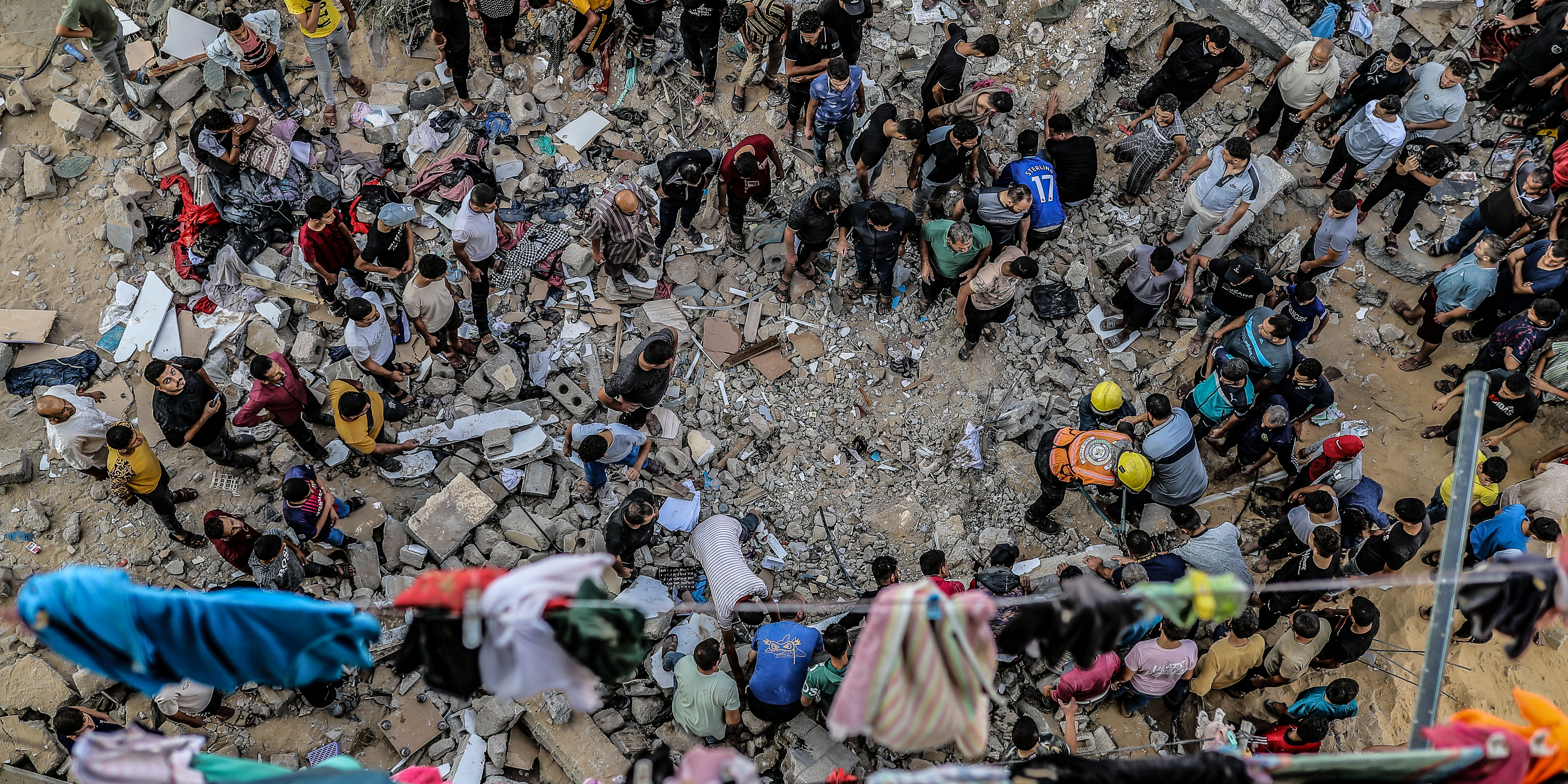
10/16/23: Water Runs Dry In Gaza As Hospitals Collapse, Biden Bumbles 60 Minutes, Arab States Erupt, Focus Group Debates Israel, Candace and Megyn Cancel Culture, Israelis Blame Bibi, MSNBC Benches Muslims, Reuters Journalist Killed By Israeli Strike
Tom RocheM 16 Oct 2023 Breaking Points is ~all Israel-Palestine (but including global and US effects), and mostly pretty good (esp excellent final segment on Reuters' craven doublespeak about Israel deliberately killing Reuters' own videographer), though the focus-group excerpts in the middle are skippable.
Krystal and Saagar discuss the Israel Gaza humanitarian criss deepening as water runs out and hospitals collapse, Biden bumbling in a 60 minutes interview on America’s involvement, Arab states erupting, our newest Breaking Points focus group where we ask Democratic voters about the situation on Israel-Gaza, Europeans criminalizing Palestinian protests, Candace Owens fights Megyn Kelly over Israel cancel culture, polls show Israelis blame Bibi for security failure, MSNBC benches their Muslim anchors after ADL comments, and Reuters can’t admit their own journalist was killed by an Israeli strike.
To become a Breaking Points Premium Member and watch/listen to the show uncut and 1 hour early visit: https://breakingpoints.supercast.com/
Merch Store: https://shop.breakingpoints.com/
Learn more about your ad choices. Visit megaphone.fm/adchoices
We'll Send You The Real Money
Tom Rocheamusing, mostly German-focused, Ciarán+Julia+Nick+Uma
It's live one baby! We talk about the Reichsbürgers.
Slides: https://youtu.be/-ADIynZT71E
HOW TO SUPPORT US:
https://www.patreon.com/cornerspaeti
HOW TO REACH US:
Corner Späti https://twitter.com/cornerspaeti
Julia https://twitter.com/KMarxiana
Rob https://twitter.com/leninkraft
Nick https://twitter.com/sternburgpapi
Uma https://twitter.com/umawrnkl
Ciarán https://twitter.com/CiaranDold
Sacha Chua: Getting Mermaid JS and ob-mermaid running on my system - needed to symlink Chromium for Puppeteer
Tom Rocheyet another thing I did not know about: [Mermaid text-based diagramming tool](https://mermaid.js.org/intro/) (archived [here](http://web.archive.org/web/20231011233516/https://mermaid.js.org/intro/)). looks EXCELLENT
I wanted to use Mermaid to make diagrams, but I ran into this issue when trying to run it:
Error: Could not find Chromium (rev. 1108766). This can occur if either
 1. you did not perform an installation before running the script (e.g. `npm install`) or
 2. your cache path is incorrectly configured (which is: /home/sacha/.cache/puppeteer).
For (2), check out our guide on configuring puppeteer at https://pptr.dev/guides/configuration.
It turns out that I needed to do the following:
sudo npm install -g puppeteer mermaid @mermaid-js/mermaid-cli --unsafe-perm
# Cache Chromium for my own user
node /usr/lib/node_modules/puppeteer/install.js --unsafe-perm
sudo npm install -g mermaid @mermaid-js/mermaid-cli
ln -s ~/.cache/puppeteer/chrome/linux-117.0.5938.149 ~/.cache/puppeteer/chrome/linux-1108766
ln -s ~/.cache/puppeteer/chrome/linux-117.0.5938.149/chrome-linux64 ~/.cache/puppeteer/chrome/linux-117.0.5938.149/chrome-linux
(The exact versions might be different for your installation.)
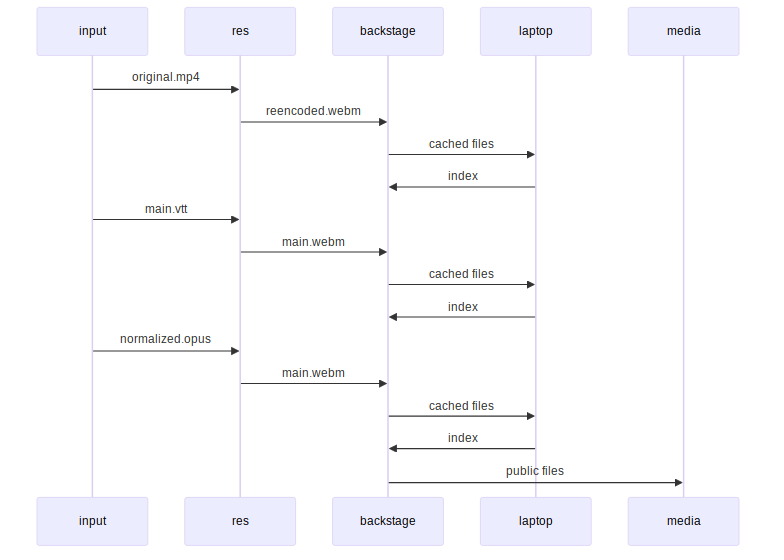
Then I could make a Mermaid file and try it out with mmdc -i input.mmd -o output.svg,
and then I could confirm that it works directly from Org with ob-mermaid:
sequenceDiagram
    input ->> res: original.mp4;
    res ->> backstage: reencoded.webm;
    backstage ->> laptop: cached files;
    laptop ->> backstage: index;
    input ->> res: main.vtt;
    res ->> backstage: main.webm;
    backstage ->> laptop: cached files;
    laptop ->> backstage: index;
    input ->> res: normalized.opus;
    res ->> backstage: main.webm;
    backstage ->> laptop: cached files;
    laptop ->> backstage: index;
    backstage ->> media: public files;
Day 7 roundtable: A new Nakba?
Tom RocheEXCELLENT survey of Palestine issues on day 7 (13 Oct) after the 20231007 Hamas prison riot, including
* Gaza sitrep 'on the ground' from Refaat Alareer and Khalil Abu Shammala
* Israeli crimes 1948 to now
* problems stalling Israel military invasion: they're not ready to invade Gaza, much less to fight a multifront war. (If they /were/, the Israeli military would have done it already! like so many aggressive wars before.)
* ... nor is the US ready for multifront, which is why Blinken is all over
(BTW: ep length is only 105 min, not 120 as my player displayed.)
Budanov admits Ukraine big counter-offensive is over
Tom RocheEXCELLENT survey of current status of NATO proxy war on Russia both in Ukraine (though A&A are exaggerating AFRF advances toward Avdiivka somewhat) and globally (esp EU-UK slide toward geoeconomic and geopolitical irrelevance)
Palestine voices on Israel's war against Gaza
Tom RocheEXCELLENT roundup (unusually for Useful Idiots free feed, this has no foodgroups, and the interview is untruncated) from day 7 of the Palestine-Israel war (soon hopefully to add additional fronts on the Zionist cancer). Topics include:
* Israeli/empire media disinformation, esp allegations of decapitation (esp of babies) and rape, which appear to come from a particularly reprehensible funder/organizer of illegal settlements
* best-I've-found-so-far discussion/ticktock of the 20231007 Gaza prison breakout ~39:30~43:30 in the audio (from Muhammad Shehada)
* Gaza militant diversity, and why Israel will /not/ destroy Hamas (because there are waayyy more militant groups)
* Israel and US-empire crimes
* forecasts
This week’s interview with Refaat Alareer, Yumna Patel, and Muhammad Shehada:
After Hamas’s attack in Israel on Saturday, the Israeli massacres of Palestinians in Gaza have skyrocketed. This genocidal ethnic cleansing has scarcely been reported by mainstream media at any time in its 50 year history, let alone at a time when western media and politicians openly support a religious war against Palestine. So we’re giving a platform to three Palestinian voices to share their story.
We speak with Refaat Alareer, a Palestinian academic currently sheltering 15 children in his Gaza apartment, Yumna Patel, the Palestine news director for Mondoweiss, and Muhammad Shehada, a Palestinian writer from Gaza.
Their stories of bombings, murder, cruelty, and lies from the Israeli government and malicious rumors from US media and politicians are difficult to hear, but so important when they’re being silenced everywhere else.
“The American public and the general public around the world is being sold a genocide,” they tell us. “We are being convinced through the rhetoric of Israeli politicians, the US president, and US state department spokespeople that Palestinians, specifically Gazans, are not human. They are trying to wipe Gaza off the map.”
And while the deaths of Israelis must be covered and mourned, the West’s hypocrisy and double standard on the value of life is clear.
“I have never seen the amount of profiles and interviews with the families of victims than I’ve seen of mainstream media interviewing these Israeli families. I have never seen this level of attention paid to one singular Palestinian.”
Israeli children matter. Why don’t Palestinian children matter? “No attention is being paid to the killing of 270 children just in the span of three or four days.”
Refaat, Yumna, and Muhammad share their frustration and disgust with “the fact that our government and the President of the United States is repeating dehumanizing genocidal language, repeating these unsubstantiated claims.”
And sadly, we may not be able to hear their voices for long. Refaat, calling from Gaza with the sounds of bombs exploding in the background during the interview, warns that resources are running low. “But in a couple of days, maximum a week or two, if things don’t change, we’re looking at a total blackout, no coverage, no media, no internet. Not that Israel cares, and mainstream media is complicit.”
Hear them speak, and share the interview to spread their message. At a dangerous time, we thank you for continuing to support Useful Idiots and our guests.
Plus, catch this week’s Thursday Throwdown: US politicians call for religious war against Palestine
And join the Absurd Arena live discussion board with Katie and Wilson every Tuesday at 12pm est in the Substack app.
For $6 a month, become a Useful Idiot and support independent media.

Air purifiers aren’t enough to clean your home from wildfire smoke
Tom Rocheexcellent empirical article from Delphine Farmer @ Colorado State U. pullquote (mildly edited):
> [Wildfire] smoke particles quickly [settle] on indoor surfaces, [but wildfire volatile organic compounds (VOCs) have more complex behavior.] At first, the house took up these smoke VOCs—on floors, walls, and building surfaces. But once the initial smoke cleared, the house would slowly release those VOCs back out over the next hours, days, or even months, depending on the type of VOC. [This "surface reservoir"] [allows smoke VOCs to linger indoors](https://www.science.org/doi/10.1126/sciadv.adh8263), meaning that people are exposed to them not just during the major smoke event but also long after.
> Opening windows to ventilate will clean the air, if it isn’t smoggy or smoky outside. But as soon as we closed windows and doors, smoke VOCs started to bleed off the surface reservoirs and into the air again, resulting in an elevated, near-constant concentration. [To] permanently remove [surface-reservoir] smoke VOCs, [one must] physically remove them from surfaces. [Fortunately,] cleaning surfaces by vacuuming, dusting, and mopping with a commercial, nonbleach solution [was effective.]

Enlarge / San Francisco City view through the haze of smoke as seen from Treasure Island on September 20, 2023. (credit: Tayfun Coskun/Anadolu Agency via Getty Images)
When wildfire smoke turns the air brown and hazy, you might think about heading indoors with the windows closed, running an air purifier or even wearing a mask. These are all good strategies to reduce exposure to the particles in wildfire smoke, but smoky air is also filled with potentially harmful gases. Those gases can get into buildings and remain in the walls and floors for weeks.
Getting rid of these gases isn’t as simple as turning on an air purifier or opening a window on a clear day.
In a new study published in the journal Science Advances, colleagues and I tracked the life of these gases in a home exposed to wildfire smoke. We also found that the best way to get rid of the risk is among the simplest: start cleaning.
Not Israel’s 9/11, but a Prison Riot
Tom Rochesurprisingly EXCELLENT from Risen--quite the departure from his recent Russiagating

Photo: Abed Rahim Khatib/picture alliance via Getty Images
The world has been struggling to find a good historical parallel for the vicious and horrific surprise attack Hamas launched against Israel on October 7.
It is often said that 10/7 is the new 9/11. But 10/7 was more like a prison riot.
For nearly two decades, the Gaza Strip has been bottled up and almost completely blocked off. It has been widely compared to an open-air prison. Israel and the United States have tried to seal Gaza, isolating its nearly 2 million residents on a tiny, impoverished strip of land. Washington and Tel Aviv thought that would let them keep Hamas at arm’s length.
Instead, it just turned Gaza into an overcrowded penal colony where the most radicalized and violent gang leaders eventually gained control. Mass murder and hostage taking have been the result.
Sealing off Gaza didn’t solve anything. Instead, its problems festered until they finally exploded last weekend.
In the days since the carnage erupted, the American media has offered precious little context to the violence. But it really isn’t that difficult to look back over U.S., Israeli, and Palestinian policies and politics of the last 20 years and understand how we got here. Like so much else that has gone wrong in the Middle East in the 21st century, the George W. Bush administration deserves plenty of the blame for what’s happening now in Israel and Gaza.
In the years immediately after the disastrous 2003 U.S. invasion of Iraq, Bush doubled down on his enterprise in the Middle East by proclaiming that he wanted to spread democracy throughout the region. So he pushed for elections in Gaza without thinking things through, just as he had in Iraq. Hamas gained power in Gaza after the 2006 elections there, leaving Palestinian territory badly divided between Gaza and the West Bank, where Fatah, a bitter enemy of Hamas, remained in charge.
By then, Israeli politics were increasingly dominated by right-wing leaders. After the second Intifada began in 2000, the Israeli left had largely collapsed, and most Israelis had dropped their support for the “two-state” solution, under which Israel would agree to the creation of an independent Palestinian state.
Instead, Israel bricked itself up. It built walls and expanded Jewish settlements in the West Bank while blockading Gaza.
The Bush administration, eager to please pro-Israel, right-wing Christian evangelicals and simultaneously win American Jewish voters over to the Republican Party, did little to stop Israel from raising its drawbridges. Foreign assistance to Gaza dried up while the U.S. imposed sanctions on the Palestinian Authority because of Hamas’s rise to power. The Hamas-controlled Gaza Strip became an international pariah.
When Barack Obama became president, he initially sought to revive Israeli–Palestinian peace talks, but little came of his efforts before he too abandoned them.
As president, Donald Trump ignored the Palestinians while engineering the so-called Abraham Accords, in which the United Arab Emirates, Bahrain, Sudan, and Morocco agreed to recognize Israel. President Joe Biden has sought to expand the accords to include Saudi Arabia. But the agreements are hollow; they have won little popular support in the Arab world, largely because they do not address the status of the Palestinians.
In other words: For two decades, a succession of American presidents has largely ignored the Palestinians and, in effect, gone along with Israeli efforts to abandon the idea of a Palestinian state.

Photo: Mohammed Abed/AFP via Getty Images
One reason the United States has been so unwilling to challenge Israel’s lurch to the right has been the simultaneous rise of right-wing Christian evangelicals in U.S. politics. Evangelicals have become so powerful within the Republican Party that they have changed the domestic American political calculus about Israel.
George W. Bush’s father, President George Herbert Walker Bush, was willing to push Israel and criticize its policies, so much so that when George W. Bush first ran for president, Israeli leaders feared that he would be just as tough on Israel as his father had been.
But that didn’t prove true, and one reason was that Christian evangelicals had become a more important part of the Republican Party by the time he came into office. Evangelicals believe the Bible compels them to support Israel; they believe that the creation of the state of Israel in 1948 was the fulfillment of the biblically foretold “regathering” of the Jews. They also believe that the Bible says that the Jews will continue to rule Israel until the return of Jesus, so Israel must continue to exist until the “Rapture,” which will occur after the second coming of Christ.
Evangelicals vigorously debate the many side-plots of this “end times” theology, which have the potential to lead them down weird geopolitical rabbit holes. And in the long run, their theology isn’t good for the Jews; in the Rapture, Christians will ascend to heaven while everyone else, including the Jews, will be destroyed.
But the Rapture is still a long way off. For now, the upshot is that Christian evangelicals are unquestioning supporters of Israel — and that means the Republican Party is too. Trump’s controversial decision to move the U.S. Embassy to Jerusalem in 2018 enthralled evangelicals. His administration prominently featured Robert Jeffress, a leading evangelical minister, and John Hagee, a televangelist and founder of Christians United for Israel, at the embassy’s opening.
(Oddly, that support for the state of Israel has coincided with an explosion of antisemitism on the American right.)
Christian evangelicals’ strong pro-Israel stance has led Republicans to make a play for the votes of American Jews — unnerving Democrats, who worry that Jews will leave their longtime political home in the Democratic Party. As a result, Democrats, just like Republicans, have been unwilling to challenge Israel’s right-wing governments or its refusal to revive serious negotiations about a Palestinian state. The few progressive voices in the Democratic Party who criticize Israel are usually shouted down by both Republicans and by the mainstream of their own party. There are no powerful voices in the United States warning of another bloody Middle Eastern quagmire.
Instead, in the coming weeks, Israel will be operating with something close to an American blank check.
The post Not Israel’s 9/11, but a Prison Riot appeared first on The Intercept.

772 - Tales From the Yelp feat. Bryan Quinby (10/12/23)
Tom Rocheamusing, just bant (Felix+Will+BQ) on media (radio, TV, web) weirdos
Podfather Bryan Quinby returns to the show for some spoofs and goofs. We catch up with various radio personalities and explore some D.C. gossip, then Bryan takes us on a tour of some of his favorite types of guy he’s encountered so far while making his new show GUYS.
Find Guys wherever you get podcasts and get all of Bryan’s premium content including Guys+ here: https://www.patreon.com/MurderXBryan
Get bonus content on PatreonHosted on Acast. See acast.com/privacy for more information.
Sacha Chua: #EmacsConf backstage: adding notes to Org logbook drawers from e-mails
Tom Rochevery excellent automation via elisp!
Sometimes I want to work with all the talks associated with an email in my inbox. For example, maybe a speaker said that the draft schedules are fine, and I want to make a note of that in the conference Org file.
First we start with a function that gets the e-mail addresses for a talk. Some speakers have different e-mail addresses for public contact or private contact, and some e-mail us from other addresses.
emacsconf-mail-get-all-email-addresses: Return all the possible e-mail addresses for TALK.
(defun emacsconf-mail-get-all-email-addresses (talk)
  "Return all the possible e-mail addresses for TALK."
  (split-string
   (downcase
    (string-join
     (seq-uniq
      (seq-keep
       (lambda (field) (plist-get talk field))
       '(:email :public-email :email-alias)))
     ","))
   " *, *"))
Then we can use that to find the talks for a given e-mail address.
emacsconf-mail-talks: Return a list of talks matching EMAIL.
(defun emacsconf-mail-talks (email)
  "Return a list of talks matching EMAIL."
  (setq email (downcase (mail-strip-quoted-names email)))
  (seq-filter
   (lambda (o) (member email (emacsconf-mail-get-all-email-addresses o)))
   (emacsconf-get-talk-info)))
We can loop over that to add a note for the e-mail.
emacsconf-mail-add-to-logbook: Add to logbook for all matching talks from this speaker.
(defun emacsconf-mail-add-to-logbook (email note)
  "Add to logbook for all matching talks from this speaker."
  (interactive
   (let* ((email (mail-strip-quoted-names
                  (plist-get (plist-get (notmuch-show-get-message-properties) :headers)
                             :From)))
          (talks (emacsconf-mail-talks email)))
     (list
      email
      (read-string (format "Note for %s: "
                           (mapconcat (lambda (o) (plist-get o :slug))
                                      talks", "))))))
  (save-window-excursion
    (mapc
     (lambda (talk)
       (emacsconf-add-to-talk-logbook talk note))
     (emacsconf-mail-talks email))))
The actual addition of notes is handled by these functions.
emacsconf-add-to-logbook: Add NOTE as a logbook entry for the current subtree.
(defun emacsconf-add-to-logbook (note)
  "Add NOTE as a logbook entry for the current subtree."
  (move-marker org-log-note-return-to (point))
  (move-marker org-log-note-marker (point))
  (with-temp-buffer
    (insert note)
    (let ((org-log-note-purpose 'note))
      (org-store-log-note))))
Then we have a function that looks for the heading for a note and then adds a logbook entry to it.
emacsconf-add-to-talk-logbook: Add NOTE as a logbook entry for TALK.
(defun emacsconf-add-to-talk-logbook (talk note)
  "Add NOTE as a logbook entry for TALK."
  (interactive (list (emacsconf-complete-talk) (read-string "Note: ")))
  (save-excursion
    (emacsconf-with-talk-heading talk
      (emacsconf-add-to-logbook note))))
All together, that makes it easy to use Emacs as a very simple contact relationship management system where I can take notes based on the e-mails that come in.
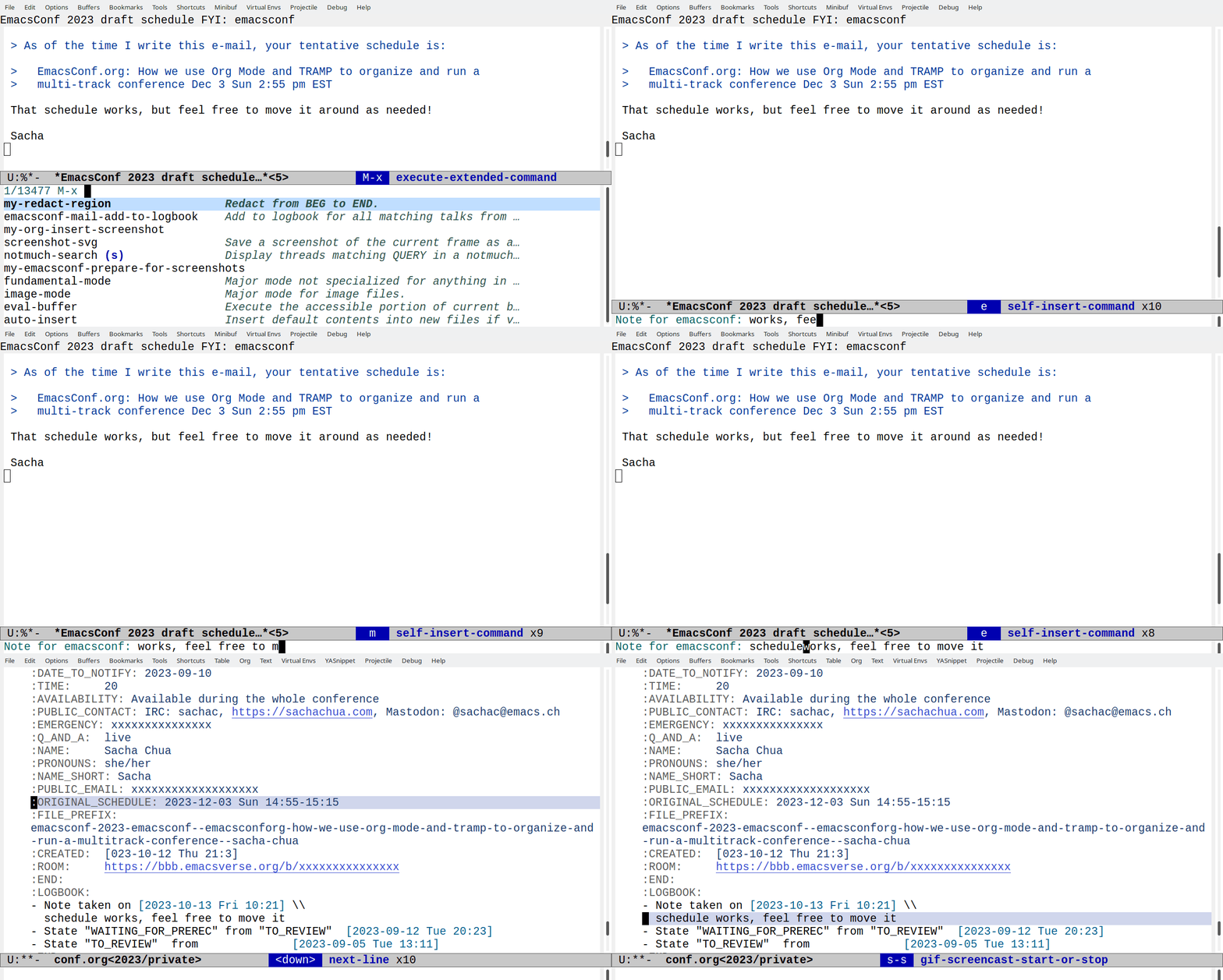 Figure 1: Logging notes from e-mail
These functions are in emacsconf-mail.el.
Sacha Chua: #EmacsConf backstage: Using Spookfox to automate creating BigBlueButton rooms in Mozilla Firefox
Tom RocheSpookfox as latest entry in the fight to control webbrowsers from emacs (à la Nyxt)
Naming conventions make it easier for other people to find things.
Just like with file prefixes, I like to use a standard naming pattern
for our BigBlueButton web conference rooms. For EmacsConf 2022, we
used ec22-day-am-gen Speaker name (slugs). For
EmacsConf 2023, I want to set up the BigBlueButton rooms before the
schedule settles down, so I won't encode the time or track information
into it. Instead, I'll use Speaker name (slugs) - emacsconf2023.
BigBlueButton does have an API for managing rooms, but that requires a
shared secret that I don't know yet. I figured I'd just automate it
through my browser. Over the last year, I've started using Spookfox to
control the Firefox web browser from Emacs. It's been pretty handy for
scrolling webpages up and down, so I wondered if I could replace my
old xdotool-based automation. Here's what I came up with for this
year.
First, I need a function that creates the BBB room for a group of talks and updates the Org entry with the URL. Adding a slight delay makes it a bit more reliable.
emacsconf-spookfox-create-bbb: Create a BBB room for this group of talks.
(defun emacsconf-spookfox-create-bbb (group)
  "Create a BBB room for this group of talks.
GROUP is (email . (talk talk talk)).
Needs a Spookfox connection."
  (let* ((bbb-name
          (format "%s (%s) - %s%s"
                  (mapconcat (lambda (o) (plist-get o :slug)) (cdr group) ", ")
                  (plist-get (cadr group) :speakers)
                  emacsconf-id
                  emacsconf-year))
         path
         (retrieve-command
          (format
           "window.location.origin + [...document.querySelectorAll('h4.room-name-text')].find((o) => o.textContent.trim() == '%s').closest('tr').querySelector('.delete-room').getAttribute('data-path')"
           bbb-name))
         (create-command (format "document.querySelector('#create-room-block').click();
document.querySelector('#create-room-name').value = \"%s\";
document.querySelector('#room_mute_on_join').click();
document.querySelector('.create-room-button').click();"
                                 bbb-name)))
    (setq path (spookfox-js-injection-eval-in-active-tab retrieve-command t))
    (unless path
      (dolist (cmd (split-string create-command ";"))
        (spookfox-js-injection-eval-in-active-tab cmd t)
        (sleep-for 2))
      (sleep-for 2)
      (setq path (spookfox-js-injection-eval-in-active-tab retrieve-command t)))
    (when path
      (dolist (talk (cdr group))
        (save-window-excursion
          (emacsconf-with-talk-heading talk
            (org-entry-put (point) "ROOM" path))))
      (cons bbb-name path))))
Then I need to iterate over the list of talks that have live Q&A sessions but don't have BBB rooms assigned yet so that I can create them.
emacsconf-spookfox-create-bbb-for-live-talks: Create BBB rooms for talks that don’t have them yet.
(defun emacsconf-spookfox-create-bbb-for-live-talks ()
  "Create BBB rooms for talks that don't have them yet."
  (let* ((talks (seq-filter
                 (lambda (o)
                   (and (string-match "live" (or (plist-get o :q-and-a) ""))
                        (not (string= (plist-get o :status) "CANCELLED"))
                        (not (plist-get o :bbb-room))))
                 (emacsconf-publish-prepare-for-display (emacsconf-get-talk-info))))
         (groups (and talks (emacsconf-mail-groups talks))))
    (dolist (group groups)
      (emacsconf-spookfox-create-bbb group))))
The result: a whole bunch of rooms ready for people to check in.
 Figure 1: BigBlueButton rooms
Using Spookfox to communicate with Firefox from Emacs Lisp made it easy to get data in and out of my browser. Handy!
This code is in emacsconf-spookfox.el.
Zelensky panics as attention and resources shift to Israel
Tom Rocheexcellent: makes the point that Israel's war on Palestine is likely to provide cover for NATO retreat from Ukraine, as the empire's mass-oriented corporate-funded media just cease to cover their proxy war
The News Quiz - 15th September
Tom RocheEXCELLENT: /almost/ consistently funny (minus the obligatory BBC Russophobia) from the opening epic Mark Steel rant to the closing Tom Ballard explainer on the (now-imminent, though this show was recorded 14 Sep 2023) Australian Indigenous Voice referendum.
Lucy Porter, Tom Ballard, Anushka Asthana, and Mark Steel joined Andy Zaltzman to quiz the week's news.
In this episode Andy and the panel search for the world's most obvious spy, the world's most awkward train ride, and the UK's worst road.
Written by Andy Zaltzman
With additional material by Cody Dahler Mike Shephard and Christina Riggs
Producer: Sam Holmes Executive Producer: James Robinson Production Co-ordinator: Katie Baum Sound Editor: Marc Willcox
A BBC Studios Production
Radio War Nerd EP 401 — Hamas's Surprise Invasion of Israel
Tom RocheVERY EXCELLENT
Radio War Nerd EP 402 — Hamas-Israel War Update #2
Tom RocheVERY EXCELLENT
Episode 311 - Left Chairs on the Left (w/ Jessica Burbank)
Tom RocheEXCELLENT esp re why ProgDems are so lame. Note however that (unless I missed something) Burbank and BJG did /not/ discuss Laphonza Butler (who /is/ replacing the (misspelled above) Dianne Feinstein, and has definitely turned on organized labor by representing Airbnb (which are basically just unorganized and unregulated hotels), Uber, et al)
Subscribe to Bad Faith on Patreon to instantly unlock our full premium episode library: http://patreon.com/badfaithpodcast
Brie catches up with Friday left-chair from Rising Jessica Burbank about all the news relevant to the left, from RFK Jr’s third party announcement, the dethroning of he speaker, Diane Finestein’s anti-labor replacement, and Bernie’s support for Ukraine funding. Lots has happened since we recorded this on Monday so let’s shoot for a short call in to catch up on Nina Turner’s announcement and the FTV redux!
Subscribe to Bad Faith on YouTube for video of this episode. Find Bad Faith on Twitter (@badfaithpod) and Instagram (@badfaithpod).
Produced by Armand Aviram.
Theme by Nick Thorburn (@nickfromislands).
Irreal: Bad Emacs Defaults
Tom Roche[source post](https://idiomdrottning.org/bad-emacs-defaults) archived [here](http://web.archive.org/web/20231012122300/https://idiomdrottning.org/bad-emacs-defaults)
A couple of months ago, I wrote about Charles Choi’s post on Emacs defaults. Choi had a list of defaults with which he disagreed. I agreed with him on some of list and disagreed on other parts. It was, though, an interesting post and I even learned something. Now Sandra Snan over at Idiomdrottning has her own list.
Mostly, it’s hard to argue with her about the list or her suggested replacements. The only exception is one that I doubt any Emacs user would agree with: Ctrl+h, she says, should be a backspace instead of an entry to the Help system. Yes, her rationale makes sense. It is, after all, the ASCII character for backspace but No True Scotsman Emacser is going to agree with her on this one.
The rest of her list makes sense to me. She considers:
- Placing of backup and autosave files in the current directory.
- Copying a backup file rather than moving it.
- Spaces ending a sentence.
- Indentation using TABs and spaces.
- Requiring a final newline in a file.
-
frame-inhibit-implied-resize. - Showing trailing whitespace.
- Killing the whole line.
As I said, most of these seem non-controversial to me except spaces ending a sentence. The proper number of spaces after a period ending a sentence is a battle that rages within and without the Emacs community. Irreal has plowed that ground many times so I won’t belabor it here.
Take a look at Snan’s list and see what you think. Perhaps you’ll decide to change some of the defaults on your own system. Regardless, Emacs, as always, lets you have it your way.
771 - The Crossing feat. Mohammad Alsaafin (10/10/23)
Tom RocheVERY EXCELLENT: no jokes, just analysis from Felix, Will, and Mohammad Alsaafin @ AJ+ on Palestine (esp Gaza) vs Zionism (esp Israel and US), esp since the 7 Oct 2023 Hamas retribution but with sidebars going back to 1948.
Journalist Mohammad Alsaafin returns to the show to cover the unprecedented new developments in the Israel-Gaza conflict.
The piece from Séamus Malekafzali mentioned in the episode: https://www.seamus-malekafzali.com/p/a-siege-broken
The playlist of AJ+ videos on Palestine Mohammad recommends at the end of the episode: https://www.youtube.com/playlist?list=PLZd3QRtSy5LNqTTQagN3IgbqVPtEIQOp1
Hosted on Acast. See acast.com/privacy for more information.
We Are Slo Vak
Tom Rocheexcellent, funny, starts with Spain politics update before the Slovakia deepdive
It's everyone's favourite topic, Slovakian politics. Content Warning: Magyarphobia I guess.
PODFEST TICKETS:
https://www.podfestberlin.com/event-details/halfdaypass-1410-pm
HOW TO SUPPORT US:
https://www.patreon.com/cornerspaeti
HOW TO REACH US:
Corner Späti https://twitter.com/cornerspaeti
Julia https://twitter.com/KMarxiana
Rob https://twitter.com/leninkraft
Nick https://twitter.com/sternburgpapi
Uma https://twitter.com/umawrnkl
Ciarán https://twitter.com/CiaranDold
How You Make Money Matters When It Comes to Carbon Emissions
Tom RocheEXCELLENT! pullquote (slightly edited by me):
> “if we put a carbon tax on shareholders [of each corporation] that reflected the carbon intensity [of that corporation], it would incentivize shareholders to move money out of [carbon-intense] companies,” [UM Amherst sustainability scientist Jared Starr] said. The approach may incentivize corporations to “decarbonize their own operations in order to [maintain the price of their equity].”

Minimizing your carbon footprint traditionally involves paying attention to the things you buy, how you commute, and conserving energy at home. A new study published in PLOS Climate shows that mindful consumption is only part of the equation: How much money you make, along with how you make it, matters too. Researchers found that the highest-earning 10% of U.S. households are responsible for around 40% of U.S. carbon emissions. And a large proportion of those emissions are associated with investment income. The findings could inform policy decisions aiming to create more equitable carbon tax systems.
Household Carbon Footprints
Carbon footprints are generally calculated from a consumption standpoint—how individual consumers’ personal choices directly translate to carbon emissions.
There are many reasons why people cannot change their commute, buy local products, or install energy-saving appliances.
“I think there are some limits to that,” said lead author Jared Starr, a sustainability scientist at the University of Massachusetts Amherst. “It assumes that people have an endless amount of choices and knowledge and agency to purchase less carbon-intensive items, and that’s not always the case.” There are many reasons, he said, why people cannot change their commute, buy local products, or install energy-saving appliances.
Instead of focusing on consumption, which can be influenced by a person’s time, money, and location, Starr and his colleagues looked at how making money produces carbon emissions. The researchers calculated the emissions created by earning wages, as well as income made from investments (rent, dividends, interest, and capital gains) and retirement accounts (Social Security or individual retirement accounts).
Using Eora MRIO—a global supply chain database that captures both supplier- and producer-sourced carbon emissions—the group calculated how much each industry category contributed to overall carbon emissions.
Starr explained that, using these data, the researchers figured out how many tons of emissions are needed to produce 1 dollar of income from a specific industry. They then linked this back to household-level U.S. Bureau of Labor Statistics/Census Bureau’s Current Population Survey data (between 1990 and 2019), which show how many dollars of income a person earned from a given industry. Details on investment incomes within a household were collected from the Congressional Budget Office, which breaks down household incomes across different income groups by type (such as wages, investments, and government entitlements such as unemployment or disability payments).
To determine the carbon emissions from investment income, the researchers assumed that households had a diversified investment portfolio that tracked a stock market index, not one that is actively managed, and that the greenhouse gas emissions from these investments were weighted by each industry’s contribution. To account for variability, the team allowed the carbon intensity of a household’s investments to vary by 25% above and below the mean, Starr explained.
“I think just that scale of disparity is quite striking.”
In 2019, the highest-earning 10% of American households were associated with about 40% of total U.S. emissions. Among the top 1%, investments made up 28%–43% of earnings, researchers found, whereas the poorest households were more wage-based and might not have any investment income.
The team found that lower-income groups tended to be employed in sectors associated with fewer greenhouse gases—think retail, teaching, and service industries. Higher-income workers tended to work in sectors associated with higher carbon emissions: financial services companies that underwrite fossil fuel projects and high-end real estate companies, for example. Higher-wage earners have more money left over for investing, too: Passive income from the top 1% of earners is associated with more emissions than their wages. And in our fossil fuel–based economy, Starr pointed out, much of a company’s shareholder value comes with creating emissions.
The emissions inequality between the highest- and lowest-income earners is profound. “Half of the American population—65 million households—are only responsible for about 14% of the emissions [from income],” Starr said. “I think just that scale of disparity is quite striking.”

Removing the consumption aspect of carbon footprints is a new way of looking at the source of household emissions. “They were able to provide evidence to something that I think we all would anticipate but hasn’t really been shown,” said Regan Patterson, an environmental engineer at the University of California, Los Angeles who was not involved with the study. Their findings were consistent with other studies on greenhouse gas emissions by wealthy households, she added.
Starr noted that the poorest Americans produce less than 2 tons of income-based carbon dioxide (CO2) per year, compared with the top 0.1% of households, which emit 2,670 tons of CO2. Put another way, it takes only about 15 days for a top-earning household to surpass a lifetime of emissions for a lower-earning household.
Rethinking Carbon Taxes
This new look at income-based emissions can foster conversations about carbon taxation policy and reducing industry greenhouse gas emissions, Patterson said.
Currently, carbon taxes are placed on consumer goods, not on passive income from investments. Because low-income earners spend all their income on goods and services, they end up carrying an outsized load of carbon emission mitigation. This is doubly the case if you consider that only 40% of a top earner’s income has any sort of consumer-focused carbon tax applied to it, Starr said, compared with 100% of a low-income earner’s income.
Instead, implementing a carbon tax on investment income could be a way to help level the burden of mitigation. “I think if we put a carbon tax on shareholders that reflected the carbon intensity of the company, it would incentivize shareholders to move money out of highly taxed companies out of their own self-interest,” Starr said. The approach may incentivize corporations to “decarbonize their own operations in order to attract investment.”
—Sarah Derouin (@Sarah_Derouin), Science Writer
Citation: Derouin, S. (2023), How you make money matters when it comes to carbon emissions, Eos, 104, https://doi.org/10.1029/2023EO230381. Published on 10 October 2023.
Text © 2023. The authors. CC BY-NC-ND 3.0
Except where otherwise noted, images are subject to copyright. Any reuse without express permission from the copyright owner is prohibited.

Palestinians have a legal right to armed resistance against Israeli colonialism
Tom RocheVERY EXCELLENT on Israel-Palestine, after the very-justified and very-provoked 7 Oct 2023 Hamas attack. Topics include
* Palestinian resistance to Israel colonization is primarily anticolonial, not religious (with callout to Northern Ireland
* Palestinian violence is justified by decades of illegal Israeli vs Palestine (esp Gaza)
* international law gives Palestinians (et al) the right to violent resistance (see, e.g., the 1980 UN resolution 35/35
***** PDF of photocopy [here](https://www.worldlii.org/int/other/UNGA/1980/33.pdf) (archived [here](https://web.archive.org/web/20231010004956/http%3A%2F%2Fwww.worldlii.org%2Fint%2Fother%2FUNGA%2F1980%2F33.pdf))
***** HTMLized text [here](https://www.un.org/unispal/document/auto-insert-187436/) (archived [here](http://web.archive.org/web/20220527211641/https://www.un.org/unispal/document/auto-insert-187436/))
)
* Israel is an apartheid state, just like its former ally apartheid South Africa, which was also supported by current Israel allies US, UK, NATO, etc
Yes, This Is Israel’s 9/11
Tom Rocheexcellent pullquote, improved by me:
> If you tell someone that pouring gas on a pile of wood and then throwing a match on it will probably make the wood catch fire, you are not “supporting fire” or “justifying fire.”

Photo: Belal Khaled/Anadolu Agency via Getty Images
On the night of September 11, 2001, I sat on the stoop of my apartment building in Greenwich Village and drank some abominable wine coolers with my neighbors. I’d bought them from a nearby store that had already started wild profiteering and was charging three times the normal price. We were two miles north of the site of the World Trade Center; the neighborhood smelled of acrid smoke, which turned out to be preferable to the stench of burnt, rotting bodies that would develop later that week.
Now, according to a plethora of voices, with the vicious recent attacks by Hamas, Israel has experienced its own 9/11. “This is our 9/11,” says the Israeli ambassador to the United Nations. “This is our 9/11,” says the Israeli military’s spokesperson. “This is the equivalent for Israel of probably what happened in the United States in September 11th,” says Florida Gov. Ron DeSantis. “Israeli Faces Its 9/11,” says the Wall Street Journal op-ed page. If you’d like to see 37,000 more examples, have at it.
The point of all these comparisons is obvious. Former Rep. Joe Walsh expressed it here:
Yesterday was Israel’s 9/11.
— Joe Walsh (@WalshFreedom) October 8, 2023
And remember, after 9/11, nobody told the United States not to retaliate, nobody called for a “ceasefire” or a “de-escalation,” nobody “both-sided” what had happened that horrible day.
In other words, Israel, like the U.S., had been innocently walking through the world when SUDDENLY, OUT OF NOWHERE, it was inexplicably attacked by inhuman barbarians. Therefore Israel, like the U.S. was, is entitled to do anything whatsoever in response. A recent estimate found that the U.S. war on terror has directly and indirectly caused over 4.5 million deaths.
I don’t agree with Walsh’s conclusion. But certainly everyone here is starting from the correct premise — that this is Israel’s 9/11 — even if they don’t understand why.
First of all, something like Hamas’s attack on Israel, as with something like 9/11, was going to happen eventually. Israel and the U.S. constantly deal out ultraviolence on a smaller scale (Israel) and a huge scale (the U.S.). Anyone in either country who believed this would never come home was living in a vain fantasy.

Photo: Mustafa Hassona/Anadolu Agency via Getty Images
Likewise, the establishments of both Israel and the U.S. were well aware of this: that their policies would inevitably lead to the deaths of their own citizens. Richard Shultz, a longtime national security state intellectual, wrote in 2004 that “a very senior [Special Operations Forces] officer who had served on the Joint Staff in the 1990s told me that more than once he heard terrorist strikes characterized as ‘a small price to pay for being a superpower.’” Eran Etzion, onetime member of Israel’s national security council, just explained that from the government’s perspective, “the relatively small price that Israel paid every so often” for its policy toward Gaza was the deaths of dozens of Israelis.
What stunned both the U.S. and Israel was that anyone managed to briefly deal out damage on a scale they’re used to delivering. Israel killed over 10,000 Palestinians from 2000 through last month. God only knows how many hundreds of thousands the U.S. killed in the Middle East in the lead-up to 9/11.
Then, as now, anyone pointing out these obvious facts was smeared as “supporting” or “justifying” the vicious blowback. It’s frustrating and suggests that it’s impossible for human beings to be rational about this subject. If you tell someone that pouring gas on a pile of shredded newspaper and then throwing a match on it will probably make the newspaper catch on fire, you are not “supporting fire” or “justifying fire.” On the contrary, you’re trying to reduce the amount of fire in the world by describing reality.

Photo: Ali Jadallah/Anadolu Agency via Getty Images
Another similarity is that both Israel and the U.S. generated their own enemies. The U.S. famously nurtured fundamentalist Islamic opposition to the Soviet Union in Afghanistan during the 1980s. Zbigniew Brzezinski, President Jimmy Carter’s national security adviser, said in a 1998 interview that this had been “an excellent idea” and he had no regrets about these “stirred-up Muslims.” Israel did essentially the same thing in miniature in the occupied territories, encouraging the growth of Hamas to damage the secular Fatah. “Hamas, to my great regret, is Israel’s creation,” according to one of the Israelis who worked on this clever project.
As with 9/11, the attacks on Israel could only have succeeded on the scale they did because of the monstrous incompetence of the relevant leaders. “Bin Laden Determined to Strike in U.S.,” the CIA told George W. Bush in August 2001. Bush ignored this. Dick Cheney actually pushed back at the intelligence world’s many warnings because he believed Al Qaeda was merely feinting and trying to get the U.S. to expend resources preventing something that would never happen. Likewise, Israeli Prime Minister Benjamin Netanyahu was apparently warned by Egypt that something bad was coming but ignored it. We’ll inevitably learn shocking details soon about Netanyahu’s general indifference to what was on the horizon.
This is all of a piece with the irrelevance of citizens’ lives to leaders like Netanyahu and Bush. They gnash their teeth and rend their garments about how enraged they are by attacks by foreigners, yet in their hearts they don’t care about us at all. Immediately after 9/11, the Bush administration falsely told New Yorkers that the city air was perfectly safe to breathe.
Finally, the revenge that Israel will now exact will be hideous, as was that taken by the U.S. There is nothing on earth like the fury of the powerful when they believe they have been defied by their inferiors.
This is something my neighbors and I agreed on as we drank those awful wine coolers on 9/11. We were frightened deep in our guts by what had happened that morning. For anyone who wasn’t in New York then, let me tell you — Al Qaeda truly put the terror back in terrorism. But what we were most scared of was what our own government was about to do next. Ever since that moment, my dream has been that someday the regular people of the world — all of us, on every “side” — will form an alliance against our grotesque leaders.
The post Yes, This Is Israel’s 9/11 appeared first on The Intercept.
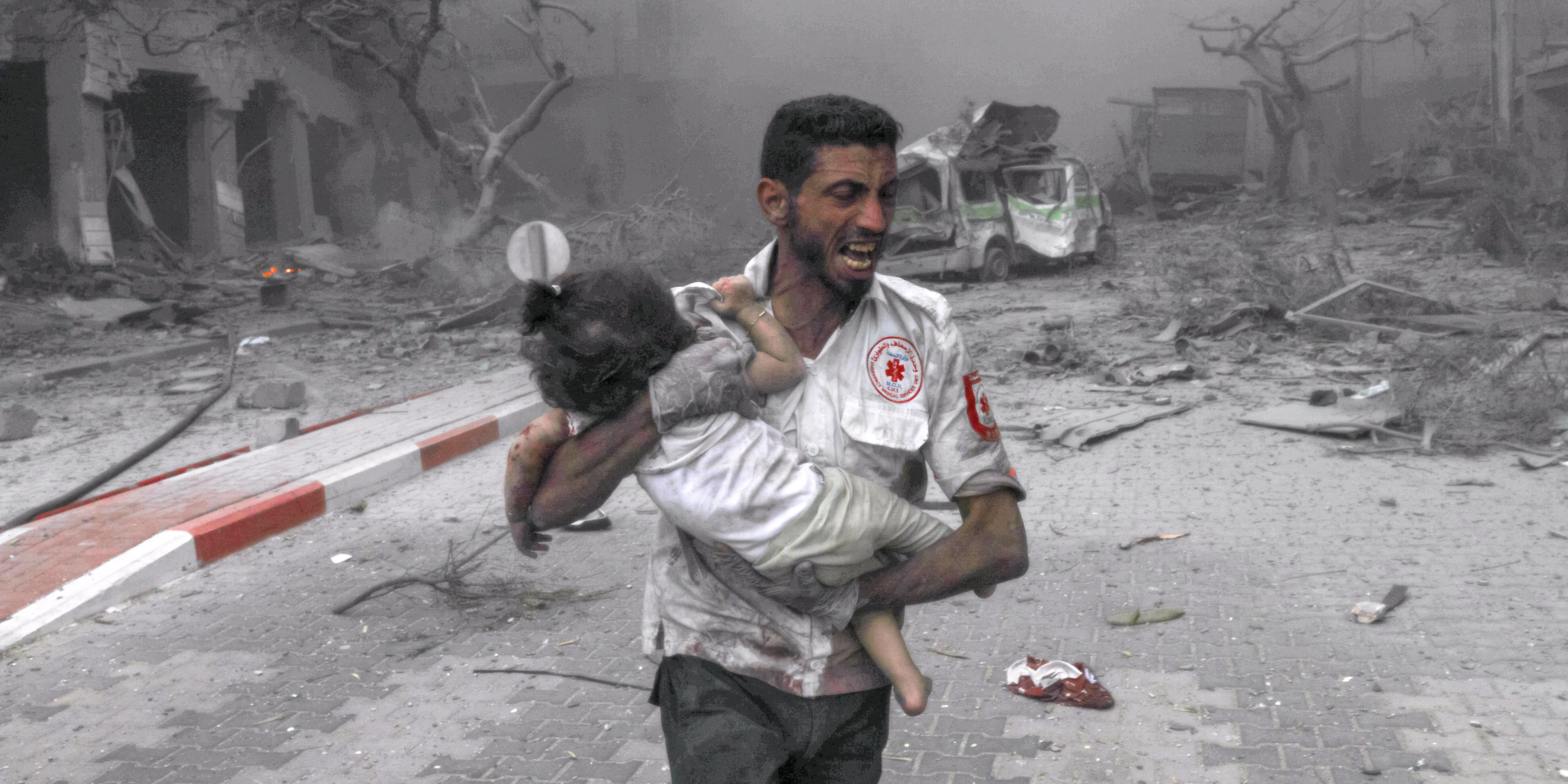

Radio War Nerd EP 399 — Short-Timers, Full Metal Jacket & The Persecution of Gustav Hasford, feat. Annibale
Tom RocheAnnibale EXCELLENT as usual
Radio War Nerd EP 400 — Mass Protests To Nowhere, feat. Vincent Bevins
Tom Rocheexcellent
#466 - I Heart New Wave
Tom RocheVERY EXCELLENT, very funny, very Canadian
770 - Master & Commander feat. Kath Krueger (10/5/23)
Tom Rocheexcellent as usual
Kath’s back as we continue reviewing the outpouring of affection for Matt and catching up on last week’s news, specifically Commander Biden’s ongoing one-dog war against White House secret service. Then, we look at Kevin McCarthy’s ouster as Speaker of the House, and discuss just how far one fellow Patreon creator will go for content.
Prod. note: I’m just as upset as you are that the public eps are now odd numbers and subscriber eps are now evens. If anyone has any ideas to rectify this without skipping more episodes, I’m all ears.
Hosted on Acast. See acast.com/privacy for more information.