Donald Trump cuts a deal with the Taliban — and America begins its withdrawal.
Advertising Inquiries: https://redcircle.com/brands
Privacy & Opt-Out: https://redcircle.com/privacy
Learn more about your ad choices. Visit megaphone.fm/adchoices
Tom RocheEXCELLENT finish to season 4, esp the closing "where they are now" seeing off legions of (mostly American) scumbags
Donald Trump cuts a deal with the Taliban — and America begins its withdrawal.
Learn more about your ad choices. Visit megaphone.fm/adchoices
Tom Rocheanother EXCELLENT episode: mostly Dave, mostly France, Germany, and (most of all) UK
Tom Rochemostly excellent 4 segments from the BP/CP team:
1. Saagar solo on the (1st, for 2024 at least) US-UK attack on Yemen. Short, not enlightening.
2. mostly EXCELLENT Krystal solo on Israel's fake/bad ICJ genocide defense
3. Norman Finkelstein interviewed by KB (few interjections by Kulinski--this was apparently excerpted from a KKF ep) on South Africa's ICJ presentation, esp evidence and law supporting the genocide accusation vs Israel. As usual with Big Norm, excellent when not tedious.
4. EXCELLENT (too short) Ryan+Emily interview of Ken Klippenstein on his reporting on US forces in Israel, and how they directly assist the Zionist military with Gaza strikes. Also, some discussion on how the US deepstate is thinking about their connection to genocide, and how they're seeking to limit their liability.
Full Israel roundup including Saagar's breakdown on US attacks against the Houthis, Krystal on Israel's ICJ defense, Norm Finkelstein on the ICJ case, and Ken Klippenstein on the US directly aiding in Israel's airstrikes on Gaza.
To become a Breaking Points Premium Member and watch/listen to the show AD FREE, uncut and 1 hour early visit: https://breakingpoints.supercast.com/
Merch Store: https://shop.breakingpoints.com/
See omnystudio.com/listener for privacy information.
Tom Rocheexcellent
Derek Sits down with Guillaume Long, senior research fellow at the Center for Economic and and Policy Research (CEPR) and former foreign minister of Ecuador, to discuss the outburst of armed conflict there over the last several days and how this fits into a larger context of issues facing the country.
Subscribe now for the full interview!
Recorded Friday…
Tom Rochealas, outside the paywall we get just a 4-min teaser
Spencer Ackerman, journalist at various outlets including Forever Wars, chats with Derek about South Africa’s case charging Israel with genocide at the ICJ.
Check out Spencer’s piece on the matter.
Recorded Thursday, January 11, 2024
Tom RocheEXCELLENT
Headlines for January 11, 2024; “Nowhere Is Safe in Gaza”: South Africa Lays Out Genocide Case vs. Israel at World Court in The Hague; Palestinian Genocide Scholar & South African Lawyer on “Extreme Urgency” of World Court Case; Gaza War Fuels Climate Crisis: “Massive” Carbon Emissions from Israeli Bombing
Tom RocheEXCELLENT analysis and humor. mostly Will and guest Grim, some input from Felix
We’re joined by the Intercept’s Ryan Grim, who’s spent the last several months attending State Department briefings, directly questioning the department representatives and reporting on administration messaging. We discuss his experiences in the mouth of the consent-manufacturing machine, and how he thinks the admin and various media orgs have functioned while he’s been there. We also discuss Ryan’s new book on The Squad, and how young progressive legislators are shaped and disciplined by the Democratic Party, and the special prominence of the Israel lobby within it.
Check out Ryan’s reporting at https://theintercept.com/staff/ryangrim/
And pick up Ryan’s book “The Squad” here: https://us.macmillan.com/books/9781250869074/thesquad
Get bonus content on PatreonHosted on Acast. See acast.com/privacy for more information.
Tom Rocheexcellent global 'week in review'
Danny and Derek come off the hottest year on record with the new year’s cold, hard facts. This week: South Africa brings a genocide case against Israel in the International Court of Justice (ICJ) (2:39) while Antony Blinken tours the region (8:48); Iraqi PM Mohammed Shia' Al Sudani is looking to request the withdrawal of U.S. forces (19:09); the Israel-Hizbollah border battles continue to escalate (22:23); the U.S. and U.K. launch strikes on Yemen (25:31); rebels in Myanmar take the border city of Laukkaing (28:49); Ethiopia looks to make a deal with the unrecognized state of Somaliland (33:56); Ukraine is running out of air defenses and shifting to a defensive posture (37:12); armed battles and chaos break out in Ecuador (40:23); 2023 was indeed the hottest year on record (43:55).
Recorded Thursday, January 11, 2024
Tom RocheVERY EXCELLENT
A team of Israeli lawyers and officials presented their defense at The Hague on Friday in the second day of the genocide case brought before the International Court of Justice by the government of South Africa. The lawyers portrayed Israel as the actual victim of genocide, not Gaza, accused South Africa of supporting Hamas, and painted South Africa’s government as functioning as the legal arm of the Palestinian militants who led the deadly raids into Israel on October 7.
Israel benefitted greatly from the fact that there was no cross examination permitted or debate allowed during these proceedings. It embarked on a bold mission to do in a court of international law what its military and political officials have done day and night throughout the course of this war against Gaza: unleash a deluge of what was known within the Trump administration as “alternative facts.”
Israel’s defense was the inverse of South Africa’s case yesterday, and as weak in offering documented facts as South Africa’s was powerful. History began on October 7, the Israelis seemed to say, South Africa is Hamas, South Africa did not give Israel a chance to meet up and chat about Gaza before suing for genocide, and actually the Israel Defense Forces is the most moral entity on Earth. As for the voluminous public statements by senior Israeli officials indicating genocidal intent, those were just “random assertions” by some irrelevant underlings. Prime Minister Benjamin Netanyahu’s statements invoking a murderous story from the Bible about killing the women, infants, and cattle of your enemies? The South Africans just don’t understand theology and presented Netanyahu’s words out of context.
While Israel’s lawyers made legal arguments that the genocide charges leveled against it are invalid, their primary strategy was to appeal to the court on jurisdictional and procedural matters, hoping that they could form the basis for the panel of international judges to dismiss South Africa’s case. Aware of the global audience, Israel also sought to reinforce its claims of righteousness and self-defense in fighting the war in Gaza.
Israel’s representative Tal Becker opened his government’s rebuttal by telling the judges at the ICJ that South Africa’s case “profoundly distorted the factual and legal picture,” claiming it sought to erase Jewish history. He charged that the legal arguments made by South Africa’s team were “barely distinguishable” from Hamas’s rhetoric and accused them of “weaponizing” the term “genocide.”
Becker called October 7 “the largest calculated mass murder of Jews since the Holocaust” and pleaded with the court to factor in the “brutality and lawlessness” of the enemy Israel says it is fighting in Gaza. Israel, he said, has a lawful right to use all available means to respond “to the slaughter of October 7 which Hamas has vowed to repeat.”
He repeatedly attacked the South African government, accusing it of doing Hamas’s bidding and alleging that its true agenda was to “thwart” Israel’s right to defend itself. “South Africa enjoys close relations with Hamas,” Becker said. “These relations have continued unabated even after the October 7 atrocities.” He said that South Africa, not Israel, should be subjected to provisional measures by the ICJ for its alleged support of Hamas. Becker neglected to mention the fact that Netanyahu himself long advocated for Hamas to retain power in Gaza and worked to ensure the flow of money to the group from Qatar continued over the years, believing it to be the best strategy to prevent the establishment of a Palestinian state.
Becker rejected South Africa’s characterization of the historical scale of civilian destruction in Gaza — which has now killed over 10,000 children — arguing that what is actually “unparalleled and unprecedented” in this war is Hamas “embedding its military operations throughout Gaza within and beneath” densely populated areas. Becker spoke as though many of Israel’s most outlandish claims about Hamas’s underground operations have not been proven false or shown to be greatly exaggerated, such as the Israeli claim that there was essentially a Hamas Pentagon under al-Shifa Hospital.
While Israel’s lawyers made legal arguments that the genocide charges leveled against it are invalid, their primary strategy was to appeal to the court on jurisdictional and procedural matters.
Becker also alleged that South Africa’s lawyers had failed to mention how many of the buildings blown up and destroyed in Gaza over the past three months of sustained Israeli bombing were actually “boobytrapped” by Hamas rather than destroyed by Israel. It was a risible claim given not only the scale of the Israeli bombardment of entire neighborhoods, but also because Israeli soldiers have posted videos of themselves gleefully hitting the detonate button to obliterate whole neighborhoods. He dismissed civilian death and injury figures provided by Gaza health authorities, saying that South Africa’s lawyers had failed to mention how many of the dead Palestinians were actually Hamas operatives. It was a striking point given that Israeli officials have openly and repeatedly said that there are no innocents in Gaza, and that United Nations workers and journalists killed by Israel are actually secret Hamas agents.
“The nightmarish environment created by Hamas has been concealed by” South Africa, Becker charged. “Israel is committed to comply with the law, but it does so in the face of Hamas’s utter contempt for the law.” Becker did not bother to address any of the scores of U.N. resolutions over the decades condemning the illegality of Israel’s apartheid regime and its illegal occupations, not to mention its own well-documented use of Palestinian children as civilian shields and the intentional killing and maiming of nonviolent protesters.
Becker also claimed that Israel was complying with international law in all of its operations in Gaza. “Israel does not seek to destroy a people, but to protect a people — its [own] people,” he said, adding that Israel is engaged in a “war of defense against Hamas, not the Palestinian people.” There could “hardly be a charge more false and more malevolent than the charge of genocide.” He accused South Africa of abusing the world court and turning it into an “aggressor’s charter.”
Malcolm Shaw, a British lawyer representing Israel, opened his argument by attacking South Africa’s reference on Thursday to what it described as Israel’s 75-year Nakba against the Palestinians. Shaw called this characterization as “outrageous” and said the only relevant historical “context” were the events of October 7, which he termed “the real genocide in this situation.” Given the civilian death toll caused by Israel in Gaza — upward of 23,000 as of this week — it was a stunning statement. By Israel’s own official count, some 1,200 people were killed on October 7. Of these, 274 were soldiers, 764 were civilians, 57 were Israeli police, and 38 were local security guards. It has still not been determined how many Israelis were killed in “friendly fire” incidents by Israeli forces who responded to the Hamas attacks that day.
Shaw and other lawyers representing Israel acknowledged that civilians had been killed during Israel’s military operations, though Shaw contended that “armed conflict, even when fully justified and conducted lawfully, is brutal and costs lives.” But, he said, Israel was engaged in a lawful and proportionate military campaign and said the ICJ was not an appropriate venue to review the Gaza war. “The only category before this court is genocide. Not every conflict is genocidal,” Shaw asserted. “If claims of genocide were to become the common currency of our conflict … the essence of this crime would be diluted and lost.”
Shaw spent much of his time arguing that South Africa had failed to follow the mandated procedures for bringing a third-party genocide charge before the world court. He accused South Africa’s government of failing to sufficiently engage in direct communications with Israel to inform it that there was a conflict between the two states. South Africa “seems to believe that it does not take two to tango,” he said. South Africa “decided unilaterally that a dispute existed” between Israel and South Africa, despite what Shaw called Israel’s “conciliatory and friendly” offers to meet with South Africa to discuss its concerns about the Gaza war. This defies common sense, given that in November, Pretoria publicly accused Israel of genocide and called for the International Criminal Court to issue a warrant for Netanyahu’s arrest. Israel responded by withdrawing its ambassador.
Shaw then addressed the voluminous statements made by Israeli officials introduced in court by South Africa as evidence of “genocidal intent.” Shaw dismissed these statements as “random assertions” that failed “to demonstrate that Israel has or has had the intent to destroy” the Palestinian people. He contended that none of those statements constituted an official policy of the Israeli government and said the only relevant factor for the court to consider is whether such statements reflected official decisions or directives made by the Israeli leaders and its war Cabinet. Shaw declared they did not, citing several official Israeli statements directing armed forces to comply with international laws and to make efforts to protect civilians from harm or death. He neglected to respond to the direct connections drawn, including through video evidence, by South Africa’s legal team showing how Israeli forces on the ground echoed Israeli officials’ statements about destroying Gaza as they laid siege to the strip.
The British lawyer directly addressed Netanyahu’s invocation of the biblical story of the destruction of Amalek, in which God ordered the Israelites to “attack the Amalekites and totally destroy all that belongs to them. Do not spare them; put to death men and women, children and infants, cattle and sheep, camels and donkeys.” Shaw argued there was “no need here for a theological discussion.” South Africa, he charged, took Netanyahu’s words out of context and failed to include the portion of his statement where he emphasized that the IDF was the “most moral army in the world” and “does everything to avoid harming the uninvolved.” The implication of Shaw’s argument is that Netanyahu’s platitudes about the nobility of the IDF somehow nullified the significance of invoking a violent biblical edict to describe a military operation against people Israeli Defense Minister Yoav Gallant described as “human animals.”
After offering a litany of public Israeli statements about protecting civilians and offering humanitarian aid to the Palestinians, Shaw quipped, “Genocidal intent?” as though these words and claims somehow erase the actual actions the entire world has watched daily for more than three months. With no sense of shame, Shaw characterized Israel’s statements directing Palestinians in Gaza to immediately evacuate their homes as a humanitarian gesture. Yesterday, South Africa called the evacuation order for over a million people on short notice an act of genocide in and of itself.
In a moment of supreme gaslighting, Shaw concluded his presentation by accusing the government of South Africa of “complicity in genocide” and failing in its “duty to prevent genocide.” He charged, “South Africa has given succor and support to Hamas at the least.” He said the allegations against Israel “verge on the outrageous” and argued that Hamas’s conduct, not Israel’s, meets the “statutory definition of genocide.” Unlike Hamas, he continued, Israel has made “unprecedented efforts at mitigating civilian harm … as well as alleviating hardship and suffering” to its own detriment.
Galit Rajuan, another Israeli lawyer, argued that Israel was operating within the rules of law in its attacks on Gaza. She spent considerable time accusing Hamas of using hospitals and other civilian sites to operate militarily and to hold Israeli hostages. South Africa, she said, pretended “as if Israel is operating in Gaza against no armed adversary” and said the civilian deaths and destruction caused by Israel’s operations is “the desired outcome” Hamas wants. “Many civilian deaths are caused by Hamas,” she alleged.

She repeated claims that have been debunked about Hamas using hospitals for military operations and holding hostages, claiming that any damage Israel had done to hospitals in Gaza was “always as a direct result of Hamas’s abhorrent method of warfare.”
Responding to South Africa’s assertion that Palestinians were given just 24 hours to flee their homes and hospitals, Rajuan claimed Israel had given the warnings weeks in advance through leaflets, online maps, and social media accounts. She did not mention that Israel has frequently shut down the internet in areas of Gaza and has repeatedly struck areas to which it told people to flee.
After describing what she characterized as Israel’s extensive efforts to deliver aid to the people of Gaza, Rajuan said it was evidence that the charge of genocide is “frankly untenable.” She said she had only told the court of a “mere fraction” of the efforts Israel had made to warn civilians to leave their homes and to deliver aid but that it “is enough to demonstrate … that the allegation of the intent to commit genocide is baseless.” Her portrayal of Israel as a beneficent humanitarian moving mountains to alleviate the suffering Palestinians would be laughable if it wasn’t so deadly. But such statements are easy to offer when your official policy is to portray aid organizations and U.N. workers as Hamas operatives.

Read our complete coverage
For months, international aid organizations have condemned Israel, which functions as the overlord of what goes in and out of Gaza, for obstructing humanitarian aid deliveries into Gaza. Just this week, U.N. officials said that Israel is blocking it from getting aid to northern Gaza, while the World Health Organization said it is facing “insurmountable” challenges in delivering aid. Nonetheless, Omri Sender, another lawyer for Israel, claimed that Israel is delivering large quantities of aid daily to Gaza, despite “Hamas constantly stealing it.” He told the judges that “Israel no doubt meets the legal test of concrete measures aimed specifically … at ensuring the rights of the Palestinians in Gaza to exist.”
Christopher Staker closed Israel’s legal arguments by charging that South Africa was trying to force a unilateral ceasefire by Israel and that this would allow Hamas to be “free to continue attacks, which it has a stated [intent] to do.” He said that the civilian carnage and destruction in Gaza cited by South Africa do not inherently constitute genocide and that it is “not within the court’s power” to order provisional measures directing Israel to cease all military operations under the Genocide Convention. He contended that Israel has a legitimate right to engage in military conduct in Gaza that South Africa is seeking to restrain, and that an ICJ order to cease all operations would cause “irreparable prejudice” to the rights of Israel. South Africa, in its argument on Thursday, contended that by refusing to cease its operations, Israel was ensuring that the pile of Palestinian corpses would continue to grow alongside the amputations of limbs without anesthesia and babies dying of treatable illnesses.
Staker took a page from Netanyahu’s well-worn propaganda playbook and compared the Gaza war to World War II, saying an international court ordering Israel to cease operations in Gaza would be akin to a court in the 1940s forcing the Allies in World War II to surrender to the Axis powers in Europe. He said a suspension of military operations would “deprive Israel of the ability to contend with the security threat against it” and allow Hamas to commit further atrocities. Such measures by the ICJ, he alleged, would assist Hamas. He also said the orders requested by South Africa were too broadly framed and, if enforced by the world court, would incapacitate Israeli operations in Palestinian territories other than Gaza. He said this as though Israel is protecting a country club in the West Bank from robbers and vandals rather than presiding over an illegal apartheid regime where Palestinians are subjected to conditions not unlike those found in South Africa decades ago.
Staker also said that South Africa’s request that the court order Israel to preserve evidence of potential crimes had no basis in fact and that no proof was offered that Israel was destroying evidence in Gaza. He said such an order would be an “unprincipled and unnecessary tarnishing of [Israel’s] reputation.” Staker may want to peruse the list of Palestinian libraries, archives, cultural sites, monuments, historic churches, and mosques that Israel has destroyed. Not to mention the academics, poets, storytellers, and historians its forces have erased from the earth.
Israel’s representative Gilad Noam closed his government’s defense by claiming that South Africa portrayed Israel as a “lawless state that regards itself as beyond and above the law. … in which the entire society” has “become consumed with destroying an entire population.” This was remarkable in that it represented an accurate characterization of precisely what South Africa argued in its presentation. Of course, Noam assured the court that this characterization was “patently false.”
South Africa, Noam said, “defames not only the Israeli leadership but also [Israeli] society.” Returning to the statements made by Israeli officials that South Africa’s lawyers said constituted proof of genocidal intent, Noam claimed that some of these “harsh” statements by Israel’s leaders were in response to the “destruction of Jews and Israelis.” He said that Israel’s courts take incitement seriously and are currently investigating such cases.
Noam accused South Africa of engaging in a “concerted and cynical effort to pervert the term ‘genocide’ itself.” He asked the judges to reject the requests to order a halting of Israeli military operations in Gaza and to dismiss South Africa’s case in full. The president of the court, U.S. Judge Joan Donoghue, adjourned the hearing, saying the judges would rule as soon as possible.
During its presentation before the court, Israel made no arguments to defend its conduct in Gaza that it—and its backers in the Biden administration for that matter—has not made repeatedly in the media over the past three months as part of its propaganda campaign to justify the unjustifiable. Each day that passes, more Palestinians will die at the hands of U.S. munitions fired by Israeli forces and the already dire humanitarian situation will deteriorate further. Should the court take Israel’s side and dismiss South Africa’s claims, Israel will point to that as evidence of the justness of its cause. If the judges approve South Africa’s request for an order to halt Israel’s military attacks, the question will be called on whether Israel and its sponsors in Washington, D.C., will respect international law. If history offers any insight on that matter, the future remains grim for the Palestinians of Gaza.
The post At The Hague, Israel Mounted a Defense Based in an Alternate Reality appeared first on The Intercept.
Tom Rocheexcellent: /very/ UK-centric, but (if you know enough to catch the references) quite funny
Topical comedy as everyone's favourite impressions show returns... with a festive twist.
This episode features the Rwanda migrant crisis, Tory factionalism, Sir Kier Starmer’s latest policy and troubling times for The Wombles.
This week's impressionists are Jon Culshaw, Lewis MacLeod, Jan Ravens, Jess Robinson and Duncan Wisbey.
This episode was written by: Nev Fountain & Tom Jamieson, Laurence Howarth, Ed Amsden & Tom Coles, Edward Tew, Robert Darke, Peter Tellouche, , Sophie Dickson, Rachel E Thorn and Jo Topping.
Sound Design for the series by Rich Evans
Produced and created by Bill Dare.
Tom RocheAs Aris-usual, mix of acute analysis with complete bullsh!t (though, regarding the Russian economy, the AA/CB ratio is increasing)
Tom RocheEXCELLENT
As Israel’s war of annihilation in Gaza enters its fourth month, Prime Minister Benjamin Netanyahu appears intent on pulling the U.S. deeper into a wider regional war. In recent weeks, Israel has intensified its military operations inside Lebanon, killing several mid-level Hezbollah commanders in what appear to be targeted assassination strikes. Israel is also widely believed to have been responsible for the January 2 drone strike in a Beirut suburb that killed a senior Hamas official, Saleh al-Arouri. Hezbollah, a well-armed and organized Lebanese resistance movement with close links to Iran and a central member in the axis of resistance, has regularly fired rockets into northern Israel and has conducted drone strikes of its own, including against a strategic Israeli military facility.
This week’s guests on Intercepted are Amal Saad, a lecturer in politics at Cardiff University and a scholar of Hezbollah, and Karim Makdisi, an associate professor of international politics at the American University of Beirut and co-host of the Makdisi Street podcast. They join Jeremy Scahill and Murtaza Hussain for an in-depth discussion on whether Israel's war on Gaza will spark what many in the region believe is an inevitable “great war” against Israel. They also discuss the role of Iran and its relationships with Hamas and Hezbollah, as well as how Joe Biden compares to past presidents on the wars in Palestine and Lebanon.
If you’d like to support our work, go to theintercept.com/give, where your donation, no matter what the amount, makes a real difference.
And if you haven’t already, please subscribe to the show so you can hear it every week. And please go and leave us a rating or a review — it helps people find the show. If you want to give us additional feedback, email us at Podcasts@theintercept.com.
Hosted on Acast. See acast.com/privacy for more information.
Tom Rocheconsistently EXCELLENT
Krystal and Saagar discuss GOP debate highlights, wild affair scandal involving Georgia Trump prosecutor, Hunter Biden storms out of Congressional hearing, DeSantis invents affirmative action for Jews, and new report exposes rampant media bias on Israel.
To become a Breaking Points Premium Member and watch/listen to the show uncut and 1 hour early visit: https://breakingpoints.supercast.com/
Merch Store: https://shop.breakingpoints.com/
See omnystudio.com/listener for privacy information.
Tom RocheEXCELLENT, detailed, insightful. pullquote (hopefully improved by me):
> [This piece by Dan Drezner disputes the claim that neoliberalism is dead](https://reason.com/2024/01/07/the-post-neoliberalism-moment/) [(archived [here](http://web.archive.org/web/20240111150107/https://reason.com/2024/01/07/the-post-neoliberalism-moment/))]. Drezner makes several good points[,] but like both [fans and critics of neoliberalism], he [misses the most important historical fact: almost no one actually is, and particularly very few neoliberals were or are now, generally] committed to ["free markets"] without government intervention.
> [...]
> [Neoliberal /rhetoric/ does indeed like] to claim that [their policies merely "free" markets. But neoliberals have usually merely deformed particular markets] in ways that redistributed income upward, [then attempted to avoid blame for the resulting redistribution by attributing it to "natural law," "market logic," or "the invisible hand." Conversely, much too often] their opponents bizarrely [respond by attacking markets in general,] instead of [attacking the specific ways that neoliberals deform specific markets].
> [Markets are tools, like wheels. To fight markets /in toto/ is as absurd as to oppose wheels in principle.] The problem is not [(usually) markets /per se/, but rather their misuse: the] policies that [neoliberals have] used to structure [specific markets] to redistribute income upward. We need to attack those policies[.]
A friend called my attention to a piece by Dan Drezner disputing the current fashion that neo-liberalism is dead. Drezner makes several good points, and gets some important things wrong, but like most “neo-liberals” and critics of neo-liberalism, he still gets the basic story wrong.
The basic point that both sides miss here is that no one was actually committed to a free market without government intervention. The difference was that the so-called neo-liberals liked to claim that their policies were about the unfettered free market, whereas their opponents liked to claim that they were attacking the free market.
In reality, the neo-liberals were simply trying to structure the market in ways that redistributed income upward, while claiming that it was all the invisible hand of the market. Their opponents bizarrely chose to attack the market instead of the way the neo-liberals were shaping it. I’ll come back to this basic issue in a moment, but first it is worth dealing with a couple of key points that Drezner gets right and then a big one he gets badly wrong.
The most important point Drezner gets right is that we can’t reverse the hit from trade to manufacturing workers, and the larger group of workers without college degrees, by adopting protectionist policies now. There is now an extensive literature showing that the opening of trade to China and other developing countries led to a loss of millions of manufacturing jobs and downward pressure on the pay of the manufacturing jobs that remain.
Since manufacturing jobs had historically been a source of relatively good-paying jobs for workers (especially male workers) without college degrees, the loss of these jobs, and the wage premium in the ones that remained, put downward pressure on the wages of non-college-educated workers more generally. The wage premium in manufacturing has largely disappeared primarily as a result of the increased openness to trade in manufactured goods.
In 1980, according to data from the Bureau of Labor Statistics, the pay for production and non-supervisory workers was nearly 6.0 percent higher for manufacturing than in the rest of the private sector. In 2023 the pay of production and non-supervisory workers in manufacturing was 9.7 percent less than in the rest of the private sector. This is not a comprehensive measure of the wage premium in manufacturing since we would also have to add in benefits and adjust for factors like age, education, and location, but there is little doubt that the wage premium has fallen sharply in the last four decades.[1]
A big part of the explanation for the decline in the premium is the plunge in unionization rates in manufacturing. In 1980, 32.3 percent of workers in manufacturing were unionized, compared to 16.5 percent in the rest of the private sector. In 2023, 7.8 percent of manufacturing workers were unionized, only slightly higher than the 5.8 percent rate for the rest of the private sector.
The plunge in unionization rates among manufacturing workers largely explains the loss in the wage premium. However, this also reinforces Drezner’s point, there is little reason to focus on bringing back manufacturing jobs in a context where there is no reason to believe they will be especially good jobs.
In fairness to the Biden administration, it has tried to couple its protectionist measures with efforts to promote unionization of the jobs that are created. But it is not clear how successful these efforts will be. And, if it can succeed in promoting unionization in manufacturing then it may also be successful in promoting unionization in sectors like healthcare and retail.
In any case, the key to creating good-paying jobs in this story is that they be union jobs. There is no magic to manufacturing. The loss of good-paying jobs in manufacturing to trade was indeed a huge hit to the working class, but simply getting back manufacturing jobs will not be a gain.
The Resilient Supply Chain Mythology
One lesson that many took from the pandemic is that we need more domestic production to ensure that our supply chains are resilient. This view involves some major confusions.
First, many of the shortages of things like face masks and other protective equipment and ventilators, that appeared at the start of the pandemic, had nothing to do with supply chains. These were stockpile problems.
We could not suddenly produce hundreds of millions of masks or tens of thousands of ventilators even if these items were all produced in Ohio. We should have had substantial stockpiles on hand for the sort of emergency that COVID created. It was a major failing of the Trump administration that we had grossly inadequate stockpiles of these items.
The second point is that having domestic suppliers doesn’t guarantee resilience. We had many factories in the United States shut down at various points because of the pandemic. If we relied exclusively on domestic production, these shutdowns would have created major problems.
The key to having resilient supply chains is having diverse sources, both domestic and international. There is a good argument for not relying on a potentially hostile country like China for a key manufacturing input like semiconductors. But apart from a relatively small number of strategically important materials and manufactured inputs, there is little reason to equate a reliance on domestic production with resiliency. There is no reason to think we somehow would have fared better in the pandemic if all our manufactured goods were produced domestically.
The Cost of Making Workers Whole: What Drezner Gets Seriously Wrong
There is an ideology among supporters of our trade policy arguing that if we had just thrown out a few dollars for additional retraining or health care then we could have ensured that everyone came out ahead. This is a story of very bad arithmetic.
The median wage has increased by around 17 percent between 1980 and 2023. If it had kept pace with productivity, as it did between 1947 and 1973, it would have roughly doubled. The difference comes to around $15 an hour or $30,000 for a full-time full-year worker. If we say we had to make 60 million workers whole, the payments would be around $180 billion a year.
Of course, there were other factors than trade depressing wages. We also had a more anti-union National Labor Relations Board. We deregulated major sectors like airlines, trucking, and telecommunications, putting downward pressure on the wages of workers in these sectors. Suppose we say that 40 percent of the lost wages, or $76 billion a year, can be blamed on trade. That is two orders of magnitude larger than the amount of assistance approved by Congress.
This sort of trade assistance is simply not a plausible story. This is not just a case of an oversight where we forgot to compensate the losers from trade, it is a fantasy to imagine that anything like the assistance needed to make the losers whole would be politically feasible. Furthermore, as an economic matter, if we have the idea that we would raise this sort of money through taxes, the distortionary impact of these taxes would offset many of the gains from more open trade.
In short, making losers whole was not a serious possibility. The point of the trade policy pursued by the country over the last forty years was to redistribute income from the bottom half of the wage distribution to those in the top 10 or 20 percent. That is the result predicted by economic theory and that was the reality.
Neo-Liberalism is a Lie
The biggest problem in the debate over the demise of neo-liberalism is that it accepts a view that is obviously at odds with reality. Neo-liberalism was never about just leaving things to the market. That is an absurd proposition on its face. There is no market out there to leave things to, markets must be structured by policy. The debates over the last four decades were about how to structure markets, not whether to just leave things to the market.
Starting with trade, there was no big effort from so-called neo-liberals to open up trade in physicians’ services or the services of other highly paid professionals. This is not because increased trade in these services, by travel of physicians or patients or telemedicine is not possible, it is because these professionals have a lot of political power and could keep any discussion of lessening of the barriers that protect them off the political agenda. As a result, our doctors get paid twice as much as doctors in other wealthy countries. (Our manufacturing workers get paid considerably less.)
There is nothing about the market that tells us to subject manufacturing workers to competition with low-paid workers in the developing world and to protect the most highly paid professionals from the same sort of competition. That was a conscious policy with the predictable effect of increasing inequality.
Government-Granted Patent and Copyright Monopolies Are Not Given to Us by the Free Market
An even bigger area that the critics of imaginary neo-liberalism like to overlook is patent and copyright policy. We redistribute over $1 trillion annually in rents, close to half of after-tax corporate profits, due to these government-granted monopolies. In drugs alone the amount likely comes to over $500 billion annually, as we will spend over $600 billion this year for drugs that would likely sell for less than $100 billion in a free market without patent monopolies or related protections.
These government-granted monopolies also account for the bulk of the price in a number of other areas, including computers, software, smartphones, medical equipment, and of course video games and movies. It is almost Trumpian that anyone can look at an economy where government-granted monopolies play such a massive role in distribution and then pronounce it to be a free market without government intervention. It is even more absurd when we consider that the government plays a large role in creating the intellectual products subject to these monopolies, most notably with prescription drugs where it spends over $50 billion a year on biomedical research.
The Rules of Corporate Governance Are Not Given to Us by the Free Market
Corporate governance is another enormously important area where the critics of neo-liberalism apparently believe that detailed rules get written by the free market. It is common for people on the left to criticize the practice of share buybacks, at least in part on the basis that they allow top management to manipulate the market to maximize the value of their stock options.
If that claim is accurate, it effectively means that top corporate management is getting high pay by ripping off the companies they work for. After all, if the shareholders wanted CEOs and other top management to get higher pay, they could just give it to them.
The implication is that if shareholders had more control over the companies that they ostensibly own, CEOs would get lower pay. The current pattern persists because CEOs and top management largely control who gets on and stays on the corporate boards that determine their pay.
This is not just an issue of the pay of a small number of executives at the top of 500 or 1,000 major companies, the pay of top executives sets pay patterns throughout the economy. We would be in a very different world if CEO pay had roughly the same ratio to the pay of ordinary workers as it did fifty years ago. In that case, CEOs would be getting around $3 million a year rather than $30 million a year. And this change would have absolutely zero to do with a free market or government intervention, it is about writing different rules of corporate governance.
Financial Industry Bailouts Are Not Given to Us by the Free Market
In 2008, when the collapse of the housing bubble was sending shock waves through the financial system, the high priests of “neo-liberalism” ran to Congress and demanded a massive bailout to prevent a Second Great Depression. The risk of a Second Great Depression was of course a lie (we know the secret for getting out of a depression, it’s called “spending money”), but the point was that they were not yelling that we need to leave things to the market.
It’s not just the occasional bailout that pulls the government into the financial sector, the entire structure of the industry depends in very fundamental ways on the government, most obviously with deposit insurance and the Fed’s lending windows. Here too the interventions matter in a big way for inequality since many of the biggest fortunes in the country were made in the financial industry.
We could shape the industry in ways that make it less conducive to accumulating vast fortunes. For example, nothing about the free market says that we need to have special tax treatment, in the form of the carried interest tax deduction, for private equity and hedge fund partners, some of the richest people in the country. We also could look to ensure that the bankruptcy laws, often used by private equity funds in the firms they take over, are not a tool to rip off workers, suppliers, and other creditors.
And we could try to minimize the need for the financial sector by having the government perform tasks where a centralized entity is most efficient, like Social Security or health insurance. It is a simple truth of economics that an efficient financial sector is a small financial sector. Finance is an intermediate good like trucking. It is essential for the economy, but it does not provide a direct benefit to households like the healthcare or housing sectors. Believers in the free market should want to see the financial sector downsized, not the bloated financial sector we have today.
Section 230 Was Not Given to Us by the Free Market
Many progressives (and non-progressives) have complained about the power of huge social media platforms like Facebook, Twitter (now “X”), and TikTok. These platforms reach an order of magnitude more people than even the largest television stations or newspapers. Their moderation decisions are entirely at the whim of their owners, who also happen to be very rich.
The astounding growth of these platforms was not just the natural working of the market, although the network effects associated with online platforms are important. A major factor allowing for the growth of these platforms was the decision by Congress to exempt them from the same sort of liability for spreading defamatory material that print or broadcast outlets face.
If a television station or newspaper spread defamatory material statements, they would face legal liability, even if they did not originate them. This in fact was largely the story with Dominion’s suit against Fox. Much of the material cited in the suit was not from people paid by the network, but rather statements from guests on its news shows.
But Section 230 of the 1996 Communications Decency Act protects Internet platforms from liability for third-party content. This means that Mark Zuckerberg and Elon Musk can profit from spreading lies that would cost the New York Times or CNN millions in defamation suits.
It is often argued that it would be impossible for Internet platforms to screen the hundreds of millions of items posted every day. That is true, but they could face a takedown requirement after notification. They have managed to survive just fine with this sort of requirement with reference to copyright violations for a quarter century since the passage of the Millennial Copyright Act.
We can also structure a repeal in a way that is likely to favor smaller platforms, for example by allowing platforms that don’t sell ads or personal information to continue to enjoy Section 230 protection. In any case, it should be pretty obvious that Section 230 protection is not the free market. It was a decision by Congress to benefit Internet platforms relative to print and broadcast outlets. And it hugely facilitated the growth of giant Internet platforms.
The Death of Neo-Liberalism: Victory Over a Non-Existent Enemy
Like everyone else, I love a victory party, but it’s hard to get too excited over defeating an enemy that does not exist. The Biden administration has adopted many progressive economic policies. Its ambitious recovery package quickly got the economy back to full employment, which also led to large wage gains for the lowest-paid workers.
It has also pushed forward with a major infrastructure program, and the Inflation Reduction Act is by far the most aggressive climate legislation ever passed in the U.S. It also has taken steps to rein in patent monopoly pricing for prescription drugs. And for the first time in decades, we have an administration that takes anti-trust policy seriously. In addition, it has made the terms for buying into the exchanges created by the Affordable Care Act far more generous, and crafted an income-driven student loan repayment plan that should mean that this debt is not a major burden.
All of these are positive developments, which can be built upon in a second Biden administration. But they have nothing to do with defeating neo-liberalism.
If we want to make serious progress in advancing progressive economic policies, we need to have a clear idea of what we are fighting. The idea that we were fighting against the free market is absurd on its face.
The market is a tool, like the wheel. It would be as absurd to have a fight against the market as a fight against the wheel. The problem is not the market, but rather a set of policies that the right has used to structure the market to redistribute income upward. We need to attack those policies, not celebrate a victory over an imaginary foe. (Yes, I am talking my book, Rigged [it’s free].)
[1] Larry Mishel has a fuller analysis which also shows a sharp decline, but still finds a substantial wage premium, although the analysis ends with the period 2010-2016, missing any declines in the subsequent seven years.
The post Neo-Liberalism Is Not Dead, It Never Lived appeared first on Center for Economic and Policy Research.
Tom RocheEXCELLENT: Chris and Matt wrap HoP in typically amusing /and/ insightful style.
We wrap up our series with a bit of Presidential trivia, Matt’s ranking of the U.S. presidents, and some final thoughts on what we learned along the way.
Thank you all for listening.
Get bonus content on PatreonHosted on Acast. See acast.com/privacy for more information.
Tom RocheEXCELLENT esp
+ how ICJ case is changing Zionist rhetoric
+ ICJ ruling forecasts
Krystal and Saagar discuss Israel warning hospitals to prepare for a possible regional war, Benjamin Netanyahu freaks over South Africa genocide case, and Norm Finkelstein predicts the outcome of the ICJ case.
To become a Breaking Points Premium Member and watch/listen to the show uncut and 1 hour early visit: https://breakingpoints.supercast.com/
Merch Store: https://shop.breakingpoints.com/
See omnystudio.com/listener for privacy information.
Tom Rocheconsistently EXCELLENT esp Fauci coverage (since St Tony and his legal woes have mostly disappeared from USCFM)
Ryan and Emily discuss the SEC social media account being hacked causing Bitcoin chaos, ICJ lawyer says Israel will lose genocide case, Fauci flip flops on gain of function to avoid perjury, White House admits Biden didn't know about Sec Def hospitalization and cancer, police clash after secret Synagogue tunnels exposed, Don Lemon returns with new show, and Israel critics purged on Twitter.
To become a Breaking Points Premium Member and watch/listen to the show uncut and 1 hour early visit: https://breakingpoints.supercast.com/
Merch Store: https://shop.breakingpoints.com/
See omnystudio.com/listener for privacy information.
Tom RocheWill @ 5:14: "We need a Canadian 'West Wing'." Au contraire: the world needs a Canadian 'Yes, Minister'.
Tom Rochejust a small step beyond [part 1](https://www.miskatonic.org/2024/01/08/org-citations-basic/) (archived [here](http://web.archive.org/web/20240111032738/https://www.miskatonic.org/2024/01/08/org-citations-basic/))
In Part 1 we took a citation in its simplest form, using the default basic citation processor, then ran through all its possible styles and variants, and made a bibliography to go with it. It all worked—the in-text citation or footnote led to the right entry in the bibliography—except for the numeric style. That generated a number, but there was no number in the bibliography to match. We’ll start here by recreating the problem.
As before, we’ll use this Basic.bib file:
@book{friends,
title = {{{LaTeX}} and Friends},
author = {van Dongen, M.R.C.},
date = {2012},
location = {Berlin},
publisher = {Springer},
doi = {10.1007/978-3-642-23816-1},
isbn = {978-3-642-23816-1}
}
Set the file basic.org to this, where the /nb in the citation object means the numeric style will be used.
#+options: title:nil author:nil date:nil toc:nil num:nil

#+bibliography: Basic.bib

"Most scholarly works have citations and a bibliography or reference
section," wrote a computer scientist [cite/nb:@friends].

* Bibliography

#+print_bibliography:
Exporting that to a PDF (C-c C-e l p) gives this:
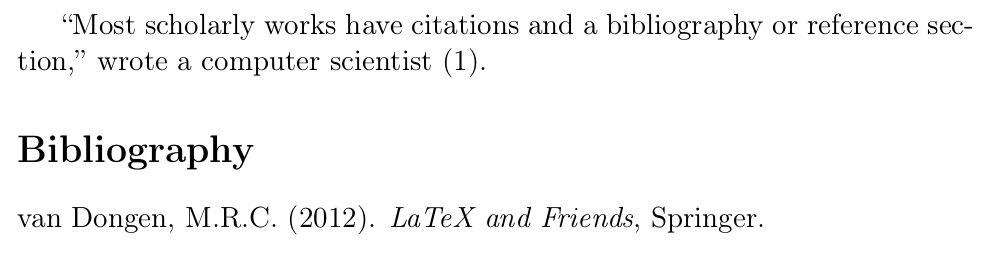 Citation number does not match bibliography
The citation is “(1)” but there’s no matching numbered entry in the bibliography. How do we fix that? With the cite_export keyword.
In basic.org we already have two keywords: bibliography (to specify where to look for bibliographic metadata) and print_bibliography (to tell Org to print the bibliography). Now we introduce the third: cite_export.
cite_export specifies three things: citation processor, bibliography style and citation style. The format is:
#+cite_export: citation-processor bibliography-style citation-style
If any of them is left out, the relevant default is used. If you don’t set cite_export, defaults are used for all three. If you specify one thing, it has to be a valid citation processor, and then the default bibliography and citation styles are used. If you specify two, they have to be a valid citation processor and a valid bibliography style, and then the default citation style is used.
(If you have an empty #+cite_export: line, the export generates a PDF with no citations or bibliography, and org-lint reports an error: “Missing export processor name.”)
In our above example, because we didn’t specify cite_export we were using the default citation processor, which is basic. However, we could specify it by name:
#+cite_export: basic
If we put that in basic.org and export to PDF we will get the same as before.
#+options: title:nil author:nil date:nil toc:nil num:nil

#+bibliography: Basic.bib
#+cite_export: basic

"Most scholarly works have citations and a bibliography or reference
section," wrote a computer scientist [cite/nb:@friends].

* Bibliography

#+print_bibliography:
That Org file exports to this PDF.
Basic processor, same as before
Indeed, same as before.
Defining only the citation processor and nothing more means the default bibliography and citation styles are used. What if we don’t want the default bibliography style? What is available? There are three options, listed in lisp/oc-basic.el:
author-year (the default)numericplainLet’s start by working through these bibliography styles. First, author-year, which is the default. This will be the same again: before we were defaulting to the default option, now we’re specifying in cite_export that we want to use it.
#+options: title:nil author:nil date:nil toc:nil num:nil

#+bibliography: Basic.bib
#+cite_export: basic author-year

"Most scholarly works have citations and a bibliography or reference
section," wrote a computer scientist [cite/nb:@friends].

* Bibliography

#+print_bibliography:
This exports to:
Basic processor, author-year bibliography, same as before
Again, same as before. Next, change cite_export to specify the numeric style.
#+options: title:nil author:nil date:nil toc:nil num:nil

#+bibliography: Basic.bib
#+cite_export: basic numeric

"Most scholarly works have citations and a bibliography or reference
section," wrote a computer scientist [cite/nb:@friends].

* Bibliography

#+print_bibliography:
This exports to:
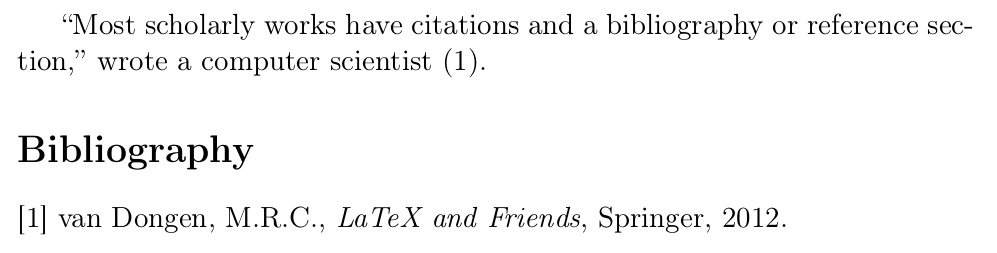 Basic processor, numeric bibliography
Aha! They match! The numeric citation style (specified in the citation object by nb) goes with the numeric bibliography style. That makes sense. We have solved the problem!
But let’s keep going and change cite_export one last time to use the plain bibliography style.
#+options: title:nil author:nil date:nil toc:nil num:nil

#+bibliography: Basic.bib
#+cite_export: basic plain

"Most scholarly works have citations and a bibliography or reference
section," wrote a computer scientist [cite/nb:@friends].

* Bibliography

#+print_bibliography:
This exports to:
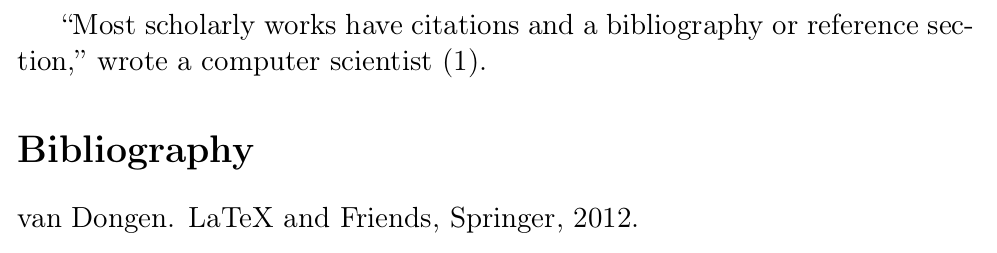 Basic processor, plain bibliography
The plain bibliography style is plain indeed. It’s sort of like author-year but without formatting and just the family name of the author.
That covers the three options for bibliography style we can set in cite_export. Next, setting a citation style and how the two sets of options fit together.
Tom Rochepullquote:
> Zotero users can go all in and make it their main research tool. That has a lot to offer. But I don’t want to write in Zotero, because I write in Org. Where should I draw the line between Zotero and Emacs?
> That sent me looking into various Emacs packages and tools. It got complicated. This is a big subject. I decided to start with a core feature of any such system: citations.
I did some sessions at work showing what Zotero can do, and my preparations got me caught up on the improvements in version 6 almost two years ago, which I’d read about but not tried. It’s fantastic. A group at Rice University did a great twenty-minute video that covers it all: Reading, Annotating, Note-taking, and Drafting/Outlining with Zotero 6.
The Zotero project did incredible work on this upgrade. Zotero already was the best research management tool and general purpose citation manager around, and now you can use it for PDF annotations, note-taking and draft-writing, and then easily move all that into your word processor, carrying all your citations along. I’ve always recommended it and now have even more reasons to do so (with still more when version 7 comes out).
But I don’t use it that way myself. Notes I take digitally I do in Org mode in Emacs, and if I want to mark up a PDF I print it and use a (mechanical) pencil. I use Zotero mostly as a research management tool, collecting citations and PDFs and web snapshots; lately I’m starting to use it to help with Wikipedia editing (see Wikipedia’s Citing sources with Zotero and Zotero’s Zotero and Wikipedia/Wikidata).
Seeing everything Zotero can do now made me wonder: Can I do that in Emacs with Org? Zotero users can go all in and make it their main research tool. That has a lot to offer. But I don’t want to write in Zotero, because I write in Org. Where should I draw the line between Zotero and Emacs?
That sent me looking into various Emacs packages and tools. It got complicated. This is a big subject. I decided to start with a core feature of any such system: citations. I’m a librarian. Citations I understand.
A citation system in Org was released in summer 2021 after years of discussion and a lot of intense work. It builds on some great existing work and is itself an extremely impressive achievement. Handling citations is hard and now Org can do it.
But I’d never tried it, not once. And I’m a librarian! I decided I was going to learn it. I enjoy formatting citations and bibliographies by hand—indeed I enjoy everything about The Chicago Manual of Style—but now is the time to figure out how Org does them. The Org manual pages on citations are still rather sparse, and I thought this would be a path to me adding some documentation to improve them. That’s my plan.
When the citation system came out, the best documentation on it was in July 2021’s This Month in Org by the mononymic Timothy. I think this is still the main thing people refer to when they want to know how the system works. Timothy’s piece is very thorough, and it was a huge contribution to helping people understand how the new features worked. I found his example citation unclear, however, because the author is “org, mode and Syntax, Citation and List, Mailing and Effort, Time.” There is so much going on there it made it hard for me to see how things worked.
Citations in Org are meant to be exported to other document formats such as LaTeX (for PDFs), OpenDocument or HTML. As we’ll see, that’s where a sort of formula specifying a citation is turned into something readable. There are five citation processors available to do this exporting: basic and csl, which export to several different formats, and bibtex, biblatex and natbib, which only go to LaTeX.
I decided to start by working through a simple example with the basic processor, which is the only one requiring no dependencies or anything from outside. It turned out there were some bugs with it, which were fixed by Org maintainer Ihor Radchenko (for example this commit). Clearly some tests are needed for citations—but perhaps no one had tried using the basic system in these past two-and-a-half years? Yet another reason to try them out and write them up.
Here is the first part of my look into the basic citation system in Org.
This is at the end of the commentary section at the top of oc-basic.el, the file with the code that controls the basic processor.
;; Disclaimer: this citation processor is meant to be a proof of concept, and
;; possibly a fall-back mechanism when nothing else is available.  It is too
;; limited for any serious use case.
This is true, but it’s still a great place to start.
First, we need something to cite. I’m going to use LaTeX and Friends by M.R.C. van Dongen (Berlin: Springer, 2012). I chose this for three reasons: first, it’s about LaTeX, which will be part of all this; second, the author’s surname begins with a lower-case letter, which will help with examples; and third, it’s a good book. Check out this fifteen-minute video about it.
Next, we’re going to put that book’s metadata into a .bib file, which is a bibliography database format used by BibTeX and BibLaTeX, which we will skip now but come back to later. I’ll also come back to the excellent Better BibTeX Zotero extension, which is going to be important for all this, and can generate these files magically. For now, we’ll just make a file called Basic.bib that has this in it:
@book{friends,
title = {{{LaTeX}} and Friends},
author = {van Dongen, M.R.C.},
date = {2012},
location = {Berlin},
publisher = {Springer},
doi = {10.1007/978-3-642-23816-1},
isbn = {978-3-642-23816-1}
}
This says we have a book which will be identified with the key “friends”. We know the title, author (in Surname, Forename order), date of publication, place of publication as “location,” the name of the publisher, the digital object identifier and the International Standard Book Number. Different citation styles will use or ignore this information in their own ways.
”{{LaTeX}}” is in curly braces so its unusual capitalization will be preserved. “Bib(La)TeX case protection rules are incredibly convoluted” as the Better BibTeX FAQ says.
Now we’re ready to work on an Org file. Let’s make basic.org. We’ll use some settings to keep exports clean and simple: no title, author, date or table of contents, and don’t number sections.
#+options: title:nil author:nil date:nil toc:nil num:nil

#+bibliography: Basic.bib

"Most scholarly works have citations and a bibliography or reference
section," wrote a computer scientist [cite:@friends].
That [cite:@friends] is an Org “citation object” in its simplest form. It means: cite the work identified with the key “friends”. Where to look for the metadata about this work? In the Basic.bib bibliography file, as specified with #+bibliography: basic.bib.
Since we’re keeping things simple, we’ll start by exporting to plain text (C-c C-e t A), which gives:
"Most scholarly works have citations and a bibliography or reference
section," wrote a computer scientist (van Dongen, M.R.C., 2012).
It works!
What citation style is “(van Dongen, M.R.C., 2012)” using? It’s Org’s default basic author-year style. We’ll come back to that later.
When we have citations, we need a bibliography. We add that with one line (#+print_bibliography:), and give it a heading to make it look nicer:
#+options: title:nil author:nil date:nil toc:nil

#+bibliography: Basic.bib

"Most scholarly works have citations and a bibliography or reference
section," wrote a computer scientist [cite:@friends].

* Bibliography

#+print_bibliography:
Then we export again:
"Most scholarly works have citations and a bibliography or reference
section," wrote a computer scientist (van Dongen, M.R.C., 2012).
Bibliography
============
van Dongen, M.R.C. (2012). /{{LaTeX}} and Friends/, Springer.
That looks a bit strange. We see the braces because of a bug in Emacs where something else should be tidying up the BibTeX formatting but doesn’t. This shows in text, HTML and ODT exports. We also see /slashes/ on either end of the title, but that is just the text way of indicating italics. The basic processor is so basic that’s all it can do.
This isn’t showing Org and its citations in the best light, so I’ll switch to exporting to LaTeX and making PDFs, which look much nicer.
Let’s export basic.org to LaTeX and generate a PDF, with C-c C-e l p (this assumes a working LaTeX system is installed, of course).
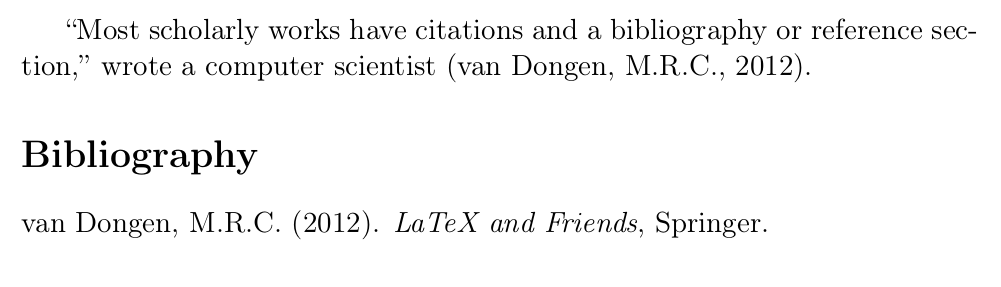 LaTeX export example
Phew! That looks a lot better.
I said [cite:@friends] is the simplest form of citation. There are several “styles” that can be added to it, and most styles have variants. (The word “style” is being unfortunately overloaded given the context of “citation styles” meaning The Chicago Manual of Style and such, but that’s the way it is.) The styles make the citations look different, sometimes very much so. The variants control if the citation is wrapped in brackets and if the first letter is capitalized. [cite:@friends] is in fact using the default style with no variant.
These are the available styles and their variants (as listed in lisp/oc-basic.el in the source code):
| style | code | variants | intention |
|---|---|---|---|
| (default) | bare, caps | ||
| author | a | caps | show only author(s) |
| note | ft | bare, bare-caps, caps | footnotes |
| nocite | n | put in bibliography | |
| noauthor | na | bare | date only |
| numeric | nb | use numbers | |
| text | t | bare, bare-caps, caps | plain text |
The variants use codes b (bare; no brackets), bc (bare-caps) or c (caps; first letter of the name is capitalized). Styles and variants are specified using slashes after cite in the citation. For example, the author style uses a, so to use it the default way you would specify [cite/a:@friends], or to use the caps variant, [cite/a/c:@friends]. To use the default style with caps variant, use [cite//c:@friends] with no style code given.
Here is a table of styles (s), variants (v), how they’re specified, what the citation object looks like in the raw, and what it becomes when exported.
| s | v | codes | citation | result |
|---|---|---|---|---|
| [cite:@friends] | (van Dongen, M.R.C., 2012) | |||
| b | //b | [cite//b:@friends] | van Dongen, M.R.C., 2012 | |
| c | //c | [cite//c:@friends] | (Van Dongen, M.R.C., 2012) | |
| a | /a | [cite/a:@friends] | van Dongen, M.R.C. | |
| a | c | /a/c | [cite/a/c:@friends] | Van Dongen, M.R.C. |
| ft | /ft | [cite/ft:@friends] | ¹ | |
| ft | b | /ft/b | [cite/ft/b:@friends] | ² |
| ft | bc | /ft/bc | [cite/ft/bc:@friends] | ³ |
| ft | c | /ft/c | [cite/ft/c:@friends] | ⁴ |
| n | /n | [cite/n:@friends] | ||
| na | /na | [cite/na:@friends] | (2012) | |
| na | b | /na/b | [cite/na/b:@friends] | 2012 |
| nb | /nb/ | [cite/nb:@friends] | (1) | |
| t | /t | [cite/t:@friends] | van Dongen, M.R.C. (2012) | |
| t | b | /t/b | [cite/t/b:@friends] | van Dongen, M.R.C. 2012 |
| t | bc | /t/bc | [cite/t/bc:@friends] | Van Dongen, M.R.C. 2012 |
| t | c | /t/c | [cite/t/c:@friends] | Van Dongen, M.R.C. (2012) |
Here’s the table in the LaTeX export, with an extra column specifying the style name.
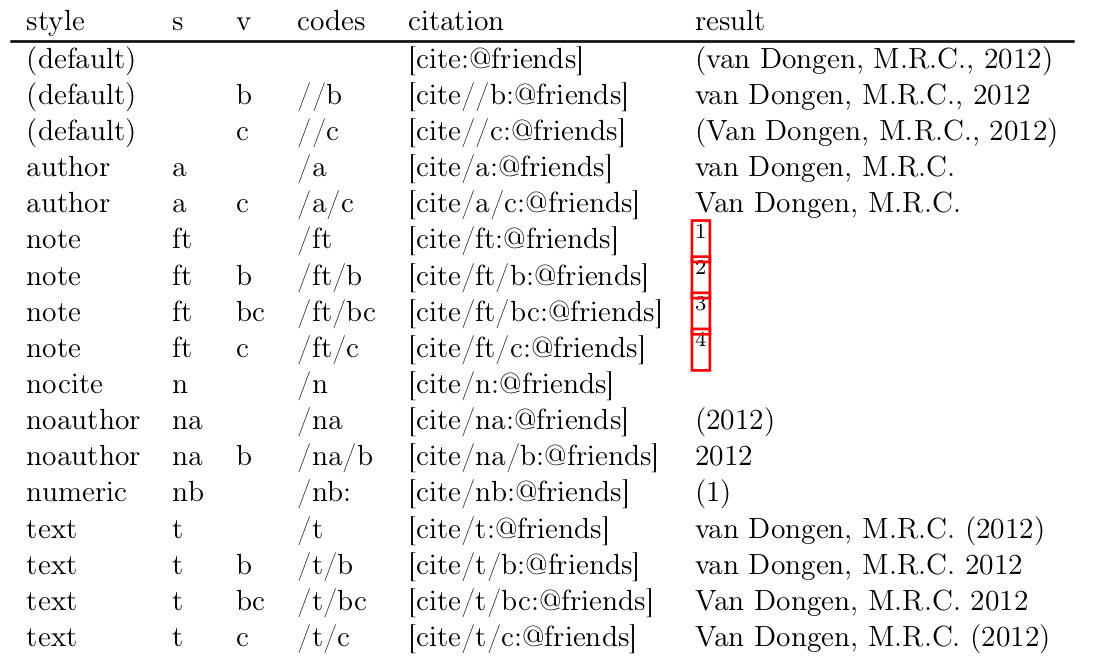 LaTeX export of table of examples
Notice that the bare (b) variants don’t have brackets, and the caps (c) variants turn “van Dongen” into “Van Dongen.” Bare-caps (bc) does both.
You can see the nocite (n) style is unusual because it produces nothing. Its use is to force the entry into the bibliography even though the work is not cited; this need arises now and then.
The numeric (nb) style is different because it’s pointing directly to the bibliography. We’ll get to that next.
I recognize these as more or less common citation forms—shown in a simple way—except for some of those text (t) variants. Maybe I’ll figure them out later. It’s good the basic citation processor is complete and offers all variants, because it helps show what’s going on. As the disclaimer said, it’s a proof of concept.
The footnotes look like this. These variants in order are default, bare, bare-caps and caps.
¹ van Dongen, M.R.C. (2012)
² van Dongen, M.R.C. 2012
³ Van Dongen, M.R.C. 2012
⁴ Van Dongen, M.R.C. (2012)
The bibliography generated after that export looks the same as before:
 Very simple bibliography
That works for all the citations but one: the numeric style, where the citation was “(1).” For that we need a matching number in the bibliography. This will give the bones of the Vancouver system, which is common in the physical sciences.
To make that appear we need to use the third part of the citation system, the cite_export keyword, which we’ve left out so far. By not specifying it we were using all the defaults. The default citation processor is basic, which we wanted. To have a numbered bibliography matching the numbered citations we’ll need to get away from other defaults and make some customizations, which I’ll cover next.
Tom RocheVERY EXCELLENT: (mostly) 80 min Christman summary of US politics as a function of US economics and, especially, class. And still funny!
Hosted on Acast. See acast.com/privacy for more information.
Tom RocheAmber+Felix+Will, mostly just bant but quite funny, esp their dissection of Neri Oxman's hilarious bullsh!t (and her top-notch Indian replyguy)
We had some other news items to discuss, but the bulk of this episode is taken up with one piece of breaking news: Did you know that there's a tunnel under Eastern Pkwy? Yes we’re discussing the ridiculous story out of Brooklyn about a group of Chabad-Lubavitch members attempting to dig a secret and unlicensed tunnel under the streets of Crown Heights. We also take a look at Bill Ackman facing some blowback against his wife in his crusade against “academic plagiarism”. Alone, you come India.
Buy Amber’s book: https://us.macmillan.com/books/9781250269621/dirtbag
Get bonus content on PatreonHosted on Acast. See acast.com/privacy for more information.
Tom RocheEXCELLENT
Tom RocheEXCELLENT, detailed ... given interview length ~= 54 min. That being said, it may seem mean-spirited to do the 'they shoulda done' thing, but ... IMHO, one /really cannot/ discuss Nixon, Kissinger, and their wars in Southeast Asia without at least mentioning the facts (now very well established, despite what Wikipedia and various commentators (e.g., Saagar Enjeti) want one to believe) that
- Kissinger and Nixon actively directed acts of sabotage against LBJ's 1968 peacetalks with the DRV (aka 'North Vietnam', now SRV) which led to their failure
- terms of the 1973 peace treaty that K&N subsequently negotiated with the DRV (and for which the Nobel Peace Prize committee disgracefully jointly awarded Kissinger that prize) were nearly identical to those in the preliminary agreement they sabotaged in 1968
and therefore
- K&N are directly responsible for a large fraction of the millions of Indochinese deaths 1968-1973, and treasonably responsible for nearly all US military deaths over that period
Danny and Derek welcome Carolyn Eisenberg, professor of history at Hofstra University, to explore Henry Kissinger and Richard Nixon’s joint pursuit of war in Southeast Asia in the 1960s and 70s. Using Carolyn’s book Fire and Rain as a guide, the group gets into the duo’s relationship, their aims in escalating conflict in the region while pursuing diplomacy with China and the Soviet Union, military events like Operation Lam Son 719, and what this story reveals about U.S. foreign relations.
Carolyn also contributed to the edited anthology The Good Die Young: The Verdict on Henry Kissinger, which was released after his death in December 2023.
Be sure to also check out Danny and Derek’s special episode with Greg Grandin on the life and legacy of Kissinger.
Become a founding member today and claim your year of a digital subscription to The Nation!
Tom Rocheboth segments EXCELLENT
Just added to my radio archive (click on date for link):
January 4, 2024 Samuel Moyn, law prof and historian, on the political and legal dubiousness of excluding Trump from the presidential ballot (article here) • labor journalist Alex Press on the year in labor (articles on that topic here and here)
Tom Rochemostly excellent KB+SE
+ esp 8th/final segment (105:35-122:55): interview with Jeff Stein on his new podcast ([American Carnage](https://feeds.buzzsprout.com/2294333.rss)) on John Brown, US slavery, and revolutionary abolitionism
- /except/
----- (most of) 4th seg (52:15-73:13): debate on protest tactics. Unless you're very media-isolated, you've heard all these arguments before, and if you've listened to /Breaking Points/ for awhile, and /Rising/ before that, you've /definitely/ heard these arguments before.
----- 5th seg (74:50-88:06): US Republican presidential race. Bit at beginning (Trump cracking on Haley) is amusing, but mostly, this is just more horserace.
----- ... and /all the ads/: at start of audio, end of audio, and between each segment (including bet 4th and 5th above)
Krystal and Saagar discuss Israel demanding the US occupy Gaza, Israelis demand investigation into Oct 7 friendly fire, Israel politician joins South Africa genocide case, Krystal and Saagar debate Gaza ceasefire protester tactics, Nikki Haley surges ahead of Iowa caucus, loose bolts found on multiple Boeing planes, Mehdi Hasan out at MSNBC over Israel criticism, and Jeff Stein joins to discuss his new podcast on revolutionary abolitionist John Brown.
To become a Breaking Points Premium Member and watch/listen to the show uncut and 1 hour early visit: https://breakingpoints.supercast.com/
Merch Store: https://shop.breakingpoints.com/
See omnystudio.com/listener for privacy information.
Tom Rochebelow-average Ken Cheng, but amusing enough
Comedian Ken Cheng focusses his analytical observations on school subjects. In the first of the series, Ken explores Maths, the subject that he loved until it broke him. Ken looks into popular disdain of Maths, and offers up his answers on how we turn around its public image.
Producer: Rajiv Karia An EcoAudio certified production.
It is a BBC Studios production for Radio 4.
Tom Roche(mostly) excellent
Krystal breaks down the latest ICJ genocide charges against Israel.
To become a Breaking Points Premium Member and watch/listen to the show AD FREE, uncut and 1 hour early visit: https://breakingpoints.supercast.com/
Merch Store: https://shop.breakingpoints.com/
See omnystudio.com/listener for privacy information.
Tom Rocheunfortunately just a trailer :-) audio for parts 1 and 2 of the History of the Kurds series at following links (which, despite the file extensions, are both MP3s, so just rename the files if your device won't play them)
https://substackcdn.com/public/audio/d24fb97c-ba11-44ff-abad-223b8eab52c0.mpga
https://substackcdn.com/public/audio/e5df68e8-7cd4-4472-9cb4-044842dddd5a.mpga
We’re back into our History of the Kurds series with Djene Bajalan, associate professor of history at Missouri State University. In this episode, the group explores changes in Kurdish nationalism during and after World War II (i.e. when it began to be framed in the context of decolonization), 1950s and 60s Kurdish politics in Iraq and Turkey, and the co…
Tom RocheExcellent series of (admittedly very restricted) views of both
* the US 'empire of capital' as it takes shape initially in Mexico from 1848
* not only Mexican but international reaction, not only to the Porfiriato but to the US empire which it served, culminating in the 1910-1920 Mexican Revolution (the event(s) unfortunately not much discussed)
delivered by short discussions of the intersections of several international radicals with early-20th-century Mexico, esp
* W.E.B. DuBois
* John Reed
* the Flores Magón brothers
* Langston Hughes
* Alexandra Kollontai
* Dorothy Healey
* Elizabeth Catlett
The news roundup returns next week, so in the meantime we thought we’d share our conversation with Christina Heatherton, Elting Associate Professor of American Studies and Human Rights at Trinity College, Connecticut. Her book Arise! Global Radicalism in the Era of the Mexican Revolution covers the Mexican Revolution as an international story, something that galvanized radical organizers of the era to fight global capitalism in new ways. The discussion broaches Dubois framing the color line as a tool of imperial expansion, touches on figures like Ricardo Flores Magón and Alexandra Kollontai, examines prisons used as organizing spaces, and how this era of radicalism can inform organizing today.
The book will be out in paperback from UC Press in February while the Spanish translation will be out from La Cigarra Press this Spring.
Recorded in June 2023
