As Israel continues its genocide on Gaza, it is ramping up its attacks in Lebanon and Syria while the US strikes Iraq and Yemen, bringing the Middle East closer to the brink of regional war.
To discuss this and more, Rania Khalek is joined by veteran war correspondent and analyst Elijah Magnier for a special live episode of Dispatches.
good Greenwald piece on start of the 2024 US Presidential campaign (Biden runs as defense of democracy while eliminating Democratic Party primaries and prosecuting Trump), then (27:08-89:37) Mearsheimer EXCELLENT as usual--nearly all on Mideast and geopolitics, only a bit at end on NATO's proxy war on Russia in Ukraine
Ames and Dolan excellent as usual on US genocides 1971 Bangladesh to 2024 Gaza, esp how the US deepstate (esp State Dept) as framed them, and how USCFM (esp New York Times) has reported on them:
* Israel regime public admissions--and urgings, even brags--about Gaza and Palestine genocide ***** Israeli public opinion supports genocide * potential for Iran war, esp US chickenhawk fulmination/fomentation * Biden's history Zionism (esp early-career links to Henry 'Scoop' Jackson) * South Africa ICJ case potential for at-least reputational damage to US, Israel, et al Zionists ***** ICC/ICJ comparison (~45 min in the audio) * USCFM (mostly NYT) reporting on genocides 1971-2024: ***** Yemen war 2015-2023: NYT lowballed casualties, zero compassion for children, failure to recognize port closure (assisted by US Navy) as genocidal ********* US-UK officers directing campaigns in KSA command centers, US colonel Toumajan commanded UAE Joint Aviation Command (while remaining active US Army) ********* suppressed Obama State Dept legal office paper on US liability to warcrime charges for role in Yemen war ***** 1971 Bangladesh independence war: NYT claimed fog of war regarding Pakistan warcrimes ********* US military et al (esp Nixon-Kissinger) total support for Pakistan ********* US State Dept 'expressed concern' while claiming war was 'internal affair' and aiding Pakistan ***** Timor independence war 1975-1999: almost no reporting until mid-1990s ********* aside on birth-rate change between war and peace ********* Australia-Indonesia joint suppression of reporting esp atrocities and warcrimes ********* 1975 Ford-Kissinger greenlight not only for Suharto/TNI invasion, but for genocide ************* NYT headline next day: 'Ford assures Indonesia of commitment', increasing aid esp military--nothing about invasion ********* US stalls Apr 1976 UNGA withdrawal resolution ********* Carter regime supported Indonesia occupation (while launching 'empire of human rights' spinline): NYT propagates Carter State Dept line that fog-of-war but 'atrocities have been greatly exaggerated' * bad CorpDem musicians esp Blinken and Beto
A look back on some of the best bits of News Quizzing from 2023
In this compilation episode Andy Zaltzman casts his satirical eye over the highs and lows of the year, in which the UK managed to hold of a Prime Minister for more than a year (well done us), The Economy moved about as erratically as a paper plane in a snow storm, and there were some events in the Middle East that made doing a light-hearted topical news show a bit of a challenge at times...
Hosted and written by Andy Zaltzman.
Producer: Sam Holmes
Executive Producer: James Robinson
Production Coordinator: Jodie Charman
Western media outlets have absurdly claimed China's economy is collapsing, due to a crisis in the real estate sector. But in reality, this is part of an intentional transition away from infrastructure, toward more investment in technological production. Ben Norton explains.
VIDEO: https://youtube.com/watch?v=VlXUy65hqv4
Check out our related video "How China became the world's industrial superpower - and why the US is desperate to stop it": https://youtube.com/watch?v=BT7Th2aV0wM
competent: borderline, mostly skippable, but excellent closing song by Peter Rugman feat. Keir Starmer doing 80s-style rap while selling out to Tories
Steve Punt and Hugh Dennis present the week via topical stand-up and sketches. Featuring Geoff Norcott looking in the proposal of a Minister for Men, Harriet Kemsley on Kim Jong Un's pleas to North Korea, and an original song from Peter Rugman.
The show was written by the cast with additional material from Adrian Gray, Miranda Holms, Rajiv Karia, Cameron Loxdale and Laura Major.
Voice Actors: Daniel Barker and Chiara Goldsmith.
Producer: Rajiv Karia
Production Coordinator: Katie Baum
EXCELLENT: mostly guest Malekafzali+Will, mostly politics but some goofing on hasbara scum. No Felix, bit of Chris, brief update on Matt before episode proper (and after excellent TrueAnon advert for their new Jan6 boardgame at start of audio)
Our friend Séamus joins us from Beirut to discuss the escalating regional elements of Israel’s war on Gaza. We look at Israel’s recent strike on a Hamas leader in Beirut, Yemeni actions restricting cargo shipping in the red sea, and the deadly bomb attack on a Soleimani memorial in Iran. We also touch on the differences between American and Lebanese media’s treatment of the events, including the recent media circus around Harvard’s president.
... but not sure why this episode rather unusually released a day late ...
Ryan and Emily discuss Israel assassinating a top Iranian leader in Lebanon, family member tears into NYT for inaccurate Oct 7th report, Harvard President Claudine Gay Resigns, Jimmy Kimmel threatens Aaron Rogers with lawsuit over Epstein allegation, Congress caught profiting from Israel war, and tech leader Paul Biggar exposes the industries Pro-Israel bias.
VERY EXCELLENT: funny and informative 72 min. Chris+Matt+Will (so it's basically a Chapo episode) do an astonishingly comprehensive rundown of portrayals (in cinema and TV, plus a few theatric) of US presidents (in chronological order--by president, not portrayals). Until nearly the end they discuss only portrayals of /real/ presidents, but throw in a few fictional ones at end.
We're joined by Chapo Trap House's Will Menaker to take a look at the history of Presidential portrayals in Film and Television. Get bonus content on Patreon
Another EXCELLENT Blowback. S04E08 covers 2001-2007, from the initial afterglow of US "victory in Afghanistan" in very-late 2001 to the obvious quagmire of 2007, as the GWB regime death-spirals into Global Financial Crisis (following mostly in order of presentation):
* Bushites attempt to do (surprisingly expensive) war-on-the-cheap almost immediately turns into civil-war-via-score-settling (notably Afghans using US forces to attack personal enemies), then settles into massive corruption plus civil war in the formal sense (militarily-organized opponents). * Bushites cease to care about Afghan war: they see New Frontiers in 'the Axis of Evil', esp the already-planned-for 2nd US-Iraq War * Afghanistan splinters into warlord states with varying amounts of toleration for US occupiers * pretend "reconstruction" complete fail, but corruption goes massive * Pashtun opposition to US coalesces in Kandahar * US increasingly fights war via corporate (e.g., Halliburton, Blackwater) and regional (mostly Pakistan) contractors * covert-war (mostly CIA) turns to kidnapping ('extraordinary rendition') and torture (esp Guantanamo) * Pakistan vs India proxy war in Afghanistan and region * Pakistani ISI allies with Taliban in Afghanistan and Pakistan (mostly in NWFP, now Khyber Pakhtunkhwa), accelerating Taliban comeback * Karzai and GWB in 2004 elections * opium comeback under both warlord and CIA protection * US (esp CIA) develops worldwide network of 'black sites' for interrogation via torture * US deepstate esp corporate-funded media promotes the Afghan-womens-rights fraud, pretending that US occupation must continue to assist its allies in protecting womens' rights, when those warlords are actively opposed to rights for women et al
America runs its war in Afghanistan on the cheap — and subcontracts to crooks, kingpins, and gangsters.
We ring in the new year by raiding the fridge for some holiday leftovers. It's become an annual tradition on this podcast to try to extract ideology from Tim Allen's "Santa Clause" franchise. With THE SANTA CLAUSE 3: THE ESCAPE CLAUSE (2006), we hit the motherlode.
Join us on Patreon for an extra episode every week - https://www.patreon.com/michaelandus
Bessner and Christman VERY EXCELLENT as usual (and occ amusing)
We’re joined by Danny Bessner of the American Prestige podcast to discuss the rise of the post-WWII National Security state and how it affects the powers and prerogatives of the presidency. Get bonus content on Patreon
Stavvy baby joins us to ring in the New Year with some talk on Christmas gift-giving, review some recent comedic offerings from Israeli TV and Tucker Carlson’s X show, and finally to look at some of recent political developments in the great city of Baltimore and state of Maryland.
Watch Stav’s special “Fat Rascal”, streaming now on Netflix.
And listen to the Stavvy’s World podcast wherever you get podcasts.
excellent, just not new: this is an episode-length mashup of 3 segments presented in 2023
Did you know that every time you perform a Google search, you're using technology invented by a medieval polymath in Oxford? That's just one of the many interesting insights in Phillip Adams' conversations about how the index, the crossword and the encyclopedia were invented - and why they stuck.
Is Israel's war on Gaza expanding into a regional conflict? Why is Yemen attacking ships in the Red Sea? What are the roles of Iran and Saudi Arabia? Journalist Ben Norton analyzes the geopolitics of the crisis.
(This analysis features many maps, so watching the video is recommended.)
VIDEO: https://youtube.com/watch?v=C-YjyCjH7SA
EXCELLENT as usual, esp regarding UK disasters at Gallipoli and Kut al Amara, as well as the very-undercovered Balkans war (esp the Salonika Campaign and the Macedonian front)
Germans use poison gas on the battlefield at Ypres, British lose 60,000 and Germans 40,000. French attack at Artois with casualties of 100,000 and German 75,000. Russians lose 2 million casualties fighting Germany on the Eastern front. British defeated at Loos, lose 50,000 and Germany 20,000. French offensive in Champagne results in 190,000 casualties and … Continue reading "World War Civ 30: Allied Disasters 1915"
SINGULAR: more than just what the title promises, this is Chua's workflow for 1. recording audio+transcript ***** simultaneously--unfortunately using Google Recorder, so tradeoff between functionality and privacy ***** Chua records audio using phrase='Oops' to signal audio error 2. (elisp to) export audio+transcript to PC (using [Syncthing](https://en.wikipedia.org/wiki/Syncthing) and Chua's [emacs package=Subed](https://github.com/sachac/subed)) 3. use [Aeneas](https://pypi.org/project/aeneas/) to {synchronize, force alignment} between audio and transcript, aka generate synchronization map 4. (elisp to) {identify, timestamp, prepare to split out} 'Oops'es from the audio 5. actually edit the 'Oops'es from the audio (using [Audacity](https://en.wikipedia.org/wiki/Audacity_(audio_editor) and [a Chua pile'o'elisp](https://github.com/sachac/compile-media)) 6. [timestamp, subtitle (which at this step seems ~= transcript)] the clean audio
Finding enough quiet focused time to record audio is a challenge. I
often have to re-record segments in order to correct brain hiccups or
to restart after interruptions. It's also hard for me to sit still and
listen to my recordings looking for mistakes to edit out. I'm not
familiar enough with Audacity to zip around with keyboard shortcuts,
and I don't like listening to myself again and again in order to find
my way around an audio file.
Sure, I could take the transcript, align it with subed-align and
Aeneas to get the timestamps, and then use subed-convert to get a CSV (actually a TSV since it uses tabs)
that I can import into Audacity as labels, but it still feels a little
awkward to navigate. I have to zoom in a lot for the text to be
readable.
Figure 1: Audacity labels
So here's a workflow I've been experimenting with for cleaning up my
recorded audio.
Just like with my audio braindumps, I use Google Recorder on my phone
because I can get the audio file and a rough transcript, and because
the microphone on it is better than on my laptop. For narration
recordings, I hide in the closet because the clothes muffle echoes. I
don't feel as self-conscious there as I might be if I recorded in the
kitchen, where my computer usually is. I used to record in Emacs using
subed-record by pressing left to redo a segment and right to
move on to the next one, but using my phone means I don't have to deal
with the computer's noises or get the good mic from downstairs.
I start the recorder on my phone and then switch to my Org file in
Orgzly Revived, where I've added my script. I read it
as far as I can go. If I want to redo a segment, I say "Oops" and then
just redo the last phrase or so.
Screenshot of Google Recorder on my phone
I export the transcript and the M4A audio file using Syncthing, which
copies them to my computer. I have a function that copies the latest
recording and even sets things up for removing oops segments
(my-subed-copy-latest-phone-recording, which calls my-split-oops).
If I want to process several files, I can copy them over with
my-subed-copy-recording.
my-subed-copy-latest-phone-recording: Copy the latest recording transcript and audio to DESTINATION.
I'll use Aeneas to get the timestamps for each line of text, so a
little bit of text processing will let me identify the segments that I
want to remove. The way my-split-oops works is that it looks for
"oops" in the transcript. Whenever it finds "oops", it adds a newline
afterwards. Then it takes the next five words and sees if it can
search backward for them within 300 characters. If it finds the words,
then that's the start of my repeated segment, and we can add a newline
before that. If it doesn't find the words, we try again with four
words, then three, then two, then one. I can also manually review the
file and see if the oopses are well lined up. When they're detected
properly, I should see partially duplicated lines.
I used to record using sub-record by using by. Oops,
I used to record. Oops,
I used to record an emacs using subhead record, by pressing left to reduce segment, and write to move on to the next one.
But using my phone means, I don't have to deal with them. Oops.
But using my phone means, I don't have to deal with the computer's noises or get the good mic from downstairs. I started recorder on my phone
my-split-oops: Look for oops and make it easier to split.
(defun my-split-oops ()
  "Look for oops and make it easier to split."
  (interactive)
  (let ((scan-window 300))
    (while (re-search-forward "oops[,\.]?[ \n]+" nil t)
      (let ((start (min (line-beginning-position) (- (point) scan-window)))
            start-search
            found
            search-for)
        (if (bolp)
            (progn
              (backward-char)
              (setq start (min (line-beginning-position) (- (point) scan-window))))
          (insert "\n"))
        (save-excursion
          (setq start-search (point))
          ;; look for 1..3 words back
          (goto-char
           (or
            (cl-loop
             for n downfrom 4 downto 1
             do
             (save-excursion
               (dotimes (_ n) (forward-word))
               (setq search-for (downcase (string-trim (buffer-substring start-search (point)))))
               (goto-char start-search)
               (when (re-search-backward (regexp-quote search-for) start t)
                 (goto-char (match-beginning 0))
                 (cl-return (point)))))
            (and (call-interactively 'isearch-backward) (point))))
          (insert "\n"))))))
Once the lines are split up, I use subed-align and get a VTT file.
The oops segments will be in their own subtitles.
Figure 2: Subtitles and waveforms
The timestamps still need a bit of tweaking sometimes, so I use
subed-waveform-show-current or subed-waveform-show-all. I can use
the following bindings:
middle-click to play a sample
M-left-click to set the start and copy to the previous subtitle
left-click to set the start without changing the previous one
M-right-click to set the end and copy to the next subtitle
right-click to set the end without changing the next one
M-j to jump to the current subtitle and play it again in MPV
M-J to jump to close to the end of the current subtitle and play it in MPV
I use my-subed-delete-oops to delete the oops segments. I can also
just mark them for skipping by calling C-u M-x my-subed-delete-oops
instead.
Then I add a #+OUTPUT: filename-cleaned.opus comment under a NOTE
near the beginning of the file. This tells
subed-record~compile-audio where to put the output.
WEBVTT

NOTE #+SKIP

00:00:00.000 --> 00:00:10.319
Finding enough. Oops.

NOTE
#+OUTPUT: 2023-12-subed-record-cleaned.opus

00:00:10.320 --> 00:00:36.319
Finding enough quiet Focused. Time to record. Audio is a challenge. I often have to re-record segments in order to correct brain hiccups, or to restart after interruptions.
I can test short segments by marking the region with C-SPC and using
subed-record-compile-try-flow. This lets me check if the transitions
between segments make sense.
When I'm happy with everything, I can use subed-record-compile-audio
to extract the segments specified by the start and end times of each
subtitle and concatenate them one after the other in the audio file
specified by the output. The result should be a clean audio file.
If I need to compile an audio file from several takes, I process each
take separately. Once I've adjusted the timestamps and deleted or
skipped the oops segments, I add #+AUDIO: input-filename.opus to a
NOTE at the beginning of the file.
subed-record-insert-audio-source-note makes this easier. Then I copy
the file's subtitles into my main file. subed-record-compile-audio will take
the audio from whichever file was specified by the #+AUDIO: comment,
so I can use audio from different files.
Example VTT segment with multiple audio files
NOTE
#+AUDIO: 2023-11-11-emacsconf.m4a

00:10:55.617 --> 00:10:58.136
Sometimes we send emails one at a time.

NOTE
#+AUDIO: 2023-11-15-emacsconf.m4a

00:10:55.625 --> 00:11:03.539
Like when you let a speaker know that we've received a proposal That's mostly a matter of plugging the talks properties into the right places in the template.
Now I have a clean audio file that corresponds to my script. I can use
subed-align on my script to get the timestamps for each line using
the cleaned audio. Once I have a subtitle file, I can use
emacsconf-subed-split (in emacsconf-subed.el - which I
probably should add to subed-mode sometime) to quickly split the
captions up to fit the line lengths. Then I redo the timestamps with
subed-align and adjust timestamps with
subed-waveform-show-current.
So that's how I go from rough recordings with stutters and oopses to a
clean audio file with captions based on my script. People can probably
edit faster with Audacity wizardry or the AI audio editors that are in
vogue these days, but this little workflow gets around my impatience
with audio by turning it into (mostly) text, so that's cool. Let's see
if I can make more presentations now that I've gotten the audio side
figured out!
EXCELLENT, comprehensive (note this ep is untruncated unlike most Khalek Dispatches) interview with Anis Germani (CeSSRA Beirut) on modes of Zionist alt-genocide modes esp vs Gaza. Topics include (mostly in order of presentation)
* Gazans decreased life expectancy * Israel's decades of deliberate starvation of Gazans ('putting them on a diet') * Israel military targets public health and medicine, including staff, materials (esp pharmaceuticals and hospital-hygiene products), and infrastructure * Israel weaponizes disease and traumatic injury * long history of Israeli organ trafficking (necessitated by religious Jews' low rates of organ donation) * current medicine and public-health problems in Lebanon as Israel threatens to widen the war
By targeting hospitals and doctors while cutting off water, food and electricity and concentrating Palestinians into smaller and smaller zones of death in Gaza, the Israelis are creating a public health crisis that will kill even more Palestinians with infectious diseases.
To discuss this and more, Rania Khalek was joined by Lebanese medical doctor and public health researcher Anis Germany.
EXCELLENT, consistently funny. Not quite as good as the 24 Nov 2023 /Now Show/, but the host sets, both guest sets, and the closing song are more-than-usually excellent. /Especially/ the 1st guest set (6:13-12:38), by David Eagle, on UK Christmas politics, economics, culture, and ... blindness! but esp Eagle's holiday compilation album, "Now That's What I Call Christmas Music: The Angry Antiwoke Edition" :-)
Steve Punt and Hugh Dennis present the week via topical stand-up and sketches. They're joined by David Eagle unpacking the Advent, Jessica Fostekew looking into the repeal of the New Zealand smoking ban, and an original song from Archie Henderson, performed with Becky CJ.
The show was written by the cast with additional material from Alex Garrick-Wright, Jade Gebbie, Rhiannon Shaw, Miranda Holms and Cody Dahler.
Voice Actors: Jason Forbes and Lola-Rose Maxwell.
Producer: Rajiv Karia
Production Coordinator: Katie Baum
VERY EXCELLENT survey of genocide history and law, and why (in the face of Jashinsky's softpeddled Zionism, which gets a polite but firm smackdown) Israel's current attacks on Gaza (especially) but also its current pogroms in Jerusalem and the West Bank, and the Zionist state's long violence against Palestinians, are all genocides by definition.
Ryan and Emily sit down with Israeli historian and Associate Professor of Holocaust and Genocide Studies, Raz Segal to ask him about Genocide and Gaza.
VERY EXCELLENT (though the episode headline is rather misleading--Israel seeking to expand the war is only a small part of this). KB only, but it's Krystal at her best.
Krystal gives a breaking update on Israel announcing a 7 Front War in the Middle East.
VERY EXCELLENT. Note Karp, Chris, and the Christman are choppin' up not just The War, but do much prep work from c1840 as well as much aftermath/legacy. Also, much humor.
We're joined by Civil War historian Matt Karp to take a closer look at the, uh, Civil War. We discuss its causes, the course of the war, how it shaped the Republic, and, of course, do a "who are your guys" for Civil War generals. Get bonus content on Patreon
We're joined by the New Republic's Osita Nwanevu to take another look at the founding, the constitution, and how we think about America in general. Get bonus content on Patreon
VERY EXCELLENT broad-but-necessarily-shallow survey of "Middle Eastern" (relative to who?) regional (in this free ~half of the episode--BRICS, EU, PRC, Russia, US (mostly) et al are apparently in the {2nd, behind-the-paywall} part) geopolitical issues in the wake of Israel's genocide on Palestine, including (following not quite in order of presentation--I'm organizing this a bit)
* Abraham Accords (AA) future: expansion is DOA, but current Israel partners (esp UAE) are unlikely to pull out.
* damage to US mass/public image/reputation: massive. Cafiero emphasizes this damage ***** goes beyond (but including) the MENA region ***** is 'irreversible'
* reactions from GCC countries. Cafiero separates them into 4 groups, from most- to least-Israel-friendly: 1. Bahrain, UAE: both are AA partners and very (if semi-covertly) Israel-friendly. 2. Saudi Arabia (aka KSA): 'flirted with' AA, fairly (though again semi-covertly) Israel-cooperative, but much more cautious than 1st group. 3. Oman, Qatar: have 'unofficial, pragmatic' relations with Israel, but have repeatedly overtly rejected AA and other forms of US-backed 'normalization' 4. Kuwait: has 'never had any form of formal or informal relations with Israel' and is 'very firmly opposed to normalization'
Cafiero then discusses in detail (much more than I'm giving here)
* UAE: /very/ authoritarian 'high-tech police state', current leadership very anti-Hamas and -Palestine * Qatar: interesting relationships with Palestinians (inc resistance groups), Israel, and US) * KSA: lip-service to Palestine, but leadership focused on Vision 2030 * Egypt: refusing Israel-US proposals for Gazan ethnic cleansing, otherwise cooperating with the hegemons * Jordan: strong elite+mass opposition to Zionist genocide, would probably break with them on a 'Nakba-2.0' genocide, but is very weak economically and militarily * Oman: "Gaza is dominating everyone's minds [with] unprecedented amount of rage against the US right now," including boycotts of US companies ... but that's it * 'day-after' policy options for Israel-Palestine (esp Gaza) after current war phase: brief discussion before the rest of the episode goes behind the paywall.
What does the genocide in Gaza mean for the surrounding Arab states? Do their oppositional responses even matter or is it all just symbolic? How will this impact the Abraham Accords and other normalization efforts? Why won’t the Gulf states use their oil as leverage to pressure the United States? How does the genocide in Gaza impact countries like Jordan and Syria? How is it affecting America’s standing in the world? What does it mean for Russia and China in an emerging multipolar world?
To discuss this and other regional developments, Rania Khalek was joined by Giorgio Cafiero, the CEO of Gulf State Analytics, a Washington, D.C.-based geopolitical risk consultancy.
This is just part of this episode. The full interview is available for Breakthrough News Members only. Become a member at https://www.Patreon.com/BreakthroughNews to access the full episode and other exclusive content.
excellent: amusing jokes, short stories, and crowdwork
Copper turned comic Alfie Moore takes an audience through real-life crime scenarios. The topic, crime at Christmas. What's it like to be a bobby on the beat in the festive season?
This merry jaunt introduces us to a fun cavalcade of Christmas characters, including a gas station Grinch, an inebriated Mary and Joseph, and a Christmas Eve saviour...
Written and presented by Alfie Moore
Script Editor: Will Ing
Production Co-ordinator: Becky Carewe-Jeffries
Producer: Sam Holmes
Western sanctions over the Ukraine war have backfired, rapidly de-industrializing Europe while accelerating Russia's economic integration with Asia. Journalist Ben Norton explains the historic changes.
VIDEO: https://youtube.com/watch?v=DkuKnYdtW9w
EU confesses ‘our prosperity was based on China & Russia’: cheap energy, low-paid labor, big market: https://geopoliticaleconomy.com/2022/10/18/eu-prosperity-china-russia-energy-market
BRICS expanding into economic powerhouse: Petrodollar under threat - https://youtube.com/watch?v=1SIfrWkQXeE
Tweaks to my -primary command line switch for Emacs.
I seem to spend a few days over most end-of-the-year holidays
tinkering with my Emacs configuration. Everyone needs a hobby. This
year, it was mostly committing to Emacs 29 (moving my “temporary” testing
configuration into ~/.emacs.d).
I live in Emacs and I enjoy tinkering with it. It’s fun. Sometimes,
it’s to try some big, new thing. When I first encountered completion
frameworks like Helm years ago, I was amazed. Magit is also amazing.
And I read my email in mu4e. This weblog post was composed in Org mode
in Emacs and converted to XML, formatted with XSLT, and posted to the
server by typing C-t p. (I put most of my personal bindings in
the C-t keymap because that’s what my advisor in grad school
where I first encountered Emacs almost 30 years ago did).
Sometimes, it’s tiny things like configuring the Org template for
taking notes during meetings. Or binding a key to insert £ or € (not
on my US English keyboard).
I don’t think I’m alone in struggling a bit to manage my todo list.
I’ve got it well(ish) organized in, er, Org mode and I’ve been trying to
keep a perspective open on the agenda so that I can easily refer to it
throughout the day. (I confess that “can easily” and “do” are not even
remotely synonymous.)
The agendas themselves are collected from across the Org mode files
where I take meeting notes as well as dedicated “Inbox”, “Personal”
and “Work” todo lists.
A few years ago, I learned that you can write your own command line
flags for Emacs. I created one, -primary, that I use when I start
Emacs after logging in. That flag starts up the Emacs server (so that
git, for example, can use emacsclient as an editor).
(I know that some folks just start Emacs in the background, running
the server, and use emacsclient for everything. That didn’t work
reliably for me a couple of decades ago for reasons I no longer recall
if I ever figured them out. So I do this instead.)
What I realized yesterday was that I could also start the Agenda
perspective that way. So the agenda would always be available and I
wouldn’t have to cons it into existence the first time with
C-x x s Agenda C-c a a C-x 1
Tada:
;; Make a custom -primary command line argument
(add-to-list
 'command-switch-alist
 '("primary" . (lambda (&rest ignore)
                 (server-start)
                 (persp-switch "Agenda")
                 (org-agenda-list)
                 (delete-other-windows)
                 (persp-switch "main"))))
Time to go work on Christmas breakfast. Happy holidays everyone!
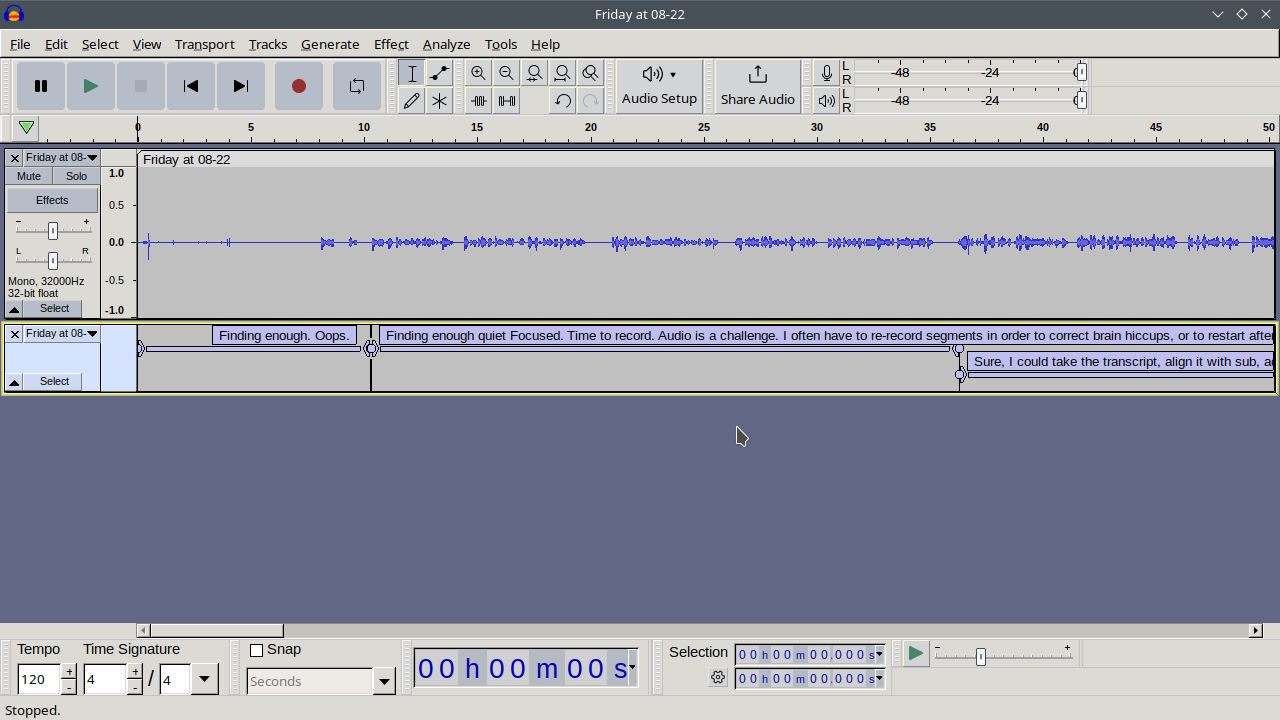 Figure 1: Audacity labels
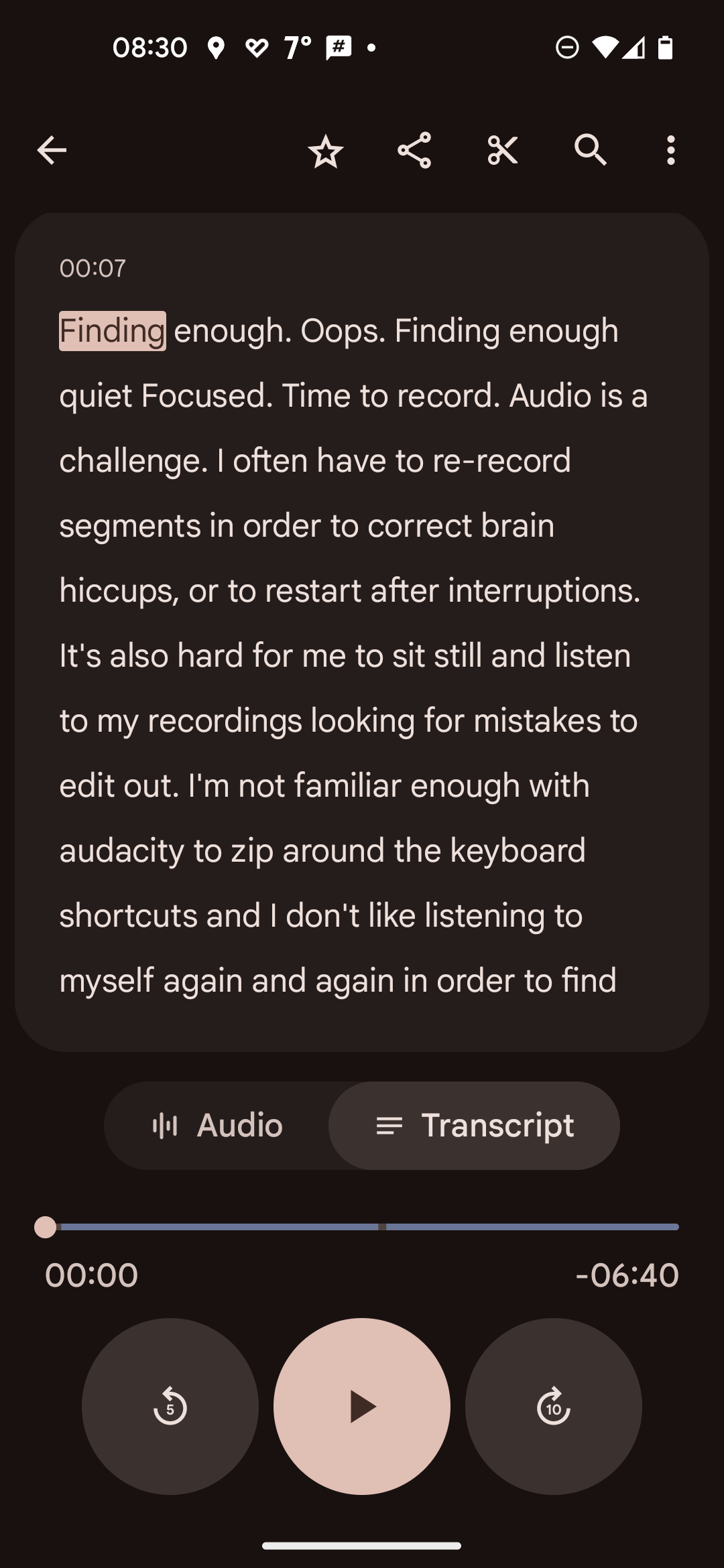
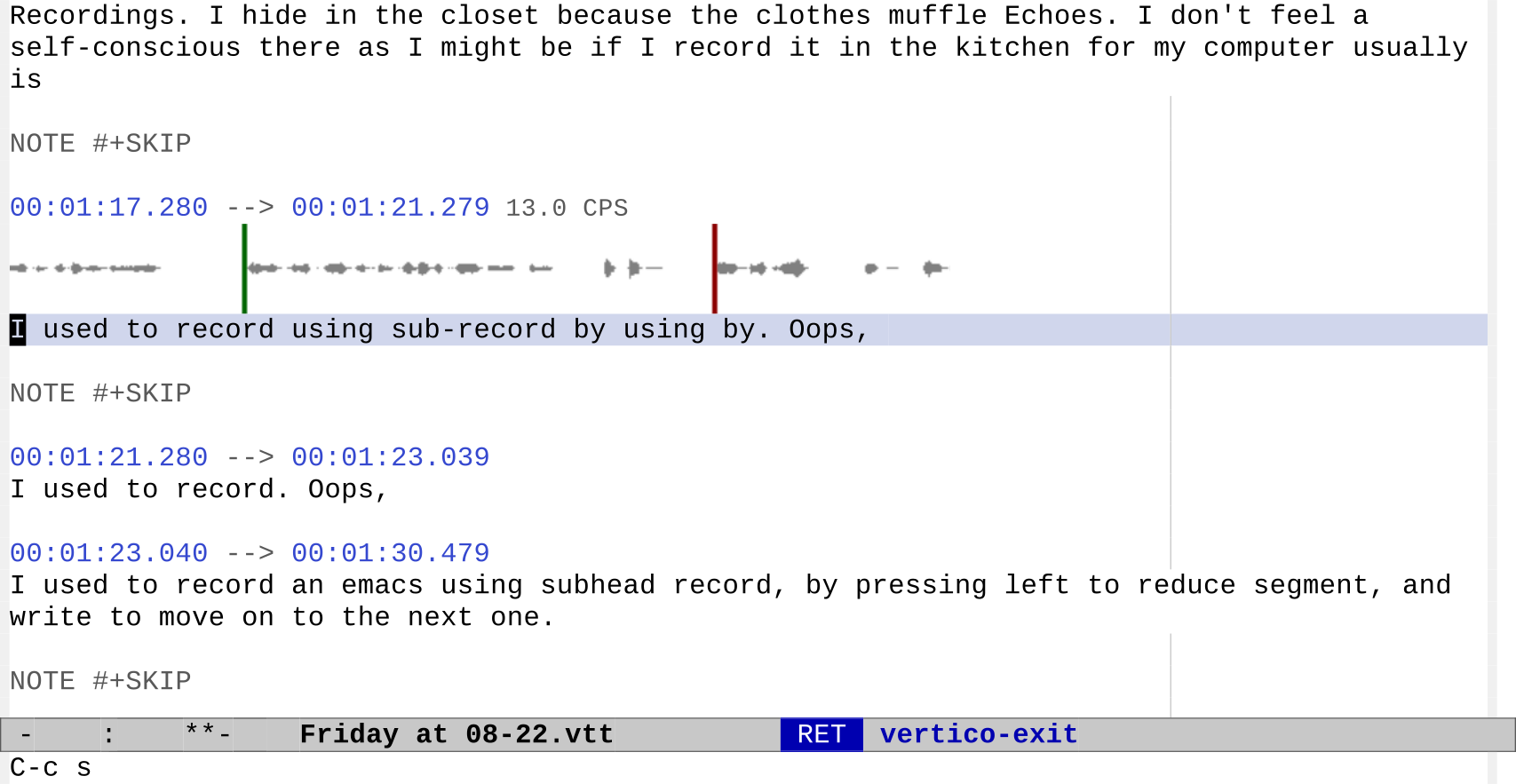 Figure 2: Subtitles and waveforms