Danny and Derek chat with Aslı Bâli, professor of law at Yale Law School. Aslı, whose research focuses largely on human rights law and the law of the international security order, helps us break down the legal definition of genocide, the substance of the ICJ ruling and what was ordered, and the court’s ability to enforce it.
Democratic leadership said in 2020 that people needed to vote for Joe Biden because another Trump term would bring about the worst case scenario. But Joe Biden is facilitating a genocide in Gaza. What happens when the so-called “lesser evil” is responsible for the worst case scenario?
To discuss this and more, Rania Khalek was joined by Briahna Joy Gray, host of Bad Faith Podcast and co-host of Rising at The Hill.
This is just part of this episode. The full interview is available for Breakthrough News Members only. Become a member at https://www.Patreon.com/BreakthroughNews to access the full episode and other exclusive content.
A trip to the Wessel Islands in north-east Arnhem land has uncovered the location where ancient African coins from the island of Kilwa in Tanzania were found in the 1940's. Since the story went viral in 2014, many people have tried to solve the mystery of how they got there.
Guests:
Mike Owen, Historian and Co-founder, PastMasters.
Michael Hermes, Archaeologist and consultant to PastMasters
Nicolas Martyanoff has a nifty post that discusses some tips for dealing with Org headlines. There are actually three tips but I adopted only two of them. The first involves what happens when you type Ctrl+Return on a headline. By default, it will start a new headline wherever the point is. By setting org-insert-heading-respect-content to t the new headline will be inserted after the current headline and its associated content. It seems to me that this is what you’d always want but it’s not the default.
In the past, I’ve avoided using Ctrl+Return to open a new headline because it messed up my current content. With this change it does the right thing so it’s definitely worth knowing.
The second tip involves another feature I’ve never really understood and never used: org-goto (bound to Ctrl+cCtrl+j by default). The default action is to open another buffer with some confusing instructions but if you set org-goto-interface to 'outline-path-completion you just get a nice completing list providing you’re using some sort of completion framework. You’ll also need to disable org-outline-path-complete-in-steps, which you’ve probably already done if you’re using a completion package.
Once those changes are in place, org-goto will get you a list of your headlines with the usual fuzzy search capabilities. This make org-goto really useful, especially for big files with lots of headlines such as my list of blog posts and notes.
The third tip involves not highlighting the entire line of TODO headings. I use org-fontify-done-headline to set DONE headlines to a different color so I don’t need this tip. Even before I discovered org-fontify-done-headline, I was never bothered by having the entire headline the same color as the TODO keyword but your mileage may vary so do what works for you. As usual, Emacs lets you have it your way.
This is a short post but it has a lot of good information in it. Definitely worth a few minutes of your time.
another John Reith Award winner--entertaining /and/ informative. 45 min well spent.
Maisie Adam, Stevie Martin and Johnny Cochrane prise open the coffin to assess Count Dracula in the cold light of day. Superhero powers, seductive charm and also looks great in a cape. Genius, surely?
Producer: Beth O’Dea
Evil Genius with Russell Kane is a BBC Audio Bristol production for BBC Radio 4 and BBC Sounds
yet another EXCELLENT week-in-review ep from Davison and Bessner
This week: Israel-Hamas ceasefire talks amble along (0:30), Netanyahu snubs Qatar (5:11), militants kill 21 IDF soldiers in a single attack (10:25), and more from Israel-Palestine; in Yemen, the U.S. prepares for a “sustained military campaign” (15:40) while a new report details the effect of sanctions on humanitarian relief (16:50); talk of (another) U.S. troop withdrawal from Iraq (19:24); Pakistan and Iran agree to stand down (22:22); India’s Modi opens a controversial new temple (24:39); Cameroon begins implementing a malaria vaccine program (26:09); Somalia-Ethiopia tensions continue to simmer (27:24); Ukraine all but confirms it shot down a Russian plane carrying Ukrainian POWs (29:23); Turkey ratifies Sweden's NATO accession (31:01); and protests erupt in Argentina against Milei’s shock therapy policies (33:50).
Danny and Derek catch subscribers up on today’s ruling by the UN’s International Court of Justice (ICJ) regarding South Africa’s genocide case against Israel.
Spreadsheet blunders aren’t just frustrating personal inconveniences. They can have serious consequences. And in the last few years alone, there have been a myriad of spreadsheet horror stories.
In August 2023, the Police Service of Northern Ireland apologized for a data leak of “monumental proportions” when a spreadsheet that contained statistics on the number of officers it had and their rank was shared online in response to a freedom of information request.
There was a second overlooked tab on the spreadsheet that contained the personal details of 10,000 serving police officers.
"Make sense of the day's news and ideas," urges The Morning, a daily New York Times newsletter. "Get smarter, faster on news and information that matters to you," Axios assures its readership. "This is how the news should sound," The New York Times again declares, via its podcast The Daily.
Over the last ten years, roughly speaking, we've seen the proliferation of the daily digest-style newsletter and podcast at legacy and new media organizations. Inspired, at least loosely, by the so-called explanatory journalism of Vox and similar outlets that arose in the mid-2010s, publications now commonly offer bite-sized breakdowns of the news that allegedly matters most, delivered to the inboxes of upwardly mobile, dinner-party-hosting, perennially on-the-go professionals - or at least those who want to think of themselves as such.
There's certainly nothing wrong with accessibility in news media—quite the opposite, in fact. But, for corporate "explanatory" news models, it's worth asking who makes the decisions about which news is the "most important," and about how that news is framed. How do seemingly benign, even folksy promises to "make sense of the news" mask the ideology of corporate media institutions? And what are the dangers of herding audiences into a center-right political consensus that issues complaints like "campus speech is vexing" and "the left is less welcoming than the right"?
On this episode, we examine the rise and hegemony of centrist micro-news platforms–from Axios's trademarked "Smart Brevity" to The New York Times' David Leonhardt's newsletter The Morning and The Daily podcast–looking at how they package left-punching, pathologically incurious, glib news nuggets served up to busy, upwardly mobile, well-meaning liberals.
The US government is preparing a "sustained military campaign" in Yemen, according to the Washington Post. Why is Biden waging this war? Who are the "Houthis"? Why is Saudi Arabia urging "restraint"? What is Israel's role? Ben Norton explains.
VIDEO: https://youtube.com/watch?v=OQT5GvayQlY
Check out our related reports:
- US bombs Yemen, Iraq & Syria. Israel bombs Gaza & Lebanon. Both threaten Iran: https://geopoliticaleconomy.com/2024/01/18/war-us-israel-yemen-iraq-syria-iran
- China brokers Iran-Saudi peace: big blow to petrodollar, geopolitical game changer: https://geopoliticaleconomy.com/2023/03/17/china-iran-saudi-peace-petrodollar
- US-Saudi war on Yemen has killed 377,000 people – UN estimate: https://geopoliticaleconomy.com/2022/02/20/us-saudi-war-yemen-377000-deaths-un
Topics
0:00 US wages war on Yemen
4:34 Why did US lose Saudi support?
6:52 Shifting geopolitical order
8:27 Who are Yemen's 'Houthis'?
14:16 Geo-economics of Red Sea
20:47 What are US war plans in Yemen?
25:27 Why is Saudi Arabia urging 'restraint'?
32:40 China is now Middle East's top trading partner
35:30 US' historic transition from oil importer to exporter
37:44 Obama boasts of making Wall Street richer and expanding oil production
38:35 Why US-Saudi relations have deteriorated
41:15 Biden breaks campaign promise to end Yemen war
42:30 US creates world's worst humanitarian crisis... twice
46:36 Outro
excellent ep (and link currently finds fixed audio, as advertised in ep notes) with Amber+Chris+Will has ~2 parts:
1. (pre-37 min) cutting up US politics (esp Republican presidential primaries) {pre-NH primary, after Iowa caucus}, esp * DeSantis long failure arc from "failure to launch" to dropout * CorpDems sheepdogging for Biden (again) * Zionist consent-manufacturing-machine breakdown 2. (37 min to end=73 min) cutting up (with occasional ululation) the new Jason Statham vehicle 'The Beekeeper', esp its semipolitics (contrasting at end with sh!tpolitik of new DuVernay PMC-agitprop)
EDIT: Original file of this episode contained some muted audio clips. File is now fixed, redownload to correct.
We start off today’s episode with a farewell to the DeSantis campaign as the Never Back Down PAC backs down, and dedicates its last days to puzzling through Iowa to the Moon Palace Retreat. We discuss Biden’s general lack of a coherent position going into this long, long general campaign, and how it’s leaving his would-be defenders in the lurch. BUT, for the main thrust of this ep, we celebrate one man: The Beekeeper. Because when the hive is threatened, when the Queen is producing faulty Offspring, then there’s one man you must call. To Bee or Not To Bee? To bee, bitch. Let’s keep some bees.
Tickets to Talking Simpsons at SF Sketchfest on 1/24 here: https://sfsketchfest2024.sched.com/event/1VUtV/talking-simpsons
Someone posted a link to an old Bozhidar Batsov post that discusses a nifty little function that automates a simple but annoying manual process. Those of you who use package.el or the use-package macro are probably familiar with the problem. You update a package but it doesn’t load or work correctly. Usually, this is the result of byte compilation problems.
The answer is to uninstall the package and then install it again. It’s not hard but it is a pain. Batsov’s solution is to simply capture the process in a small function. The whole thing amounts to:
Unloading the package
Reinstalling the package
Requiring the package
To make things really easy, he also has an interactive version that does a completing read to specify the package to reinstall. The completing read is populated with the complete package list so it’s easy to get the name right.
If you handle your packages with package.el you should definitely take a look at Batsov’s post. It’s short and easy to read and it’s also easy to just copy his code and insert it right into your init.el.
EXCELLENT, except - /much/ too short (27:03), and ... - ... Nick yammers through /waaay/ too much runtime, apparently making up questions on the fly (or just failing to state his questions concisely). If you're doing an interview this short, ya gotta just spit 'em out (as Julia, to her credit, did).
Julia and Nick sit down for a quick chat with former Greek Finance Minister Yanis Varoufakis reflecting on 50 years of the Athens Polytechnic Uprising and creating our own hope.
another EXCELLENT WW1 deepdive, this time on (mostly) the perfidies of Albion in (what they called) The East, mostly through the life and crimes of Mark Sykes (1879-1919)
Early in the Great War Britain decided to dismantle the Turkish Empire and made promises to Arab leaders of independence if they would rebel against Britain’s Turkish enemy. While one British leader was making these promises, another, Mark Sykes, was making a deal with other imperialists for the division of Arab lands between them. Follow … Continue reading "World War Civ 32: Britain’s plans for Arab lands – Sykes-Picot, 1916"
Official AP Taiwan Desk James Lin returns to the pod to give us a breakdown of the recent presidential election in Taiwan. The group discusses the three candidates, winner Lai Ching-te’s Democratic Progressive Party (DPP) and its moves to avoid repercussions from the PRC (China), the international response to the election, the evolving diplomatic norms …
Djene Bajalan, associate professor of history at Missouri State University, returns to educate us on Kurdish history. We’ve reached the 1971 coup in Turkey, which has fractured the left. In its wake, a group led by Abdullah Öcalan forms what will become the Kurdistan Workers' Party (PKK). The discussion covers the PKK’s ideology, how it differentiates i…
3 mostly EXCELLENT segments, except that KB+SE can't /quite/ seem to admit that the supposed conflict between the ultra-Zionist Bidenites and the uber-Zionist Netanyahu is purely theater. The US, as a political economy, is dominated by Zionists who are completely committed to genociding Palestine. US Corporate Party "opposition" to that genocide is merely performative political theatre for consumption by the CorpDems' PMC base.
Krystal and Saagar discuss Bibi saying Gaza war until 2025, Biden failure as Houthi attacks increase, and Antony Loewenstein joins to discuss how Israel uses Gaza and the West Bank as a weapons testing ground.
another Jon Holmes triumph of audio art/weirdness! unfortunately a mere 14 min runtime (minus ad at end)
We forced Artificial Intelligence to digest massive amounts of human media and then write its own versions. Everything from The One Show, Game of Thrones, Friends, Songs of Praise and more via movies, fables, adverts, Shakespeare, poetry and, er, gardening tips (and much much more) are all forever ruined by technology.
We take the scripts, push them word-for-word into the mouths of actors, and the result is absurdly, joyously - and then absurdly again - hilarious.
This is the comedy that conclusively proves that AI is an absolute idiot.
Based on materials by Keaton Patti.
Forcing A Bot To Write This Show are:
Jon Holmes
Sarah Dempster
Gareth Ceredig
Performed by:
Isy Suttie
James Lance
Lauren Douglin
Esmonde Cole
and
Craig Parkinson as The Narrator
Olivia Williams as The Stoyteller
Original Music by Jake Yapp. Lyrics: Holmes / Ceredig / Patti
Produced and Directed by Jon Holmes
Technical Wizardry: Tony Churnside
Production Co-ordinator: Laura Grimshaw
most segs (esp final/7th, but not penultimate/6th) EXCELLENT
Ryan and Emily discuss Biden's Houthi strikes backfiring as companies halt shipping in the Red Sea, Senate rejects Bernie's bill to investigate Israel human rights abuses, shocking poll shows Nikki Haley tied with Trump in New Hampshire, Texas wars with Biden admin over border security, Ukraine gives psychedelics to troops, and a new report shows the Freedom Caucus and The Squad represent the poorest districts in the nation.
Headlines for January 17, 2024; Israel’s War on Journalists: More Reporters Killed in Gaza in 3 Months Than Any Country Over Entire Year; How Israel Bombed Al Jazeera Journalists & Blocked Rescue of Cameraman Samer Abudaqa Until He Died; “They Don’t Show Gaza”: Gideon Levy on How Israel’s Press Is Failing to Cover the War’s True Toll; What Happened on October 7? Gideon Levy on Haaretz’s Call to Investigate Kibbutz Killings & More; “The Logic of Escalation”: From Red Sea to Iran & Beyond, Will Israel’s Gaza Assault Spark Wider War?
In parts 1, 2 and 3 we took a single citation in an Org document, applied citation and bibliography styles to it, and used the basic processor to export it. In this post I’ll look at the four capabilities that the basic processor has. They are described in the manual and also in lisp/oc.el, which says (at time of writing):
This library provides tooling to handle citations in Org, e.g, activate, follow, insert, and export them, respectively called “activate”, “follow”, “insert” and “export” capabilities. Libraries responsible for providing some, or all, of these capabilities are called “citation processors”.
The four capabilities are: activate, follow, insert and export. Citation processors don’t need to have all of them, but the basic processor does.
Activate
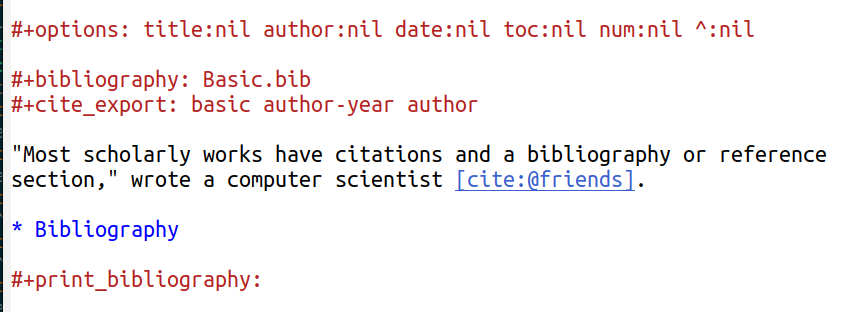
The activate capability changes how a citation looks and acts in Org. Here’s our sample file from last time when viewed in plain uncustomized Emacs with emacs -Q basic.org (after hitting y several times to allow file-local variables):
Screenshot of basic.org in plain Emacs
The default Org highlighting makes keyword lines (options, bibliography, cite_export and print_bibliography) red and the heading blue. The basic citation processor’s activate capability makes the citation look different: it’s RoyalBlue3.
(To dig into details like this, put the cursor in the citation somewhere and hit C-u C-x = (that’s what-cursor-position with a prefix argument) and Emacs will show you a remarkable amount of information about that character, including that it has the faces org-cite-key and org-cite. They are what you would customize to change the look.)
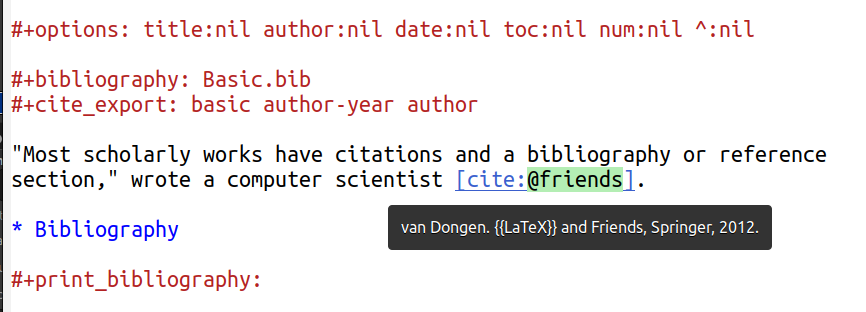
Another property is that if you hover the mouse over the citation key (in this case @friends) then you’ll see the bibliographic information. In this screenshot you can’t see my pointer, but it’s on top of @friends, which is why it’s turned green:
Hovering over citation key shows metadata
If you hover over the rest of the citation object, such as the word cite, nothing will happen. Only the citation key has information to show.
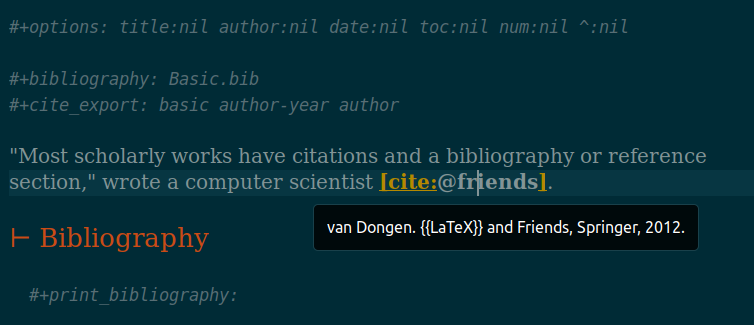
From now on I’ll show it with my Emacs setup (which I’ve honed since 1995 and continue to fiddle with monthly: it’ll be perfect soon). Here’s the same mouseover, again without the mouse pointer visible.
Hovering over citation key shows metadata
That’s using the solarized dark theme and now the citation object has this colour by default but changes on mouseover.
Here’s some relevant documentation from lisp/oc-basic.el in the source code:
[The] “activate” capability re-uses default fontification, but provides additional features on both correct and wrong keys according to the bibliography defined in the document.
When the mouse is over a known key, it displays the corresponding bibliography entry. Any wrong key, however, is highlighted with `error’ face. Moreover, moving the mouse onto it displays a list of suggested correct keys, and pressing on the faulty key will try to fix it according to those suggestions.
We saw what happens with a correct citation key, but Org can also tell us about broken ones!
Let’s make this a little more interesting by adding a fake item into Basic.bib with a key that’s almost the same as the real one.
@book{friends,
title = {{{LaTeX}} and Friends},
author = {van Dongen, M.R.C.},
date = {2012},
location = {Berlin},
publisher = {Springer},
doi = {10.1007/978-3-642-23816-1},
isbn = {978-3-642-23816-1}
}
@book{frionds,
title = {Frionds},
author = {F. Rionds}
}
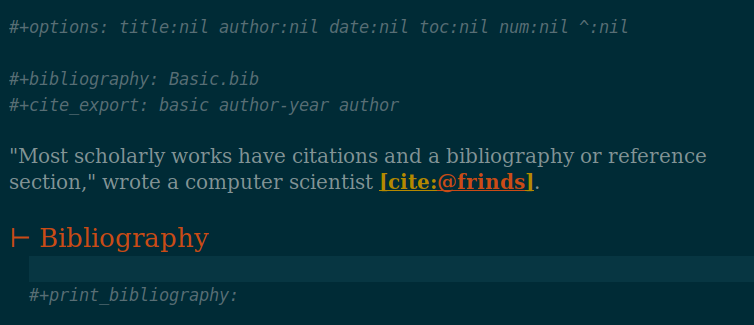
Then in our Org file we misspell the citation key as @frinds. The processor knows this key doesn’t exist in our bibliography so it shows it in a different colour.
Incorrect citation key is shown in red
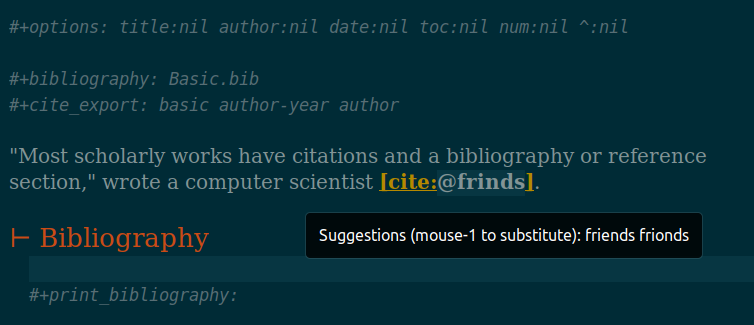
If we hover over it, Org offers help: “Suggestions (mouse-1 to substitute): friends frionds”.
Mouseover text on bad citation key
Left-clicking on the key pops up this in the minibuffer:
1/2 Did you mean
friends
frionds
Up or down to choose the one you want, hit RET (that is, Return or Enter), and that key is put into the citation object, fixing it. Nice! This is a smart, helpful feature. (The suggestions are made with the string-distance function, which calculates the Levenshtein distance between two strings.)
I looked ahead at the other export processors and they do not have any special activate features, so they will fall back on what’s here. Perhaps people will add more features: might it be possible to see a fully formatted citation in the mouseover, similar to a LaTeX preview fragment? Perhaps users could get at the suggestions with the keyboard and not have to use a mouse?
Follow
With a simple citation the follow capability is straightforward: if the pointer is in a citation object and you hit RET, the window splits, a new buffer opens, and the pointer is placed at the start of that entry in the .bib file. I guess this would be used mostly for editing the metadata when you notice a problem, but if you want to use it to look at the entry a quick C-x 0 gets rid of the new window.
With more complex citations this capability does a little more, so we’ll come back to it.
Insert
The command to insert a citation is org-cite-insert, and the keybinding to remember is C-c C-x @. As Emacs keybindings go this is pretty easy to remember (I admit that’s not saying much): Org mode uses C-c C-x so we’re typing that all the time, and the @ goes with the @ in the citation keys.
Let’s say that Basic.bib still has that faked @frionds entry, and we’re in basic.org.
#+options: title:nil author:nil date:nil toc:nil num:nil

#+bibliography: Basic.bib
#+cite_export: basic numeric numeric

"Most scholarly works have citations and a bibliography or reference
section," wrote a computer scientist [cite:@friends].

* Bibliography

#+print_bibliography:
I start a new paragraph after my one sentence and I hit C-c C-x @. This pops up in my minibuffer:
(1/2) Key (empty input exits):
F. Rionds                       Rionds
van Dongen, M.R.C.        2012   and Friends
It may not look like that in yours. If you’re using plain Emacs you won’t see a list of options but they are there. If you’re using a completion system such as Vertico or Ivy or the built-in fido-mode then you’ll see a list. Org knows the options, and your completion system is handling them.
I could move down a line and the van Dongen entry would be highlighted, and then if I hit RET it would be chosen. Or I can do some filtering: here’s what it looks like if I enter “van”:
Filtering to matches on van
If I hit RET the van Dongen entry is chosen and the citation key is added to the list it’s building.
The key has been added to a list
If you’re using plain Emacs, enter “van” and complete it with TAB. You’ll see the bibliographic entry listed, and hit RET to add it.
You can insert more than one citation, but I’m going to deal multiples next so we’ll stop here. In plain Emacs, and some other completion systems, you would hit RET to make the “empty input” that finishes this step. In Vertico and Ivy that won’t work, and you’ll need to hit C-u C-j or (in Vertico) M-RET. (Thanks to twohelpful people on the Org mailing list for helping me with this.)
However you do it, when you’ve done it the citation object [cite:@friends] will be inserted into the file. Done!
#+options: title:nil author:nil date:nil toc:nil num:nil

#+bibliography: Basic.bib
#+cite_export: basic numeric numeric

"Most scholarly works have citations and a bibliography or reference
section," wrote a computer scientist [cite:@friends].

[cite:@friends]

* Bibliography

#+print_bibliography:
If you want to delete a citation, giving the insert command a prefix argument (C-u) will do that: if the pointer is on a citation then C-u C-c C-x @ will delete it.
One small last note: Org will let you insert a citation anywhere there is regular text, but not on keyword lines such as options or in source code blocks. You’ll get a “Cannot insert a citation here” error.
Export
Exporting turns the Org file into some other document format, and we’ve been doing that to text or PDF. The export capability is what makes a citation object (perhaps with a style and variant such as [cite/na/b:@friends]) into something human-readable. There’s a lot about this in part 1, but I’ll copy some of that here for completeness.
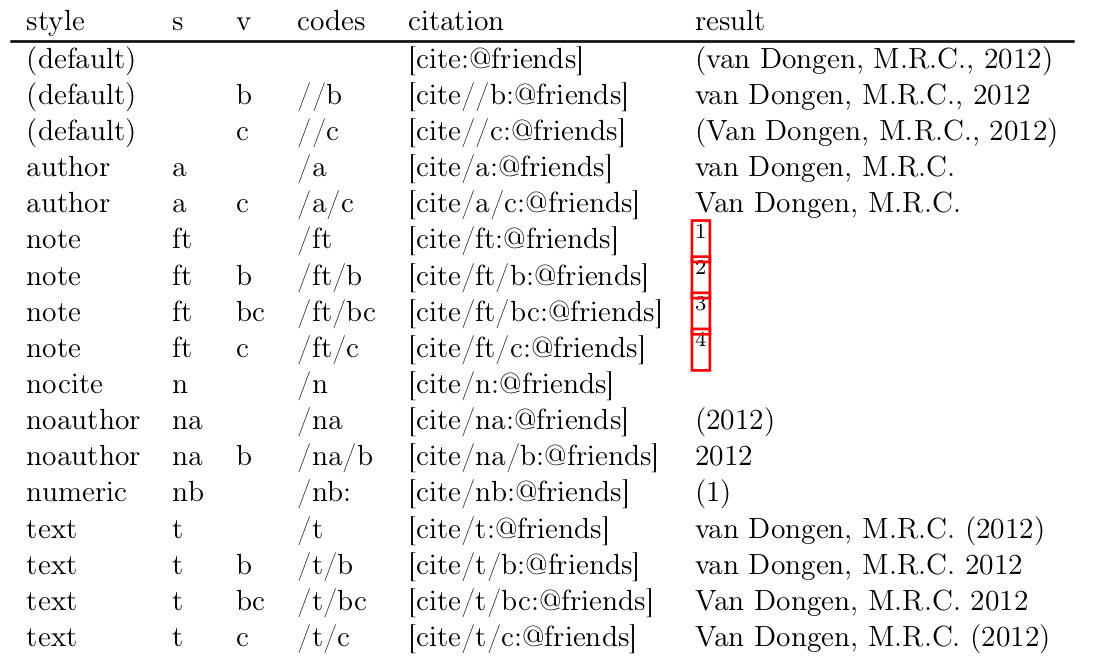
Showing what’s available in the basic citation processor, here is a table of styles (s), variants (v), how they’re specified, what the citation object looks like in the raw, and what it becomes when exported. The citation exporting happens when the whole document is exported (for example with C-c C-e l o to export to a PDF and then open it)—you don’t have to do anything special to prepare it.
s
v
codes
citation
result
[cite:@friends]
(van Dongen, M.R.C., 2012)
b
//b
[cite//b:@friends]
van Dongen, M.R.C., 2012
c
//c
[cite//c:@friends]
(Van Dongen, M.R.C., 2012)
a
/a
[cite/a:@friends]
van Dongen, M.R.C.
a
c
/a/c
[cite/a/c:@friends]
Van Dongen, M.R.C.
ft
/ft
[cite/ft:@friends]
¹
ft
b
/ft/b
[cite/ft/b:@friends]
²
ft
bc
/ft/bc
[cite/ft/bc:@friends]
³
ft
c
/ft/c
[cite/ft/c:@friends]
⁴
n
/n
[cite/n:@friends]
na
/na
[cite/na:@friends]
(2012)
na
b
/na/b
[cite/na/b:@friends]
2012
nb
/nb/
[cite/nb:@friends]
(1)
t
/t
[cite/t:@friends]
van Dongen, M.R.C. (2012)
t
b
/t/b
[cite/t/b:@friends]
van Dongen, M.R.C. 2012
t
bc
/t/bc
[cite/t/bc:@friends]
Van Dongen, M.R.C. 2012
t
c
/t/c
[cite/t/c:@friends]
Van Dongen, M.R.C. (2012)
Here’s the table in the LaTeX export, with an extra column specifying the style name.
LaTeX export of table of examples
With the basic processor we can export to text, HTML, LaTeX and OpenDocument. Different processors export to different document types, but they all export to LaTeX and you can always make a PDF.
The next post—the last about the basic processor—will be about complex citations with multiple keys, prefixes and suffixes.
EXCELLENT (though severely truncated @ 10:38, but not /just/ a teaser) on the insane Zionism of Biden and top Mideast policy adviser Brett McGurk (a guy who's so deepstate, he's been in every US regime since Bill Clinton's)
EXCELLENT (and funny!) survey of the hell that is US politics
Well, here we are, Iowa Caucus day 2024. Considering we all took several points of permanent sanity damage this time 4 years ago, what’s insane this year is how on rails this whole thing is. Nonetheless, our elections correspondent Josh (@ettingermentum) returns to update us on the state of the races for 2024. We look at how Biden’s long-term hyper-commitment to Israel affects his chances, Trump’s advantages and disadvantages in his ‘24 campaign, the RFK Jr. of it all, and the race for #2 between the rest of the GOP candidates..
EXCELLENT: KB+SE 3 segs on how the Zionist Alliance is expanding their war beyond Palestine
Krystal and Saagar discuss 100 days of war in Gaza, Benjamin Netanyahu tells USA 'this is your war', and two Navy Seals lost at sea during Yemen operation.
another excellent-though-non-political Corner Späti (Ciarán+Julia+Nick plus (trans-sounding) guest Jacqueline from podcast=Indieheads), this time focusing on the Eurodance genre from the 1990s to 2024. Topics discussed include (in ~order of presentation, though they skip around a bit, and somethings arise more than once):
* Eurodance history: origins and periodization * important songs and performers. This is the bulk of this episode: discussing (and occasionally playing snippets--though very short and very background, presumably avoiding copyright problems) acts including the following (unfortunately I did not record the songs, but most of these are 'one-hit wonders') ***** Snap ***** Dr Alban ***** 2 Unlimited ***** Haddaway ***** Culture Beat ***** Rednex ***** Scatman John ***** Mr President ***** Amber ***** Aqua ***** Vengaboys ***** Eiffel 65 (1st mentioned near ep start) ***** ATC ***** Crazy Frog ***** Scooter ***** Cascada ***** Captain Jack (also mentioned earlier) * how Eurodance became (even) more fake/performative and IP-driven * Eurodance influence on US (sub)culture esp Guidos * Eurodance in (a celebration of) European trash culture
Finally we are joined by Jacqueline of the Indieheads podcast to talk about Eurodance. A beautiful and wonderful export from this stupid trashy continent.
My look at citations in Org continues on from Part 1 and Part 2, and here I finish going through the document-level settings.
Keywords and options
We can make document-level settings with three keywords:
bibliography, to specify where to look for bibliographic metadata (this has no options);
print_bibliography, to tell Org to print the bibliography, if we want one (this has no options in the basic citation processor but does in some others); and
cite_export, which we’ll look at here.
cite_export specifies three things, and is used like so:
The first option sets which citation processor (or export processor) to use. There are five available in Org:
basic, the default, which exports to text, HTML, LaTeX and OpenDocument;
csl, which uses the Citation Style Language, and also exports to text, HTML, LaTeX and OpenDocument; and
bibtex, biblatex and natbib, which all export only to LaTeX.
We’re using the basic processor here. It’s very simple and useful for figuring out how all this works.
The next choice is about bibliography style. The options here depend on the citation processor. With the basic processor, there are just three:
author-date (the default)
numeric
plain
In the last post we saw how we can set the processor and bibliography style with cite_export, for example:
#+cite_export: basic numeric
Lastly there is citation style, the options for which also depend on the citation processor. With the basic processor there are seven possible styles. (Most have variants that control whether they’re wrapped in brackets and if the first letter of the author name is capitalized.) They are:
the unnamed default (used if nothing else is specified)
author
note
nocite
noauthor
numeric
text
There’s a table of them all in Part 1. (Look at lisp/oc-basic.el in the source code if you want to see how this is all made to happen.)
Setting a document-level citation style in cite_export
In the first post we saw how we can override the default citation style by adding a style (and possibly variant) to citation objects, for example [cite/a:@friends] (author style) or [cite/a/c:@friends] (author style, with caps variant). This is good for changing one citation at a time. To change them through the whole document, we can specify a new citation style in cite_export and rely on it. (In fact we’re setting a new default, but I’m trying not to use the word “default” in two different ways here. We’re already using “style” two different ways.)
Let’s do some examples. We’ll use the same Basic.bib as before:
@book{friends,
title = {{{LaTeX}} and Friends},
author = {van Dongen, M.R.C.},
date = {2012},
location = {Berlin},
publisher = {Springer},
doi = {10.1007/978-3-642-23816-1},
isbn = {978-3-642-23816-1}
}
We’ll revise our sample basic.org file to this, with an unadorned citation object ([cite:@friends]) and all the options in cite_export. Here we say we want a numeric bibliography with numeric citations:
#+options: title:nil author:nil date:nil toc:nil num:nil

#+bibliography: Basic.bib
#+cite_export: basic numeric numeric

"Most scholarly works have citations and a bibliography or reference
section," wrote a computer scientist [cite:@friends].

* Bibliography

#+print_bibliography:
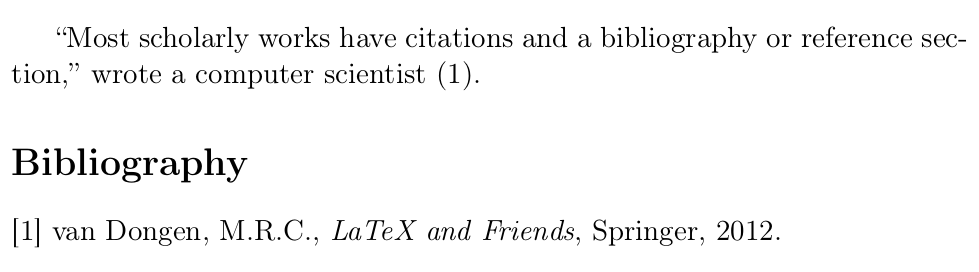
Exporting to PDF produces this pleasing match of citation and bibliography, where the reference “(1)” leads to the right source in the bibliography:
Numeric bibliography, numeric citations
The citation object is unadorned but exports in the numeric style because of the document-level setting.
Settings need to work together
It’s possible to put together combinations that don’t make sense. For example, we could use the numeric bibliography style and noauthor citation style. The Org file is the same as above, but with this line changed:
#+cite_export: basic numeric noauthor
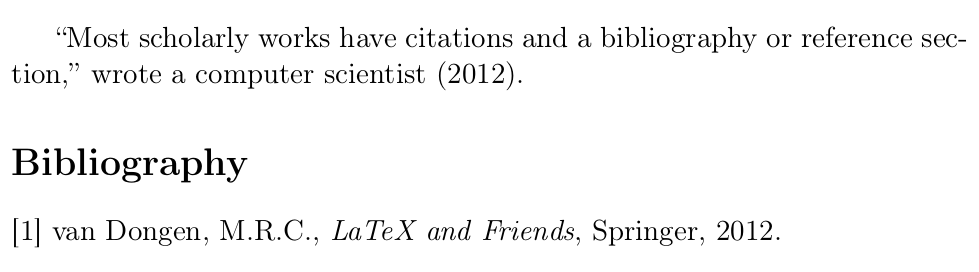
Exporting gives this PDF:
Numeric bibliography, noauthor citations
That’s not helpful. Similarly, using the author-year bibliography style and the nocite citation style is silly. Change the cite_export line to this:
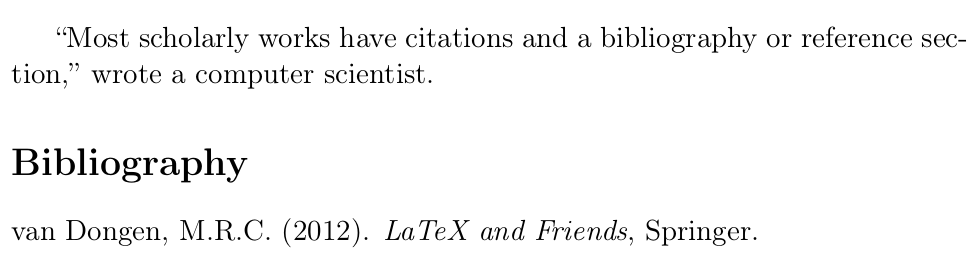
#+cite_export: basic author-year nocite
Exporting gives this PDF (notice the tiny space before the full stop, because [cite:@friends] becomes nothing but the space before it is still there).
Author-date bibliography, nocite citations
We need to make sure the citation and bibliography settings work together properly. If you’re using Microsoft Word and pulling in citation information from Zotero then you couldn’t mess things up like this. I think BibLaTeX is aware of context and can sometimes produce different output when needed (we may get to this later). With this basic system it’s up to you. Fair enough.
Overriding the document-level citation style
What if we set a new citation style for the document in cite_export but then want to use something different for one citation? This is always possible. In fact, this is just what we saw in Part 1. By not setting a citation style in cite_export the unnamed default was used, and we overrode it in all the examples. If a different citation style is named, we can override it just the same. We always have the freedom to use whatever citation style we want in any citation object.
There’s one situation where this gets tricky: overriding a named citation style to use the unnamed default. Let’s say we have cite_export set so:
#+cite_export: basic author-year author
Now using an unadorned citation object such as [cite:@friends] will just give the author. To use the noauthor style, for example, we would say [cite/na:@friends]. But what if we want to get the original default? It has no style code like na, so it seems like there’s no way to specify it. As I learned from Ihor Radchenko on the Org mailing list, we can get it with nil.
Here’s an example with the author citation style defined for the whole document, then overridden twice. The first citation object gets a nil style code to give the unnamed default we’ve seen before, the second inherits the document-level setting but uses the caps variant (because it’s at the start of the sentence, and I know I need to force that), and the third overrides to give only the date.
#+bibliography: Basic.bib
#+cite_export: basic author-year author

"Most scholarly works have citations and a bibliography or reference
section," wrote a computer scientist [cite/nil:@friends].

[cite//c:@friends] wrote, "Most scholarly works have citations and a
bibliography or reference section" [cite/na:@friends].

* Bibliography

#+print_bibliography:
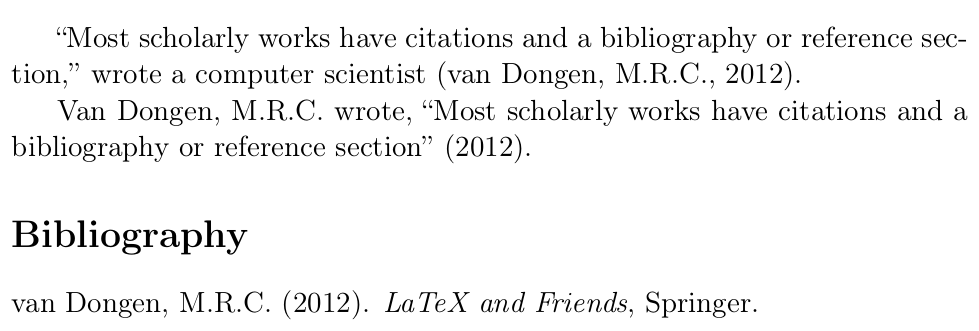
This exports to:
In fact, using anything that isn’t a recognized style code will fall through to the default. The same is true of the variants. And it’s also true of the bibliography and citation style settings in cite_export!
This will export with all the default settings, and org-lint doesn’t complain either:
#+bibliography: Basic.bib
#+cite_export: basic alice wonderland

"Most scholarly works have citations and a bibliography or reference
section," wrote a computer scientist [cite/slithy:@friends].

[cite//mimsy:@friends] wrote, "Most scholarly works have citations and a
bibliography or reference section."
But don’t rely on any of that. Use proper names for things, and nil when you want to use that unnamed default citation style.
Next we’ll look at the four capabilities the basic processor has.
Danny chats with Frank Costigliola, Board of Trustees Distinguished Professor of History at the University of Connecticut, about diplomat and historian George F. Kennan. They discuss his legacy as a realist with an unending belief in diplomacy, the “long telegram”, his wariness of the public holding sway in foreign relations, the emphasis on industrial …

 Screenshot of basic.org in plain Emacs
 Hovering over citation key shows metadata
 Hovering over citation key shows metadata
 Incorrect citation key is shown in red
 Mouseover text on bad citation key
 Filtering to matches on van
 The key has been added to a list
 LaTeX export of table of examples
 Numeric bibliography, numeric citations
 Numeric bibliography, noauthor citations
 Author-date bibliography, nocite citations