Shared posts

16 Jan 17:57

Jon Stewart on LA Wildfire Blame Game, Canada Not Into Statehood

Tom Roche

VERY EXCELLENT (even the Carney interview)

Jon Stewart examines how Trump's finger-pointing, and the GOP's threats to withhold disaster relief for the LA wildfires are missing the bigger picture: nature is f**ked, and helping those in pain shouldn't be a political issue.

Mark Carney, Canadian economist and former Governor of the Bank of Canada and Bank of England, chats about his country’s response to Donald Trump’s desire to annex Canada: “It’s not going to happen.” They also discuss the impending financial crisis Canada faces if Trump follows through on his tariff threats and how the country’s upcoming election mirrors the 2024 U.S. presidential race. 

See omnystudio.com/listener for privacy information.

16 Jan 17:56

TDS Time Machine | New Year's Resolutions with Steve Carell and Trevor Noah

Tom Roche

excellent bits (even Noah--substandard as usual, but still OK), esp not one but 2-count-em-2 minisodes of /Slimming Down with Steve/ (Carell, that is)

New year, new you! A look back at some New Year’s Resolutions over the years through the lens of The Daily Show.

The 2016 GOP presidential candidates share their personal resolutions with Fox News. Steve Carell tries to improve himself in two “Slimmin’ Down with Steve” segments focussing on nutrition and plastic surgery. Plus Trevor Noah digs into what it means to “sleep better.”

See omnystudio.com/listener for privacy information.

15 Jan 19:56

1/15/25: Gaza Ceasefire Terms Locked In, Pete Hegseth Hearing, LA Landlord Price Gouging & MORE!

Tom Roche

1st 3 quarters: consistently VERY EXCELLENT (except--of course!--for all the ads), RG+EJ deliver at-least-median-quality CounterPoints. Most of 4th quarter (96:53-123:22): very skippable interview with Robert J. Goldston (basically just another neoliberal internationalist, but Trump-friendly and not a norms freak) on potential for Pax Trumpica ... followed by a brief (would be much less skippable, but its runtime < 5 min) bit of end matter (mostly about Cuba).

Ryan and Emily discuss Trump bodies Bibi as ceasefire terms locked in, poll shows Gaza cost Kamala the election, Pete Hegseth hearing goes off the rails, celeb realtor exposes LA fire landlord price gouging, Chinese app surges to #1 as TikTok ban looms, how Trump could win Nobel peace prize. 


Trump Peace Prize Report: https://www.foxnews.com/opinion/how-donald-trump-can-make-history-win-3-nobel-peace-prizes

Jeremy Scahill: https://x.com/jeremyscahill 

To become a Breaking Points Premium Member and watch/listen to the show AD FREE, uncut and 1 hour early visit: www.breakingpoints.com


Merch Store: https://shop.breakingpoints.com/

See omnystudio.com/listener for privacy information.

15 Jan 19:39

Pete Hegseth Grilled in Senate Hearing, Boyd Holbrook on Playing Johnny Cash

Tom Roche

VERY EXCELLENT, 2-3 very funny segments (host monolog by Jordan Klepper, "journalist" spot from Desi Lydic, and a masterful Daily Showography 'Pete Hegseth: Overserved with Honor') completely wrecking ... just guess who ... followed by a completely skippable interview of Boyd Holbrook. Just skip the ads (this is IHeart aka Clear Channel aka I Heart Advertising) and bail @ 20:23 in the audio.

Jordan Klepper recaps Pete Hegseth's contentious Senate confirmation hearing for Secretary of Defense. Desi Lydic teaches Jordan Klepper a lesson on digging too deeply into Trump's cabinet selects. Plus, a new Daily Showography | Pete Hegseth: Overserved with Honor.

Actor Boyd Holbrook sits down with Jordan Klepper to talk about his experience playing Johnny Cash in the new film, “A Complete Unknown.” They discuss working with director James Mangold on the legacy of playing Johnny Cash, Cash’s letters to Bob Dylan on the back of airplane barf bags, the pressures of portraying a real person on film, and how Christian Bale threw him a bone early in his career.

See omnystudio.com/listener for privacy information.

15 Jan 16:59

BONUS: Y2K feat. Colette Shade

Tom Roche

Not /great/ Chapo, but an interesting hourish listen as Will and guest Colette Shade discuss US popculture and Zeitgeist (with a /lot/ of personal anecdotes about growing up millenial) in the period 1997-2008: from dot-com bubble to Y2K to 911+GWOT to housing bubble

Author Colette Shade joins us to discuss her new book “Y2K” on the millennial era of ~1997-2008. Will and Colette review how the boundless optimism of ‘the end of history’ curdled into the permanent pessimism of the 21st century, how computer doomed everything even if the specific prediction of the “Y2K bug” maybe didn’t literally come to pass, how nostalgia can be both useful and a trap, and of course, how everything is 9/11.


Purchase “Y2K: How the 2000s Became Everything”:

Bookshop: https://bookshop.org/p/books/y2k-how-the-2000s-became-everything-essays-on-a-future-that-never-was-colette-shade/21416954?ean=9780063333949

Audible: https://www.audible.com/pd/Y2K-Audiobook/B0D3G5JV6P


Catch Colette on here book tour, dates here: https://www.coletteshade.com/

Get bonus content on Patreon

Hosted on Acast. See acast.com/privacy for more information.

15 Jan 15:02

899 - Nut Up feat. Yasha Levine & Rowan Wernham (1/13/25)

Tom Roche

VERY EXCELLENT

We’re joined by journalist Yasha Levine & filmmaker Rowan Wernham of the new documentary “Pistachio Wars” join us to look at water in the state of California in light of last week’s L.A. wildfires. We discuss California’s water history, the network of real estate developers and agribusiness concerns that effectively control California’s water, the Resnick family and their Nut Empire, 21st century company towns, and how California water politics affect the Iran Nuclear deal.


Watch The Pistachio Wars documentary now: https://www.pistachiowars.com/


Get bonus content on Patreon

Hosted on Acast. See acast.com/privacy for more information.

14 Jan 18:18

E193 - Israeli Domestic Politics w/ Udi Greenberg

Tom Roche

VERY EXCELLENT deepdive into the Zionazi hell

Udi Greenberg, associate professor of history at Dartmouth, is back on the podcast to talk about the state of politics within Israel. They discuss the major factors driving domestic politics, the ruling coalition, ultra-Orthodox military exemption, the “centrist” faction, Yoav Gallant, the politics around national security, Israeli media narratives about Gaza, resettling the Strip, and more.


Subscribe now for bonus episodes and more.

Learn more about your ad choices. Visit megaphone.fm/adchoices

14 Jan 03:23

1/13/25: TikTok Ban Imminent, Morning Joe Says Biden Would've Won, Ultrarich Stoke LA Fires, Loneliness Crisis

Tom Roche

This part 2 of 2 for M 13 Jan 2025 is /sooo/ much better than part 1: KB+SE do 2 good US-politics segments, and end with a surprisingly-good interview with some Atlantic Magazine guy (though it's really more about US political/social atomization than a "loneliness crisis"). But the best part is Krystal's monolog/"radar" on how increasing US economic inequality drives a host of other evils (both for US and our planet), including anthropogenic climate change and the homelessness crisis. (Saagar's response is as usual omitted, unlike the inclusion of Krystal's response to SE's 9 Jan monolog.)

Krystal and Saagar TikTok ban imminent, Morning Joe insists Biden would have won, how the ultra rich stoked LA fires, loneliness crisis in the US.


To become a Breaking Points Premium Member and watch/listen to the show AD FREE, uncut and 1 hour early visit: www.breakingpoints.com


Merch Store: https://shop.breakingpoints.com/

See omnystudio.com/listener for privacy information.

14 Jan 03:16

1/13/25: Krystal And Saagar DEBATE Climate Change DEI Amid LA Fires, Hasan Interviews Inmate Firefighters

Tom Roche

skip this 1st of 2 episodes for M 13 Jan 2025:

- 1st segment on LA fires devolves in to a /loooong/ "debate" in which Saagar no-big-deals anthropogenic climate change in order to blame ... pretty much everything else, while doing his usual thing of confusing empirical (e.g., "many Americans oppose efforts to mitigate radiative-forcing emissions") and normative (e.g., "one should therefore oppose efforts to mitigate radiative-forcing emissions")
- final segment (of 3? 5? more? depends on whether you define a segment as everything between ad breaks, whether or not the content changes) on economics of the LA fires (e.g., inmate firefighters, housing insurance, rentgouging) is better ... except KB+SE keep getting back to the debate

Anyway, Krystal's monolog/"radar" on these topics in part 2 of 2 is /much/ better, so just skip this 78 min pile (including pre-, inter-, and post-audio ads--total content more like 65 min) and listen to part 2.

Krystal and Saagar discuss climate change as LA engulfed, Hasan interviews inmate firefighters.


To become a Breaking Points Premium Member and watch/listen to the show AD FREE, uncut and 1 hour early visit: www.breakingpoints.com


Merch Store: https://shop.breakingpoints.com/

See omnystudio.com/listener for privacy information.

13 Jan 17:30

Special - Domestic Acts of Violence and Military Veterans w/ Lyle Jeremy Rubin (Preview)

Tom Roche

6:02 teaser only

Danny and Derek welcome back Lyle Jeremy Rubin, veteran of the war in Afghanistan, host of the Bang-Bang podcast, and author of the memoir Pain is Weakness Leaving the Body: A Marine’s Unbecoming, to talk about the January 1 attacks allegedly perpetrated by two former American servicemen. They discuss the attacks themselves (one in New Orleans and one in Las Vegas), the manifesto from the New Orleans attack, domestic violence, the ideologies at play, and more.


Subscribe now for the full episode!

Learn more about your ad choices. Visit megaphone.fm/adchoices

13 Jan 17:26

Mr. Musk goes to Nuuk (feat. Riley)

by The Späti Boys
Tom Roche

Ciarán+Nick+Uma+Riley (from Trashfuture and now also 'No Gods No Mayors') == always amusing

13 Jan 05:49

Revising NYT History on Democrats Losing the Working Class

by Adam Fishbein
Tom Roche

pullquote (edited):
> The New York Times had a lengthy [piece](https://www.nytimes.com/2025/01/04/us/politics/democrats-working-class.html) (archived [here](http://web.archive.org/web/20250105070110/https://www.nytimes.com/2025/01/04/us/politics/democrats-working-class.html)) giving a story on how the Democrats lost the support of working-class voters over the last three decades. The essence of the argument is that working-class voters were angered by Democrats’ support of “free trade” and the bailouts of the financial industry in the financial crisis. While this story is largely true, it seriously understates the working-class cause for complaint. [... The Corporate Democrats pursued] policies that benefited the elites at the expense of people with less education. They also used their power in the media and other institutions to cover up the class interests in these policies.

The New York Times had a lengthy piece giving a story on how the Democrats lost the support of working-class voters over the last three decades. The essence of the argument is that working-class voters were angered by Democrats’ support of “free trade” and the bailouts of the financial industry in the financial crisis. While this story is largely true, it seriously understates the working-class cause for complaint.

First and foremost, our trade deals were not about free trade. They did little or nothing to free up trade in highly paid professional services, such as physicians’ and dentists’ services. As a result of the continued protectionism in these services our doctors get paid more than twice as much as their counterparts in other wealthy countries. At the same time, our manufacturing workers get paid less than manufacturing workers in Germany and other wealthy countries in Northern and Western Europe. 

If we brought the pay of our doctors and dentists in line with pay in other wealthy countries it would save patients more than $100 billion a year ($800 per family) in healthcare costs. This is far more than most estimates of the gains from NAFTA and other trade deals.

Presumably, the reason that free trade in highly paid professional services was not a topic in recent “free trade” deals is that these professions are extremely powerful politically. They would not allow an administration of either party to pursue trade deals that sharply lower their pay. 

While unions of manufacturing workers also did not want trade deals that they correctly recognized as undermining their bargaining position, these unions did not have the political power of doctors and dentists. So, we got NAFTA and China’s entry into the WTO, both of which had a very negative effect on the wages of manufacturing workers and led to the loss of millions of manufacturing jobs.

In fact, the story is even worse. While these trade deals were putting manufacturing workers in direct competition with low-paid workers in the developing world, they also increased protectionism in the form of stronger and longer patent and copyright protection. Proponents of these trade deals turned reality on its head and dubbed these government-granted monopolies “free trade.” 

It again speaks to the differential power of the beneficiaries of these monopolies and manufacturing workers that they actually got this clear falsehood accepted in public debate. It is reasonable to argue for patents and copyrights as policies to promote innovation and creative work, but liking these policies does not make them free trade. And there is a huge amount of money at stake, with the difference between patent protected prices and free market prices costing us in the neighborhood of $500 billion a year ($4,000 a family) in the case of pharmaceuticals alone. 

In short, working-class people not only got screwed by the trade policies associated with Democratic presidents, but they also had to listen to elite types lie about the nature of the policies. The lying went deep. 

For example in the case of NAFTA, not only did the media largely minimize the impact on workers here, it also fabricated stories about a post-NAFTA boom in Mexico, implying workers here were being selfish if they didn’t want to see much poorer workers in Mexico prosper. The Washington Post, a strong NAFTA supporter, stood out in this respect running periodic pieces touting the growth of a post-NAFTA middle-class in Mexico. It even invented data to push the case; in 2007, it had an editorial claiming that Mexico’s GDP had quadrupled since 1988. The actual increase was 86 percent. 

In fact, now that we have 30 years to look back, we can see that the promised convergence between the US and Mexico did not take place. Between 1994 and 2024 per capita income in the United States rose by 63.9 percent. In Mexico, it rose by just 20.3 percent. Rather than having moved closer together, the gap between income in the United States and Mexico grew enormously in the post-NAFTA period. There are surely many factors that contributed to the differences in growth rates, but obviously NAFTA did not bring about the promised convergence. (The World Bank got into the act as well, pushing a bogus study arguing the case for convergence.) 

Trade was not the only area where elites pushed lies that advanced their economic interests at the expense of the working class. The story on partially deregulating and bailing out the financial industry was very similar. 

In 2008 and 2009, when most of the country’s major financial institutions faced bankruptcy, very few people in policy positions were advocating leaving things to the market. Instead, they pushed the lie that letting the major banks fail would lead to a Second Great Depression. 

This was completely untrue. While an extensive set of banking collapses surely would have worsened the recession, we had in place the tools needed to prevent anything like another Great Depression. Most immediately, we now have deposit insurance that would have allowed the overwhelming majority of people to get the full amount from their deposits, even if their bank failed. This would limit the immediate damage.

We also learned the secret for getting out of a depression. It’s called “spending money.” In the first Great Depression it was the spending associated with World War II in 1941 that finally lifted us out of the depression in 1941. However, if we had undertaken similarly large-scale spending on domestic needs in 1931, we could have avoided a decade of double-digit unemployment. The same would have been true in 2008-09, if we decided to let the market work its magic.

The benefit of going that route is that it would have radically downsized the financial sector. This would both made it more efficient and also eliminated a major source of inequality in the economy, since many of the country’s largest fortunes come from the financial sector. 

Here also the Democrats’ fingerprints were everywhere. The first bailout took place under Bush, but the regime of bailouts continued under Obama. This was a clear case where the Democrats were not prepared to leave things to the market, but rather insisted on putting a very big thumb on the scale to benefit the rich at the expense of everyone else. 

Short Story: The Masses Have a Very Good Case

While the NY Times piece might leave readers with the impression that working-class disaffection with the Democrats is the result of a misunderstanding, in fact the party’s leaders did pursue policies that benefited the elites at the expense of people with less education. They also used their power in the media and other institutions to cover up the class interests in these policies. The working-class has a pretty good case. 

The one point the Democrats can make in their favor is that the Republicans are even worse. They will give even more money to the pharmaceutical industry, the financial industry, and the tech bros. This will presumably become clear over the course of a second Trump administration, but that doesn’t change the fact that the working class had very real grounds for being unhappy with the Democrats.

The post Revising NYT History on Democrats Losing the Working Class appeared first on Center for Economic and Policy Research.
13 Jan 00:48

898 - Bragg and Tag feat. Seth Harp (1/10/25)

Tom Roche

EXCELLENT: informative

We’re joined by investigative journalist Seth Harp to look at the two New Years terror incidents. Both involving military personnel associated with Fort Bragg, Seth helps us unpack the bizarre details around the attacks & attackers, their connections with the infamous fort, and the sprawling network of crime and conspiracy connected to U.S. special forces that could be connected to the incidents.


Pre-order Seth’s new book “The Fort Bragg Cartel,” covering everything discussed here and more, NOW: https://www.amazon.com/Fort-Bragg-Cartel-Trafficking-Special/dp/0593655087/ref=sr_1_1?crid=2IBFCDHXPCDNK&dib=eyJ2IjoiMSJ9.DChbCJr_ack2Y0E77PHx1A.c3bQI937DRUIMbRbVsdKhtyPbEan_qiFTtz0ZgDgQP0&dib_tag=se&keywords=the+fort+bragg+cartel+seth+harp&qid=1736454146&sprefix=the+fort+br%2Caps%2C152&sr=8-1

Get bonus content on Patreon

Hosted on Acast. See acast.com/privacy for more information.

11 Jan 19:44

What will Trump's return mean for Ukraine, Gaza, and the economy?

Tom Roche

surprisingly good (and /very/ wide-ranging) Desai interview with the as-usual-variable-quality Lieven. He's still empirically bad on the NATO proxy war with Russia, but not so normatively bad on RF geostrategy, and quite good on a number of other topics, including

* probable US geostrategy under Trump 2.0 (aka /T2/)
* geoeconomy esp T2 tariffs esp vs PRC
* US deepstate pro and con war
* US empire economic and military decline
* (esp good) how US MIC (actually, Eisenhower wanted to call it 'military-industrial-academic complex') drives industrial policy (badly)
* probable nearterm backlash from Eurovassal voters (and how Eurovassal deepstates will seek to suppress it)
* Russia geostrategy esp RUW (Lieven weak as usual, but he's been worse)
* Zionist lock on empire deepstate (spatially- and level-comprehensive)

What will Donald Trump's second term as US president mean for the NATO-Russia proxy war in Ukraine and Israel's war on Gaza? How will his tariffs affect the economy? To discuss, political economist Radhika Desai is joined by Anatol Lieven, director of the Eurasia Program at the Quincy Institute for Responsible Statecraft. VIDEO: https://www.youtube.com/watch?v=fNQztns8C9U This is part of the show Geopolitical Economy Hour. You can watch other episodes of the program here: https://youtube.com/playlist?list=PLDAi0NdlN8hMl9DkPLikDDGccibhYHnDP
11 Jan 18:38

#588 - Lubrication Theory Simulations

Tom Roche

MU excellent as usual

The White House has been destroyed by an earthquake, President Sean Young is trapped under the rubble, and House Speaker Eric Roberts wants to take over America in DC DOWN (2023), a low-budget disaster movie from the most trusted names in entertainment, Tubi and The Asylum. We treated ourselves to a good old-fashioned "good movie movie." PLUS: How seriously should we be taking Trump's threat to annex Canada? Join us on Patreon for an extra episode every week - https://www.patreon.com/michaelandus TORONTO: See Will introduce a screening of Jess Franco's Bloody Moon on January 14, 7pm at the Fox Theatre. Tickets - https://www.foxtheatre.ca/movies/the-important-cinema-club-masterpiece-classics-bloody-moon/ "The failure of Trudeauism" by Luke Savage - https://www.newstatesman.com/author/luke-savage
10 Jan 23:56

Will There Be a Gaza Deal Before Trump's Inauguration?

by Jeremy Scahill
Tom Roche

EXCELLENT

After his victory in the 2024 election, Donald Trump made clear that he wants a deal to release Israeli and international captives held in Gaza prior to his inauguration on January 20. Trump’s public posture has added urgency to what had become a diplomatic process surviving on the weakest of life support systems. The president-elect’s position on the Gaza war is largely in sync with that of Biden’s; Trump’s nominees for key national security positions and U.S. ambassador to Israel are a kettle of pro-Israel hawks, some of whom have openly declared there is no such thing as a Palestinian and no such place as the West Bank. At the same time, Trump clearly wants to proclaim a victory by securing the release of hostages as he resumes office in Washington, D.C.

In a new Drop Site News podcast episode, Jeremy Scahill speaks to Muhammad Shehada, a Palestinian writer and journalist from Gaza who has been doing in-depth reporting on the negotiations for a ceasefire and exchange of captives. His most recent piece for the Center for International Policy is titled “The Biden Administration’s False History of Ceasefire Negotiations.” They discuss the details of what is being negotiated, Benjamin Netanyahu’s history of sabotaging a ceasefire and how the Biden administration enabled it, as well as the prospects for a deal before Trump’s inauguration.

Our continued work depends on reader support. Your tax-deductible donation will fuel the hard-hitting investigations you won't find anywhere else.

Subscribe to get Drop Site's free newsletter at dropsitenews.com.


Get full access to Drop Site News at www.dropsitenews.com/subscribe
10 Jan 23:54

Charles Choi: Converting a Markdown Region to Org Revisited

by Charles Choi
Tom Roche

very short article ([archived here](http://web.archive.org/web/20250110235331/http://yummymelon.com/devnull/converting-a-markdown-region-to-org-revisited.html)) includes elisp (calling `pandoc`) function=`markdown-to-org-region`

On more than one occasion I’ve found myself needing to convert Markdown formatted text to Org using this workflow:

  1. Copy Markdown formatted text (usually from a web browser) into the kill ring.
  2. Paste above text into an Org buffer.
  3. Manually reformat said text to Org.

Folks who have pandoc installed can automate step 3 above with the Elisp function quoted below from the Stack Exchange post “Convert region/subtree from Markdown to org”.

1
2
3
4
(defun my-md-to-org-region (start end)
  "Convert region from markdown to org"
  (interactive "r")
  (shell-command-on-region start end "pandoc -f markdown -t org" t t))

So just copy the above function into your config and call it a day, no?

Not quite. If left unspecified, pandoc will automatically wrap long lines 😞. I prefer keeping a paragraph as a single long line in Org.

To keep a paragraph as a long line, use the pandoc argument --wrap=preserve.

Listed below is an amended version of the above routine.

1
2
3
4
5
6
7
8
9
(defun cc/markdown-to-org-region (start end)
  "Convert Markdown formatted text in region (START, END) to Org.

This command requires that pandoc (man page `pandoc(1)') be
installed."
  (interactive "r")
  (shell-command-on-region
   start end
   "pandoc -f markdown -t org --wrap=preserve" t t))

Regardless of your preference, if this is news to you and seems useful, give it a try.

References

10 Jan 19:50

Best of The News Quiz 2024

Tom Roche

excellent

A satirical smorgasbord of The News Quiz's best bits of the year. Covering international tensions, a UK General Election, and of course the question on everyone’s lips, what exactly was a ‘Brat Summer’?

With Andy Zaltzman in the chair, full of whimsical animal metaphors and cricket stats, we’ll hear highlights from the crème de la crème of British and international comedy and journalism to dissect the news. It's a chance to return to, and revel in, some of 2024's funniest moments, starring Ian Smith, Lucy Porter, Geoff Norcott, Alasdair Beckett-King, Mark Steel, Ria Lina, Simon Evans and Zoe Lyons, amongst others.

Come digest a dramatic year of news, along with the leftover turkey, as we say goodbye to 2024, goodbye to 14 years or Conservative rule, goodbye to short-lived presidential hopeful Kamala Harris, and goodbye to Earth’s temporary second moon.

Written and presented by Andy Zaltzman

Producer: Sam Holmes Executive Producer: James Robinson Production Coordinator: Jodie Charman

A BBC Studios Audio Production for Radio 4 An Eco-Audio certified Production

10 Jan 17:40

News - Lebanon Elects a President, Afghanistan and Pakistan Skirmish at the Border, Trump Embraces Imperialism

Tom Roche

Bessner and (mostly) Davison return from 2-week holiday hiatus to deliver another EXCELLENT week-in-review (though now unfortunately with pre- and mid-audio advertisements, but they are brief and easily fast-forwarded)

Danny and Derek return to the newsroom for the first time in 2025! This week: the transition process continues in Syria (1:48) as the US government beginning relations with the new Syrian leadership (7:11), but fighting continues between Turkey and the SDF (10:25); in Lebanon, the IDF faces a withdrawal deadline (13:48) and the parliament finally elects a new president (15:46); yet more Gaza ceasefire talks are underway (19:37); the downing of a civilian aircraft strains Azerbaijan-Russia relations (22:54); Afghanistan and Pakistan exchange cross-border fire (26:05); South Korea is still trying to arrest impeached president Yoon while the interim president is also impeached (27:55); the Biden administration determines that the RSF is committing genocide in Sudan (31:13); as a new Ukrainian offensive is underway in Kursk (33:49), the Russians continue advancing in eastern Ukraine (35:36); Austria looks to be getting a far-right government (37:21); Justin Trudeau resigns as prime minister of Canada (40:21); and Donald Trump appears to warm up to the idea of conquering everything (43:12).


To help support people in LA:

Learn more about your ad choices. Visit megaphone.fm/adchoices

10 Jan 02:53

Day 461: The end of UNRWA?

Tom Roche

another EXCELLENT update on the Zionazi wars from EI, esp
* Chris Gunness on the US empire's war on UNRWA
* Resistance Report (90:10-138:14) on Gaza and West Bank
* Israel prosecutor admits there are no 7 Oct rape victims
* Israel bans UN investigation of the "Hamas rape" hoax in order to shield actual IDF rapists

Watch entire broadcast here: https://www.youtube.com/watch?v=z76bFnkpWiw Guests: - Donya Abu Sitta, writer and teacher in Gaza - Chris Gunness, former UNRWA spokesperson
09 Jan 21:01

1/9/25: LA Fires, Biden's Big Admission, Laken Riley Bill, Trump Retreating On Tariffs & MORE!

Tom Roche

BreakingPoints does 1st-of-2025 classic-format (KB+SE) episode of the year, and it's ... good enough--up to their usual standards--but it coulda been better. Notably: it ends (119:45 to end of content @ 144:52) with sequence=[excellent-if-flawed Saagar monolog on {H-1B visas, US techworker exploitation}, response/discussion (included in freefeed) with Krystal on that plus Amy Chua, Vivek, et al on "US culture"] which is EXCELLENT. Unfortunately, this comes after yet-another KB-vs-SE on US immigration policy (56:10-93:47) ... which would not be a problem, except that there's very little new content or argument. ISTM KB+SE have gotten into a rut s.t. ~2/mo (maybe weekly) they do these kinda-debates on migration which do not much except retread old content for ~30 min.

Net: generally-listenable and -excellent episode, but ya might wanna get your finger on that fast-forward trigger (which presumably you already have to cope with all the very-repetitive advertisements) starting ~56 min in the audio.

Krystal and Saagar discuss LA devastated by fires, Biden admits he wouldn't have made it four years, Dems support Laken Riley Act, is Trump retreating on universal tariffs, Fox News accused of colluding with Trump, Elon/Vivek full anti-American on H1b.


To become a Breaking Points Premium Member and watch/listen to the show AD FREE, uncut and 1 hour early visit: www.breakingpoints.com


Merch Store: https://shop.breakingpoints.com/

See omnystudio.com/listener for privacy information.

09 Jan 18:08

BRICS grows, adding Indonesia as member: world's 4th most populous country, 7th biggest economy

Tom Roche

GER/Norton deliver another EXCELLENT, esp re Indonesia in geoeconomy esp nickel

BRICS keeps expanding. As a new full member, it added Indonesia, the 4th most populous country with the 7th largest economy on Earth. BRICS now has 10 members and 8 partners. Together they make up 41.4% of global GDP (PPP) and roughly half the world population. Ben Norton explains. VIDEO: https://www.youtube.com/watch?v=tIDWOWHW-cU Sources and links here: https://geopoliticaleconomy.com/2025/01/07/brics-adds-indonesia-member-economy/ Check out our related report on BRICS' plan to challenge US dollar domination by creating a multi-currency financial system: https://geopoliticaleconomy.com/2024/10/19/brics-russia-multi-currency-system-us-dollar/ Topics 0:00 BRICS expansion 0:51 Map of BRICS membership 1:11 List of BRICS members & partners 1:47 BRICS share of world economy 2:27 BRICS vs G7 3:44 Indonesian economy bigger than UK & France 4:41 Indonesia's BRICS invitation 6:05 Global South cooperation 6:56 China supports Global South 7:29 Non-Aligned Movement & Bandung Conference 8:31 US-backed coup against Sukarno 8:58 CIA-sponsored massacres 9:53 ASEAN prefers China over USA 11:07 Philippines allies with USA 12:08 Indonesia calls China & Russia friends 13:52 China is Indonesia's largest trading partner 14:17 China is ASEAN's largest trading partner 14:39 Nickel production 15:32 Indonesia industrializes with China's help 21:53 BRICS cooperation 23:43 De-dollarization 24:46 Outro
09 Jan 17:59

Irreal: Using Ediff On Regions

by jcs
Tom Roche

jeez: been using Ediff for at least a decade, did not know about `ediff-regions-wordwise` and `ediff-regions-linewise`. [Original post](https://emacs.dyerdwelling.family/emacs/20250108140933-emacs--ediff-comparing-regions/) archived [here](https://archive.today/LIlJA)

One of the Emacs powerhouses is Ediff. Every time I think I’ve found a better way of comparing files, it turns out that I just didn’t understand Ediff well enough. It can seem intimidating but as Prot informed me it really pretty simple if you ignore all the complications. I took his advice and can only agree with his assessment.

Now James Dyer has his own take on Ediff. His particular use case is comparing regions rather than whole files. It turns out that there are two functions, ediff-regions-linewise and ediff-regions-wordwise that will use Ediff to compare two regions in the usual Ediff way.

The documentation recommends that you use ediff-regions-wordwise for small regions and ediff-regions-linewise for larger regions. In either case, once you set up the regions to be compared you use Ediff in the usual way. Take a look at Dyer’s post to see how to set up the regions. It’s straightforward and easy to remember once you use it a couple of times.

It’s a nice post and well worth reading even if you don’t need to compare regions right now. You probably will in the future and even if you don’t remember the details, you’ll know what to look for when you do.

08 Jan 22:29

[UNLOCKED] Sweden, NATO, and Olaf Palme - Ola Tunander (AE146)

Tom Roche

EXCELLENT

This is a public episode of the American Exception podcast on Patreon [ www.patreon.com/americanexception ]. Subscribe for access to past and future episodes of American Exception and Devil's Chess Club! With Sweden officially becoming a NATO member, Ola Tunander returns to discuss the subject, with reference to his landmark article on the NATO deep state in Sweden. Entitled, “Dual State: The Case of Sweden,” this article was published in The Dual State: Parapolitics, Carl Schmitt and the National Security Complex. Ola Tunander is Research Professor Emeritus with the Peace Research Institute in Oslo. He earned his doctoral degree in 1989 with a thesis on US Maritime Strategy. He has written and edited 15 books on geopolitics, military strategy and European security, submarine warfare, and deception operations (aka psychological operations). Also, please subscribe to Ola’s Substack [ https://olatunander.substack.com/ ] where you can check out these additional excellent articles by Ola Tunander: * "The Concept of the Deep State" (This one discusses his recent discussions on American Exception with Peter Dale Scott and Aaron) * "Democratic State vs. Deep State: Part I" (His classic article the deep state of the West) * “An Underwater U-2: Part I" (Important work on the Swedish version of the strategy of tension, psychological operations which in the Swedish case involved submarine warfare) * "After Seymour Hersh’s Article" (His article on the Nord Stream bombing) Special thanks to Dana Chavarria for the sound engineering! Music: "Hawks Can Go” by Mock Orange
08 Jan 19:39

UNLOCKED - #586 - A Newsroom with a View

Tom Roche

Luke and Will excellent as usual

On our Patreon, we will be discussing the full run of Aaron Sorkin's THE NEWSROOM. This is the first episode. Join us on Patreon - https://www.patreon.com/michaelandus
07 Jan 00:15

Ahir Shah's Seven Blunders of the World

Tom Roche

amusing, but note this is only part 1 of 3 (the rest of which will probably not be on this feed)

Inspired by an email from his 74 year-old father, comedian Ahir Shah introduces us to the The Seven Blunders of the World.

In 1925, Mahatma Gandhi published an article in the journal Young India, outlining what he called the Seven Social Sins. They were wealth without work, pleasure without conscience, knowledge without character, commerce without morality, science without humanity, religion without sacrifice, and politics without principle.

One hundred years on, the world is a very different place (this was written on a computer, for crying out loud!). Yet, Ahir reckons Gandhi's century-old list of the great societal blunders still feels relevant today. Could they teach us anything going forward?

Join Ahir (and sometimes his dad, who started this whole thing), as he explores these seven blunders through his trademark combination of philosophical inquiry, political vigour and sweet gags.

Created and Performed by Ahir Shah Additional Material by Glenn Moore Cast: Vikram Shah and Meera Syal Producers: Daisy Knight and Jules Lom An Avalon production for BBC Radio 4

06 Jan 23:01

Kris Carta: Shopping (Lists) with Emacs

by Kris Carta
Tom Roche

unfortunately /very/ Apple-dependent, but interesting in showing elisp calls to AppleScript (and pointing to additional resources)

At home, we're tying to re-establish a good weekly meal planning & grocery shopping routine.

For many years the steps have been:

  1. Open up Notion
  2. Make a new page like "Meal Plan: Week 2"
  3. Write down what we'll eat on each day
  4. For each meal, list out the items we need to get for it
  5. (Add anything else we need to get for the week, like detergent)

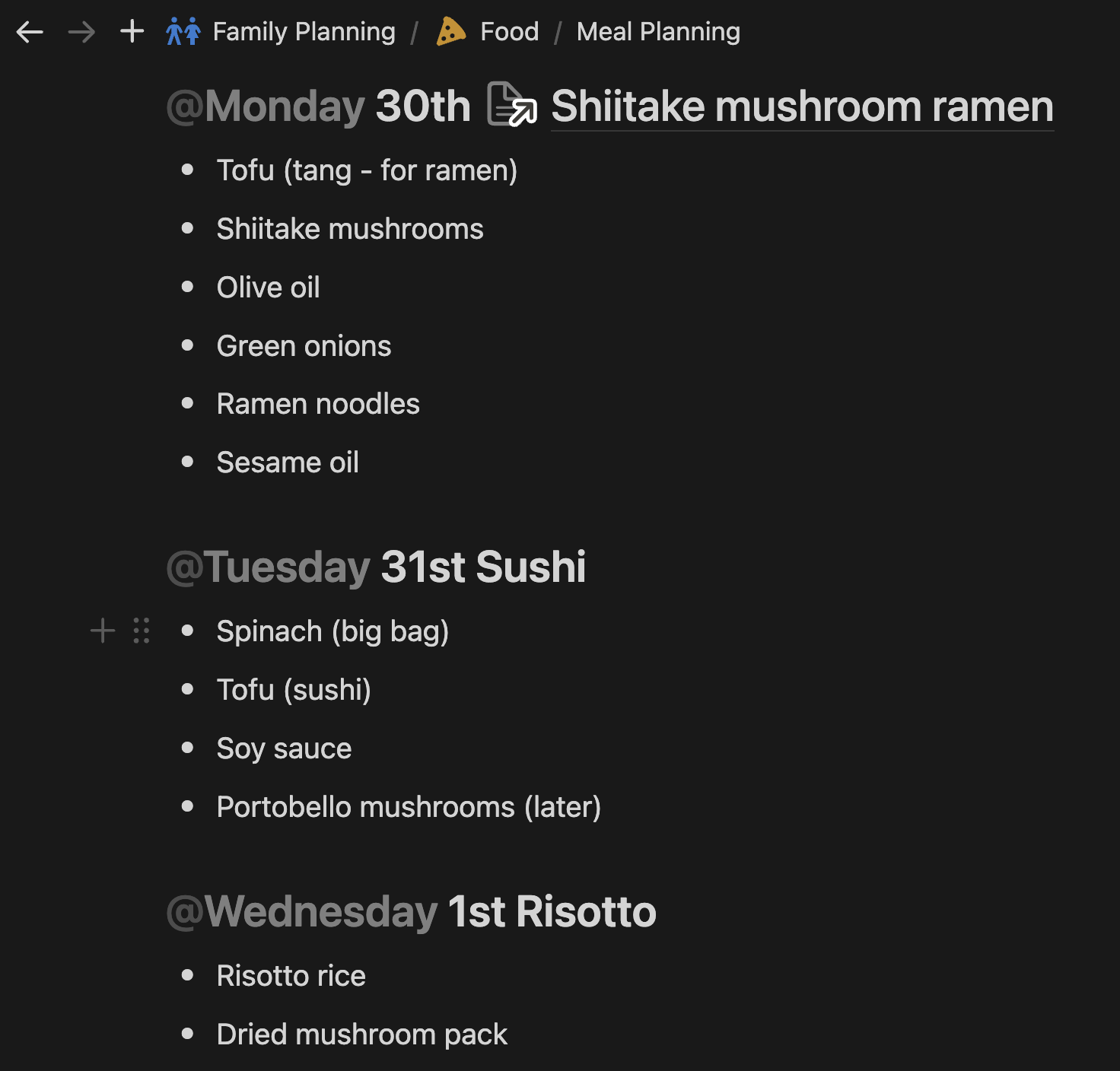
The end result looks something like this: Meal plan in Notion


With the meal plan written down, now we need to make a shopping list.

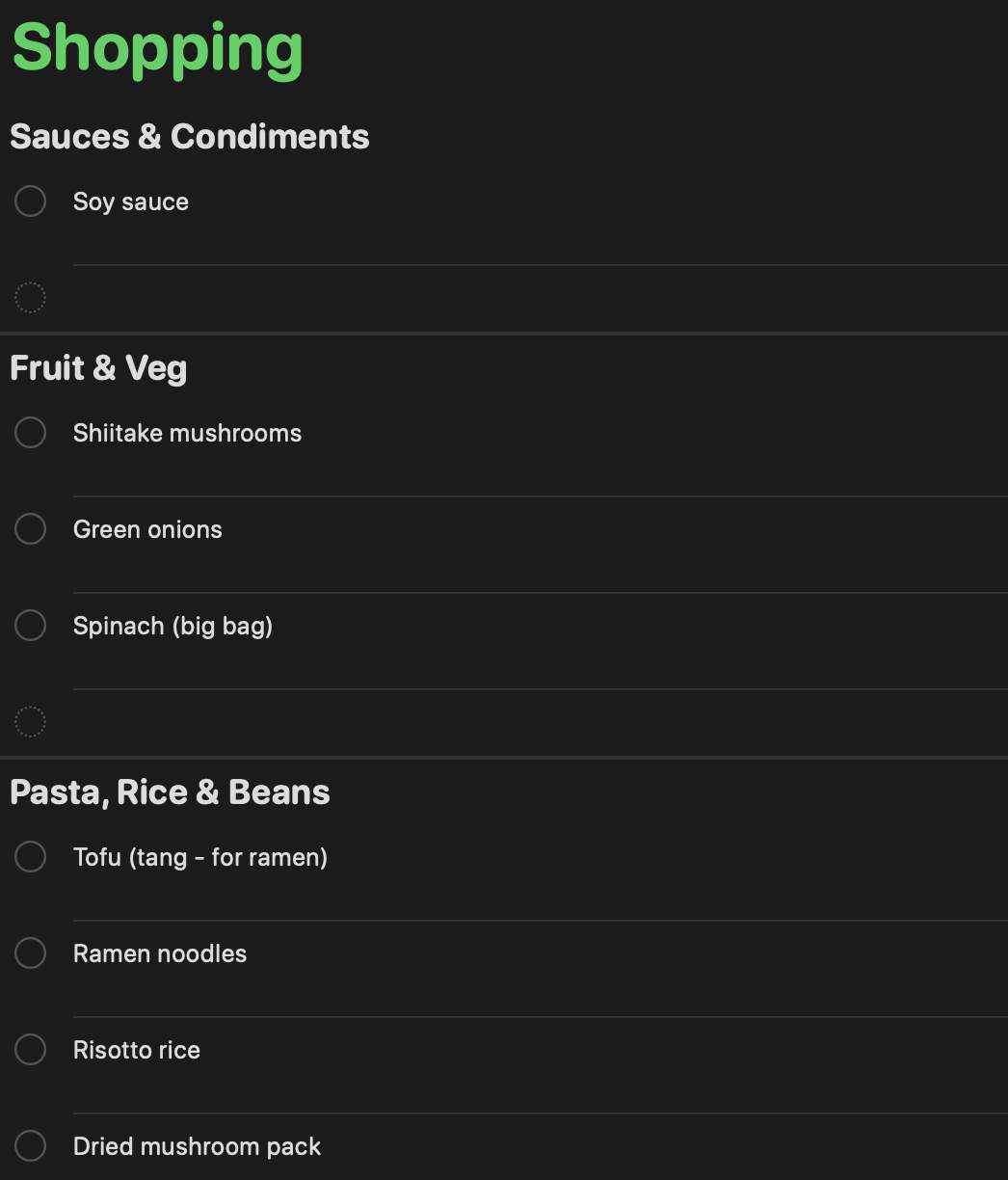
We've started using a shared "Shopping" list in Apple Reminders. The UX is great, and it all works quite well when we're actively shopping.1 2 We also have widgets on our phones so we can check the list with some quick gestures.

The irritating part is getting the items into the shopping list. I struggled to find a satisfying way to automate this part 😣3 (until now!) .

At an impasse, I had given up, and kept awkwardly copy-pasting the ingredients from Notion over to Apple Reminders - of course this felt wrong every time I did it!

Recently I came across this page showing how to invoke AppleScript from Emacs (because of course that's in Emacs!).

I loathe AppleScript far more than is probably healthy, but sometimes it's the right - i.e. only - tool for the job.

After many iterations and some consultations with my private Emacs tutor, ChatGPT, I scratched together a function to add an item into the Shopping list in Apple Reminders:

Note: if this code can be improved, let me know! I'm still a beginner here and guidance is greatly appreciated.

(defun my-add-item-to-shopping-reminders (item)
  "Prompt for ITEM and add it to the ‘Shopping’ list in Apple Reminders."
  (interactive "sAdd item to Shopping: ")
  (let ((as-command (format
	"tell application \"Reminders\"
		tell list \"Shopping\"
			make new reminder with properties {name:\"%s\"}
		end tell
	end tell"
	item)))
    (message "AppleScript: %s" as-command)  ;; Debug
    (shell-command (format "osascript -e '%s'" as-command))))

I ended up going with shell-command and osascript because I couldn't get past permissions issues between Emacs and Reminders when using do-applescript - I spent a lot of time troubleshooting this before finally giving up 😞

With this milestone reached, there was just one step remaining: process the shopping list items, using the power of Emacs 🙌

With a deal great more iterations and head-scratching, I managed to make a script that:

  1. Parses an Org buffer into an AST
  2. Gets all the list items from the AST
  3. Gets the content of the list items and pushes it into a list
  4. For each item in the list of content, calls AppleScript to add it to the Apple Reminders "Shopping" list.

Sidebar: The hardest part in my Emacs learning has been finding a good reference flow for Emacs / library API's. I know I can look things up in Emacs with C-h, but if I don't know what to look up, then I end up online and searching around aimlessly. This Org Element API is quite helpful, but I wish I knew how to 'discover' it in Emacs, and I still wish it were better organized and more detailed (without being able to put my finger on what exactly I feel like I'm missing).

The script:

(defun my-add-org-items-to-shopping-reminders ()
  "Extract all list items from the current Org buffer and add them to the 'Shopping' list in Apple Reminders."
  (interactive)
  (require 'org-element)
  ;; Extract all list items
  (let ((parsed (org-element-parse-buffer))
        (items '()))
    (org-element-map parsed 'item
      (lambda (item)
        (let ((content (org-element-property :contents-begin item))
              (end (org-element-property :contents-end item)))
          (when (and content end)
            (push (buffer-substring-no-properties content end) items)))))
    ;; Add each item to Apple Reminders
    (dolist (item (reverse items))
      (let ((as-command (format
                         "tell application \"Reminders\"
                            tell list \"Shopping\"
                              make new reminder with properties {name:\"%s\"}
                            end tell
                          end tell"
                         item)))
        (message "Adding to Reminders: %s" item)  ;; Debug
        (shell-command (format "osascript -e '%s'" as-command)))))
  (message "All items added to the 'Shopping' list."))

Now, I have a new routine:

  1. Make the Meal Plan in Notion as usual, with the lists of items we need to get at the store: Meal plan in Notion

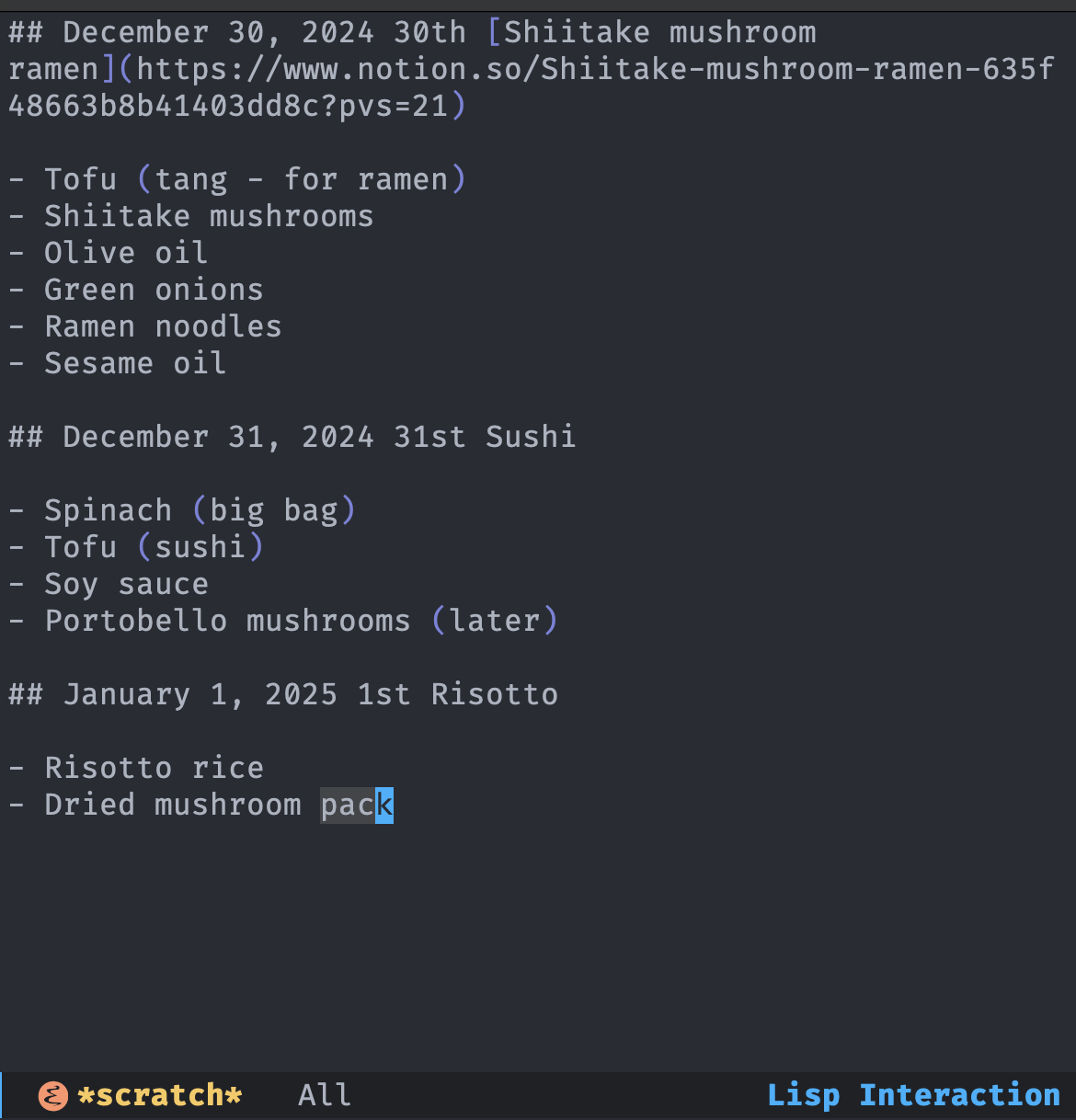
  2. Copy the entire Notion page and paste it into an Emacs buffer (even *scratch* works for this): Meal plan in Markdown

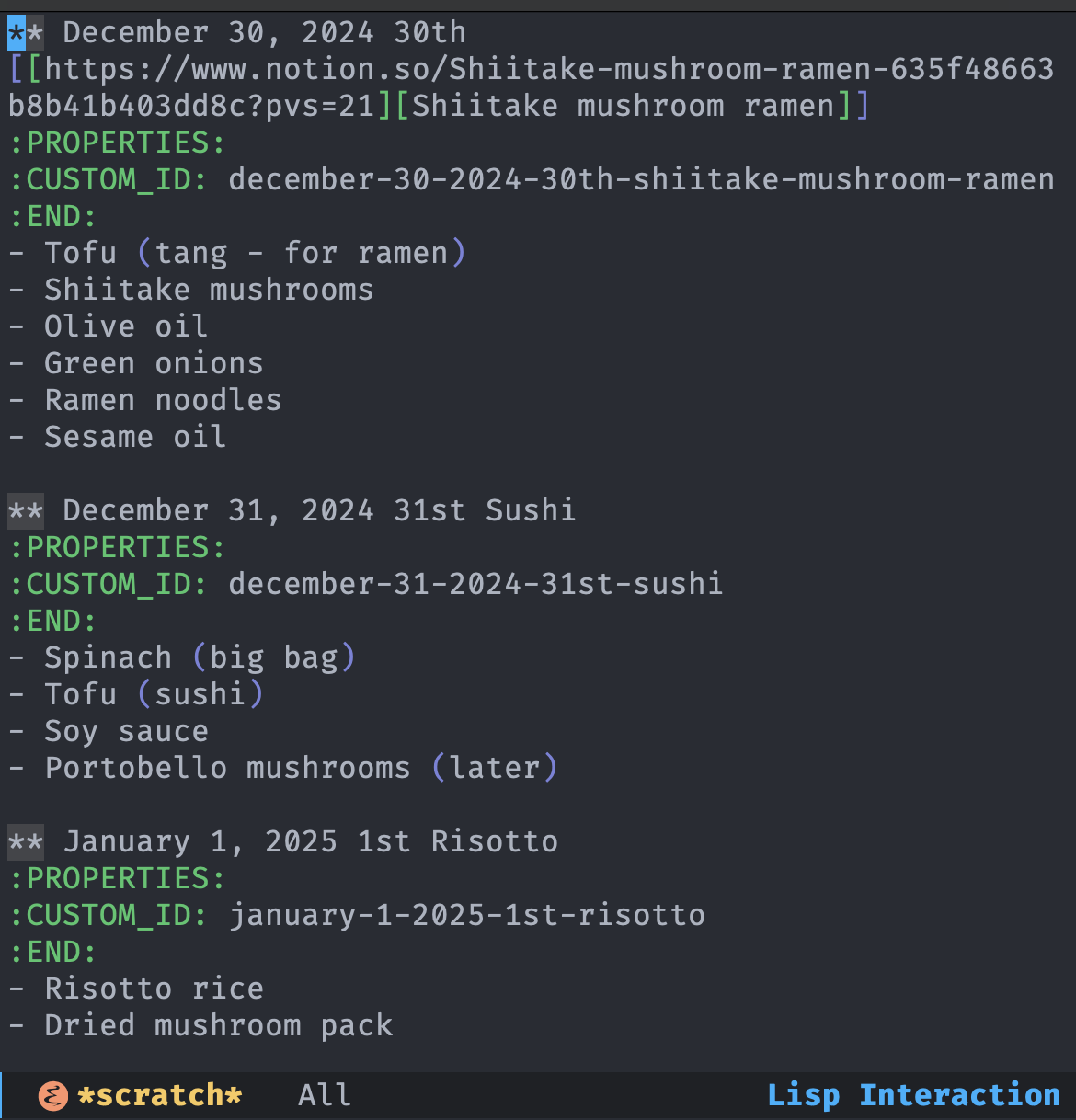
  3. Convert Notion's Markdown into Org4 Meal plan in Org

  4. Run the command to send the list items to Apple Reminders: Command to send meal plan items to Apple Reminders

  5. Go shopping! 🛒 Shopping list in Apple Reminders

  1. As much as I otherwise love it, Notion has never been 'lightweight' to use on mobile, and is often a real distraction in cases where I just need something, like a checklist to quickly reference and update.

  2. Also, it's important to keep the meal planning in Notion, because my partner, as smart & wonderful as they otherwise are, is not about to start using some nerdy text editor (😿) or a half-baked app I've written myself (we have enough of those already). Much of our family planning, including our recipes, is also done in Notion.

  3. At least one that doesn't require adding an additional service promising to synchronize the two platforms - no thanks!

  4. Not shown: a simple function I have to convert md->org in the same buffer, using a shell command to pandoc. Also, I did have the thought to just process a md buffer, but I don't know of a good parser for that and I avoid writing regexes whenever possible. I'm fine with have one extra command in my process (for now 🙃).

06 Jan 18:09

The Annual Berlin Fireworks Discussion

by The Späti Boys
Tom Roche

excellent

Uma, Nick and Ciarán ring in the new year with a discussion of Berlin's fireworks tradition, Macron's arrogant comments in Mayotte and Musk's Op-Ed in Welt am Sonntag.

HOW TO SUPPORT US:
https://www.patreon.com/cornerspaeti

HOW TO REACH US:
Bluesky https://bsky.app/profile/cornerspaeti.bsky.social
Twitter https://twitter.com/cornerspaeti
Instagram https://www.instagram.com/cornerspaeti/
Julia https://twitter.com/KMarxiana
Rob https://twitter.com/leninkraft
Nick https://bsky.app/profile/lilouzovert.bsky.social
Uma https://twitter.com/umawrnkl
Ciarán https://bsky.app/profile/ciarandold.bsky.social

Support Corner Späti

05 Jan 23:44

Irreal: Writing With Doom

by jcs
Tom Roche

pullquote edited {for clarity, to fix typos}:
> The real value of [this article](https://discourse.doomemacs.org/t/emacs-for-writing-prose/515) (archived [here](http://web.archive.org/web/20241231030948/https://discourse.doomemacs.org/t/emacs-for-writing-prose/515)) is the workflow and strategy that Mediapathic uses to organize his books. It’s very Org-centric. An obvious benefit of Org is the outlining and the ability to easily move headlined sections around. But there’s more. You can use tags to control export, track characters and their characteristics, and other useful things. Another advantage to Org for some writers is folding. Mediapathic shows a bit of code that opens a new window with the file narrowed to the Org subtree that the point is in. There’s some other useful information and a bunch of links to other resources

Recently, some one posted a link to this post about using Emacs for writing. It was written by Mediapthatic in 2022 but still very useful and up to date. It takes the point of view of a book writer but is equally applicable to any type of writing.

The post assumes you’re using Doom Emacs and Evil but that manifests mainly in the key shortcuts used to invoke the various commands. It mostly uses vanilla Emacs (including Org) but also depends on Avy for a lot of its functionality. There are some other packages but they play fairly minor rolls.

The real value of the piece is the workflow and strategy that Mediapthatic uses to organize his books. It’s very Org-centric. The obvious benefit of Org is the outlining and the ability to easily move headlined sections around. But there’s more. You can use tags to control export, track characters and their characteristics, and other useful things. Take a look at the post for the details.

Another advantage to Org for some writers is folding. It allows you to essentially disappear all the text except for that portion you’re working on. Mediapthatic also shows a bit of code that opens a new window with the file narrowed to the Org subtree that the point is in.

There’s some other useful information and a bunch of links to other resources so if you’re interested in using Emacs for writing prose, take a look at Mediapthatic’s post.

05 Jan 22:38

126! A Brave New World

History of Persia is back as we enter the Hellenistic Age. From a veterans' revolt in Bactria to the Lamian War in Greece, Perdiccas became the new regent of Alexander the Great's Empire in a chaotic time of shifting allegiances.


The Hellenistic Age Podcast https://hellenisticagepodcast.wordpress.com/

Visit https://HoPfulMedia.com.co to support this show!

Support Twitter Facebook Instagram


Advertising Inquiries: https://redcircle.com/brands

Privacy & Opt-Out: https://redcircle.com/privacy