Shared posts

17 Jan 21:20

Oddly Familiar Talking Points

by Jen Sorensen
Tom Roche

I often like Sorensen's work, but this is truly shameful.

Apologies for the late posting this week. I had to dig myself out of a post-holiday pileup of to-dos.

Let me start by saying I consider myself to be somewhat to the left of Bernie. I favor a Scandinavian-style social safety net — heck, I am Scandinavian. And I admire Elizabeth Warren more than just about anyone. So this comic is not coming from the perspective of a milquetoast centrist Democrat, or even a strong Hillary partisan, as I’m guessing some will assume in our world of fun political binaries. What concerns me is that I’m seeing fundamentally right-wing concepts being adopted by those who self-identify as lefties or progressives. You might say I’m criticizing the left from the left.

To address a few points raised in the cartoon: I shouldn’t need to even spell this out, but as a gentle reminder, Russia is an authoritarian regime that crushes free speech, dissidents, LGBT rights, and now, apparently, my own health insurance. This didn’t just happen to Hillary; it happened to all of us. It’s pretty much the definition of what should be a non-partisan concern. Mountains of evidence exist for Putin’s attempt to swing our election (and others), and to minimize the problem is nothing short of laughable. And yes, I do think the interference had a substantial impact.

Hillary has certainly frustrated me at times over the years, but I came to admire her intelligence and poise over the course of this election cycle. Her performance at the debates with Trump was nothing short of heroic. She also ran on the most progressive Democratic platform ever, but since policy has become almost completely divorced from politics, that doesn’t get talked about much. I could go on, but as my husband says, this was not so much an election as an exorcism, the culmination of a decades-long smear campaign by the right.

The term “political correctness” has been the cornerstone of conservative efforts to transform the ideas of civil rights and equality into something frivolous and stupid. The right loves plucking silly examples from obscure, powerless people and blowing them up into huge “culture war” issues that supposedly threaten the nation. “PC” is an insult that plays into their hands.

Along these same lines, “liberal elites” — long a Fox News favorite — is designed to shift attention away from the actual economic elites hoovering up the world’s wealth and resources, such as the Koch Brothers or Trump, and instead make one think of poodle-owning urbanites supposedly looking down their noses at everyone (while in reality voting to raise the minimum wage). It’s a frame, not a fact, and hides a deep anti-intellectual agenda. By definition, I would say a liberal is someone who cares about the less fortunate. So a liberal “elite” would be a liberal with power. However, the term is thrown around as a pejorative to smear just about anyone — feminists, college student activists, etc. — rendering it meaningless, and an effective right-wing language hack that divides the left.

So don’t fall for these con-job concepts! We progressives need to be strategic in our opposition, not Fox News Lefties.

17 Jan 16:35

Why time management is ruining our lives – podcast

All of our efforts to be more productive backfire – and only make us feel even busier and more stressed
17 Jan 16:34

Alan Yentob: the last impresario – podcast

For decades, Alan Yentob was the dominant creative force at the BBC – behind everything from Adam Curtis to Strictly Come Dancing. He was a towering figure in British culture – so why did many applaud his very public slide from power?
17 Jan 08:07

Behind the News, 12/22/16

Tom Roche

rerun

Behind the News, 12/22/16 - guests: Rania Khalek, George Joseph - Doug Henwood
11 Jan 00:54

Incarceration Around the World and SF’s Proposition Q: Banning Tents on Sidewalks

Tom Roche

1st half (Jennifer Freidenbach on SF homelessness and Proposition Q) is missable. 2nd half (Baz Dreisinger on differing global approaches to incarceration) is quite good.

09 Jan 18:46

Embers of War: The Fall of an Empire and the Making of America's Vietnam Jan 14, 2014 by Fredrik Logevall

by The John Batchelor Show
Tom Roche

rerun

Author (Photo:... Indochina War In 1953 - French Camp For 'Reeducated' Vietnamese Political Prisoners - Jean ) http://JohnBatchelorShow.com/contact http://JohnBatchelorShow.com/schedules http://johnbatchelorshow.com/blog Twitter: @BatchelorShow Embers of War: The Fall of an Empire and the Making of America's Vietnam Jan 14, 2014 by Fredrik Logevall WINNER OF THE PULITZER PRIZE Written with the style of a great novelist and the intrigue of a Cold War thriller, Embers of War is a landmark work that will forever change your understanding of how and why America went to war in Vietnam. Tapping newly accessible diplomatic archives in several nations, Fredrik Logevall traces the path that led two Western nations to tragically lose their way in the jungles of Southeast Asia. He brings to life the bloodiest battles of France’s final years in Indochina—and shows how, from an early point, a succession of American leaders made disastrous policy choices that put America on its own collision course with history. An epic story of wasted opportunities and deadly miscalculations, Embers of War delves deep into the historical record to provide hard answers to the unanswered questions surrounding the demise of one Western power in Vietnam and the arrival of another. Eye-opening and compulsively readable, Embers of War is a gripping, heralded work that illuminates the hidden history of the French and American experiences in Vietnam. ONE OF THE MOST ACCLAIMED WORKS OF HISTORY IN RECENT YEARS Winner of the Francis Parkman Prize from the Society of American Historians • Winner of the American Library in Paris Book Award • Winner of the Council on Foreign Relations Arthur Ross Book Award • Finalist for the Cundill Prize in Historical Literature NAMED ONE OF THE BEST BOOKS OF THE YEAR BY The Washington Post • The Christian Science Monitor • The Globe and Mail “A balanced, deeply researched history of how, as French colonial rule faltered, a succession of American leaders moved step by step down a road toward full-blown war.”—Pulitzer Prize citation “This extraordinary work of modern history combines powerful narrative thrust, deep scholarly authority, and quiet interpretive confidence.”—Francis Parkman Prize citation “A monumental history . . . a widely researched and eloquently written account of how the U.S. came to be involved in Vietnam . . . certainly the most comprehensive review of this period to date.”—The Wall Street Journal “Superb . . . a product of formidable international research.”—The Washington Post “Lucid and vivid . . . [a] definitive history.”—San Francisco Chronicle “An essential work for those seeking to understand the worst foreign-policy adventure in American history . . . Even though readers know how the story ends—as with The Iliad—they will be as riveted by the tale as if they were hearing it for the first time.”—The Christian Science Monitor “A remarkable new history . . . Logevall skillfully explains everything that led up to Vietnam’s fatal partition in 1954 [and] peppers the grand sweep of his book with vignettes of remarkable characters, wise and foolish.”—The Economist “Fascinating, beautifully written . . . Logevall’s account provides much new detail and important new insights. . . . It is impossible to read the book without being struck by contemporary parallels.”—Foreign Policy “[A] brilliant history of how the French colonial war to hang on to its colonies in Indochina became what the Vietnamese now call ‘the American war.’”—Esquire “An excellent, valuable book.”—The Dallas Morning News
09 Jan 18:45

Origins of Our Big Brains & What Was the Trade-Off? @Mbalter @Salon @Science.

by The John Batchelor Show
Tom Roche

rerun

Author (Photo: ) http://JohnBatchelorShow.com/contact http://JohnBatchelorShow.com/schedules http://johnbatchelorshow.com/blog Twitter: @BatchelorShow Origins of Our Big Brains & What Was the Trade-Off? @Mbalter @Salon @Science. "...The oversized Homo sapiens brain let us take over the planet, build cities, send space probes to Mars, and do all the other marvelous things that we humans are so proud of. But none of these things makes us much better at reproducing, and in terms of evolution, that’s really all that matters. It’s not so obvious why Darwinian natural selection should have favored the brain’s dramatic expansion given the huge costs. Although the human brain is only about 2 percent of total body weight, it siphons off about 20 percent of our total calorie intake; this overall percentage varies little whether we are engaged in hard mental tasks or just zoning out. If having a large brain were all that advantageous, it seems that every animal would have one. And yet most species have been content, evolutionarily speaking, with relatively small ones. The brain of our closest living cousin, the chimpanzee, is less than a third the volume of ours, even though chimps weigh almost as much as humans. Our primate lineage had a head start in evolving large brains, however, because most primates have brains that are larger than expected for their body size. The Encephalization Quotient is a measure of brain size relative to body size. The cat has an EQ of about 1, which is what is expected for its body size, while chimps have an EQ of 2.5 and humans nearly 7.5. Dolphins, no slouches when it comes to cognitive powers and complex social groups, have an EQ of more than 5, but rats and rabbits are way down on the scale at below 0.4. Natural selection already had something to work with, if Dunbar’s hypothesis is correct, because many primates have complex social relationships. The best proxy for this social complexity, Dunbar argues, is the size of an animal’s social group. The social brain hypothesis really got cooking back in 1993, when Dunbar, along with anthropologist Leslie Aiello, crunched a bunch of numbers from the hominid fossil record and observations of living apes. The larger a species’ group size, they found, the larger its brain—particularly the neocortex, the outer layers where most of the serious thinking goes on. They concluded that the correlation among group size, brain size, and neocortex size held pretty tightly throughout our lineage, from the australopithecines more than 3 million years ago to modern-day humans. The average group size for today’s Homo sapiens, the pair concluded in a widely cited paper in Current Anthropology, is about 150 people—a figure often called Dunbar’s number, and which refers to the number of people with whom the average person can maintain close personal relationships. (The Australopithecus afarensis Lucy had a group size of 60 to 70, as do most living apes such as chimps, but Neanderthals were a close social-group match with modern humans.)..." http://www.slate.com/articles/health_and_science/human_evolution/2012/10/human_brain_size_social_groups_led_to_the_evolution_of_large_brains.html _____________ '...At an average volume of 1400 cubic centimeters, our brains are three times as large as those of our closest living evolutionary cousins, chimpanzees. While researchers debate why our noggins got so big, one thing is for sure: The brain is a costly organ. Our brains use 20% of our energy expenditures when we are resting, more than twice as much as expended by chimps and other primates. Back in the 1990s, U.K.-based researchers Leslie Aiello and Peter Wheeler proposed what they called the expensive-tissue hypothesis, arguing that the human digestive system, which uses a great deal of energy to metabolize our food, had downsized considerably to help pay that price. To see what other trade-offs might have occurred, a team led by Philipp Khaitovich, a biologist at the CAS-MPG Partner Institute for Computational Biology in Shanghai, China, looked at the energy use profiles of five different tissues in four animal species. Three of the tissues were in the brain: the prefrontal cortex (involved in advanced cognition), the primary visual cortex (which processes the sense of sight), and the cerebellar cortex (key to motor control). The other two tissues were the kidney and thigh muscle. The animal species in the study were humans, chimps, rhesus monkeys, and mice, whose tissues were sampled soon after their deaths...." http://www.sciencemag.org/news/2014/05/did-big-brains-sap-our-strength
09 Jan 18:44

The Victims Return: Survivors of the Gulag after Stalin Jun 19, 2012 by Stephen F. Cohen

by The John Batchelor Show
Tom Roche

rerun

Author (Photo: Ninaras - Own work Monument to the victims of the Akmola Labour Camp for Wives of Political Dissidents during Soviet times, Astana, Kazakhstan CC BY 4.0 File:Gulag ALZHIR in Astana, Kazakhstan, Monument to the victims 03.jpg Created: 21 July 2012 ) http://JohnBatchelorShow.com/contact http://JohnBatchelorShow.com/schedules http://johnbatchelorshow.com/blog Twitter: @BatchelorShow The Victims Return: Survivors of the Gulag after Stalin Jun 19, 2012 by Stephen F. Cohen "Stalin’s Reign of terror in the Soviet Union has been called “the other holocaust.” During the Stalin years, it is thought that more innocent men, women, and children perished than in Hitler’s destruction of the European Jews. Many millions died in Stalin’s Gulag of torture prisons and forced labor camps, yet others survived and were freed after his death in 1953. This book is the story of the survivors. Long kept secret by Soviet repression and censorship, it is now told by renowned author and historian Stephen F. Cohen, who came to know many former Gulag inmates during his frequent trips to Moscow over a period of 30 years. Based on first-hand interviews with the victims themselves and on newly available materials, Cohen provides a powerful narrative of the survivors’ post-Gulag saga, from their liberation and return to Soviet society, to their long struggle to salvage what remained of their shattered lives and to obtain justice; showing that the struggle between anti-Stalinists and Stalinists is still under way in Russia today." https://www.amazon.com/Victims-Return-Survivors-Gulag-Stalin/dp/1780761376/ref=sr_1_1?s=books&ie=UTF8&qid=1483925624&sr=1-1&keywords=survivors+return+cohen
09 Jan 18:43

Grab Their Belts to Fight Them: The Viet Cong's Big Unit-War Against the U.S., 1965-1966 May 15, 2011 by Warren Wilkins

by The John Batchelor Show
Tom Roche

rerun

Author (Photo: Dak To, South Vietnam. An infantry patrol moves up to assault the last Viet Cong position after an attempted overrun of the artillery position by the Viet Cong during Operation Hawthorne. Date 7 June 1966 Source National Archives and Records Administration Author US Army Signal Corps) http://JohnBatchelorShow.com/contact http://JohnBatchelorShow.com/schedules http://johnbatchelorshow.com/blog Twitter: @BatchelorShow Grab Their Belts to Fight Them: The Viet Cong's Big Unit-War Against the U.S., 1965-1966 May 15, 2011 by Warren Wilkins “During 1965 and 1966,” wrote Dale Andrade, a historian at the U.S. Army Center of Military History, “the Communists fought the Americans toe to toe, making little effort to act like guerillas.” Indeed, despite pronounced disadvantages in firepower and mobility, the Communist Vietnamese endeavored to crush South Vietnam and expel the American military with a strategy predicated on “big unit” war. Orchestrated by a militant clique in Hanoi, the “big unit” war was designed to yield a quick and decisive victory over South Vietnam. Exploiting an extensive array of Communist Vietnamese sources, including seldom utilized unit histories and battle studies, Grab Them by Their Belts chronicles in rich detail the formation, development, and participation of the Viet Cong in the opening stanza of the Communist big unit war against the Americans, and how the ultimate failure of that war profoundly influenced the decision to launch the Tet Offensive. Grab Them by their Belts, unlike much of the existing body English literature on the Vietnam War, mined the expansive Communist historiography on the conflict to craft an authentic and accurate account of the big unit war from a Communist perspective. Communist memoirs, unit histories, and battlefield studies were extensively consulted to reconstruct the formation and deployment of major VC/NVA military units, battles and campaigns, and the overarching strategic debates that informed the big unit war. Additionally, Grab Them by Their Belts recounts how the Communist big unit war reflected the desire to crush South Vietnam quickly and decisively, and how the failure of that war influenced the decision to launch the Tet Offensive. https://www.amazon.com/Grab-Their-Belts-Fight-Them/dp/1591149614/ref=sr_1_1?s=books&ie=UTF8&qid=1483926960&sr=1-1&keywords=belts+wilkins
08 Jan 16:57

Tough Without a Gun: The Life and Extraordinary Afterlife of Humphrey Bogart by Stefan Kanfer

by The John Batchelor Show
Tom Roche

rerun

Author (Photo: The Treasure of the Sierra Madre ) http://JohnBatchelorShow.com/contact http://JohnBatchelorShow.com/schedules http://johnbatchelorshow.com/blog Twitter: @BatchelorShow Tough Without a Gun: The Life and Extraordinary Afterlife of Humphrey Bogart by Stefan Kanfer Kanfer, a Time magazine editor who has written biographies of Marlon Brando, Lucille Ball, and Groucho Marx, turns his attention to Humphrey Bogart, whose "outstanding characteristics--integrity, stoicism, a sexual charisma accompanied by a cool indifference to women--are never out of style when he's on-screen." After a privileged New York childhood as the son of famed illustrator Maud Humphrey, Bogart flunked out of Phillips Andover, joined the Navy near the end of WWI, and entered show business as a stage manager. Kanfer delivers compelling coverage of Bogart's early marriages and 13 years as a New York stage actor, culminating with The Petrified Forest, his 1935 Broadway breakthrough. Casablanca and other film classics are detailed with both illuminating insights and anecdotal accounts of Tinseltown. Raymond Chandler was pleased by the casting of The Big Sleep because, he wrote, "Bogart can be tough without a gun." By the mid-1940s, Bogart was the world's highest paid actor, with a résumé of 19 plays and 53 films. Although Bogart was heard on more than 80 radio broadcasts (even singing) between 1936 and 1954, Kanfer overlooks this medium. Apart from that lapse, the biography stands as an entertaining, definitive portrait, enriched with delightful digressions into Bogie's noirish, rough-hewn persona. (Feb. 3) (c) Copyright PWxyz, LLC. All rights reserved. --This text refers to the Hardcover edition. From Booklist Humphrey Bogart was 42 before in 1941 he broke through as an A-list star in The Maltese Falcon and High Sierra. He was dead of lung cancer a mere 16 years later. Yet, as Kanfer points out in his revealing account of Bogart’s life and legacy, Bogie, in those few short years, established a cinematic identity that lives on across generations. Kanfer thoroughly covers the relatively familiar ground of Bogart’s upbringing as the rebellious child of blue-blood parents; his long apprenticeships, first in the theater and then playing bad guys in the movies; and, finally, his brief but iconic years of stardom. Beyond that, though, what separates Kanfer’s book from other Bogart bios by David Thomson, Jeffrey Meyers, and Richard Schickel is the emphasis on the actor’s “afterlife,” the way that somehow his persona—“integrity, stoicism, sexual charisma accompanied by a cool indifference to women”—has never gone out of style. Bogart divided the world into “professionals and bums,” and Kanfer makes a convincing case that, with so many bums surrounding us today, the real pros never grow stale. --Bill Ott --This text refers to the Hardcover edition. Review "A swift, smart, scrupulous book. It brims with insights." —Tom Shone, Slate "Terrific. . . . Kanfer is particularly good in sketching [Bogart's] lasting influence." —Los Angeles Times "Evocative. . . . Gives the reader a palpable sense of the sadly truncated arc of [Bogart's] life." —Michiko Kakutani, The New York Times "Insightful. . . . The value of this book lies in Kanfer's insights into and analysis of the way that Bogart worked " —Chicago Sun-Times "There may be no better analysis of Bogart’s mysterious and enduring appeal." —The Daily Beast “Gracefully written. . . . [Kanfer] approaches the complicated and difficult man Katharine Hepburn called ‘one of the biggest guys I ever met’ with a fair, discerning eye. . . . Both sensitive and agile. . . . An insightful, compassionate portrait of a man who cared about his craft and, close friends said, camouflaged a kind and generous heart with a sardonic wit and snarl.” —Dallas Morning News “Excellent. . . . A moving, psychologically intimate portrait of an icon that leaves some of the mystique intact.” —A.V. Club “A readable and entertaining biography that reflects the author’s delight in his subject and the world in which Bogart thrived.” —Denver Post https://www.amazon.com/Tough-Without-Gun-Extraordinary-Afterlife/dp/0307455815
07 Jan 05:04

WaPo Spreading Own Falsehoods Shows Real Power of Fake News

by Adam Johnson
Tom Roche

Exposing how USCFM and allies hypocritically define their falsehoods as not "fake news" by definition--only those other guys do that.

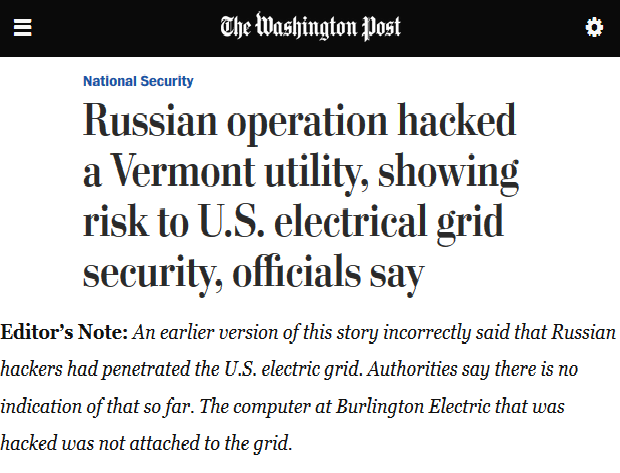
WaPo: Russian operation hacked a Vermont utility, showing risk to U.S. electrical grid security, officials say

Washington Post story (12/31/16) with revised headline and a never-mind editor’s note. Is this “fake news”?

The putative scourge of “fake news” has been one of the most pervasive post-election media narratives. The general thrust goes like this: A torrent of fake news swept the internet, damaging Hillary Clinton and possibly leading to a Donald Trump victory.

A primary problem with this convenient-to-some narrative is that “fake news” has yet to be clearly defined by anyone. Vaguely conceptualized as misleading or outright fabricated stories, it can mean anything—as FAIR has noted previously (12/1/16)—from outlets that align with “Russian viewpoints” to foreign spam.

A recent series of events further illustrates this ambiguity. Friday night, the Washington Post (12/30/16) published an explosive report about Russian hackers breaking into a Vermont utility company. The headline splashed all over social media:

Russian Hackers Penetrated US Electricity Grid Through a Utility in Vermont, Officials Say

Quickly, the blockbuster story began to fall apart, after Burlington Electric, the utility in question, issued a statement saying they had “detected the malware in a single Burlington Electric Department laptop not connected to [their] organization’s grid systems.” The Post “updated” the story several times throughout the evening, eventually adding a heavily qualified editor’s note that the only cause for concern was some “Russian code” on a laptop of one of the employees. There was no evidence of a hack or an attempted hack, Russian or otherwise.

Two days later, after the story was walked back several times, Washington Post columnist Catherine Rampell linked to it in a story about cybersecurity issues facing the incoming Trump administration:

...Or maybe even the code running an electrical grid, such as the one Russian hackers recently tried to infiltrate in Vermont.

After FAIR and others pointed out the error, Rampell’s article was changed, but this episode shows how quickly an entirely bogus premise—that Russia had hacked, or even attempted to hack, an American public utility—can spread without an ounce of skepticism. At the time her column was published, the only “evidence” of an “attempted” Russian hack was some malware code that could have been used by anybody. Rampell, likely influenced by the initial erroneous reporting by her colleagues, made an assumption that this was evidence of an “attempted hack,” a false assumption debunked by the Post itself (1/2/16) two hours after she published. In all cases, everything is rounded up to the most sensational, most Cold War–panic inducing conclusion. “Mistakes” rarely, if ever, happen in favor of less hysteria.

WaPo: We have a stake in Syria, yet we have done nothing

John McCain’s Washington Post op-ed (12/22/16) failed to acknowledge that, according to the Post (6/12/15), the CIA has done a billion dollars a year worth of “nothing” in Syria.

In a separate instance, the Washington Post (12/22/16) ran a column by Sen. John McCain insisting that the United States had “done nothing” in Syria. Had McCain’s editors, again, bothered to read their own paper, they would see that the Post (6/12/15) reported that the CIA has spent up to $1 billion a year on the Syrian opposition, or roughly $1 out of every $15 dollars the agency spends.

This wasn’t merely a difference of opinion; it was a clear, black-and-white falsehood—not only had the US not “done nothing,” it had, by any objective metric, done quite a bit. Even opinion columns can be factchecked; that this one wasn’t, on its most basic premise, suggests that when it comes to fanning the New Cold War—especially on its hottest front in Syria—the Washington Post has lowered its editorial standards to tabloid levels.

All this highlights the problem with limiting the criticism of misinformation to low-rent content farms in Macedonia, as the “fake news” narrative so often does, while inoculating traditional outlets from the charge without a discernible reason to do so.

University of North Carolina professor Zeynep Tufekci—whose November New York Times column (11/15/16) helped kick off the latest round of concern over fake news—objected to this counter-objection: “There is no, and never was, ‘perfect news,’” she tweeted. “Pls stop referring to every mode of failure of news as ‘fake news.’ Conflation is not analysis.” When security researcher Marcy Wheeler pushed back by insisting that what the Post had done was, by its own criteria, fake news, Tufekci doubled down:

The issue, of course, is not whether the Washington Post engages in the same proportion of fake news as the trollhole websites in question; it’s that when its news is fake, it has a far more significant effect. The Post is still read by far more people than fringe websites, and its reporting is met with far more credulity. It is also assumed that mistakes by the the Post are done entirely in good faith, with no consideration for political or editorial pressure to find dirt on America’s current No. 1 enemy, Russia.

But Tufekci and others have carved out such a narrow definition of “fake news” that it excludes anything emanating from establishment news sources. Indeed, when pressed on this point, Tufekci insisted “traditional media” could not, by definition, engage in fake news:

The Post’s misleading and sometimes outright false reporting on matters related to Russia are dismissed as simply “newsroom economics,” and no ill will or political incentive or ideology is ascribed. Because, we—The Good American Traditional Media—don’t do those types of things. A “fake news phenomenon” that cannot, by definition, include mainstream media is a power-serving tautology that shields US corporate media from scrutiny and encourages citizens to simply trust some outlets (we’ll tell you which ones) rather than think critically.

A recent YouGov poll showed a shocking 46 percent of Trump supporters believed the “pizzagate” scandal—a bizarre conspiracy spread on 4Chan and Infowars about Clinton’s campaign manager running a child sex ring out of a DC pizza parlor. This led, justifiably, to widespread mockery and hand-wringing over fake news by the pundit classes.

But most missed that the same poll found that 50 percent of Clinton supporters believed the Russian government had tampered directly with vote tallies—as in, Putin agents directly manipulated election results. While these fears are based, at least in part, on actual (though still unproven) assertions by US intelligence that Russian hackers leaked unflattering DNC emails in an effort to influence the election, the idea that Russia actually hacked the voting process itself is an ungrounded conspiracy theory, and one the White House has repeatedly insisted didn’t happen. But where, one may ask, did 50 percent of Clinton supporters get the idea Russia hacked the election?

Headlines on 'Election Hacking'Corporate media continue to refer to the alleged Russian hacking of the DNC (and Clinton campaign manager John Podesta) emails as “election hacking,” giving readers the distinct impression the Russians, well, hacked the election. This wildly misleading framing is augmented by a network of pro-Clinton pundits who, in the wake of the election, spent weeks fanning theories that the machines were tampered with.

Fake news, to the extent it is a menace, ought to be measured by how badly it pollutes with misinformation. Given the number of people who think Russia is literally overturning vote totals, this meme and those who spread it certainly fits the description. But it doesn’t get the label that treats it as a serious problem, because “fake news”—in effect, if not by design—includes everyone and everything except US corporate media.

h/t Nima Shirazi


Adam Johnson is a contributing analyst for FAIR.org. You can find him on Twitter at @AdamJohnsonNYC.

Messages can be sent to the Washington Post at letters@washpost.com, or via Twitter @washingtonpost. Please remember that respectful communication is the most effective.

06 Jan 19:48

Behind the News – January 5, 2017

Tom Roche

rerun from 10 Mar 2016: Anne Balay on declining incomes and working conditions for US truckers, then Lester Spence on class and ideological divisions among US black political leadership, esp the Prosperity Gospel in the black church

06 Jan 02:07

Patrick Wolfe, “Traces of History: Elementary Structures of Race” (Verso, 2016)

by Anna Levy
Tom Roche

Unfortunately almost nothing specific on the content of the work: it's almost entirely about (the recently deceased) Wolfe personality and scholarship, how Wolfe's work has affected the two scholars interviewed (Lynette Russell and Aziz Rana) and their field, etc. Quite disappointing.

Widely known for his pioneering work in the field of settler colonial studies, Patrick Wolfe advanced the theory that settler colonialism was, “a structure, not an event.” In early 2016, Wolfe deepened this analysis through his most recent book, Traces
04 Jan 22:00

In Syria, Western Media Cheer Al Qaeda

by Rania Khalek
Tom Roche

I suspect the Syrian timeline points to the key facts. Ongoing internal opposition to Assad increases a bit after Bouazizi's immolation. Later but still early 2011, as the 2012 US presidential campaign is "heating up," Romney friend and surrogate Netanyahu joins with the Saudis, other Gulf Sunnis, and the US corporate-funded media to demand military action against Iran. The US military tells Obama to fuhgedaboutit, and the media campaign dies down in mid-2011, just before the intensity of the Syrian civil war makes a step-change increase. I strongly suspect that Obama did a deal with the militant Zionists (in Israel, the US, and the USCFM) and Sunnis, saying something like, 'I won't attack Iran directly, and won't help you do that either. But I will help you attack Assad, which should allow us to flip that regime, weaken the Iranians, and break the "land bridge" between Iran and Hezbollah.' The rest is very bloody history.

Daily Beast: Heroes? Jihadis With al Qaeda Links Break Assad Siege of Aleppo

This Daily Beast headline (8/8/16) was an unusually direct acknowledgement of Al Qaeda’s role in Aleppo.

The Syrian government—a dictatorship known for imprisoning, torturing and disappearing dissidents—is easy to vilify. And over the last five years of Syria’s civil war, it has committed its share of atrocities. But there is more than one side to every story, and US media coverage has mainly reflected one side—that of the rebels—without regard for accuracy or basic context.

As the Syrian government recaptured East Aleppo from rebels in recent weeks, media outlets from across the political spectrum became rebel mouthpieces, unquestioningly relaying rebel claims while omitting crucial details about who the rebels were.

Almost always overlooked in the US (and UK) media narrative is the fact that the rebels in East Aleppo were a patchwork of Western- and Gulf-backed jihadist groups dominated by Jabhat Fateh al-Sham (formerly Jabhat al-Nusra)—Al Qaeda’s affiliate in Syria—along with its ally, Ahrar al-Sham (Daily Beast, 8/8/16; Foreign Policy, 9/1/16). These groups are explicitly anti-democratic and have been implicated in human rights violations, from mass execution and child beheadings to using caged religious minorities as human shields.

In the absence of any desire to evoke a political response, US media would surely have identified East Aleppo’s rebels by the name of the most famous militant group in the world—Al Qaeda. Yet press reports regularly referred to the militant forces dominating East Aleppo simply as “rebels.”

“Women in Aleppo Choose Suicide Over Rape,” declared a headline at the Daily Beast (12/12/16). The source of this very serious claim was Abdullah Othman, a member of Jabhat Al-Shamiya, or the Levant Front, an umbrella group whose membership consists of several jihadist rebel factions. So far no evidence has been presented, at least not publicly, to substantiate Othman’s claim. But that didn’t stop his story from spreading like wildfire across social media and being picked up by Commentary (12/13/16), Mic (12/16/16), Elle (12/13/16) and Foreign Policy (12/16/16), among others.

NBC News (12/13/16) reported that “scores of civilians were burned alive by regime forces.” The source for this accusation was unspecified “reports from Arab media.” The Independent (12/17/16) warned of “house-to-house murder.” The source was British politician David Miliband. The UN (12/13/16) cited “credible reports” of 82 civilians being shot “on the spot” by pro-government forces. While this is certainly plausible, the UN, which was not on the ground in East Aleppo, has yet to follow up on the matter.

US media also promoted accusations made by self-described “media activists” in East Aleppo warning that the Syrian regime was going to slaughter them. State Department spokesperson John Kirby called the messages “brave” and praised those who posted them as providing “independent third-party media coverage” of the horrors in Aleppo.

But information coming out of rebel areas is far from independent. On the contrary, it is tightly controlled by the jihadist groups that control these areas. These groups do not tolerate activism. They jail, torture and summarily execute activists, as well as lawyers, humanitarian workers, journalists and minorities. This should raise questions about anyone purporting to be an activist from rebel areas. But in the Western press, it doesn’t, which is why one of the most widely featured media personalities out of rebel-held Aleppo, Bilal Abdul Kareem, has been uncritically promoted by CNN (12/16/16) and even the usually adversarial Intercept (6/30/16), despite a well-established record of pushing hyper-sectarian propaganda for extremist groups (AlterNet, 12/29/16).

If media outlets were quick to grant legitimacy to rebel accusations, they ignored or downplayed rebel atrocities.

For example, when the rebels burned several buses (and killed the drivers) meant to evacuate the sick and injured from two besieged Shiite villages in Idlib, the New York Times (12/18/16)  buried the details of the incident deep inside in the 19th paragraph of a story on evacuations.

Reports that the rebels shot at civilians attempting to flee to government areas and withheld food and humanitarian aid from civilians rarely made it into Western media reports.

While both sides have accused the other of carrying out massacres in Aleppo, only rebel accusations received widespread US media coverage. But the only evidence to emerge so far points to the rebels as culprits. Ahead of their evacuation from East Aleppo, rebel groups reportedly executed an estimated 100 Syrian soldiers they were holding prisoner, according to pro-government forces. The bodies were found in a local school. Despite photos, corroborating video evidence and the fact that rebels have carried out mass summary executions of Syrian soldiers taken prisoner in Aleppo in the past, US media outlets mostly ignored it. One of the groups alleged to be behind the killings is Nouriddeen Al-Zinki, a recipient of US weapons. (Months ago, Al-Zinki fighters videotaped themselves beheading a child. The gruesome act was met with a shrug by the group’s Western backers.) Russia also reported finding mass graves of tortured civilians and booby traps during its sweep of East Aleppo, which received little to no attention.


A boy mourns outside the morgue in West Aleppo after his father was killed by rebel mortars. (photo: Rania Khalek)

A boy mourns outside the morgue in West Aleppo after his father was killed by rebel mortars. (photo: Rania Khalek)

If none of this were true, the loathing that many Syrians in government areas express for the rebels, and for the Western media who glorify them, would be hard to explain.

In November, I visited government-held areas of Syria, where the overwhelming majority (an estimated 75 percent) of Syrians live, and I witnessed a side of the conflict that US media outlets have almost entirely overlooked. It’s as if the views and well-being of some 17 million Syrians don’t matter, simply because they live on the government side.

This rule seems to apply across the media spectrum. An editor at a major progressive publication rejected on-the-ground reporting from government areas, telling me it was a futile journalistic endeavor because the Syrian government watches everything, and Syrians are too terrified of the secret police to say what they really think.

While it’s true that Syrians are limited in their capacity to criticize the government, it doesn’t justify ignoring them. And the situation on the ground isn’t so black and white. Behind closed doors and in private conversations, many Syrians were sharply critical of the Assad regime. Yet they still supported the government, largely out of even stronger opposition to the religious fundamentalism and brutality of the armed groups, whom they view as foreign-backed religious fanatics who have invaded their country and terrorized them and their families.

I’m still haunted by what I saw at Al-Razi Hospital in what was then government-held West Aleppo. I watched as one ambulance after another dropped off civilians wounded by rebel mortars fired into residential neighborhoods around the clock. Medical staff quickly went to work on a man whose chest was pierced by a piece of twisted metal. A frantic woman lingered close by, shouting, “He’s the only son I have left!” The man was soon pronounced dead and the woman collapsed in agony.

Down a crowded hall, 10-year-old Fateh stood on a blood-smeared floor, crying beside a gurney where his 15-year-old brother, Mohammad, was lying. Blood had soaked through the bandage on his leg, but the medical staff was too busy with more life-threatening injuries to take notice. The boys were lucky to be alive. They had been moving furniture out of the house with their younger cousins earlier in the day when they were struck by rebel mortars. Their 6-year-old cousin, a girl, was in the ICU. Their 4-year-old cousin, a boy, had been killed.

Across the street, grieving families waited outside the morgue to identify the bodies of their recently deceased loved ones. A group of sobbing children explained to me how they had watched their father die that morning from the balcony of their apartment. A rebel mortar struck him as he was parking his car. Meanwhile, a shell-shocked father told me his 10-year-old son was shot and killed by a sniper while fetching water on the roof.

A grief-stricken woman, mourning the loss of her husband, cursed the government for not hitting the rebels—or “terrorists,” in her words—hard enough. Her family members agreed, complaining that the Syrian government was being too soft on the armed groups that they blamed for destroying their city.

Underneath all the grief and calls for revenge was exhaustion. After five years of war, these people were tired. I didn’t meet a single Syrian in the government areas I visited who hadn’t lost friends and family since the war started. But their suffering, with a few minor exceptions, has been largely disappeared from Western media, probably because the people most responsible for it are supported by the West.

Even those who expressed disapproval of Russia’s involvement in their country told me they hold the US and its regional allies—Saudi Arabia, Qatar and Turkey—most responsible for the disintegration of their country.


These sentiments totally contradict one of US media’s most pernicious lies—that US inaction allowed the bloodshed in Syria to continue with impunity.

“Many thousands of people have been killed in Aleppo…but Washington shrugs,” lamented the New York Times (12/14/16). “The United States’ inaction in Syria has transformed our country into nothing other than a bystander to the greatest atrocity of our time,” complained Leon Wieseltier in the Washington Post (12/15/16).

But Washington has intervened (FAIR.org, 10/1/15)—and by doing so, it prolonged the bloodshed and empowered Al Qaeda.

Despite being warned about the extremist and violently sectarian ideology that dominated the opposition as early as November 2011, the Obama administration spent, according to the Washington Post (6/12/15), a colossal $1 billion-a-year training and funneling weapons to Al Qaeda–linked extremists in order to weaken the Syrian government.

In written testimony to the Senate Foreign Relations Committee in June 2016, Brett McGurk, the US special presidential envoy for the Global Coalition to Counter IS, warned that “Nusra is now Al Qaeda’s largest formal affiliate in history.” According to US intelligence officials, Nusra is starting to plot attacks against the US.

In other words, the US government outsourced its war against the Syrian government to Al Qaeda, and Americans have no idea, because corporate media continue to promote lies about Obama’s so-called inaction.

Many US media consumers might be shocked to learn that the Syrian uprising was never particularly popular in Aleppo. The rebels, with help from their American benefactors, invaded and captured Aleppo’s eastern neighborhoods by force in 2012. At times they laid siege to Aleppo’s government-held areas, cutting off access to drinking water, electricity and food. American politicians cheered the territorial gains. Hillary Clinton, then secretary of State, expressed hope that the rebels taking East Aleppo would “provide a base for further actions by the opposition.”

With its ground forces already overstretched fighting an insurgency across the country, the Syrian government responded, as it often has, with overwhelming and devastating air power, which Western leaders routinely denounced. But the criminal conduct of the rebels failed to provoke similar outrage.

Many whose neighborhoods were occupied by rebel forces fled early on to government areas or neighboring countries. Their homes were looted in their absence and turned into operating bases. Those who stayed were subjected to strict interpretations of Islamic law that closely resembled the brutal practices imposed by ISIS.


Corporate media’s own accounts periodically reflected these realities, back when Western journalists still ventured into rebel areas.

“We waited and waited for Aleppo to rise, and it didn’t. We couldn’t rely on them to do it for themselves so we had to bring the revolution to them,” a rebel commander told Reuters in July 2012. The article went on to note that the fighters were “lounging inside a school taken over by the rebels as a temporary base” in an area that “appeared to be completely deserted by residents. Fighters were using houses as bases to sleep in.”

“Around 70 percent of Aleppo city is with the regime. It has always been that way. The countryside is with us and the city is with them,” confessed another rebel commander to the Guardian in August 2012.

“In Aleppo, I heard Salafi jihadists talk of slaying the minority Alawites, and call for both the immediate support of America, and its immediate demise,” reported the New York Times in October 2012.

Indeed, schools, medical facilities and residential buildings were transformed into military bases and sharia courts. The Children’s Hospital in Aleppo became a notorious prison and torture facility where several Western hostages, including journalist James Foley, who was later beheaded by the Islamic State, were held.

By late 2013, rebel kidnappings of journalists were so rampant that major Western media outlets collectively urged the Syrian opposition to put a stop to the abductions.

At the same time, Western governments poured millions of dollars into rebel propaganda made up of authentic-looking rebel media outlets and NGOs, like the White Helmets, to glorify the armed groups and agitate for more forceful Western military intervention against Syrian President Bashar al-Assad.

No longer able to travel to rebel areas for fear of being kidnapped or worse, journalists were relegated to covering the war from Beirut and Istanbul, becoming entirely dependent on Western-funded propaganda to fill the information vacuum.

Falling in line behind the geopolitical interests of their governments, Western media went about whitewashing and romanticizing jihadist groups as liberators and protectors adored by the Syrians living under them, even as their own reporters were being kidnapped, ransomed and even shot by Western-backed rebels.

Take Liz Sly of the Washington Post. In a 2013 on-the-ground report from East Aleppo (3/19/13), Sly details the brutality of Al Qaeda’s Syrian affiliate, which had taken over the area and turned the city’s Eye Hospital into its headquarters. Yet as the government recaptured East Aleppo, Sly and her colleagues omitted any mention of Al Qaeda among the rebels, while promoting the claims of rebel activists who operate under their control.

Contrasting NBC headlines on the recapture of Fallujah, Aleppo

When a US-backed government like Iraq retakes a city, NBC (6/17/16) celebrates the victory over “ISIS terror”; when an enemy state, Syria, recaptures a city, the militant group it defeated–Al Qaeda–isn’t even mentioned by NBC (12/14/16).

The cognitive dissonance is truly astounding in light of US media’s fawning coverage of similar military offensives in cities controlled by ISIS in both Syria and Iraq, where US-backed forces have employed many of the same tactics condemned in Aleppo.

In the Syrian city of Manjib, not far from Aleppo, US-backed ground forces imposed a crippling siege that left tens of thousands of civilians hungry as US airstrikes pounded the city, killing up to 125 civilians in a single attack. In Iraq, the US also used airstrikes to drive ISIS out of Ramadi and Fallujah, leaving behind flattened neighborhoods that resemble the ruins of East Aleppo. In Fallujah, 140 people reportedly died from lack of food and medicine during the siege.

After ISIS was ejected from Fallujah, NBC News (6/17/16) ran the headline: “Iraqi Forces Enter Central Fallujah, Liberate Key Areas from ISIS.” In striking contrast, during Al Qaeda’s removal from East Aleppo, NBC (12/14/16) declared: “Aleppo Is Falling. What Does This Mean For Assad, ISIS and Russia?”

Since 9/11, US corporate media have portrayed Al Qaeda as a monstrous organization whose existence justifies a global war without end. Who could have predicted that by 2016, these same media outlets would become Al Qaeda’s most enthusiastic cheerleaders?


Rania Khalek is a journalist and co-host of the weekly Unauthorized Disclosure podcast. Her work has appeared at The Nation, Salon, FAIR.org, Vice, The Intercept, Electronic Intifada and more.
 

04 Jan 20:36

The Guardian’s Summary of Julian Assange’s Interview Went Viral and Was Completely False

by Glenn Greenwald
Tom Roche

Greenwald exposes the hypocrisy of the USCFM crusaders against "fake news." What they want, of course, is a monopoly on the generation and transmission of fake news.

(updated below [Fri.])

Julian Assange is a deeply polarizing figure. Many admire him and many despise him (into which category one falls in any given year typically depends on one’s feelings about the subject of his most recent publication of leaked documents).

But one’s views of Assange are completely irrelevant to this article, which is not about Assange. This article, instead, is about a report published this week by The Guardian that recklessly attributed to Assange comments that he did not make. This article is about how those false claims — fabrications, really — were spread all over the internet by journalists, causing hundreds of thousands of people (if not millions) to consume false news. The purpose of this article is to underscore, yet again, that those who most flamboyantly denounce Fake News, and want Facebook and other tech giants to suppress content in the name of combating it, are often the most aggressive and self-serving perpetrators of it.

One’s views of Assange are completely irrelevant to this article because, presumably, everyone agrees that publication of false claims by a media outlet is very bad, even when it’s designed to malign someone you hate. Journalistic recklessness does not become noble or tolerable if it serves the right agenda or cause. The only way one’s views of Assange are relevant to this article is if one finds journalistic falsehoods and Fake News objectionable only when deployed against figures one likes.


The shoddy and misleading Guardian article, written by Ben Jacobs, was published on December 24. It made two primary claims — both of which are demonstrably false. The first false claim was hyped in the article’s headline: “Julian Assange gives guarded praise of Trump and blasts Clinton in interview.” This claim was repeated in the first paragraph of the article: “Julian Assange, the founder of WikiLeaks, has offered guarded praise of Donald Trump. …”

The second claim was an even worse assault on basic journalism. Jacobs set up this claim by asserting that Assange “long had a close relationship with the Putin regime.” The only “evidence” offered for this extraordinary claim was that Assange, in 2012, conducted eight interviews that were broadcast on RT. With the claimed Assange-Putin alliance implanted, Jacobs then wrote: “In his interview with la Repubblica, [Assange] said there was no need for WikiLeaks to undertake a whistleblowing role in Russia because of the open and competitive debate he claimed exists there.”

The reason these two claims are so significant, so certain to attract massive numbers of clicks and shares, is obvious. They play directly into the biases of Clinton supporters and flatter their central narrative about the election: that Clinton lost because the Kremlin used its agents, such as Assange, to boost Trump and sink Clinton. By design, the article makes it seem as though Assange is heralding Russia as such a free, vibrant, and transparent political culture that — in contrast to the repressive West — no whistleblowing is needed, all while praising Trump.

But none of that actually happened. Those claims are made up.

Despite how much online attention it received, Jacobs’s Guardian article contained no original reporting. Indeed, it did nothing but purport to summarize the work of an actually diligent journalist: Stefania Maurizi of the Italian daily la Repubblica, who traveled to London and conducted the interview with Assange. Maurizi’s interview was conducted in English, and la Repubblica published the transcript online. Jacobs’s “work” consisted of nothing other than purporting to re-write the parts of that interview he wanted to highlight, so that he and The Guardian could receive the traffic for her work.

Ever since the Guardian article was published and went viral, Maurizi has repeatedly objected to the false claims being made about what Assange said in their interview. But while Western journalists keep re-tweeting and sharing The Guardian’s second-hand summary of this interview, they completely ignore Maurizi’s protests — for reasons that are both noxious and revealing.

To see how blatantly false The Guardian’s claims are, all one needs to do is compare the claims about what Assange said in the interview to the text of what he actually said.


To begin with, Assange did not praise Trump, guardedly or otherwise. He was not asked whether he likes Trump, nor did he opine on that. Rather, he was asked what he thought the consequences would be of Trump’s victory: “What about Donald Trump? What is going to happen? … What do you think he means?” Speaking predictively, Assange neutrally described what he believed would be the outcome:

Hillary Clinton’s election would have been a consolidation of power in the existing ruling class of the United States. Donald Trump is not a D.C. insider, he is part of the wealthy ruling elite of the United States, and he is gathering around him a spectrum of other rich people and several idiosyncratic personalities. They do not by themselves form an existing structure, so it is a weak structure which is displacing and destabilizing the pre-existing central power network within D.C. It is a new patronage structure which will evolve rapidly, but at the moment its looseness means there are opportunities for change in the United States: change for the worse and change for the better.

Most of those facts — “Clinton’s election would have been a consolidation of power” and Trump is creating “a new patronage structure” — are barely debatable. They are just observably true. But whatever one’s views on his statements, they do not remotely constitute “praise” for Trump.

In fact, Assange says Trump “is part of the wealthy ruling elite of the United States” who “is gathering around him a spectrum of other rich people and several idiosyncratic personalities.” The fact that Assange sees possibility for exploiting the resulting instability for positive outcomes, along with being fearful about “change for the worse,” makes him exactly like pretty much every political and media organization that is opportunistically searching for ways to convert the Trumpian dark cloud into some silver lining.

Everyone from the New York Times and ThinkProgress to the ACLU and Democratic Socialists has sought or touted a massive upsurge in support ushered in by the Trump victory, with hopes that it will re-embolden support for critical political values. Immediately after the election, Democrats such as Bernie Sanders, Elizabeth Warren, and Chuck Schumer said exactly what Assange said: that they were willing and eager to exploit the ways that a Trump presidency could create new opportunities (in the case of the first two, Trump’s abrogation of the TPP, and in the case of the latter, fortified support for Israel; as Sanders put it: “To the degree that Mr. Trump is serious about pursuing policies that improve the lives of working families in this country, I and other progressives are prepared to work with him”). None of that remotely constitutes “praise for Trump.” And if it were anyone but Assange saying this, nobody would pretend that was so — indeed, in those other cases, nobody did.

If one wants to be generous and mitigate that claim as sloppy and deceitful rather than an outright fraud, one could do so. But that’s not the case for The Guardian’s second and far more inflammatory claim: that Assange believes Russia is too free and open to need whistleblowing.

In that part of the interview, Assange was asked why most of WikiLeaks’ publications have had their biggest impact in the West rather than in countries such as Russia or China. To see how wildly deceitful Jacobs’s claim was about his answer, just read what he said: He did not say that Russia was too free to need whistleblowing. Instead, he explains that any Russian whistleblower who wanted to leak information would have many better options than WikiLeaks given that Assange’s organization does not speak Russian, is composed of English-speaking Westerners, and focuses on the West:

In Russia, there are many vibrant publications, online blogs, and Kremlin critics such as [Alexey] Navalny are part of that spectrum. There are also newspapers like Novaya Gazeta, in which different parts of society in Moscow are permitted to critique each other and it is tolerated, generally, because it isn’t a big TV channel that might have a mass popular effect, its audience is educated people in Moscow. So my interpretation is that in Russia there are competitors to WikiLeaks, and no WikiLeaks staff speak Russian, so for a strong culture which has its own language, you have to be seen as a local player. WikiLeaks is a predominantly English-speaking organization with a website predominantly in English. We have published more than 800,000 documents about or referencing Russia and President Putin, so we do have quite a bit of coverage, but the majority of our publications come from Western sources, though not always. For example, we have published more than 2 million documents from Syria, including Bashar al-Assad personally. Sometimes we make a publication about a country and they will see WikiLeaks as a player within that country, like with Timor East and Kenya. The real determinant is how distant that culture is from English. Chinese culture is quite far away.

What Assange is saying here is so obvious. He is not saying that Russia is too free and transparent to need whistleblowing; indeed, he points out that WikiLeaks has published some leaked documents about Russia and Putin, along with Assad. What he says instead is that Russian whistleblowers and leakers perceive that they have better options than WikiLeaks, which does not speak the language and has no place in the country’s media and cultural ecosystem. He says exactly the same thing about China (“The real determinant is how distant that culture is from English. Chinese culture is quite far away”).

To convert that into a claim that Assange believes is Russia is too free and open to need whistleblowing — a way of depicting Assange as a propagandist for Putin — is not merely a reckless error. It is journalistic fraud.


But, like so much online fake news, this was a fraud that had a huge impact, as The Guardian and Jacobs surely knew would happen. It’s difficult to quantify exactly how many people consumed these false claims, but it was definitely in the tens of thousands and almost certainly in the hundreds of thousands if not millions. Here’s just one tweet, by the Washington Post’s Clinton-supporting blogger (and Tufts political science professor) Dan Drezner, that spread the claim about Assange’s purported belief that Russia is too open to need whistleblowing; as of today, it has been re-tweeted by more than 7,000 people and “liked” by another 7,000:

Nothing illustrates the damage done by online journalistic deceit better than this: While Drezner’s spreading of Jacobs’s false claim was re-tweeted thousands and thousands of times, the objection from the actual reporter, Maurizi, pointing out that it was false, was almost completely ignored. At the time this article was published, it had a grand total of 14 re-tweets:

Worse still, the most vocal Clinton-supporting pundits, such as The Atlantic’s David Frum, then began promoting a caveat-free version of the false claims about what Assange said regarding Trump; he was now converted into a full-fledged Trump admirer:

Part of why this happened has to do with The Guardian’s blinding hatred for WikiLeaks, with whom it partnered to its great benefit, only to then wage mutual warfare. While the paper regularly produces great journalism, its deeply emotional and personalized feud with Assange has often led it to abandon all standards when reporting on WikiLeaks.

But here, the problem was deeply exacerbated by the role of this particular reporter, Ben Jacobs. Having covered the 2016 campaign for The Guardian U.S., he’s one of those journalists who became beloved by Clinton’s media supporters for his obviously pro-Clinton coverage of the campaign. He entrenched himself as a popular member of the clique of political journalists who shared those sentiments. He built a following by feeding the internet highly partisan coverage; watched his social media follower count explode the more he did it; and generally bathed in the immediate gratification provided by online praise for churning out pro-Clinton agitprop all year.

But Jacobs has a particularly ugly history with WikiLeaks. In August 2015, news broke that Chelsea Manning — whose leaks became one of The Guardian’s most significant stories in its history and whom the U.N. had found was subjected to “cruel and inhumane” abuse while in detention — faced indefinite solitary confinement for having unapproved magazines in her cell as well as expired toothpaste. Jacobs went to Twitter and mocked her plight: “And the world’s tiniest violin plays a sad song.” He was forced to delete this demented tweet when even some of his Guardian colleagues publicly criticized him, though he never apologized publicly, claiming that he did so “privately” while blocking huge numbers of people who objected to his comments (including me).

The absolute last person anyone should trust to accurately and fairly report on WikiLeaks is Ben Jacobs, unless the goal is to publish fabrications that will predictably generate massive traffic for The Guardian. Whatever the intent, that is exactly what happened here.


The people who should be most upset by this deceit are exactly the ones who played the leading role in spreading it: namely, those who most vocally claim that Fake News is a serious menace. Nothing will discredit that cause faster or more effectively than the perception that this crusade is really about a selective desire to suppress news that undermines one’s political agenda, masquerading as concern for journalistic accuracy and integrity. Yet, as I’ve repeatedly documented, the very same people most vocal about the need to suppress Fake News are often those most eager to disseminate it when doing so advances their agenda.

If one really wants to battle Fake News and deceitful journalism that misleads others, one cannot selectively denounce some Fake News accounts while cheering and spreading those that promote one’s own political agenda or smear those (such as Assange) whom one most hates. Doing that will ensure that nobody takes this cause seriously because its proponents will be seen as dishonest opportunists: much the way cynically exploiting “anti-Semitism” accusations against Israel critics has severely weakened the sting of that accusation when it’s actually warranted.

It is well-documented that much Fake News was disseminated this year to undermine Clinton, sometimes from Trump himself. For that reason, a poll jointly released on Tuesday by The Economist and YouGov found that 62 percent of Trump voters — and 25 percent of Clinton voters — believe that “millions of illegal votes were cast in the election,” an extremely dubious allegation made by Trump with no evidence.

But this poll also found that 50 percent of Clinton voters now believe an absurd and laughable conspiracy theory: that “Russia tampered with vote tallies to help Trump.” It’s hardly surprising they believe this: Some of the most beloved Democratic pundits routinely use the phrase “Russia hacked the U.S. election” to imply not that it hacked emails but the election itself. And the result is that — just as is true of many Trump voters — many Clinton voters have been deceived into embracing a pleasing and self-affirming though completely baseless conspiracy theory about why their candidate lost.

By all means: Let’s confront and defeat the menace of Fake News. But to do so, it’s critical that one not be selective in which type one denounces, and it is particularly important that one not sanction Fake News when it promotes one’s own political objectives. Most important of all is that those who want to lead the cause of denouncing Fake News not convert themselves into its most prolific disseminators whenever the claims of a Fake News account are pleasing or self-affirming.

That’s exactly what those who spread this disgraceful Guardian article did. If they want credibility when posing as Fake News opponents in the future, they ought to acknowledge what they did and retract it — beginning with The Guardian.


UPDATE [Fri.]: The Guardian, to its credit, has now retracted one of the baseless claims in Jacobs’ article, and corrected and amended several others:

  • This article was amended on 29 December to remove a sentence in which it was asserted that Assange “has long had a close relationship with the Putin regime”. A sentence was also amended which paraphrased the interview, suggesting Assange said “there was no need for Wikileaks to undertake a whistleblowing role in Russia because of the open and competitive debate he claimed exists there”. It has been amended to more directly describe the question Assange was responding to when he spoke of Russia’s “many vibrant publications”.

Unfortunately, those falsehoods were tweeted and re-tweeted and shared tens of thousands of times, consumed by hundreds of thousands of people, if not millions. We’ll see if those who spread those falsehoods now spread these corrections with equal vigor.

The post The Guardian’s Summary of Julian Assange’s Interview Went Viral and Was Completely False appeared first on The Intercept.

04 Jan 20:36

WashPost Is Richly Rewarded for False News About Russia Threat While Public Is Deceived

by Glenn Greenwald
Tom Roche

excellent as usual

In the past six weeks, the Washington Post published two blockbuster stories about the Russian threat that went viral: one on how Russia is behind a massive explosion of “fake news,” the other on how it invaded the U.S. electric grid. Both articles were fundamentally false. Each now bears a humiliating editor’s note grudgingly acknowledging that the core claims of the story were fiction: The first note was posted a full two weeks later to the top of the original article; the other was buried the following day at the bottom.

The second story on the electric grid turned out to be far worse than I realized when I wrote about it on Saturday, when it became clear that there was no “penetration of the U.S. electricity grid” as the Post had claimed. In addition to the editor’s note, the Russia-hacked-our-electric-grid story now has a full-scale retraction in the form of a separate article admitting that “the incident is not linked to any Russian government effort to target or hack the utility” and there may not even have been malware at all on this laptop.

But while these debacles are embarrassing for the paper, they are also richly rewarding. That’s because journalists — including those at the Post — aggressively hype and promote the original, sensationalistic false stories, ensuring that they go viral, generating massive traffic for the Post (the paper’s executive editor, Marty Baron, recently boasted about how profitable the paper has become).

After spreading the falsehoods far and wide, raising fear levels and manipulating U.S. political discourse in the process (both Russia stories were widely hyped on cable news), journalists who spread the false claims subsequently note the retraction or corrections only in the most muted way possible, and often not at all. As a result, only a tiny fraction of people who were exposed to the original false story end up learning of the retractions.

Baron himself, editorial leader of the Post, is a perfect case study in this irresponsible tactic. It was Baron who went to Twitter on the evening of November 24 to announce the Post’s exposé of the enormous reach of Russia’s fake news operation, based on what he heralded as the findings of “independent researchers.” Baron’s tweet went all over the place; to date, it has been re-tweeted more than 3,000 times, including by many journalists with their own large followings:

But after that story faced a barrage of intense criticism — from Adrian Chen in the New Yorker (“propaganda about Russia propaganda”), Matt Taibbi in Rolling Stone (“shameful, disgusting”), my own article, and many others — including legal threats from the sites smeared as Russian propaganda outlets by the Post’s “independent researchers” — the Post finally added its lengthy editor’s note distancing itself from the anonymous group that provided the key claims of its story (“The Post … does not itself vouch for the validity of PropOrNot’s findings” and “since publication of the Post’s story, PropOrNot has removed some sites from its list”).

What did Baron tell his followers about this editor’s note that gutted the key claims of the story he hyped? Nothing. Not a word. To date, he has been publicly silent about these revisions. Having spread the original claims to tens of thousands of people, if not more, he took no steps to ensure that any of them heard about the major walk back on the article’s most significant, inflammatory claims. He did, however, ironically find the time to promote a different Post story about how terrible and damaging Fake News is:


Whether the Post’s false stories here can be distinguished from what is commonly called “Fake News” is, at this point, a semantic dispute, particularly since “Fake News” has no cogent definition. Defenders of Fake News as a distinct category typically emphasize intent in order to differentiate it from bad journalism. That’s really just a way of defining Fake News so as to make it definitionally impossible for mainstream media outlets like the Post ever to be guilty of it (much the way terrorism is defined to ensure that the U.S. government and its allies cannot, by definition, ever commit it).

But what was the Post’s motive in publishing two false stories about Russia that, very predictably, generated massive attention, traffic, and political impact? Was it ideological and political — namely, devotion to the D.C. agenda of elevating Russia into a grave threat to U.S. security? Was it to please its audience — knowing that its readers, in the wake of Trump’s victory, want to be fed stories about Russian treachery? Was it access and source servitude — proving it will serve as a loyal and uncritical repository for any propaganda intelligence officials want disseminated? Was it profit — to generate revenue through sensationalistic click-bait headlines with a reckless disregard to whether its stories are true? In an institution as large as the Post, with numerous reporters and editors participating in these stories, it’s impossible to identify any one motive as definitive.

Whatever the motives, the effects of these false stories are exactly the same as those of whatever one regards as Fake News. The false claims travel all over the internet, deceiving huge numbers into believing them. The propagators of the falsehoods receive ample profit from their false, viral “news.” And there is no accountability of the kind that would disincentivize a repeat of the behavior. (That the Post ultimately corrects its false story does not distinguish it from classic Fake News sites, which also sometimes do the same.)

And while it’s true that all media outlets make mistakes, and that even the most careful journalism sometimes errs, those facts do not remotely mitigate the Post’s behavior here. In these cases, they did not make good faith mistakes after engaging in careful journalism. With both stories, they were reckless (at best) from the start, and the glaring deficiencies in the reporting were immediately self-evident (which is why both stories were widely attacked upon publication).

As this excellent timeline by Kalev Leetaru documents, the Post did not even bother to contact the utility companies in question — the most elementary step of journalistic responsibility — until after the story was published. Intelligence officials insisting on anonymity — so as to ensure no accountability — whispered to them that this happened, and despite how significant the consequences would be, they rushed to print it with no verification at all. This is not a case of good journalism producing inaccurate reporting; it is the case of a media outlet publishing a story that it knew would produce massive benefits and consequences without the slightest due diligence or care.


The most ironic aspect of all this is that it is mainstream journalists — the very people who have become obsessed with the crusade against Fake News — who play the key role in enabling and fueling this dissemination of false stories. They do so not only by uncritically spreading them, but also by taking little or no steps to notify the public of their falsity.

The Post’s epic debacle this weekend regarding its electric grid fiction vividly illustrates this dynamic. As I noted on Saturday, many journalists reacted to this story the same way they do every story about Russia: They instantly click and re-tweet and share the story without the slightest critical scrutiny. That these claims are constantly based on the whispers of anonymous officials and accompanied by no evidence whatsoever gives those journalists no pause at all; any official claim that Russia and Putin are behind some global evil is instantly treated as Truth. That’s a significant reason papers like the Post are incentivized to recklessly publish stories of this kind. They know they will be praised and rewarded no matter the accuracy or reliability because their Cause — the agenda — is the right one.

On Friday night, immediately after the Post’s story was published, one of the most dramatic pronouncements came from the New York Times’s editorial writer Brent Staples, who said this:

Now that this story has collapsed and been fully retracted, what has Staples done to note that this tweet was false? Just like Baron, absolutely nothing. Actually, that’s not quite accurate, as he did do something: At some point after Friday night, he quietly deleted his tweet without comment. He has not uttered a word about the fact that the story he promoted has collapsed, and that what he told his 16,000-plus followers — along with the countless number of people who re-tweeted the dramatic claim of this prominent journalist — turned out to be totally false in every respect.

Even more instructive is the case of MSNBC’s Kyle Griffin, a prolific and skilled social media user who has seen his following explode this year with a constant stream of anti-Trump content. On Friday night, when the Post story was published, Griffin hyped it with a series of tweets designed to make the story seem as menacing and consequential as possible. That included hysterical statements from Vermont officials — who believed the Post’s false claim — that in retrospect are unbelievably embarrassing.

That tweet from Griffin — convincing people that Putin was endangering the health and safety of Vermonters — was re-tweeted more than 1,000 times. His other similar tweets — such as this one featuring Vermont Sen. Patrick Leahy’s warning that Putin was trying to “shut down [the grid] in the middle of winter” — were also widely spread.

But the next day, the crux of the story collapsed — the Post’s editor’s note acknowledged that “there is no indication” that “Russian hackers had penetrated the electricity grid” — and Griffin said nothing. Indeed, he said nothing further on any of this until yesterday — four days after his series of widely shared tweets — in which he simply re-tweeted a Post reporter noting an “update” that the story was false without providing any comment himself:

In contrast to Griffin’s original inflammatory tweets about the Russian menace, which were widely and enthusiastically spread, this after-the-fact correction has a paltry 289 re-tweets. Thus, a small fraction of those who were exposed to Griffin’s sensationalistic hyping of this story ended up learning that all of it was false.

I genuinely do not mean to single out these individual journalists for scorn. They are just illustrative of a very common dynamic: Any story that bolsters the prevailing D.C. orthodoxy on the Russia Threat, no matter how dubious, is spread far and wide. And then, as has happened so often, when the story turns out to be false or misleading, little or nothing is done to correct the deceitful effects. And, most amazingly of all, these are the same people constantly decrying the threat posed by Fake News.


A very common dynamic is driving all of this: media groupthink, greatly exacerbated (as I described on Saturday) by the incentive scheme of Twitter. As the grand media failure of 2002 demonstrated, American journalists are highly susceptible to fueling and leading the parade in demonizing a new Foreign Enemy rather than exerting restraint and skepticism in evaluating the true nature of that threat.

It is no coincidence that many of the most embarrassing journalistic debacles of this year involve the Russia Threat, and they all involve this same dynamic. Perhaps the worst one was the facially ridiculous, pre-election Slate story — which multiple outlets (including The Intercept) had been offered but passed on — alleging that Trump had created a secret server to communicate with a Russian bank; that story was so widely shared that even the Clinton campaign ended up hyping it — a tweet that, by itself, was re-tweeted almost 12,000 times.

But only a small percentage of those who heard of it ended up hearing of the major walk back and debunking from other outlets. The same is true of The Guardian story from last week on WikiLeaks and Putin that ended up going viral, only to have its retraction barely noticed because most of the journalists who spread the story did not bother to note it.

Beyond the journalistic tendency to echo anonymous officials on whatever Scary Foreign Threat they are hyping at the moment, there is an independent incentive scheme sustaining all of this. That Russia is a Grave Menace attacking the U.S. has — for obvious reasons — become a critical narrative for Democrats and other Trump opponents who dominate elite media circles on social media and elsewhere. They reward and herald anyone who bolsters that narrative, while viciously attacking anyone who questions it.

Indeed, in my 10-plus years of writing about politics on an endless number of polarizing issues — including the Snowden reporting — nothing remotely compares to the smear campaign that has been launched as a result of the work I’ve done questioning and challenging claims about Russian hacking and the threat posed by that country generally. This is being engineered not by random, fringe accounts, but by the most prominent Democratic pundits with the largest media followings.

I’ve been transformed, overnight, into an early adherent of alt-right ideology, an avid fan of Breitbart, an enthusiastic Trump supporter, and — needless to say  — a Kremlin operative. That’s literally the explicit script they’re now using, often with outright fabrications of what I say (see here for one particularly glaring example).

They, of course, know all of this is false. A primary focus of the last 10 years of my journalism has been a defense of the civil liberties of Muslims. I wrote an entire book on the racism and inequality inherent in the U.S. justice system. My legal career involved numerous representations of victims of racial discrimination. I was one of the first journalists to condemn the misleadingly “neutral” approach to reporting on Trump and to call for more explicit condemnations of his extremism and lies. I was one of the few to defend Jorge Ramos from widespread media attacks when he challenged Trump’s immigration extremism. Along with many others, I tried to warn Democrats that nominating a candidate as unpopular as Hillary Clinton risked a Trump victory. And as someone who is very publicly in a same-sex, inter-racial marriage — with someone just elected to public office as a socialist — I make for a very unlikely alt-right leader, to put that mildly.

The malice of this campaign is exceeded only by its blatant stupidity. Even having to dignify it with a defense is depressing, though once it becomes this widespread, one has little choice.

But this is the climate Democrats have successfully cultivated — where anyone dissenting or even expressing skepticism about their deeply self-serving Russia narrative is the target of coordinated and potent smears; where, as The Nation’s James Carden documented yesterday, skepticism is literally equated with treason. And the converse is equally true: Those who disseminate claims and stories that bolster this narrative — no matter how divorced from reason and evidence they are — receive an array of benefits and rewards.

That the story ends up being completely discredited matters little. The damage is done, and the benefits received. Fake News in the narrow sense of that term is certainly something worth worrying about. But whatever one wants to call this type of behavior from the Post, it is a much greater menace given how far the reach is of the institutions that engage in it.

The post WashPost Is Richly Rewarded for False News About Russia Threat While Public Is Deceived appeared first on The Intercept.

03 Jan 03:22

Italian Facism and the Partnership Between Mussolini and Pope Pius XI

Tom Roche

rerun

02 Jan 23:53

The History of “Social Media” Over the Last 2000 Years

Tom Roche

excellent

02 Jan 18:45

Amia Srinivasan on What is a Woman?

Tom Roche

good survey of issues in feminist philosophy

'What is a woman?' may seem a straightforward question, but it isn't. Feminist philosophers from Simone de Beauvoir onwards have had a great deal to say on this topic. Amia Srinivasan gives a lucid introduction to some of the key positions in this debate in this episode of the Philosophy Bites podcast. She is talking to Nigel Warburton.

02 Jan 18:44

Democracy Now! 2017-01-02 Monday

Tom Roche

rerun

Democracy Now! 2017-01-02 Monday

  • Noam Chomsky: With Trump Election, We Are Now Facing Threats to the Survival of the Human Species
  • Noam Chomsky & Harry Belafonte in Conversation on Trump, Sanders, the KKK, Rebellious Hearts & More

Download this show

02 Jan 03:33

Dragnet Nation: A Quest for Privacy, Security, and Freedom in a World of Relentless Surveillance Julia Angwin

by The John Batchelor Show
Tom Roche

rerun

Author (Photo: Бульвар Дмитрия Донского в Северном Бутово. На горизонте Южное Бутово. ) http://JohnBatchelorShow.com/contact http://JohnBatchelorShow.com/schedules http://johnbatchelorshow.com/blog Twitter: @BatchelorShow Dragnet Nation: A Quest for Privacy, Security, and Freedom in a World of Relentless Surveillance Feb 10, 2015 by Julia Angwin “Welcome to life in a society of ubiquitous surveillance, tracking and data mining... Angwin, a Wall Street Journal reporter who along with her colleagues has produced essential reporting on privacy and security … aims to illuminate the costs of living with systems that track nearly everything we do, think or say… [and] she performs a herculean effort to regain her privacy… A useful, well-reported study.” ―The Los Angeles Times “I read Julia Angwin's new book Dragnet Nation… I heartily recommend it to you… [The book is an] antidote to Big Brother's big chill.” ―Bill Moyers “A deeply researched book that is completely of the moment. Dragnet Nation moves right to the top of the list of books we should all read about privacy.” ―Salon “Angwin's warning that ‘information is power' resonates.” ―The Daily Beast “Angwin elegantly chronicles this tragedy of the digital commons at the level of policy and our individual civil liberties…Dragnet Nation really kicks in--and becomes a blast to read--when she fights back…If enough people follow Angwin's lead, new networks of computer users might manage to open up ever larger holes in the dragnet world.” ―Bookforum “Entertaining… Pacy and eye-opening.” ―The Financial Times “Angwin, a longtime reporter on digital privacy issues for the Wall Street Journal, releases the contemporary (and, unfortunately, nonfiction) companion book to Orwell's 1984. Dragnet Nation examines the surveillance economy and its effect on free speech and thought, likely causing readers to rethink the next words they type into a search engine.” ―LA Weekly “[Angwin is] a privacy ninja.” ―Yahoo!'s Tech Modern Family “Informative, conversational… [Angwin's] travails educate her (and her readers) about all the ways privacy-minded developers are working to develop anti-surveillance tools, and this forms a helpful guide for readers seeking non-jargony information on minimizing their digital footprints.” ―Columbia Journalism Review “A new hot-button issue that touches both politics and business is privacy, and the erosion of privacy is examined in Dragnet Nation.” ―Publishers Weekly (Top 10 Business & Economics Books) “Fascinating ... Angwin, who spent years covering privacy issues for the Wall Street Journal, draws on conversations with researchers, hackers and IT experts, surveying the modern dragnet tracking made possible by massive computing power, smaller devices and cheap storage of data...A solid work for both privacy freaks and anyone seeking tips on such matters as how to strengthen passwords.” ―Kirkus Reviews “In this thought-provoking, highly accessible exploration of the issues around personal data-gathering, Julia Angwin provides a startling account of how we're all being tracked, watched, studied, and sorted. Her own (often very funny) attempts to maintain her online privacy demonstrate the ubiquity of the dragnet--and the near impossibility of evading it. I'll never use Google in the same way again.” ―Gretchen Rubin, bestselling author of Happier at Home and The Happiness Project “Julia Angwin's pathbreaking reporting for the Wall Street Journal about online tracking changed the privacy debate. Her new book represents another leap forward: by showing how difficult it was to protect her own privacy and vividly describing the social and personal costs, Angwin offers both a wakeup call and a thoughtful manifesto for reform. This is a meticulously documented and gripping narrative about why privacy matters and what we can do about it.” ―Jeffrey Rosen, president and CEO, National Constitution Center, and author of The Unwanted Gaze and The Naked Crowd “Dragnet Nation is an impressive picture of the new world of electronic surveillance -- from Google to the NSA. Julia Angwin's command of the technology is sure, her writing is clear, and her arguments are compelling. This is an authoritative account of why we should care about privacy and how we can protect ourselves.” ―Bruce Schneier, author of Liars and Outliers: Enabling the Trust That Society Needs to Thrive “Dragnet Nation is a fascinating, compelling, and powerful read. Many of us would simply prefer not to know how much others know about us, and yet Julia Angwin opens a door onto that dark world in a way that both raises a new set of public issues and canvasses a range of solutions. We can reclaim our privacy while still enjoying the benefits of many types of surveillance – but only if we take our heads out of the sand and read this book.” ―Anne-Marie Slaughter, president and CEO, New America https://www.amazon.com/Dragnet-Nation-Security-Relentless-Surveillance/dp/1250060869/ref=la_B001JS1GVE_1_1?s=books&ie=UTF8&qid=1483314103&sr=1-1
01 Jan 19:25

Hell and Good Company: The Spanish Civil War and the World it Made by Richard Rhodes

by The John Batchelor Show
Tom Roche

rerun

Author (Photo: Hemingway (center) with Dutch filmmaker Joris Ivens and German writer Ludwig Renn (serving as an International Brigades officer) in Spain during Spanish Civil War, 1937. Bundesarchiv, Bild 183-84600-0001 / Unknown / CC-BY-SA 3.0 For documentary purposes the German Federal Archive often retained the original image captions, which may be erroneous, biased, obsolete or politically extreme. ADN-ZB/Archiv Nationalrevolutionärer Krieg des spanischen Volkes vom 18.7.1936 bis 2.4.1939/ Internationale Brigaden Während des spanischen Freiheitskampfes weilten Joris Ivens, holländischer Filmregisseur (links) und Ernest Hemingway, nordamerikanischer Schriftsteller (Mitte) bei den Internationalen Brigaden. Ludwig Renn, Chef des Stabes der XI.Internationalen Brigaden, Kommandeur des Thälmann-Bataillons (rechts).) http://JohnBatchelorShow.com/contact http://JohnBatchelorShow.com/schedules http://johnbatchelorshow.com/blog Twitter: @BatchelorShow Hell and Good Company: The Spanish Civil War and the World it Made by Richard Rhodes From the Pulitzer Prize–winning and bestselling author of The Making of the Atomic Bomb, “The most extraordinary book about the Spanish Civil War ever encountered” (The Washington Post). The Spanish Civil War (1936–1939) inspired and haunted an extraordinary number of exceptional artists and writers, including Pablo Picasso, Joan Miró, Martha Gellhorn, Ernest Hemingway, George Orwell, and John Dos Passos. The idealism of the cause—defending democracy from fascism at a time when Europe was darkening toward another world war—and the brutality of the conflict inspired some of their best work: Guernica, For Whom the Bell Tolls, Homage to Catalonia, The Spanish Earth. The war spurred breakthroughs in military and medical technology as well. New aircraft, new weapons, new tactics and strategy all emerged during this time. Progress arose from the horror: the doctors and nurses who volunteered to serve with the Spanish defenders devised major advances in battlefield surgery and frontline blood transfusion. In those ways, and in many others, the Spanish Civil War served as a test bed for World War II, and for the entire twentieth century. From the life of John James Audubon to the invention of the atomic bomb, readers have long relied on Richard Rhodes to explain, distill, and dramatize crucial moments in history. Now, he takes us into battlefields and bomb shelters, into the studios of artists, into the crowded wards of war hospitals, and into the hearts and minds of a rich cast of characters to show how the ideological, aesthetic, and technological developments that emerged in Spain and changed the world forever. “Hell and Good Company is vivid and emotive…thrilling reading” (The Wall Street Journal). https://www.amazon.com/Hell-Good-Company-Spanish-Civil/dp/1451696221/ref=la_B00LXR3SYE_1_8?s=books&ie=UTF8&qid=1483242964&sr=1-8
01 Jan 19:21

Noam Chomsky on the hard stuff

Tom Roche

rerun, but excellent

What are words worth? Well they are worth thinking about, and that’s what Noam Chomsky has spent a lifetime doing.
31 Dec 18:49

A Very Merry Happy Holiday Part 2

by podcasting@cbc.ca
Tom Roche

rerun

John Wing, Simon Radoff and Special Guest Chelsea P. Manders celebrate the holidays.
31 Dec 18:43

Latin America’s Schindler: a forgotten hero of the 20th century – podcast

Tom Roche

original article/transcript by Ewen MacAskill and Jonathan Franklin @ https://www.theguardian.com/world/2016/dec/14/roberto-kozak-chile-latin-america-schindler

Under General Pinochet’s rule of terror in Chile, one man saved thousands of people from the dictator’s brutal secret police. How did Roberto Kozak do it – and escape death?
31 Dec 18:29

Economists, Doctors' Cartels, and Uber

by dean.baker1@verizon.net (Dean Baker)
Tom Roche

further dissecting the "free trade" myth

Breaking the taxi industry cartel's and promoting Uber has been somewhat of a cause célèbre among economists in recent years. Any card carrying economist can give you the two minute tirade on the evils of the taxi cartel and the benefits of Uber. (I can too, but the argument should be for modernized regulation, not Uber gets to do whatever it wants because it's Uber, see pieces here, here, and here.)

What is striking is that the enthusiasm for the virtues of competition seems to disappear when we switch the topic from the taxi cartel to the doctors' cartel. Doctors actually have been far more effective than taxi companies in limiting competition. Doctors largely get to set standards of care, which not surprisingly requires twice as high a percentage of highly paid specialists as in other wealthy countries. They also restrict the number of doctors with a wonderfully protectionist rule that prohibits doctors from practicing in the United States unless they have completed a U.S. residency program. This means that even well-established doctors in places like Germany, France, and Canada would face arrest if they attempted to practice medicine in the United States.

As a result of this cartel, doctors in the U.S. earn on average more than $250,000 a year, putting the average doctor not far below the one percent threshold, even assuming no other family income. This is roughly twice the pay as the average doctor earns in other wealthy countries.

It is striking that the doctors' cartel gets so much less attention from economists than the taxi cartel. After all, we spend close to $250 billion a year on doctors compared to $6 billion a year on taxis. I could suggest that the lack of interest is due to the fact that many economists have parents, siblings and/or children who are doctors, but I wouldn't be that rude.

Anyhow, there are measures that can be taken at both the national and state level to break the cartel if economists ever take an interest in free trade. At the national level the obvious step would be to establish an international certification system so that doctors trained in other countries could establish their competency and then practice in the United States just like a doctor born and trained here. (Save the whine. We can establish a system whereby we repatriate money to developing countries for the doctors they train who then practice in the United States. As it stands, they get zero money for the doctors that leave the country, so this system would almost certainly be a net improvement for them. Yes, this is discussed in Rigged.)

Since protectionists dominate trade policy (I mean up until now, not just since the election of Donald Trump), we can also look to measures at the state level. It seems that several states are considering policies that would allow doctors who do not complete a residency program to practice under the supervision of another doctor. This is a great first step as is expanding the scope of practice for nurse practitioners and other less highly paid health care professionals. 

Developments in technology should allow health care professionals with much less training than doctors to make diagnoses as accurately or more accurately than the best doctors. The same is true with robotics, which is likely to eventually outperform even the best surgeons. These technologies will offer both huge savings and better care, if we don't allow the doctors' cartel to maintain its lock on the practice of medicine.    

31 Dec 03:08

Everlasting Mysteries of Cousin Neanderthal. Peter Bogucki @Princeton University @Eprinceton

by The John Batchelor Show
Tom Roche

rerun

Author (Photo: Between Neanderthals and Homo Sapiens) http://JohnBatchelorShow.com/contact http://JohnBatchelorShow.com/schedules http://johnbatchelorshow.com/blog Twitter: @BatchelorShow Everlasting Mysteries of Cousin Neanderthal. Peter Bogucki @Princeton University @Eprinceton http://www.princeton.edu/~bogucki/ ______________ "...The latest study produced the first accurate dates for the final decline of the Neanderthals with the help of sophisticated developments in radio-carbon dating. It found a clear overlap within Europe that spanned some 25 to 250 generations – between 470 and 4,900 years depending on the region. The overlap also fits with archaeological data on the kind of tools that each used, suggesting a period when Neanderthals began to copy the more sophisticated tool-making of the new migrants. “We believe we now have the first robust timeline that sheds new light on some of the key questions around the possible interactions between Neanderthals and modern humans,” said Professor Tom Higham of Oxford University, lead author of the study published in the journal Nature. “The chronology also pinpoints the timing of the Neanderthals’ disappearance, and suggests they may have survived in dwindling populations in pockets of Europe before they became extinct,” Professor Higham said...." http://www.independent.co.uk/news/science/neanderthals-lived-alongside-humans-for-centuries-latest-study-shows-9681740.html ______ "The timing and spatiotemporal patterning of Neanderthal disappearance." Published online 20 August 2014 "The timing of Neanderthal disappearance and the extent to which they overlapped with the earliest incoming anatomically modern humans (AMHs) in Eurasia are key questions in palaeoanthropology1, 2. Determining the spatiotemporal relationship between the two populations is crucial if we are to understand the processes, timing and reasons leading to the disappearance of Neanderthals and the likelihood of cultural and genetic exchange. Serious technical challenges, however, have hindered reliable dating of the period, as the radiocarbon method reaches its limit at ~50,000 years ago3. Here we apply improved accelerator mass spectrometry 14C techniques to construct robust chronologies from 40 key Mousterian and Neanderthal archaeological sites, ranging from Russia to Spain. ..." http://www.nature.com/nature/journal/v512/n7514/full/nature13621.html
25 Dec 16:56

Remembrance of tastes past: Syria’s disappearing food culture – podcast

For Syrians in exile, food is more than a means of sustenance. It is a reminder of the rich and diverse culture being destroyed by civil war
24 Dec 23:10

A Very Merry Happy Holiday Part 1

by podcasting@cbc.ca
Tom Roche

pretty sure this is a rerun

Simon Rakoff, John Wing and Special guest Jean Paul celebrate the holiday season.
23 Dec 05:56

Behind the News – December 22, 2016

Tom Roche

First part is excellent: Rania Khalek on reality on the ground in Syria vs the fantasies of the US foreign-policy/military establishment and its corporate-funded media. Second part is a rerun (but still good): George Joseph on "Teach for All" (the international rollout of Teach for America), particularly the fiasco that is Teach for India.