Shared posts

22 Dec 20:47

Democracy Now! 2016-12-14 Wednesday

Tom Roche

Unfortunately Stephen F. Cohen is a rather poor debater; Ken Roth gives the {Clinton, USCFM establishment} pro-war-on-Russia line considerably more effectively :-(

Democracy Now! 2016-12-14 Wednesday

  • Headlines for December 14, 2016
  • Slaughter or Liberation?: A Debate on Russia's Role in the Syrian War & the Fall of Aleppo
  • What's Next for U.S.-Russia Relations? Stephen Cohen & Ken Roth on Trump, Hacking & Tillerson
  • Rick Perry, Trump's Energy Secretary Pick, is Close Ally to Oil Industry & Dakota Access Pipeline

Download this show

22 Dec 20:43

Nightmarish creatures across the globe

Tom Roche

Excellent piece, but grossly mistitled. It's not about 'creatures across the globe', just nightmarish/supernatural creatures in Islam (esp djinn) and esp from South Asia (e.g., churels). Still well worth the listen.

What creepy spirits lurk under Malaysian, Moroccan and Mexican beds? And do their powers reflect something of the culture of their origin?
19 Dec 21:19

Larrie Ferreiro, “Brothers at Arms: Independence and the Men of France and Spain Who Saved It” (Knopf, 2016)

by Carl Nellis
Tom Roche

How France and Spain won the US war of independence--truly excellent history-telling, must listen even if you know lots about (what I would call) the First American Civil War.

Was the War for American Independence really about American independence? It depends on who you ask. In his new book, Brothers at Arms: American Independence and the Men of France and Spain Who Saved It (Knopf, 2016), Larrie Ferreiro draws…
19 Dec 21:07

Political correctness: how the right invented a phantom enemy – podcast

For 25 years, invoking this vague and ever-shifting nemesis has been a favourite tactic of the right – and Donald Trump’s victory is its greatest triumph
18 Dec 06:22

AskHistorians Podcast 077 - The End of World War One in the Middle East, Part 2

Tom Roche

truly excellent public history, just wish the files weren't so damn large!

The conversation with CptBuck continues as we move south from Anatolia and the new state of Turkey into the regions of Mesopotamia, Syria, and the Levant. The politics and conflicts which led to the borders and formation of the modern states of Iraq, Syria, Jordan, and Israel/Palestine are all discussed, as well as a quick digression into Egypt. We end with a discussion on whether the borders of these nations predestined them for future conflicts. (60mins)


Join the discussion!

18 Dec 06:22

AskHistorians Podcast 076 - The End of World War One in the Middle East, Part 1

Tom Roche

truly excellent public history, just wish the files weren't so damn large!

CptBuck gives us the first of two episodes looking at WW1 in the Middle East, discussing the political intrigue and wrangling between the Ottomans, British, French, and Russians, among others. This episode focuses primarily on the Turkish area of the Ottoman Empire, and the various plans hatched both before and after Armistice to divvy up the Ottoman state. Along the way we talk about the Sykes-Picot, the Young Turks, the Greco-Turkish War, and Lawrence of Arabia. (59min)


Join the Discussion!

16 Dec 21:29

Conquering FEARS - like performing in small towns and getting pants-ed!

by podcasting@cbc.ca
Tom Roche

rerun

From the IceBreakers Comedy Festival, we go down a musical memory lane, courtesy of Patrick Haye. And - when you’re engaged in a robbery, even if it is of a human being…please use the correct terminology, implores Jen Grant.
16 Dec 21:29

Armies of Heaven: The First Crusade and the Quest for Apocalypse by Jay Rubenstein

by The John Batchelor Show
Tom Roche

rerun

Author (Photo: ) http://JohnBatchelorShow.com/contact http://JohnBatchelorShow.com/schedules http://johnbatchelorshow.com/blog Twitter: @BatchelorShow Armies of Heaven: The First Crusade and the Quest for Apocalypse by Jay Rubenstein At Moson, the river Danube ran red with blood. At Antioch, the Crusaders— their saddles freshly decorated with sawed-off heads—indiscriminately clogged the streets with the bodies of eastern Christians and Turks. At Ma'arra, they cooked children on spits and ate them. By the time the Crusaders reached Jerusalem, their quest—and their violence— had become distinctly otherworldly: blood literally ran shin-deep through the streets as the Crusaders overran the sacred city. Beginning in 1095 and culminating four bloody years later, the First Crusade represented a new kind of warfare: holy, unrestrained, and apocalyptic. In Armies of Heaven, medieval historian Jay Rubenstein tells the story of this cataclysmic event through the eyes of those who witnessed it, emphasizing the fundamental role that apocalyptic thought played in motivating the Crusaders. A thrilling work of military and religious history, Armies of Heaven will revolutionize our understanding of the Crusades. https://www.amazon.com/Armies-Heaven-First-Crusade-Apocalypse/dp/0465019293/ref=la_B001H9TU7C_1_2?s=books&ie=UTF8&qid=1481851429&sr=1-2
16 Dec 21:26

Behind the News – December 15, 2016

Tom Roche

fundraiser, clips from the Ilon Ziv documentary "Capitalism"

16 Dec 02:29

Hypocrisy of Russia-Did-It Stories Is Hard to Stomach

by Janine Jackson
Tom Roche

now if Janine can just get over identity politics :-)

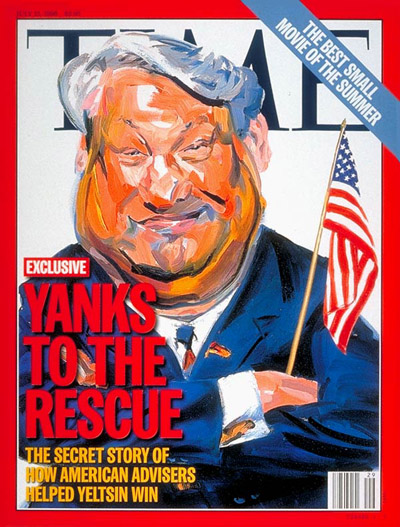
Time: Yanks to the Rescue

Meddling in other countries’ elections is an exciting adventure–when it’s the United States doing the meddling.

It is, of course, worth knowing what involvement any other country might have had in the US election, but elite media’s consumption with the Russia-did-it storyline so far is discouraging to say the least.

The Intercept‘s Sam Biddle (12/14/16) has a breakdown of what public evidence there is that Russia was behind hacks of DNC email accounts. He concludes that while it’s plausible that Russians or even Russia was involved, it’s a very long way from proven, different agencies dispute it, all the sources we’re reading are anonymous and the assessments themselves are secret.

It should go without saying that the repercussions of such an accusation are serious. As Biddle writes:

What we’re looking at now is the distinct possibility that the United States will consider military retaliation (digital or otherwise) against Russia, based on nothing but private sector consultants and secret intelligence agency notes. If you care about the country enough to be angry at the prospect of election-meddling, you should be terrified of the prospect of military tensions with Russia based on hidden evidence.

Apart from the slipperiness between the possible and the proven, the gap between the confidence of the headlines and the caution buried deep inside, it’s weird to see media skip over the story’s center: that the alleged meddling consisted of revealing true information about the Democratic Party and Clinton campaign. As journalist Bob Parry (Consortium News, 11/18/16) notes, a sort of hysteria in official Washington is now clumsily conflating such real—if embarrassing—news with the phenomenon of “fake news,” though reporting has tracked that phenomenon not to the Kremlin but to Millennials in Macedonia, for example, who figured out how to make money with crazy click-bait stories.

But in back of it all, what makes the umbrage of elite media so hard to stomach is the hypocrisy. This is, after all, the same elite media that supports outsider-induced “regime change” anywhere and everywhere they see an official enemy, from Iraq to  Honduras to Libya to Syria—and wait, what’s this? A cover from Time magazine (7/15/96): a chipper Boris Yeltsin holding an American flag, and the line “Yanks to the Rescue! The Secret Story of How American Advisers Helped Yeltsin Win.” You can make “one law for me, another for thee” your credo, but you can’t be too surprised when others are unimpressed.

Whatever story there is to be told about Russia and the 2016 election, corporate media have squandered the credibility it would take to tell it.


Janine Jackson is the program director of FAIR and the producer and host of CounterSpin.

14 Dec 20:58

Julie Holcomb, “Moral Commerce: Quakers and the Transatlantic Boycott of the Slave Labor Economy” (Cornell UP, 2016)

by Franklin Rausch
Tom Roche

excellent and relevant to both contemporary boycotts and to certification efforts (e.g., fair-trade)

The question of how we should act when facing something gravely immoral is a difficult one. This is particularly true when that immorality touches upon our everyday life. Such was the issue that Quakers, and others, faced with the question…
13 Dec 16:21

Historians in parliament

Tom Roche

quite the waste of time

Historian-politicians Tristram Hunt, Chris Skidmore, Kwasi Kwarteng and Peter Hennessy explain how their two professions relate to each other.
12 Dec 02:08

The hygge conspiracy – podcast

This year’s most overhyped trend is a wholesome Danish concept of cosiness, used to sell everything from fluffy socks to vegan shepherd’s pie. But the version we’re buying is a British invention – and the real thing is less cuddly than it seems
12 Dec 01:21

Recommended Gift: German Wars: A Concise History, 1859-1945Nov 12, 2010 by Michael A. Palmer

by The John Batchelor Show
Tom Roche

rerun

Author (Photo:File:German crown Prince Friedrich Wilhelm contemplating the corpse of French general Abel Douay, Franco-Prussian War, 1870.jpg ) http://JohnBatchelorShow.com/contact http://JohnBatchelorShow.com/schedules http://johnbatchelorshow.com/blog Twitter: @BatchelorShow German Wars: A Concise History, 1859-1945Nov 12, 2010 by Michael A. Palmer "The German Wars: A Concise History, 1859-1945 outlines the history of European warfare from the Wars of German Unification to the end of the World War II. The title aside, the book is not be another history of the German military; it takes a much broader approach looking at political, social, economic, and military developments across Europe, and the United States during the period. The “German War” part of the title is there because Germany plays the central part in the story. But the key element threading its way through this volume is the Industrial Revolution." https://www.amazon.com/German-Wars-Concise-History-1859-1945/dp/0760337802/ref=sr_1_1?s=books&ie=UTF8&qid=1481483768&sr=1-1&keywords=german+wars+palmer
05 Dec 21:20

Lena Salaymeh, “Beginnings of Islamic Law: Late Antique Islamicate Legal Traditions” (Cambridge UP, 2016)

by SherAli Tareen
Tom Roche

not much content: alludes to points in book, but does nothing to explicate them

In her brilliant new book Beginnings of Islamic Law: Late Antique Islamicate Legal Traditions (Cambridge University Press, 2016), Lena Salaymeh, Associate Professor of Law at Tel Aviv University, presents a fascinating account of the historical unfolding of Islamic Law…
04 Dec 23:06

The First Frontier: The Forgotten History of Struggle, Savagery, and Endurance in Early America by Scott Weidensaul

by The John Batchelor Show
Tom Roche

excellent material on indigenous North America's demographics and economics pre-contact and early-contact, and how Europeans both fitted-in and transformed.

Author (Photo: File:Reconstructed Huron Wendat long house at Huron Wendat Museum in Wendake Quebec.jpg) http://JohnBatchelorShow.com/contact http://JohnBatchelorShow.com/schedules http://johnbatchelorshow.com/blog Twitter: @BatchelorShow The First Frontier: The Forgotten History of Struggle, Savagery, and Endurance in Early America by Scott Weidensaul "Frontier: the word carries the inevitable scent of the West. But before Custer or Lewis and Clark, before the first Conestoga wagons rumbled across the Plains, it was the East that marked the frontier—the boundary between complex Native cultures and the first colonizing Europeans. Here is the older, wilder, darker history of a time when the land between the Atlantic and the Appalachians was contested ground—when radically different societies adopted and adapted the ways of the other, while struggling for control of what all considered to be their land. The First Frontier traces two and a half centuries of history through poignant, mostly unheralded personal stories—like that of a Harvard-educated Indian caught up in seventeenth-century civil warfare, a mixed-blood interpreter trying to straddle his white and Native heritage, and a Puritan woman wielding a scalping knife whose bloody deeds still resonate uneasily today. It is the first book in years to paint a sweeping picture of the Eastern frontier, combining vivid storytelling with the latest research to bring to life modern America’s tumultuous, uncertain beginnings."
04 Dec 19:09

The shocking murder of Spain’s most flamboyant politician – podcast

The brazen killing of Isabel Carrasco scandalised the nation. But when police began to investigate, they uncovered an even darker story of power, corruption and betrayal.
04 Dec 19:02

President-Elect Trump And U.S. Trade

Tom Roche

Dean Baker is good (though lower-key than his blog), but other 2 guests are completely neoliberal (Peterson Institute guy and a former The Economist)

During the campaign President-elect Donald Trump promised to bring jobs back to the U.S. by changing the rules with our global trading partners: What stronger protectionist policies could mean for American workers and the U.S. economy.
02 Dec 18:18

The Orwell Tapes, Part 1 (Encore April 4, 2016)

by podcasting@cbc.ca
Tom Roche

rerun, but excellent

He was one of the most influential writers of our time. His name was Eric Blair, better known as George Orwell. Who was the man who gave us 'big brother', 'thoughtcrime', 'doublethink', whose name looms so large in this era of mass surveillance?
02 Dec 18:17

Behind the News – December 1, 2016

Tom Roche

1st part: Sean Jacobs from New School on Cuba and South Africa. Starts with Castro obit focusing on the violent southern African liberation struggles, and the crucial role played by the Cuban military in defeating the SA military and forcing negotiations. Segues into overview of SA politics post-apartheid, esp higher education, ending with a critique of identity politics in the SA context (with allusions to the US context. 2nd part: Cinzia Arruzza (also New School) on contemporary Italian politics.

01 Dec 23:09

Trump's Hindu connection

Tom Roche

never heard of the Republican Hindu Coalitiion? http://www.rhcusa.com/ archived @ https://web.archive.org/web/20161005072154/http://rhcusa.com/

Donald Trump's supporters include a radical Hindu coalition with an agenda of their own.
01 Dec 23:07

The richest professors in the world

Tom Roche

The Compass Lexecon scam and the decline of US antitrust law.

Who are the academic economists who have become the richest professors in the world?
30 Nov 23:13

Democracy Now! 2016-11-29 Tuesday

Tom Roche

Bernie for the hour

Democracy Now! 2016-11-29 Tuesday

  • Headlines for November 29, 2016
  • Democracy Now! Special: Bernie Sanders on Trump's Victory & the Need to Rebuild the Democratic Party
  • Bernie Sanders: "I Was Stunned" by Corporate Media Blackout During Democratic Primary
  • Bernie Sanders on the Dakota Access Pipeline & Treaty Rights Violations by U.S. Government
  • Sanders on Trump: We Need to Think Every Day How to Mobilize People to Defeat This Horrific Agenda
  • Bernie Sanders on Green Party's Effort to Force Recounts in Wisconsin, Michigan & Pennsylvania
  • Bernie Sanders on the Life and Legacy of Late Cuban Revolutionary Fidel Castro
  • Will We Be Feeling the Bern in 2020?: Sanders on Whether He'd Ever Run for President Again

Download this show

30 Nov 02:20

How the education gap is tearing politics apart – podcast

In the year of Trump and Brexit, education has become the greatest divide of all – splitting voters into two increasingly hostile camps. But don’t assume this is simply a clash between the ignorant and the enlightened
29 Nov 21:27

US Election 2016: The Result

Tom Roche

An astonishing collection of stupidities from the right wing of the British establishment media. Even the lone academic is a bit ludicrous, at least on Russia, where the group is rather hysterical, excepting Melanie McDonagh.

It may be a post-pollster, post-pundit, post-truth landscape – but can we predict where the world goes from here? An extraordinary US presidential election campaign has resulted in an outcome that few could have predicted at its outset: Donald J Trump will become the 45th US President of the United States. The implications of this historic decision are, for now, highly unpredictable, and for many, deeply concerning, with many questions unresolved around the course of future US policy on the economy, security, environmental protection, and human rights. Our panel of experts consider what a Trump presidency says about, and means for America and the world in the days, months and years to come. Panel: Melanie McDonagh, Leader writer, Evening Standard and contributor, The Spectator; John Prideaux, US editor, The Economist; Professor Malcolm Chalmers, Deputy Director-General of RUSI; Stephen Bush, Special correspondent, New Statesman; James O'Brien, Presenter, LBC & BBC Newsnight
29 Nov 01:57

Hundred Days: The Campaign That Ended World War I by Nick Lloyd. PART 2 of 2.

by The John Batchelor Show
Tom Roche

rerun

Author (Photo:American bodies from the fighting on 29 September, 1918, near Gillemont Farm, when men from the 27th American Division attacked over the main Hindenburg Line. ) http://JohnBatchelorShow.com/contact http://JohnBatchelorShow.com/schedules http://johnbatchelorshow.com/blog Twitter: @BatchelorShow Hundred Days: The Campaign That Ended World War I by Nick Lloyd. PART 2 of 2. “A readable, instructive, and compelling narrative of Allied successes and German failures…Hundred Days succeeds in its ambition of covering all the major combatants on the Western Front in the final campaign of World War I. Lloyd adroitly combines sweeping historical scope with the perspectives of the men who did the fighting on the ground. All this in a history that taps the latest relevant scholarship without sidetracking the narrative.” —Michigan War Studies Review “His accounts of each battle are both lively and clear...the real strength of Lloyd’s work is his treatment of the experience of the war from an individual perspective. He paints vivid portraits of the character and motivations of the various commanders and draws on a variety of first hand accounts from men at all levels on both sides of the front” —History in the Margins “Lloyd… enters the upper tier of Great War historians with this admirable account of the war’s final campaign.... Lloyd’s unfailing eye for telling anecdotes vitalize his narrative…. The text brims with archival research.” —Publishers Weekly “A fine account of the Allies’ dramatic but ultimately unsatisfying victory in World War I.” —Kirkus Reviews “Lloyd effectively proves his thesis that Allied military might and leadership, with four hard years of strategic and tactical lessons learned, were what brought the war to a close. While most of the new books commemorating the 100th anniversary of the beginning of the war will focus on its causes and origin, Lloyd’s analysis of the final campaigns brings a new perspective to the terrible conflict.” —Library Journal “This culmination of four years of bloodshed has been largely forgotten.... [Lloyd] gives the reader an insight into the raw emotions of the period.” —The Oxford Times “This is a powerful and moving book by a rising military historian. Lloyd’s depiction of the great battles of July-November provides compelling evidence of the scale of the Allies’ victories and the bitter reality of German defeat.” —Gary Sheffield, Professor of War Studies, University of Wolverhampton https://www.amazon.com/Hundred-Days-Campaign-Ended-World/dp/0465074928/ref=la_B0034NRE4K_1_1?s=books&ie=UTF8&qid=1480224061&sr=1-1
29 Nov 01:57

West of the Revolution: An Uncommon History of 1776 by Claudio Saunt

by The John Batchelor Show
Tom Roche

excellent, but a rerun

Author (Photo: People on horseback & bighorn sheep & other animals - Ute Indian-carved petroglyphs (~1650 to 1850 A.D.) on desert varnish-covered sandstone cliff face in Utah. Locality: Wolfe Ranch, Delicate Arch Trail, Arches National Park, eastern Utah, USA Date 6 November 2015, 00:55) http://JohnBatchelorShow.com/contact http://JohnBatchelorShow.com/schedules http://johnbatchelorshow.com/blog Twitter: @BatchelorShow West of the Revolution: An Uncommon History of 1776 by Claudio Saunt "This panoramic account of 1776 chronicles the other revolutions unfolding that year across North America, far beyond the British colonies. In 1776, Thomas Paine published Common Sense, the Continental Congress declared independence, and Washington crossed the Delaware. We are familiar with these famous moments in American history, but we know little about the extraordinary events occurring that same year far beyond the British colonies. In this distinctive history, Claudio Saunt tells an intriguing, largely untold story of an immense and restless continent connected in surprising ways. In that pivotal year, the Spanish established the first European colony in San Francisco and set off a cataclysm for the region’s native residents. The Russians pushed into Alaska in search of valuable sea otters, devastating local Aleut communities. And the British extended their fur trade from Hudson Bay deep into the continent, sparking an environmental revolution that transformed America’s boreal forests. While imperial officials in distant Europe maneuvered to control lands they knew almost nothing about, America's indigenous peoples sought their own advantage. Creek Indians navigated the Caribbean to explore trade with Cuba. The Osages expanded their dominion west of the Mississippi River, overwhelming the small Spanish outposts in the area. And the Sioux advanced across the Dakotas. One traditional Sioux history states that they first seized the Black Hills, the territory they now consider their sacred homeland, in 1776. "Two nations were born that year," Saunt writes. The native one would win its final military victory at the Battle of Little Bighorn one hundred years later. From the Aleutian Islands to the Gulf Coast and across the oceans to Europe’s imperial capitals, Saunt’s masterfully researched narrative reveals an interconnected web of history that spans not just the forgotten parts of North America but the entire globe. Richly illustrated, with maps that reenvision a familiar landscape, West of the Revolution explores a turbulent continent in a year of many revolutions. 22 illlustrations, 15 maps" https://www.amazon.com/West-Revolution-Uncommon-History-1776/dp/0393240207/ref=mt_hardcover?_encoding=UTF8&me=
29 Nov 01:56

Democracy Now! 2016-11-28 Monday

Tom Roche

Fidel Castro obit for the hour (after the headlines) with Bill Fletcher, Peter Kornbluh, Louis Pérez

Democracy Now! 2016-11-28 Monday

  • Headlines for November 28, 2016
  • After Surviving 600 Assassination Attempts & Outlasting 11 U.S. Presidents, Fidel Castro Dies at 90
  • The Untold Story of Cuba's Support for African Independence Movements Under Fidel Castro
  • How Fidel Castro Showed Latin America There was a Way to Resist U.S. Imperialism
  • Will Trump Roll Back Efforts to Normalize Relations Between Havana & Washington?

Download this show

28 Nov 03:32

.67 Sparks: Risk: 10/28/16

Tom Roche

once again, the Sparks group plays at philosophy without a license or competence :-(

Our monthly science series looks at why humans make, or don't make, risky choices. Part 2 of this conversation - and interview with author Kayt Sukel - airs next week.
28 Nov 03:31

Behind the News – November 17, 2016

Tom Roche

Jodi Dean for the hour on the case for conventional organization on the Left, as made in her book "Crowds and Parties."