Shared posts

13 Mar 02:54

2000 years of typecasting: 2 OF 4: A Most Dangerous Book:Tacitus's Germania from the Roman Empire to the Third Reich by Christopher B. Krebs

by The John Batchelor Show
Tom Roche

rerun

AUTHOR.

(Photo: Publius (or Gaius) Cornelius Tacitus (/ˈtæsɪtəs/; Classical Latin: [ˈtakɪtʊs]; c. 56 – c. 120 AD) was a senator and a historian of the Roman Empire. The surviving portions of his two major works—the Annals and the Histories—examine the reigns of the Roman emperors Tiberius, Claudius, Nero, and those who reigned in the Year of the Four Emperors (69 AD). These two works span the history of the Roman Empire from the death of Augustus, in 14 AD, to the years of the First Jewish–Roman War, in 70 AD. There are substantial lacunae in the surviving texts, including a gap in the Annals that is four books long.

Tacitus' other writings discuss oratory (in dialogue format, see Dialogus de oratoribus), Germania (in De origine et situ Germanorum), and the life of his father-in-law, Agricola, the Roman general responsible for much of the Roman conquest of Britain, mainly focusing on his campaign in Britannia (De vita et moribus Iulii Agricolae).

Tacitus is considered to be one of the greatest Roman historians.[1][2] He lived in what has been called the Silver Age of Latin literature, and is known for the brevity and compactness of his Latin prose, as well as for his penetrating insights into the psychology of power politics.)

http://JohnBatchelorShow.com/contact

http://JohnBatchelorShow.com/schedules

Twitter: @BatchelorShow

2000 years of typecasting: 2 OF 4: A Most Dangerous Book:Tacitus's Germania from the Roman Empire to the Third Reich by Christopher B. Krebs

From Publishers Weekly

Harvard classics professor Krebs writes a scholarly but lucid account of the abuse of history. Written in 98 C.E. by the Roman official Tacitus, About the Origin and Mores of the Germanic Peoples was lost for centuries but resurfaced around 1500 as Germans were growing resentful of foreign domination—in this case from the Catholic Church in Rome. The rediscovered book launched a primitivist myth that captivated admirers over the next 500 years, from Martin Luther to Heinrich Himmler, who loved its portrayal of ancient Germans as freedom-loving warriors, uncultured but honorable, in contrast to decadent Romans. In fact, Tacitus probably never visited Germany, Krebs notes. Rather, using books and travelers' reports, he wrote for a Roman audience who shared his romantic view of northern barbarians. Enthusiastic German readers, culminating in the Nazis, ignored Tacitus's disparaging comments, misread passages to confirm their prejudices, and proclaimed that the ancient historian confirmed their national superiority. This is an inventive analysis of, and warning against, an irresistible human yearning to find written proof of one's ideology. Illus. (May) 

(c) Copyright PWxyz, LLC. All rights reserved.

Review

“A fascinating story of how a book could be used and―especially―abused over two thousand years, as enemies saw it as presenting Germans as brutish and barbarian, while German nationalistic pride extracted a quite different message of a nation that was simple, virtuous, and pure.... beautifully told by Christopher Krebs.”

  • Christopher Pelling, editor of Greek Tragedy and the Historian

“A most exciting book! In Krebs’ hands, the story of the Germania manuscript becomes part thriller, part detective story.... A must-read for anyone interested in the pernicious power of the ideas of antiquity―and a timely reminder of the responsibilities placed on readers as well as writers.”

  • Tim Rood, University of Oxford, author of American Anabasis

About the Author

Christopher B. Krebs, a classics professor at Stanford University, has published widely on the Roman historians and their afterlives.

13 Mar 02:54

2000 years of typecasting: 1 OF 4: A Most Dangerous Book:Tacitus's Germania from the Roman Empire to the Third Reich by Christopher B. Krebs

by The John Batchelor Show
Tom Roche

rerun

AUTHOR.

(Photo: Map of the Roman Empire and Germania Magna in the early 2nd century, with the location of some tribes described by Tacitus as Germanic)

http://JohnBatchelorShow.com/contact

http://JohnBatchelorShow.com/schedules

Twitter: @BatchelorShow

2000 years of typecasting: PART 1 OF 4: A Most Dangerous Book:Tacitus's Germania from the Roman Empire to the Third Reich by Christopher B. Krebs

From Publishers Weekly

Harvard classics professor Krebs writes a scholarly but lucid account of the abuse of history. Written in 98 C.E. by the Roman official Tacitus, About the Origin and Mores of the Germanic Peoples was lost for centuries but resurfaced around 1500 as Germans were growing resentful of foreign domination—in this case from the Catholic Church in Rome. The rediscovered book launched a primitivist myth that captivated admirers over the next 500 years, from Martin Luther to Heinrich Himmler, who loved its portrayal of ancient Germans as freedom-loving warriors, uncultured but honorable, in contrast to decadent Romans. In fact, Tacitus probably never visited Germany, Krebs notes. Rather, using books and travelers' reports, he wrote for a Roman audience who shared his romantic view of northern barbarians. Enthusiastic German readers, culminating in the Nazis, ignored Tacitus's disparaging comments, misread passages to confirm their prejudices, and proclaimed that the ancient historian confirmed their national superiority. This is an inventive analysis of, and warning against, an irresistible human yearning to find written proof of one's ideology. Illus. (May) 

(c) Copyright PWxyz, LLC. All rights reserved.

Review

“A fascinating story of how a book could be used and―especially―abused over two thousand years, as enemies saw it as presenting Germans as brutish and barbarian, while German nationalistic pride extracted a quite different message of a nation that was simple, virtuous, and pure.... beautifully told by Christopher Krebs.”

  • Christopher Pelling, editor of Greek Tragedy and the Historian

“A most exciting book! In Krebs’ hands, the story of the Germania manuscript becomes part thriller, part detective story.... A must-read for anyone interested in the pernicious power of the ideas of antiquity―and a timely reminder of the responsibilities placed on readers as well as writers.”

  • Tim Rood, University of Oxford, author of American Anabasis

About the Author

Christopher B. Krebs, a classics professor at Stanford University, has published widely on the Roman historians and their afterlives.

12 Mar 04:05

War on coal: Reckoning at Eagle Creek: The Secret Legacy of Coal in the Heartland by Jeff Biggers

by The John Batchelor Show
Tom Roche

rerun

AUTHOR.

(Photo: Coal Region, Pennsylvania)

http://JohnBatchelorShow.com/contact

http://JohnBatchelorShow.com/schedules

Twitter: @BatchelorShow

War on coal: Reckoning at Eagle Creek: The Secret Legacy of Coal in the Heartland by Jeff Biggers

Set in the ruins of his family’s strip-mined homestead in the Shawnee National Forest in southern Illinois, award-winning journalist and historian Jeff Biggers delivers a deeply personal portrait of the overlooked human and environmental costs of our nation’s dirty energy policy. Beginning with the policies of Thomas Jefferson and Andrew Jackson, chronicling the removal of Native Americans and the hidden story of legally sanctioned black slavery in the land of Lincoln, Reckoning at Eagle Creek vividly describes the mining wars for union recognition and workplace safety, and the devastating consequences of industrial strip-mining. At the heart of our national debate over climate change and the crucial transition toward clean energy, Biggers exposes the fallacy of “clean coal” and shatters the marketing myth that southern Illinois represents the “Saudi Arabia of coal.” 

Reckoning at Eagle Creek is ultimately an exposé of “historicide,” one that traces coal’s harrowing legacy through the great American family saga of sacrifice and resiliency and the extraordinary process of recovering our nation’s memory.

12 Mar 04:04

Disinformation operation, 1917: The Zimmermann Telegram: PART 2 of 2: Intelligence, Diplomacy, and America’s Entry into World War I by Thomas Boghardt

by The John Batchelor Show
Tom Roche

rerun

AUTHOR.

(Photo: Wilson asks Congress for Declaration of War on April 2, 1917)

http://JohnBatchelorShow.com/contact

http://JohnBatchelorShow.com/schedules

Twitter: @BatchelorShow

Disinformation operation, 1917: The Zimmermann Telegram: PART 2 of 2: Intelligence, Diplomacy, and America’s Entry into World War I by Thomas Boghardt

By the winter of 1916/17, World War I had reached a deadlock. While the Allies commanded greater resources and fielded more soldiers than the Central Powers, German armies had penetrated deep into Russia and France, and tenaciously held on to their conquered empire. Hoping to break the stalemate on the western front, the exhausted Allies sought to bring the neutral United States into the conflict. 

A golden opportunity to force American intervention seemed at hand when British naval intelligence intercepted a secret telegram detailing a German alliance offer to Mexico. In it, Berlin's foreign secretary, Arthur Zimmermann, offered his country's support to Mexico for re-conquering "the lost territory in Texas, New Mexico, and Arizona" in exchange for a Mexican attack on the United States, should the latter enter the war on the side of the Allies. The British handed a copy of the Telegram to the American government, which in turn leaked it to the press. On March 1, 1917, the Telegram made headline news across the United States, and five weeks later, America entered World War I.

Based on an examination of virtually all available German, British, and U.S. government records, this book presents the definitive account of the Telegram and questions many traditional views on the origins, cryptanalysis, and impact of the German alliance scheme. While the Telegram has often been described as the final step in a carefully planned German strategy to gain a foothold in the western hemisphere, this book argues that the scheme was a spontaneous initiative by a minor German foreign office official, which gained traction only because of a lack of supervision and coordination at the top echelon of the German government. On the other hand, the book argues, American and British secret services had collaborated closely since 1915 to bring the United States into the war, and the Telegram's interception and disclosure represented the crowning achievement of this clandestine Anglo-American intelligence alliance. Moreover, the book explicitly challenges the widely accepted notion that the Telegram's publication in the U.S. press rallied Americans for war. Instead, it contends that the Telegram divided the public by poisoning the debate over intervention, and by failing to offer peace-minded Americans a convincing rationale for supporting the war. The book also examines the Telegram's effect on the memory of World War I through the twentieth century and beyond.

12 Mar 04:04

Disinformation operation, 1917: The Zimmermann Telegram: PART 1 of 2: Intelligence, Diplomacy, and America’s Entry into World War I by Thomas Boghardt

by The John Batchelor Show
Tom Roche

rerun

AUTHOR.

(Photo:1917 political cartoon about the Zimmermann Telegram )

http://JohnBatchelorShow.com/contact

http://JohnBatchelorShow.com/schedules

Twitter: @BatchelorShow

Disinformation operation, 1917: The Zimmermann Telegram:  PART 1 of 2: Intelligence, Diplomacy, and America’s Entry into World War I by Thomas Boghardt

By the winter of 1916/17, World War I had reached a deadlock. While the Allies commanded greater resources and fielded more soldiers than the Central Powers, German armies had penetrated deep into Russia and France, and tenaciously held on to their conquered empire. Hoping to break the stalemate on the western front, the exhausted Allies sought to bring the neutral United States into the conflict. 

A golden opportunity to force American intervention seemed at hand when British naval intelligence intercepted a secret telegram detailing a German alliance offer to Mexico. In it, Berlin's foreign secretary, Arthur Zimmermann, offered his country's support to Mexico for re-conquering "the lost territory in Texas, New Mexico, and Arizona" in exchange for a Mexican attack on the United States, should the latter enter the war on the side of the Allies. The British handed a copy of the Telegram to the American government, which in turn leaked it to the press. On March 1, 1917, the Telegram made headline news across the United States, and five weeks later, America entered World War I.

Based on an examination of virtually all available German, British, and U.S. government records, this book presents the definitive account of the Telegram and questions many traditional views on the origins, cryptanalysis, and impact of the German alliance scheme. While the Telegram has often been described as the final step in a carefully planned German strategy to gain a foothold in the western hemisphere, this book argues that the scheme was a spontaneous initiative by a minor German foreign office official, which gained traction only because of a lack of supervision and coordination at the top echelon of the German government. On the other hand, the book argues, American and British secret services had collaborated closely since 1915 to bring the United States into the war, and the Telegram's interception and disclosure represented the crowning achievement of this clandestine Anglo-American intelligence alliance. Moreover, the book explicitly challenges the widely accepted notion that the Telegram's publication in the U.S. press rallied Americans for war. Instead, it contends that the Telegram divided the public by poisoning the debate over intervention, and by failing to offer peace-minded Americans a convincing rationale for supporting the war. The book also examines the Telegram's effect on the memory of World War I through the twentieth century and beyond.

12 Mar 02:20

Down on the Farm: More Hysteria About Steel Tariffs

by dean.baker1@verizon.net (Dean Baker)

The selective free traders (people who support protectionism that benefits high-income people, but oppose it when it can help ordinary workers) are pulling out all the stops in going after Trump's steel tariffs. Today, the NYT takes the show to rural America where it tells us how much agriculture can be hurt by a trade war.

We meet various farmers worried about the threat of a trade war and get a few random facts thrown in:

"Three out of every five rows of soybeans planted in the United States find their way out of the country; half of those, valued at $14 billion in 2016, go to China alone."

"Two weeks after the administration imposed a tariff on solar panels, China opened an anti-dumping investigation into American exports of sorghum, a grain used in livestock feed. The United States was virtually China’s sole foreign source of sorghum last year, with $1 billion in sales."

There are a few points worth making here. First, if our trading partners do impose barriers to US exports of agricultural goods, then we would see the price of these products fall somewhat in the domestic market. That is bad news for these farmers, but good news for the rest of us who will have lower priced food. The NYT apparently only thinks of consumers when it comes to tariffs raising prices.

The second point is that while the loss of a large market can have a substantial impact on the price of a relatively small volume crop like sorghum since it is a relatively small volume crop the number of farmers affected will be relatively few. Furthermore, most will be able to switch to crops that offer a better return.

Read More ...

12 Mar 02:13

The Almighty Dollar [Audio]

Tom Roche

don't waste your time. David is a TV presenter and this presentation shows why: totally lightweight and conventional.

Speaker(s): Dharshini David | The dollar is the lifeblood of globalisation: China holds billions in reserve for good reason. Greenbacks, singles, bucks or dead presidents, call them what you will, $1.2 trillion worth are floating around right now – and half the dollars in circulation are actually outside of the USA. But what is really happening as these billions of dollars go around the world every day? By following $1 from a shopping trip in suburban Texas, via China’s Central Bank, Nigerian railroads, the oil fields of Iraq and beyond, The Almighty Dollar answers questions such as: why is China the world’s biggest manufacturer – and the US its biggest customer? Is free trade really a good thing? Why would a nation build a bridge on the other side of the globe? Dharshini David (@DharshiniDavid) is an economist and broadcaster. From 2009 she fronted Sky News’ daily financial coverage and copresented Sky News Tonight. Keyu Jin (@KeyuJin) is an Associate Professor in the Department of Economics and a member of the Centre for Macroeconomics and Centre for Economic Performance. The Department of Economics at LSE (@LSEEcon) is one of the largest economics departments in the world. Its size ensures that all areas of economics are strongly represented in both research and teaching. The Centre For Macroeconomics (@CFMUK) brings together world-class experts to carry out pioneering research on the global economic crisis and to help design policies that alleviate it.
12 Mar 02:11

Dan Healey, “Russian Homophobia from Stalin to Sochi” (Bloomsbury, 2017)

by Joy Neumeyer
Tom Roche

very excellent

In 2013, when the Russian State Duma passed a law banning the propaganda of non-traditional sexual relationships to minors, some rushed to boycott Russian vodka. In Russian Homophobia from Stalin to Sochi (Bloomsbury, 2017), Dan Healey provides historical context for…
11 Mar 18:05

Sumana Harihareswara - Cogito, Ergo Sumana: Recent Debugging And Confidence

Tom Roche

need a Recurse Center for scientific programming: see, e.g., https://www.recurse.com/about https://www.recurse.com/not-a-bootcamp

I am proud of myself for some recent debugging I've done on and with codebases and tools that I hadn't worked on before.

A few weeks ago, I was sitting next to a friend who co-maintains a web app and hadn't looked at it for a while. The styling was screwy. I asked whether some CSS or JS he depended on had upgraded, like jQuery or something. He said no, his site hosted all its dependencies. I opened up the site and checked the Network tab in Firefox Developer Tools and saw that it pulled in Bootstrap from a CDN. Ah, one of the other maintainers had added that! And updates to Bootstrap had screwed up the page's styling.

That same day, as a freshly minted co-maintainer of twine (a utility to upload packages to PyPI), I investigated a problem with our CHANGELOG. Twine's changelog, as represented on Read The Docs

(example) and when I built the docs locally, only displayed version number 1.4.0 (2014-12-12) and two associated GitHub issues. This was inaccurate since the source file changelog.rst had 70+ items and ran up to version 1.9.1 (2017-05-27). I figured out that this was happening because changelog.rst is meant to be formatted so the Sphinx extension releases (which I hadn't used before) can parse it, and the current file wasn't syntactically (or semantically) adhering to releases's conventions. (Since then, with advice and help from some folks, I've released Twine 1.10.0 and started a new maintainer checklist.)

And then, a couple days later, I fixed my friends' blog. Their front page had reverted to a ten-year-old index page. I had never touched Movable Type before and hadn't used their particular managed hosting web GUI before, but I poked around (and checked for backups before changing anything) and managed to figure it out: during a May 2008 outage, someone had hand-made an index.shtml page, which was now overriding the index.html page in the server config. I figured it out and found and fixed it.

My mom says that when I was a kid, I took apart alarm clocks and spare hose attachments and so on, and put them back together just fine. She once came upon me taking something apart, and when she drew breath to admonish me, I said, "Amma, if I don't take it apart, how do I know what is inside? Don't worry, amma, I'm just looking at it, I'll put it back together when I'm done," and I did. She told me that I took apart a mechanical alarm clock, carefully spreading all the parts out on some newspaper, and put it back together, and it didn't quite work properly, so I took it apart again and then put it back together, and it worked, and I jumped for joy and said "I fixed it!" (I still feel that way when I fix something.)

At some point along the way I feel like I lost that calm confidence in my abilities, that "things are made of stuff" and what one person made another can fix. But I have it again, now, at least for some bits of software, and some purely mechanical stuff (yesterday, helping friends move, deciding to break down a big empty cardboard box, responding to "but it's so big, it won't fit on the stack" with "we have knives"). It doesn't feel courageous at the time, just sensible, but then I look back and feel like a badass.

If I had to point to the single biggest cause of this regained confidence, I'd point to the Recurse Center, where I got way more comfortable with bravery and failure in programming.

11 Mar 04:08

It's time you took brunch more seriously!

Tom Roche

Nour Hadidi is excellent as usual

From Accent on Toronto 16, The Doo Wops take you on a tour of Carnival life and Nour Hadidi has a message for all the friends and future friends in her life; never, ever mess with this woman's brunch plans.
08 Mar 05:07

Cornel West | Race Matters: 25th Anniversary

Tom Roche

Cornel West is always a great listen, even when he's just rapping and rambling ...

Watch the video here. Lauded for his ''ferocious moral vision and astute intellect'' (New York Times), educator and philosopher Dr. Cornel West is the author of the National Book Award-winning Race Matters, a sea change discourse on race, justice, and democracy in America. His other books include the bestselling Democracy Matters, Hope on a Tightrope, and Black Prophetic Fire. A former teacher at Union Theological Seminary, Yale, Harvard, and Princeton, he has collaborated on three spoken-word albums with Prince, Andre 300, Jill Scott, and a litany of other artists. More relevant than ever, the new edition of West's classic book of essays seeks methods to create a genuinely inclusive 21st-century democracy. Horace W. Goldsmith Foundation Endowed Lecture (recorded 2/10/2018)
08 Mar 05:02

The Infamous Trump-Russia Dossier

Tom Roche

the usually-excellent Jane Mayer faceplants majorly in this hagiography of crusading saint Christopher Steele

'New Yorker' staff writer Jane Mayer tells the story of ex-spy Christopher Steele, the man behind the unverified dossier detailing Trump's ties with Russia. We'll talk about how the dossier was compiled, and why so little was done about its findings during the campaign — even after Steele told the FBI. Steele also wrote a memo after the election about the possibility that Russians blocked Trump's first choice for Secretary of State, Mitt Romney.
08 Mar 02:20

For NYT, a Trillion Dollars’ Worth of A-Bombs Is ‘Little’ Response to Russia

by Adam Johnson
Tom Roche

Adam Johnson is a genius. "New York Times/CSIS itch-and-scratch combination" illustrates precisely how corporate media and PR/thinktanks work together to further corporate interests.

NYT: Russian Threat on Two Fronts Meets Strategic Void in US

“Russia has ramped up its arsenals,” and “US has done little in response”—except ramp up its own arsenal by more than the size of the entire Russian arsenal (New York Times, (3/5/18).

For the New York Times, the US is always lagging behind the Russian menace. Previously, the Times has told us how America was losing the “scramble for the Arctic” (8/30/15) and falling behind in election-meddling (3/4/18). Now it’s in the realms of cyber and nuclear war that the Times sees dangerous gaps.

In “A Russian Threat on Two Fronts Meets an American Strategic Void” (3/5/18), reporters David Sanger and William Broad passed along the worries of Washington—as expressed by a few military higher-ups, some guy from the arms industry mouthpiece known as the Center for Strategic and International Studies, and a disembodied “The United States”—that Trump didn’t have a coherent strategy for dealing with cyber and nuclear threats from Russia. The front-page subhead warned, “Russia has ramped up its arsenal, US has done little in response.”

So what does a “little” response look like? Since taking office, the Trump administration and Congress—citing the Russian challenge as one of their major rationales—have increased the military budget by about $80 billion, or roughly 13 percent, the largest increase since the aftermath of 9/11, and 70 percent greater than the entire Russian military budget of $47 billion. (Note that in the late 1970s and early ’80s, the Soviet military budget was bigger in real terms than that of the United States—and yet the USSR still managed to lose the Cold War.)

Additionally, Trump has reportedly asked for a “black budget” of over $80 billion for covert operations ($30 billion more than previous reports), and pledged more than $1.2 trillion to building up the United States’ nuclear arsenal over the next 30 years, $200 billion more than Obama asked Congress for when he announced the plan two years ago.

And Trump has, again, asked to increase the military budget by even more—to $716 billion—for 2019. All this, of course, is omitted from Sanger and Broad’s piece, which largely paints the United States as bumbling around without any idea how to combat the always-one-step-ahead-of-us Russians.

While the framing paints an image of the US doing nothing at all, the article’s text is a little less daft, focusing primarily on a “strategic void,” or what some “experts” believe is a lack of “strategy.” Although there’s no indication the US military has ceased to carry out strategic objectives laid out before Trump took office, one can grant this vague premise (it’s difficult to know what degree of “strategic” PowerPoint presentations would satisfy Sanger and Broad), but omitting the unprecedented amounts of money and resources Trump has spent on the military under the guise of combating Russia—to say nothing of his sending “lethal aid” to Ukraine (something Obama long declined to do)—is a massive omission.

As usual, the United States, when it’s not being painted as bumbling, is presented as simply responding to threats in a defensive manner:

And in the nuclear sphere, the Trump administration has yet to offer a strategy to contain or deter Russia beyond simply matching the weapons buildup.

Here again, the US only responds to threats, it never instigates them; the US is only “matching [Russia’s] weapons buildup,” not inciting one. The fact that the US’s most recent nuclear “revamp” began in earnest in 2014—long before Trump announced his campaign, much less moved into the White House—is not mentioned.

Uncle Sam (image: James Montgomery Flagg)

“I want YOU to refer to me in your story as ‘the United States,’ because I am not authorized to speak as the personification of the nation.”

Later on, apparently unable to find a specific party or person to quote, Sanger and Board paraphrase the general impression of the entire US government (emphasis added):

By comparison, the United States is still uncertain how to make use of its cyberweapons after spending billions of dollars to build an arsenal. It is concerned that the Russians—along with the Chinese, the Iranians and the North Koreans—could easily retaliate against any attack, striking American banks, utilities, stock markets and communications networks.

Somehow the whole of the US government is “uncertain” how to make use of all their fancy new toys, and is “concerned” that Russia and other Bad Guys could harm us. Who, exactly, feels this way? The Times doesn’t narrow it down beyond “the United States.”

The effect of the article—by intent or accident—is to justify even more military spending, as Trump and Congress plan yet another massive military increase for 2019. And this is where the rub comes, around paragraph 16:

“We must no longer think in terms of building just ‘limited’ missile defense capabilities,” concluded a report that was issued last year by the Center for Strategic and International Studies, a Washington think tank.

“The United States should begin the journey to develop a next-generation missile defense.” It called for pursuing a “space-based kill layer” that would try to shoot down swarms of enemy warheads and missiles—a step that would go beyond the Reagan administration’s “Star Wars” research on space arms, and no doubt prompt new rounds of reaction from Mr. Putin and the Russian military.

Here the Times quotes CSIS doing what CSIS was set up and specifically funded to do: push for the US to buy ever-more elaborate and exotic weapons systems from the arms makers who bankroll the think tank (FAIR.org, 8/12/16). Sanger and Broad have an itch, and CSIS has come along to scratch it: There’s a “void” in response to the Russian threat and, oh, here’s this “strategy,” by a Very Official group with “Strategic” right in its name, and it’s calling for an obscene amount of spending on new missile systems that blow things up from space.

NYT: How Think Tanks Amplicy Corporate America's Influence

CSIS was Exhibit A in the New York Times‘ expose  (8/8/16) of how think tanks serve as undisclosed corporate lobbyists.

Who would possibly build such a system? By sheer coincidence, five of CSIS’s top 10 corporate funders—Lockheed Martin, Leonardo Finmeccanica, Boeing, General Dynamics and Northrop Grumman—are positioned to do just that. As the New York Times  (8/8/16) itself reported in August 2016, after it obtained a cache of private emails from the organization, CSIS is little more than a lobbying arms of the weapons industry:

As a think tank, the Center for Strategic and International Studies did not file a lobbying report, but the goals of the effort were clear.

“Political obstacles to export,” read the agenda of one closed-door “working group” meeting organized by Mr. Brannen that included Tom Rice, a lobbyist in General Atomics’ Washington office, on the invitation lists, the emails show.

Boeing and Lockheed Martin, drone-makers that were major CSIS contributors, were also invited to attend the sessions, the emails show. The meetings and research culminated with a report released in February 2014 that reflected the industry’s priorities.

“I came out strongly in support of export,” Mr. Brannen, the lead author of the study, wrote in an email to Kenneth B. Handelman, the deputy assistant secretary of state for defense trade controls.

But the effort did not stop there.

Mr. Brannen initiated meetings with Defense Department officials and congressional staff to push for the recommendations, which also included setting up a new Pentagon office to give more focus to acquisition and deployment of drones. The center also stressed the need to ease export limits at a conference it hosted at its headquarters featuring top officials from the Navy, the Air Force and the Marine Corps.

As FAIR (5/8/17) noted last summer, when documenting CSIS’s love for the Lockheed-built THAAD missile system in South Korea, 30 out of 30 times when they weighed in on the wisdom of a weapons system, it was in support—an entirely predictable trend for a group largely supported by those who make such systems. When asked by FAIR via email if CSIS had ever publicly opposed a new weapons purchase or deployment, CSIS did not respond.

The stakes for these marketing efforts are hardly trivial. The Aerospace & Defense index “is already up nearly 6 percent year to date,” Barron’s (2/26/18) noted last month, “compared to a 2.8 percent gain for the S&P 500, while Boeing, Lockheed and Raytheon all sport double-digit gains in 2018.” Since Trump’s inauguration in January 2017, the US’s second-largest defense contractor and CSIS’s second-biggest arms-industry donor, Boeing, has seen its stock more than double, from $159 to $345 a share.
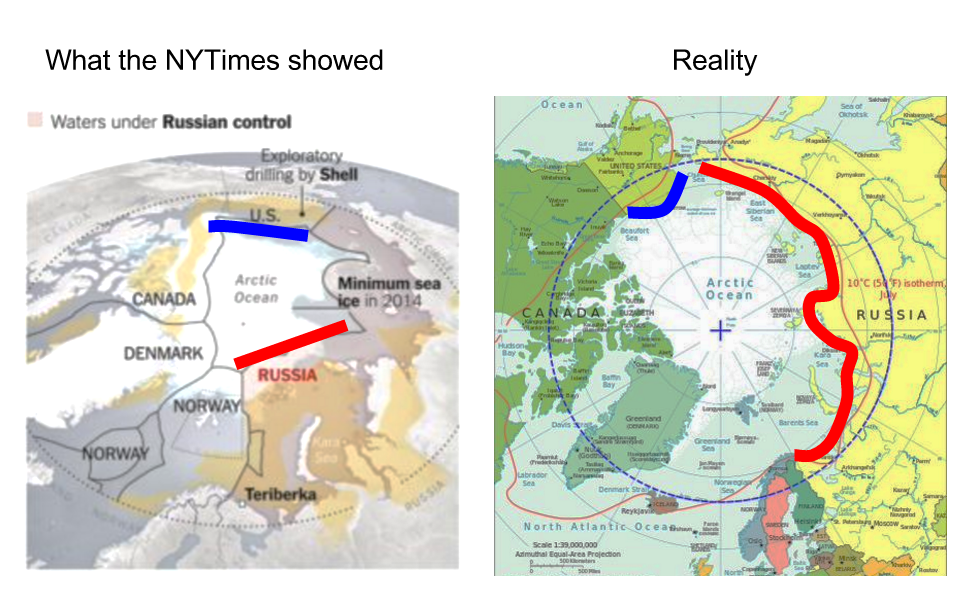
Arctic Maps

The New York Times (8/20/15) made Russia’s presence in the Arctic seem sinister by pretending that it doesn’t have far more Arctic coastline than the US.

The same New York Times/CSIS itch-and-scratch combination, as FAIR (Extra!, 10/16) reported at the time, was used when the Times insisted the US was “lagging behind” Russia in the Arctic, citing another CSIS report. And guess how that one turned out? As we noted the following fall:

In May [2017] the torrent of media articles hyping the “Arctic gap” asserted by CSIS and the US military paid dividends, with Congress allocating an additional $1 billion to the Navy’s budget to pay for icebreaker ships.

While the contracts are not awarded yet, Lockheed Martin—one of CSIS’s top donors—is said by market analysts the Motley Fool (7/24/16) to be an “obvious choice” to build the new fleet. Their runner up to build the new icebreakers? Huntington Ingalls Industries, who also donated generously to CSIS.

We’re seeing this play out once again. CSIS releases a report saying the Russians are getting the better of us, major outlets like the New York Times uncritically spread this message, their reporting is used as further evidence we need more military spending, that military spending is lavished on CSIS’s clients (d/b/a “donors”). Meanwhile, CSIS is treated as a neutral, objective “Washington think tank,” and its well-documented (by the Times itself!) conflicts of interest in pushing its funders’ weapons systems go unmentioned.

At the very least, one would hope that if the Times is going to handwring about how the largest military in the history of the world is leaving a “void” of influence, perhaps they can consult a group that isn’t paid millions of dollars to fill that void when discussing how best to do so.


You can send a message to the New York Times at letters@nytimes.com (Twitter: @NYTimes). Please remember that respectful communication is the most effective.
07 Mar 02:29

A Conversation about Archaeology in the Arctic

Tom Roche

no download link in soundcloud?

Picture
For the third episode of the Climate History Podcast, Dr. Dagomar Degroot interviews two leading archaeologists of the medieval and early modern Arctic: Dr. Thomas McGovern of the City University of New York, and Dr. George Hambrecht of the University of Maryland College Park. Since 1972, Professor McGovern has travelled the world for archaeological fieldwork. He has spent much of his time in the far north, especially in Greenland, Iceland, the Faeroes, and Shetland. He is one of the founders of the North Atlantic Biocultural Organization (NABO), and he is associate director of the Human Ecodynamics Research Center at the CUNY Graduate Center. He has an extraordinary record of groundbreaking publications on the history of Arctic peoples, and he has won many awards from the National Science Foundation, the Ford Foundation, the National Geographic Society, and other leading organizations. 

Picture
Professor Hambrecht is part of a new generation of interdisciplinary archaeologists of far north. He explores interactions between the political, environmental, and biological dimensions of the transformative early modern period. He is especially interested in historical and zooarchaeology in Iceland, the Subarctic, and the Arctic North Atlantic. He has done extensive fieldwork to reconstruct how Icelandic farmers coped with the onset of the Little Ice Age. He leads teams of interdisciplinary researchers in projects that have recently won support from the National Science Foundation. ​

In this episode, professors Degroot, McGovern, and Hambrecht discuss the perils of doing fieldwork in the Far North; the struggles of the Norse in Greenland and Iceland at the onset of the Little Ice Age; the threat of climate change to the archaeological record of northern peoples; and the possibilities (and challenges) of interdisciplinary approaches to Arctic research. 

To listen to this episode, click here to subscribe to our podcast on iTunes. If you don't have iTunes, you can still listen by clicking here.

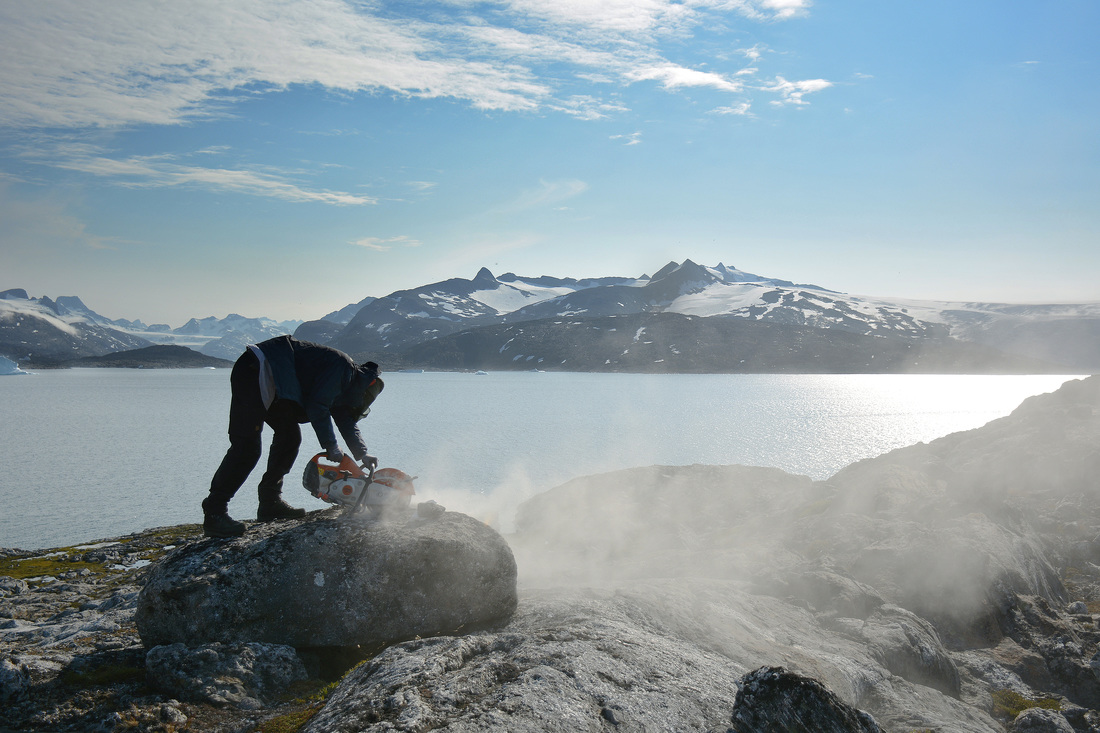
Photo credit: Benoit S. Lecavalier (2014).

06 Mar 17:28

Democracy Now! 2018-03-06 Tuesday

Tom Roche

1st half: excellent trade debate between Lori Wallach @ Global Trade Watch (who wins) and Michael Hudson (not conventional free-trade pitch, but like much of left, can't quite get behind anything with a whiff of Trump). see

https://www.democracynow.org/2018/3/6/lori_wallach_and_michael_hudson_debate#transcript
Forgettable 2nd half: Chris Murphy on gun control. He's correct, of course, but there's absolutely nothing you haven't heard before.

Democracy Now! 2018-03-06 Tuesday

  • Headlines for March 06, 2018
  • Lori Wallach and Michael Hudson Debate Trump's Plan to Impose Steel & Aluminum Tariffs
  • Sen. Chris Murphy Calls for Reinstating Assault Weapons Ban & Breaking NRA's "Vise Grip" on GOP
  • Sen. Chris Murphy: The U.S. Is Exporting Violence & Killing Civilians in Illegal War in Yemen

Download this show

05 Mar 17:15

Hard fate: Grant's Final Victory: PART 2 of 2: Ulysses S. Grant's Heroic Last Year by Charles Bracelen Flood

by The John Batchelor Show
Tom Roche

rerun

AUTHOR.

(Photo:Grant funeral

1912 April 26 (date created or published later by Bain)

1 negative : glass ; 5 x 7 in. or smaller.

Notes:

Title and date from data provided by the Bain News Service on the negative.

Photo shows funeral procession on April 26, 1912, for Major General Frederick Dent Grant (1850-1912), son of President Ulysses S. Grant, former New York City Police Commissioner and commander for the Eastern Division of the U.S. Army. (Source: Flickr Commons project, 2008 and New York Times, April 24, 1912)

Forms part of: George Grantham Bain Collection (Library of Congress).

Format: Glass negatives.

Rights Info: No known restrictions on publication.

Repository: Library of Congress, Prints and Photographs Division, Washington, D.C. 20540 USA, hdl.loc.gov/loc.pnp/pp.print

General information about the Bain Collection is available at hdl.loc.gov/loc.pnp/pp.ggbain

Higher resolution image is available (Persistent URL): hdl.loc.gov/loc.pnp/ggbain.10388

Call Number: LC-B2- 2396-4 )

http://JohnBatchelorShow.com/contact

http://JohnBatchelorShow.com/schedules

Twitter: @BatchelorShow

Hard fate: Grant's Final Victory: PART 2 of 2: Ulysses S. Grant's Heroic Last Year by Charles Bracelen Flood

Shortly after losing all of his wealth in a terrible 1884 swindle, Ulysses S. Grant learned he had terminal throat and mouth cancer. Destitute and dying, Grant began to write his memoirs to save his family from permanent financial ruin.

As Grant continued his work, suffering increasing pain, the American public became aware of this race between Grant's writing and his fatal illness. Twenty years after his respectful and magnanimous demeanor toward Robert E. Lee at Appomattox, people in both the North and the South came to know Grant as the brave, honest man he was, now using his famous determination in this final effort. Grant finished Memoirs just four days before he died in July 1885.

Published after his death by his friend Mark Twain, Grant's Memoirs became an instant bestseller, restoring his family's financial health and, more importantly, helping to cure the nation of bitter discord. More than any other American before or since, Grant, in his last year, was able to heal this—the country's greatest wound.

05 Mar 17:15

Hard fate: Grant's Final Victory: PART 1 of 2: Ulysses S. Grant's Heroic Last Year by Charles Bracelen Flood

by The John Batchelor Show
Tom Roche

rerun

AUTHOR.

(Photo:

English: Engraving of Ulysses S. Grant funeral train passing West Point, New York.

From a sketch by Cadet C.T. Hamilton

Date 1885

Source Engraving from a sketch by Cadet C.T. Hamilton

Illustrated in the Book, Illustrious Americans by Edward Everett Hale

Photo-scan of illustration in book from personal library by Gwillhickers.

Author Cadet C.T. Hamilton)

http://JohnBatchelorShow.com/contact

http://JohnBatchelorShow.com/schedules

Twitter: @BatchelorShow

Hard fate: Grant's Final Victory: PART 1 of 2: Ulysses S. Grant's Heroic Last Year by Charles Bracelen Flood

Shortly after losing all of his wealth in a terrible 1884 swindle, Ulysses S. Grant learned he had terminal throat and mouth cancer. Destitute and dying, Grant began to write his memoirs to save his family from permanent financial ruin.

As Grant continued his work, suffering increasing pain, the American public became aware of this race between Grant's writing and his fatal illness. Twenty years after his respectful and magnanimous demeanor toward Robert E. Lee at Appomattox, people in both the North and the South came to know Grant as the brave, honest man he was, now using his famous determination in this final effort. Grant finished Memoirs just four days before he died in July 1885.

Published after his death by his friend Mark Twain, Grant's Memoirs became an instant bestseller, restoring his family's financial health and, more importantly, helping to cure the nation of bitter discord. More than any other American before or since, Grant, in his last year, was able to heal this—the country's greatest wound.

05 Mar 17:14

Grant's and Lee's first war:A Wicked War: PART 2 of 2: Polk, Clay, Lincoln, and the 1846 U.S. Invasion of Mexico by Amy S. Greenberg (Author)

by The John Batchelor Show
Tom Roche

rerun

AUTHOR.

(Photo:Storming of Chapultepec – Pillow's attack (September 13, 1847) in the Mexican-American War. Hand-colored lithograph; original size of painted area: 42.7×28 cm.

Date 1851

Source Immediate image source: http://www.dsloan.com/Auctions/A22/item-kendall-nebel.html

Originally published in George Wilkins Kendall & Carl Nebel: The War between the United States and Mexico Illustrated, Embracing Pictorial Drawings of all the Principal Conflicts, New York: D. Appleton; Philadelphia: George Appleton [Paris: Plon Brothers], 1851.

Author Lithograph by

Adolphe Jean-Baptiste Bayot (1810–1866) Blue pencil.svg wikidata:Q4684426

after a drawing by

Carl Nebel (1805–1855) Blue pencil.svg wikidata:Q329557

http://JohnBatchelorShow.com/contact

http://JohnBatchelorShow.com/schedules

Grant's and Lee's first war:A Wicked War: PART 2 of 2: Polk, Clay, Lincoln, and the 1846 U.S. Invasion of Mexico by Amy S. Greenberg (Author)

Often forgotten and overlooked, the U.S.-Mexican War featured false starts, atrocities, and daring back-channel negotiations as it divided the nation, paved the way for the Civil War a generation later, and launched the career of Abraham Lincoln. Amy S. Greenberg’s skilled storytelling and rigorous scholarship bring this American war for empire to life with memorable characters, plotlines, and legacies.

This definitive history of the 1846 conflict paints an intimate portrait of the major players and their world. It is a story of Indian fights, Manifest Destiny, secret military maneuvers, gunshot wounds, and political spin. Along the way it captures a young Lincoln mismatching his clothes, the lasting influence of the Founding Fathers, the birth of the Daughters of the American Revolution, and America’s first national antiwar movement. A key chapter in the creation of the United States, it is the story of a burgeoning nation and an unforgettable conflict that has shaped American history.

05 Mar 17:14

Grant's and Lee's first war: A Wicked War: PART 1 of 2: Polk, Clay, Lincoln, and the 1846 U.S. Invasion of Mexico by Amy S. Greenberg (Author)

by The John Batchelor Show
Tom Roche

rerun

AUTHOR.

(Photo: The Battle of Churubusco took place on August 20, 1847, while Santa Anna's army was in retreat from the Battle of Contreras (Padierna), Mexican–American War. After defeating the Mexican army at Churubusco, the U.S. Army was only 5 miles (8 km) away from Mexico City.)

http://JohnBatchelorShow.com/contact

http://JohnBatchelorShow.com/schedules

Grant's and Lee's first war: A Wicked War: PART 1 of 2: Polk, Clay, Lincoln, and the 1846 U.S. Invasion of Mexico by Amy S. Greenberg (Author)

Often forgotten and overlooked, the U.S.-Mexican War featured false starts, atrocities, and daring back-channel negotiations as it divided the nation, paved the way for the Civil War a generation later, and launched the career of Abraham Lincoln. Amy S. Greenberg’s skilled storytelling and rigorous scholarship bring this American war for empire to life with memorable characters, plotlines, and legacies.

This definitive history of the 1846 conflict paints an intimate portrait of the major players and their world. It is a story of Indian fights, Manifest Destiny, secret military maneuvers, gunshot wounds, and political spin. Along the way it captures a young Lincoln mismatching his clothes, the lasting influence of the Founding Fathers, the birth of the Daughters of the American Revolution, and America’s first national antiwar movement. A key chapter in the creation of the United States, it is the story of a burgeoning nation and an unforgettable conflict that has shaped American history.

05 Mar 17:11

War to the knife: The First Frontier: PART 2 of 2: The Forgotten History of Struggle, Savagery, and Endurance in Early America by Scott Weidensaul

by The John Batchelor Show
Tom Roche

rerun

AUTHOR.

(Photo:1720 )

http://JohnBatchelorShow.com/contact

http://JohnBatchelorShow.com/schedules

Twitter: @BatchelorShow

War to the knife: The First Frontier: PART 2 of 2: The Forgotten History of Struggle, Savagery, and Endurance in Early America by Scott Weidensaul

“With a novelist's flair, he conveys the experiences of ordinary people pitted against powerful and unpredictable nature. . . Mr. Weidensaul invites readers to imagine the bloody ground beneath modern America's apparently tame landscape.”

—The Wall Street Journal

“Exhaustively researched and entertainingly written. . . Credit Weidensaul with proving once again that history does not have to be dull in order to be comprehensive. It would be difficult to find a work of either fact or fiction more filled with excitement and suspense than The First Frontier.”

—The Seattle Times

“With a novelist's flair, he conveys the experiences of ordinary people pitted against powerful and unpredictable nature. . . Mr. Weidensaul invites readers to imagine the bloody ground beneath modern America's apparently tame landscape.”

—The Wall Street Journal

From the Inside Flap

Frontier: the word carries the inevitable scent of the West. But before Custer or Lewis and Clark, before the first Conestoga wagons rumbled across the Plains, it was the East that marked the frontier—the boundary between complex Native cultures and the first colonizing Europeans.

Here is the older, wilder, darker history of a time when the land between the Atlantic and the Appalachians was contested ground—when radically different societies adopted and adapted the ways of the other, while struggling for control of what all considered to be their land.

The First Frontier traces two and a half centuries of history through poignant, mostly unheralded personal stories—like that of a Harvard-educated Indian caught up in seventeenth-century civil warfare, a mixed-blood interpreter trying to straddle his white and Native heritage, and a Puritan woman wielding a scalping knife whose bloody deeds still resonate uneasily today. It is the first book in years to paint a sweeping picture of the Eastern frontier, combining vivid storytelling with the latest research to bring to life modern America’s tumultuous, uncertain beginnings.

From the Back Cover

Advance praise for The First Frontier

"Excitement abounds in Scott Weidensaul’s detailed history of the first clashes between European settlers and Native Americans on the East Coast. By turns bloody and gruesome, poignant and haunting, The First Frontier reminds us that neither side in this 'disturbing, in-between world' was wholly in the right." — Nancy Marie Brown, author of The Far Traveler: Voyages of a Viking Woman

“In this charming and fascinating chronicle . . . Weidensaul’s delightful storytelling brings to life the terrors and hopes of the earliest days of America.” — Publisher’s Weekly

“In this comprehensive chronicle . . . Weidensaul weaves together an impressive number of true stories. . . . any reader who picks it up will get a very real picture of what it was like to live and die in the New World.” — Kirkus Reviews

About the Author

Author and naturalist Scott Weidensaul, who grew up in the heart of the old Eastern frontier, has written more than two dozen books, including the Pulitzer Prize finalist Living on the Wind: Across the Hemisphere with Migratory Birds.

05 Mar 17:11

War to the knife: The First Frontier: PART 1 of 2: The Forgotten History of Struggle, Savagery, and Endurance in Early America by Scott Weidensaul

by The John Batchelor Show
Tom Roche

rerun

AUTHOR.

(Photo:War to the knife: The First Frontier: PART 1 of 2: The Forgotten History of Struggle, Savagery, and Endurance in Early America by Scott Weidensaul )

http://JohnBatchelorShow.com/contact

http://JohnBatchelorShow.com/schedules

Twitter: @BatchelorShow

War to the knife: The First Frontier: PART 1 of 2:  The Forgotten History of Struggle, Savagery, and Endurance in Early America by Scott Weidensaul

“With a novelist's flair, he conveys the experiences of ordinary people pitted against powerful and unpredictable nature. . . Mr. Weidensaul invites readers to imagine the bloody ground beneath modern America's apparently tame landscape.”

—The Wall Street Journal

“Exhaustively researched and entertainingly written. . . Credit Weidensaul with proving once again that history does not have to be dull in order to be comprehensive. It would be difficult to find a work of either fact or fiction more filled with excitement and suspense than The First Frontier.”

—The Seattle Times

“With a novelist's flair, he conveys the experiences of ordinary people pitted against powerful and unpredictable nature. . . Mr. Weidensaul invites readers to imagine the bloody ground beneath modern America's apparently tame landscape.”

—The Wall Street Journal

From the Inside Flap

Frontier: the word carries the inevitable scent of the West. But before Custer or Lewis and Clark, before the first Conestoga wagons rumbled across the Plains, it was the East that marked the frontier—the boundary between complex Native cultures and the first colonizing Europeans.

Here is the older, wilder, darker history of a time when the land between the Atlantic and the Appalachians was contested ground—when radically different societies adopted and adapted the ways of the other, while struggling for control of what all considered to be their land.

The First Frontier traces two and a half centuries of history through poignant, mostly unheralded personal stories—like that of a Harvard-educated Indian caught up in seventeenth-century civil warfare, a mixed-blood interpreter trying to straddle his white and Native heritage, and a Puritan woman wielding a scalping knife whose bloody deeds still resonate uneasily today. It is the first book in years to paint a sweeping picture of the Eastern frontier, combining vivid storytelling with the latest research to bring to life modern America’s tumultuous, uncertain beginnings.

From the Back Cover

Advance praise for The First Frontier

"Excitement abounds in Scott Weidensaul’s detailed history of the first clashes between European settlers and Native Americans on the East Coast. By turns bloody and gruesome, poignant and haunting, The First Frontier reminds us that neither side in this 'disturbing, in-between world' was wholly in the right." — Nancy Marie Brown, author of The Far Traveler: Voyages of a Viking Woman

“In this charming and fascinating chronicle . . . Weidensaul’s delightful storytelling brings to life the terrors and hopes of the earliest days of America.” — Publisher’s Weekly

“In this comprehensive chronicle . . . Weidensaul weaves together an impressive number of true stories. . . . any reader who picks it up will get a very real picture of what it was like to live and die in the New World.” — Kirkus Reviews

About the Author

Author and naturalist Scott Weidensaul, who grew up in the heart of the old Eastern frontier, has written more than two dozen books, including the Pulitzer Prize finalist Living on the Wind: Across the Hemisphere with Migratory Birds.

04 Mar 15:36

Lost World: 1493: PART 1 of 2: Uncovering the New World Columbus Created by Charles C. Mann.

by The John Batchelor Show
Tom Roche

rerun

AUTHOR.

(Photo: Map of Florida and the Caribbean from 1594)

http://JohnBatchelorShow.com/contact

http://JohnBatchelorShow.com/schedules

Twitter: @BatchelorShow

Lost World: 1493: PART 1 of 2: Uncovering the New World Columbus Created by Charles C. Mann.

Amazon.com Review

Guest Reviewer: Nathaniel Philbrick on 1493 by Charles C. Mann 

Nathaniel Philbrick is the author of the New York Times bestsellers The Last Stand; In the Heart of the Sea, which won the National Book Award; Sea of Glory, winner of the Theodore and Franklin D. Roosevelt Naval History Prize; and Mayflower, which was a finalist for the Pulitzer Prize in history and one of the New York Times' ten best books of the year. He has lived on Nantucket since 1986.

I’m a big fan of Charles Mann’s previous book 1491, in which he provides a sweeping and provocative examination of North and South America prior to the arrival of Christopher Columbus. It’s exhaustively researched but so wonderfully written that it’s anything but exhausting to read.

With his follow-up, 1493, Mann has taken it to a new, truly global level. Building on the groundbreaking work of Alfred Crosby (author of The Columbian Exchange and, I’m proud to say, a fellow Nantucketer), Mann has written nothing less than the story of our world: how a planet of what were once several autonomous continents is quickly becoming a single, “globalized” entity.

Mann not only talked to countless scientists and researchers; he visited the places he writes about, and as a consequence, the book has a marvelously wide-ranging yet personal feel as we follow Mann from one far-flung corner of the world to the next. And always, the prose is masterful. In telling the improbable story of how Spanish and Chinese cultures collided in the Philippines in the sixteenth century, he takes us to the island of Mindoro whose “southern coast consists of a number of small bays, one next to another like tooth marks in an apple.”

We learn how the spread of malaria, the potato, tobacco, guano, rubber plants, and sugar cane have disrupted and convulsed the planet and will continue to do so until we are finally living on one integrated or at least close-to-integrated Earth. Whether or not the human instigators of all this remarkable change will survive the process they helped to initiate more than five hundred years ago remains, Mann suggests in this monumental and revelatory book, an open question.

04 Mar 15:36

Lost world: 1493: PART 2 of 2: Uncovering the New World Columbus Created by Charles C. Mann.

by The John Batchelor Show
Tom Roche

rerun

AUTHOR.

(Photo: Potosi, the first image in Europe. Pedro Cieza de León, 1553.)

http://JohnBatchelorShow.com/contact

http://JohnBatchelorShow.com/schedules

Twitter: @BatchelorShow

Lost world: 1493: PART 2 of 2: Uncovering the New World Columbus Created by Charles C. Mann.

Amazon.com Review

Guest Reviewer: Nathaniel Philbrick on 1493 by Charles C. Mann 

Nathaniel Philbrick is the author of the New York Times bestsellers The Last Stand; In the Heart of the Sea, which won the National Book Award; Sea of Glory, winner of the Theodore and Franklin D. Roosevelt Naval History Prize; and Mayflower, which was a finalist for the Pulitzer Prize in history and one of the New York Times' ten best books of the year. He has lived on Nantucket since 1986.

I’m a big fan of Charles Mann’s previous book 1491, in which he provides a sweeping and provocative examination of North and South America prior to the arrival of Christopher Columbus. It’s exhaustively researched but so wonderfully written that it’s anything but exhausting to read.

With his follow-up, 1493, Mann has taken it to a new, truly global level. Building on the groundbreaking work of Alfred Crosby (author of The Columbian Exchange and, I’m proud to say, a fellow Nantucketer), Mann has written nothing less than the story of our world: how a planet of what were once several autonomous continents is quickly becoming a single, “globalized” entity.

Mann not only talked to countless scientists and researchers; he visited the places he writes about, and as a consequence, the book has a marvelously wide-ranging yet personal feel as we follow Mann from one far-flung corner of the world to the next. And always, the prose is masterful. In telling the improbable story of how Spanish and Chinese cultures collided in the Philippines in the sixteenth century, he takes us to the island of Mindoro whose “southern coast consists of a number of small bays, one next to another like tooth marks in an apple.”

We learn how the spread of malaria, the potato, tobacco, guano, rubber plants, and sugar cane have disrupted and convulsed the planet and will continue to do so until we are finally living on one integrated or at least close-to-integrated Earth. Whether or not the human instigators of all this remarkable change will survive the process they helped to initiate more than five hundred years ago remains, Mann suggests in this monumental and revelatory book, an open question.

04 Mar 03:10

Thomas Whigham, “The Road to Armageddon: Paraguay versus the Triple Alliance, 1866-1870” (U Calgary Press, 2017)

by Mark Klobas
Tom Roche

very excellent

Paraguay’s intervention in a crisis between Uruguay and Brazil in November 1864 began the bloodiest and most destructive conflict in South American history. Thomas Whigham begins his book The Road to Armageddon: Paraguay versus the Triple Alliance, 1866-1870 (University of…
04 Mar 03:09

Dagomar Degroot, “The Frigid Golden Age: Climate Change, the Little Ice Age, and the Dutch Republic, 1560 -1720” (Cambridge UP, 2018)

by Emma Shortis
Tom Roche

very excellent

Historians, writes Dagomar Degroot, rarely feature in discussions about global warming. With his new book, The Frigid Golden Age: Climate Change, the Little Ice Age, and the Dutch Republic, 1560-1720 (Cambridge University Press, 2018), Degroot seeks to remedy this…
02 Mar 18:37

Tales of the New Cold War: Fear of the Russians is old-fashioned American politics. PART 2 of 2. Stephen F. Cohen @NYU @Princeton eastwestaccord.com.

by The John Batchelor Show
Tom Roche

good summary of US intervention in Russian election 1996

AUTHOR.

(Photo:

File:Boris Yeltsin with Bill Clinton-1.jpg)

http://JohnBatchelorShow.com/contact

http://JohnBatchelorShow.com/schedules

Twitter: @BatchelorShow

Tales of the New Cold War: Fear of the Russians is old-fashioned American politics. PART 2 of 2. Stephen F. Cohen @NYU @Princeton eastwestaccord.com.

01 Mar 20:10

India Now: the problem is caste

Tom Roche

The MP3 that downloads [as of 19:20 UTC 1 Mar 2018] from

http://mpegmedia.abc.net.au/rn/podcast/2018/03/lnl_20180301_2220.mp3

is only 1.33 MB in size, and plays for just over a minute (1:21), cutting off before Phillip finishes introducing the guest's book.

One in six Indians is an 'untouchable', but few Indians and fewer Westerners understand the depths of their oppression.
28 Feb 15:54

Redrawing the map: Potsdam: PART 3 of 4. The End of World War II and the Remaking of Europe by Michael Neiberg.

by The John Batchelor Show
Tom Roche

rerun

AUTHOR.

(Photo:The Foreign Ministers: Vyacheslav Molotov, James F. Byrnes, and Anthony Eden, July 1945 )

http://JohnBatchelorShow.com/contact

http://JohnBatchelorShow.com/schedules

Twitter: @BatchelorShow

Redrawing the map: Potsdam: PART 3 of 4. The End of World War II and the Remaking of Europe by Michael Neiberg.

After Germany s defeat in World War II, Europe lay in tatters. Millions of refugees were dispersed across the continent. Food and fuel were scarce. Britain was bankrupt, while Germany had been reduced to rubble. In July of 1945, Harry Truman, Winston Churchill, and Joseph Stalin gathered in a quiet suburb of Berlin to negotiate a lasting peace: a peace that would finally put an end to the conflagration that had started in 1914, a peace under which Europe could be rebuilt. The award-winning historian Michael Neiberg brings the turbulent Potsdam conference to life, vividly capturing the delegates personalities: Truman, trying to escape from the shadow of Franklin Roosevelt, who had died only months before; Churchill, bombastic and seemingly out of touch; Stalin, cunning and meticulous. For the first week, negotiations progressed relatively smoothly. But when the delegates took a recess for the British elections, Churchill was replacedboth as prime minster and as Britain s representative at the conferencein an unforeseen upset by Clement Attlee, a man Churchill disparagingly described as a sheep in sheep s clothing. When the conference reconvened, the power dynamic had shifted dramatically, and the delegates struggled to find a new balance. Stalin took advantage of his strong position to demand control of Eastern Europe as recompense for the suffering experienced by the Soviet people and armies. The final resolutions of the Potsdam Conference, notably the division of Germany and the Soviet annexation of Poland, reflected the uneasy geopolitical equilibrium between East and West that would come to dominate the twentieth century. As Neiberg expertly shows, the delegates arrived at Potsdam determined to learn from the mistakes their predecessors made in the Treaty of Versailles. But, riven by tensions and dramatic debates over how to end the most recent war, they only dimly understood that their discussions of peace were giving birth to a new global conflict.

https://www.amazon.com/Potsdam-End-World-Remaking-Europe/dp/0465075258/ref=sr14?s=books&ie=UTF8&qid=1505269729&sr=1-4

28 Feb 15:53

Redrawing the map: Potsdam: PART 4 of 4. The End of World War II and the Remaking of Europe by Michael Neiberg.

by The John Batchelor Show
Tom Roche

rerun

AUTHOR.

(Photo:Sitting (from left): Clement Attlee, Harry S. Truman, Joseph Stalin, and behind: Fleet Admiral William Daniel Leahy, Foreign Secretary Ernest Bevin, Secretary of State James F. Byrnes, and Foreign Minister Vyacheslav Molotov. )

http://JohnBatchelorShow.com/contact

http://JohnBatchelorShow.com/schedules

Twitter: @BatchelorShow

Redrawing the map: Potsdam: PART 4 of 4. The End of World War II and the Remaking of Europe by Michael Neiberg.

After Germany s defeat in World War II, Europe lay in tatters. Millions of refugees were dispersed across the continent. Food and fuel were scarce. Britain was bankrupt, while Germany had been reduced to rubble. In July of 1945, Harry Truman, Winston Churchill, and Joseph Stalin gathered in a quiet suburb of Berlin to negotiate a lasting peace: a peace that would finally put an end to the conflagration that had started in 1914, a peace under which Europe could be rebuilt. The award-winning historian Michael Neiberg brings the turbulent Potsdam conference to life, vividly capturing the delegates personalities: Truman, trying to escape from the shadow of Franklin Roosevelt, who had died only months before; Churchill, bombastic and seemingly out of touch; Stalin, cunning and meticulous. For the first week, negotiations progressed relatively smoothly. But when the delegates took a recess for the British elections, Churchill was replacedboth as prime minster and as Britain s representative at the conferencein an unforeseen upset by Clement Attlee, a man Churchill disparagingly described as a sheep in sheep s clothing. When the conference reconvened, the power dynamic had shifted dramatically, and the delegates struggled to find a new balance. Stalin took advantage of his strong position to demand control of Eastern Europe as recompense for the suffering experienced by the Soviet people and armies. The final resolutions of the Potsdam Conference, notably the division of Germany and the Soviet annexation of Poland, reflected the uneasy geopolitical equilibrium between East and West that would come to dominate the twentieth century. As Neiberg expertly shows, the delegates arrived at Potsdam determined to learn from the mistakes their predecessors made in the Treaty of Versailles. But, riven by tensions and dramatic debates over how to end the most recent war, they only dimly understood that their discussions of peace were giving birth to a new global conflict.

https://www.amazon.com/Potsdam-End-World-Remaking-Europe/dp/0465075258/ref=sr14?s=books&ie=UTF8&qid=1505269729&sr=1-4

26 Feb 03:40

Intelligence Accountability in the United States