Tom Roche
Shared posts
The Triumph of Christianity: How a Forbidden Religion Swept the World
Raimon Grau: SF emacs meetup
Tom Rochesee esp PYNT (PYthon iNTeractive) mode for interacting with Jupyter notebooks @ https://github.com/ebanner/pynt (includes YouTube tutorial)
Being the first time I'm in San Francisco, and the fact that I'll be around just for a couple of weeks (for my new job), it makes it even more surprising that I was able to go.
We were about 15 people, most from the bay area, and I think myself I was the only foreigner. The meetup topic was "a few of our favourite emacs modes", which unlocked the possibility to talk about helm-dash (not that it's my favourite mode, but is the one I wrote (and I also find it quite helpful)).
So I volunteered and gave a really quick intro to helm-dash.
Others talked about evil, magit, pynt, multiple-cursors (that was nuts!), git-timemachine, use-package, and probably some more that I already forgot.
My discoveries were:
- evil can easily create new text objects.
- learn to use multiple cursors (although I prefer vim's substitutions, mc work better for multiline "macros", and give you more visual feedback than emacs macros)
- pynt and emacs-ipython-notebook . If I ever do python again, I should remember that.
- use-package has more options that one usually thinks. RTFM
- ggtags is worth looking at if your language is not supported by etags/ctags.
- hydra red/blue modes.
Lots of fun during a couple of hours talking about tooling and worfklows with random techies.See you next time I'm around.
The News Quiz 23rd Feb 2018
Tom Rocheconsistently excellent, esp Hardy and Calman
Destination weddings and divorces. Related? Who knows!
Tom Roche1st set is Rob Ross, which is OK. 2nd set (starting @ 12:50) is John Hastings, who is excellent.
Chris Moffitt: Intro to pdvega - Plotting for Pandas using Vega-Lite
Tom RocheFMI about the Vega visualization grammar, see https://vega.github.io/vega/
Introduction
Much has been made about the multitude of options for visualizing data in python. Jake VanderPlas covered this topic in his PyCon 2017 talk and the landscape has probably gotten even more confusing in the year since this talk was presented.
Jake is also one of the creators of Altair (discussed in this post) and is back with another plotting library called pdvega. This library leverages some of the concepts introduced in Altair but seeks to tackle a smaller subset of visualization problems. This article will go through a couple examples of using pdvega and compare it to the basic capabilities present in pandas today.
pdvega
Likely sensing the inevitable questions about another plotting library, the pdvega documentation quickly gets to the point about its goals:
pdvega is a library that allows you to quickly create interactive Vega-Lite plots from Pandas dataframes, using an API that is nearly identical to Pandas’ built-in visualization tools, and designed for easy use within the Jupyter notebook.
The basic idea is that pdvega can improve on pandas plot output by adding more interactivity, improving the visual appeal and supporting the declarative Vega-Lite standard. The other nice aspect is that pdvega tries to leverage the existing pandas API so that it is relatively simple to get up and running and produce useful visualizations - especially in the Jupyter notebook environment.
plotting
For this example, I decided to use data from FiveThirtyEight’s Ultimate Halloween Candy Power Ranking post. FiveThirtyEight is gracious enough to make all of its data available here. If you are interested in finding fun data sets to analyze, I encourage you to check it out.
All of the code is meant to be run in a notebook. An example one is available on github.
Make sure the code is installed properly:
pip install pdvega
jupyter nbextension install --sys-prefix --py vega3
Get started by importing pandas and pdvega and reading the csv into a dataframe:
import pandas as pd
import pdvega
df = pd.read_csv("https://github.com/fivethirtyeight/data/blob/master/candy-power-ranking/candy-data.csv?raw=True")
Here’s what the data looks like:
| competitorname | chocolate | fruity | caramel | peanutyalmondy | nougat | crispedricewafer | hard | bar | pluribus | sugarpercent | pricepercent | winpercent | |
|---|---|---|---|---|---|---|---|---|---|---|---|---|---|
| 0 | 100 Grand | 1 | 0 | 1 | 0 | 0 | 1 | 0 | 1 | 0 | 0.732 | 0.860 | 66.971725 |
| 1 | 3 Musketeers | 1 | 0 | 0 | 0 | 1 | 0 | 0 | 1 | 0 | 0.604 | 0.511 | 67.602936 |
| 2 | One dime | 0 | 0 | 0 | 0 | 0 | 0 | 0 | 0 | 0 | 0.011 | 0.116 | 32.261086 |
| 3 | One quarter | 0 | 0 | 0 | 0 | 0 | 0 | 0 | 0 | 0 | 0.011 | 0.511 | 46.116505 |
| 4 | Air Heads | 0 | 1 | 0 | 0 | 0 | 0 | 0 | 0 | 0 | 0.906 | 0.511 | 52.341465 |
The data includes voter results on which one of 86 candy options was their favorite.
The
winpercent
column includes how often that candy was the vote winner.
The other columns include descriptive characteristics of that candy. The good folks
at FiveThirtyEight did lots of analysis, but we’ll do some quick EDA to compare stock pandas plotting
vs pdvega.
First, let’s look at the distribution of winning percentages using a histogram.
In pandas:
df["winpercent"].plot.hist()
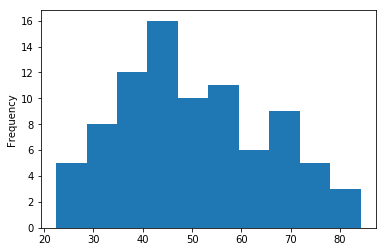
Now in pdvega:
df["winpercent"].vgplot.hist()

There are a couple of key points here:
- The pdvega API is pretty much the same as pandas plotting. Instead of calling
plotyou can callvgplot. - The actual output looks much cleaner in pdvega
- The png shown here does not replicated the interactivity you get in a notebook
If we want to plot multiple distributions to look at the sugar and price percentiles, it’s fairly simple:
df[["sugarpercent", "pricepercent"]].plot.hist(alpha=0.5)
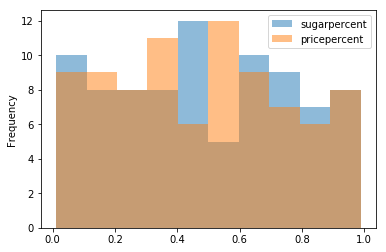
In pdvega, the syntax is a little cleaner because the
alpha
parameter is
not needed.
df[["sugarpercent", "pricepercent"]].vgplot.hist()
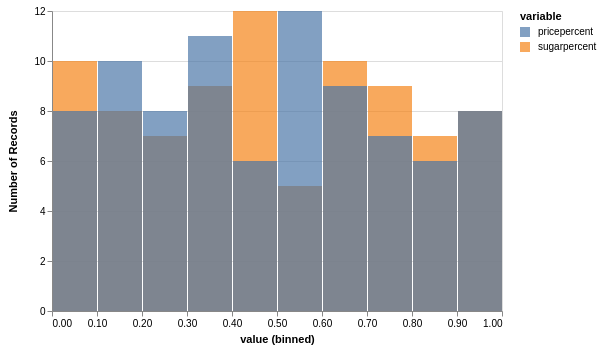
pdvega supports most of the standard plot types you would expect. Here’s an example of a horizontal bar chart showing the top 15 winpercentages. This fits in seamlessly with the standard pandas approach of sorting and viewing the top entries:
df.sort_values(by=['winpercent'], ascending=False).head(15).vgplot.barh(x='competitorname', y='winpercent')
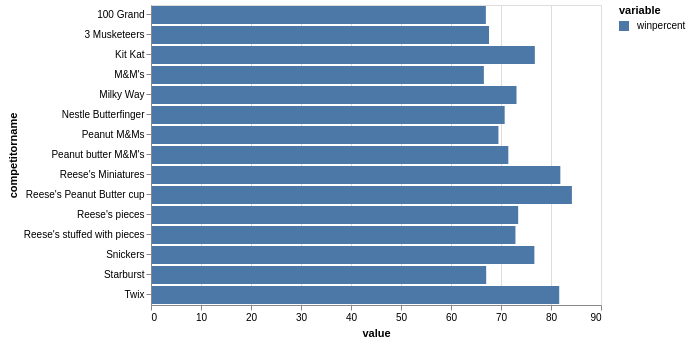
The one challenge I had was figuring out how to make sure the bars were ordered by winpercent not alphabetically but the name. I’m sure there is a way but I could not figure it out.
If we’re interested in looking at a more complicated analysis, the scatter plotting
functionality allows us to control the size and color of the plots based on the values
in a column. For instance, if we want to look at the relationship between winning percentages,
sugar percentiles, pricing percentiles and candy bar status, we can encode that
all in a single
vgplot.scatter
call:
df.vgplot.scatter(x='winpercent', y='sugarpercent', s='pricepercent', c='bar')

Once again, the API is similar to panda’s scatter plot but it natively creates
a more useful plot without additional tinkering. The ability to easily
encode the size of the plot using the
s
argument for size and
c
for color
is a simple enhancement that makes scatter plots much more useful.
Finally, pdvega supports statistical visualization with
pdvega.plotting.
A scatter matrix can be a useful tool to view multiple variable interactions
in one chart:
pdvega.scatter_matrix(df[["sugarpercent", "winpercent", "pricepercent"]], "winpercent")

This API is slightly different in that you pass the actual dataframe to the pdvega function but the basic approach is similar to the rest of the pdvega API. The individual plots are linked together so that zooming in one, interacts with the other plot.
Closing Thoughts
There is no doubt that the python visualization landscape is crowded. However, there is a lot of activity in this space and many powerful tools available. In the end, I think the competition is good but hope that some standards eventually emerge so that new users have a simpler time figuring out which tool is best for them. It’s always a concern in the open source world when resources get spread too thin across competing projects and the barrier for new users to learn is high.
That being said, pdvega is very early in its lifecycle but it shows promise. Some of the primary benefits are that it is easy to pick up, generates very nice visualizations out of the box and is primarily developed by Jake VanderPlas who is extremely active in this space and wants to drive some convergence of solutions. In addition, the library should see improvements in functionality as more people use it and generate feedback. I look forward to seeing how it grows and develops in future releases and where it ultimately lands in the crowded visualization space.
Codementor: Automating Simple Tasks with Scheme (Competing with Perl, Python and Ruby)
Tom Rochetask in this post is: rename buncha camera files using their EXIF metadata to create meaningful names. shows how to import/use some Scheme libraries, define/use utility functions, find the files, access their metadata, and rename.
Blue Cross Executives Are Working Hard Against a Pro-Single Payer Candidate for Governor
Tom Rocheyet again, corporate Democrats fight real progressive change
In Michigan’s gubernatorial Democratic primary in August, voters will get to choose between two competing visions for health care.
Former executive director of the Detroit Health Department, Abdul El-Sayed, has a simple plan: cover every Michigander in one public program with single-payer health insurance. His opponent, former Senate Democratic Leader Gretchen Whitmer, does not support single payer and rather wants to continue to build on the Affordable Care Act.
Insurance giant Blue Cross Blue Shield Michigan isn’t leaving things things to chance, and has decided to weigh in heavily against El-Sayed’s candidacy.
On official Whitmer letterhead, bluesPAC, the company’s corporate fundraising vehicle, blasted out an invitation for a major fundraiser on March 7th. “Blue Cross Blue Shield of Michigan plays a major role in Michigan’s economy and the health of Michigan’s citizens,” it notes. “The vibrancy of Michigan’s economic climate is driven by public policy put forward by our state’s Governor; and we believe Gretchen Whitmer will be a great leader for Michigan.”
The invite is signed by Lynda Rossi, executive vice president of strategy, government and public affairs at Blue Cross Blue Shield Michigan.
The Intercept received a copy, which we have pasted below. Note that while the invite is signed by senior lobbyists with the insurer, it is paid for by Whitmer’s campaign:

Blue Cross spokeswoman Helen Stojic confirmed to The Intercept that the Whitmer campaign paid for the mailer, but did so in coordination with bluesPAC. “The letter was paid for by the Whitmer campaign. bluesPAC gave one-time permission to this campaign to use addresses of bluesPAC members to invite them to the event,” she wrote in an e-mail.
She insisted that bluesPAC does not host fundraisers on its own but that the event is instead hosted by its officers. “This event is hosted by the officers of the bluesPAC, not bluesPAC,” she told us. “The officers believe her background in the state legislature has provided her with a good understanding of the state’s needs, including concern about the health of Michigan residents. The officers provided an opportunity for bluesPAC members to attend the event.”
Craig Mauger, executive director of the Michigan Campaign Finance Network, told The Intercept that corporations are prohibited by law from directly donating to state candidates in Michigan. Instead, he said, they often solicit their employees to donate in order to demonstrate political influence.
“Blue Cross Blue Shield, their PAC is one of the ten largest PACs in our state. They are one of the PACs that gives broadly to candidates on both sides of the aisle. They’re a very active force in politics,” he noted.
“While bluesPAC does not formally endorse candidates, it periodically provides its members an opportunity to directly support candidates for elective office,” Blue Cross spokeswoman Helen Stojic told The Detroit News. “And this is one of those opportunities.”
The health insurance firm touts itself as Michigan’s “largest health insurance company“; it lists a client base of 4.5 million Michiganders as well as 1.6 million people in other states.
Annie Ellison, communications director for Whitmer’s campaign, offered a short statement to The Intercept pointing to her work on Medicaid expansion.
“The campaign has built support from a large, broad coalition of people who are ready for a governor who will fix the roads, connect Michiganders to good-paying jobs, and put people first,” she said. “As Senate Democratic Leader, Whitmer brokered the deal with a Republican governor to expand health care to 680,000 people through Medicaid expansion because she’ll work with everyone who wants to solve problems, and take on anyone who stands in our way to increase access to quality, affordable health care for every Michigander.”
Adam Joseph, a spokesperson for El-Sayed, said the case demonstrates why their campaign is not taking corporate PAC money.
“One of the biggest problems in Michigan is that Lansing politicians are putting corporations over real people. They’ve bought and sold government,” he told The Intercept. “So we’re not going to wait around for corporate politicians to finally start doing the right thing. We’ve taken a clear stand on Medicare for All, and we don’t take corporate PAC money because it’s time to stand up to the insurance industry that has profiteered on sick Michiganders for too long.”
Top photo: Michigan Senate Democratic Leader Gretchen Whitmer, foreground, and Senator Debbie Stabenow address the media following a town hall meeting on the campus of Wayne State University in Detroit, Sunday, Oct. 12, 2014.
The post Blue Cross Executives Are Working Hard Against a Pro-Single Payer Candidate for Governor appeared first on The Intercept.
EMILY’s List Weighs in Hard in Texas Primary — Against a Leading Woman in the Trump Resistance
Tom RocheYet another case where corporate Democrats--the left wing of the US Corporate Party--show that their primary purpose is to hold back genuine progressive change, and that they do this by pitting "social issues" to uphold economic inequality.
EMILY’s List is dumping big money into an upcoming Democratic primary in Texas’s 7th Congressional District, pitting the women’s group against a pro-choice woman who was, in the months after the election of Donald Trump, a face of the resistance.
Laura Moser, as creator of the popular text-messaging program Daily Action, gave hundreds of thousands of despondent progressives a single political action to take each day. Her project was emblematic of the new energy forming around the movement against Trump, led primarily by women and often by moms. (Moser is both.)
It was those types of activists EMILY’s List spent 2017 encouraging to make first-time bids for office. But that doesn’t mean EMILY’s List will get behind them. Also running is Lizzie Pannill Fletcher, a corporate lawyer who is backed by Houston mega-donor Sherry Merfish. EMILY’s List endorsed her in November.
The 7th District includes parts of Houston and its wealthy western suburbs, and Merfish and her husband, Gerald Merfish, are among the city’s leading philanthropists. Gerald Merfish owns and runs a steel pipe company in the oil-rich region and Sherry Merfish, who worked for decades for EMILY’s List, is a major donor to the Democratic Party and to EMILY’s List.
Actor Alyssa Milano, another face of the Trump resistance, is backing Moser, and plans to drive voters to the polls as a campaign volunteer. “I like EMILY’s List a lot but I feel like they missed the boat on this one,” Milano told The Intercept. “Laura is a proud progressive Democrat and her values are the values of the majority of the country, which is evident by the success of her grassroots campaign and her broad base of support.”
The Houston district is one of scores where crosscurrents of the Democratic Party are colliding. Democrats, who in the past have had difficulty fielding a single credible candidate even in winnable districts, have at least four serious contenders in the race to replace Republican John Culberson. Moser, who has more than 10,000 donors — more than 90 percent of whom are small givers — and cancer researcher Jason Westin make up the progressive flank, while Fletcher and Alex Triantaphyllis are running more moderate campaigns. Triantaphyllis, a former Goldman Sachs analyst who doesn’t live in the district, has the backing of some establishment elements of the party.
“Alex T has been open about being the chosen candidate of the [Democratic Congressional Campaign Committee],” said Daniel Cohen, president of Indivisible Houston, who is not endorsing any particular candidate. (The DCCC has not officially endorsed a candidate in the primary, though its support can come in less public ways.)
As the race heats up ahead of the March 6 primary, 905 donors from the Houston area have given to Moser, with 48 percent of itemized donations coming from Texas. She also has gotten money from all 49 of the other states, including $1 from Guam, she told The Intercept. Fletcher, according to her campaign spokesperson Erin Mincberg, has 600 overall donors who live directly in the district, and 75 percent of their funds come from Houston.
Take a survey: Did EMILY’s List make the right call in this race?
With both Fletcher and Moser battling for a spot in the two-person runoff, and Westin surging in the race, EMILY’s List’s endorsement of Fletcher could end up having the paradoxical effect of producing a runoff between the two men. EMILY’s List, while expending resources in several competitive primaries between women, has also stayed out of other races that pit a pro-choice woman against an anti-choice man. Despite significant pressure, the group held out on endorsing Marie Newman against Democratic incumbent Daniel Lipinski, only shifting course when it became clear the SEIU would be breaking with Lipinski.
EMILY’s List’s endorsement of Fletcher could end up having the paradoxical effect of producing a runoff between two men.
The group has also declined to endorse the pro-choice Kara Eastman running against anti-choice Democrat Brad Ashford; the same is true for Lupe Valdez running against Andrew White for Texas governor. (White says that he believes Roe v. Wade is the law of the land and that his religious beliefs would not influence how he approached the issue, but he is far from a champion of reproductive rights.)
The support of first Merfish and then EMILY’s List for Fletcher raises questions about whether the endorsement was made at the behest of a major donor or because the organization truly believed Fletcher is the stronger candidate.
An EMILY’s List endorsement alone is useful in helping a candidate break out of a crowded pack, but the group has also announced funding for eight rounds of mailers as well as digital ads, including video, all ahead of the upcoming primary. In justifying its decision, EMILY’s List cited Fletcher’s past activism and her legal work. “As a senior in high school, she linked arms with hundreds of other Houstonians to keep protesters out and a Planned Parenthood clinic open. Since then, she became a lawyer to help those in need and co-founded the Planned Parenthood Young Leaders program to get the next generation involved,” reads a statement from the group.
Bryan Lesswing, a spokesperson for EMILY’s List, said that the group backed Parnell Fletcher because of her local roots and a history of activism. “We see so many women running as a good problem to have. Ultimately, we want to see as many women elected as possible and that sometimes means making tough decisions,” he said.
Moser is blunt in her criticism of the group. “Rather than lifting us both up, EMILY’S List has pitted us against each other. I knew as a progressive, pro-choice woman running in Texas, I would face obstacles. I never dreamed EMILY’s List would be one of them,” she said.
Mincberg, Fletcher’s spokesperson, also highlighted the candidate’s ties to the district.
She noted that the Chronicle’s dual endorsement of Fletcher and another candidate, cancer researcher Westin, could not be explained away as a favor to a donor and had more to do with the type of candidate the paper thought could feasibly win the district. Moser is known as one of the most progressive candidates in the race, along with Westin, in a district that is trending Democratic but by no means a lock. It went to Mitt Romney over Barack Obama by more than 20 points in 2012; Hillary Clinton edged out Donald Trump by just a point in 2016. Clinton topped Bernie Sanders there in the 2016 primary by a 2-1 margin.
Indeed, until 2017, Moser was living in Washington, where she worked as a writer, and only recently relocated back home to Houston. Her husband, Arun Chaudhary, a partner at Revolution Messaging, which did media and email work for the presidential campaign of Bernie Sanders, hasn’t gotten around to updating his bio, which still suggests that he “lives in Washington, D.C., with his wife, son and daughter.”
“I’d always agreed with my husband that we would move back to Houston when the time was right, and part of my commitment [to the resistance] led me to speed up my plans,” Moser said. “Women all over the country felt the same call and returned home to try to ‘be the change.'”
But Fletcher’s legal work for “those in need” has caused her problems in the campaign. The firm where she is a partner largely represents employers and won a major case against local janitorial workers, who were predominantly immigrants. The firm boasted, in its effort to attract future business from employers, that it won the case in part by studying the social media feeds of the jury pool to make sure the jury was stacked with Trump supporters. PJS, the firm’s client, was involved with Empower Texans, a right-wing group working to undermine organized labor in Texas.
When local unions raised the issue recently, Fletcher defended herself by saying that she did not work directly on the case, and that she does not always share the views of her clients. She also claimed to have represented workers before the Equal Employment Opportunity Commission.
The defense has not resonated with local workers. The local AFL-CIO has not endorsed in the race, but it did take the remarkable step of resolving to non-endorse Fletcher: Union members will be canvassing the district urging residents to vote for any candidate other than her.
“She’s trying to claim she’s represented women before the EEOC — but lower and middle class people can’t afford to hire an attorney every time they get screwed by their boss, that’s why they need a union,” said Ginny Stogner McDavid president of the Harris County AFL-CIO Labor Assembly.
The extent of Fletcher’s activism on reproductive rights has also been called into question by a photo she recently posted, and that she presumably will be using in mailers to come.

Lizzie Pannill Fletcher campaign image.
Photo: Facebook
It’s an image from 1992, when she was a senior in high school at a demonstration supporting a Houston-area Planned Parenthood as the Republican Party gathered for its presidential convention nearby.
The photo has been strangely cropped. Only when examining the original does the reason for the crop become clear: She is standing next to Benjamin Moser, the brother of her primary opponent Laura Moser, who was also at the rally. In addition, in the cropped version the Planned Parenthood sign has been moved so it can be seen over Fletcher’s head.
Benjamin Moser, who was even tagged by Fletcher when she originally posted the photo on Facebook in 2013, raised the obvious question in his own recent Facebook post. “Lizzie, I do get that it’s unfortunate that Laura’s brother is standing right next to you. (Needless to say, Laura was at this same protest.) But isn’t there a better solution?” he wrote. “Maybe a picture from some other event, some other activism you’ve been involved in over the *quarter-century* since this picture was taken? Unless, of course, there aren’t any, and this highly awkward crop is the best you can do.”

Benjamin Moser, the brother of Laura Moser, and Lizzie Pannill Fletcher at a demonstration at a Houston-area Planned Parenthood in 1992.
Photo: Facebook
Fletcher also notes on her website that she co-founded Planned Parenthood Young Leaders, which was a group that met for happy hours and other events to try to attract younger supporters for the organization.
Benjamin Moser’s defense of his sister, though, clashes with the image Laura Moser painted of herself last year as an overnight activist who was startled awake by the election of Trump. As the photo demonstrates, she has been active in, and around, politics for much of her adult life, through her own writing and the work of her husband, Chaudhary, who was a key member of Obama’s 2008 campaign and went on to become the first White House videographer. That led to an iconic photo of Moser’s 2-year-old daughter having a temper tantrum on the floor of the Oval Office.

President Barack Obama and First Lady Michelle Obama talk with guests, including Arun Chaudhary, Laura Moser and their children Leo and Claudia, in the Red Room prior to hosting a Passover Seder dinner in the Old Family Dining Room of the White House, April 3, 2015.
Photo: Pete Souza/The White House
Daily Action, the resistance group Moser founded, lists itself as “paid for by Creative Majority PAC,” which has a close financial relationship with Revolution Messaging.
Indeed, Moser is now leaning into her long record of advocacy on the campaign trail. “I have seen the other candidates say the right things and pay lip service to feminist ideals. And I’ve seen Laura,” wrote Laura’s mother Jane Moser in a recent email to campaign supporters. “I’ve seen her spend a lifetime time standing up, speaking out, and taking action. She never planned all her life to run for office. But she’s been acting and advocating all her life. As a journalist, she has written about everything from K-12 education to gun violence. To be called an activist in this race is a high compliment.”
She said, however, that there is a crucial difference between then and now. “While I had a close-up seat to the political world for the duration of the Obama administration, I had never worked in politics or really ever considered working in politics until Trump’s election,” she said. “I was active in the way many politically aware people are, but I had two kids and a full-time job and it was only after November 8 that I truly decided I had a patriotic duty to turn my whole life upside-down.”
Top photo: Laura Moser picking up her campaign materials at a print shop in Houston, Monday May 22, 2017.
The post EMILY’s List Weighs in Hard in Texas Primary — Against a Leading Woman in the Trump Resistance appeared first on The Intercept.
Tunisia - an Arab anomaly
Tom Rocheinteresting history
Talk is cheap: the myth of the focus group – podcast
Tom Rocheoriginal article/transcript by Liza Featherstone @ https://www.theguardian.com/news/2018/feb/06/talk-is-cheap-the-myth-of-the-focus-group
Robert Samuelson Is Worried About Inflation, Yet Again
Tom RocheBaker gives a good short summary of the conventional lies about inflation, growth, and stagflation in the 1970s, ending with
> the 1960s and 1970s were not a world of continually rising inflation. It was period of serious shocks which would have created problems for the economy if the inflation rate was zero. But we get it -- Samuelson is happy to throw millions of people out of work and make tens of millions take lower pay because of his irrational fears of inflation. Well, what do you expect from the Washington Post opinion pages?
As the saying goes, writing for Washington Post means never having to say you're sorry. Hence, the paper never apologized for saying NAFTA had caused Mexico's GDP to quadruple when the true growth was just 84.2 percent. And Robert Samuelson needs never apologize for silly warnings about run away inflation.
The latest line is that we are supposed to be scared about the 0.5 percent inflation rate shown in the Consumer Price Index (CPI) for January. He begins his piece telling readers:
"Anyone looking for good economic news will be disappointed by the latest inflation report, which showed the consumer price index (CPI) advancing by 0.5 percent in January. By itself, this isn’t especially alarming — prices jump around month to month — but it has troubling implications for the future. To some economists, it suggests the possibility of another financial crisis on the order of the 2008-2009 crash.
"Until recently, inflation seemed to be dead or, at least, in a prolonged state of remission. It was beaten down by cost-saving technologies and a caution against raising wages and prices instilled by the Great Recession. From 2010 to 2015, annual inflation as measured by the CPI averaged about 1.5 percent, often too small to be noticed. In 2016 and 2017, the annual rates inched up to 2.1 percent. On an annualized basis, January’s 0.5 percent would be 6 percent."
Sound scary?
Actually, monthly CPI data are pretty erratic. If we are supposed to be scared by January's 0.5 percent figure, we should also have been bothered by the 0.5 percent figure for last September as well the 0.5 percent rate for January of 2017. We also hit 0.5 percent in February of 2013 and again in September of 2012, which followed a 0.6 percent rise in August. In short, the 0.5 percent CPI inflation rate for January really doesn't provide us much basis for concern about rising inflation.
Alex La Guma - The Black Dickens
Tom Rocheexcellent, though "colored Dickens" is more appropriate, since La Guma belonged to that community.
Thebes
Tom Rochevery excellent, as one might expect with Edith Hall and Paul Cartledge
Charles Lane and the Washington Post Continue Attack on Unions: Disturbed to Discover the Importance of Precedent in Court Decisions
Tom Rochepullquote:
> Lane then makes the argument that there is a serious problem with public sector unions collecting representation fees and dues (dues are paid only by those who choose to join the union), which come out of their paychecks, and then use some of this money to support their favored political candidates. (Only dues can be used for political campaigns, not representation fees, which can only be used for the cost of running the union.)
> Lane argues that this creates a conflict of interest because the government is effectively paying money to unions, who then support candidates that are favorable to the union. It’s not clear how this is different from government contractors who give campaign contributions to candidates who support giving them government contracts, or from oil companies who give campaign contributions to candidates who give them favorable access to government land, or from drug companies who give campaign contributions to candidates who will give them stronger and longer patent monopolies on their drugs.
The Washington Post has long had a hostile attitude toward unions, which it expresses in both its opinion and news sections. (As an example of the latter, this front page article complaining about high pensions for public sector workers in California, highlighted the case of Bruce Malkenhorst Sr., a retired city administrator, who received a pension of more than $500,000 a year. Only after reading down in the piece do readers discover that Mr. Malkenhorst was awaiting trial for misusing public funds. Of course, as an administrator, he was not a typical public employee or a union member.)
The latest expression of hostility is from editorial writer Charles Lane. Lane is upset that public sector employees can be required to pay representation fees to the unions that represent them as a condition of working in a unit that is represented by a union. There is much about the current situation that draws his wrath.
Ian Dunt's UK
Tom Roche2nd time recently that ABC has truncated download (1st was earlier this week?), so attempted to comment @ http://www.abc.net.au/radionational/programs/latenightlive/ian-dunts-uk-8-feb/9405076
> Please fix the file to which the download link
> http://mpegmedia.abc.net.au/rn/podcast/2018/02/lnl_20180208_2205.mp3
> currently points (as of 1528 UTC F 9 Feb). The downloaded file is only 700 kB, and plays for only 40 sec, cutting off in the middle of one of Josh's questions.
Australia's new extinction crisis
Tom RocheYet another ABC audio fail. Attempted to comment @ http://www.abc.net.au/radionational/programs/latenightlive/australias-extinction-crisis/9443680
> Please fix the download. As of 2050 UTC 14 Feb 2018, the URI given on this page
> http://mpegmedia.abc.net.au/rn/geo/podcast/2018/02/lnl_20180214_2240.mp3
> forwards to
> http://mpegmedia.abc.net.au/rn/geo_olympics2012.mp3
> which is a 250k apology stating that the "item is not available due to international copyright restrictions relating to the Olympic Games." I'm guessing this does not actually apply to Dr Ritchie's discussion of Australian extinction events.
The cult of Mary Beard – podcast
Tom Rocheoriginal article/transcript by Charlotte Higgins @ https://www.theguardian.com/news/2018/jan/30/mary-beard-the-cult-of
Democracy Now! 2018-02-08 Thursday
Tom Rochevery excellent Steve Coll interview
Democracy Now! 2018-02-08 Thursday
- Headlines for February 08, 2018
- Black Lives Matter Activist Muhiyidin d'Baha, Who Grabbed Confederate Flag, Shot Dead in New Orleans
- Directorate S: Steve Coll on the CIA & America's Secret Wars in Afghanistan & Pakistan
Democracy Now! 2018-02-07 Wednesday
Tom RocheExcellent 1st segment
https://www.democracynow.org/2018/2/7/nyc_taxi_driver_kills_himself_at#transcript
interview with Bhairavi Desai of New York Taxi Workers Alliance, esp on
* political connections of Uber and Lyft (and their moral equivalence)
* their especially tight connections with US Democrats
* how these political connections drive legislation and regulatory capture
* how that exploits a mostly immigrant workforce
Democracy Now! 2018-02-07 Wednesday
- Headlines for February 07, 2018
- NYC Taxi Driver Kills Himself at City Hall After Condemning Uber & Politicians for Financial Ruin
- "They were Both Cops & Robbers": Baltimore Police Scandal Exposes Theft, Cover-Ups & Drug Peddling
- NAACP vs. Trump: Racial Discrimination Suit Filed to Block Deportations of Haitians with TPS
- Bresha Meadows, Teenage Girl Who Killed Her Abusive Father, Finally Freed After 10 Months in Jail
The immigration department vanishes
Tom Rocheinteresting history of Australian immigration and policy, mostly since 1945
The Science of Swearing
Tom Rocheunexpectedly excellent
Post-work: the radical idea of a world without jobs – podcast
Tom Rocheoriginal article/transcript by Andy Beckett @ https://www.theguardian.com/news/2018/jan/19/post-work-the-radical-idea-of-a-world-without-jobs
The Stock Market Plunges, a Major Blow Against Inequality!
Tom Rochepullquote:
those concerned about inequality should keep the focus on income, not wealth. It's fine to celebrate Friday's drop in the Dow, but this is not going to help people in the middle and bottom unless they see gains in income shares, even if though their wealth share has risen.
The stock market tumbled by 2.0 percent on Friday. Given that the top 1.0 percent hold a grossly disproportionate share of stock wealth, this means they took a big hit. Are we more equal as a society now?
Those who like to focus on wealth measures on inequality would have to say yes. And if the market continues to fall (not a prediction, but it certainly is possible that the correction will continue) then we will see a further gain on the inequality front. Suppose it falls 30 to 40 percent, bringing price-to-earnings ratios closer to historic averages. Will the country then look much different than it does today?
I'm inclined to say no, at least if the distribution of income has not changed. To my view, the major story on inequality over the last four decades has been the more than doubling of the share of income that goes to the 1.0 percent, from less than 10 percent in the 1970s to slightly more than 20 percent today. The top 0.1 percent have been the biggest gainers in this picture.
Wealth has not always followed the same pattern since so much of the wealth of the rich is tied up in stock. We had two big plunges in the stock market during this period, 2000 to 2002, when it fell by more than half, and again between 2007 and 2009. It's hard to see how the poor and middle class were doing any better at these troughs in wealth (2002 and 2009) than they were when wealth was at its peaks before the crashes.
Orb of Evil: Trump's embrace of Saudi Arabia, with Mohammed al-Nimr (Ep. 5)
Tom Rochevery excellent, esp the Shadi Hamid takedown
Moderate Rebels episode 5 - Max Blumenthal and Ben Norton discuss how Saudi Arabia is at the heart of Donald Trump's Middle East policy. We are joined by activist Mohammed al-Nimr, the son of the executed dissident Sheikh Nimr al-Nimr, to discuss the Saudi regime's attack on the Shia community of Awamiya.
Blumenthal and Norton also introduce the semi-regular segment Thought Loser, starring Brookings Institution senior fellow Shadi Hamid, a staunch supporter of NATO and its catastrophic 2011 regime change war in Libya.
TOPICS 0:00 to 2:40 - Intro 2:41 to 20:16 - Thought Loser: Shadi Hamid, NATO, and Libya 20:17 to 40:57 - Saudi Arabia and Trump 40:48 to 1:01:56 - Mohammed al-Nimr interview and Awamiya
The mysteries of why we sleep: "Mapping the birth of the sleep connectome." Vladyslav V. Vyazovskiy @ScienceMagazine.
Tom Rochererun
AUTHOR.
(Photo: )
http://JohnBatchelorShow.com/contact
http://JohnBatchelorShow.com/schedules
Twitter: @BatchelorShow
The mysteries of why we sleep: "Mapping the birth of the sleep connectome." Vladyslav V. Vyazovskiy @ScienceMagazine.
We generally fall asleep and then wake up at least 25,000 to 30,000 times throughout our lifetime. Transitions between sleep and waking appear to occur seamlessly, but the underlying mechanisms are extraordinarily complex. There is much interest in characterizing the brain's neuronal circuitry that control these shifts in state, and recent research has pointed to specific populations of neurons in the brainstem, hypothalamus, basal forebrain, and thalamus. On page 957 of this issue, Hayashi et al. (1) report that a specific population of neurons in the early developing hindbrain gives rise to subpopulations that contribute to the sleep-wake circuitry.
http://science.sciencemag.org/content/350/6263/909.summary?sid=1c8379a8-11f2-49ff-9888-182905703aad
Civil Wars, by David Armitage —highly readable and intellectually important. PART 1 of 3.
Tom Rochererun
(Photo: The death of Gustavus von Tempsky by Tītokowaru's forces in 1868. Tītokowaru's War was one of the last major conflicts of the New Zealand wars.)
Civil war plagues our times. As David Armitage notes in his brilliant work, Civil Wars: A History in Ideas, the idea of the ‘Long Peace’ after the Second World War is in many ways misleading as intrastate conflict has become far more common than in previous centuries. From the former Yugoslavia to the recent horrors in Syria, so many in recent years have experienced the pain of civil war. His work sheds light on the long history of the construction and reconstruction of the concept. Through it, Armitage reveals the dynamism of the concept, which has almost always been politicized. His book is much needed, but it is also only the beginning of the study of civil war. As Armitage rightly notes in the introduction, ‘other histories of civil war can and should be written’ (p. 22). Throughout Armitage uses a methodology derived from his training at Cambridge. Armitage, like his mentor Quentin Skinner and the many others who have used Skinner’s method, seeks to understand the meaning of the concept civil war and the contexts in which writers deployed it. In a concluding statement that would not surprise anyone familiar with the Cambridge School, Armitage notes that ‘[t]he historian’s task’ is not to develop a new concept of civil war but instead to ‘ask where such competing conceptions came from, what they have meant, and how they arose from the experience of those who lived through what was called by that name or who have attempted to understand it in the past’ (p. 238). In particular, Armitage deploys a genealogy schematic to understand how thinkers imagined ‘Civil War’ across time and space. This too is derived from the Cambridge School, for while Armitage explicitly names Nietzsche’s On the Genealogy of Morality in the introduction, he also cites Skinner’s recent work on the genealogy of the state. The difference between Armitage’s work and other contributions from the Cambridge School is the temporal ambition of the book, which traces the concept of civil war from Roman times to our own. This is thus the first substantive contribution to a methodology Armitage and Jo Guldi laid out in their 2014 History Manifesto (1), which encourages historians to write long-term histories of 500 years or more as a strategy to make history relevant again in the public sphere. Others have tried similarly ambitious chronological scopes. Giorgio Agamben’s State of Exception, which Armitage analyzes in the last chapter of this book, comes to mind; as does Daniel Heller-Roazen’s Enemy of All: Piracy and the Law of Nations.(2) But neither of those scholars uses the ‘meaning and context’ approach to the analysis of texts that the Cambridge School demands. The uniqueness of Civil Wars is due to the combination of its methodological approach and its chronological scope.
The work is divided into three parts. In part one, Armitage argues that the invention and elaboration of the concept took place in the first century BCE. The second section handles the early modern period, where Armitage locates the transformation of civil war by philosophers and jurists in Western Europe. The final section explores the contested usages of civil war in modern times. The first substantive chapter contrasts the Greek concept of stasis with the later Latin phrase bellum civile with the purpose of establishing the origins of civil war within the Roman, and not Greek, tradition. Armitage argues that stasis (violence between factions within a polis), while disruptive, was never understood to have the formal underpinnings of war. Standards, generals, camps and columns, were not present in the fight. Stasis was much more like lawlessness, a disease, to Thucydides, that afflicted poleis during extended wartimes. The Roman bellum civile, however, recognized the seemingly impossible: that citizens in a space designed for peace fought one another formally as one would normally have fought an external hostis. This began first and foremost with Sulla, who marched on Rome in 88 BCE, and then fought his rival Marius in the following years. For Armitage, historians described this war in two important ways: first, they noted that it was a war that took place ‘within a political community’ and, second, they noted that two contending parties competed for political legitimacy.
The second chapter covers how classical authors remembered the civil wars of the Roman period. While for some like Julius Caesar it was the ‘war that shall not be named’ many began to believe that civil war was a permanent structure within Roman politics. The term itself was first used by Cicero in 66 BCE, but Armitage spends most of his analysis on the historians and poets who tried to understand Rome’s constant resort to civil war, like Lucan, Sallust, Appian, Plutarch, and Tacitus. He ends with the great theologian Augustine’s analysis of Roman politics in his City of God. Armitage concludes by noting that three strands of analysis of civil war developed from these authors: a republican understanding of civil war as a necessary condition of being civilized, a monarchical understanding which claimed that monarchical rule was the only antidote to a cycle of civil wars, and a religious understanding of civil war which claimed that strife was a consequence of the sinfulness of the political community.
Armitage abandons the last of these categories in the ensuing chapters on the early modern period, which roughly cover the period from Grotius to the outbreak of the French Revolution. Here instead, Armitage focuses on jurists and political philosophers and the ways in which they transformed the concept of civil war. In this historian, he has found one of the most sympathetic of readers for this approach. Nevertheless, others will be disappointed that he ignores the many divines in the early modern period who interpreted civil strife through a religious lens. This neglect, however, is not surprising. The Cambridge School has always produced better tour guides of Rome than of Jerusalem. More unfortunate from this author’s perspective is Armitage’s neglect of the Middle Ages. It is true, as Armitage notes, that Ben Jonson’s Catiline was more popular than Shakespeare’s history plays of England’s Middle Ages in the 17th century. But that does not mean early modern English politicians, jurists, and divines ignored their tumultuous medieval history. Armitage is right to assert the importance of the Roman tradition in the early modern period. That tradition, however, was often combined with readings of medieval and continental histories and legal texts. Nevertheless, the two chapters on the early modern period are brilliant in what they do cover. Armitage is particularly at home in his discussion of Hobbes, who eventually attempted to eliminate civil war as a logical possibility in his famous Leviathan which argued for an absolute and unitary sovereignty. This was done after the Long Parliament convicted Charles I for treason in 1649 for waging war against his own people. Locke, although he differed from Hobbes in many respects, likewise rejected the Roman notion of civil war, while Algernon Sidney and Robert Filmer used the history of civil wars to debate the relative merits of republicanism and absolutism respectively.
Even in this brief chapter on the 17th century, Armitage manages to make important historiographical interventions. His discussion of Charles I’s trial just might revitalize a topic that has been dominated by a debate, won by Clive Holmes, over whether the Purged Parliament wanted to kill the king. Further, his brief but cutting description of the Glorious Revolution as a bloodless transmission of ‘authority from one faction to another’ effectively rebuts the thesis of the book that shall not be named.(3) At least for this historian, the pages on the Glorious Revolution will provide a much-needed source of mirth for future rainy days. In the second chapter of part two, Armitage complicates the distinction between civil war and revolution through an analysis of the American and French Revolutions. While civil war is often seen as backwards-looking and destructive, and revolution is understood to be uplifting and modern, Armitage notes that in actuality the two concepts cannot be so easily separated. The American conflict was a much better example of a secessionist civil war. It was one, further, that resembled the Swiss jurist Emer de Vattel’s novel understanding of a civil war that took on an international character and should be governed by the laws of war. In this analysis, Armitage joins many recent historians who have argued that civil war is a much better description of the War of Independence than revolution. Through an analysis of the French Revolution, Armitage carefully charts how even in that supposedly most modern of moments, contemporary observers relied on scripts of civil war. This was especially true of opponents of the Revolution, like Edmund Burke, but even those more sympathetic to revolutionary causes like later revolutionary socialists saw civil war as a necessary component of revolution. In the first chapter of part three, Armitage explores the tangled intellectual legacy of the American Civil War. After noting that as late as the mid 19th century, civil war remained under-regulated by European jurists, Armitage, in several brilliant close readings of American jurists and statesmen, notes how American statesmen wanted to both deny and accept the concept of civil war during the violent conflict between the Confederacy and the Union from 1861–5. Rejecting the Confederacy’s claim to a secessionist civil war, President Abraham Lincoln became the great defender of state inviolability by denying all legitimacy to civil wars. Nevertheless, the military/legal establishment under his control often utilized the concept of civil war for humanitarian and expedient purposes. The most important actor was Francis Lieber, the famous author of General Orders No 100, whose tangled definition of civil war would still be studied by American commanders as late as 2001. Lieber argued that civil war was a war between two portions of a state but it could also be a war of rebellion – a claim that did little to ultimately disentangle civil war from wars of rebellion or insurrection even if, as Armitage notes, it helped support the legal actions the Union had taken since the opening of the conflict. On the one hand, Lieber perhaps helped civilize civil war by applying the laws of war to the conflict. On the other, he also gave room for future internal conflicts to be governed by more brutal domestic laws. This same inability to separate civil war from other types of domestic conflict plagued philosophers, humanitarians, and jurists in the 20th century. In the aftermath of the Second World War jurists at Geneva once again tried to provide international legal protections for the ‘victims of conflicts not of an international character’ (p. 201). The resulting Common Article 3, however, allowed states ‘ample discretion to decide whether or not conflicts crossed the threshold from rebellion to civil war’ (p. 203). Subsequent international legal definitions were likewise flexible. While political theorists like John Rawls and, especially for Armitage, Michel Foucault, offered brilliant analyses of civil war, and social scientists like those working on the Correlates of War Project attempted to quantify instances of civil war, the term remained flexible enough for there to be real disagreement between statesmen over whether the escalating conflict in Iraq in the mid-2000s was in fact a civil war. This, of course, is the point. As an ‘essentially contested concept’ from its birth, politicians could either assert or deny civil war when it suited their purposes (p. 226). In an increasingly global age, further, the concept has only become more elastic as politicians have described the ideological struggle between the United States and the USSR and, now, the War on Terror, as global civil wars.
Armitage is as comfortable analyzing Lucan as he is Hobbes or Foucault. His ability to range widely and dig deeply is admirable. It is illuminating to have the classical, the early modern, and the modern analyzed in the same book. The approach that Armitage advocates is also particularly good at showing change over time. Most importantly, he shows how both classical and early modern historians can apply their crafts in ways that will make their periods relevant again to modernists who in most instances would prefer not to bother with older periods of history. There is more work to be done. A deeper comparison between Islamic understandings of civil strife and European notions of civil war needs to be conducted, especially given the horrifying conflicts that are currently taking place in Iraq and in Syria. A work that focuses on less canonical figures and more on those who directly experienced the pain of civil war would complement Armitage’s work nicely. Many others, in both print and in the pub, will critique this work for its selectivity, its brevity, and its chronological scope. Those critiques will not come from this historian. Given his stature in the academy, Armitage could have easily continued to write learned monographs on focused subjects. Instead, in an attempt to revitalize the historical discipline, he has risked the scorn of his colleagues by trying new methods. Both the impulse to try new ways of writing history and the finished product should be applauded. Armitage’s approach might cause a revolution within the discipline. As he knows all too well, that revolution will be preceded by civil war.
Notes 1. David Armitage and Jo Guldi, The History Manifesto (Cambridge, 2014).Back to (1)
Giorgio Agamben, State of Exception (Chicago, IL, 2005); Daniel Heller-Roazen, Enemy of All: Piracy and the Law of Nations (Cambridge, MA, 2009).Back to (2)
Steven Pincus, 1688: The First Modern Revolution (New Haven, CT, 2009).Back to (3)
Civil war is unseen even after it's too late to stop: Civil Wars: A History in Ideas by David Armitage. PART 2 of 3.
Tom Rochererun
AUTHOR.
(Photo: File:Charles West Cope - Oliver Cromwell and His Secretary John Milton, Receiving a)
http://JohnBatchelorShow.com/contact
http://JohnBatchelorShow.com/schedules
Twitter: @BatchelorShow
Civil Wars: A History in Ideas by David Armitage. PART 2 of 3.
A highly original history, tracing the least understood and most intractable form of organized human aggression from Ancient Rome through the centuries to the present day.
We think we know civil war when we see it. Yet ideas of what it is, and what it isn't, have a long and contested history, from its fraught origins in republican Rome to debates in early modern Europe to our present day. Defining the term is acutely political, for ideas about what makes a war "civil" often depend on whether one is a ruler or a rebel, victor or vanquished, sufferer or outsider. Calling a conflict a civil war can shape its outcome by determining whether outside powers choose to get involved or stand aside: from the American Revolution to the war in Iraq, pivotal decisions have depended on such shifts of perspective.
The age of civil war in the West may be over, but elsewhere in the last two decades it has exploded--from the Balkans to Rwanda, Burundi, Somalia, and Sri Lanka, and most recently Syria. And the language of civil war has burgeoned as democratic politics has become more violently fought. This book's unique perspective on the roots and dynamics of civil war, and on its shaping force in our conflict-ridden world, will be essential to the ongoing effort to grapple with this seemingly interminable problem.
Calling conflict a civil war gives legitimacy to the rebels: Civil Wars: A History in Ideas by David Armitage. PART 3 of 3.
Tom Rochererun
AUTHOR.
(Photo: Photo of ambushed JNA tanks near Nova Gorica, on the border with Italy)
http://JohnBatchelorShow.com/contact
http://JohnBatchelorShow.com/schedules
Twitter: @BatchelorShow
Calling conflict a civil war gives legitimacy to the rebels: Civil Wars: A History in Ideas by David Armitage.PART 3 of 3.
A highly original history, tracing the least understood and most intractable form of organized human aggression from Ancient Rome through the centuries to the present day.
We think we know civil war when we see it. Yet ideas of what it is, and what it isn't, have a long and contested history, from its fraught origins in republican Rome to debates in early modern Europe to our present day. Defining the term is acutely political, for ideas about what makes a war "civil" often depend on whether one is a ruler or a rebel, victor or vanquished, sufferer or outsider. Calling a conflict a civil war can shape its outcome by determining whether outside powers choose to get involved or stand aside: from the American Revolution to the war in Iraq, pivotal decisions have depended on such shifts of perspective.
The age of civil war in the West may be over, but elsewhere in the last two decades it has exploded--from the Balkans to Rwanda, Burundi, Somalia, and Sri Lanka, and most recently Syria. And the language of civil war has burgeoned as democratic politics has become more violently fought. This book's unique perspective on the roots and dynamics of civil war, and on its shaping force in our conflict-ridden world, will be essential to the ongoing effort to grapple with this seemingly interminable problem.
BONUS: Leading Marxist Scholar David Harvey on Trump, Wall Street and Debt Peonage
Tom Rochevery excellent
We live in a society that does not study its own history — its unvarnished history — and often current events are analyzed in a vacuum that almost never includes the context or history necessary to understand what is new, what is old and how we got to where we are. As Trump celebrates his first year in office and demonstrations confront a year of his rule, leading Marxist scholar David Harvey sat down for an interview on Intercepted. Harvey is one of the leading Marxist thinkers in the world and a leading authority on Marx’s "Das Kapital," which turned 150 years old late last year. Harvey is Distinguished Professor of Anthropology and Geography at the City University of New York.