Benjamin Carp tackles listener questions and popular search queries on the conflict that saw colonists in North America rise up and declare independence from the British. He speaks to Elinor Evans about the causes of the war, key battles, and how the revolution is mythologised today.
2 of 3 segments EXCELLENT. In order of presentation:
1. new [Economic Policy Institute](epi.org/) report on corporate crimes esp wage theft 2. Corporate Party welfare-reform failure 1996-2021: AFDC-to-TANF transition (aka--per Bill Clinton--the end of "welfare as we [knew] it") has produced more US poverty *and* more intense poverty
good but not great:
3. Arizona to restart gas-chamber executions. This is a bit culture-war-y, in that it attacks the *mode* of execution, while mostly ignoring capital punishment itself.
[Rana Mitter](https://en.wikipedia.org/wiki/Rana_Mitter) provides his usually competent-but-very-conventional take on the 1972 US-PRC rapprochement, which is worth the listen. Oddly, however, he
- barely mentions (at the end) the [1971 accession of the PRC](https://en.wikipedia.org/wiki/United_Nations_General_Assembly_Resolution_2758) not only to the UN, but as a permanent member (i.e., one of the only "members who count") of the Security Council. This certainly could not have been done without the approval (tacit--the US ambassador voted against, knowing it would pass) of US imperial management, by whom this is widely considered to have been engineered.
- mentions the US-Vietnam war, but only in the context of US domestic politics. Mitter ignores the military context, despite the fact (well-understood then as now) that the [PAVN and LASV](https://en.wikipedia.org/wiki/People%27s_Army_of_Vietnam#Vietnam_War) were logistically dependent on USSR and PRC aid (all of which flowed through south China), and US foreign/military-policy elites plainly hoped to restrict that aid.
Fifty years ago this month, US president Richard Nixon embarked on a trip to China – a visit that marked a key moment in the thawing of relations between the two nations. Rana Mitter talks to Matt Elton about the 1972 visit, and how it changed the course of the Cold War.
* IIRC this is the 3rd or 4th time LOL has aired this Lara Rae bit
* the rest of the show (Noor Kidwai and Craig Fay sets) is also a rerun
Recorded in October 2021 with a small but dedicated audience at the Winnipeg Comedy Festival, Noor Kidwai says sure, Millennial's might not be perfect - but the blame may lie with the parents! And Craig Fay delivers some messages to his old bosses. An older, but classic set from Lara Rae starts off the show.
IMPORTANT, since (IIRC) both AsciiMath and Starmath (also discussed here) have *much* smaller-size package- and therefore diskspace requirements than LaTeX
Objective This article will explore how to use AsciiMath to typeset Math equations in HTML documents produced from Org mode files. In other words, by the end of this artcile, you will be able to accomplish this … Motivation In previous articles(1,2), I talked about how to use Starmath as a math dialect in the … Continue reading How to use AsciiMath, instead of LaTeX, to typeset Math equations in HTML export
Just added to my radio archive (click on date for link):
February 24, 2022 Christopher Leonard, author of The Lords of Easy Money, on the damage done by over a decade of hyper-easy monetary policy from the Fed • Lea Ypi, a political philsopher and author of Free, on growing up in the last days of Communist Albania and the early days of its neoliberal successor
VERY EXCELLENT. In this unusually-brief (53:37, less if you omit a few minutes of useless banter at start) episode#=318 (recorded H 24 Feb 2022), the Nerds
- assess what they've gotten wrong. Mostly, both Mark and John disbelieved predictions of war. (FWIW, I've thought a Cyprus- or Kosovo-style partition was inevitable as long as US refused to explicitly neutralize (aka Finlandize) Ukraine ... but I didn't expect a Russian move now.)
- assess what they've gotten correct. As M&J point out (excellent cite of William Burns 2008 cable from Wikileaks), lotsa military/foreign-policy realists (e.g., Mearsheimer, Kennan, even Kissinger) and Russia students (e.g., S.F. Cohen and everyone else @ [ACURA](https://usrussiaaccord.org/board-of-directors/)) have been predicting *for decades* that NATO expansion would lead to war. Now the Empire Party has gotten yet another war, so ...
- make limited predictions. M&J briefly explore war scenarios but explicitly refuse to make war predictions. But they make the all-too-rational predictions that (e.g.)
- politics will get ugly in Russia, Ukraine, Europe, and the US - this war may even split the US Corporate Party (my term, not M&J's) as each side attempts to take advantage, while of course doing nothing to threaten the interests of the ... - ... Imperial scum in NoVa and other DC suburbs, who will make even more massive profits
VERY EXCELLENT post: looks like good notes-first, thinking-{before, while}-doing strategy. TODO: learn more about [org-transclusion](https://nobiot.github.io/org-transclusion/)
Ever Improving my Personal Note Taking Process
This past week, I’ve been migrating my blogging workflow towards an Org-Mode-first workflow. By that I mean I’m writing my blog posts using
Org-mode 📖 and exporting the content to Hugo for building Take on Rules.
Why This Added Layer of Effort?
The short answer to “why this added layer of effort” is because of Org-Roam and Org-Transclusion. But those are technical implementations. First I want to talk about the functional issues I’ve encountered.
I write a lot of notes. For work, I keep a daily list of tasks I’ve worked on. I also write meeting notes
And I write notes to think through a technical approach. For all of that, I use Org-mode.
For commit messages and interactions with GitHub, I use Markdown.
For play, I write session reports, poetry, thoughts about games, reviews, and so on. Up until recently, I’ve written most of that with Markdown.
In other words, I had two different formats for my non-programming writing. That alone isn’t a reason to change; and is one reason I previously had not.
Yet this bifurcation sat as a mental irritant, even though it was not quite a problem to solve.
A year ago someone told me that at some point I’d be migrating to Org-Mode for blogging. So credit to them for seeing that future. I chose to sit with this mental friction, to better understand the problem I was experiencing.
What Changed?
A slow moving confluence of moments brought about this change.
When I was facilitating the New Vistas in the Thel Sector campaign, I wrote notes using Org-Mode and Org-Roam and exported my notes to Markdown. At the time, I would then finesse the export. This involved scrubbing links to “private” notes. My
Game Master (GM 📖) notes if you will.
I was also new to Emacs and not yet comfortable with emacs-lisp.
As that campaign spun down, I started writing functions to help me compose Markdown blog posts.
These functions lean heavily on yasnippet and later custom emacs-lisp.
In all of this, I wasn’t ready to address the mixture of “public” and “private” notes paired with the idea of yet another content migration.
I have migrated this blog’s page generation from Wordpress
Fast forward to , and I’m playing in two
Burning Wheel Gold (BWG 📖) games. I’m facilitating the Mistimed Scroll campaign.
I am about 5 session reports behind on this campaign
. And I’m playing in Burning Locusts. In both campaigns, one of the fellow players is also an Emacs enthusiast.
That exchange was another brain-worm that nudged me revisit my blogging process.
Why? Because Org-Roam’s Org-Roam UI can generate an interactive graph based on nodes. And more importantly, I had found and was playing games with a fellow gamer that was interested in Emacs, relationship graphs, note taking, and many other shared interestes.
The kind of gamer who I’d love to meet for coffee and just talk about games and theory.
Sidebar for a Glossary
Before I go further, I want to briefly work through some graph terms.
Node
a chunk of descriptive information
Edge
a reference from one Node to another Node
In Org-Roam, when I create Node A and add a link to Node B, that creates an edge A -> B. In Org-Roam, Node A references Node B and Node B has a back link to Node A.
Org-Roam also exposes the concept of :ROAM_REFS:. Let’s say I add Node C to my notes. For Node C lets set its :ROAM_REFS: to include “https://orgmode.org”. Now, anytime I link to “https://orgmode.org” in my notes, Node C will have a back link to that reference.
In other words, :ROAM_REFS: let me create proxies for external concepts.
As I learned about that, I started exporting my blog’s posts to my Org-Mode directory.
The original reason for export into Org-Mode was because I have also been writing more technical blog posts that I wanted to reference in my private note-taking; a confluence of labyrinthine moments.
But, I was treating my blog as the primary source of knowledge. And that runs contrary to the actual model. My thoughts are private, and in speaking them, they become public. But I digress a bit.
Back to taking Session Notes
With my blog now “imported” into my Org Mode ecosystem.
Not migrated just imported via some Ruby scripts and Pandoc antics. Critical in this import is that I would generate a node ID and a :ROAM_REF: entry. Thus creating the connection between public URL and private node identity.
I started thinking about the directional flow of information.
This is when I again revisited Ox-Hugo. I was looking to scratch the itch of resolving the directional flow of knowledge, and the Do I need to re-write my whole blog in Org? page gave me confidence to spend a bit of time exploring.
The main concept being that I wanted to correct the flow of information (e.g., private to public). When exporting a node, I did not want to export links to private nodes.
It is okay to export the text but I don’t want to export broken links.
And my experiment worked.
But Wait, There’s More
As I solve one problem, I become aware of more opportunities that arise with the new state. And I owe you, dear reader, information about Org-Transclusion.
Once I had the export working, I started looking at the graphical structure of my notes in Org-Roam UI. And as structured, each game session node (e.g. the node I publish to my blog) had lots of edges. After all, I was writing all of these notes in one node.
My custom export process assumes that I’m exporting one file which has one Org-Roam node; an implementation detail that has thus far been adequate
Which node has the reference impacts the back links. To make it concrete; my session notes incorporate
Non-Player Characters (NPCs 📖), and while back links from the NPC to their sessions is nice, I’m often more interested in the scenes in which they were present.
Around this time, I also got the wild idea of “How might I, a player in Burning Locusts share my notes with the game facilitator, such that they could overlay their notes on my notes. I spent a bit of time thinking through that in my Burning Locusts Campaign Data repository.
You can also see a snapshot of the campaign data.
Which brings me to Org-Transclusion. I started reworking this in my to be published Burning Locusts: Session 7 notes.
At the time of writing this I linked to my internal notes, but you dear reader, will not have such a link until I both re-export this post and publish the session notes.
What I’ve now chosen to do is to create a node for each scene. And transclude those nodes into my session report. In a way, my session report is an index of scenes. Here’s what that session report looks like:
:PROPERTIES:
:ID:       4E332C1F-57FA-47D3-B303-A4B21AF3BA3B
:SESSION_REPORT_DATE: 2022-02-16
:SESSION_REPORT_GAME: BURNING-WHEEL-GOLD
:SESSION_REPORT_LOCATION: via Discord and Roll20
:END:

#+title: Burning Locusts: Session 7
#+SUBTITLE: Arson, Ambush, and Art Sales
#+FILETAGS: :session-report:burning-locusts:rpg:burning-wheel:

* TODO More Happenings at Adriano’s Party

#+transclude: [[file:20220225---adriano-faraldo-s-party.org::*Session 7][Session 7]] :only-contents


* TODO Aftermath of the Ambush at Adriano’s

#+transclude: [[id:1226FDD8-E7D3-4AF1-9958-5DC0ABE721FF][Aftermath of the Ambush at Adriano’s]]


* DONE Background Events Resolved After Adriano’s Party

#+transclude: [[id:6AC158C5-2279-4A80-916F-E087F5B6FF2D][Background Events Resolved After Adriano’s Party]]


* DONE Frederico Meets with the City Clerk

#+transclude: [[id:8761371C-B4C2-4E06-8C13-135BB0780382][Frederico Meets with the City Clerk]]


* DONE Antonius and Maccio Have a Conversation Regarding the Arsonist

#+transclude: [[id:7DABFA0F-5200-46E0-A494-F9EBFD23CBAD][Antonius and Maccio Have a Conversation Regarding the Arsonist]]


* DONE Frederico and Antonius Seek a Fence

#+transclude:  [[id:0BEFCA44-8DA4-4167-A727-07F676F6EBD1][Frederico and Antonius Seek a Fence]]

* TODO Closing Scene

I have minimal memory of this, as it was very much a denouement.
You’ll also note that I repeat the header with the label of the transclusion. I wouldn’t need to do this, if I moved the header into the file. But I prefer this method.
Conclusion
Riffing on Clarke, and as I’ve said before, “Any sufficiently advanced hobby is indistinguishable from work.”
I have a lot of tooling for helping me write Markdown blog posts, and nothing that I’ve done invalidates that. Instead I’ve extended my workflow to allow me to now better take and share session notes. If I’ve learned anything in my 2 years with
Emacs 📖, all aspects of my computer life benefit when I experiment with writing and knowledge management.
For example, when I’m writing my daily work activity log and am working with someone on that activity, I add a reference to those coworkers.
Yes, there’s a node for each person I interact with at work
. This way, if I need to recall information, I have the back link available as a tool to assist on that recollection.
Postscript
As I finished writing this post, I realized that another catalyst in this change was adopting a Literate Programming approach. I spent time moving my Emacs configuration to use org-babel-tangle, which allows for a mixture of prose and code. Which is not to confuse the prose with code comments.
It turns out that taking the time to write through an observed problem with prose tools while also having access to coding context all in the same file helps me better think through these problems.
This starts mebbe not badly but not well, but definitely improves *after* Biederman and Ruess (from 'Fun.' and 'The Format') quit talking about the nominal topic (a bad 2012-2018 US cable show) and just riff on The State of Things.
Felix is joined by musician Nate Ruess to discuss Nashville (2012) and figure out if it’s possible to make a good show about music or nah.
It's testimony to the consistent excellent of Breaking Points that this episode is still worth your listen, despite being below median-BP in value. Apologies to James Li stans out there, but ... please, Krystal and Saagar: bring back Daily Poster (or The Lever, or whatever Sirota's current operation is called) or Stoller.
Krystal and Saagar talk about NBC's disastrous Olympics ratings, a rat infestation of a major food chain, the record of judge Michelle Childs, and how the MBA is the root of all corporate evil with new contributor James Li!
VERY EXCELLENT Marcetic interview (starting 24:43), but even the '4 food groups' work in this episode. Err ... more like 3--the bit about the Olympic cross-country skier with penis frostbite is, umm, overdone--but, on the whole, this is definitely one of the better UIs. Maté continues Taibbi's politics-with-humor while improving the quality of the pre-interview bants.
Click here for the full episode, including an extended interview with Branko Marcetic about Ukraine, Epstein & more, plus a chat about Vaush.
Note: This episode was recorded before Russia invaded Ukraine. The interview with Branko Marcetic provides a lot of useful context on how we got here.
When we look at the progression of this war, the Biden administration and cable news hosts will tell you that Mastermind Putin foresaw this six moves back in his chess game, and that the only thing we could’ve done was impose more sanctions earlier.
They won’t tell you about the US escalating tensions for years, stoking the 2014 coup and aiding neo-Nazi forces for its own benefit.
Now, two war-mongering countries, both with bloated militaries, whose people are neglected in favor of entrenched elites, whose politicians profit from war, are back to causing destruction.
And Ukraine is stuck in the middle.
Jacobin’s Branko Marcetic joins us to break down everything happening in the region and the steps that led to Russia’s deadly attack. See the extended episode for the full discussion on Ukraine plus a look at his in-depth reporting on Jeffrey Epstein’s death.
It’s a dark day, but Useful Idiots will always keep speaking the truth. Join us as we follow the news and keep the people of Ukraine in our thoughts.
It’s this week’s episode of Useful Idiots. Check it out now.
Just added to my radio archive (click on date for link):
February 17, 2022 Toronto-based activist and organizer John Clarke on the politics and personnel behind the Ottawa convoy • Dave Zirin on racism in the NFL (and Brian Flores’s lawsuit over it) • Justine Medina on working at Amazon and trying to unionize it
In another Superdelegate-selected episode, we discuss THE PEOPLE VS. LARRY FLYNT (1996), the hagiographic biopic of the Hustler Magazine publisher and First Amendment warrior. We discuss Flynt's politics and the implications of his brand of civil libertarianism. PLUS: would you like to live in a town run by Disney?
Good-but-not-great discussion of "Ukraine crisis" (recorded T 22 Feb 2022 pre-invasion, so Davison does pre-show disclaimer), followed by a much better discussion of how NOT to do foreign/military-policy analysis--by making analogies from recent US TV franchises. Which in any case Da Boyz can do much, MUCH better than Terrell Jermaine "Russia" Starr :-)
So, we recorded an in depth Ukraine update with Derek on Tuesday evening, and obviously now the update needs to be updated. So Derek leads us off with some context and what we know of the Russia/Ukraine situation as of the morning of Thursday, 2/24, then we go back and cover how we got up to here. Then finally, for even more context, we have a piece from noted Foreign Policy expert Terrell Jermaine Starr on how everything about Vladimir Putin can be made clear through a close reading of HBO’s The Wire.
Krystal Ball joins Saagar Enjeti in going *nearly* nutty on Russia. Lots of talk like (paraphrasing) "reckless all-out invasion" and "the dying petrostate is trying to reboot the Russian Empire." To be fair, they pushback on the Putin-is-Hitler line, (e.g.) Pelosi's Sudentenland nonsense. More disturbingly,
- KB has now joined SE in going all-out for nuclear power as "renewable." - SE's monolog (68:45-74:45) makes the claim (starting ~73:50) that Putin's "hubris" will lead to "disaster," which SE likens to everything from the Russo-Japanese War to the Russo-Finnish/Winter War to the post-1979 Afghanistan occupation.
(FWIW, my predictions are:
1. Russia will merely continue to partition Ukraine along linguistic and economic lines, providing
- buffer states for Russia (and Belarus) - autonomy for the predominantly Russian-speaking southern and eastern populations, whose more-industrial economies are more closely linked to the Eurasian Economic Union. (As compared to the Ukrainian-speakers of northern and western Ukraine, whose more-agricultural economy is more closely linked to the European Union.)
2. This further partition of Ukraine (which began in Crimea 2014) will not be "a disaster"; rather, its results will much more resemble (e.g.)
- the post-1974 partition (by NATO-member Turkey) of Cyprus into a northern, ethnically-Turkish protectorate and a southern, mostly-Greek south. (Younger readers may not be aware that this partition responded to a coup by the US- and NATO-backed Greek military dictatorship, the "Colonels' junta.") - the post-1993 partition of Georgia into the Georgian ethnostate in the south and the Russian protectorates of Abkhazia and South Ossetia in the north. - the post-1999 partition of Serbia into the NATO protectorate of Kosovo in the south and the Serb ethnostate in the north.
) KB partly redeems the show with her monolog (74:56-82:42) on US economic inequality, esp post-COVID-19 work and housing, and its social implications.
Krystal and Saagar provide detailed, in depth coverage of Vladimir Putin's invasion of Ukraine and how the world has responded so far in terms of the political leadership, financial markets, domestic populations, and what this means for our geopolitical future.
Even intermediate Emacs users are probably familiar with most of those settings although I had never heard about disabling dialog boxes before. That’s probably because they only come into play when you’re using the mouse, which I virtually never do.
Oddly, I use only two of these settings. I have my init.el under version control so it’s really annoying when some random function decides to scribble in it. That can be avoided by moving the custom data to a separate file. That file will also receive the random scribblings so my init.el doesn’t get corrupted with transient information.
The other setting I use is to enable minibuffer history. That’s really useful and something I take advantage of many times a day.
I haven’t explicitly enabled recentf but something else in my configuration has because recent files are being saved and when I tried recentf-open-files I got the list as shown in the video. Even so, my workflow is such that I’d hardly ever use the facility so I ignore the setting and will probably forget all about it soon.
The same goes for remembering the last place visited in files. I hate that kind of thing. Emacs has great search capabilities—which avy makes even better—so I can always easily find where I want to go in a file. Most likely that’s the end of the file so a simple Meta+> suffices.
The same goes for global-auto-revert-mode. My workflow just doesn’t have the problem of other processes updating files I’m working on so the overhead isn’t worth it to me.
Other folks will certainly have preferences that differ from mine so it’s worthwhile taking a look at the video. The run time is 15 minutes, 40 seconds so plan accordingly.
If you're Chapo for the politics: weak start saved by Horvat interview. IYC for the bants: reverse previous.
The boys take a quiz that makes you old. Then, Will talks to Croatian philosopher Srećko Horvat about the upcoming Belmarsh Tribunal, an attempt to hold U.S. and U.K. governments accountable for war crimes and wrongful imprisonments done in the name of the War on Terror. They discuss imprisonments of whistleblowers, extra-judicial surveillance, breaking mass media blackout of reporting on western war crimes and more.
potentially excellent interview ruined by lack of preparation--Joanne tries to "wing it," results in excess pauses, vacuous riffing, and general lack of focus. Too bad: Dejevsky seems knowledgeable, but there's not much here.
Guest: Mary Dejevsky. We talk about the recent communications between US, NATO and Russia with a realistic view of Russia and Ukraine. In a bonus segment we talk about why the UK establishment is hostile toward Russia.
Mary Dejevsky is a veteran journalist and columnist, a former foreign correspondent in Moscow, Paris, Washington and a special correspondent in China. She has written about the collapse of the USSR from inside Moscow and she is an expert on relations between Russia and the western world. She now writes for several media outlets across the political spectrum.
FOLLOW Mary Dejevsky on Twitter @marydejevsky, read her columns at the Independent, at Spiked and The Spectator. Also look for her writing and appearances on various media outlets.
Around the Empire aroundtheempire.com is listener supported, independent media.
The music world lost legendary hip hop producer and artist J Dilla far too soon, and for many people, he's still relatively unknown. Hosts Jim DeRogatis and Greg Kot talk with author Dan Charnas about his book on J Dilla's rhythmic innovation, artistry and close relationships with Common, Questlove, D'Angelo and more. Plus, the hosts review new albums from Big Thief and Sarah Shook & the Disarmers.
The Usual (which is quite good, but flawed in the usual ways) from UI:
* Starts with mixed banter. Some is good (opener on Hillary shilling merch, closer on how the Biden regime is stealing Afghan Central Bank money), but the rest (5:36-14:50) is skippable. That's followed by ...
* ... an excellent but much-too-short interview with Rania Khalek (starts 25:17). Note also that, unlike what's suggested in the [show notes](https://usefulidiots.substack.com/p/rania-khalek-debunks-anti-cuba-propaganda), the interview is /only/ about Cuba and healthcare: Beirut/Lebanon, Syria, Daesh, and Ukraine are all behind the paywall.
Click here for the full episode, including an extended interview with Rania Khalek.
Breakthrough News’ Rania Khalek recounts her horrifying travel nightmare:
“So I went to Cuba and it was terrifying… just like Marco Rubio said.”
Then she laughs and proceeds to share an enlightening and inspiring story of a country perpetually beat down by the US that still continues to survive. Seeing the stellar healthcare, education, and public safety of a poorer nation only underscores that we’re doing something wrong here.
She explains:
“When you see how this poor country, which is poor because of the US, spends all of its revenue providing medical care and education for everybody, it really tells you something about the US system.
I walked around all of Havana and not one person begged for money. That was astounding to me after being in New York.
Plus, Rania, who’s currently based in Beirut, gives her on-the-scene takes on Syria, ISIS, and Ukraine mania. Subscribe now to hear it all.
It’s all this, and more, on this week’s episode of Useful Idiots. Check it out.
The tagline for this excellent episode (apparently recorded 15 Feb 2022) is a bit misleading. Of course there is the usual opening banter (this time focusing mostly on where Dolan has been and is going), but that's to be expected. That's followed by an update on the "Ukraine crisis" and how our current generation of warmongers is failing and flailing hilariously (esp the Atlantic Council's Melinda Haring). *Then* M&J get to Africa--but it's not just coups (though there's more than a few), and it's not just the past year. Actually, the Nerds do a survey of conflict in the Sahel and west Africa (esp, but not limited to, the former French West Africa) since Hillary's 2011 Libya adventure went so horribly wrong. In approximate order (though M&J go back and forth a bit, as well as "going background" and just getting goofy), they do Libya, Mali, Niger, Chad, Guinea-Bissau (mostly about cocaine trafficking, and its links to recent coup/attempts there), and the Sudan civil wars (mostly Darfur, only a bit about South Sudan ... which oddly enough also became independence in 2011).
Felix, Tom, and Drew (latter=2 random Chapo bros I know nothing about, but they seem to know TV, which I know nothing about) tell you everything you need to know about the [2016-2021_auntcore_TV_show 'Lucifer'](https://en.wikipedia.org/wiki/Lucifer_(TV_series)), including plots (with ABUNDANT spoilers--I don't care, you might), fan fiction, extensions, et al, plus the usual 'This Is Sus' meta-TV about contemporary production/story norms, networks, LA, etc. Entertaining waste of an hour.
Felix is joined by Tom (@tom_on_here) and Drew (@CanadasHost) to discuss Lucifer (2016), the show that dares to ask “what if Satan was a cool dude who owned a nightclub?”
Note the download problem from H 17 Feb 2022 has not recurred--back to normal
Krystal and Saagar talk about CIA spying, Biden's legal battle against student debtors, CNN imploding, Prince Andrew settlement, MSNBC ratings crash, big weed monopolies, and more!
# -*- mode: snippet -*-
# name: my weekly plan template
# key: <wp
# --

* w$0
** Meta

** Work

** Side projects

** Health / Friends / Family

* Summary & Metrics
When planning for next week, I would create new org file, e.g.,
week8.org, and then invoke M-x yas-insert-template, select
my weekly planning template, and start filling up the content.
Note: I rarely use the <wp shorthand. That's because I never remember it. All I remember is
, I have a planning template in yasnippet, and now I
just insert it. The next move is just to invoke the right M-x command.
The template has nothing fancy: just some org-mode headings to remind
some important buckets of my
life.
What's more important is, my template is plaintext and
version controlled in Git, which allows to change and iterate on it as I
grow.
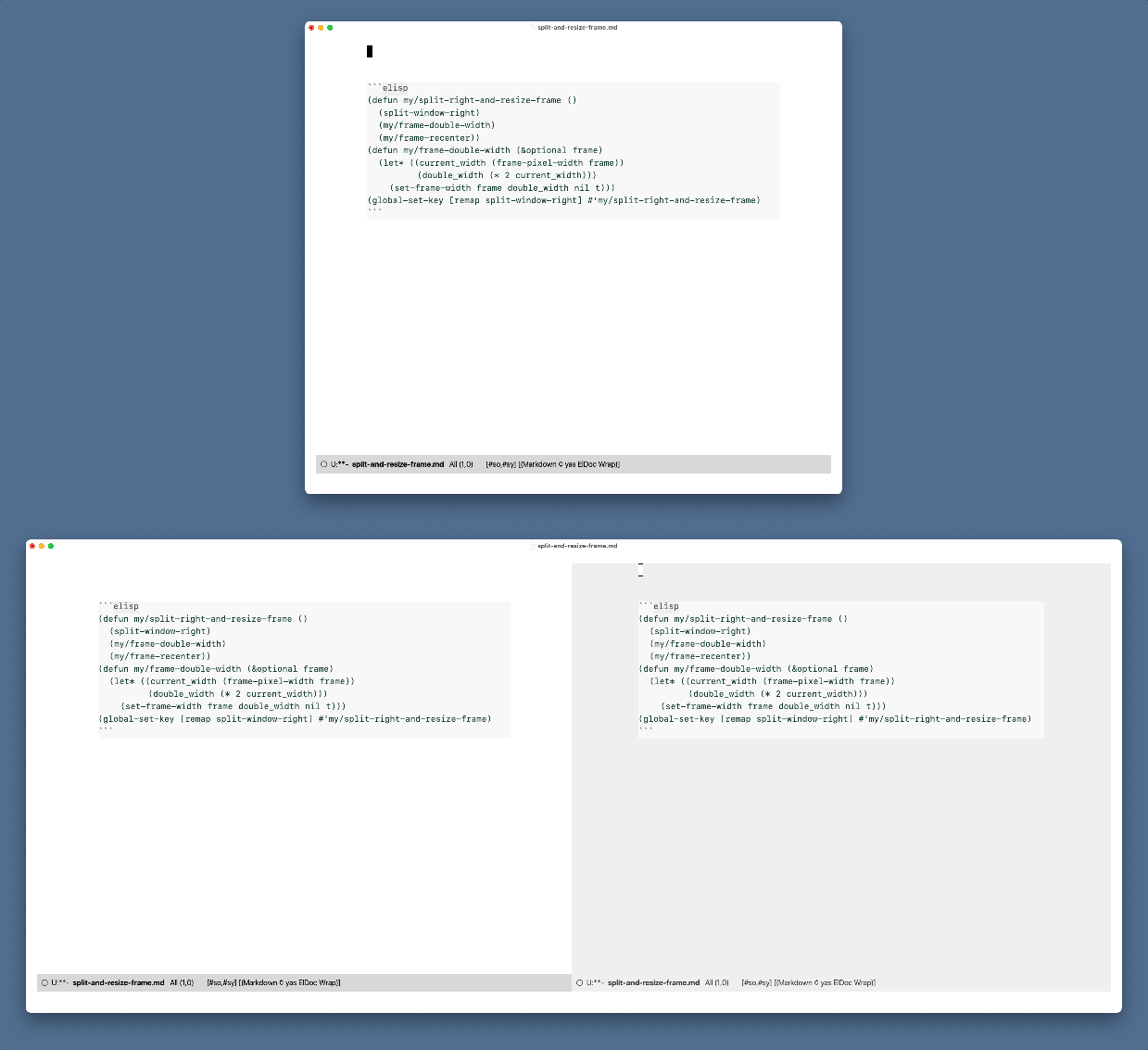
TODO: exploit this elisp for {get, set}ing frame and monitor width (and presumably height), exploit for emacs startup
I got an email by reader Andrej this week, asking about ways to (ab)use frame recentering in Emacs so that when a split window is created, the frame would grow to make room.
So if you have a frame with 1000px width, and split the window to the right, it should enlargen to 2000px width. And then recenter.
The code turned out to be surprisingly easy. Maybe I’m just getting accustomed to all this Emacs stuff. (That’s happy news, in case you weren’t sure!!1)
This is a Grayzone livestream rather than a Pushback episode per se, but still excellent. 1st 40-ish minutes is an interview with the Russian deputy UN ambassador Dmitri Polyanskiy, mostly about the "Ukraine crisis" currently being manufactured by the Anglophone deepstate and its corporate-funded media mouthpieces. After that is ~60 min of Blumenthal-Maté banter, mostly on same topic but more wide-ranging (and funnier).
Aaron Maté and Max Blumenthal speak with Russia's Deputy Ambassador to the United Nations, Dmitri Polyanskiy, on escalated tensions on the Russian-Ukraine border, US accusations of an imminent Russian invasion, and the context missing from a US media that refuses to interview Russian officials.
Guest: Dmitri Polyanskiy. Russia's Deputy Ambassador to the United Nations.
EXCELLENT too-short (< 23 min) author interview about a "Smalltime" (book title) Sicilian mini-mob running gambling (which useta be illegal in the US! hard to imagine now) in Johnstown PA (50-ish miles east/upstream of Pittsburgh on the Allegheny River) during the height of its steeltown affluence (and population--then ~= 70k, now ~= 20k) from 1933 (and thus the end of Prohibition, which gets discussed a bit but seems to be more scene-setting than subject) to ~1970 (when the collapse of the US steel industry--the economic foundation of western Pennsylvania at the time--accelerated). Shorto (the author) makes the point that this story is just one case study among hundreds of similarly small-scale criminal organizations operating in (what I would call) the US economic periphery (i.e., small-to-medium cities outside the major (mostly coastal) metropolitan areas, but also at the fringes of those metros). Shorto also discusses this as a work not only of oral history, but of family and community memory.
Writer Russell Shorto's grandfather was a mob boss in a small town in Pennsylvania.
He ran an extensive gambling-based enterprise.
This background was rarely talked about in Russell's family, so the decision to delve into the past was a difficult one.
EXCELLENT, esp discussions of how bluestone movement was probably done, and overview of the development/use of the site c3000-c2000 BCE
In the first episode of a two-part special, archaeologist Mike Pitts answers listener questions on the most famous prehistoric site in Britain. Speaking to David Musgrove, he discusses how Stonehenge was built – and why.
(Ad) Mike Pitts is the author of How to Build Stonehenge (Thames & Hudson, 2022). Buy it now from Waterstones:
NOTE: as of 1830 UTC H 17 Feb 2022, BP's backend seems to have changed how they handle audio downloads or requests:
Formerly, I successfully 'just plain downloaded' the audio link from the feed, which then as now was prefixed (aka has domain=) 'traffic.megaphone.fm'. Today, however, that audio link silently fails: it gets one redirect, which `curl` apparently cannot handle. After fiddling a bit (to no end) and looking for a support/contact option via Megaphone, Simplecast, and breakingpoints.com (with nothing at latter, and options only for content providers @ former 2), I stumbled upon the following procedure, which works (not sure why, and I've been downloading web-delivered audio about as long as there's been MP3):
1. Open feed's audio link IN BROWSER (in new tab). 2. Browser seems to handle the redirect, which is to a URI with 2.1. prefix=dcs.megaphone.fm (vs traffic.megaphone.fm in feed) 2.2. same path as the feed URI (today path=BRPL3027117884.mp3 ) 2.3. a new (but still single/unique) query string: - currently-broken/feed URI's query key='updated', with a 10-decimal-digit query value - working/redirected URI's query key='key', with a 32-octal-digit query value - (MOST IMPORTANTLY) the query for the currently-broken/formerly-working feed URI was in the past always discardable. (Note today that using the feed URI fails either with or without the query: i.e., either truncating the feed URI at the '?' or using it as given.) However the currently-working/redirected URI works *only* if {unedited, query not removed}. So ... 3. Copy the new/redirected URI from the browser (which seems to be streaming, instead of streaming and downloading, but ICBW) to `curl` for all the usual scriptable goodness.
Krystal and Saagar talk about Ukraine's response to American media warmongering, NBC spreading propaganda from Ukrainian Nazis and the US deep state, Canada's targeting of Trucker bank accounts, woke school board recall elections, CNN drama causing a meltdown behind the scenes, how Democrats lost the working class, dangerous comparisons of Putin to Hitler, and the history of corporate elites selling out to China!
 Before and after the split