Tom Roche
Shared posts
Why is Pentecostalism on the rise?
Tom RocheNote that, as of 1800 UTC H 17 Feb 2022: audio abends @ 10:14, but the segment page @ http://www.abc.net.au/radionational/programs/latenightlive/why-is-pentecostalism-on-the-rise/13757432 claims duration=26:12. Fix requested via ABC website.
Radio War Nerd EP 316 — Russian Gas Pipelines & Politics, with Ben Aris
Tom RocheVERY EXCELLENT data-packed RWN episode! Mark and John start with mocking the increasingly witless Ukraine insanity of NATO thinktanks (esp Melinda Haring @ Atlantic Council) and elites (esp UK Foreign Minister Liz Truss) and US mass-oriented corporate-funded media (CFM), esp the warhead's predictions of Russian invasion (esp the predictions' time-specificity). M&J predict that, when R does not invade, NATO and Anglophone elites will declare victory ("it didn't happen because we revealed their plans!"). M&J look at parallels between 2008 Georgia and 2022 Ukraine, esp in USCFM coverage/portrayal.
Ben Aris interview starts @ ~27 min, includes
- tribalism in Anglophone CFM: one must either demonize Russia or be "on their side"
- history of first Soviet and now Russian gas supplies to Europe
- declining importance of Russian fossil-fuels (esp gas) to EU+Turkey economy as Europe has diversified--but now EU's own gas fields (e.g., Norway, Netherlands, UK) are declining (more below) (but LNG, below)
- pipelines as "geopolitical equivalent of getting married" for ~30-year pipeline lifetime. This works on both sides: supplier (e.g.) is locked-in to customers on pipeline route ... unless supplier decouples and sells LNG (which currently sells at premium to pipeline gas, due to larger market) to any consumer with an LNG terminal.
- German/BRD elites don't want to depend on unreliable Druzhba pipeline (through Donbass and Ukraine), want Nord Stream 2 (direct Russia-BRD via Baltic) instead
- Nord Stream 2 is ready-to-go since before Dec 2021, but US/NATO pressured BRD to halt regulatory approval
- post-fracking US is now a major exporter of LNG to EU, but LNG remains a small part of overall EU gas consumption
- US elites are pushing Europe to replace consumption of Russian pipeline gas with LNG, but doing that at scale would force competition with Asian consumers (esp Japan), essentially creating a global spot market with massive price increases.
- invading Ukraine makes no sense for Russia, whether security or gas market. Gazprom regrets 2006 cutoff (after U reneged on payment), and is (and has been since USSR days) very focused on contract compliance.
- Ukraine elites' and oligarchs' records of interfering with (and outright stealing gas from--esp Timoshenko) Druzhba pipeline, and dependence on pipeline-transit fees.
- ... and problems with Belarus-transiting pipeline
- varying routes, increasing numbers, and diversification of Russian pipelines (inc Druzhba, Nord Stream 1, Nord Stream 2, Yamal Europe, Turk Stream--BA calls these the "western trident") will allow R to cut Ukraine off if necessary, which threatens Ukraine state and elite finances. (see BA article 'How a V-shaped market and aging pipes and fields sent gas prices soaring')
- BRD elites and consumers very much want the price relief NS2 would provide (from winter 2021-2022 "gas crisis" shortage). BRD elites submitted to US pressure to pause its approval/startup, but Schultz etc have pushed back in recent "Ukraine crisis." (Notably, both Baerbock and Schultz have refused to commit to rejecting NS2 *even in case of Russian invasion of U*.) Ultimately, "business always comes first": e.g., EU trade with Belarus increased over past 3 years of attempted color revolution against Lukashenko.
- recent huge increase in Ukraine-representing US lobbying (i.e., buying US elites), now even larger than Saudi.
- Turk Stream pipeline: transits Black Sea-Turkey-Mediterranean, provides customers in T, Balkans, southern Europe. Turk Stream has already cut Ukraine transit revenue (from gas formerly shipped via Druzhba) by 1/3. Erdogan totally resists US/NATO pressure.
- {Biden regime, US elites} is threatening BRD with sanctions if both [R invades U, BRD approves NS2 anyway]. Schultz visit to US is about pushback. (EU economic elites are already and increasingly opposed to US global economic/financial sanctions regime.)
- gas pipelines don't connect *nations* (BA says "Russia is not a giant balloon filled with methane"), they connect specific gas fields with specific customers. Hence Druzhba gas will inevitably decrease over time (despite its capacity), because the pipeline is old-and-leaky, and even more importantly, its input NPT fields (in western Siberia) are nearly finished. By contrast, the new and newer-technology NS2 pipeline is link to new Arctic Yamal fields coming online. Hence, "Ukrainian [gas] business is dead" no matter what NATO and U elites want to force R to do, because there is no Arctic-U gas interconnect.
- Russian gas to PRC comes from yet another, southern-Siberia field. R-PRC gas shipments are still quite small relative to R-EU, but R has plans to build a "really-long" pipeline Yamal-PRC, but "that will take a decade."
- NATO blaming EU gas {crisis, high prices} on Putin is ridiculously false. (See "V-shaped market" above,) Best explanation for EU gas prices are storage policies, COVID-19, European weather, and EU switching from longterm contracts (with Russia/Gazprom, which US elites hate) to gas spot markets (which are inherently more volatile).
- EU has switched policy (back) to considering nuclear energy as "green"
- EU gas fields are in some cases being closed early. Recently Netherlands has started to close (by 2028, possibly earlier) the Groningen field (which still has commercially-extractable gas) due to earthquakes and massive subsidence, which took several BCM of gas offmarket.
- EU elites on Putin and "Russian regime": they see R as massive business partner/opportunity, while NATO (because US) is locked-in to R as rival at best and enemy at worst. BRD is esp heavily invested, also France, Italy, Hungary, etc are friendly, and see P as pragmatic. (Merkel-P meetings mostly about trade.) UK (and "Angloids" via Dan Boeckner), Poland, Baltics are insane Russophobes; they (formerly including UK) use their power to pollute (consensus-run) EU talks, hence R diplomacy is increasingly bilateral rather than multilateral (with EU or NATO). BA believes Schultz will continue Merkel policies/relationship.
Unfortunately
- BA repeats the old/tired renewables-need-baseload and gas-is-clean arguments. Particularly, no discussion of methane radiative forcing.
- no discussion of chemical industry's need for gas as feedstock
- no discussion of why LNG is more expensive to *consume* than pipeline gas
- insufficient discussion of *eastern* Russia-Asia pipelines/markets (esp with PRC, Japan)
- no discussion of BRD Green Party (esp warhawk now Foreign Minister Annalena Baerbock) and its astonishingly aggressive official foreign/military policies
James Cash: Automaking Prolog
Tom Rocheamazing that Prolog (possibly the weirdest programming language ever) is still going after all these years ...
I’ve been gradually building some little tools for myself to enhance the web development experience in Prolog. My “day job” is still primarily Clojure, but I really enjoy using Prolog and I’d like to bring the experience of building web apps up to par.
I couple of years ago, I made a pack for generating CSS from Prolog terms (in the style of Garden for Clojure). It was nice enough and made it possible to write more of the parts of a web-app in (SWI-)Prolog, in conjunction with the built-in html_write library for generating the HTML with DCGs (analogous Clojure’s Hiccup), but the lack of a nice story for client-side javascript made building the sort of very interactive things I do with Clojure + Clojurescript not as feasible.
I’d looked at doing some shenanigans, using pengines and vue to have some sort of “live” experience while mostly writing Prolog, but I didn’t love that approach.
More recently, having started using Girouette in Clojure to do styling in the manner of Tailwind and really liking that approach, I ported Girouette to Prolog (a pretty fun exercise in itself!). With this, I had a very nice way of generating styled HTML in Prolog, but the interactive piece was still missing.
I got a final piece of inspiration from reading about Phoenix’s “LiveView” and Rail’s “Hotwire”. This seemed much easier than the “boil the ocean” approach of running Prolog on the client side and so, I hacked together a little single-js-file library that implements just enough of the “live HTML” idea to work.
I put together a little Proof-of-Concept TODO-list type thing (source here) and then, more recently, a Wordle “assistant” (source).
Building that was quite fun; I was pleasantly surprised how well just that tiny bit of javascript worked to let me build a usable little site.
It also has the nice attribute of gracefully degrading – if you use the sites with Javascript turned off, they still work fine!
Deploying is also very smooth – I just pull the repo with the code on the server, connect a top-level to the running process, run make and boom, Prolog automatically re-compiles the changed predicates and the app is updated seamlessly.
There was just one nagging little thing that was bugging me in my dev experience.
While the “tailwind” watcher would automatically update the CSS when the files containing the code changed, I would have to remember to also reload the code, so when the page refreshed, the server was sending the corresponding new HTML.
It’s easy enough to do – C-c C-z to switch to the *prolog* buffer, make. to recompile, refresh, continue – but it was easy to forget and would knock me out of my flow.
Having the CSS update just as the file changed made me subconsciously expect the rest of the code to work the same way, I think.
That, in addition to some comments on the SWI-Prolog Discourse, planted the idea in my head that I should build something that would automatically run make. whenever any dependent files changed.
Prolog already knows which files are of interest and I’d used inotify before, so it seemed straight-forward enough to do.
The wrinkle though was that I knew using inotify by just using the pack would limit my tool to only working on Linux.
I’d had issues previously with someone unable to use my tailwind_pl library because it depended on inotify, even though it was only needed at “dev time”, not if one wanted to just one-off generate the CSS.
Since there isn’t (yet?) a way to have conditional dependencies in packs, I’d handled the tailwind case by splitting it into two libraries: The main tailwind_pl pack that contains the file-watcher code and tailwind_pl_generate that depends only on my css_write pack and should work anywhere.
In this case though, it would be nice if I could just make it work on multiple platforms.
As I’ve written about before, SWI’s FFI is quite nice, so it was short work to put together a little “foreign module” in C that uses inotify on Linux and kqueue on macOS to monitor for file changes, then write a tiny bit of Prolog to use that module to run make as needed.
Pretty slick!
However…I didn’t want to also leave Windows users out in the dark (they already suffer so much, the poor dears). I don’t have access to a Windows machine, but Jan suggested cross-compiling with mingw64 plus Wine to test. He’d already made a docker image, which he uses for creating the Windows builds of SWI, so it was straightforward enough to get that all set up.
Well, in theory. In actuality, it took me longer to figure out how to use docker, the various flags I needed to pass and environment variables I needed to set to build a dll than it took to actually write the code, but I persevered. Using the API was pretty simple, although Windows’ versions of inotify/kqueue, as best I can tell, only lets you monitor directories for changes, not particular files. Not a huge deal for my use-case – it might create redundant watches and be triggered unnecessarily, but that’s not really much of a problem.
Once I had this working though, I wanted someone to be able to test it on Windows.
However…just running pack_install/2 failed, since it needed a toolchain to be able to build the foreign library and my very generous test subject didn’t have MingW or MSys installed.
That instilled my next idea: I’d started trying to use sourcehut more, so why not take advantage of its features and set up a .build.yml to do the cross-compilation?
That would take care of two things, if I could get it to work:
Firstly, Windows users would be able to just download the file with the DLL in it and not need a tool-chain installed.
Secondly, I could make the build stage generate a zip, so I could use a simpler pack_install incantation.
Previously, I’d had to install the pack from git, which necessitated passing several options to pack_install and was kind of a pain, because sourcehut only automatically generates a tar.gz archive for releases, but library(pack) gets confused by the double suffix.
So, with ropes.pl as a convenient example, I dove in. It took the better part of a day of watching jobs fail, editing the manifest, re-running, and watching it fail in a new way, but I finally got it working! I have to say that the experience of debugging was actually fantastic. The fact that sourcehut lets you edit a failing build manifest and re-submit it without having to make a new commit definitely saved my sanity, not to mention that it lets you ssh in to the failed build server so you can poke around and see what’s what. Without those two things, I probably would either still be at it now, or have finally renounced all my worldly possessions and moved to the woods.
As all my Prolog posts seem to conclude, I really do like this language and ecosystem.
I would submit that it has Christopher Alexander’s “Quality Without a Name”; it just makes one warm and fuzzy to be working with.
If you happen to be a Prolog developer, check out automake and let me know what you think!
The next thing I’d really like to add is some sort of “hook” to be run after make; that would let me use that instead of inotify directly for my tailwind watcher and would also let me rig up some neat thing to make the browser automatically update as well…but I do have actual work that I need to get to at some point.
Soon!
For more implementation details, see part two
Please Use Other Door
Tom RocheVERY EXCELLENT funny short (pretty sure none exceed 3 min) weird ensemble skits, resembling audio Monty Python. (In fact, the final skit is *very* reminiscent of MP's famous [Argument Clinic](https://en.wikipedia.org/wiki/Argument_Clinic). 'Please Use Other Door' was created and produced by one of the BBC's comedy greats, Bill Dare.
602 - Crypto Bowl (2/14/22)
Tom RocheCTH 602 is just banter but consistent good, mostly on Super Bowl LXI's commercials and halftime show (great takes on Larry David cryptocurrency-trading ad, good edit from Chris on 50 Cent), but ending with David Axelrod's bizarre advice for Joe Brandon's upcoming State of the Union (plus numerous slams on Axelrod, Obama, Biden, and a few other Corporate Democrats).
We take our semi-annual look at the Super Bowl through commercials and what they predict about our future. Then it’s back to Joe Brandon as we discuss former Obama aid David Axelrod’s advice to POTUS on how to navigate his upcoming State of the Union address.
Tickets for our southern tour still on sale here: chapotraphouse.com/live
Stand-off at the Ukrainian Corral
Tom Roche"The Punch Out" continues excellent run, esp VERY EXCELLENT 3rd/final segment (starting 12:08 in the audio). Puryear explains how, with the 11 Feb 2022 motion from special counsel John Durham, Russiagate is an increasingly potent scandal (despite complete blackout from most mass-oriented US corporate-funded media) for Hillary (and the corrupt Clinton Foundation and HRC campaign), Obama (and his VP Biden), and the US Corporate Democrats generally. While Puryear is appropriately hesitant/skeptical (correctly noting that Durham's most-recent allegations have not yet been tested in court, and Sussmann, Joffe, et al have so far pleaded innocent), he ends with following pullquote (starting 17:52):
> If highlevel officials in either [of the elite-permitted US parties] are able to use their establishment connections and money to falsely smear people as agents of a foreign power, up to and including breaking the law, in order to win an election, that's something that does deserve to be known and revealed.
On Today’s Episode of the Punch Out:
US-Russia Tensions Continue
Nevada Death Penalty Debacle
Russiagate Still Going?
Long Reads: John Foot on Italy's Two Republics From Anti-Fascism to Anti-Politics
Tom RocheExcellent survey of Italian politics (with some economics and culture) 1945-2021. Foot makes convincing claim that political innovations in Italy--for good and ill--eventually propagate to rest of "the West" *including* the Anglosphere.
John Foot joins Long Reads for a discussion about Italy from the era of partisan resistance to the current predicament of "post-democracy"—and a resurgent right wing. John is professor of modern Italian history at the University of Bristol. His works include The Man Who Closed the Asylums: Franco Basaglia and the Revolution in Mental Health Care and The Archipelago: Italy Since 1945.
Long Reads is a Jacobin podcast looking in-depth at political topics and thinkers, both contemporary and historical, with the magazine’s longform writers. Hosted by Features Editor Daniel Finn.
Read John's article "Closing the Asylums" here: https://jacobinmag.com/2018/05/asylum-franco-basaglia-psychiatry-mental-health
Produced by Conor Gillies, music by Knxwledge.
See acast.com/privacy for privacy and opt-out information.
Michael and Us: Rorschach Tests
Tom RocheVERY EXCELLENT
What happens when the UK's Minister for International Development accidentally calls an inevitable war "unforeseeable"? We discuss Armando Iannucci's beloved political satire IN THE LOOP (2009) and what it says about the culture of spin in U.K. politics. PLUS: further developments in the Canadian trucker protest, and thoughts on that most important institution of all: the Oscars.
Mayor Ed Koch's movie review show - https://www.youtube.com/channel/UCl1C-jPg7L4nsHg6EVgAXvQ
Michael and Us is a podcast about political cinema and our crumbling world hosted by Will Sloan and Luke Savage.
See acast.com/privacy for privacy and opt-out information.
Sacha Chua: 2022-02-14 Emacs news
Tom RocheTODO: checkout using ({tomato.el, pomodoro, Beeminder})[http://mbork.pl/2022-02-12_tomato.el_update] for time management
- Help wanted:
- Upcoming events:
- M-x Research (contact them for password): TBA https://m-x-research.github.io/ Tue Feb 15 0800 Vancouver / 1000 Chicago / 1100 Toronto / 1600 GMT / 1700 Berlin / 2130 Kolkata – Wed Feb 16 0000 Singapore
- Emacs Berlin (virtual, in English) https://emacs-berlin.org/ Wed Feb 23 0930 Vancouver / 1130 Chicago / 1230 Toronto / 1730 GMT / 1830 Berlin / 2300 Kolkata – Thu Feb 24 0130 Singapore
- Emacs APAC (virtual, in English) https://emacs-apac.gitlab.io/ Sat Feb 26 0030 Vancouver / 0230 Chicago / 0330 Toronto / 0830 GMT / 0930 Berlin / 1400 Kolkata / 1630 Singapore
- Beginner:
- Emacs configuration:
- Irreal: Emacs Extensibility
- A few cases of literate configuration (Reddit)
- How to show (temporary) cheat-sheet buffer
- Emacs from Source Part 6: Fixing initial evil-mode states and keybindings (14:03)
- /sqrtminusone's Emacs config (Reddit)
- System Crafters Live! - Rational Emacs: A New Base Configuration (01:54:29)
- Emacs Lisp:
- Appearance:
- Navigation:
- Dired:
- Writing:
- Org Mode:
- Sharing some appreciation for how useful org-mode is in my life
- Humanities Dissertation in org-mode? Some Thoughts
- Task Repeaters in Org Mode
- Pretty rendering of paragraphs with org-view mode
- Org Mode Headlines in Org Source Blocks
- journal with the use of org-mode
- Data Analysis with Emacs Org Mode: Tables and AWK Source Blocks (17:34)
- Jeremy Friesen: Org Roam, Emacs, and Ever Refining the Note Taking Process
- Plain Org v1.2 released (Reddit)
- Time management:
- Import, export, and integration:
- Completion:
- Coding:
- Building an Intelligent Emacs with LSP (Reddit, HN)
- Irreal: Some Comment Tips from Mickey
- Emacs Macros and HTML (02:53)
- js/react emacs config review
- I finally got full auto-competion in Swift with emacs, here is how: - xcodeprojects
- User Scripts in mpv with Lua (with Lua LSP setup in Emacs) (36:13)
- Connect to existing REPL · Clojure development with Spacemacs & Cider
- Emacs from Source Part 5: Rust setup with rustic (17:43)
- Go Live Coding in Emacs Part 3: Refactoring Input File Parsing (01:01:22)
- Moldable Emacs: learning syntax from your editor! (Reddit)
- Math:
- Science:
- Shells:
- Mail and news:
- Multimedia:
- Fun:
- Emacs as my DnD environment (Follow-up)
- dnd-mode: A minor mode for playing DnD
- org-dnd-srd: System Reference Documents for DnD written in org files to be searchable and interactive when in emacs
- emacs-dnd5e-api: An Emacs interface to the DnD 5e SRD API
- decide-mode: Random decisions for emacs, with functions and a minor mode. Roll various types of dice etc.
- Community:
- Other:
- Emacs: Search Engine Mode 2022_02_13_03:14:23 (09:36)
- Edit browser textarea with Emacs - Chromium/Firefox
- Why MSYS was developed
- Emacs development:
- Continued discussion re: sqlite3
- Continued discussion Re: Can watermarking Unicode text using invisible differences sneak thro
- Note caveat about remapping basic faces
- Add a mechanism for querying before executing a command
- Add a new macro `setopt'
- Remove the 'C-k' binding in ido-mode
- Make `C-u M-x count-words' also give totals
- Optionally allow point to enter composed character sequences
- Allow customization of the user's eln-cache directory
- Mention `overlay' show-paren-context-when-offscreen value in NEWS
- Make connection-local variables user options
- New packages:
- helm-twitch: Navigate Twitch.tv via `helm' (MELPA)
- org-journal-tags: Tagging and querying system of org-journal (MELPA)
- org-remark: Highlight & annotate any text files (GNU ELPA)
- paimon: A major mode for Splunk (MELPA)
- simplicity-theme: A minimalist dark theme (MELPA)
Links from reddit.com/r/emacs, r/orgmode, r/spacemacs, r/planetemacs, Hacker News, planet.emacslife.com, YouTube, the Emacs NEWS file, Emacs Calendar, emacs-devel, and lemmy/c/emacs.
Thanks to Andres Ramirez for a few mailing list links!
Alvaro Ramirez: Plain Org v1.2 released
Tom Rochewhere is the Android ?-(
13 February 2022 Plain Org v1.2 released
Although Plain Org v1.2 has been in the App Store for a little while, the release write-up was overdue, sorry. The update receives some new features and bugfixes.
If you haven't heard of Plain Org, it gives ya access to your org files on iOS while away from your beloved Emacs.
If you're finding Plain Org useful, please help support this effort by getting the word out. Tell your friends, tweet, or blog about it.
Ok, now on to what's included in the v1.2 release…
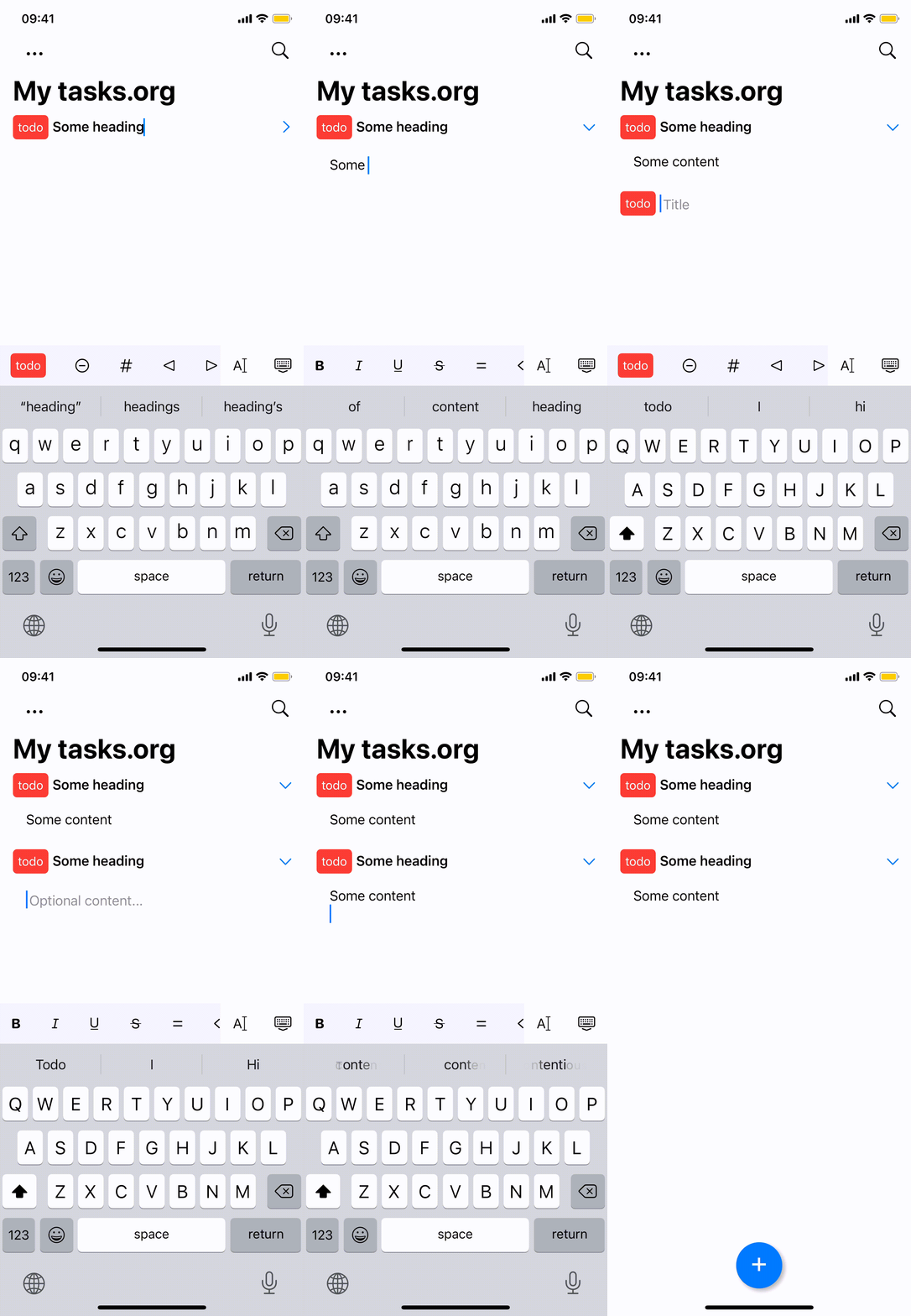
Edit heading sections inline
v1.0 introduced outline editing (for headings only). In v1.2, we can also edit section content. Press the return
key multiple times to exit out section editing.
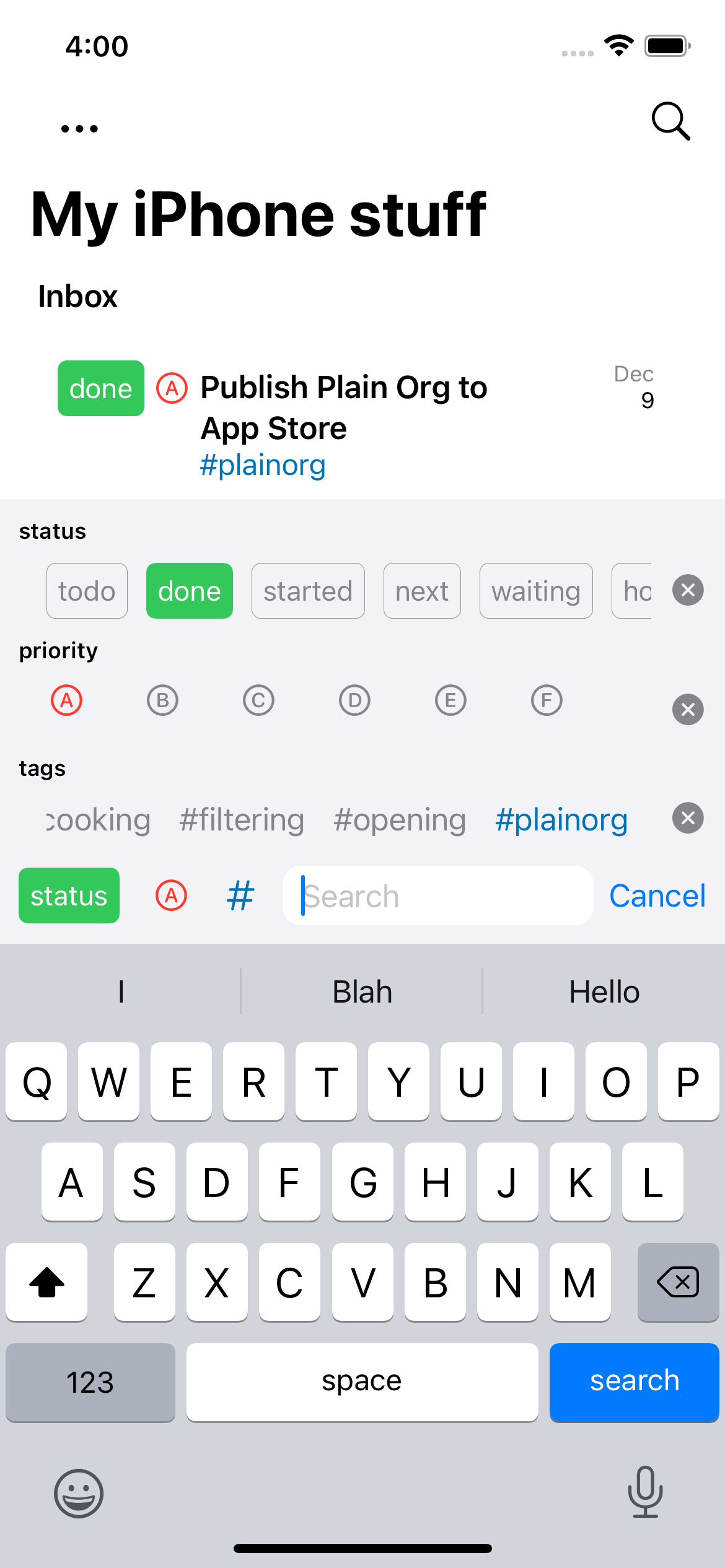
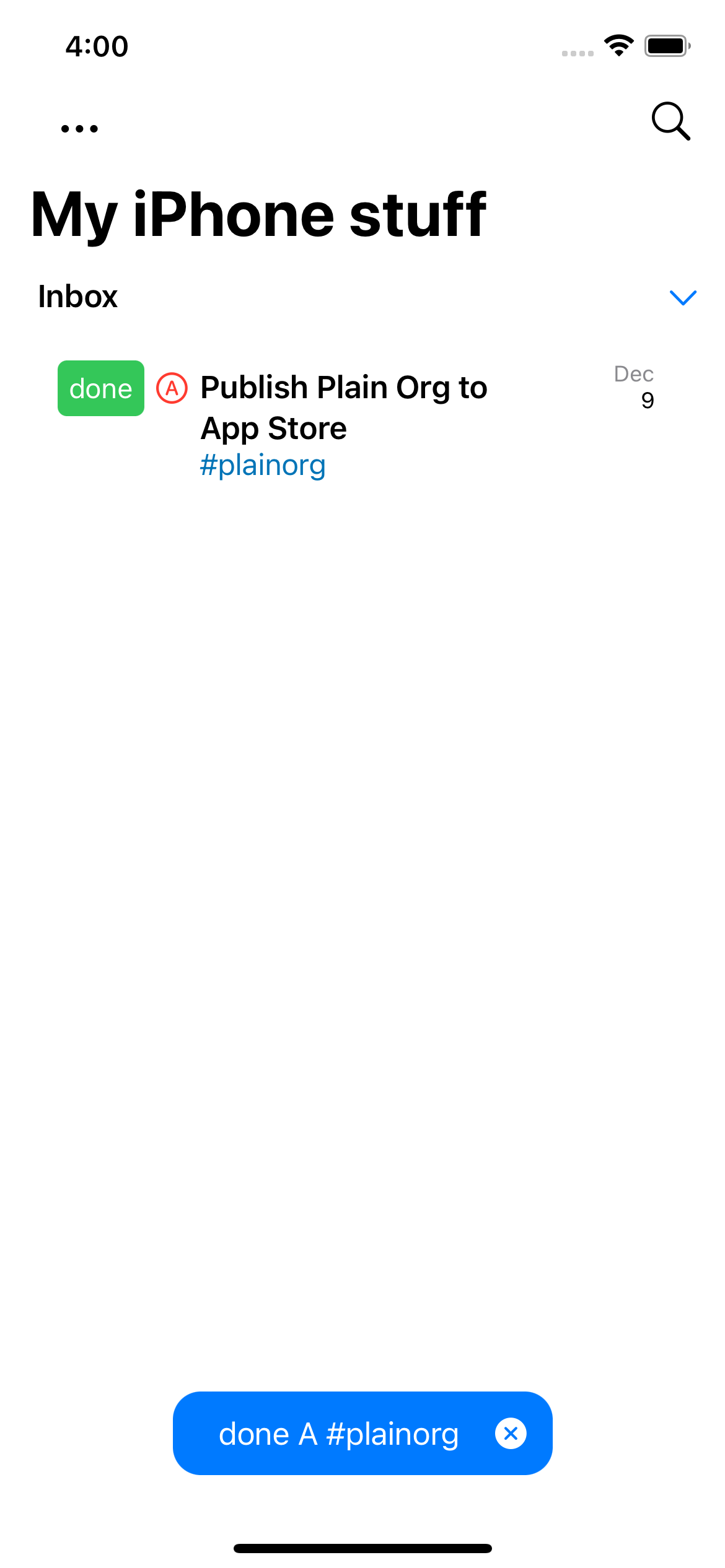
Filter by keyword/priority/tag
From the search dialog, you can now filter by keyboard, priority, and tag.
Render drawers and properties
Drawers are now rendered and can be expanded to view their content.

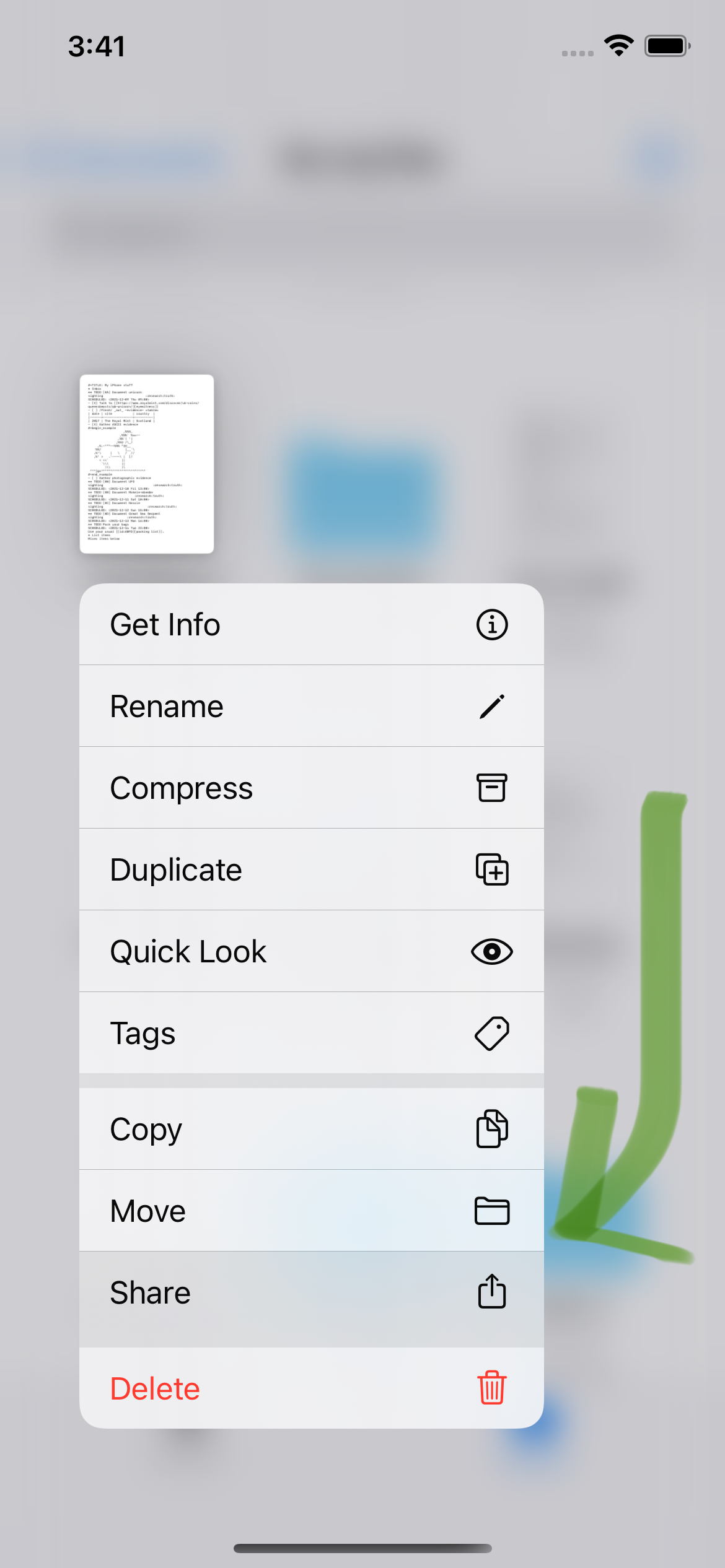
Open files via the Files app's "Share" sheet
From the Files app, you can now explicitly request launching files in Plain Org by using the "Share" menu.
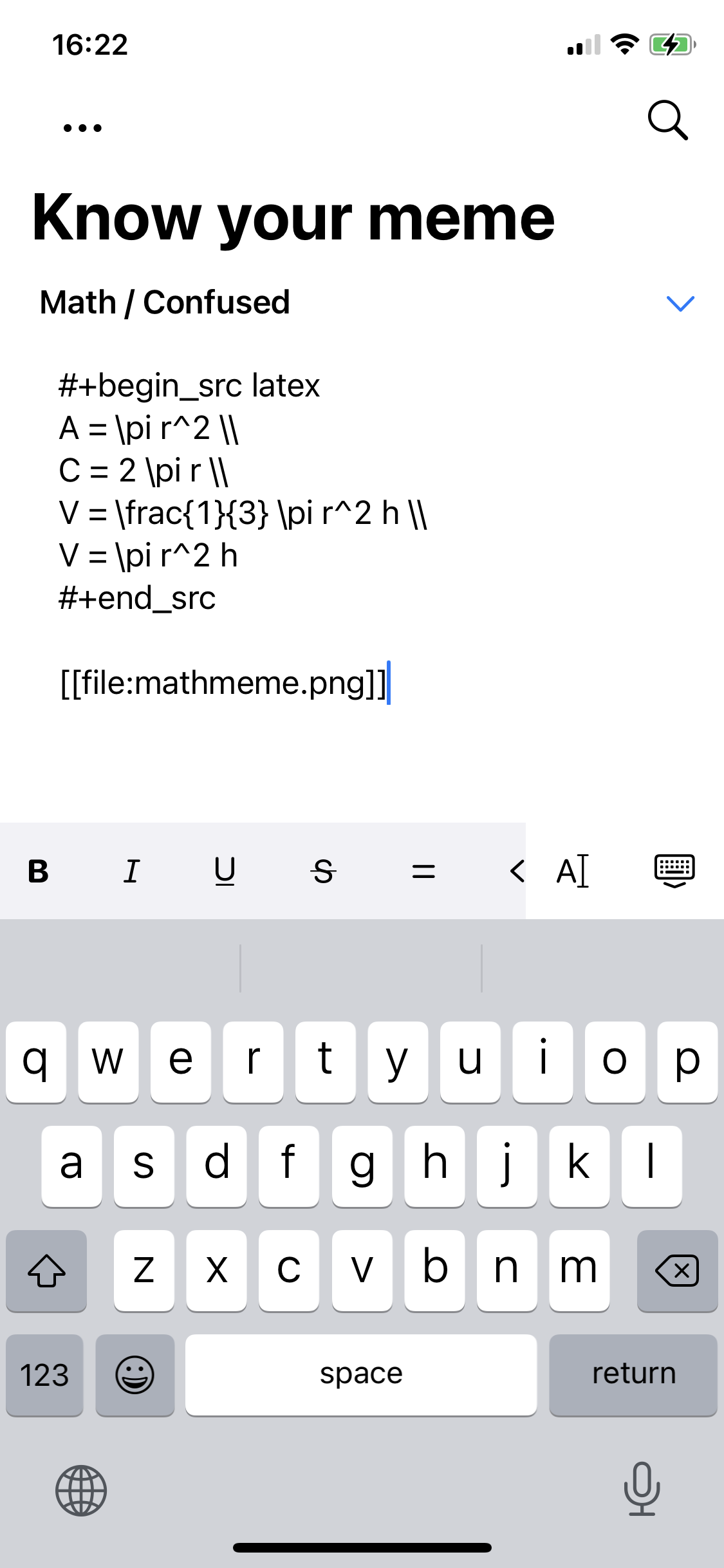
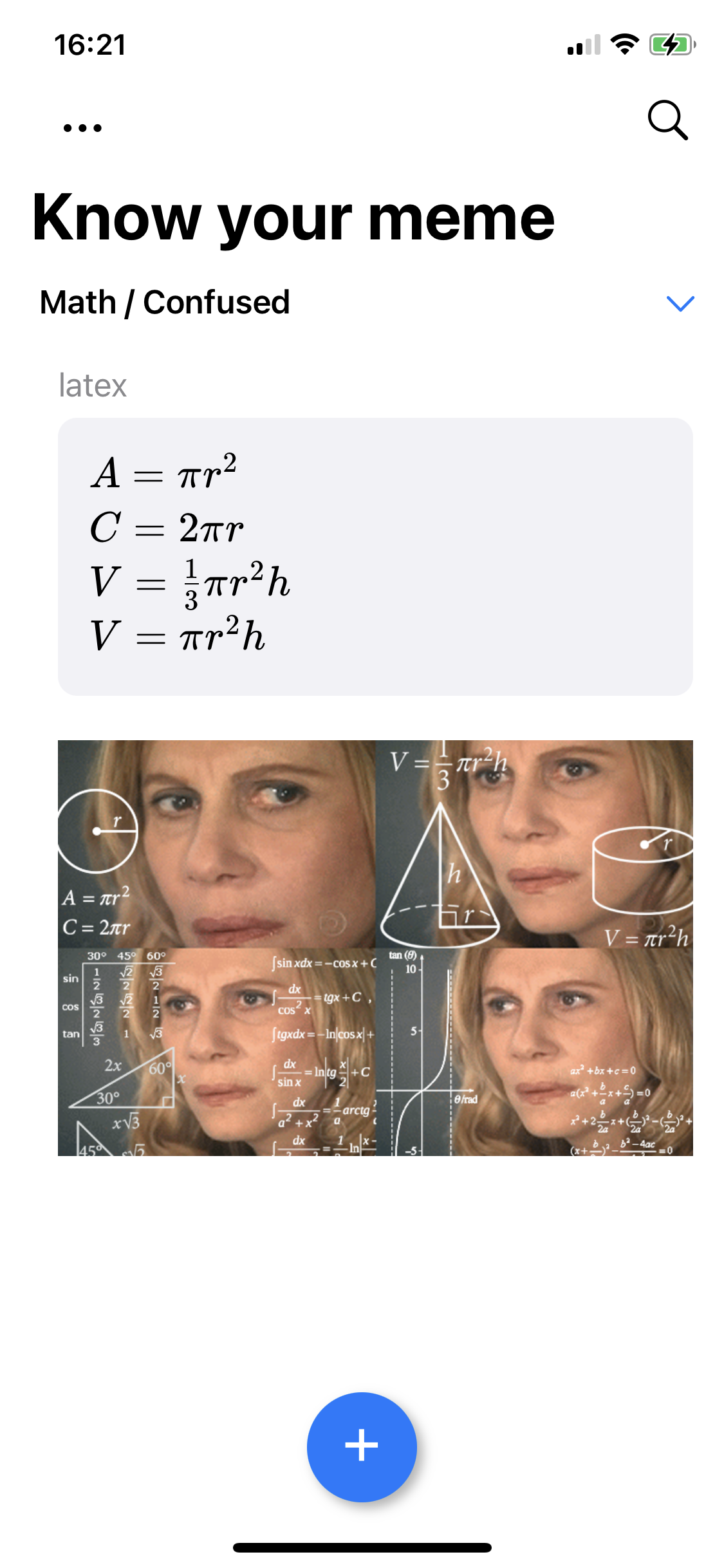
Render LaTeX src blocks (experimental)
This one has its rough edges at the moment, so have to mark it experimental, but… you can can now render #+begin_src latex blocks.
Insert title/id in new files
New files created via Plain Org automatically get #+TITLE: and :ID: inserted by default as follows:
#+TITLE: My favorite title
:PROPERTIES:
:ID:       7C845D38-8D80-41B5-BEB1-94F673807355
:END:
UPDATE: Sorry, this feature currently has a bug. You may not get these values inserted into your new document. Working on a fix.
Adding new tags quicker
Add tags quicker via the new + button.

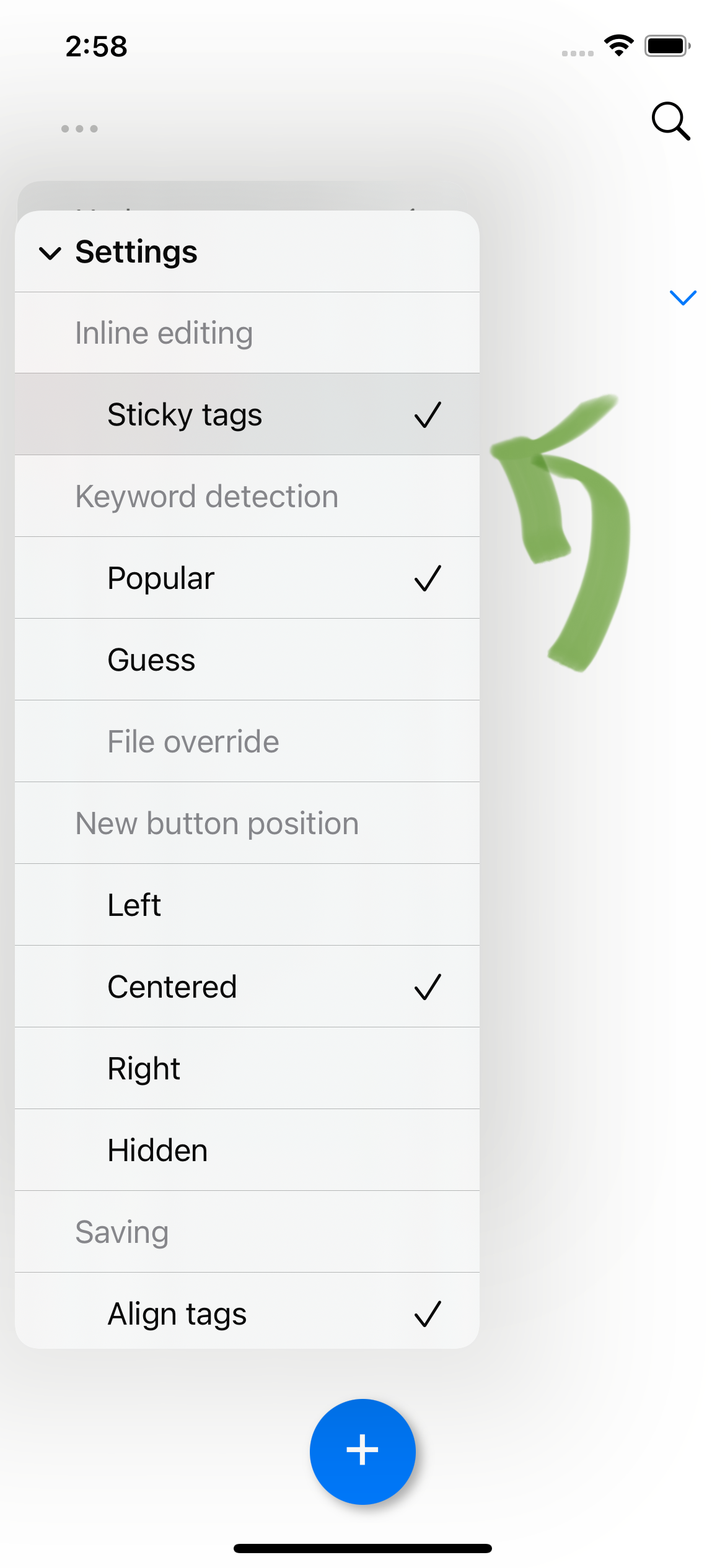
Enable/disable sticky tags
Keywords, indent, and tags are maintained when adding new headings via outline editing. If you prefer disabling sticky tags, this can now be disabled.
Improved navigation bar
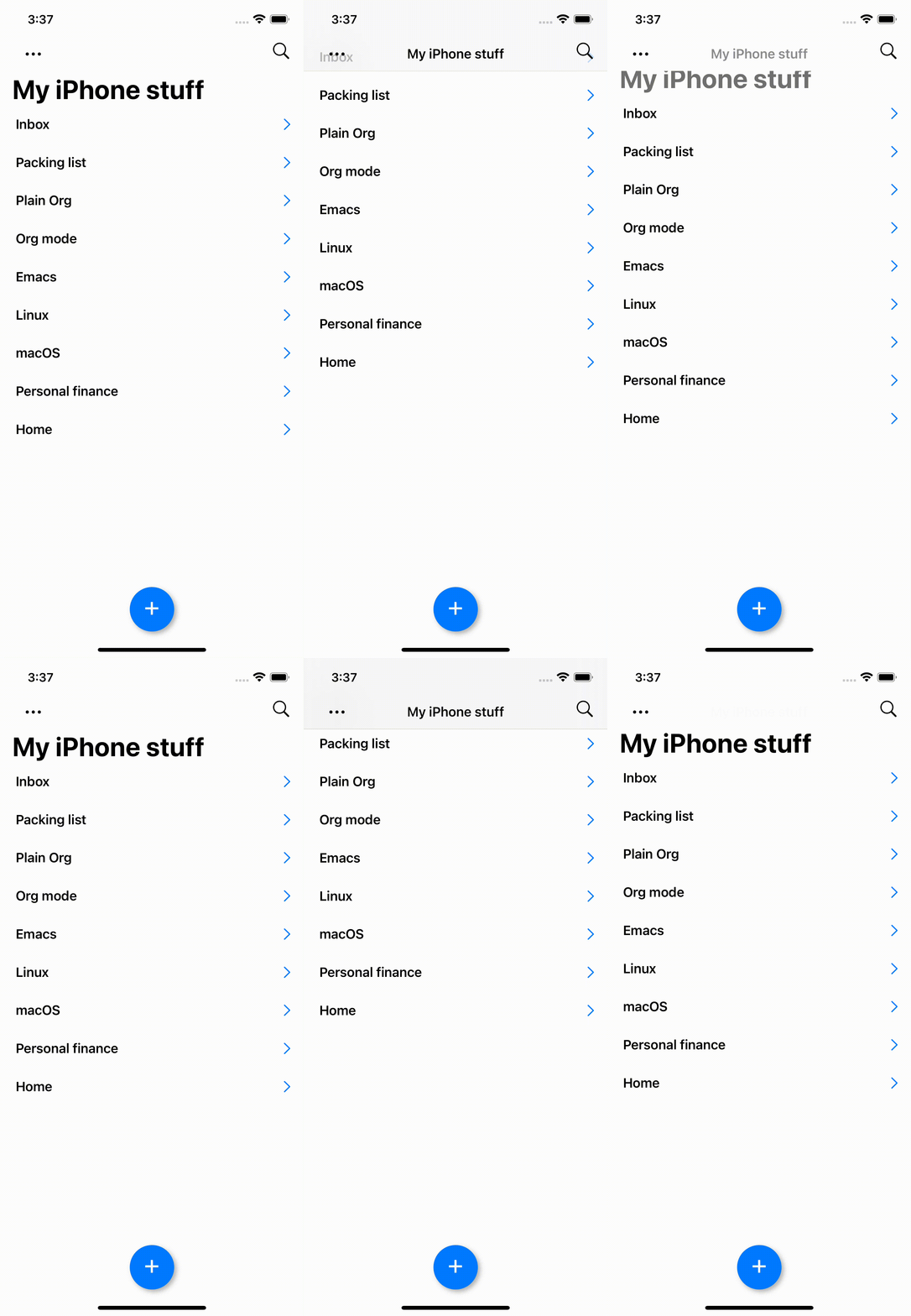
v1.2 makes the navigation bar feel more at home on your iPhone. It uses a large title which scrolls into the navigation bar.
Bugfixes
- Fix table rendering for iPad width.
- Fix image's horizontal padding.
- Fix adding new tags on new headings.
- Fix snapshotting bug resulting in Syncthing conflicts.
- Fix tapping menu after presenting other dialogs.
- Filter out parenthesis in file-local keywords like
TODO(t). - Commit pending inline changes if search is requested.
- Fix opening local links inside tables.
- Roundtrip whitespace in empty headings.
- Roundtrip trailing whitespace when raw-editing heading content.
- Tapping on body content should not toggle expansion.

2/14/22: Ukraine Escalation, Trucker Convoy, Clinton Spying, Trump's Toilet, CNN Derangement, Obama's Delusion, Afghanistan Crisis, & More!
Tom Rochemostly EXCELLENT, esp
+ both Krystal and Saagar are great on the Anglophone CFM and US military/foreign-policy Ukraine crisis- and warmongering.
+ KB's radar/monolog on how Corporate Democrats, esp Obama (who she rips mercilessly :-), are planning an UTTERLY DOOMED Trump- and Jan-6-centric strategy for the Nov 2022 US elections.
However, SE's radar/monolog (which is good in its recommendations--esp that US should publicly and in writing commit to NATO *excluding* Ukraine and Georgia) gets some key points about NATO history very wrong, notably:
- NATO (and its precursor and successor alliances) were *not* developed to "contain Soviet aggression" (not a direct quote from SE, but definitely a paraphrase). They were just more weapons for the Global Class War that intensified 1917-1990 (with a pragmatic, time-limited interval to fight fascism), along with Gladio, the ratlines, atomic bombing Japan, and all the other things the Anglophone-led empire introduced *during WW2*. NATO etc were not *reactions to* USSR policy, they were just rebooting the 1917-1940 phase of the Global Class War. (See, e.g., US, UK, and France behavior during the 1936-1939 assault on the Spanish Republic--which was a proxy war more than a Civil War, but I digress.)
- Bill Clinton (et al) did not simply decide to repurpose NATO for humanitarian interventions, as SE explicitly claims. US CorpDems were from the beginning totally sympathetic with US weapons contractors' need to "find a new enemy" in order to terminate the "peace dividend." CorpDems then decided that they could use R2P (and "looking tough," etc) to sell shitlibs on reflating military budgets. (Pro tip--US military has almost nothing to do with "defense," so DON'T call it that!)
Krystal and Saagar cover the latest Biden administration warmongering in Ukraine, Canada's escalation towards the Trucker convoy, Hillary's campaign operation to spy on Trump, the report Trump flushed White House documents down a toilet, CNN's deranged views on Joe Rogan, Obama's terrible midterm strategy for Dems, the real history of NATO, and Biden's decision to steal billions from Afghanistan.
To become a Breaking Points Premium Member and watch/listen to the show uncut and 1 hour early visit: https://breakingpoints.supercast.com/
To listen to Breaking Points as a podcast, check them out on Apple and Spotify
Apple: https://podcasts.apple.com/us/podcast/breaking-points-with-krystal-and-saagar/id1570045623
Spotify: https://open.spotify.com/show/4Kbsy61zJSzPxNZZ3PKbXl
Merch: https://breaking-points.myshopify.com/
Ali Latifi’s work: https://authory.com/Ali
Learn more about your ad choices. Visit megaphone.fm/adchoices
Democracy Now! 2022-02-14 Monday
Tom Roche2nd segment (and headlines): good. 1st segment (interview mostly with the woman formerly known as Eve Ensler) ... is DN! at not-quite-peak identity-cringe, and definitely skippable (though it gets better once "V" goes away)
Democracy Now! 2022-02-14 Monday
- Headlines for February 14, 2022
- V-Day to Earth Day: How Women in 70+ Countries Are Rising to End Violence Against Women & Our Planet
- Climate & Punishment: How Incarcerated People Face Increasing Threat of Fires, Floods & Extreme Heat
Amazon’s Tax Holiday
Tom Rocheall 3 segments EXCELLENT, esp 3rd on Israel's attempt to takeover South Africa's dairy industry. Israel's Milco bought SA-flagship Clover, and is now doing layoffs and cutbacks, plus moving Clover's operations from the logical/lower-cost interior to more-expensive coastal cities ... from where it would be sooo much easier to just import Israel-subsidized dairy ... coincidentally grazed on land stolen from Palestine !-( Of course, US mass-oriented corporate-funded media will provide coverage ~= 0 on this, much less pushback from SA unions or global BDS movement.
On Today’s Episode of the Punch Out:
Amazon’s Tax Holiday
Bloomberg Joins Biden Admin
South African Unions Fight Israeli Company
You Never Know Who’s Listening
Tom Rocheall 3 segs EXCELLENT, esp 1st on Wyden-Heinrich disclosures (just a redacted copy of what they initially protested to the CIA and DCI in *April 2021*) on CIA's bulk-collection spying on US citizens. Note this is NOT just a repeat of the NSA abuses Snowden exposed--new agency, but more importantly, claiming new/older legal authority. Of course, the "FISA court" remains a joke.
On Today’s Episode of the Punch Out:
CIA Spying
Sudanese Struggle Continues
Massive Poison Risk in California
Laugh Out Loud Introduces: True Dating Stories
Tom RocheSKIP!
News Quiz 11th February 2022
Tom RocheEXCELLENT, esp Mark Steel (and host Zaltzman)
After 5-and-a-half series, 44 episodes and 714 days, The News Quiz welcomes a live studio audience once again.
Recorded at the BBC Radio Theatre, this week Andy Zaltzman was joined by Mark Steel, Athena Kugblenu, Hugo Rifkind and Jackie Weaver to look at NHS backlogs, the end of all COVID restrictions in England, a minor reshuffle and a major scientific breakthrough.
Hosted by Andy Zaltzman Chairs script by Andy Zaltzman Additional Material from Alice Fraser, Alex Kealy, Eleri Morgan and Rajiv Karia Production Co-ordinator: Katie Baum Sound Editor: Marc Willcox
The Producer is Gwyn Rhys Davies, and it is a BBC Studios Production.
601 - Convoy feat. Dan Boeckner (2/11/22)
Tom RocheVERY EXCELLENT ep with Matt, Will, and guest, mostly on Canada, Ukraine, and their intersection, inc:
- Freedom Convoy trucker protest is NOT working-class movement, despite the fact that ...
- ... US and Canadian shitlibs want a violent backlash (yes, Matt Yglesias /did/ call for the US Marines to attack!)
- UK (whose inbred elites are increasingly ridiculous) and US (less inbred, more dangerous) are creating the "Ukraine crisis," which actual Ukrainians reject
- western-backed Ukrainians are corrupt "granteaters"
- Ukrainian oligarchs (esp Kolomoysky) run scams and launder money with US real estate
- Canadian Liberals esp Chrystia Freeland backs actual Nazis and corrupt oligarchs esp Poroshenko
- literally Brookings-backed Jewish Yale-y neocon James Kirchick hates being called a warmonger while literally mongering wars for a living
Sr. Canada-Ukraine correspondent Dan Boeckner returns to update us on Canada’s trucker convoy issue as well as their new Queen Romana. Then we turn to Ukraine, discussing the ongoing tensions in the region, as well as how Ukrainian style corruption is working it’s way into the industrial midwest. Finally, a reading series from and old friend reminding folx to be considerate and refrain from using the w*rm*nger slur.
See E1 & Wolf Parade on tour: https://www.e1pod.com/shows
Check out Dan’s podcast The Bottlemen here: https://thebottlemen.podbean.com/
Beijing Winter Olympics: Front line in new cold war on China - with Carl Zha
Tom RocheVERY EXCELLENT (and funny!), esp regarding laughable Anglophone CFM and social-media and corporate-funded media attacks on PRC, esp on
- athletes, esp migrants, esp Gu Ailing aka Eileen Gu
- claims of Uyghur genocide
- infrastructure development in and outside China (the "slow train" bit is really odd)
VIDEO: https://youtube.com/watch?v=tysrspp7KOU
Follow Carl on Twitter at https://twitter.com/CarlZha
You can support Carl's Silk and Steel Podcast on Patreon at https://patreon.com/silknsteel
This is Sus: Homeland feat. Hasan Piker
Tom RocheEXCELLENT Felix-only ep with guest (and occasional contributor--Biederman does tend to take all available air :-) Hasan Piker on the 2011 Showtime series 'Homeland', the making of modern middlebrow TV, and the development of post-911 natseclib propaganda in the Obama Years.
Felix is joined by Hasan Piker to discuss the 2011 Showtime series “Homeland”
You can find Hasan here:
twitch.tv/hasanabi
twitter.com/hasanthehun
instagram.com/hasandpiker
Modeling Forest-Atmosphere Exchange
Tom RocheSINGULAR review of issues in forest land-atmosphere transfers (and their modeling). Note this is a summary of their recent article [Bannister, MacKenzie, and Cai 2022](https://agupubs.onlinelibrary.wiley.com/doi/10.1029/2021RG000746 )

Editors’ Vox is a blog from AGU’s Publications Department.
In order to survive, plant life relies on exchanges with the atmosphere. These exchanges are particularly complex in forests where they are affected by a variety of microbes and animals and are further complicated by human interaction with the environment. A new article published in Reviews of Geophysics presents recent developments in our understanding of forest-atmosphere exchange. We asked the authors about advances in our understanding of forest-atmosphere exchange and what is still unknown.
What is “forest-atmosphere exchange”?
Forests are landscapes dominated by trees. “Forest-atmosphere exchange” is a catch-all phrase referring to the exchange of “stuff” (specifically, mass, momentum, and energy) between the atmosphere and the trees, other plants, and soil in these landscapes. For example, trees draw carbon dioxide from the air and release water vapor, oxygen, pollen, and a variety of organic compounds.
Forests also exchange huge quantities of heat with the atmosphere, both directly through the sensible heating and cooling of leaves and indirectly as latent heat passing to the atmosphere when water vapor is released.
Forest-atmosphere exchanges have important effects on our weather, climate, and how the whole Earth works as an interconnected system.
The microbes, fungi, and animals living in forests further add to the quantity and variety of exchanges.
Forest-atmosphere exchanges are vital to forests’ physiology and ecology. The exchanges also have important effects on our weather, climate, and how the whole Earth works as an interconnected system.
What tools do researchers use to understand forest-atmosphere exchange?
The three traditional pillars of research for forest-atmosphere exchange are field observations, mathematical theory, and physical scale-models. Many of these techniques were developed to answer applied questions in forestry and agriculture or are extensions of more general fluid flow theory.
By the 1970s and 1980s the development of better sensors and a robust theoretical framework allowed researchers to get at more fundamental aspects of forest-atmosphere exchanges, such as their role in cycling essential nutrients.
With the subsequent advent of high-performance computers, numerical modeling now provides a fourth pillar in the investigation of forest-atmosphere exchange.
At larger time and space scales, remote sensing (from satellites, drones, or tall towers) can infer some aspects of forest–atmosphere exchange, typically through indirect measures such as canopy greenness or changes in atmospheric composition.
How does forest-atmosphere exchange vary between different types of forests and on different scales?
Forest-atmosphere exchanges span time and space scales from milliseconds and millimeters, such as when gases diffuse through a leaf’s stomata, to scales measured in decades and continents, such as when considering the impact of deforestation on the Earth’s atmosphere. There is no single correct scale at which to view these exchanges.
Our study focuses on exchanges happening over tens of centimeters up to one kilometer, and over times from one second to tens of minutes. Our key message is that the real-world structure of forests really matters for forest-atmosphere exchange. Real forests are patchy and that greatly affects their aerodynamics. For example, the aerodynamics of forest edges dominate patches as large as 120 hectares (roughly equivalent to the size of 170 soccer pitches!). Real forests edges are also filled with low branches and tall woody shrubs, presenting a green wall to the wind, rather than the set of lollipop-like trees seen in many models. Lastly, we argue measurements and models should encompass a wider range of forest densities. This is important because the flow around forests can be counter intuitive; for example, the wind penetrates deeper into a patchy forest canopy when it is in leaf.
How do different human activities affect forest-atmosphere exchange?
Almost everything human beings can do in or to a forest can affect forest-atmosphere exchange. Even simply walking through a forest can affect microbial activity and therefore the amount of CO2 exchanged. Of course, some activities have larger potential impacts than others.
We are only beginning to unravel the large-scale impact of many human activities on forest-atmosphere exchange.
Globally, over the past few decades, forests have become increasingly fragmented. Only about half of the world’s remaining forest area lies more than 500 meters from the nearest edge. This fragmentation affects forest-atmosphere exchange because edges differ from the forest interior in their local climates and the habitats they provide.
We are only beginning to unravel the large-scale impact of many human activities on forest-atmosphere exchange. For example, what is the net effect of increasing atmospheric CO2 on the world’s forests? Research on immature trees shows some evidence of a “greening” effect, with more vigorous growth under elevated CO2. The response of mature ecosystems is less well understood— elevated CO2 increases carbon uptake by photosynthesis but does it increase the long-term carbon storage, or do other factors, such as nutrient availability, limit biomass growth and therefore carbon capture?
To what extent do current computer models capture the realism of forest-atmosphere exchange?
There is a perpetual tradeoff in computer modeling between scale and resolution. Generally, we can make models more realistic when considering smaller distances and shorter times, but we are forced to sacrifice detail at larger scales. This tradeoff is particularly relevant to weather and climate simulations because of the extreme computational expense of simulating air movement. Despite the prevalence and importance of forests, most forest-atmosphere interactions must be reduced to coarse approximations to be included in these models, if they are included at all.
At the scales of time and space we discuss in our review, advances in non-destructive scanning techniques, computing power, and theory are poised to allow researchers to investigate forest-atmosphere exchange at real sites, using models capable of resolving turbulence. These models are potentially powerful tools to study smaller-scale processes, and to improve the realism of the parametrizations in the larger-scale models that inform policy and commerce.
What are some of the broader scientific and societal applications of a better understanding of forest-atmosphere exchange?
A better understanding of forest-atmosphere exchange could improve weather forecasts and climate simulations, and therefore generate more informed policy and commercial decisions based on those models.
A better understanding of forest-atmosphere exchange could improve weather forecasts and climate simulations, and therefore generate more informed policy and commercial decisions based on those models. For example, the most recent versions of Earth-system models allow researchers to simulate how vegetation responds to environmental change, such as damage from tropospheric ozone.
Other applications include the risk management industry. Large insurers and specialist agencies constantly update their probabilistic models to help manage the impact of catastrophic weather events on forestry and agriculture, whose resulting annual losses in Europe alone amount to billions of US dollars. A better understanding of forest-atmosphere exchange could help us use money and resources more effectively in large-scale tree planting schemes, and so reduce the impact of human activity on our climate and the living world.

What are some of the unresolved questions where additional research, data, or modeling are needed?
Many questions remain when considering different scales of time and space. Taking just the ecosystem scale that we discuss, outstanding research areas include:
- improving our understanding of how water vapor and CO2 move through the forest
- targeted observations of the actual exchange of gases and particles, particularly around forest edges
- how best to allocate computing resources for weather, climate, and Earth-system studies
- improving our understanding of exchange at night and during low winds
- developing statistical approximations of forest-atmosphere exchange that can be used in larger models.
—A. Robert MacKenzie (a.r.mackenzie@bham.ac.uk;  0000-0002-8227-742X) and Edward J. Bannister ( 0000-0003-1410-6204) University of Birmingham, UK
Editor’s Note: It is the policy of AGU Publications to invite the authors of articles published in Reviews of Geophysics to write a summary for Eos Editors’ Vox.
Citation: MacKenzie, A. R. and E. J. Bannister (2022), Modeling forest-atmosphere exchange, Eos, 103, https://doi.org/10.1029/2022EO225008. Published on 11 February 2022.
This article does not represent the opinion of AGU, Eos, or any of its affiliates. It is solely the opinion of the author.


The Big Lie of the Elites
Tom RocheSINGULAR: "The big lie [from US mass-oriented corporate-funded media] is that the massive rise in [US economic] inequality over the last four decades was somehow the result of the natural workings of the market." Esp citing [this Thomas Edsall essay on 'status anxiety' in NYT](https://www.nytimes.com/2022/02/09/opinion/trump-status-anxiety.html) (archived [here](https://web.archive.org/web/20220209102334/https://www.nytimes.com/2022/02/09/opinion/trump-status-anxiety.html)).
pullquotes:
> we are told as a matter of fact that a globalized world leads to a larger wage premium for more educated workers. This is undoubtedly true when the people designing the course of globalization deliberately structured it to put less-educated workers in rich countries in direct competition with low-paid workers in the developing world. It would likely not be true if globalization had been designed to put doctors, dentists, lawyers, and other highly paid professionals in direct competition with their lower paid counterparts in the developing world.
> it is a lie to claim that the neoliberal ideology described by [[Hartwich, Becker, and Haslam 2021](https://doi.org/10.1111/bjso.12438)] is one that holds that economies and societies should be organized along the principles of the free market. In fact, the ideology is consistent with all sorts of government interventions that have the effect of redistributing income upward.
> Edsall’s piece does a very good job laying out evidence that US trade policy has been a major factor in breeding the resentments that have led to the rise of Trump and support for racist and authoritarian policies more generally. But a key feature missing from this discussion is the fact that the worsening of the plight of non-college educated workers, to the benefit of more educated workers, was by design. [...] Perhaps one factor in the resentment of white non-college educated workers is that they are repeatedly lied to about the causes of their relative decline in well-being. It might be good if it was more generally acknowledged that they are faring more poorly because we structured policy so that they would fare more poorly. In other words, it was not something that just happened, it was something the elites did to them.
We all know about the Trumpers’ big lie: somehow millions of votes were stolen from their hero, but the liberals were so smart in their steal that Trump’s team can’t produce any evidence. That one rightly draws contempt from anyone not in the cult, but what about the big lie that the vast majority of intellectuals seem to accept?
Regular readers know what I am talking about. The big lie is that the massive rise in inequality over the last four decades was somehow the result of the natural workings of the market. The standard position among policy types is that the rise in inequality was simply the result of the development of technology and the process of globalization.
We saw this view on full display in a generally interesting column in today’s NYT by Thomas Edsall. The piece looks at the growth in support for Trump, and right-wing populism more generally, among non-college educated white workers. It cites a number of academics who identify this development as a result of being left behind by economic developments, while Blacks and other minorities are perceived as having increased opportunities.
The key point, that is repeatedly misrepresented in this piece, is that the harm to the working-class in the last four decades was the result of deliberate policy, not something that just happened. For example, the first quote from an academic tells readers:
“Education has emerged as a clear cleavage in addition to more traditional indicators of social class. The highly educated fare better in a more globalized world that puts a premium on human capital.”
Note that we are told as a matter of fact that a globalized world leads to a larger wage premium for more educated workers. This is undoubtedly true when the people designing the course of globalization deliberately structured it to put less-educated workers in rich countries in direct competition with low-paid workers in the developing world.
It would likely not be true if globalization had been designed to put doctors, dentists, lawyers, and other highly paid professionals in direct competition with their lower paid counterparts in the developing world. (Yes, we can have testing requirements to ensure they meet rich countries’ standards. Even elites are smart enough to design mechanisms for accomplishing this task.)[1] In other words, we are given as a fact that globalization had to hurt less-educated workers, as opposed to this outcome being a policy choice by the people who crafted trade agreements over the last four decades.
We get another repetition of the big lie a little further down when Edsall discusses the work of Lee Hartwich, Julia C. Becker, and S. Alexander Haslam which finds that neoliberalism can “reduce well-being by promoting a sense of social disconnection, competition, and loneliness.”
It warns of these harms from exposure to neoliberal ideology, which according to Edsall, “they describe as the belief that ‘economies and societies should be organized along the principles of the free market.’”
Edsall is writing this in the middle of a pandemic which has created dozens of billionaires because of government-granted patent monopolies on vaccines, treatments, and other items needed to combat the pandemic, even as millions lost their jobs and struggled with illness.
These government-granted monopolies are antithetical to a free market. They are a government policy to promote innovation, and arguably a very poor one in the case of the pandemic. But the more basic point is that it is a lie to claim that the neoliberal ideology described by Hartwich, Becker, and Haslam is one that holds that economies and societies should be organized along the principles of the free market. In fact, the ideology is consistent with all sorts of government interventions that have the effect of redistributing income upward.
On the whole, Edsall’s piece does a very good job laying out evidence that US trade policy has been a major factor in breeding the resentments that have led to the rise of Trump and support for racist and authoritarian policies more generally. But a key feature missing from this discussion is the fact that the worsening of the plight of non-college educated workers, to the benefit of more educated workers, was by design. There was nothing inherent to the logic of globalization or development of technology that led to this outcome.
Perhaps one factor in the resentment of white non-college educated workers is that they are repeatedly lied to about the causes of their relative decline in well-being. It might be good if it was more generally acknowledged that they are faring more poorly because we structured policy so that they would fare more poorly. In other words, it was not something that just happened, it was something the elites did to them.
[1] To preempt an obvious complaint, this need not be a brain drain story where the most educated workers leave developing countries. We can design mechanisms where rich countries share their gains by paying to educate two or three professionals for every one that arrives from a developing country. As it stands, many professionals from developing countries already move to rich countries, but there is no compensation.
The post The Big Lie of the Elites appeared first on Center for Economic and Policy Research.
Who Killed Martin Luther King Jr? with Eugene Puryear
Tom RocheEXCELLENT: Puryear makes the case against James Earl Ray as *lone* killer very well. Spoiler: JER pretty clearly had assistance from people with Real Power (tm).
Whoopi Goldberg's Holocaust Mishegas With Briahna Joy Gray & Historian Daniel Bessner
Tom RocheVERY EXCELLENT, esp the 2nd half (more like 2/3) with BJG
Africa Unite? The African Union Meets
Tom RocheVERY EXCELLENT episode on 5-6 Feb 2022 AU meeting, and on how African polities and the African Union are becoming less reliant on US-led neoliberal empire, and multipolarizing with Russia and PRC. Esp good on differential US/NATO treatment of multiple recent (and past) coups.
On This Episode of the Punch Out:
African Union Meets in Addis
Vichy France: everything you wanted to know
Tom Rocheworth a listen, but totally fails to discuss 3 of 4 groups of 'undesirables' on which Pétain's 'Révolution nationale' focused. Long discussion about Jews/Holocaust, no mention of foreigners/immigrants, Freemasons, and Communists. To be precise:
* the words 'Communist' or 'socialist' (or any variant) are only uttered *once* each, and then in the context of discussing French antisemitism! It's as if there was no class war involved ...)
* Freemasons or anticlericalism are never mentioned, nor IIRC is the RN's hardcore Catholicism
* the only mention of foreigners or immigrants is Romas/Sintis, once.
Shannon Fogg answers listener questions on the collaborationist regime created following France’s defeat by Nazi Germany
In the latest episode in our series on history’s biggest topics, Professor Shannon Fogg answers listener questions on the collaborationist French regime that was created following the country’s defeat by Nazi Germany. In conversation with Rob Attar, she examines the origins of Vichy France, explores its relationship with Nazi Germany and reveals what life was like for those who lived under Vichy rule.
See acast.com/privacy for privacy and opt-out information.
600 - We Fight for China (2/7/22)
Tom RocheVERY EXCELLENT: episode#=600 is consistently entertaining and (not usually a CTH strength) focused on the 'Wolf Warrior' movies, the evolution of genre='big-budget, blockbuster action movie' in US and PRC, and reflections on their global competition in culture, geopolitics, and swag.
We ring in our 600th episode by taking our movie reviews international. We watched Wolf Warrior (2015) and Wolf Warrior II (2017), two entries in the emerging genre of Chinese action blockbusters. What can these films tell us about the new Chinese century? Does belt and road translate to the cinema? Can Xi thought defeat the neoliberlized menace of CGI blood and lead to the return of true action filmmaking? Is it based to get silly with your homies? All these answers and more await you.
Tickets going fast for our southern tour, get yours here: chapotraphouse.com/live
Emacs TIL: Pocket Reader on Emacs
Tom RocheTODO: integrate this! pullquotes
> pocket-reader.el [allows] you to read Pocket articles on Emacs.
> I can [also] save an elfeed entry to pocket, and read it later like any other web articles.
I found this gem: pocket-reader.el. It is one of those low-key packages that just works. Kudos to alphapapa!
pocket-reader.el does what it says: It allows you to read Pocket articles on Emacs. If you use Firefox, it's handy because Pocket is built in on Firefox. All you have to do is sign up a Pocket account and authorize pocket-read.el.

Then you are just a button click away from saving articles and reading them later.
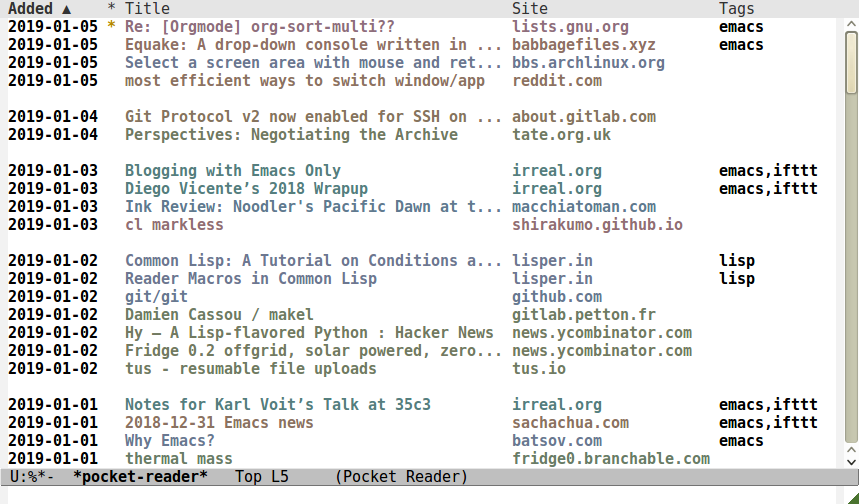 (image source: pocket-reader.el)
This setup requires you change your habit to the Read-it-Later flow. If you are not familiar, Tiago Forte has a good post explaining this flow.
It feels liberating for me to know that an app remembers the interesting long-form writings, and I can come back any time in the future, on Emacs!
What's interesting is, pocket-reader.el integrates well with elfeed, as I can save an elfeed entry to pocket, and read it later like any other web articles.
Happy reading!
Tudur Owen: United Nations of Anglesey
Tom RocheEXCELLENT! not particularly funny (nor is there any 'Patagonian gaucho' contrary to the shownotes), but Owens crafts and tells his light and lighthearted stories (of which this is just one--he's basically the BBC's 21c Welshman) as well as anyone active today.
Radio War Nerd EP 315 — The US Civil War, Part 7: German '48ers, with Matt Christman
Tom RocheVERY EXCELLENT
Michael and Us: Cries and Whispers
Tom RocheMU episode# 304 is VERY EXCELLENT despite not much politics (Luke riffs on socialism and human development briefly and well) or banter (not comedic, anyway--Will talks about his parents recent deaths) ... but, hey, when you're doing Bergman it better be all about the movie. Been a while (OK, decades) since I saw 'Cries and Whispers' (or, Bergman says in the trailer which W&S helpfully provide, 'Whispers and Cries') and now I gotta see it again ...
See acast.com/privacy for privacy and opt-out information.