Tom Roche
Shared posts
How US-backed Maidan coup, Russiagate led to war in Ukraine
Tom RocheVERY EXCELLENT information-rich interview with Simona Mangiante Papadopoulos (SMP, formerly EU legal adviser, currently wife of George Papadopoulos--GP below) connecting the current/2022 Russia-Ukraine war to Russiagate, Russophobia, and Ukrainian-nationalist propaganda in Anglophone politics and media, esp from 2016. Episode topics include:
- her 2021 documentary 'Ukraine: the Everlasting Present' (part of the trilogy begun by Oliver Stone's 'Ukraine on Fire')
- 2014 Maidan coup made and used by US-NATO coalition with far-right 'Ukrainian nationalists' (UNs). UNs are that segment of Ukrainian-language speakers determined to "cleanse" Ukraine of not only ethnic Russian residents but also Russian-language speakers (~40% of Ukraine population) and any remnant of Russian or Soviet culture. SMP discusses her interview with Viktor Yushchenko (et al).
- Maté on 2014 Maidan massacre, esp work by Ivan Katchanovski @ U Ottawa (see, e.g., [[https://jordanrussiacenter.org/news/the-maidan-massacre-in-ukraine-revelations-from-trials-and-investigation/][this article]], with excellent links, archived [[https://web.archive.org/web/20220315160950/https://jordanrussiacenter.org/news/the-maidan-massacre-in-ukraine-revelations-from-trials-and-investigation/][here]]) demonstrating its execution by the UNs, esp members of Right Sector and Svoboda.
- links between US, EU, and Ukrainian nationalists (esp Burisma and the Bidens)
- US deepstate uses Big Tech to censor dissent
- Russiagate and Joseph Mifsud (JM):
- JM connections to HRC campaign
- JM connections to Five Eyes intelligence (US and Australian) used to frame GP
- contradictions between Mueller Report and FBI handling of JM
- SMP, GP, and John Durham investigation
- Ukraine interference in 2016 US election: using Manafort to target Trump (per Financial Times), weaponizing RNC platform on arming Ukraine
- Christopher Steele (and Steele Dossier) connections to Victoria Nuland
- US Corporate Democrats covered for Mueller Report failure by pivoting to Ukrainegate and 1st Trump impeachment, claiming need to 'fight Russia over there' (per Adam Schiff)
Long Reads: David Edgerton on the Myths of Modern Britain
Tom RocheVERY EXCELLENT book talk with David Edgerton @ KCL regarding his book [[https://reviews.history.ac.uk/review/2307]['Rise and Fall of the British Nation: a Twentieth Century History']] (archived [[https://web.archive.org/web/20220314235529/https://reviews.history.ac.uk/review/2307][here]]). While the book itself appears to cover the period c1920-c1990 (ending with Thatcher and Thatcherism), this interview seems to cover c1900-c2016 (ending with Brexit), mostly on the UK's political economy (esp, its decline) but also (necessarily) empire. As usual, the host (Daniel Finn) and producer (Conor Gillies) also work in excellent audio additions, esp (for this episode) a track ([[https://www.youtube.com/watch?v=umoLSKhmdWg]['The Great British Mistake']]) I don't remember hearing since the 1980s, from an excellent proto-art-punk band ([[https://en.wikipedia.org/wiki/The_Adverts][The Adverts]]) I haven't thought about in almost as long. Topics discussed (roughly in order) include
* influence of British Empire on UK economy pre-1914
* growth of UK welfare state, esp on how that began very largely in c1918, rather than c1945 as usually claimed
* importance of migration to UK economy and society, esp /outmigration/ (again, too often ignored) rather than (the /much/ more often discussed) immigration
* trajectory (in detail) of UK automotive industry c1920-c1990
* UK labor power trajectory: organization and strikes, esp the Thatcher counterrevolution
* how Thatcherism and the UK Conservative Party split UK Labour and produced Blairism
* UK trade balance, esp how it went from
- negative to positive on agriculture trade, with UK becoming (to a 1st approximation) food-independent as the rest of its economy (esp manufacturing) largely failed
- negative to positive on oil with North Sea production (which very much helped make Thatcher's success), and now back to negative again (with the North Sea earnings mostly squandered)
* how UK industry survived longer than generally thought. This is IMHO one of the more interesting parts of this excellent talk.
* discussing the great 1980 British Noir [[https://en.wikipedia.org/wiki/The_Long_Good_Friday][The Long Good Friday]] as a product of its time, and its influence on subsequent UK thought and culture
* (another great section, and too short, on) Blairism, the decline of UK Labour, and the Blair-Brown years (1997-2010) as (in the title of the [[https://en.wikipedia.org/wiki/Pulp_(band)][Pulp]] track) [[https://www.youtube.com/watch?v=UdALbCGev5A]['Cocaine Socialism']]
* (2nd) Iraq War as the crash-and-burn of both Blairism and Empire ... for now, anyway. This interview was made before the Russia-Ukraine war, which could possibly revive one or both (though I doubt it--Brexit seems rather fatal for the short- to medium-term)
* Brexit:
- as a social reaction by the UK 90% against UK capital
- the trajectory of 'Lexit' (i.e., the left case against Euroliberalism, as articulated by (e.g.) Corbyn c1973-c2015 before he stupidly abandoned that critique to chase the Novara/woke Labour bloc)
David Edgerton joins Long Reads for a discussion about the making of the modern British nation. David is a professor at King’s College London, where his work concentrates on twentieth-century history, global science, and technology. His most recent work is The Rise and Fall of the British Nation, one of the most ambitious reinterpretations of modern Britain for many years.
Long Reads is a Jacobin podcast looking in-depth at political topics and thinkers, both contemporary and historical, with the magazine’s longform writers. Hosted by Features Editor Daniel Finn.
Produced by Conor Gillies, music by Knxwledge.
See acast.com/privacy for privacy and opt-out information.
#131 School’s Choice
Tom RocheEXCELLENT as usual: HYH can get a bit woke at times, but esp on the economics of US education, they're generally excellent
Democracy Now! 2022-03-14 Monday
Tom Rochewhat has become (over the past few years) my increasingly-frequent approach to DN: listen to the headlines, skip the rest
Democracy Now! 2022-03-14 Monday
- Headlines for March 14, 2022
- Brent Renaud, First U.S. Reporter Killed in Ukraine, Praised for His Humanity & Exposing Horrors of War
- In Belarus, Russia's Partner in Ukraine Invasion, There Is "No Possibility" of Dissent on War
3/14/22: Ukraine War Developments, Iran Nuclear Deal, Polling Perils, Online Censorship, & How Biden Can Lower Gas Prices!
Tom Rochemostly good, but serious fails on Iran, Israel, Russia, and US energy-environmental policy
Krystal and Saagar bring battle updates from Ukraine, arms shipments from the west to the battlefield, diplomatic developments, Iran deal future, more polling on Ukraine, online censorship of anti-war views, Trump interview censorship, Facebook's Ukraine policy, sleepwalking to nukes, deranged media punditry, and how Biden can alleviate the gas price surge!
To become a Breaking Points Premium Member and watch/listen to the show uncut and 1 hour early visit: https://breakingpoints.supercast.com/
To listen to Breaking Points as a podcast, check them out on Apple and Spotify
Apple: https://podcasts.apple.com/us/podcast/breaking-points-with-krystal-and-saagar/id1570045623
Spotify: https://open.spotify.com/show/4Kbsy61zJSzPxNZZ3PKbXl
Merch: https://breaking-points.myshopify.com/
Skanda Amarnath: https://www.employamerica.org/researchreports/spr-esf-dpa/
Learn more about your ad choices. Visit megaphone.fm/adchoices
Click here to hear the most Canadian thing ever...
Tom RocheNOT a great LOL episode, except for *very* short Nour Hadidi bit at end. 1st/Zedlacher half is normie but funny enough. 2nd/Tolev half is IMHO very skippable: if you like Debra DiGiovanni, you'll like this, but it doesn't WFM.
The World of Simon Rich
Tom RocheNot LOL-funny, but entertaining enough: this sketch (one for the whole half-hour, not several bits) mashes (in a way that actually works!) pirates with modern parenting and relationships. You'll sus-out the concept rather quickly, but then (at least, if you're a cynical bastard like me :-) be surprised that it actually works.
This is Sus: La Brea feat. Will Menaker
Tom Rochevery funny: just 2 guys riffing on bad TV, so completely uninformative, but very funny
Felix and Will discuss the 2021 NBC sci-fi drama La Brea, in which everyone’s looking for the hole.
The Hillary Clinton Master Class Grand Finale w/Special Guests Briahna Joy Gray and Katie Halper
Tom RocheVERY EXCELLENT!
Briana and Katie join Josh and Dave to wrap up The Hillary Thing by watching Hillary and Huma discuss the meaning of life.
Plus: That amazing victory speech!
Plus plus: Lee Camp stops by to talk about the demise of RT, and how opposing war makes you a Commie.
Michael and Us: Sympathy for the Riddler
Tom RocheEXCELLENT as usual (and quite funny)
Some Batman movies have been called fascist, but THE BATMAN (2022) breaks new ground for the franchise by being lib. We wouldn't be a left-wing culture podcast if we didn't occasionally pick a new Batman movie from the lowest branch on the tree, so come join us as we chart the latest developments in the Caped Crusader's political evolution.
Michael and Us is a podcast about political cinema and our crumbling world hosted by Will Sloan and Luke Savage.
See acast.com/privacy for privacy and opt-out information.
The Ukraine tragedy, from US-backed coup to Russian assault
Tom RocheVERY EXCELLENT
WHO, US worry Ukrainian biological lab samples could spill, go to Russians
Tom Rochesome amazing propaganda in this article, but the comments are particularly unhinged, e.g. "Nazi sympathizer Glenn Greenwald"
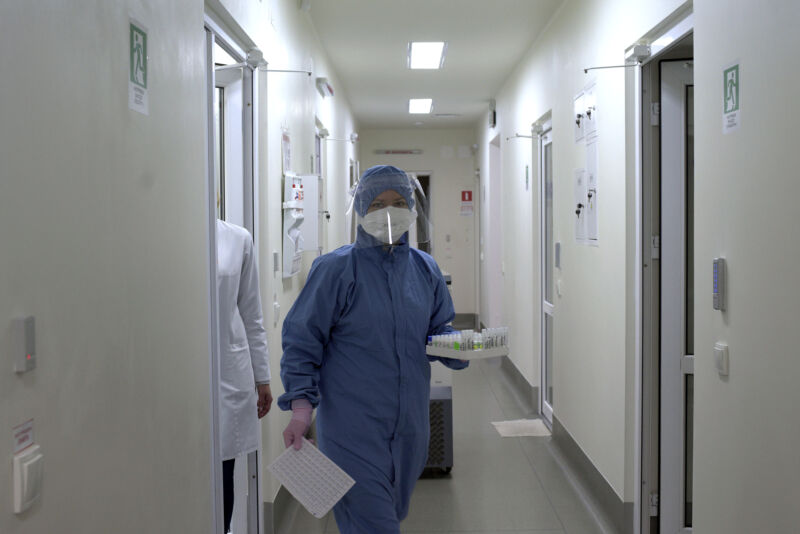
Enlarge / A health care worker carries test tubes while on duty in the bacteriological laboratory at the Lviv Regional Laboratory Centre of the State Sanitary and Epidemiological Service, Lviv, western Ukraine. (credit: Getty | Future Publishing)
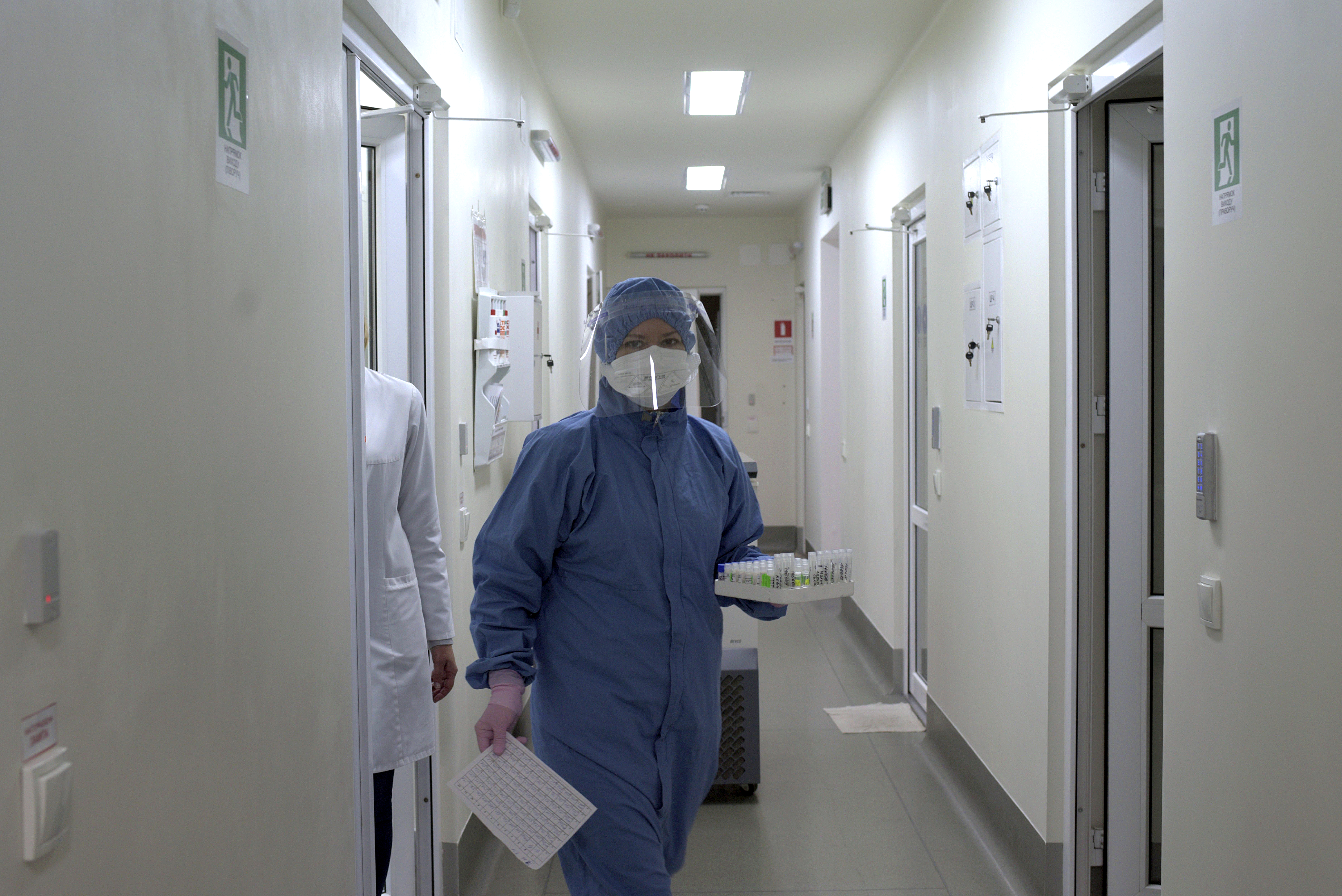
The World Health Organization has advised officials in Ukraine to destroy any high-risk pathogens housed in public health laboratories in order to prevent their release amid the Russian onslaught, according to a report by Reuters.
The agency said that it has worked with Ukrainian officials for years to promote security practices at its laboratories to prevent "accidental or deliberate release of pathogens." As part of that longstanding work, "WHO has strongly recommended to the Ministry of Health in Ukraine and other responsible bodies to destroy high-threat pathogens to prevent any potential spills," the agency said in an email to Reuters. The WHO did not clarify when it made that recommendation or if it was carried out.
The news follows Senate testimony on Tuesday by Victoria Nuland, US Undersecretary of State for Political Affairs, who said that the US is "quite concerned" that Russian troops will seek out Ukraine's biological research laboratories to seize control of any potentially dangerous samples.
Read 6 remaining paragraphs | Comments
608 - The World’s Mack (3/7/22)
Tom RocheVERY EXCELLENT: da boyz confront US deepstate's propaganda and its drive towards WW3
We’re back from the first leg of our tour of the South and here to look at the responses to war in Ukraine brewing in the foreign policy op-ed world. We’ve got reading series by Shadi Hamid in the Atlantic and our old friend Max Boot in WaPo, both asking “well, yes, American foreign intervention has been very bad in the past, but maybe this time it would be very good?”
Tickets to Houston, Dallas and New Orleans shows still available at: https://www.chapotraphouse.com/live
609 - Mayors Just Wanna Have Fun (3/10/22)
We check in on two of our favorite fun lovin’ goofballs, Chicago Mayor Lori Lightfoot and New York City Mayor Eric Adams. Lori got herself in a bit of trouble by claiming to have the biggest dick in Chicago, and we turn to our old friend columnist John Kass for incisive takes on how she can win back over the small-dicked Italian demo. Then, Eric Adams managed to successfully convene the Drill summit, how this bodes well for his - and the Democrats - political future.
Tickets to Houston, Dallas and New Orleans shows still available at: https://www.chapotraphouse.com/live
Democracy Now! 2022-03-08 Tuesday
Tom RocheIlhan Omar interview starts ~40 min
Democracy Now! 2022-03-08 Tuesday
- Headlines for March 08, 2022
- On International Women's Day, Ukrainian LGBTQI Activist Describes Russian Siege as Millions Flee
- The Silencing of Dissent: Russia's Memorial Human Rights Center Faces Closure Amid Putin's Crackdown
- Ilhan Omar on Ending War, Global Refugees, Russia Sanctions & Why More Saudi Oil Is Not the Answer
Chris Hedges On Ukraine, Russia, NATO & Why We Shouldn't Arm Ukraine
Tom RocheEXCELLENT interview but, be advised, this audio is only a paywall teaser:
- full-length is only 23:30 ...
- ... which includes >3 min of Katie's intro and outro, so only ~20 min content ...
- ... contrary to shownotes, this has absolutely /nothing/ from Phyllis Bennis
That being said, Hedges is brilliant as usual, particularly in making the too-rarely-made point that one of the material driving forces behind NATO expansion 1991-2022 has been the massive profits for US (et al, inc Germany, UK, Israel, France, Sweden) weapons contractors (not just manufacturers, but also maintenance, trainers, public relations inc "journalists," thinktankers, academics) for "integrating" the former Warsaw Pact nations into NATO.
In Our Time is now first on BBC Sounds
Tom Rochealas, the long-announced 28-day delay has arrived--much prefer to [download, play] than rely on continous internet access
Looking for the latest episode? New episodes of In Our Time will now be available first on BBC Sounds for four weeks before other podcast apps.
If you haven’t already, you can download the BBC Sounds app to listen to the In Our Time podcast first.
BBC Sounds is also available in lots of other places. Find us on your voice device or smart speaker, on your connected TV, in your car, or at bbc.co.uk/sounds.
The latest episode is available on BBC Sounds right now.
BBC Sounds – you can find exclusive music mixes, live BBC radio and more podcasts like this one.
Irreal: Reading RSS With Elfeed
Tom RocheTODO: [elfeed-org](https://github.com/remyhonig/elfeed-org)
Irreal regulars know that I’m a huge fan of Christopher Wellons’ Elfeed. It’s an Emacs-based RSS reader that allows you to manage and read your RSS feeds from within Emacs. If you’re already an Emacs user, there’s no reason not to be using it.
Ramces Red has a post that explains how and why to use elfeed. Ramces covers the installation and configuration of Elfeed. Other than specifying which feeds you want to follow, you can get away with no configuration at all but Elfeed allows extensive customization. There’s also a thorough and flexible tagging mechanism that you can use to sort posts according to interest.
To me, the most useful thing Elfeed brings to RSS is the ability to store the feeds forever. They all go into a database that is searchable by date and content. Even years later, you can search and find an entry and as long as the original post is still online, you can revisit it.
The one thing that his post doesn’t mention is that you can maintain your list of feeds in Org-mode. To do that you need to load elfeed-org. After that, it’s easy to add or delete entries from your feed even if you aren’t an Elisp expert.
I can’t recommend Elfeed enough. Take a look at Ramces’ post to see why.
Law and Disorder February 28, 2022
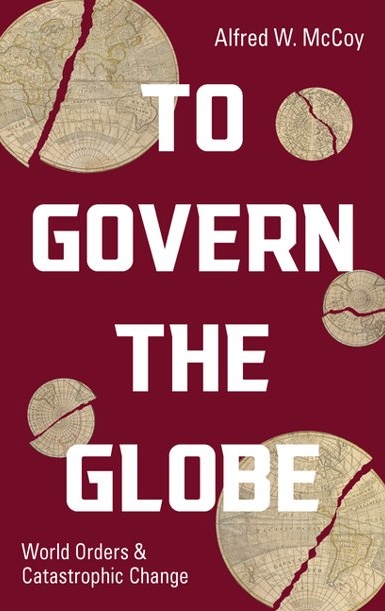

To Govern the Globe: World Orders and Catastrophic Change
Today we speak with University of Wisconsin history professor Alfred McCoy about his new book “To Govern the Globe: World Orders and Catastrophic Change.” The United States of America has been governing the globe now for 80 years, since World War II. This is about to end. By 2030, China will have the world’s largest economy and hold more riches than the U.S., which is deeply in debt.
The America we know will change drastically as a world power just as the previous world powers, the British, and before them the Dutch, and before them the Spanish and the Portuguese, all saw their empires end.
Climate change will upend the world. It has already started. The effects of climate change on the population of the world, especially China, will be catastrophic. The great coastal city of Shanghai, where 18 million people reside, will sink, uprooting millions of the 400 million Chinese people in the North China Plain.
What can we learn from the demise of the great world powers in the past? Where is the United States headed and how soon? What might be done to ameliorate this dire future? Only a prodigious historian could undertake to answer these questions.
Guest – Alfred W McCoy holds the Fred Harvey Harrington chair of history at the University of Wisconsin. He has written 20 books, including “The Politics of Heroin in Southeast Asia,” for which he became well-known, and recently, “In the Shadows of the American Century.”
—-

Encroaching Fascism In The United States
An American form of fascism is unfolding in our country. What exactly is it and what can we do to fight it?
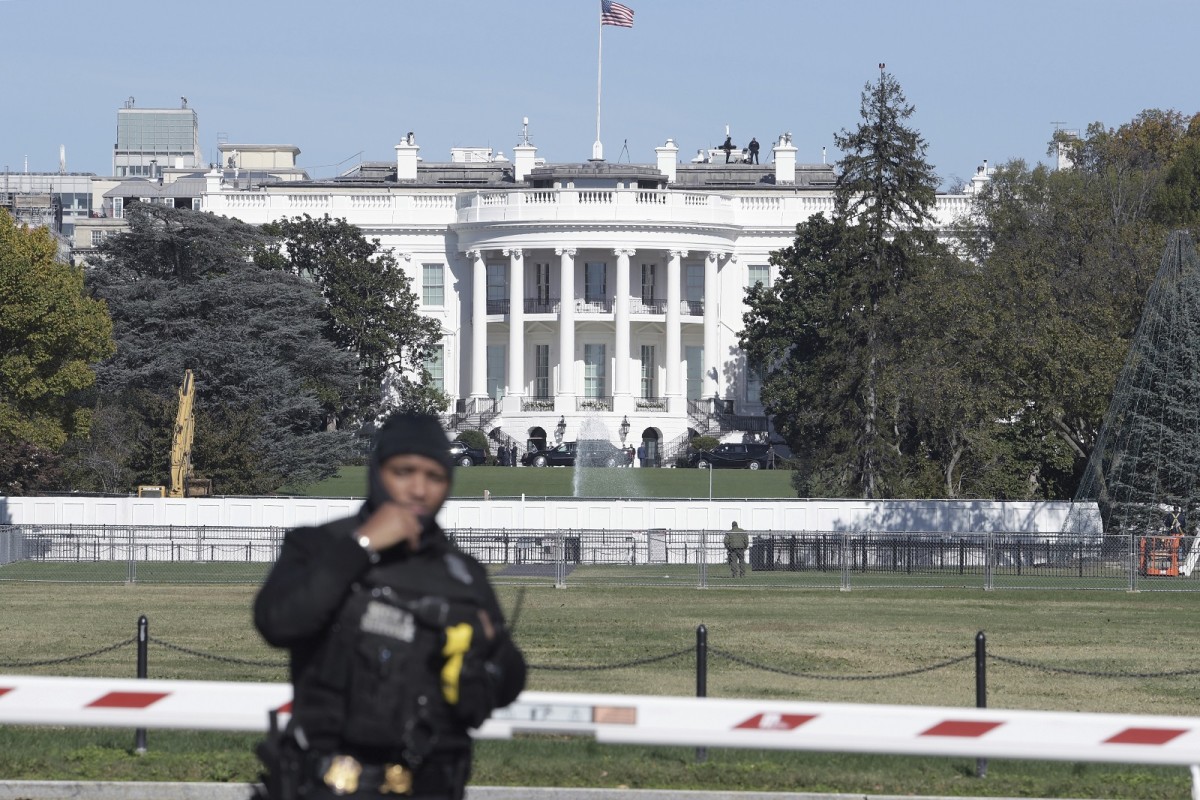
We see a massive political effort to legitimatize and normalize white minority rule. Things are happening rapidly. A year ago our capital was attacked pursuant to a plan to reverse the results of the election. Soon the Supreme Court will likely overrule the almost 50 year precedent set by Roe v Wade on the question of a woman’s right to control her own body. Voting rights have been and will continue to be extremely restricted particularly in communities of color. Irrational and magical thinking has been legitimatized. More than 900 thousand people have unnecessarily died of Covid. There has developed in our country a culture of cruelty manifested by Trump, but initiated in CIA torture and detention camps for Muslim men and boys in Abu Ghraib and Guantánamo.
It didn’t start after 9/11 with the wars against Afghanistan and Iraq. It goes back further than that. America has been prosecuting wars abroad during our entire lifetimes. The provocations against Russia regarding NATO military encroachment on its borders are the latest chapter in almost continual and seemingly endless wars. A lesson of history since Greek and Roman times is that you can’t have imperialism abroad and democracy at home.
Guest – Professor Henry A. Giroux currently holds the McMaster University chair for a Scholarship in the Public Interest in the English and Cultural Studies Department. He has written many books, most recently The Public in Peril: Trump and the Menace of American Authoritarianism and American Nightmare: Facing the Challenge of Facism.

———————-
News Quiz 4th March 2022
Tom Roche1st 10-ish minutes is bad/unfunny: proof that propaganda destroys comedy. Gets better after that, though this is definitely *not* a great outing for the normally-reliable Mark Steel (or, for that matter, Andy Zaltzman)
Recorded at the BBC Radio Theatre, this week Andy Zaltzman is joined by Mark Steel, Sindhu Vee, Daniel Finkelstein and Lucy Porter to discuss war in Ukraine and the international reaction. Last in the series.
Hosted by Andy Zaltzman Chairs script by Andy Zaltzman Additional Material from Alice Fraser, Mike Shephard, Cameron Loxdale, Jade Gebbie and Peter Tellouche. Production Co-ordinator: Katie Baum Sound Editor: Marc Willcox
The Producer is James Robinson, and it is a BBC Studios Production.
There are certain things you just don't say to your Mom!
Tom Rochefeels like a repeat, only moderately funny
607 - Live From the South: Chapo Went Down to Georgia feat. Trillbillies & Walton Goggins (3/4/22)
Tom RocheEXCELLENT, funny, esp dragging Georgia politics (e.g., Jimmy Carter and the (near) birth of US neoliberalism, Newt Gingrich's stupid futurism, and the insanity that is [MTG](https://en.wikipedia.org/wiki/Marjorie_Taylor_Greene))
A mashup of our recent live shows in Atlanta and Nashville. We start with a Hateful 8 rundown of some of Georgia’s most notorious political figures. Then, we’re joined by very special guests Tarence and Tom of the Trillbillies to present our original spec script “Kentucky Swap: A Justified Story”. Then, it’s back to Atlanta for Will to read a special message concerning his Southern heritage.
If you don’t already, listen to Trillbilly Worker’s Party here:
https://soundcloud.com/user-972848621-463073718
and subscribe to the Trillbillies podcast here: https://www.patreon.com/trillbillyworkersparty
& a very special thank you to the god Walton Goggins for contributing line readings to these shows.
Calling Russia’s Attack ‘Unprovoked’ Lets US Off the Hook
Tom RocheVERY EXCELLENT: best *short* analysis I've yet seen (as of 4 Mar 2022) on Ukrainian, US and NATO provocations preceding the Russia-Ukraine War.

Russia’s invasion of Ukraine can fairly be called many things, but “unprovoked” (Roll Call, 2/24/22) is not one of them.
Many governments and media figures are rightly condemning Russian President Vladimir Putin’s attack on Ukraine as an act of aggression and a violation of international law. But in his first speech about the invasion, on February 24, US President Joe Biden also called the invasion “unprovoked.”
It’s a word that has been echoed repeatedly across the media ecosystem. “Putin’s forces entered Ukraine’s second-largest city on the fourth day of the unprovoked invasion,” Axios (2/27/22) reported; “Russia’s unprovoked invasion of Ukraine entered its second week Friday,” said CNBC (3/4/22). Vox (3/1/22) wrote of “Putin’s decision to launch an unprovoked and unnecessary war with the second-largest country in Europe.”
The “unprovoked” descriptor obscures a long history of provocative behavior from the United States in regards to Ukraine. This history is important to understanding how we got here, and what degree of responsibility the US bears for the current attack on Ukraine.
Ignoring expert advice
The story starts at the end of the Cold War, when the US was the only global hegemon. As part of the deal that finalized the reunification of Germany, the US promised Russia that NATO would not expand “one inch eastward.” Despite this, it wasn’t long before talk of expansion began to circulate among policy makers.
In 1997, dozens of foreign policy veterans (including former Defense Secretary Robert McNamara and former CIA Director Stansfield Turner) sent a joint letter to then-President Bill Clinton calling “the current US-led effort to expand NATO…a policy error of historic proportions.” They predicted:
In Russia, NATO expansion, which continues to be opposed across the entire political spectrum, will strengthen the nondemocratic opposition, undercut those who favor reform and cooperation with the West [and] bring the Russians to question the entire post-Cold War settlement.

Diplomat George Kennan (New York Times, 5/2/98) said NATO expansion would be “a tragic mistake.”
New York Times columnist Thomas Friedman (5/2/98) in 1998 asked famed diplomat George Kennan—architect of the US Cold War strategy of containment—about NATO expansion. Kennan’s response:
I think it is the beginning of a new cold war. I think the Russians will gradually react quite adversely and it will affect their policies. I think it is a tragic mistake. There was no reason for this whatsoever. No one was threatening anybody else.
Of course there is going to be a bad reaction from Russia, and then [the NATO expanders] will say that we always told you that is how the Russians are—but this is just wrong.
Despite these warnings, Poland, Hungary and the Czech Republic were added to NATO in 1999, with Bulgaria, Estonia, Latvia, Lithuania, Romania, Slovakia and Slovenia following in 2004.
US planners were warned again in 2008 by US Ambassador to Moscow William Burns (now director of the CIA under Joe Biden). WikiLeaks leaked a cable from Burns titled “Nyet Means Nyet: Russia’s NATO Enlargement Redlines” that included another prophetic warning worth quoting in full (emphasis added):
Ukraine and Georgia’s NATO aspirations not only touch a raw nerve in Russia, they engender serious concerns about the consequences for stability in the region. Not only does Russia perceive encirclement, and efforts to undermine Russia’s influence in the region, but it also fears unpredictable and uncontrolled consequences which would seriously affect Russian security interests.
Experts tell us that Russia is particularly worried that the strong divisions in Ukraine over NATO membership, with much of the ethnic Russian community against membership, could lead to a major split, involving violence or at worst, civil war. In that eventuality, Russia would have to decide whether to intervene; a decision Russia does not want to have to face.
A de facto NATO ally
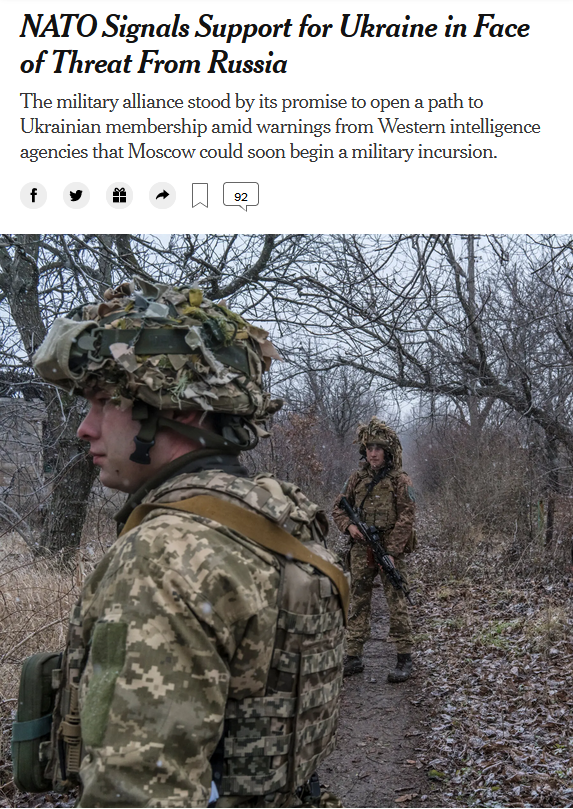
As Russia threatened to invade Ukraine over the threat of NATO expansion, NATO’s response was to emphasize that Ukraine would some day join the alliance (New York Times, 12/16/21).
But the US has pushed Russia to make such a decision. Though European countries are divided about whether or not Ukraine should join, many in the NATO camp have been adamant about maintaining the alliance’s “open door policy.” Even as US planners were warning of a Russian invasion, NATO Secretary General Jens Stoltenberg reiterated NATO’s 2008 plans to integrate Ukraine into the alliance (New York Times, 12/16/21). The Biden administration has taken a more roundabout approach, supporting in the abstract “Kyiv’s right to choose its own security arrangements and alliances.” But the implication is obvious.
Even without officially being in NATO, Ukraine has become a de facto NATO ally—and Russia has paid close attention to these developments. In a December 2021 speech to his top military officials, Putin expressed his concerns:
Over the past few years, military contingents of NATO countries have been almost constantly present on Ukrainian territory under the pretext of exercises. The Ukrainian troop control system has already been integrated into NATO. This means that NATO headquarters can issue direct commands to the Ukrainian armed forces, even to their separate units and squads….
Kiev has long proclaimed a strategic course on joining NATO. Indeed, each country is entitled to pick its own security system and enter into military alliances. There would be no problem with that, if it were not for one “but.” International documents expressly stipulate the principle of equal and indivisible security, which includes obligations not to strengthen one’s own security at the expense of the security of other states….
In other words, the choice of pathways towards ensuring security should not pose a threat to other states, whereas Ukraine joining NATO is a direct threat to Russia’s security.
In an explainer piece, the New York Times (2/24/22) centered NATO expansion as a root cause of the war. Unfortunately, the Times omitted the critical context of NATO’s pledge not to expand, and the subsequent abandonment of that promise. This is an important context to understand the Russian view of US policies, especially so given the ample warnings from US diplomats and foreign policy experts.
The Maidan Coup of 2014
A major turning point in the US/Ukraine/Russia relationship was the 2014 violent and unconstitutional ouster of President Viktor Yanukovych, elected in 2010 in a vote heavily split between eastern and western Ukraine. His ouster came after months of protests led in part by far-right extremists (FAIR.org, 3/7/14). Weeks before his ouster, an unknown party leaked a phone call between US officials discussing who should and shouldn’t be part of the new government, and finding ways to “seal the deal.” After the ouster, a politician the officials designated as “the guy” even became prime minister.
The US involvement was part of a campaign aimed at exploiting the divisions in Ukrainian society to push the country into the US sphere of influence, pulling it out of the Russian sphere (FAIR.org, 1/28/22). In the aftermath of the overthrow, Russia illegally annexed Crimea from Ukraine, in part to secure a major naval base from the new Ukrainian government.
The New York Times (2/24/22) and Washington Post (2/28/22) both omitted the role the US played in these events. In US media, this critical moment in history is completely cleansed of US influence, erasing a critical step on the road to the current war.
Keeping civil war alive
In another response to the overthrow, an uprising in Ukraine’s Donbas region grew into a rebel movement that declared independence from Ukraine and announced the formation of their own republics. The resulting civil war claimed thousands of lives, but was largely paused in 2015 with a ceasefire agreement known as the Minsk II accords.

Anatol Lieven (The Nation, 11/15/21): “US administrations, the political establishment, and the mainstream media have quietly buried…the refusal of Ukrainian governments to implement the solution and the refusal of the United States to put pressure on them to do so.”
The deal, agreed to by Ukraine, Russia and other European countries, was designed to grant some form of autonomy to the breakaway regions in exchange for reintegrating them into the Ukrainian state. Unfortunately, the Ukrainian government refused to implement the autonomy provision of the accords. Anatol Lieven, a researcher with the Quincy Institute for Responsible Statecraft, wrote in The Nation (11/15/21):
The main reason for this refusal, apart from a general commitment to retain centralized power in Kiev, has been the belief that permanent autonomy for the Donbas would prevent Ukraine from joining NATO and the European Union, as the region could use its constitutional position within Ukraine to block membership.
Ukraine opted instead to prolong the Donbas conflict, and there was never significant pressure from the West to alter course. Though there were brief reports of the accords’ revival as recently as late January, Ukrainian security chief Oleksiy Danilov warned the West not to pressure Ukraine to implement the peace deal. “The fulfillment of the Minsk agreement means the country’s destruction,” he said (AP, 1/31/22). Danilov claimed that even when the agreement was signed eight years ago, “it was already clear for all rational people that it’s impossible to implement.”
Lieven notes that the depth of Russian commitment has yet to be fully tested, but Putin has supported the Minsk accords, refraining from officially recognizing the Donbas republics until last week.
The New York Times (2/8/22) explainer on the Minsk accords blamed their failure on a disagreement between Ukraine and Russia over their implementation. This is inadequate to explain the failure of the agreements, however, given that Russia cannot affect Ukrainian parliamentary procedure. The Times quietly acknowledged that the law meant to define special status in the Donbas had been “shelved” by the Ukranians, indicating that the country had stopped trying to solve the issue in favor of a stalemate.
There was no mention of the comments from a top Ukrainian official openly denouncing the peace accords. Nor was it acknowledged that the US could have used its influence to push Ukraine to solve the issue, but refrained from doing so.
Ukrainian missile crisis
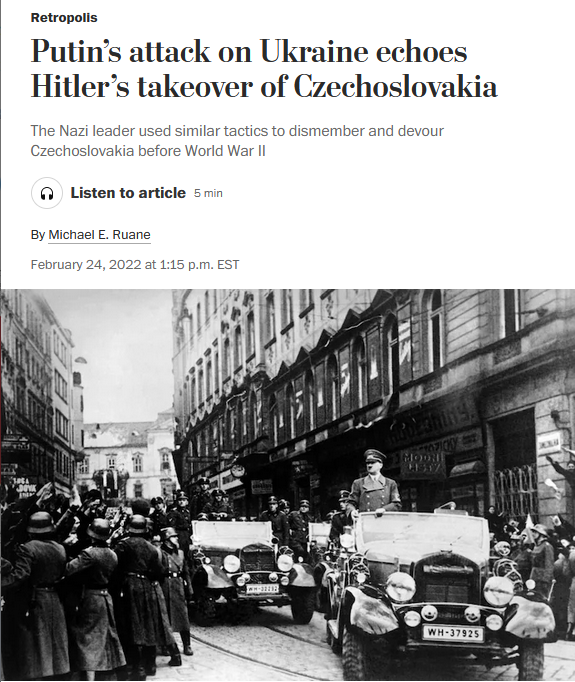
The Washington Post‘s Hitler analogy (2/24/22) is a bit much, considering that the Ukrainian government provides veterans benefits to militias that actually participated in the Holocaust (Kyiv Post, 12/24/18).
One under-discussed aspect of this crisis is the role of US missiles stationed in NATO countries. Many media outlets have claimed that Putin is Hitler-like (Washington Post, 2/24/22; Boston Globe, 2/24/22), hellbent on reconquering old Soviet states to “recreat[e] the Russian empire with himself as the Tsar,” as Clinton State Department official Strobe Talbot told Politico (2/25/22).
Pundits try to psychoanalyze Putin, asking “What is motivating him?” and answering by citing his televised speech on February 21 that recounted the history of Ukraine’s relationship with Russia.
This speech has been widely characterized as a call to reestablish the Soviet empire and a challenge to Ukraine’s right to exist as a sovereign nation. Corporate media ignore other public statements Putin has made in recent months. For example, at an expanded meeting of the Defense Ministry Board, Putin elaborated on what he considered to be the main military threat from US/NATO expansion to Ukraine:
It is extremely alarming that elements of the US global defense system are being deployed near Russia. The Mk 41 launchers, which are located in Romania and are to be deployed in Poland, are adapted for launching the Tomahawk strike missiles. If this infrastructure continues to move forward, and if US and NATO missile systems are deployed in Ukraine, their flight time to Moscow will be only 7–10 minutes, or even five minutes for hypersonic systems. This is a huge challenge for us, for our security.
The United States does not possess hypersonic weapons yet, but we know when they will have it…. They will supply hypersonic weapons to Ukraine and then use them as cover…to arm extremists from a neighbouring state and incite them against certain regions of the Russian Federation, such as Crimea, when they think circumstances are favorable.
Do they really think we do not see these threats? Or do they think that we will just stand idly watching threats to Russia emerge? This is the problem: We simply have no room to retreat.
Having these missiles so close to Russia—weapons that Russia (and China) see as part of a plan to give the United States the capacity to launch a nuclear first-strike without retaliation—seriously challenges the cold war deterrent of Mutually Assured Destruction, and more closely resembles a gun pointed at the Russian head for the remainder of the nuclear age. Would this be acceptable to any country?
Media refuse to present this crucial question to their audiences, instead couching Putin’s motives in purely aggressive terms.
Refusal to de-escalate

As the threat of war loomed, Secretary of State Antony Blinken (Twitter, 1/27/22) framed the issue of NATO expansion as “Kyiv’s right to choose its own security arrangements and alliances”—as though NATO were a public accommodation open to anyone who wanted to join.
By December 2021, US intelligence agencies were sounding the alarm that Russia was amassing troops at the Ukrainian border and planning to attack. Yet Putin was very clear about a path to deescalation: He called on the West to halt NATO expansion, negotiate Ukrainian neutrality in the East/West rivalry, remove US nuclear weapons from non proliferating countries, and remove missiles, troops and bases near Russia. These are demands the US would surely have made were it in Russia’s position.
Unfortunately, the US refused to negotiate on Russia’s core concerns. The US offered some serious steps towards a larger arms control arrangement (Antiwar.com, 2/2/22)—something the Russians acknowledged and appreciated—but ignored issues of NATO’s military activity in Ukraine, and the deployment of nuclear weapons in Eastern Europe (Antiwar.com, 2/17/22).
On NATO expansion, the State Department continued to insist that they would not compromise NATO’s open door policy—in other words, it asserted the right to expand NATO and to ignore Russia’s red line.
While the US has signaled that it would approve of an informal agreement to keep Ukraine from joining the alliance for a period of time, this clearly was not going to be enough for Russia, which still remembers the last broken agreement.
Instead of addressing Russian concerns about Ukraine’s NATO relationship, the US instead chose to pour hundreds of millions of dollars of weapons into Ukraine, exacerbating Putin’s expressed concerns. Ukrainian President Volodymyr Zelenskyy didn’t help matters by suggesting that Ukraine might begin a nuclear weapons program at the height of the tensions.
After Putin announced his recognition of the breakaway republics, Secretary of State Antony Blinken canceled talks with Putin, and began the process of implementing sanctions on Russia—all before Russian soldiers had set foot into Ukraine.
Had the US been genuinely interested in avoiding war, it would have taken every opportunity to de-escalate the situation. Instead, it did the opposite nearly every step of the way.
In its explainer piece, the Washington Post (2/28/22) downplayed the significance of the US’s rejection of Russia’s core concerns, writing: “Russia has said that it wants guarantees Ukraine will be barred from joining NATO—a non-starter for the Western alliance, which maintains an open-door policy.” NATO’s open door policy is simply accepted as an immutable policy that Putin just needs to deal with. This very assumption, so key to the Ukraine crisis, goes unchallenged in the US media ecosystem.
‘The strategic case for risking war’

John Deni (Wall Street Journal, 12/22/21): “There are good strategic reasons for the West to stake out a hard-line approach, giving little ground to Moscow.”
It’s impossible to say for sure why the Biden administration took an approach that increased the likelihood of war, but one Wall Street Journal piece from last month may offer some insight.
The Journal (12/22/21) published an op-ed from John Deni, a researcher at the Atlantic Council, a think tank funded by the US and allied governments that serves as NATO’s de facto brain trust. The piece was provocatively headlined “The Strategic Case for Risking War in Ukraine.” Deni’s argument was that the West should refuse to negotiate with Russia, because either potential outcome would be beneficial to US interests.
If Putin backed down without a deal, it would be a major embarrassment. He would lose face and stature, domestically and on the world stage.
But Putin going to war would also be good for the US, the Journal op-ed argued. Firstly, it would give NATO more legitimacy by “forg[ing] an even stronger anti-Russian consensus across Europe.” Secondly, a major attack would trigger “another round of more debilitating economic sanctions,” weakening the Russian economy and its ability to compete with the US for global influence. Thirdly, an invasion is “likely to spawn a guerrilla war” that would “sap the strength and morale of Russia’s military while undercutting Mr. Putin’s domestic popularity and reducing Russia’s soft power globally.”
In short, we have part of the NATO brain trust advocating risking Ukrainian civilians as pawns in the US’s quest to strengthen its position around the world.
‘Something even worse than war’

What would be worse than thousands of Ukrainians dying? According to this New York Times op-ed (2/3/22), “a new European security architecture that recognizes Russia’s sphere of influence in the post-Soviet space.”
A New York Times op-ed (2/3/22) by Ivan Krastev of Vienna’s Institute of Human Sciences likewise suggested that a Russian invasion of Ukraine wouldn’t be the worst outcome:
A Russian incursion into Ukraine could, in a perverse way, save the current European order. NATO would have no choice but to respond assertively, bringing in stiff sanctions and acting in decisive unity. By hardening the conflict, Mr. Putin could cohere his opponents.
The op-ed was headlined “Europe Thinks Putin Is Planning Something Even Worse Than War”—that something being “a new European security architecture that recognizes Russia’s sphere of influence in the post-Soviet space.”
It is impossible to know for sure whether the Biden administration shared this sense that there would be an upside to a Russian invasion, but the incentives are clear, and much of what these op-eds predicted is coming to pass.
None of this is to say that Putin’s invasion is justified—FAIR resolutely condemns the invasion as illegal and ruinous—but calling it “unprovoked” distracts attention from the US’s own contribution to this disastrous outcome. The US ignored warnings from both Russian and US officials that a major conflagration could erupt if the US continued its path, and it shouldn’t be surprising that one eventually did.
Now, as the world once again inches toward the brink of nuclear omnicide, it is more important than ever for Western audiences to understand and challenge their own government’s role in dragging us all to this point.
Featured image: Wikimedia map of NATO expansion since 1949 (creator:Patrickneil).

The post Calling Russia’s Attack ‘Unprovoked’ Lets US Off the Hook appeared first on FAIR.
How the Ukraine War Helps US Empire
Tom RocheThis episode is a good example of the 'Aaron Maté era' of 'Useful Idiots', at least of the free feed (gotta get me mo money):
1. episodes are consistently shorter--this one is 44:48. I haven't actually measured, but IIRC the free-feed episodes during the 'Matt Taibbi era' were typically longer than 60 min, and they've gotten shorter in the Maté era.
2. Maté is just as funny and as consistent as Taibbi.
3. Katie Halper is more consistently funny with Maté than with Taibbi. Dunno if that's from tighter editing, better chemistry, or what.
4. Pre-interviews ('4 food groups' and other banter) are overall better, and significantly more consistently good. This one has
- Hillary on how arming Ukraine, like when the US armed jihadis in Afghanistan in the late 1970s, might have 'unintended consequences' (like, say 9/11?) ... and laughing about it (à la HRC's infamous 'we came, we say, he died' giggling)
- Harris Faulkner and Condoleezza Rice agree that invading sovereign nations (like, say, Afghanistan, Iraq, and Syria) is a war crime
- Pelosi antics during Biden's 2022 SOTU
- some woman throws her ex's dog out a 7th-floor window
But ...
5. ... the interviews, while just as good and consistent, are waay shorter :-( This episode's interview (with Daniel Bessner and Derek Davison from podcast='American Prestige') *is* excellent on the Russia-Ukraine war, esp (e.g.)
- current status
- left policy responses (Bessner makes good point about current lack of "effective left internationalism")
- why arming Ukraine is probably harmful (esp, it feeds US empire)
- odd status of air-war and air-supremacy in Ukraine war: Russia seems not to have tried hard to take out Ukraine air assets, nor do Russian forces seems to have suffered unduly thereby
- US-empire policy objective in Ukraine (esp 2019 RAND study and the dynamics of the US thinktank-policy complex) as honeypot-ing for costly/entangling intervention: i.e., trying to redo Afghanistan 1979 (or [Iraq 1990](https://en.wikipedia.org/wiki/April_Glaspie#Meetings_with_Saddam_Hussein) or Georgia 2008) in Ukraine 2022.
But the interview is only 20-min long before it fades to paywall.
Click here for the extended episode, including the full interview with Daniel Bessner and Derek Davison.
For a while, pundits have been predicting the decline of American superpower. Although some decline is inevitable, don’t expect Russia’s invasion of Ukraine to precipitate it.
As the American Prestige podcast’s Daniel Bessner and Derek Davison explain, the US ability to invade another country and commit war crimes that would merit US sanctions if it was any other country, and without any backlash, underscores America’s overwhelming strength.
“What would these scholars, who say Russian students should be kicked out of schools and that there are no good Russians, have thought if in 2003, scholars in Russia said there are no good Americans because we invaded Iraq? They would have been aghast.”
“They can’t process the thought that those situations are analogous. We’re virtuous and everyone else is evil.”
With the war ramping up, US ghoulishness runs rampant. Hillary Clinton, Condoleezza Rice, and Nancy Pelosi all giggle at the brink of war while Bucky is left to take the fall.
It’s all this, and more, on this week’s episode of Useful Idiots. Check it out.
Biden Surrenders to the Rich
Tom RochePuryear's EXCELLENT talent for summary again on display, as he distills Biden's 61-min (2 Mar) 2022 State of the Union speech into 10 min of analysis (minus the 30-sec-ish intro and outro themes). Basically, Biden's SOTU just restates
- the continuing allegiance of the US Corporate Party (including its Corporate Democrat faction) with empire, economic oligarchy (in the US, not Russia--that's what empires are for :-), and police.
- minimally, the unwillingness of Biden and his CorpDem backers (notably Obama) to confront Manchin, Sinema, and other more extreme CorpDems (who--and this is me talking, not Puryear--are almost certainly working together for this particular bit of political theatre).
- Biden/ites are not just "throwing in the towel" on COVID-19 (which--me again--is probably good shortterm/tactical politics), but refusing to make the needed changes to US public health processes and institutions (minimally, enacting universal single-payer health finance).
Biden's State of the Union represents a surrender to the most reactionary forces in our society: the military-industrial complex, the so-called “business community” more broadly, the police, and the opponents of public health.
The Hillary Clinton Master Class Part 4 w/Special Guests Ashley Stevens & Meagan Day
Tom RocheVERY EXCELLENT (and funny) deepdive (146 min) into the sociopathy of the US CorpDems in general and Hillary Rodham Clinton in particular. As usual, Josh and Dave are great, as are the songs (not just the theme) by [Collyn McCoy aka 'Diesel Boots'](https://collynmccoy.bandcamp.com/). In this episode, the insights of Jacobin editor Meagan Day, but also the VERY EXCELLENT (and unknown to me outside of WWT) Ashley Stevens (who is apparently just some black woman teacher from South Carolina who J&D met on Twitter, but is quite funny and (dare one say it?) articulate and a *great listen*) on
- how the CorpDems/shitlibs have flipped (and fast) on COVID-19
- how same are *absolutely loving* the Russia-Ukraine war, for all the wrong reasons, and to very bad ends
and the main event:
- part 4 of 5 on the [HRC Master Class](https://www.currentaffairs.org/2021/12/the-toxic-positivity-of-hillary-clintons-masterclass-in-resilience). Again, not *just* dunking on Hillary, but also on the horse she rode in (the "identity left," the Corporate Democrats, etc), with some more-general discussion of the Democratic Party c1984-2022 (esp the evolution of their pro- and anti-healthcare politics from Jesse Jackson's 1988 version of single-payer to Bernie Sanders' in 2016 and 2020).
Irreal: Podcasts with Elfeed and EMMS
Tom Rochenote [Elfeed](https://github.com/skeeto/elfeed) is the RSS/feed reader and [EMMS](https://www.gnu.org/software/emms/) is the media player
Arne Babenhauserheide has an interesting post on how he listens to podcasts in Emacs using Elfeed and EMMS. It’s a perfect workflow: the podcast episodes are collected from RSS and listed with Elfeed and those he wants to listen to are queued by simply typing A next to the entry in Elfeed. That queues up the entry in EMMS. Babenhauserheide has a step-by-step guide to the workflow in the post.
There’s a tiny bit of configuration to do but it’s just a few lines. Best of all, everything happens from within Emacs and you can do other work while you’re listening if you like.
I don’t generally listen to podcasts but if I did, I’d certainly try this method out. The nice thing about it is that it’s simple to set up and try out. If you decide you don’t like it, it’s easy to back out the changes. Of course, you’ll want Elfeed regardless because it’s the absolute best RSS reader. I don’t use EMMS because
- I’m too lazy to set it up
- I don’t usually listen to music while I’m working so I just depend on iTunes. (See #1.)
If you’re an Emacs user who listens to podcasts, be sure to take a look at Babenhauserheide’s post. The section on Elfeed/EMMS is short and will take less than a minute to read.
Andrea: Repository to find your Emacs buddy
Tom Rochepullquote:
> I have created a [repository](https://github.com/ag91/emacs-buddy) to add people that wish to be buddies to other Emacs users
S. Lott: Static Site Blues
Tom Rocheinteresting post on static-blog transfer, but he's apparently deciding to port from RST to Markdown as part of this, which seems odd (UIMS)
I have a very large, static site with 10+ years of stuff about my boat. Most of it is pretty boring. http://www.itmaybeahack.com/TeamRedCruising/
I started with iWeb. It was very -- well -- 2000-ish look and feel. Too many pastels and lines and borders.
In 2012, I switched to Sandvox. I lived on a boat back then. I don't have reliable internet. Using blogger.com, for example, required a sincere commitment to bandwidth. I moved ashore in 2014 and returned to the boat in 2020.
Sandvox's creator seems to be out-of-business.
What's next?
Give up on these fancy editors and switch to a static site generator. Write markdown. Run the tool. Upload when in a coffee shop with Wi-Fi.
What site generator?
See https://www.fullstackpython.com/static-site-generator.html for some suggestions.
There are three parts to this effort.
- Extract the goodness from iWeb and Sandvox. I knew this would be real work. iWeb's site has too much javascript to be easy-to-parse. I have to navigate the underlying XML database. Sandvox is much easier to deal with: their published site is clean, static HTML with useful classes and ids in their tags.
- Reformat the source material into Markdown. I've grudgingly grown to accept Markdown, even through RST is clearly superior. Some tools work with RST and I may pandoc the entire thing over to RST from Markdown. For now, though, the content seems to be captured.
- Fixup internal links and cross references. This is a godawful problem. Media links -- in particular -- seem to be a nightmare. Since iWeb resolves things via Javascript, the HTML is opaque. Fortunately, the database's internal cross-references aren't horrible. Maybe this was exacerbated a poor choice of generators.
- Convert to HTML for a local server. Validate.
- Convert to HTML for the target server. Upload to a staging server and validate again. This requires a coffee shop. Not doing this with my phone's data plan.
Steps 1 and 2 aren't too bad. I've extracted serviceable markdown from the iWeb database and the published Sandvox site. The material parallels the Site/Blog/Page structure of the originals. The markdown seems to be mostly error-free. (Some images have the caption in the wrong place,  isn't as memorable as I'd like.)
Step 3, the internal links and cross-references, has been a difficult problem, it turns out. I can, mostly, associate media with postings. I can also find all the cross-references among postings and fix those up. The question that arises is how to reference media from a blog post?
Mynt
I started with mynt. And had to bail. It's clever and very simple. Too simple for blog posts that have a lot of associated media assets.
The issue is what to write in the markdown to refer to the images that go with a specific blog post. I resorted to a master _Media directory. Which means each posting has ![caption][../../../../_Media/image.png) in it. This is semi-manageable. But exasperating in bulk.
What scrambled my brain is the way a mynt posting becomes a directory, with an index.html. Clearly, the media could be adjacent to the index.html. But. I can't figure out how to get mynt's generator to put the media into each post's published directory. It seems like each post should not be a markdown file.
Also, I can trivially change the base URL when generating, but I can't change the domain. When I publish, I want to swap domains *only*, leaving the base URL alone. I tried. It's too much fooling around.
Pelican
Next up. Pelican. We'll see if I can get my media and blog posts neatly organized. This http://chdoig.github.io/create-pelican-blog.html seems encouraging. I think I should have started here first. Lektor is another possibility.
Since my legacy sites have RSS feeds, it may be sensible to turn Pelican loose on the RSS and (perhaps) skip steps 1, 2, and 3, entirely.
Krystal and Saagar Give EVERYTHING You Need to Know On Ukraine Crisis
Tom RocheThis BP episode (apparently recorded today=M 28 Feb 2022) is /almost/ entirely (excepting 70:58-76:01 on the Jackson SCOTUS nomination) about the present Ukraine Crisis: the Russian military invasion, {US, EU, NATO} economic/military counterattack, and global reaction. It's occasionally excellent, notably
+ Krystal's monolog (76:05-83:45) on how the global Anglophone media chooses victims to manipulate discourse (see 'Manufacturing Consent' for details), particularly the egregiously sleazy way in which they are currently coming right out and saying that their audiences should care about Ukrainian civilians more than (among many others currently, esp Yemenis) because Us are white Europeans. KB's monolog begins with some amazing clips from deepstate propagandists talking about "blue-eyed" and "blonde" Us--PFA.
+ calling out (repeatedly--Saager as well as Krystal) the danger of nuclear war and esp dangerous Resistance neocon/neolibs currently claiming that such concern is just weakminded surrender to Putin.
+ warning against US/NATO war hype generally, and ...
~ ... current claims regarding the status of the war, particularly given how most of what's stated as fact by the global Anglophone media is coming from Ukraine, which has (wait for it !-) a vested interest in that coverage.
And yet, ... K&S (and closing guest Derek Thompson) then go on to reiterate those Ukraine-sourced talking points over and over :-) Worse yet, they continue to echo the deepstate's most pernicious analytic flaw, which is to pretend that Putin equals politics in Russia.
Saagar's biggest mistakes (somewhat shared by Krystal), not just in his monolog (84:00-90:25) but throughout, are
- refusal to fully acknowledge that Russia has legitimate security concerns. He'll say those words, but never examines their implications, moreover repeating actual falsehoods like (here I'm paraphrasing) "nobody is saying" that Ukraine or Georgia will actually be admitted to NATO ... despite the fact that the Jun 2021 NATO Brussels Summit Declaration states](https://www.nato.int/cps/en/natohq/news_185000.htm) (archived [here](https://archive.fo/7KQEc))
> We reiterate the decision made at the 2008 Bucharest Summit that Ukraine will become a member of the Alliance
- credulousness regarding the longterm willingness of EU economic elites (esp the German ones) to stick (over the /long/ term) to the commitments recently made by their current leadership. E.g., the German economy has been built on (to a 1st approximation) a single plan: use cheap Russian commodities and (where necessary) cheap eastern-European labor to manufacture export goods.
- a /truly bizarre/ notion that the PRC will assist US-NATO in isolating Russia. Because ... the PRC is so horrified by "Russian aggression" that they will allow US-driven color-revolution-izing of Russia, Mongolia, and Kazakhstan ?-)
The bestcase scenario, circa 1 Feb 2022, was that the US and Russia would agree to make neutral buffer states on Russia's western border. That was never gonna happen, due to the vicious Russophobia that has developed among US elites and many European clients.
The worstcase scenario (as KB and SE agree) is nuclear war, about which the neocons and Resistancelibs are shockingly, casually indifferent (when not-quite-cheering).
IIUC most probable scenario at this time has results including
1. Ukraine partition, with a frozen war with shortterm European escalation followed by gradual walkback (as the economic consequences become clear)
2. Russian economic damage/suffering forcing a "pivot to Eurasia" (how does one say "Belt and Road" in Russian ?-)
3. return to a "3-world" economic system à la 1970:
- "1st World": US-EU-Anglosphere-based trade, linked by SWIFT, where all bow before the USD .
- "2nd World": everyone the 1st World sanctions, with trade flows denominated in some (currently unspecified, hence a real problem) currency basket, and handled by SPFS, CIPS, or some federation of payment networks. In 1970, the 2nd World (basically COMECON, plus associates like the PRC) was tiny relative to the 1st. In 2022, a likely 2nd World (e.g., PRC, Russia, Iran, Venezuela, most of the Eurasian Union and the Belt and Road states) is economically large and growing.
- "3rd World": a new Non-Aligned Movement, composed of all those nations sufficiently powerful and diversified that they can trade with both of the 1st and 2nd Worlds without either bloc being able to compel their full vassalage. E.g. Argentina, (post-Bolsonaro) Brazil, Mexico, India, Vietnam, South Africa, Sudan, Ethiopia, probably Japan, maybe even Australia (if they acquire national economic sanity :-)
4. stronger PRC (with a much more dominant position WRT Russian trade)
5. weapons manufacturers (mostly US, also Russian, German, Swedish, French, etc) laughing all the way to their banks.
Krystal and Saagar cover the warfare in Ukraine, beginning of peace talks, economic sanctions, Russian oligarch panic, Putin's nuclear threats, protests around the world, neocon warmongering, Biden's SCOTUS pick, the media's selective empathy, Putin's mistakes, possible endgame scenarios for Russia, and more!
To become a Breaking Points Premium Member and watch/listen to the show uncut and 1 hour early visit: https://breakingpoints.supercast.com/
To listen to Breaking Points as a podcast, check them out on Apple and Spotify
Apple: https://podcasts.apple.com/us/podcast/breaking-points-with-krystal-and-saagar/id1570045623
Spotify: https://open.spotify.com/show/4Kbsy61zJSzPxNZZ3PKbXl
Merch: https://breaking-points.myshopify.com/
Derek Thompson: https://www.theringer.com/plain-english-with-derek-thompson-podcast
Learn more about your ad choices. Visit megaphone.fm/adchoices