05 Jan 00:40
Nanoscale, 2017, 9,1229-1236
DOI: 10.1039/C6NR06741G, Paper

Open Access
Ahmed Esmail Shalan, Tomoya Oshikiri, Hiroki Sawayanagi, Keisuke Nakamura, Kosei Ueno, Quan Sun, Hui-Ping Wu, Eric Wei-Guang Diau, Hiroaki Misawa
Plasmonic gold nanoislands (Au NIs) harvest light at the interface of NiO and perovskite in perovskite solar cells.
The content of this RSS Feed (c) The Royal Society of Chemistry

05 Jan 00:37
J. Mater. Chem. A, 2017, 5,2572-2579
DOI: 10.1039/C6TA08970D, Paper
Cong-Cong Zhang, Meng Li, Zhao-Kui Wang, Yu-Rong Jiang, Hai-Rui Liu, Ying-Guo Yang, Xing-Yu Gao, Heng Ma
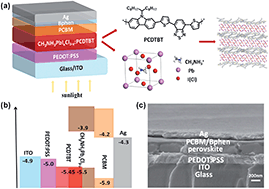
Photovoltaic performance of planar perovskite solar cells has been improved by mixing CH3NH3PbIxCl3-x and a donor polymer [N-9[prime or minute][prime or minute]-hepta-decanyl-2,7-carbazole-alt-5,5-(4[prime or minute],7[prime or minute]-di-2-thienyl-2[prime or minute],1[prime or minute],3[prime or minute]-benzothiadiaz-ole)].
The content of this RSS Feed (c) The Royal Society of Chemistry
04 Jan 05:18
Nanoscale, 2017, 9,2088-2094
DOI: 10.1039/C6NR08158D, Paper
Jae Choul Yu, Dae Woo Kim, Da Bin Kim, Eui Dae Jung, Ki-Suk Lee, Sukbin Lee, Daniele Di Nuzzo, Ji-Seon Kim, Myoung Hoon Song
This research confirms that the effect of the solvent in solvent dropping method is to fabricate a uniform perovskite film and to passivate the defect sites of the perovskite crystal films.
The content of this RSS Feed (c) The Royal Society of Chemistry

04 Jan 05:15
by Tze-Bin Song, Takamichi Yokoyama, Constantinos C. Stoumpos, Jenna Logsdon, Duyen H. Cao, Michael R. Wasielewski, Shinji Aramaki and Mercouri G. Kanatzidis

Journal of the American Chemical Society
DOI: 10.1021/jacs.6b10734

29 Dec 01:10
by Qiliang Wu, Weiran Zhou, Qing Liu, Pengcheng Zhou, Tao Chen, Yalin Lu, Qiquan Qiao and Shangfeng Yang

ACS Applied Materials & Interfaces
DOI: 10.1021/acsami.6b12683

29 Dec 01:08
by Jie Chen, Yongping Fu, Leith Samad, Lianna Dang, Yuzhou Zhao, Shaohua Shen, Liejin Guo and Song Jin

Nano Letters
DOI: 10.1021/acs.nanolett.6b04450

29 Dec 01:07
by James Stevenson, Blaire Sorenson, Varun Hari Subramaniam, James Raiford, Petr P. Khlyabich, Yueh-Lin Loo and Paulette Clancy

Chemistry of Materials
DOI: 10.1021/acs.chemmater.6b04327

29 Dec 01:07
by Andrey A. Petrov, Norman Pellet, Ji-Youn Seo, Nikolai A. Belich, Dmitriy Yu. Kovalev, Andrei V. Shevelkov, Eugene A. Goodilin, Shaik M. Zakeeruddin, Alexey B. Tarasov and Michael Graetzel

Chemistry of Materials
DOI: 10.1021/acs.chemmater.6b03965

29 Dec 01:07
by Yuping He and Giulia Galli

Chemistry of Materials
DOI: 10.1021/acs.chemmater.6b04300

27 Dec 13:59
by Daniel Niesner, Haiming Zhu, Kiyoshi Miyata, Prakriti P. Joshi, Tyler J. S. Evans, Bryan J. Kudisch, M. Tuan Trinh, Manuel Marks and X.-Y. Zhu
Journal of the American Chemical Society
DOI: 10.1021/jacs.6b12818

27 Dec 10:17
Energy Environ. Sci., 2017, 10,337-345
DOI: 10.1039/C6EE02650H, Paper
Jungjin Yoon, Hyangki Sung, Gunhee Lee, Woohyung Cho, Namyoung Ahn, Hyun Suk Jung, Mansoo Choi
With rapid and brilliant progress in performance over recent years, perovskite solar cells have drawn increasing attention for portable power source applications.
The content of this RSS Feed (c) The Royal Society of Chemistry

David and -1 others like this
27 Dec 10:17
Energy Environ. Sci., 2017, 10,509-515
DOI: 10.1039/C6EE03474H, Communication
Open Access
Tianyi Wang, Benjamin Daiber, Jarvist M. Frost, Sander A. Mann, Erik C. Garnett, Aron Walsh, Bruno Ehrler
Unusually long charge carrier lifetime in methylammonium lead halide perovskites is a result of the Rashba-split indirect bandgap. At high pressure the bandgap becomes purely direct, with shorter carrier lifetime and higher radiative efficiency.
The content of this RSS Feed (c) The Royal Society of Chemistry

27 Dec 10:16
Energy Environ. Sci., 2017, 10,361-369
DOI: 10.1039/C6EE03014A, Paper
Open Access
Waqaas Rehman, David P. McMeekin, Jay B. Patel, Rebecca L. Milot, Michael B. Johnston, Henry J. Snaith, Laura M. Herz
We establish compositional effects on stability, crystallinity, charge-carrier life times and mobilities in mixed-cation lead iodide-bromide perovskites as band gap tunable materials for multi-junction photovoltaic cells.
The content of this RSS Feed (c) The Royal Society of Chemistry

27 Dec 10:14
by Qifan Xue, Yang Bai, Meiyue Liu, Ruoxi Xia, Zhicheng Hu, Ziming Chen, Xiao-Fang Jiang, Fei Huang, Shihe Yang, Yutaka Matsuo, Hin-Lap Yip, Yong Cao
In this work, both anode and cathode interfaces of p-i-n CH3NH3PbI3 perovskite solar cells (PVSCs) are simultaneously modified to achieve large open-circuit voltage (Voc) and fill factor (FF) for high performance semitransparent PVSCs (ST-PVSCs). At the anode, modified NiO serves as an efficient hole transport layer with appropriate surface property to promote the formation of smooth perovskite film with high coverage. At the cathode, a fullerene bisadduct, C60(CH2)(Ind), with a shallow lowest unoccupied molecular orbital level, is introduced to replace the commonly used phenyl-C61-butyric acid methyl ester (PCBM) as an alternative electron transport layer in PVSCs for better energy level matching with the conduction band of the perovskite layer. Therefore, the Voc, FF and power conversion efficiency (PCE) of the PVSCs increase from 1.05 V, 0.74 and 16.2% to 1.13 V, 0.80 and 18.1% when the PCBM is replaced by C60(CH2)(Ind). With the advantages of high Voc and FF, ST-PVSCs are also fabricated using an ultrathin transparent Ag as cathode, showing an encouraging PCEs of 12.6% with corresponding average visible transmittance (AVT) over 20%. These are the highest PCEs reported for ST-PVSCs with similar AVTs paving the way for using ST-PVSCs as power generating windows.

The anode and cathode interfaces of CH3NH3PbI3 perovskite solar cells are optimized simultaneously. The shallow lowest unoccupied molecular level of C60(CH2)(Ind) provides better energy level alignment and surface passivation. High performance opaque cell with a power conversion efficiency (PCE) of 18.1% (Voc: 1.13 V, FF: 0.8) and semitransparent cell with a PCE of 12.6% (AVT>20%) are achieved.
19 Dec 00:33
by Hua Zhang, Huan Wang, Wei Chen, Alex K.-Y. Jen

The p-type inorganic semiconductor CuGaO2 as a hole-transporting layer (HTL) in perovskite solar cells (PSCs) provides higher carrier mobility, better-energy level matching, and superior stability, as well as low-temperature processing technique. Compared to organic HTL, a very competitive PCE of 18.51% with long-term stability is achieved. This indicates that CuGaO2 is a promising HTL for efficient and stable PSCs.
Bin, ZZQ and 6 others like this
19 Dec 00:32
by Zhenjun Tan, Yue Wu, Hao Hong, Jianbo Yin, Jincan Zhang, Li Lin, Mingzhan Wang, Xiao Sun, Luzhao Sun, Yucheng Huang, Kaihui Liu, Zhongfan Liu and Hailin Peng

Journal of the American Chemical Society
DOI: 10.1021/jacs.6b11683

19 Dec 00:32
by Tim Vangerven, Pieter Verstappen, Nilesh Patil, Jan D’Haen, Ilaria Cardinaletti, Johannes Benduhn, Niko Van den Brande, Maxime Defour, Vincent Lemaur, David Beljonne, Roberto Lazzaroni, Benoit Champagne, Koen Vandewal, Jens W. Andreasen, Peter Adriaensens, Dag W. Breiby, Bruno Van Mele, Dirk Vanderzande, Wouter Maes and Jean Manca

Chemistry of Materials
DOI: 10.1021/acs.chemmater.6b04143

07 Dec 10:15
by Dick van Dam, Niels J. J. van Hoof, Yingchao Cui, Peter J. van Veldhoven, Erik P. A. M. Bakkers, Jaime Gómez Rivas and Jos E. M. Haverkort

ACS Nano
DOI: 10.1021/acsnano.6b06874

07 Dec 10:09
by Cristina Besleaga, Laura Elena Abramiuc, Viorica Stancu, Andrei Gabriel Tomulescu, Marian Sima, Liliana Trinca, Neculai Plugaru, Lucian Pintilie, George Alexandru Nemnes, Mihaiela Iliescu, Halldor Gudfinnur Svavarsson, Andrei Manolescu and Ioana Pintilie

The Journal of Physical Chemistry Letters
DOI: 10.1021/acs.jpclett.6b02375

07 Dec 10:09
by Igal Levine, Satyajit Gupta, Thomas M. Brenner, Doron Azulay, Oded Millo, Gary Hodes, David Cahen and Isaac Balberg

The Journal of Physical Chemistry Letters
DOI: 10.1021/acs.jpclett.6b02287

06 Dec 00:40
by Thomas Strassner

Accounts of Chemical Research
DOI: 10.1021/acs.accounts.6b00240

06 Dec 00:40
by Yu Tong, Florian Ehrat, Willem Vanderlinden, Carlos Cardenas-Daw, Jacek K. Stolarczyk, Lakshminarayana Polavarapu and Alexander S. Urban

ACS Nano
DOI: 10.1021/acsnano.6b05649

06 Dec 00:38
J. Mater. Chem. A, 2017, 5,571-582
DOI: 10.1039/C6TA09626C, Paper
Mahmoud E. Farahat, Packiyaraj Perumal, Widhya Budiawan, Yang-Fang Chen, Chih-Hao Lee, Chih-Wei Chu
A PCE of greater than 8% is the highest ever achieved for a molecular solar cell processed using a green solvent.
The content of this RSS Feed (c) The Royal Society of Chemistry
06 Dec 00:36
by Paul Gratia, Giulia Grancini, Jean-Nicolas Audinot, Xavier Jeanbourquin, Edoardo Mosconi, Iwan Zimmermann, David Dowsett, Yonghui Lee, Michael Grätzel, Filippo De Angelis, Kevin Sivula, Tom Wirtz and Mohammad Khaja Nazeeruddin

Journal of the American Chemical Society
DOI: 10.1021/jacs.6b10049

06 Dec 00:35
by Mingxing Li, Ling Li, Rupam Mukherjee, Kai Wang, Qing Liu, Qiang Zou, Hengxing Xu, Jeremy Tisdale, Zheng Gai, Ilia N. Ivanov, David Mandrus, Bin Hu

The spin on a ferromagnetic Co surface can interact with the asymmetric orbital on an organometal halide perovskite surface, leading to an anisotropic magnetodielectric effect. This study presents an opportunity to integrate ferromagnetic and semiconducting properties through the Rasbha effect for achieving spin-dependent electronic functionalities based on thin-film design.
06 Dec 00:32
by Petr P. Khlyabich and Yueh-Lin Loo

Chemistry of Materials
DOI: 10.1021/acs.chemmater.6b04020

02 Dec 14:13
by Youyu Jiang, Bangwu Luo, Fangyuan Jiang, Fuben Jiang, Canek Fuentes-Hernandez, Tiefeng Liu, Lin Mao, Sixing Xiong, Zaifang Li, Tao Wang, Bernard Kippelen and Yinhua Zhou

Nano Letters
DOI: 10.1021/acs.nanolett.6b04019

02 Dec 10:26
by Jia Liang, Caixing Wang, Yanrong Wang, Zhaoran Xu, Zhipeng Lu, Yue Ma, Hongfei Zhu, Yi Hu, Chengcan Xiao, Xu Yi, Guoyin Zhu, Hongling Lv, Lianbo Ma, Tao Chen, Zuoxiu Tie, Zhong Jin and Jie Liu

Journal of the American Chemical Society
DOI: 10.1021/jacs.6b10227

02 Dec 10:25
by Zhiping Wang, David P. McMeekin, Nobuya Sakai, Stephan van Reenen, Konrad Wojciechowski, Jay B. Patel, Michael B. Johnston, Henry J. Snaith

Air-stable doping of the n–type fullerene layer in an n–i–p planar heterojunction perovskite device is capable of enhancing device efficiency and improving device stability. Employing a (HC(NH2)2)0.83Cs0.17Pb(I0.6Br0.4)3 perovskite as the photoactive layer, glass–glass laminated devices are reported, which sustain 80% of their “post burn-in” efficiency over 3400 h under full sun illumination in ambient conditions.
02 Dec 04:43
by Dmitry N. Dirin, Ihor Cherniukh, Sergii Yakunin, Yevhen Shynkarenko and Maksym V. Kovalenko

Chemistry of Materials
DOI: 10.1021/acs.chemmater.6b04298


   This article is licensed under a Creative Commons Attribution-NonCommercial 3.0 Unported Licence.