Chemistry of Materials
DOI: 10.1021/acs.chemmater.6b03539


Ultraweak light detection with solid-state and cooling-free photodetectors is important for both fundamental research and practical applications. A general phototransistor architecture for detecting ultraviolet–visible light down to 100 fW cm−2 at room temperature is demonstrated. The exceptional sensitivity stems from an amplification process triggered by incident light. A responsivity of ≈107 A W−1 is achieved.

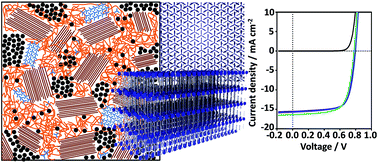
A sequential-casting ternary method is developed to create stratified bulk heterojunction (BHJ) solar cells, in which the two BHJ layers are spin cast sequentially without the need of adopting a middle electrode and orthogonal solvents. This method is found to be particularly useful for polymers that form a mechanically alloyed morphology due to the high degree of miscibility in the blend.

Fullerene-free organic solar cells show over 11% power conversion efficiency, processed by low toxic solvents. The applied donor and acceptor in the bulk heterojunction exhibit almost the same highest occupied molecular orbital level, yet exhibit very efficient charge creation.

Integration of organic/inorganic hybrid perovskites with metallic or semiconducting phases of 2D MoS2 nanosheets via solution processing is demonstrated. The results show that the collection of charge carriers is strongly dependent on the electronic properties of the 2D MoS2 with metallic MoS2 showing high responsivity and the semiconducting phase exhibiting high on/off ratios.

Solution-processed CsPbBr3 quantum-dot light-emitting diodes with a 50-fold external quantum efficiency improvement (up to 6.27%) are achieved through balancing surface passivation and carrier injection via ligand density control (treating with hexane/ethyl acetate mixed solvent), which induces the coexistence of high levels of ink stability, photoluminescence quantum yields, thin-film uniformity, and carrier-injection efficiency.


A formamidinium(FA)-based perovskite showns superior optoelectronic properties including better stability than methylammonium-based counterparts. Pure FA-perovskite-based light-emitting diodes (LEDs) with high efficiency are reported. Interestingly, the LED clearly shows a sub-bandgap emission at 1.7 V (bandgap 2.3 eV). This important discovery provides further insights of the charge transport mechanism in perovskite-based optoelectronic devices.


Nature Materials. doi:10.1038/nmat4797
Authors: Derya Baran, Raja Shahid Ashraf, David A. Hanifi, Maged Abdelsamie, Nicola Gasparini, Jason A. Röhr, Sarah Holliday, Andrew Wadsworth, Sarah Lockett, Marios Neophytou, Christopher J. M. Emmott, Jenny Nelson, Christoph J. Brabec, Aram Amassian, Alberto Salleo, Thomas Kirchartz, James R. Durrant & Iain McCulloch
Ionic iridium(III) complexes are emerging with great promise for organic electronic devices, owing to their unique features such as ease of molecular design and synthesis, excellent photophysical properties, superior redox stability, and highly efficient emissions of virtually all colors. Here, recent progress on new material design, regarding photo- and electroluminescence is highlighted, including several interesting topics such as: i) color-tuning strategies of cationic iridium(III) complexes, ii) widespread utilization in phosphorescent light-emitting devices fabricated by not only solution processes but also vacuum evaporation deposition, and iii) potential applications in data record, storage, and sercurity. Results on anionic iridium(III) complexes and “soft salts” are also discussed, indicating a new related subject. Finally, a brief outlook is suggested, pointing out that ionic iridium(III) complexes should play a more significant role in future organic electronic materials technology.

Ionic iridium(III) complexes show high promise for organic electronic devices owing to their excellent luminescence of virtually all colors. Recent progress on material design, characterization, and applications of ionic iridium(III) complexes is highlighted, pointing out their great potential for future organic displays, lighting, and data record storage.


C.-Z. Li, H. Chen and co-workers present, on page 9729, for the first time, efficient non-fullerene tandem organic solar cells (OSCs) by utilizing all non-fullerene acceptor-based bulk heterojunctions as sub-cells. A high power conversion efficiency of 8.48% is achieved with an ultra-high open-circuit voltage of 1.97 V, which is the highest voltage value reported to date feasible for water splitting among the efficient tandem OSCs.


MACl, as additive to the standard FAPbI3 precursor solution, enables near-complete coverage perovskite film to stabilize the phase-pure black FAPbI3 annealing at 100 °C. A partial substitution of FACl for FAI in precursor solution is used to grow FA perovskites with controllable chlorine doped fraction, which improves the performance of the planar perovskite solar cell.

A PbSe quantum dot solar cell with an efficiency of 7.22% and a fill factor of 62.4% is achieved by applying a CsPbBr3 perovskite quantum dot back layer. The back layer can effectively suppress carrier recombination at the PbSe/Au interfaces, hence lead to significant improvement in open-circuit voltage and fill factor.
Nonstoichiometric acid–base reaction as reliable synthetic route to highly stable CH3NH3PbI3 perovskite film
Nature Communications, Published online: 15 November 2016; doi:10.1038/ncomms13503
The stability of perovskite thin films and devices depends on a number of environmental factors, amongst which humidity. Here, Long et al. develop a synthetic route using a nonstoichiometric acid-base reaction to prepare films stable in humid environments for two months.