Shared posts

28 May 00:56

Transfer-Printed PEDOT:PSS Electrodes Using Mild Acids for High Conductivity and Improved Stability with Application to Flexible Organic Solar Cells

by Xi Fan, Bingang Xu, Shenghua Liu, Chaohua Cui, Jinzhao Wang and Feng Yan

TOC Graphic

ACS Applied Materials & Interfaces
DOI: 10.1021/acsami.6b01389
28 May 00:55

Improved Performance of Organic Light-Emitting Field-Effect Transistors by Interfacial Modification of Hole-Transport Layer/Emission Layer: Incorporating Organic Heterojunctions

by Li Song, Yongsheng Hu, Nan Zhang, Yantao Li, Jie Lin and Xingyuan Liu

TOC Graphic

ACS Applied Materials & Interfaces
DOI: 10.1021/acsami.6b02618
28 May 00:55

Bithiophenesulfonamide Building Block for π-Conjugated Donor–Acceptor Semiconductors

by Ferdinand S. Melkonyan, Wei Zhao, Martin Drees, Nicholas D. Eastham, Matthew J. Leonardi, Melanie R. Butler, Zhihua Chen, Xinge Yu, Robert P. H. Chang, Mark A. Ratner, Antonio F. Facchetti and Tobin J. Marks

TOC Graphic

Journal of the American Chemical Society
DOI: 10.1021/jacs.6b03498
27 May 10:49

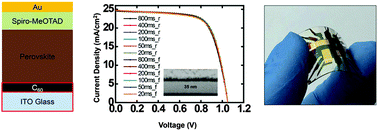
Hysteresis-free low-temperature-processed planar perovskite solar cells with 19.1% efficiency

Energy Environ. Sci., 2016, 9,2262-2266
DOI: 10.1039/C6EE01037G, Communication
Heetae Yoon, Seong Min Kang, Jong-Kwon Lee, Mansoo Choi
Hysteresis-free and highly efficient CH3NH3PbI3 perovskite solar cells employing a compact C60 material as an electron transport layer have been developed for the first time using both rigid glass and plastic substrates.
The content of this RSS Feed (c) The Royal Society of Chemistry
27 May 10:46

Discerning the Surface and Bulk Recombination Kinetics of Organic–Inorganic Halide Perovskite Single Crystals

by Bo Wu, Huy Tiep Nguyen, Zhiliang Ku, Guifang Han, David Giovanni, Nripan Mathews, Hong Jin Fan, Tze Chien Sum

Organic–inorganic halide perovskite single crystals possess many outstanding properties conducive for photovoltaic and optoelectronic applications. However, a clear photophysics picture is still elusive, particularly, their surface and bulk photophysics are inexorably convoluted by the spectral absorbance, defects, coexisting photoexcited species, etc. In this work, an all-optical study is presented that clearly distinguishes the surface kinetics from those of the bulk in the representative methylammonium-lead bromide (MAPbBr3) and -lead iodide (MAPbI3) single crystals. It is found that the bulk recombination lifetime of the MAPbBr3 single crystal is shortened significantly by approximately one to two orders (i.e., from ≈34 to ≈1 ns) at the surface with a surface recombination velocity of around 6.7 × 103 cm s−1. The surface trap density is estimated to be around 6.0 × 1017 cm−3, which is two orders larger than that of the bulk (5.8 × 1015 cm−3). Correspondingly, the diffusion length of the surface excited species is ≈130–160 nm, which is considerably reduced compared to the bulk value of ≈2.6–4.3 μm. Furthermore, the surface region has a wider bandgap that possibly arises from the strong lattice deformation. The findings provide new insights into the intrinsic photophysics essential for single crystal perovskite photovoltaics and optoelectronic devices.

Thumbnail image of graphical abstract

The surface and bulk photophysics of perovskite single crystals are clearly separated in an all-optical approach. Their surface photophysics is similar to that of polycrystalline thin films, but is significantly different in the bulk region. Key properties from both regions (e.g., recombination lifetimes, trap densities, surface recombination velocity, diffusion lengths, etc.) essential for optoelectronic applications are obtained in this comprehensive study.

27 May 10:45

Inverted Perovskite Solar Cells: Progresses and Perspectives

by Tanghao Liu, Ke Chen, Qin Hu, Rui Zhu, Qihuang Gong

During the past 6 years, perovskite solar cells have experienced a rapid development and shown great potential as the next-generation photovoltaics. For the perovskite solar cells with regular structure (n-i-p structure), device efficiency has reached over 20% after the intense efforts of researchers from all over the world. Recently, perovskite solar cells with the inverted structure (p-i-n structure) have been becoming more and more attractive, owing to their easy-fabrication, cost-effectiveness, and suppressed hysteresis characteristics. Some recent progress in their device performance and stability has indicated their promising future. Here, recent developments and future perspectives about inverted perovskite solar cells are reviewed. Interface engineering, film morphology control, device stability, hysteresis phenomena and other research hotspots are discussed to present the roadmap for the development of inverted perovskite solar cells.

Thumbnail image of graphical abstract

Inverted perovskite solar cells are attracting much attention owing to their superior characteristics. Recent developments and future perspectives about inverted perovskite solar cells are reviewed. Interface engineering, film morphology control, device stability, hysteresis phenomena and other research hotspots are discussed to present the promising future of inverted perovskite solar cells.

27 May 10:45

Nonhazardous Solvent Systems for Processing Perovskite Photovoltaics

by Kira L. Gardner, Jeffrey G. Tait, Tamara Merckx, Weiming Qiu, Ulrich W. Paetzold, Lucinda Kootstra, Manoj Jaysankar, Robert Gehlhaar, David Cheyns, Paul Heremans, Jef Poortmans

Replacing toxic solvents with nonhazardous solvents is one of the key challenges for industrial scale commercialization of thin film perovskite photovoltaics. Here, nonhazardous solvent/alcohol/acid systems are presented for the single-step deposition of pinhole-free perovskite layers with combined lead halide precursors of Pb(CH3CO2)2·3H2O, PbCl2, and CH3NH3I. Comparable performance to standard hazardous inks is achieved: devices with 15.1% power conversion efficiency are demonstrated and maintain 13.5% tracked for 5 min at maximum power point. Blade coated 4 cm2 solar modules fabricated with highest performing device ink attain 11.9% in power conversion efficiency.

Thumbnail image of graphical abstract

Nonhazardous solvent-alcohol-acid systems are developed for single-step deposition of perovskite photovoltaic layers, based on Hansen solubility parameters. The blade coating of 4 cm2 modules demonstrates the high yield and uniformity of the ink's coating capability.

27 May 10:45

Critical Role of Grain Boundaries for Ion Migration in Formamidinium and Methylammonium Lead Halide Perovskite Solar Cells

by Jae S. Yun, Jan Seidel, Jincheol Kim, Arman Mahboubi Soufiani, Shujuan Huang, Jonathan Lau, Nam Joong Jeon, Sang Il Seok, Martin A. Green, Anita Ho-Baillie
Thumbnail image of graphical abstract

The critical role of grain boundaries for (CH(NH2)2PbI3)0.85(CH3NH3PbBr3)0.15 perovskite solar cells studied by Kelvin probe force microscopy under bias voltage and illumination is reported. Ion migration is enhanced at the grain boundaries. Under illumination, the light-induced potential causes ion migration leading to a rearranged ion distribution. Such a distribution favors photogenerated charge-carrier collection at the grain boundaries.

26 May 02:01

Low thermal budget, photonic-cured compact TiO2 layers for high-efficiency perovskite solar cells

J. Mater. Chem. A, 2016, 4,9685-9690
DOI: 10.1039/C6TA02105K, Paper
Sanjib Das, Gong Gu, Pooran C. Joshi, Bin Yang, Tolga Aytug, Christopher M. Rouleau, David B. Geohegan, Kai Xiao
High-efficiency perovskite solar cells were fabricated using low thermal budget photonic-cured compact TiO2 as the electron transport layer. The best device on glass substrate exhibited an efficiency of 15% with average efficiency of 12.7%, comparable to the devices with furnace-annealed TiO2. Flexible devices were as efficient as 11.2%.
The content of this RSS Feed (c) The Royal Society of Chemistry
26 May 02:01

Quantification of spatial inhomogeneity in perovskite solar cells by hyperspectral luminescence imaging

Energy Environ. Sci., 2016, 9,2286-2294
DOI: 10.1039/C6EE00462H, Communication
Gilbert El-Hajje, Cristina Momblona, Lidon Gil-Escrig, Jorge Avila, Thomas Guillemot, Jean-Francois Guillemoles, Michele Sessolo, Henk J. Bolink, Laurent Lombez
Perovskite solar cells are analyzed by photo- and electroluminescence hyperspectral imaging. Significant spatial inhomogeneities in the quasi-Fermi level splitting are observed.
The content of this RSS Feed (c) The Royal Society of Chemistry
23 May 13:05

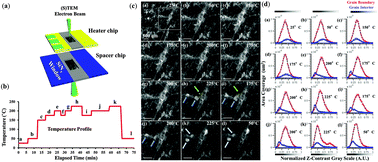
In situ investigation of the formation and metastability of formamidinium lead tri-iodide perovskite solar cells

Energy Environ. Sci., 2016, 9,2372-2382
DOI: 10.1039/C6EE01079B, Paper
Jeffery A. Aguiar, Sarah Wozny, Terry G. Holesinger, Toshihiro Aoki, Maulik K. Patel, Mengjin Yang, Joseph J. Berry, Mowafak Al-Jassim, Weilie Zhou, Kai Zhu
Organic-inorganic perovskites have emerged as an important class of next generation solar cells due to their remarkable low cost, band gap, and sub-900 nm absorption onset.
The content of this RSS Feed (c) The Royal Society of Chemistry
21 May 00:59

Poly(3,4-ethylenedioxythiophene):poly(styrenesulfonate)(PEDOT:PSS)-molybdenum oxide composite films as hole conductors for efficient planar perovskite solar cells

J. Mater. Chem. A, 2016, 4,9958-9966
DOI: 10.1039/C6TA03658A, Paper
Yurong Jiang, Chen Li, Hairui Liu, Ruiping Qin, Heng Ma
PEDOT:PSS-molybdenum oxide (MoOx) composite films are used as hole transport layers in planar perovskite solar cells (PSCs) by simply incorporating solution-processed MoOx powders into a PEDOT:PSS solution.
The content of this RSS Feed (c) The Royal Society of Chemistry
21 May 00:58

Photonic nanostructures for solar energy conversion

Energy Environ. Sci., 2016, 9,2511-2532
DOI: 10.1039/C6EE01182A, Review Article
Xiuzhen Zheng, Liwu Zhang
This review article provides a comprehensive review of recent progress in photonic nanostructures for efficient solar energy conversion.
The content of this RSS Feed (c) The Royal Society of Chemistry
21 May 00:54

Not All That Glitters Is Gold: Metal-Migration-Induced Degradation in Perovskite Solar Cells

by Konrad Domanski, Juan-Pablo Correa-Baena, Nicolas Mine, Mohammad Khaja Nazeeruddin, Antonio Abate, Michael Saliba, Wolfgang Tress, Anders Hagfeldt and Michael Grätzel

TOC Graphic

ACS Nano
DOI: 10.1021/acsnano.6b02613
19 May 00:56

Well-Defined Nanostructured, Single-Crystalline TiO2 Electron Transport Layer for Efficient Planar Perovskite Solar Cells

by Jongmin Choi, Seulki Song, Maximilian T. Hörantner, Henry J. Snaith and Taiho Park

TOC Graphic

ACS Nano
DOI: 10.1021/acsnano.6b01575
17 May 08:41

Light-activated photocurrent degradation and self-healing in perovskite solar cells

by Wanyi Nie

Article

Organometallic perovskite solar cells exhibit good efficiency but their photostability is still relatively poorly understood and controlled. Here the authors show that photo-degradation arises from the formation of light-activated meta-stable trap states, is reversible, and can be frozen at 0 °C.

Nature Communications doi: 10.1038/ncomms11574

Authors: Wanyi Nie, Jean-Christophe Blancon, Amanda J. Neukirch, Kannatassen Appavoo, Hsinhan Tsai, Manish Chhowalla, Muhammad A. Alam, Matthew Y. Sfeir, Claudine Katan, Jacky Even, Sergei Tretiak, Jared J. Crochet, Gautam Gupta, Aditya D. Mohite

17 May 08:40

Hole-Transporting Materials in Inverted Planar Perovskite Solar Cells

by Weibo Yan, Senyun Ye, Yunlong Li, Weihai Sun, Haixia Rao, Zhiwei Liu, Zuqiang Bian, Chunhui Huang

Hybrid organic–inorganic halide-perovskite-based solar cells have achieved notable progress. A hot topic in this field is exploring inexpensive, stable and effective hole-transporting materials (HTMs) in order to improve the device performance and be favorable for large-scale production in the future. The HTMs have been proven to be an important component of perovskite solar cells, which can form selective contact being favorable for reducing charge recombination and effective hole collection, thus resulting in the enhancement of the open-circuit voltage and the fill factor. Here, an overview of the design and development of HTMs is given, mainly divided into conductive polymers, inorganic p-type semiconductors in inverted-structure-based planar perovskite solar cells. The influences of their mobility, work function and film property on device performance are discussed.

Thumbnail image of graphical abstract

Hole-transporting materials in inverted planar perovskite solar cells have been widely studied in the past years. Most commonly these are p-type wide band-gap semiconductors which can be mainly divided into conductive polymers and inorganic p-type semiconductors. Their energy levels and chemical structures are summarized and the effects of their properties on the device performance are discussed in detail.

17 May 08:39

A New Polythiophene Derivative for High Efficiency Polymer Solar Cells with PCE over 9%

by Qunping Fan, Wenyan Su, Xia Guo, Bing Guo, Wanbin Li, Youdi Zhang, Kun Wang, Maojie Zhang, Yongfang Li
Thumbnail image of graphical abstract

A new fluorinated polythiophene (PT) derivative, PBDD-ff4T, is designed and synthesized. The PBDD-ff4T/PC71BM-based device without any extra treatment exhibits a high efficiency of 9.2%, under the irradiation of AM 1.5G, 100 mW cm−2, which is the highest power conversion efficiency reported for PT derivative-based polymer solar cells.

17 May 08:38

A Novel Dopant-Free Triphenylamine Based Molecular “Butterfly” Hole-Transport Material for Highly Efficient and Stable Perovskite Solar Cells

by Fei Zhang, Chenyi Yi, Peng Wei, Xiangdong Bi, Jingshan Luo, Gwénolé Jacopin, Shirong Wang, Xianggao Li, Yin Xiao, Shaik Mohammed Zakeeruddin, Michael Grätzel
Thumbnail image of graphical abstract

A triphenylamine based molecular “butterfly” is developed as dopant-free hole-transport material for perovskite solar cells exhibiting excellent power conversion efficiency of 16.3% which is comparable to the state-of-the-art doped 2,2′,7,7′-tetrakis(N,N′-di-p-methoxy-phenylamine)-9,9′-spirobifluorene (spiro-OMeTAD). Moreover, the device is much more stable than that of spiro-OMeTAD based device under light irradiation.

16 May 05:48

Interfacial Charge-Carrier Trapping in CH3NH3PbI3-Based Heterolayered Structures Revealed by Time-Resolved Photoluminescence Spectroscopy

by Yasuhiro Yamada, Takumi Yamada, Ai Shimazaki, Atsushi Wakamiya and Yoshihiko Kanemitsu

TOC Graphic

The Journal of Physical Chemistry Letters
DOI: 10.1021/acs.jpclett.6b00653
16 May 05:48

High Chloride Doping Levels Stabilize the Perovskite Phase of Cesium Lead Iodide

by Subham Dastidar, David A. Egger, Liang Z. Tan, Samuel B. Cromer, Andrew D. Dillon, Shi Liu, Leeor Kronik, Andrew M. Rappe and Aaron T. Fafarman

TOC Graphic

Nano Letters
DOI: 10.1021/acs.nanolett.6b00635
13 May 01:00

Structure and Dopant Engineering in PEDOT Thin Films: Practical Tools for a Dramatic Conductivity Enhancement

by Magatte N. Gueye, Alexandre Carella, Nicolas Massonnet, Etienne Yvenou, Sophie Brenet, Jérôme Faure-Vincent, Stéphanie Pouget, François Rieutord, Hanako Okuno, Anass Benayad, Renaud Demadrille and Jean-Pierre Simonato

TOC Graphic

Chemistry of Materials
DOI: 10.1021/acs.chemmater.6b01035
12 May 00:50

Nanoscale Control of Morphology in Fullerene-Based Electron-Conducting Buffers via Organic Vapor Phase Deposition

by Byeongseop Song and Stephen R. Forrest

TOC Graphic

Nano Letters
DOI: 10.1021/acs.nanolett.6b01416
12 May 00:49

Colloidal Wurtzite Cu2SnS3 (CTS) Nanocrystals and Their Applications in Solar Cells

by Uma V. Ghorpade, Mahesh P. Suryawanshi, Seung Wook Shin, Inyoung Kim, Seung Kyu Ahn, Jae Ho Yun, Chaehwan Jeong, Sanjay S. Kolekar and Jin Hyeok Kim

TOC Graphic

Chemistry of Materials
DOI: 10.1021/acs.chemmater.6b00176
11 May 00:46

Ultrasmooth metal halide perovskite thin films via sol-gel processing

J. Mater. Chem. A, 2016, 4,8308-8315
DOI: 10.1039/C6TA03092K, Paper
Ross A. Kerner, Lianfeng Zhao, Zhengguo Xiao, Barry P. Rand
We show that metal halide perovskite thin film formation is a sol-gel process which allows us to improve film morphology, achieving roughness [similar]1 nm via process and additive engineering.
The content of this RSS Feed (c) The Royal Society of Chemistry
11 May 00:42

Photovoltaics: Electrohydrodynamically Assisted Deposition of Efficient Perovskite Photovoltaics (Adv. Mater. Interfaces 9/2016)

by Hidetaka Ishihara, Wenjun Chen, Yen-Chang Chen, Som Sarang, Nicholas De Marco, Oliver Lin, Sayantani Ghosh, Vincent Tung
Thumbnail image of graphical abstract

The idea of regulating the hydrodynamics of incoming perovskite-containing droplets — that is whether the droplets undergo coalesce, merge and spread or pinning, and individual drying — sheds light on the scalable production of printable perovskite photovoltaics with reproducibility and high efficiency. Hidetaka Ishihara and co-workers investigate these hydrodynamics for a high throughput production of highly stable perovskite photovoltaics in article 1500762.

11 May 00:41

Red-to-Black Piezochromism in a Compressible Pb–I–SCN Layered Perovskite

by Daiki Umeyama, Yu Lin and Hemamala I. Karunadasa

TOC Graphic

Chemistry of Materials
DOI: 10.1021/acs.chemmater.6b01147
07 May 05:58

Contacts between Two- and Three-Dimensional Materials: Ohmic, Schottky, and p–n Heterojunctions

by Yang Xu, Cheng Cheng, Sichao Du, Jianyi Yang, Bin Yu, Jack Luo, Wenyan Yin, Erping Li, Shurong Dong, Peide Ye and Xiangfeng Duan

TOC Graphic

ACS Nano
DOI: 10.1021/acsnano.6b01842
07 May 05:57

Novel Excitonic Solar Cells in Phosphorene–TiO2 Heterostructures with Extraordinary Charge Separation Efficiency

by Liujiang Zhou, Jin Zhang, Zhiwen Zhuo, Liangzhi Kou, Wei Ma, Bin Shao, Aijun Du, Sheng Meng and Thomas Frauenheim

TOC Graphic

The Journal of Physical Chemistry Letters
DOI: 10.1021/acs.jpclett.6b00475
07 May 05:56

Side-Chain Engineering for Enhancing the Properties of Small Molecule Solar Cells: A Trade-off Beyond Efficiency

by Jie Min, Chaohua Cui, Thomas Heumueller, Stefanie Fladischer, Xiao Cheng, Erdmann Spiecker, Yongfang Li, Christoph J. Brabec

Three small molecules with different substituents on bithienyl-benzo[1,2-b:4,5-b′]dithiophene (BDTT) units, BDTT-TR (meta-alkyl side chain), BDTT-O-TR (meta-alkoxy), and BDTT-S-TR (meta-alkylthio), are designed and synthesized for systematically elucidating their structure–property relationship in solution-processed bulk heterojunction organic solar cells. Although all three molecules show similar molecular structures, thermal properties and optical band gaps, the introduction of meta-alkylthio-BDTT as the central unit in the molecular backbone substantially results in a higher absorption coefficient, slightly lower highest occupied molecular orbital level and significantly more efficient and balanced charge transport property. The bridging atom in the meta-position to the side chain is found to impact the microstructure formation which is a subtle but decisive way: carrier recombination is suppressed due to a more balanced carrier mobility and BDTT based devices with the meta-alkylthio side chain (BDTT-S-TR) show a higher power conversion efficiency (PCE of 9.20%) as compared to the meta-alkoxy (PCE of 7.44% for BDTT-TR) and meta-alkyl spacer (PCE of 6.50% for BDTT-O-TR). Density functional density calculations suggest only small variations in the torsion angle of the side chains, but the nature of the side chain linkage is further found to impact the thermal as well as the photostability of corresponding devices. The aim is to provide comprehensive insight into fine-tuning the structure–property interrelationship of the BDTT material class as a function of side chain engineering.

Thumbnail image of graphical abstract

A comprehensive insight into fine-tuning the structure–property interrelationship (a trade-off beyond efficiency) of the bithienyl-benzo[1,2-b:4,5-b′]dithiophene material class as a function of side chain engineering is provided.