12 Jun 06:04
by Le Quang Phuong, Yasuhiro Yamada, Masaya Nagai, Naoki Maruyama, Atsushi Wakamiya and Yoshihiko Kanemitsu

The Journal of Physical Chemistry Letters
DOI: 10.1021/acs.jpclett.6b00781

12 Jun 06:03
by Jing Wang, Kai Lin, Kai Zhang, Xiao-Fang Jiang, Khalid Mahmood, Lei Ying, Fei Huang, Yong Cao

A novel crosslinkable amino-functionalized conjugated polymer PFN-V is used as the cathode interlayer for high performance polymer solar cells, as reported by Lei Ying, Fei Huang, and co-workers in article number 1502563. The film can be rapidly crosslinked by UV-curing within 5 s in a nearly quantitative yield based on “thiol-ene” click reaction. This time- and labor-saving strategy may have practical applications in high throughput industrial production.
12 Jun 06:02
by Tom Kollek, Christian Fischer, Inigo Göttker-Schnetmann and Sebastian Polarz

Chemistry of Materials
DOI: 10.1021/acs.chemmater.6b01263

12 Jun 06:00
by Dongwen Yang, Wenmei Ming, Hongliang Shi, Lijun Zhang and Mao-Hua Du

Chemistry of Materials
DOI: 10.1021/acs.chemmater.6b01348

08 Jun 00:47
J. Mater. Chem. A, 2016, 4,10524-10531
DOI: 10.1039/C6TA02769E, Paper
M. Jaysankar, W. Qiu, J. Bastos, J. G. Tait, M. Debucquoy, U. W. Paetzold, D. Cheyns, J. Poortmans
An insight into how crystallisation dynamics influence the performance of wide-bandgap perovskite photovoltaics.
The content of this RSS Feed (c) The Royal Society of Chemistry
08 Jun 00:45
by Hung-Ju Yen, Po-Wei Liang, Chu-Chen Chueh, Zhibin Yang, Alex K.-Y. Jen and Hsing-Lin Wang

ACS Applied Materials & Interfaces
DOI: 10.1021/acsami.6b02169

08 Jun 00:43
by Lara Ferrighi, Martina Datteo, Gianluca Fazio and Cristiana Di Valentin

Journal of the American Chemical Society
DOI: 10.1021/jacs.6b02990

08 Jun 00:42
by Jung-Hoon Lee, Nicholas C. Bristowe, June Ho Lee, Sung-Hoon Lee, Paul D. Bristowe, Anthony K. Cheetham and Hyun Myung Jang

Chemistry of Materials
DOI: 10.1021/acs.chemmater.6b00968

07 Jun 01:29
J. Mater. Chem. A, 2016, 4,10130-10134
DOI: 10.1039/C6TA03284B, Communication
Yong Li, Kunyuan Lu, Xufeng Ling, Jianyu Yuan, Guozhen Shi, Guanqun Ding, Jianxia Sun, Shaohua Shi, Xiu Gong, Wanli Ma
Schematic illustration of the dual function of C60-N on the perovskite layer: first, to reduce the work function of the Al electrode and second, to passivate the perovskite surface.
The content of this RSS Feed (c) The Royal Society of Chemistry
07 Jun 01:28
by Javad Shamsi, Zhiya Dang, Paolo Bianchini, Claudio Canale, Francesco Di Stasio, Rosaria Brescia, Mirko Prato and Liberato Manna

Journal of the American Chemical Society
DOI: 10.1021/jacs.6b03166

07 Jun 01:27
by Jongkuk Ko, Jiyun Song, Hyunsik Yoon, Taeyong Kim, Changhee Lee, Rüdiger Berger, Kookheon Char
A new approach is presented to control the nanomorphology of organic solar cells in a predictable, controllable, and easily-scalable way. The nanoimprint lithography (NIL) is combined with a subsequent molecular diffusion step controlled by thermal annealing. The new approach is realized by using nanointerdigitated donor–acceptor structure, consisting of poly(3-hexylthiophene-2,5-diyl) nanopillar arrays surrounded by phenyl-C61-butyric acid methyl ester. Subsequent thermal annealing leads to vertically aligned ordered quasi-bulk heterojunctions with hierarchical nanostructure. The changes are studied in nanostructural and electrical properties of the pillar samples using scanning probe microscopy. In addition, grazing-incidence small and wide angle X-ray scattering yield detailed quantitative information on the molecular- to domain-scale nanostructures. The changes in crystal size, chain orientation, and domain composition as a function of thermal anneal temperature and time are obtained. In addition, the conductive scanning force microscopy in quantitative imaging mode, applied to the pillar-based samples for the first time, allows us to establish a clear relationship between nanomorphology, nanoelectrical property, and macroscale device performance. It is believed that the NIL combined with controlled molecular diffusion is a powerful method, which could be easily extended to other materials and processes to realize a whole variety of other hierarchical nanomorphologies.

With controlled mutual diffusion of donor and acceptor molecules on well-defined nanointerdigitated donor–acceptor pillar structure, quasi-bulk heterojunction pillars are formed in large area. The pillar nanostructures are effectively controlled by varying the thermal annealing conditions, showing nano- to macroscale structural and electrical properties easily monitored by grazing-incidence X-ray scattering, and scanning force microscopy.
07 Jun 01:27
by Jenya Tilchin, Dmitry N. Dirin, Georgy I. Maikov, Aldona Sashchiuk, Maksym V. Kovalenko and Efrat Lifshitz

ACS Nano
DOI: 10.1021/acsnano.6b02734

04 Jun 02:28
Energy Environ. Sci., 2016, 9,2444-2452
DOI: 10.1039/C6EE01337F, Paper
Shuyan Shao, Mustapha Abdu-Aguye, Li Qiu, Lai-Hung Lai, Jian Liu, Sampson Adjokatse, Fatemeh Jahani, Machteld E. Kamminga, Gert H. ten Brink, Thomas T. M. Palstra, Bart J. Kooi, Jan C. Hummelen, Maria Antonietta Loi
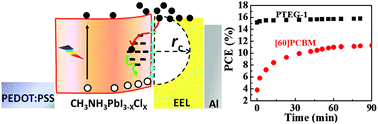
The higher dielectric constant and electron donating properties of PTEG-1 electron extraction layer synergistically helps to eliminate the light soaking effect and enhance device performance.
The content of this RSS Feed (c) The Royal Society of Chemistry

04 Jun 02:27
by Robert J. Stewart, Christopher Grieco, Alec V. Larsen, Grayson S. Doucette and John B. Asbury

The Journal of Physical Chemistry C
DOI: 10.1021/acs.jpcc.6b03472

04 Jun 02:26
by Bo Wu, Zhenghui Wu, Qingyi Yang, Furong Zhu, Tsz-Wai Ng, Chun-Sing Lee, Sin-Hang Cheung and Shu-Kong So

ACS Applied Materials & Interfaces
DOI: 10.1021/acsami.6b03619

04 Jun 02:25
by Ludwig Bormann, Frederik Nehm, Luisa Sonntag, Fan-Yu Chen, Franz Selzer, Lars Müller-Meskamp, Alexander Eychmüller and Karl Leo

ACS Applied Materials & Interfaces
DOI: 10.1021/acsami.6b02363

04 Jun 02:24
by Yinghong Hu, Johannes Schlipf, Michael Wussler, Michiel L. Petrus, Wolfram Jaegermann, Thomas Bein, Peter Müller-Buschbaum and Pablo Docampo

ACS Nano
DOI: 10.1021/acsnano.6b01535

Lucy and -1 others like this
04 Jun 02:20
by Bo Peng, Guannan Yu, Yawen Zhao, Qiang Xu, Guichuan Xing, Xinfeng Liu, Deyi Fu, Bo Liu, Jun Rong Sherman Tan, Wei Tang, Haipeng Lu, Jianliang Xie, Longjiang Deng, Tze Chien Sum and Kian Ping Loh

ACS Nano
DOI: 10.1021/acsnano.6b02845

04 Jun 02:20
by Donna M. Joyce, Fahima Ouchen, James G. Grote

For the first time, a new re-engineered polarized capacitor architecture for high energy density storage is demonstrated. Thin charge blocking layers are introduced at the electrode/dielectric interfaces. The insertion of these blocking layers leads to a likely reduction of charge injection into the dielectric material and a more than 200 V μm−1 increase in the electric field breakdown of the dielectric.
02 Jun 01:17
by You Seung Rim, Kyung-Chul Ok, Yang Michael Yang, Huajun Chen, Sang-Hoon Bae, Chen Wang, Yu Huang, Jin-Seong Park and Yang Yang

ACS Applied Materials & Interfaces
DOI: 10.1021/acsami.6b02814

02 Jun 01:17
by Qinghe Wu, Donglin Zhao, Alexander M. Schneider, Wei Chen and Luping Yu

Journal of the American Chemical Society
DOI: 10.1021/jacs.6b03562

02 Jun 01:16
by Chee Kong Lee, Liang Shi and Adam P. Willard

The Journal of Physical Chemistry Letters
DOI: 10.1021/acs.jpclett.6b00871

01 Jun 10:13
J. Mater. Chem. A, 2016, 4,10223-10230
DOI: 10.1039/C6TA03121H, Paper
Jie Cao, Feng Wang, Hui Yu, Yang Zhou, Haipeng Lu, Ni Zhao, Ching-Ping Wong
A new approach is introduced to synthesize porous PbI2, which produces a PbI2-free, crystallinity enhanced and air-stable MAPbI3 perovskite film.
The content of this RSS Feed (c) The Royal Society of Chemistry
01 Jun 00:53
J. Mater. Chem. A, 2016, 4,10212-10222
DOI: 10.1039/C6TA03709G, Paper
Ning Wang, Weichao Chen, Wenfei Shen, Linrui Duan, Meng Qiu, Junyi Wang, Chunming Yang, Zhengkun Du, Renqiang Yang
A PCE of 9.02% for a two-dimensional polymer as donor applied in solar cells was obtained without any additive treatment.
The content of this RSS Feed (c) The Royal Society of Chemistry
01 Jun 00:53
J. Mater. Chem. A, 2016, 4,10231-10240
DOI: 10.1039/C6TA02918C, Paper
Ashish Dubey, Nicholas Kantack, Nirmal Adhikari, Khan Mamun Reza, Swaminathan Venkatesan, Mukesh Kumar, Devendra Khatiwada, Seth Darling, Qiquan Qiao
Room temperature growth and crystallization of perovskite nanorod films in ambient air without the use of thermal annealing was reported for high performance solar cells.
The content of this RSS Feed (c) The Royal Society of Chemistry
01 Jun 00:53
J. Mater. Chem. A, 2016, 4,9967-9976
DOI: 10.1039/C6TA03801H, Paper
Yuxiang Li, Seo-Jin Ko, Song Yi Park, Hyosung Choi, Thanh Luan Nguyen, Mohammad Afsar Uddin, Taehyo Kim, Sungu Hwang, Jin Young Kim, Han Young Woo
Three types of quinoxaline-thiophene based photovoltaic polymers were synthesized by considering the backbone coplanarity via side-chain spacing and intrachain non-covalent coulombic interactions.
The content of this RSS Feed (c) The Royal Society of Chemistry
01 Jun 00:52
Energy Environ. Sci., 2016, 9,3429-3435
DOI: 10.1039/C6EE00315J, Paper
Yongxi Li, Lian Zhong, Fu-Peng Wu, Yi Yuan, Hai-Jun Bin, Zuo-Quan Jiang, Zhanjun Zhang, Zhi-Guo Zhang, Yongfang Li, Liang-Sheng Liao
In this work, we present a non-fullerene electron acceptor bearing a fused five-heterocyclic ring containing selenium atoms, denoted as IDSe-T-IC, for fullerene-free polymer solar cells (PSCs).
The content of this RSS Feed (c) The Royal Society of Chemistry

01 Jun 00:50
by Angela Y. Chang, Yi-Ju Cho, Kuan-Chen Chen, Chang-Wen Chen, Alper Kinaci, Benjamin T. Diroll, Michael J. Wagner, Maria K. Y. Chan, Hao-Wu Lin, Richard D. Schaller
Carrier dynamics in methylammonium lead halide (CH3NH3PbI3–xClx) perovskite thin films, of differing crystal morphology, are examined as functions of temperature and excitation wavelength. At room temperature, long-lived (>nanosecond) transient absorption signals indicate negligible carrier trapping. However, in measurements of ultrafast photoluminescence excited at 400 nm, a heretofore unexplained, large amplitude (50%–60%), 45 ps decay process is observed. This feature persists for temperatures down to the orthorhombic phase transition. Varying pump photon energy reveals that the fast, band-edge photoluminescence (PL) decay only appears for excitation ≥2.38 eV (520 nm), with larger amplitudes for higher pump energies. Lower photon-energy excitation yields slow dynamics consistent with negligible carrier trapping. Further, sub-bandgap two-photon pumping yields identical PL dynamics as direct absorption, signifying sensitivity to the total deposited energy and insensitivity to interfacial effects. Together with first principles electronic structure and ab initio molecular dynamics calculations, the results suggest the fast PL decay stems from excitation of high energy phonon modes associated with the organic sub-lattice that temporarily enhance wavefunction overlap within the inorganic component owing to atomic displacement, thereby transiently changing the PL radiative rate during thermalization. Hence, the fast PL decay relates a characteristic organic-to-inorganic sub-lattice equilibration timescale at optoelectronic-relevant excitation energies.

Ultrafast photoluminescence dynamics in CH3NH3PbI3–xClx perovskite thin films are examined as functions of pump wavelength, temperature, and film morphology. A previously unexplained, rapid decay feature in emission, which occurs only for above-gap excitation and lacks thermal activation, arises from organic-to-inorganic thermalization of phonons. Density functional theory and transient mid-infrared spectroscopy further support the assignment of this important dissipation mechanism.
01 Jun 00:50
by Edoardo Mosconi, Giulia Grancini, Cristina Roldán-Carmona, Paul Gratia, Iwan Zimmermann, Mohammad Khaja Nazeeruddin and Filippo De Angelis

Chemistry of Materials
DOI: 10.1021/acs.chemmater.6b00779

28 May 06:52
by Amanda J. Neukirch, Wanyi Nie, Jean-Christophe Blancon, Kannatassen Appavoo, Hsinhan Tsai, Matthew Y. Sfeir, Claudine Katan, Laurent Pedesseau, Jacky Even, Jared J. Crochet, Gautam Gupta, Aditya D. Mohite and Sergei Tretiak

Nano Letters
DOI: 10.1021/acs.nanolett.6b01218