Shared posts
[ASAP] Intrinsic Role of Excess Electrons in Surface Reactions on Rutile TiO2 (110): Using Water and Oxygen as Probes
[ASAP] Can Density Matrix Embedding Theory with the Complete Activate Space Self-Consistent Field Solver Describe Single and Double Bond Breaking in Molecular Systems?
[ASAP] Automatic Selection of an Active Space for Calculating Electronic Excitation Spectra by MS-CASPT2 or MC-PDFT
Consistent gaussian basis sets of double- and triple-zeta valence with polarization quality of the fifth period for solid-state calculations
Consistent basis sets of double- and triple-zeta valence with polarization quality for the fifth period have been derived for periodic quantum-chemical solid-state calculations with the crystalline-orbital program CRYSTAL. They are an extension of the pob-TZVP basis sets, and are based on the full-relativistic effective core potentials (ECPs) of the Stuttgart/Cologne group and on the def2-SVP and def2-TZVP valence basis of the Ahlrichs group. We optimized orbital exponents and contraction coefficients to supply robust and stable self-consistent field (SCF) convergence for a wide range of different compounds. The computed crystal structures are compared to those obtained with standard basis sets available from the CRYSTAL basis set database. For the applied hybrid density functional PW1PW, the average deviations of calculated lattice constants from experimental references are smaller with pob-DZVP and pob-TZVP than with standard basis sets. © 2018 Wiley Periodicals, Inc.
Consistent basis sets of double- and triple-zeta valence with polarization quality for the fifth period have been derived for periodic quantum-chemical solid-state calculations. The computed crystal structures are compared to those obtained with standard basis sets available from the CRYSTAL basis set database. The calculated lattice parameters are an improvement over the standard basis sets for DFT and HF methods.
Development of a Computational Tool for the Analysis and Synthesis of Crystallization Processes

Keiji Morokuma (1934–2017)
Keiji Morokuma, William Henry Emerson Professor Emeritus of Emory University and Research Leader at the Fukui Institute for Fundamental Chemistry, Kyoto University, passed away at the age of 83 on November 27, 2017. Morokuma made numerous contributions to theoretical methodologies for the determination of reaction mechanisms and the understanding of intermolecular interactions.
Hydrogen Evolution Reaction on Hybrid Catalysts of Vertical MoS2 Nanosheets and Hydrogenated Graphene

CO adsorption and oxygen activation on group 11 nanoparticles – a combined DFT and high level CCSD(T) study about size effects and activation processes
DOI: 10.1039/C7FD00225D, Paper
The focus of this study lies in the activation of molecular oxygen and reaction with CO within density functional theory (DFT) and high level CCSD(T) calculations.
The content of this RSS Feed (c) The Royal Society of Chemistry
Step edge structures on the anatase TiO2 (001) surface studied by atomic-resolution TEM and STM
DOI: 10.1039/C7FD00222J, Paper
Atomic arrangements in oxide surfaces can be uncovered by combining side view imaging using transmission electron microscopy and top view imaging using scanning tunnelling microscopy.
The content of this RSS Feed (c) The Royal Society of Chemistry
Trends in Adhesion Energies of Gold on MgO(100), Rutile TiO2(110), and CeO2(111) Surfaces: A Comparative DFT Study
Investigation of (Leaky) ALD TiO2 Protection Layers for Water-Splitting Photoelectrodes
Thomas:-)
Heterogeneity of Deposited Phases in Supported Transition Metal Oxide Catalysts: Reversible Temperature-Dependent Evolution of Molecular Structures and Configurations
DOI: 10.1039/C7CP07286D, Paper
In situ high temperature Raman spectroscopy under steady state oxidative dehydrated conditions is used for capturing the temperature dependence of molecular structures and configurations of (MOx)n (M = Re, Mo,...
The content of this RSS Feed (c) The Royal Society of Chemistry
CdTe-Based Photoanode for Oxygen Evolution from Water under Simulated Sunlight
CO2 adsorption on anatase TiO2(101) surfaces: a combination of UHV-FTIRS and first-principles studies
DOI: 10.1039/C7CP05375D, Paper
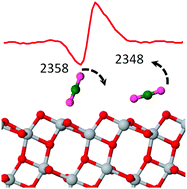
The IRRAS results show that the [small nu]3(OCO) asymmetric stretching vibration of adsorbed CO2 on a-TiO2(101) surfaces exhibits band splitting, which results from the swing motion of CO2 molecules on a-TiO2(101) surfaces at finite temperature.
The content of this RSS Feed (c) The Royal Society of Chemistry
Probing the Interactions of O2 with Small Gold Cluster AunQ (n = 2–10, Q = 0, −1): A Neutral Chemisorbed Complex Au5O2 Cluster Predicted
Photocatalytic Water Splitting: Quantitative Approaches toward Photocatalyst by Design

Machine learning for quantum dynamics: deep learning of excitation energy transfer properties
DOI: 10.1039/C7SC03542J, Edge Article
Open Access
  This article is licensed under a Creative Commons Attribution 3.0 Unported Licence.
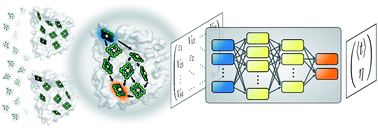
Understanding the relationship between the structure of light-harvesting systems and their excitation energy transfer properties is of fundamental importance in many applications including the development of next generation photovoltaics.
The content of this RSS Feed (c) The Royal Society of Chemistry
Mechanisms of molecular water oxidation in solution and on oxide surfaces
DOI: 10.1039/C7CS00465F, Review Article
Initial experiments on water oxidation by well-defined molecular catalysts were initiated with the goal of finding solutions to solar energy conversion.
The content of this RSS Feed (c) The Royal Society of Chemistry
Bridging Hydroxyls on Anatase TiO2(101) by Water Dissociation in Oxygen Vacancies
Characterization of Electrocatalytic Water Splitting and CO2 Reduction Reactions Using In Situ/Operando Raman Spectroscopy