I assume readers know evolution is not a conspiracy. You start out with a small tree shrew and—through nothing other than the pressure to survive in various environments—you end up with a giraffe whose neck gets ever longer and a panda whose color gets ever starker and who becomes increasingly intolerant of anything but bamboo.
Complex environments create specialists, and the longer these environments are stable, the more stereotyped the specialists are pressured to become. That’s why Bertrand Russell was able to write:
The reign of Augustus was a period of happiness for the Roman Empire…Augustus, for the sake of stability, set to work, somewhat insincerely, to restore ancient piety, and was therefore necessarily rather hostile to free inquiry. The Roman world began to become stereotyped, and the process continued under later emperors.
…so when I say “capitalism wants” I am no more talking about a conspiracy than when I use the shorthand “evolution wants”.
All kinds of people are born—always—but the pressure to survive while being that kind of person (plus the lessons their parents impress on them because they themselves had had to survive while being whatever kind of people they were) push people in each field toward personality types that can survive in their environment.
Considering, for instance, the world is going to keep producing artists, what kind of shape does early 21st-century capitalism want them in?
It needs them to go to school, for two reasons:
-the examples of earlier artists are always available (and often in the public domain), so in order to make anything broadly competitive saleable to a public whose main reliable taste is for technical expertise a decent chunk of them must have access to the means of acquiring it
-as we now expect technology will advance continuously, we like our artists to be conversant with it, as marrying the artist to new technology produces novelty—the other thing the public reliably likes—plus enables our artists to be able to talk to our advertisers, with whom they exist in a symbiotic relationship.
Capitalism wants artists’ talents and ideas because they can be used to sell things, capitalism wants artists to have a liberal education so they can steal ideas from all the world's culture. Capitalism would like to meet artists at parties—where the artist can simultaneously entertain the capitalist and can be introduced to patrons in an informal setting outside the recorded and legalized confines of the application process (where there are difficult questions concerning how many people of what kind you're taking applications from)--so it wants artists to throw parties, or at least go to them, and so be at least social enough to handle that. What it doesn’t want is artists who have money (artists are creative, so if you give them money they won’t necessarily invest in things and hire people to make more money, they might just spend it on firecrackers and beanbag chairs) or power (artists are nearly by definition people with unpredictable and radical ideas, and capitalism wants stable or at least controllable governance) or who are taken seriously outside the world of entertainment (unpredictable ideas plus the ability to communicate=trouble).
And, lo-and-behold, what kind of personality types do we get? “Artists are crazy,” “Artists are flakes,” “Guitarists are drug addicts,” “He’s a genius behind the piano but in real life he was a disaster”, etc. etc. Lovable but "unstable". You'd never vote for an artist.
Are these myths promoted to keep them in their place? Or descriptions of the personality-types that the institutions and conditions most favorable to survival produce? If, like lawyers, artists had art firms come around their studios around graduation time and offer them jobs they could keep for life we might well have a very different stereotype of them. Or maybe not. Whether chicken or egg isn’t actually important to my point, the point is however artists got there, capitalism has exactly no incentive to change their position. They have them right where they want them: always unstable, always vulnerable, always available.
-
-
-
The etymology of the word “nerd” goes back to 1950.
This makes perfect sense: a great war had just been decided through the use of weapons that had been unimagined (and in some cases had been unimaginable) during the war just before it. We were buying cars, we were about to have a space race. We did not know what the future would bring, but we knew we needed minders of machines and the mechanized bureaucratic instruments they enable. We put money into manufacturing these people on an industrial scale.
Just as The Art Student (nipple ring, blue hair, Starbucks job, campus-rock music taste, earnest and pointless politics, flake spirituality) is
something that capitalism has done to its artists and the Jock (etymology: 1963) is
something capitalism has done to its athletes and physically capable people, “nerd” is
something that capitalism has done to its intellectuals.
“Intellectual” has two common definitions—the first is the kind of person you hear getting interviewed on NPR about a Big Idea, the second, used by people like Marx, is any kind of economic actor who gets paid to do brainstuff rather than hard labor, like a plumbing engineer. The point of "Nerd" is to keep these two kinds of intellectuals separate, because together they are fucking dangerous. When Ta-Nehisi Coates is writing Black Panther comics
and demanding reparations after documenting decades of housing discrimination?--capitalism does not want that shit.
You, reading this, may very well work only with your brain for a living. You're probably too smart to go around calling yourself an intellectual--you know you'd get punched. But you call yourself a nerd? That's fine. That's adorable. Let me buy you a drink.
That's because the word ‘nerd’ and all the ideas around it are epiphenomena of anti-intellectualism. Troll culture is what you get when Nerd is shorn of any trace of intellectualism, and is, like all bullying, ultimately about enforcing existing social roles: If, in the middle of a discussion of a supremely nerdy subject, you bring up a creative imperative, you’re Pretentious, if you out-nerd the nerd you’re Aspie, if you display any awareness of the wider world, you’re reminded you’re just a nerd discussing a nerd thing in a nerd place. Be a middlebrow minder of machines, be quiet and uncharismatic and if you have to dream, dream only unreachably escapist and irrelevant dreams and if you have to fight, fight only with other nerds about those dreams and with no-one by your side. If 'Nerd' is the defanged intellectual, "troll" is the intellectual as collaborator, as kapo. And, like the kapo, they are betraying the only culture that could ever value their real assets.
Back in the day, under a different kind of ruling class than we have now, the kings and emperors knew that if they could just keep the smart people arguing which each other about whether Christ had one soul or three, they wouldn’t have much to worry about. That's why, when a smart person invented monks, they decided to keep them around--and make sure they kept wearing burlap sacks and having shitty haircuts. When the monks started growing pea plants and getting ideas about genetics and fucking nuns it was time to dream up new roles for them. Feudalism needed scholars, but not thinkers.
Capitalism needs smart and well-educated specialists who know how to teach machines to do new tricks. What it doesn’t need is more guys in the office charming or aggressive or relatable enough to compete for their management jobs. It doesn’t need to meet them at parties (they can just apply, it’s more efficient), it doesn’t need them to reproduce (their skills are considered transferrable through formal education rather than culture and parenting), it doesn’t want them rich or brave (a nerd who doesn’t need a new job after the one they’re quitting can do things to your machines that destroy you forever), it doesn’t need them broadly culturally educated (just make the fucking printer work, ok?).
For an example of how this works in practice,
Wesley Yang does a good job here of describing what it's like for many high-achieving tiger-parented Asian-americans who feel like all their education has done is polish them into ideal cogs for managerial types to install and ignore:
"An icon of so much that the culture pretends to honor but that it in fact patronizes and exploits. Not just people 'who are good at math' and play the violin, but a mass of stifled, repressed, abused, conformist quasi-robots who simply do not matter, socially or culturally.".
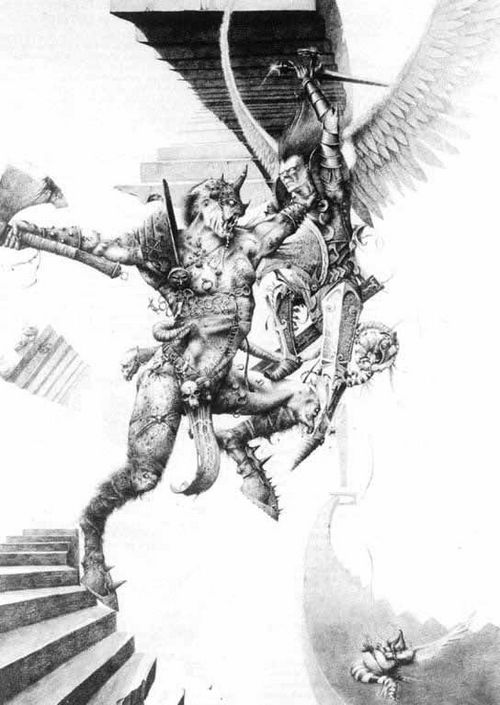
Nerds (or, rather: the intellectuals that late-stage-postindustrial capitalism would like to turn into mere “nerds”), like art students, aren’t actually that stupid. Anyone with a brain can do more (probably needs to do more) with it than crunch numbers and make bad jokes. And the nerds created, despite the wider economy’s—at best—apathy and—at worst—hostility to the idea, a culture. Gary Gygax going from adjusting insurance to working with Dave Arneson to invent a game about elves fighting demons is just about as pure an example of that culture as we get. The game drew on a knowledge of a rich literature that had developed completely independently of the mainstream of American literary culture; a culture that had vociferously argued, not coincidentally, the year before about whether to give
Gravity’s Rainbow—an undeniably
literary literary novel that only a Naval engineer with stacks of pulp novels in his garage could’ve produced—a Nobel prize. Both Gygax and Pynchon (born a year apart) were part of the first generation old enough to be called "nerds" as teenagers, had gotten nerd jobs to survive about as soon as they could and--about 20 years later, managed to make things that built on the would-be disposable culture they loved and the technocratic esoteric they'd been stuffed full of.
D&D, like
Gravity’s Rainbow, was an assertion that the nerd had something to teach the art student—and a hint that maybe they both could push past roles that they were being asked to fill and just be smart people.
This is a terrible revelation—because it suggests maybe if you stop accepting You’re just a…(whatever) you might suddenly have responsibilities. You might be capable of things you’ve been neglecting. You might be expected to compete on a wider field than just how fast you can get that Naruto reference in or cite the figure that backs up the opinion everyone you know already has. You might’ve been slacking off all this time.
It is ok to be awkward or afraid or unable to relate to people outside the narrow world of your hobbies and tastes—but it isn’t ok to fail to recognize those things as limitations—and ones that the world outside you has encouraged and will continue to encourage. This was not done to protect you from the world--it was done to protect the world from you.
-
-
-