We won't get any more new builds for Windows 10 Technical Preview this year, but it looks like Microsoft is cooking up a host of changes for the first preview of 2015. WinBeta has learned that the first Consumer Preview of the OS is likely to debut early next year, which may include Cortana for the desktop, a new Start screen, access to the desktop-to-tablet UI switching mode called Continuum and more.
Shared posts
What Habits Are Best for Creativity?
When I tell people that I’ve been working on Better Than Before, my book about habit change, many people ask, “What habits are best for creativity? What habits help people think creatively — and also, actually produce?”
Often, people make the case for adopting a particular habit by pointing to a renowned figure who practiced that habit, with great success. For instance…
Maybe we should live a life of quiet predictability, like Charles Darwin.
Or maybe we should indulge in boozy revelry, like Toulouse-Lautrec.
Maybe we should wake up early, like Haruki Murakami.
Or maybe we should work late into the night, like Tom Stoppard.
Maybe it’s okay to procrastinate endlessly, like William James.
Or maybe it’s better to work regular hours, like Anthony Trollope.
Should we work in silence, like Gustav Mahler?
Or amidst a bustle of activity, like Jane Austen?
Maybe it’s helpful to drink a lot of alcohol, like Friedrich Schiller.
Or a lot of coffee, like Kierkegaard.
Are we better off producing work for many hours a day, like H. L. Mencken?
Or maybe for just thirty minutes a day, like Gertrude Stein.
The sad fact is, there’s no magic formula, no one-size-fits-all solution—not for ourselves, and not for the people around us.
We won’t make ourselves more creative and productive by copying other people’s habits, even the habits of geniuses; we must know our own nature, and what habits serve us best.
In his fascinating book Daily Rituals: How Artists Work, from which these examples are drawn, Mason Currey exhaustively examines the work habits of 161 writers, composers, artists, scientists, and philosophers.
These examples make one thing perfectly clear about creative habits: while brilliant people vary tremendously in the specific habits they follow, they all know very well what habits work for them, and they go to enormous lengths to maintain those habits.
I used to tell everyone that working slowly and steadily was the best way to produce creative work. Because that’s what works for me.
And I used to encourage everyone to get up early, to work in the morning. Because that’s what works for me.
And I used to say that it was better to work in a reasonably quiet, calm environment. Because that’s what works for me.
But as I worked on Better Than Before, it became increasingly clear to me that the opposite habits work better for some people.
I’m a Marathoner, but some people are Sprinters.
I’m a Lark, but some people are Owls.
I’m a Simplicity-Lover, but other people are Abundance-Lovers.
We have to think about ourselves. It’s helpful to ask, “When have I worked well in the past? What did my habits look like then – and how can I replicate them?” Maybe you work more creatively with a team – or by yourself. Maybe you need deadlines – or maybe you feel strangled by deadlines. Maybe you like working on several projects at once — or you prefer to focus on one project at a time.
With habits, as with happiness, the secret is to figure out ourselves. When we shape our habits to suit our own nature, our own interests, and our own values, we set ourselves up for success.
How about you? What habits contribute or detract from your creativity?
Do You Agree with These 7 Quotations about Habits?
Every Wednesday is List Day, or Tip Day, or Quiz Day.
This Wednesday: Do you agree with these 7 quotations about habits?
Whenever I read a book, I love to copy my favorite lines and passages into my giant trove of quotations. (If you love quotations too, sign up for my “Moment of Happiness,” a free daily quote.)
When doing my research for Better Than Before, my book about habit change, I naturally began to collect quotations about habits. Working those passages into the book was one of my favorite things to do.
Certain quotations, however, had a particularly strong influence over my thinking about habits.
1. “Every time you break the law you pay, and every time you obey the law you pay.” — John Gardner
I love this quotation, and almost made it the epigraph of the entire book. Gardner is a Rebel, and made that observation from his Rebel perspective, but it’s just as true for everyone. Nothing stays in Vegas; everything counts.
2. “The greatest of empires, is the empire over one’s self.” — Publilius Syrus
I made this quotation the epigraph of the book, instead. With habits, as with happiness, it all boils down to self-knowledge. When we truly know ourselves, we can master ourselves to create the lives that suit us best.
3. “A stumble may prevent a fall.” — English Proverb
With habits, it’s very important to think about safeguards, and to plan to fail. The idea that a little failure might actually be constructive — that a stumble may prevent a fall — is very helpful idea to help to re-frame lapses.
4. “Researchers were surprised to find that people with strong self-control spent less time resisting desires than other people did. . . . people with good self-control mainly use it not for rescue in emergencies but rather to develop effective habits and routines in school and at work.” — Roy Baumeister and John Tierney
This quotation lacks that aphoristic quality of the others, but it really sparked my thinking about habits, and why they’re so valuable. Auto-pilot! Habits help us escape the drain of making decisions and exercising willpower.
5. “The reward of a thing well done is to have done it.” — Ralph Waldo Emerson
The issue of reward is extremely complicated in the field of habits. Rewards are very, very tricky to apply. But the one reward that never fails is the satisfaction of the good habits itself.
6. “One of the secrets of a happy life is continuous small treats.” — Iris Murdoch
We must have treats! More and more, I’m seeing that the idea of deprivation is an enormous challenge to good habits. When we start to feel deprived, we enter into the “I need it, I deserve it, I’ve earned it” cycle. Getting lots of healthy treats help ward that off. When we give more to ourselves, we can ask more of ourselves.
7. “If I consider my life honestly, I see that it is governed by a certain very small number of patterns of events which I take part in over and over again…when I see how very few of them there are, I begin to understand what huge effect these few patterns have on my life, on my capacity to live. If these few patterns are good for me, I can live well. If they are bad for me, I can’t.” — Christopher Alexander
This is a reminder of the central role of habits in our daily existence, and also a reminder of the very purpose of mastering habits: to live well. It may take time and effort to change our habits, but in the end, they make our lives better.
Do you agree or disagree with these statements?
Do you have any habit-related quotes you love? Or any quotation at all, really. I do love quotations.
To pre-order Better Than Before, go here. If you’re inclined to buy the book, it really helps me if you pre-order it. Remember, you won’t be charged until the book ships, so don’t worry about that.
How to End This Sentence? “There Is Certainly No Greater Happiness Than To…”
How would you end that sentence? Here’s how Dr. Johnson completed it:
“There is certainly no greater happiness than to be able to look back on a life usefully and virtuously employed, to trace our own progress in existence by such tokens that excite neither shame nor sorrow.”
–Samuel Johnson, “Rambler No. 41,” August 7, 1750
I love the work of Samuel Johnson. I was looking back through the draft of Better Than Before, my book about habit change, and I realized that I’d quoted him several times — and I cut out several more quotations, as well. (To pre-order Better Than Before, click here.)
What authors do you find yourself quoting most often?
7 Tips To Make It Easier To Have Healthy Eating Habits.
Every Wednesday is Tip Day, or List Day, or Quiz Day.
This Wednesday: 7 tips that make it easier to have healthy eating habits.
Many people were very intrigued by my interview with behavioral scientist Brian Wansink and his ideas. He studies eating behavior and consumer habits, and has a book that just came out: Slim By Design: Mindless Eating Solutions for Everyday Life.
I asked him for some of his top tips, and he gave me these excellent suggestions to “Help your kitchen make you slim.”
- Serve vegetables first.
- Serve the main dish from the stove or counter, so that to get seconds, you have to stand up and go get more. (This combines the Strategy of Inconvenience, because you can’t just reach out to take more food, and the Strategy of Monitoring, because you can keep track better of how much you’re eating.)
-
Use dinner plates that are 9-10 wide. We eat less when we use a smaller plate, but American plate sizes have been steadily growing.
-
Sit at a table, with the TV off. People eat more, without noticing, if they’re watching TV. And if you have to sit at a table to eat, you’ve made it harder to have impulsive snacks.
- Keep two or fewer cans of sugary drinks in your fridge.
- Keep your kitchen counters organized, not messy. (I was interested to see this one — it confirms my argument about the Strategy of Foundation and the importance of “uncluttering.”)
- Keep snack foods in one inconvenient cupboard. (Again, the Strategy of Inconvenience.)
What would be your best tips? I remind myself of one of my Secrets of Adulthood for Habits: It’s easier to change my surroundings than myself. It’s easier to put cookies on a high shelf than to boost my willpower.
I talk about all of these tips in Better Than Before, my forthcoming book about habit change. The most fascinating subject in the world. To pre-order, click here. If you’re inclined to buy the book, I’d really appreciate your pre-order. Pre-orders really matter.
IHeart a Great Giveaway - Getting Organized with Madesmart!
Madesmart is based in St. Paul, Minnesota and they work hard at creating organizational items that encompass style, function, quality and affordability. Um, yes please!
And they also believe that if they can create beautifully designed and useful products, that they can in turn make the act of getting organized enjoyable and fun. I can fist pump to that!
Bonus points that madesmart actually rhymes with iheart.
In 1990, Devee dreamed up “the Junk Drawer Organizer®” and it was the first of its kind that lucky for us, became very successful. That success moved Devee into an amazing career and super cool new category of storage and organization. Today, her company now has over 300 unique products that are offered in most major retailers (like Target and The Container Store!). See, inspiring! I couldn't be happier for her success!
So, now that you have some information as to why I personally heart madesmart, here is what they will be giving away to one lucky iHeart Organizing reader this week! A complete kitchen storage pack!

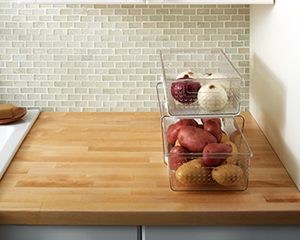
2-Tier Organizers: A stacking system that works in all areas of the home. This system makes the most out of the vertical space we have throughout the abode. Each basket slides easily on each tray and their handles allow for easy transport.
Clear Stackable Cabinet Shelves: These stackable shelves help maximize your vertical space. They feature rubber feet to keep things in place and they fold flat when not in use.
Fridge/Pantry Collection: These versatile bins store items efficiently in the fridge or pantry. Features include durable, high-quality plastic; rounded corners for easy cleaning; non-slip handles for moving and dry erase labeling area. Its nonslip lining rubber feet keeps things in place. BPA free and food safe.
a Rafflecopter giveaway
Good luck everyone! IHeart Organizing official giveaway entry rules can always be found here.
“It Is Easy To Be Heavy: Hard To Be Light.”
“It is easy to be heavy: hard to be light.”
–G. K. Chesterton, “The Eternal Revolution,” in The Everyman Chesterton
Agree, disagree? This idea haunted me as I was writing The Happiness Project. It seemed relevant to everything.
“No One Wants to Admit They Were Tricked by the Size of a Scoop or the Shape of a Glass.”
Habits interview: Brian Wansink.
I’ve been a big fan of behavioral scientist Brian Wansink for years. He does intensely interesting research on eating behavior and consumer habits, and his book Mindless Eating: Why We Eat More Than We Think was a resource for me as I was writing Better Than Before.
For instance, he’s done a lot of research to show how much convenience influences whether and how much we eat. It’s astonishing how much convenience matters. The lesson for habits? Make it easy to do things right, and hard to do things wrong.
Brian Wansink has a new book, Slim By Design: Mindless Eating Solutions for Everyday Life. It’s crammed with ideas to make it easy to eat healthier–without even noticing that you’re making changes. The book is fascinating, and surprisingly lively and funny–this isn’t a dry review of the literature. It’s a fun read.
I so agree with this approach of “mindless eating” to eating habits. Whenever someone tells me, “I need to make healthy choices,” I think, “No, don’t make healthy choices! Choose once, then stop deciding. Use habits. Mindfully use mindlessness to get where you want to go.”
I was very eager to hear what Brian Wansink had to say about habits in general, and about his own habits.
Gretchen: You’ve done fascinating research on the subject of habits and eating. What’s the most significant thing you’ve concluded?
Brian: After conducting hundreds of food studies, I’m increasingly convinced that our stomach has only three settings: 1) We either feel like we’re starving, 2) we feel like we’re stuffed, or 3) we feel like we can eat more. Most of the time we’re in the middle, we’re neither hungry nor full, but if something’s put in front of us, we’ll eat it. I all but guarantee that most people with a few spare pounds would lose 20 pounds in a year if every time they had a craving they would announce – out loud – “I’m not hungry, but I’m going to eat this anyway.” Having to make that declaration either prevents you for eating, or if you do indulge, it prevents you from overindulging.
A second finding is that most people think they are too smart to be influenced by candy dishes, television, or the shape of a glass. When we show someone that they ate 30% more because we gave them a large scoop at the ice cream social, they will deny it. That’s what is so astonishing. No one wants to admit they were tricked by something as mundane as the size of a scoop or the shape of a glass. That’s what makes these cues around us so dangerous to our diets.
What aspects of habits would be most helpful for people to understand?
Most people believe they are Master and Commander of their food choices. They aren’t, but I want them to see that they can make small changes that can put them back in the driver’s seat. I want people to see that making small changes in their kitchens and routines will make all the difference with no real sacrifice.
What’s a simple habit that consistently makes you happier?
Before both breakfast and lunch, I think of one thing that’s happened so far that day that I’m grateful for. At dinnertime – if I’m home and not traveling – I have a slightly different routine. Each person in the family (including me) shares what happened that day by answering 4 questions: 1) their high point, 2) their low point, 3) who they appreciate most and why, and 4) their plan for tomorrow. It gives them a chance to celebrate the good things that happen, realize that each of us has daily disappointments, thank a person who helped them out, and to raise their eyes toward the future. All three of my daughters get their moment in the sun, and it makes me happy to see each one shine.
What’s something you know now about forming healthy habits that you didn’t know when you were 18 years old?
When you get up in the morning, you can say “This is going to be a tremendous day,” “This is going to be OK day,” or “This is going to be a terrible day.” Regardless of what you say, you’ll be right.
Do you have any habits that continually get in the way of your happiness?
The most top of mind that gets in the way of my happiness is very vivid right now: It’s thinking my work is more urgent than my young daughters.
I’m in DC now because I gave a House and a Senate Briefing on something related to Slim by Design. An hour ago, I was on the phone with my middle daughter, and she asked if I knew these people and I said, “No.”
She replied, “But Daddy, why do you have time to read your book to strangers but not to us. We’re more important than strangers. We’re your little girls.” I’m still choked up and wiping my eyes.
Which habits are most important to you? (for heath, for creativity, for productivity, for leisure, etc.)
Dreaming big, staying positive, building other people up, laughing as much as possible and making other people laugh.
Have you ever managed to gain a challenging healthy habit—or to break an unhealthy habit? If so, how did you do it?
The only way I can do it is by avoiding what I call the Tyranny of the Moment.
Generally speaking, we can commit to making a small change in life, such as not eating sweet snacks before dinner. We can write it down, cross our heart, and announce it to others. We can really, really mean it. But fast forward two days. It is been a hard day at work; you finished a 45 minute commute; you are drained, and you know frozen Snickers bar is waiting in the right corner of the freezer door. It is easy to break your cross-the-heart commitment. After all, today is an exception – it was a tough day and, come to think of it, you did not have a very big breakfast. Your plan of the year has just been thwarted by the tyranny of the moment. And the moment – this one exceptional moment – tyrannically wins every time.
Sometimes that inner voice actually whispers to us, “I know I said I’m not going to eat out of vending machines at work, but today’s different – it’s been crazy,” or “I know I still have to do my sit-ups today, but it’s late – I’ll do twice as many tomorrow when I wake up.” I know I should have had only one glass of wine but this is really a great dinner and a really good wine.” [I talk about this problem in the Strategy of Loophole-Spotting.]
There is only one thing that is strong enough to defeat the tyranny of the moment.
Habit.
As mentally disciplined as most of us like to think we are, nothing beats having to face facts each night and check off a box. We have very selective memories, but I use tools such as this checklist to let us know just why – or why not – we have painlessly lost two pounds on the 31st of the month.
This basic approach works for well or other habits also.
Would you describe yourself as an Upholder, a Questioner, a Rebel, or an Obliger?
80% Upholder, 20% Rebel.
Does anything tend to interfere with your ability to keep your healthy habits? (e.g. travel, parties)
Since I try to invest heavily in other people, I’m tripped up when a key relationship isn’t going well — it’s tremendously disorienting. A while back, my wife and I were having difficulties, and it threw me out of balance so much that it distracted me away my mindlessly healthy routines. One day I woke up and realized I had gained over 20 lbs.
I went back to these routines (they’re in Mindless Eating, chapter 10), and lost the pounds in about 4 months. It was an unfortunate reminder about what happens when we let healthy habits (and relationships) slip.
Have you ever been hit by a lightning bolt, where you changed a major habit very suddenly, as a consequence of reading a book, a conversation with a friend, a milestone birthday, a health scare, etc.?
You were raised in Kansas City [wow, good memory, Brian!], and I was raised up the Missouri River in Sioux City, Iowa. My parents were extremely loving and supportive, but there wasn’t an expectation I would go to college or the means to very easily make it happen. I did go to college, and to try and support myself, I struggled selling Amway. I worked all the time, but I blamed my lack of success on being too shy, not smart enough, not having a suit, and so on. One day a friend gave me a copy of an old book called The Magic of Thinking Big by David Schwartz.
This book gave me a transforming level of confidence in myself and my mission. I reread that book 10 times within the first month and at least 30 more times since. Within a semester my grades went from a 2.5 to a 3.8, I met my wonderful college sweetheart, my college money worries disappeared, I ran for the student senate, and I committed myself to become a professor who changes eating behavior – oh, and I bought a suit.
I’ve given that book to over 200 people over the past 25 years. Most think it’s pretty hokey, dated, or simple-minded. I understand that, but I would also understand if their thinking – as a result – never grew any bigger than the thinking they inherited from their parents.
Do you embrace habits or resist them?
Embrace. That was the theme of Mindless Eating, and that’s also the theme of Slim by Design: “For 90 percent of us, the solution to mindless eating is not mindful eating—our lives are just too crazy and our willpower’s too wimpy. Instead, the solution is to tweak small things in our homes, favorite restaurants, supermarkets, workplaces, and schools so we mindlessly eat less and better instead of more. It’s easier to use a small plate, face away from the buffet, and Frisbee-spin the bread basket across the table than to be a martyr on a hunger strike. Willpower is hard and has to last a lifetime. Rearranging your life to be Slim by Design is easy.”
Has another person ever had a big influence on your habits?
Absolutely. This happens all of the time. I am a very coachable person. Sometimes that coach is a 5-year old daughter who tells me drink less Diet Coke, and sometimes it’s an author whose book I’ve read over 40 times.
Are You a “People-Pleaser?” What Do You Feel Obliged To Do?
Jessica KendrickI'm a total obliger.
I posted yesterday about “Do you resist when anyone asks or tell you what to do?”, about some questions I had about the Rebel Tendency, as part of the Four Tendencies framework I’ve created.
The Four Tendencies are part of what I discuss in Better Than Before, my book on habit change.
A key piece of self-knowledge — which is crucial to habit change — is “What is your ‘Tendency’?” That is: How do you respond to expectations?
-outer expectations (meet a deadline, perform a “request” from a sweetheart, follow traffic regulations)
-inner expectations (write a novel in your free time, keep a New Year’s resolution, start flossing)
Your response to expectations may sound slightly obscure, but it turns out to be very, very important.
In a nutshell:
- Upholders respond readily to outer and inner expectations (I’m an Upholder, 100%)
- Questioners question all expectations; they’ll meet an expectation if they think it makes sense (my husband is a Questioner), so they make everything an inner expectation
- Obligers meet outer expectations, but struggle to meet expectations they impose on themselves (they often describe themselves as “people-pleasers”)
- Rebels resist all expectations, outer and inner alike
I gave a talk at LinkedIn about the Four Tendencies, so if you’d like to see me discuss each category in a video, you can watch: for Upholders, watch here; Questioners, here; Obligers, here, and Rebels, here.
I’m always trying to deepen my understanding of how they play out. So this week, I’m going to pose some questions. Yesterday, I focused on Rebels.
Today’s questions relate to the Obliger Tendency.
Obligers, and Obliger-observers, I’m curious: what do you feel obliged to do? It seems to me that Obligers vary tremendously in their standards. They often describe themselves as “people-pleasers” but some do much more to please than others!
Some Obligers seem to feel obliged to do all sorts of things — perhaps even things that no one is actually expecting from them. “I have to make a homemade dessert for the bake sale.” “I can’t go to sleep with dirty dishes in the sink, because someone might see.” “I have to do the yard work myself.” They may exhaust themselves meeting obligations for others — and feel burned out, and also resentful, because they don’t meet their expectations for themselves.
Other Obligers seem to feel obliged only to do things if they’ll actually get in some kind of trouble if they don’t. “I won’t work on the report until my boss comes looking for it.” “I won’t clean up the kitchen unless someone is coming over.”
Another variety: I have a friend who is an Obliger, and very ethical. She feels obligated to anything that she considers morally necessary. So she feels obliged to be on time, because that shows respect for others, which is morally worthy, but she feels no obligation to go to the gym. I said, “What about your duty to yourself?” (That’s the Upholder perspective.) She just waved her hand and said, “Meh.”
Note: For Obligers to meet expectations for themselves, they need to create systems of external accountability. This is key! Essential! And makes an enormous difference.
What do you think? Does this ring true? What spectrum of Obliger behavior have you noticed or experienced?
If you want to know when Better Than Before goes on sale — and of course you do — sign up here.
aglow
Jessica KendrickI wish there was more art in public spaces. it's so enjoyable.
The colours of this last burst of late summer warmth in old stained glass window in the Cloister in Bristol Cathedral. The corridor is effectively a gallery of stained glass presented at eye level - not high up above - which means you can examine all the robes, tassels, folds, drapes, patterns, colours, and ribbons close up,
and wonder at the incredible artistry of the makers and staying power of this medium.
Why the Issues that We Ignore Often Come Back to Plague Us.
Jessica KendrickThese are interesting concepts. They totally tap into the idea that if I just avoid it, ignore it, it will take care of itself: ostrich syndrome. Which everyone knows, doesn't work! I wonder if you did an experiment with the areas of your life that you were feeling like an ostrich in, if you you tackled those, what would happen?
Novelist Paul Auster wrote a memoir, Hand to Mouth: A Chronicle of Early Failure.
He writes, “By the end of 1977, I was feeling trapped, desperate to find a solution. I had spent my whole life avoiding the subject of money, and now, suddenly, I could think of nothing else.”
This reminded me of a thought-provoking interview I did with personal finance expert Zac Bissonnette a few years ago. I’ve never forgotten a story he told:
A few years ago – when I was in high school — my dad was going through a ton of financial problems that culminated in him living at a friend’s house.
My dad was born in 1948 and is a classic hippie; He lived in a tree-house in a state park for a while in the early 1970s, he’s a carpenter, and he is probably the coolest, most loving person I know.
But he’s never really given much thought to money. He always said that it wasn’t important to him and that it didn’t matter. So I was sitting on the couch with him at his friend’s house watching the Red Sox…and I asked him, just off the top of my head: “Who do you think thinks about money more? You or Bill Gates?”
And I’ll never forget his response: “Without a doubt, me. I spent my whole life thinking I was above money and that it didn’t matter and now it dominates my life and is all I think about. It’s like money is exacting its cruel revenge on me.”
I interviewed you [meaning me, Gretchen] once for a piece and you told me that “Money affects happiness primarily in the negative” and that’s exactly right. When it comes to happiness, the less money matters to you, the more careful you need to be with it. If you don’t like thinking about money and don’t pay enough attention to it, it will one day become all you think about.
I think this is true about money, and I think it’s true about habits. All too often, the areas of our lives that we decide to ignore can become the areas that dominate our lives, later. And not in a good way.
Perhaps this happens most with health.
Habits allow us to put a behavior on automatic, so we don’t have to think about it or make decisions related to it anymore. In this way, habits can free us from the things we don’t want to think about.
For instance, if you hate to think about money, you might decide to follow the habit of never carrying credit cards, so that you can’t impulsively buy things that you can’t really afford.
My sister told me, “Now I’m free from French fries.” Not everyone would use habits the way she did, to get free from French fries — the Strategy of Abstaining doesn’t work for everyone — but habits can bring freedom.
This idea, of how habits can be confining but how we can use them to feel free, is a big theme in my forthcoming book about habit formation, Better Than Before. If you want to hear when it goes on sale, sign up here.
our favorite waffle recipe.
I was recently contacted by Got Milk? to see if I was interested in partnering with them for a blog post.
Considering that milk was such a huge staple of my childhood (like a totally normal person, I collected Got Milk? mustache magazine ads in a binder) and because every member of my family drinks milk every day, this was a no-brainer for me. I was raised on glasses of milk. From age 1 to 18, my brother and I had milk with our dinner every single time my family sat down at the table (so six of seven nights a week). When I go to Sacramento to visit my parents, they pour my glass of milk without asking. (And I drink it without compliant.)
"Drink you milk" was part of the chorus I heard growing up. (Along with "do your best," "take the laundry upstairs" and the Full House theme song.) If I do my job right, it will be part of Ellerie's as well. (Along with "finish your Harry Potter," "bring in the backyard tomato harvest" and "do you want to go craft supply shopping?")
Anyway, I'm excited to share one of our favorite whole wheat waffle recipes with you today. We eat cereal and milk for breakfast most mornings, but on weekends, we get a little more exciting (you can see our pancake recipe here) and sometimes that includes waffles (made with milk, of course).
This recipe makes three dense (and delicious) waffles, feel free to increase it to fit your needs.
- 1 egg
- 3/4 C wheat flour
- 1/4 C white flour
- 2 Tbsp wheat germ
- 1/8 tsp salt
- 3/4 tsp baking powder
- 3/4 C milk (we used whole milk)
- 1 Tbsp honey
- 2 Tbsp butter (melted)
Separate the egg. Set aside the yolk (to be used later) and beat the whites with a hand mixer until stiff.
Combine the dry ingredients in a large bowl.
Combine the wet ingredients. I like to beat the egg yolk then mix with the melted butter and honey before adding the milk.
Mix the wet into the dry and stir just until you can't see dry ingredients anymore (do not over mix).
Add in your strawberries (or other fruit choice).
Fold in your egg whites. This is what will keep the waffle more on the light and fluffy side (again, take care not to over mix).
Pour the mixture into your waffle iron (we have this one). This is a thick batter and you can sort of scoop it into place. Follow the cooking directions according to your waffle iron.
Serve right away...ideally with whipped cream and more fruit! Since I had the hand-mixer out for the egg whites anyway, I decided to make up some whipped cream. I combined 1/2 C cream, a dash of vanilla and 1tsp sugar and whipped until it was the right consistency.
So good. And as far as sweet breakfasts go, these are pretty healthy and properly filling (we're not all starving again at 10am). All three of us are fans (though Ellerie perfers that hers is broken into bite-sized pieces).
This post is sponsored by Got Milk? As always, opinions, post concept and text are all my own.
wait for it.
After Ellerie was born I started having a lot more fun taking photos. Don't get me wrong. I have always LOVED taking photos. But I am learning that, for me, it's more fun when my subject moves. And it's more fun when my subject grows. (No offense, potted plants and cups of coffee.)
I also now take A LOT more photos. (Again with the moving and the growing.) I've gotten a few questions on Instagram about how I get "good" photos of Ellerie and while I have shared technique tips here and cropping tips here I thought I'd share another secret.
I wait for it.
Generally I know the shot is possible - the light is right, Ellerie's in a good mood, the background is decent - so I get my phone ready. Then I set the shot, which for me means lining things up, either by crouching to Ellerie's level or by setting my phone on the ground.
And then I start snapping. Over and over and over. I don't say anything to her, I just let her move around naturally. I usually know when I've got it and, no joke, my breath catches in my throat. The one perfect photo. It's there, caught in the 8 to 12 other decent shots that aren't quite the shot.
As you can see in these "outtakes" the camera doesn't really move. I keep things lined up and just let Ellerie do her thing within the frame. The key for me is to keep the camera out long enough. Usually the best photo comes a few snaps in (though not always).
I like to share stuff like this to keep the mystery out of my photography. It's just about getting things squared up and then...waiting for it.
all of these were taken on my iPhone 5s and the final images were processed with the VSCO app and shared on Instagram (along with photos of my coffee, projects and plants).
Today on ELISE GETS CRAFTY I am chatting with Kathleen Shannon of Braid Creative about all sorts of small busines things including her killer weekly newsletter. Click here to subscribe or stream the episode from your computer here.
Putting Off Some Horrible Task? Try These 7 Tips.
Every Wednesday is Tip Day, or List Day, or Quiz Day.
This Wednesday: Seven tips for forcing yourself to tackle a dreaded task.
It’s a Secret of Adulthood: Happiness doesn’t always make me feel happy. Often, I know I’d be happier if I do something I really don’t feel like doing. Making that phone call. Dealing with tech support. Writing that email. Going to the gym.
Those dreaded tasks hang over my head, though; they make me feel drained and uneasy. I’ve learned that I’m much happier, in the long run, if I try to tackle them as soon as possible, rather than allowing myself to push them off.
Here are some habits I use:
1. Do it first thing in the morning. If you’re dreading doing something, you’re going to be able to think of more creative excuses as the day goes along. One of my Twelve Commandments is “Do it now.” No delay is the best way.
2. If you find yourself putting off a task that you try to do several times a week, do it every day. When I was planning my blog, I envisioned posting two or three times a week. Then a blogging friend convinced me that no, I should post every day. As counter-intuitive as it sounds, I’ve found that it’s easier to do it every day (well, except Sundays) than fewer times each week. There’s no dithering, there’s no juggling. I know I have to post, so I do. If you’re finding it hard to go for a walk four times a week, try going every day.
3. Have someone keep you company. Studies show that we enjoy practically every activity more when we’re with other people. Having a friend along can be a distraction, a source of reassurance, or moral support.
4. Make preparations, assemble the proper tools. Clean off your desk, get the phone number, find the file. I often find that when I’m dreading a task, it helps me to feel prepared. There’s a wonderful term that chefs use: mis-en-place, French for “everything in its place.” It describes the preparation done before starting to cook: gathering ingredients and implements, chopping, measuring, etc. Mis-en-place is preparation, but it’s also a state of mind; mis-en-place means you have everything at the ready, with no need to run out to the store or begin a frantic search for a sifter. You’re truly ready to begin to work.
5. Commit. We’ve all heard the advice to write down your goals. This really works, so force yourself to do it. Usually this advice relates to long-term goals, but it works with short-term goals, too. On the top of a piece of paper, write, “By October 31, I will have _____.” This also gives you the thrill of crossing a task off your list. (See below.)
6. Remind yourself that finishing a dreaded task is tremendously energizing. Studies show that hitting a goal releases chemicals in the brain that give you pleasure. If you’re feeling blue, although the last thing you feel like doing is something you don’t feel like doing, push yourself. You’ll get a big lift from it.
7. Observe Power Hour. I get enormous satisfaction from my new habit of Power Hour. I came up with Power Hour because, as I was working on Better Than Before, my book about habit-formation, I wanted to create a habit of tackling dreaded tasks. But how could I form a single habit to cover a bunch of non-recurring, highly diverse tasks? I hit on an idea. Once a week, for one hour, I steadily work on these chores. An hour doesn’t sound like much time, but it’s manageable, and it’s amazing how much I can get done.
In Better Than Before, I identify the “Essential “Seven,” the areas into which most people’s desired habits fall. Number 5 is “stop procrastinating, make consist progress.” Often, it’s dreaded tasks that block us. (If you want to know when the book goes on sale, sign up here.)
How about you? What strategies do you use to help yourself tackle a dreaded task?
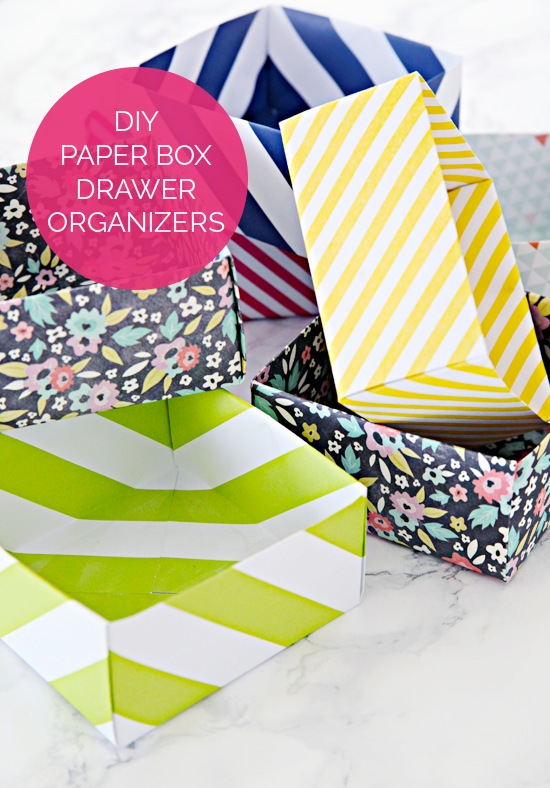
DIY Paper Box Drawer Organizers and an Organized "Everything" Drawer
Jessica Kendrickhuh. Maybe I can actually make something out of all that extra scrapbook paper I have.
Today I have a fun and free project to share that was inspired by a messy drawer I opened this weekend.
I have grown completely understanding that organizing is an on going process and that occasionally some systems don't work out the first time. Or the second.
Our junk drawer never seems to stay organized. No matter how many times I have re-organized it, it always ends up becoming a catch all for anything and everything. That means that the items we should be storing within the drawer become lost in the shuffle.
There is only so much you can do with a junk drawer. Half of the items I dumped out have a dedicated place to call home, they just never made it that far initially. So lesson learned team Jones. put stuff away where it belongs instead of tossing it in the "junk" drawer. Problem solved.
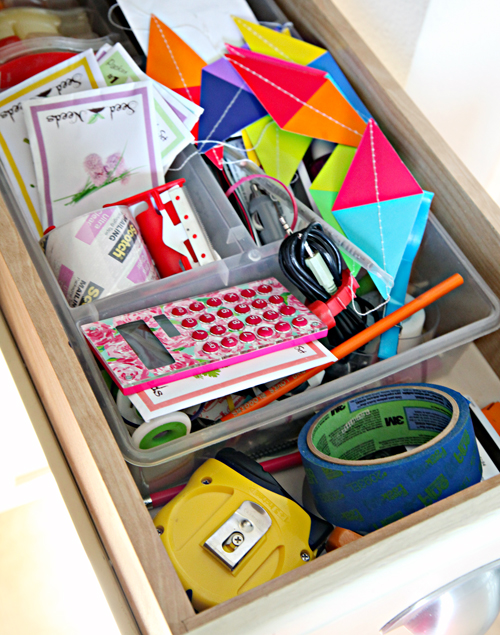
So I did what I always do and dumped everything out, sorted, tossed and put things away where they really should go. I even found a dollar and two gift cards! See my friends! There is always value in organizing!
I decided that in order to remedy the situation, I would have to add a few more organizers. This would allow me to categorize a few more items as well as prevent the previous organizer from sliding around within the drawer. Lastly, this time I would be adding labels so there is absolutely no confusion about what belongs within the drawer.
Once the previous organizer was empty, I added a little life by lining the bottom of the tray with decorative paper. I have a few bins of pretty paper from my scrapbooking days, so I was able to use what I already had on hand.
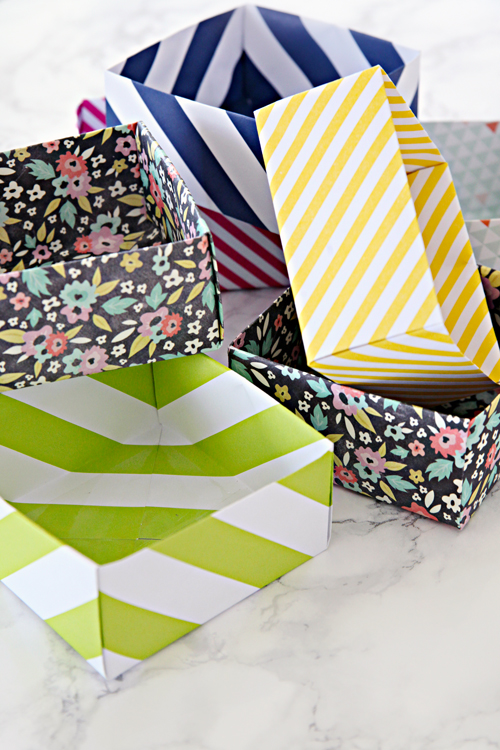
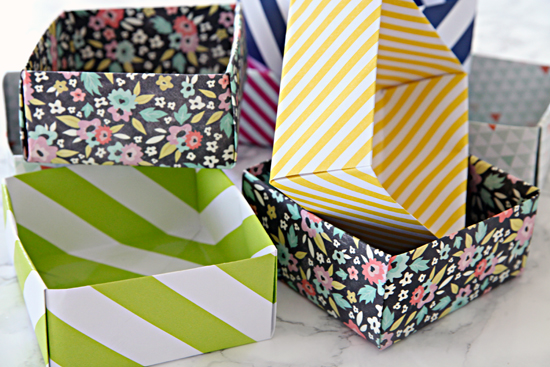
Next up, I made a couple of boxes out of more sheets of scrapbook paper. And they were so darn cute and addicting that I made a few extras for other drawers as well.
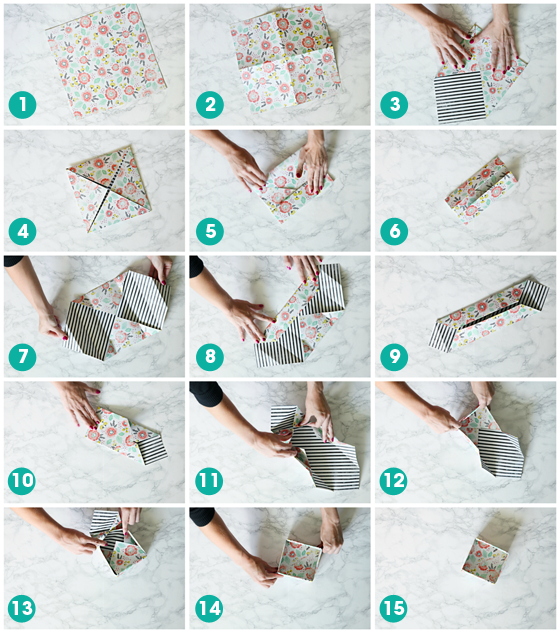
All you need is some scrap-paper and you can easily make a little box/tray for organizing or anything you wish really. However, I did find that the stronger the paper, the stronger the box. Go figure right?
- Start with a square piece of paper.
- Fold it down the center and then down the center again to create four equal sections. Open the paper back up.
- Fold each corner into the center of the paper.
- Visual of progress - all corners folded in.
- Fold one edge to the center.
- Fold opposite edge to the center.
- Open back up to reveal new creases and only two corners folded in at the center.
- Now repeat on the opposite two sides, folding each edge to the center {leaving the other two edges unfolded}
- Visual of progress - two edges folded in meeting at the center.
- Fold one edge over at the crease in paper.
- Push in edges of paper.
- Fold over edge to create one side of the box.
- Repeat on opposite side, folding over the edge to create the opposite side of the box.
- Wiggle a little bit until all edges are straight.
- Celebrate! Pretty sweet huh?
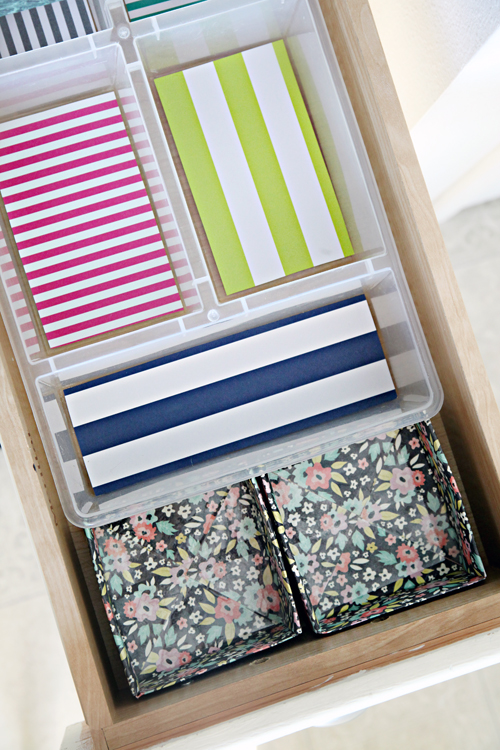
Once I had some little boxes created, I popped everything back into the empty drawer. I also added a couple of pieces of clear packing tape to the bottom of the newly created paper boxes for a little added strength.
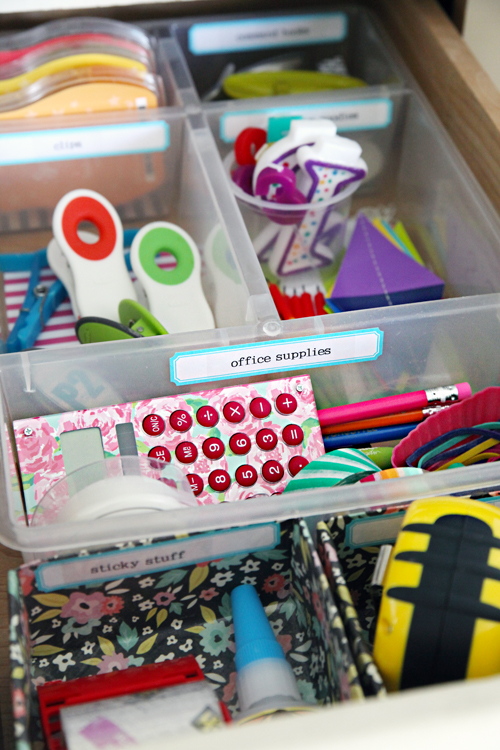
I categorized the items I want access to on a daily basis because we actually use them within the kitchen frequently... and the added some labels to the organizers.
For the labels, I used some Martha Stewart stickers labels {found at Staples awhile back}, which I paired with my label maker and clear label maker tape.
And a full view of the after.
This view makes me giddy inside! Maybe those sweet little flower boxes and labeled organizers will actually do the trick this time? Or maybe I will just have to be OK with the fact that the junk drawer clean-out is an annual task. Either way, all is right in the drawer for today.
I love anytime I can use what I have at home to whip up something pretty and functional. You can also see how I used cereal boxes for drawer dividers here, as well as cardboard boxes paired with fabric for great storage bins here. Now to put the rest of those sweet little paper boxes to good use in other drawers around the house.
Have you been DIY'ing any storage big or small? How about taking back a drawer that is always a small thorn in your side?
UHeart Organizing: Be Prepared To Party!
Jessica KendrickI actually like these ideas. I never remember friend's birthdays in time to get gifts and I don't know what the rule is now that I'm older.
I hadn't considered "preparing to attend a party" a process until we got all these invites at once. If you have more than one child, I'm sure keeping up with their social calendar of birthdays can be quite the juggling act at times- especially during the school year when you're also dealing with sports/dance/gymnastics or other activities. Today, I'm sharing with you some tips on how to stay on top of the birthday parties (or other events where gifts are appropriate) and some cute handmade cards to keep the costs down and make the gift more personal when it's for a child.
I write the party on our family kitchen calendar that way we can quickly see if something is occurring on a weekend. I also put the date and location on my iPhone calendar with details like "bring socks or swimsuit" so we don't forget. Then, I "invite" my husband on my iPhone calendar so he knows what's happening on the weekend too, but it doesn't mean I don't still have to remind him. ;)
If you have an Evite account (just sign up with your email and password), you'll be able to log in and see all at once the Evite events you've been invited to.
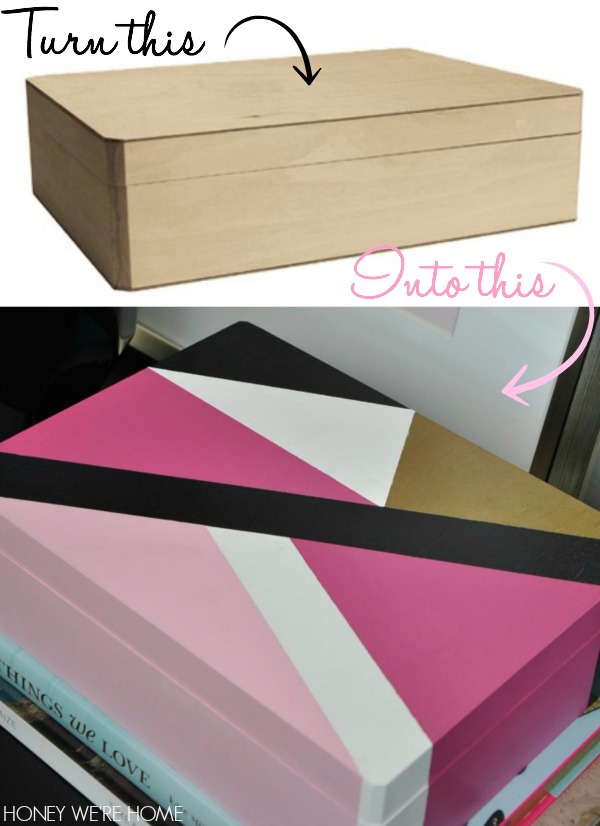
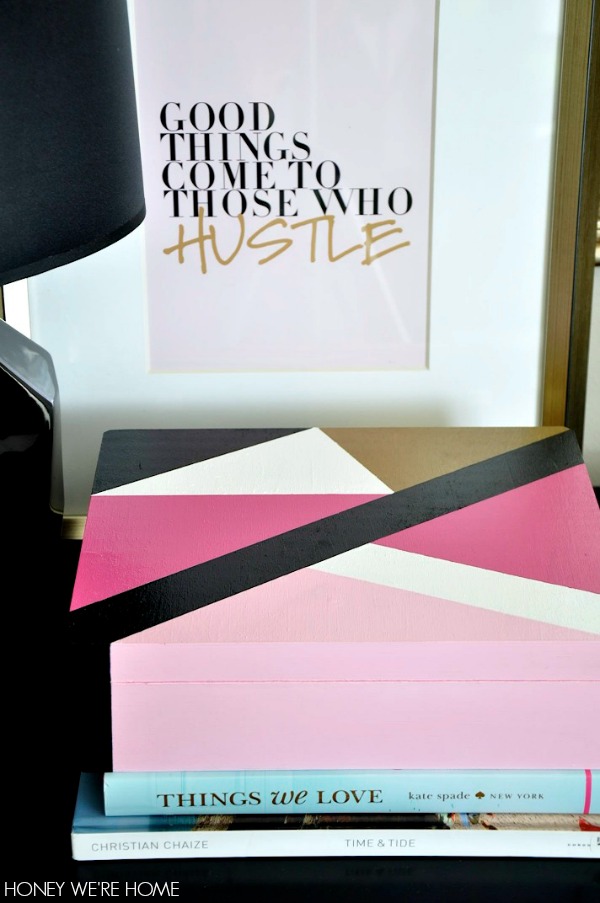
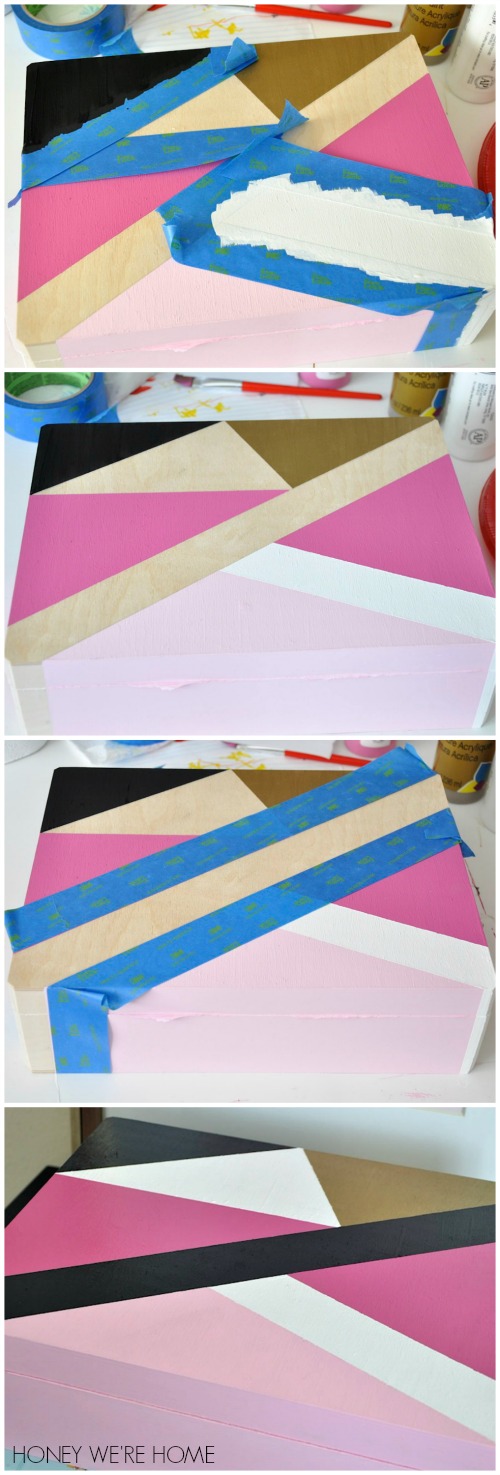
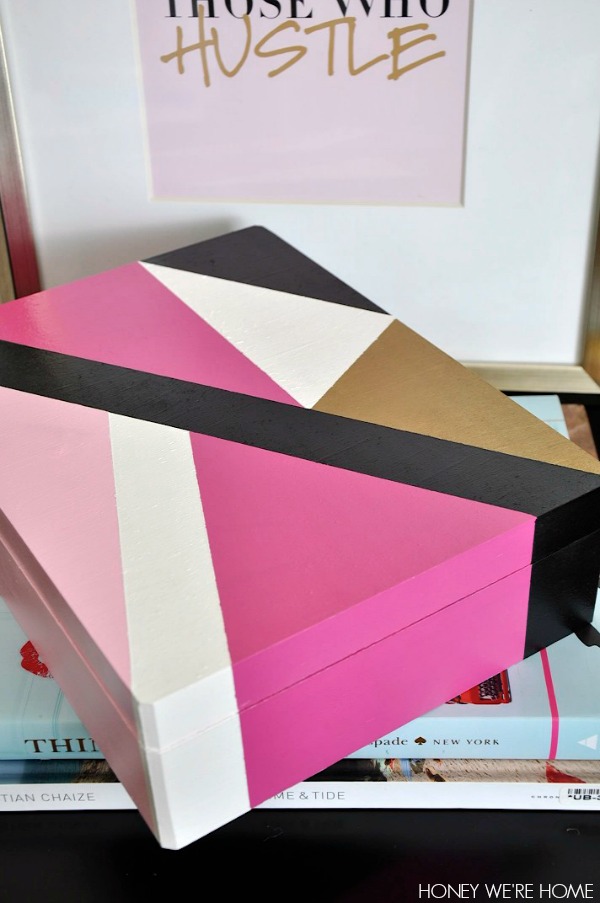
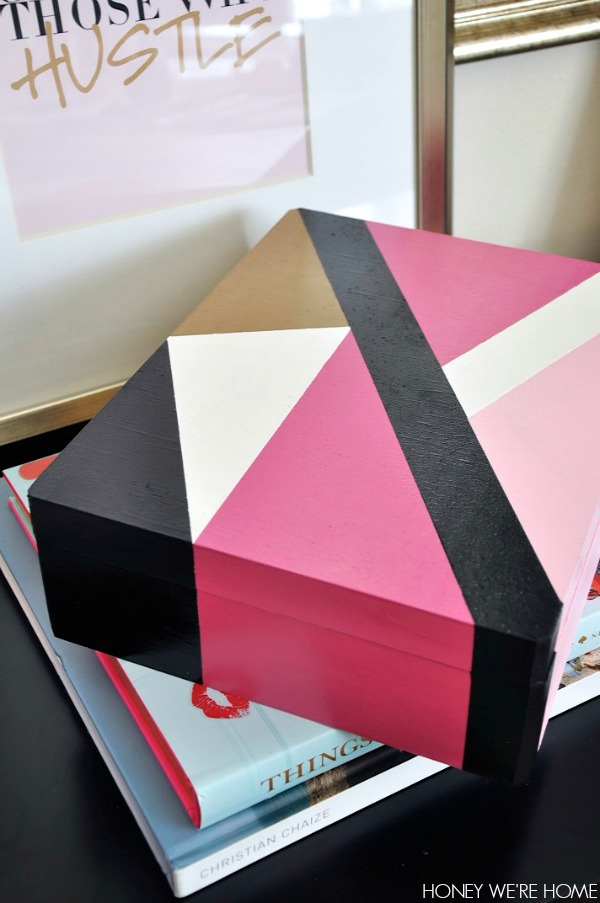
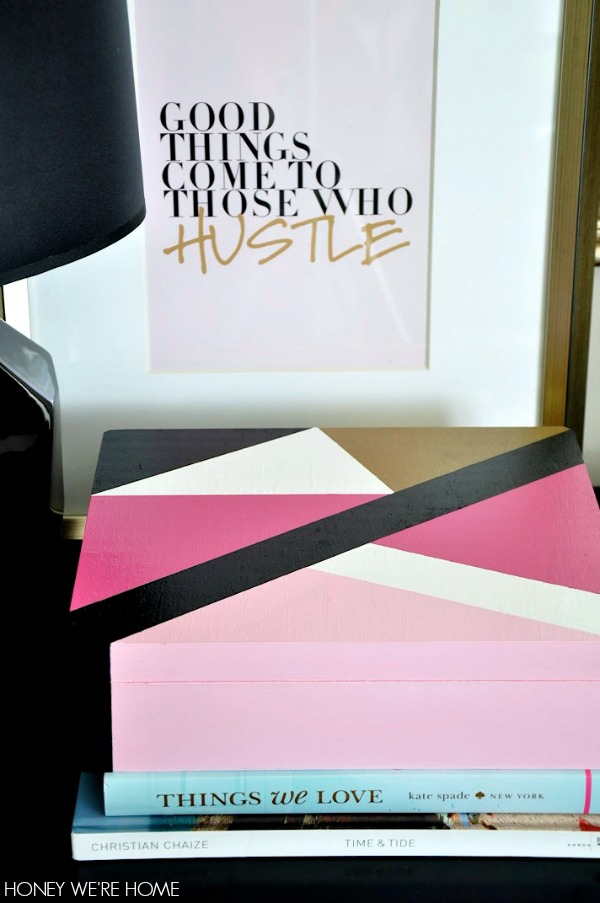
"My name is Megan and I am a lawyer by day, design and decor lover by night, and Mama to the sweetest 4-year old boy you've ever seen. I'm passionate about fitness (and chocolate!) and could not live without my relationships, girl talk, and my morning coffee. I've been blogging for four years over at Honey We're Home, sharing my love of keeping things organized and beautiful at our house. My efforts to live in the moment and cook more are an adventure in progress."Painted Wooden Boxes
Jessica KendrickI hate the word hustle. I hate it so much! It makes it sound like hard work should be a blur, a hive of constant activity! Hard work isn't always a hustle. Hard work is sometimes quiet, slow and deliberate. Sometimes its incremental. Sometimes you must wait for the work to be done by someone else or something else-- in which case hustling aint gonna help nobody. BAN THE WORD HUSTLE!!
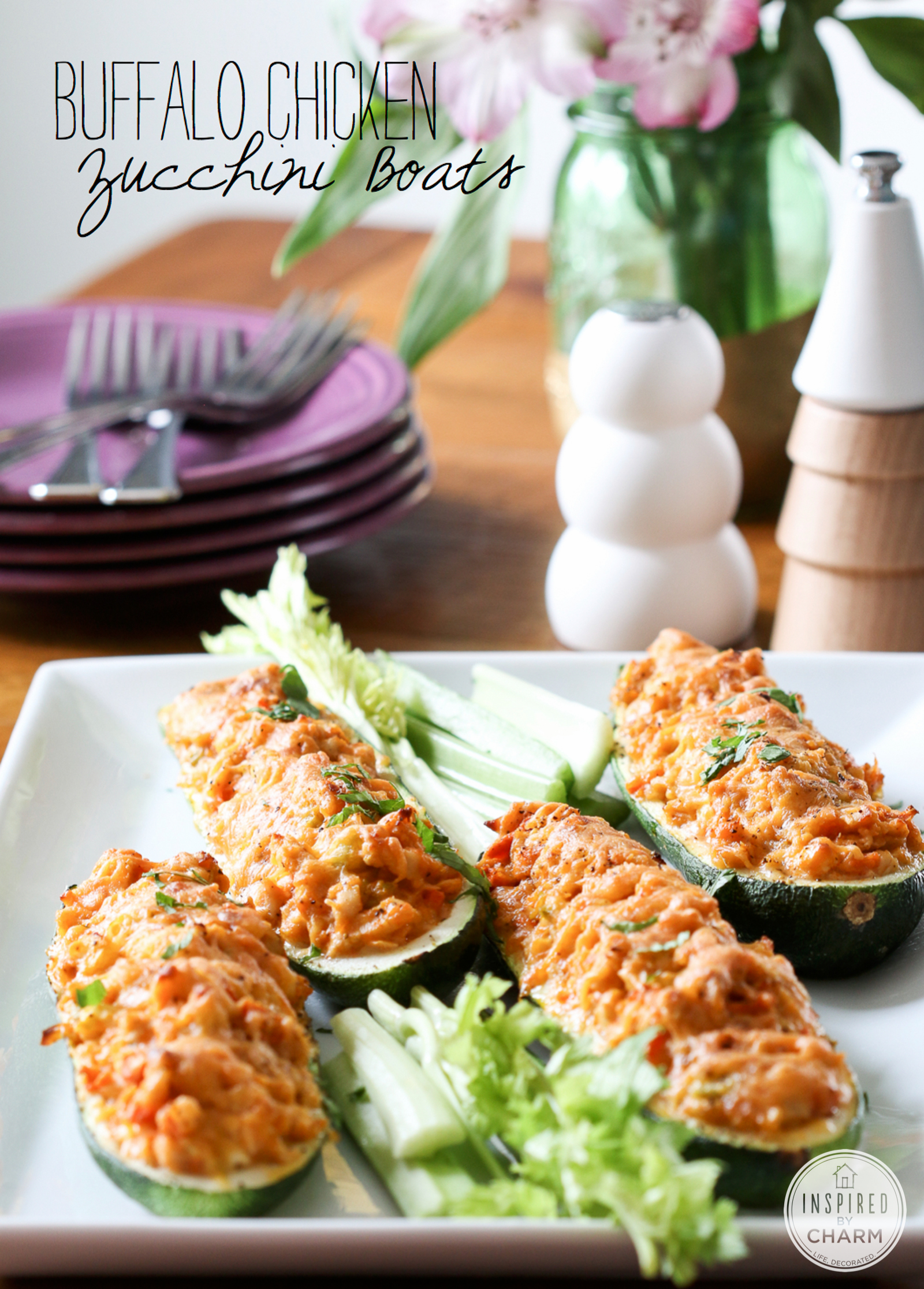
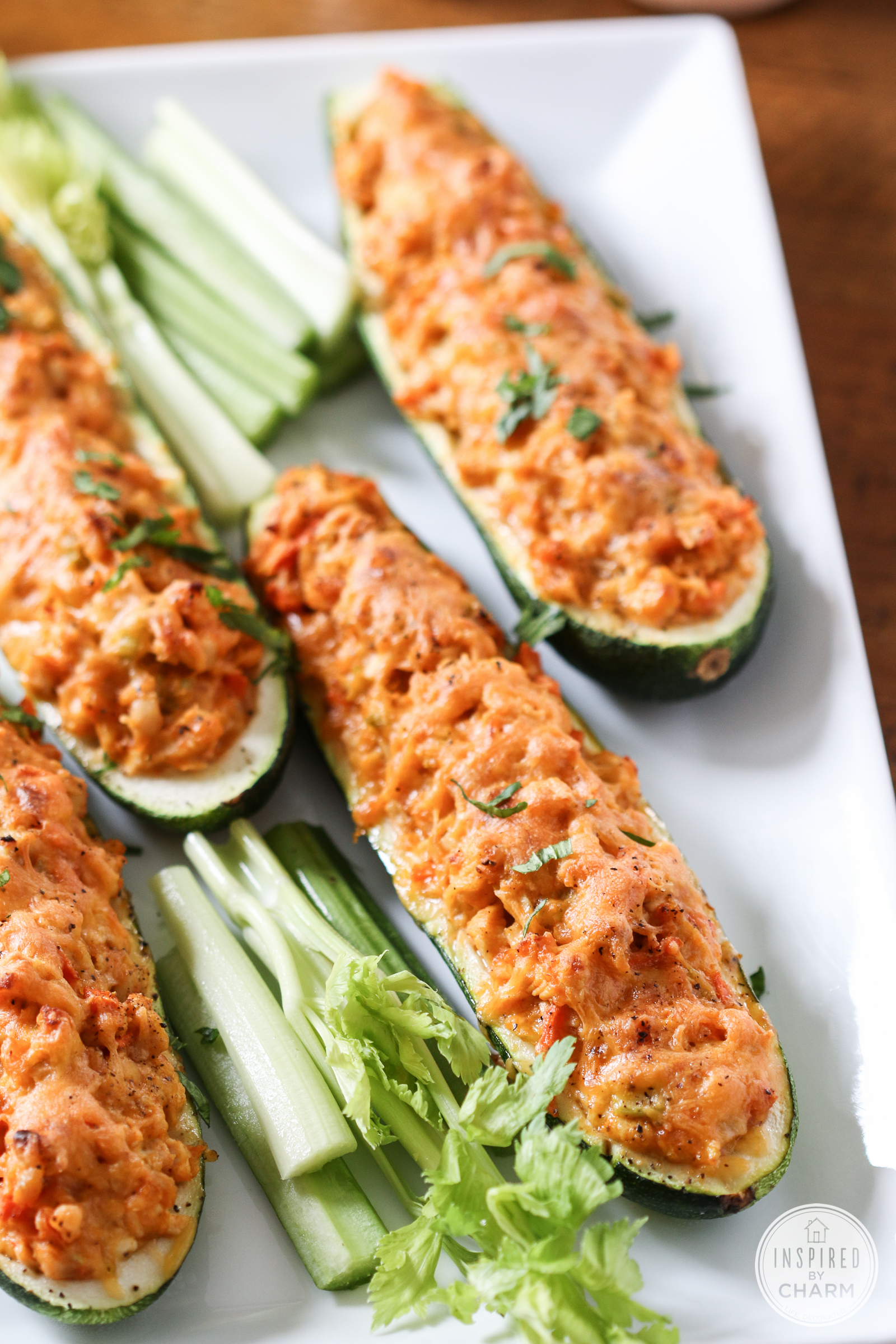
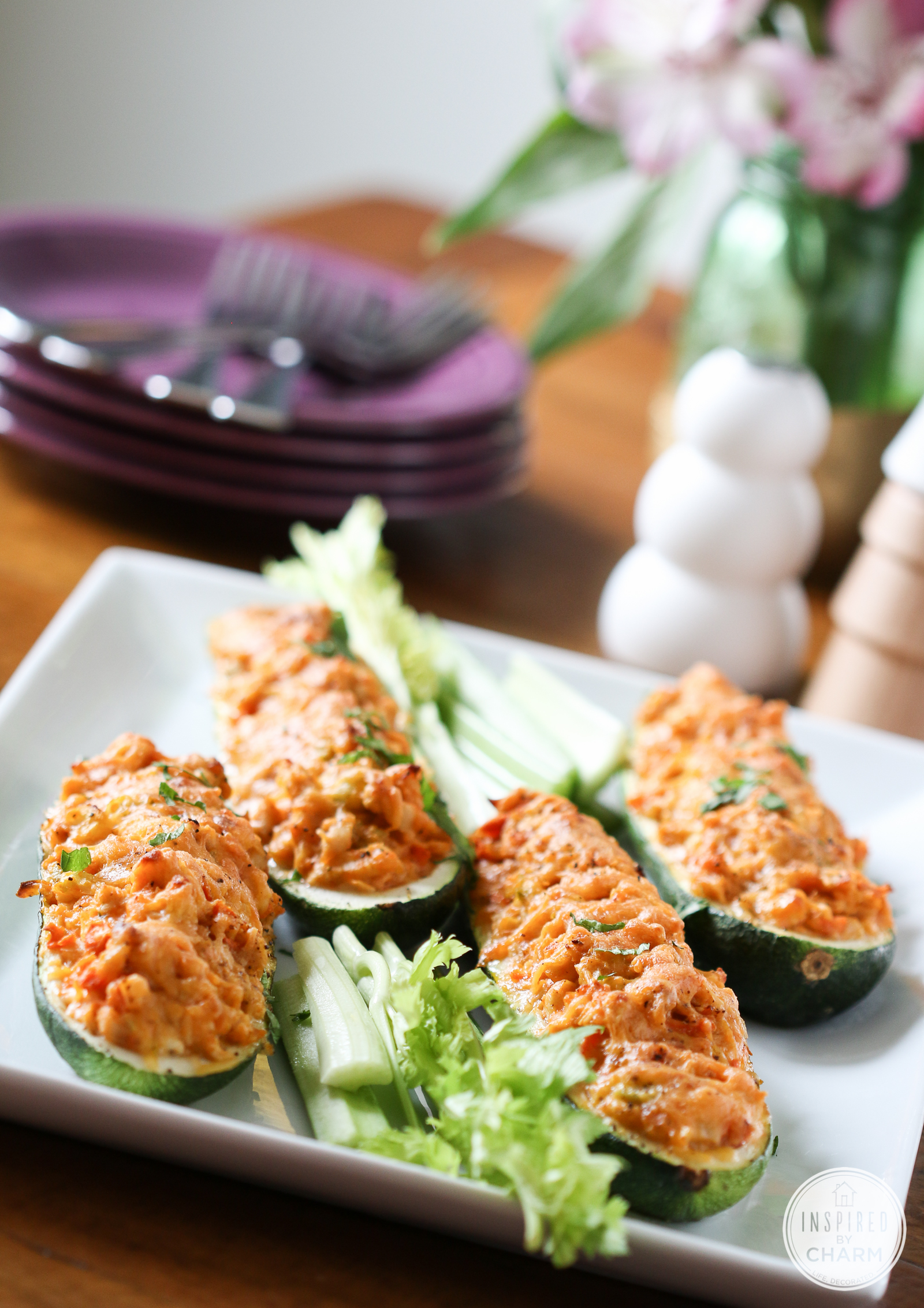
Buffalo Chicken Zucchini Boats
I’m fairly certain that 90% of the recipes here on IBC involve dessert or buffalo chicken. I can’t help what I love. It’s a problem.
Anyway, I hope you won’t be mad for long because these Buffalo Chicken Zucchini Boats are bangin’! If you like buffalo chicken and want to find a way to get more veggies in your diet, look no further. Also, with a couple substitutions (light dressing and low-fat cheese), this recipe can be fairly healthy. I opted for the full-fat version, however, because that’s how I roll.
This recipe is my brainchild after seeing lots of zucchini boat recipes on Pinterest. It’s a quick and easy meal that will certainly satisfy.
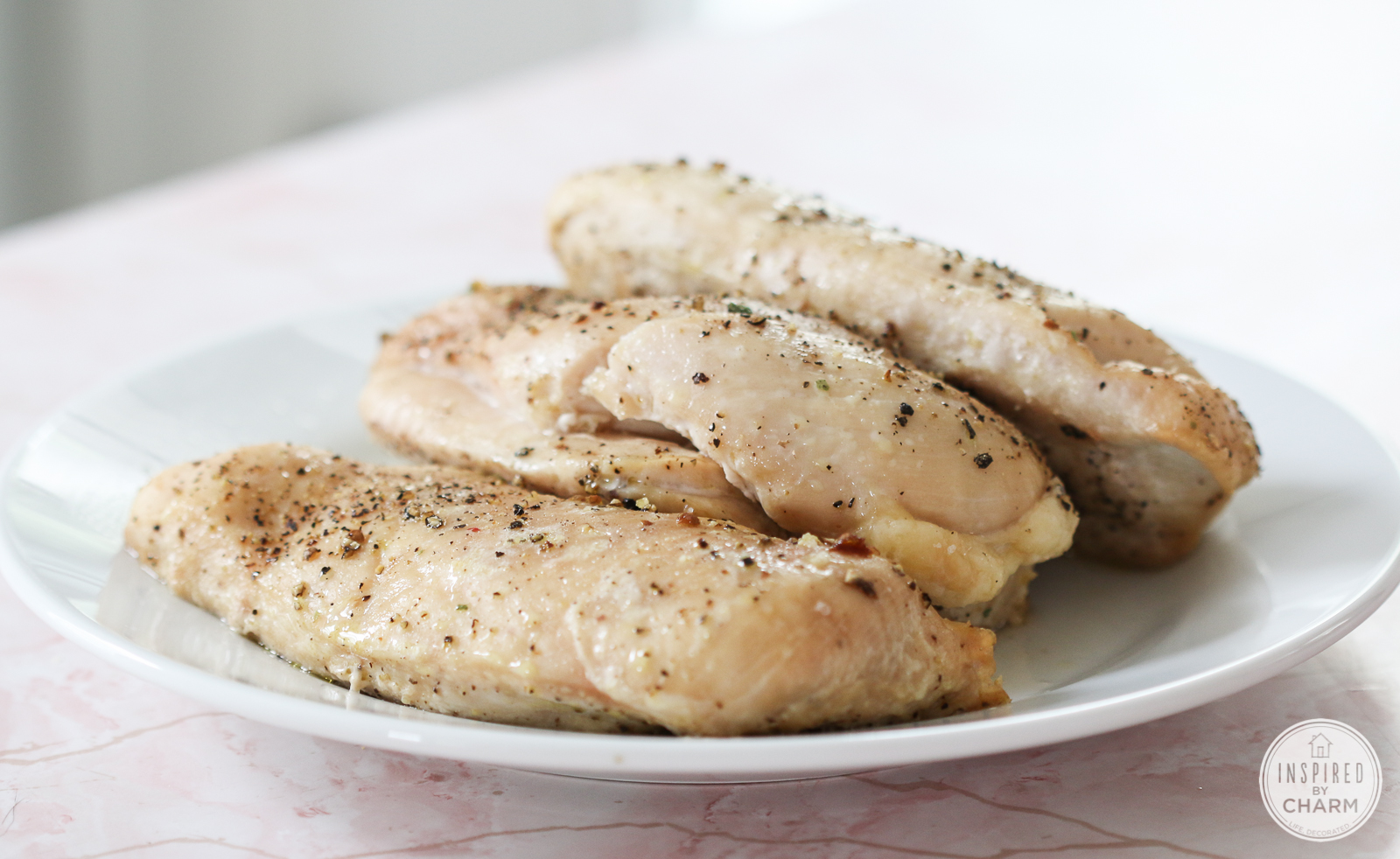
The recipe starts off with cooked chicken breast. My favorite way to cook chicken is to put it in a sheet pan and sprinkle it with a little olive oil and salt and pepper. I bake it at 300 degrees F until it’s cooked through. This keeps the meat nice and moist. Depending on the size of the breast, it will take about 20 minutes.
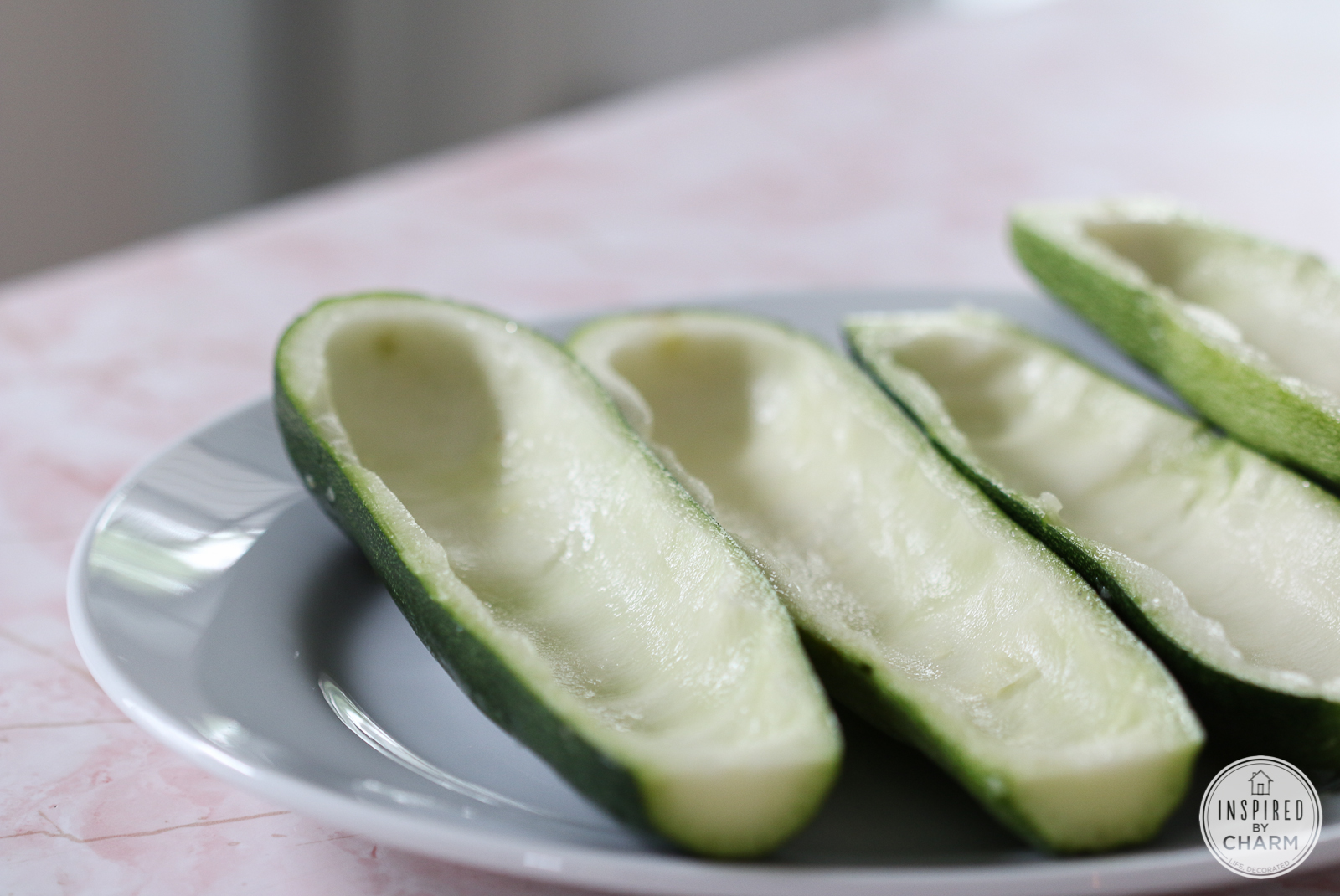
While the chicken is baking, slice your zucchinis in half lengthwise and hollow out each half with a melon baller. You’ll want to save about 1/2 cup of the zucchini for your filling.
Once the chicken is cooled and cut up and the zucchinis are prepped, you’re ready to mix everything together and bake!
For the filling, I used blue cheese dressing. I also added some blue cheese crumbles. If you don’t care for blue cheese, what’s wrong with you? Ha! Just kidding. If you prefer, use ranch dressing and omit the crumbles.
Also, I used celery and carrots in my filling as they go really well with buffalo chicken. However, if you have something else on hand, use that. You could even use a bell pepper or tomato for your “boat” if zucchini isn’t your thing.
Other than that, you’re good to go. The recipe is below so you can whip up a batch of the Buffalo Chicken Zucchini Boats in your own kitchen. Hope you enjoy them!
Buffalo Chicken Zucchini Boats
Here's what you'll need:
2 zucchinis
1 pound cooked chicken, diced
2 tablespoons flour
1/2 teaspoon salt
1/2 teaspoon black pepper
1 carrot, shredded
1 rib of celery, diced
3/4 cup shredded cheddar cheese, divided
1/4 cup blue cheese crumbles (optional)
3 tablespoons buffalo sauce
3 tablespoons blue cheese (or ranch) dressing
Preheat your oven to 350 degrees F. Line a baking sheet with aluminum foil and spray with cooking oil. Set aside.
Cut each zucchini in half horizontally. Then with a melon baller (or spoon) carefully scoop out the center of the zucchini. Reserve 1/2 cup of the center and dice it up for your filling.
In a bowl, mix together chicken, flour, salt, pepper, carrot, celery, 1/2 cup cheddar cheese, blue cheese crumbles (optional), buffalo sauce and dressing.
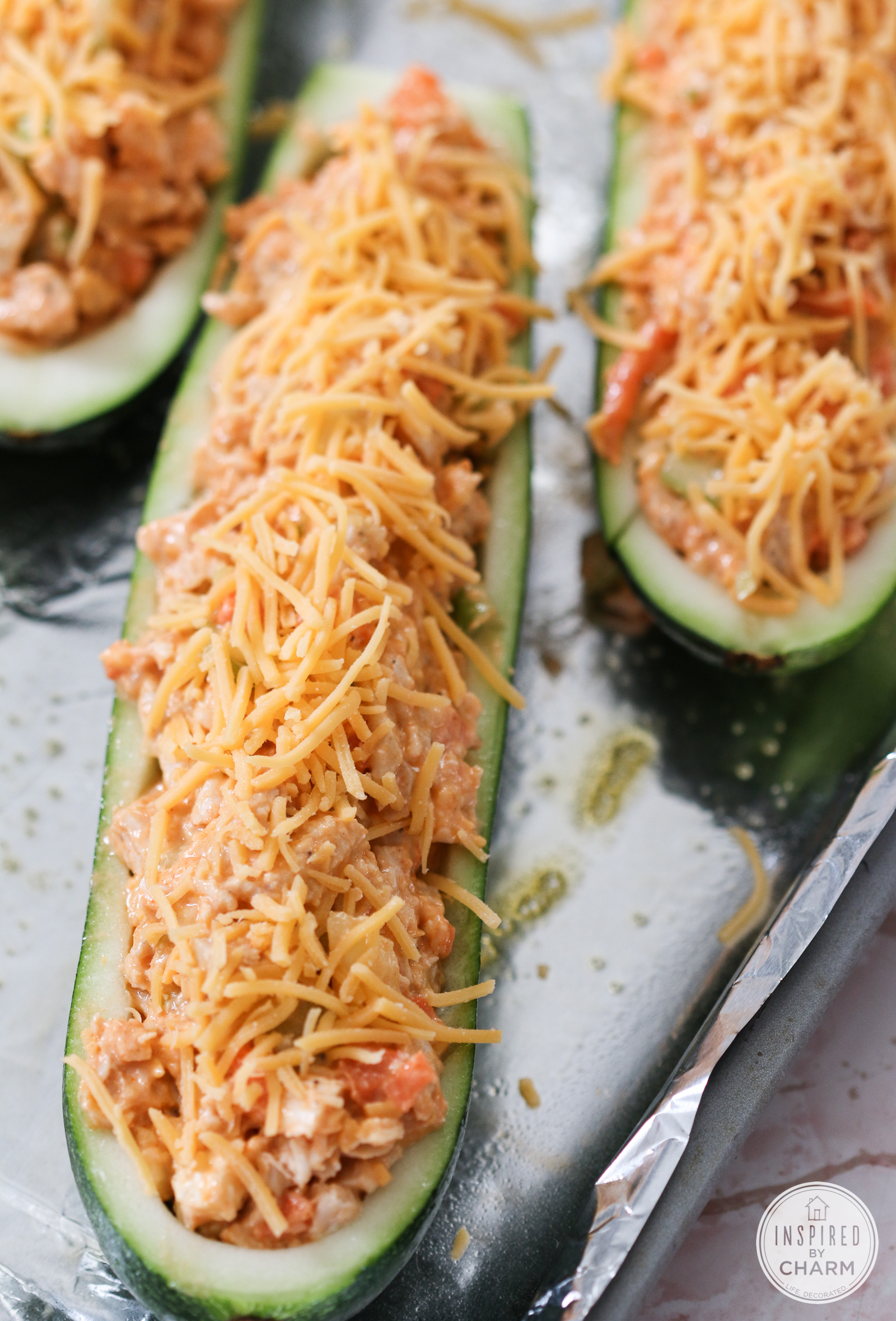
Place zucchini, hollow side up, on the prepared baking sheet. Fill the boats with your buffalo chicken filling. The filling should be heaping. Sprinkle with the remaining cheddar cheese.
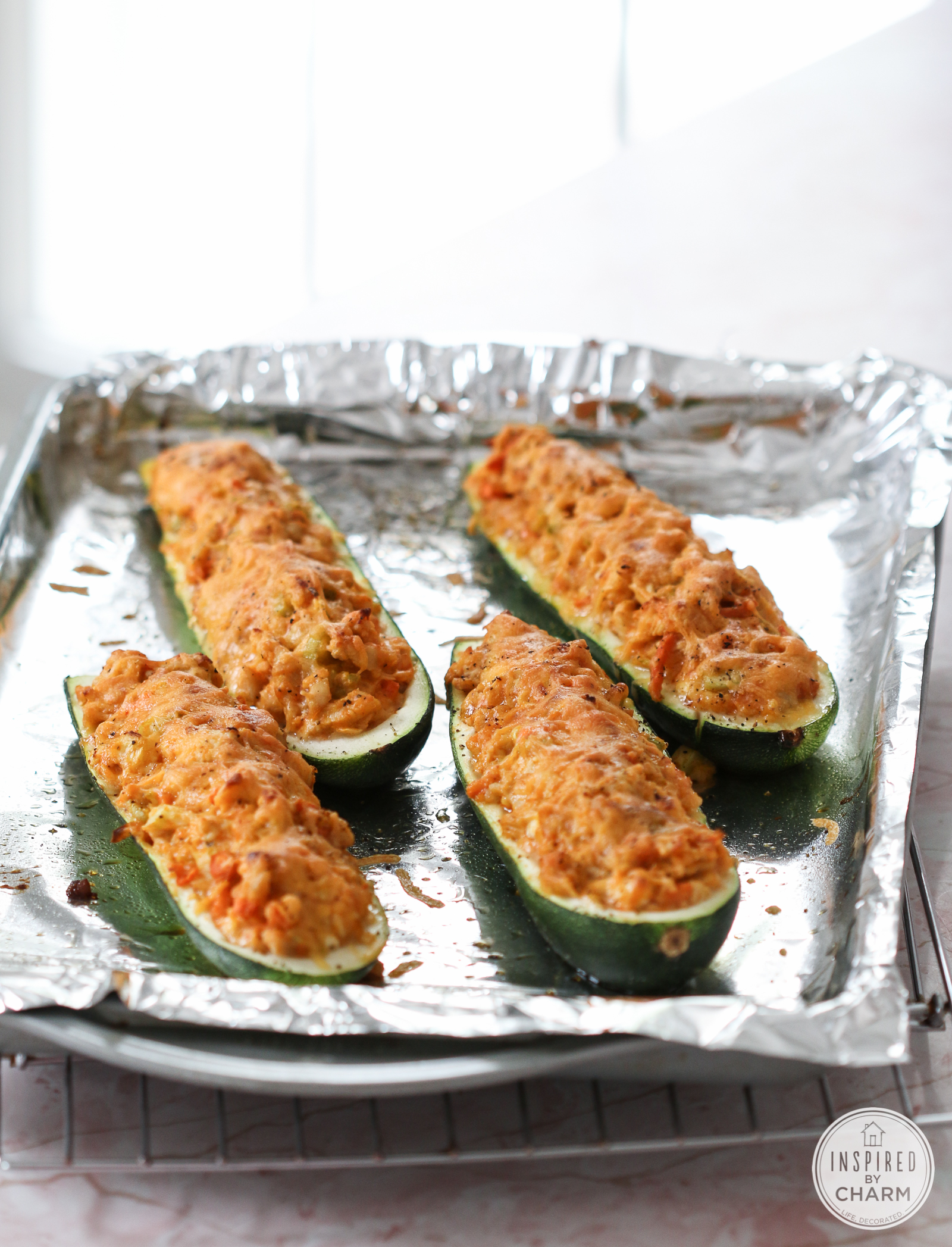
Bake for about 30 minutes or until the zucchini have achieved desired softness.

MORE BUFFALO CHICKEN DISHES:
Buffalo and Blue Cheese Lit’l Smokies
Buffalo Cheese Ball
Blue Cheese-Stuffed Buffalo Meatballs
Wanderlust Gallery Wall
Jessica KendrickI'm a big fan of gallery walls. In our next place, I hope to do something a little more intentional, a little less hoge-podged then what we have now.
I’m happy to report that the gallery wall in my living room is complete! As you may know, I’m on a mission to get art on the walls of my living room and office. A couple weeks ago I decided to create a large drama-filled gallery wall above my sofa in the living room.
The theme for this new gallery wall is wanderlust – places that I’ve visited and places where I want to go. One of my goals for the year is to travel a bit more. I’m always on the hunt for inspiration, and traveling seems to be a wonderful way to soak in the personality of a place. To help make my travel goals a reality, I’ve teamed up with Carnival Cruise Lines to share a few posts on IBC over the next few months. From cocktails to gallery walls, I’ll be sharing ideas inspired by some of the most beautiful travel destinations in the world.
To get my wanderlust gallery wall started, I used several photographs that I took myself (you may recognize the images from my trips to Ireland, California, and Oregon). I also purchased a couple on Etsy – I ordered the barn and train from Annie Bailey’s shop. Her collection of photographs is stunning and she’s graciously offered a 20% off coupon code for IBC readers (use “CHARM20” at checkout, valid through 9/21/14).
Ultimately, I’d like to fill the entire wall with my own photography. I’m hoping that will be possible with some of this year’s travel plans.

I’m all about creating artwork that is personal. Using my photography is a great way to create inexpensive artwork that is meaningful.
I use Photoshop Lightroom to edit all of my photos here on IBC. It’s a less -expensive and less-complicated version of Photoshop. I played around with the colors, brightness, and saturation to make my pictures look a bit more artistic and colorful. I also tried to choose pictures that would complement my current decor.

In the photo above the image on the left is the altered image. As you can see there is more color in the sky, the wood in the dock is more visible, the sky is more colorful near the horizon, and the image is sharper.

Once I had my photos printed (I used Walmart), I laid them out on the floor to get an idea of where I wanted them on the wall.

After that, I loaded up the frames, and in no time my gallery wall was complete.

I took a picture as I was making progress with filling my frames. Remember last time I mentioned I ordered bright white mats instead of the off-white ones included with the frame? Can you see the difference? I prefer the bright white mats so much better. It works better with the room and makes the photographs pop!
Now, for the finished wall!

What do you think?
I was a little bit nervous about using my own photography. However, once it’s matted and put behind a frame, it’s amazing how professional it looks.

What I particularly love about this gallery wall is that I can change it whenever I’d like. While I’m certainly pleased with the gallery wall as is, when I travel to new destinations, I can add new pictures to keep the wall feeling fresh and inspired.

Speaking of new destinations, as I was checking out the Carnival site, one of the places I’m most excited to visit is Belize (located in Central America off the Caribbean Sea). My friends and I were recently talking about planning a vacation, and Belize was one of our top choices. However, getting there is a little more complicated when you’re not arriving on a cruise ship. So, visiting with Carnival is going to be ah-mazing. Belize, puh-lease!

How are you loving my wanderlust gallery wall? If you could hop on a cruise ship, what places would you want to visit?

This post was created as part of my collaboration with Carnival. As always, all of the opinions, thoughts, and ideas in this post are my own.
![]()
FOR MORE DETAILS ABOUT THIS SPACE, CHECK OUT THE LINKS BELOW:
A New Couch – Sectional
Rug and Blinds
Hanging Rattan Chair
Coffee Table Styling
Paint Colors
Other Living Room Sources
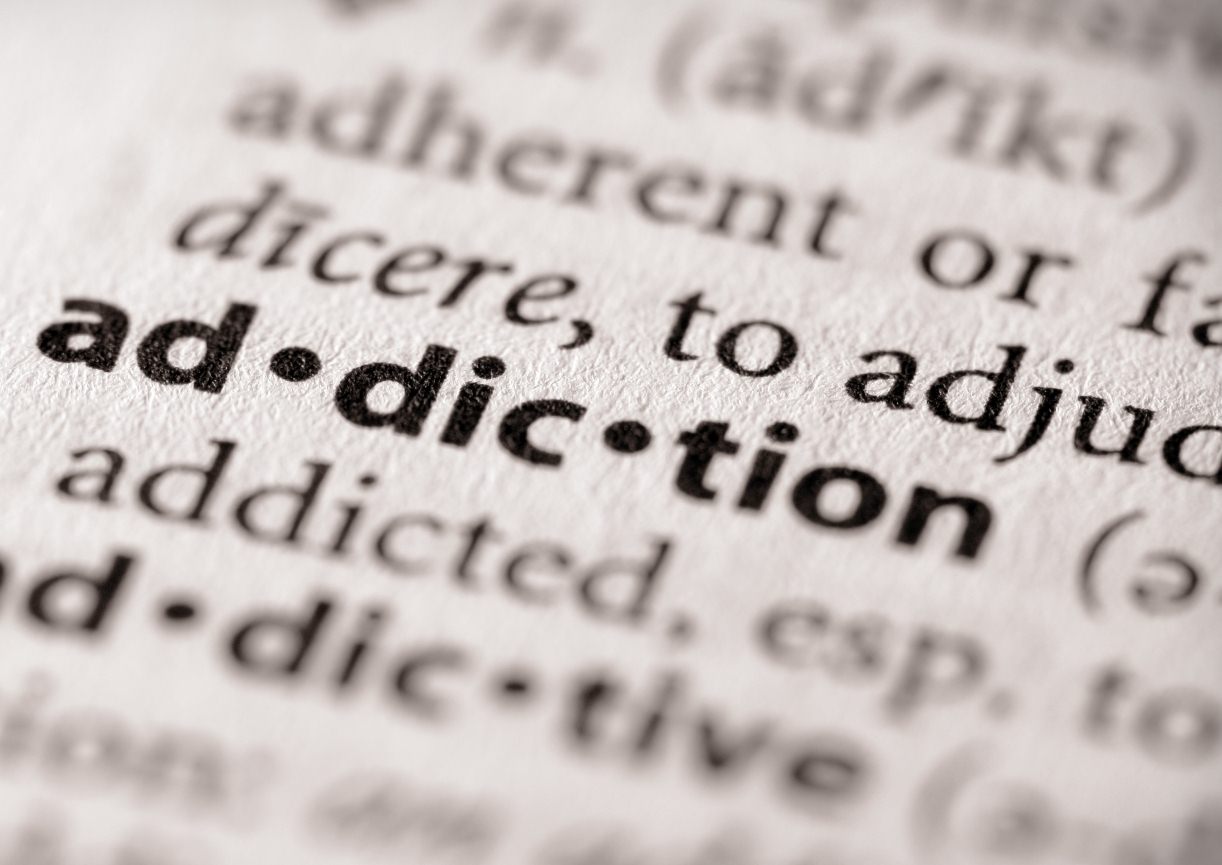
Are You “Addicted” to Something?
Jessica KendrickI think there are more addictions out there than people realize. Thoughts?
Every Wednesday is Tip Day, or List Day, or Quiz Day.
This Wednesday: Are you “addicted” to something?
The definition of “addiction,” and what people can become “addicted” to, are hotly contested issues. In everyday conversation, of course, people throw around the word “addicted” a lot, as in, “I’m addicted to Game of Thrones.”
Addiction, whatever it might be, is a subject that’s related to my current fascination: habits. As I explain in the introduction of Better Than Before, my discussion of habit formation doesn’t cover addictions, compulsions, nervous habits, or habits of mind. Nevertheless, I did a lot of reading and thinking about addiction, because it’s a useful area to consider.
The nature of addiction is highly controversial, but I found it interesting to read, in Kenneth Paul Rosenberg and Laura Curtiss Feder’s Behavioral Addictions, this list of factors put forth by Mark Griffiths. Apart from the question of “what’s a true addiction?” it’s a helpful way to think about whether a certain habit is making it harder to live a life that reflects our values and contributes to our long-term happiness.
According to this definition, a behavioral addiction is marked by:
Salience — this behavior has become the important activity in a person’s life
Mood modification — this behavior changes a person’s mood, by providing a rush of excitement or a sense of calm or numbness
Tolerance — more and more behavior is needed to get the mood boost
Withdrawal symptoms — a person feels lousy or irritable when unable to engage in the behavior
Conflict — the behavior causes conflicts with other people, interferes with other activities, or causes a person to feel a loss of control
Relapse — the behavior returns after being given up
I don’t want to sound like I’m treating addiction lightly. Whatever “addiction” might be exactly, when a person feels powerless to control a behavior that’s destructive, that’s a very, very serious matter. Far beyond the scope of my writing.
But I do think that even for people who aren’t “addicted” to something, these points are interesting to ponder, as they might relate to a bad habit (a habit that’s not good for us, but doesn’t rise to this level of severity).
They help us think about whether we’re engaging in a behavior that’s turned into a negative. That’s when we might want to consider changing a habit.
Sometimes, a behavior that one person consider to be healthy and positive is viewed as another person as extreme and negative. I have a friend, a fellow Upholder, who exercises just about every day of the year. People sometimes say she’s “addicted” to exercise in a way that’s unhealthy, but that’s not how she sees it.
In cases like this, I found this point by Griffiths to be very helpful: “Healthy enthusiasms add to life whereas addictions take away from it.”
My research on habits and happiness have convinced me that it’s very important that we feel in control of ourselves. The feeling that a behavior is out of our control — that we can’t change what we’re doing, even when we know it’s not good for us — well, that’s a bad feeling. Whether it’s an “addiction” or not.
As I was writing Better Than Before, I kept changing the epigraph (I love choosing epigraphs). In the end, I’ve chosen this line from Publilius Syrus: “The greatest of empires, is the empire over one’s self.”
Self-command, self-knowledge…more and more, I’m convinced that good habits and happiness come down to these two. And maybe self-command comes from self-knowledge, so really it’s just self-knowledge.
What about you? Have you ever had a behavior in your life that felt out of your control? If you wrested back control, how did you do it?
“A Man Gets an Immense Amount of Satisfaction from the Knowledge of Having Done Good Work.”
You increase your self-respect when you feel you’ve done everything you ought to have done, and if there is nothing else to enjoy, there remains that chief of pleasures, the feeling of being pleased with oneself. A man gets an immense amount of satisfaction from the knowledge of having done good work and of having made the best use of his day, and when I am in this state I find that I thoroughly enjoy my rest and even the mildest forms of recreation.
Delacroix was an artist, and he was also a brilliant writer, and I highly recommend reading his Diary. It’s fascinating — particularly if you’re interested in subjects like art, creativity, and productivity.
HomeGoods Happy $100 Gift Card GIVEAWAY
Jessica KendrickAwesome!
“We’d Be Better Served Watching the Carb Content of the Diet Rather than How Much We Eat and Exercise.”
Jessica KendrickI am reading this book right now, and I as I tried to explain the argument to Arthur today, little did I know there was a blog post that would do it for me! The book is compelling and interesting... it makes total sense to me.
Habits interview: Gary Taubes.
I’m so pleased to be posting this interview with Gary Taubes, because it’s no exaggeration to say that his work has had more practical influence on my day-to-day habits than probably any other writer.
In Better Than Before, I describe the multiple strategies we can use to change our habits. One of the most powerful, but also one of the most mysterious and unpredictable strategies, is the Strategy of the Lightning Bolt.
When the lightning bolt hits you, you’re so moved by a new idea or belief that your habits change, overnight. Instantly, effortlessly.
I was hit by a lightning bolt when I read Gary’s book, Why We Get Fat: And What to Do About It, in March 2012, when my eating habits changed dramatically. Just a few days ago, I described the lightning bolt in a short video. (Some of you may be a bit tired of this subject, but I wanted to explain the strategy before I posted Gary’s interview. Next week, different topics.)
It’s interesting — I was hit by this Lightning Bolt, and my habits changed. Another habits strategy is the Strategy of Other People; we often pick up habits from other people. My habit changed, and my father picked up that habit change, through me. He’s a Questioner, and as he weighed the book’s arguments and tested its principles on himself, he became persuaded gradually. Now he’s as much of a convert as I am. We got to similar habits through different routes.
It’s important to be aware of the forces that can affect our habits, for better and for worse, because when we understand what’s happening, we can direct it.
Gretchen: You’ve done fascinating research. What’s the most significant thing you’ve concluded?
Gary: This one’s easy, but counter-intuitive: that the conventional wisdom on why we get fat or fatter is both foolish and wrong. Ever since the 1950s, nutritionists and obesity researchers have insisted we get fat merely because we take in more calories than we expend and all we have to know about the effect of foods on our weight is how many calories they contain. What I now realize is that this is like having a theory of wealth management or investing that says people get rich because they make more money than they spend, or that the only thing you have to know about an investment strategy is that it makes more money than it loses. If your financial advisor told you this was the secret formula to how they were going to invest your pension plan, you’d fire him or her in a second. And yet this is the way we’re supposed to think about obesity and the way the authorities do. What I suggested in my books is what pre-WW2 European researchers had come to believe: that obesity is a hormonal/regulatory disorder and that foods influence our weight not because of their caloric content (although that’s obviously one way to measure quantity) but because of their effects on the hormones and enzymes that regulate fat accumulation in our fat tissue and whether or not we burn that fat for fuel. If you think about it from this perspective, then the focus becomes on the carbohydrates in our diet, because carbohydrates drive up secretion of the hormone insulin which in turn tells our fat cells to store fat and our lean cells not to burn it. So just by thinking of obesity as a biological problem rather than a mathematical or physics problem, you end up with a conclusion that maybe we’d be better served watching the carbohydrate content of the diet rather than how much we eat and exercise.
What aspects of eating habits would be most helpful for people to understand?
If it’s true that the way foods influence how fat we are — our adiposity — is by their effects on hormones, and specifically insulin (and leptin, as well, but that’s another, technical story), then any foods that drive up insulin and make us store calories as fat are also likely to make us hungry in the process. These foods will come to taste better than other, foods and these are the foods we’ll quickly come to crave. When we’re hungry or dieting, these are the foods on which we’ll end up binging. This is an idea that came out of school of science in the 1920s-30s known as physiological psychology and the idea is that our most pronounced behaviors are responses to underlying physiological states. The implication is that if you change the underlying physiology, you can change the behavior. So we can change food habits — how we eat, how much we eat, when we eat, when we snack, what we snack, etc. — by understanding that physiology and changing that. It’s not that this won’t require some willpower and restraint in the short term, but once we’ve got our physiology fixed and healthy, our eating habits will be healthier too.
What’s something you know now about forming healthy habits that you didn’t know when you were 18 years old?
Is it fair to say “everything?” Or rather anything that I might have thought I knew about forming healthy habits when I was 18 was as likely to be wrong as right. And even if it was right, it might have only pertained to the forming of healthy habits as an 18-year-old. Each age presents new challenges. Certainly as I get older, forming healthy habits is as much or more about unforming unhealthy habits first. At 18 I would have been more of a blank slate.
Which habits are most important to you? (for heath, for creativity, for productivity, for leisure, etc.)
For creativity and productivity, it’s making sure that my morning hours are reserved for writing — it’s the only time of day when I’m smart enough to write — and getting to my desk having already been thinking deeply about what it is I have to write that day. For health, it’s living by the lessons I learned researching my books (with the caveat, of course, that I turn out to be right and they serve me well). For leisure, let’s just say I have to work on that. I’ve always been a workaholic and have never managed to hit a healthy balance of leisure time with work time. I was writing articles about burn-out when I was in my 20s. Now that I’m in my late fifties, I could write an encyclopedia on the subject if I wasn’t too burnt out to do it. I have to work on the leisure thing.
Have you ever managed to gain a challenging healthy habit—or to break an unhealthy habit? If so, how did you do it?
Well, let’s see. I used to be a smoker and now I’m not. It was an endless battle, capped by using nicotine gum in my early 40s to finally quit. Then I chewed the nicorette gum for a decade. Recently I quit drinking caffeine. I titrated down over the course of a summer — buying one pound bags of coffee from my local Peets that were first 80 percent caffeinated, 20 percent decaf, then 60/40, then 40/60, then 20/80 and finally all decaf. Then I gave up the decaf. This was last summer. I was off caffeine and coffee entirely by last August. It was as hard as quitting smoking, although in a different way. I never thought of caffeine as anti-depressant until I found out how depressing mornings could be without that first cup of hot coffee waiting for you. Now that I have to write a book, though, and it happens to be almost two years over due, I will probably go back to the coffee or at least caffeine to get it done. I may even start chewing nicorettes again, with the expectation that I’ll quit both — again — when the book is done. I also gave up fattening carbohydrates about a dozen years ago, first as an experiment and then, when I saw the obvious benefits, as a lifestyle. That’s one healthy habit I’ll keep for the duration.
Would you describe yourself as an Upholder, a Questioner, a Rebel, or an Obliger?
Definitely a Questioner. Although doesn’t everyone or at least most people think the same?
Does anything tend to interfere with your ability to keep your healthy habits? (e.g. travel, parties)
When you’re a person who doesn’t eat sweets, baked goods or starchy vegetables, as I am, dinner parties are an always an adventure. I try not to be a zealot in any way and will eat anything, but it’s a challenge. Moreover these foods can be a little bit like drugs — the sweets, especially — and so the more we eat them, or at least the more I eat them, the more I want to eat them. So my wife will order a dessert; she’ll take one bite and leave the rest. I’ll take one bite because, well, it’s there, and then have to struggle mightily not to eat the rest, and then everyone else’s left over desert as well. It’s the way I am and the way I’ve been for a long time. When I was young I was like Mikey in the old Life cereal commercial. Remember? Give it to Mikey, he’ll eat anything. Of course, when I was young I could eat anything (and usually did). As I got older I found I couldn’t, or at least not without my waistline expanding. Now I find it easier to avoid sweets entirely than to try to eat them in moderation. But dinner parties and restaurants always challenge that decision. [I describe this as the abstainer/moderator distinction.]
Have you ever been hit by a lightning bolt, where you changed a major habit very suddenly, as a consequence of reading a book, a conversation with a friend, a milestone birthday, a health scare, etc.? [I ask because reading Why We Get Fat hit me like a lightning bolt.]
When I was turning fifty, I got a life insurance exam which included being weighed. Lo and behold, I appeared to weigh 240 pounds. This was about fifteen pounds heavier than I expected. Now I’m supposed to understand the diet weight control thing, and if I’ve gained fifteen pounds that’s a bad sign. Right? So I started thinking about what could have happened. As I may have mentioned, or should have, I was a caffeine addict. I would have a cup of coffee by my side, at my desk, all day long, and I drank that coffee with cream. One thing I could never understand was why I had to have the coffee at my desk, all day long, even at those periods that I was drinking decaf? Was it the dregs of caffeine in the decaf, or something else — the cream? — that caused the craving? So I did some research, found out that some people over-secrete insulin response to dairy — even cream — and thought that might explain it. I switched to drinking black coffee, which was easier than I expected. A testament to the addictive power of caffeine. It took me only three days to actually like black coffee. The 15 pounds went a way in six weeks, along with another five for good measure. I’ve been a healthy 220 ever since. (I’m 6’2″ and so this is my healthy weight.)
Do you embrace habits or resist them?
I try to embrace the good ones, obviously. But I realize that I’m disorganized and could definitely use some habits to help me be better organized. I suppose I resist those on the basis that I don’t have time to learn them. But if I did learn them, I’d have more time. I’m working on this.
Has another person ever had a big influence on your habits?
Yes. Other than the obvious — my wife, my two boys, my best friend Marion and my partner/boss, Peter Attia — I have an older cousin who lives in Hawaii and was an intelligence officer during the Vietnam War. When I was living in Hawaii between my junior and senior years in college, he gave me a lecture about not working hard enough. He said things came easy to me and so I coasted and was willing to settle for what came easy as good enough. I took his lecture to heart and changed my work habits and my goals. I owe him for that.
A Clean Dream House
Jessica KendrickUm, worth it for the giveaway folks!
Want to WIN one?!
CONGRATULATIONS Carla Jordan, the winner of the Dyson DC59 Motorhead!
* Thank you to everyone who entered the giveaway. The giveaway is now closed. *
"Write an entire monologue with your main character if you have to. Spend a chapter just exploring..."
Because you must keep going. Just a little more. You are stubborn. You are exhausted. You are determined. You are a Writer.”
- marielubooks, on making it through the dark swamp.
UHeart Organizing: How To Feel A Little More Unplugged Without Pulling The Plug
Jessica KendrickIf I could, sometimes I wish for an old fashioned landline, with a cord, and a paper planner.
In this day and age of habituated technology usage, our cell phones have become more like appendages than simple communication devices. I’m sure you’ve seen the ever-so-popular articles floating around about the importance of “unplugging” and enjoying the real everyday. It’s a bit of a hot topic lately, and while some may see it as a passing fad, I think it’s a concept worth trying out.
My husband and I both have very “tech-centeric” jobs (he’s a web developer and I’m a graphic designer / brand consultant), so we frequently (if not always) feel tethered to our phones, tablets and laptops. In an effort to step away from the devices, we schedule “Official Unplug Days” on our calendars. It may seem a bit extreme to literally schedule them, but for us, it’s helpful to put them on the calendar because we like to be sure to catch up on everything digital the day before. I’ve grown to LOVE and look forward to these days. Not only does it help me truly relax, but since my job is in a creative field, it also helps me keep the creative juices flowing by giving my brain a little rest and some much-needed breathing room.
Despite “Official Unplug Days”, it’s 2014, and there’s no way to get around using our phones. Even though some days, I want to throw mine into a lake (we’ve all been there), our smartphones should make our lives easier, not more stressed. Since we can’t travel back to the 1950’s (but oh how I’d love to live in the days of I Love Lucy and telegrams), there are a few things we can do to help organize and simplify our attention-sucking devices. Here are three of my favorite tips and tricks…
01 / Have a heart-to-heart with your phone. About a month ago, in an effort to simplify my “tech days", I recently went through my cell phone and completely decluttered. I got rid of any apps I hadn’t used in the last 3 months and/or didn’t have a viable use for. Yes, I finally got rid of Angry Birds (much to Greg’s disappointment). Once I cut through the clutter, my phone was immediately more organized. Seriously, it felt physically lighter - even though I know that isn’t really possible, haha. (In a minute, I’ll talk about my top three apps that keep me organized and made the cut.)
02 / Group similar apps together by categories. On my iPhone, I use the built-in grouping feature and categorize my apps into folders. (You can do the same on Android phones) I put all of my news apps in one folder, coupon/shopping apps in another, restaurant/dining apps in another, photo editing apps in another and so on. By taking a few minutes to do this, I took my 5 pages of apps and condensed it down to two - including the home page. To organize things a bit more, I keep my most used apps on the home page and use the second page just for my categorized folders.
03 / Categorize your contacts. Updating and organizing the contacts in your cell phone can make a day out running errands go so much smoother. To start off, go through your phone and delete the contacts you don’t need/want anymore. This is basically the phone’s equivalent to throwing away gum wrappers in your purse. Then, organize the contacts. I group numbers for take-out places, medical-related offices/people, shops, florists, and such together in their respective categories. So, for florists, I add “Florist | ” before the name of the florist. That way, when flipping through my phone, the contact would read “Florist | Strange’s (West Broad)” and all of the florist-related numbers would be grouped together. If there are multiple locations (like our favorite florist above), I add the location after the name in parentheses. This is something I’ve been doing for a long time (an idea I actually picked up from my 72-year-old-iPhone-loving Aunt Jerrie) and I love the handiness of it.
Now, for the icing on the cake… apps! As I mentioned earlier, I’m a huge advocate for not boggling down your phone with a ton of useless apps that just clutter it (and your mind!) up. Here are three apps I think are worth holding on to…
01 / Swipes. I’ve been through my fair share of task apps. (In reality, I think I’ve gone through 12 or so in the past few years) I always end up using them for a few days then forgetting I have them or getting frustrated with the design. That’s definitely not the case with this app. It’s very well designed (which makes the graphic designer in me very happy), uncomplicated and - best of all - it’s fun. Basically, it keeps your daily to-dos on a timeline and allows you to easily prioritize each task. If something comes up and you have to switch your priorities around, you can “snooze” the rest for a later time. Under each task, you can be as simple or as detailed as you want because you have the option to add elements like notes, contact info, reminders, and categories. Yet another perk, if you’re an Evernote user, this app will sync to your Evernote account, allowing you to have pretty much everything in one list. One of my favorite features of the app is the screen that pops up after all of your tasks are done for the day - which comes complete with a quote/saying about productivity and an option to share it on Twitter or Facebook. If you’re on the hunt for a really good all around app to keep your days organized, be sure to give this one a spin. *Swipes is available for iPhone and iPad, as a web app, and it’s currently in beta testing for Android. Oh, and it’s free!
02 / Tick. This app is a lot more powerful than how I use it, but I still easily consider it to be one of my top favorite apps to keep me organized. Tick has the capability to keep track of lists, project/task due dates and reminders, and it even syncs to iCloud to keep track of the reminders that you dictate to Siri. I use this app to keep track of my long-term lists (Christmas gift lists, article ideas, future dog names [yes, I have a list for that!], beauty products I want to try, etc). Up until I found this app, I’ve been keeping my long-term lists in the standard Notes app. It worked out okay, but it just wasn’t as versatile or fun to use as Tick is. (Here’s a little video to see it in action) I also love that you can customize the colors and icons for each list. All in all, it is what you make it. So, if you’re looking for a super-simple yet customizable list-keeping app, this is your guy. *Right now, Tick only available for iPhone. You can find it in the App Store for only $1.99!
03 / Dropbox. This app definitely falls in the “simplify” category. I use it at least a few times a week and it has proven to be a lifesaver. Basically, Dropbox ensures that files you’re working on or important documents you need to keep track of will be easily accessed on another computer or mobile device. I’ve been using Dropbox on my computer for years, but it wasn’t until recently that I downloaded the app. Cue: “A Whole New World” from Aladdin. Whenever you add a file to your Dropbox, it’s instantaneously pushed to all of your computers and devices. That way, you have hassle-free access to all of your important files, photos, videos pretty much everywhere you go. If you’re one of those people who finds yourself running out of space on your phone for photos, you can easily transfer your photos over to Dropbox to free up space on your phone while keeping all of your photos. *The Dropbox app is available on iPhone, iPad, and Android. You can sign up for a free account, which gives your 2BG of storage space.
If you have any favorite organizing apps to add to the list, be sure to share them in the comments!
"I'm Ashley from 7th House on the Left - a blog where my husband, Greg, and I talk about renovating, decorating and living in our first house here in Hanover, Virginia. I’ve been an interior design enthusiast and a long-time fan of all things organizing. Yep, I was the kid with the perfectly arranged Disney stuffed animals, alphabetized coloring books and the categorized and color-coded sticker book. When I'm not busy writing or doing projects around the house, I love classic TV shows (particularly I Love Lucy) and curling up with Greg, Bentley (our 9-pound Pomeranian), a blanket and a good black and white classic movie – I’m a complete sucker for Audrey Hepburn, Doris Day, Katharine Hepburn and Cary Grant films. I'm thrilled and honored to be a part of the IHeart Organizing team and excited to get to work!"
three-ingredient summertime salsa
Google offers windows into at least 3.8 million iterations of “perfect homemade salsa” — I mean, the red, spicy stuff we went through two jars a week of when I was a freshman in college — but I find most of them terrifyingly complicated. Many have nearly a dozen ingredients ranging from sugar to cumin, or call for very specific brands of tomatoes, like Ro-Tel, which isn’t particularly easy to find outside of Texas or well-stocked bodegas in NYC. Fain’s recipe shrugs at all this fussing, and tells you to go to the market when tomatoes are overflowing, halve a bunch on a tray along with a couple garlic cloves and jalapenos, broil them until they’re charred and blend them until you get your desired consistency and just forget about eating salsa another way ever again.
... Read the rest of three-ingredient summertime salsa on smittenkitchen.com
© smitten kitchen 2006-2012. | permalink to three-ingredient summertime salsa | 91 comments to date | see more: Photo, Quick, Summer, Tex-Mex, Tomatoes, Vegetarian
brownie ice cream sandwiches
Jessica Kendrickdelicious
Within reason, I think if you’re craving something, you should go for it, although this theory is mostly born of my own poor logic. I’ve all too many times craved, say, a brownie but thought I shouldn’t eat a brownie and so instead snacked on (just for a completely random example) 12 almonds, 1 slice of cheese, half an apple, 1 banana and then, oops, a handful of chocolate chips, amounting roughly 3x the calories of a brownie, a brownie that I craved exactly as much as I did 500 calories ago. And so, when I really want a brownie, I make my favorite brownies and we each eat one and then I stash the rest in the freezer, so they are not out on the counter, calling to me that we haven’t been cut in a straight line and you should really even us out or we’re going to go bad soon and you don’t want us to go to waste or any of those things that brownies tell me when we’re alone together.
[Hm, here I should probably interject some sort of "sure, okay, brownies talk to me but I'm not like crazy or anything; it's not weird. Brownies talk to everyone, right? Haha?" reassurance but I'm not going to. I'm going to make this as awkward as possible.]
... Read the rest of brownie ice cream sandwiches on smittenkitchen.com
© smitten kitchen 2006-2012. | permalink to brownie ice cream sandwiches | 166 comments to date | see more: Chocolate, Ice Cream/Sorbet, Photo, Summer
Garage Update: Outdoor Toy Organization
Jessica KendrickOrganized garages are sexy. Hint hint Arthur.
You can catch up on our garage story and progress here. Long story short, the entire space is getting brand-spankin' new storage so that it is simple to maintain. We built in boatloads of overhead storage which I will share when I finish painting it up. That will get a lot of the larger items up and off the floor and tucked away out of sight. All we want left out on the walls is the items we use daily, such as lawn toys / games, sports equipment and bikes.
As soon as hubby finished caulking up the last hole in the beadboard, I couldn't wait to get to work on the newly empty corner of our garage. The corner previously held our gardening supplies, but we actually put our garden shed to use, and that left this corner as the ideal location for outdoor toys. In fact, it is right near the opening of the garage, making it super simple for the boy's and their pals to access everything they need for a day of outdoor play.
After we had ripped out our previous walk-in closet a few years ago, we saved a few pieces of the track shelving system (which I believe was purchased at Menards back in the day). It was the perfect solution for this nook, as it is durable and the open shelves prevent too much dust build up. I also love that they are adjustable to allow us to customize each shelf to our needs.
Installation is simple and only requires locating the studs in the wall using a level to make sure the top rail is installed correctly. It went up in a jif!
You may recall that in the chaos of the garage, I had dumped their items onto the front porch. Then we cleaned that up and moved them to the backyard until storage day.
Before filling up the shelves with all of the boy's belongings, I took inventory of everything and gathered bins and baskets from around the garage and home. I began sorting everything down by type, and made a list of the labels that I needed to create.
For any bin or basket with a flat surface, I cut word labels with my Silhouette die cutting machine. For everything else, I painted up some unfinished wooden tags, and affixed the vinyl lettering to those. In typical Jen fashion, I went a little label crazy.
My entire thought process was sticking with what has worked well for us in the past. I break the toys down by type and put everything into portable bins. This allows the boys to grab a bin to take out to the yard and easily return the bins and contents to the shelf when they are done.
For outdoor storage, I always select finishes which are weather friendly. Galvanized steel, plastic and outdoor rattan were all used for this project. That way if anything is left in the rain, no worries. These finishes also make for easy dusting and cleaning.
The teal and green plastic totes were purchased at the dollar store and are lightweight and portable, which is perfect for quick trips to the park.
The green metal pails are my favorite. They are from IKEA and remind me of the adorable versions from PB Kids.
For all of the random sized balls that are used for impromptu neighborhood dodge ball matches and kickball games, I found an oversized wire basket from Target.
Bike gear remained in a bin we were using previously in another area of the garage. It just received a sweet new label.
Squirt guns, life jackets and other water gear is in a portable plastic tote which is ideal for day trips to the beach. Didn't those labels turn out darling? Happy sigh....
There is a step stool nearby for the boys should they need anything higher, and for the items we didn't want little hands to reach, they we placed in bins on the top shelf.
Sometimes it is the quick and easy projects that really motivate us to continue on with the less fun items; like installing the rest of the beadboard and trim and finishing up the painting of the overhead cabinets. But oh the difference the beadboard walls are making to the entire garage. It is like ten windows were installed with how open, clean and bright it feels. And we also have plans to update the lighting, build a new step and paint the doors. One day at a time my friends, one day at a time...
I couldn't even finish getting everything in bins and on the shelves before half the neighborhood kiddos were down grabbing things and playing in the yard with the boys. I love that leaving everything out and easy to access really promotes instant play. A total summer saver for sure!
Sandbox toys are stored in our outdoor bench in the backyard, you can check that out here.


.png)