

Read more of this story at Slashdot.
Read more of this story at Slashdot.
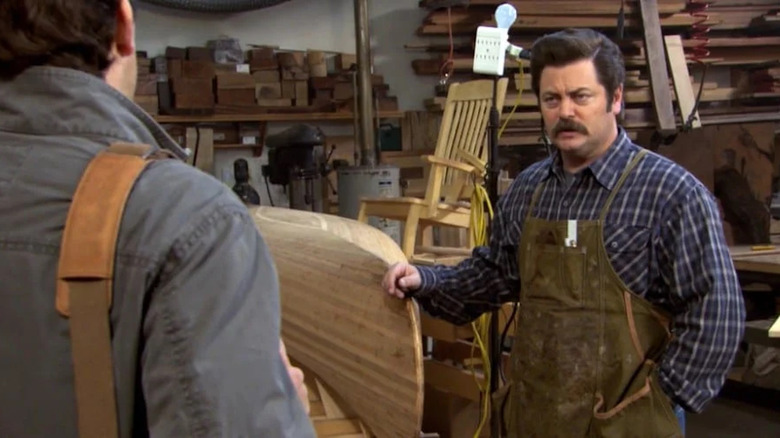
If you've been paying attention to Nick Offerman at all, you know he's the kind of actor that brings a little piece of himself to every character he plays. In real life he's more progressive than, say, Ron Swanson from "Parks and Recreation" or Bill from "The Last of Us," but that stoic man's man Mr. Fix-It quality that both of those characters have does parallel Offerman in real life.
In fact, Ron Swanson's love of woodworking comes directly from Offerman's own hobby. The man has written books about woodworking and has notoriously used his talents to make wrap gifts for his co-stars, like the canoe paddles he crafted for his "Parks and Rec" cast members using the discarded materials from the actual sets. The point is, Offerman is a handy guy to have around and it should come as no surprise that he brought some of those skills to the set of "The Last of Us."
In an interview with Empire Magazine, Peter Hoar (director of Offerman's big episode) shared just how much like Bill the actor was. Here's what he said:
"Nick is Bill. There were so many times on set, he would be fixing things because all of Bill's tools were everywhere."
How absolutely wonderful is that mental image? There's, like, an hour turnaround time between camera set-ups and instead of going to his trailer to wait it out like most actors, Offerman instead just grabs some of Bill's prop tools and gets to work fixing things up around the set.
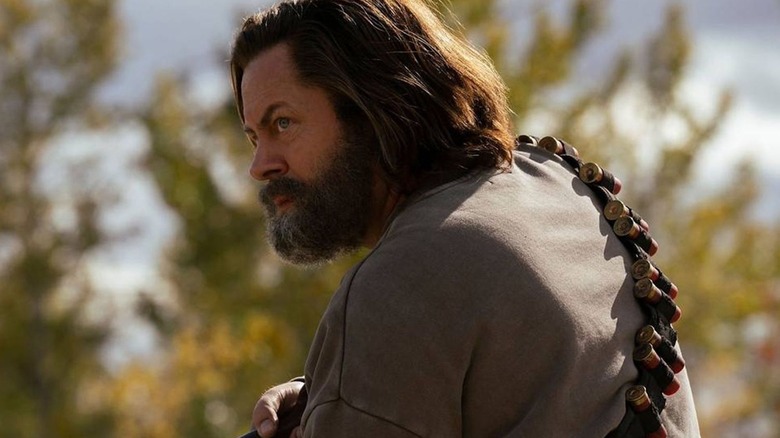
Beyond Offerman practically being born to play the sensitive loner "The Last of Us" needed, there's another connection his woodworking hobby has to him getting cast in "The Last of Us." Turns out, his woodshop sponsored a little league team for some years and it just so happens that "The Last of Us" writer and showrunner Craig Mazin's son was on that team.
In the very same Empire interview, Offerman is quoted as saying that for a long time, he knew Mazin as just one of his "baseball dads" until it was brought to his attention that Mazin was "the 'Chernobyl' guy."
Later on, when Mazin reached out to Offerman for the part of Bill, he almost had to pass because of scheduling conflicts. Ultimately, Offerman left the decision up to his wife, actress Megan Mullally, who all but insisted her husband prioritize "The Last of Us" after reading the script for the episode.
Originally, Bill was supposed to be played by Mazin's "Chernobyl" actor Conn O'Neill, but he had to drop out due to his "Our Flag Means Death" schedule. O'Neill is a wonderful performer and I'm sure he would have put his own unique spin on the character of Bill, but I think it's safe to say that this is a role so perfectly suited for Nick Offerman that the right guy ended up in this role.
Read this next: 12 Things We'd Like To See In HBO's The Last Of Us
The post Nick Offerman Kept Using Bill's Tools To Fix Stuff On The Last Of Us Set appeared first on /Film.
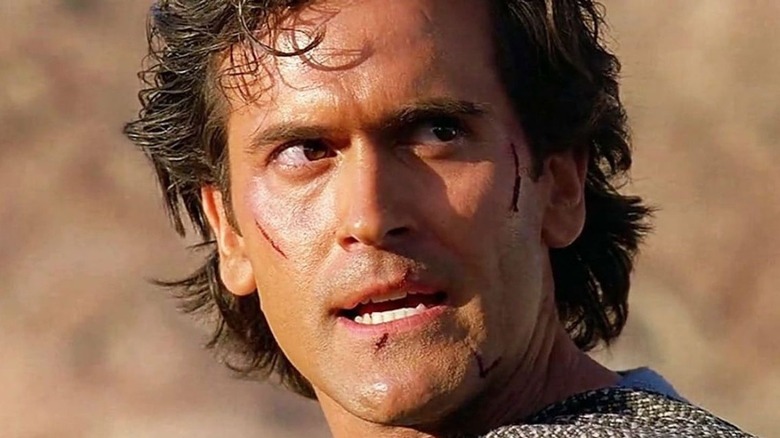
The "Evil Dead" trilogy is not particularly renowned for its strict continuity. Quite the contrary, actually — the three films, "The Evil Dead," "Evil Dead II," and "Army of Darkness," employ some notably loose connective tissue between each movie.
Some of this is due to the shifting creative approach, as the first film's ultimate experience in grueling terror morphs into the sequel's outrageous slapstick (or perhaps "splatstick" is a better term) before shifting completely into the period adventure comedy of "Army of Darkness." The continuity confusion also infamously stems from the films' production issues, with access to rights for recap footage requiring director Sam Raimi and company to reshoot and reconceive the backstory for each prior entry. There's also the fact that the "rules" Raimi establishes for the Deadites in the first "Evil Dead" are purposely vague, with victims being possessed and un-possessed seemingly at the drop of a hat, for instance.
Amongst all this, the "Evil Dead" trilogy still absolutely contains a sense of progression with each successive film — not necessarily one of plot or mythology but rather character, specifically that of protagonist Ash (Bruce Campbell). Despite all manner of continuity gaps, retconned backstory, and the like, Ash has a definitive character arc throughout the trilogy, and "Army of Darkness" acts as the culmination of his hero-ish journey, one way or another.
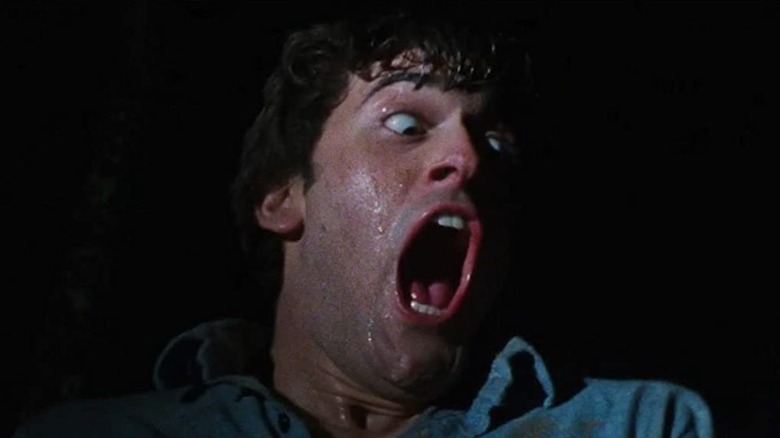
To anyone who may have seen "Army of Darkness" before "The Evil Dead," Ash is borderline unrecognizable in the 1981 original. As Raimi, Campbell, and producer Rob Tapert sought to make a killing at the drive-in box office while conceiving and shooting the film in 1979, they were thinking of utilizing "The Texas Chain Saw Massacre" as well as the then-recently released "Alien" as templates, both of which whittle down an ensemble of friends (or co-workers) to leave a woman as the last person standing. Given that Campbell was elected to be the last survivor of the film (thanks in part to the movie becoming a lengthy and arduous shoot with a shrinking cast and crew), Ash is portrayed in a more feminine manner, contrasting with the overtly macho Scotty (Hal Delrich née Richard DeManincor).
Shy, romantic, sensitive, and completely unprepared for the bloody chaos that's unleashed by his innocent playing of a tape found in the basement of a cabin, Ashley in "The Evil Dead" follows what would become known as the "final girl" archetype, remaining in the margins of the story until there's no choice for him to step up and take action. Of course, he's also the very first example of a Raimi protagonist, which means he is made to suffer in all manner of ways, both physical and psychological. Though he goes from having various items of furniture falling on him during each demonic attack to brandishing a shotgun and burning the evil book of the dead Naturom Demonto, Ash's resilience is not rewarded a la Sally Hardesty or Ellen Ripley, and the still-roaming Evil Force consumes him.
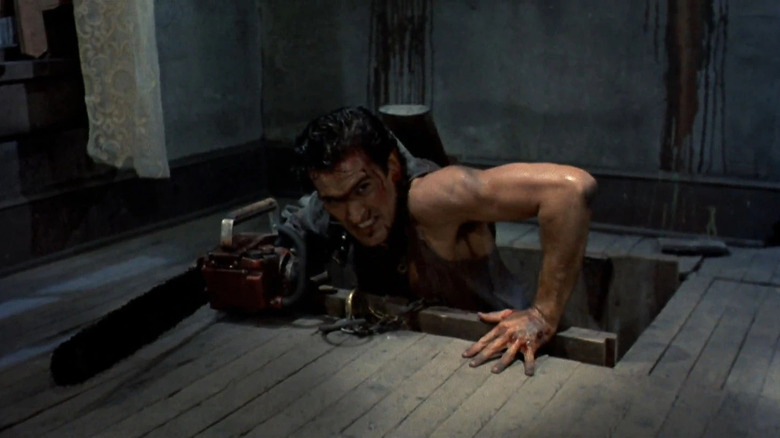
Or does it? Raimi, Campbell, and co-writer Scott Spiegel intended "Evil Dead II" to pick up almost right from where the first film left off, with Ash being thrown by that Evil Force rather than swallowed. However, due to not having the rights to re-use footage from the first film, it was decided to write and shoot a new recap, in which Ash's friends are conspicuously absent. Not only that, but this film's Ash is decidedly different from the start, boisterously cavorting with girlfriend Linda (Denise Bixler) before the demons are unleashed. One could say this is an Ash who's been merged with the old Scotty character — he's the one driving himself and Linda to the remote cabin in the woods, after all. Yet one could also say this is an Ash who retains the confidence he gained at the end of the first film, that attitude a little transposed to the recap sequence for brevity's sake.
In any case, Ash is viciously brutalized by the Deadites from the start, and over the course of the movie's reversed structure from the first film — Ash begins isolated and alone and is then joined by an ensemble of characters — the man changes from a tortured and mocked victim to a square-jawed, one-liner spouting '80s-style action hero. That change is a bit of a twist all by itself, as Raimi has Ash possessed by the Evil not once, but twice, seemingly hinting that the daughter of the cabin's owner, Annie (Sarah Berry) will take over as the movie's sole hero.
That sensitive, romantic man from the first film isn't completely gone, however, as Ash's love for his tragically departed Linda brings him back from the brink, allowing him to truly become — in his own words — "groovy."
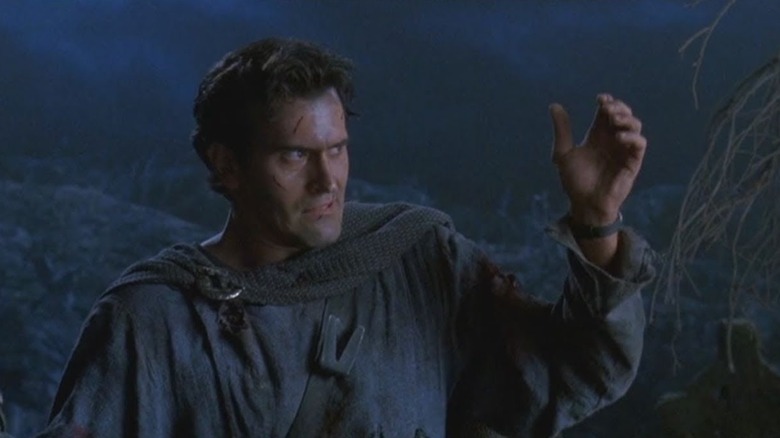
Raimi and company can't allow Ash to be victorious for long, though. In order to dispel the Evil Force, Ash and Annie read passages from the Necronomicon that opens up a time portal, sending Ash helplessly back to the Middle Ages. In the final moments of "Evil Dead II," the newly minted hero Ash finds being a prophesied savior a curse more than a blessing, with the denizens of Medieval times excitedly praising his arrival.
Beginning "Army of Darkness" with a new recap (featuring Bridget Fonda in the role of Linda this time) and a little bit of actual "Evil Dead II" footage, Ash mostly begins where he left off in the prior film, only his arrival in the kingdom of Lord Arthur (Marcus Gilbert) is not as welcoming as it was in part 2. While Ash is once again beaten, harangued and mocked (initially by the people of Arthur's land as well as the Deadites), he's no longer the innocent victim of the Evil Force. Now he's all too aware of the dangers inherent in tangling with Deadites and questing for the book of the dead, and his fear of the evil combined with his newfound heroism and fish-out-of-water status makes him behave like, as Arthur puts it, a "loudmouth braggart."
Despite all of Ash's bluster — toward the citizens of the kingdom, his new love interest, Shelia (Embeth Davidtz), and the Deadites themselves — he manages to screw everything up by inadvertently releasing the Evil, painting a target on the kingdom's back by bringing the Necronomicon to the castle, letting Shelia get kidnapped and cowardly demanding he be sent back to his own time.
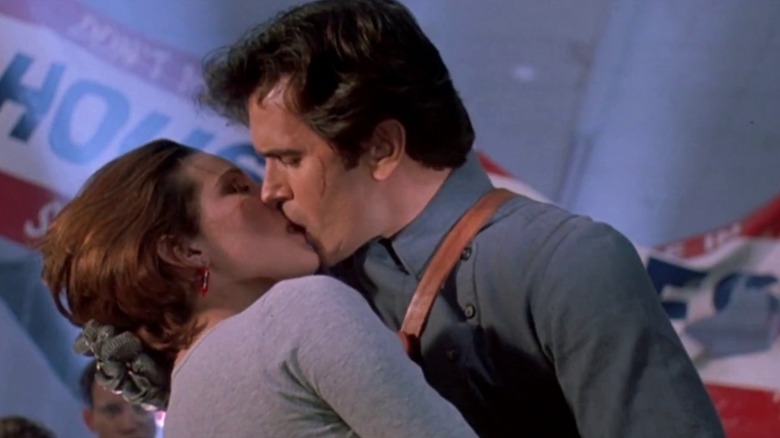
Yet hope exists for Ash to redeem himself, and nowhere is this more apparent than in Raimi and co-writer Ivan Raimi's choice to have the major villain of "Army of Darkness" be none other than Ash himself. A cloned evil twin of Ash, mind you, one that's fully given over to the Evil that thirsts for the Necronomicon. Even though the makeup for Evil Ash disguises Campbell's face, allowing for a degree of subtlety to be applied to the subtext, the battle between Ash and Evil Ash sees the character taking responsibility not just for his actions in "Army of Darkness" but for the entire "Evil Dead" trilogy. After all, though Scotty was involved and his friends were complicit, Ash did play the recording of the deadly incantations that began this entire mess.
In addition to facing his literal and figurative demons, Ash makes good on the promise made by the end of "Evil Dead II," becoming a fully-fledged action hero and buckling some swash to boot. Rousing the remaining members of Arthur's kingdom as well as convincing Duke Henry the Red (Richard Grove) to come to Arthur's aid, Ash proves himself to be a leader of men and an inspiration, defeating the Evil for good.
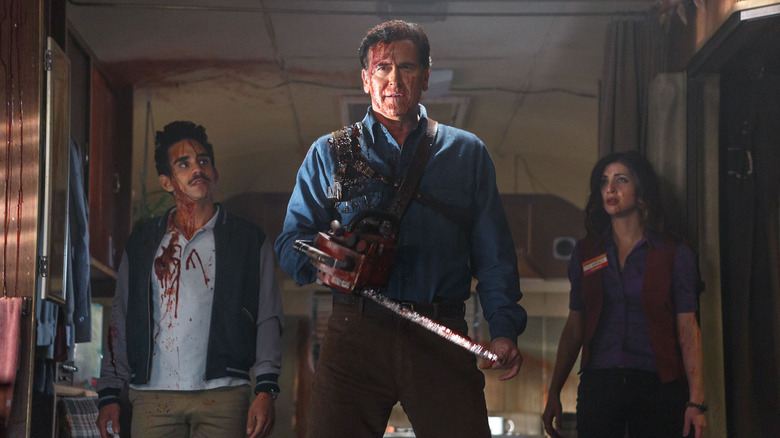
Or does he? It wouldn't be "Evil Dead" without some ambiguity to the continuity, and the fate of Ashley J. Williams, S-Mart employee, is suitably varied. "Army of Darkness" is the only "Evil Dead" film to date that features multiple cuts of the movie with alternate endings, and Raimi's Director's Cut features Ash suffering a very familiar fate: he swallows one too many drops of magic liquid and wakes up a century beyond his own time, discovering that an apocalypse has befallen the Earth. With this ending, Ash is shown to be a character eternally doomed for his mistakes.
However, the Theatrical Cut's ending retains that theme with a decidedly less bleak edge. Ash is able to return to his own time (and his far less glamorous job at S-Mart) but, thanks to his buffoonery, has brought the Evil back with him. Yet his development over the three films means that, despite his responsibility, he is now adept and often victorious when forced to deal with Evil rearing its ugly head. The three-season sequel series "Ash vs. Evil Dead" picks up from this ending as well as this core definition of Ash's character, as he learns to incorporate new friends and old family members into his never-ending quest.
While it's difficult to claim any one "Evil Dead" film as the most popular, the version of Ash as a character that's the best known is undeniably the one from "Army of Darkness," proving how the film fully realizes and caps Ash's journey. While it's unlikely we'll see Ash again in the upcoming reboot (or is it a sequel? or rebootquel?!) "Evil Dead Rise," we can rest assured that, despite the "Evil Dead" franchise playing fast and loose with continuity, the heroic schmuck Ash continues to be rocksteady.
Read this next: Horror Movies That Make Us Root For The Villain
The post How Army of Darkness Completes Ash's Character Arc in the Evil Dead Trilogy appeared first on /Film.
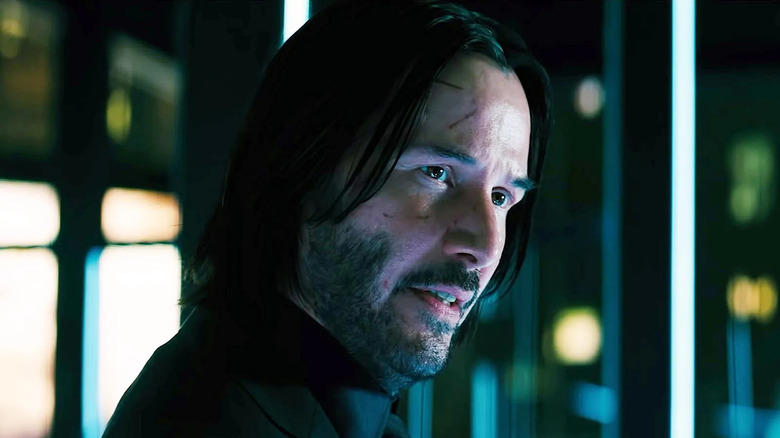
The advancement of artificial intelligence has likely been on everyone's minds over the past few weeks. From apps that use your personal data to generate edited selfies, to major companies pivoting to AI-generated content, there's been a big question about whether popular media will pivot to content produced by machines rather than living creatives. If we can be so easily replaced by machines, is our creativity even worth maintaining?
According to Keanu Reeves, the answer to that question is a resounding yes. The actor, who may know a thing or two about artificial intelligence taking over the world, recently spoke to WIRED to promote the upcoming "John Wick: Chapter 4" with director Chad Stahelski. By happenstance, the interview shifted to a discussion of AI usage in film. When a Russian television ad with a deepfaked Bruce Willis appearance was brought up, Reeves made some pretty passionate remarks lobbying against its widespread usage, defending a clause in his contracts prohibiting deepfakes in the process.
"What's frustrating about that is you lose your agency," he argued. "When you give a performance in a film, you know you're going to be edited, but you're participating in that. If you go into deepfake land, it has none of your points of view. That's scary."
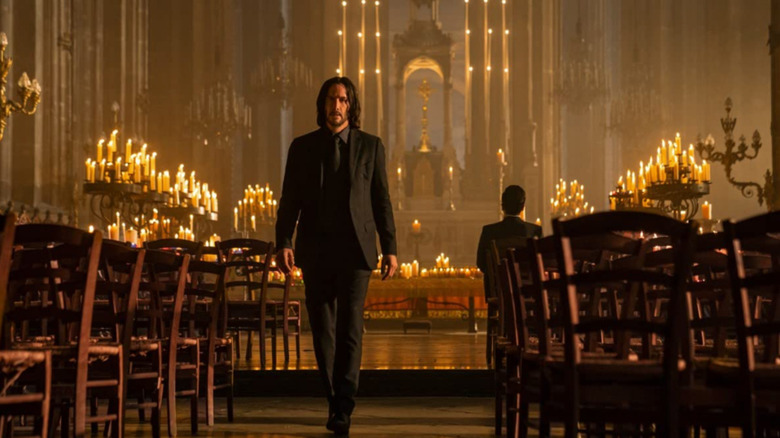
It isn't just deepfakes that Reeves has an issue with. Although he is an advisor for a metaverse initiative called the Futureverse Foundation, he also told WIRED that the current direction of what is considered the mainstream metaverse is a terrifying one. The actor argues that the normalization of such projects could lead to some dire consequences:
"People are growing up with these tools: We're listening to music already that's made by AI in the style of Nirvana, there's NFT digital art. It's cool, like, 'Look what the cute machines can make!' But there's a corporatocracy behind it that's looking to control those things. Culturally, socially, we're gonna be confronted by the value of real, or the nonvalue. And then what's going to be pushed on us?"
Reeves really does make an important point. Like cryptocurrency, AI and the metaverse are not inherently scummy things, as they can theoretically lead to some cutting-edge ways to assist humanity's uniquely creative spirit. However, it seems like the vast majority of AI and metaverse projects want to replace that humanity altogether. In the case of deepfakes, the passion and grit that leads to a powerful screen performance can be easily replaced by an emotionless mask. Tying this into the actor's body of work, no machine could do the impressive action stunts that Reeves and the other actors in the "John Wick" series do. Without that human and emotional touch, it's nothing.
"It's this sensorium. It's spectacle," remarked Reeves, "and it's a system of control and manipulation."
But hey, maybe he just doesn't want to be deepfaked because he's immortal. What do we know?
Read this next: The Best Action Movies Of 2022, Ranked
The post Why Keanu Reeves Will Never Let Himself Be Deepfaked Into Movies (It's Not Just Because He's Immortal) appeared first on /Film.
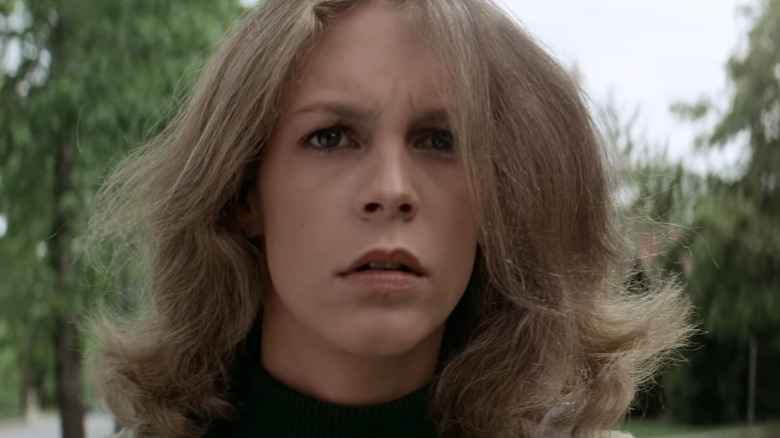
What do horror movie characters and Hollywood movie producers have in common? They're both unstoppable forces who pillage and plunder until something finally stops them. For horror movie characters, that something is a super-contrived death scene. For Hollywood movie producers, it's a box office bomb. But don't worry, because both will be back for the inevitable sequel, reboot, or remake! Horror movie producers are in the business of making money, since they're certainly not winning plaudits from critics or gold statues at award shows. Good thing horror movies are cheap to make, quick to produce, and usually a license to print cash ... until they aren't.
What kills horror movie characters aren't bullets, knives, getting set on fire or run over by trucks, but fan apathy. So while just about every horror film franchise has achieved great successes, most have also -- eventually -- suffered miserable failures. Some franchises take multiple decades and several Roman numerals to collapse, while others hit their expiration date after only a few installments. Whether the series runs three movies or 10 (and counting), let's take a look at the biggest blockbusters and bombs across some of your favorite horror film franchises.
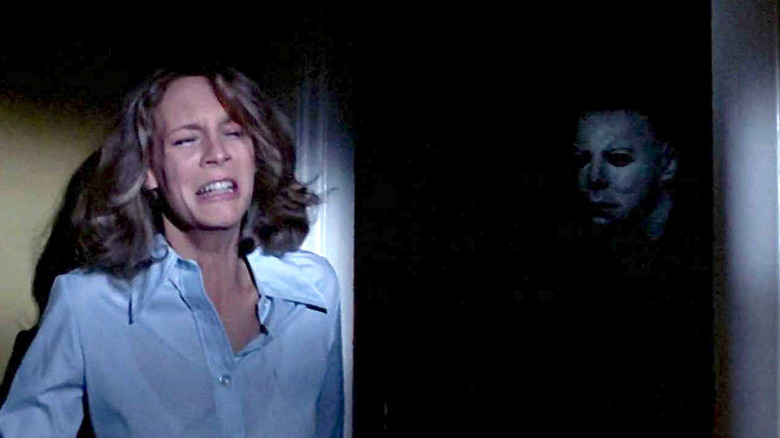
"Halloween" is the granddaddy of slasher horror. Sure, "Psycho" in 1960 came first, with its creepily charismatic killer, while 1974's "Black Christmas" and "The Texas Chainsaw Massacre" introduced many of the subgenre's tropes. However, "Halloween" in 1978 brought everything together into a formula that has been repeated ever since. "Halloween" not only kicked off the first true slasher horror series, but also one of the most fecund, with 12 sequels across 45 years. In fact, "Halloween" has effectively played out over five different timelines, making the DC Universe seem cogent. All of the franchise's highest-grossing hits share one common denominator: Jamie Lee Curtis' Laurie Strode. When it comes to raw numbers David Gordon Green's 2018 soft reboot "Halloween" is numero uno, with $159 million domestic and $255 worldwide on a $10 million budget. Its insane profitability is unheard of today but pales in comparison to the 1978 original. On a $325,000 budget, "Halloween (1978)" grossed $47 million domestically and $79 million worldwide, roughly $354 million in today's dollars. While almost every "Halloween" movie made at least a slim profit, 1989's "Halloween 5: The Revenge of Michael Myers" took in a mere $11 million on a $6 million budget. Myers stayed dead for six years until 1995's "Halloween: Curse of Michael Myers." It actually performed a little better than "Halloween 5" ($15 million on a $5 million budget), but both movies were so abysmal they rebooted the series in 1998 with "H20" starring, you guessed it, Jamie Lee Curtis.
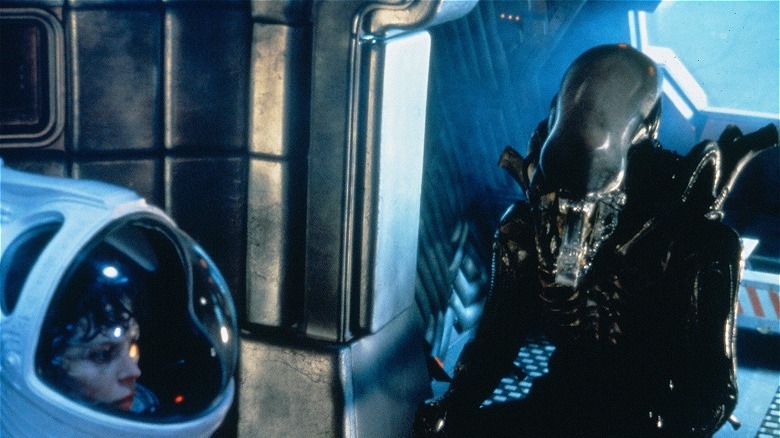
I would argue Ridley Scott's "Alien" (1979) is "'Halloween' in space." The differences are that "Alien" traded the psychotic serial killer for an ambivalently destructive xenomorph, and Jamie Lee Curtis' Laurie Strode for Sigourney Weaver's Lt. Ellen Ripley. But from a financial perspective, "Alien" rode the waves of other 1970s sci-fi mega-hits "Star Wars" and "Close Encounters of the Third Kind," with a gross that dwarfed what "Halloween" earned. "Alien" scared up $62 million domestically and $184 million worldwide on a $10 million budget in 1979, about $741 million in today's dollars. Strangely, it took 20th Century Fox seven years to make a sequel. "Aliens" brought home $183 million on a $17 million budget, about $488 million today (and marks the rare instance in which a James Cameron movie didn't earn the most money). In 2012, Scott returned to the series with a prequel, "Prometheus." Its $402 million gross equates to $512 million today. Mighty impressive, but a far cry from the 1979 originals' franchise high-water mark. What about the busts? There really aren't any. The 2007 sequel "Aliens vs. Predator - Requiem" took in $128 million worldwide (roughly $180 million accounting for inflation) on a $40 million budget, which proved the xenomorphs did better at the box office on their own. I hope I'm wrong, but I'm betting that the upcoming "Alien: Romulus" -- directed by Fede Alvarez and produced by Ridley Scott -- will be the "Alien" series' biggest bust.
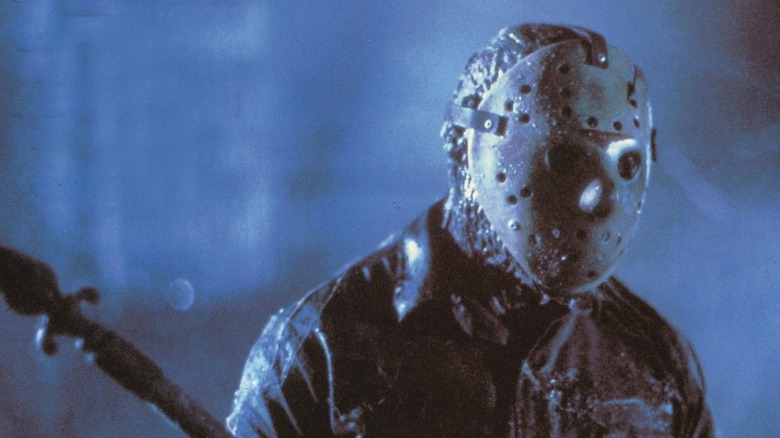
Jason Voorhees is one of the most unusual characters on this list. Technically, the main villain in "Friday the 13th" was his mom, but "killer mom gets vengeance for her son" doesn't scream franchise potential, so Jason became the big bad in the next 11 films. He's not just your everyday serial killer. Jason is effectively an immortal demon who has survived the depths of space and the bowels of hell. Hey, all in a day's work for a supernatural psychopath, right?
Believe it or not, in terms of pure profitability, Jason's mom is still the biggest draw. On a meager $550,000 budget, the 1980 original chopped up $59 million in box office grosses worldwide, roughly $209 million today. The rest of the series never reached those numbers, though there was a "Friday the 13th" movie released almost every year in the 1980s because they were such a safe bet. Sadly, that string of hits ended with 2002's "Jason X," which crashed and burned with $16 million worldwide on a $14 million budget. I guess "Jason Goes to Space" was a bridge too far for "Friday" fans. Jason's failure was short-lived, however, as the very next year "Freddy vs. Jason" earned $114 million worldwide. This was Jason's largest gross in raw numbers, though the $181 million inflation-adjusted numbers can't touch his mom's OG movie.
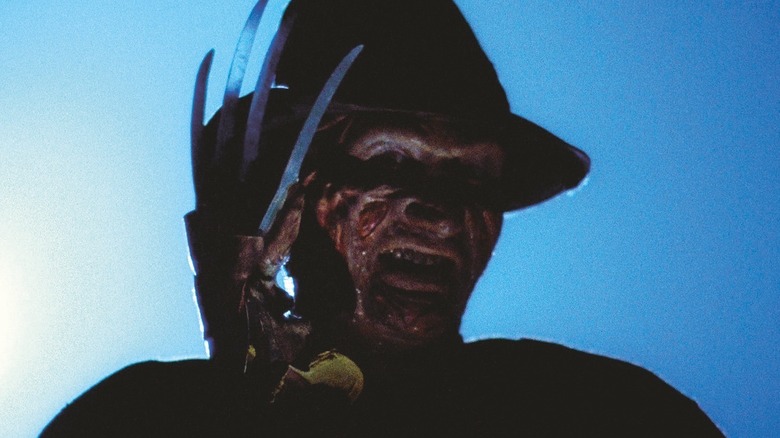
You might be surprised to hear this, but Freddy Krueger never really hit the box office heights of his serial killer contemporaries, Michael Myers and Jason Voorhees. However, like a fine wine Freddy grew more popular with age ... until he went sour. Freddy's profitability was the kind that movie studios dream about (Get it? Because he kills people in their dreams?). Long before "The Lord of the Rings," New Line Cinema was "the house that Freddy built," which is why the studio released one nearly every year from 1984 to 1991.
Freddy's biggest box office hit was his bout against Jason Voorhees in 2003's "Freddy vs. Jason," which satiated decades of fan demand. Its $114 million worldwide would equal $181 million today. On his own, Freddy's number one movie is actually the 2010 "A Nightmare On Elm Street" remake; its $117 million worldwide would be $157 million today. Yep, turns out Jackie Earle Haley's Freddy out-earned Robert Englund's Krueger. Englund's biggest Freddy was "A Nightmare On Elm Street 4: The Dream Master," which raked in $49 million in 1988, or $121 million today. The series' lone misfire was "Wes Craven's New Nightmare," which put "Nightmare" to bed for nearly 10 years with $18 million on an $8 million budget. Moviegoers weren't ready for Craven making a meta-commentary on the slasher genre in 1994, but that would all change with 1996's "Scream."
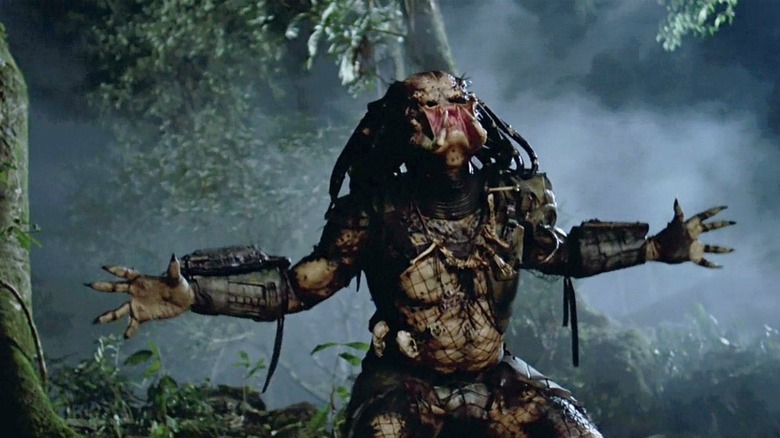
I know what you're thinking: "Wait, is 'Predator' a horror, action, or sci-fi series?" If Blockbuster were still around (R.I.P.), you'd likely find it in the action section. However, the original has all the makings of a slasher horror film, except the baddie is an alien, not a serial killer, and the Final Girl is Arnold Schwarzenegger. The 1987 original was the creative high point for the series, but despite starring Ahh-nuld, it was not the highest-grossing film – adjusted or unadjusted for inflation. Still, nobody would complain about its $98 million worldwide gross on an $18 million budget, which technically makes "Predator" the most profitable flick in the franchise.
The top spot for the "Predator" franchise actually goes to 2004's "AVP: Alien vs. Predator." Its $172 million worldwide tops the list in raw numbers, while its $266 million inflation-adjusted gross means it probably sold the most tickets. So, sorry "Predator" fans, but it looks like "Alien" may be the more popular franchise. The "Predator" series also includes more high-profile duds, though it's a toss-up which "wins" (er, loses). "Predator 2" scored $54 million worldwide in 1992, or about $112 million adjusted, on a $35 million budget. Meanwhile, 2018's "The Predator" earned a frankly surprising $159 million worldwide in 2018 ... but that was offset by its ridiculously high $88 million budget. Let's just say when it comes to losing money, the "Predator" franchise does have time to bleed.
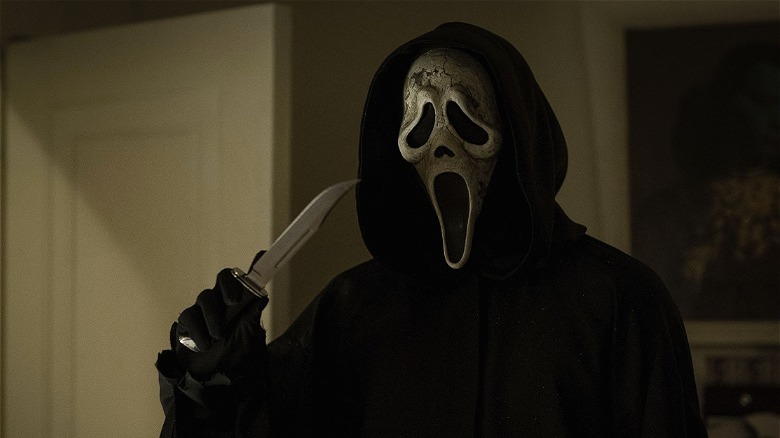
Wes Craven reinvented the slasher horror film not once, but twice. First, with his "A Nightmare on Elm Street" series, where the baddie Freddy Krueger killed victims in their sleep. The "Nightmare" series took a dirt nap after 1994's "Wes Craven's New Nightmare," which was ahead of its time. By "ahead of its time" I mean by like two years, as Craven brought back his brand of meta-commentary on the genre he helped create with 1996's "Scream." Whereas "Nightmare" operated in a supernatural world, "Scream" is a down-to-Earth slasher flick where everything could really happen. Well, maybe not David Arquette being a hero, but other than that, almost everything.
What made "Scream" fresh was that its characters were in on the act, having grown up watching slasher movies. Moviegoers dug it big time, as "Scream" earned $173 million worldwide, $322 million in today's dollars. This gross, made even more impressive by its $15 million budget, not only makes "Scream" the highest-grossing film in that franchise, but the biggest box office hit of Craven's career. So you could say Ghostface has a larger cultural impact than Freddy Krueger (you could, but I won't, because Freddy fans will cut you). "Scream" ran out of steam by "Scream 4," which earned $95 million worldwide on a $40 million budget. Fans may have been over "Scream" in 2011, but 2022's legacy sequel "Scream" brought the franchise back to its winning ways.
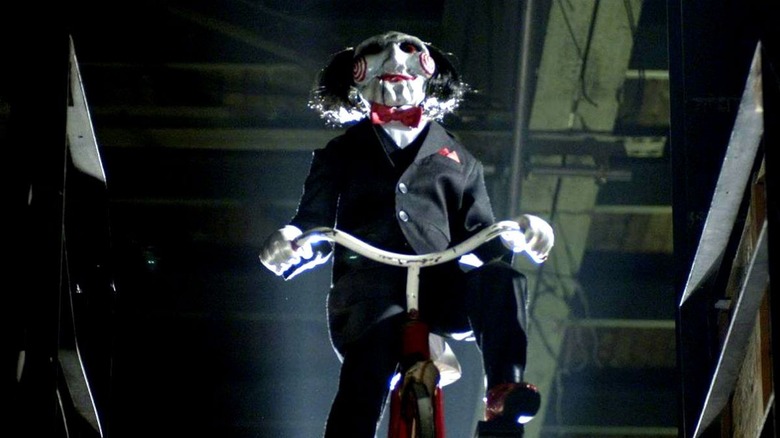
"Torture Porn" was a thing in the 2000s, something I'm still trying to wrap my head around. Admittedly, part of slasher films' appeal is the outlandish death scenes. However, that was the exclusive appeal of torture porn. Before you accuse me of being an old man yelling at clouds (which I am, btw) I'll acknowledge one series that stood apart: "Saw." The "Saw" series helped launch "torture porn" and was insanely popular, spawning nine movies in less than two decades, and becoming an annual Halloween tradition from 2004-2010.
Even for people who don't like "torture porn," its storyline is iconic and helped establish Tobin Bell as a horror legend. Dying from an incurable disease, the central character Jigsaw (Bell) does what any normal, well-adjusted person would do, and forces innocent victims to play elaborate games to save their lives. With these pieces in place, "Saw" was basically a license to print cash. While almost all of them made a lot of money, the series hit its peak with "Saw III," which banked $163 million in 2006, or $236 million today. "Saw" quit while it was ahead with 2010's "Saw 3D," came back for 2017's successful legacy sequel, "Jigsaw," and then produced the franchise's lone bomb, "Spiral," in 2022. Starring and conceived by Chris Rock, this pseudo-sequel/spinoff didn't connect and probably confused audiences too. With $39 million worldwide on a $20 million budget, you could say "Saw" found itself between (Chris) Rock and a hard place.
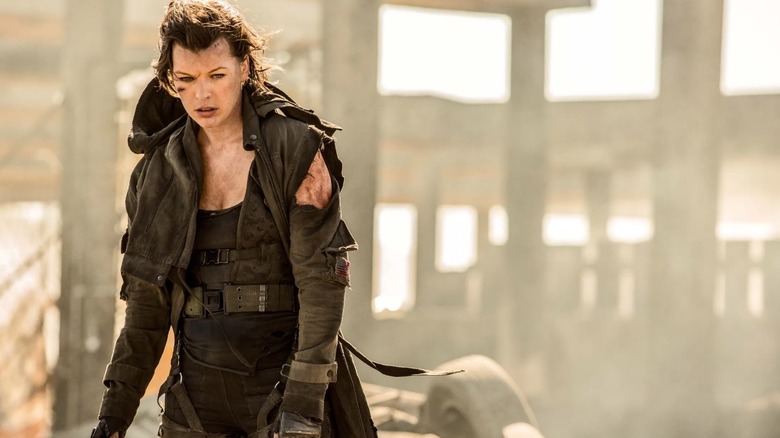
Ten movies in, "Resident Evil" is not only one of the most prolific horror franchises but the most prolific video game-based series. It's easy to see why. Long before "The Walking Dead" and "The Last of Us," the "Resident Evil" flicks satisfied audiences' bloodlust for post-apocalyptic zombie fare. While their budgets are usually two to three times the typical horror production, their grosses are almost across-the-board in the triple digits.
Ironically, the biggest blockbuster in the franchise was almost the biggest bomb, at least domestically. Wait, what? Yep, North American audiences were already over the series by 2017's "Resident Evil: The Final Chapter." It grossed $26 million domestically on a $40 million budget, an "L" for star Milla Jovovich. However, the movie also made $314 million worldwide, with $161 million of that coming from China, so it was also the franchise's highest-grossing flick worldwide. Crazy, right? The 2022 reboot "Resident Evil: Welcome to Raccoon City" was a franchise-killing bust by every objective measure. Sans Jovovich, the movie mustered a measly $17 million domestic and $41 million worldwide, though the $25 million budget was also the series' most economical, stopping the bloodbath at least a little bit.
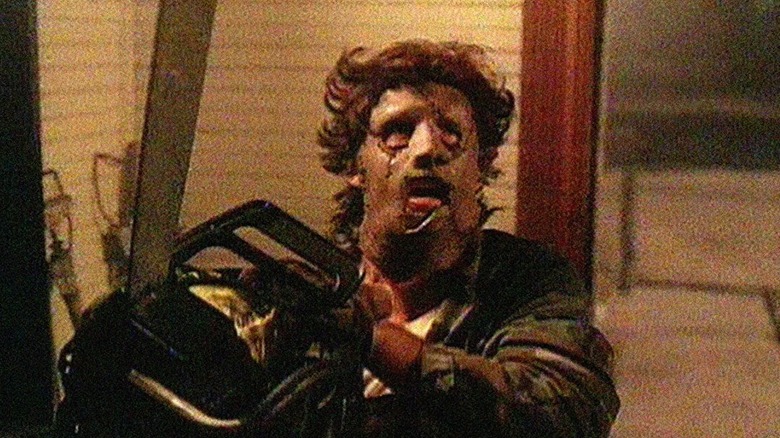
Despite being an OG slasher horror franchise, "The Texas Chainsaw Massacre" hasn't achieved the same box office success as the films that followed in its footsteps. Don't assume that it hasn't been profitable, as movie studios usually don't make eight sequels to underwhelming results. The 1974 original was the box-office champ for almost 30 years, despite only earning $26 million, or about $133 million in today's dollars. That's nothing to sneeze at, especially with a $140,000 budget.
However, the franchise's top dog -– both in unadjusted and adjusted numbers -– is the 2003 remake, which earned $107 million worldwide, or $155 million adjusted for inflation. I guess the combined might of Michael Bay producing and Jessica Biel playing the lead did the trick. However, star power didn't help the lowest-grossing film in the series, "Texas Chainsaw Massacre: The Next Generation." Even with Matthew McConaughey and Renée Zellweger in "before they were famous" roles, the 1995 film only earned $94,558 worldwide, or less than either of those A-listers probably rake in one day of work nowadays.
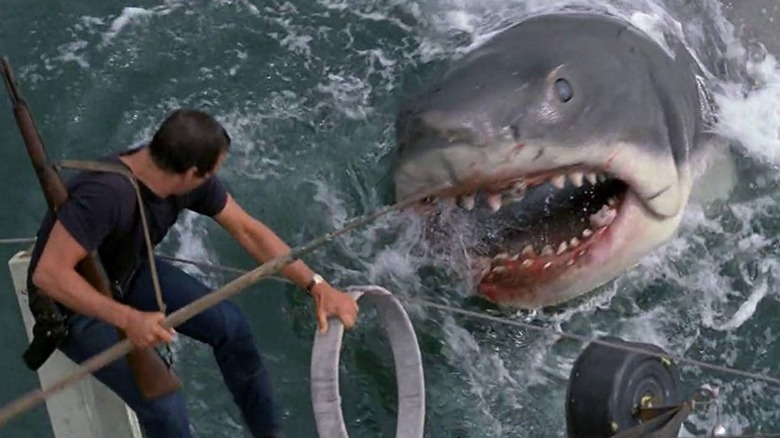
You gain a much greater appreciation for Steven Spielberg's "Jaws" when you watch the films that followed. Spielberg's 1975 original is credited with kicking off the summer blockbuster season thanks to its $108 million domestic and $408 million worldwide gross, which equals about $2.2 billion (yes, with a "b") in inflation-adjusted dollars. The good vibes from that movie carried over to the 1978 sequel, "Jaws 2." Roy Scheider was back, but Spielberg was out, so there was a tremendous quality and financial drop-off. No worries. "Jaws 2" bit into $208 million worldwide, a steep plunge from the original, but still $933 million in today's dollars.
"Jaws 2" was able to ride the coattails on "Jaws," but that film's awfulness resulted in a massive decline for "Jaws 3-D" –- $42 million, or $123 million in today's dollars. "Jaws 3-D" made money, so someone -- the producers? the studio? -- figured why not keep churning out "Jaws" movies? Yeah, about that. "Jaws 4: The Revenge" finally tanked the series, earning $15 million worldwide (about $38 million in today's dollars) on a $23 million budget. So the "Jaws" franchise started with arguably the best summer movie ever and ended with one of the worst movies, period. You'll note they haven't produced any "Jaws" movies since 1987, so you might say the shark series is "fin"-ished.
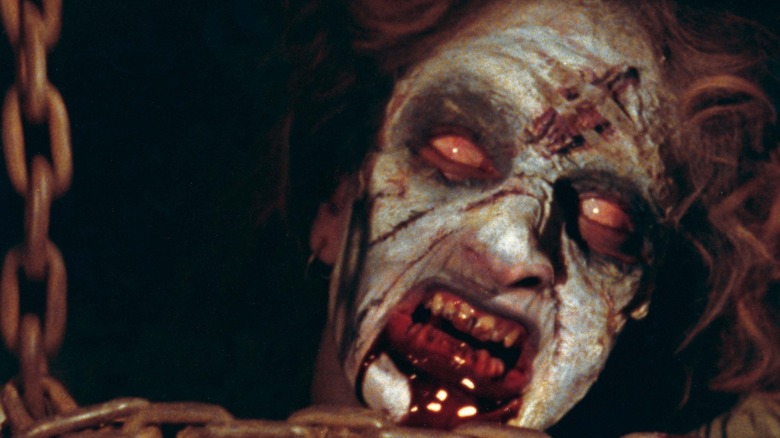
"The Evil Dead" is a sui generis horror-comedy hybrid that defies easy categorization. While the "Evil Dead" boasts a rabid fanbase, it hasn't inspired the same diehard devotion among mainstream audiences. The series' most profitable film is the 1983 original, "The Evil Dead." Shot on a shoestring $375,000 budget by Sam Raimi, Bruce Campbell, and their buddies, "The Evil Dead" earned $29 million worldwide, or just over $86 million when adjusted for inflation. Surprisingly, the series' top cash cow is the 2013 Fede Alvarez-directed remake, "Evil Dead."
With a $17 million budget, it earned $99 million worldwide or $124 million adjusted. It only featured Ash (Campbell) in a post-credits cameo and nowhere in the marketing, suggesting moviegoers had little connection to the originals and saw "Evil Dead" merely as a horror movie. The franchise's biggest financial failure is debatable. Was it 1987's "Evil Dead II," which collapsed with $5.9 million on a $3.5 million budget? Or 1993's "Army of Darkness," which tanked with $21 million on an $11 million budget? Either way, the successes of the 1983 original and 2013 remake suggest mainstream audiences prefer "Evil Dead" when it's a straight horror series, not a horror-comedy hybrid. Further support for my thesis is that the Starz TV series "Ash vs. Evil Dead" -- produced by Raimi and starring Campbell -- was canned after three seasons due to declining ratings. I'm saying this as a hardcore "Evil Dead" stan, but the numbers don't lie.
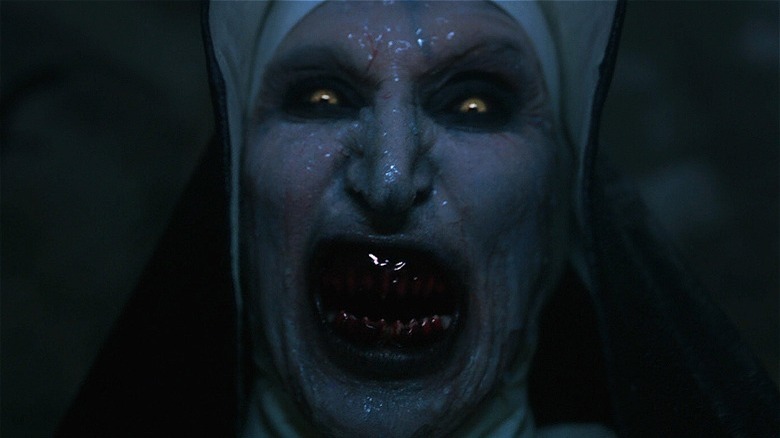
Horror movies are known for their profitability, but "The Conjuring" franchise puts up blockbuster numbers. There's a reason they have made nine movies and counting in 10 years; with $2.1 billion worldwide, "The Conjuring" has a per-film average of $263 million. For context, that puts "The Conjuring" series between "Minions" and "Planet of the Apes" for total box office among franchises. Interestingly, the series' number one hit is the 2018 spinoff, "The Nun," which conjured up $363 million worldwide, $423 million adjusted, on a $22 million budget.
Which is the series' worst bomb? None of them. "The Conjuring" hasn't produced a dud ( ... yet), so expect the franchise to remain an "every other year" tradition until that changes. However, for what it's worth, the spinoff "The Curse of La Llorona" only collected $123 million worldwide in 2019, while "The Conjuring: The Devil Made Me Do It" raked in $200 million in 2021. With its $40 million budget, "The Devil Made Me Do It" was still profitable, but brought home $100+ million less than "The Conjuring 2: The Enfield Poltergeist."
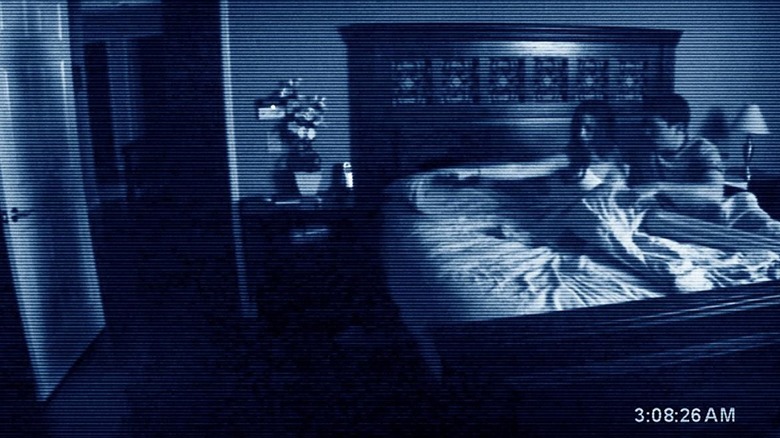
"Found footage" movies may be mostly associated with "The Blair Witch Project" or "Cloverfield," but the clear winner when it comes to box office results is the "Paranormal Activity" series. Seriously, it's hard to scale just how successful these films have been. The highest-grossing is 2011's "Paranormal Activity 3," which made $207 million ($269 million adjusted for inflation) on a $5 million budget. But in terms of pure profitability, the ghost with the most isn't even close. "Paranormal Activity" cost a mere $450,000 to produce, but spirited away with a staggering $194 million worldwide in 2009, for an inflation-adjusted gross of $264 million. With nearly $200 million on a less than half-a-million-dollar budget, "Paranormal Activity" is the most profitable movie of all time. Despite cranking out seven movies in 12 years, Blumhouse Productions hit the "pause" button with 2015's "Paranormal Activity: The Ghost Dimension." On a $10 million budget, the movie made $77 million worldwide, but only $18 million domestically, signaling audience disinterest and diminishing returns. In 2021, "Paranormal Activity: Next of Kin" didn't even get a theatrical release, but haunted Paramount+ instead.
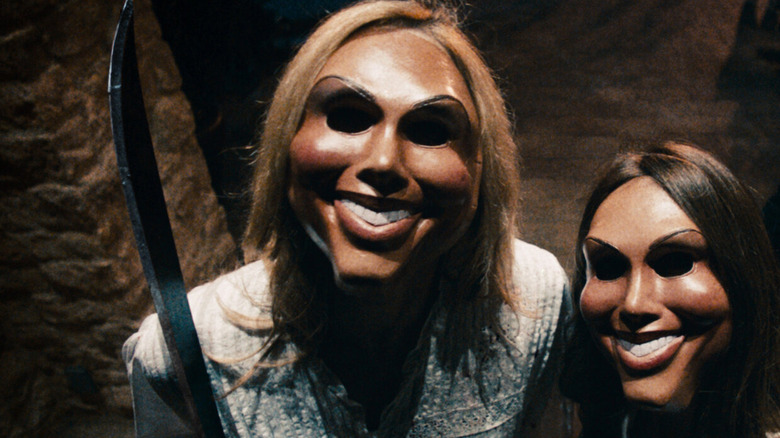
"The Purge" franchise envisions a dystopian future that's not much different from ours, except once a year all crime is legal for 12 hours. Given that this is a horror franchise, people don't use this 12-hour window to steal movie tickets or jaywalk, but rather to rape, pillage, plunder, and murder. "The Purge" doesn't inspire much confidence about the human race, but it has been a big hit with moviegoers.
The first "Purge" earned $91 million in 2013 and the series saw mostly steady increases with each entry. Film four in the franchise -– 2018's "The First Purge" -– banked the most of any "Purge" movie, though its $13 million budget was quadruple the original's $3 million. Somehow, I doubt Blumhouse Productions worried about that. They were surely concerned about the precipitous decline of the fifth (and so far last) film, "The Forever Purge." Released in 2021, "The Forever Purge" cost $18 million to produce, but collected only $76 million worldwide, a steep 45% decline despite having the series' highest budget. With its lukewarm response, perhaps audiences have purged themselves of "The Purge." And we didn't even mention "The Purge" television series that ran for two seasons between 2018 and 2019.
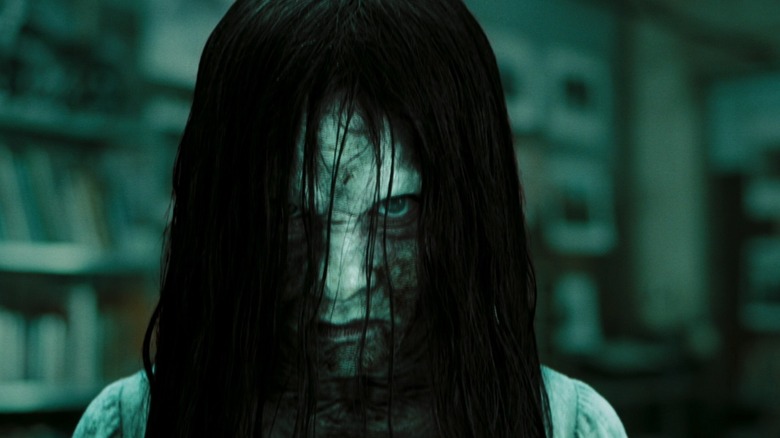
Japanese horror remakes were big business in the 2000s, and none were more massive than "The Ring." Released in 2002, "The Ring" made stars out of Naomi Watts and director Gore Verbinski, and it banked a lot of money. Even with a pricey (for horror) $48 million budget, "The Ring" earned $248 million worldwide in 2002, which is about $403 million today. Naturally, Dreamworks put out a sequel, though fan enthusiasm seemed to have dwindled during the three-year gap.
"The Ring Two" cost $50 million to produce and netted $161 million at the worldwide box office ($241 million adjusted for inflation), great numbers, but a 36% decline from the original. "The Ring" franchise took a 12-year break, going the legacy sequel route for 2017's "Rings." The movie was wisely produced for a modest $25 million budget, about half of the previous two entries before inflation, and earned $82 million worldwide. Those numbers meant "Rings" was probably profitable, but its domestic gross of $27 million was pitiful. The tagline for the original was "before you die you see the ring," but clearly moviegoers weren't dying to go back to this franchise. "The Ring" was a major movie in the early aughts, but it appears that's where it should stay.
Read this next: The 15 Best Final Girls In Horror Movies Ranked
The post The biggest blockbuster and biggest bomb in these famous horror film franchises appeared first on /Film.
Read more of this story at Slashdot.
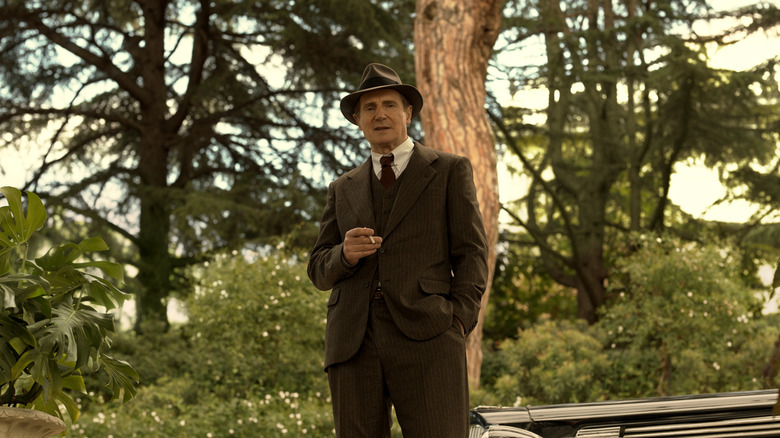
Neil Jordan is a prolific filmmaker. His work has spanned many genres over the course of his career, and he's not a writer-director whose movies can be placed in a box. Where to even begin listing his credits? There's "The Crying Game," "Interview with a Vampire," "Michael Collins," "Mona Lisa," and a movie we spent a good deal of time asking him about, "The Company of Wolves." Now, Jordan returns to the world of noir with "Marlowe."
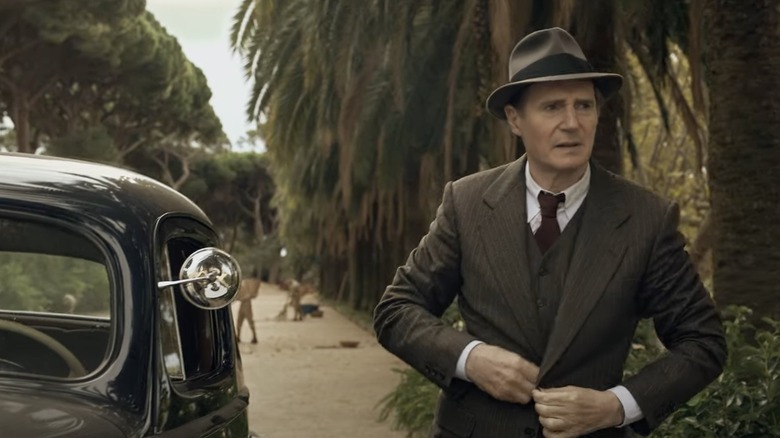
The filmmaker reunites with Liam Neeson for a Philip Marlowe picture, about the same literary detective character Humphrey Bogart played in "The Big Sleep" and Elliott Gould in "The Long Goodbye." This story is not based on one of Raymond Chandler's hardboiled novels, but Jordan does capture the vibe that defines the character at the heart of those stories. As Jordan told us, he wanted to make a colorful noir and even went as far to use "Blade Runner" as an influence.
Note: This interview has been lightly edited for clarity and brevity.
Hello, young man. Very young, you are. Is it Slashfilm?
[Laughs] Yes.
Is it a slightly horror-orientated kind of publication or site, is it?
It is not. If it was, I would just talk to you all about "The Company of Wolves."
Okay. We can talk about that. Don't worry, we can talk about it.
We'll definitely get to it. Starting with "Marlowe," was there anything in particular about Raymond Chandler's style you wanted to capture?
Well, I just wanted to see the character live again. Liam brought me the script, basically. I wasn't there at the genesis of it. I didn't buy the rights to the book and hire William Monahan. It was sent to me. William Monahan had written this great script, Liam Neeson was attached, and I really wanted to see what Liam could do with this character. I really did. Okay, so it's that template they call noir, that French word. You know that French word? I said, "Okay, I want to make a noir movie that is absolutely drenched in color and in dazzling sunlight." Obviously, people would say, "Well, why don't you make it in black and white?" I said, "I don't want to do that if that's what you're talking about. I just really want to make these images drenched with color, reds and yellows and kind of the heat of Los Angeles." We shot in Barcelona, so we're talking about the heat of Barcelona, but a similar thing.
I really wanted to see what Liam would do with this character, because I've done three or four movies with Liam in the past, and he's been firing weapons and using his fists, which he's very, very good at. I wanted to see what he would do with the slow contemplative burn, right? That's why I made the movie.
Was filming him across from Jessica Lange, just smoking and laughing, as enjoyable as it looks?
It was kind of thrilling, actually. I mean, William Monahan had written these large scenes, huge, dialogue-heavy scenes, and I normally write my own stuff or I collaborate. But in this case, it was Bill's vision, Bill's script that I wanted to realize. It was an unusual position for me to be in as a director, I'm saying.
So those scenes with Jessica and Liam, there's huge swathes of dialogue, and you have to find a way to get the camera to dance with them in a strange way, even though they're both sitting down, really. Jessica Lange is an extraordinary actress. Liam and Jessica had worked together, hadn't they? In "Rob Roy," I think it was.
Jessica has got this extraordinary quality, that it's almost like when she's delivering these things, it's almost like she's forgetting her lines. I'm sitting there listening, and I'm saying, "Has she forgotten the line?" But something's going on behind the face and behind the character, and then the line comes out. She's remarkable. Really remarkable. It's thrilling for me to see her on the screen again.
Were there any differences working with Liam Neeson now compared to when you collaborated in the past?
Well, he is older, for one thing. It was very important that we flesh out this character in a way that Liam Neeson can play. I mean, the script was based on the book by John Banville, who took that Raymond Chandler character and did different things with it. He gave him an Irish background. Apparently, Chandler himself was born in Wexford. At a certain point, working with Liam, I said, "Okay, we're going to give you the same background as the book has," which I think released something in him because Liam has an Irish accent. I said, "Okay, you fought with the Irish rifles in the First World War, you know the west of Ireland." I think it allowed him the freedom to inhabit that character.
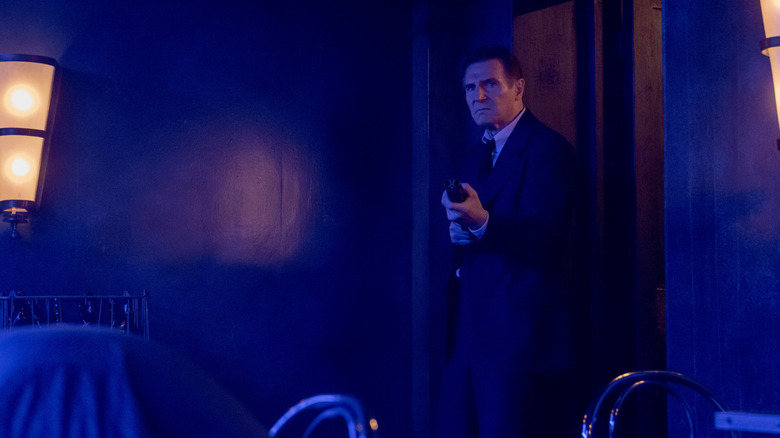
There's a scene with Alan Cumming and Neeson in a car, in which Cumming says he's made out of tarantulas. Like you said earlier, it's packed with color and almost sensory overload.
Do you know how that was done?
I don't.
It was a nightmare, actually. You know those circular LED screens? They used them in "The Mandalorian" and all that sort of stuff. So we had to get a whole series of backgrounds of Los Angeles streets of that period, and it was almost impossible. I was discussing it with the light and cameraman, Xavi Giménez, and the visual effects guy, a guy called Àlex [Villagrasa] from Barcelona, kind of a genius. I was saying, "How are we going to manage this? How are we going to do it?" Because we pulled from whatever source we could, various backgrounds that we could use even in a green-screen way. Eventually, this young genius said, "I will build them."
I said, "What?" He said, "I'm going to make them. Yeah, I'll make them for you. I'll design them. I'll build 3D images on the computer. I will give you the entire kind of background that you need for these two characters to drive through."
So we have a circular LED screen, and he's built these backgrounds. And we started shooting, and it was almost mesmerizing. Suddenly the entire city is passing by these windows. It was pretty cool, actually. I don't know how else I would've done it, but it's cool.
Barcelona really adds that heightened effect, too, kind of like Chandler's L.A.
First of all, it gave me the possibility to actually even deliver the movie, because Los Angeles in 1938 doesn't exist anymore. Are you from L.A.?
I've lived there for many years now.
Okay. Well, you could shoot around Hancock Park maybe, but you couldn't realize this movie in Los Angeles. I mean, when they shoot for L.A. in the '30s and '40s, they often go to Sacramento, but it's totally flat. Los Angeles is the city of canyons and hills and all that sort of stuff. So, it was a real problem.
I spent a lot of time in Barcelona. I said to the producers, "Let's just look at the hills around Barcelona and the environments around Barcelona." We began to look at them with the designer, and suddenly it became apparent we could make the entire movie here. It would be almost be like a science fiction version of what the city could have been at the period.
I said to the light and cameraman, "Look, this is an alternative reality of this possible L.A." And he's going, "Okay, what kind of template do we have?" I said, "Well, let's have a look at 'Blade Runner.'" So we looked at bits of "Blade Runner." We dragged in those neon elements and stuff like that. Piece by piece, we eventually arrived at our own version of L.A., which suited the movie perfectly, I thought.
I would not have expected "Blade Runner" to be an influence on this movie.
He threaded little bits, little threads of kind of neon through things and all that sort of stuff. I wanted to make a noir-ish movie that was drenched in color, that was full of color. Sounds like a total contradiction in terms, but that's what I wanted to do.
Hey, Robert Altman did it with this character.
He did, didn't he? He did, yeah. He shot it in Los Angeles, what, in 1974 or '75? Yeah, but it's cool. Yeah, it's good.
When you make a Philip Marlowe movie, do you revisit the past films?
Of course I looked at Howard Hawks' "The Big Sleep," and I looked at Edward Dmytryk's "Murder, My Sweet." I looked at the Mitchum version. I can't remember who directed that. I know it was designed by Dick Sylbert, and actually, it's a movie where the design actually is the movie -- the design and Mitchum's performance.
Yeah, I did look at them, but I wanted to make something new, something quite new, because it was a new version of a Chandler novel, and it was a new version of the character.
Have you seen Neeson's Mitchum impression? It's great.
No, I know. When he wore the three-piece suits and he came on set for the first time, he said, "Neil, I'm thinking of doing Mitchum's walk when he starts striding." I said, "No, Liam, do not do that. I want your version of this character. I don't want your version of Robert Mitchum. I want your version of Philip Marlowe."
When did you first meet Liam Neeson?
I know when I met Liam for the first time. Do you remember that movie, "Excalibur"? I wrote part of that, but I wasn't credited. I didn't get credit for it. I was a friend of [director] John Boorman's at the time, and I did a doc. He had me around the set, and I made a documentary on making the movie. And that was the first time I came across Liam Neeson.
That was basically your film school, right? Great movie, by the way.
It was a great movie, wasn't it? Yeah, I couldn't afford to go to film school. I'm Irish. They didn't make movies in Ireland at the time. I was a writer, John read my work, and he asked me to write a script with him which I did, which he could never get going. It was called "Broken Dreams." And then John said, "Look, I'm doing this movie called 'Excalibur.' Would you go through the script with me?" So we began to go through the last draft of the script with John, and I think it was a 300-page script. I began doing some editing, some writing on it.
And then "Star Wars" came out, and I saw "Star Wars." I said, "John, John, we can get this all down to an absolutely workable nut." And he says, "No, I'm off to shoot the movie now." I was going, "You can't, you can't, you can't! We haven't finished yet." But he did.
I think John really wanted me around to bounce ideas off, so he proposed that I make a documentary on the making of the film, which I did. And that's the only reason I ever learned about filmmaking. I never wanted to make a movie. I showed John that documentary recently. John is now 90, and he's got movement issues and stuff like that.
So I rented a little cinema in Dublin, and I showed John that documentary, which he'd never actually seen. He was just incredibly moved by it. He was kind of crying. It was a very moving experience, actually.
That is very lovely. I'm going to circle back to "The Company of Wolves."
Sure.
That is a beautiful movie. Such a vision. It's a broad question, but where did that come from? Just the colors in that movie are so lavish.
Oh, that was the weirdest movie. That was the weirdest film you can imagine. I mean, [writer] Angela Carter was somebody I knew. Angela sent me a short version of a little radio play she'd written on a short story, and I read it. She wanted to make a movie of it. It was too short. But she had a book called "The Bloody Chamber," which is her version of traditional fairy tales turned on their heads with a very savage and neo-feminist kind of spin on everything.
I said to Angela, "Look, if we construct this Russian doll kind of template for a movie...'' -- within the film, somebody's telling a story, and within that story, somebody else tells a story, that kind of thing -- I said, "Maybe we'll be able to combine a lot of your other fairy tales in the script or in this thing." Strange thing to say.
Anyway, I went over and began to work on it, and we came up with a script called "The Company of Wolves," which is wonderful. The grandmother was a storyteller, and she weaved in and out of all these fairytales and stuff like that. It was an insane script. Stephen Woolley, who wanted to make his first movie as a producer, managed somehow to get the money to make it.
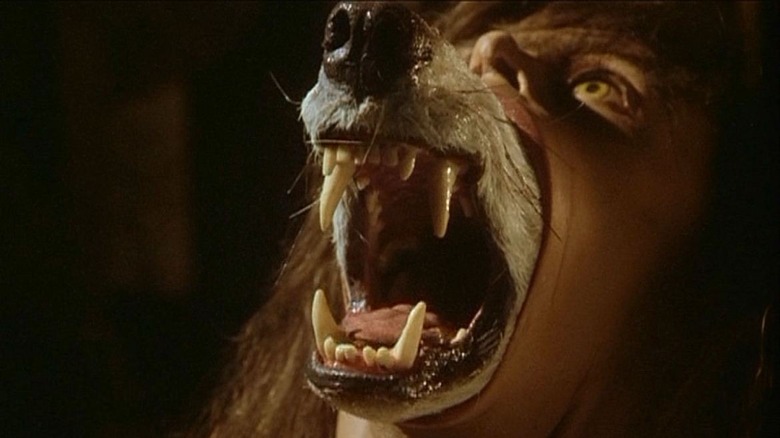
Those werewolf transformations hold up beautifully.
They all had to be done for real. There was no CGI available to us. There was latex and people pulling latex and latex constructions, and a ridiculous amount of people doing the puppetry behind what the camera sees. But I had a wonderful designer, Anton Furst, who went on to win an Oscar for "Batman" with Tim Burton and all that sort of stuff. We built this imaginary forest and this imaginary kind of village in this forest, and we somehow managed to get the money to make the movie, and people let us make this crazy movie.
It's insane.
It's hard to imagine it would happen these days, but maybe it would. All of the inventive stuff at the moment seems to happen in horror, doesn't it? Ari Aster, and the really interesting movies that are coming out generally belong to the zone of fantasy and horror these days, don't they? It's where directors can let their imaginations go insane, as I did in that film.
Are you working on any horror movies at the moment?
Me? I'm always working on a horror movie. I have a ghost story. I wrote a novel called "The Drowned Detective," and I'm working on it as we speak. Actually, it's sitting beside me here. I kind of want to make the best ghost story ever made, because I never really believe in ghost stories, know what I mean? I want to create something that actually is so believable that you can't escape it. Yeah, I'd love to do it.
I hope we see it. You've said before you can capture a side of an actor on film they didn't even know existed. Say for Bob Hoskins in "Mona Lisa," what new side of him did you want to show?
Basically, I had written the script for "Mona Lisa," and I wrote it with another writer called David Leland. It was rather harsh and savage. David had one sense of what this story could be. I met Bob Hoskins and I showed him the script, and suddenly, I saw a totally different character. I saw this guy with this huge heart, with this great capacity for violence, but actually this huge emotional kind of thing.
I rewrote the script entirely for Bob, basically. I met with him, went off for two weeks, came back with a different script, gave it to him, said, "What do you think now?" And he loved it. I really wanted that movie to be about a man who generally didn't understand women, and that's what Bob played. It was lovely to do.
Has that happened often in your career where you're writing something and then you meet an actor and then you see a character very differently?
All the time, yeah. That's what I love to do. I mean, that's what I do. I don't rehearse. I know most directors rehearse, and some of them put out chalk on the floor and all that sort of stuff. I don't do that. I get actors to read what I've written and then I see, okay, I can do something better here, or I can do something different here. I see them inhabit something and I rewrite it very quickly and that kind of thing. I did that movie with Isabelle Huppert. What was it called? "Greta"?
Yeah, that's a fun one.
That kind of process was really at the heart of what we did. I use rehearsal to rewrite, basically. And when I do rewrite, it's generally around actors and what actors are doing or what they're not doing or what they should be doing.
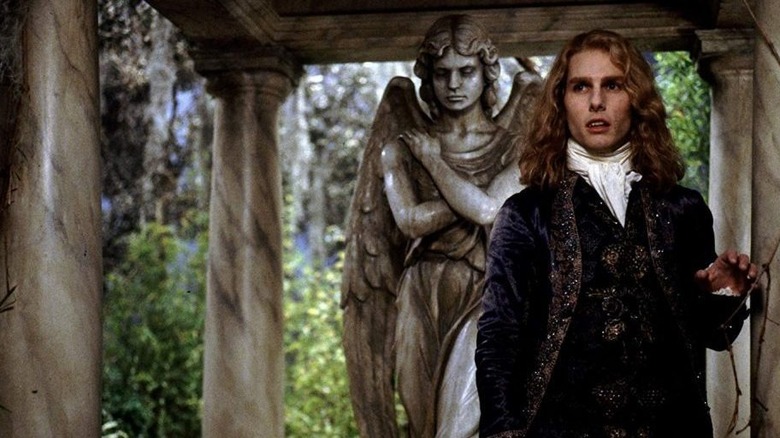
You famously made a very bold choice in casting Tom Cruise in "Interview with a Vampire." You made his charisma frightening.
I saw exactly that.
That's why you cast him?
Well, it's an icy kind of beauty, an icy control and beauty. I also saw, I suppose, that Tom's life -- because he was the biggest star in the world at the time -- he has to retreat to the shadows because he can't expose himself too much. Do you understand what I mean? I saw kind of a parallel between the life of a vampire and the life of a very, very big star, let's put it that way. Tom had the same instincts as myself, and everybody said he was miscast, but he proved them wrong, didn't he? He did.
"Marlowe" is now playing in theaters.
Read this next: The 14 Best Noir Movies Ranked
The post Marlowe Director Neil Jordan on Colorful Noir and His Past Horror Films [Exclusive Interview] appeared first on /Film.
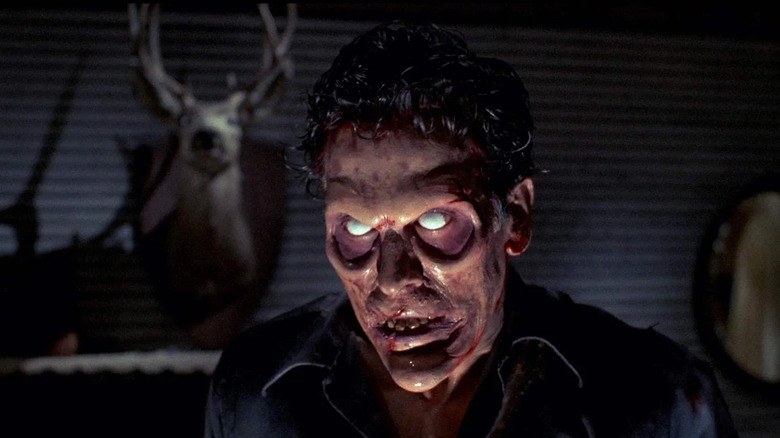
(For the 30th anniversary of Sam Raimi's "Army of Darkness," we're looking back at some scary and funny anecdotes about the movie this week.)
Sequels -- especially horror ones -- have a bad reputation for repeating the original story. Part of this has to do with the rise of slashers during the 1980s. When the audience is there to see Michael Myers or Freddy Krueger, it's easy to follow the same beats of them killing teenagers in movie after movie, with only the window dressing changed.
However, the '80s were also the decade of Raimi's "Evil Dead," one of the wildest horror franchises out there. Now, "Evil Dead II" does have a similar story to the original — Ash Williams (Bruce Campbell) and co. are stuck in a cabin in the woods, menaced by undead summoned via the Necromonicon. The sequel opens with an abbreviated version of the first film's events.
What is different is the presentation. Raimi lets loose his love for "Looney Tunes" and "The Three Stooges" and turns "Evil Dead II" into a slapstick horror comedy. For instance, the headless corpse of Ash's possessed girlfriend Linda (Denise Bixler) rises from the grave and dances outside the cabin. Meanwhile, Ash can't trust his body once his hand is possessed by the Deadites. As his hand tries to kill him in an array of physical comedy, he eventually cuts it off with a groovy chainsaw, with blood splattering across his face.
Not since James Whale's "Bride of Frankenstein" had a horror sequel been so daring. That is, until the third "Evil Dead" film, "Army of Darkness," came out in 1993.
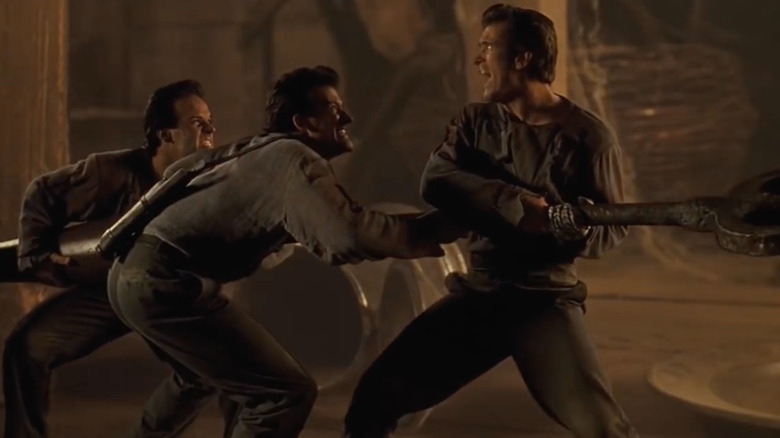
"Evil Dead II" has a surreal ending: the Necronomicon opens a time vortex, sending Ash back to the Arthurian era. "Army of Darkness" retains the horror and the slapstick, except in a totally different setting from the first two films. The first two films had a confined setting, but Ash has to go on a quest to get home this time.
This quest becomes more and more surreal as the film goes on. Before departing, Ash receives a metal hand to replace his chainsaw — unfortunately for him, his groovy new armament doesn't come with dignity. When he takes refuge in a windmill, a mirror shatters. Ash's reflection gives birth to about a dozen mini-duplicates who menace him in a sequence right out of "Tom & Jerry." The Mini-Ashes ram a fork into Ash's behind, drop a bucket on his head and trip him so his cheek falls flat on sizzling metal. Even after he crushes one, the clone gets the last laugh by puncturing his foot with a nail.
While he's gotten more physically capable, Ash in "Army of Darkness" is also noticeably dimmer than in the first two movies. When he finally retrieves the Necronomicon, he forgets the incantation needed to take it — "Klaatu barada nikto" — and causes the titular undead Army of Darkness to rise. It's not just the universe itself kicking Ash around, he's creating his own problems too.
It takes a bold director to make a film like "Army of Darkness" after starting with a rather normal horror movie like "The Evil Dead." More horror directors could take lessons from the approach of Sam Raimi.
Read this next: The Highest Rated Horror Movies Of All Time
The post More Horror Series Should Be Fearless Enough to Swerve Like Evil Dead and Army of Darkness appeared first on /Film.
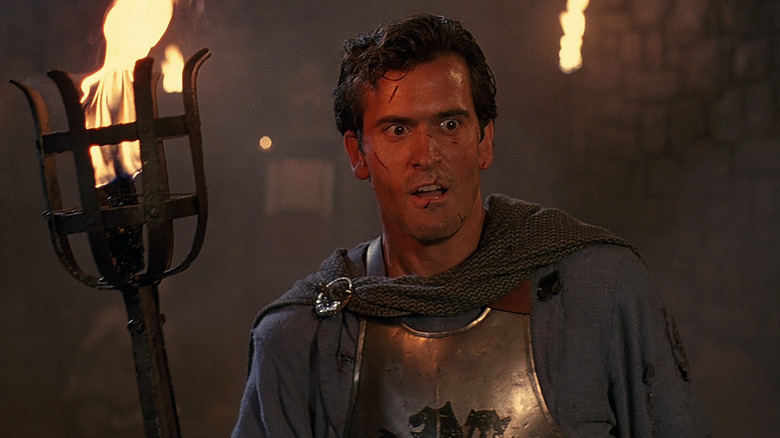
As many of the film's fans know, Sam Raimi's slapstick medieval horror comedy "Army of Darkness" was not a hit upon its release in North American release in February of 1993. The film's budget was a modest $11 million, and it made only $21 million worldwide, little enough to be considered a bomb. After the film's release on VHS, however, a cult audience swiftly began to amass around it. If you were in high school in 1993, one might hear lines of Sam and Ivan Raimi's screenplay shouted randomly in hallways, each one a cult password for horror nuts in the crowd. It wasn't long thereafter that "Army of Darkness" began rounding the midnight movie circuit. It has been a mainstay in pop culture ever since.
Or, to paraphrase lead actor Bruce Campbell in his biography "If Chin Could Kill: Confessions of a B-Movie Actor," a blockbuster is when a million people see a movie ten times. A cult movie is where ten people see a movie a million times.
Lore and stories and trivia about the making of "Army of Darkness" have been steadily revealed over the years, and Campbell has made many convention appearances to talk about the production in detail. The film's fans will likely be familiar with the stories behind the film's multiple cuts. But, it seems, there will always be something to learn. For instance, on the film's DVD audio commentary track, Campbell revealed that his own father — not an actor — appeared in "Army of Darkness." All four versions of it. As it so happens, Charles Newton Campbell, credited as Charlie Campbell, played a knight in the film's final battle sequence.
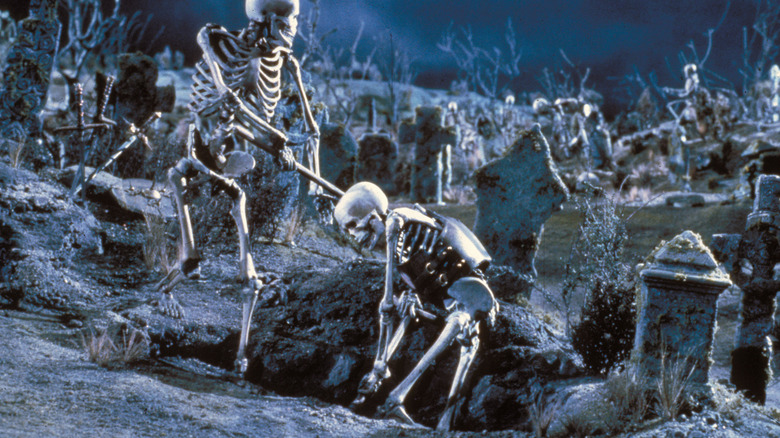
Charlie Campbell had a few dalliances in acting prior to "Army of Darkness." According to his IMDb page, Campbell appeared in the amateur short film "Acting and Reacting" in 1980, alongside his sons Bruce and Ted, as well as the underground 1985 cult film "Stryker's War," also opposite Bruce and Ted. It seems that he was merely a game parent who agreed to participate in his kids' movies as a favor. That favor, it seems, extended to "Army of Darkness." On the commentary track, Sam Raimi and Bruce Campbell marvel over his inclusion and how he stayed in every edit. Charlie's star scene? Getting stabbed in the stomach by a skeleton. Campbell said:
"He made it through all the versions of this. I was so happy. Because you can't really argue with the studio. If they want to cut out a shot of a guy getting killed. I couldn't really say 'Heh, heh. That's my dad. Can you leave him in?' He made it in all versions for some reason! Coming up here, he'll get killed. [...] Remember, Sam, when we were filming with him, I wanted my dad to do a good job, so I started directing him [...] And you said 'Shut up! I'm the director! I tell your dad how to die, okay? Not you!'"
Raimi also was kind, saying that Charlie had "always been a big supporter of ours. Gave us one of our first investors."
If one looks around online, one might find photos of Charlie on set, posing with his son Bruce.
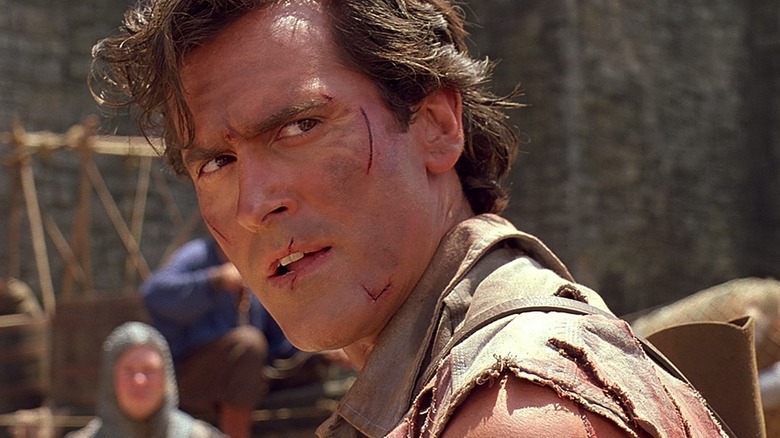
Charles Newton Campbell passed in 2004 at the age of 76. According to his obituary, he was a lifelong Michigan resident, studied history in school, and enjoyed a 35-year career in advertising. He left the advertising world at the age of 63 to return to school and get a Masters in education. His obituary also mentioned that he frequently acted in local theater productions in his hometown, that he loved painting, and that he was generally a friendly and funny human being.
On Father's Day in 2020, Bruce Campbell paid homage to his dad on his Twitter account. One can see the resemblance.
Looking back over the low-budget B-movies he was in, Charlie Campbell appeared to be having a wonderful time. Make movies with his kids and get splattered with blood squibs? There are far worse ways one can bond with family on the weekends. One would to well to watch the R-rated trailer for "Stryker's War" to see the kind of glorious bloody shlock he and Bruce and Ted (and Sam Raimi) were doing in the 1980s. "Stryker's War" was also called "Thou Shalt Not Kill ... Except." It's a film about military men who wage war on a Charles Manson-like cult figure, played by Raimi. It's gloriously cheap, gross and bloody.
Rest in peace, Charlie. You seemed way cool.
Read this next: Horror Movies With Unconventional Monsters
The post Bruce Campbell's Dad is In Every Cut of Army of Darkness appeared first on /Film.
The post Returnal-FLT appeared first on SceneSource.
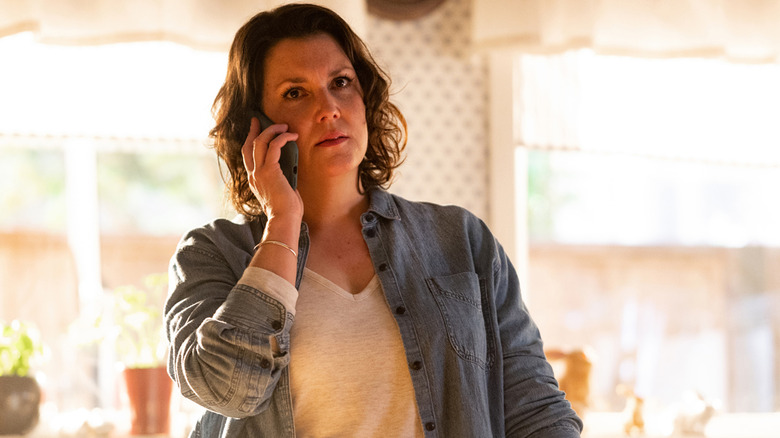
The entertainment industry is a fickle beast, what with shows being unceremoniously canceled when they were just getting started and fully completed feature films being dumped for massive tax write-offs. Nothing is ever a guarantee, and even people who have been cast and shot footage on projects have been replaced in the eleventh hour. This is probably why so many cast members of the hit Showtime series "Yellowjackets" were convinced they were going to be out of a job after their first table read. The sentiment seems ridiculous in hindsight, considering the first season of "Yellowjackets" was showered with nominations (and wins) from multiple awards circuits, and the ensemble cast is often highlighted as one of the best in the business.
And yet, before a single scene was filmed, the brilliant cast was all terrified that they weren't going to make it to principal photography. During an exclusive panel about the show presented by Showtime, the cast recalled what it was like to meet each other for the first time and what thoughts immediately plagued their minds. Sophie Nélisse, who plays the teenage version of Shauna Sadecki (née Shipman) made famous by Melanie Lynskey, was certain that she was going to be kicked to the curb.
"I remember not thinking I would even get the role, because I'm like, blonde with blue eyes and we didn't – my eyes didn't look alike at all," Nélisse said. Fortunately, with a quality pair of contacts and some intentional styling, the physical differences between the two actors were a non-issue. But then Nélisse heard Lynskey speak for the first time, and was terrified she wouldn't be able to match the voice of her adult counterpart.
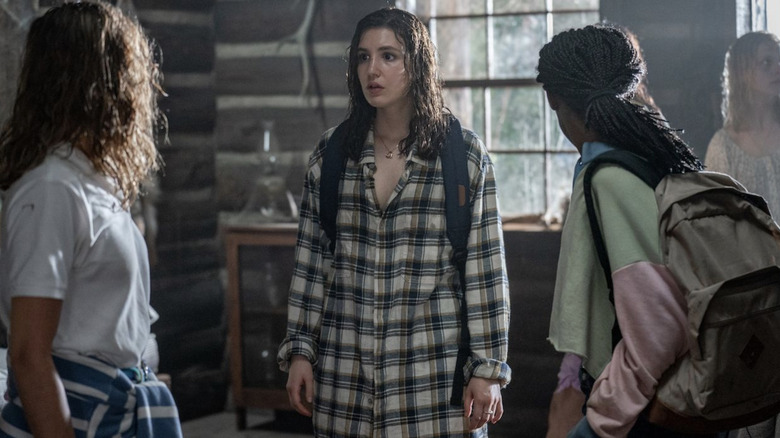
Sophie Nélisse said during the panel that she had never heard Melanie Lynskey speak in real-life and panicked the second she did. "I hear her and I'm like, 'Oh my god she's so high-pitched!' And I'm sitting with everyone around the table that's important and I'm like, 'I'm gonna get fired.'" Nélisse said she started "freaking out" and tried to compensate by speaking in a slightly higher voice than usual to try and match Lynskey's signature sound. It wasn't until she saw herself in the full transformation that things clicked and she accepted that the pair were the perfect match.
"I think it works, and you were so good in the table read if anyone was going to get fired it would be me," Melanie Lynskey added. "Like if they were worried about us not looking alike." At this point, show co-creator Ashley Lyle had to add her two cents. "We were not going to fire either one of you to be very clear," she said. In the midst of the cast and audience's laughter, Christina Ricci, who plays Misty Quigley added, "I was terrified that I was getting fired at the table read, and I embarrassingly went around telling everyone I was afraid of getting fired." Can you imagine a world where Christina friggin' Ricci was afraid she wasn't the right casting decision?! Fortunately, the tension was broken by Jasmin Savoy Brown, who plays teen Taissa, who added, "I wasn't even at the table read!" Fortunately, none of the cast members were ever at risk of being fired, and "Yellowjackets" remains one of the best new shows on television.
"Yellowjackets" returns to Showtime for season 2 on March 26, 2023.
Read this next: The Best TV Shows Of 2022, Ranked
The post Yellowjackets' First Table Read Had The Cast Convinced They Were Getting Fired appeared first on /Film.
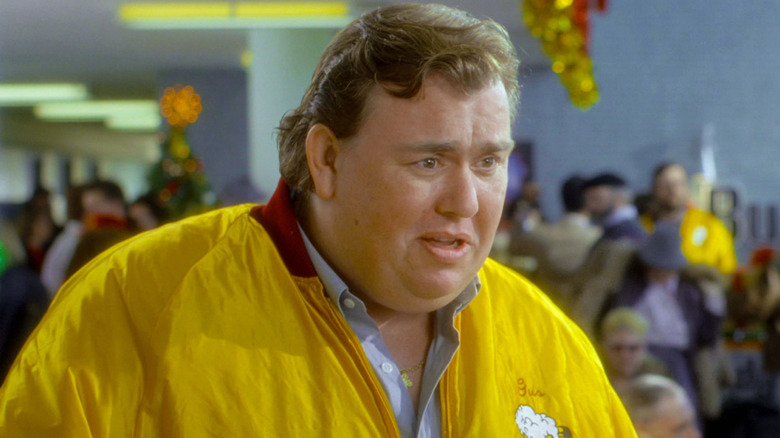
Like many kids of the '90s, John Candy was my treasured movie uncle growing up. The beloved "Second City Television" funnyman turned comedic superstar could just as easily make you bust a gut laughing as he could tear your heart out. Heck, he was capable of doing both those things in the span of a single scene (Example: Candy's heart-wrenching "You wanna hurt me?" speech from "Planes, Trains and Automobiles"). That we were forced to bid farewell to him at the age of only 43 — when he died of a heart attack in 1994 — only makes the time we got him all the more precious.
Candy's fellow wise-cracking Canuck, Ryan Reynolds, paid his respects to the late funnyman on the 25th anniversary of his passing in 2019, posting a short video of clips from Candy's movies on Twitter as "a small tribute to a comedic genius and Canadian hero." Three years after that, however, Reynolds revealed he's also working on a far more labor-heavy love letter to Candy in the form of a full-length documentary. The as-yet-untitled film has since been formally acquired by Amazon Prime Video, making now the perfect time to run down everything we know about the project so far.
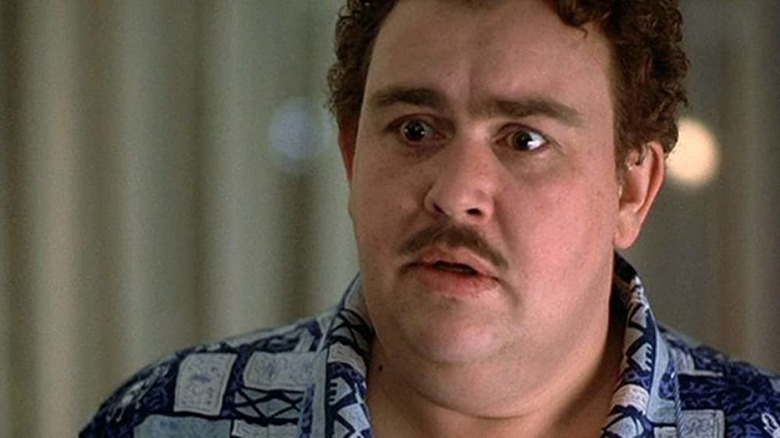
According to Variety, the John Candy documentary will go beyond the actor's public persona "and delve into the inner life that Candy kept private off-screen." Candy's widow, Rosemary Margaret Hobor, and their two children, Christopher Michael and Jennifer Anne Candy, have reportedly given their "full support" to the feature, providing "never-before-seen home videos, archives and interviews with the [Candy] family to explore the man behind the movie star."
This is, of course, far from the first non-fiction project to focus on John Candy. His life and legacy have already been explored in episodes of the documentary TV series "Biography" and "E! True Hollywood Story" over the years, with "Behind Closed Doors" having done an episode on him as recently as 2020. By the sound of it, though, this new film will delve much deeper into his personal motivations as an artist, as well as his experiences with his loved ones away from the cameras. No doubt, the movie will also touch on pricklier topics like his experiences dealing with severe panic attacks and his continual attempts to cut down on his smoking and alcohol intake. Thankfully, the involvement of Candy's family ought to go a long ways in ensuring these aspects of his life are handled with the sensitivity and care they deserve.
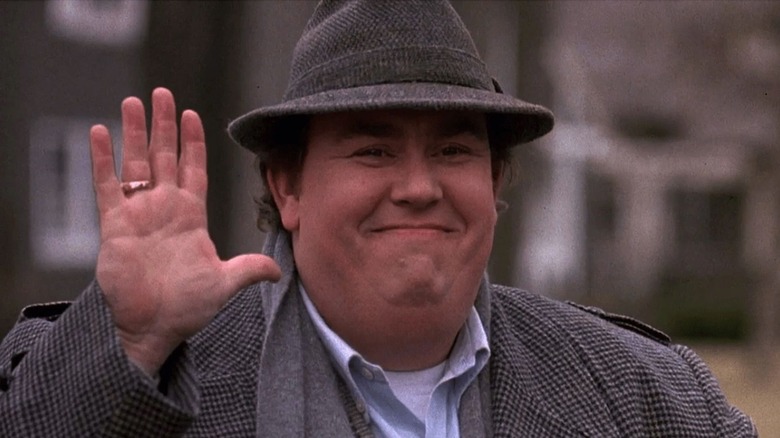
Ryan Reynolds is producing the John Candy documentary with George Dewey by way of his Maximum Effort production company, with Colin Hanks also producing on top of directing. Hanks himself has a tangential connection to Candy thanks to his father — a fella by the name of Tom Hanks. John Candy and Tom Hanks famously shared the screen in Ron Howard's hit 1984 mermaid comedy "Splash." Rita Wilson, who is married to Tom Hanks, even joined the duo for their onscreen reunion a year later in Nicholas Meyer's 1985 comedy "Volunteers."
Colin Hanks, who's appeared in films like Peter Jackson's "King Kong" and starred in the first season of Noah Hawley's "Fargo" TV series, already has a handful of directorial efforts under his belt, including the music documentary films "All Things Must Pass" and "Eagles of Death Metal: Nos Amis (Our Friends)." Naturally, as someone who grew up with parents who make their living in the entertainment industry (and, again, worked with Candy personally), Hanks has a unique perspective and insights that ought to serve him well in his attempts to do justice by Candy's private life. It surely helps that, like Reynolds and the rest of us, Candy clearly meant something to him growing up too.
Read this next: The 20 Most Influential Comedy Stars In Movie History
The post Amazon Prime Video Picks Up John Candy Documentary from Ryan Reynolds and Colin Hanks appeared first on /Film.
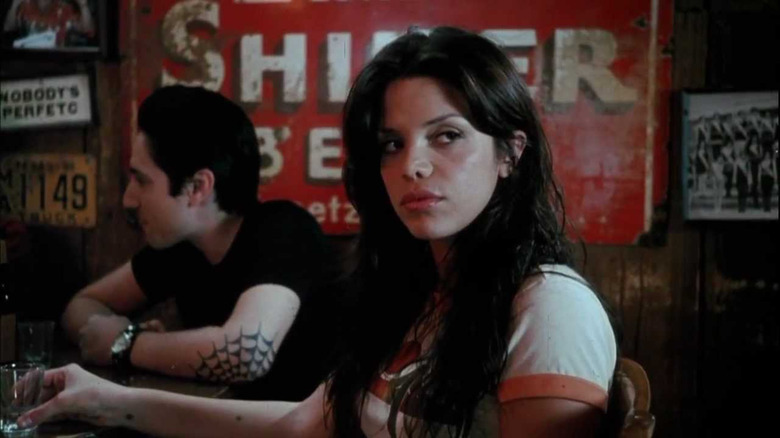
Robert Rodriguez and Quentin Tarantino met in 1992 when both filmmakers exploded onto the scene with their respective films, "El Mariachi" and "Reservoir Dogs." Filmmaker panels don't happen quite as often as they used to at major film festivals, but back then, Rodriguez and Tarantino were on a panel addressing violence in the movies (naturally). That was always a hot button topic and both directors, especially Tarantino, have had to address the graphic content in their films multiple times over the years.
Coming off the success of "Kill Bill" and "Sin City" over a decade later, the idea to do "Grindhouse" was born out of curated movie nights that Tarantino would cull together out of old 35mm prints of drive-in movies and obscure trailers from the 1970's. "Grindhouse" was really a way to craft a passion project out of their love for some of the under seen gems that they revered growing up that, hopefully, wouldn't have the same level of scrutiny as their previous efforts. "It's an exploitation movie, it's a double feature, it almost doesn't count. It's like a throwaway," spouted Rodriguez in a dual interview with Tarantino with Entertainment Weekly about a year before the film's release.
Justifiably thinking they could do no wrong at that point in their careers, QT and Rodriguez set out to recreate the feeling of watching an old, battered print that had been snipped and sliced over and over again after playing all kinds of theaters across the country. Every aging film print has been on a journey, which "Grindhouse" paid homage to by recreating that state of disrepair with fake film breaks and missing reels. One movie and one filmmaker, in particular, gave them the idea for one of the best in-jokes in Rodriguez's segment, "Planet Terror."
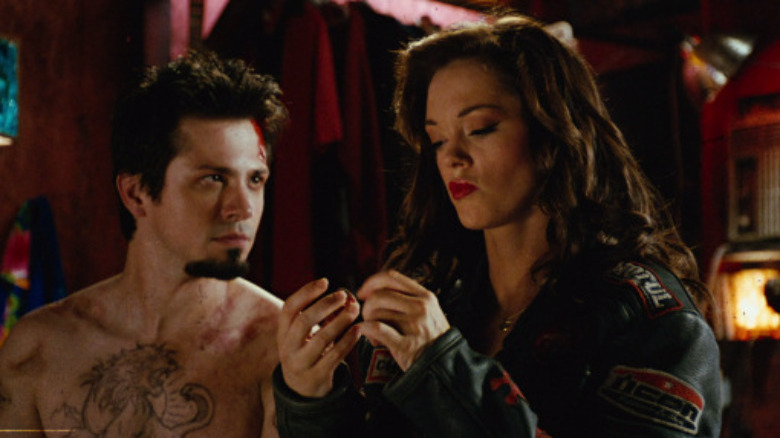
Timing the gag to perfection in "Planet Terror," a sex scene between Cherry Darling (Rose McGowan) and Wray (Freddy Rodriguez) is interrupted when a sign comes up saying "Missing Reel." When the movie starts up again moments later, they're both getting dressed. Quentin Tarantino recalled a 1976 spy thriller that he and Rodriguez were watching one night when the idea for the meta joke started to materialize. Tarantino told EW:
"We were watching this Oliver Reed, Richard Widmark movie called 'The Sell-Out,' and it was missing a reel right in the middle. And I've come to like it that way. I don't even want to know what happens in the missing reel. I like having to figure it out."
It was actually the revered Texas filmmaker Richard Linklater of "Dazed and Confused," the "Before" trilogy, and "Boyhood" fame who cemented the idea to include a missing reel in "Grindhouse." ("It was Rick Linklater's idea that we do the missing reel," to quote QT directly.) The meta gag wound up being the perfect way to both lampoon and celebrate exploitation movies from the drive-in era.
"Planet Terror" wasn't the only spot where the "Missing Reel" sign pops up, though. In Tarantino's original version of "Death Proof," Arlene's (Vanessa Ferlito) lap dance for Stuntman Mike (Kurt Russell) at the Texas Chili Parlor is cut out of the film, altogether. Rodriguez perfectly summed up the feeling they wanted audiences to have when the "Missing Reel" suddenly popped up. "It's like you went on a 20-minute bathroom break and you come back and all hell's broken loose."
Read this next: 13 Tarantino Projects We Never Saw But Wish We Could've
The post Richard Linklater Gave Quentin Tarantino and Robert Rodriguez Grindhouse's Most Meta Moment appeared first on /Film.

Great news for our hive of "Yellowjackets" fans: season 2 is almost upon us! That's right, Showtime's multi-timeline cannibal thriller returns next month and after waiting over a year for some answers, viewers are ready to head back into the wilderness. The fact that the series centers on a group of teen girls in '90s New Jersey (the time and place in which I grew up) was enough to pique my interest, but nothing could've prepared me for the wild ride this show would take me on. If you've not yet tuned in, all I can say is, what are you waiting for? Season 2 promises to be even more shocking, so catch up!
"Yellowjackets" partially takes place in the '90s, focusing on a girls' soccer team after their plane, which is headed to Seattle for a tournament, crash lands in the Canadian wilderness, leaving them stranded for 19 months. The show also follows the survivors 25 years later, with plenty of mysterious threads left dangling in between. Even better still, it stars Melanie Lynskey, Juliette Lewis, Christina Ricci, and Tawny Cypress as the adult versions of our main characters. Other exciting performers have been added for the show's sophomore outing as well, including Lauren Ambrose.
Casting the younger and grown-up versions of someone can undoubtedly be difficult, much like two people playing one character could be. "Yellowjackets" really excels in this area and it's easy to imagine these girls growing up into their onscreen adult counterparts. 1996 Natalie Scatorccio, for example, is played by Sophie Thatcher, and in 2021, Nat is portrayed by Juliette Lewis. The transition between the two is seamless and it turns out both performers worked hard to create that illusion.
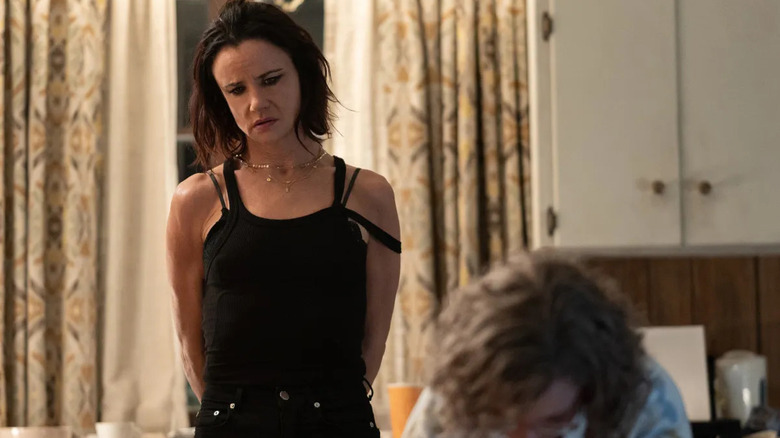
During a Showtime panel, Sophie Thatcher discussed the process of playing Nat alongside Juliette Lewis in "Yellowjackets." She explained:
"I think the table reads really helped with seeing each other and just, like, staying on tact with that and studying each other's mannerisms and just making sure that everything was in line. I think everyone had conversations from the get-go, and me and [Juliette Lewis] were very much on the same page which was really f***in' nice.
Tawny Cypress, who plays adult Taissa Turner in the show, then interjected that Thatcher had done vocal work to match Lewis. Thatcher continued:
"Well, she has so many movies that I can watch. Like, there's so much to study. So, that itself was a lot to take in. But, I mean, I think from the get-go we were very much on the same page. But you were always just really specific with just costumes and everything. I remember one of our first conversations you talked about what she would wear and how she would be, like, too hungover to wear or to choose certain outfits. Like, 'That was too put together. That wouldn't have worked.' You were so specific, and I want to take that with me. I love that, I think that's so f***in' cool. No, just, your attention to detail is so cool."
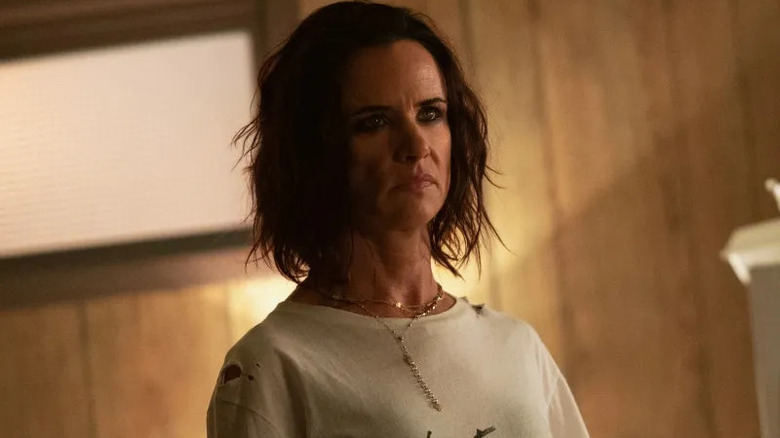
It is pretty awesome that Lewis had an opinion on outfits that would be too well put together for a hungover teenage Nat to wear. As someone who also very much stumbled my way through high school, I can definitely relate. It's apparent that both actors took their job of playing the same character quite seriously (they weren't the only ones) and also that Thatcher admires Lewis. Who wouldn't? I grew up obsessed with her in films like "What's Eating Gilbert Grape," "Natural Born Killers," and "Strange Days" — which remains underrated. Watching Lewis' movies to prepare for a role is undeniably a pretty cool homework assignment.
One of my favorite aspects of "Yellowjackets" is the way it reminded everyone that '90s staples Lewis, Lynskey, and Ricci are even more impressive today than they were when they first made their respective marks in Hollywood. Seeing them in this series has been truly remarkable and their onscreen teen counterparts are amazing in their roles as well.
Season 2 of "Yellowjackets" can't come soon enough but will buzz onto Showtime beginning March 26, 2023.
Read this next: The 20 Best Female Friendships In TV History, Ranked
The post Juliette Lewis & Sophie Thatcher Brought An Obsessive Level Of Detail To Their Yellowjackets Character appeared first on /Film.
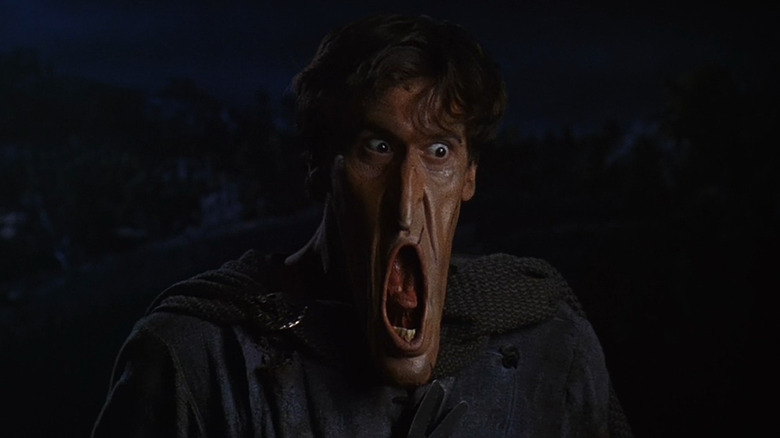
Horror, by its very nature, is an intimidating genre. For one thing, there's something about the promise of being scared that's part warning, part dare. After all, there's a long history of ballyhoo surrounding the genre, whether it's a barker getting people to attend a dark ride at a carnival or TV spots for "Paranormal Activity" showing real audience members scared out of their wits.
There's also another aspect to horror movies in particular being intimidating, that being the fact that there are so darn many of them. In a marketplace that is continually morphing and reinventing itself while paying homage to the past at the same time — we seem to be in a post-post-modern era where slasher movies are concerned, for example — it can be daunting to know where to begin. On a basic, literal level, there are now three separate movies entitled "Halloween" alone! What is a horror fan looking to introduce their significant other or family members to their favorite genre to do? Where is a newbie to begin?
The answer, in this writer's humble opinion, lies with Sam Raimi's med-Evil opus, "Army of Darkness." A movie that's intense, violent, imaginative, expansive but not too expensive, and hilarious without making fun of itself, "Army of Darkness" represents the perfect gateway horror movie, one you can use to test the waters (if you're green to the genre) or expose others to (if you're a veteran) without traumatizing them too harshly.
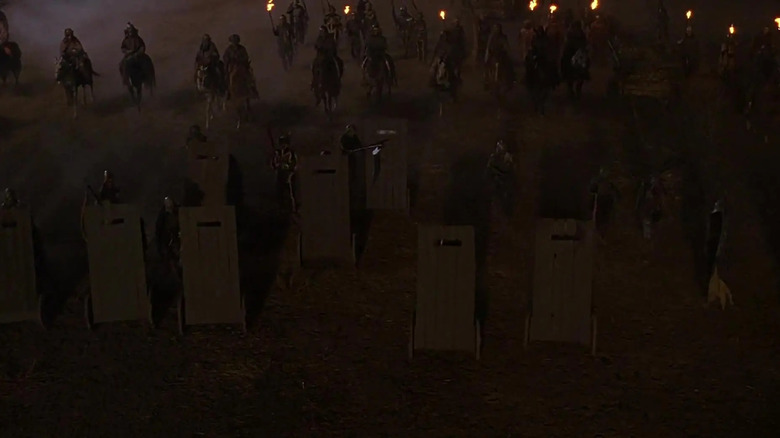
One of the easiest ways to sell someone on watching "Army of Darkness" (whether it's a pal or yourself) is an aspect of the film that Universal Studios' marketing department zeroed in on when advertising the movie in 1993: it's more than just a horror movie! If "horror" to you means something disturbing, scary, unsettling, or grotesque, well then, "Army of Darkness" is safely free of those more disreputable aspects of the genre.
While you can rest assured that you won't see any eyeballs gouged out (unlike the first two "Evil Dead" pictures made by Raimi, of which "Army" is the third), that's not to say that "Army of Darkness" is all cuddles and friendship. There are still loads of exciting elements in the film, from fight sequences between Ash (Bruce Campbell) and demonic ghouls to "Three Stooges"-inspired setpieces involving Ash and "Gremlins"-esque miniature versions of himself, to a third act that's one long medieval swashbuckling castle siege. Yes, fans of action films, slapstick comedies, and war movies all have something to chew on here. Even though it receives a minimum of screen time, there's even a tawdry romance subplot, a demented love triangle between Ash, lady-in-waiting Sheila (Embeth Davidtz), and Ash's re-animated evil double.
Raimi is a filmmaker whose love of movies is infectious and can be felt to some degree in everything he makes. "Army of Darkness" is the epitome of that quality — it can't be all things to all people, of course, but its energy, exuberance, and mashing-up of so many tones and tropes means that watching it feels a little like changing channels: not into the slapstick? Here comes some stop-motion animation! And so on.
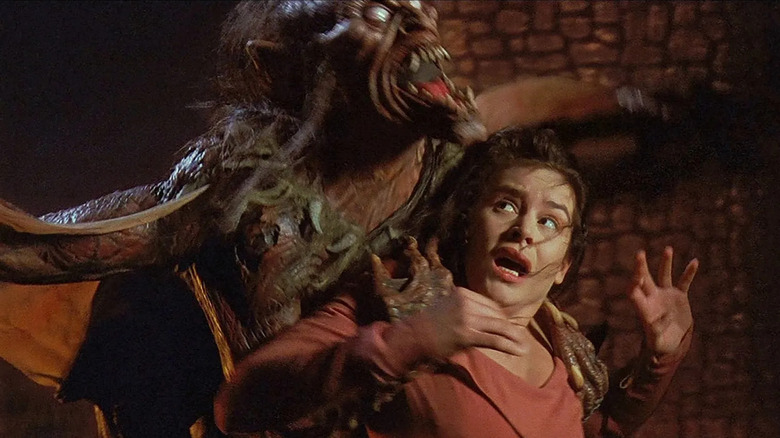
"Army of Darkness" is not an anti-horror movie, however — it's a gateway horror movie, luring you inside the genre so slyly that you may not know it's happening until it's too late. As I mentioned, the film is the third in Raimi's "Evil Dead" trilogy, following "The Evil Dead" and "Evil Dead II," and as such it continues the story of the hapless schmuck Ash battling the forces of the demonic undead who've been resurrected by the powerful magic tome Necronomicon Ex Mortis.
The movie is littered with ghoulish creatures of all sorts: demonically possessed people, winged dragon-like demons, mischievous decoy Necronomicons, tiny Ashs, the hamburger-faced Evil Ash, the vampiric possessed Sheila, and oodles of re-animated talking skeleton warriors. The sheer variety of foes Ash and the forces of good must face is vast enough that the movie coins the term "Deadites" as a catch-all name.
Being the third film where Ash must survive the Deadites' attacks, his attitude toward the creatures is decidedly snarky, like an annoyed parent or sibling more than a victim. Still, one need only observe the things Ash goes through to realize that, if a different character was involved, the movie would be far more obviously horrific. Ash endures beatings, psychological torture, the loss of his hand, being chased by an unseen Evil Force, being ripped from his own time and stuck in the Middle Ages, and having to face a murderous version of himself (and his new girlfriend) — let's face it, the guy is not having a good time. Even if the literal geyser of blood that occurs early on in the film is its most gory moment, there's no question that the life-and-death stakes of "Army of Darkness" are not to be dismissed.
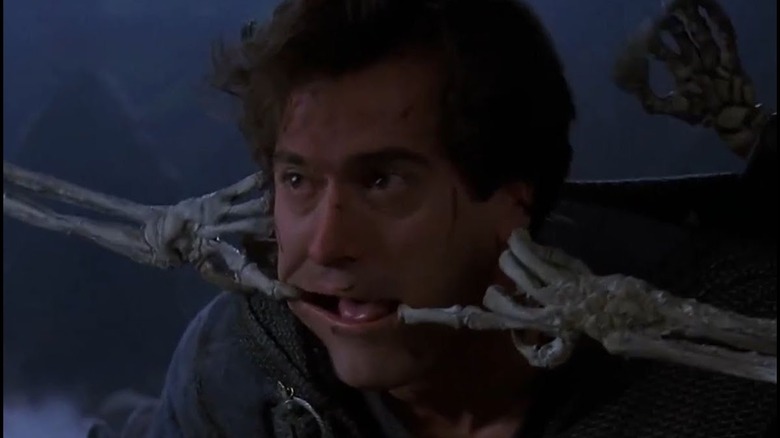
As fans of "Army of Darkness" already know, the film has a weird history involving its distribution and the existence of several alternative cuts. The reasons for this can be found elsewhere, but the ultimate result is that these various versions allow one to have a different experience based on your tastes and mood.
To wit: are you looking to have a relatively breezy, more comedic, fun spook-a-blast time with the movie? Then the Theatrical Cut is for you. On the other hand, if you'd like a bit more meaty character development, then try the International Version. Wary of the movie's light-R rating? There's the Television Version for that. Of course, if you're ready and willing to dive into the deeper end of the movie's horror aspects, try the Director's Cut, with its infamously downbeat (though much more appropriate for a horror film and the "Evil Dead" series in general) finale.
No matter which version you choose, there are plenty of ways you can follow up a viewing of "Army of Darkness" with your next horror venture. You could rip the band-aid off, so to speak, and go straight for the first two "Evil Dead" films. Or you could give another horror adventure featuring stop-motion animation a try, like "Jason and the Argonauts" or the original "King Kong." Perhaps another horror-comedy is in order, like "Gremlins" or "Goosebumps." My personal recommendation would be to follow up Raimi's Universal horror movie with some of the classic Universal horror films: "Dracula," "Frankenstein," and the like. In any case, "Army of Darkness" will set you on your merry, horrific way.
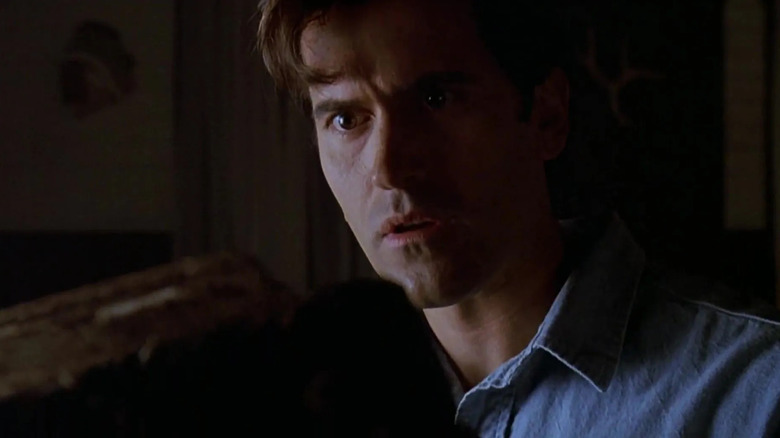
Allow me to finish this article by nearly completely contradicting myself. As it happens, I was once a scaredy-cat when it came to horror films, so much so that just looking at the poster art for the average slasher film would give me nightmares. One afternoon at a friend's birthday party, it was announced that we would be watching "The Evil Dead," a title I knew meant scary stuff. When I couldn't figure out a way to leave the party in time, I watched the movie nervously from the back of the room so as not to embarrass myself.
To my surprise and everlasting enjoyment, I became enthralled by Raimi's movie. I loved it so much that I hunted down a copy of it for my own shortly after that party, becoming rapidly obsessed with the way in which it was made and the enjoyably spooky feeling it gave me. From there, I discovered its sequels and was not only easily charmed by "Army of Darkness," but used that movie to introduce my suspicious parents to the genre I was now a full-blown fan of.
So whether you're using one of Raimi's films or another gateway movie, I highly encourage you and/or your loved ones to join us (ahem) in the eerie, fascinating, joyous dark of the horror genre.
Read this next: The 15 Best Horror Movie Directors Of All Time
The post Army of Darkness is the Perfect Gateway Horror Movie appeared first on /Film.
Intel has released patches for multiple critical- and high-severity vulnerabilities across its product portfolio.
The post Dozens of Vulnerabilities Patched in Intel Products appeared first on SecurityWeek.
Read more of this story at Slashdot.

When we head out for a drive, we’re always hoping it will be uneventful, we won’t hit too much traffic, and we’ll get to where we’re going with plenty of time to spare. But sometimes nature, mechanical failures, and medical emergencies have other plans. Read on for some of the life-threatening situations you might…
Learn how Microsoft Security is transforming its cloud access security broker to a software as a service security solution, empowering organizations to adopt a modern approach to protecting cloud apps.
The post Microsoft shifts to a comprehensive SaaS security solution appeared first on Microsoft Security Blog.

Let’s talk about Bar Keepers Friend, the inexpensive, acidic scouring powder in a can that’s been around over 100 years. In that time, people have found loads of uses for the cleaning product, which is why the name is so, well, apt.
But the branding might also suggest that this isn’t a product for you, unless you spend…
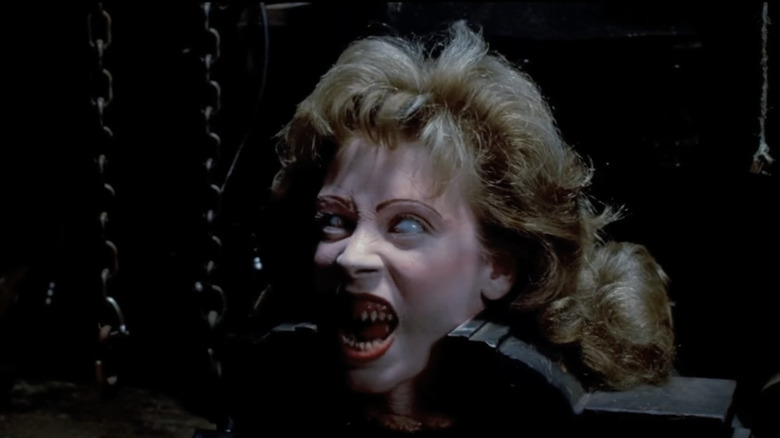
(For the 30th anniversary of Sam Raimi's "Army of Darkness," we're looking back at some scary and funny anecdotes about the movie this week).
Both "Evil Dead II" and "Army of Darkness" open with recaps, explaining the story of Ash Williams (Bruce Campbell) up to where the previous film left off. This is a necessity since both "The Evil Dead" and "Evil Dead II" end with cliffhangers; in the first, Ash is ambushed by an Unseen Force, while in the second he's sent back to medieval times. This mandated an explanation in each subsequent movie for viewers unacquainted with the series. But there's a catch to this: The story is never quite the same in any of the three films.
"Evil Dead II" opens with a reshot version of the first film, one that condenses its beats into 10 minutes: Ash goes out to a cabin in the woods, awakens the "evil dead" with the Necronomicon, and horror ensues. Originally, Raimi simply wanted to use the already shot footage, but distribution rights for "The Evil Dead" were scattered. To streamline the story, it was altered. In "The Evil Dead," Ash went to the cursed cabin with four companions: his girlfriend Linda, his sister Cheryl, and another couple Scott & Shelly. In "Evil Dead II," this is altered into only Ash and Linda going to the cabin, turning the story into a romantic getaway gone wrong.
What "Evil Dead II" told in 10 minutes, "Army of Darkness" does in 2. On top of retelling the previous film, there's also new footage of Ash's life as a big-box store worker before he went to the cabin ("Shop Smart, Shop S-Mart"). Another difference is Linda; in each film, she's played by a different actress.
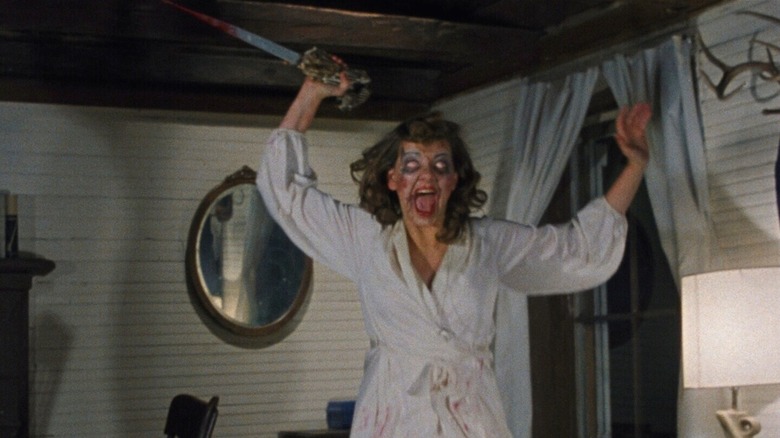
In "The Evil Dead," Linda is played by Betsy Baker. Some context: the film had a low budget of only $375,000, and thus was shot in Raimi's home state of Michigan using local talent with little experience. Campbell and Ellen Sandweiss (Cheryl) were friends of Raimi and had acted in his amateur Super 8 movies. Of the film's cast, only Campbell became a full-time actor. Between 1981 and 2006, Baker has only one credit.
Baker was interviewed for "The Unseen Force: The Films of Sam Raimi" by author John Kenneth Muir. She recalls that Raimi and Campbell asked her to return as Linda in "Evil Dead II," but she turned them down: "I was actually married by then and expecting my first child. The timing was not going to be conducive for me to shoot and be gone."
So, the part was recast with Denise Bixler since the undead Linda maintains a presence in the story. In particular, there's the scene where Ash has to destroy her decapitated head with a chainsaw and the demon inside it taunts him with Linda's voice.
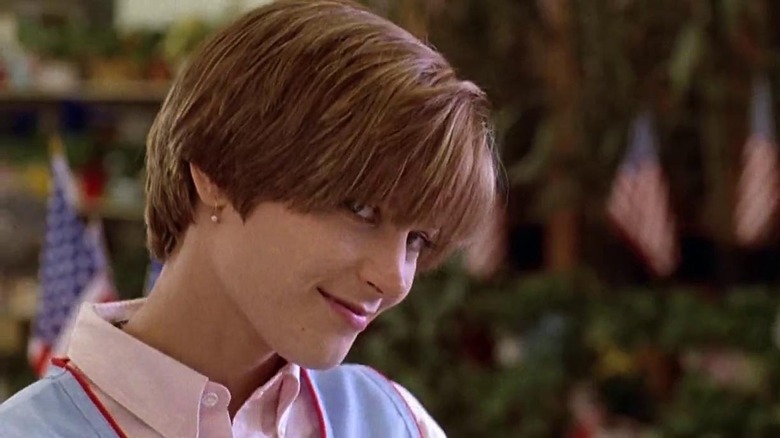
The opening flashbacks of "Army of Darkness" stay close to "Evil Dead II," even using some footage from the preceding film. However, the movie again recasts Linda. Why? It may be because Bixler has only three credits and hasn't appeared in anything since 1992.
The Linda in "Army of Darkness" was none other than Bridget Fonda. She has the least screentime of the three; according to Muir's book, her scenes were all quickly completed reshoots. These scenes include a shot of Linda working at S-Mart, her and Ash pulling up to the cabin in their Oldsmobile, and a recreation of Dixler-Linda's demise in "II" (the Unseen Force crashes through the window and takes Linda in a pushing-forward POV shot).
However, Fonda also had the most prolific career of the three actresses — she is Hollywood royalty, after all. She would also work with Raimi again on his crime thriller "A Simple Plan." Not bad considering in "Army of Darkness," she's practically a stand-in.
Since the turn of the 21st century, Fonda has gone into retirement while Baker has come out of it. The circle of Linda has come full circle as Baker has reprised her role in the 2017 fan-film "Ash vs Evil Dead: Aunt Linda's Bake-Off" and 2022's "Evil Dead: The Game." The story of "Evil Dead" has been reinterpreted so many times that eventually, it looped back around to the original Linda.
Read this next: The 30 Best Zombie Movies Of All Time
The post How Army of Darkness Rebooted The Evil Dead Franchise Yet Again appeared first on /Film.
Read more of this story at Slashdot.
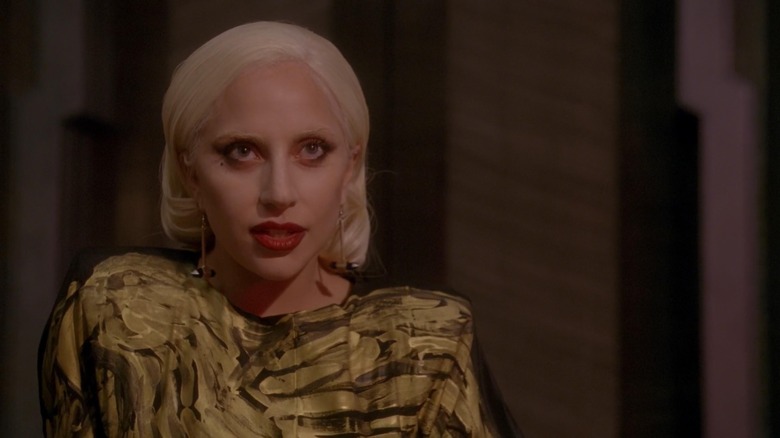
Perhaps one of the more suitable ways to wrap up Valentine's Day is a brand-new look at Todd Phillips' highly anticipated sequel to 2019's "Joker." There's been a lot of intrigue surrounding the project, primarily because of the big-name star added to the film: Lady Gaga. The actress is playing who we can only assume to be Harley Quinn, a character created for "Batman: The Animated Series" as a psychiatrist who eventually falls in love with the Joker and becomes his partner-in-crime. Margot Robbie previously portrayed the character in the greater DC Extended Universe, and now the time has come for another iteration of the character in Phillips' gritty and decrepit depiction of Gotham City.
Even the film's subtitle, "Folie à Deux," refers to a medical term for a delusion or mental illness shared by two people, solidifying the idea that Gaga will be playing the massively popular Batman character. Now, thanks to this new image, we have a better idea of how the relationship between the two characters will play out, especially given the impeccable timing of Phillip's release of this first-look image of the duo. While things may not have worked out with Zazie Beetz's character from the first film, there may yet be love in the air.
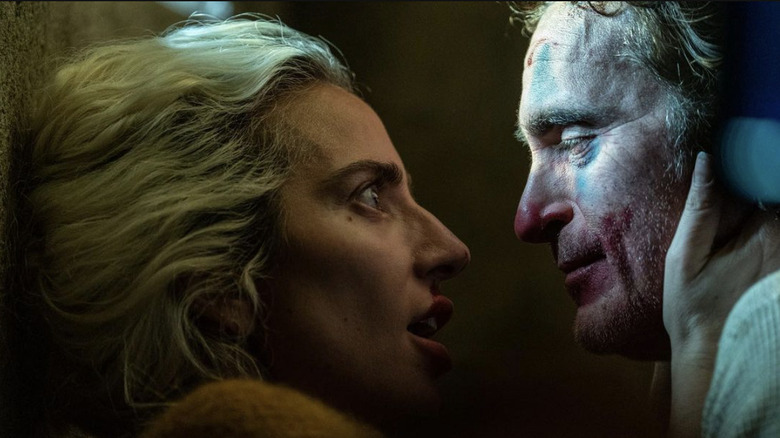
Director Todd Phillips shared the above photo on Instagram with the simple caption, "Happy Valentines Day." In it, we can see Joaquin Phoenix's Arthur Fleck and Lady Gaga's Harley Quinn sharing what is undoubtedly a twisted romantic moment in the film. Fleck's Joker makeup is faded, but some of it has clearly rubbed off on the face of Gaga's character, and I'll go ahead and let the readers figure out how it got there. The first "Joker" film ended on a catastrophic note, showing the influence of Arthur's actions as the Joker, inspiring a clown movement that led to fiery riots in Gotham City.
Exploring how deep Arthur's influence as the Joker runs with new characters is a natural thing to explore in the upcoming sequel and will likely be done through Gaga's character. Add to that the film is supposed to be a musical, and you have an exciting concept that differentiates itself from the original movie, which will more than likely use similar detached-from-reality moments that the first film used, only this time for musical numbers. Phillips' caption also confirms what many were already thinking, in that Phoenix and Gaga's characters will be romantically entangled thanks to their shared delusions. The official DC brand account even commented, "...love is in the air...?"
All that's left to see is if this warped relationship is meant to last when the film hits theaters on October 4, 2024.
Read this next: What These DC Villains Really Look Like Under The Makeup
The post Todd Phillips Reveals The First Look at Lady Gaga's Harley Quinn for Joker: Folie a Deux appeared first on /Film.
Read more of this story at Slashdot.


