Shared posts

24 Sep 19:41

William Shatner is going to space on Jeff Bezos's Blue Origin rocket

by David Pescovitz

Captain Kirk is finally headed to space for real. According to TMZ, William Shatner plans to be part of the next civilian crew to fly aboard Blue Origin's spacecraft. If it happens, Shatner, 90, will be the oldest person to visit space, taking the record from Wally Funk, 82, who in July joined Jeff Bezos and two other private citizens for a short jaunt past the edge of space. — Read the rest

24 Sep 16:40

Attention ladies: If you want to keep your abortion rights, you need to start flattering conservative justices. You know, express amazement at the size of their jurisprudence, compliment their oral arguments, stuff like that. Oh, and smile, of course [Facepalm]

24 Sep 16:39

Gunmen disguised as lawyers shoot murder suspect in courtroom

by David Pescovitz

Today in New Delhi, Jitender Gogi—allegedly involved in 19 murders and attempted murders—appeared in Rohini Court for a hearing. After the court proceedings began though, two men, thought to be lawyers involved in the case, opened fire and killed Gogi. From NDTV:

"Two from rival gang opened fire at Jitender Gogi inside the court.

Read the rest
24 Sep 16:25

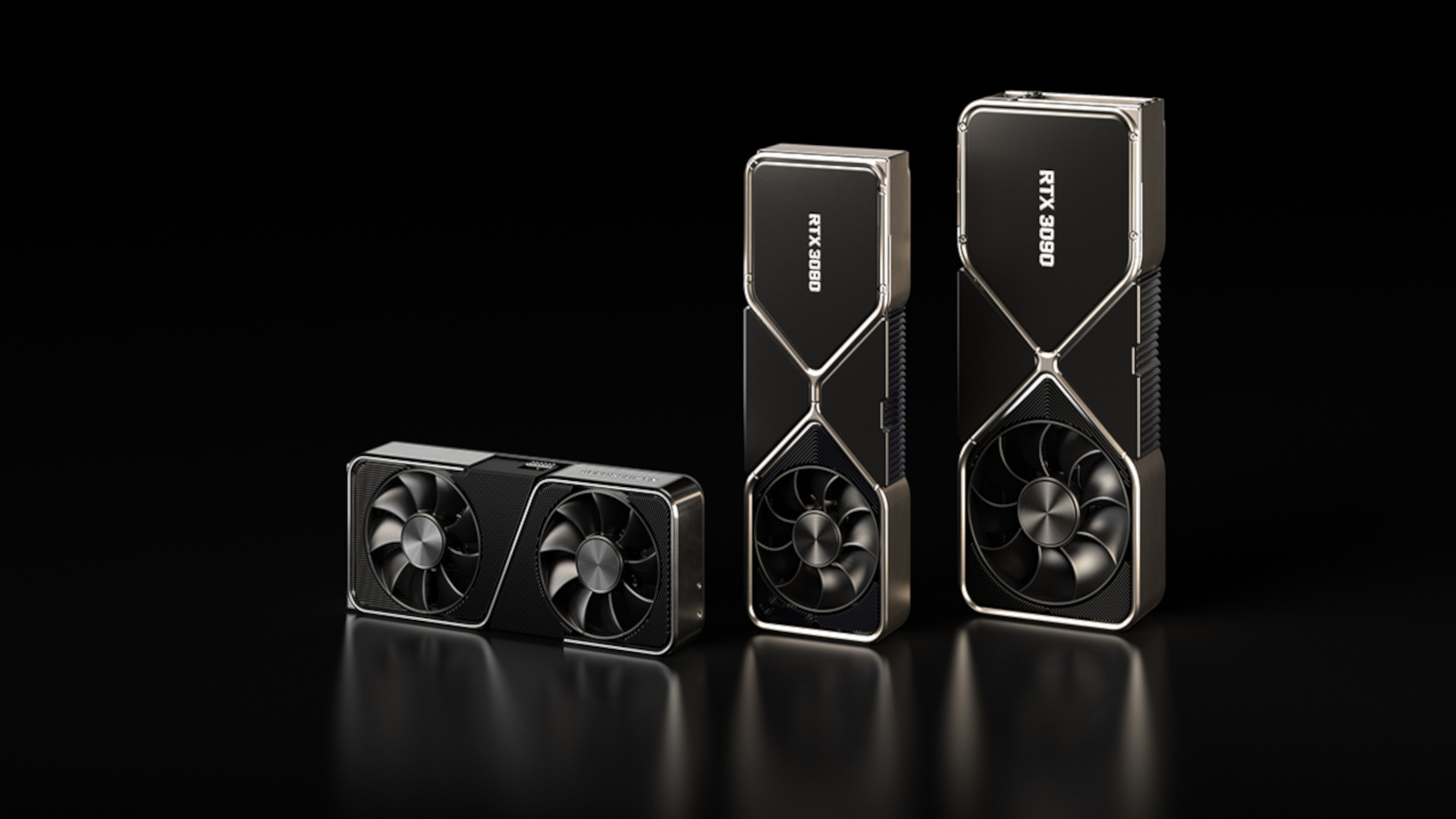
GPU shortage could improve thanks to China’s increased crypto crackdown

by Samuel Willetts
GPU shortage could improve thanks to China’s increased crypto crackdown

A large contributing factor to the dire state of the current GPU market is the ongoing cryptocurrency boom. Despite moves from manufacturers to make their graphics card less appealing to miners, a huge number of the best graphics cards available (or unavailable, as the case may be) are still finding their way into mining farms instead of gaming PCs. However, a recent development in China’s ongoing crypto crackdown may bring some relief to the grossly inflated video card market.

As reported in Financial Times, Chinese government agencies and The People’s Bank of China have now banned all cryptocurrency exchanges. Previously, the country had only banned domestic activities, which led to traders moving to foreign platforms and also resulted in China’s used GPU market being flooded with RTX 3000 GPUs listed well under MSRP. This change in legislation is seen as a means of closing this loophole.

The collective value of crypto wallets controlled by Chinese users is estimated to be around $150 million USD, which places it “second only to the US” according to analytics provider Chainalysis. The price of bitcoin also fell by around 8% following the news.

RELATED LINKS: Best SSD for gaming, How to build a gaming PC, Best gaming CPU
24 Sep 16:18

Siegfried fined $40,000 for promoting fake Covid cures. Roy unavailable for comment, because, well, you know [Ironic]

24 Sep 16:17

The Craziest Banned Books You Should Read

by Bea

Whether it was a scandalous, vivid depiction of sex or a culture-shattering story, people found all sorts of reasons to ban books over the years. Many of these books, however, turn out to be some of the best and most popular books ever. Even in recent years, despite of having a more progressive world, a lot of great books are still being banned. But that shouldn’t stop us from having an open mind, and learning about what these authors have to say, right? So in honor of Banned Books Week (September 22-28), check out the craziest banned books you should read.

The Complete Fairy Tales of the Brothers Grimm (Jacob and Wilhelm Grimm, 1812)

Brothers Grimm

If you thought fairy tales were all about happy endings, then you are in for a big surprise with the Brothers Grimm’s dark and violent (and sometimes realistic) take on them. I guess this is one fairy tale book that won’t be reaching the hands of grade-schoolers, huh?

Ulysses (James Joyce, 1922)

Ulysses

Considered to be one of the most important works of Modernist literature. Since it’s publication, the novel has attracted controversy and criticism because of its obscenity. It was banned in countries such as Ireland, Canada, the United States, and England.

Thirteen Reasons Why (Jay Asher, 2007)

13 Reasons

This novel tackles sex, drugs, rape, suicide, and bullying among other things. But it was only after the release of the 2017 Netflix series that it was banned from several school districts, as it was said to “glamorize” suicide. It may be quite a depressing read, but it is also very enticing and real.

The Satanic Verses (Salman Rushdie, 1988)

The Satanic Verses

The scandalous name of this book already warrants some kind of preconceived notion of its plot. It focuses on two Indian Muslims living in England and gives readers a touch of magical realism. It was banned in countries like Pakistan, Saudi Arabia, Egypt, Malaysia, and many more for its “blasphemous references”.

1984 (George Orwell, 1949)

1984

One of the greatest dystopian novels ever, 1984 was banned due to its portrayal of oppressive regimes and censorship. Ironically, it triggered the likes of Stalin and China. Orwell is also responsible for another controversial banned book – Animal Farm.

Harry Potter Series (J.K. Rowling, 1997)

HP Set

When the world fell in love with J.K. Rowling’s fascinating and magical world of Harry Potter, I don’t think they expected people to ban it for using “actual curses and spells” and “conjuring evil spirits”.

To Kill A Mockingbird (Harper Lee, 1960)

To Kill A Mockingbird

Still very relevant today, this novel tackles racism when the black lead character is falsely accused of raping a white woman. With the N-word appearing over 50 times in the novel, several schools removed it from their curriculum for its “dated approach to race”.

Alice’s Adventures in Wonderland (Lewis Carroll, 1865)

Alice in Wonderland

The now popular Alice in Wonderland was not so popular during the early 1900s for its unusual and extravagant plot. Moreover, here are three reasons why it was banned which, today, seem very silly.

The Da Vinci Code (Dan Brown, 2003)

Da Vinci Code

When a fiction novel completely revises one of the most fundamental teachings of the bible, the Church is bound to have some major opinions on it. The scandal this book brought is enough to make you want to read it.

Lolita (Vladimir Nabokov, 1955)

Lolita

Lolita was banned for its disturbing and controversial plot about a middle-aged man who kidnaps and rapes a 12-year old girl. In spite of this, it is a captivating and beautifully written book.

Naked Lunch (William Burroughs, 1959)

Naked Lunch

Naked Lunch takes readers on a wild ride into the paranoid, hallucinogenic, drugged-up mind of a heroin addict. Banned for its obscenity, it stood trial for its “hardcore pornography”.

American Psycho (Brett Easton Ellis, 1991)

American Psycho

The novel on which the cult classic film was based, American Psycho is told from the point of view of its resident serial killer Patrick Bateman. Because of this, the book paints some extremely graphic and violent scenes.

Beartown (Fredrik Backman, 2016)

Beartown

Banned for being “unnecessarily vulgar and graphic”, Beartown tackles the sexual assault of a teenage girl by a varsity hockey player.

The Kite Runner (Khaled Hosseini, 2003)

Kite Runner

One of the most challenged books in recent years, The Kite Runner was banned due to its themes of homosexuality, religious viewpoints, and sex. However, readers will realize that its message of redemption is what makes this book a great read.

The Catcher in the Rye (J.D. Salinger, 1951)

Catcher in the Rye

One of my favorite novels, The Catcher in the Rye tackles teenage angst, alienation, and the preservation of childhood innocence.

Anne Frank: The Diary of a Young Girl (Anne Frank, 1947)

Diary of Anne Frank

I guess the diary of a young, Jewish girl during the Holocaust was too depressing for some readers, but that shouldn’t be a reason for banning an important piece of history, does it?

The Best-Selling Sci-Fi Books of All Time

Summer Reading List: Sci-Fi and Fantasy Books For the Beach

24 Sep 16:17

Could the Moon Actually Crash Toward Earth?

by Rhett Allain
The trailer for the film Moonfall shows our satellite getting too close for comfort. Here are the physics of what it would take to push the moon out of orbit
24 Sep 16:16

CISA Opens IPv6 Guidance to Public Feedback

by Ionut Arghire

The United States Cybersecurity and Infrastructure Security Agency (CISA) on Thursday announced that it’s asking for public feedback on new IPv6 guidance for federal agencies.

read more

24 Sep 16:15

Google Warns of a New Way Hackers Can Make Malware Undetectable on Windows

by noreply@blogger.com (Ravie Lakshmanan)
Cybersecurity researchers have disclosed a novel technique adopted by a threat actor to deliberately evade detection with the help of malformed digital signatures of its malware payloads. "Attackers created malformed code signatures that are treated as valid by Windows but are not able to be decoded or checked by OpenSSL code — which is used in a number of security scanning products," Google
24 Sep 16:14

How Training for a Hunting Trip Gave Me a Bigger Ass

by Claire Lower

When I started this archery-focused strength training program, I had one goal: Increase my draw strength to at least 40 pounds so I could kill an elk if I happened to see one while hunting in Eastern Oregon with my dad. As I’ve mentioned previously, focusing on “losing weight” has never worked for me, nor has working…

Read more...

24 Sep 16:14

Review: MIDNIGHT MASS, Auteur Mike Flanagan Mixes Horror and Drama in Equal Measure

When someone sits down to write the the history of cinematic horror covering the last decade, three names will likely take the most amount of space on the printed page or the digital equivalent:  James Wan, one of the key creative forces behind three franchises (Saw, Insidious, and The Conjuring). Uber-producer Jason Blum (Paranormal Activity, The Purge, Halloween, The Invisible Man), the micro-budget pioneer who’s helped to usher in a new Golden Era of Horror. And Mike Flanagan, a remarkably prolific filmmaker who’s directed eight films since 2011 and, in a mutually beneficial partnership with Netflix, three well-received series, The Haunting of Hill House in 2018, The Haunting of Bly Manor two years later, and now Midnight Mass, possibly, if not probably, his most personal...

[Read the whole post on screenanarchy.com...]

24 Sep 16:14

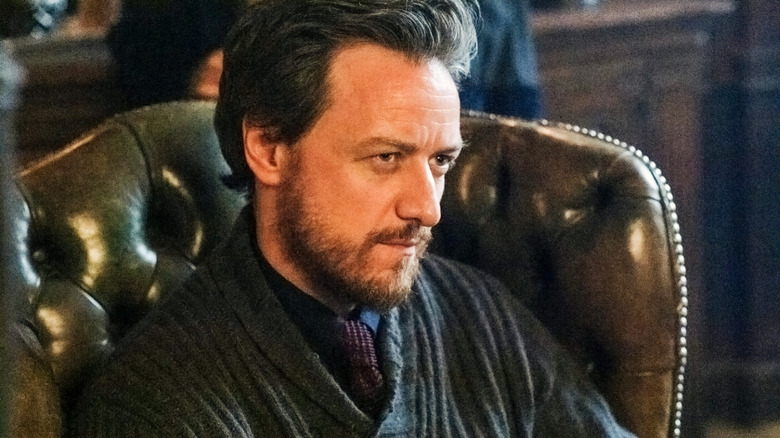
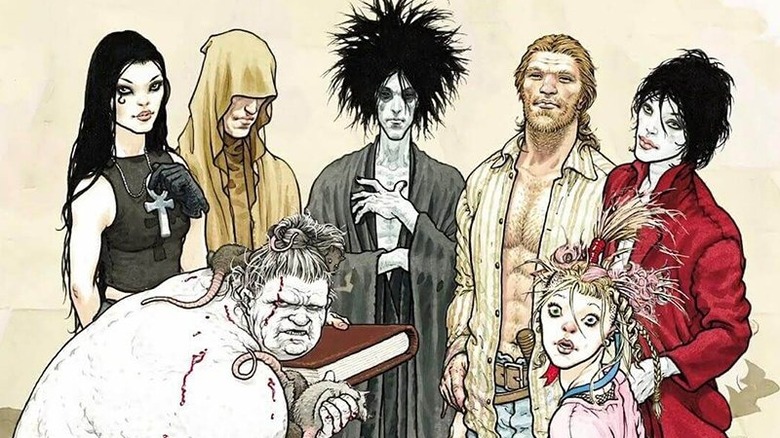
James McAvoy Is Living The Dream In The Sandman Act II [Interview]

by Hoai-Tran Bui

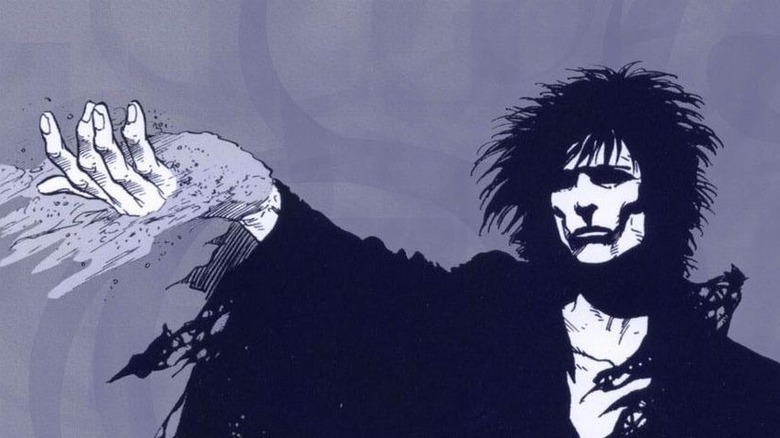
James McAvoy played the captive Morpheus in his own kind of locked room. In the first part of "The Sandman" audio drama directed by Dirk Maggs and released by Audible, Morpheus — the ancient anthropomorphic personification of dreams — is captured by a group of cultists that hold him captive for 80 years, before he's finally released to return to his decaying domain. And McAvoy performed the part of Morpheus in the first part of "The Sandman," released in July 2020, while in lockdown in his spare bedroom. Okay, he wasn't locked in there per se, but he could probably empathize with Morpheus' plight: a little lonely, a little isolated.

But in "The Sandman Act II," Morpheus has finally escaped his cage and so has McAvoy (again, this imagery is very loose, I'm not implying that McAvoy was locked in a cage). The "Glass" and "His Dark Materials" actor got to return to the studio to record his parts for "The Sandman Act II" and he was overjoyed to do it — even if he was only acting opposite director Dirk Maggs.

"It was really nice to step into an actual recording studio, and have [Dirk] as my scene partner this time round," McAvoy told me over the phone in an interview timed to the release of "The Sandman Act II" (now available on Audible). "Because last time, yeah, it was pretty mental, just being stuck in my bedroom, on my own. A bit lonely."

But listening to "Act II," you wouldn't expect the actor playing Morpheus to be lonely, let alone acting alone in a studio with one other person. The ensemble has exploded since the first part of the audio drama dropped to positive reviews, with actors like Regé-Jean Page, Jeffrey Wright, Brian Cox, Emma Corrin, John Lithgow, David Tennant, Bill Nighy, Kristen Schaal, and Kevin Smith joining the fray. And Morpheus isn't even in the audio drama for a lot of Act II, notably absent during many of the events in the "A Game of You" arc. ("Act II" adapts the volumes "Season of Mists," "A Game of You," and parts of "Fables and Reflections"). Not that McAvoy minds.

"He feels quite mischievous at times," McAvoy said of playing Morpheus as a side spectator to many of these events. "And he's letting other people do the heavy lifting, he's not doing it all himself, which, as a performer, is quite nice sometimes."

I chatted with McAvoy about returning to the Dreaming, giving Morpheus a little more humanity, and what it will be like for the audio drama to exist alongside the upcoming Netflix live-action series.

"I Feel Like, For Me, Dirk Is The Voice Of All Of Them."

James, you last played the part of Morpheus back in April 2020 at the beginning of the pandemic, recording from your spare bedroom. What was it like getting back into the role of such an ancient mythic character, however many months later?

It was nice. It was also nice to be able to do it in a studio this time, with Dirk. No other actors. I was about to say unfortunately, but actually, I loved doing it with Dirk. Bloody brilliant. It was just the way I like it. But it was really nice to step into an actual recording studio, and have him as my scene partner this time round. Because last time, yeah, it was pretty mental, just being stuck in my bedroom, on my own. A bit lonely.

So this time, since you were in the studio, did you get to actually act opposite other people? Or was it still fairly distanced?

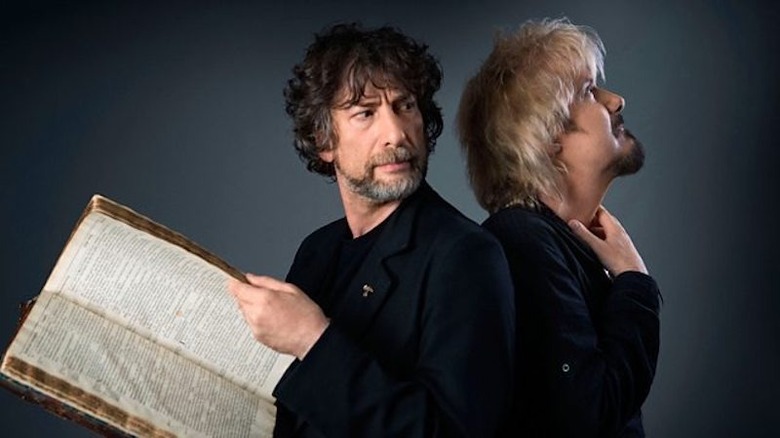
No, it was still really distant. I got to act opposite Dirk. But the nice thing about Dirk is that he's a writer, he's a director, yes. But he's also a glam rock metal drummer. Although I've never seen him, but he sports a pretty wild glam rock metal haircut. And as a performer like that, he understands and knows this material inside out. And in the words of Neil Gaiman himself, possibly even better than Neil does himself. So I think you're acting with somebody who, while he's not an actor, he's giving it more than a lot of actors could give. And loves acting and production. So basically, he played every single character in the show, except my one, when we're working together. And I bloody love it.

Wow. That's a lot that he gets to play. And yes, I have seen him. He has that great sort of blonde mullet, if I remember?

Yes, he's got a great sort of mane/mullet with a great equally daring and questionable 'stache, which is... He's just wild. He's just wicked. He's got a little bit of panache, just like a lot of Neil's writing. And he's the perfect guy to do this stuff with.

Were there any choices that Dirk made that you kind of wish the actual performer made during the finalized product?

Oh, that's a good point, actually. I haven't listened to the final product as yet, so I don't know. But, yeah, I mean, to be honest with you, all those guys, apart from maybe Kat Dennings, who I think just gives something so unique to the character of Death, I feel like, for me, Dirk is the voice of all of them. And that's nothing against the actors, who are all wonderful. But they didn't get to hear Dirk really go for it, and give it big licks, the way he does. And I love it.

"He Starts To Sound A Little More Off Guard, Off Voice..."

So as familiar as you are with the graphic novels, where there any specific story arcs or scenes that you were excited to perform in Act II?

Probably the stuff with Delirium, his sister. I think that stuff was always going to be quite interesting. They're such two sort of diametrically opposed personalities, it was always going to be fun to play with that. And it was in the end. But, actually that was probably all. It was just as fun. I'd never read any more than season 1's worth of writing, when I was teenager. So it was nice to kind of get to that, and start to be surprised myself, and start learning as I was acting.

So Morpheus is notably absent for a lot of Act II, due to the events of "A Game of You." Apart from the whole, "not having to go into the studio as much" element, what was it like playing into the more mythic fairytale bogeyman aspects of Morpheus, when you pop in at various points throughout the series?

It's quite good fun, really. Because he feels quite mischievous at times. And he's letting other people do the heavy lifting, he's not doing it all himself, which, as a performer, is quite nice sometimes. So, no, it was good. It was nice to share that responsibility with other performers, other characters. And feel like you were adding to their stories, their narrative, and not just trying to build your own the entire time.

At the same time, there are more human aspects that reveal themselves within Morpheus in Act II. He gets sheepish around his siblings. He gets embarrassed. He admits his wrongdoings with Nada. What was it like digging into those aspects, and how did you approach it from a specifically voice acting angle?

I think the first season, he sounds quite different. He sounds quite... not inhumane, but he doesn't sound particularly human. There's something quite alien about him, without trying to make him into Mr. Spock, there was some quite otherworldly, or on another plane, about him, do you know what I mean?

Whereas I feel like in season 2, he starts to possibly ... not humanize, but slightly more humanized actually. He starts to, like you say, experience these things. So he sounds different, he starts to sound a little more off guard, off voice, off sort of company line, if you like. Where his responsibility, his job, the realm of which he is the custodian and all the weight that it carries, starts to get undercut by personal things. And that was actually quite fun. It gave me a different, just a different thing to play, a different tone to tap into. So it was actually really good. Because otherwise, you'd just end up doing the same thing twice.

"I Think They Feed Each Other, You Know?"

Yeah. And how do you approach that from a technical aspect? For example, your voice in the first part was so gravelly and alien, as you said, but how do you bring that warmth to the performance?

I guess, partly is you're doing it consciously, and then partly you're just letting yourself play the scene and play it naturally. And if you are, I guess, succumbing to more familial pressures, and you start to really lean into the everyday and the domestic and the banal, then that comes out in your voice a little bit as well.

But yeah, I think that the slowness with which he spoke in the first season as well, was really important. It conveyed the gravity and the gravitas and the weight of the things that you're dealing with. So when it is undercut with the little bit of familial strife, or familial bonding even, it's appropriate. It feels like that tone and that cadence can be undercut a little bit. You can't just read the book. You can definitely modulate it and play with it just a little bit. And that's a relief as a performer, because otherwise, like I say, you are just doing the same thing again and again and again.

Right. So, as we're speaking, the Netflix live action adaptation of Sandman is in development. It's been cast, it's filming, the whole shebang is happening. What do you think of the Netflix series, and how do you hope that the Sandman audio drama and the live action series can exist side by side?

I think, probably quite happily. I feel that when you're dealing with something like this... Like The Lord of The Rings, or something like that, or Star Wars, or whatever it is, these big, huge properties, that people feel really passionate about, they generally want more and more and more. So, I read all The Lord of The Rings books, that didn't stop me going and watching the movies. I listened to every single radio drama version of Lord of The Rings and every single audiobook version of Lord of The Rings, and it didn't stop me going and watching those movies. And it probably won't stop me watching the TV show when it comes out as well. So I think that they don't really preclude each other. I think they feed each other, you know?

The Sandman Act II is available to order on Audible now.

Read this next: How James McAvoy Injected Some Humanity Into The Inhuman Morpheus In 'The Sandman' Audio Drama

The post James McAvoy is Living the Dream in The Sandman Act II [Interview] appeared first on /Film.

24 Sep 16:14

What is the tastiest apple?

by Mark Frauenfelder

Thrillest bit into 20 varieties of eating apples, ranking them from worst (Red Delicious) to best (Braeburn). My favorite, the Fuji, comes in at a respectable fourth place.

  1. Fuji
    "Really Good With a Dark Secret"
    大好きだね! These Japanese apples developed by Tohoku Research Station in the 1930s are mild and completely reasonable, a treat on their own and the perfect accompaniment to Greek yogurt.
Read the rest
24 Sep 16:11

Warehouse-sized asteroid sneaks up on Earth by hiding near the sun - CNET

by Eric Mack
2021 SG was bigger than the bolide that blew up over Russia in 2013.
24 Sep 15:58

Explorers have reached the bottom of the Well of Hell. What is there has always been a mystery [Spiffy]

24 Sep 15:58

Why Lawns Are Terrible (and What You Can Do About Yours)

by A.A. Newton

It’s never been harder to keep a lawn alive, and unless radical climate interventions happen like, tomorrow, this is the easiest it’ll be for the rest of your life. Not to be too dramatic, but: Have you ever considered giving up?

Read more...

24 Sep 15:57

CDC director endorses Pfizer booster for front-line workers, overruling advisory panel - CNET

by Carrie Mihalcik
The decision is in line with FDA authorization for booster shots of the Pfizer vaccine.
24 Sep 15:57

Netflix Series MIDNIGHT MASS Ending Explained

by Nadja "HorrorDiva" Houmoller
24 Sep 15:55

Google Says Threat Actors Using New Code Signing Tricks to Evade Detection

by Eduard Kovacs

Financially motivated threat actors have started using new code signing tricks to increase the chances of their software evading detection on Windows systems, Google’s Threat Analysis Group reported on Thursday.

read more

24 Sep 15:55

Park After Dark - My New Girlfriend Mary

by SWEARNET

Ricky's got a new toy - is it a tanning booth, Doctor Who's TARDIS, or something really dope? Watch the latest episode of Park After Dark at https://bit.ly/pad3-18 and the TPB/SwearNet app - download at https://linktr.ee/tpbswearnet and come fuckin' join us!
24 Sep 14:53

"Ghost" footprints in New Mexico turn out to be 23,000 years old

by Gareth Branwyn

A set of fossilized footprints in White Sands National Park, New Mexico have been dated to around 23,000 years ago and offer the oldest firm evidence of humans in the Americas, appearing to show that people arrived here before the last Ice Age. — Read the rest

24 Sep 10:38

FBI intensifies manhunt with federal arrest warrant for Brian Laundrie. Apparently, he forget the dead can't use debit cards [Followup]

24 Sep 10:35

Working Securely From Anywhere With Zero Trust

by John Maddison

Over the past year, two things have become clear. First, the network infrastructure organizations need to operate in today’s increasingly digital world will continue to evolve. And second, rather than “returning to normal,” the future will be even more fragmented than ever. Users will need faster access to a growing number of applications and resources deployed across an increasingly distributed infrastructure. Those applications will continue to deliver richer and more complex data.

read more

24 Sep 01:23

Diablo II: Resurrected Released

by Blue
The second, second coming of Diablo is upon us, as Diablo II: Resurrected is now available through the Blizzard Store. Here's the Live Action Trailer ft. Simu Liu from the other day and a Live Action...
24 Sep 01:23

Imposter Syndrome

by Unknown

Imposter Syndrome

This is something many of us have experienced to one degree or another, at various times. Many have experienced, some have overcome it, others may not be able to and wonder why.

HealthLine tells us, "Imposter feelings represent a conflict between your own self-perception and the way others perceive you." I would modify that slight to, "...the way we believe others perceive us." Imposter syndrome is something internalized, and has very little to do with the outside world.

I wanted to take the opportunity to share with you, the reader, what I've learned over the years about what's really happening in the world when we're having those feelings of imposter syndrome.

Perception: I don't want to present at a conference, or ask a question at a conference, because everyone knows more than I do, and will ask questions I don't know the answer to.

Reality: Have you ever stood in the back of the room at a conference and just...watched? Most people you see aren't even listening the presentation. Some are on social media (Twitter, Discord, Slack, etc.), and some are on their phones.

When someone asks a question about a presentation, calm yourself so instead of the ringing of fear in your ears, you actually hear the question. Does the question have anything to do with the presentation? I ask, because in my experience, I've gotten a few questions following a presentation, and some of those questions have been way off topic. Looking back, what seems to happen is that someone hears a term that they're familiar with, or something that strikes a chord, and they take it way out in left field. 

My point is simply that, at conferences, the simple reality a lot of people aren't really paying attention. This can be very important, even critical, when the fear behind imposter syndrome is that you're under a microscope.

I've found that I've had to engage with people directly to get a reaction. When I worked for CrowdStrike, I was involved with a number of public speaking engagements, and for the last 5 or so months, the events were about 3 1/2 hrs long. Across the board, almost no one actually asked questions. For those who did, it took time for them to do so; some wouldn't ask questions until the 2 1/2 or 3 hr mark. Some would ask questions, but only after I'd goaded someone else into asking a question.

Perception: I could never write a book or blog post, no matter how prepared I am, because the moment it's published it'll torn apart, and I'll be eviscerated and exposed as the fraud that I am.

Reality: Most people don't actually read books and blog posts. My experience in writing books is that some will purchase the books, but few are willing to actually read the books, and even fewer will write reviews. It's the same with blog posts...you put work into the topic and content, and if you don't share a link to the post on social media, very few actually see the post. If you do share it on social media, you may get "likes" and retweets, but no one actually comments, neither on the tweet nor the post.

My overall point is that imposter syndrome is an internal dialog that prevents us from being our best and reaching our potential. We can overcome it by replacing it with a dialog that is more based on reality, on what actually happens, in the real world. 

My perspective on this is based on experience. In 2005, Cory Altheide and I published a paper discussing the artifacts associated with the use of USB devices on Windows systems (at the time, primarily Windows XP). After the paper was published, I spoke on the topic at a conference in my area, one primarily attended by law enforcement, and got a no questions. Several years later, I was presenting at another conference, and had mistakenly opened the wrong version of presentation; about halfway through, there was a slide with three bullets that all said, "blah blah blah". At the end of the presentation, three attendees congratulated me on a "great presentation". 


24 Sep 01:20

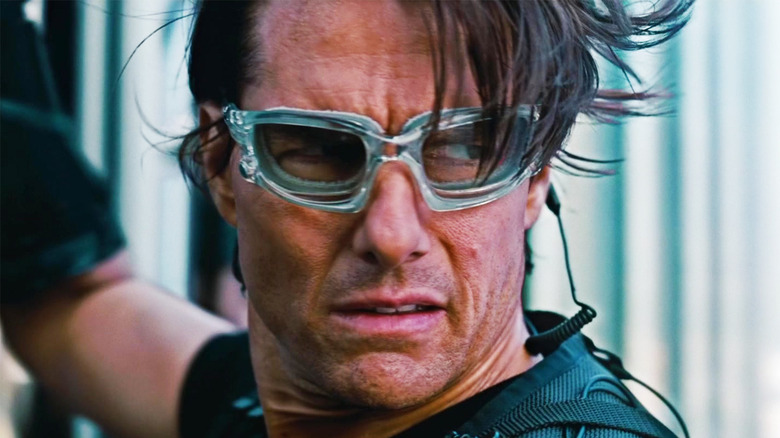
The 14 Most Dangerous Mission: Impossible Stunts, Ranked Worst To Best

by Jeremy Herbert

"Mission: Impossible" premiered on CBS in 1966 as an upside down "Topkapi" riff that left the conniving to the good guys. For creator Bruce Geller, expertise was the point. Characters and plots were left blank and blurry, forcing viewers to join the Impossible Missions Force or be left in the high-tech dust. Fun only got in the way; Geller famously scolded star Peter Graves for smiling at the end of an episode.

In 1996, director Brian De Palma reinvented the series as a star vehicle for Tom Cruise, and it's nothing but fun. The second film even includes a joke about how its star can't stop smiling. The fuse burns brighter than ever and expertise remains the native tongue, but "Mission: Impossible" has carved a new legacy in theaters -- mainly, its reputation for showing off knuckle-whitening, insurance-defying stunts, often performed by Cruise himself. Factoring in franchise importance and danger inherent, the following 14 examples are the best stunts "Mission: Impossible" has to offer.

Aquarium Explosion — Mission: Impossible
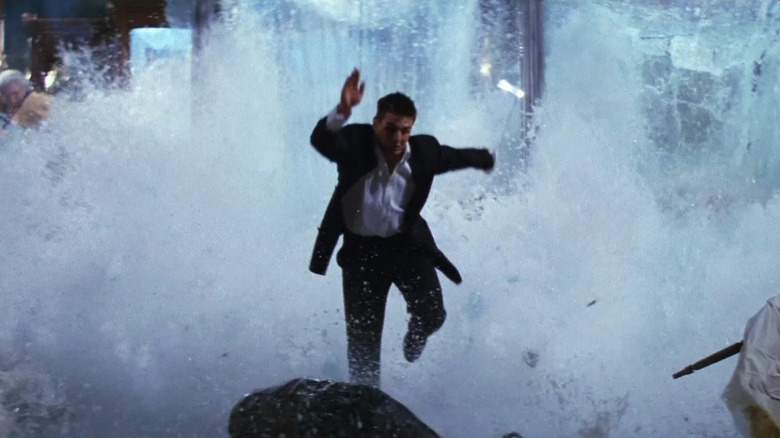
The bottom of the list is also the beginning, when Tom Cruise became an action hero and Ethan Hunt became Ethan Hunt. Before he can process the death of his IMF team, Hunt is politely accused of betraying the entire organization. He decides that the only way through is out and, in what will soon become a tradition, goes rogue. All it takes to make his escape is one well-placed stick of explosive chewing gum and 16 tons of aquarium water. Director Brian De Palma savors the subsequent wave in luscious slow-motion, letting the audience get a good, long look at his star.

The stunt's provenance is still in question, with some sources claiming that Cruise volunteered to do the stunt himself, while others say De Palma volunteered him. Regardless, minus a face-replaced stuntman take in which the falling glass gave a better performance, it's really Tom Cruise in the line of fire. The scope of this scene may seem quaint now, but it's still an impressive spectacle, made historic with age. Cruise's first big "Mission: Impossible" stunt, in his first film as producer, lit a fuse longer than anyone could've possibly imagined in 1996, and remains among his best.

Parking Garage Parkour — Ghost Protocol
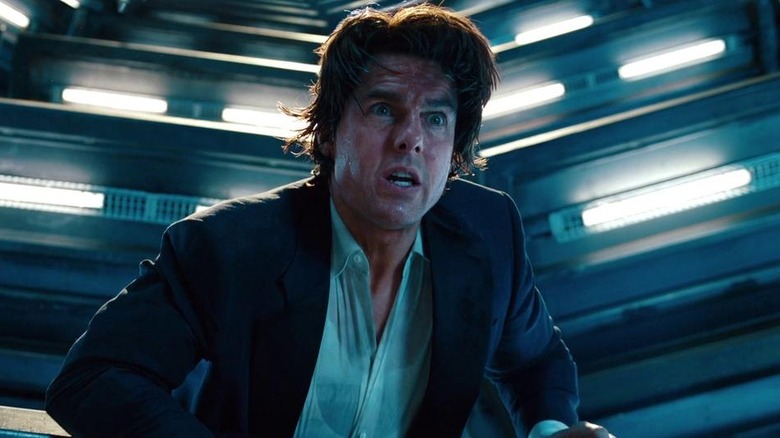
The Burj Khalifa sequence in "Ghost Protocol" was so tantalizing that it dominated the movie's ad campaign and so iconic that it drowns out the rest of the movie in memory. Of all the setpieces that suffer by immediate proximity to the scene, none fare worse than the climactic parking garage fight.

The location, inspired by Volkswagen's original "auto silos," is an oversized Hot Wheels playset invaded by action figures. Due to the impracticality of using a real auto silo, the production built its own working facsimile in a Vancouver warehouse.

There is no standout moment in the scene -- even Cruise's three-story jump between moving platforms is just another bruise in a symphony of them -- but the overall effect is dizzying. Cruise has more than proven his mettle in the star-as-stuntman pantheon, but this is the only sequence in the series that could be transplanted wholesale into a Jackie Chan film. On a list of the greatest fights, not stunts, the scene's Rubik's Cube geography and lockstep timing would make this one rate higher, but the brawl is still a dark horse in this crowded stunt race.

Arc De Triomphe Runaround — Fallout
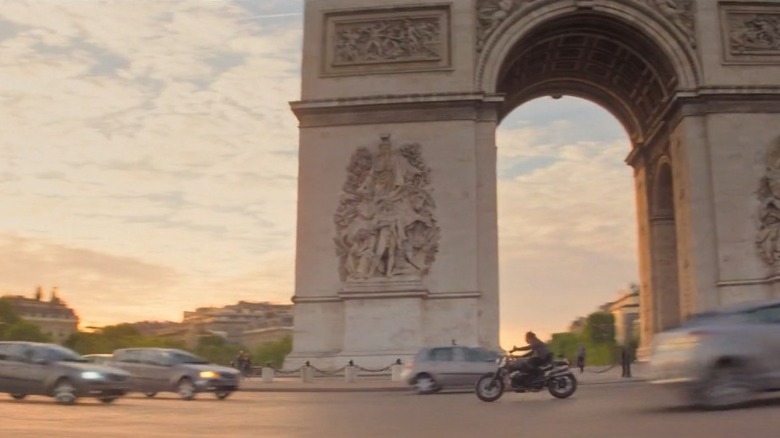
Like the parking garage fight in "Ghost Protocol," the Arc de Triomphe motorcycle chase in "Fallout" is a great sequence rendered merely good by more impressive stunts nearby.

It's low on the relative risk scale, the stakes being no more exotic than a head-on collision. Still, there's a bone-deep anxiety to watching somebody speed against traffic. Some of the greatest chases in cinema history are built on little more. What elevates this example, though, is how returning director Christopher McQuarrie shoots it. Or, rather, when.

Given that the Arc marks the intersection of twelve major streets, the city of Paris was none-too-pleased about diverting traffic. The production got two hours to film. Minus camera setup, stunt driver choreography, and roundabout rehearsal, that translated to a 15-minute window of actual filming. Thankfully, that was all the time McQuarrie needed. The results, as agonizing as they are effortless, speak for themselves.

Underwater Heist — Rogue Nation
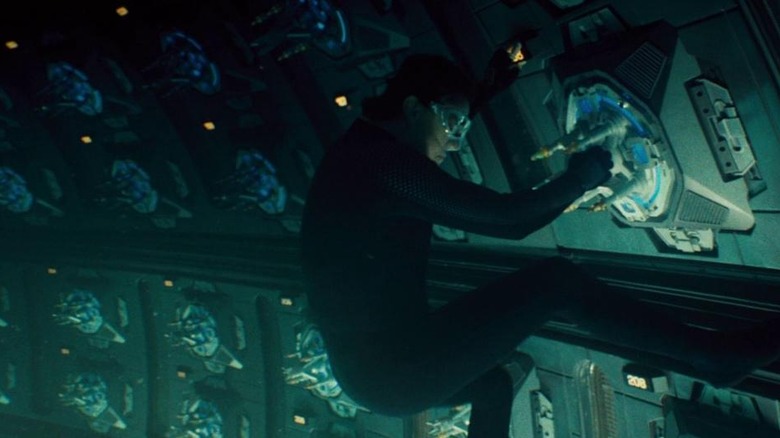
Faced with the unenviable task of following "Ghost Protocol," instead of looking up, McQuarrie looked down.

All Hunt has to do is swap a computer chip with an IMF-tampered copy to allow Benji (Simon Pegg) safe passage through a cutting-edge security system. Unfortunately, the storage unit for these chips is completely submerged and constantly scanned for unexpected metals. As a result, the only gadgets allowed are Hunt's own lungs.

The one-take sequence is so daring, so blatantly self-destructive, that the effort almost does the effect a disservice. If not for the press surrounding this scene, the average viewer would never even consider that Cruise was capable of it. But he is, and he spent two months training for it with co-star Rebecca Ferguson, then two weeks shooting it. In the end, Cruise spent a sustained six minutes underwater on a single breath. His dedication was enough to scare stunt coordinator Wade Eastwood.

Train Chase — Mission: Impossible
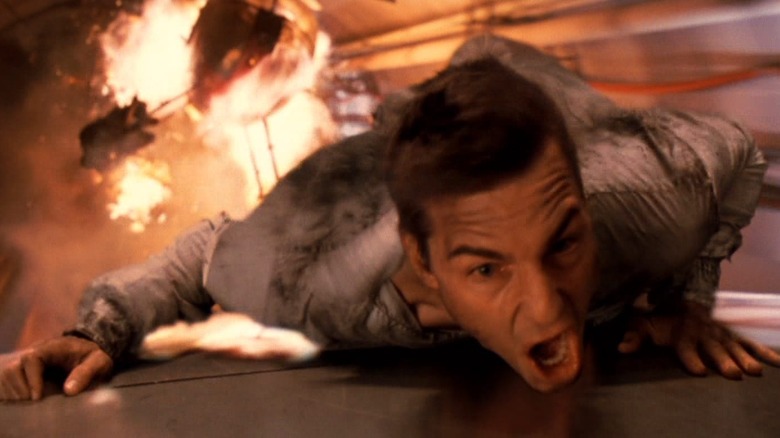
The ending of the original "Mission: Impossible" gets a bad rap, even from the people who made it. Brian De Palma wanted to film a train before there was a scripted reason for it. Cruise agreed, until the train sequence became a train-and-helicopter sequence. It was too far for what he considered a reasonably grounded cloak-and-dagger story. And yet, De Palma stood firm, even in the face of arguments from effects supervisor John Knoll about the laws of physics.

For all its scientific faults, the sequence hasn't lost a step. The combination of miniatures, blue screen inserts, and projection-mapped location footage was a high-water mark for a kind of action scene not long for the world in 1996. Anyone squeamish about dated effects need only watch the 140-mph wind machines beat Tom Cruise back to puberty.

The biggest stunt was Cruise's baptism by fire. There was no clearer way to show the star being flung from an exploding helicopter to a speeding train than by strapping him in a harness and throwing him until he landed right. After many takes, most of which he requested, Cruise was bruised and bleeding. The only way to satisfy Cruise's frustrations about realism was to do it for real, whatever the bodily cost. He hasn't been the same since.

Knife Trick — M:I-2
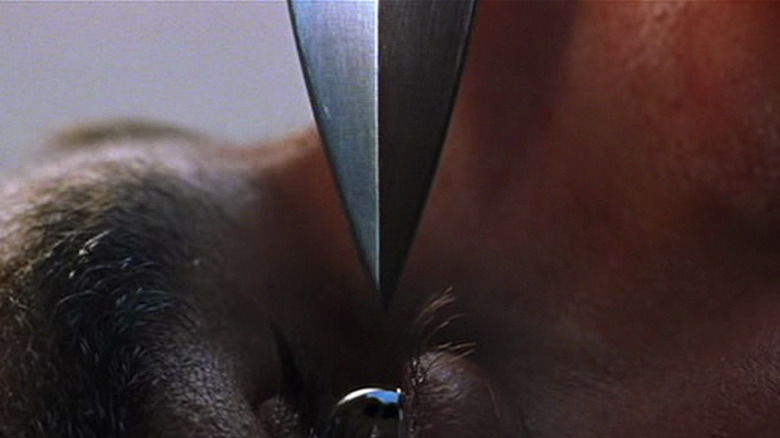
"Mission: Impossible" may be synonymous with spectacle now, but the franchise's most uncomfortable stunt comes from a much simpler time -- the year 2000 -- and a much smaller effect: an ordinary boot knife.

All the action in John Woo's maximalist "M:I-2" was choregraphed down to the doves, but Woo remained flexible on set. During the mano-a-mano finale, Cruise came up with an additional flourish: a knife-first dive from the villainous Sean Ambrose (Dougray Scott) that would land within an inch of Hunt's retina. As usual, Woo tried to talk his producer-star down. There was no time to fake it, and no money to hand it off to the effects department. Cruise countered that they didn't need to fake it at all.

A real knife was hastily tethered to an overhead bar, allowing the attacker to hang their full weight on the hilt and let it fall no further than measured. The resulting shot, with the blade shaking no more than a knuckle-length away from Cruise's unblinking eye, made the entire crew squirm. The stunt endures 20 years and four sequels later as, millimeter for millimeter, the most immediate danger Tom Cruise has ever faced, as well as a sick reminder that even the small stuff can be worth sweating.

Leaning Into The Skid — Rogue Nation
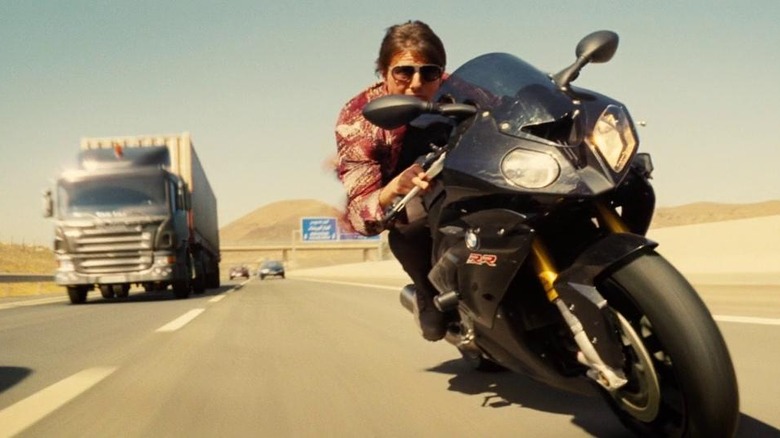
Of the franchise's three motorcycle chases, the mountainside pursuit in "Rogue Nation" pales by comparison. It doesn't have the dueling Triumphs of "M:I-2" or the postcard obstacle course of "Fallout." What it does have, however, is blistering, nauseating speed.

Immediately after surviving a car crash, Ethan Hunt crawls out of the wreckage and onto a BMW S 1000 RR. In motion, it's a redline ballet, the machines evolving into earthbound speeder bikes on loan from "Return of the Jedi." The striking purity of this sequence, especially compared to the shaggier scrapes around it, is by early design. Here, the bikes came first.

Inspired by "Ghost Protocol" stunt coordinator Greg Smrz's desire to do "a real motorcycle movie," McQuarrie and Cruise brought him back as the second unit director and shaped the entire story around this chase. Camera cars, usually limited to a top speed of 25 miles per hour, were tricked out to keep pace with the bikes at 100. "Rogue Nation" opens with a faster stunt, but due to that craftsmanship, this smokes it on the starting line and makes the simplest case yet for the franchise's modern appeal: when Tom Cruise self-consciously checks his knee after it grazes asphalt somewhere near Mach 1, that's what "Mission: Impossible" is all about.

HALO Jump — Fallout
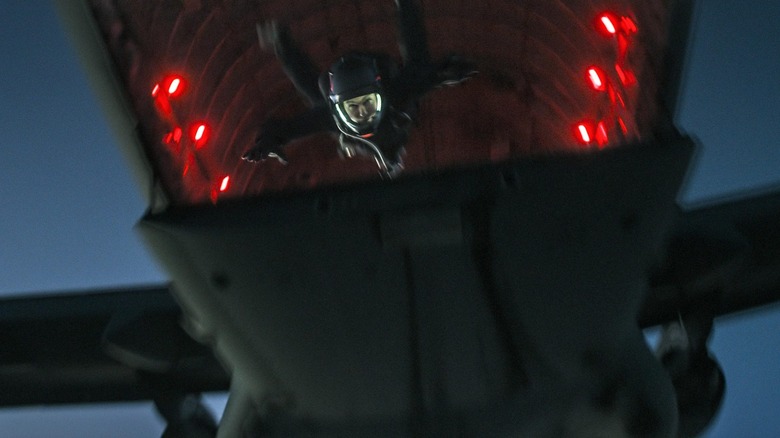
Art is getting as indistinguishable from life as one of the IMF's peelable disguises. The line between Hunt and Cruise has been blurry for a while now, but each superlative stunt takes a bigger team of highly trained experts, working in perfect communion, to pull off. No set piece better demonstrates this spy-worthy prep and execution than the HALO jump.

At 25,000 feet in the air and 225 miles per hour, it would've been a risky maneuver even if Cruise didn't have a broken ankle. In addition, because shooting practically at that altitude was unprecedented, the stunt was pushed to the end of production -- McQuarrie had no way of knowing how long it might take to get the three necessary shots in the can. Every day for weeks on end, the director would break away from editing the rest of the film to review footage from the day's rehearsal jumps, then fly up with the crew at dusk to call action. All in all, it took 106 jumps to complete the sequence and another three months in post-production to paint Paris beneath it, all for two minutes of a 147-minute film. Mission, somehow, accomplished.

Hanging Out — Rogue Nation
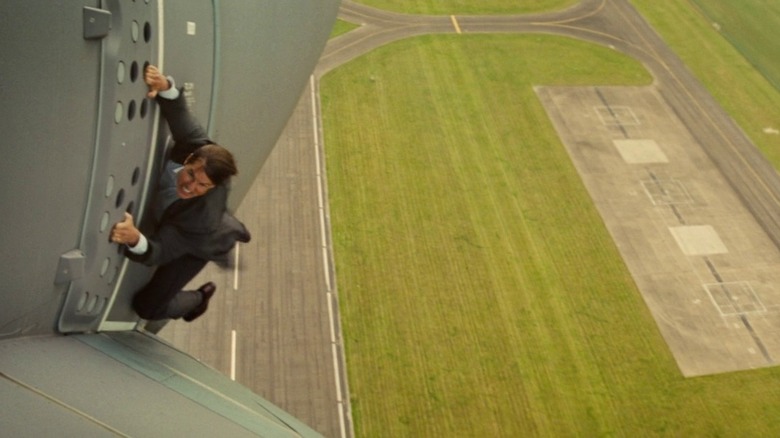
By contrast, the first stunt of McQuarrie's "Mission: Impossible" run was a walk in the park. It only took eight flights to get the necessary footage, though none were nearly as comfortable for Cruise.

There's a beautiful simplicity to strapping a movie star to the fuselage of an Airbus 400 and rolling camera, but only over popcorn. The crew painstakingly cleaned the entire runway of objects; at 185 miles per hour, even acorns are lethal. Any precipitation at all was a non-starter. Cruise wore protective contacts as insurance. Though he claimed he lost sleep in a featurette detailing the production of the stunt, he still insisted on keeping his harness slack to make his performance authentic. 

It was impressive moment in the trailers and downright astounding in context; Cruise lands on the wing of the Airbus within three minutes of the Paramount logo appearing on screen. Christopher McQuarrie made his entrance to the franchise in assured style by doing the impossible: putting the big bang before the fuse.

Shockwave — Mission: Impossible III
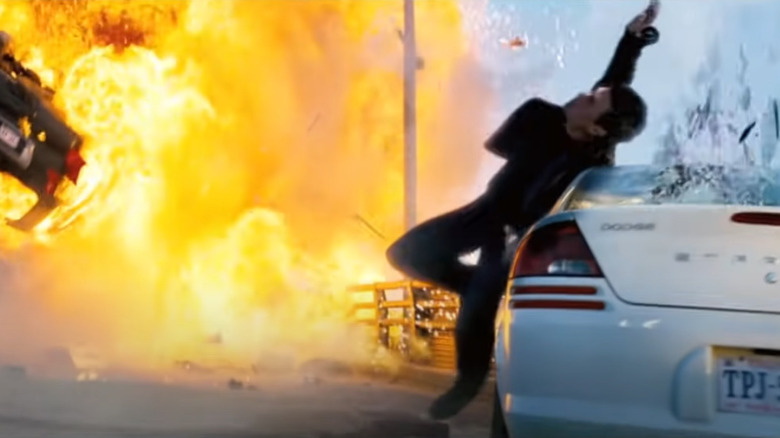
Tom Cruise getting thrown into the side of a Dodge Stratus is more than just wirework; it's sooth.

The stakes in "Mission: Impossible III" remain, to date, the most personal in the franchise. That focus extended to the stunts. To Abrams's credit, "Mission: Impossible III" was the first "Mission" to recognize that Tom Cruise running as a special effect unto itself. During one of these sprints -- this time, escaping from a strafing drone -- a missile hits close enough to send Ethan flying. The stunt only lasts two seconds from take-off to landing, and spans the height of a car door, yet it became a touchstone for the franchise.

The effect was pieced together from six different shots, only two of which included Cruise, and a healthy smear of digital dirt, then was given the famous Abrams shake after the fact. All that invisible work came together to craft the film's mission statement in miniature: Hunt is unstoppable, maybe even indestructible, but he's also human. He still is, even if the explosions have gotten bigger and the falls a lot farther as the franchise has continued.

Cliffhanger — M:I-2
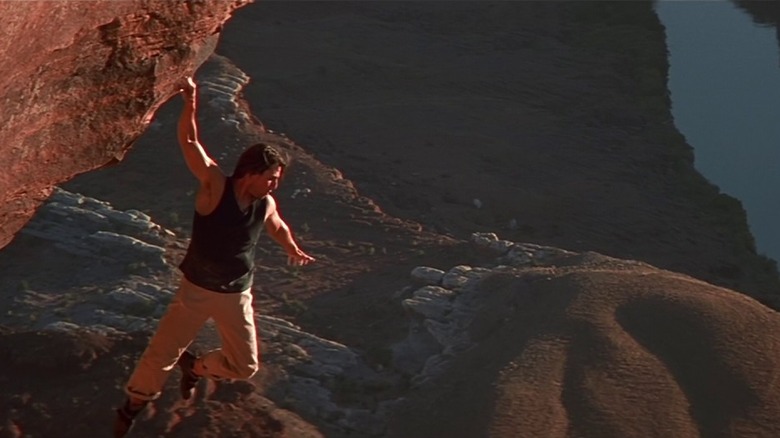
To make up for lost time caused by delays in filming Stanley Kubrick's "Eyes Wide Shut," "M:I-2" hits the ground running as a treatise on the inhuman cool of America's would-be Bond. Hunt is reintroduced spending his vacation doing something even more dangerous than his day job. By the power of his own hands, feet, and, briefly, knees, Hunt scales the mile-high crags of Moab, Utah. After a misjudged jump, he turns himself around and hangs, Christlike, above all creation.

Minus a digitally erased-safety harness and his slide off the edge, it's all Cruise. Woo was too terrified to watch the seven takes as they happened. The producer-star refused to share any footage of the stunt until they wrapped, lest anyone at the studio try to pull the plug. The peril, paranoia, and torn shoulder were worth it -- the stunt not only became the film's signature, but pop-culture shorthand in spoofs everywhere from the "2000 MTV Movie Awards" to "Austin Powers: Goldmember." The ego that made the sequence such a popular target at the time has aged into awe -- and Cruise into an endangered species.

Dueling Helicopters — Fallout
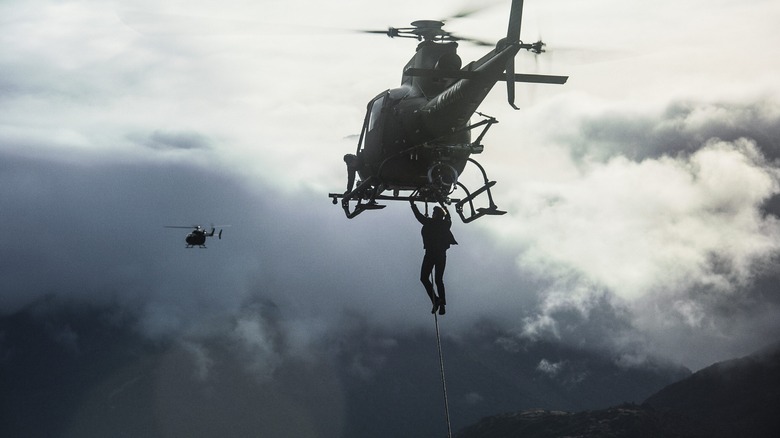
In a gauntlet of stunts either tediously captured (the HALO jump) or wincingly performed (Arc de Triomphe), the helicopter finale in "Fallout" bests both the movie's crown jewels.

It was shot over six weeks in three different countries. During prep, Cruise condensed three months of helicopter training into one. On set, he was nursing a broken ankle and still had the HALO shoot ahead of him. Custom cameras were fitted all over the aircraft, inside and out, and McQuarrie directed by walkie-talkie. Henry Cavill, playing Hunt's villainous quarry, was strapped into the fleeing helicopter, effectively placing the lives of not one but two movie stars in the hands of Cruise, which were already shivering from the sub-freezing temperatures.

The result is documentary, or as close as "Mission: Impossible gets." There he is. There he goes. The price of a mistake for both Ethan and Tom is never less than equal -- swift, fiery death -- and never less than obvious. With a little imagination and barroom piano, it passes for something that Buster Keaton might've done with $178 million and the right license; for all the technical wizardry on display, there's no bigger gasp in the franchise than when Tom Cruise slips off the skid and just barely catches the cargo net below.

Burj Khalifa — Ghost Protocol
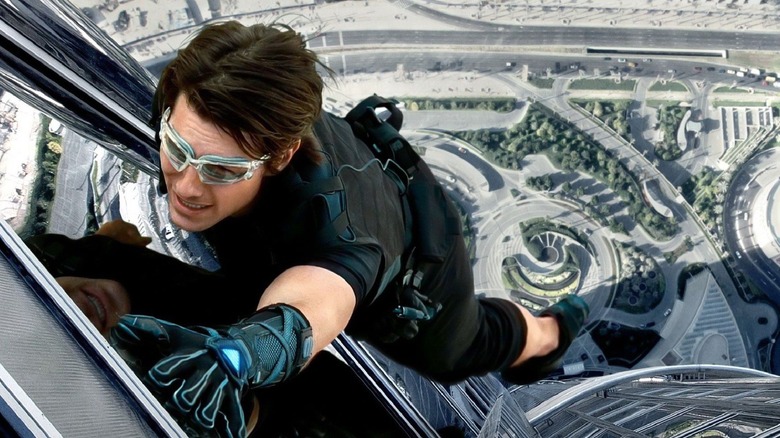
After "Mission: Impossible III" turned in the lowest box office take of any film in the franchise, a fourth "Mission" was anything but guaranteed. When -- or if -- the series returned, Hunt would have to prove himself to moviegoers all over again. The first trailer for "Ghost Protocol" underlined the action and ended with a 2,722-foot exclamation point: Tom Cruise swinging around the tallest building in the world like a plastic army man on a shoestring. There's not only a close-up to guarantee that it's him, but a frustrated retort at Jeremy Renner -- "You're not helping."

When Brad Bird started filming, "Ghost Protocol" was a baton-pass. Ethan Hunt's return was supposed to be his retirement from field work, replacing the assassinated Secretary (Tom Wilkinson) as head of the IMF. Renner's character, William Brandt, was going to be the new face of the franchise. Then, 10 weeks into production, Cruise brought in trusted collaborator Christopher McQuarrie for a rewrite. Changing only the pieces yet to be shot, including the interior half of the Burj Khalifa climb, McQuarrie overhauled the entire second half of the film. There would be no desk job for Ethan Hunt.

Brad Bird's die-cut eye for action, honed over decades in animation, reinvigorated the franchise and challenged it to a game of one-upmanship that audiences are still winning 10 years later. Even if McQuarrie hadn't taken the wheel, the Burj Khalifa stunt speaks for itself and would've made Hunt's promotion all the stranger. This is clearly the dawn of Tom Cruise, stunt man, not the twilight.

CIA Infiltration — Mission: Impossible
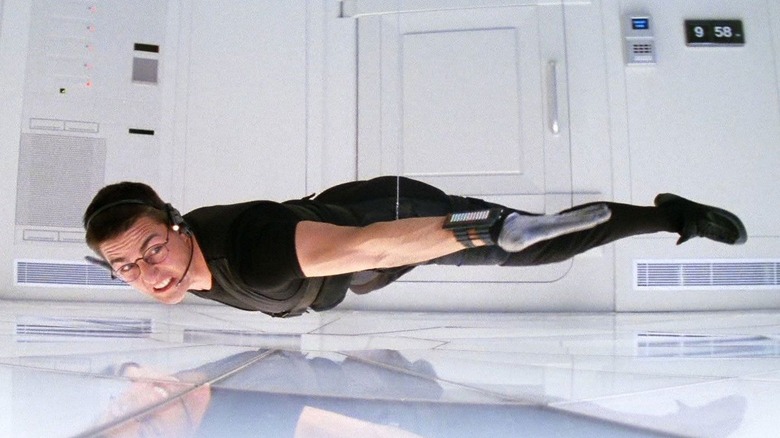
15 years before "Ghost Protocol" revised the "Mission: Impossible" blueprint, Brian De Palma and screenwriter David Koepp sketched it out in a tall, octagonal room with nothing more than a computer, a light-up floor nicked from the "Billie Jean" music video, and near-complete silence. 

Ethan Hunt's makeshift IMF team must break into the CIA Headquarters at Langley and steal the hallowed NOC List. Unfortunately, it's stored in an ultra-secure computer terminal surrounded by pressure-sensitive tiles, among other absurd countermeasures. Seeing no other option, Hunt rappels from the lone vent overhead. The compounding distractions -- a curious rat, an inconsistent stomach, sweat 00 ratchet along like clockwork. Nobody builds Swiss watches like De Palma. The crescendo, though, is all flesh and blood. Krieger (Jean Reno) drops Hunt's line and only catches it again when the spy is centimeters from the floor.

During filming, Cruise kept faceplanting. The fall wasn't far, but the harness was imbalanced and the sustained exertion of trying to catch himself was adding up. De Palma called it. He'd just cut before impact to a close-up. Cruise asked the director for one more take and the crew for pocket change. With pound notes in his shoes, Cruise fell for the last time and nailed the stunt for all three rolling cameras. His marionette flail is the greatest thrill in a film constructed of nothing else. The sequence is a peerless translation and expansion of the original show's mission to create suspense through hyper-competence. This stunt, within just a few feet, summarizes everything essential about "Mission: Impossible" -- disbelief, suspended.

The post The 14 most dangerous Mission: Impossible stunts, ranked worst to best appeared first on /Film.

24 Sep 01:19

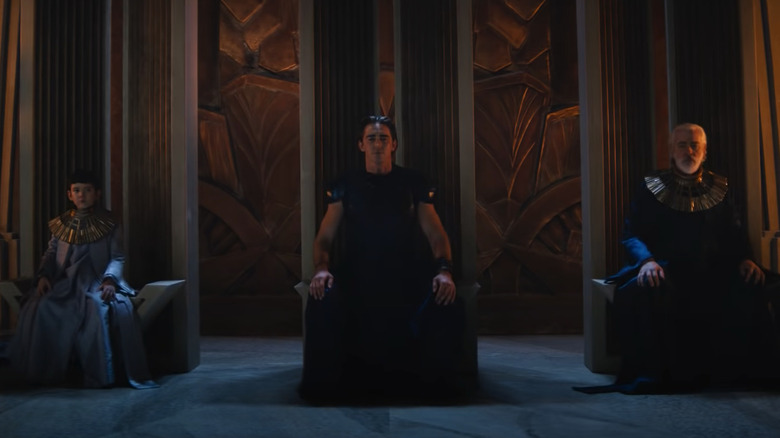
Foundation Review: A Science Fiction Classic Finds Bold New Life

by Jacob Hall

How do you adapt Isaac Asimov's "Foundation"? You can't. 

As written, the novel (and its sequels and prequels) aren't just impenetrable — they're downright un-cinematic. Asimov may have liked writing scenes about men sitting in rooms, having long conversations about societal downfalls and monumental events that have, will, or could happen, but it's hard to imagine a story more ready to die on a screen. It's is a series of novels where people tend to talk about action instead of engaging in it.

So, once again, how do you adapt Isaac Asimov's "Foundation"? You don't. You remix it. You open it up and search the underside of the legendary science fiction writer's heady ideas, finding the character (and the drama and the action and the sex) hidden between the notions of history, science, and philosophy. And you make a TV show about that.

So here we are, with the new "Foundation" TV series premiering this week on Apple TV+, which owes as much to "Game of Thrones" as it does to the most influential sci-fi writer of the 20th century. It's not Asimov's "Foundation" because it cannot be that. But it is the world of those novels reinvented for an audience who already proved willing to learn the great houses of Westeros, to showcase tremendous patience across an often-methodically paced season that doles out enough sex and violence to keep your attention as the many rules of a complex universe come into focus.

And it works.

The End Is Nigh

To describe the plot of "Foundation" is to realize why adapting it was such a headache. 

Mathematician Hari Seldon (Jared Harris) — a citizen of a galactic republic that sprawls across the known universe in a distant future where humanity has spread across hundreds of planets and created countless subcultures — looks at the numbers and sees the end of the world. Or rather, the end of the empire, and the civilization(s) it protects and dominates. His creation, mathematical equations that predict the future with eerie accuracy (dubbed "psycho-history"), gains traction. Those in power take notice, and they're not happy. After all, Hari says the empire will collapse, many lifetimes from now. But if they build the right infrastructure, they can shorten the impending dark age, allowing their distant, distant descendants the chance to build anew.

The resulting narrative first spans decades. And then centuries. And then many centuries. When you watch "Foundation," you learn to thrill at titles telling you "400 years earlier," "19 years later," and so on. The timeline here is a hoot.

It's heavy. It's a lot. And yes, this is a series about preparing for the distant apocalypse because it's too late to save the current infrastructure. Asimov wrote his first "Foundation" story in the 1940s, long before anyone could've seen the world seemingly crumbling in the midst of climate change and a global pandemic. Watching Hari, a man defined by hard facts and numbers, fail to earn the ear and support of those in charge hits hard. And Harris gives the character the same dignity he gave his Soviet scientist in HBO's "Chernobyl." He's become the go-to actor to play intelligent men who stand their ground in the face of powerful foes who bury their heads in the sand.

The subtext floats just above the surface, frequently emerging from below the waves to make its point clear. "Foundation" wants you to know what it's all about. It's science fiction as a call to action, about it not being too late.

A Massive Universe

While the show orbits around Hari and his ideas (and Harris is a strong enough actor to anchor the show's premise), showrunner David S. Goyer and his writers offer many other windows into this universe. There's Gaal Dornick (Lou Llobell, shouldering the weight of a POV character with an appealing, low-simmering rage), a math wiz who flees persecution on her religious planet to work alongside Hari and gets more than she bargained for. There's Salvor Hardin (Leah Harvey, enough angst and earnestness to win our instant affection), a "warden" (think space cop) on an isolated planet who lives decades in the future and whose plot ultimately intersects with the other storylines as the action shifts back and forth across the years.

These characters represent the canniest departure from the original text. The almost entirely male cast of the books has been largely gender-swapped, with people of color filling out key roles and numerous supporting characters. It's easy to imagine a certain subset of science fiction fan rolling their eyes at the "wokeness" of this choice, but it's a creative choice that pays dividends.

The result of this casting is a universe that feels modern, sprawling, and, you know, vast. A single frame of "Foundation" suggests a galaxy so sweeping, so filled with different cultures, that you can't help but get lost in it. (It helps that the show is downright lavish, and Goyer and his directors making fine use of Apple's Scrooge McDuck money to make it all look appropriately cinematic.)

The Pace Of It All

Llobell and Harvey are the audience's way into the story, our eyes and ears as the scripts introduce us to the rules of this world. So leave it to Lee Pace to find all of the remaining scenery and place it firmly between his teeth. The "Guardians of the Galaxy" actor is perfectly cast as Cleon, the literal emperor of the galaxy, his deep voice and intimidating build (and his opulent costumes, a standout in a series filled with inspired looks for every character) making him look and feel like a marble sculpture of a Roman god come to life. And Pace doesn't just play one character, but several — his emperor is the latest in a generation of clones, all descended from the same ruler who decided to literally keep the empire in his hands.

He rules alongside the older clone who came before him and the young clone who will take the throne when he ages, leading to a sinister and fascinating triumvirate. Pace shares the role with Cassian Bilton, Terrance Mann, and Cooper Carter, and their combined performances form a magic trick — you watch as the years pass and Carter's Cleon takes the place of Pace's Cleon, and Pace's Cleon is then played by Mann, before cycling through again. Tracking the Cleons could've been a nightmare, but it ends up being the show's most satisfying and strange narrative. An extended prologue in episode three explores what happens to an aged Cleon clone, and it's the kind of mesmerizing short story that defines the best episodes of "Foundation" so far.

The series is at its best when it finds these diversions and indulges itself. This universe is massive, and the show wants us to live in it.

Breaking The Gateway

If it sounds like I'm dodging a lot of plot here, well, I am. Part of that is knowing how the season unfolds (I have seen the first eight episodes of the 10 episode season) and not wanting to spoil it. But most of it, honestly, is because "Foundation" is at its best when it plants its feet in a single location for a bit and lets these characters exist in this rich, detailed universe. 

Looking nothing like "Star Wars" or "Star Trek" or "Battlestar Galactica," "Foundation" feels designed from a fresh place, pulled out from a corner of the imagination not yet mined. There are some familiar shades here and there (the Roman Empire in Cleon's court, the video game "Destiny" on Terminus), but it mostly feels fresh, like when we first started watching "Game of Thrones" and realized, so quickly, this wasn't Tolkien's fantasy world. It was something new.

Asimov purists will scoff, and that's their right. "Foundation" is full of gunfights and burning romance, dramatic plot reveals and sexy actors allowed to be sexy. It pauses to philosophize, but it also pauses for big, violent action and swimming pool make-out sessions. This isn't Asimov. This is the unsaid stuff between the chapters of Asimov that he probably thought too lurid, too pulpy, too simple.

But I'm reminded of how Peter Jackson approached his "Lord of the Rings" films. That trilogy isn't J.R.R. Tolkien. It's Tolkien and "Dungeons & Dragons" and thousands of pieces of art inspired by the original work and countless hours of dreaming about what Middle-earth looks like. Those movies, masterpieces all of them, built a personal, accessible vision of a complicated world. It took something tricky and made it for everyone. "Foundation" has similar gateway-demolishing goals.

It's Not Asimov – And That's Okay

I won't say "Foundation" is a masterpiece. It shares that "Game of Thrones" scope, but also its weaknesses, spinning wheels in the middle of the season to maneuver characters into place for a series of climaxes. Episodes blend into one another, and it's tough to recall which episode is which, a weakness common in the age of streaming and binge-watching. It's easy to imagine a tighter season, a more disciplined structure, that tightens the water-treading. It's ironic that the core storyline is the one that sometimes drags, while the subplots and asides are the ones that resonate.

"Foundation" has been reinvented as something more accessible, more vibrant, more action-driven, sexier, and yes, more fun in the traditional sense of the word. 

Asimov purists will cry foul. The rest of us will enjoy the ride.

Read this next: Foundation Was Considered Impossible To Adapt – Here's How David S. Goyer Did It [Interview]

The post Foundation Review: A Science Fiction Classic Finds Bold New Life appeared first on /Film.

23 Sep 23:15

Online 'Expansion Pack' brings N64 and Genesis games to Nintendo Switch

by Jessica Conditt

Nintendo is rolling out a new membership plan for Switch Online, and it'll unlock a library of classic Nintendo 64 and Sega Genesis titles. The Nintendo Switch Online + Expansion Pack subscription tier will go live in October. Nintendo has not shared pricing details yet, but the company says more information is coming soon.

Games in the Online Expansion Pack include Super Mario 64, Mario Kart 64, Starfox 64, The Legend of Zelda: Ocarina of Time, Mario Tennis, Castlevania: Bloodlines, Ecco the Dolphin, Phantasy Star IV, Sonic the Hedgehog 2 and Streets of Rage 2, among other iconic titles. Additional N64 games will be added to the lineup over time, including Pokemon Snap, Banjo-Kazooie, The Legend of Zelda: Majora's Mask and Paper Mario. See a complete list of Expansion Pack titles at the end of the article.

The Expansion Pack tier grants members all of the perks of a traditional Switch Online subscription, and it takes some classic games online for the first time. Mario Kart 64, for instance, will be playable online for up to four players.

Nintendo
Nintendo

Alongside the new (old) games and the fresh Online tier, Nintendo is rolling out wireless N64 and Genesis gamepads just for the Switch, and only for Online subscribers. The controllers are $50 each and will require a Switch Online membership to purchase.

Switch owners have been anxiously waiting for N64 games to hit the system since it launched in 2017, and the inclusion of Genesis titles is the cherry on top of today's news. The surprising part is how the games will be distributed, via a new form of subscription DLC.

Nintendo provided the following list of old-school games included in the Online Expansion Pack:

Launch Lineup of Nintendo 64 Games

  • Super Mario 64

  • The Legend of Zelda: Ocarina of Time

  • Mario Kart 64

  • Star Fox 64

  • Sin and Punishment

  • Dr. Mario 64

  • Mario Tennis 64

  • WinBack

  • Yoshi’s Story

Upcoming Nintendo 64 Games (With More To Come!)

  • Banjo-Kazooie

  • Pokémon Snap

  • The Legend of Zelda: Majora’s Mask

  • Kirby 64: The Crystal Shards

  • Mario Golf

  • Paper Mario

  • F-Zero X

Launch Lineup of SEGA Genesis Games

  • Sonic the Hedgehog 2

  • Streets of Rage 2

  • Ecco the Dolphin

  • Castlevania: Bloodlines

  • Contra: Hard Corps

  • Dr. Robotnik’s Mean Bean Machine

  • Golden Axe

  • Gunstar Heroes

  • M.U.S.H.A.

  • Phantasy Star IV

  • Ristar

  • Shining Force

  • Shinobi III: Return of the Ninja Master

  • Strider

23 Sep 23:13

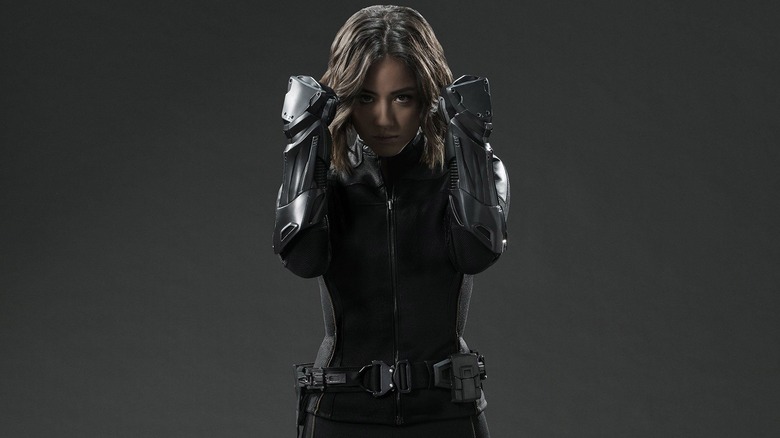
Agents Of SHIELD Star Says She's Not In Secret Invasion, Stop Bothering Her At Target

by Jeremy Mathai

With the Marvel Cinematic Universe expanding outwards in bigger and bolder directions, fans of Marvel's "Agents of S.H.I.E.L.D." have been clamoring for the popular characters from the Marvel Television production to cross over into the MCU proper in a future film or TV series. That possibility has always seemed rather unlikely, especially considering the fact that "Agents of S.H.I.E.L.D." operated under Marvel Television -- a division entirely separate from Kevin Feige's purview that focuses more on movies and Disney+ shows.

However, that hasn't stopped vocal supporters from voicing their hopes that Marvel would bring Chloe Bennet's Daisy Johnson/Quake into the official "canon" of the shared universe, specifically through the upcoming "Secret Invasion" series. That message has reached all the way to Bennet's ears and, well, fans might be a little disappointed by what she has to say.

Addressing The Rumor Mill

Great, now you've all broken Chloe Bennet. With the increasing noise among the fanbase becoming too loud to ignore, the actor recently took to her Instagram story (you can watch part of the video here) to dispel any and all rumors that she might have anything to do with "Secret Invasion." The Disney+ series is steadily getting into shape with a star-studded cast and a Skrulls-centric plot presumed to be based on the "Secret Wars" comic series which -- theoretically, at least -- could serve as a seamless entry point for some members of the "S.H.I.E.L.D." cast to finally join the rest of the MCU. According to Bennet, however, those dreams are likely to remain exactly that. Thanks to Screen Rant, the full transcript of her comments are as follows:

"I have avoided saying anything like this in general, on social media or whatever, because I thought maybe it would blow over, but it has not. I am in no way attached or involved, even at all or a little bit, in the Secret Invasion Marvel thing. I honestly don't even know really what that is ... I am only coming on here to say this because it has gotten to the point that every day I'm getting hundreds of messages about this ... I'm now getting like approached in person. Today it was in the tampon aisle at Target ... So I figured I would just clear the air."

Leave Chloe Alone!

As much as we'd like to think that the public figures who portray superheroes in movies and TV are actually the biggest, most invested fans of those characters, the reality is that most actors tend to look at it as little more than a steady source of income and would just like to be left in peace while shopping at Target during their downtime. The rest of us may not enjoy even close to the same level of fame or fortune, but only a monster wouldn't be able to sympathize with that! Of course, that's not to imply Bennet didn't enjoy her years-long run as Quake on "Agents of S.H.I.E.L.D." or wouldn't return Feige's phone calls if he reached out and offered her a role in some future. That said, I think we can all agree that accosting actors in public to ask them to spill the beans on potential future appearances that they wouldn't be allowed to confirm anyway is, uh, not great.

Unless this whole thing turns out to be a complete ruse designed to throw creepy obsessives off the scent, the Quake-less "Secret Invasion" series will debut on Disney+ sometime in 2022.

Read this next: Marvel's 'Secret Invasion' Series Will Be Smaller Than The Comic, But Will Be "A Showcase" For Samuel L. Jackson And Ben Mendelson

The post Agents of SHIELD Star Says She's Not in Secret Invasion, Stop Bothering Her at Target appeared first on /Film.

23 Sep 22:56

Watch: A sheep with its head stuck in a barbed wire fence is rescued by a human super hero

by Carla Sinclair

A sheep in Australia who got its head stuck in a barbed wire fence couldn't have asked for a better human to come along. Watch how this passerby — former Australian rugby player Nick Cummins — swoops in, skillfully unhooking the sheep, calming it down, and then, after strategizing, hoisting it over the fence and back into the field. — Read the rest