Ronald.phillips
Shared posts
Valve Launches "Steam Deck Verified" Program For Games That Run Well On The Steam Deck
Apple Announces The M1 Pro / M1 Max, Asahi Linux Starts Eyeing Their Bring-Up
Congratulations To Michael Myers For Achieving A Personal Best Murder Score In Halloween Kills
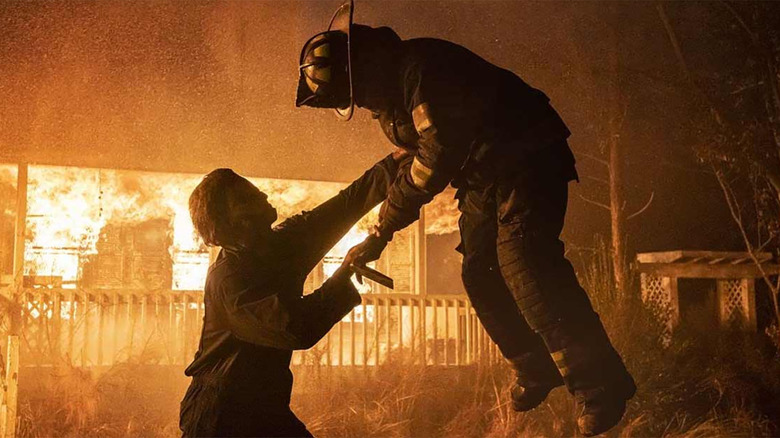
"Halloween Kills" may be getting sliced and diced by critics, earning a 39% critical score on Rotten Tomatoes, but that didn't stop the movie from topping the box office this past weekend with a whopping $50 million opening weekend, in spite of being simultaneously released for streaming on Peacock. In fact, the latest "Halloween" sequel (which isn't all bad) ushered in another big number for the franchise, and it's Michael Myers who deserves the congratulations.
"Halloween Kills" has the highest death count of any film in the "Halloween" franchise. Though not everyone dies at the hands of Michael Myers, the masked killer still achieved a personal best in the number of kills executed in the film, and it's enough to set the record for the most kills at the hands of any slasher in mainstream horror movie history.
Michael Myers: Murder Champ
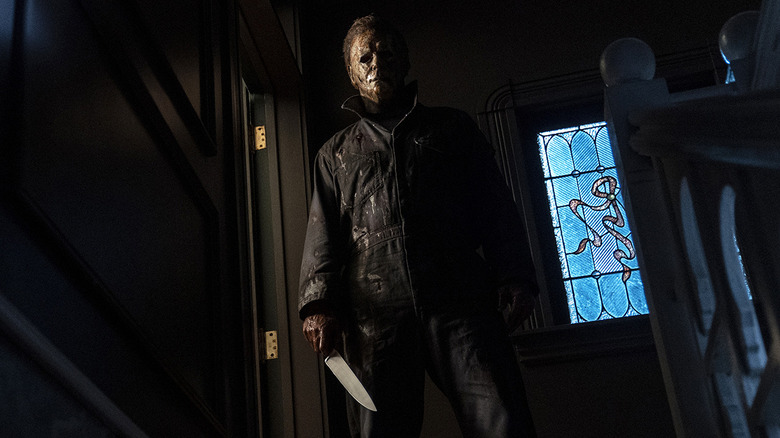
ComicBook.com (of all places) pointed out the record-setting murder count achieved by "Halloween Kills," with most of the kills coming from Michael Myers himself. The film shows 30 people being killed in the film, and 25 of them are confirmed to die at the hands of Michael Myers. Not only is that enough to beat out any of the "Halloween" movies, with the next closest being "Halloween: The Curse of Michael Myers" with 17 kills (and we're not counting the "Halloween" remake's 18 kills in 2007).
Even more impressive is Michael Myers' new personal best is also several bodies ahead of the rest of the contenders. The closest to the new record is Victor Crowley's 22 kills from "Hatchet III." However, that falls a little outside of mainstream horror, so the next most murderous is 22 kills by Jigsaw in "Saw 3D," followed by 21 kills by Jason Vorhees in "Jason X." It's the "Friday the 13th" slasher who has the most consistently high kill count, but Michael Myers isn't far behind, and he's now the murder champ.
Even though "Halloween Kills" is a little messy and clumsy in executing the not so subtle thematic elements, the kills are some of the most gory and inventive that we've ever seen from Michael Myers. A firefighter massacre is particularly gruesome, and without spoiling anything specific, let's just say the third act is where the most murderous Michael Myers is unleashed. In fact, it's possible that Myers killed more than 25 people since it's hard to account for the true body count in the conclusion's killing spree.
Is there a chance "Halloween Ends" will eclipse all of these? More than likely we're looking at a final showdown between Laurie Strode and Michael Myers, but usually some stupid people always end up getting in the way. Hell, in "Halloween Kills," most of the victims intentionally put themselves in the path of Michael Myers.
"Halloween Kills" is playing in theaters now, and it's also available to stream on the premium version of Peacock. "Halloween Ends" is slated to arrive in theaters on October 14, 2022.
Read this next: The 11 Scariest Scenes In The Halloween Franchise
The post Congratulations To Michael Myers For Achieving A Personal Best Murder Score In Halloween Kills appeared first on /Film.
Meet Rob Zombie's Munsters In First Look At The New Cast
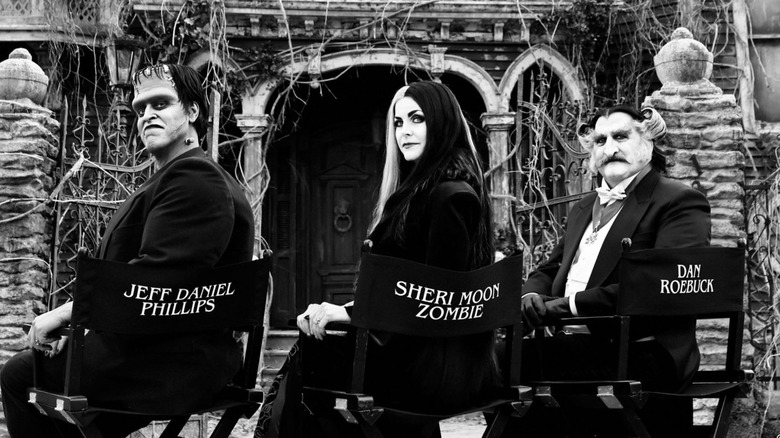
When it was first announced that Rob Zombie was remaking "The Munsters," many were fearful that the characters would get a gritty re-design the same way his characters in his "Halloween" remakes suddenly all had matted hair and bathrooms that looked like the inside of a punk dive bar. Skeptics fear no more, as Rob Zombie took to Instagram today to give the first look at Herman, Lily, and Grandpa Munster in front of 1313 Mockingbird Lane ... aka, on-set in Hungary. The photo confirms that frequent Zombie collaborators Jeff Daniel Phillips, Sheri Moon Zombie, and Daniel Roebuck are playing Herman, Lily, and Grandpa, respectively.
The Legacy Of The Munsters
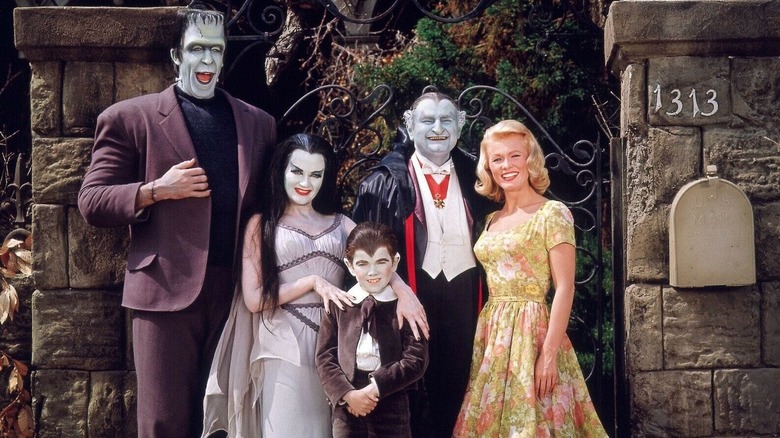
Premiering in the fall of 1964, the same year that audiences would fall in love with "The Addams Family," you might think "The Munsters" was a long-lasting show spanning decades, considering the popularity and iconography of the show has continued for generations. In reality, the show was only on the air for two seasons. The Munster family were a collective of monsters based on the Universal Monsters of the 1930s. Patriarch Herman Munster shares a striking resemblance to Frankenstein's monster and is happily married to the vampiric Lily who dons a single white streak in her hair like the titular "Bride of Frankenstein." Together they have a werewolf son named Eddie and the family also houses Lily's father, Grandpa Munster, who resembles Count Dracula, and their very conventional-appearing niece Marilyn who laments that her "ugliness" of not looking like a ghoulish creature is why she struggles so much to find a boyfriend.
The show was produced by the same people who made "Leave it to Beaver," with "The Munsters" serving as the subversion of the traditional family sitcom. The show exploded in popularity and became a merchandising sensation, something we still see today thanks to companies like Retro-A-Go-Go. "The Munsters" was far more philosophically progressive compared to most sitcoms, juxtaposing the monstrous look of the family to express themes of learning to base opinions of people on who they are and how they act rather than what they look like on the outside. Despite the premature cancellation, "The Munsters" enjoyed a great life of syndication and spawned multiple spin-offs, films, and tv specials.
Rob Zombie's Love Of The Munsters
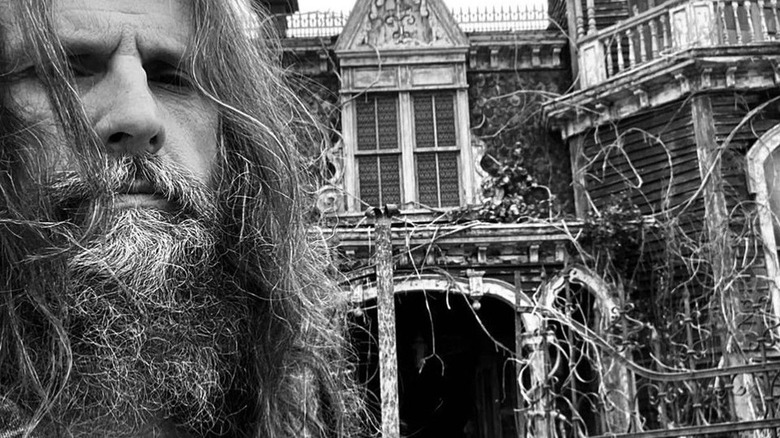
"The Munsters" are a beloved show for generations, but there are few people who love the show quite like Rob Zombie. Before Zombie began filmmaking, he was a prolific musician, with his most famous song being "Dragula." The song gets its namesake from the "Drag-U-La" drag racing car Grandpa Munster makes in the episode "The Munsters: Hot Rod Herman." Rob Zombie quite literally owes his entire career to "The Munsters" and the inspiration it provided him.
Based on the photo shared to Instagram, Rob Zombie knows the importance of keeping true to the spirit of "The Munsters."
So far, everything Zombie has been posting regarding "The Munsters" has all been in black and white, leading many to speculate that the final film will follow suit. Zombie has been trying to make a reboot of "The Munsters" for over two decades, so it's exciting to see the film finally coming to fruition.
Read this next: 14 Awesome Comedies That Never Got Sequels
The post Meet Rob Zombie's Munsters in First Look at the New Cast appeared first on /Film.
Apple's MacBook Pro Models Get a Redesign, New Chips and MagSafe Charging


Read more of this story at Slashdot.
Password Auditing Tool L0phtCrack Released as Open Source
The password auditing and recovery tool L0phtCrack is now open source and the project is looking for both maintainers and contributors.
First released in 1997, L0phtCrack can be used to test password strength and recover lost Windows passwords via dictionary, brute-force, and other types of attacks.
Hit-Monkey Trailer: Marvel Presents A Simian Assassin On Hulu
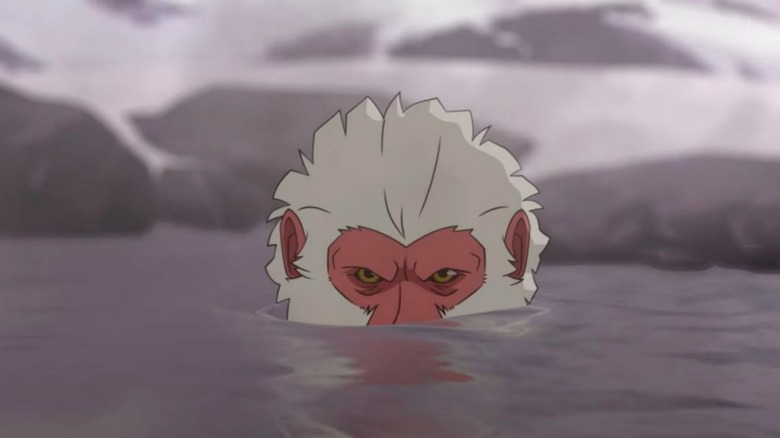
"You're going to have to kill some evil people who totally deserve to die ... 'cause it's your destiny."
Even with the ongoing superhero boom introducing general audiences to all sorts of B- and C-tier characters that comic fans never could've even imagined going mainstream, few might have expected a violent, manic-looking, adult-oriented animated cartoon adaptation of ... "Hit-Monkey," of all things. That's precisely what's happening, however, as Marvel has teamed up with Hulu to bring the adventures of the monkey-turned-hitman to streaming. These days, truly no character is too obscure or too silly to get its own movie or series. The first trailer was released alongside a helpful explainer to give audiences a better feel for the characters and concept of this project, but this latest footage shows off even more confidence and personality as it attempts to spice things up. You can watch the "Hit-Monkey" trailer below.
Hit-Monkey Trailer
Originally created by writer Daniel Way and artist Dalibor Talajić in 2010, this animated "Hit-Monkey" adaptation comes from Josh Gordon and Will Speck. The two are best known for "Blades of Glory" and "Office Christmas Party" and will serve as creators, showrunners, and executive producers for the cartoon. They've also brought along co-stars Jason Sudeikis and Olivia Munn from "Office Christmas Party" as well, both of whom will be voicing major supporting characters named Bryce (the assassin who dies and becomes "ghost-leashed" to the primate) and Akiko, respectively. Fred Tatasciore voices the main Monkey himself and will be joined by George Takei as Shinji, an honest politician with his eyes set on becoming the Prime Minister of Japan. Other cast members include Ally Maki as reform-minded cop Haruka and Nobi Nakanishi as Karuka's partner Ito.
All ten episodes of "Hit-Monkey" will fight its way to Hulu on November 17, 2021. The series has previously been described as:
Monkey's peaceful existence in the Japanese alps is shattered by the tragic loss of his tribe—setting him on a course of revenge and violence in the very world of humans that are responsible for his plight. He's a killer of killers with a bit of a rage problem. Throughout the series, he must learn to navigate the struggle between his inherently sweet nature and the evil acts he must commit. It's through his complicated friendship with the Ghost of Bryce (a former assassin and now, Monkey's unwanted conscience), that will determine whether Monkey will be consumed by his rage or channel it for good. This is the story of Hit-Monkey.
Read this next: Every MCU Post-Credits Sequence Ranked From Worst To Best
The post Hit-Monkey Trailer: Marvel Presents a Simian Assassin on Hulu appeared first on /Film.
ripsaw8080 committed [r4467]
The Movies That Made Us Creator Brian Volk-Weiss On Learning To Love Horror [Interview]
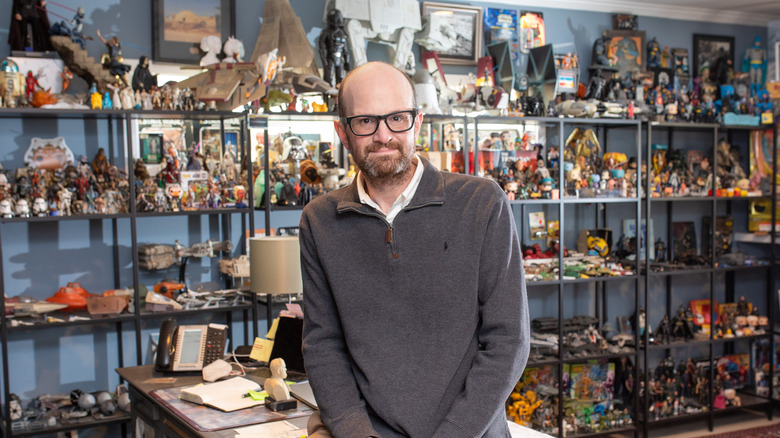
"The Movies That Made Us" has a new third season now available on Netflix, releasing episodes on quite a few horror classics just in time for Halloween. As always, the mini-doc series promises to bring together the cast and crew behind your favorites to look at the origins, unknown tales, and interesting stories behind a number of beloved films of this spookiest of holiday seasons. Season 3 includes episodes on the infamous trilogy of slasher classics, John Carpenter's "Halloween," Sean S. Cunningham's "Friday the 13th," and Wes Craven's "A Nightmare on Elm Street" alongside additional episodes on James Cameron's "Aliens," "Robocop," "Coming to America" and more.
I sat down with Brian Volk-Weiss, the creator of "The Movies That Made Us" and its companion series "The Toys That Made Us," both for Netflix. We chatted about the series, surprising and little known tidbits that arose in his interviews and research, favorite slashers, and the personal favorite episodes he'd love to shoot that haven't made it in quite yet.
"Context... Is One Of My Favorite Words In The English Language."
This season branches off into a healthy dose of horror. Why horror for these episodes?
So horror, it's really interesting. I've always respected horror. I have so many friends who love it as a genre but I never really got it... I'm a science fiction guy, you know? [...] I'm a history guy, I'm a drama guy. For the first time with "The Movies That Made Us" ... and I'm not trying to claim that I was an expert in "Dirty Dancing" beforehand but I'll be honest with you, I was exponentially more familiar with "Dirty Dancing" than I was "Halloween" and "Friday the 13th" in particular. So I really was learning while making the show, and I came out of it with a ... 'I get it, now I get it.' I was at the premiere of "Halloween Kills" last night, and I'm watching it... And I was at the L.A. premiere of the last David Gordon Green "Halloween" and it was apples and oranges because now when I watch the movie, I understand (for lack of a better word) the history that led to that movie. Does that make any sense?
Definitely. I feel like that's why some fans are so into horror history, the context really, really matters.
Context is everything... one of my favorite words in the English language.
I know you just saw Halloween Kills, but are there any other horror films that you've seen since recording these episodes that you really got into?
Well, it's funny... I had to do a lot of research for the show, I always do the research, but [...] because horror had never been my favorite genre, during the research phase [...] I kind of saw everything. I probably did a lifetime's worth of horror movies, it was crazy. But yeah, "Black Christmas" ... I really hope we get to do an episode on "Black Christmas." Have you seen that?
I have. I love "Black Christmas."
I really wish we could have done "Black Christmas." So good. [... And] everybody makes fun of this movie, but "Chopping Mall." That's my new favorite movie. [...] I've got a "Chopping Mall" T-shirt now, a "Chopping Mall" VHS. I had never seen movies like that before. It's funny. Thanks to "The Movies That Made Us" I've actually become ... I hope he is not offended by me using this word, but I've actually become friends with Ed Neumeier, the writer of "Robocop," and his wife edited "Chopping Mall." So [ ... ] I'll get a text and I'll feel my phone vibrate, I'll look at my phone, I'll see Ed Neumeier's name. I still can't believe that, because I'm the biggest "Robocop" fan you'll ever meet. But the extra bonus is getting some gossip on the making of "Chopping Mall."
"Halloween," "Friday the 13th," "A Nightmare On Elm Street," all classics. How did you land on those films?
I've learned the hard way, especially when you're starting something, you don't start with the obscure. You don't start with the back alley. If we're going to do horror movies, we're doing the classics. So it really was that simple. So it's like, if we're doing the classics, what are the classics? And then we really had to decide between, well, are we doing "The Exorcist" and "Rosemary's Baby" or are we doing something slightly more modern?
The decision that I made, which, who knows if it was the right one or not? But what I decided was I really feel like "Rosemary's Baby" and "The Exorcist" ... I really feel that those were still made when the industry considered those films dramas. Horror had not become its own genre yet. I really think the beginning of there being a genre called horror, I really think that starts with "Halloween." So "Halloween" directly led to "Friday the 13th." And both of those films directly led to "A Nightmare On Elm Street."
"They Had A Lot Of Heart."
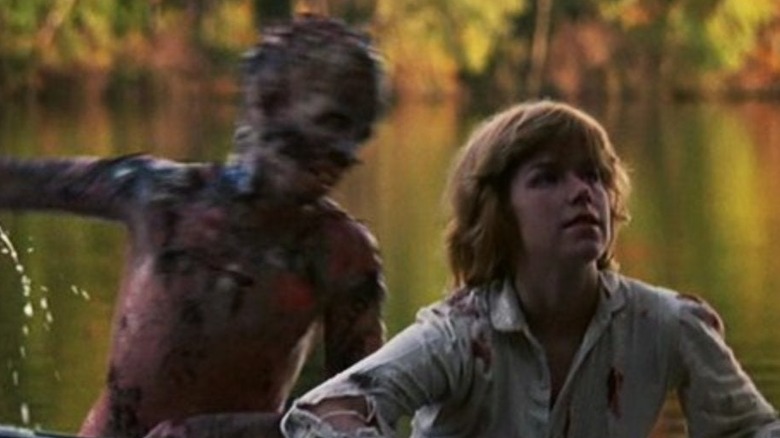
There are a number of interesting factoids in each episode, like the rejection that "The Babysitter Murders" was ever a title. Do you have a favorite tidbit that came out in the process of making these episodes?
I think my favorite thing was [that] I had a lifetime riddle solved. My entire life, even though I wasn't a big fan of "Halloween," everyone was like "Oh, it's a William Shatner mask. It's a Captain Kirk Mask." And I'm always like, "That doesn't look anything like Captain Kirk." My whole life I'm like "What is this?" Learning that they did edit the mask quite a bit and do some work on it, they didn't just turn it upside down and spray paint it, for me was like, "Okay, cool. Well, that makes sense." How come nobody ever talks about that? The thing that I loved especially about ... I mean, all three of them have it, but especially "Friday the 13th" [is that] these were kids. The crew were kids, the cast were kids. They were just goofing around [...] almost everybody we interviewed for "Friday the 13th," everybody was like "I did it for practice," or "I did it. Why not? I had nothing to do that week. Nobody's going to see this." Everybody told us that nobody's going to see this. So that was something I really loved.
"Nobody is going to see this" came up a lot during "Friday the 13th!"
Exactly. But the other thing I also love, like with "Halloween," there are so many flubs, but ... like when he smashes the window and you can see the metal bar, all that stuff. That doesn't matter. The fans don't care. And that's what I find extremely interesting and very cool about the genre, where they just got it right. The other thing I learned, which I thought was interesting, is even [with] "Halloween" people think, "Oh, 'Halloween' came out and changed everything," which is true. But [ ... ] I think "Halloween" blew up [not] because it was first, but ... And I know this is a weird thing to say about these horror movies, but I really think these films pop for two reasons that made them special.
One was they actually ... again, I know this is crazy to say about these films, but I believe it ... they had a lot of heart, they really did. Yes, it's a dumb slasher film. Yes, it's very simple concept, but they had heart. You could tell they were made by people that care about what they were doing. And I don't think that's true for a lot of other horror films of that era, so that's the first thing. And then the second thing is they were really well cast. Again, if you look at some of the other movies that came out at the same time, the casts aren't great. The acting ... Again, I know it's not "Amadeus." It's not "Gladiator." I get it. But my point is, compared to a lot of other movies in the genre, these three films [...] had really good casts, and I don't just mean good acting. They had charisma. These were actors with charisma. And that's what makes a movie work. That's what makes a movie stand out.
It's so interesting too. I mean, you look at the people that got started in these roles, like Johnny Depp and Kevin Bacon. They're people that became some of the most charismatic and recognized actors of all time, starring in cheap movies like "Friday the 13th."
Exactly. And by the way, again, with very few exceptions, you're not going to find other horror movies with a comparable quote-unquote graduating class. It really shows you how impressive the casting was.
"Usually At The End Of The Movie It's The Woman Who Saves The Day."
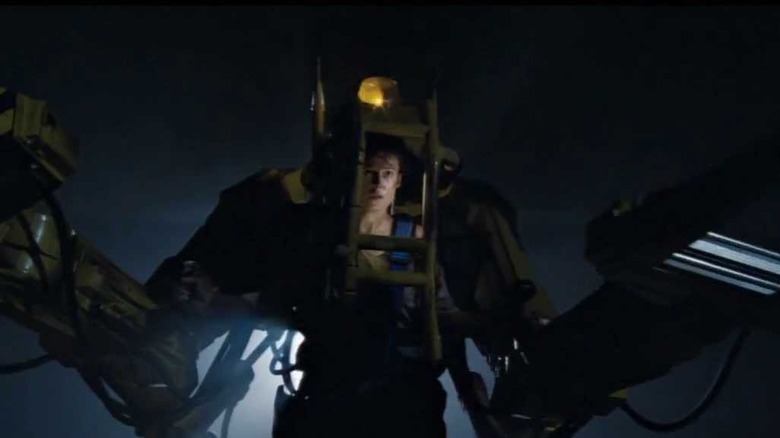
Were there any moments for digging into these films that, that made you stop and think, "Well, they couldn't do that today"?
Oh, my God. Yeah. Oh, let's start with, I don't know, chopping a snake in half, a real snake. [...] I guarantee you ... Well, anyway. I won't go there. But yes, definitely. You're not going to cut a snake [...] I'll tell you another thing I thought was interesting is ... again, having not been a huge horror fan in my whole life, I think there's a real misconception with these movies that the female protagonists are victims.
I thought it was extremely interesting that a genre that has a reputation for all these women being chased around and needing the men to save them and all that stuff, which by the way was true in almost every other genre of that era... [ in ] horror, almost every one of these movies [ ... ] usually at the end of the movie it's the woman who saves the day. Point other movies to me in the late '70s, early '80s, where that's the case.
At least three of the films from this season have not even just survivor female protagonists, but you're looking at Jamie Lee Curtis, you're looking at Sigourney Weaver, you're looking at Heather Langenkamp. They're literal bad-asses. They're incredibly strong characters.
Exactly. And none of those characters were trained to be bad-asses, they just rose to the occasion. That's what all four films, if you're going to include "Aliens," that's what all four films have in common. And by the way, I'll put Nancy Allen in "Robocop" on that list too.
"Robocop" is such a classic, and I know it means something to you. What's something surprising you learned digging into that film for this season?
Well, "Robocop" was the opposite of the horror films. I hate using this word, but I think I can safely describe myself as a expert on "Robocop." I've conservatively seen it 300 times, and I have an entire shelf in my collection dedicated to "Robocop." There were very few surprises. [ ...]
I mean, one of the surprises was [ ... ] it really was another film where, to use a cliche, it was 'lightning in a bottle.' [ ... ] I knew there was a lot of problems with the suit. I knew Peter Weller wasn't getting along great with everybody, but I didn't realize they fired him. I mean, he absolutely was on the path to being sent home. I never realized how bad it got and how Peter basically had to turn [around] and immediately behave, otherwise he would've been kicked off the movie. We have it in the episode. They were literally asking a stunt man who had no acting experience, but could fit in the costume, if he'd be willing to play Robocop if they fired Peter Weller. I did not know it got that close.
"Here's The Star Of The Movie Getting Into A Fistfight With His Director."
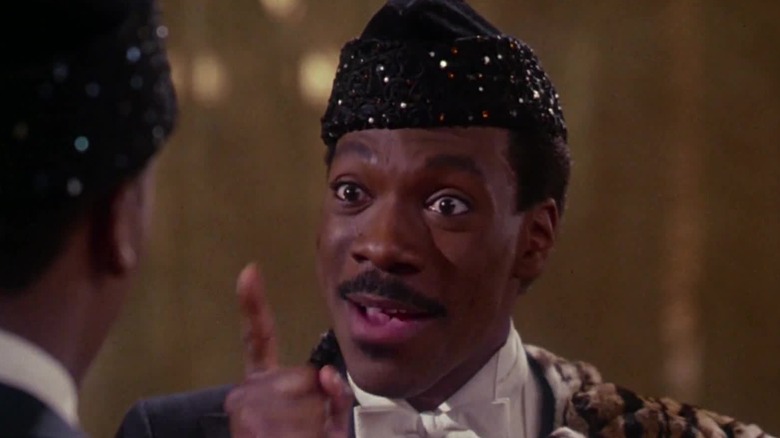
Are there any other stories that you think are particularly interesting to pull out from this season?
Oh, my God. I mean, where to start? One of the things we did that I have always wanted to do [ ... but ] finally was able to do it in the "Coming to America" episode, we did this Rashomon thing. [ ...] I actually knew this before the episode was greenlit because I did Arsenio Hall's Netflix special and he had told me this story after, so I had known for a little while [...] Eddie Murphy had literally gotten into a fist fight with John Landis while making the movie.
What was interesting, and this is what I'd always wanted to do but I'd never been able to do until now, is we did this whole little [piece] where literally ... I think we asked six or seven people what caused the fight, and we got six or seven different answers. And we put them all in the episode. I have my theory as to which one is correct, but the fact that ... here's the star of the movie, one of the most famous people on earth, getting into a fistfight with his director in front of 100 people, that's pretty wild. And we were able to get at least six or seven of those people to tell us what happened. And then you hear completely different stories. It says a lot about the human condition.
"Every Time A Movie's Made, It's Really About Luck."
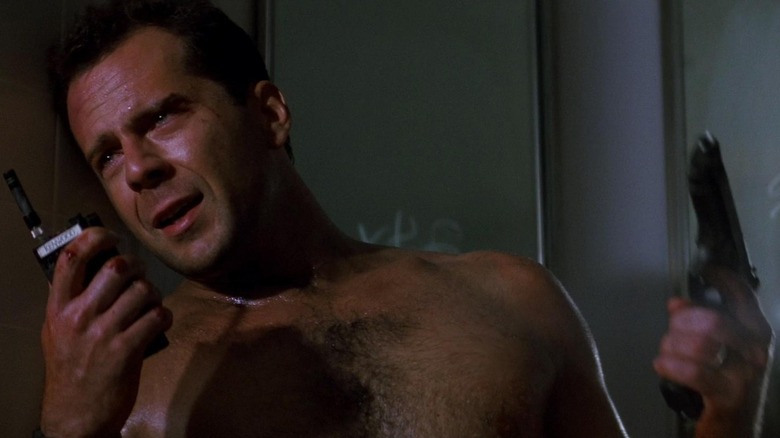
These stories from behind-the-scenes are so illuminating.
Well, one of the things I've learned from now making, I think, 16 episodes of this show is ... Oh, my God. Every time a movie's made, it really is about luck. You can do all the preparation you want, you can have the most talented people, but [ ... ] there are so many separate things that have to line up for a movie to work.
The other thing, which I always find so interesting about a lot of the movies we've covered ... Fox had no idea what "Home Alone" was. Warner Brothers let it go. A lot of these movies have in common [that] they almost get green-lit by accident. So many of the films we covered were green-lit because "they needed a movie in August," of the following year, other deals they were trying to do fell apart. So they're like, '"All right, we'll make 'Die Hard.'" When "Die Hard" was in production, "Midnight Run" was also in production and everybody at Fox was talking about "Midnight Run." Nobody was talking about "Die Hard." So that's one of the things if you watch every episode, you'll see all these people being like, "Oh, look at that line in front of the movie theater. I wonder what movie that is... Oh, my God, it's my movie." Almost all these were ... Half of them weren't even sleeper hits. They were massive hits out of nowhere...
One final, very difficult question. Personally, between Michael Myers, Jason and Freddy, who's your favorite on a personal level?
I mean, no offense to Jason and Mr. Myers, but first of all, they don't talk. Let's start with that. Second of all, they're kind of simple. Michael Myers just kind of walks around and for the most part, just smashes people against walls. Freddy, extremely funny. He does talk and is very creative. Of those three movies, I really respected "Halloween" and "Friday the 13th," but I enjoyed "A Nightmare On Elm Street." So that also definitely ties into my answer.
Read this next: The 20 Best '80s Horror Movies Ranked
The post The Movies that Made Us Creator Brian Volk-Weiss on Learning to Love Horror [Interview] appeared first on /Film.
OpenMW is an open-source reimplementation of classic RPG Morrowind

Morrowind is the most interesting place in the fantasy world of The Elder Scrolls, with its weird ecology and insular culture, and the game by that name will be 20 years old next year. Despite its age, Morrowind's fan following remains strong and there are countless projects keeping the game fresh and fascinating for players new and old alike. — Read the rest
Proud Boys lament lack of female companionship

The Proud Boys, what with all the sexism and far-right ideology, seem to be having trouble finding romance. Ron Filipkowski notes that at the gang's 'Fall Love Fest' rally this weekend, a speaker made a point of announcing that many of the attendees were single and "looking for housewives." — Read the rest
Banks Informed U.S. Treasury of $590 Million in Ransomware Payments
The United States Department of the Treasury’s Financial Crimes Enforcement Network (FinCEN) has identified a total of 177 cryptocurrency wallets associated with the top 10 most commonly reported ransomware variants during the first half of the year.
Y: The Last Man Has Been Canceled By FX On Hulu
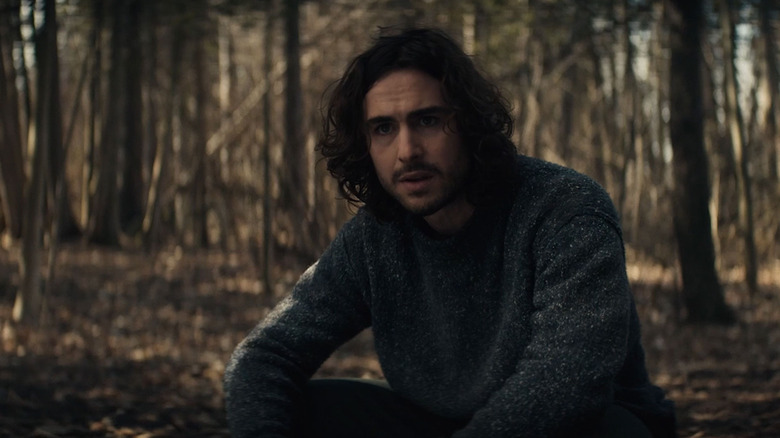
Unfortunately, these guys — unlike their show's title — won't be the last men standing on FX. On October 17, showrunner Eliza Clark took to Instagram to reveal that FX's "Y: The Last Man" had been canceled by the network.
"We have learned that we will not be moving forward with FX on Hulu for Season 2 of 'Y: The Last Man.' I have never in my life been more committed to a story, and there is so much more left to tell. 'Y: The Last Man' is about gender, about how oppressive systems inform identity. We had a gender diverse team of brilliant artists, led by women at almost every corner of our production. Producers, writers, directors, cinematographers, production design, costume design, stunt coordination, and more. It is the most collaborative, creatively fulfilling, and beautiful thing I have ever been a part of. We don't want it to end."
She added, "FX has been an amazing partner. We have loved working with them, and we're sad YTLM is not going forward at FX on Hulu. But we know that someone else is going to be very lucky to have this team and this story. I have never experienced the remarkable solidarity of this many talented people. We are committed to finding Y its next home."
Brian K. Vaughan, the writer of the original comic book series on which the show is based, also reposted Clark's words to his Instagram and added his own about the "unexpected hard" news.
"This is not the first time in twenty years I've seen Yorick [and] co. escape the seemingly inescapable! I love this show, and I'm very hopeful Y will find a new home, not just because it happens to employ more extraordinary women, people of color, and members of the LGBTQ+ community—both in front of and behind the camera—than any project I've ever been a part of, but because they've made something spectacular, the kind of thoughtful, contemporary, fearless evolution of the comic that @pia.guerra and I always wanted. These next three episodes are the very best of the season, so please keep watching, and if you want to see this journey continue as much as I do, we encourage you to let the world know: #YLivesOn."
Clark also used the #YLivesOn hashtag in her post, so it is clear the "Y: The Last Man" crew is gunning hard to be revived.
Will The Short-Lived Series Live On At Another Streamer?
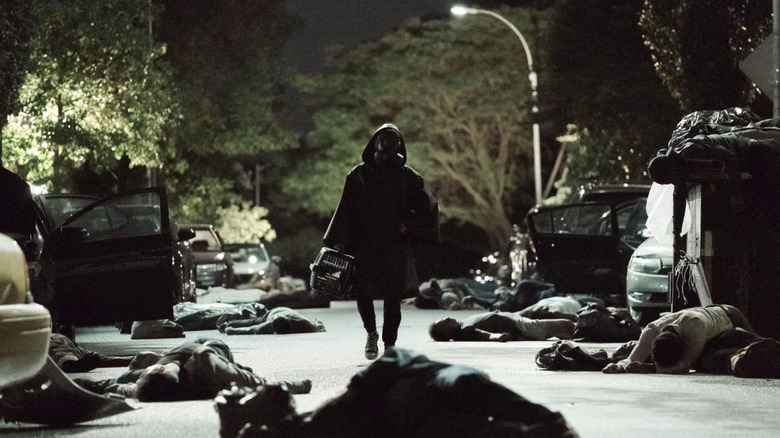
The post-apocalyptic science fiction series premiered on September 13 with Eliza Clark penning and Louise Friedberg directing the first two episodes. The 10-episode season — which stars Amber Tamblyn, Olivia Thirlby, and Diane Lane — will take its final bow on FX with its upcoming November 1 finale.
The source material was written by Brian K. Vaughan and illustrated by Pia Guerra. The original comic book series was published by Vertigo from 2002 through 2008.
As far as the #YLivesOn movement, there has yet to be another network or streamer that has expressed interest in picking up the series now that it is a free agent — but considering how shows like "Brooklyn 99" and "One Day at a Time" were brought back from the grave over the last few years due to an overwhelming fan response, "Y: The Last Man" definitely has a shot. Heck, fans were able to get the Wachowski's Netflix sci-fi drama "Sense8" back for a two-and-a-half hour finale in June 2018 after their cancellation announcement left their second season with a cliffhanger. Genuinely, anything is possible these days. So, for those reasons, I wish this show the best outcome. Hopefully, you can get back up again after being cut at the knees.
Read this next: Shows Like Breaking Bad That You Can Binge Watch Today
The post Y: The Last Man Has Been Canceled By FX on Hulu appeared first on /Film.
Denuvo removed from Shadow of the Tomb Raider & Rise of the Tomb Raider
Square Enix has released two new patches for Shadow of the Tomb Raider and Rise of the Tomb Raider that remove the Denuvo anti-tamper tech. Moreover, and as promised, these new patches add support for the latest version of the NVIDIA DLSS tech. Going into more details, this new update for Shadow of the Tomb … Continue reading Denuvo removed from Shadow of the Tomb Raider & Rise of the Tomb Raider →
The post Denuvo removed from Shadow of the Tomb Raider & Rise of the Tomb Raider appeared first on DSOGaming.
Third-Party Attacks Are Increasing, But Third-Party Risk Management Is Failing
The risks associated with supply chain (for software and services) is huge and growing. A new report shows that boardroom awareness and budgets for third-party risk management has increased; but this is not necessarily translating into effective action.
New Salem Witch Trials exhibit re-examines the meaning of "witch"

The Salem Witch Trials: Reckoning and Reclaiming is a new exhibit at the Peabody Essex Museum in Massachusetts that aims to re-examine and re-contextualize the whole idea of "witches". From the website:
— Read the restMore than 300 years after the Salem witch trials, the personal tragedies and grievous wrongs that occurred still provoke reflection as we continue to reckon with the experiences of those involved.
Windows 11 only allows admins to print in certain situations
It’s now been a couple of weeks since Windows 11 launched, and as you may know, it came with a few known issues. One of those issues affects AMD processors, reducing the performance of the L3 cache in those CPUs. Many known issues in the initial Windows 11 release have been fixed with a recent cumulative update for Windows Insiders, but there’s one known issue that has still slipped through the cracks. As noted on a Microsoft support page (via BleepingComputer), there may be certain situations where only administrators of a PC are allowed to print documents on Windows 11.
To be fair, the issue will likely only affect a subset of users. What happens is, when printing documents using a print server, users may be asked for administrator permissions every time they attempt to print using Windows 11. This only happens when using a print server that’s in a different time zone from that of the PC itself, so it won’t be a major problem for most. Regardless, if you happen to be affected, it might be a major hurdle to productivity.
This printing problem isn’t completely new with Windows 11. Windows 10 users were affected by a similar problem after the September Patch Tuesday update. However, the issue was fixed last week with the October Patch Tuesday rollout. Windows 11 users, however, didn’t receive that fix. Even the recently-released update for Windows Insiders in the Beta channel doesn’t seem to fix the problem, or at least, Microsoft made no mention of it.
In its support page detailing the issue, Microsoft does say a fix is expected to come in late October. Typically, Windows received optional updates towards the end of the month, and those updates are then rolled into the following month’s Patch Tuesday rollout, which is mandatory. As such, unless you’re willing to update manually, you may be waiting until November to get a fix via Windows Update. Still, at least you’ll have the ability to address the issue in the next week or two.
Microsoft isn’t offering any workarounds for the issue, so anyone affected will simply have to deal with the security prompts until the fix is rolled out.
The post Windows 11 only allows admins to print in certain situations appeared first on xda-developers.


Watch Greta Thunberg rickroll the world

At yesterday's Climate Live concert in Stockholm, Greta Thunberg took the stage to massive applause before stating: "We're no strangers to love." And with that, the rickroll began.
"At the end of the day, we are just teenagers fooling around with each other, not just the angry kids the media often portrays us as," Thunberg told Swedish newspaper Aftonbladet. — Read the rest
Jennifer Coolidge Is Returning For The White Lotus Season 2
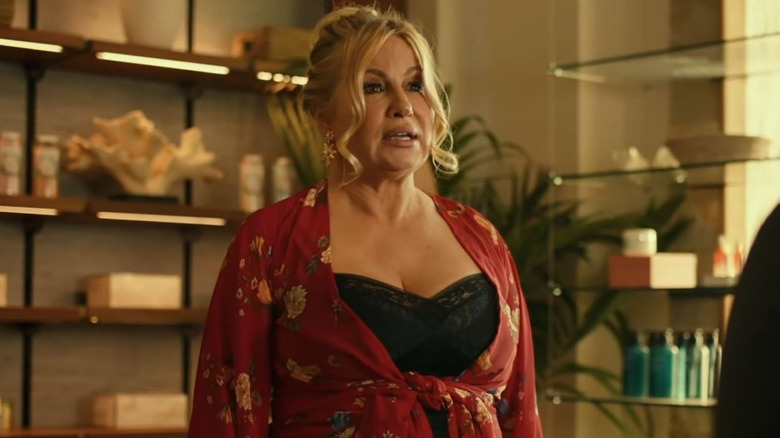
The best part of "The White Lotus" — yep, you knew I meant Jennifer Coolidge — will return to season 2. Can I get a W in the chat, please?
According to TVLine, several sources confirmed on October 15 that the legendary actress will be reprising her role as Tanya McQuoid (that's pronounced McWad, by the way) in season 2 of the hit HBO Max series.
As previously revealed by HBO, the second season of the series will step away from Hawaii "and follow a different group of vacationers as they jet to another White Lotus property and settle in temporarily amongst its inhabitants." The next destination for the show will reportedly be somewhere in Europe, but no concrete location details have been revealed.
Writer-director Mike White previously revealed that he was interested in bringing back some original cast members, but that he wanted to do it in the right way. "I don't think you can credibly have [all the season 1 guests] on the same vacation again," he told TVLine in August. "But maybe it could be a Marvel Universe type thing, where some of them would come back. We only made one-year deals with the actors, so we'd have to find out who is even available."
He also noted that he found Coolidge's success via the series "hugely satisfying" after many years of her prolific comedy roles. "She's one of the funniest people I've ever met. She's also a really nice person," White told the outlet over the summer. "And we had some false starts with other [projects] we tried to work on together, so this is very gratifying. It's probably one of the most satisfying aspects of the whole experience for me."
Remind Me Why We Loved The White Lotus Season 1, Again?
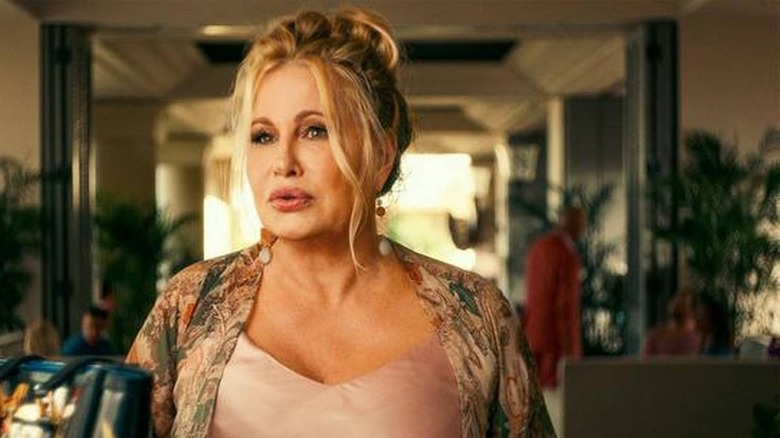
It has only been a minute since the satirical romp went off-air, but if you need a refresher, here's the gist.
The cast of season 1 was really pitch perfect and set the tone for an insightful piece that stirred up a lot of conversation in the prestige TV zeitgeist. Murray Bartlett, Connie Britton, Alexandra Daddario, Fred Hechinger, Jake Lacy, Brittany O'Grady, Natasha Rothwell, Sydney Sweeney, and Steve Zahn rounded out the cast of White Lotus Hawaii guests alongside Coolidge.
Additionally, the show's laser-sharp focus on white guilt and how white supremacy functions within friendships, families, and potential business relationships has been an interesting topic of debate — which has kept the series on the tip of everyone's tongues.
According to HBO, "The White Lotus" closed out its freshman run with 1.9 million viewers for its season finale. This number was calculated across all platforms and went up a whopping 59% from the previous week. In addition, the season finale audience went up 3.5 times from its July 11 premiere.
Read this next: 15 Shows Like Brooklyn Nine-Nine You Need To See
The post Jennifer Coolidge Is Returning for The White Lotus Season 2 appeared first on /Film.
The 31 Scariest Movie Scenes Ever
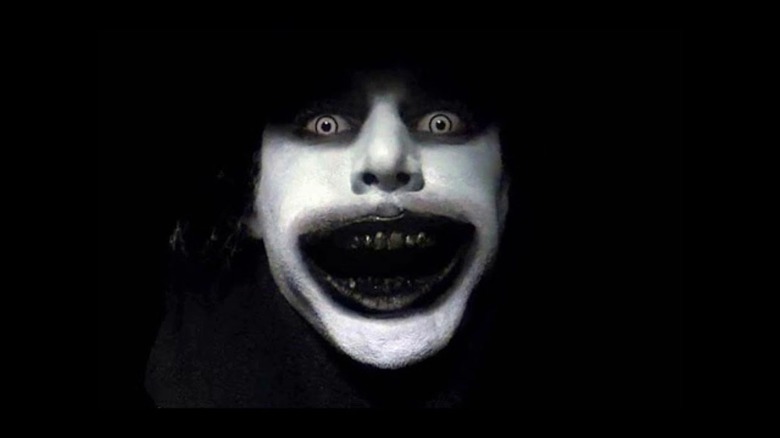
Everyone loves a good scare, and there are plenty of them — a century of horror movies has seen to that. If there's something out there that unsettles you, makes your skin crawl, or convinces you to sleep with the lights on, there's almost certainly a film that taps into it. There's no shortage of good horror movies or scares. But what about the great ones? Hell, what about the greatest ones?
As the days grow shorter and the nights grow cooler, we decided to tackle that question directly. /Film assembled its horror brain trust to compile a list of the scariest movie scenes ever, a tribute to the cinematic moments that have left us truly rattled. Over a series of conversations and several rounds of voting, we emerged with a list of the 31 moments that still manage to rattle our jaded selves to the core.
A note before we proceed: the /Film staff had several big conversations about what defines a "scary" scene for the purposes of this list, and we decided on one major rule. For this ranking, we would only consider scenes we found actually terrifying rather than scenes that were just famous. There are countless incredible horror movies with iconic scenes and sequences that we love and treasure that you will not find on this list. It hurt us to cut the shower scene from "Psycho," the low-key chills of "Rosemary's Baby," and anything from the classic Universal Monster movies. They're all masterpieces, yes, and they contain some of the greatest moments in horror cinema. But are they the scariest scenes ever? We made the tough choice to dust off the canon and retire some of the classics for our purposes here. What actually scares us, seasoned horror fans, right now? And that's what drove the list.
So let's dive in. These are the scariest movie scenes ever.
31. Something's In The Shadows In The Babadook
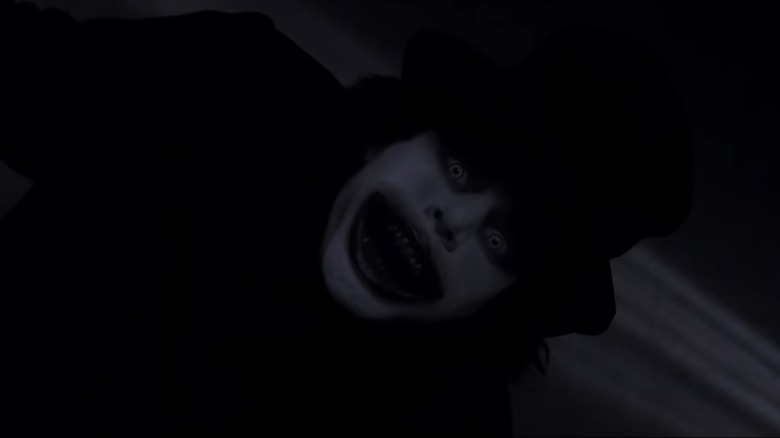
"The Babadook" is one of the most emotionally rich and thematically compelling horror movies in recent memory. It's also scary as hell. Director Jennifer Kent uses the titular monster as a stand-in for grief, trauma, and mental illness, proving once again that our greatest monsters are always metaphors.
It helps that, you know, the Babadook is really good at appearing suddenly without warning. In the film's scariest scene, widowed mother Amelia is trying to sleep, but there's a noise coming from a particularly dark corner of her bedroom.
She investigates — it's just the dog. Mystery solved.
But the noise persists.
Paralyzed with fear, she watches as ... something .. moves in the shadows. We catch quick glimpses of limbs and shapes. We hear its croaking voice. And then it's on the ceiling, crawling unnaturally, like a stop-motion creature birthed from our darkest subconscious. We don't even have time to take this in, to understand it when the Babadook lunges at Amelia. It's proof that jump scares are only lazy when they come out of nowhere. The best of them serves as the natural climax to masterfully built tension and dread. (Jacob Hall)
30. A Demonic Face Appears In Insidious
What's it say about a filmmaker's talent and a horror film's overall potency when a memorable trailer scare becomes a defining ghoulish image in the genre's recent history?
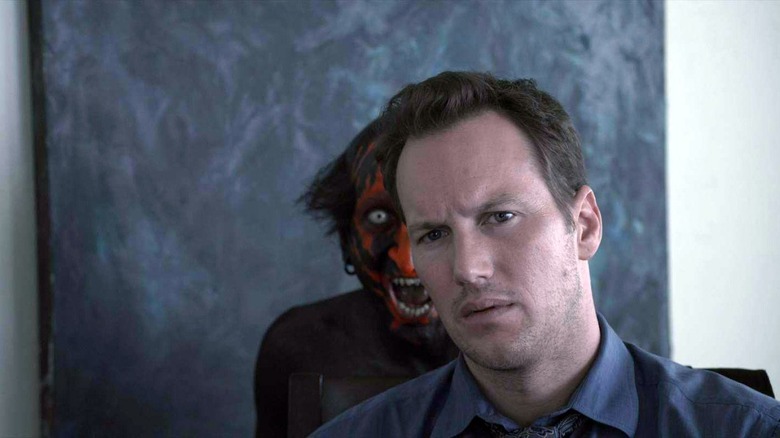
James Wan's "Insidious" is his first franchise (smh "Dead Silence" stayed silent), placing Patrick Wilson and Rose Byrne in a household under siege by demonic villains. Josh (Wilson) and Renai (Byrne) Lambert's children become targets for a resident of The Further dubbed "Man With Fire On His Face," an evil entity who some might presume is cosplaying Darth Maul at a quick glance.
For a now-infamous scare, Lorraine Lambert (Barbara Hershey) describes a dream about the red-faced demon as both Josh and Renai intently listen. As she concludes, stressing the nightmare's implications, the mentioned devil-demon appears behind Josh and hiss-scowls at Lorraine, who then doubles back in fear.
A straightforward blueprint yelp, expertly defined by Wan's camerawork as the frame focuses on one person at a time — cuts are frantic, back and forth, unassuming until the edit to Josh reveals an underworld infiltrator interrupting the otherwise quiet scene of dialogue. (Matt Donato)
29. The Hospital From Hell In Jacob's Ladder
If you're a fan of the "Silent Hill" video games, you can thank "Jacob's Ladder" for all of the nightmarish imagery.
In this 1990 psychological horror film from Adrian Lyne, Tim Robbins plays a Vietnam veteran named Jacob Singer who is plagued by fragmentary visions, disassociation, and grotesque hallucinations. Singer struggles to tell the difference between reality and delusion, with the images surrounding him switching on a dime.
The entire film is a grisly assault on the senses, but Jacob's journey through a hospital is absolutely unforgettable.
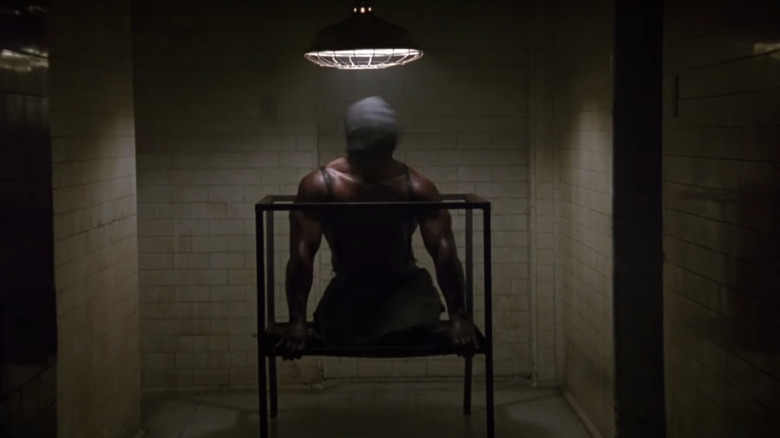
After traveling through a plastic curtain, the floor of the hospital is suddenly covered in blood, guts, and severed body parts. Hospital patients look down from the ceiling while contorting their bodies, organs get caught under the wheels of the hospital gurney, and a new horror awaits wherever Jacob looks. In the most memorable moment, Jacob looks to see a man with amputated legs trapped on a fenced table with a black sack over his head. The man's head shakes manically, at a speed impossible for humans to achieve.
This effect would be reused in future horror movies and nu-metal music videos, but the initial use in "Jacob's Ladder" was so shocking, it became the namesake for the style of filmmaking required to achieve the scare. (BJ Colangelo)
28. The Cell Phone Footage In Lake Mungo
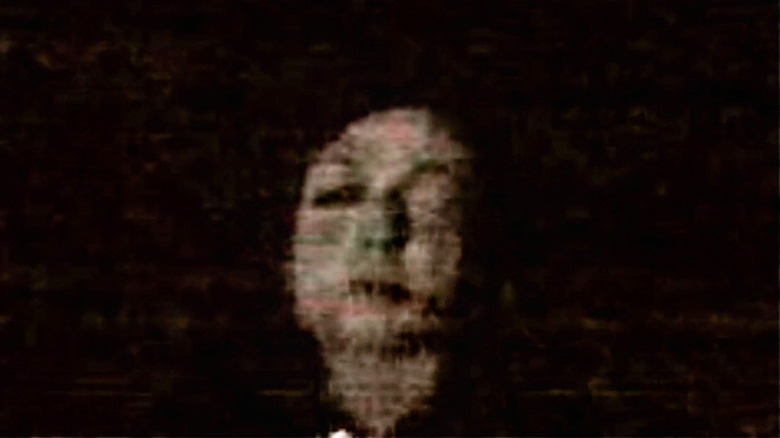
Never before has grainy cell phone footage been so deeply disturbing.
In Joel Anderson's 2008 horror film "Lake Mungo," starring Talia Zucker, a teen girl drowns while vacationing with her family at a dam. Ever since, her parents and brother struggle to come to terms with her death and begin to suspect her presence in the house, thanks to video footage set up by her brother. After digging and learning shocking secrets about Alice's personal life prior to her drowning, they travel to a spot where she was seen burying something in one of their old videos. What she buried was a cell phone, and the footage on it haunts millennials to this day.
The footage shows her walking along the shores of Lake Mungo and running into a waterlogged, corpse-like doppelgänger of herself, looking like her body was freshly pulled from the lake. It's visible for mere seconds, but that little white face is like looking at death itself, an image so chilling that people still talk about this little Aussie indie horror over a decade later. (Anya Stanley)
27. The Clown Doll In Poltergeist
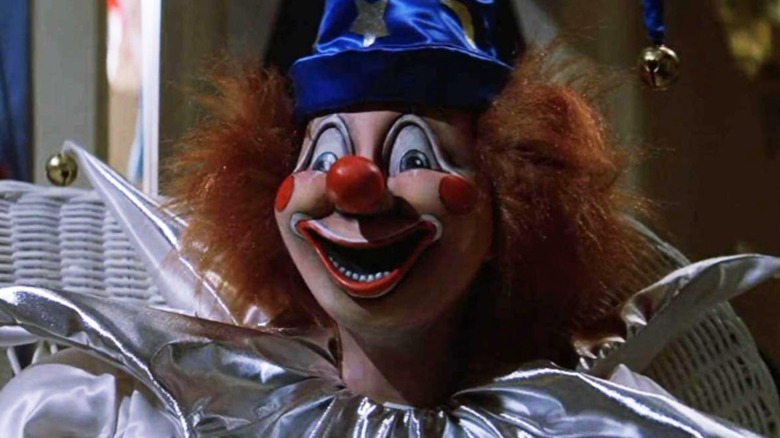
You know that clichéd scene in horror movies where a character hears a scary noise and inexplicably thinks it would be a good idea to just hang their head over the edge of the bed and look underneath it? Well, one of the reasons it became a cliché is because generations of horror directors were scarred by the infamous clown scene from "Poltergeist."
Robbie (Oliver Robins) is understandably creeped out by a clown doll in his room, and things only get scarier when he looks up to find that the clown is gone from the chair it was sitting on. Naturally, he decides to look under the bed for it, and there's a great build-up to an expected scare as he lifts the sheet. But the scare doesn't come -- there's nothing under the bed!
...Because the clown is on the bed, just waiting to grab Robbie with its creepy clown fingers as soon as he sits back up. (Hannah Shaw-Williams)
26. The Bag In Audition
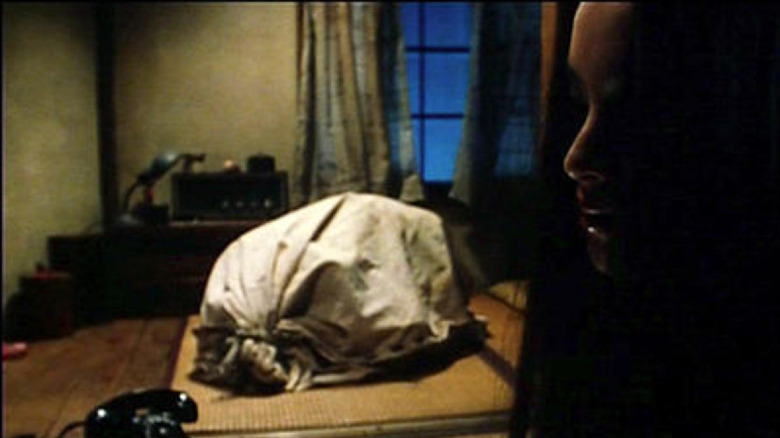
There are some scenes that require context, a revelation that builds upon the information already given. The bag scene from Takashi Miike's "Audition" is not one of them; it's creepy all on its own and could function as its own scary short film.
The moment is simple: a man, Aoyama, struggles to decide whether or not he should call a woman back. After a few rings, it's revealed that her apartment is bare except for a phone and a massive sack. The young woman, Asami, has been waiting four days for his call. Her creeping grin heightens the dread, but it kicks into full gear just seconds later, when the bag suddenly lurches towards the edge of the frame and it's apparent that Asami has been keeping something big and alive in the bag — and it only gets freakier when the contents are revealed.
Despite the scene having no more than a handful of words, it effectively ratchets up the creep factor in a film that works its way up to a shocking final fifteen minutes and an important lesson in texting back promptly. (Anya Stanley)
25. The Semi-Truck Tear In The Hitcher
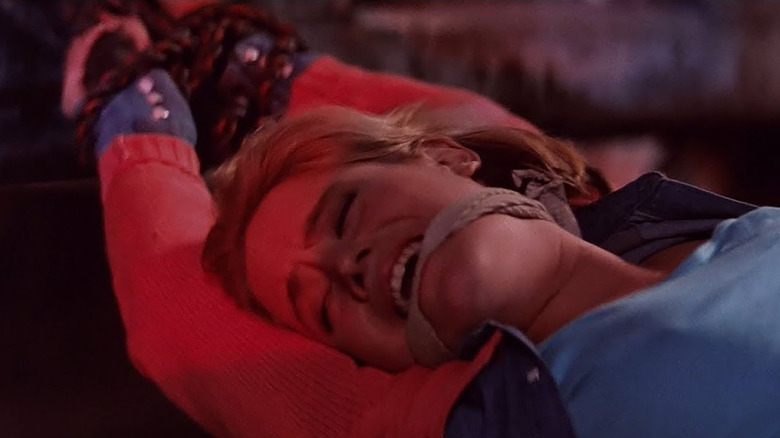
Sometimes, the greatest scares don't come from out of the darkness, but rather a looming sense of danger dangling right in front of your face. In 1986's "The Hitcher," Rutger Hauer plays a hitchhiker named John Ryder who traps a young man named Jim in a high-stakes game of cat and mouse after Jim offers him a ride. At one point, Ryder abducts a waitress named Nash who has been trying to help Jim and ties her between two semi-trucks with a gag in her mouth.
Ryder sits at the wheel of one of the trucks, threatening to take his foot off the clutch which would drive the truck forward and rip Nash apart. Jim enters the cab of the truck and tries to reason with Ryder who gives him a revolver and tells him to shoot him. Jim chickens out, and a disappointed Ryder releases the clutch, tearing Nash in two.
Knowing that Nash's life is on the line, the entire conversation between Jim and Ryder is hair-raising, with spikes of anxiety shooting through with every rev of the engine. (BJ Colangelo)
24. The Basement Scene In Zodiac
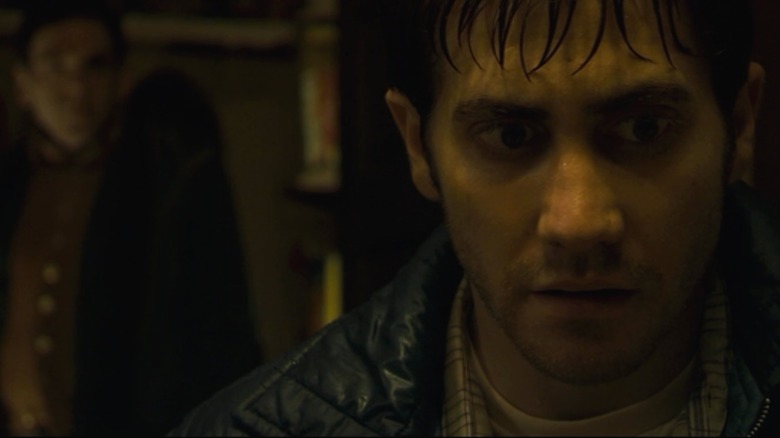
"Don't Go Into The Basement" is already the name of a horror movie — a rather fun 70s one by S.F. Brownrigg — but it might as well be the title of one of the most terrifying scenes of the new millennium.
In David Fincher's thrilling 2008 cop procedural "Zodiac," a killer is on the loose in the San Francisco Bay area during the early 70s. He taunts the cops with letters, threatens to kill schoolchildren, and sends cryptic ciphers to the media while a manhunt is underway.
Detective Robert Graysmith, played by Jake Gyllenhaal, is tracking down some information and goes to the home of Bob Vaughn to ask about a film, "The Most Dangerous Game," and some posters from a theater Vaughn worked at. The handwriting on the posters is similar to the Zodiac's, and when Vaughn gently says, "That's my handwriting," the scene instantly shifts into deep unease. We sit with Graysmith and squirm with him as he goes into the basement with the homeowner, where clear footfalls indicate that there is someone else in the house, despite Vaughn's insistence that they are alone. In the end, it was a loose end and Vaughn wasn't a suspect in the case. But that sequence gives the movie a shot of adrenaline without shedding a drop of blood, no easy feat when making a movie about a serial killer. (Anya Stanley)
23. Dragged Across The Ceiling In A Nightmare On Elm Street
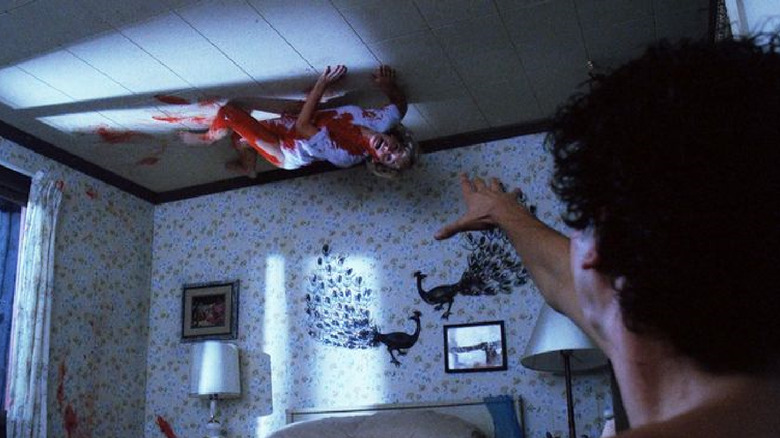
Movies that work on dream logic can give some great creative freedom to those who make them. Freddy Krueger works within a dream space, and as he stalks the Elm Street kids in Wes Craven's 1984 slasher classic, "A Nightmare on Elm Street," he can transition from the real world to the dream world, and bring sleeping teens with him.
One of /Film's top scariest scenes has poor Tina Gray picked up and tossed around her room by the blade-wielding child killer. As her boyfriend, Rod, helplessly watches, Tina (who is in a nightshirt and her underwear) is pulled by some unseen force onto her wall, and eventually ceiling, and sliced to ribbons by Freddy's invisible-to-the-camera bladed claw glove. Rod is in the shot most of the time, so it's not him! Knowing that the killer has such invincibility, not to mention hearing Tina's blood-curdling screams, makes this not only the movie that put a new slasher icon on the map but stands tall as one of the most terrifying kill sequences put to film. (Anya Stanley)
22. Bruce Says Hello In Jaws
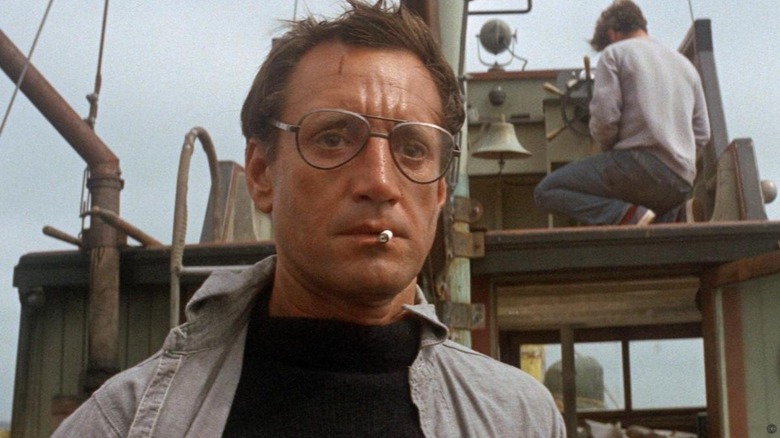
In 1975, Steven Spielberg defined the summer blockbuster with his adaptation of Peter Benchley's "Jaws." Beachgoers wouldn't dip their toes into frothy shallows. Vacationers fled to mountainsides and areas without oceanic connections.
Spielberg's manipulation of his mechanical shark, Bruce, has paved the way for countless filmmakers' inspirations — "We didn't want to reveal our monster until the last possible second, as an homage to 'Jaws' and the tension that film generates." We've heard such reasoning seventy-thousand times over and with good cause. It's not until Chief Brody (Roy Scheider) is chumming water while aboard the Orca that Bruce gives us a rather up-close-and-personal fright, while Brody snarks back at his accomplices about the mucky task.
Brody's face takes up a portion of the frame, but Bruce emerges into focus from the blood-clouded waters with a snarl. Brody stiffens and jolts upwards, glimpsing the beast otherwise barely spotted as a dorsal fin prior. Kudos to Spielberg because an on-paper moment that sounds grand becomes the ceremonious reveal everyone imagined through meticulous execution. (Matt Donato)
21. The Station Isn't Safe In Train To Busan
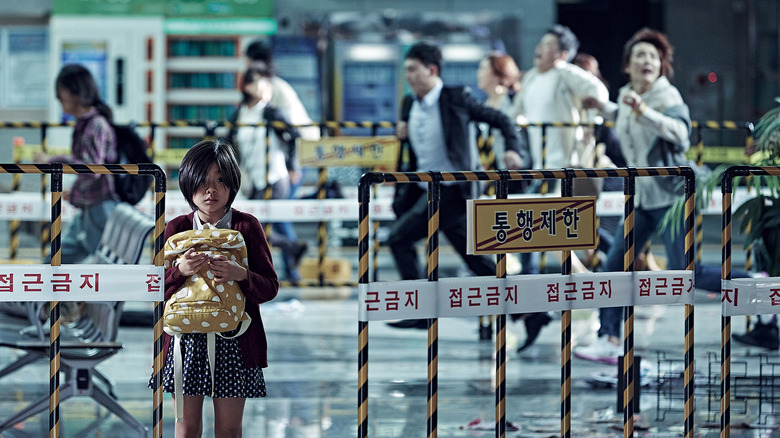
Apparently, once you become a parent, your perspective on fear changes. Your priorities shift, and the things that terrify you are less insular. They extend to your children, what may happen to them, or your inability to protect them. Such is the case with "Train to Busan."
After being told Daejeon station was safely secured by the military, the passengers disembark to find that they've all been infected. Seok-woo (Gong Yoo) left his little girl, Soo-an (Su-an Kim), in what he thought was a safe area. Meanwhile, Sang-hwa (Ma Dong-seok) thought he was escorting his pregnant wife, Seong-kyeong (Yu-mi Jung), to safety, only to realize they were walking directly into harm's way.
Ravenous, the wave of zombies moves like a brush fire, consuming everything in its path in the blink of an eye. It can't be contained, so they have to run. But Seok-woo doesn't make it in time, and he has to watch as Soo-an is nearly killed, only to be saved by Sang-hwa and Seong-kyeong as they ran for the door.
Seok-woo is nearly killed in the process, as he looks to the door where his daughter has just been ushered to safety. Will she be ok? If I die now, can I trust she'll be taken care of? If you're gone, who will protect your children?
The horror here is in part due to the tidal wave of undead carnage. But what makes the moment truly terrifying runs deeper, right to the core of what drives these characters. (Ariel Fisher)
20. The Red Flare In 47 Meters Down
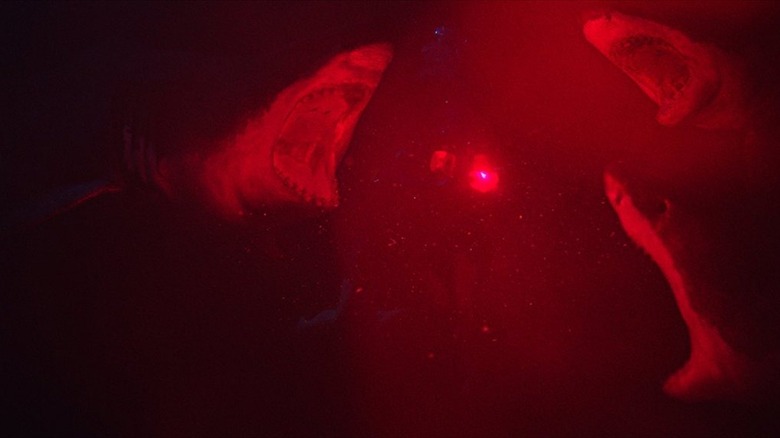
"47 Meters Down" doesn't require much embellishment to deliver scares — sharks are terrifying enough as aquatic predators. Johannes Roberts' 2017 When Animals Attack flick ensures that finned foes are as menacing as the film needs, but also draws upon Thalassophobia by pitting Mandy Moore and Claire Holt's stranded divers against the ocean's unknowns.
In what stands as the film's most artistic and vicious scare, Lisa (Moore) and Kate (Holt) surface knowing that aggressive sharks are presumably hot on their flippers, with only crimson flares illuminating the pitch-black darkness on all sides. Around 20-meters, the women must pause a few minutes — otherwise, pressurization could be fatal. Lisa's flare extinguishes, plunging the sisters into a momentary abyss until she ignites another that shows the trio of enclosing sharks about to strike without any awareness. It's the epitome of tension and a red-lit highlight in an expressively haunting underwater flick that's nothing but natural horror of our Earth's environment. (Matt Donato)
19. Sloth In Se7en
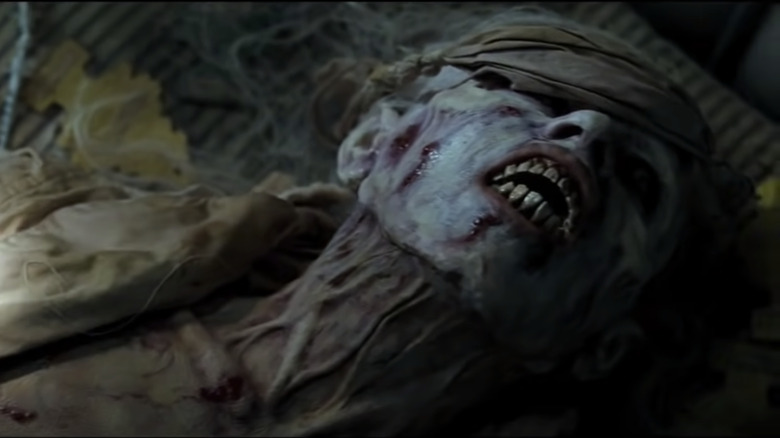
David Fincher is an absolute thrill master, but few moments in his filmography are as arrestingly terrifying as the reveal of the "Sloth" victim in 1995's "Se7en."
Brad Pitt and Morgan Freeman are two detectives tasked with investigating a series of murders inspired by the seven deadly sins. The duo follows a SWAT team leader named California to the scene of a crime where the skeletal, almost zombie-like body of a drug dealer and known child molester lay lifeless and restrained to a bed with "SLOTH" written above him on the wall. California leans in, disgusted by the man's crimes, and says, "You got what you deserved" before the corpse-like being gasps for air, somehow still alive.
The unexpected proof of life erupting from the Sloth victim's lungs is a solid jump scare on its own, but the emaciated condition of the twisted, rotting body is viscerally upsetting. It seems unfathomable that this thing could still be alive, and the realization that the killer has been intentionally keeping this victim on the brink of death just to send a message reveals just how demented the killer truly is, and what fresh horrors he is capable of enacting. (BJ Colangelo)
18. The Nurse In The Exorcist III
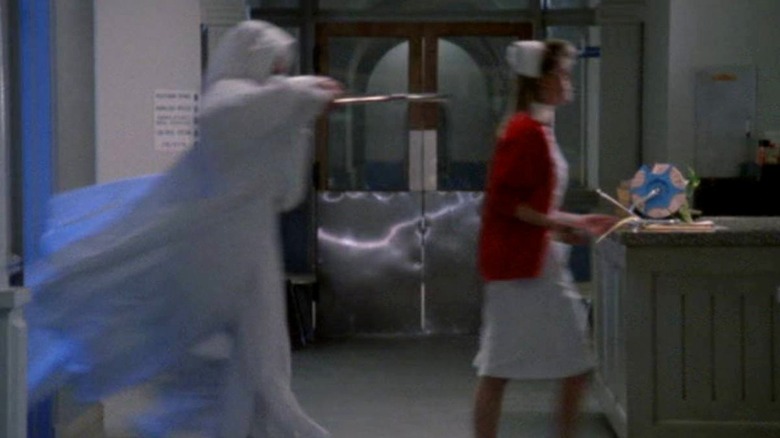
"The Exorcist III" may not live up to the heights of the first film, but it's still a must-see sequel (that wisely ignores the dismal "Exorcist II: The Heretic.") Written and directed by William Peter Blatty, author of the original 1971 novel upon which "The Exorcist" was based, "The Exorcist III" brings back Jason Miller as Father Damian Karras, who is discovered to still be alive and confined to the psych ward of a hospital.
He's not having a good time: Karras' body has been possessed by the spirit of "The Gemini Killer" (a masterful performance from Brad Dourif), and at night the Gemini Killer leaves Karras and possesses other patients in the hospital, causing them to commit brutal murders. And that brings us to one of the greatest scares in horror history.
The reason it works so well is that there's none of the usual build-up you'd expect from a jump scare; if anything, the preceding minute of quiet routine on the hospital's night shift is set up to lull the audience into a state of slight boredom. And then "The Exorcist III" hits you with the trifecta: a screeching sting of music, a sudden zoom in, and a nun-like figure draped in white robes and wielding a pair of shears charging towards a poor unsuspecting nurse. (Hannah Shaw-Williams)
17. Want To Play Hide And Clap In The Conjuring?
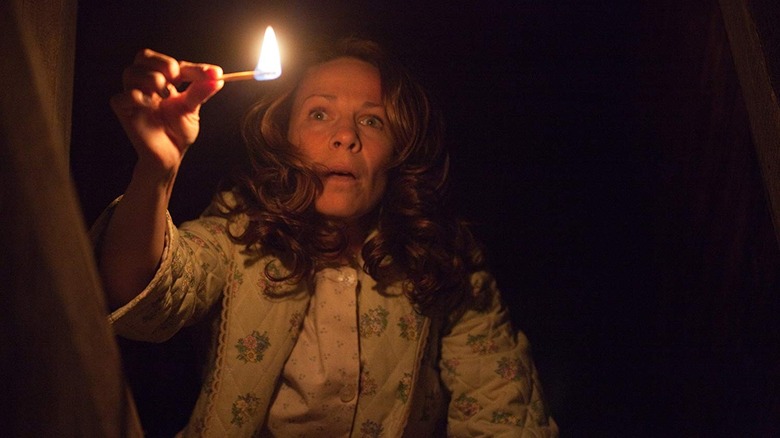
Hide and Clap from "The Conjuring" is, without question, one of the great jump scares of the 21st century, if not of all time. It's uncomplicated, succeeding because of its simplicity rather than in spite of it. But, like with any recipe, it's the skill of the chef that dictates the final quality of the dish. In that regard, James Wan masterfully wields Chad and Carey W. Hayes' script, taking what could be someone screaming "Boo!" at the top of their lungs and transforming it into a masterclass on building and releasing tension.
It presents an ordinary and relatable scenario — a mother, exhausted, folding laundry while her kids should be asleep. She hears a noise, and suspects they're out of bed. Until she checks on them, only to find them all snugly tucked in. Picture frames crash to the ground while the sound of running feet and giggling echoes down the hall. It seems like there's someone there, so she has to protect her family.
The scene takes a sense of territoriality and protectiveness and weaponizes it against not only the protagonist but the audience, as well. Despite the fact that the audience knows something supernatural is about to happen, they have no idea what it will be or where it will come from. Then the movie reminds you that it can — and will — come from anywhere.
Clap clap. (Ariel Fisher)
16. The Crucifix Scene In The Exorcist
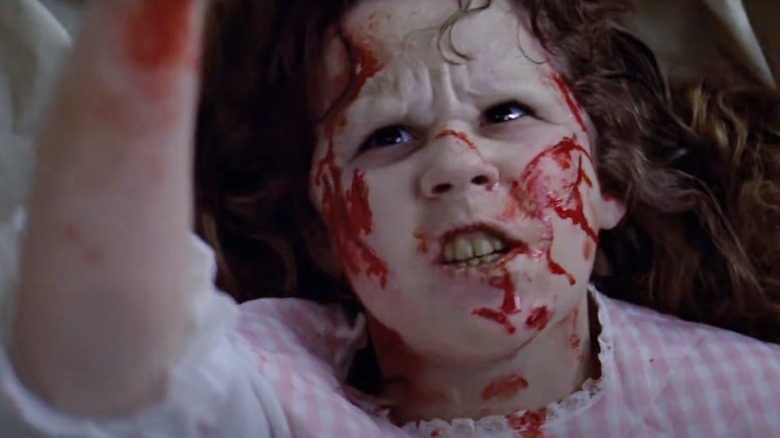
Widely renowned as one of the most terrifying horror movies ever made, you could probably make a list of 31 scariest moments from "The Exorcist" alone. The infamous "masturbating with the crucifix" scene is as shocking today as it was in 1973. Hearing a commotion coming from upstairs, Chris (Ellen Burstyn) rushes up to Regan's (Linda Blair) room to find a telekinetic storm whirling and Regan stabbing herself in the vagina with a crucifix as the entity possessing her screams, "Let Jesus f*** you!"
It's horrifying on so many levels. The demonic voice is layered with Regan's own screams of terror as she's violently sexually assaulted by her own hand. The crucifix -- which is supposed to be a weapon against evil in movies like this -- is instead gleefully wielded by the demon itself. And to top it all off, Chris' attempts to help her daughter result in the demon grabbing her head and shoving it into her 12-year-old daughter's bloody crotch with instructions to "lick me!" (Hannah Shaw-Williams)
15. The Tall Man Appears In It Follows
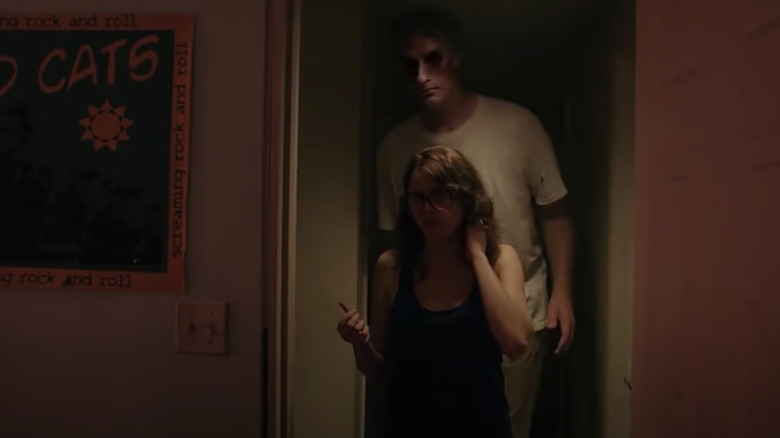
Something is following Jay Height (Maika Monroe), and that something can look like anyone.
2014's "It Follows" terrified audiences and did so without gore or disturbing imagery, just the lingering notion that no matter where you are, something could be coming right toward you. When the titular "It" arrives in Jay's house, she is the only one who can see it. She runs through her house screaming, the jarring score from Disasterpeace blaring behind her. She makes it upstairs and locks herself in a bedroom, knowing that it's coming for her.
She goes against her better judgment and lets in her friends and her sister, who at this point don't understand what is scaring her so badly. The doorknob rattles and they arm themselves with weapons awaiting the possible "It." Jay leans against the bedroom wall, heart pounding, when suddenly music roaring, an over 7-foot-tall man without eyes walks down the hallway and appears behind her friend standing in the doorway, causing Jay to climb out her second-story window and run off into the night. The scare is simple yet so effective, as it plays with the innate fear of something being where it shouldn't, and throwing all expectations off balance. (BJ Colangelo)
14. The "Birth" Scene In Inside
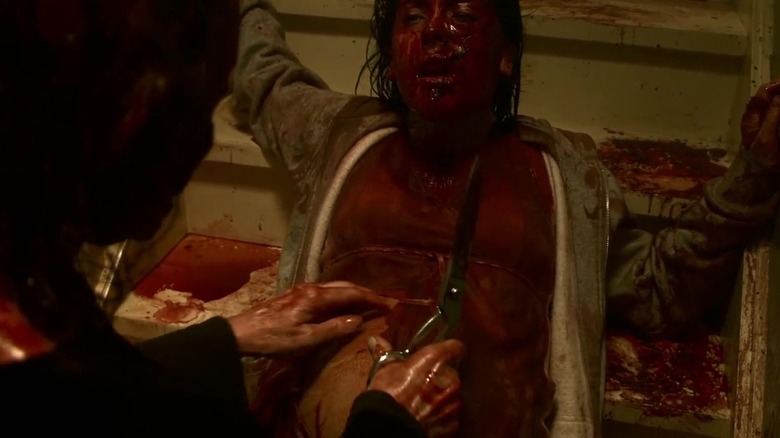
The most terrifying moment in "Inside" is a twisted act of kindness born from a nightmare. This obscenely violent French horror movie, part of the New French Extremity subgenre, finds Sarah, an overdue pregnant widow, stalked through her home by a mysterious woman wielding a very large, very sharp pair of scissors who wants one thing and one thing only: the unborn child in her victim's womb. Directors Julien Maury and Alexandre Bustillo lean on dread, ratcheting up the tension and allowing the spurts of brutal violence to emerge suddenly and painfully. You feel every cut in this movie. This is especially true in the climax, where Sarah, having suffered a terrible injury, goes into labor on the stairs. But the baby is stuck. So Sarah asks her tormenter to do exactly what she came here to do: remove the child with that giant pair of scissors.
Cue the cutting of flesh. Cue the literal waterfall of blood down the stairs. Cue the final shot of the woman, herself mutilated from a previous altercation with Sarah, comforting the newborn child in the shadows.
It's one of the great feel-bad endings in all of horror, and you're never going to shake it. (Jacob Hall)
13. "Jesus Wept" In Hellraiser
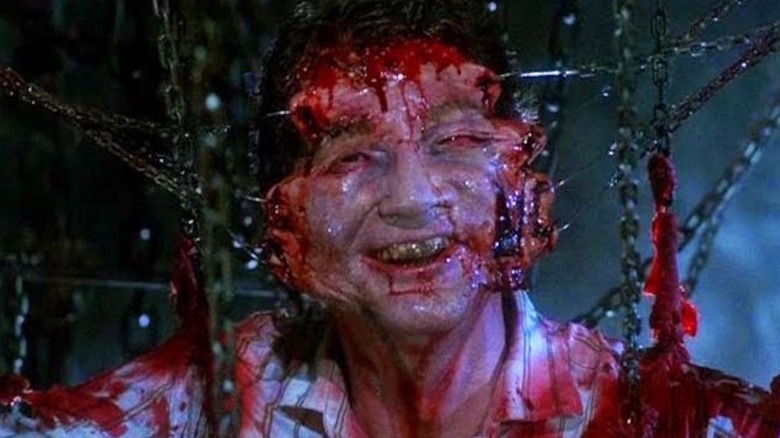
"Hellraiser" is a sublime combination of atmosphere and disgust, managing to be both eerie and gnarly, often at the same time.
In the film's most famous scene, Frank Cotton's luck runs out.
After escaping Hell — or rather, an alternate realm built around extreme, violent carnal pleasures overseen by demonic entities known as the Cenobites — he restores his body with the lives of others, including his brother, Larry. But the Cenobites learn of his escape from his niece, Kirsty, and corner him in the attic where he's been hiding. They emerge from the darkness, each of them an unsettling sight for mortal eyes, each of them dead set on punishment for what they see as a grievous crime. As strange blocks covered with strands of flesh and hair rotate in the shadows, hooks fly from the darkness, latching onto Frank's hands, forcing him into a twisted parody of a crucifixion.
The Cenobites, in a rare moment of mercy, ask Kirsty to leave ("This isn't for your eyes") before more hooks dig onto Frank's flesh, tearing the skin and ripping him open and transforming his face into a ghoulish, tortured mass of gore. "Jesus wept," Frank says, as the hooks pull one final time and his entire body is torn asunder. It feels like a vision borrowed straight from Hell itself. (Jacob Hall)
12. The Knife In The Invisible Man
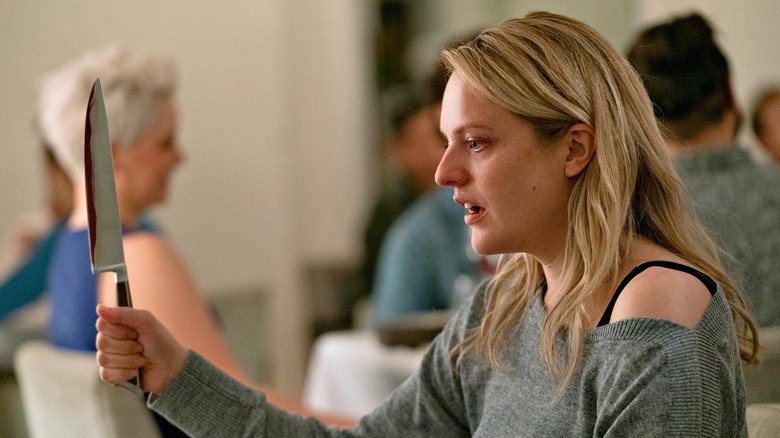
An absolute masterclass in examining the horror of abusive relationships, 2020's "The Invisible Man" shows an architect named Cecilia (Elizabeth Moss) who is convinced her manipulative ex-boyfriend and tech mogul Adrian has faked his own death and somehow turned himself invisible in order to torture her. Everyone in Cecilia's life struggles to believe her claims and finds her erratic behavior more than a little concerning.
After a fallout with her sister due to Adrian's interference, Cecilia convinces her to meet at a restaurant in public in order to explain the proof she has found that Adrian is in fact alive, and is continuing to stalk and abuse her. Cecilia is desperate and disheveled while explaining to her skeptical sister what she believes is happening to her when suddenly a knife appears to float next to Cecilia's head.
At this moment, the first time anyone other than Cecilia has seen Adrian as the titular invisible man, we see her sister believe Cecilia's story only for the knife to seemingly "fly" across the dinner table and slit her throat only to retract back into Cecilia's hand. A traumatized restaurant guest sees Cecilia, bloody knife in hand, shaking with terror as her sister bleeds out on the table. It's a remarkably effective jump scare, but the true horror is realizing the extent of Adrian's abuse. (BJ Colangelo)
11. What's In The Attic In REC
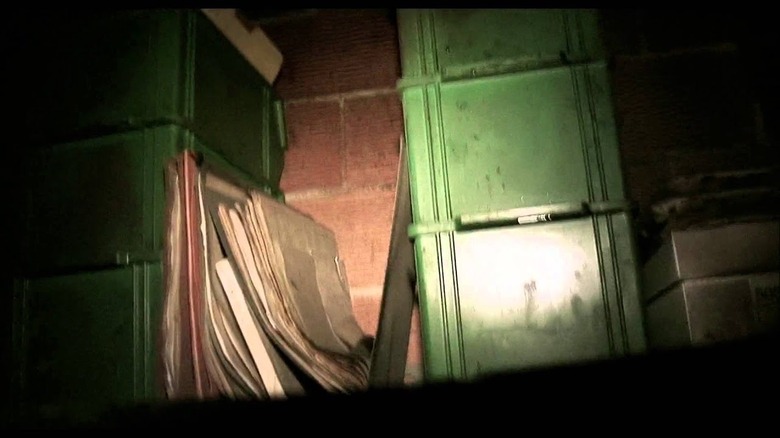
Jaume Balagueró and Paco Plaza showcase the limitless intimacy of fear through found footage in 2007's "[REC]," one of the subgenre's supreme accomplishments.
Spanish reporter Ángela Vidal (Manuela Velasco) and her cameraman Pablo (director of photography Pablo Rosso) hope to informatively document a Barcelona fireman's brigade on their overnight duties but instead become quarantined inside a viral-dangerous apartment complex. As Angela and Pablo eventually find themselves trapped within a Vatican agent's upstairs penthouse, the attic hatch swings open. Pablo hoists his station's camera above his head, using it to reveal whatever's thumping around. As the lens slowly twists three-sixty degrees, Balagueró and Plaza know what we're expecting and hold their ultimate scare until the last possible millisecond. Pablo's unable to see through his eyes, as we hear both himself and Angela's quivering voices twist paranoia into tension.
Right when Pablo almost completes an entire explorative rotation, one of the resident's now infected children lunges directly towards the screen with a deafening screech, and Pablo's camera crashes downward. It's the simplest found-footage fright drawn into a lesson about how jump scares aren't inherently wasteful — execution trumps laziness, and "[REC]" might be the quintessential example of how impenetrable a perfect jump scare becomes. (Matt Donato)
10. The Closet In Halloween
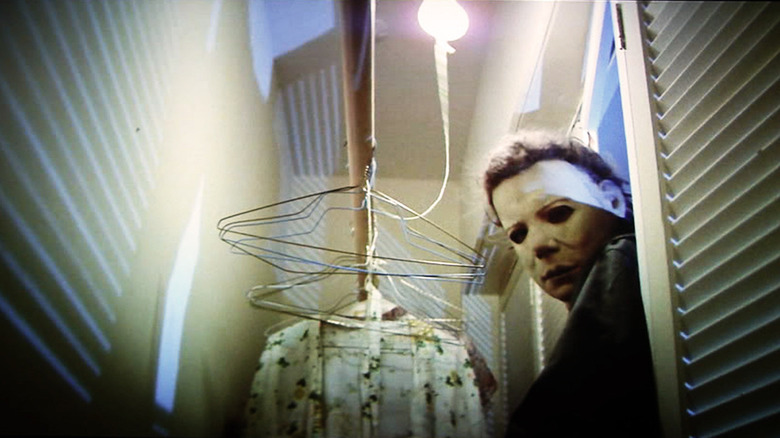
It's one of the most famous scenes from one of the most famous horror movies ever made, and boy, it sure does hold up.
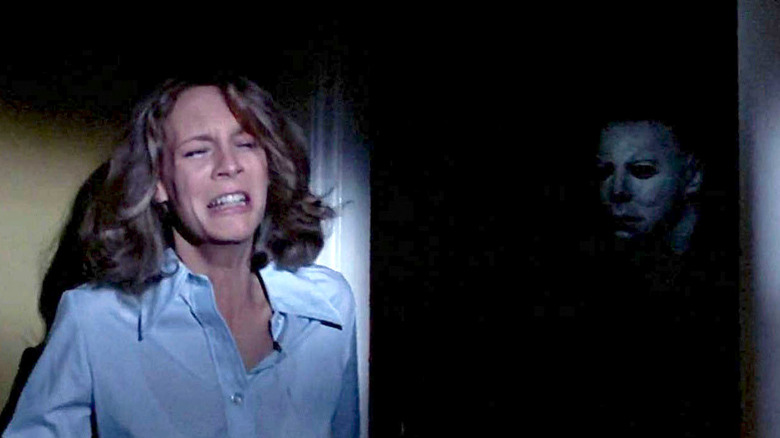
Late in John Carpenter's 1978 masterpiece, Jamie Lee Curtis' Laurie Strode is alone, all of her friends dead, as escaped masked maniac Michael Myers tries to kill her. Seeking refuge, a safe haven of any kind, she hides in the closet ... but he finds her. Michael rattles at the door before smashing it open, his heavy breathing competing with Carpenter's iconic score for sheer volume. His grasping arms turn the closet bulb on and off, flooding the tiny space with light before plunging it into darkness again. There is literally nowhere to run: the width of a closet separates the boogeyman from his next chosen victim. Laurie does fight back, first with a wire clothes hanger and then with Michael's dropped knife. But for a few pure moments, the film captures the debilitating horror of being trapped in a tiny space with someone whose only goal is to harm you. (Jacob Hall)
9. The Chest Opens In The Thing
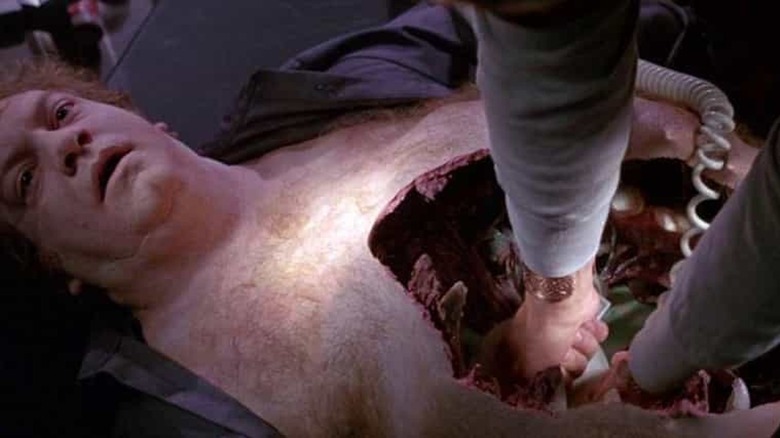
"The Thing" is the granddaddy of body horror movies, as an unfortunate group of Antarctic researchers is picked off one by one by an alien entity that infiltrates their bodies and twists them in gruesome ways. After Norris (Charles Hallahan) suffers a heart attack, the resident doctor attempts to save his life using a defibrillator. But when he goes to press the pads to Norris' chest, it opens up into a fanged mouth that closes around the doctor's arms and bites them off!
And that's just the start of this scare. As poor Dr. Doctor (Richard Dysart) screams and sprays blood from his severed arms, a second Norris head -- created by the alien inside him, which can replicate any organic being -- emerges from the chest cavity with crab-like legs, while Norris' original head detaches from his body and makes a break for it. Fortunately, R.J. MacReady (Kurt Russell) is on hand to do the only rational thing: spray absolutely everything in that room with a flamethrower. (Hannah Shaw-Williams)
8. The Birthday Party Alien In Signs
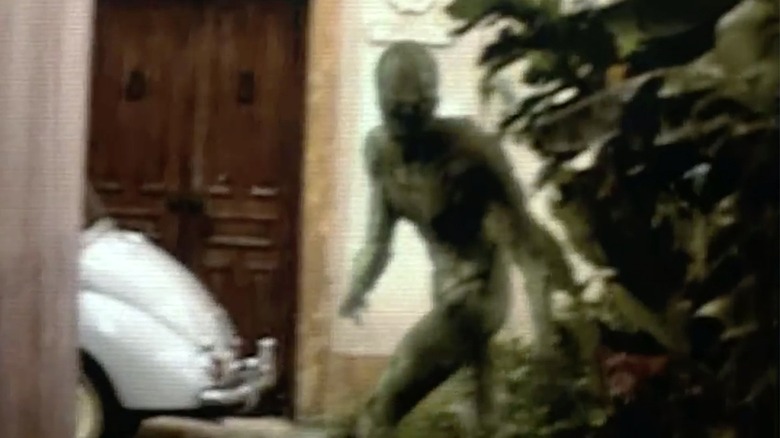
What makes this scene from M. Night Shyamalan's "Signs" work so well is Joaquin Phoenix's presence as an audience surrogate. Merrill (Phoenix) has become obsessed with the evidence that aliens have come to Earth, and after falling asleep in front of the TV he wakes up to find the news program playing some "startling footage." Unfortunately, the footage isn't very good and it was taken at a birthday party so there are a bunch of irritating kids jumping in front of the camera and blocking the view.
A frustrated Merrill commands, "Move children! Vamanos!" at the children on TV, a comedic moment that's almost immediately followed by the first proper sighting of an alien. In isolation it's kind of goofy: it just looks like a blurry shot of a tall guy in a costume. But what sells it as one of the scariest moments in movie history is the build-up and Merrill's reaction -- crying out and backing away from the TV like he thinks the alien might grab him through the screen. (Hannah Shaw-Williams)
7. Snack Time In The Taking Of Deborah Logan
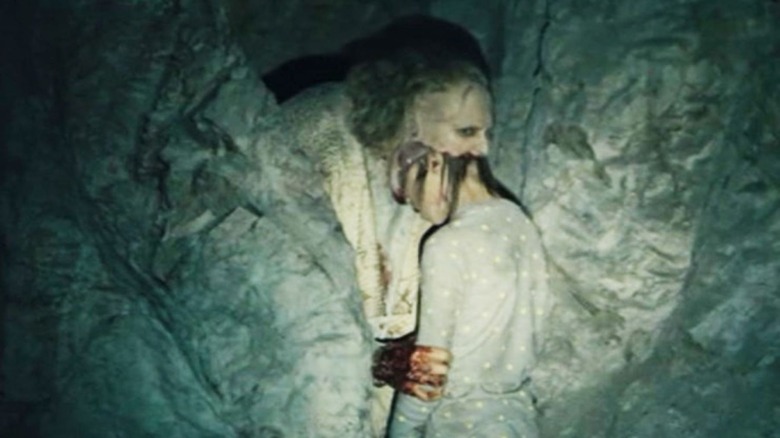
Put this one in the hall of fame for great scares that come out of nowhere and scare the skin right off your body. This found-footage horror film is initially structured as a faux documentary about an elderly woman battling Alzheimer's, but the filmmakers eventually learn their subject, Deborah Logan isn't ill.
She's possessed. By a ghost. Of a cannibalistic doctor. Who was trying to murder five young girls as part of an evil ritual. Who she killed to save her own daughter.
It all culminates with Deborah absconding with a young girl to a dark cave to complete the ritual, camera crew in hot pursuit. As the camera and its dim lights desperately search the cavern, the image pans over to reveal ... Deborah, her jaw unhinged like a snake, her mouth unnaturally wrapped about the entire head of her young victim, prepared to devour her whole. The handheld camera and the lack of a score lend an upsetting reality to image that simply should not be, especially since director Adam Robitel wisely waits until late in the film to take things to this extreme. It's an image so shocking, it's become a common gif shared in horror circles. The greatest testament to its success is that it's just as terrifying in context. (Jacob Hall)
6. Leatherface Appears In The Texas Chain Saw Massacre
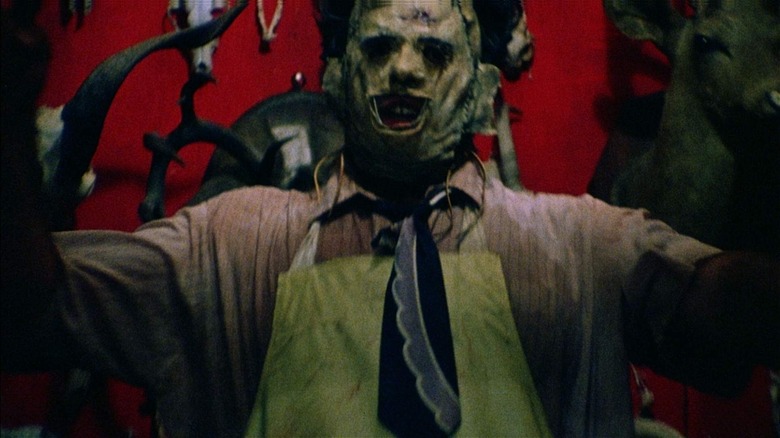
Some horror films are scary simply in how uncomplicated they are: a house, some kids, a dysfunctional family, and a man with a chainsaw. That's all you need.
In Tobe Hooper's 1974 game-changer "The Texas Chain Saw Massacre," Sally Hardesty, her brother Franklin, and their friends stumble upon an old house occupied by the Sawyer Family, a real cast of characters. But their shining star is their Large Adult Son, known as Leatherface due to the human skin face mask he wears as he swings his saw.
His first appearance is straightforward: one of Sally's friends, Kirk, heads inside the house to see if anyone there has gas for their van. There's someone there, alright. Accompanied by a jarring squeal of a nearby pig, Leatherface's towering frame pops up in a doorway and cracks Kirk's dome with a sledgehammer, and it makes one of the foulest thuds you'll ever hear. Kirk goes into convulsions before a second whack puts him down for good. No music score, no fanfare beyond the noise of steel hitting bone, then the killer slamming the door shut with a reverberating BOOM. The finality of the brutal moment is the cherry on top of the scene that gave nightmares to a generation. Add to that an opening crawl that asserts the events to be based on a true story, and you've got nightmare fuel to accompany you on every summer road trip for life. (Anya Stanley)
5. There's Something In The Room In Gonjiam: Haunted Asylum
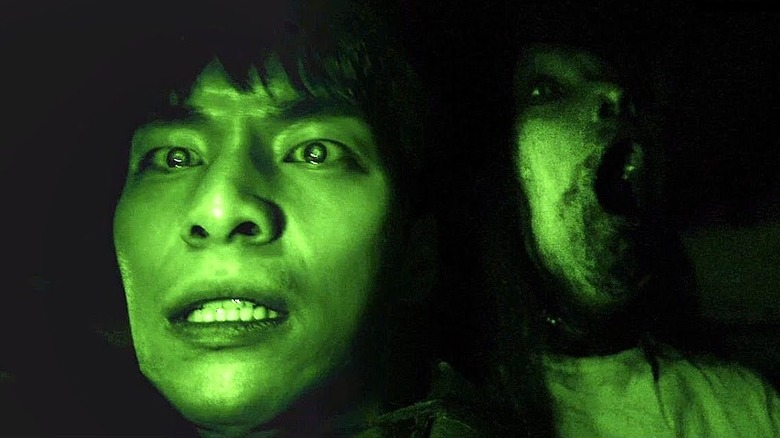
It's never a good feeling when you can see the scare coming, but you know it's going to get you. "Gonjiam: Haunted Asylum" is full of incredible scares that wave at you as they approach, daring you to keep watching, and none quite as much as the grand finale.
Wi Ha-joon (Ha-joon) has spent the entire movie coordinating things from the relative safety of a tent on the grounds of the asylum. Eventually, like the others, he winds up in the inescapable room 402. He's frozen in fear, panicked in the darkness, alone and with no source of light to navigate whatever hell he's found himself in.
Then, through his camera, we see her. Gonjiam's hospital director, rumored to haunt room 402 and to have killed 42 of her patients in the '70s. She silently hovers backward, towards Ha-joon until their backs touch. She waits, her wails growing steadily louder until she turns around, strangling him in mid-air.
This scene, like the rest of the movie, is a dare to stare terror in the face and not look away. It puts the characters in inescapable positions and refuses to blink. On top of the film's complete lack of a score, the sound design is out of this world, sending chills down your spine with the smallest whisper, the most unearthly moan, or the faintest creak. Every moment is designed to keep you on pins and needles, wanting to see more while simultaneously jumping out of your skin. (Ariel Fisher)
4. "I Saw Her Face" In The Ring
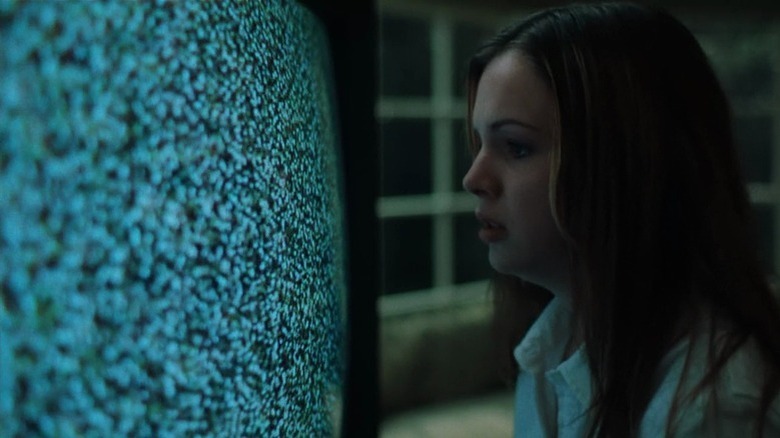
A great jump scare doesn't take much in the way of gimmicks. Rather, it's reliant on an understanding of human behavior. Emotional cues can put people in a state of calm or panic depending on a million different factors. But when you lull someone into a state of calm only to force them into sensory overload, it dials the impact up to 11.
After her niece, Katie's (Amber Tamblyn) funeral, Rachel (Naomi Watts) and her son go to the wake at her sister's house. It's a somber event, a place of great mourning. The mood is inescapably bleak, but also still. Calm.
Both Rachel's sister and brother-in-law are lost in their own lives, without a clue how to navigate their grief. It's sad. All she wants to do is help ease her sister's pain. How does a 16-year-old's heart just ... stop?
Reeling from the inconceivability of it all, the silence is broken by a violent grating sound. A closet door slides open, and Katie sits huddled, almost fetus-like. Her face is contorted, eyes blank and staring up in terror, skin a sickly grey, and her mouth hanging open in an eternal scream.
In the three seconds it takes to rip us out of our morose comfort, we're made to feel attacked. It elicits a fight or flight response, forcing your senses into overdrive without a moment to get your bearings. It's disorienting which only amplifies the impact. And you'll never get her face out of your mind again. (Ariel Fisher)
3. Just Hanging Out In Hereditary
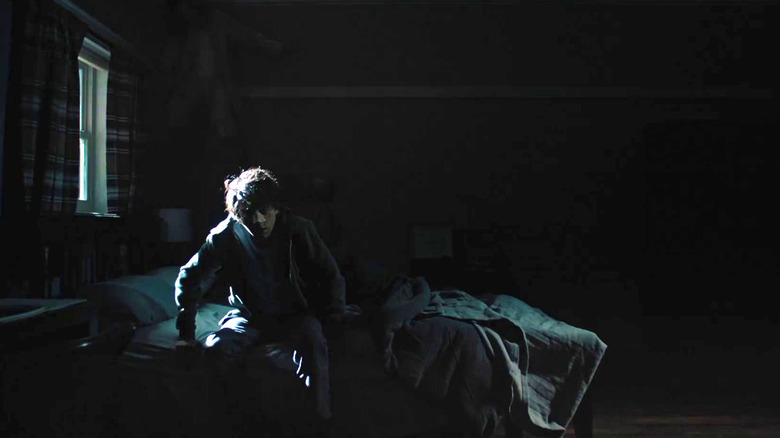
Some of the most terrifying things are often sitting in plain sight. They lurk in dark corners, waiting to be noticed. But it isn't until your eyes adjust that you actually see it. And then it's too late — the terror's crept in.
Peter Graham (Alex Wolff) wakes up after having bashed his own face into a desk at school, breaking his nose. He's likely concussed, but definitely groggy. He sits up and calls for his mom, Toni Collette's bereaved — and now posessed — Annie. No answer. Just silence, stillness, and darkness. The room is framed as it has been throughout the movie, only now something's ... different. But what is it?
Perched in the top left corner of the room is Annie, clinging unnaturally to the wall like a spider. She doesn't move. She doesn't make a sound. She just watches as Peter gradually feels her eyes on his back, slowly turning around only for her to scuttle silently away.
In theory, the most shocking part of the scene is her inhuman position. In execution, the darkness creates the kind of camouflage that terrified us as kids. You're not sure if you're seeing something, it just looks kind of fuzzy. But once your eyes adjust to the lack of light, once they zero in on the figure waiting, watching in plain sight ... the terror hits like a freight train, and you forget to breathe.
She might hear you. (Ariel Fisher)
2. The Chestburster In Alien
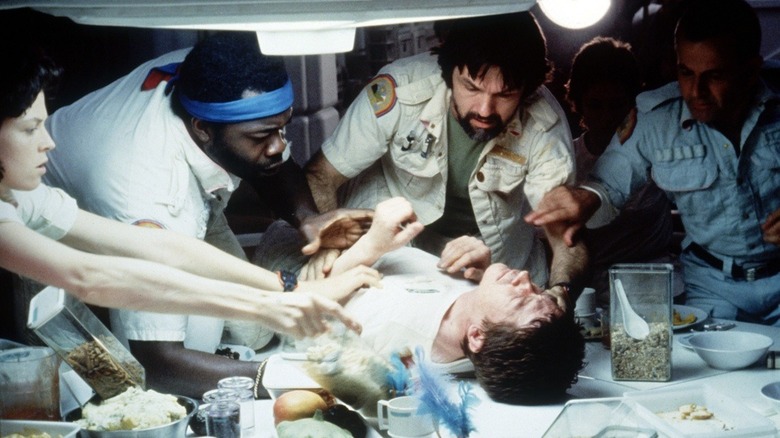
What's left to analyze about John Hurt's death as Kane in Ridley Scott's 1979 gamechanger "Alien" — the Chestburster reveal is the pinnacle of science-fiction horror devastation (so prodigious it was spoofed by Mel Brooks in "Spaceballs").
Kane's just spent an extended amount of time with a Facehugger tightly attached, and he regains consciousness with quite an appetite. The crew of the Nostromo settles around their vessel's dinner table, passing rehydrated dishes. Kane chows on a few mouthfuls but then starts acting like he's choking or consumed poison. Crewmates gaze on in horror as Kane starts convulsing atop their feast, with everyone begging Kane to describe his internal pain. Then, a burst of red mist stains his white uniform shirt after a tear-pop explosion sound effect. A few more writhes and the incubated Xenomorph baby growing inside Kane jack-in-the-boxes out of his body, slick with warm human blood. The infantile alien glances around at stunned and mortified crewmember faces, equally horrified as the viewers watching in theaters or from the now tainted comforts of home. (Matt Donato)
1. Lawn Work '86 In Sinister
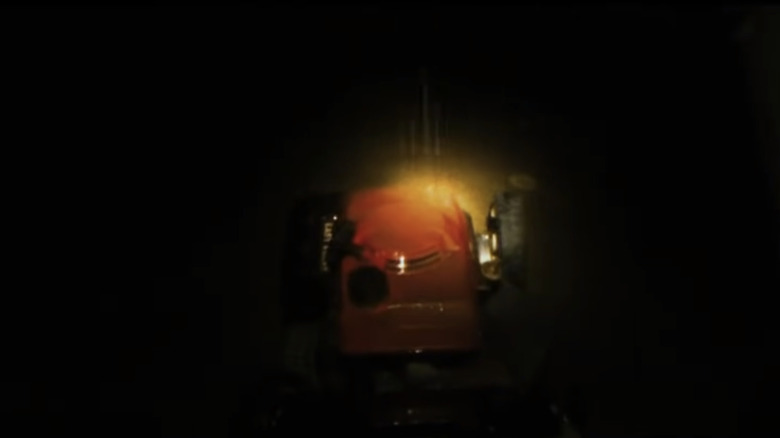
2012's "Sinister" is filled with so many horrifying moments it's almost sacrilegious to choose just one, but the lawnmower scene is, without a shadow of a doubt, one of the scariest moments ever put on screen.
Ethan Hawke plays a man named Ellison who discovers a box of Super 8 reels, each depicting the murder of different families in various ways. The one labeled "Lawn Work '86" features an unseen figure filming a family in the rain from outside of their home. The family looks to be spending quality time together but then the footage cuts to the figure opening the gate to the backyard and turning on a lawnmower placed outside. The camera fixates on the path of the lawnmower, illuminated by only the light of the camera. The lawnmower runs in a straight path across the grass for a short period of time before the light of the camera reveals the family from before, tied up in the grass, and immediately run over by the lawnmower. The scare is effective in part because jump scares are a great way to jolt your fight/flight/freeze response, but unlike most horror films that utilize sound to build up tension before the scare strikes, "Lawn Work '86" comes completely out of nowhere, catching the audience off guard and guaranteeing a hell of a shock to the system. (BJ Colangelo)
Read this next: The 15 Best Japanese Horror Movies Of All Time
The post The 31 Scariest Movie Scenes Ever appeared first on /Film.
Blade Runner 2049 Ending Explained: A Fresh Twist On The Old Chosen One Narrative
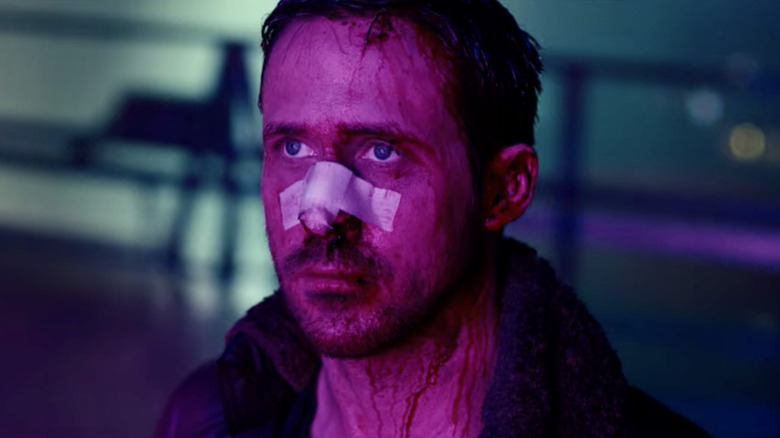
One of the most interesting things about "Blade Runner 2049" is its subversive ending. In the 2010s, after making a couple of top-notch thrillers — "Prisoners" and "Sicario" — director Denis Villeneuve entered a new sci-fi phase in his career with "Arrival" and "Blade Runner 2049." "Arrival" garnered eight Academy Award nominations, including Best Picture and Best Director for Villeneuve, whereas "Blade Runner 2049" earned accolades more in the technical categories. It was considered a box office disappointment, and Villeneuve later reflected that it could have ended his career (though of course, he'd survive to shoot another science-fiction epic, "Dune.")
Ridley Scott's original 1982 film, "Blade Runner," was not a smashing commercial or critical success in its day, either. However, its stature has grown considerably in the intervening years, to the point where it is now in the National Film Registry and was one of the titles chosen for the 10th-anniversary edition of the American Film Institute's list of the 100 greatest American movies of all time.
Villeneuve was faced with the task of delivering a sequel to a classic. He responded with a long, meditative film that became an instant classic for some and that seems destined to become a cult classic for others. Maybe in 2052, when they make "Blade Runner 2079," more people will rediscover this film ... but why wait?
If you're here, maybe you're already looking to rediscover "Blade Runner 2049," or maybe you've just seen it for the first time and are still digesting what you watched. The film's ending upends what Ryan Gosling's protagonist, K, and the audience thinks about him. Here, we'll be examining that ending with spoilers.
Viva Las Harrison
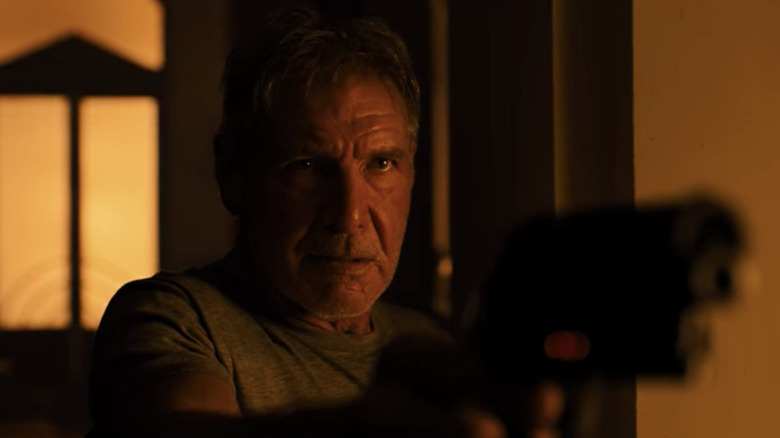
With stunning production design by Dennis Gassner and Oscar-winning cinematography by Roger Deakins, "Blade Runner 2049" is a visual feast. It delivers all the neon you would expect from a "Blade Runner" sequel, yet it also takes viewers through the orange haze of a desert landscape into an abandoned Las Vegas, which looks like it was overrun by a sandstorm. That's where we finally catch up with Harrison Ford's character, Rick Deckard, from the original "Blade Runner" movie.
In "Blade Runner 2049," Deckard doesn't enter the picture until the last hour, and when he does, he and K are bound by the laws of superhero/blade runner first meetings to fight. They do it in a casino lounge against the backdrop of glitchy Elvis Presley and go-go dancer holograms. The film's Hans Zimmer and Benjamin Wallfisch score gives way to jukebox songs like "Suspicious Minds," "Can't Help Falling in Love with You," and eventually, Frank Sinatra's "One for My Baby (and One More for the Road)."
After Deckard gets tired of punching K, they sit down together at the bar for a drink. At this point, K is still operating under the assumption that he is Deckard's son, the first child ever born of a replicant (Rachael, Sean Young's character from the original "Blade Runner"). Deckard refuses to accept the name K, so K introduces himself as "Joe," the name his digital companion, Joi (Ana de Armas), bestowed on him back in his lonely apartment.
It's a name that imports an average-Joe quality to him, as if he were just some guy caught up in forces he does not understand — which is exactly what he is. That's the thing about K/Joe: he's not as special as he thinks.
The Chosen Wannabe
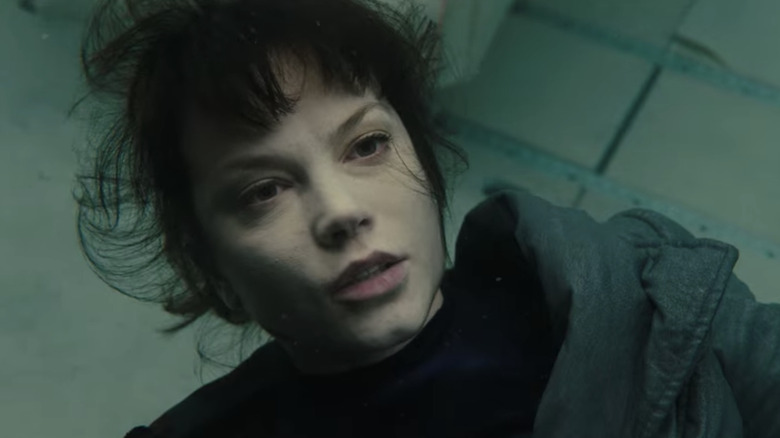
Deckard explains that he abandoned his child with Rachael to an orphanage because they were being hunted. He didn't want to put a target on the child's back. "Sometimes, to love someone, you've got to be a stranger," he says. K had already visited the orphanage earlier, looking for old records there, and we've already seen, via flashback, a memory he had of himself as a boy (or so we think).
In that flashback, other children were chasing K to get at a wooden horse toy he had, but he was able to hide it in an unused furnace before they caught up with him. Finding this same toy in the furnace, years later, makes him realize that it's a real memory he's been carrying around in his head all this time, as opposed to just an implanted one that his artificial consciousness as a replicant holds. K comes to believe that he is more than just a replicant. He's the chosen one.
This is a time-honored trope that has popped up elsewhere in science-fiction and other genres, with "The Matrix" being one example that explicitly identifies its chosen one, Neo, as "The One." Another example would be the "Star Wars" franchise, where Obi-Wan Kenobi has been known to scream, "You were the chosen one!" at Anakin Skywalker.
Up to this point, what we know of K in "Blade Runner" slots right into that familiar old Chosen One narrative. It's not long, however, before the replicant enforcer, Luv (Sylvia Hoeks), shows up in Vegas, where she kidnaps Deckard and stomps on the device containing Joi, destroying K's imaginary girlfriend and leaving him for dead. The truth is, K is the Chosen Wannabe, and he's about to come to terms with that.
Ready To Meet His Fate
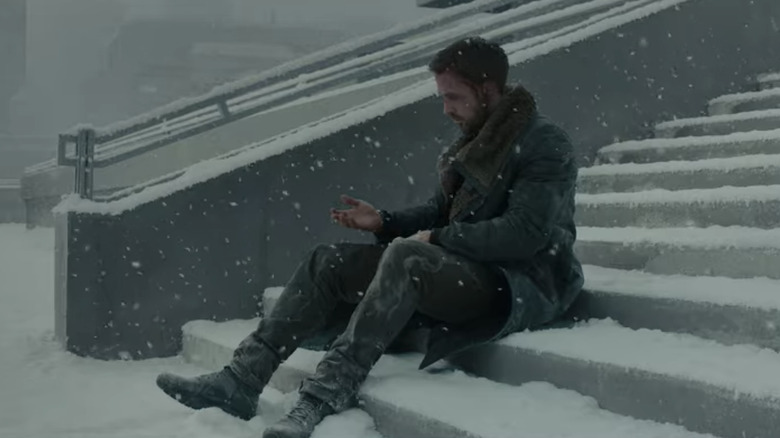
With Luv and Deckard gone, K gets picked up by a group of replicant revolutionaries, which includes Mariette (Mackenzie Davis), the prostitute Joi used for her body double when she and K were making love. The head of the group, Freysa (Hiam Abbass), was there when Rachael's miracle baby was born, and it turns out the child was a girl. K realizes that Ana (Carla Juri), a doctor and memory designer for replicants he met before, is Deckard's daughter. She illegally implanted her own real memories in him.
It's official: he's not the chosen one, after all. With pity, Freysa says to him, "You imagined it was you... We all wish it was us."
Deakins and Gassner also collaborated on the James Bond film, "Skyfall," and in "Blade Runner 2049," they brought to bear the same creative synergy to fashion a series of eye-catching tableaus: not just the nighttime views of a futuristic L.A. or the dusty daytime vistas of Vegas in ruins, but also, some stylishly lit interiors in the Wallace Corporation. It's an industrial temple with floors surrounded by water, like islands. The walls shimmer with watery reflections.
This is where Deckard confronts a carbon copy of Rachael, a replicant of a replicant, the handiwork of the blind technologist, Niander Wallace (Jared Leto). When Deckard refuses to give up information about his child's last-known whereabouts, Wallace sends him off with Luv, with the understanding that torture awaits him off-world.
K, however, intercepts them in his flying car, forcing them to crash-land on a seawall, where K and Luv subsequently fight to the death. He drowns her, but not before she stabs him and gives him the kiss of death, declaring herself "the best one."
The Big Bright Lie
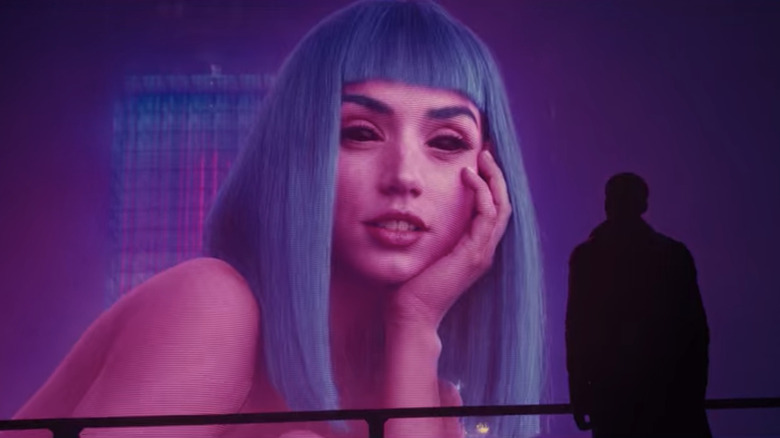
Luv is her own Chosen Wannabe, whose dying view of K underwater is "through a glass, darkly," per the Bible and Philip K. Dick, the author of both "A Scanner Darkly" and "Do Androids Dream of Electric Sheep?" (The latter of which was the basis for "Blade Runner.")
Since it will look like Deckard has perished in the crash, K is able to defy both Wallace's will (torture Deckard for information) and that of the replicant revolutionaries (kill Deckard to protect the child). He takes Deckard to be reunited with his daughter. Outside Ana's lab, K lies down on the snowy steps, succumbing to his wounds, ready to meet his melancholy fate.
"Blade Runner 2049" has a bittersweet ending. K's fate is ultimately a sad yet noble one. He's not the chosen one, but he still got to play the hero. In so many ways, he symbolizes the egocentric inner child in all of us, who wants to believe they are so much more than they really are sometimes.
We grow up in the light of Hollywood, our heads filled with movie images, thinking anything is possible. The silver screen promises that dreams — even android ones filled with electric sheep — do come true for all of us. For K, however, the dream and the promise of self-actualization as some messianic replicant child do not come true.
Joi was always there to support him, telling him what he wanted to hear, but after she's gone and he's lost his Joi (the joy of the lies we tell ourselves about ourselves), he sees her again in a different context. This time, she's a giant pink hologram with blue hair. In the rain, she greets him, "Hello, handsome," but her eyes are black and soulless.
Through A Glass Darkly
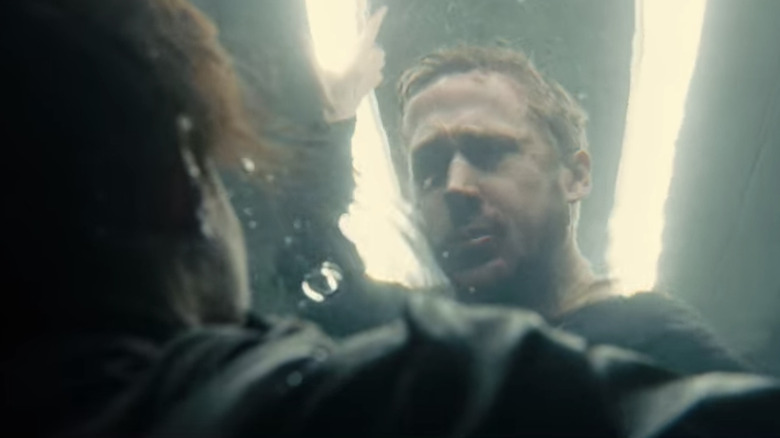
When Joi points right at K and says, "You look like a good Joe," it's now a reminder that she's a hollow construct who peddles the same line to all lonely guys, mediocre Chosen Wannabes.
People identify "Blade Runner" with the neon of Hong Kong or Tokyo, cities far from American shores. Yet this is a movie that, on one level, appeals to the spirit of the American dreamer, that wounded idealist who believes they're the hero of their own story and it all revolves around them ... only to find that the world has different plans in store for them.
Beyond the requisite continuation of the first movie's story, it's no coincidence, perhaps, that "Blade Runner 2049," is set in L.A., a place that offers up no shortage of movie mirages, evanescent holograms of humanity that land like tears in the rain. It's a movie that speaks to an entire generation of millennials and movie-lovers, looking for their moment to shine online or wherever. The world is flooded with all this glittering content ("Everything You Want," like Joi), and at a certain point, it drowns us all out, leaving our faces and perhaps our very selves blurred and indistinct, dark-eyed, like K's.
In such a vast, bleak, overstimulated world, the best one can hope for, maybe, is to do something selfless and find a separate peace that way. K does that when he reunites Deckard and his daughter. Our final image of him is in a setting where the classic rain of "Blade Runner" has frozen over into snow. He's left his mark on them and their lives, just as the movie has with ours.
Read this next: Every Denis Villeneuve Movie Ranked From Worst To Best
The post Blade Runner 2049 Ending Explained: A Fresh Twist on the Old Chosen One Narrative appeared first on /Film.
Doom 4 (Unreleased)
Just a few years after DOOM 3 released, Carmack and Id Software were already planning to make a new DOOM game, which would be known as DOOM 4. It was also going to take the franchise in a Final Fantasy sort of direction, abandoning a focused continuity for just doing a new thing every game. It was definitely a different beast, supposedly some sort of serious story about Earth merging with Hell, focused on the people who had to live through it rather than the lone badass who solved the problem partly to avenge the death of his pet bunny.
This is an article on a canceled game where everyone involved was most likely under NDA, so do take attempts at making the bigger picture with a grain of salt.
What seems to be the case is that a new DOOM title started development in 2007, supposedly alongside the new IP RAGE, which would be getting the majority of the attention from the studio. The first year was for gathering new staff, and development began proper in 2008. Since DOOM 3 was a new take on DOOM, the team decided to do a new take on DOOM II while making it another new continuity. That was the general idea, but there were problems getting it to really come together, hot helped by the focus of the studio shifting to RAGE and making that work with the new Id Tech 5 engine.
There were two builds in production, a single player one called “Hades” and a multiplayer one called “Zion,” the latter being where the majority of the footage for the game comes from. There was a rough story line seemingly made, setting the game in 2038 and possibly starting with a UAC base evacuation, one called Valhalla, based on a vertical slice of the game prepped for Quakecon 2011. A solid way to nod to the original game, suggesting that the invasion started elsewhere.
The game would focus on Earth and started with a…uh, global pandemic. Uh, yeah, the Earth dealing with a virus called the Kafere Plague that a lack of government action in dealing with lead to…riots..and, uh…militarized action against the government. Like, guns ad everything. There is a cure nobody trusts called AGiS made by the UAC, a mostly unchecked corporate entity with focus mainly on what benefits it first and…jeez.
Oh, and then the DOOM stuff happens as a portal to Hell opens in Manhattan, causing a “Hell wave” that starts shifting reality so things become bone and flesh, and people start turning into monsters. Your character would either have survived the base evacuation or have just been a regular joe and joined the resistance against the demon menace, with a a possible level based around reaching the Hell portal that had broken apart a UAC facility. May have been other playable characters in talk, but nothing concrete has been dug up.

The premise of the game was definitely promising, and by the looks of what little we have, it seemed to be doing a more down to Earth (heh) take on what we had seen of the DOOM series so far. Action packed, but exploring the actual impact of such a horrific event like Hell bursting open. It should be kept in mind the footage we have for story bits are not trailer footage, but strung together cutscenes from Blur Studio, using characters planned for the project (there is a NoClip doc floating around that includes a gasmasked person but that’s just a clip accidentally taken from a Nine Inch Nails fan video, a thing among that community).
As far as gameplay goes, hard facts we have are the existence of a sort of kill streak system that would let you summon your own helper demon after filling a soul gauge, and the existence of something called a “sync melee” system that would be reused in DOOM 2016 for its glory kill system. Being much longer melee kills compared to the final ones we got. Otherwise, multiplayer seemed based around deathmatch, as one would expect from Id at this point. The overall gameplay rhythm, though, seemed to be another slower affair with a possible focus on cover, health regeneration, and cinematic presentation, even more so than DOOM 3. Around some of Id’s staff and from the wider fanbase, DOOM 4 ended up getting the mocking nickname of “Call of DOOM.” The footage available suggests there was some truth to all this.
After Bethesda had bought Id Software and once RAGE was released, Bethesda and Id management ended up checking in on the project and decided something had to change. They did like it, but there was a feeling that it wasn’t really DOOM with all these modern design trends baked into the project. There was also the fact the story was very un-DOOM. Hugo Martin, the lead and writer for the modern DOOM franchise, compared this version to Robert Zemeckis’ Contact, a story about the “big things,” while DOOM had previously been about “one guy being involved in big things.” And yeah, that is accurate.
Beyond just moving fast, killing demons, and finding keycards, DOOM was about being in the middle of the thick of it, everything within your character’s perspective rather than the wider one, because that distracts from the action. You could argue this angle has its own issues, but mixed with some of the design decisions, it may have been for the best the project was restarted for the sake of the franchise, especially after RAGE‘s middling launch. At least not everything was thrown out, like the hell knight design and the super shotgun and chainsaw models being brought over to DOOM 2016. This even includes that game’s new demon, the summoner, which in DOOM 4 would have created portals demons could crawl out of. There was even a combat pitch made with DOOM 4 assets to give an idea of where to go with the project.
While DOOM 4 was in development Hell (heh heh), the classic shooter was a mostly dead beast, and modern military FPS had become the norm, with a plodding pace based around iron sight aiming and shouting racial slurs at complete strangers. They were dark times. The few who stuck around didn’t do great, with Serious Sam coming back in a successful but scuff third (or forth???) mainline outing, and Duke Nukem finally coming out of retirement to embarrass himself and make extremely uncomfortable sex lines at the Olsen twins. The torch had to be carried by Painkiller developers, and anyone familiar with the Painkiller hole knows that isn’t exactly who you want carrying an entire genre. There was also Raven trying, but they ended up running out of steam with Singularity and being sent to the Call of Duty mines, where they remain to this day. The best of the era for classic style FPS was probably Bulletstorm, and even that got buried by Epic’s Gears of War cash cow.
But then things started to change. The Painkiller hole brought us something that was actually good with minimal jank in the Shadow Warrior reboot, early life signs of something stirring. The Rise of the Triad reboot didn’t do as well, but helped two people get a foot in the industry. One was Dave Oshry, who’d go on to form New Blood, one of the major names in the retro shooter revival. The other was the game’s composer Andrew Hulshult, who’d end up making the soundtrack to basically every modern retro shooter, yes, even that one. He toiled away with the mod scene before his career grew to unexpected heights with the release of DUSK. That would be 2018, really starting the trend, but it was already brewing by then.


After the development of DOOM 4 was given a new direction and made notes of what to take and leave, Hugo Martin gave the game the concept of a “Doom Hero,” a sort of Robocop style figure made by the UAC who’d act as the doomguy of a new continuity, with a spiffy blue outfit. Then, a few months before the game was to release, he made a mess of rewrites, keeping the general story the same but changing several details, and the Doom Hero was removed…
The lead up to the next big DOOM game was a mess, starting with John Carmack leading Id Software in 2013 to pursue VR development with Oculus. News of DOOM 4 had started to leak and it made people skeptical of the coming game, especially due to the seemingly vast development hell the game had. It wasn’t helped by the odd marketing blunders, like having a trailer that was only shown to Quakecon attendees and nobody else, and focusing heavily on the multiplayer mode, a thing that while DOOM was an originator for, never really was the franchise focus.

The multiplayer beta went over bad, very bad. It made people worry more. Bethesda held back review copies, a strategy normally reserved for huge disasters that could be affected by day one reviews. This did not help matters, especially since this was Bethesda we’re talking about, a company that was still using an outdated engine due to Donald Trump’s brother refusing to give them money to make new technology. I can’t believe that is an actually factual sentence.
Things were bad. Things were REALLY bad. This looked like the end of another major gaming franchise, just like Duke in 2011. This would be the end of Id once and for all, the rocky Carmack years now over and the company mainly being run by people nobody recognized at all. The rumors of what this game was once were worried the fans, as did every single decision made in informing people of just what this game was and would be. The seventh console gen was the death kneel of countless legendary series, and DOOM would soon follow, as everyone thought.
A new DOOM game released on May 13th, 2016.
When you started a new game, the following lines were spoken to you.
“They are rage, brutal, without mercy. But you. You will be worse. Rip and tear, until it’s done.”
Nobody was ready for the game that followed that.
Special mention needs to be made to twitter user FeoUltima, who helped with research on DOOM 4. She’s been helping gather information on the game, including video and images shared here, and a lot more she’s promised not to share to her sources. Without her work this clear a picture of the project wouldn’t be possible, especially due to a mess of misinformation out there.
DOOM 4 footage:
Doom 4 (Unreleased) was first posted on October 17, 2021 at 10:42 am.
©2017 "Hardcore Gaming 101". Use of this feed is for personal non-commercial use only. If you are not reading this article in your feed reader, then the site is guilty of copyright infringement. Please contact me at kurt@hardcoregaming101.net
D&D: Why Spelljammer Is Likely To Return
The Dungeons & Dragons players of the world could soon be hanging a flag at the end of the mast and taking to the stars as explorers or pirates, as there is mounting evidence to suggest that the Spelljammer campaign setting is returning. Wizards of the Coast has slowly been updating the classic D&D campaign settings for use with the current edition of D&D, even though many groups still default to the Forgotten Realms for their games.
The most popular D&D campaign settings are the ones inspired by European folklore and The Lord of the Rings, but there were more released in the past that went in drastically different directions. The desert world of Athas from Dark Sun was controlled by the powerful Sorcerer-Kings, who ruled the small pockets of civilization with an iron fist, while the only dragon in the world was so powerful that it could decimate any opposition. Ravenloft was a gothic horror plane that trapped the unwary residents of other worlds, forcing them to reside in lands governed by the wicked Darklords, who were just as much a prisoner as their captives. The Ghostwalk campaign was set in the location where life ends and the afterlife begins, where players could use their deceased characters to explore the mysterious boundaries between the living and the dead. All of these campaigns offered different experiences to the standard adventures set in Faerun or Oerth.
One of the strangest D&D campaign settings was Spelljammer, which involved traditional sailing ships that had been empowered with magic so that they could fly through the void of space, and explore different worlds. Spelljammer debuted in the days of Advanced Dungeons & Dragons, but it has yet to receive an official revival in a later edition. There's a good chance that Spelljammer will be returning within the next few years, allowing the many new D&D players to sail the stars and carve their own destiny in the multiverse.
Wizards of the Coast has revealed that three classic settings are returning. Two of the classic settings will return in 2022, while a third classic campaign setting will return in 2023. In recent years, D&D has brought back Ravenloft in Van Richten's Guide to Ravenloft, as well as Eberron in Eberron: Rising from the Last War. There are lots of potential candidates for these returning campaign slots, including Athas from Dark Sun, Krynn from Dragonlance, or Oerth from Greyhawk. It's likely that Dragonlance will be one of the next two classic settings, as new Dragonlance novels are on the way. There is evidence to suggest that Spelljammer is on the way and it could be the third campaign setting that is coming back in 2023.
The news regarding the third classic setting was revealed during D&D Celebration 2021, where it was included as part of a discussion regarding the growing multiverse of D&D. It was also revealed that new settings will be introduced in the future. There's a good chance that these settings will be planes from Magic: The Gathering, as several of these already have sourcebooks, with Strixhaven: A Curriculum of Chaos adding another later this year. If Wizards of the Coast is fleshing out the D&D multiverse, then Spelljammer is the perfect setting to accompany the existing campaign settings. A big part of Spelljammer is controlling a magical spaceship, which has the ability to sail the stars and visit other D&D worlds. There has already been an example of Spelljamer content appearing within the lore of fifth edition, as a Mind Flayer ship appears in Baldur's Gate 3, as well as in one of the campaigns published by Wizards of the Coast.
The smoking gun in the discussion of Spelljammer's return is the recent Unearthed Arcana article that featured Spelljammer races. The Unearthed Arcana articles released by Wizards of the Coast contain playtest material for fans to use. The intention is for players to send in feedback, based on their experiences using the content, and this is used to refine it for publication. The recent "Travelers of the Multiverse" Unearthed Arcana article featured playable races that debuted in Spelljammer. These include the giff, which are a race of humanoid hippos that have no homeworld and act as mercenaries to those with gold or the promise of plunder. The hadozee were also featured, which are humanoid apes with skin flaps on their arms that resemble the "wings" of a flying squirrel, allowing them to glide through the air. The hadozee are skilled ship hands, who can use their gliding ability to quickly travel from mast to mast. The autognomes also appeared, which are a race of robotic gnomes that were created by the tinker gnomes of Krynn. The fact that so many Spelljammer races appeared in the latest Unearthed Arcana article suggests that it's coming back unless Wizards of the Coast is trolling the fans.
It bears mentioning that not all of the material in Unearthed Arcana articles makes it into a D&D. An upcoming example of this is happening in Strixhaven: A Curriculum of Chaos. Wizards of the Coast released an Unearthed Arcana article for the "Mages of Strixhaven" subclasses, which were unique, in that multiple classes could take them. Usually, the subclasses in D&D are restricted to a specific class, such as the Assassin for the Rogue. The feedback to this new type of Strixhaven mage subclass was so negative that it ended up being scrapped. In this case, it feels as if the decision to revive Spelljammer is set in stone. The "Travelers of the Multiverse" races will likely be tweaked in the future, but it's unlikely that any of them will be scrapped completely.
The other contender for a multiverse-spanning campaign setting is Planescape. This was the setting that went in-depth regarding the different planes of existence, as well as challenging some of the notions about celestials, demons, and devils. The hub of Planescape was the city of Sigil, which was home to the incredibly powerful Lady of Pain. It's said that any plane can be reached in Sigil, so long as the traveler knows the location of the correct portal. As it stands, the Planescape campaign setting is best known for being the setting for the incredible classic video game RPG Planescape: Torment. The setting has its fans, but there seem to be considerably more people clamoring for the return of Spelljammer to Dungeons & Dragons than Planescape. There's still hope for Planescape to arrive in the future, but Spelljammer seems the more likely prospect at the moment.
What Katey Sagal Has Done Since Sons of Anarchy Ended
Katey Sagal played one of the most important characters in Sons of Anarchy, but what has she done since the show came to an end? In 2008, Kurt Sutter took the audience to a small town in California to meet a motorcycle club and all the drama in their daily lives in the TV series Sons of Anarchy. The series premiered on FX in 2008 and lived on for a total of seven seasons, coming to an end in 2014. Sons of Anarchy got positive reviews throughout its whole run, with most praise going towards the themes it addressed (such as corruption and racism) and the performances of the main cast.
Sons of Anarchy tells the story of Jackson “Jax” Teller (Charlie Hunnam), VP of the motorcycle club Sons of Anarchy in the fictional town of Charming, California. The series kicks off when Jax finds a manifesto written by his late father, John “JT” Teller, one of the founding members of the MC. In it, JT shared his plans and vision for the club, which were very different from those of the current President and Jax’s stepfather, Clay Morrow (Ron Perlman). Reading his father’s ideas and seeing how different the club was, among other events, send Jax on a personal journey that leads him to question his path, role in the club, relationships, family, and more. Sons of Anarchy also introduced the audience to Gemma Teller-Morrow (Katey Sagal), Jax’s mother and the matriarch of the club, who even though wasn’t a member of it, had a lot of influence in it and the town in general, but she was also a very dangerous woman.
Katey Sagal’s role as Gemma in Sons of Anarchy was one of the most praised elements of the series, and she was one of the few characters from the first season who made it to the final one, though not to the series finale, as she was killed by Jax in the second last episode. Gemma Teller has become one of Sagal’s most memorable roles, but it definitely isn’t her most famous one, as she has played a variety of characters before and after Sons of Anarchy. Prior to living in Charming, Sagal did a lot of voice work in film, such as in Recess: School’s Out (playing Mrs. Flo Spinelli) and the Futurama movies, voicing Turanga Leela. In TV, she became known for playing Peggy Bundy in the sitcom Married… with Children from 1987 to 1997, and other notable roles include Edna Hyde in That 70’s Show and Cate S. Hennessy in 8 Simple Rules for Dating My Teenage Daughter.

While working on Sons of Anarchy, Sagal continued doing voice work, most notably in Futurama, and once the show came to an end, she explored other genres in TV. Sagal played Annora of the Alders in The Bastard Executioner, Penny’s mother in one episode of The Big Bang Theory, and Lanie Schultz in This Is Us. Sagal reprised her role as Gemma in one episode of Mayans M.C, the spinoff series of Sons of Anarchy, and after that, she went on to play Dr. Ingrid Jones in Shameless, Louise Goldufski in The Conners, Teresa Williams in Grand Hotel, and Eleanor Hale in Dead to Me. Her most recent work is in the legal comedy-drama Rebel, inspired by the life of Erin Brockovich, and in which she plays the lead role of Annie “Rebel” Bello. On the big screen, she played Lee Ann in There’s Always Woodstock, Katherine Junk in Pitch Perfect 2, and Louise Pazienza in Bleed for This.
In addition to an incredible acting career that has covered almost every genre, Katey Sagal has a musical career and released her first solo album in 1994, and she also contributed with at least one song per season in Sons of Anarchy. Katey Sagal is a woman of many talents, and while many will always remember her as Gemma Teller-Morrow, it’s definitely worth checking out her other works in both film and TV.
The Moon Will Soon Have Its Own Internet
Read more of this story at Slashdot.
International 'US Cyber Games' Competition Seeks Next Generation of Cybersecurity Experts
Read more of this story at Slashdot.
Robert Pattinson Did His Batman Screen Test In Val Kilmer's Batsuit
At DC's FanDome 2021 event, "The Batman" director Matt Reeves sat down with stars Robert Pattinson, who plays Batman, and Zoë Kravitz, who plays the enigmatic Catwoman. Reeves revealed that in order to get casting approval, Pattison had to do a screen test in a bat suit they happened to have on hand. It wasn't just any bat suit, of course, but Val Kilmer's from the 1995 Joel Schumacher film "Batman Forever."
Pattinson apparently donned one of the more infamous batsuits in history for his screen test. Kilmer's costume was roasted by fans when it debuted in 1995 because, well, it had nipples! The nipples on the rubber costume caused a surprising amount of ruckus, and Schumacher continually apologized for them in interviews.
Reeves had Pattinson don the suit from 1995 (let's hope they aired it out) and both were a little taken aback in the moment, but for very different reasons. Reeves felt like he had truly found his Batman, but Pattinson was focused on more mundane concerns:
"It was crazy, but I remember putting it on and thinking 'this is going to be absolutely impossible.' I remember [Reeves] saying I guess, just trying to move, wearing a kind of two-inch thick rubber suit or latex suit and being incredibly nervous and full of adrenaline the whole time, I remember we did like two takes and [Reeves] saying 'well what can we do about this sweat?' Nothing! There's nothing that can be done! I would have to be drained of liquid."
A Blast From The Bat-Past
Kilmer had his own problems with the rubber suit, which he detailed extensively in his 2021 documentary, "Val":
"Whatever boyhood excitement I had was crushed by the reality of the Batsuit. Yes, every boy wants to be Batman. They actually want to be him ... not necessarily play him in a movie."
Yikes. Good thing Pattinson was able to trade the screen test version in for a newer model, and hopefully had a better time with his Batman role.
Reeves explained that it was at that moment, seeing Pattinson in the eye makeup and costume, that he wanted the "Good Times" star for the role. There was one little concern, though:
"If you think of Bruce Wayne as this recluse rock star in this decaying manor, there's this part of me that so saw you as that, and I had no idea if you would be interested in the role at all. I thought, 'what if Rob doesn't want to play Batman? This will be a disaster!'"
Thankfully, Pattinson was already a huge fan of the Batman franchise and was eager to help Reeves bring his new vision of Batman to life.
"The Batman" will exclusively hit theaters on March 4, 2022.
Read this next: The 15 Best Batman: The Animated Series Episodes
The post Robert Pattinson Did His Batman Screen Test in Val Kilmer's Batsuit appeared first on /Film.
Rebel FM Episode 516 - 10/15/2021
The Ghostbusters Crossing Streams Created Their Franchise's Multiverse
IDW's Ghostbusters comic revealed that their defeat of Gozer in the first film created the franchise's multiverse of film and TV adaptations. In Ghostbusters 101 #1, the Ghostbusters learn of the dimension protected by the 2016 reboot's female Ghostbusters, whose world is beginning to overlap with their own. As both Ghostbusters teams wonder how this can be, Ray and Egon believe they have an answer.
What began as a simple paranormal investigation and elimination business has expanded beyond what any of the original Ghostbusters could have ever expected. In the IDW Comics, the guys in grey have franchises in other states, liaisons with the FBI, and interns to do their bidding, but everything changes after their crossover with the Teenage Mutant Ninja Turtles. After helping them build an interdimensional gateway to return to their world, the Ghostbusters now have the ability to explore the multiverse. In Ghostbusters 101, the Ghostbusters' interns turn on the device and open a portal to another dimension, attracting ghosts. When the door is closed on an aggressive phantom, part of the other-dimensional ghost is trapped outside its home reality, and both universes begin to overlap, introducing the original Ghostbusters to the Ghostbusters from the 2016 remake.
In the story by writer Eric Burnham and artist Dan Schoening, the female Ghostbusters are confused and alarmed at the sight of a different group of people calling themselves the Ghostbusters. With both paranormal investigators meeting at the Firehouse, the scientists and their colleagues try to make sense of this unusual situation and what it means. The original Ghostbusters explain that not only were they the ones that started it all, but their research into the multiverse has revealed the existence of even more Ghostbusters, even teams that have nothing to do with them. Their theory is that, when they crossed the streams in their battle with Gozer, the total protonic reversal created a connection to every reality at once that spread the subconscious information and methods necessary for Ghostbusters to exist in other dimensions.

Ray and Egon's theory not only recalls one of the Ghostbuster's greatest battles but adds even more importance to it, especially the act that they were so hesitant to do. When they crossed the streams, this action did almost destroy them, but it apparently also caused much more lasting consequences. With Gozer the Gozerian being a unique multiversal being with no duplicates, his portal allows the Ghostbusters to impart their thoughts, personalities, concepts and methods throughout multiple worlds. This explains how certain characters may act like one of the original four but still maintain their own individuality - for instance in the animated The Real Ghostbusters - making the original Ghostbusters the true architects of the franchise while also establishing the individuality of every incarnation fans have seen in film, television, video games and comics.

Although both Ghostbusters teams are able to put aside any differences and work together to save their realities, this was only one chapter in their adventures through the multiverse. When an unlicensed dimensional doorway unleashes ghosts from the Containment Unit throughout multiple worlds, 2017's Crossing Over maxi-series saw multiple Ghostbusters groups work together to find and retrap them before the unthinkable happened. The awesome comic twist set up future stories while also tying every Ghostbusters property back to the original movie in a way that expands, rather than ignores, the series' lore.