

Read more of this story at Slashdot.
Read more of this story at Slashdot.
Read more of this story at Slashdot.

Unless you spring for the expensive anti-scratch coating, or take really good care of your glasses, chances are you’ll end up with a few scratches on your lenses from time to time. And even if you don’t wear prescription glasses, you probably have a pair of sunglasses sitting around somewhere, and they also have a…
Earlier this month, modder ‘Kuzja80’ released a brand new version of his AI-enhanced HD Texture Pack for The Elder Scrolls IV: Oblivion. This pack uses AI techniques in order to enhance almost all of the textures of this classic TES game. According to the modder, this latest version brings a new quality level to the … Continue reading The Elder Scrolls IV: Oblivion gets a 19GB AI-enhanced HD Texture Pack →
The post The Elder Scrolls IV: Oblivion gets a 19GB AI-enhanced HD Texture Pack appeared first on DSOGaming.

AMD and Microsoft have officially released patches through Windows 11 update and Drivers release to fix issues affecting Ryzen CPUs.
AMD was experiencing poor performance for their entire line of Windows 11 compatible processors due to a configuration issue with their tech and Microsoft's newest operating system. AMD has now released a chipset driver fixing the specific UEFI CPPC2 (Collaborative Power and Performance Control 2) driver responsible for sending data threads to specific cores that were interrupting the performance. Windows 11 will typically update to the new patch, as well as any other bug fixes or BIOS updates, automatically. In fact, for ease of access, you can download the newest driver from AMD here.
Microsoft will release their fix as part of the Windows Update that appears today (2000.282 patches, KB0006746). Microsoft was experiencing a problem with the L3 cache latency, as well as several bandwidth issues.
We have provided highlights of the changelog for both companies below:
 Power Provisioning Package (required for UEFI CPPC2 support with “Zen 3” and later in Windows 11)
AMD states that the issue with the L3 cache latency reduced performance while gaming as high as 15% and applications on PC by as high as 5% in performance. All Ryzen CPUs that were supported by Microsoft Windows 11 were affected, covering "all Zen+, Zen 2 and Zen 3 CPUs that comprise the Ryzen 2000, Ryzen 3000, Ryzen 4000, and Ryzen 5000 processors," as well as "select AMD EPYC processors for data centers and some newer Athlon chips are also impacted."
With Intel on the horizon of the release of Alder Lake CPU, their next-gen processors, AMD and even NVIDIA are in serious competition over the next several years by Intel and their newest next-gen plans with delving into GPU territory that was dominated by Team Red and Team Green.
The post AMD and Microsoft Release Official Patches for Windows 11 Errors To Fix Ryzen CPU L3 & CCPC2 Issues by Jason R. Wilson appeared first on Wccftech.

Hayden Christensen is once again returning to a galaxy far, far away.
The actor, who portrayed "Star Wars" character Anakin Skywalker in 2002's "Attack of the Clones" and eventually became Darth Vader in 2005's "Revenge of the Sith," is now set to appear in "Ahsoka," the upcoming live-action Disney+ streaming series centering on fan-favorite character Ahsoka Tano.

The Hollywood Reporter broke the news about Christensen's appearance in "Ahsoka," which would see the actor reunite with his "Shattered Glass" co-star Rosario Dawson. Dawson plays the title character in the upcoming series and made her debut as the live-action version of the Jedi warrior in season 2 of "The Mandalorian." But given that "Ahsoka," like "The Mandalorian," is set several years after the events of "Star Wars: Return of the Jedi," there's a big question here: how the heck does Anakin Skywalker/Darth Vader show up when he's dead by that point? (Remember, Vader sacrifices himself in order to kill Emperor Palpatine and save Luke Skywalker at the end of "Return of the Jedi." Let's all just pretend that Palpatine stayed dead instead of came back as a weird zombie in "The Rise of Skywalker," shall we?)
When Ahsoka was first introduced in 2008's animated "Star Wars: The Clone Wars," she served as Anakin's padawan – essentially a trainee in the ways of the Jedi. Details about Christensen's role in this live-action show are being kept close to the vest, but The Hollywood Reporter speculates that we may see flashbacks to the time Anakin spent training his apprentice. Then again, writer Dave Filoni could also go the more obvious route here and simply make him a Force Ghost who occasionally interacts with Ahsoka.

In December 2020, Lucasfilm president Kathleen Kennedy announced that Christensen had been added to the cast of "Obi-Wan," the Disney+ streaming series that will feature the return of Ewan McGregor as Obi-Wan Kenobi. That show takes place ten years after the events of "Revenge of the Sith," and Kennedy specifically said Christensen "will return in the role of Darth Vader" in "Obi-Wan," where fans will see "the rematch of the century" between Vader and Kenobi.
Interestingly, though, the terminology regarding Christensen's appearance on "Ahsoka" is more vague. Will he be Darth Vader, or Anakin? Personally, I'm hoping it's Anakin, just so we can see what Christensen can bring to both of those identities all of these years after his work on the prequel trilogy.
"Obi-Wan" is set to premiere sometime in 2022, and "Ahsoka" does not have a release date yet.
Read this next: The 11 Best Star Wars Droids Ranked By Usefulness
The post Star Wars Series Ahsoka Adds Hayden Christensen to Its Cast appeared first on /Film.
Read more of this story at Slashdot.
Deark is a portable command-line utility that can decode certain types of files, and either convert them to a more-modern or more-readable format, or extract embedded files from them. It also has an option (-d) to display detailed information about a file’s contents and metadata. It’s free and open source.
The demo digs through Inception-like layers in fbm-1.2.tgz to identify and convert a Sun raster image to PNG.
~250 formats, from obscure (BMI, TN3, etc.) to common (MP3, PNG, etc.), are supported:
Alias PIX, a.k.a. Vivid ray tracer bitmap, Alpha Microsystems BMP, Amiga Workbench Icon, AMOS Picture Bank, AMOS Sprite Bank (AmSp) / AMOS Icon Bank (AmIc), ANI (Windows Animated Cursor), ANIM (Amiga IFF-ANIM), Animatic Film, Animator PIC/CEL, ANSI Art, Apple volume label image, ART - PFS: 1st Publisher clip art, ArtWorx Data Format (ADF), AutoCAD Slide Library (.slb), Award BIOS logo (EPA, AWBM), Binary Text (.BIN character graphics format), BLD (MegaPaint BLD), BMI (Zoner bitmap), BMP (Windows bitmap), Bob ray tracer bitmap, BPG, BSAVE/BLOAD image, Calamus Raster Graphic, Cardfile, COKE (Atari Falcon) (*.tg1), Compface intermediate format, Corel CCX, CorelDRAW CDR, old "WL" format, Corel Gallery BMF, CorelMOSAIC CLB, DIB, DCX, DEGAS and DEGAS Elite, DeskMate Paint .PNT, DL animation (DL MAKER), Doodle (Atari), Dr. Halo .CUT, EggPaint (*.trp), EggPaint (*.trp), Enhanced Windows Metafile, EPOC MBM/Sketch/AIF, EPS (Encapsulated PostScript), Falcon True Color, farbfeld, FLI/FLC (Autodesk Animator), GEM VDI Bit Image (GEM Raster), GIF, GodPaint (Atari Falcon), Graphic Workshop thumbnail (.thn), GRASP GL animation, GROB (HP calculator), Hemera Photo-Object image, HP 100LX / HP 200LX .ICN icon format, HR (TRS-80 High Resolution graphics file), HS2, HSI Raw, icns (Apple Icon), ICO/CUR (Windows icon/cursor), ILBM and related IFF-based images, IndyPaint (*.tru), IndyPaint (*.tru), Inset PIX, InShape IIM, Jovian Logic VI bitmap, JPEG and JPEG-LS, JPEG 2000, JPEG 2000 codestream, JPEG XR (HD Photo), LSS16 (SYSLINUX image), Lumena CEL, MacPaint, Magic Desk icon, MAKIchan graphics, MegaPaint Symbol Library (.lib), MegaPaint Patterns (.pat), MRW (Minolta RAW), MSP (Microsoft Paint graphics), MS Word for DOS Screen Capture, NEOchrome (.NEO), NEOchrome Animation, New Print Shop .POG format, NIE/NII/NIA, NGG (Nokia Group Graphic), NLM (Nokia Logo Manager bitmap), NOL (Nokia Operator Logo), NPM (Nokia Picture Message), NSL (Nokia Startup Logo), OLPC .565 firmware icon, OS/2 Icon, Pointer, Bitmap Array formats, PaintShop Pro Browser Cache, Palm BitmapType, Palm Database (PDB) ImageViewer/FireViewer, PCPaint / Pictor, PCX, PGC (Portfolio graphics compressed), PGF (Portfolio graphics), PGX (Portfolio graphics animation), PI4 (Atari Falcon 320x240), PI7 (Atari Falcon 640x480), PI9 (Atari Falcon 320x200), PICT (Macintosh image), PKM (GrafX2 image), PNG / MNG / JNG, PNM/PBM/PGM/PPM/PAM, PrintMaster .SHP format, PrintPartner .GPH, Print Shop .DAT format, Prism Paint, PSD / PSB (Photoshop), Psion PIC, QDV (Giffer), QTIF (QuickTime image), RIPscrip icon (.ICN) or BGI image, RISC OS / Acorn Sprite, RISC OS / Acorn Draw, RSC (GEM resource), SHG and MRB, Spectrum 512 Compressed (.spc), Spectrum 512 Smooshed (.sps), Spectrum 512 uncompressed (.spu), STOS Memory Bank (.mbk), Sun Raster, TGA (Targa), Thumbs.db (Windows thumbnail), TI calculator "variable" files, TIFF and Exif, TIM (Playstation graphics), Tiny Stuff (.TNY, .TN1, .TN2, .TN3), VBM (VDC BitMap), Video Master (.flm/.vid/.vsq), VITec image format, VORT ray tracer .pix image, Windows 1.0 ICO/CUR, Windows Metafile, Winzle, WordPerfect Graphics, X11 puzzle, XBIN, X-Face (icon/avatar format), XGA (Atari Falcon image), YBM (Bennet Yee face format), ZBR ((Zoner) Zebra Metafile), FNT (Windows font), GEM bitmap font, GRASP font, PCF font, PC Screen Font (PSF), PFF2 font, PK font (Packed Font), Unifont HEX, ADF (Amiga disk image), ARC archive, ArcFS, ArcMac, ARJ, AmBs (AMOS "Banks" aggregate format), Apple Partition Map, AppleSingle/AppleDouble, ar (.a archive/library format), ATR (Atari disk image), BinHex (.hqx), CAB (Microsoft Cabinet), ARX, CAR, CD/raw, compress (legacy Unix .Z format), cpio, CRLZH, Crunch, DCL Implode, CRUSH (.cru), D64 (Commodore 64 disk format), DMS (Amiga disk image), Doom WAD, FAT, Gzip, HFS filesystem image, InstallShield Z archive, ISO 9660 CD-ROM image, LBR, LHA/LZH/PMA, LoadDskF/SaveDskF, LZWCOM, MacBinary, Microsoft Compound File Binary, Microsoft Installation Compression, MSA (Magic Shadow Archiver), NRG, Pack, PackDir, Palm PDB/PQA, Palm PRC, Pasti (.stx), RPM (package manager), SIS (EPOC/Symbian archive), Spark archive, Squash, Squeeze, StuffIt (.sit), tar, WOZ, ZIP, zlib, Zoo, Zoo filter format, Zoo Z format, ZSQ, Ascii85, Base16, Base64, Uuencoded, Xxencoded, AMOS source code, ASF multimedia, Byte frequency analysis, C64 BASIC, Copy, CP437, CRC, DS_Store, EBML/Matroska/MKV/WebM, EXE/PE/NE/etc., FLAC audio, Hex dump, HLP (Windows Help), ICC profile, IFF (Interchange File Format), IPTC-IIM metadata, ISO-BMFF, JPEG scan, Macintosh Resource Manager, MIDI, Monkey's Audio (.ape), MP3 / MPEG audio, NULL, Ogg (Vorbis, Theora, etc.), Photoshop Action format (.atn), Photoshop Brush format (.abr), Photoshop Custom Shapes format (.csh), Photoshop Gradient format (.grd), Photoshop Patterns format (.pat), Photoshop Styles format (.asl), Plain text, .plist Property List, Psion APP/IMG and OPA/OPO, RIFF, Split, WRI - Microsoft Write.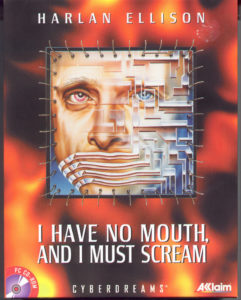
To the person who [is] contemplating buying this game, what would I say? I would say take your money and give it to the homeless, you’ll do more good. But if you are mad to buy this game, you’ll probably have a hell of a lot of fun playing it, it will probably make you uneasy, and you’ll probably be a smarter person when you’re done playing the game. Not because I’m smarter, but because everything was done to confuse and upset you. I am told by people that it is a game unlike any other game around at the moment and I guess that’s a good thing. Innovation and novelty is a good thing. It would be my delight if this game set a trend and all of the arcade bang-bang games that turn kids into pistol-packing papas and mamas were subsumed into games like this in which ethical considerations and using your brain and unraveling puzzles become the modus operandi. I don’t think it will happen. I don’t think you like to be diverted too much. So I’m actually out here to mess with you, if you want to know it. We created this game to give you all the stuff you think you want, but to put a burr into your side at the same time. To slip a little loco weed into your Coca-Cola. See you around.
— Harlan Ellison
Harlan Ellison made a very successful career out of biting the hands that fed him. The pint-sized dervish burst into literary prominence in the mid-1960s, marching at the vanguard of science fiction’s New Wave. In the pages of Frederick Pohl’s magazine If, he paraded a series of scintillatingly trippy short stories that were like nothing anyone had ever seen before, owing as much to James Joyce and Jack Kerouac as they did to Isaac Asimov and Robert Heinlein. Ellison demanded, both implicitly in his stories and explicitly in his interviews, that science fiction cast off its fetish for shiny technology-fueled utopias and address the semi-mythical Future in a more humanistic, skeptical way. His own prognostications in that vein were almost unrelentingly grim: “‘Repent, Harlequin!’ Said the Ticktockman” dealt with a future society where everyone was enslaved to the ticking of the government’s official clock; “I Have No Mouth, and I Must Scream” told of the last five humans left on a post-apocalyptic Earth, kept alive by an insane artificial intelligence so that he could torture them for all eternity; “A Boy and His Dog” told of a dog who was smarter than his feral, amoral human master, and helped him to find food to eat and women to rape as they roamed another post-apocalyptic landscape. To further abet his agenda of dragging science fiction kicking and screaming into the fearless realm of True Literature, Ellison became the editor of a 1967 anthology called Dangerous Visions, for which he begged a diverse group of established and up-and-coming science-fiction writers to pick a story idea that had crossed their mind but was so controversial and/or provocative that they had never dared send it to a magazine editor — and then to write it up and send it to him instead.
Ellison’s most impactful period in science fiction was relatively short-lived, ending with the publication of the somewhat underwhelming Again, Dangerous Visions in 1972. He obstinately refused to follow the expected career path of a writer in his position: that of writing a big, glossy novel to capitalize on the cachet his short stories had generated. Meanwhile even his output of new stories slowed in favor of more and more non-fiction essays, while those stories that did emerge lacked some of the old vim and vinegar. One cause of this was almost certainly his loss of Frederick Pohl as editor and bête noire. Possessing very different literary sensibilities, the two had locked horns ferociously over the most picayune details — Pohl called Ellison “as much pain and trouble as all the next ten troublesome writers combined” — but Pohl had unquestionably made Ellison’s early stories better. He was arguably the last person who was ever truly able to edit Harlan Ellison.
No matter. Harlan Ellison’s greatest creation of all was the persona of Harlan Ellison, a role he continued to play very well indeed right up until his death in 2018. “He is a test of our credulity,” wrote his fellow science-fiction writer David Gerrold in 1984. “He is too improbable to be real.”
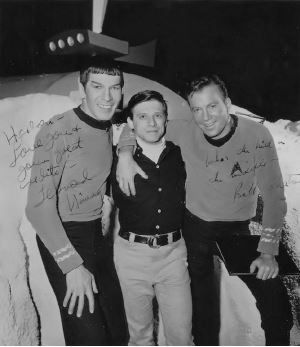
Harlan Ellison on the set of Star Trek with Leonard Nimoy and William Shatner.
The point of origin of Harlan Ellison as science fiction’s very own enfant terrible can be traced back to the episode of Star Trek he wrote in 1966. “The City on the Edge of Forever” is often called the best single episode of the entire original series, but to Ellison it was and forever remained an abomination in its broadcast form. As you may remember, it’s a time-travel story, in which Kirk, Spock, and McCoy are cast back into the Great Depression on Earth, where Kirk falls in love with a beautiful social worker and peace activist, only to learn that he has to let her die in a traffic accident in order to prevent her pacifism from infecting the body politic to such an extent that the Nazis are able to win World War II. As good as the produced version of the episode is, Ellison insisted until his death that the undoctored script he first submitted was far, far better — and it must be acknowledged that at least some of the people who worked on Star Trek agreed with him. In a contemporaneous memo, producer Bob Justman lamented that, following several rounds of editing and rewriting, “there is hardly anything left of the beauty and mystery that was inherent in the screenplay as Harlan originally wrote it.” For his part, Ellison blamed Star Trek creator Gene Roddenberry loudly and repeatedly for “taking a chainsaw” to his script. In a fit of pique, he submitted his undoctored script for a 1967 Writers Guild Award. When it won, he literally danced on the table in front of Roddenberry inside the banquet hall, waving his trophy in his face. Dorothy Fontana, the writer who had been assigned the unenviable task of changing Ellison’s script to fit with the series’s budget and its established characters, was so cowed by his antics that for 30 years she dared not tell him she had done so.
Despite this incident and many another, lower-profile one much like it, Ellison continued to work in Hollywood — as, indeed, he had been doing even before his star rose in literary science-fiction circles. Money, he forthrightly acknowledged, was his principal reason for writing for a medium he claimed to loathe. He liked creating series pilots most of all, he said, “because when they screw those up, they just don’t go on the air. I get paid and I’ve written something nice and it doesn’t have to get ruined.” His boorish behavior in meetings with the top movers and shakers of Hollywood became legendary, as did the lawsuits he fired hither and yon whenever he felt ill-used. Why did Hollywood put up with it? One answer is that Harlan Ellison was at the end of the day a talented writer who could deliver the goods when it counted, who wasn’t unaware of the tastes and desires of the very same viewing public he heaped with scorn at every opportunity. The other is that his perpetual cantankerousness made him a character, and no place loves a character more than Hollywood.
Then again, one could say the same of science-fiction fandom. Countless fans who had read few to none of Ellison’s actual stories grew up knowing him as their genre’s curmudgeonly uncle with the razor wit and the taste for blood. For them, Harlan Ellison was famous simply for being Harlan Ellison. Any lecture or interview he gave was bound to be highly entertaining. An encounter with Ellison became a rite of passage for science-fiction journalists and critics, who gingerly sidled up to him, fed him a line, and then ducked for cover while he went off at colorful and profane length.
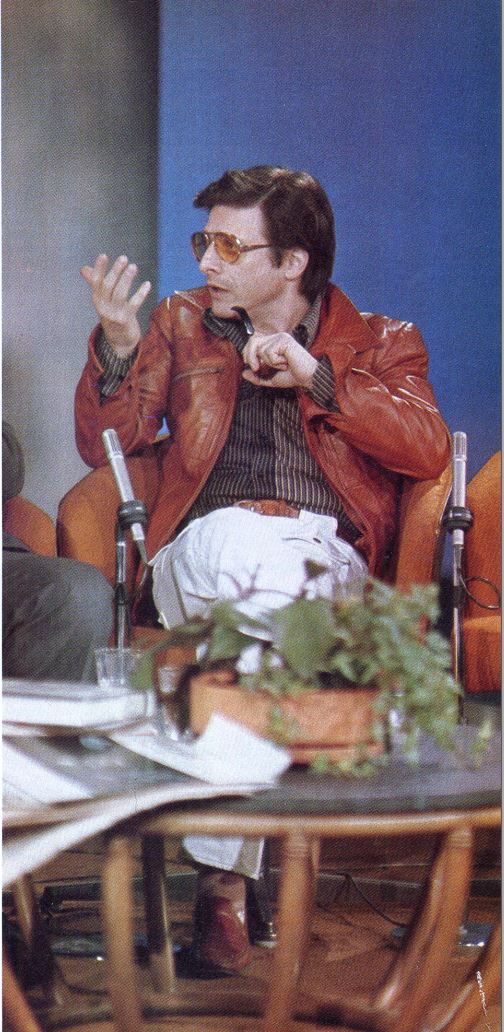
Harlan Ellison was a talk-show regular during the 1970s. And small wonder: drop a topic in his slot, and something funny, outrageous, or profound — or all three — was guaranteed to come out.
It’s hard to say how much of Ellison’s rage against the world was genuine and how much was shtick. He frequently revealed in interviews that he was very conscious of his reputation, and hinted at times that he felt a certain pressure to maintain it. And, in keeping with many public figures with outrageous public personas, Ellison’s friends did speak of a warmer side to his private personality, of a man who, once he brought you into his fold, would go to ridiculous lengths to support, protect, and help you.
Still, the flame that burned in Ellison was probably more real than otherwise. He was at bottom a moralist, who loathed the hypocrisy and parsimony he saw all around him. Often described as a futurist, he was closer to a reactionary. Nowhere could one see this more plainly than in his relationship to technology. In 1985, when the personal-computer revolution had become almost old hat, he was still writing on a mechanical typewriter, using reasoning that sounded downright Amish.
The presence of technology does not mean you have to use that technology. Understand? The typewriter that I have — I use an Olympia and I have six of them — is the best typewriter ever made. That’s the level of technology that allows me to do my job best. Electric typewriters and word processors — which are vile in every respect — seem to me to be crutches for bad writing. I have never yet heard an argument for using a word processor that didn’t boil down to “It’s more convenient.” Convenient means lazy to me. Lazy means I can write all the shit I want and bash it out later. They can move it around, rewrite it later. What do I say? Have it right in your head before you sit down, that’s what art is all about. Art is form, art is shape, art is pace, it is measure, it is the sound of music. Don’t write slop and discordancy and think just because you have the technology to cover up your slovenliness that it makes you a better writer. It doesn’t.
Ellison’s attitude toward computers in general was no more nuanced. Asked what he thought about computer entertainment in 1987, he pronounced the phrase “an oxymoron.” Thus it came as quite a surprise to everyone five years later when it was announced that Harlan Ellison had agreed to collaborate on a computer game.
The source of the announcement was a Southern California publisher and developer called Cyberdreams, which had been founded by Pat Ketchum and Rolf Klug in 1990. Ketchum was a grizzled veteran of the home-computer wars, having entered the market with the founding of his first software publisher DataSoft on June 12, 1980. After a couple of years of spinning their wheels, DataSoft found traction when they released a product called Text Wizard, for a time the most popular word processor for Atari’s 8-bit home-computer line. (Its teenage programmer had started on the path to making it when he began experimenting with ways to subtly expand margins and increase line spacings in order to make his two-page school papers look like three…)
Once established, DataSoft moved heavily into games. Ketchum decided early on that working with pre-existing properties was the best way to ensure success. Thus DataSoft’s heyday, which lasted from roughly 1983 to 1987, was marked by a bewildering array of television shows (The Dallas Quest), martial-arts personalities (Bruce Lee), Sunday-comics characters (Heathcliff: Fun with Spelling), blockbuster movies (Conan, The Goonies), pulp fiction (Zorro), and even board games (221 B Baker St.), as well as a bevy of arcade ports and British imports. The quality level of this smorgasbord was hit or miss at best, but Ketchum’s commercial instinct for the derivative proved well-founded for almost a half a decade. Only later in the 1980s, when more advanced computers began to replace the simple 8-bit machines that had been the perfect hosts for DataSoft’s cheap and cheerful games, did his somewhat lackadaisical attitude toward the nuts and bolts of his products catch up to him. He then left DataSoft to work for a time at Sullivan Bluth Interactive Media, which made ports of the old laser-disc arcade game Dragon’s Lair for various personal-computing platforms. Then, at the dawn of the new decade, he founded another company of his own with his new partner Rolf Klug.
The new company’s product strategy was conceived as an intriguing twist on that of the last one he had founded. Like DataSoft, Cyberdreams would rely heavily on licensed properties and personalities. But instead of embracing DataSoft’s random grab bag of junk-food culture, Cyberdreams would go decidedly upmarket, a move that was very much in keeping with the most rarefied cultural expectations for the new era of multimedia computing. Their first released product, which arrived in 1992, was called Dark Seed; it was an adventure game built around the striking and creepy techno-organic imagery of the Swiss artist H.R. Giger, best known for designing the eponymous creatures in the 1979 Ridley Scott film Alien. If calling Dark Seed a “collaboration” with Giger is perhaps stretching the point — although Giger licensed his existing paintings to Cyberdreams, he contributed no new art to the game — the end result certainly does capture his fetishistic aesthetic very, very well. Alas, it succeeds less well as a playable game. It runs in real time, meaning events can and will run away without a player who isn’t omniscient enough to be in the exact right spot at the exact right time, while its plot is most kindly described as rudimentary — and don’t even get me started on the pixel hunts. Suffice to say that few games in history have screamed “style over substance” louder than this one. Still, in an age hungry for fodder for the latest graphics cards and equally eager for proof that computer games could be as provocative as any other form of media, it did quite well.
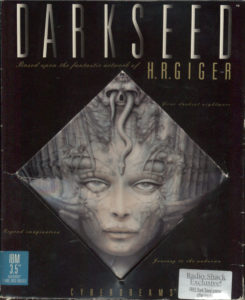
By the time of Dark Seed‘s release, Cyberdreams was already working on another game built around the aesthetic of another edgy artist most famous for his contributions to a Ridley Scott film: Syd Mead, who had done the set designs for Blade Runner, along with those of such other iconic science-fiction films as Star Trek: The Motion Picture, TRON, 2010, and the Alien sequel Aliens. CyberRace, the 1993 racing game that resulted from the partnership, was, like its Cyberdreams predecessor, long on visuals and short on satisfying gameplay.
Well before that game was completed — in fact, before even Dark Seed was released — Pat Ketchum had already approached Harlan Ellison to ask whether he could make a game out of his classic short story “I Have No Mouth, and I Must Scream.” Doing so was, if nothing else, an act of considerable bravery, given not only Ellison’s general reputation but his specific opinion of videogames as “an utter and absolute stupid waste of time.” And yet, likely as much to Ketchum’s astonishment as anyone else’s, he actually agreed to the project. Why? That is best left to Ellison to explain in his own inimitable fashion:
The question frequently asked of me is this: “Since it is common knowledge that you don’t even own a computer on which you could play an electronic game this complex, since it is common knowledge that you hate computers and frequently revile those who spend their nights logging onto bulletin boards, thereby filling the air with pointless gibberish, dumb questions that could’ve been answered had they bothered to read a book of modern history or even this morning’s newspaper, and mean-spirited gossip that needs endless hours the following day to be cleaned up; and since it is common knowledge that not only do you type your books and columns and TV and film scripts on a manual typewriter (not even an electric, but an actual finger-driven manual), but that the closest you’ve ever come to playing an actual computer- or videogame is the three hours you wasted during a Virgin Airlines flight back to the States from the UK; where the hell do you get off creating a high-tech cutting-edge enigma like this I Have No Mouth thing?”
To which my usual response would be, “Yo’ Mama!”
But I have been asked to attempt politeness, so I will vouchsafe courtesy and venture some tiny explication of what the eff I’m doing in here with all you weird gazoonies. Take your feet off the table.
Well, it goes back to that Oscar Wilde quote about perversion: “You may engage in a specific perversion once, and it can be chalked up to curiosity. But if you do it again, it must be presumed you are a pervert.”
They came to me in the dead of night, human toads in silk suits, from this giant megapolitan organization called Cyberdreams, and they offered me vast sums of money — all of it in pennies, with strings attached to each coin, so they could yank them back in a moment, like someone trying to outsmart a soft-drink machine with a slug on a wire — and they said, in their whispery croaky demon voices, “Let us make you a vast fortune! Just sell us the rights to use your name and the name of your most famous story, and we will make you wealthy beyond the dreams of mere mortals, or even Aaron Spelling, our toad brother in riches.”
Well, I’d once worked for Aaron Spelling on Burke’s Law, and that had about as much appeal to me as spending an evening discussing the relative merits of butcher knives with O.J. Simpson. So I told the toads that money was something I had no trouble making, that money is what they give you when you do your job well, and that I never do anything if it’s only for money. ‘Cause money ain’t no thang.
Well, for the third time, they then proceeded to do the dance, and sing the song, and hump the drums, and finally got down to it with the fuzzy ramadoola that can snare me: they said, “Well (#4), you’ve never done this sort of thing. Maybe it is that you are not capable of doing this here now thing.”
Never tell me not to go get a tall ladder and climb it and open the tippy-topmost kitchen cabinet in my mommy’s larder and reach around back there at the rear of the topmost shelf in the dark with the cobwebs and the spider-goojies and pull out that Mason jar full of hard nasty petrified chickpeas and strain and sweat to get the top off the jar till I get it open and then take several of those chickpeas and shove them up my nose. Never tell me that. Because as sure as birds gotta swim an’ fish gotta fly, when you come back home, you will find me lying stretched out blue as a Duke Ellington sonata, dead cold with beans or peas or lentils up my snout.
Or, as Oscar Wilde put it: “I couldn’t help it. I can resist anything except temptation.”
And there it is. I wish it were darker and more ominous than that, but the scaldingly dopey truth is that I wanted to see if I could do it. Create a computer game better than anyone else had created a computer game. I’d never done it, and I was desirous of testing my mettle. It’s a great flaw with me. My only flaw, as those who have known me longest will casually attest. (I know where they live.)
Having entered the meeting hoping only to secure the rights to Ellison’s short story, Pat Ketchum thus walked away having agreed to a full-fledged collaboration with the most choleric science-fiction writer in the world, a man destined to persist forevermore in referring to him simply as “the toad.” Whether this was a good or a bad outcome was very much up for debate.
Ketchum elected to pair Ellison with David Sears, a journalist and assistant editor for Compute! magazine who had made Cyberdreams’s acquaintance when he was assigned to write a preview of Dark Seed, then had gone on to write the hint book for the game. Before the deal was consummated, he had been told only that Cyberdreams hoped to adapt “one of” Ellison’s stories into a game: “I was thinking, oh, it could be ‘Repent, Harlequin!’ Said the Ticktockman,’ or maybe ‘A Boy and His Dog,’ and it’s going to be some kind of RPG or something.” When he was told that it was to be “I Have No Mouth, and I Must Scream,” he was taken aback: “I was like, what? There’s no way [to] turn that into a game!” In order to fully appreciate his dismay, we should look a bit more closely at the story in question.
Harlan Ellison often called “No Mouth” “one of the ten most-reprinted stories in the English language,” but this claim strikes me as extremely dubious. Certainly, however, it is one of the more frequently anthologized science-fiction classics. Written “in one blue-white fit of passion,” as Ellison put it, “like Captain Nemo sitting down at his organ and [playing] Toccata and Fugue in D Minor,” it spans no more than fifteen pages or so in the typical paperback edition, but manages to cram quite a punch into that space.
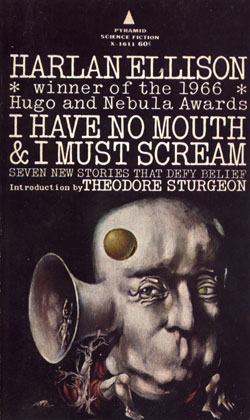
The backstory entails a three-way world war involving the United States, the Soviet Union, and China and their respective allies, with the forces of each bloc controlled by a supercomputer in the name of maximal killing efficiency. That last proved to be a mistake: instead of merely moving ships and armies around, the American computer evolved into a sentient consciousness and merged with its rival machines. The resulting personality was twisted by its birthright of war and violence. Thus it committed genocide on the blighted planet’s remaining humans, with the exception of just five of them, which it kept alive to physically and psychologically torture for its pleasure. As the story proper opens, it’s been doing so for more than a century. Our highly unreliable narrator is one of the victims, a paranoid schizophrenic named Ted; the others, whom we meet only as the sketchiest of character sketches, are named Gorrister, Benny, Ellen (the lone woman in the group), and Nimdok. The computer calls itself AM, an acronym for its old designation of “Allied Mastercomputer,” but also a riff on Descartes: “I think, therefore I AM.”
The story’s plot, such as it is, revolves around the perpetually starving prisoners’ journey to a place that AM has promised them contains food beyond their wildest dreams. It’s just one more of his cruel jokes, of course: they wind up in a frigid cavern piled high with canned food, without benefit of a can opener. But then something occurs which AM has failed to anticipate: Ted and Ellen finally accept that there is only one true means of escape open to them. They break off the sharpest stalactites they can find and use them to kill the other three prisoners, after which Ted kills Ellen. But AM manages to intervene before Ted can kill himself. Enraged at having his playthings snatched away, he condemns the very last human on Earth to a fate more horrific even than what he has already experienced:
I am a great soft jelly thing. Smoothly rounded, with no mouth, with pulsing white holes filled by fog where my eyes used to be. Rubbery appendages that were once my arms; bulks rounding down into legless humps of slippery matter. I leave a moist trail when I move. Blotches of diseased, evil gray come and go on my surface, as though light is being beamed from within.
Outwardly: dumbly, I shamble about, a thing that could never have been known as human, a thing whose shape is so alien a travesty that humanity becomes more obscene for the vague resemblance.
Inwardly: alone. Here. Living under the land, under the sea, in the belly of AM, whom we created because our time was badly spent and we must have known unconsciously that he could do it better. At least the four of them are safe at last.
AM will be the madder for that. It makes me a little happier. And yet… AM has won, simply… he has taken his revenge…
I have no mouth. And I must scream.
Harlan Ellison was initially insistent that the game version of No Mouth preserve this miserably bleak ending. He declared himself greatly amused by the prospect of “a game that you cannot possibly win.” Less superciliously, he noted that the short story was intended to be, like so much of his work, a moral fable: it was about the nobility of doing the right thing, even when one doesn’t personally benefit — indeed, even when one will be punished terribly for it. To change the story’s ending would be to cut the heart out of its message.
Thus when poor young David Sears went to meet with Ellison for the first time — although Cyberdreams and Ellison were both based in Southern California, he himself was still working remotely from his native Mississippi — he faced the daunting prospect of convincing one of the most infamously stubborn writers in the world — a man who had spent decades belittling no less rarefied a character than Gene Roddenberry over the changes to his “City on the Edge of Forever” script — that such an ending just wouldn’t fly in the contemporary games market. The last company to make an adventure game with a “tragic” ending had been Infocom back in 1983, and they’d gotten so much blow back that no one had ever dared to try such a thing again. People demanded games that they could win.
Much to Sears’s own surprise, his first meeting with Ellison went very, very well. He won Ellison’s respect almost immediately, when he asked a question that the author claimed never to have been asked before: “Why are these [people] the five that AM has saved?” The question pointed a way for the game of No Mouth to become something distinctly different from the story — something richer, deeper, and even, I would argue, more philosophically mature.
Ellison and Sears decided together that each of AM’s victims had been crippled inside by some trauma before the final apocalyptic war began, and it was this that made them such particularly delightful playthings. The salt-of-the-earth truck driver Gorrister was wracked with guilt for having committed his wife to a mental institution; the hard-driving military man Benny was filled with self-loathing over his abandonment of his comrades in an Asian jungle; the genius computer scientist Ellen was forever reliving a brutal rape she had suffered at the hands of a coworker; the charming man of leisure Ted was in reality a con artist who had substituted sexual conquest for intimacy. The character with by far the most stains on his conscience was the elderly Nimdok, who had served as an assistant to Dr. Josef Mengele in the concentration camps of Nazi Germany.
You the player would guide each of the five through a surreal, symbolic simulacrum of his or her checkered past, helpfully provided by AM. While the latter’s goal was merely to torture them, your goal would be to cause them to redeem themselves in some small measure, by looking the demons of their past full in the face and making the hard, selfless choices they had failed to make the first time around. If they all succeeded in passing their tests of character, Ellison grudgingly agreed, the game could culminate in a relatively happy ending. Ellison:
This game [says] to the player there is more to the considered life than action. Television tells you any problem can be solved in 30 minutes, usually with a punch in the jaw, and that is not the way life is. The only thing you have to hang onto is not your muscles, or how pretty your face is, but how strong is your ethical behavior. How willing are you to risk everything — not just what’s convenient, but everything — to triumph. If someone comes away from this game saying to himself, “I had to make an extremely unpleasant choice, and I knew I was not going to benefit from that choice, but it was the only thing to do because it was the proper behavior,” then they will have played the game to some advantage.
Harlan Ellison and David Sears were now getting along fabulously. After several weeks spent working on a design document together, Ellison pronounced Sears “a brilliant young kid.” He went out of his way to be a good host. When he learned, for example, that Sears was greatly enamored with Neil Gaiman’s Sandman graphic novels, he called up said writer himself on his speakerphone: “Hi, Neil. This is David. He’s a fan and he’d love to talk to you about your work.” In retrospect, Ellison’s hospitality is perhaps less than shocking. He was in fact helpful and even kind throughout his life to young writers whom he deemed to be worth his trouble. David Sears was obviously one of these. “I don’t want to damage his reputation because I’m sure he spent decades building it up,” says Sears, “but he’s a real rascal with a heart of gold — but he doesn’t tolerate idiots.”
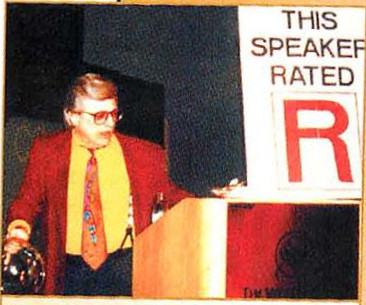
Harlan Ellison prepares to speak at the 1993 Game Developers Conference.
The project had its industry coming-out party at the seventh annual Computer Game Developers Conference in May of 1993. In a measure of how genuinely excited Harlan Ellison was about it, he agreed to appear as one of the most unlikely keynote speakers in GDC history. His speech has not, alas, been preserved for posterity, but it appears to have been a typically pyrotechnic Ellison rant, judging by the angry response of Computer Gaming World editor Johnny L. Wilson, who took Ellison to be just the latest in a long line of clueless celebrity pundits swooping in to tell game makers what they were doing wrong. Like all of the others, Wilson said, Ellison “didn’t really understand technology or the challenges faced daily by his audience [of game developers].” His column, which bore the snarky title of “I Have No Message, but I Must Scream,” went on thusly:
The major thesis of the address seemed to be that the assembled game designers need to do something besides create games. We aren’t quite sure what he means.
If he means to take the games which the assembled designers are already making and infuse them with enough human emotion to bridge the gaps of interpersonal understanding, there are designers trying to accomplish this in many different ways (games with artificial personalities, multiplayer cooperation, and, most importantly, with story).
If he objects to the violence which is so pervasive in both computer and video games, he had best revisit the anarchic and glorious celebration of violence in his own work. Violence is an easy way to express conflict and resolution in any art form. It can also be powerful. That is why we advocate a more careful use of violence in certain games, but do not editorialize against violence per se.
Harlan Ellison says that the computer-game design community should quit playing games with their lives. We think Ellison should stop playing games with his audiences. It’s time to put away his “Bad Melville” impression and use his podium as a “futurist” to challenge his audiences instead of settling for cheap laughs and letting them miss the message.
Harlan Ellison seldom overlooked a slight, whether in print or in person, and this occasion was no exception. He gave Computer Gaming World the rather hilarious new moniker of Video Wahoo Magazine in a number of interviews after Wilson’s editorializing was brought to his attention.
But the other side of Harlan Ellison was also on display at that very same conference. David Sears had told Ellison shortly before he made his speech that he really, really wanted a permanent job in the games industry, not just the contract work he had been getting from Cyberdreams. So, Ellison carried a fishbowl onstage with him, explained to the audience that Sears was smart and creative as heck and urgently needed a job, and told them to drop their business cards in the bowl if they thought they might be able to offer him one. “Three days later,” says Sears, “I had a job at Virgin Games. If he called me today [this interview was given before Ellison’s death] and said, ‘I need you to fix the plumbing in my bathroom,’ I’d be on a plane.”
Ellison’s largess was doubly selfless in that it stopped his No Mouth project in its tracks. With Sears having departed for Virgin Games, it spent at least six months on the shelf while Cyberdreams finished up CyberRace and embarked on a Dark Seed II. Finally Pat Ketchum handed it to a new hire, a veteran producer and designer named David Mullich.
It so happens that we met Mullich long, long ago, in the very early days of these histories. At the dawn of the 1980s, as a young programmer just out of university, he worked for the pioneering educational-software publisher Edu-Ware, whom he convinced to let him make some straight-up games as well. One of these was an unauthorized interactive take on the 1960s cult-classic television series The Prisoner; it was arguably the first commercial computer game in history to strive unabashedly toward the status of Art.
Mullich eventually left Edu-Ware to work for a variety of software developers and publishers. Rather belying his earliest experiments in game design, he built a reputation inside the industry as a steady hand well able to churn out robust and marketable if not always hugely innovative games and educational products that fit whatever license and/or design brief he was given. Yet the old impulse to make games with something to say about the world never completely left him. He was actually in the audience at the Game Developers Conference where Harlan Ellison made his keynote address; in marked contrast to Johnny L. Wilson, he found it bracing and exciting, not least because “I Have No Mouth, and I Must Scream” was his favorite short story of all time. Half a year or so later, Pat Ketchum called Mullich up to ask if he’d like to help Ellison get his game finished. He didn’t have to ask twice; after all those years spent slogging in the trenches of commerce, here was a chance for Mullich to make Art again.
His first meeting with Ellison didn’t begin well. Annoyed at the long delay from Cyberdreams’s side, Ellison mocked him as “another member of the brain trust.” It does seem that Mullich never quite developed the same warm relationship with Ellison that Sears had enjoyed: Ellison persisted in referring to him as “this new David, whose last name I’ve forgotten” even after the game was released. Nonetheless, he did soften his prejudicial first judgment enough to deem Mullich “a very nice guy.” Said nice guy took on the detail work of refining Sears and Ellison’s early design document — which, having been written by two people who had never made a game before, had some inevitable deficiencies — into a finished script that would combine Meaning with Playability, a task his background prepared him perfectly to take on. Mullich estimates that 50 percent of the dialog in the finished game is his, while 30 percent is down to Sears and just 20 percent to Ellison himself. Still, even that level of involvement was vastly greater than that of most established writers who deigned to put their names on games. And of course the core concepts of No Mouth were very much Ellison and Sears’s.
Pat Ketchum had by this point elected to remove Cyberdreams from the grunt work of game development; instead the company would act as a design mill and publisher only. Thus No Mouth was passed to an outfit called The Dreamers Guild for implementation under Mullich’s supervision. That became another long process; the computer game of I Have No Mouth, and I Must Scream wasn’t finally released until late 1995, fully three and a half years after Pat Ketchum had first visited Harlan Ellison to ask his permission to make it.
The latter’s enthusiasm for the project never abated over the course of that time. He bestowed his final gift upon David Mullich and the rest of Cyberdreams when he agreed to perform the role of AM himself. The result is one of the all-time great game voice-acting performances; Ellison, a man who loved to hear himself speak under any and all circumstances, leans into the persona of the psychopathic artificial intelligence with unhinged glee. After hearing him, you’ll never be able to imagine anyone else in the role.
Upon the game’s release, Ellison proved a disarmingly effective and professional spokesman for it; for all that he loved to rail against the stupidity of mainstream commercial media, he had decades of experience as a writer for hire, and knew the requirements of marketing. He wrote a conciliatory, generous, and self-deprecatory letter to Computer Gaming World — a.k.a., Video Wahoo Magazine — after the magazine pronounced No Mouth its Adventure Game of the Year. He even managed to remember David Mullich’s last name therein.
With a bewildering admixture of pleasure and confusion — I’m like a meson which doesn’t know which way to quark — I write to thank you and your staff. Pleasure, because everybody likes to cop the ring as this loopy caravanserie chugs on through Time and Space. Confusion, because — as we both know — I’m an absolute amateur at this exercise. To find myself not only avoiding catcalls and justified laughter at my efforts, but to be recognized with a nod of approval from a magazine that had previously chewed a neat, small hole through the front of my face… well, it’s bewildering.
David Sears and I worked very hard on I Have No Mouth. And we both get our accolades in your presentation. But someone else who had as much or more to do with bringing this project to fruition is David Mullich. He was the project supervisor and designer after David Sears moved on. He worked endlessly, and with what Balzac called “clean hands and composure,” to produce a property that would not shame either of us. It simply would not have won your award had not David Mullich mounted the barricades.
I remember when I addressed the Computer Game Designers’ banquet a couple of years ago, when I said I would work to the limits of my ability on I Have No Mouth, but that it would be my one venture into the medium. Nothing has changed. I’ve been there, done that, and now you won’t have to worry about me making a further pest of myself in your living room.
But for the honor you pay me, I am grateful. And bewildered.
Ellison’s acknowledgment of Mullich’s contribution is well-taken. Too often games that contain or purport to contain Deep Meaning believe this gives them a pass on the fundamentals of being playable and soluble. (For example, I might say, if you’ll allow me just a bit of Ellisonian snarkiness, that a large swath of the French games industry operated on this assumption for many years.) That No Mouth doesn’t fall victim to this fallacy — that it embeds its passion plays within the framework of a well-designed puzzle-driven adventure game — must surely be thanks to Mullich. In this sense, then, Sears’s departure came at the perfect time, allowing the experienced, detail-oriented Mullich to run with the grandiose concept which Sears and Ellison, those two game-design neophytes, had cooked up together. It was, one might say, the best of both worlds.
But, lest things start to sound too warm and fuzzy, know that Harlan Ellison was still Harlan Ellison. In the spring of 1996, he filed a lawsuit against Cyberdreams for unpaid royalties. Having spent his life in books and television, it appears that he may have failed to understand just how limited the sales prospects of an artsy, philosophical computer game like this one really were, regardless of how many awards it won. (Witness his comparison of Cyberdreams to the television empire of Aaron Spelling in one of the quotes above; in reality, the two operated not so much in different media galaxies as different universes.) “With the way the retail chain works, Cyberdreams probably hadn’t turned a profit on the game by the time the lawsuit was filed,” noted Computer Gaming World. “We’re not talking sales of Warcraft II here, folks.” I don’t know the details of Ellison’s lawsuit, nor what its ultimate outcome was. But I do know that David Mullich estimates today that No Mouth probably sold only about 40,000 copies in all.
Harlan Ellison didn’t always keep the sweeping promises he made in the heat of the moment; he huffily announced on several occasions that he was forever abandoning television, the medium with which he passed so much of his career in such a deadly embrace, only to be lured back in by money and pledges that this time things would be different. He did, however, keep his promise of never making another computer game. And that, of course, makes the one game he did help to make all the more special. I Have No Mouth, and I Must Scream stands out from the otherwise drearily of-its-time catalog of Cyberdreams as a multimedia art project that actually works — works as a game and, dare I say it, as a form of interactive literature. It stands today as a rare fulfillment of the promise that so many saw in games back in those heady days when “multimedia” was the buzzword of the zeitgeist — the promise of games as a sophisticated new form of storytelling capable of the same relevance and resonance as a good novel or movie. This is by no means the only worthwhile thing that videogames can be, nor perhaps even the thing they are best at being; much of the story of gaming during the half-decade after No Mouth‘s release is that of a comprehensive rejection of the vision Cyberdreams embodied. The company went out of business in 1997, by which time its artsy-celebrity-driven modus operandi was looking as anachronistic as Frank Sinatra during the heyday of the Beatles.
Nevertheless, I Have No Mouth, and I Must Scream remains one of the best expressions to stem from its confused era, a welcome proof positive that sometimes the starry-eyed multimedia pundits could be right. David Mullich went on to work on such high-profile, beloved games as Heroes of Might and Magic III and Vampire: The Masquerade — Bloodlines, but he still considers No Mouth one of the proudest achievements of a long and varied career that has encompassed the naïvely idealistic and the crassly commercial in equal measure. As well he should: No Mouth is as meaningful and moving today as it was in 1995, a rare example of a game adaptation that can be said not just to capture but arguably to improve on its source material. It endures as a vital piece of Harlan Ellison’s literary legacy.
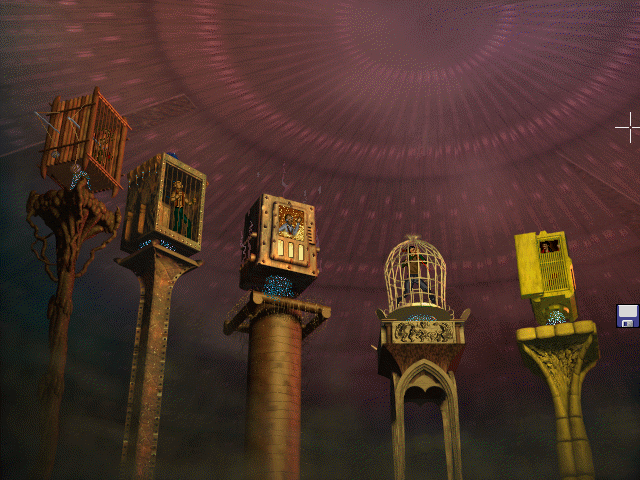
In I Have No Mouth, and I Must Scream, you explore the traumas of each of the five people imprisoned by the psychotic supercomputer AM, taken in whatever order you like. Finding a measure of redemption for each of them opens up an endgame which offers the same chance for the rest of humanity — a dramatic departure from the infamously bleak ending of the short story on which the game is based.
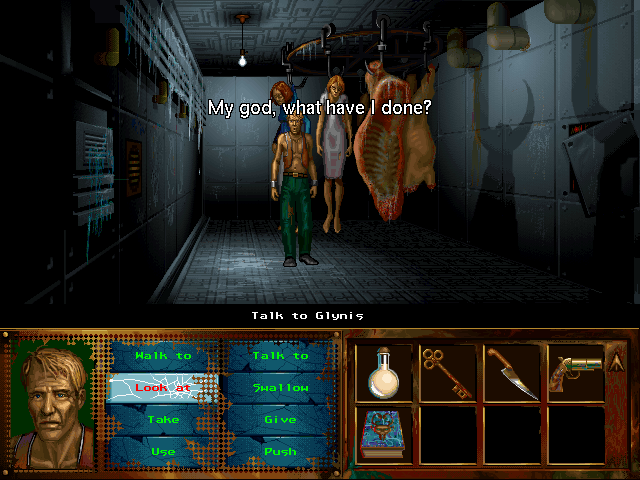
Each character’s vignette is a surreal evocation of his tortured psyche, but is also full of opportunities for him to acknowledge and thereby cleanse himself of his sins. Harlan Ellison particularly loved this bit of symbolism, involving the wife and mother-in-law of the truck driver Gorrester: he must literally let the two principal women in his life off the hook. (Get it?) Ellison’s innocent delight in interactions like these amused the experienced game designer David Mullich, for whom they were old hat.
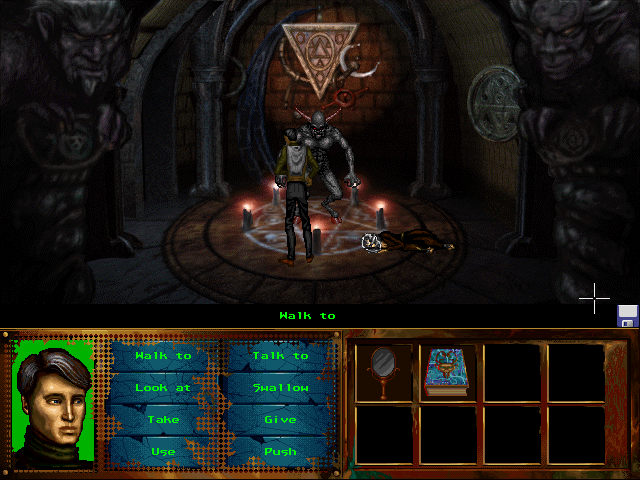
In mechanical terms, No Mouth is a fairly typical adventure game of its period. Its engine’s one major innovation can be seen in the character portrait at bottom left. The background here starts out black, then lightens through progressive shades of green as the character in question faces his demons (literally here, in the case of Ted — the game is not always terribly subtle). Ideally, each vignette will conclude with a white background. Be warned: although No Mouth mostly adheres to a no-deaths-and-no-dead-ends philosophy — “dying” in a vignette just gets the character bounced back to his cage, whence he can try again — the best ending becomes impossible to achieve if every character doesn’t demonstrate a reasonable amount of moral growth in the process of completing his vignette.
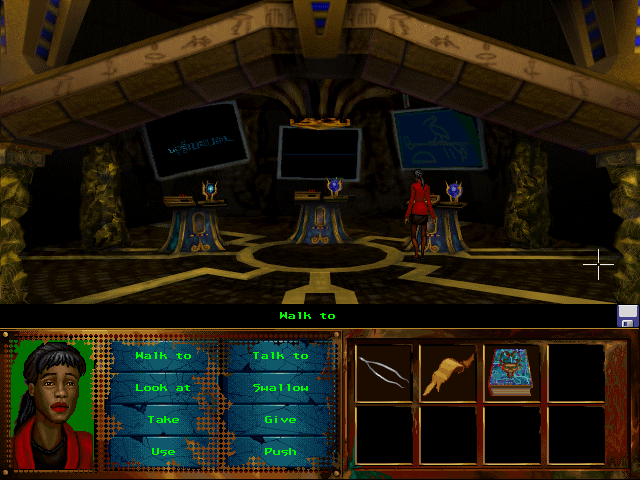
The computer genius Ellen is mortified by yellow, the color worn by the man who raped her. Naturally, the shade features prominently in AM’s decor.
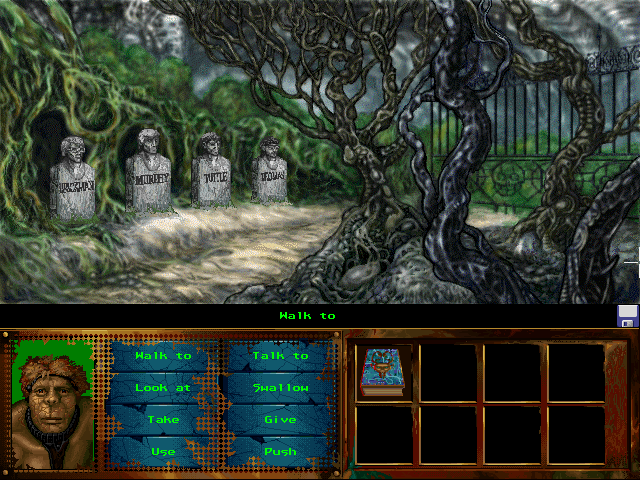
The professional soldier Benny confronts the graves of the men who died under his command.
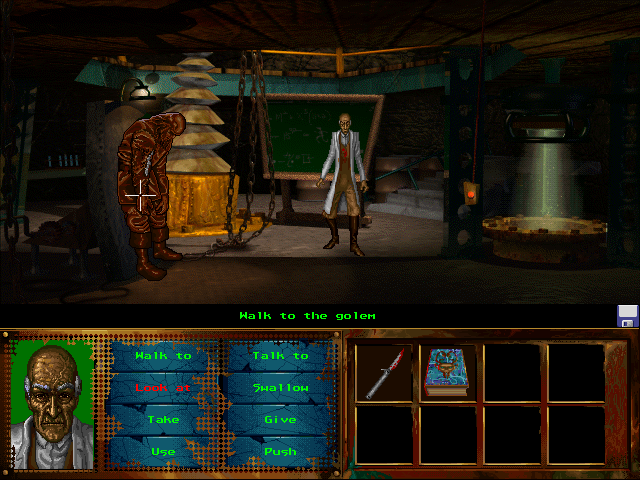
If sins can be quantified, then Nimdok, the associate to Dr. Mengele, surely has the most to atone for. His vignette involves the fable of the Golem of Prague, who defended the city’s Jewish ghetto against the pogroms of the late sixteenth century. Asked whether he risked trivializing the Holocaust by putting it in a game, Harlan Ellison answered in the stridently negative: “Nothing could trivialize the Holocaust. I don’t care whether you mention it in a comic book, on bubble-gum wrappers, in computer games, or write it in graffiti on the wall. Never forget. Never forget.“
People say, “Oh, you’re so prolific.” That’s a remark made by assholes who don’t write. If I were a plumber and I repaired 10,000 toilets, would they say, “Boy, you’re a really prolific plumber?”
If I were to start over, I would be a plumber. I tell that to people, they laugh. They think I’m making it up. It’s not funny. I think a plumber, a good plumber who really cares and doesn’t overcharge and makes sure things are right, does more good for the human race in a given day than 50 writers. In the history of the world, there are maybe, what, 20, 30 books that ever had any influence on anybody, maybe The Analects of Confucius, maybe The History of the Peloponnesian Wars, maybe Uncle Tom’s Cabin. If I ever write anything that is remembered five minutes after I’m gone, I will consider myself having done the job well. I work hard at what I do; I take my work very seriously. I don’t take me particularly seriously. But I take the work seriously. But I don’t think writing is all that inherently a noble chore. When the toilet overflows, you don’t need Dostoevsky coming to your house.
That’s what I would do, I would get myself a job as a plumber. I would go back to bricklaying, which I used to do. I would become an electrician. Not an electrical engineer. I would become an electrician. I would, you know, install a night light in a kid’s nursery, and at the end of the day, if I felt like writing, I would write something. I don’t know what that has to do with the game or anything, but you asked so I told you.
— Harlan Ellison (1934-2018)
(Sources: the books The Way the Future Was by Frederick Pohl, These Are the Voyages: Season One by Marc Cushman with Susan Osborn, The Cambridge Companion to Science Fiction edited by Edward James and Farah Mendlesohn, I Have No Mouth & I Must Scream: Stories by Harlan Ellison, and I Have No Mouth, and I Must Scream: The Official Strategy Guide by Mel Odom; Starlog of September 1977, April 1980, August 1980, August 1984, November 1985, and December 1985; Compute! of November 1992; Computer Gaming World of March 1988, September 1992, July 1993, September 1993, April 1996, May 1996, July 1996, August 1996, November 1996, and June 1999; CU Amiga of November 1992 and February 1993; Next Generation of January 1996; A.N.A.L.O.G. of June 1987; Antic of August 1983; Retro Gamer 183. Online sources include a 1992 Game Informer retrospective on I Have No Mouth, and I Must Scream and a history of Cyberdreams at Game Nostalgia. My thanks also go to David Mullich for a brief chat about his career and his work on No Mouth.
I Have No Mouth, and I Must Scream is available as a digital purchase at GOG.com.)
![[Theory] What is Michael Myers in HALLOWEEN KILLS?](https://i2.wp.com/www.nightmarishconjurings.com/wp-content/uploads/2021/06/HAK_Tsr1Sheet10_RGB_2.jpg?resize=640%2C1013&ssl=1)
In the past sequels, Michael was invincible due to being possessed by a demon thanks to the Cult of Thorn. That explains all of the times that he should have been dead but wasn’t. At the end of HALLOWEEN KILLS, ole Mikey has been beaten, stabbed, and burned, AND YET he gets up and proceeds to stab and yeet people left, right, and center, including Karen. So, if the past sequels are all for naught, what the hell is Michael, and why won’t he die? I think I may have an idea.
The big theme of HALLOWEEN KILLS is that “Evil dies tonight,” and it is chanted all through the town. Everyone knows what Michael did in 1963 and again in 1978. His story is told every year by the survivors and by Laurie who has been preparing for his demise for 40 years. His story is told and told and told again. On Halloween night in 2018, more than ever his name and deeds were on the lips of the entire town. So, why does this matter?
I present to you a mythical creature that graces our presence even today: the Tulpa. A Tulpa is a being that is breathed into life through thought and stories. A Tulpa can be created over a matter of months or weeks. A perfect example of this is Slenderman. Slenderman is a creepypasta created by Eric Knudsen. What started as a meme became a story, which then became something that people claim to now see in real life. Two young girls even nearly stabbed their best friend to death because they thought that Slenderman was going to come and take them to his Slender-Mansion.
So, with that in mind, it makes sense that 40 years’ worth of stories and myths surrounding Michael’s slayings could have made Michael into the thing which they feared all along: an unstoppable and unkillable force that will kill everything in its path. Michael escaping the basement is realistic because he hid himself away from the fire until he was released. However, surviving massive beatings and stabbings with enough strength to then kill literally everyone around him just doesn’t make a whole lot of sense unless we throw some Tulpa logic into the mix. Enough people in the town and the country know his name and have shared the stories of his murders enough that they could have created a super murder machine.
With Laurie’s monologue at the end of HALLOWEEN KILLS talking about how it’s Michael’s story that is destroying the town and how the evil is spreading, it makes a lot of sense. You could also toss in the theory that his anger and adrenaline are topped out, so he is just killing on chemicals alone, but all that juice runs out at some point. We won’t know for sure until the next movie and you KNOW there will be another film. Do you think Michael is a Tulpa and the town will forever bring about their own demise or do you think something else is at play here? Let us know what you think!
HALLOWEEN KILLS is now in theaters and available for streaming only on Peacock.
The post [Theory] What is Michael Myers in HALLOWEEN KILLS? appeared first on Nightmarish Conjurings.
The digital transformation and shift in work patterns have drastically changed the network security landscape. Employees are bringing remote devices and accessing data from outside the corporate network. The same data is also shared with external collaborators like partners and vendors.

Microsoft this week announced that organizations can now enable their employees to make one-to-one calls on Teams that are protected by end-to-end encryption.
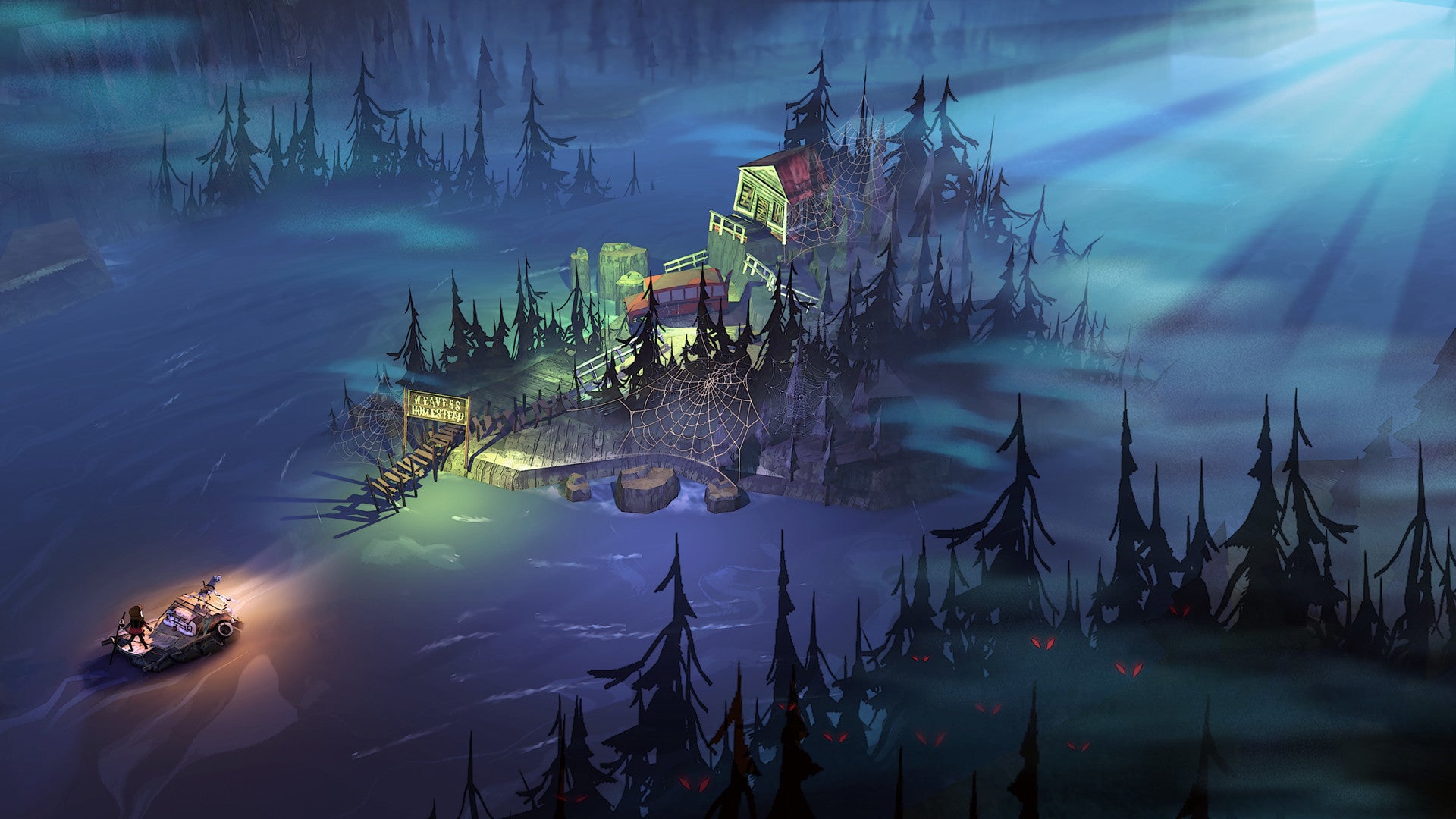
Cyberpunk and Witcher crew CD Projekt have acquired The Molasses Flood, the American studio behind post-apocalyptic raft ride The Flame In The Flood and base-building game Drake Hollow. Huh! The studio will be making a game set in one of CD Projekt's worlds, which warrants a second: huh! It's all secret for now.
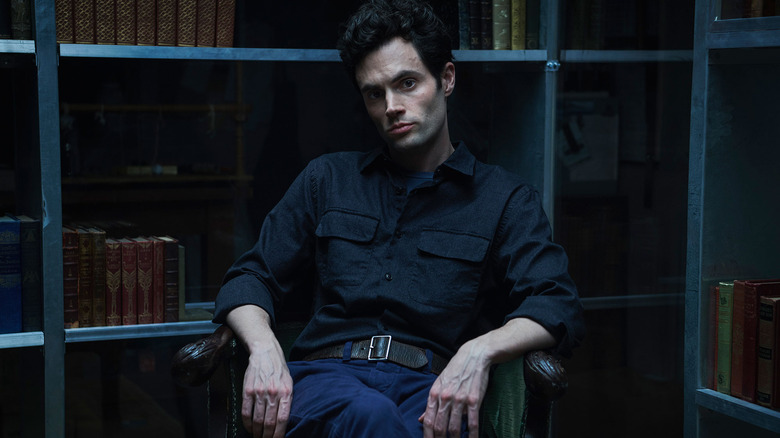
After three years starring in the Netflix "romantic" thriller "You," Penn Badgley has become very comfortable with his character. Or at the very least, comfortable with his crazy.
When we first met series lead Joe Goldberg (Badgley), he was a bookish nice guy, a hopeless romantic ... and a budding psychopath. Three seasons later, he is no stranger to the detailed process of murdering those who get in his way, disposing of their bodies, and skirting past lawful repercussions. Everything Joe does is, apparently, in the name of love; an insane plan always in pursuit of the latest woman he's latched onto. And sadly, it never ends well for her. So it's getting harder not to wonder... How will it end for him?
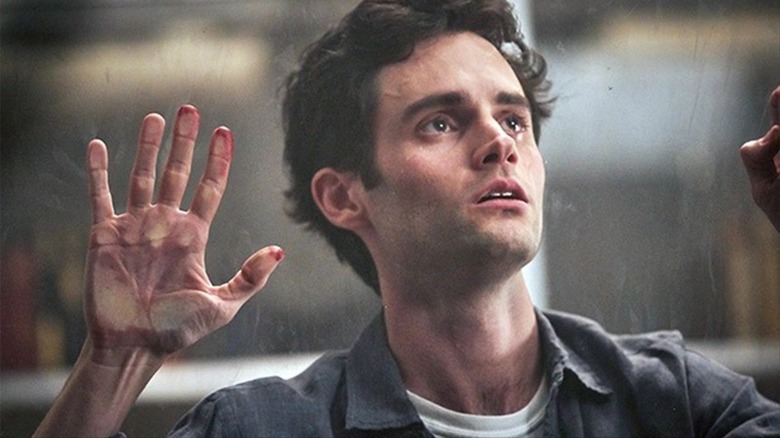
Fans of the series are very familiar with Joe's cycle by now — getting obsessed, stalking the woman of the season, somehow starting a relationship with her and eventually, burning her life to the ground. So as "You" goes into its fourth season, will the cycle continue? Or might there be something new in the cards for the serial killing lunatic? For Badgley, this has been the source of much consideration. In an interview with Collider, he gave voice to the big question — what comes next? Badgley said:
"In the real world — so that we're in a real emotional universe and can relate to this happening — where does a person like Joe go? Where is justice for him and for us? Does that mean happiness? I mean, it's like, does a person like Joe deserve to die? Yes. But does anyone deserve to kill him? I really think this is [the] question."
Surely fans can agree on one thing: Joe is well beyond redemption. His lack of self awareness means that though he may regret his actions on occasion, he often dismisses them as necessary — or worse, justified. As for the matter of happiness, the man never manages to stay pleased for very long. The latest season of the series sees Joe finally getting what he always wanted: a wife and child. His new wife by his side, Joe heads to the suburbs to raise his newborn son, Henry and get his much-anticipated happily ever after. But ... let's just say things don't go as expected.
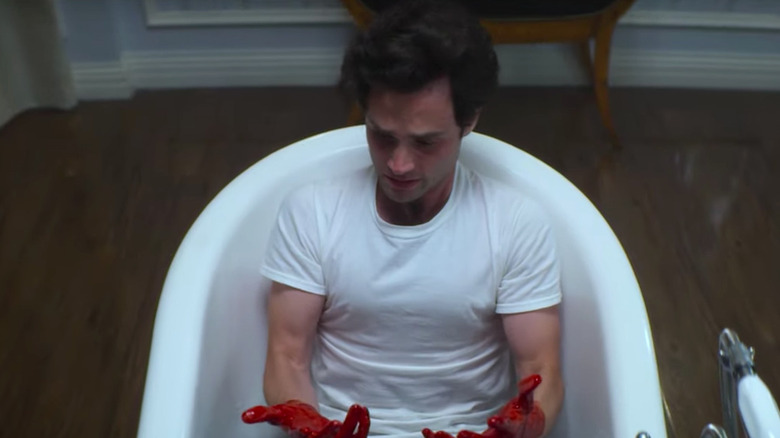
You'll have to experience the third season of "You" to understand how impossible Joe's happiness truly is. His relationship with his wife, Love Quinn (Victoria Pedretti) has the potential to last forever. Do they both have a bad habit of committing murder? Yes. But were they both initially enamored by the other? Yes! Who else could love a serial killer but another serial killer? If Joe can't make a psychotic relationship work, then what chance does he have with a normal, sane woman?! This is where the fourth season has the potential to be much more interesting. Badgley added:
"The next season could be quite different. It really could be quite different... I think it might be more about Joe's relationship with himself. Because this isn't really a show about a murderer, this is a show about ... I think it's taking the mistakes that we make in relationships to the extreme for the sake of a good story. Like, we really need to lay down our swords and stop being competitive in relationships, but that's very hard to do."
Death would be an easy way out for Joe. Though it would be poetic to see him killed by his latest beloved, would it be the proper punishment? As Badgley alluded, would it be fair to her? In which case, where else could Joe's story lead? Badgley hints that understanding the character will be a key part of finding this ending but for viewers, how much more is there to unpack? Prior season of "You" have brought us closer to understanding Joe's childhood and upbringing. Flashbacks have given us a peek at the serial killer's first murder and insight into the abandonment issues that continue to plague him through adulthood. And thanks to his inner monologue, Joe's thoughts has been laid bare each episode. We've known Joe's problem for years (i.e. he's crazy), but maybe season 4 is where he finally comes to the same conclusion.
Read this next: 20 Movies About Serial Killers That Will Absolutely Creep You Out
The post You Season 4 Will Be 'Quite Different,' According to Star Penn Badgley appeared first on /Film.

Denis Villeneuve's reimagining of Frank Herbert's beloved sci-fi novel "Dune" is already cementing itself as a future classic within the genre. Villeneuve had already shown that he could take beloved sci-fi properties and reinvent them for a new generation with his masterful work on "Blade Runner 2049," and "Dune" boasts a similarly epic scale and intricate world building.
"Dune" takes place in a distant future where warring clans vie for precious resources. The young Paul (Timothee Chalamet) is poised to become the leader of House Atreides. His father Duke Leto Atreides (Oscar Isaac) leads the noble house in a conflict on the desert planet Arrakis, which has been torn apart by the warring Fremen and House Harkonnen clans. Paul possesses mystical powers inherited from his mother Lady Jessica (Rebecca Ferguson).
"Dune" combines the political intrigue of "Game of Thrones," the mix of sci-fi and fantasy of "Star Wars," and the unparalleled scale of "Lord of the Rings." If you loved "Dune," these films are worth watching.
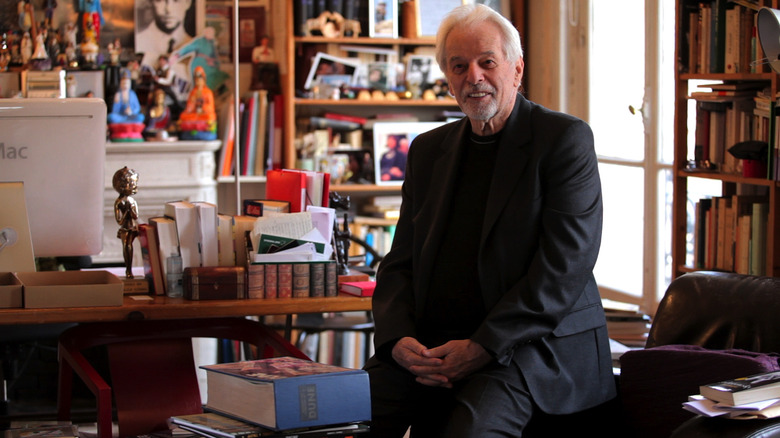
Fans interested in learning about the history of the "Dune" franchise will certainly want to check out this insightful 2014 documentary. "Jodorowsky's Dune" explores Alejandro Jodorowsky's failed attempt to bring Herbert's book to life. The documentary, directed by Frank Pavich, details the meticulous craft and planning that went into a film that unfortunately never saw the light of day. Jodorowsky himself is an engaging presence, and it's interesting to ponder what sci-fi history would have looked like if his version was released. Jodorowsky's remark that if Lynch failed to make a good "Dune" movie then no one could is particularly humorous.
Jodorowsky is notorious for his eccentric films, which took familiar genres and transformed them into wild surrealist adventures. His early films "El Topo" and "The Holy Mountain" had gained popularity on the midnight screening circuit throughout the 1970s, gaining him high profile fans like John Lennon. In 1974, Jodorowsky grew interested in developing a sci-fi epic and optioned the rights to "Dune" from the production company Apjac International.
"Jodorowsky's Dune" features insights from those involved in the planned production. Jodorowsky's son Brontis would have starred as Paul Atreides, and future John Carpenter collaborator Dan O'Bannon had begun designing the film's extensive visual effects. Among the eclectic cast members associated with the project were Orson Welles, Mick Jagger, and Gloria Swanson. However, the ambition for what Jodorowsky saw as a 14 hour unprecedented experience only ballooned, and after nearly three years of development it was shelved.
In addition to being an expansive sci-fi epic, "Dune" is a political thriller set in space. Paul is forced to contend with the warring bureaucrats that vie for the interests of House Atreides. Although Leto promises that he will love his son regardless of the decisions he makes during his eventual political rule, Paul is burdened with responsibilities of representing an entire society at a young age.
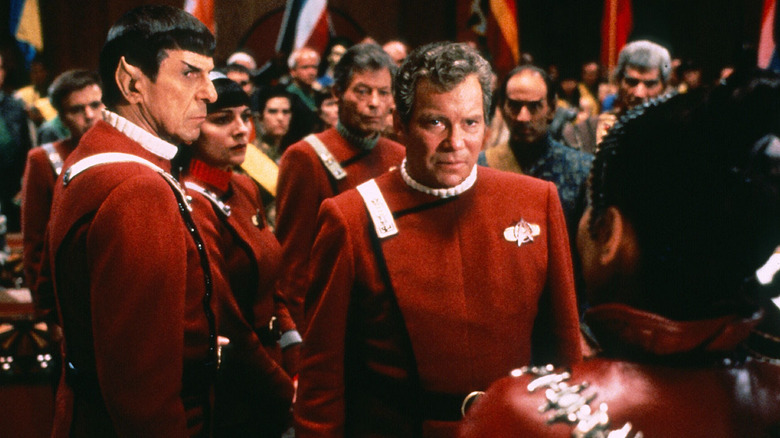
"Star Trek" has always been a very political franchise, as the original series reflected a vision of the future that was forward thinking in the 1960s. Gene Rodenberry envisioned a society where all races, cultures, and religions could co-exist peacefully, but balancing all of these distinct political systems is undoubtedly a challenging task. The "Star Trek" shows frequently depict similar burdens and conflicts to the ones Paul is forced to deal with, and the 1991 film "Star Trek VI: The Undiscovered Country" is the most explicitly political cinematic entry within the series.
In a parallel to peace discussions between the United States and the Soviet Union that were ongoing when the film was released, the Federation negotiates a truce with the Klingon Empire that ends generations of conflict. Tensions escalate when the Klingon military leader Chang (Christopher Plummer) assassinates the Klingon Chancellor and frames Kirk (William Shatner) for the crime.
One of Paul's recurring inner conflicts in "Dune" is the haunting series of visions he receives of his own future. Paul inherits mind enhancing abilities from his mother's bloodline, but there are points in which he's unable to trust his own reality. He doesn't know how to interpret these visions, or what ramifications they will have.
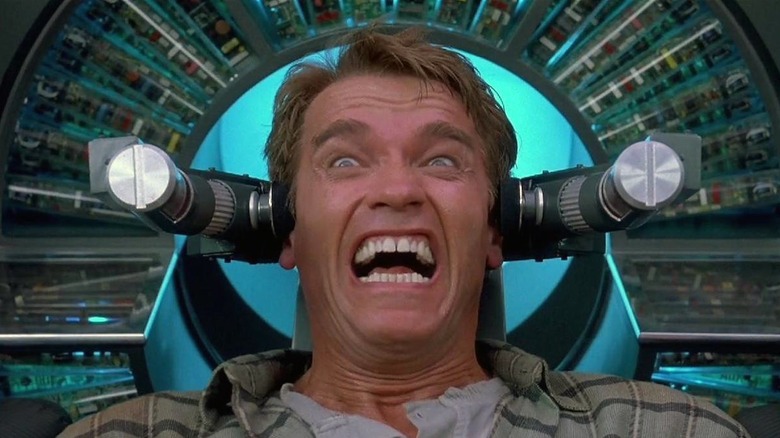
Paul Verhoeven's 1990 sci-fi masterpiece "Total Recall" explores a similar concept of contorted reality. Douglas Quaid (Arnold Schwarzeneneggar) is a simple working class construction worker in a futuristic Earth society, and the prospects of living on Mars are only a pipe dream. However, Douglas receives visions of a mysterious woman who lures him to the Red Planet; in the dreams he is Carl Hauser, a secret agent who is caught within a conspiracy involving the immersive reality company Rekall and their control of participants.
Quaid is forced to question which version of events are true and, like "Dune," the intergalactic adventure boasts many great action sequences. Schwarzenenggar delivers one of his best performances, successfully playing both the mild-mannered Quaid and supremely confident Hauser.
The oppressive nature of the desert is a recurring theme within "Dune." The Fremen representatives warn Leto and the Atreides leaders that while they may have experience with intergalactic conflict, nothing can prepare them for the desolate nature of the natural environment. The second half of the film primarily focuses on the dangers Paul experiences within the hostile Arrakis desert; not only is he contending with a complex political strife, but he's fighting for the basic resources necessary for survival.
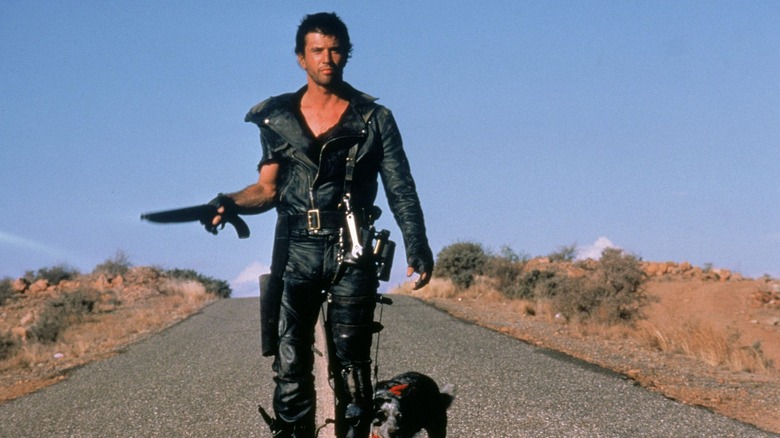
Nothing epitomizes desert-bound science fiction better than George Miller's "Mad Max" franchise. Miller's original 1979 "Mad Max" explored humanity's disintegration into chaos, but the 1981 sequel "Mad Max 2: The Road Warrior" is entirely contained to the post-apocalyptic Australian wasteland. Mel Gibson's titular character, a former cop who is haunted by his tragic past, is nearly wordless for the film's entire runtime. Like "Dune," resources are scarce, and Max contends with villains like Toecutter for water and supplies. Max is a more hardened character, but the young Feral Child he mentors possesses the same youthful innocence that makes Paul compelling, and is forced to adopt adult responsibilities quickly once he's thrust into violent circumstances.
"Dune" explores the reality of war in more intricate detail than most science fiction films. It's not as simple as just heroes and villains duking it out, and the efforts needed to mobilize an entire civilization into conflict are complex. Paul and the Atreides clan are also forced to deal with the moral questions that war entails. They must consider the ramifications of aligning with the Freman, and what the casualties to their military would look like in the wake of a large-scale assault.
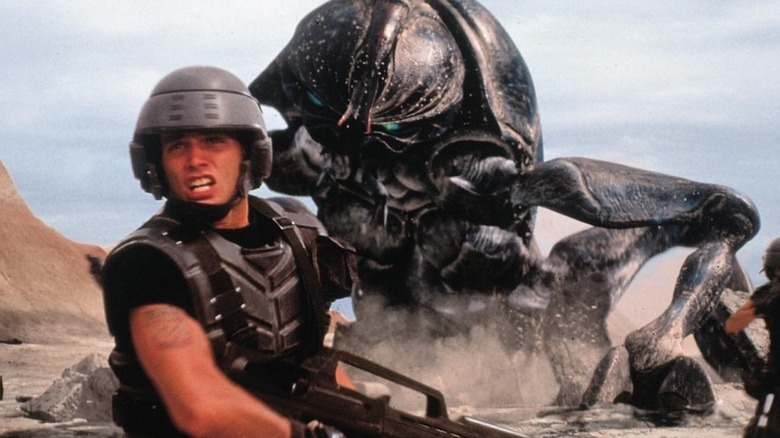
Paul Verhoeven's 1997 film "Starship Troopers" is in no way a traditional futuristic military action thriller. Verhoeven took the more straightforward premise of Robert A. Heinlein's 1959 novel and used it to satirize militarization, and how "war makes fascists of us all." It's set within a future where the United Citizen Federation, the intergalactic government system, guarantees citizenship to all military veterans. The story follows earnest high school graduate Johnny Rico (Casper Van Dien) as he signs up for service and ascends to a leadership role. When the Federation declares war on the bug-like invaders that devastate Earth's surface, Johnny begins to shed his humanity as he becomes entrenched within the conflict.
"Starship Troopers" is a grim warning about the loss of idealism that paralleled the Vietnam era, but surprisingly the film's satirical intent was lost on some audience members during its initial release.

One of the most engaging elements of "Dune" is the intricacy of its world-building. He develops specific details of what space travel looks like, and spends time exploring the interior of the different vessels. Villeneuve captures these designs beautifully, and Paul pilots multiple spacecrafts and must quickly learn of their different abilities throughout his adventure.
Claire Denis's 2019 arthouse film "High Life" shows what daily life in space looks like, and meticulously details how the technology works. The film follows a group of criminals who are dispatched to deep space in an isolated vessel, bound for a mysterious destination at the center of a black hole. The crew of untrustworthy characters may question each other's motivations and break into brawls, but they're required to form some semblance of peace in order to not run out of air.
The story is told in a nonlinear fashion with surrealist flourishes characteristic of Denis's filmmaking, but focuses on Monte (Robert Pattinson) and his efforts to raise a young daughter Willow (Jessie Ross). Monte's anxieties about preserving his child's youthful experience amidst a hostile environment are shared by Leto and Jessica in "Dune."
The shaky notion of peace is present throughout "Dune." House Atreides is aware that the Emperor's invitation to replace House Harkonnen is a trap, and that conflict is likely if they choose to align themselves with the Fremen. The Fremen themselves are far from trustworthy, and during an initial meeting the tribal leader Stilgar (Javier Bardem) is standoffish. Paul grows concerned about negotiating a deal with a culture that is inherently combative.
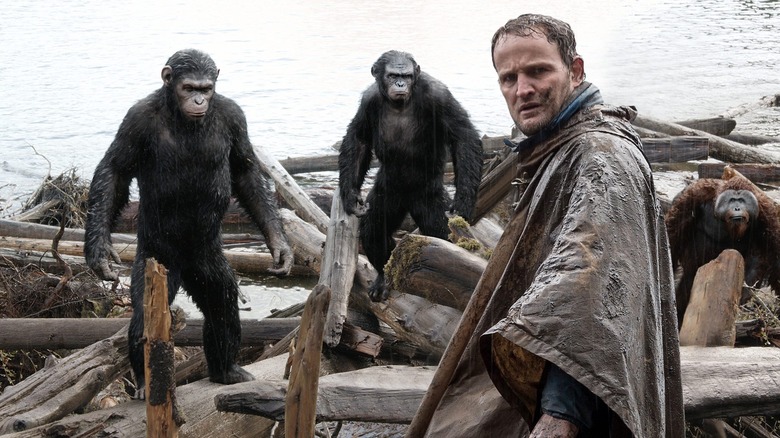
The "Planet of the Apes" franchise has frequently shown how intense these negotiations can be, and isolated societies of humans and apes are drawn into war throughout the course of the series. 2014's "Dawn of the Planet of the Apes" is set several years after humanity has been overrun by a virus, and a colony of humans makes contact with the tribe of apes led by Caesar (Andy Serkis). Caesar aims to resolve the situation peacefully, but the influential ape warrior Koba (Toby Kebbell) threatens to disrupt the talks with his plot of vengeance. Koba was tortured and enslaved during his captivity, and sees all of humanity as his enemy.
"Dawn of the Planet of the Apes" shows extremism on both sides. Malcolm (Jason Clarke) sees Caesar as a potential ally, and suggests that the two could work together to build a dam that would provide resources for both colonies. However, his rival Dreyfus (Gary Oldman) has been stung by his military experience, and like Koba threatens to initiate conflict.
Loyal "Dune" fans will want to honor Villeneuve's wishes and seek out the film theatrically, as it boasts a stunning visual spectacle that merits the immersive nature of the big screen. Even for those who find the mythology to be overwhelming and the characters to be unengaging, it's hard to discount the breathtaking visuals from cinematographer Greig Fraser. "Dune" isn't only a thrilling action-adventure, but an artistic achievement.
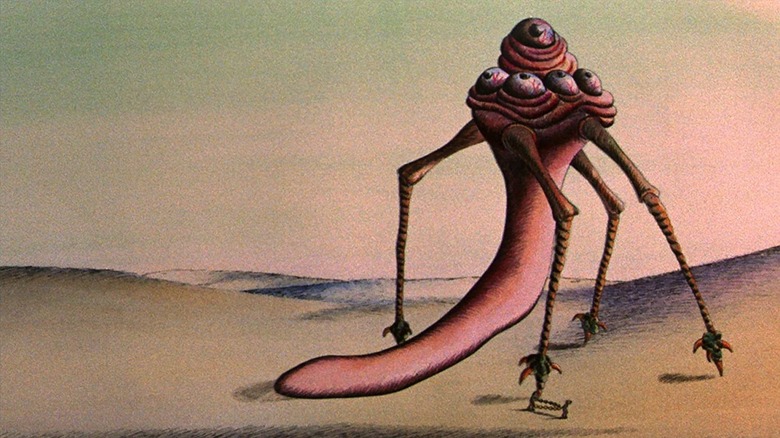
The 1973 surrealist animated film "Fantastic Planet" is one of the most signature works of science fiction artistry ever created. Based on the 1957 novel "Oms en série" from Stefan Wul, it's dramatically different from "Dune." The dialogue is sparse, the tone is experimental, and the runtime is capped at a brief 71 minutes. However, sci-fi fans that love the genre for its unique aesthetics may find that both films offer compelling visualizations of intergalactic locals. "Fantastic Planet" tackles the same mature themes of intolerance, communication, and coexistence that "Dune" deals with.
In addition to the meticulous world building, "Dune" has a compelling mystery at its center. House Atreides must investigate what the Emperor's schemes are, and Paul is caught between the warring influences of his parents. He knows the expectations that he will inherit from his father, but his mother's heritage as an acolyte of the Bene Gesserit mystical group gives him reason to question her allegiance. There is a constant aura of suspense, and Paul is haunted by mysterious dreams of the Fremen girl Chani (Zendaya).
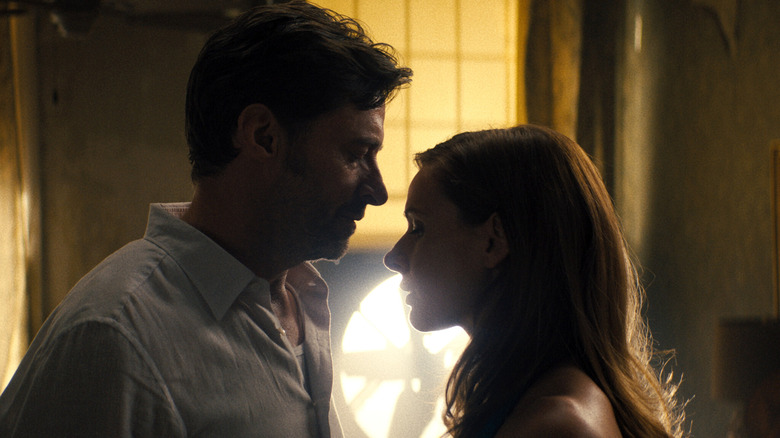
2021's underrated original sci-fi thriller "Reminiscence" has a similar blend of sci-fi and mystery. It's a clear homage to sci-fi neo-noir classics like the "Blade Runner" universe to hich Villeneuve contributed. The film is set within the near future in Miami, where dramatic climate change has forced humans to live in perpetual darkness, and the government's strict police state is just as grim. Nick Bannister (Hugh Jackman) and his co-developer Watts Sanders (Thandie Newton) create innovative technology that allows participants to relive memories, and their clients have become hooked on nostalgia.
The lonely Nick sees a rare bright moment in his life when he falls for the nightclub performer Mae (Lady Jessica herself, Rebecca Ferguson), who is embroiled within a conspiracy involving a mysterious fortune. "Dune" has many romantic themes through Paul and Chani's relationship, and "Reminiscence" features terrific chemistry between Jackman and Ferguson. Even though they share only a few moments together in the beginning, Bannister's obsession is warranted.
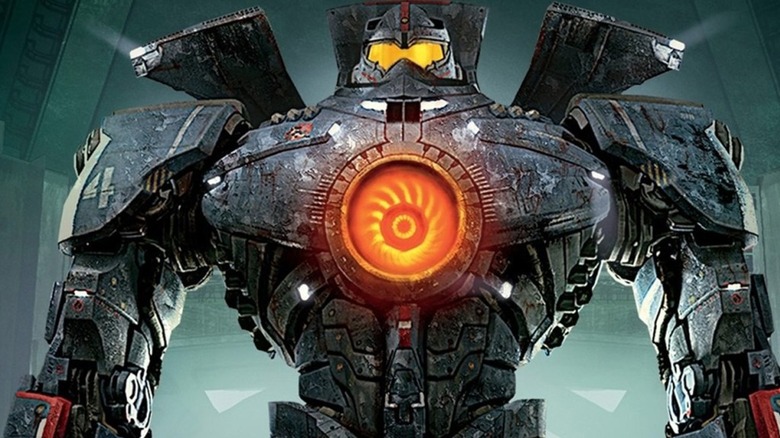
Few filmmakers working today can effectively incorporate CGI without sacrificing the heart of their stories and characters, but Denis Villeneuve is one of them. Although renowned for his innovative narrative structures and frequent plot twists, Villeneuve is a visual genius who can create immersive spectacles. "Blade Runner 2049" and "Arrival" were both visually stunning, but "Dune" boasts his grandest scale yet. It showed Villeneuve's ability to craft epic action sequences, and the Attredies' escape from the sandworm and battle with the Emperor's disguised Sardaukar forces are massive.
Villeneuve's visual mastery is shared by the auteur Guillermo del Toro. Like Villeneuve, del Toro spent years perfecting his craft with smaller-scale projects before he helmed massive blockbusters. Although his action filmmaking skills were evident through his work on the superhero films "Blade II" and the "Hellboy" franchise, del Toro didn't create battle sequences on the level of "Dune" until his Kaiju monster film "Pacific Rim" in 2013.
In the near future, Kaiju creatures lying beneath Earth's surface are awoken and wreak havoc on civilization, forcing mankind to create superweapons to combat the unprecedented threat. They develop massive robotic Yaegars as large as the Kaijus, and the resulting duels are just as thrilling as the sandstorm battle of "Dune."
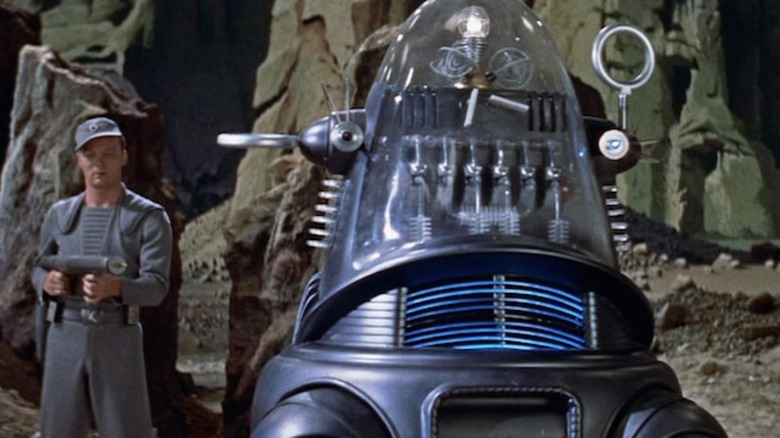
Herbert's vision of outer space exploration within "Dune" is seen as one of the definitive science fiction texts, and explores what intergalactic travel could look like centuries into the future. Sci-fi is often prophetic. The notion of space travel has been present since the genre's earliest stages, and long before the Apollo 11 mission lunar visits could only be found in sci-fi stories. It's fascinating to look at early science fiction films to see what actual scientific advancements they foreshadowed, and the 1950s saw the debut of many classics within the genre.
While some of these films seem silly now, the classics that have stood the test of time introduced philosophical concepts that are still relevant. The 1956 film "Forbidden Planet" is an essential watch for any sci-fi fan. Inspired by William Shakespeare's play "The Tempest," the film follows the explorer Dr. Edward Morbius (Walter Pidgeon) as he leads a rescue mission to uncover a missing spaceship in the 23rd Century. "Forbidden Planet" was a landmark in many ways, as it was (according to the National Air and Space Museum) among the first films to depict lightspeed space travel. Robby the Robot was one of the first distinguishable robot characters in film, long before the Thinking Machines featured in "Dune."
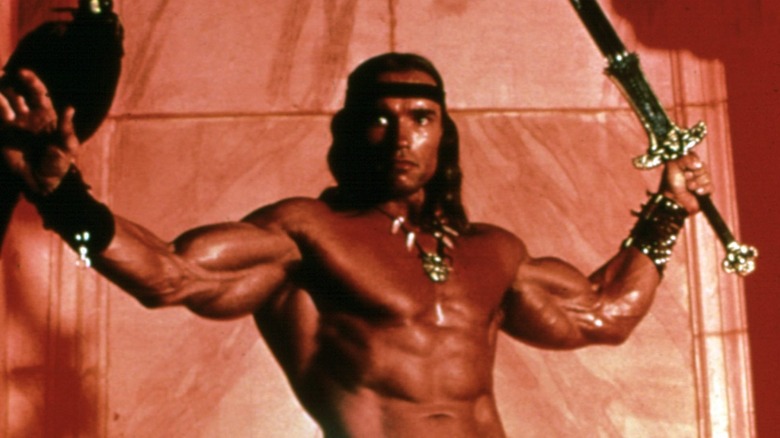
Family drama amidst a state of war is one of the key themes of "Dune." Paul fears inheriting his destiny and failing to meet expectations, but knows he must do so in order to honor the legacy of his parents. As the story develops, Paul realizes he must seek vengeance for the crimes committed against his family. Although distinctly sci-fi, the imagining of political systems is reminiscent the medieval era.
Sword and sorcery films deal with similar concepts of destiny and family honor, and 1982's "Conan the Barbarian" is one of the definitive fantasy epics. Arnold Schwarzenegger delivered one of his breakout roles as the titular hero, an animalistic warrior who takes a leadership role in order to get revenge for his parents' death. The quest leads him to the fearsome snake warrior Thulsa Doom (James Earl Jones), a terrifying antagonist worthy of Baron Vladimir Harkonnen (Stellan Skargard).
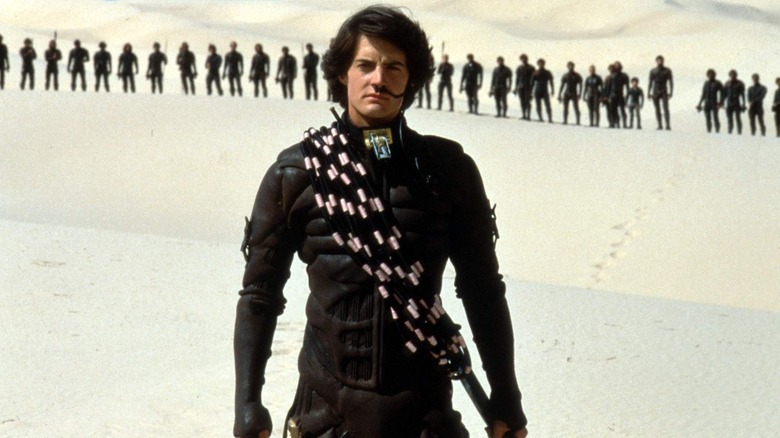
Fans' skepticism about the new version of "Dune" largely stems from the tumultuous process behind the first attempt at adapting Herbert's novel. Many filmmakers attempted to gain the rights to the source material, but eventually David Lynch earned the job as writer and director. Lynch was an unusual choice to helm a massive sci-fi epic, as he was primarily known as the experimental genius behind "Eraserhead."
He was coming off of a successful awards season run for his emotional biopic "The Elephant Man," and was being courted by major studios to helm a blockbuster. Lynch even passed on the opportunity to direct "Return of the Jedi" before he signed on for "Dune." Unfortunately, Lynch was given little control over the film's creative direction, and was forced to significantly cut down his original vision. Lynch is known for his unique filmmaking style, which frequently features disorienting imagery and dreamlike sequences, but he was denied final cut privilege on "Dune."
The film was marketed as the next "Star Wars," but it was met with scathing reviews and bombed financially, crushing all prospects for a sequel. 1984's "Dune" is not perfect by any means, but it's still fascinating. Lynch got a fantastic performance out of breakthrough star Kyle Machlachlan in the role of Paul Atreides, and the two would go on to become frequent collaborators. The grimy visuals and terrific score by Toto make "Dune" enjoyable on a visceral level.
Read this next: 13 Box Office Bombs That Are Truly Worth A Watch
The post Movies to Watch If You Loved Dune appeared first on /Film.
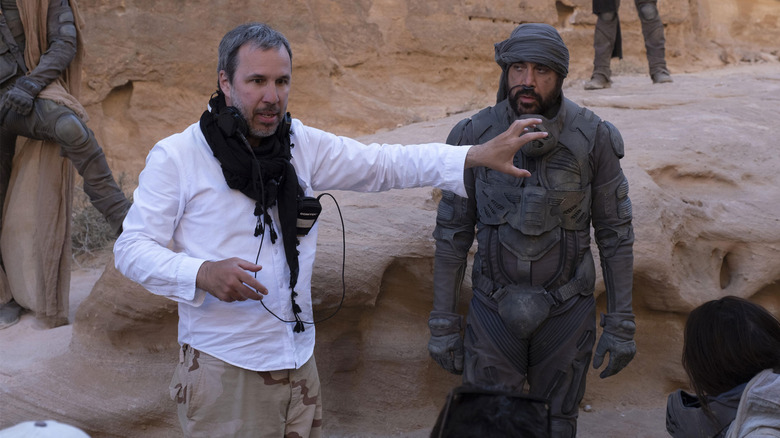
If there's one indisputably positive result that the Marvel Cinematic Universe can be held responsible for, it's the fact that these superhero movies have successfully trained audiences to sit through several minutes of lengthy credits after the final cut to black. Not everyone actually pays attention to the names of the invaluable crew members who poured blood, sweat, and tears into the entertainment we all take for granted, sure, but it's something at least! Clearly, the allure of post-credit scenes that may or may not contain ramifications on the future of the franchise is simply too much for viewers to resist.
One person who is decidedly not a fan of those extra little teasers, however, is "Dune" director Denis Villeneuve. Although fans are eager for any hint about a sequel coming to pass, maybe don't get your hopes up about seeing Samuel L. Jackson arrive out of nowhere to talk to Paul Atreides about putting together the Fremen Initiative at the end of "Dune." I, uh, have not seen the movie yet and have no idea how it actually ends, in case that needs to be said.

As fun as it is to oftentimes have multiple mid- or post-credit scenes to analyze and obsess about, I have to admit that I kind of miss when these tags were much more of a fun novelty than a franchise-altering expectation. I can vividly remember when I happened to leave the TV on once after watching "Ferris Bueller's Day Off" and, whoa, suddenly here was Matthew Broderick again, breaking the fourth wall and telling me to leave already because the movie was over. Reader, I was shook.
In any case, Denis Villeneuve is making it absolutely clear not to expect any extra footage once the credits start rolling upon the conclusion of "Dune." During a sit-down with NME, the "Enemy," "Sicario," and "Arrival" director explained why he has consciously opted to avoid post-credit scenes throughout his filmography -- and especially when it comes to "Dune."
"I don't like post-credits scenes. There is a very specific final emotion that I was looking for with the final frame [of Dune] and I don't want to mess with that.
So no, I don't use post-credits scenes. I've never done that and I would never."
That's as final as it gets! Even without seeing the movie just yet, he certainly has a point when it comes to preserving whatever ultimate emotional response he has in mind for "Dune." As cool as it might be to receive some sort of sequel-bait clue about where the adventures on Arrakis will go next, my recent experience reading the Frank Herbert novel makes one aspect abundantly clear. This very modern approach to franchising would feel completely out of place in any adaptation of the story, so I fully trust Villeneuve's instincts on this one.
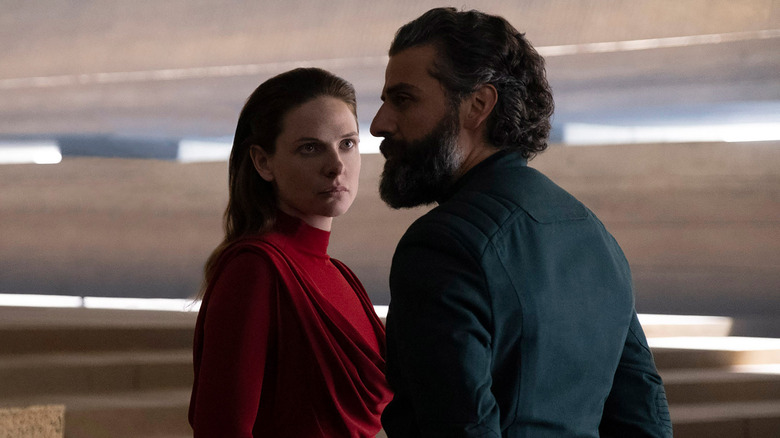
While on the subject of extremely modern approaches to franchise filmmaking, elsewhere in the same interview Villeneuve also addresses certain calls for an extended cut of "Dune." Star Jason Momoa has previously championed this idea, obviously influenced by his front row seat to seeing "Zack Snyder's Justice League" go from a rumor to a relentless internet campaign to a fully-fledged HBO Max release in its own right. But that, according to Villeneuve, is just another pipe dream.
"I love Jason but such a thing doesn't exist! The Director's Cut is what people are watching in theatres right now. There will be no other cut.
Yes I could have made a much longer, more contemplative movie, but that was not the plan."
If you ask me, good on Denis Villeneuve for immediately shutting this train of thought down. As a big fan of "The Lord of the Rings" extended editions, I can't exactly claim to be 100% anti-director's cuts or anything like that. However, there's something deeply weird about the idea that certain fans can't accept the realities and constrictions of blockbuster filmmaking. It'd be neat if every filmmaker was afforded the ability to release their own 3-plus hour cut of a movie, but that would rob us of appreciating the talent and skills of those who are able to say everything they need to say within the confines of a traditional theatrical cut. Call me old-fashioned!
"Dune" is currently in theaters and available to stream on HBO Max.
Read this next: 12 Awesome Sci-Fi Movies That Never Got Sequels
The post Dune Director Denis Villeneuve is Not a Fan of Post-Credit Scenes, Says Theatrical Release is His Cut appeared first on /Film.

Once upon a time, it seemed as if "Cloverfield" movies were about to become all the rage. Think about it: How great is the idea of a loose anthology of horror/thrillers that, yes, share tons of tiny blink-and-miss-it Easter eggs connecting one film to the previous one, but mostly only maintain a sense of "continuity" through their shared tone and intention? Yeah, that's the good stuff. The original Matt Reeves-directed monster movie "Cloverfield" felt like a solid enough proof-of-concept display of this ambition, though Dan Trachtenberg's "10 Cloverfield Lane" took that general template and dramatically raised the bar with its story of three individuals trapped together in a post-apocalyptic bunker as the world may or may not have ended outside. Only the exceedingly poor reception to "The Cloverfield Paradox" seemed to put a stop to this budding series of low-budget (yet high-reward) movies, but "10 Cloverfield Lane" still stands tall as the franchise highlight five years later.
We're not done singing the praises of that movie, and thankfully star Mary Elizabeth Winstead isn't done talking about it either. The process of taking an original script (in this case, the project was initially titled "The Cellar" and then "Valencia") and retrofitting it into the "Cloverfield" brand name was always a secretive one, which apparently applies to the cast every bit as much as it does to us viewers. Winstead is now looking back and reminiscing about her perspective of just how late in the game it was when she finally grasped the full intentions for "10 Cloverfield Lane."
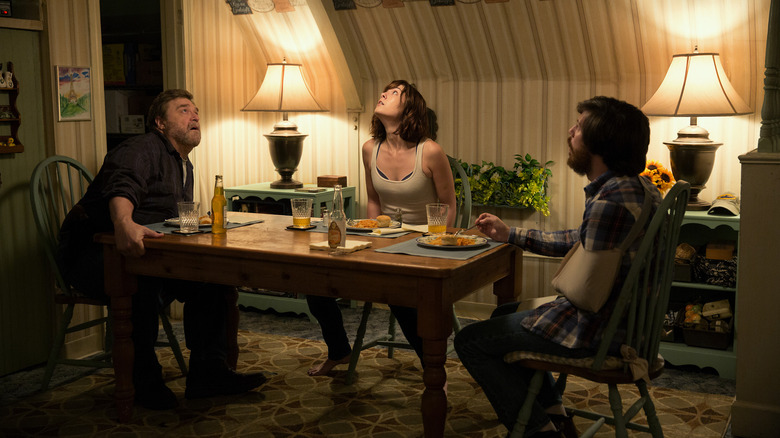
For the vast majority of "10 Cloverfield Lane," the story functions as a highly effective claustrophobic thriller, with Trachtenberg's creative use of space, the tightly-wound script, and the strength of the very small cast doing much of the heavy lifting. It isn't until the final act when (spoiler alert!) we finally get a glimpse of the outside world and realize that John Goodman's conspiracy theorist antagonist was actually right to be paranoid about whatever apocalyptic event had apparently took place. The last-minute plot twist inspired some fierce debate at the time (it's Good, Actually!), but it's also precisely what helped bring the film closer in spirit to the original "Cloverfield."
In a conversation with the Collider Ladies Night podcast, Winstead revealed that she was mostly unaware of the "Cloverfield" connections until the film was about to release.
"It was all definitely after the fact because I didn't know it was a Cloverfield movie until just before it came out. I had no idea it was a Cloverfield movie! [Laughs] It was an idea that was floated around but wasn't something that was really, officially like, 'This is part of that universe.' It was its own standalone film and then, just before the movie came out, spoke with JJ and it was like, 'Oh no, this is gonna be part of the Cloverfield franchise.' And I really didn't know what to think of it at first because I hadn't really wrapped my brain around it and then, once everything got laid out and it made sense and the marketing for it came out, I was like, 'Oh, I see how this fits together, this kind of puzzle,' and it's actually really smart."
Personally, I think all the debate over the ending would've been justified if the final threat had been clumsily revealed to be the literal monster from the original (adorably referred to as Clover!), as many suspected might be the case at the time. Thankfully, "10 Cloverfield Lane" steered well clear of that and instead gave audiences a surprising, out-of-nowhere, spiritual sequel to the original hit movie ... even if that meant keeping the actors themselves in the dark for almost as long as us.
Mary Elizabeth Winstead most recently appeared in the action movie "Kate," which is currently streaming on Netflix.
Read this next: The 10 Best Sci-Fi Movie Villains
The post 10 Cloverfield Lane Star Mary Elizabeth Winstead Did Not Know She Was Making a Cloverfield Movie appeared first on /Film.
Read more of this story at Slashdot.
Read more of this story at Slashdot.
Read more of this story at Slashdot.
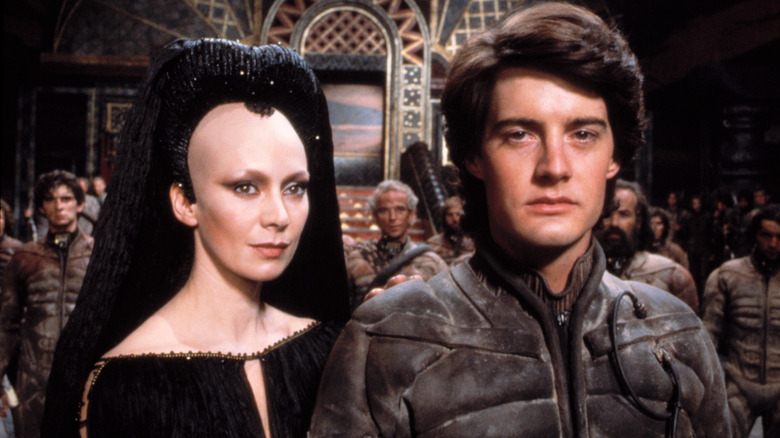
Denis Villeneuve's "Dune" exists in the shadow of not just Frank Herbert's massive sci-fi tome, but also David Lynch's infamous adaptation that arrived in 1984. Universal Pictures, executive producer Dino De Laurentiis and his production company Dino De Laurentiis Corporation were all hoping that Lynch's take on Herbert's epic would be the next "Star Wars." It wasn't. The adaptation bombed at the box office, and in the years since its release, Lynch has all but disowned it. When extended cuts with extra scenes started making the rounds, Lynch went so far as to take his name of the movie entirely, his credit replaced by that famous Hollywood pseudonym Alan Smithee.
Lynch came to the project after cult director Alejandro Jodorowsky spent years trying to adapt the book into what would've been a strange, massive movie clocking in at 10 hours. Other filmmakers floated for "Dune" before Lynch included Ridley Scott, who would go on to make "Alien" instead, with many of the people who were working on Jodorowsky's failed film, and David Lean, someone who knew a thing or two about shooting in deserts, having helmed "Lawrence of Arabia." But it was ultimately Lynch who won the gig – an unconventional choice since the filmmaker hadn't even read the book when he was first offered the job.
Producer Raffaella De Laurentiis decided on Lynch after seeing the filmmaker's "The Elephant Man." There seems to be no real correlation between "Dune" and "The Elephant Man" other than they can both be considered "weird," and that was apparently enough to make Lynch an offer. As it turned out, the offer arrived at a time when Lynch was juggling several different things. "I was working on 'Blue Velvet' at the time, which kind of got derailed," Lynch told interviewer Chris Rodley. "I was in this space where I was trying to catch ideas to make it work. And then a weird thing started happening. I went to meet George Lucas who had offered me the third 'Star Wars' to direct, but I've never even really liked science fiction. I like elements of it, but it needs to be combined with other genres. And, obviously, 'Star Wars' was totally George's thing."
The idea of Lynch directing "Return of the Jedi" will always be one of those fascinating "what ifs?" in cinema. But it was not to be. Here's how the rest of the story goes, according to Lynch (and it's impossible to read what follows without hearing Lynch's distinct voice in your head):
"I got onto Thomas Harris' 'Red Dragon' with Richard Roth, who was gonna be the producer of 'Blue Velvet.' And then I kinda got turned off that. And about that time Dino De Laurentiis called the house. And Dino says, 'I want you to read this book, "Dune."' I thought he said 'June,' you know, and I said, '"June"?' He said, 'No, "Dune."' And so then a friend of mine said, 'Man! That's a great science fiction book,' and I said, 'I know, that's what I heard.' So I started reading it."
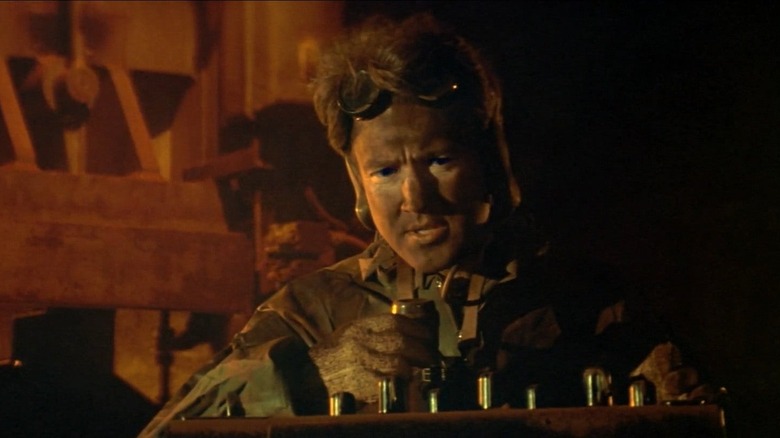
Lynch worked for sixth months with Eric Bergren and Christopher De Vore on a "Dune" script. The team delivered two drafts and then disbanded over creative differences. From there, Lynch took over, writing five more drafts. The final draft Lynch ended up with reduced Herbert's 400+ page book to 135 pages. Filming began in 1983, with the reported budget somewhere around $40 million. Over 80 sets were built on 16 different soundstages, and the crew consisted of at least 1,700 people. Lynch's film finally arrived in theaters in December of 1984 – and flopped. Taking in only $30.9 million from a $40 million budget, Lynch's film was also torn apart by critics. Roger Ebert gave it 1 star, writing:
"This movie is a real mess, an incomprehensible, ugly, unstructured, pointless excursion into the murkier realms of one of the most confusing screenplays of all time."
But is Lynch's "Dune" really all that bad? I'd seen bits and pieces of Lynch's film over the years but never sat down and watched the whole thing until recently, not long after I had seen Denis Villeneuve's big new take on the material. The first thing I was struck by was how similar Lynch's movie is to Villeneuve, at least in terms of how the story unfolds. Sure, both Lynch and Villeneuve were working from the same exact source material. But the first half of Villeneuve's movie is almost beat for beat the same as Lynch's. The two diverge at a point where Paul, the main character, heads off into the desert of Arrakis with the Fremen. Here, Villeneuve's movie ends – setting the stage for a sequel that has yet to be announced. Lynch's movie keeps going – but moves at an incredibly rushed pace, hurrying to wrap things up. One minute, Paul, as played by Lynch regular Kyle MacLachlan, is meeting Fremen member Chani (Sean Young). Nearly a minute later, the two are embracing and passionately smooching. Some time is meant to have passed, but it sure doesn't seem that way.
The second thing that struck me about Lynch's "Dune" is how much it feels like a David Lynch movie. After all the years spent hearing about how unhappy Lynch was with the film, and how angry he was at not being given final cut, I expected something lacking the filmmaker's distinct style and personality. But "Dune" very much feels in line with Lynch's other work, and I don't just mean it's "weird," which seems to be the go-to description for everything Lynch does. Lynch's "Dune" is overflowing with the filmmaker's esoteric charms, and the rumbling, grumbling, churning sounds of machinery – something I'm pretty sure Lynch has a fetish for – are always present. But most of all, Lynch's "Dune" is impenetrable, and I mean that as a compliment.
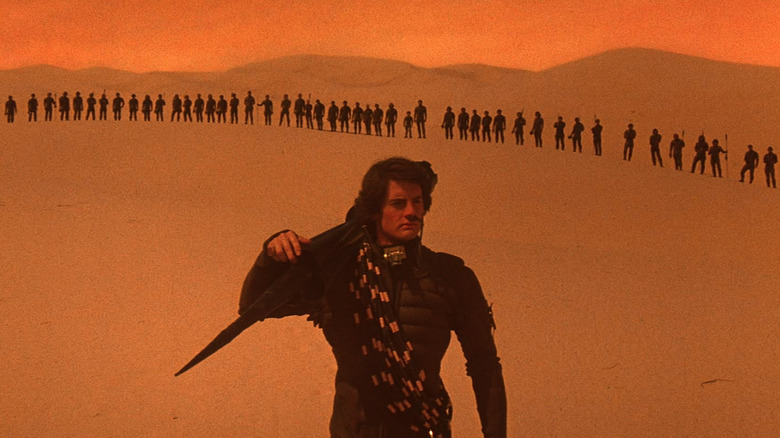
Denis Villeneuve's "Dune" is huge; every cent of the budget is up on the screen, and whatever you think of Villeneuve's film as a whole, it's safe to say he's succeeded in crafting a big, sweeping blockbuster. The worlds here feel genuine. But they also feel ... familiar. We're meant to be thousands and thousands of years into the future jumping from one alien world to another, and yet, everything on display feels perfectly natural. On one hand, that's a good thing – it lends a certain realism to the proceedings; as realistic as a movie with giant Sandworms can be, at least.
Lynch's film, in contrast, often looks strangely cheap, and claustrophobic. The sets, while delectably dressed, are also closed-off with low ceilings, littered with clutter. The visual effects are often laughably bad, even for 1984. And yet, all of this helps Lynch's film rather than hurt it. Because all of these details, combined with Lynch's puzzling screenplay choked with dialogue that Ebert described as having "little or no context," make the 1984 "Dune" feel truly alien. Nothing here is recognizable. It's as if we've stumbled into some parallel universe. Few sci-fi films capture the unearthly, indescribable vibe Lynch has created here; the closest example would be Stanley Kubrick's superior "2001: A Space Odyssey," at least in terms of the cold distance between us and what's happening on the screen.
This can be seen as a blessing or a curse. I can perfectly understand why some audiences didn't connect with the out-of-this-world tone Lynch conjured. There's nothing, and no one, for us to grab ahold of. Timothée Chalamet's slight, youthful Paul is someone we feel like we could meet in real life. MacLachlan's Paul, with his constant shouts to the heavens and repeated inner phrases ("Arrakis. Dune. Desert planet.") is a mystery.
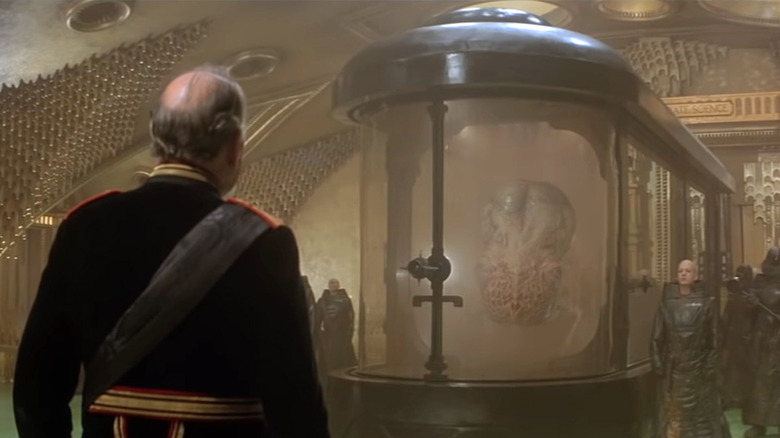
Lynch didn't create all this in a bubble, and producers were painfully aware that the filmmaker had helmed something so inexplicable. To make sense of it all, Lynch added inner monologues for nearly every character here – something I'm now almost positive inspired filmmaker Terrence Malick, who uses the same technique with much better results. "40 percent of [the voice-over] was added on to nail things that they thought people wouldn't understand," Lynch confessed. But while this isn't the worst idea, it doesn't do "Dune" any favors. As Lynch put it: "It can be a beautiful thing – to hear thinking. It's a nifty thing, but when it's just for information, you smell a rat."
Villeneuve's "Dune" is a film made for the widest possible audience. It is epic scope, pulse-pounding action, and massive special effects all congeal to result in a sci-fi epic that will appeal to folks from all walks of life. And that's fine. But while I think Villeneuve's "Dune" is more successful on this front, I find myself more enamored with Lynch's otherworldly take. The filmmaker, in his own words, was "actively involved in creating a certain look" for the film, and it shows in nearly every frame. When the Guild Navigator arrives and is presented as some sort of giant brain-bug-thing floating in a tank of gas, it's stunning in its unfamiliarity. There's nothing even close to that in Villeneuve's movie. Stellan Skarsgård's Baron Harkonnen is appropriately villainous and vile, but Kenneth McMillan's Harkonnen is repulsive in innumerable ways. Just being around him makes us ill.
None of this is to say Lynch's "Dune" is some unjustly maligned masterpiece. The film's flaws are sprawling – the voice-over really is quite clunky and often needless and the story is rushed. Yet, the rushing also allowed Lynch to tell a complete story – something that can't be said for Villeneuve's "Dune," which is very much the first part of a two-part tale. But when Lynch gives us images of practical effect Sandworms created with puppetry, and has Sting strut into scenes donning plastic bikini briefs, it's hard not to get swept up in it all. To feel as if we're witnessing something incredibly unique and strange. Villeneuve's "Dune" makes us think of "Star Wars" by way of "Game of Thrones." Lynch's "Dune" makes us think we've never seen anything like this before, and probably never will again.
Read this next: The 10 Best Sci-Fi Movie Villains
The post David Lynch's Dune Is Better Than Its Reputation Suggests appeared first on /Film.
Read more of this story at Slashdot.
![[GOG] (Game) Corridor 7: Alien Invasion](https://external-preview.redd.it/qHUJeA6IJAPeGiuc3VWlEzUlbJWC_cm-Ip3vEbljOGk.jpg?width=640&crop=smart&auto=webp&s=b416adf07f3e0f662b111797b0b5898662900839 "[GOG] (Game) Corridor 7: Alien Invasion") |
submitted by /u/Frankdrabin05 [link] [comments] |
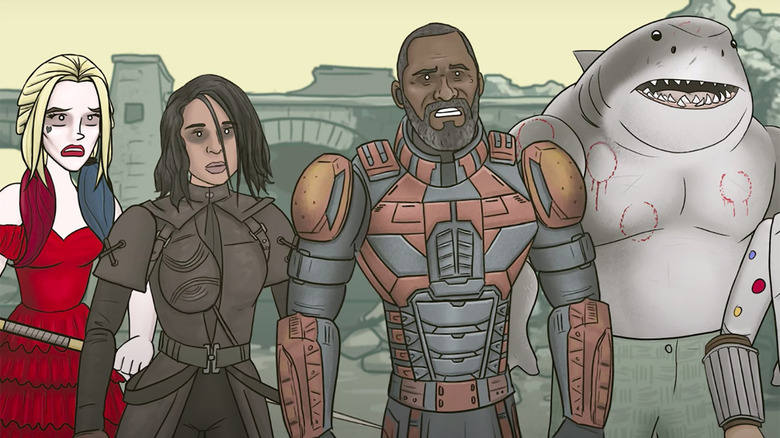
(The Morning Watch is a recurring feature that highlights a handful of noteworthy videos from around the web. They could be video essays, fan-made productions, featurettes, short films, hilarious sketches, or just anything that has to do with our favorite movies and TV shows.)
In this edition, find out how "The Suicide Squad" should have ended, with a special appearance by a familiar face from the DC Extended Universe. Plus, see "The Batman" trailer get a strange but satisfying remix with footage from "Ted Lasso." And finally, listen as Jeff Daniels breaks down some of the most memorable roles from his career, including "Arachnophobia," "Dumb & Dumber," "Speed," "The Newsroom," and more.
First up, How It Should Have Ended has chimed in with their take on "The Suicide Squad." Although they initially take aim at how Bloodsport left Peacemaker alive, by far the most sensible alternate ending should have had Superman coming in to throw Starro back into space. After all, there's no way Superman is still in the ICU from Bloodsport's kryptonite bullet, so why wouldn't be intervene in this disaster unfolding across the globe? Maybe James Gunn has an answer.
Next, YouTuber Jason Gallagher (via Nerdist) put together this trailer mash-up featuring footage from "Ted Lasso" cut to the recently released trailer for "The Batman." However, if you haven't seen "Ted Lasso" season 2, beware of some major spoilers. It's the second season footage that makes the trailer remix work so well. Something so upsetting happens that it's not hard to imagine Ted Lasso taking a turn for vengeance.
Finally, with Jeff Daniels starring in Showtime's new series "American Rust," GQ brought in the actor to take a look back at some of his most memorable roles throughout his career. Hear what he has to say about his work on "Arachnophobia," the beloved comedy "Dumb & Dumber," the indie darling "The Squid and the Whale," the action staple "Speed," and his time working with Aaron Sorkin on "The Newsroom" for HBO.
Read this next: 14 Remakes That Are Better Than The Original
The post The Morning Watch: How The Suicide Squad Should Have Ended, Ted Lasso is The Batman & More appeared first on /Film.
Like many other career paths in tech, becoming a network engineer means being a forever student. As technology evolves, you're going to need to keep up and prove that your expertise is up to date. The easiest way to do so is earning certification in supporting areas.


